EP4179967B1 - Kommunikationskopfhörer mit stressmanagementfunktion - Google Patents
Kommunikationskopfhörer mit stressmanagementfunktion Download PDFInfo
- Publication number
- EP4179967B1 EP4179967B1 EP23150162.8A EP23150162A EP4179967B1 EP 4179967 B1 EP4179967 B1 EP 4179967B1 EP 23150162 A EP23150162 A EP 23150162A EP 4179967 B1 EP4179967 B1 EP 4179967B1
- Authority
- EP
- European Patent Office
- Prior art keywords
- user
- headset
- call
- beat
- components
- Prior art date
- Legal status (The legal status is an assumption and is not a legal conclusion. Google has not performed a legal analysis and makes no representation as to the accuracy of the status listed.)
- Active
Links
Images




Classifications
-
- A—HUMAN NECESSITIES
- A61—MEDICAL OR VETERINARY SCIENCE; HYGIENE
- A61B—DIAGNOSIS; SURGERY; IDENTIFICATION
- A61B5/00—Measuring for diagnostic purposes; Identification of persons
- A61B5/02—Detecting, measuring or recording for evaluating the cardiovascular system, e.g. pulse, heart rate, blood pressure or blood flow
- A61B5/024—Measuring pulse rate or heart rate
- A61B5/02405—Determining heart rate variability
-
- A—HUMAN NECESSITIES
- A61—MEDICAL OR VETERINARY SCIENCE; HYGIENE
- A61B—DIAGNOSIS; SURGERY; IDENTIFICATION
- A61B5/00—Measuring for diagnostic purposes; Identification of persons
- A61B5/02—Detecting, measuring or recording for evaluating the cardiovascular system, e.g. pulse, heart rate, blood pressure or blood flow
- A61B5/024—Measuring pulse rate or heart rate
- A61B5/02416—Measuring pulse rate or heart rate using photoplethysmograph signals, e.g. generated by infrared radiation
-
- A—HUMAN NECESSITIES
- A61—MEDICAL OR VETERINARY SCIENCE; HYGIENE
- A61B—DIAGNOSIS; SURGERY; IDENTIFICATION
- A61B5/00—Measuring for diagnostic purposes; Identification of persons
- A61B5/02—Detecting, measuring or recording for evaluating the cardiovascular system, e.g. pulse, heart rate, blood pressure or blood flow
- A61B5/024—Measuring pulse rate or heart rate
- A61B5/02416—Measuring pulse rate or heart rate using photoplethysmograph signals, e.g. generated by infrared radiation
- A61B5/02427—Details of sensor
-
- A—HUMAN NECESSITIES
- A61—MEDICAL OR VETERINARY SCIENCE; HYGIENE
- A61B—DIAGNOSIS; SURGERY; IDENTIFICATION
- A61B5/00—Measuring for diagnostic purposes; Identification of persons
- A61B5/02—Detecting, measuring or recording for evaluating the cardiovascular system, e.g. pulse, heart rate, blood pressure or blood flow
- A61B5/024—Measuring pulse rate or heart rate
- A61B5/02416—Measuring pulse rate or heart rate using photoplethysmograph signals, e.g. generated by infrared radiation
- A61B5/02427—Details of sensor
- A61B5/02433—Details of sensor for infrared radiation
-
- A—HUMAN NECESSITIES
- A61—MEDICAL OR VETERINARY SCIENCE; HYGIENE
- A61B—DIAGNOSIS; SURGERY; IDENTIFICATION
- A61B5/00—Measuring for diagnostic purposes; Identification of persons
- A61B5/02—Detecting, measuring or recording for evaluating the cardiovascular system, e.g. pulse, heart rate, blood pressure or blood flow
- A61B5/024—Measuring pulse rate or heart rate
- A61B5/02438—Measuring pulse rate or heart rate with portable devices, e.g. worn by the patient
-
- A—HUMAN NECESSITIES
- A61—MEDICAL OR VETERINARY SCIENCE; HYGIENE
- A61B—DIAGNOSIS; SURGERY; IDENTIFICATION
- A61B5/00—Measuring for diagnostic purposes; Identification of persons
- A61B5/16—Devices for psychotechnics; Testing reaction times ; Devices for evaluating the psychological state
- A61B5/165—Evaluating the state of mind, e.g. depression, anxiety
-
- A—HUMAN NECESSITIES
- A61—MEDICAL OR VETERINARY SCIENCE; HYGIENE
- A61B—DIAGNOSIS; SURGERY; IDENTIFICATION
- A61B5/00—Measuring for diagnostic purposes; Identification of persons
- A61B5/68—Arrangements of detecting, measuring or recording means, e.g. sensors, in relation to patient
- A61B5/6801—Arrangements of detecting, measuring or recording means, e.g. sensors, in relation to patient specially adapted to be attached to or worn on the body surface
- A61B5/6802—Sensor mounted on worn items
- A61B5/6803—Head-worn items, e.g. helmets, masks, headphones or goggles
-
- A—HUMAN NECESSITIES
- A61—MEDICAL OR VETERINARY SCIENCE; HYGIENE
- A61B—DIAGNOSIS; SURGERY; IDENTIFICATION
- A61B5/00—Measuring for diagnostic purposes; Identification of persons
- A61B5/68—Arrangements of detecting, measuring or recording means, e.g. sensors, in relation to patient
- A61B5/6801—Arrangements of detecting, measuring or recording means, e.g. sensors, in relation to patient specially adapted to be attached to or worn on the body surface
- A61B5/6813—Specially adapted to be attached to a specific body part
- A61B5/6814—Head
- A61B5/6815—Ear
- A61B5/6817—Ear canal
-
- A—HUMAN NECESSITIES
- A61—MEDICAL OR VETERINARY SCIENCE; HYGIENE
- A61B—DIAGNOSIS; SURGERY; IDENTIFICATION
- A61B5/00—Measuring for diagnostic purposes; Identification of persons
- A61B5/72—Signal processing specially adapted for physiological signals or for diagnostic purposes
-
- A—HUMAN NECESSITIES
- A61—MEDICAL OR VETERINARY SCIENCE; HYGIENE
- A61B—DIAGNOSIS; SURGERY; IDENTIFICATION
- A61B5/00—Measuring for diagnostic purposes; Identification of persons
- A61B5/72—Signal processing specially adapted for physiological signals or for diagnostic purposes
- A61B5/7203—Signal processing specially adapted for physiological signals or for diagnostic purposes for noise prevention, reduction or removal
- A61B5/7207—Signal processing specially adapted for physiological signals or for diagnostic purposes for noise prevention, reduction or removal of noise induced by motion artifacts
- A61B5/721—Signal processing specially adapted for physiological signals or for diagnostic purposes for noise prevention, reduction or removal of noise induced by motion artifacts using a separate sensor to detect motion or using motion information derived from signals other than the physiological signal to be measured
-
- A—HUMAN NECESSITIES
- A61—MEDICAL OR VETERINARY SCIENCE; HYGIENE
- A61B—DIAGNOSIS; SURGERY; IDENTIFICATION
- A61B5/00—Measuring for diagnostic purposes; Identification of persons
- A61B5/72—Signal processing specially adapted for physiological signals or for diagnostic purposes
- A61B5/7271—Specific aspects of physiological measurement analysis
- A61B5/7278—Artificial waveform generation or derivation, e.g. synthesizing signals from measured signals
-
- A—HUMAN NECESSITIES
- A61—MEDICAL OR VETERINARY SCIENCE; HYGIENE
- A61B—DIAGNOSIS; SURGERY; IDENTIFICATION
- A61B5/00—Measuring for diagnostic purposes; Identification of persons
- A61B5/74—Details of notification to user or communication with user or patient; User input means
- A61B5/746—Alarms related to a physiological condition, e.g. details of setting alarm thresholds or avoiding false alarms
-
- H—ELECTRICITY
- H04—ELECTRIC COMMUNICATION TECHNIQUE
- H04M—TELEPHONIC COMMUNICATION
- H04M1/00—Substation equipment, e.g. for use by subscribers
- H04M1/02—Constructional features of telephone sets
- H04M1/04—Supports for telephone transmitters or receivers
- H04M1/05—Supports for telephone transmitters or receivers specially adapted for use on head, throat or breast
-
- H—ELECTRICITY
- H04—ELECTRIC COMMUNICATION TECHNIQUE
- H04M—TELEPHONIC COMMUNICATION
- H04M1/00—Substation equipment, e.g. for use by subscribers
- H04M1/02—Constructional features of telephone sets
- H04M1/21—Combinations with auxiliary equipment, e.g. with clocks or memoranda pads
-
- H—ELECTRICITY
- H04—ELECTRIC COMMUNICATION TECHNIQUE
- H04R—LOUDSPEAKERS, MICROPHONES, GRAMOPHONE PICK-UPS OR LIKE ACOUSTIC ELECTROMECHANICAL TRANSDUCERS; ELECTRIC HEARING AIDS; PUBLIC ADDRESS SYSTEMS
- H04R1/00—Details of transducers, loudspeakers or microphones
- H04R1/10—Earpieces; Attachments therefor ; Earphones; Monophonic headphones
- H04R1/1041—Mechanical or electronic switches, or control elements
-
- H—ELECTRICITY
- H04—ELECTRIC COMMUNICATION TECHNIQUE
- H04R—LOUDSPEAKERS, MICROPHONES, GRAMOPHONE PICK-UPS OR LIKE ACOUSTIC ELECTROMECHANICAL TRANSDUCERS; ELECTRIC HEARING AIDS; PUBLIC ADDRESS SYSTEMS
- H04R1/00—Details of transducers, loudspeakers or microphones
- H04R1/10—Earpieces; Attachments therefor ; Earphones; Monophonic headphones
- H04R1/1091—Details not provided for in groups H04R1/1008 - H04R1/1083
-
- H—ELECTRICITY
- H04—ELECTRIC COMMUNICATION TECHNIQUE
- H04M—TELEPHONIC COMMUNICATION
- H04M2250/00—Details of telephonic subscriber devices
- H04M2250/12—Details of telephonic subscriber devices including a sensor for measuring a physical value, e.g. temperature or motion
Definitions
- the present disclosure relates to a method and a system for determining heart rate data of a user.
- the system comprises a headset for voice communication, and the headset is configured to be worn at least partly at or in the ear of the user.
- a stressed call center agent may lose temper or in other ways be perceived as impolite.
- US 2016/157776 A1 discloses a head set in a call-centre environment using LF/HF ratios and comparing them to a preset threshold for stress evaluation.
- the invention is defined by a headset according to claim 1. Further embodiment are disclosed in claims 2-8. Additionally, the invention is defined by a method according to claim 9.
- the system comprises a headset for voice communication.
- the headset is configured to be worn at least partly at or in the ear of the user.
- the headset comprises a voice communication unit for enabling a voice communication call mode for establishing a call between the headset and a far-end device.
- the headset comprises a speaker for reproduction of audio signals.
- the headset comprises a microphone for reception of audio signals.
- the headset comprises a photoplethysmograph (PPG) sensor for optically measuring through the skin of the user in or at the ear of the user.
- the system comprises a processing unit connected to the PPG sensor.
- the processing unit is configured for determining heart rate data of the user based on the PPG sensor measurements.
- the system comprises detecting whether the user is on-call with a far-end device or off-call.
- the system comprises a data communication unit for providing the determined heart rate data of the user, when the user is wearing the headset, for indication of the heart rate data of the user.
- the determined heart rate data of the user can be used to detect stress of the user.
- the heart rate data of the user is determined by means of a photoplethysmograph (PPG) sensor.
- the system comprises a processing unit which is configured for determining heart rate data of the user based on PPG sensor measurements.
- the PPG sensor is arranged in the headset configured to be worn by the user.
- the headset comprises the photoplethysmograph (PPG) sensor for optically measuring through the skin of the user in or at the ear of the user.
- the headset comprises the PPG sensor.
- the user of the headset When the user of the headset is a call center agent or an employee working in an open plan office, the user will typically wear the voice communication headset for extended periods of a working day, since the user may have many or long phone calls with other persons at far-end devices, and/or since the user may listen to music or use a noise cancellation function in the voice communication headset in order to avoid the noise from the surroundings in the office.
- the PPG sensor is arranged in the headset, since then the PPG sensor measurements can be performed when the user is anyway wearing the headset.
- the PPG sensor measurements can be used to detect stress of the user over a short time period, e.g. substantially momentarily, such that a specific event, e.g. a specific call conversation with a customer, can be linked or associated with increased stress of the user.
- the PPG sensor measurements can be used to detect stress of the user over longer time periods, e.g. a whole day, a week, a month etc., such that increased stress of the user over long terms can be detected.
- the system can detect whether the user is on-call with a far-end device or off-call, since thereby the system can link or associate the determined heart rate data or detected stress with time periods where the user is on-call or off-call.
- the system comprises a headset for voice communication, where the voice communication may be via a wireless connection or via a wired connection.
- the headset is configured to be worn at least partly at or in the ear of the user.
- the headset may comprise earcups, where the earcups are of a circumaural design enclosing the ears of the user completely, or where the earcups are of a supra-aural design not completely enclosing the ears of the user.
- the headset may comprise earbuds or earpieces configured to be arranged in the outer part of the ear canal of the user.
- the headset comprises a voice communication unit for enabling a voice communication call mode for establishing a call between the headset and a far-end device.
- the voice communication unit may be a transceiver.
- the headset is configured for voice communication by establishing phone calls with far-end devices, such as other phones, telephones, cell phones, smartphones, IP phones, Skype calls etc.
- the headset comprises a speaker for reproduction of audio signals, thus the speaker transmits the voice or speech from the person in the far-end device to the ears of the user wearing the headset.
- the headset comprises a microphone for reception of audio signals, thus the voice or speech from the user of the headset is transmitted through the microphone of the headset to the far-end device.
- the system comprises a processing unit connected to the PPG sensor.
- the processing unit may be arranged in the headset. Alternatively and/or additionally the processing unit may be arranged external from the headset, e.g. in the user's computer, in the supervisor/managers computer etc.
- the processing unit may be connected to the PPG sensor either wired or wirelessly. If the processing unit is arranged in the headset, the processing unit will typically be connected to the PPG sensor via a wire. If the processing unit is not arranged in the headset, i.e. arranged external from the headset, the processing unit may be connected wirelessly to the PPG sensor.
- the processing unit is configured for determining heart rate data of the user based on the PPG sensor measurements, thus the term heart rate data may be used as a general overall expression for what is measured or determined using the PPG sensor.
- the heart rate data may be processed in various ways in order to detect stress, performing well-being analysis of the user, determining the heart rate (HR) of the user, determining beat-to-beat (RRi) intervals of the user, determining heart rate variability (HRV) of the user etc.
- the system comprises detecting whether the user is on-call with a far-end device or off-call.
- the headset may be in a call mode when the user is on-call, and the headset may be in a non-call mode when the user is off-call.
- a time period or time interval where the user is off-call may be referred to as a first time interval T1.
- a time period or time interval where the user is on-call may be referred to as a second time interval T2.
- the system comprises a data communication unit for providing the determined heart rate data of the user, when the user is wearing the headset, for indication of the heart rate data of the user.
- Heart rate data of the user is determined when the user is wearing the headset, since the PPG sensor is arranged in the headset and configured for measuring on/at the skin of the user. Thus heart rate data can only be obtained when the user is wearing the headset.
- the data communication unit may provide the determined heart rate data when the user is wearing the headset and/or after the user is finished wearing the headset and/or when the user is taking a break from wearing the headset, such as during a lunch break.
- the data communication unit is configured for transmitting the data from the processing unit, e.g.
- the external electronic device belonging to the supervisor or manager may comprise a corresponding data communication unit for receiving the transmitted data from the processing unit.
- Indication of the heart rate data of the user may be provided both when the user is on-call and off-call, or only when the user is on-call.
- the heart rate data may be provided for or during specific time intervals.
- a body worn device which can monitor and detect stress level and provide a stress feedback to the user, "in the moment" or as a daily indicator.
- a feedback signal can be provided to the call agent or the supervisor, as a visual or audio signal.
- a headset provides an advantageous location for body sensors which can be used to detect stress triggering a feedback to the user nudging the user to rest, or to reduce the workload, or to take a relaxation exercise.
- a photoplethysmograph (PPG) sensor as an on-head detection sensor can be used to detect a lack of physical activity and nudge the user to take a break from work in to relax.
- biometrics parameters like Heart Rate (HR), Blood Pressure (BP) and collecting them on a daily basis can provide additional well-being indicators.
- the method comprises:
- the processing unit is configured for determining the heart rate (HR) and determining beat-to-beat (RRi) intervals based on the PPG sensor measurements, and the processing unit is configured for determining a heart rate variability (HRV) during a time interval based on the beat-to-beat (RRi) intervals.
- Heart rate (HR) may be current heart rate. Thus heart rate (HR) may not be over a period of time. However a current heart rate (HR) may be over, e.g. a very short time interval, such as a few seconds, milliseconds etc.
- Heart rate variability (HRV) may be over a period of time or during a time interval.
- the heart rate variability (HRV) may be determined solely from the beat-to-beat (RRi) intervals.
- Beat-to-beat intervals may be time intervals between heart beats, where heart beats is a contraction of the heart muscle resulting in a volume of blood being moved.
- Heart rate variability is a broad term covering extraction of many parameters, one of them is the ratio between low frequency and high frequency (LF/HF) which is indicative of stress, as the definition of the stress is that the sympathetic nervous activity dominates the autonomous nervous system.
- the processing unit is configured for determining low frequency (LF) components and high frequency (HF) components based on the heart rate variability (HRV), where the low frequency (LF) components and the high frequency (HF) components are components in a beat-to beat (RRi) periodogram, where the beat-to beat (RRi) periodogram is based on the determined beat-to beat (RRi) intervals.
- LF low frequency
- HF high frequency
- the processing unit is configured for determining a baseline measurement of the low frequency (LF) components and the high frequency (HF) components during a first time interval T1, when the user is off-call, and the processing unit is configured for measuring a first ratio (LF/HF-off call) between the low frequency (LF) components and the high frequency (HF) components during the first time interval T1.
- LF low frequency
- HF high frequency
- the baseline measurement during the first time interval T1 and i.e. the measurement of the first ratio (LF/HF-off call) is performed when the user is off-call, i.e. not having a call, where it can be assumed that the user is calm and not stressed.
- the baseline measurement during the first time interval T1 may for example be performed at the start of a working day, such as at the beginning of each working day, or such as each Monday morning, or such as performed after the user has just finished a relaxation exercise etc.
- the processing unit is configured for measuring a second ratio (LF/HF-on call) between the low frequency (LF) components and the high frequency (HF) components during a second time interval T2, when the user is on-call.
- LF/HF-on call a second ratio between the low frequency (LF) components and the high frequency (HF) components
- the measurement of the second ratio (LF/HF-on call) during the second time interval T2 is performed when the user is having a call, since this is a time period where it can happen that the user becomes stressed.
- the processing unit is configured to detect stress by detection of the heart rate exceeding a first predefined threshold value (threshold1) and by detection of the second ratio (LF/HF on-call) exceeding a second predefined threshold value (threshold2).
- Stress can be detected by (a) the heart rate (HR) exceeding a first predefined threshold value (threshold1) and (b) the ratio LF/HF, determined from the heart rate variability (HRV) analysis, exceeding a second predefined threshold value (threshold2).
- HR heart rate
- HRV heart rate variability
- the processing unit of the system is configured to detect heart rate (HR) exceeding a first predefined threshold value (threshold1) and to detect the second ratio (LF/HF on-call) exceeding a second predefined threshold value (threshold2) to detect stress, in the second time interval T2, when the user is on-call.
- the detection may be performed throughout the entire second time interval T2 or may be a subset of the second time interval T2.
- the detected heart rate increase may be an increase exceeding a threshold, or, in embodiments not within the scope of the claims, a significant heart rate increase, and/or an increase of a certain magnitude etc.
- the system comprises a notification unit for providing a notification, if the processing unit detects a heart rate increase of the user.
- the notification may be to the user and/or to the supervisor or manager.
- the notification may be an audio, visual and/or tactile notification, such as a warning sound, voice or speech in the headset and/or on an associated computer, a flashing light in the headset and/or on an associated computer, and/or vibration of the headset and/or on an associated computer etc.
- the headset comprises a motion sensor configured for detecting head movements of the user for filtering out motion-induced artefacts in the PPG sensor measurements.
- the headset is configured such that the PPG sensor is arranged at the preauricular skin pit area of the user for obtaining the PPG signal from the superficial temporary artery, when the user is wearing the headset.
- the PPG sensor may be arranged at the preauricular skin pit area of the user for example where the headset comprises a circumaural earcup covering or touching the preauricular skin pit area of the user.
- the headset is configured such that the PPG sensor is arranged at less than 5 mm over the skin surface, such as less than 4 mm, or such as less than 3 mm, or such as less than 2 mm, or such as less than 1 mm over the skin surface, when the user is wearing the headset.
- the PPG sensor may be arranged at less than 5 mm over the skin surface for example when the headset comprises a circumaural earcup or when the headset is an in-ear device such as a sport headset.
- the headset comprises an earphone housing, and an ear cushion is mounted on the earphone housing, and the PPG sensor is mounted in the earphone housing or in the ear cushion.
- the PPG sensor is arranged at the preauricular skin pit area of the user for obtaining the PPG signal from the superficial temporary artery, when the user is wearing the headset.
- the earphone housing comprises a protrusion where the PPG sensor is configured to be arranged, such that the protrusion is configured to rest/be situated at the preauricular skin pit area of the user, when the user is wearing the headset.
- the protrusion may be an angled part, a raised part, a bend etc.
- the earphone housing may comprise a first face configured to point towards the ear/skin of the user when the user is wearing the headset.
- the earphone housing may comprise a second face configured to point towards the surroundings when user is wearing the headset.
- the protrusion may be arranged in the first face.
- the protrusion may be an angled part having an angle relative to a plane, e.g. the plane of the second face, of between 10 degrees and 60 degrees.
- the protrusion or angled part may be arranged at a centreline of the earphone housing, or arranged skew/oblique relative to a centreline of the earphone housing.
- the headset comprises a fixation part for fixing the position of the earphone housing, when the user is wearing the headset, such that the PPG sensor is arranged at the preauricular skin pit area of the user.
- the fixation part may be a bar, or a rod from a headband part of the headset to fixate or keep the earcup part at the ear for ensuring that the PPG sensor is arranged at the preauricular skin pit area of the user.
- a headset configured for voice communication, where the headset is configured to be worn at least partly at or in the ear of a user, where the headset is configured for use in a system according to the above.
- the headset may be a USB-connected wired communication headset with a PPG sensor.
- the PPG sensor is configured to be connected to a processor (DSP) controlling sampling of PPG data.
- DSP processor
- the PPG sensor and its processor are configured to determine heart rate (HR) and beat-to-beat (Ri-R)i intervals, and perform Heart Rate Variability (HRV) analysis.
- HRV Heart Rate Variability
- HRV Heart Rate Variability
- the LF (low frequency) and HF (high frequency) components in an RRi periodogram are configured to be determined, detecting periods of stress both when the user is on call and when not on call.
- the system may be configured to provide audio and/or visual feedback to the user to influence the user's behavior.
- the user may have the possibility to request a "relaxation service” (de-stress service), for example by the headset being configured to connect to an app or a web service providing a relaxation coaching by means of audio coaching, e.g. a combination of music and breathing exercises.
- a "relaxation service” de-stress service
- the headset and/or the system may be configured for providing a visual and/or audio feedback based on real-time analysis of HRV which is affected by the breathing.
- the PPG sensor may additionally be used as a reliable detector of whether the headset is mounted on the user's head. Therefore the PPG sensor can be configured to be used to detect when the user is sitting at work i.e. detecting periods of low/none physical activity.
- the combination of one or more of stress index, HR, at-work-indicator, on-call indicator etc. are configured to be collected and logged during working hours for well-being analysis of the user, e.g. detecting day-to-day changes, impact of workload on the collected biometric data, etc.
- the PPG sensor may be configured to be mounted on the user's head to have an unobstructed field of view pointing towards the pre-auricular skin pit thus obtaining the PPG signal from the superficial temporal artery of the user.
- the earphone housing in which the PPG sensor and ear cushions are configured to be mounted may be angled or folded or bended allowing for a reasonably precise location of the PPG sensor relative to the pinna and the pre-auricular skin pit of the user.
- the system comprises a headset with an embedded photoplethysmographic (PPG) sensor.
- the headset is configured to be worn by a user.
- the PPG sensor is connected to a processor, e.g. a DSP (digital signal processor) or the like.
- the processor is configured for performing an analysis of the heart rate variability of the user, extracting features from the heart rate variability data, estimating a stress metric and may provide near instantaneous feedback to the user or to a supervisor when stress or anger exceeds a threshold.
- the reflection PPG sensor is configured to be arranged in proximity to the skin or in contact with the skin of the user, e.g. by being attached to the body.
- the PPG sensor is configured to use an LED (light emitting diode) light source generating blue (465 nm) and/or green (520 nm) and/or infrared (940 nm) light and/or a combination of lights of multiple wavelengths.
- a photodetector in the PPG sensor is configured to measure the intensity of the reflected light from the skin/tissue/blood of the user. Due to the absorption of light in blood the reflected light is inversely proportional to the blood volume in the line of sight and can thus be used to track the pulsation of arterial blood.
- the ear cushion with a PPG sensor may be an option in a modular design where the user may choose between ear cushion with or without a PPG sensor.
- the earcup may be of a supra-aural design.
- Supra-aural headphones are headphones that rest on the ear, but does not completely cover, enclose or envelope over the ear.
- a spring loaded arm comprising the PPG sensor may be provided on the earcup.
- the PPG sensor may be mounted on a PCB (printed circuit board) behind the cushion, and the cushion may have an opening to allow the PPG sensor to have an unobstructed field of view to the skin.
- the PPG sensor may alternatively be integrated into the earphone housing used to mount the cushion.
- the PPG sensor may be embedded in an ear bud type of headsets where the PPG sensor will have a contact with a concha.
- Jabra Pulse Sport is an example implementation of an ear bud type of headset.
- an angled, folded or bended earphone housing may be provided in the earcups of the headset, and may provide a proper location of the PPG sensor at the preauricular skin pit area of the user for obtaining the PPG signal from the superficial temporal artery of the user.
- a motion sensor provided in the headset may be used to monitor motion of the user, e.g. when the user is performing physical activity, in order to exclude periods of high physical activity from the stress analysis and to prevent using rather a poor PPG signal during motion as motion will induce artifacts in the PPG signal.
- the following method For detecting stress of the user and/or providing a well-being analysis, the following method may be performed.
- Detecting and signaling stress during a call is provided.
- a baseline measurement may be provided.
- the processor of the communication headset may know the call context, such as on call, not on call etc.
- the processor of the communication headset may be configured to know when the user is on-call. Therefore the processor may be configured to perform the baseline measurement when the user is not on call, and the processor may be configured to measure HRV during a non-call period and during a call.
- the processor of the communication headset may therefore be configured to detect a change in stress or anger situation and provide a feedback, e.g. intervention, to the user and/or manager and thus provide feedback influencing the user to relax such as to restrain himself or herself.
- the feedback to the user can be visual or by means of an audio signal provided to the user in the headphones.
- the headset can be USB wired or wireless.
- the signal processing, analysis and intervention may be performed in or through the headset.
- the resulting HR, HRV and stress metrics may be delivered via a Bluetooth connection or Bluetooth Low Energy connection to a Health app in a smartphone or on a tablet or PC.
- the resulting HR, HRV and stress metric may be delivered via USB to a connected PC or tablet.
- the signal processing analysis and intervention may be performed outside the headset, such as in an external processor and/or using an app in a smartphone or in a connected PC or tablet.
- the PPG signal may be sampled at a suitable high frequency, typically 250 HZ - 1000 Hz to enable millisecond accuracy of the PPG curve and hence a good accuracy of the RR intervals.
- a typical analysis process may include:
- the PPG curve may be corrected for possible artifacts.
- the R-R intervals (RRi) are determined from the peaks in the PPG curve.
- a linear interpolation may be used to transform RRi tachogram into equidistantly spaced samples (resampling).
- the sympathetic nervous activity dominates the autonomous nervous system ANS then the subject or user is stressed, as per definition of stress.
- the parasympathetic nervous activity dominates in the recovery periods.
- the RR intervals are modulated by those two activities and they can be estimated by performing a Fourier analysis of the RRi resampled data.
- the separate rhythmic contributions from sympathetic and parasympathetic nervous systems modulate the heart rate intervals RR: the sympathetic activity is associated with low frequencies 0.04-0.15Hz, while the parasympathetic activity is associated with higher frequency range 0.15-0.4Hz.
- the low frequency to high frequency ratio is one of the metrics that may be used to detect stress or anger.
- the impact of stress can be seen by the LF component (corresponding to the sympathetic nervous system) dominating the frequency spectrum when the subject or user is stressed.
- the analysis may use disjoint intervals of fairly short length of 1-4 seconds, longer disjoint intervals or sliding window intervals.
- HRV may be dependent on the extrinsic regulation of the heart rate (HR).
- HRV may be a useful signal to understand the status of autonomous nervous system (ANS).
- sympathetic activity is associated with low frequencies 0.04-0.15Hz
- parasympathetic is associated with higher frequency range 0.15-0.4Hz.
- Numerous analysis methods may be used: time domain (standard deviation of RR intervals SDNN, standard deviation of differences between intervals SDSD, etc.), Poincare geometry analysis, Frequency domain analysis, nonlinear methods, etc. Stress may be defined as "increased activation level of the body when sympathetic activity dominates the ANS and parasympathetic (vagal) activation is low”. Recovery is defined as “reduced activation level of the body when parasympathetic (vagal) activation dominates the ANS over sympathetic activity”.
- HFP and LFP obtained typically by Fourier transform from equidistantly re-sampled RR signal, can be used to distinguish between periods of stress and recovery.
- Fig. 1 schematically illustrates an example of a system 2 for determining heart rate data of a user.
- the system 2 comprises a headset 4 for voice communication.
- the headset 4 is configured to be worn at least partly at or in the ear of the user.
- the headset 2 comprises a voice communication unit 6 for enabling a voice communication call mode for establishing a call between the headset 4 and a far-end device (not shown).
- the headset 2 comprises a speaker 8 for reproduction of audio signals.
- the headset 2 comprises a microphone 10 for reception of audio signals.
- the headset 2 comprises a photoplethysmograph (PPG) sensor 12 for optically measuring through the skin of the user in or at the ear of the user.
- PPG photoplethysmograph
- the system 2 comprises a processing unit 14 connected to the PPG sensor 12, where the processing unit 14 is configured for determining heart rate data of the user based on the PPG sensor measurements.
- the processing unit 14 is shown in the headset 2.
- the processing unit 14 may alternatively and/or additionally be arranged in an external device 18 external from the headset, e.g. in the user's computer, and/or in a computer belonging or being controlled by a supervisor/manager to the user.
- the system 2 comprises a data communication unit 16 for providing the determined heart rate data of the user, when the user is wearing the headset 4, for indication of the heart rate data of the user.
- the data communication unit 16 is shown to be provided in the headset 2.
- the processing unit 14 is arranged in the external device 18 external from the headset 2, the data communication unit 16 may also be arranged in the external device 18, such as in user's computer, in the supervisor/managers computer etc.
- the communication 20 between the headset 2 and the external device 18 may be via a wired connection or via a wireless connection, such as Bluetooth.
- the external device 18 may comprise a data communication unit 22 for data communication with the data communication unit 16 in headset 2.
- the external device 18 may further comprise a display 28 for displaying heart rate data of the user.
- Fig. 2 schematically illustrates an example of a system 2 for determining heart rate data of a user.
- the system 2 comprises a headset 4 for voice communication.
- the headset 4 is configured to be worn at least partly at or in the ear of the user.
- the headset 2 comprises a voice communication unit 6 for enabling a voice communication call mode for establishing a call between the headset 4 and a far-end device (not shown).
- the headset 2 comprises a speaker 8 for reproduction of audio signals.
- the headset 2 comprises a microphone 10 for reception of audio signals.
- the headset 2 comprises a photoplethysmograph (PPG) sensor 12 for optically measuring through the skin of the user in or at the ear of the user.
- PPG photoplethysmograph
- the system 2 comprises a processing unit 14 connected to the PPG sensor 12, where the processing unit 14 is configured for determining heart rate data of the user based on the PPG sensor measurements.
- the processing unit 14 is shown in the headset 2.
- the processing unit 14 may alternatively and/or additionally be arranged in an external device 18 external from the headset, e.g. in the user's computer, and/or in a computer belonging or being controlled by a supervisor/manager to the user.
- the system 2 comprises detecting whether the user is on-call with a far-end device or off-call.
- the system 2 comprises a data communication unit 16 for providing the determined heart rate data of the user, when the user is wearing the headset 4, for indication of the heart rate data of the user.
- the data communication unit 16 is shown to be provided in the headset 2.
- the processing unit 14 is arranged in the external device 18 external from the headset 2, the data communication unit 16 may also be arranged in the external device 18, such as in user's computer, in the supervisor/managers computer etc.
- the communication 20 between the headset 2 and the external device 18 may be via a wired connection or via a wireless connection, such as Bluetooth.
- the external device 18 may comprise a data communication unit 22 for data communication with the data communication unit 16 in headset 2.
- the external device 18 may further comprise a display 28 for displaying heart date data of the user.
- Fig. 2 further shows that the headset may comprise a microphone boom 24 comprising the microphone 10.
- the headset may also comprise a headband 34 or neckband for attaching the headset 2 to the head of the user.
- the shown headset 2 in fig. 2 is a headset with only one earcup and thus one speaker 8 to cover one ear.
- the headset 2 is configured to attach to the head of the user at the part 36.
- the headset 2 may comprise one earbud, or two earcups or two earbuds.
- Fig. 3 schematically illustrates a photoplethysmograph (PPG) sensor optically measuring through the skin of the user.
- PPG photoplethysmograph
- the reflection PPG sensor is configured to be arranged in proximity to the skin or in contact with the skin of the user, e.g. by being attached to the body.
- the PPG sensor is configured to use an LED (light emitting diode) light source generating blue (465 nm) and/or green (520 nm) and/or infrared (940 nm) light and/or a combination of lights of multiple wavelengths.
- a photodetector in the PPG sensor is configured to measure the intensity of the reflected light from the skin/tissue/blood of the user. Due to the absorption of light in blood the reflected light is inversely proportional to the blood volume in the line of sight and can thus be used to track the pulsation of arterial blood.
- Fig. 3 schematically illustrates that the light source transmits and reflects through tissues, venous blood, the non-pulsatile component of artery blood and the pulsatile component of artery blood, see top part of fig. 3 .
- the bottom part of fig. 3 schematically illustrates that the intensity of the reflected light is configured to be measured by the photodetector in the PPG sensor during a time interval (x-axis is time). Due to the absorption of light in blood the reflected light is inversely proportional to the blood volume in the line of sight and can thus be used to track the pulsation of arterial blood.
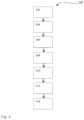
- Fig. 4 schematically illustrates a method 100 performed in a system 2 for determining heart rate data of a user.
- the method comprises the following steps: In step 102 a heart rate (HR) of the user is determined.
- HR heart rate
- step 104 beat-to-beat (RRi) intervals of the user is determined.
- step 106 a heart rate variability (HRV) of the user is determined during a time interval, where the determination 106 is based on the determined beat-to-beat (RRi) intervals from step 104.
- HRV heart rate variability
- step 108 low frequency (LF) components and high frequency (HF) components are determined based on the heart rate variability (HRV) from step 106, where the low frequency (LF) components and the high frequency (HF) components are components in a beat-to beat (RRi) periodogram, where the beat-to beat (RRi) periodogram is based on the determined beat-to beat (RRi) intervals from step 104.
- HRV heart rate variability
- a baseline measurement of the low frequency (LF) components and the high frequency (HF) components is determined during a first time interval T1, when the user is off-call, and the processing unit is configured for measuring a first ratio (LF/HF-off call) between the low frequency (LF) components and the high frequency (HF) components during the first time interval T1.
- LF low frequency
- HF high frequency
- step 112 a second ratio (LF/HF-on call) between the low frequency (LF) components and the high frequency (HF) components is measured during a second time interval T2, when the user is on-call.
- LF low frequency
- HF high frequency
- step 114 stress is detected by detection of the heart rate exceeding a first predefined threshold value (threshold1) and/or by detection of the second ratio (LF/HF on-call) exceeding a second predefined threshold value (threshold2).
- Fig. 5 schematically illustrates a method for a well-being analysis, such as detecting stress of a user, wearing a headset comprising a PPG sensor.
- the following method For detecting stress of the user and/or providing a well-being analysis, the following method may be performed.
- Detecting and signaling stress during a call may be provided.
- a baseline measurement may be provided.
- the processor of the communication headset may know the call context, such as on call, not on call etc.
- the processor of the communication headset may be configured to know when the user is on-call. Therefore the processor may be configured to perform the baseline measurement when the user is not on call, and the processor may be configured to measure HRV during a non-call period and during a call.
- the processor of the communication headset may therefore be configured to detect a change in stress or anger situation and provide a feedback, e.g. intervention, to the user and/or manager and thus provide feedback influencing the user to relax such as to restrain himself or herself.
- the feedback to the user can be visual or by means of an audio signal provided to the user in the headphones.
- the method comprises transmitting the PPG sensor input 502 to a heart rate (HR) signal extraction 504.
- HR heart rate
- the system or the headset detects 506 if the headset is on the user's head. If the headset is not, 508, on the user's head, return to PPG sensor input 502 and HR signal extraction 504. If the headset is on, 510, the user's head, continue to record heart rate (HR) for analyzing stress metrics 512. Then determine 514 if the user in on-call or off-call. If the user is not on-call, 516, then continue to well-being biometric logging (heart rate, stress metrics, on-call detector) 518.
- HR heart rate
- stress index exceeds a threshold. If stress index does not exceed a threshold 524, continue to well-being biometric logging (heart rate, stress metrics, on-call detector) 518. If stress index does exceed a threshold 526, then generate on-the-spot stress feedback 528 to the user and continue to well-being biometric logging (heart rate, stress metrics, on-call detector) 518.
- Fig. 6 schematically illustrates a method for a well-being analysis, such as detecting stress of a user, wearing a headset comprising a PPG sensor.
- the headset can be USB wired or wireless.
- the signal processing, analysis and intervention may be performed in or through the headset.
- the resulting HR, HRV and stress metrics may be delivered via a Bluetooth connection or Bluetooth Low Energy connection to a Health app in a smartphone or on a tablet or PC.
- the resulting HR, HRV and stress metric may be delivered via USB to a connected PC or tablet.
- the signal processing analysis and intervention may be performed outside the headset, such as in an external processor and/or using an app in a smartphone or in a connected PC or tablet.
- the method comprises starting 602 when the user is not in call 604, i.e. off-call.
- the baseline LF, HF components and their ratio are measured.
- the LF, HF components and their ratio are measured.
- the change between the user being not in call 604 and the user being in call 622 may be due to either a call is ended 624 or that a new call 626 has begun.
- time of (LF/HF above baseline threshold TB1) does not, 636, exceed TB2 threshold, then return to the state where user is in-call 622, where the LF, HF components and their ratio are measured. If the time of (LF/HF above baseline threshold TB1) exceeds, 638, TB2 threshold, then generate on-call on-the-spot feedback 640, and then return to the state where user is in-call 622, where the LF, HF components and their ratio are measured.
- Fig. 7 schematically illustrates the anatomy of the outer ear showing the approximate position of the preauricular skin pit 72.
- the PPG sensor in the headset is configured to be arranged at the preauricular skin pit area of the user for obtaining the PPG signal from the superficial temporary artery, when the user is wearing the headset.
- Fig. 8 schematically illustrates a headset with a PPG sensor and an earcup of the headset with a circumaural design.
- the mounting or provision of the PPG sensor 12 in the headset 4 may be provided by that the earcup 40 of the headset 4 is of a circumaural design, see fig. 8a ).
- the earcup 40 comprises an earphone housing 44 and an ear cushion material 42.
- the preauricular skin pit area of the user may be a suitable place to measure the PPG signal.
- Fig. 8b shows that the PPG sensor 12 may in such case be embedded in the ear cushion material 42, which is typically polyurethane or polyester foam.
- the ear cushion material 42 may be configured such that is it exposing the optical sensor in the PPG 12 such that the optical sensor can be in contact with or close to skin, such within 1-4 mm from the surface of the skin.
- Fig. 9a schematically illustrates an angled, folded or bended earphone housing 44 provided in the earcups 40, see fig. 8 , of the headset.
- the angled, folded or bended earphone housing 44 may provide a proper location of the PPG sensor at the preauricular skin pit area of the user for obtaining the PPG signal from the superficial temporal artery of the user.
- the earphone housing 44 comprise a protrusion 46 where the PPG sensor is configured to be arranged, such that the protrusion is configured to rest/be situated at the preauricular skin pit area of the user, when the user is wearing the headset.
- the protrusion 46 may be an angled part, a raised part, a bend etc.
- the earphone housing 44 may comprise a first face 48 configured to point towards the ear/skin of the user when the user is wearing the headset.
- the earphone housing 44 may comprise a second face 50 configured to point towards the surroundings when user is wearing the headset.
- the protrusion 46 may be arranged in the first face 48.
- the protrusion 46 may be an angled part having an angle relative to a plane, e.g.
- the protrusion 46 or angled part may be arranged at a centreline of the earphone housing 44, or arranged skew/oblique relative to a centreline of the earphone housing 44.
- Fig. 9b illustrates with the dotted line the optimal position for the protrusion or angled part of the earphone housing, see fig. 9a ).
Landscapes
- Health & Medical Sciences (AREA)
- Life Sciences & Earth Sciences (AREA)
- Engineering & Computer Science (AREA)
- Cardiology (AREA)
- Physics & Mathematics (AREA)
- Veterinary Medicine (AREA)
- Animal Behavior & Ethology (AREA)
- Public Health (AREA)
- General Health & Medical Sciences (AREA)
- Surgery (AREA)
- Molecular Biology (AREA)
- Biophysics (AREA)
- Pathology (AREA)
- Biomedical Technology (AREA)
- Heart & Thoracic Surgery (AREA)
- Medical Informatics (AREA)
- Physiology (AREA)
- Signal Processing (AREA)
- Psychiatry (AREA)
- Otolaryngology (AREA)
- Artificial Intelligence (AREA)
- Computer Vision & Pattern Recognition (AREA)
- Social Psychology (AREA)
- Psychology (AREA)
- Child & Adolescent Psychology (AREA)
- Developmental Disabilities (AREA)
- Hospice & Palliative Care (AREA)
- Educational Technology (AREA)
- Acoustics & Sound (AREA)
- Measuring Pulse, Heart Rate, Blood Pressure Or Blood Flow (AREA)
Claims (9)
- Headset (4) zur Sprachkommunikation, wobei das Headset (4) dazu konfiguriert ist, mindestens teilweise an oder in dem Ohr eines Benutzers getragen zu werden,wobei das Headset (2) Folgendes umfasst:- eine Sprachkommunikationseinheit (6) zum Ermöglichen eines Sprachkommunikationsanrufmodus zum Aufbauen einer Anrufverbindung zwischen dem Headset (4) und einem Endgerät;- einen Lautsprecher (8) zur Wiedergabe von akustischen Signalen;- ein Mikrofon (10) zur Aufnahme von akustischen Signalen;- einen Photoplethysmograph-Sensor (PPG-Sensor) (12) zum optischen Messen durch die Haut des Benutzers in oder an dem Ohr des Benutzers;wobei das Headset (4) eine Verarbeitungseinheit (14) umfasst, die mit dem PPG-Sensor (12) verbunden ist, wobei die Verarbeitungseinheit (14) zum Bestimmen von Herzratendaten des Benutzers basierend auf den PPG-Sensor-Messungen konfiguriert ist;wobei die Verarbeitungseinheit (14) zum Detektieren, ob sich der Benutzer in einem Anruf mit einem Endgerät befindet oder nicht, konfiguriert ist; undwobei das Headset (4) eine Datenkommunikationseinheit (16) zum Bereitstellen der bestimmten Herzratendaten des Benutzers, wenn der Benutzer das Headset (4) trägt, zur Angabe der Herzratendaten des Benutzers umfasst;wobei die Verarbeitungseinheit (14) zum Bestimmen der Herzrate (HR) und zum Bestimmen von Schlag-zu-Schlag(RR)-Intervallen basierend auf den PPG-Sensor-Messungen konfiguriert ist und wobei die Verarbeitungseinheit (14) zum Bestimmen einer Herzratenvariabilität (HRV) während eines Zeitintervalls basierend auf den Schlag-zu-Schlag(RR)-Intervallen konfiguriert ist;wobei die Verarbeitungseinheit (14) zum Bestimmen von Niederfrequenz(LF)-Komponenten und Hochfrequenz(HF)-Komponenten basierend auf der Herzratenvariabilität (HRV) konfiguriert ist, wobei die Niederfrequenz(LF)-Komponenten und die Hochfrequenz(HF)-Komponenten Komponenten in einem Schlag-zuSchlag(RR)-Periodogramm sind, wobei das Schlag-zu-Schlag(RR)-Periodogramm auf den bestimmten Schlag-zu-Schlag(RR)-Intervallen basiert;wobei die Verarbeitungseinheit (14) zum Bestimmen einer Basismessung der Niederfrequenz(LF)-Komponenten und der Hochfrequenz(HF)-Komponenten während eines ersten Zeitintervalls T1, wenn sich der Benutzer in keinem Anruf befindet, konfiguriert ist und wobei die Verarbeitungseinheit (14) zum Messen eines ersten Verhältnisses (LH/HF bei keinem Anruf) zwischen den Niederfrequenz(LF)-Komponenten und den Hochfrequenz(HF)-Komponenten während des ersten Zeitintervalls T1 konfiguriert ist;wobei die Verarbeitungseinheit (14) zum Messen eines zweiten Verhältnisses (LH/HF bei einem Anruf) zwischen den Niederfrequenz(LF)-Komponenten und den Hochfrequenz(HF)-Komponenten während eines zweiten Zeitintervalls T2, wenn sich der Benutzer in einem Anruf befindet, konfiguriert ist; undwobei die Verarbeitungseinheit (14) dazu konfiguriert ist, Stress durch Detektion, dass die Herzrate einen ersten vordefinierten Schwellenwert (Schwellenwert1) überschreitet, und durch Detektion, dass das zweite Verhältnis (LF/HF bei einem Anruf) einen zweiten vordefinierten Schwellenwert (Schwellenwert2) überschreitet, zu detektieren.
- Headset (4) nach einem der vorhergehenden Ansprüche, wobei das Headset (4) eine Benachrichtigungseinheit zum Bereitstellen einer Benachrichtigung, wenn die Verarbeitungseinheit (14) eine Herzratenerhöhung des Benutzers detektiert, umfasst.
- Headset (4) nach einem der vorhergehenden Ansprüche, ferner umfassend einen Bewegungssensor, der zum Detektieren von Kopfbewegungen des Benutzers zum Herausfiltern von bewegungsinduzierten Artefakten in den PPG-Sensor-Messungen konfiguriert ist.
- Headset (4) nach einem der vorhergehenden Ansprüche, der ferner derart konfiguriert ist, dass der PPG-Sensor (12) an dem Bereich der präaurikulären Hautgrube (72) des Benutzers zum Erlangen des PPG-Signals von der oberflächlichen Schläfenarterie, wenn der Benutzer das Headset (4) trägt, angeordnet ist.
- Headset (4) nach einem der vorhergehenden Ansprüche, das ferner derart konfiguriert ist, dass der PPG-Sensor (12) weniger als 5 mm über der Hautoberfläche, wie etwa weniger als 4 mm oder wie etwa weniger als 3 mm oder wie etwa weniger als 2 mm oder wie etwa weniger als 1 mm über der Hautoberfläche, angeordnet ist, wenn der Benutzer das Headset (4) trägt.
- Headset (4) nach einem der vorhergehenden Ansprüche, ferner umfassend ein Kopfhörergehäuse (44), und wobei ein Ohrpolster (42) an dem Kopfhörergehäuse (44) montiert ist und wobei der PPG-Sensor (12) in dem Kopfhörergehäuse (44) oder in dem Ohrpolster (42) montiert ist.
- Headset (4) nach einem der vorhergehenden Ansprüche, wobei das Kopfhörergehäuse (44) einen Vorsprung (46) umfasst, wobei der PPG-Sensor (12) dazu konfiguriert ist, derart angeordnet zu werden, dass der Vorsprung (46) dazu konfiguriert ist, an dem Bereich der präaurikulären Hautgrube (72) des Benutzers zu ruhen/platziert zu sein, wenn der Benutzer das Headset (4) trägt.
- Headset (4) nach einem der vorhergehenden Ansprüche, ferner umfassend ein Fixierteil zum Fixieren der Position des Kopfhörergehäuses (44), wenn der Benutzer das Headset (4) trägt, sodass der PPG-Sensor (12) an dem Bereich der präaurikulären Hautgrube (72) des Benutzers angeordnet ist.
- Verfahren (100), das in einem Headset (4) nach einem der Ansprüche 1-8 zum Bestimmen von Herzratendaten eines Benutzers durchgeführt wird, wobei das Verfahren Folgendes umfasst:- Bestimmen (102) einer Herzrate (HR);- Bestimmen (104) von Schlag-zu-Schlag(RR)-Intervallen;- Bestimmen (106) einer Herzratenvariabilität (HRV) während eines Zeitintervalls basierend auf den bestimmten Schlag-zu-Schlag(RR)-Intervallen;- Bestimmen (108) von Niederfrequenz(LF)-Komponenten und Hochfrequenz(HF)-Komponenten basierend auf der Herzratenvariabilität (HRV), wobei die Niederfrequenz(LF)-Komponenten und die Hochfrequenz(HF)-Komponenten Komponenten in einem Schlag-zu-Schlag(RR)-Periodogramm sind, wobei das Schlagzu-Schlag (RR) -Periodogramm auf den bestimmten Schlag-zuSchlag(RR)-Intervallen basiert;- Bestimmen (110) einer Basismessung der Niederfrequenz(LF)-Komponenten und der Hochfrequenz(HF)-Komponenten während eines ersten Zeitintervalls T1, wenn sich der Benutzer in keinem Anruf befindet, und wobei die Verarbeitungseinheit zum Messen eines ersten Verhältnisses (LF/HF bei keinem Anruf) zwischen den Niederfrequenz(LF)-Komponenten und den Hochfrequenz(HF)-Komponenten während des ersten Zeitintervalls T1 konfiguriert ist;- Messen (112) eines zweiten Verhältnisses (LF/HF bei einem Anruf) zwischen den Niederfrequenz(LF)-Komponenten und den Hochfrequenz(HF)-Komponenten während eines zweiten Zeitintervalls T2, wenn sich der Benutzer in einem Anruf befindet; und- Detektieren von Stress durch Detektion, dass die Herzrate einen ersten vordefinierten Schwellenwert (Schwellenwert1) überschreitet, und durch Detektion, dass das zweite Verhältnis (LF/HF bei einem Anruf) einen zweiten vordefinierten Schwellenwert (Schwellenwert2) überschreitet.
Priority Applications (1)
| Application Number | Priority Date | Filing Date | Title |
|---|---|---|---|
| EP23150162.8A EP4179967B1 (de) | 2017-05-18 | 2017-05-18 | Kommunikationskopfhörer mit stressmanagementfunktion |
Applications Claiming Priority (2)
| Application Number | Priority Date | Filing Date | Title |
|---|---|---|---|
| EP23150162.8A EP4179967B1 (de) | 2017-05-18 | 2017-05-18 | Kommunikationskopfhörer mit stressmanagementfunktion |
| EP17171653.3A EP3403573B1 (de) | 2017-05-18 | 2017-05-18 | Kommunikationssprechkopfhörer mit einer stressverwaltungsfunktion |
Related Parent Applications (2)
| Application Number | Title | Priority Date | Filing Date |
|---|---|---|---|
| EP17171653.3A Division EP3403573B1 (de) | 2017-05-18 | 2017-05-18 | Kommunikationssprechkopfhörer mit einer stressverwaltungsfunktion |
| EP17171653.3A Division-Into EP3403573B1 (de) | 2017-05-18 | 2017-05-18 | Kommunikationssprechkopfhörer mit einer stressverwaltungsfunktion |
Publications (3)
| Publication Number | Publication Date |
|---|---|
| EP4179967A1 EP4179967A1 (de) | 2023-05-17 |
| EP4179967C0 EP4179967C0 (de) | 2024-10-09 |
| EP4179967B1 true EP4179967B1 (de) | 2024-10-09 |
Family
ID=58992621
Family Applications (2)
| Application Number | Title | Priority Date | Filing Date |
|---|---|---|---|
| EP23150162.8A Active EP4179967B1 (de) | 2017-05-18 | 2017-05-18 | Kommunikationskopfhörer mit stressmanagementfunktion |
| EP17171653.3A Active EP3403573B1 (de) | 2017-05-18 | 2017-05-18 | Kommunikationssprechkopfhörer mit einer stressverwaltungsfunktion |
Family Applications After (1)
| Application Number | Title | Priority Date | Filing Date |
|---|---|---|---|
| EP17171653.3A Active EP3403573B1 (de) | 2017-05-18 | 2017-05-18 | Kommunikationssprechkopfhörer mit einer stressverwaltungsfunktion |
Country Status (3)
| Country | Link |
|---|---|
| US (2) | US20180333091A1 (de) |
| EP (2) | EP4179967B1 (de) |
| CN (1) | CN108937900A (de) |
Families Citing this family (16)
| Publication number | Priority date | Publication date | Assignee | Title |
|---|---|---|---|---|
| EP3445063B1 (de) * | 2017-08-18 | 2020-04-22 | Honeywell International Inc. | System und verfahren für eine gehörschutzvorrichtung zur übermittlung von alarmen von persönlichen schutzausrüstungen an den benutzer |
| CN109645977A (zh) * | 2019-01-04 | 2019-04-19 | 深圳金康特智能科技有限公司 | 一种基于智能穿戴装置监控人体心率变异性的方法及系统 |
| JP7484546B2 (ja) * | 2020-08-07 | 2024-05-16 | ヤマハ株式会社 | ヘッドホン |
| JP7075459B2 (ja) * | 2020-09-16 | 2022-05-25 | アップル インコーポレイテッド | オフセンタ旋回イヤピースを備えたヘッドホン |
| CN112333592B (zh) * | 2020-10-29 | 2022-10-18 | 歌尔科技有限公司 | 检测耳罩材质的耳机 |
| USD976229S1 (en) * | 2021-01-04 | 2023-01-24 | Wen Xie | Headset |
| USD991908S1 (en) * | 2021-08-07 | 2023-07-11 | Tieyong Liu | Gaming headset |
| USD1028929S1 (en) * | 2021-08-13 | 2024-05-28 | Gn Audio A/S | Headset |
| USD1021855S1 (en) * | 2021-12-09 | 2024-04-09 | Tao Peng | Headphone |
| USD1016037S1 (en) * | 2021-12-20 | 2024-02-27 | Tao Peng | Headphone |
| CN218772357U (zh) * | 2022-03-21 | 2023-03-28 | 华为技术有限公司 | 一种耳机 |
| USD1062688S1 (en) * | 2023-08-28 | 2025-02-18 | Dell Products L.P. | Headset |
| USD1006786S1 (en) * | 2023-09-19 | 2023-12-05 | Shenzhen Yinzhuo Technology Co., Ltd | Headphone |
| USD1089145S1 (en) * | 2024-05-24 | 2025-08-19 | Dell Products L.P. | Headset |
| USD1096696S1 (en) * | 2024-09-12 | 2025-10-07 | Biling Chen | Wireless headset |
| USD1063890S1 (en) * | 2024-12-10 | 2025-02-25 | Qiang Wang | Headset |
Family Cites Families (26)
| Publication number | Priority date | Publication date | Assignee | Title |
|---|---|---|---|---|
| US5608794A (en) * | 1995-08-04 | 1997-03-04 | Larson; Dana | Telephone headset in-use indicator |
| US6358201B1 (en) | 1999-03-02 | 2002-03-19 | Doc L. Childre | Method and apparatus for facilitating physiological coherence and autonomic balance |
| US20020148470A1 (en) * | 2000-01-13 | 2002-10-17 | Dr. Brent Blue | Headset including oximeter and method of using oximeter in oxygen supply system |
| FI20025039A0 (fi) | 2002-08-16 | 2002-08-16 | Joni Kettunen | Menetelmä II fysiologisen signaalin analysoimiseksi |
| US7617457B2 (en) * | 2004-01-07 | 2009-11-10 | At&T Intellectual Property I, L.P. | System and method for collaborative call management |
| US8641635B2 (en) * | 2006-08-15 | 2014-02-04 | University Of Florida Research Foundation, Inc. | Methods and devices for central photoplethysmographic monitoring methods |
| US9668695B2 (en) * | 2004-08-11 | 2017-06-06 | University Of Florida Research Foundation, Inc. | Pulse oximeter probes and methods for using the same |
| CA2599148A1 (en) * | 2005-02-22 | 2006-08-31 | Health-Smart Limited | Methods and systems for physiological and psycho-physiological monitoring and uses thereof |
| EP1906812A1 (de) | 2005-07-28 | 2008-04-09 | Boris Schwartz | Im ohr befestigter biosensor |
| KR100786279B1 (ko) * | 2006-04-20 | 2007-12-18 | 삼성전자주식회사 | 생체신호 측정이 가능한 헤드셋 장치 및 헤드셋 장치를이용한 생체신호 측정방법 |
| WO2008067122A1 (en) * | 2006-11-30 | 2008-06-05 | Motorola, Inc. | Wireless headsets and wireless communication networks for heart rate monitoring |
| KR20080069851A (ko) * | 2007-01-24 | 2008-07-29 | 삼성전자주식회사 | 생체 신호 측정 센서 장치 및 상기 센서 장치를 구비한헤드셋 장치 및 팬던트 장치 |
| CN101467875B (zh) | 2007-12-28 | 2012-10-10 | 周常安 | 耳戴式生理反馈装置 |
| JP5386511B2 (ja) * | 2008-02-13 | 2014-01-15 | ニューロスカイ インコーポレイテッド | 生体信号センサを備えたオーディオヘッドセット |
| US8298131B2 (en) | 2008-10-31 | 2012-10-30 | The Hong Kong Polytechnic University | System and method for relaxation |
| EP2389754B1 (de) * | 2009-01-20 | 2018-03-14 | GN Audio A/S | Headset-system mit zwei benutzerschnittstellen |
| KR101179943B1 (ko) * | 2010-09-02 | 2012-09-07 | 장용호 | 인계 난연제와 팽창흑연을 이용한 발포 폴리스티렌폼의 난연방법 |
| US20130184517A1 (en) * | 2011-07-07 | 2013-07-18 | Ronda Collier | System and Method for Measuring and Controlling Stress |
| KR101295046B1 (ko) * | 2012-03-05 | 2013-08-09 | 주식회사 경희스포츠패나틱 | 헤드셋 모듈 |
| US9270825B2 (en) * | 2014-03-18 | 2016-02-23 | Xerox Corporation | Non-contact stress assessment devices |
| US20150289813A1 (en) * | 2014-04-15 | 2015-10-15 | Eugene Lipov | System and Method for the Biological Diagnosis of Post-Traumatic Stress Disorder: PTSD Electronic Device Application |
| SE1451410A1 (sv) * | 2014-11-21 | 2016-05-17 | Melaud Ab | Earphones with sensor controlled audio output |
| US20160157776A1 (en) * | 2014-12-08 | 2016-06-09 | Xerox Corporation | Wearable device for stress assessment and management and method of its use |
| KR20160107007A (ko) * | 2015-03-03 | 2016-09-13 | 삼성전자주식회사 | 혈압 측정 장치 및 방법 |
| US10258272B2 (en) | 2015-10-08 | 2019-04-16 | International Business Machines Corporation | Identifying stress levels associated with context switches |
| US20170181649A1 (en) | 2015-12-28 | 2017-06-29 | Amiigo, Inc. | Systems and Methods for Determining Blood Pressure |
-
2017
- 2017-05-18 EP EP23150162.8A patent/EP4179967B1/de active Active
- 2017-05-18 EP EP17171653.3A patent/EP3403573B1/de active Active
-
2018
- 2018-05-10 US US15/976,089 patent/US20180333091A1/en not_active Abandoned
- 2018-05-17 CN CN201810494254.1A patent/CN108937900A/zh active Pending
-
2022
- 2022-04-14 US US17/720,906 patent/US11980464B2/en active Active
Also Published As
| Publication number | Publication date |
|---|---|
| EP4179967C0 (de) | 2024-10-09 |
| EP3403573A1 (de) | 2018-11-21 |
| US11980464B2 (en) | 2024-05-14 |
| US20180333091A1 (en) | 2018-11-22 |
| US20220265185A1 (en) | 2022-08-25 |
| CN108937900A (zh) | 2018-12-07 |
| EP3403573B1 (de) | 2023-06-21 |
| EP4179967A1 (de) | 2023-05-17 |
| EP3403573C0 (de) | 2023-06-21 |
Similar Documents
| Publication | Publication Date | Title |
|---|---|---|
| US11980464B2 (en) | Communication headset with a stress management function | |
| US10506310B2 (en) | Wearable biometric monitoring devices and methods for determining signal quality in wearable biometric monitoring devices | |
| US10610158B2 (en) | Physiological monitoring devices and methods that identify subject activity type | |
| US12219324B2 (en) | Hearing aid comprising a physiological sensor | |
| US10945618B2 (en) | Physiological monitoring devices and methods for noise reduction in physiological signals based on subject activity type | |
| US20220225887A1 (en) | Heart rate measurements using hearing device and app | |
| AU2014248464A1 (en) | Ear-related devices implementing sensors to acquire physiological characteristics | |
| CN116489585A (zh) | 一种耳后健康监测助听装置 | |
| EP3600013B1 (de) | Physiologische überwachungsvorrichtungen und verfahren zur rauschverminderung bei physiologischen signalen auf der basis des personenaktivitätstyps | |
| TWI603709B (zh) | Dynamic cardiovascular activity monitoring method and apparatus and system using the same | |
| CN106821358A (zh) | 心率检测装置及可穿戴设备 | |
| WO2017124946A1 (zh) | 动态心血管活动监测方法、系统以及穿戴式监测装置 | |
| JP7403136B2 (ja) | 心拍検出システム |
Legal Events
| Date | Code | Title | Description |
|---|---|---|---|
| PUAI | Public reference made under article 153(3) epc to a published international application that has entered the european phase |
Free format text: ORIGINAL CODE: 0009012 |
|
| STAA | Information on the status of an ep patent application or granted ep patent |
Free format text: STATUS: THE APPLICATION HAS BEEN PUBLISHED |
|
| AC | Divisional application: reference to earlier application |
Ref document number: 3403573 Country of ref document: EP Kind code of ref document: P |
|
| AK | Designated contracting states |
Kind code of ref document: A1 Designated state(s): AL AT BE BG CH CY CZ DE DK EE ES FI FR GB GR HR HU IE IS IT LI LT LU LV MC MK MT NL NO PL PT RO RS SE SI SK SM TR |
|
| STAA | Information on the status of an ep patent application or granted ep patent |
Free format text: STATUS: REQUEST FOR EXAMINATION WAS MADE |
|
| STAA | Information on the status of an ep patent application or granted ep patent |
Free format text: STATUS: EXAMINATION IS IN PROGRESS |
|
| 17P | Request for examination filed |
Effective date: 20230925 |
|
| RBV | Designated contracting states (corrected) |
Designated state(s): AL AT BE BG CH CY CZ DE DK EE ES FI FR GB GR HR HU IE IS IT LI LT LU LV MC MK MT NL NO PL PT RO RS SE SI SK SM TR |
|
| 17Q | First examination report despatched |
Effective date: 20231027 |
|
| GRAP | Despatch of communication of intention to grant a patent |
Free format text: ORIGINAL CODE: EPIDOSNIGR1 |
|
| STAA | Information on the status of an ep patent application or granted ep patent |
Free format text: STATUS: GRANT OF PATENT IS INTENDED |
|
| INTG | Intention to grant announced |
Effective date: 20240604 |
|
| GRAS | Grant fee paid |
Free format text: ORIGINAL CODE: EPIDOSNIGR3 |
|
| GRAA | (expected) grant |
Free format text: ORIGINAL CODE: 0009210 |
|
| STAA | Information on the status of an ep patent application or granted ep patent |
Free format text: STATUS: THE PATENT HAS BEEN GRANTED |
|
| AC | Divisional application: reference to earlier application |
Ref document number: 3403573 Country of ref document: EP Kind code of ref document: P |
|
| AK | Designated contracting states |
Kind code of ref document: B1 Designated state(s): AL AT BE BG CH CY CZ DE DK EE ES FI FR GB GR HR HU IE IS IT LI LT LU LV MC MK MT NL NO PL PT RO RS SE SI SK SM TR |
|
| REG | Reference to a national code |
Ref country code: CH Ref legal event code: EP |
|
| REG | Reference to a national code |
Ref country code: DE Ref legal event code: R096 Ref document number: 602017085490 Country of ref document: DE |
|
| REG | Reference to a national code |
Ref country code: IE Ref legal event code: FG4D |
|
| U01 | Request for unitary effect filed |
Effective date: 20241105 |
|
| U07 | Unitary effect registered |
Designated state(s): AT BE BG DE DK EE FI FR IT LT LU LV MT NL PT RO SE SI Effective date: 20241113 |
|
| PG25 | Lapsed in a contracting state [announced via postgrant information from national office to epo] |
Ref country code: IS Free format text: LAPSE BECAUSE OF FAILURE TO SUBMIT A TRANSLATION OF THE DESCRIPTION OR TO PAY THE FEE WITHIN THE PRESCRIBED TIME-LIMIT Effective date: 20250209 Ref country code: HR Free format text: LAPSE BECAUSE OF FAILURE TO SUBMIT A TRANSLATION OF THE DESCRIPTION OR TO PAY THE FEE WITHIN THE PRESCRIBED TIME-LIMIT Effective date: 20241009 |
|
| PG25 | Lapsed in a contracting state [announced via postgrant information from national office to epo] |
Ref country code: ES Free format text: LAPSE BECAUSE OF FAILURE TO SUBMIT A TRANSLATION OF THE DESCRIPTION OR TO PAY THE FEE WITHIN THE PRESCRIBED TIME-LIMIT Effective date: 20241009 |
|
| PG25 | Lapsed in a contracting state [announced via postgrant information from national office to epo] |
Ref country code: NO Free format text: LAPSE BECAUSE OF FAILURE TO SUBMIT A TRANSLATION OF THE DESCRIPTION OR TO PAY THE FEE WITHIN THE PRESCRIBED TIME-LIMIT Effective date: 20250109 |
|
| PG25 | Lapsed in a contracting state [announced via postgrant information from national office to epo] |
Ref country code: GR Free format text: LAPSE BECAUSE OF FAILURE TO SUBMIT A TRANSLATION OF THE DESCRIPTION OR TO PAY THE FEE WITHIN THE PRESCRIBED TIME-LIMIT Effective date: 20250110 |
|
| PG25 | Lapsed in a contracting state [announced via postgrant information from national office to epo] |
Ref country code: PL Free format text: LAPSE BECAUSE OF FAILURE TO SUBMIT A TRANSLATION OF THE DESCRIPTION OR TO PAY THE FEE WITHIN THE PRESCRIBED TIME-LIMIT Effective date: 20241009 |
|
| PG25 | Lapsed in a contracting state [announced via postgrant information from national office to epo] |
Ref country code: RS Free format text: LAPSE BECAUSE OF FAILURE TO SUBMIT A TRANSLATION OF THE DESCRIPTION OR TO PAY THE FEE WITHIN THE PRESCRIBED TIME-LIMIT Effective date: 20250109 |
|
| U20 | Renewal fee for the european patent with unitary effect paid |
Year of fee payment: 9 Effective date: 20250516 |
|
| PG25 | Lapsed in a contracting state [announced via postgrant information from national office to epo] |
Ref country code: SM Free format text: LAPSE BECAUSE OF FAILURE TO SUBMIT A TRANSLATION OF THE DESCRIPTION OR TO PAY THE FEE WITHIN THE PRESCRIBED TIME-LIMIT Effective date: 20241009 |
|
| PG25 | Lapsed in a contracting state [announced via postgrant information from national office to epo] |
Ref country code: SK Free format text: LAPSE BECAUSE OF FAILURE TO SUBMIT A TRANSLATION OF THE DESCRIPTION OR TO PAY THE FEE WITHIN THE PRESCRIBED TIME-LIMIT Effective date: 20241009 |
|
| PG25 | Lapsed in a contracting state [announced via postgrant information from national office to epo] |
Ref country code: CZ Free format text: LAPSE BECAUSE OF FAILURE TO SUBMIT A TRANSLATION OF THE DESCRIPTION OR TO PAY THE FEE WITHIN THE PRESCRIBED TIME-LIMIT Effective date: 20241009 |
|
| PLBE | No opposition filed within time limit |
Free format text: ORIGINAL CODE: 0009261 |
|
| STAA | Information on the status of an ep patent application or granted ep patent |
Free format text: STATUS: NO OPPOSITION FILED WITHIN TIME LIMIT |
|
| 26N | No opposition filed |
Effective date: 20250710 |
|
| REG | Reference to a national code |
Ref country code: CH Ref legal event code: H13 Free format text: ST27 STATUS EVENT CODE: U-0-0-H10-H13 (AS PROVIDED BY THE NATIONAL OFFICE) Effective date: 20251223 |
|
| PG25 | Lapsed in a contracting state [announced via postgrant information from national office to epo] |
Ref country code: CH Free format text: LAPSE BECAUSE OF NON-PAYMENT OF DUE FEES Effective date: 20250531 |
|
| PG25 | Lapsed in a contracting state [announced via postgrant information from national office to epo] |
Ref country code: MC Free format text: LAPSE BECAUSE OF FAILURE TO SUBMIT A TRANSLATION OF THE DESCRIPTION OR TO PAY THE FEE WITHIN THE PRESCRIBED TIME-LIMIT Effective date: 20241009 |
|
| REG | Reference to a national code |
Ref country code: GB Ref legal event code: 732E Free format text: REGISTERED BETWEEN 20260115 AND 20260121 |
|
| U1K | Transfer of rights of the unitary patent after the registration of the unitary effect |
Owner name: GN HEARING A/S; DK |
|
| PGFP | Annual fee paid to national office [announced via postgrant information from national office to epo] |
Ref country code: GB Payment date: 20260317 Year of fee payment: 10 |
|
| PG25 | Lapsed in a contracting state [announced via postgrant information from national office to epo] |
Ref country code: IE Free format text: LAPSE BECAUSE OF NON-PAYMENT OF DUE FEES Effective date: 20250518 |