EP4186590A1 - Partikeldispersion und verfahren zur formung einer partikeldispersion - Google Patents
Partikeldispersion und verfahren zur formung einer partikeldispersion Download PDFInfo
- Publication number
- EP4186590A1 EP4186590A1 EP21211369.0A EP21211369A EP4186590A1 EP 4186590 A1 EP4186590 A1 EP 4186590A1 EP 21211369 A EP21211369 A EP 21211369A EP 4186590 A1 EP4186590 A1 EP 4186590A1
- Authority
- EP
- European Patent Office
- Prior art keywords
- solvent
- polymer
- particle
- particles
- particle dispersion
- Prior art date
- Legal status (The legal status is an assumption and is not a legal conclusion. Google has not performed a legal analysis and makes no representation as to the accuracy of the status listed.)
- Pending
Links
Images
Classifications
-
- C—CHEMISTRY; METALLURGY
- C09—DYES; PAINTS; POLISHES; NATURAL RESINS; ADHESIVES; COMPOSITIONS NOT OTHERWISE PROVIDED FOR; APPLICATIONS OF MATERIALS NOT OTHERWISE PROVIDED FOR
- C09D—COATING COMPOSITIONS, e.g. PAINTS, VARNISHES OR LACQUERS; FILLING PASTES; CHEMICAL PAINT OR INK REMOVERS; INKS; CORRECTING FLUIDS; WOODSTAINS; PASTES OR SOLIDS FOR COLOURING OR PRINTING; USE OF MATERIALS THEREFOR
- C09D7/00—Features of coating compositions, not provided for in group C09D5/00; Processes for incorporating ingredients in coating compositions
- C09D7/40—Additives
- C09D7/65—Additives macromolecular
-
- B—PERFORMING OPERATIONS; TRANSPORTING
- B01—PHYSICAL OR CHEMICAL PROCESSES OR APPARATUS IN GENERAL
- B01J—CHEMICAL OR PHYSICAL PROCESSES, e.g. CATALYSIS OR COLLOID CHEMISTRY; THEIR RELEVANT APPARATUS
- B01J13/00—Colloid chemistry, e.g. the production of colloidal materials or their solutions, not otherwise provided for; Making microcapsules or microballoons
- B01J13/02—Making microcapsules or microballoons
- B01J13/04—Making microcapsules or microballoons by physical processes, e.g. drying, spraying
-
- C—CHEMISTRY; METALLURGY
- C09—DYES; PAINTS; POLISHES; NATURAL RESINS; ADHESIVES; COMPOSITIONS NOT OTHERWISE PROVIDED FOR; APPLICATIONS OF MATERIALS NOT OTHERWISE PROVIDED FOR
- C09D—COATING COMPOSITIONS, e.g. PAINTS, VARNISHES OR LACQUERS; FILLING PASTES; CHEMICAL PAINT OR INK REMOVERS; INKS; CORRECTING FLUIDS; WOODSTAINS; PASTES OR SOLIDS FOR COLOURING OR PRINTING; USE OF MATERIALS THEREFOR
- C09D7/00—Features of coating compositions, not provided for in group C09D5/00; Processes for incorporating ingredients in coating compositions
- C09D7/20—Diluents or solvents
-
- C—CHEMISTRY; METALLURGY
- C09—DYES; PAINTS; POLISHES; NATURAL RESINS; ADHESIVES; COMPOSITIONS NOT OTHERWISE PROVIDED FOR; APPLICATIONS OF MATERIALS NOT OTHERWISE PROVIDED FOR
- C09D—COATING COMPOSITIONS, e.g. PAINTS, VARNISHES OR LACQUERS; FILLING PASTES; CHEMICAL PAINT OR INK REMOVERS; INKS; CORRECTING FLUIDS; WOODSTAINS; PASTES OR SOLIDS FOR COLOURING OR PRINTING; USE OF MATERIALS THEREFOR
- C09D7/00—Features of coating compositions, not provided for in group C09D5/00; Processes for incorporating ingredients in coating compositions
- C09D7/40—Additives
- C09D7/60—Additives non-macromolecular
- C09D7/61—Additives non-macromolecular inorganic
- C09D7/62—Additives non-macromolecular inorganic modified by treatment with other compounds
Definitions
- the present invention relates to a particle dispersion exhibiting a homogenous drying pattern and a process for forming said particle dispersion. Furthermore, the invention relates to a homogenous particle film comprising modified particles and a process for forming a homogenous particle film from droplets of said particle dispersion. Finally, the invention also relates to the use of said particle dispersion for suppressing the coffee ring effect during the drying process of droplets of said particle dispersion.
- the capillary flow can be reduced by an increase in viscosity due to the addition of soluble polymers ( Seo, C. et al.; Sci. Rep. 7, 1-9 (2017 )) or by invoking Maragoni flows ( Hu, H. et al.; J. Phys. Chem. B, 110, 7090-7094 (2006 )) to at least partially counteract the capillary flow.
- the homogeneity of the deposit could also be improved by using solvent mixtures ( Parsa, Maryam, et al. Journal of Nanoparticle Research, 19, 1-26 (2017 ); Hu, Guohua, et al. Science advances 6.33 (2020 )).
- the object of the present invention is to provide a versatile strategy to overcome the coffee ring effect for particle dispersions comprising at least one organic solvent.
- the present invention is based on the finding that the above-mentioned objectives can be achieved by a particle dispersion exhibiting a homogenous drying pattern comprising from 0.0001 to 5.0 wt.% of modified particles and a solvent,
- Another aspect of the invention is the provision of a process for producing a particle dispersion comprising the steps of:
- the invention relates to a homogenous particle film comprising, or consisting of, modified particles comprising a solid core particle and an outer polymer shell, wherein the polymer shell comprises, or consists of, a soluble, interfacially-active polymer having a molecular weight of at least 5 kDa, wherein the average coverage of the substrate surface with particles is essentially uniform over the entire particle film.
- the invention is directed to a process for forming a homogenous particle film from droplets of a particle dispersion according to any one of claims 4 to 11, the process comprising:
- the invention relates to the use of a particle dispersion according to anyone of claims 4 to 11 for suppressing the coffee ring effect, that is, convective transport of particles to the edge, during the drying process of droplets of said particle dispersion.
- the "coffee ring effect” is the convective transport of particles to the droplet edge during the drying process of droplets of a particle dispersion.
- solvent as used herein relates to at least one organic solvent, mixtures of at least two organic solvents, as well as to mixtures of at least one organic solvent and water.
- pure solvent as used herein relates to a solvent or solvent mixture, which does not comprise any solid particles, dissolved polymer or any other additive that does not fall under the above definition of a solvent.
- the "molecular weight" of polymers indicates the weight average molecular weight of a polymer as determined by gel permeation chromatography (GPC).
- particle size refers to the average particle diameter as determined by dynamic light scattering.
- surface tension of dispersions and / or solutions relates to numerical values in mN/m of the surface tension as determined using the Wilhelmy method at a temperature of 25 °C.
- adsorbed indicates that a polymer (or any other chemical substance) is linked to a particle and/ or surface via any type of physical and/ or chemical interaction. Such interactions include, for example, Van-der-Waals forces, hydrogen bonding, hydrophobic interactions, or covalent or ionic chemical bonds.
- homogenous film relates to a film, wherein the average coverage of the surface of a substrate is essentially uniform over the entire film. Uniformity of the average surface coverage is determined via grey scale measurements on photographs of the dried droplets. The grey scale distribution was obtained by plotting the grey values of a cross-sectional line across the droplet using the software imageJ.
- soluble polymers describes polymeric substances that dissolve, disperse, or swell in the respective solvent.
- interfacially-active describes the ability of a substance to adsorb or / and interact with solid and liquid interfaces and modify their physical properties.
- interfacially-active soluble polymer describes a polymer that is soluble in the respective solvent and reduces the surface tension of said solvent when dissolved therein. This decrease in surface tension can be measured with the Wilhelmy method.
- the particle dispersion of the invention comprises modified particles, wherein the modified particles comprise a solid core particle and a polymeric shell. More specifically, said particle dispersion is a dispersion comprising solid core particles, modified by adsorbing on the surface thereof a monolayer of an interfacially-active polymer, and a solvent or solvent mixture, wherein said modified solid particles are dispersible.
- organic solvents including polar and apolar organic solvents, as well as miscible mixtures thereof, optionally further comprising water, can be used.
- the solvent, or solvent mixture has a boiling point in a range of from 60 to 250°C, preferably from 80 to 200°C, more preferably from 100 to 180°C and a surface tension in a range of from 23 to 60 mN/m, preferably from 23 to 50 mN/m, more preferably from 25 to 40 mN/m, most preferably from 25 to 35 mN/m.
- the solvent evaporates too quickly at ambient temperature.
- special drying conditions would be required (elevated temperature and/ or reduced pressure) since the evaporation timescale is too long to observe meaningful drying at room temperature.
- Suitable solvents include polar and apolar organic solvents.
- Polar solvents include, for example, alcohols, esters, ethers, ketones, amides and any miscible mixture thereof.
- Preferred polar solvents comprise alcohols, ketones, ethers and amides.
- More preferred polar solvents are alcohols having between 3 and 8 carbon atoms, acetone, tetrahydrofuran (THF), dimethyl formamide (DMF) and dimethyl sulfoxide (DMSO).
- Apolar organic solvents include, for example, unsubstituted hydrocarbons, halogenated hydrocarbons and any miscible mixture thereof.
- Preferred apolar solvents comprise unsubstituted hydrocarbons having between 6 and 12 carbon atoms.
- More preferred apolar solvents are hexane, benzene, toluene and decalin.
- Solvent mixtures may optionally further comprise water, given that the overall solvent mixture is miscible. If water is comprised in the solvent mixture, it is preferably present in an amount of less than 50 wt.%, more preferably less than 75 wt.%, even more preferably less than 90 wt.% based on the total mass of the solvent mixture.
- Possible materials for the solid core particle are organic materials, carbonaceous materials, and inorganic materials.
- organic materials include thermoplastic polymer particles, such as (meth)acrylic polymers, polyolefins, polystyrene, polyvinyl chloride, polyvinylidene fluoride, polycarbonate, polytetrafluoroethylene and duroplastic polymer particles, such as polyesters, polyurethanes, polyimides, epoxy resins, melamine resins.
- Polymer particles may, optionally, be crosslinked in order to enhance their stability in the solvent.
- the material of the polymer particle is selected such that it is insoluble in the solvent to avoid dissolution.
- suitable organic materials may include organic pigments.
- carbonaceous materials include carbon black, graphite, carbon nanotubes and graphene.
- inorganic materials include metals, semimetals, metal alloys, intermetallic components, metal oxides, semimetal oxides, transition metal oxides, non-metal oxides, mixed metal oxides, mixed semi metal oxides, metal sulphides, metal halides, metal oxide hydrates, metal phosphates, semimetal phosphate, metal chalcogenides, semimetal chalcogenides, metal nitrides, semimetal nitrides, silicates, aluminosilicates, metal carbides, perovskites, metal carbonates, zeolites, metal organic frameworks, particles formed from two dimensional, sheet-like structures, mica, glass, ceramic materials, calcium carbonate, hydroxyapatite, bioglass, bioactive glasses, bioactive ceramics and mixtures thereof.
- the material for the solid core particle is selected from polymer particles -which may optionally be crosslinked, carbon black particles, iron oxide particles, silica particles, titania particles; even more preferably, selected from silica, hematite, goethite and titanium dioxide.
- Shape and size of the solid core particles are not particularly limited. However, upon selecting the size of the solid core particles, it is important to keep the intended use of the particle dispersions in mind and to select the particle size accordingly. If the particles become exceedingly large and, thus, too heavy, sedimentation will prevent the formation of a stable dispersion of particles in the solvent phase and affect the drying behaviour. Therefore, the solid core particles may have a size of 100 ⁇ m or less, preferably of 10 ⁇ m or less, more preferably 1.5 ⁇ m or less. In case of solid core particles having a particle size of 100 ⁇ m or more, physical effects during drying are outweighed by the large mass of the particles. According to a preferred embodiment, the particle size of the solid core particles is at least 5 nm, preferably at least 20 nm, more preferably at least 50 nm, and even more preferably at least 100 nm.
- the particle shape is of no importance for achieving the effect.
- the polymeric shell comprises, or consists of, a monolayer of an interfacially-active polymer having a molecular weight of more than 5 kDa, which is adsorbed to the solid core particle and which is soluble in the respective solvent.
- the polymer can also be attached to the core particle via chemical bonding.
- interfacially-active polymer Upon selecting the interfacially-active polymer, care must be taken to ensure that the polymer can interact with the particle surface and the liquid/air interface.
- the interfacial activity of a polymer is shown by a reduction in the surface tension of a solvent upon addition of free polymer. This can be measured, for example by the Wilhelmy plate method.
- the interaction between polymer and particle surface is possible if the free energy of adsorption is negative, i.e. that the system gains energy from the interaction of polymer and particle.
- Such interactions can be measured, for example, by isothermal titration calorimetry.
- suitable soluble interfacially-active polymers include polyvinylpyrrolidone, polyvinyl alcohol 87% hydrolyzed, poly(N-isopropylacrylamide), methyl cellulose and poly(dimethylsiloxane).
- the polymer is selected form polyvinylpyrrolidone, polyvinyl alcohol 87% hydrolyzed and poly(N-isopropylacrylamide). More preferably, the polymer is selected from polyvinylpyrrolidone and polyvinyl alcohol 87% hydrolyzed.
- the resulting polymeric shell is not suitable to overcome the coffee ring effect.
- the molecular weight of the soluble interfacially-active polymer is at least 10 kDa, more preferably at least 55 kDa, still more preferably at least 130 kDa and most preferably at least 360 kDa.
- Suitable combinations for forming particle dispersions in accordance with the present invention and comprising solid core particles, interfacially-active polymer and a solvent, should meet the following requirements:
- a suitable strategy involves verifying that the Hansen solubility parameters of solvent and polymer are similar. Similar in this respect means that the relative energy difference (RED) between the Hansen parameters of the polymer and the solvent originating from disperse interactions ( ⁇ D ), polar interactions ( ⁇ P ), and hydrogen-bonding interactions ( ⁇ H ) is smaller than 1.2, preferably smaller than 1.1, even more preferably smaller than 1.0 and most preferably smaller than 0.95.
- RED relative energy difference
- a particle dispersion according to the present invention and exhibiting a homogenous drying pattern comprises, or consists of, from 0.0001 to 5.0 wt.% of modified particles comprising a solid core particle, a polymeric shell (as described above in detail) and a solvent, wherein the requirement described by the following formula is fulfilled: ST disp ⁇ 18 mN / m / ST solv ⁇ 18 mN / m > 0.90 , with ST disp being the surface tension of the modified particle dispersion in [mN/m] and ST solv being the surface tension of the pure solvent or solvent mixture in [mN/m]; and the solvent is selected from an organic solvent, a mixture of at least two organic solvents or a mixture of at least one organic solvent with water.
- the concentration of the modified particles is below 0.0001 wt.%, no homogenous film can be obtained since the particle density in a droplet of the particle dispersion is so low that insufficient particles are available to fully and homogenously coat the area of the droplet.
- the concentration of the modified particles exceeds 5.0 wt.%, a homogenous film cannot be obtained because the particle density in a droplet of the particle dispersion is so high that the particles start to - partially - form multiple layers of particles on top of one another during drying.
- the modified particles are present in an amount of from 0.0005 to 2.5 wt.%, more preferably from 0.001 to 1.0 wt.% and most preferably from 0.01 to 0.5 wt.% based on the total weight of the particle dispersion.
- the particle dispersion of the current invention meets the requirement described by the following formula: ST disp ⁇ 18 mN / m / ST solv ⁇ 18 mN / m > 0.90 , with ST disp being the surface tension of the modified particle dispersion in [mN/m] and ST solv being the surface tension of the pure solvent or solvent mixture in [mN/m].
- ST disp being the surface tension of the modified particle dispersion in [mN/m]
- ST solv being the surface tension of the pure solvent or solvent mixture in [mN/m].
- a ratio (ST disp - 18 mN/m)/ (ST solv -18 mN/m) of less than 0.90 indicates the presence of significant amounts of dissolved interfacially-active polymers/ additives in the particle dispersion, which is not in accordance with the present invention. However, if the ratio (ST disp - 18 mN/m)/ (ST solv -18 mN/m) is greater than 0.90 than, the dispersion only contains a limited amount of soluble interfacially-active polymer.
- the dispersion is substantially free of any soluble polymer that is not adsorbed to the solid core particle.
- the expression “substantially free” indicates that the dispersion does not contain any significant amount of soluble polymer other than the soluble interfacially-active polymer constituting the polymeric shell of the modified particles. Nevertheless, especially in case of physical adsorption, unavoidable small amounts of said soluble interfacially-active polymer constituting the polymeric shell may be present due to the equilibrium state.
- Dispersing agents which help to increase dispersion stability in (non-aqueous) particle dispersions, interact simultaneously with the particles and the surrounding solvent.
- Surfactants are usually added to particle dispersions and/ or solutions in order to adapt, more particularly reduce, the surface tension thereof. This is especially important in inkjet printing applications.
- Both dispersing agents and surfactants are commercially available in vast varieties and may comprise polymeric substances. Some dispersing agents act as surfactants and vice-versa.
- the particle dispersions in accordance with the current invention do not comprise any further interfacially-active additives, such as dispersing agents and/ or (polymeric) surfactants.
- the particle dispersions of the current invention do not comprise any further additives.
- a process for producing a particle dispersion comprising, or consisting of, the steps of:
- the amount of solid core particles in the dispersion of step a) is such that the final modified particle dispersion has a modified particle concentration in a range of from 0.0001 to 5.0 wt.%, preferably from 0.0005 to 2.5 wt.%, more preferably from 0.001 to 1.0 wt.% and most preferably from 0.01 to 0.5 wt.% based on the total weight of the modified particle dispersion.
- the amount of the polymer added exceeds by a factor of two, preferably by a factor of 5, more preferably by a factor of 10, most preferably by a factor of 20, the amount of polymer required to coat the surface of each of the solid core particles with a monolayer of the polymer.
- the amount of polymer required to coat the surface of each of the solid core particles with a monolayer of the polymer may be determined as follows:
- the total surface area of the solid core particle in the dispersion is calculated from the particle diameter as measured via dynamic light scattering, the particle density as known from literature, and the particle concentration. From the particle concentration and the density, the total volume of dispersed particles can be calculated. Using the diameter measured from dynamic light scattering, the number of particles in the dispersion is obtained, which allows calculation of the total surface area.
- the mass of soluble interfacially-active polymers that adsorb onto certain surface area are either available from literature sources or can be determined by someone skilled in the art using the following method.
- a particle dispersion with a known size is mixed with a polymer solution of known concentration and molecular weight and kept under constant stirring for one day.
- the particles, including the polymer adsorbed onto the particles, are removed by centrifugation.
- the change in polymer concentration in the supernatant can be determined for example by UV-Vis spectroscopy.
- the difference compared to the original polymer solution yields the total amount of adsorbed polymer onto the particle surface.
- the mass of adsorbed polymer per particle surface area can be obtained by dividing the adsorbed polymer mass by the total available surface area.
- the amount of the soluble interfacially-active polymer needed to cover the surface of the solid particles with a monolayer is then calculated as: Total surface area of the solid core particle in the dispersion m 2 * mass of adsorbed polymer per surface area mg / m 2 .
- Free polymer may be removed from the obtained mixture by various methods including, for example, centrifugation and dialysis, preferably centrifugation.
- Solid core particles and soluble interfacially-active polymers are selected as outlined above in the context of the particle dispersion.
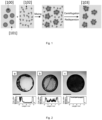
- Fig. 1 provides a schematic illustration of the above described process for producing a particle dispersion.
- the particle surface of a solid core particle is modified using interfacially-active polymers: a particle dispersion ([100]: particles, [101]: organic solvent) is mixed with an interfacially-active polymer solution ([102]: interfacially-active polymer). The polymer adsorbs onto the particles. Centrifugation and redispersion removes excess, non-adsorbed polymer.
- the modified dispersion is comprised, or consists, of a solvent and particles with an interfacially-active polymeric shell ([103]) and is preferably essentially free of any non-adsorbed polymer.
- the modification of solid core particles may be carried out as outlined above with the exception of the medium being an aqueous medium, followed by a solvent exchange to an organic solvent or solvent mixture, for example by drying of the particle dispersion and redispersion in an organic solvent or solvent mixture.
- the modification of the core can be carried out by the copolymerization of interfacially-active macromonomers or by grafting-from or grafting-to methods.
- polydimethylsiloxane-coated PMMA particles were synthesized by a copolymerization of surface-active, monovinyl-terminated poly(dimethyl siloxane) (PDMS) macromonomers adapted from Srinivrasan, S. A., et al. Polymer 39 6-7 (1998): 1497-1501 .
- PDMS surface-active, monovinyl-terminated poly(dimethyl siloxane)
- homogenous particle films can be obtained from droplets of a particle dispersion according to the invention via the following process, comprising:
- the concentration of modified particles in the dispersion is from 0.01 to 0.5 wt.% based on the total weight of the particle dispersion.
- the particle dispersion is a dispersion comprising solid core particles, modified by adsorbing on the surface thereof a monolayer of an interfacially-active polymer, and at least one organic solvent or a solvent mixture as defined herein above, wherein said modified solid particles are dispersible.
- the particle dispersion is a modified particle dispersion as described herein.
- the particle concentration is chosen such that the total cross-sectional area of the particles, including the polymeric shell, is equal to the droplet surface area, which can be calculated by someone skilled in the art.
- the optimal particle concentration thus depends on the particle diameter, particle density, chain length of the polymeric additive, contact angle of the particle at the liquid interface, volume of the droplet and the contact angle of the droplet on the solid substrate.
- the optimum concentration to reach a homogeneous coating varies and concentration ranges as specified above can result.
- an exemplary calculation of the optimum concentration of particles in a dispersion is provided.
- the concentration of the modified particles is much below the optimum concentration as specified above, no homogenous film can be obtained since the particle number in a droplet of the particle dispersion is so low that an insufficient amount of particles is available to fully cover the droplet area.
- the concentration of the modified particles is much above the optimum concentration, a homogenous film cannot be obtained because the particle density in a droplet of the particle dispersion is so high that the particles start to form multiple layers of particles on top of one another at the droplet edge during drying.
- Droplets of the particle dispersion may be formed by any method and using any type of equipment.
- Preferred means for forming droplets include inkjet printing, drop casting, spray drying, electrospraying, spin coating, dip coating, more preferable means are inkjet printing and dropcasting.
- Homogenous particle films comprising, or consisting of, modified particles comprising a solid core particle and an outer polymer shell, wherein the polymer shell comprises, or consists of, a soluble interfacially-active polymer having a molecular weight of at least 5 kDa, preferably at least 10 kDa are characterized in that an average coverage of the substrate surface with particles is essentially uniform over the entire film.
- Uniformity of the surface coverage is determined via grey scale measurements of optical microscopy images.
- grey values of a line through the droplet are extracted using the software ImageJ.
- modified particle dispersions according to the current invention can be used for suppressing the coffee ring effect during the drying process of droplets of such particle dispersion.
- convective transport of the modified particles to the drop edge is avoided.
- Double-filtered and deionized water (18.2 M ⁇ cm, double reverse osmosis by Purelab Flex 2, ELGA Veolia) was used throughout this study.
- the RED Relative Energy Difference
- HSP Hansen Solubility Parameter
- the interfacially-active polymer is considered soluble, and thus, suitable for carrying out the invention in a solvent, if RED polymer / solvent ⁇ 1 .
- Numerical values for Hansen solubility parameters in [MPa 1 ⁇ 2 ] are given in tables 2 and 3 below.
- the weight average molecular weight, M w of the polymers used in the examples, may be determined by gel permeation chromatography. Generally, M w of the polymers as given herein corresponds to the specifications provided by the manufacturer.
- Particle size as used herein relates to the arithmetic mean particle diameter determined via dynamic light scattering (DLS). Specifically, DLS measurements were performed on a Malvern Zetasizer Nano-ZS.
- a suspension droplet on a solid substrate can be described by a spherical cap, where the volume V L is described by equation (1).
- V L ⁇ / 3 * r L 3 1 ⁇ cos ⁇ 2 2 + cos ⁇
- N p M L / A P * 0.9069
- a p describes the interfacial area occupied by one particle including its polymeric corona and the factor 0.9069 describes the maximum packing of spheres in a plane.
- m ptot N p 4 / 3 ⁇ r p 3 ⁇ P where ⁇ P is the density of the dispersed particles.
- Hematite particles (Bayferrox 130, Lanxess) were used as obtained from the commercial supplier without modification.
- the particles have an average particle diameter of 244 nm with the particle shape being unspecified.
- Particles "A” were used as received, viz. without any additional modification and/ or purification steps, in order to prepare particle dispersions denoted as Comparative Examples 1, 3, 4 and 7 (CE1, CE3, CE4, CE7) in various solvents or solvent mixtures.
- Hematite particles (Bayferrox 130, Lanxess) were dispersed in an organic solvent at a concentration of 3.2 wt.%, mixed with a solution of a soluble interfacially-active poly(vinylpyrrolidone) (5.0 wt.%) and kept under constant stirring for at least 1 hour.
- the weight ratio of soluble interfacially-active polymer to solid core particles in the mixture was adjusted to 1.
- the mixed dispersion was diluted with a solvent and centrifuged at 5'000 rpm for 5 min. The supernatant was discarded and the particles were redispersed in a solvent. The centrifugation and redispersion was, optionally, repeated several times.
- Comparative Example 2 corresponds to a dispersion of particles "B", wherein the centrifugation and redispersion cycle was NOT repeated.
- Inventive Example 1 corresponds to a dispersion of particles "B", wherein the centrifugation and redispersion cycle was repeated until the surface tension of the dispersion met the requirement STdisp ⁇ 18 mN/M / STsolv ⁇ 18 mN/m > 0.90 .
- Hematite particles (Bayferrox 130, Lanxess) were dispersed in water at a concentration of 3.2 wt.% and mixed with an aqueous solution of soluble, interfacially-active poly(vinyl alcohol) (5.0 wt.%) with the same protocol as described above and in co-pending European Patent Application No. 20191024.7 .
- the solvent was then exchanged by the evaporation of water and the particles were redispersed in a desired solvent.
- Particles "C” were used to prepare particle dispersions denoted as Inventive Examples 2-4 and 6 (IE2, IE3, IE4, IE6) in various solvents or solvent mixtures. Free polymer was removed from the aqueous particle dispersion by repeated centrifugation and redispersion cycles prior to the final solvent exchange.
- Spherical poly(methyl methacrylate) PMMA particles stabilized by poly(12-hydroxystearic acid)-graft-poly(methyl methacrylate) with an arithmetic mean diameter of (531 ⁇ 42) nm were prepared as described by Antl, L. et al. Colloids and Surfaces 17, 67-78 (1986 ).
- Particles "D” were cleaned by 10 centrifugation and redispersion cycles in decalin to remove educts and impurities from the particle synthesis.
- the polymer itself does not lower the surface tension of decalin and therefore is not an interfacially-active polymer for this system.
- the particle dispersion in decalin is denoted as Comparative Example 5 (CE5).
- Spherical PMMA particles stabilized with poly(dimethylsiloxane) (PDMS) with an arithmetic mean diameter of (534 ⁇ 92) nm were prepared according to a procedure adapted from Srinivrasan, S. A., et al. Polymer 39 6-7 (1998): 1497-1501 .
- PDMS poly(dimethylsiloxane)
- Comparative Example 6 corresponds to a dispersion of particles "E", wherein the centrifugation and redispersion cycle was NOT repeated.
- Inventive Example 5 corresponds to a dispersion of particles "E", wherein the centrifugation and redispersion cycle was repeated until the surface tension of the dispersion met the requirement ST disp ⁇ 18 Mn / M / ST solv ⁇ 18 mN / m > 0.90 .
- Inventive (IE1 to IE6) and Comparative Examples (CE1 to CE7) are based on hematite and PMMA particles A to E as described herein.
- Table 1 provides data regarding surface tension and boiling point of the solvents used in the Inventive and Comparative Examples.
- Table 2 provides Hansen solubility parameters for the polymers and solvents used in the Inventive and Comparative Examples
- Table 3 provides numerical data as to HSP distance (Ra) and Relative Energy Distance (RED) for the systems used in the Inventive and Comparative Examples. Ra and RED were calculated as described herein above.
- the silicon wafer (LG Siltron Inc. Korea), previously cleaned by sonication in isopropanol, ethanol and water for 5 min substrate was surface-modified using a perfluorooctyltriethoxysilane.
- the drying behaviour at ambient temperature (20°C) was characterized by optical microscopy (Zeiss), using a 2x objective.
- the substrate was solely cleaned as described above without a silanisation step.
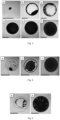
- Fig. 2 Top: Optical microscopy images of dried hematite particle films according to CE 1 (a), CE 2 (b) and IE 1 (c), respectively. Scale bar: 1 mm. Bottom: Cross-sectional grey value distribution after drying. A clear increase in homogeneity is observed upon removal of non-adsorbed PVP (c). Scale bar: 1 mm.
- Fig. 3 Optical microscopy images of dried particle films according to comparative (CE3 (a), CE4 (b), CE1 (c)) and inventive examples (IE2 (d), IE3 (e), IE4 (f)). Scale bar: 1 mm.
- Fig. 4 Optical microscopy images of dried particle films according to comparative (CE5 (a), CE6 (b)) and inventive examples (IE5 (c)). Scale bar: 1 mm.
- Fig. 5 Optical microscopy images of dried particle films according to comparative (CE7 (a)) and inventive examples (IE6 (b)). Scale bar: 1 mm.
- a homogeneous drying pattern was observed for the modified particles when surface tension and boiling point of the selected solvent were within the predefined ranges.
Landscapes
- Chemical & Material Sciences (AREA)
- Organic Chemistry (AREA)
- Life Sciences & Earth Sciences (AREA)
- Engineering & Computer Science (AREA)
- Materials Engineering (AREA)
- Wood Science & Technology (AREA)
- Inorganic Chemistry (AREA)
- Dispersion Chemistry (AREA)
- Chemical Kinetics & Catalysis (AREA)
- Processes Of Treating Macromolecular Substances (AREA)
Priority Applications (2)
| Application Number | Priority Date | Filing Date | Title |
|---|---|---|---|
| EP21211369.0A EP4186590A1 (de) | 2021-11-30 | 2021-11-30 | Partikeldispersion und verfahren zur formung einer partikeldispersion |
| US18/070,139 US20230227674A1 (en) | 2021-11-30 | 2022-11-28 | Particle dispersion and process for forming a particle dispersion |
Applications Claiming Priority (1)
| Application Number | Priority Date | Filing Date | Title |
|---|---|---|---|
| EP21211369.0A EP4186590A1 (de) | 2021-11-30 | 2021-11-30 | Partikeldispersion und verfahren zur formung einer partikeldispersion |
Publications (1)
| Publication Number | Publication Date |
|---|---|
| EP4186590A1 true EP4186590A1 (de) | 2023-05-31 |
Family
ID=78819951
Family Applications (1)
| Application Number | Title | Priority Date | Filing Date |
|---|---|---|---|
| EP21211369.0A Pending EP4186590A1 (de) | 2021-11-30 | 2021-11-30 | Partikeldispersion und verfahren zur formung einer partikeldispersion |
Country Status (2)
| Country | Link |
|---|---|
| US (1) | US20230227674A1 (de) |
| EP (1) | EP4186590A1 (de) |
Citations (2)
| Publication number | Priority date | Publication date | Assignee | Title |
|---|---|---|---|---|
| US20130307899A1 (en) * | 2011-02-17 | 2013-11-21 | Fujifilm Corporation | Ink composition, ink set, and image forming method |
| EP3954744A1 (de) * | 2020-08-14 | 2022-02-16 | Friedrich-Alexander-Universität Erlangen-Nürnberg | Wässrige partikeldispersion und verfahren zur herstellung einer wässrigen partikeldispersion |
-
2021
- 2021-11-30 EP EP21211369.0A patent/EP4186590A1/de active Pending
-
2022
- 2022-11-28 US US18/070,139 patent/US20230227674A1/en not_active Abandoned
Patent Citations (2)
| Publication number | Priority date | Publication date | Assignee | Title |
|---|---|---|---|---|
| US20130307899A1 (en) * | 2011-02-17 | 2013-11-21 | Fujifilm Corporation | Ink composition, ink set, and image forming method |
| EP3954744A1 (de) * | 2020-08-14 | 2022-02-16 | Friedrich-Alexander-Universität Erlangen-Nürnberg | Wässrige partikeldispersion und verfahren zur herstellung einer wässrigen partikeldispersion |
Non-Patent Citations (14)
| Title |
|---|
| ANTL, L ET AL., COLLOIDS AND SURFACES, vol. 17, 1986, pages 67 - 78 |
| ANYFANTAKIS, M ET AL., LANGMUIR, vol. 31, 2015, pages 4113 - 4120 |
| CHANGDEOK SEO ET AL: "Altering the coffee-ring effect by adding a surfactant-like viscous polymer solution", SCIENTIFIC REPORTS, vol. 7, no. 1, 29 March 2017 (2017-03-29), XP055602797, DOI: 10.1038/s41598-017-00497-x * |
| DEEGAN, R. D. ET AL., NATURE, vol. 389, 1997, pages 827 - 829 |
| HANSEN, C: "Hansen Solubility Parameters: A User's Handbook", TAYLOR AND FRANCIS INC |
| HU, GUOHUA ET AL., SCIENCE ADVANCES, vol. 6, 2020, pages 33 |
| HU, H ET AL., J. PHYS. CHEM., vol. 110, 2006, pages 7090 - 7094 |
| KIM HYOUNGSOO ET AL: "Controlled Uniform Coating from the Interplay of Marangoni Flows and Surface-Adsorbed Macromolecules", PHYSICAL REVIEW LETTERS, vol. 116, no. 12, 1 March 2016 (2016-03-01), US, XP055916561, ISSN: 0031-9007, DOI: 10.1103/PhysRevLett.116.124501 * |
| PARK, J ET AL., LANGMUIR, vol. 22, 2006, pages 3506 - 3513 |
| PARSA, MARYAM ET AL., JOURNAL OF NANOPARTICLE RESEARCH, vol. 19, 2017, pages 1 - 26 |
| PERTOFT H ET AL: "Density gradients prepared from colloidal silica particles coated by polyvinylpyrrolidone (Percoll)", ANALYTICAL BIOCHEMISTRY, ACADEMIC PRESS, AMSTERDAM, NL, vol. 88, no. 1, 15 July 1978 (1978-07-15), pages 271 - 282, XP024822292, ISSN: 0003-2697, [retrieved on 19780715], DOI: 10.1016/0003-2697(78)90419-0 * |
| SEO, C, SCI. REP., vol. 7, 2017, pages 1 - 9 |
| SRINIVRASAN, S. A. ET AL., POLYMER, vol. 39, no. 6-7, 1998, pages 1497 - 1501 |
| YUNKER, P. J. ET AL., NATURE, vol. 476, 2011, pages 308 - 311 |
Also Published As
| Publication number | Publication date |
|---|---|
| US20230227674A1 (en) | 2023-07-20 |
Similar Documents
| Publication | Publication Date | Title |
|---|---|---|
| EP3954744B1 (de) | Wässrige partikeldispersion und verfahren zur herstellung einer wässrigen partikeldispersion | |
| Fonseca et al. | Self-assembly of colloidal metal–organic framework (MOF) particles | |
| Lim et al. | Stable colloidal dispersion of octylated Ti3C2-MXenes in a nonpolar solvent | |
| Karg et al. | Smart inorganic/organic hybrid microgels: Synthesis and characterisation | |
| Chai et al. | Development of iron oxide decorated graphene oxide (Fe3O4/GO) PSf mixed-matrix membrane for enhanced antifouling behavior | |
| Ayyaru et al. | Fabrication and separation performance of polyethersulfone/sulfonated TiO2 (PES–STiO2) ultrafiltration membranes for fouling mitigation | |
| Bulychev et al. | Nanotechnological aspects of temperature-dependent decomposition of polymer solutions | |
| Berendjchi et al. | Fabrication of superhydrophobic and antibacterial surface on cotton fabric by doped silica-based sols with nanoparticles of copper | |
| Mahdavi et al. | Synergistic effect of GO@ SiO2 and GO@ ZnO nano-hybrid particles with PVDF-g-PMMA copolymer in high-flux ultrafiltration membrane for oily wastewater treatment and antifouling properties | |
| Kirillova et al. | Platelet Janus particles with hairy polymer shells for multifunctional materials | |
| Ge et al. | Colloidal inks from bumpy colloidal nanoparticles for the assembly of ultrasmooth and uniform structural colors | |
| KR20090079942A (ko) | 초미세 코어/쉘 입자의 미니유현탁액 또는 현탁액의 제조 방법 | |
| Sohrabi et al. | The study of glass superhydrophobicity by modified SiO2-hexadecyltrimethoxysilane (SiO2-m-HDTMS) nanoparticles and mixture of surfactants | |
| Salimi et al. | Preparation and characterization of a novel MMMs by comprising of PSF–HNT/TiO2 nanotubes to reduce organic sediments | |
| Zhao et al. | One-pot fabrication of fluoride-silica@ silica raspberry-like nanoparticles for superhydrophobic coating | |
| Kraft et al. | Conditions for equilibrium solid-stabilized emulsions | |
| Liang et al. | Tuning membrane surface wetting behavior via dual-nanomaterial functionalization for efficient water purification | |
| Araghi et al. | Synthesis and investigation of antimicrobial properties of SiO2@ Cu rods with core–shell structure | |
| van Wijk et al. | Formation of hybrid poly (styrene-co-maleic anhydride)–silica microcapsules | |
| US20230227674A1 (en) | Particle dispersion and process for forming a particle dispersion | |
| Liu et al. | Structural design and preparation of pigment/resin integrated ultra-stable antibacterial composite particles | |
| CN102672197B (zh) | 一种多用途的等离子的金纳米粒子膜的制备方法 | |
| Rhee et al. | Interconnected assembly of ZrO2@ SiO2 nanoparticles with dimensional selectivity and refractive index tunability | |
| Sun et al. | Antifogging UV curable coatings based on hierarchical composite particles through electrostatic interactions | |
| Wu et al. | Coating organic pigment particles with hydrous alumina through direct precipitation |
Legal Events
| Date | Code | Title | Description |
|---|---|---|---|
| PUAI | Public reference made under article 153(3) epc to a published international application that has entered the european phase |
Free format text: ORIGINAL CODE: 0009012 |
|
| STAA | Information on the status of an ep patent application or granted ep patent |
Free format text: STATUS: THE APPLICATION HAS BEEN PUBLISHED |
|
| AK | Designated contracting states |
Kind code of ref document: A1 Designated state(s): AL AT BE BG CH CY CZ DE DK EE ES FI FR GB GR HR HU IE IS IT LI LT LU LV MC MK MT NL NO PL PT RO RS SE SI SK SM TR |
|
| STAA | Information on the status of an ep patent application or granted ep patent |
Free format text: STATUS: REQUEST FOR EXAMINATION WAS MADE |
|
| 17P | Request for examination filed |
Effective date: 20231128 |
|
| RBV | Designated contracting states (corrected) |
Designated state(s): AL AT BE BG CH CY CZ DE DK EE ES FI FR GB GR HR HU IE IS IT LI LT LU LV MC MK MT NL NO PL PT RO RS SE SI SK SM TR |
|
| STAA | Information on the status of an ep patent application or granted ep patent |
Free format text: STATUS: EXAMINATION IS IN PROGRESS |
|
| 17Q | First examination report despatched |
Effective date: 20250616 |