EP4187792A1 - Matrixprozessor, der sar-gesuchte eingangsverzögerungseinstellungen erzeugt, um zeitversätze in einem mehrkanaligen verschachtelten analog-digital-wandler (adc) zu kalibrieren - Google Patents
Matrixprozessor, der sar-gesuchte eingangsverzögerungseinstellungen erzeugt, um zeitversätze in einem mehrkanaligen verschachtelten analog-digital-wandler (adc) zu kalibrieren Download PDFInfo
- Publication number
- EP4187792A1 EP4187792A1 EP22178075.2A EP22178075A EP4187792A1 EP 4187792 A1 EP4187792 A1 EP 4187792A1 EP 22178075 A EP22178075 A EP 22178075A EP 4187792 A1 EP4187792 A1 EP 4187792A1
- Authority
- EP
- European Patent Office
- Prior art keywords
- channel
- matrix
- sign
- bit
- sar
- Prior art date
- Legal status (The legal status is an assumption and is not a legal conclusion. Google has not performed a legal analysis and makes no representation as to the accuracy of the status listed.)
- Granted
Links
Images




Classifications
-
- H—ELECTRICITY
- H03—ELECTRONIC CIRCUITRY
- H03M—CODING; DECODING; CODE CONVERSION IN GENERAL
- H03M1/00—Analogue/digital conversion; Digital/analogue conversion
- H03M1/10—Calibration or testing
- H03M1/1009—Calibration
- H03M1/1014—Calibration at one point of the transfer characteristic, i.e. by adjusting a single reference value, e.g. bias or gain error
-
- H—ELECTRICITY
- H03—ELECTRONIC CIRCUITRY
- H03M—CODING; DECODING; CODE CONVERSION IN GENERAL
- H03M1/00—Analogue/digital conversion; Digital/analogue conversion
- H03M1/06—Continuously compensating for, or preventing, undesired influence of physical parameters
- H03M1/0617—Continuously compensating for, or preventing, undesired influence of physical parameters characterised by the use of methods or means not specific to a particular type of detrimental influence
- H03M1/0626—Continuously compensating for, or preventing, undesired influence of physical parameters characterised by the use of methods or means not specific to a particular type of detrimental influence by filtering
- H03M1/0631—Smoothing
-
- H—ELECTRICITY
- H03—ELECTRONIC CIRCUITRY
- H03M—CODING; DECODING; CODE CONVERSION IN GENERAL
- H03M1/00—Analogue/digital conversion; Digital/analogue conversion
- H03M1/06—Continuously compensating for, or preventing, undesired influence of physical parameters
- H03M1/0602—Continuously compensating for, or preventing, undesired influence of physical parameters of deviations from the desired transfer characteristic
- H03M1/0604—Continuously compensating for, or preventing, undesired influence of physical parameters of deviations from the desired transfer characteristic at one point, i.e. by adjusting a single reference value, e.g. bias or gain error
- H03M1/0607—Offset or drift compensation
-
- H—ELECTRICITY
- H03—ELECTRONIC CIRCUITRY
- H03M—CODING; DECODING; CODE CONVERSION IN GENERAL
- H03M1/00—Analogue/digital conversion; Digital/analogue conversion
- H03M1/06—Continuously compensating for, or preventing, undesired influence of physical parameters
- H03M1/0617—Continuously compensating for, or preventing, undesired influence of physical parameters characterised by the use of methods or means not specific to a particular type of detrimental influence
- H03M1/0624—Continuously compensating for, or preventing, undesired influence of physical parameters characterised by the use of methods or means not specific to a particular type of detrimental influence by synchronisation
-
- H—ELECTRICITY
- H03—ELECTRONIC CIRCUITRY
- H03M—CODING; DECODING; CODE CONVERSION IN GENERAL
- H03M1/00—Analogue/digital conversion; Digital/analogue conversion
- H03M1/06—Continuously compensating for, or preventing, undesired influence of physical parameters
- H03M1/0617—Continuously compensating for, or preventing, undesired influence of physical parameters characterised by the use of methods or means not specific to a particular type of detrimental influence
- H03M1/0626—Continuously compensating for, or preventing, undesired influence of physical parameters characterised by the use of methods or means not specific to a particular type of detrimental influence by filtering
-
- H—ELECTRICITY
- H03—ELECTRONIC CIRCUITRY
- H03M—CODING; DECODING; CODE CONVERSION IN GENERAL
- H03M1/00—Analogue/digital conversion; Digital/analogue conversion
- H03M1/06—Continuously compensating for, or preventing, undesired influence of physical parameters
- H03M1/08—Continuously compensating for, or preventing, undesired influence of physical parameters of noise
- H03M1/0836—Continuously compensating for, or preventing, undesired influence of physical parameters of noise of phase error, e.g. jitter
-
- H—ELECTRICITY
- H03—ELECTRONIC CIRCUITRY
- H03M—CODING; DECODING; CODE CONVERSION IN GENERAL
- H03M1/00—Analogue/digital conversion; Digital/analogue conversion
- H03M1/12—Analogue/digital converters
- H03M1/124—Sampling or signal conditioning arrangements specially adapted for A/D converters
- H03M1/1245—Details of sampling arrangements or methods
-
- H—ELECTRICITY
- H03—ELECTRONIC CIRCUITRY
- H03M—CODING; DECODING; CODE CONVERSION IN GENERAL
- H03M1/00—Analogue/digital conversion; Digital/analogue conversion
- H03M1/12—Analogue/digital converters
- H03M1/34—Analogue value compared with reference values
- H03M1/38—Analogue value compared with reference values sequentially only, e.g. successive approximation type
- H03M1/46—Analogue value compared with reference values sequentially only, e.g. successive approximation type with digital/analogue converter for supplying reference values to converter
- H03M1/462—Details of the control circuitry, e.g. of the successive approximation register
-
- H—ELECTRICITY
- H03—ELECTRONIC CIRCUITRY
- H03M—CODING; DECODING; CODE CONVERSION IN GENERAL
- H03M1/00—Analogue/digital conversion; Digital/analogue conversion
- H03M1/12—Analogue/digital converters
- H03M1/1205—Multiplexed conversion systems
- H03M1/121—Interleaved, i.e. using multiple converters or converter parts for one channel
- H03M1/1215—Interleaved, i.e. using multiple converters or converter parts for one channel using time-division multiplexing
-
- H—ELECTRICITY
- H03—ELECTRONIC CIRCUITRY
- H03M—CODING; DECODING; CODE CONVERSION IN GENERAL
- H03M1/00—Analogue/digital conversion; Digital/analogue conversion
- H03M1/12—Analogue/digital converters
- H03M1/34—Analogue value compared with reference values
- H03M1/38—Analogue value compared with reference values sequentially only, e.g. successive approximation type
Definitions
- This invention relates to Analog-to-Digital Converters (ADC), and more particularly to calibration of interleaved ADCs.
- ADCs Analog-to-Digital Converters
- Multi-bit ADCs have a high resolution, and its accuracy can be improved by calibration.
- Higher sampling rates can be achieved by interleaving two ADCs that each operate at half the sampling rate.
- FIG. 1 shows a prior-art interleaved ADC.
- ADC 10 and ADC 12 are interleaved, with ADC 10 sampling analog input AIN when clock CLK closes switch 20, and ADC 12 sampling analog input AIN when inverse clock CLKB closes switch 22.
- Mux 18 selects digital output Y1 from ADC 10 when CLK is high, when ADC 10 has had sufficient time to sample and hold AIN and convert it to a digital value.
- the digital output DOUT is Y2 when CLK is low to mux 18.
- each of ADC 10, 12 can operate at half the data rate of the final output DOUT.
- Figure 2 is a graph of analog sampling and clock skew.
- AIN is sampled into ADC 10 to generate Y1[K-1] and Y1[K] on the falling edges of CLK, while AIN is sampled into ADC 12 to generate Y2[K-1] and Y2[K] on the falling edges of CLKB, where K is the sample or time-index number.
- the sampling time or period of AIN is Ts.
- CLK may not have a pulse width that is exactly 50% of period 2*Ts, introducing sampling pulse-width mismatch and non-linearities.
- Sampling of channel Y2 may be delayed relative to sampling of channel Y1 by Ts+DT/2, while Sampling of channel Y1 may be delayed relative to sampling of channel Y2 by Ts-DT/2.
- DT 0 without mismatch on sampling.
- ⁇ DT is finite. It is desired to reduce DT to a minimal acceptable level for more than 2 channels.
- ADC 10, 12 and switches 20, 22 may not be exactly matched, introducing finite bandwidth mismatches among the two channels Y1, Y2. Thus, both sampling-pulse mismatches and ADC component mismatches may contribute to nonlinearities.
- Figure 3 is a graph of spurious tones in a spectrum for a prior-art interleaved ADC.
- Sampling pulse-width mismatches and component mismatches may introduce non-linearities or errors that cause spurious tones 302.
- spurious tones are undesirable since they can restrict the dynamic range of high-speed ADCs and are proportional to analog input signal amplitude and frequency.
- What is desired is a highly-interleaved ADC with at least 3 ADC channels interleaved together for operation at higher sampling rates. It is desired to introduce a variable, programmable delay to each of the channel inputs to correct for timing skews caused by sampling pulse-width, clock, and component mismatches among the 3 or more channels interleaved together.
- a calibration method is desired to test various values of these delays to program these delays to minimize the skew among the multiple channels. Both a rapid foreground calibration method and a background calibration method to adjust for gradual temperature skews are desired.
- the present invention relates to an improvement in interleaved ADC calibration.
- the following description is presented to enable one of ordinary skill in the art to make and use the invention as provided in the context of a particular application and its requirements.
- Various modifications to the preferred embodiment will be apparent to those with skill in the art, and the general principles defined herein may be applied to other embodiments. Therefore, the present invention is not intended to be limited to the particular embodiments shown and described but is to be accorded the widest scope consistent with the principles and novel features herein disclosed.
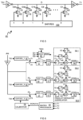
- Figure 4 is a block diagram of a 4-channel interleaved ADC with product derivative correlators and a matrix processor for calibration of programmable input delays.
- Analog input AIN is buffered by analog buffer 30 and sampled by switches 20, 22, 23, 24 into ADC 10, 12, 13, 14 that generate digital values D1, D2, D3, D4, respectively.
- Mux 64 alternately selects D1, D2, D3, D4 to generate the final data output DOUT.
- Final mux 64 operates with clock TSX4 that has four times the frequency of sampling clock TS1.
- Sampling clocks TS1, TS2, TS3, TS4 can be a four-phase clock all operating at the same frequency but with phase shifts of 0, 90, 180, and 270 degrees.
- Sampling clocks TS1, TS2, TS3, TS4 are delayed by variable delays to generate clocks T1, T2, T3, T4 that control switches 20, 22, 23, 24, respectively, that sample AIN to ADC 10, 12, 13, 14 that generate channel digital outputs D1, D2, D3, D4, having phases of 0, 90, 180, and 270 degrees.
- These variable delays are programmed during calibration with digital values that are stored in a Successive-Approximation-Register (SAR) that enable and disable binary-weighted capacitor delay elements.
- Calibration uses a Successive-Approximation method testing larger, Most-Significant Bit (MSB) capacitors first, then testing successively smaller capacitors until a Least-Significant Bit (LSB) capacitor is tested.
- MSB Most-Significant Bit
- SAR delay 40 delays sampling clock TS1 to generate T1 to switch 20, while SAR delays 42, 43, 44 delay sampling clocks TS2, TS3, TS4 to generate T2, T3, T4 to switches 22, 23, 24, respectively.
- the delay values programmed into SAR delays 40, 42, 43, 44 the timing skews between channels D1, D2, D3, D4 can be compensated for and matched to within the delay of 1 LSB capacitor in SAR delay 40, 42, 43, 44.
- Finite-Impulse-Response (FIR) filters 17 filter digital outputs D1, D2, D3, D4 from ADC 10, 12, 13, 14 to generate filtered digital values Y1, Y2, Y3, Y4.
- FIR filters 17 can act as lowpass or bandpass filters for calibration.
- Product derivative correlators 52 receive filtered digital values Y1, Y2, Y3, Y4 and generate product derivative factors F1, F2, F3, F4.
- the product derivative factor F2 is a function of the current channel filtered digital value Y2, and the adjacent channels Y1, Y3.
- the product derivative factor F(X) for a channel X has inputs Y(X), Y(X-1), and Y(X+1), where X-1 and X+1 are modulo N, where N is the number of interleaved channels.
- Each product derivative correlator 52 generates a correlation factor of the current channel compared to the two adjacent channels.
- Product derivative correlator 52 can be a mid-point correlator such as shown by the logic implemented of Fig. 6 .
- Matrix processor 50 receives product derivative factors F1, F2, F3, F4 from product derivative correlators 52, and forms a matrix from F1, F2, F3, F4 that is multiplied by a correlation matrix to generate sign bits.
- the correlation matrix is constant matrix that is fixed for a fixed number of channels N.
- the delay in SAR delay 40 is fixed and acts as a timing reference for the other N-1 channels. Therefore, the sign bit for channel 1 is not generated by matrix processor 50.
- Product derivative factors F1, F2, F3, F4 each indicate a digital value or timing difference between a channel and its two adjacent channels. These timing differences are combined with all other timing differences by matrix processor 50 to generate the sign bits.
- the sign bits indicate which channels have larger delays, and which channels have smaller delays.
- Calibrator 55 uses these sign bits during a successive-approximation sequence to decide when to keep a test bit set in SAR delay 42, 43, 44 and when to reset the test bit, as successively smaller bit-positions are tested.
- FIG. 5 is a diagram of a SAR delay element with binary-weighted capacitors.
- SAR delay 40 has input inverter 92 that inverts input sampling clock TS1 to drive delay node D, and output inverter 94 that drives local sampling clock T1 for channel 1.
- a series of binary-weighted capacitors 110, 108, 106, 104, ... 102 have capacitance values or weights of 64, 32, 16, 8, 4, 2, and 1 times a minimum capacitor value of C, C1 capacitor 102. All of binary-weighted capacitors 110, 108, 106, 104, ... 102 have one terminal that connects to delay node D between inverters 92, 94, and another terminal connected to ground through enabling transistors 120, 118, 116, 114, ... 112. Bits in SAR register 130 drive the gates of enabling transistors 120, 118, 116, 114, ... 112. When the bit in SAR register 130 is high, the enabling transistor is turned on, connecting the lower terminal of the capacitor to ground, enabling the capacitor and increasing the capacitance and delay of delay node D.
- the value 1010000 programmed into SAR register 130 enables transistors 120, 116, and capacitors 110, 106, increasing the capacitance on delay node D by 64C + 16C, or 80C.
- MSB capacitor 110 adds a 64C delay while capacitor 106 adds a 16C delay.
- Other SAR delays 42, 43, 44 operate in a similar manner and can each be programmed with a different SAR delay value.
- FIG. 6 is a block diagram of a 3-channel interleaved ADC with details of the product derivative correlators that drive a matrix processor for calibration of programmable input delays.
- this simplified 3-channel ADC there are only three ADC 10, 12, 13, three sampling switches 20, 22, 23, three SAR delays 40, 42, 43, and three inputs D1, D2, D3 to mux 64, which operates with clock TSX3.
- the three FIR filters 17 generate filtered digital values Y1, Y2, Y3 that are input to product derivative correlators 52-1, 52-2, and 52-3 for channels 1, 2, 3 that generate product derivative factors F1, F2, F3, respectively.
- Channel 2 product derivative correlator 52-2 has sample delay 11 delay Y2 before being input to multiplier 142, where its is multiplied by the sum from adder 140, which is Y3 delayed by sample delay 148 minus Y1 delayed by sample delay 146. Averager 54 then generates the average over M analog-input samples to generate product derivative factor F2.
- F2 is the average correlation of the current channel Y2 with its adjacent channels Y1, Y3.
- F2 is a product derivative correlation factor.
- F X Average Y X n ⁇ 1 * Y X + 1 n ⁇ 1 ⁇ Y X ⁇ 1 n ⁇ 1
- the sample number is also increased or decreased by 1.
- the correlation matrix is based on the shift matrix C, which is a square N x N matrix with N rows and N columns:
- C ⁇ 1 0 0 0 0 ... ... 0 0 ⁇ 1 2 ⁇ 1 0 0 0 ... ... 0 0 0 ⁇ 1 2 ⁇ 1 0 0 ... ... 0 0 0 0 ⁇ 1 2 ⁇ 1 0 ... ... 0 0 0 0 ⁇ ⁇ 1 2 ⁇ 1 0 ... ... 0 0 0 ⁇ ⁇ 0 0 0 0 ... ... ⁇ 1 2 ⁇ 1 0 0 0 0 0 0 0 ... ... 0 ⁇ 1 2
- the correlation matrix is the transpose of C, C T , divided by the product of the transpose of C, C T , and C, or:
- C T C T C INV C T C C T
- the inverse matrix INV of (C T * C) may be multiplied by C T .
- the adjacent channel correlation results from product derivative factors [F1, F2, F3, ... FN] is a variable that is multiplied by a constant to generate the sign bits.
- Sign bits sign(2), sign(3), ...sign(N) form a 1-diemsional matrix or a vector, and can be transposed from a vertical 1 x N matrix to a horizontal N x 1 matrix for easier processing or data storage.
- SAR delay 40 is set with a fixed delay value, such as a mid-point value of 10000...0, while SAR delays 42, 43 have bits set and cleared by calibrator 55 during a SAR routine.
- calibrator 55 sets high the bit in SAR delay 42, but when sign bit sign(2) is low, calibrator 55 clears low the bit in SAR delay 42.
- sign bit sign(3) generated by matrix processor 50 is high, calibrator 55 sets high the bit in SAR delay 43, but when sign bit sign(3) is low, calibrator 55 clears low the bit in SAR delay 43.
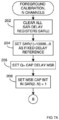
- Figures 7A-7B is a flowchart of foreground calibration of N ADC channels interleaved together. This process can be used to initially calibrate the 4-way interleaved ADC of Fig. 4 , the 3-way interleaved ADC of Fig. 6 , the 6-way interleaved ADC of Fig. 11 , the 7-way interleaved ADC of Fig. 12 , or any arbitrary N-way interleaved ADC, where N is a whole number of at least 3.
- SAR delay 40 for the first channel, SAR(1) is set to the midpoint value of 1000...0, step 204.
- the first channel acts as a fixed timing reference for correlation with the other channels, so SAR(1) remains fixed for the rest of foreground calibration.
- the other channels have bits in their SAR(J) set or cleared during calibration.
- the current bit-position Q in SAR delays 42, 42, 44, SAR(J), is set to the MSB of the variable delay or variable capacitor, step 206.
- product derivative correlators 52 generate product derivative factors F1, F2, F3, F4, ...FN that are each the average correlation to adjacent channels over M samples, step 210.
- Matrix processor 50 arranges product derivative factors F1, F2, F3, F4,...FN into a matrix F and multiples it by the correlation matrix, C T /( C T *C), step 212.
- the result from matrix processor 50 is sign vector sign(2...N). This sign vector has one sign bit for each of channels 2 to N. Each sign bit indicates the sign of the correlated delay difference for that channel relative to the first channel.
- step 214 calibrator 55 keeps SAR(Q) high for that channel.
- the added delay in SAR delay 42, 43, 44 was not large enough.
- SAR(Q) is the corresponding bit in SAR delay 42, 43, 44 for bit-position Q.
- step 216 calibrator 55 clears SAR(Q) to 0 for that channel.
- the added delay in SAR delay 42, 43, 44 was too large.
- step 222 When Q has not yet reached the LSB, step 222, then Q is decremented, step 224, and the next significant bit Q in SAR delay 42, 43, 44 is set, step 218.
- product derivative correlators 52 generate new values of product derivative factors F1, F2, F3, F4,...Fn using the new delay values in SAR delay 42, 43, 44 set by calibrator 55 in step 218.
- Matrix processor 50 generates new sign bits, step 212, and calibrator 55 clears any bits that have zero sign bits, step 216.
- This process repeats for successively smaller Q bit-positions and smaller added capacitances in steps 210-224 until Q reaches the LSB, step 222, when calibration ends.
- Figure 8 is a graph of reduced spurious tones in a spectrum for an interleaved ADC with channel input delays calibrated by product derivative correlators and matrix processing. Sampling pulse-width mismatches and component mismatches that introduce non-linearities or errors are compensated for by the calibration routine of Figs. 7A-7B adjusting the programmable delays in SAR delay 40, 42, 43, 44 in the interleaved ADC shown in Fig. 4 . This calibration reduces the amplitude of spurious tones 303.
- N is the number of channels interleaved together.
- the amplitude of spurious tones 303 are reduced when compared with spurious tones 302 of the prior-art of Fig. 3 .
- Figure 9 shows a backend processor triggering background calibration of an interleaved ADC.
- Foreground calibration such as shown in Figs. 7A-7B , can be triggered on power-up, initialization, or a reset.
- This foreground calibration uses product derivative correlators and a matrix processor with calibrator 55 to perform Successive-Approximation searches that load delay values into SAR delay registers 744 in interleaved ADC 730 to compensate for timing skews among ADC channels in interleaved ADC 730.
- Temperature and voltage conditions can drift over time. Switches, delays, ADCs, and other components and their errors can be temperature and voltage dependent.
- the circuitry in interleaved ADC 730 is sensitive to temperature and voltage. Over time, as the system heats up or as the environment changes, temperature and supply-voltage changes may cause increased timing skews in interleaved ADC 730. As conditions drift, the calibrated delays may need to be updated to compensate for this drift. Background calibration can be triggered periodically to compensate for these drifts.
- Downstream device 732 could be a baseband modem, a Digital Signal Processor (DSP), a Field-Programmable Logic Array (FPGA), or other device that uses the digital output DOUT from interleaved ADC 730.
- Downstream device 732 may include logic that detects when temperature, voltage, or other conditions have changed and trigger interleaved ADC 730 to perform background calibration.
- Downstream device 732 could have a timer and trigger background calibration after some period of time, such as hourly or daily.
- Downstream device 732 could detect idle times or times when the analog input AIN has a suitable signal strength and frequency for calibration.
- Patterngeneration logic integrated with interleaved ADC 730 may also be enabled to generate suitable analog input AIN signals for calibration.
- FIGS 10A-10B show a flowchart of a background calibration process. Background calibration is performed after foreground calibration has completed and calibrated delays are loaded into all of SAR delay 40, 42, 43, 44,... SAR(J) and re-used, step 252.
- Product derivative correlators 52 generate product derivative factors F1, F2, F3, F4, ...FN that are each the average correlation to adjacent channels over M samples, step 260.
- Matrix processor 50 arranges product derivative factors F1, F2, F3, F4,...FN into a matrix F and multiples it by the correlation matrix, C T /(C T *C), step 262.
- the result from matrix processor 50 is sign vector sign(2...N). This sign vector has one sign bit for each of channels 2 to N.
- calibrator 55 adds one LSB to the delay value in SAR delay 42, 43, 44 for that channel X.
- the added delay in SAR delay 42, 43, 44 was not large enough.
- step 256 calibrator 55 subtracts one LSB from the SAR delay value SAR(X) for that channel. The added delay in SAR delay 42, 43, 44 was too large.
- the sign vector sign(2..N) is stored as the old sign vector old_sign(2..N), step 258.
- Product derivative correlators 52 again generate product derivative factors F1, F2, F3, F4, ...FN that are each the average correlation to adjacent channels over M samples, step 270.
- Matrix processor 50 once again arranges product derivative factors F1, F2, F3, F4,...FN into a matrix F and multiples it by the correlation matrix, C T /(C T *C), step 272.
- the result from matrix processor 50 is the new sign vector sign(2...N).
- step 274 When the sign bit for a channel X has changed, so that sign(X) is not equal to old_sign(X), step 274, then the LSB either added in step 254 or subtracted in step 256 is removed, such as by subtracting one LSB or adding one LSB, or by re-loading the prior value in SAR(X) before the last loop.
- a flip indicator for that channel X is incremented when the sign bit changes.
- step 276 When a flip limit is not yet reached, step 276, then another loop begins.
- step 264 When the sign bit for a channel X is 1, and the old sign bit old_sign(X) was also 1, step 264, then calibrator 55 adds one LSB to the delay value in SAR delay 42, 43, 44 for that channel X.
- step 266 calibrator 55 subtracts one LSB from the SAR delay value SAR(X) for that channel. Then steps 258, 270, 272, 274 are repeated.
- the flip limit can be when each of the channels has flipped in each of the last FL loops or can require that the majority of the channels have flipped in each of the last FL loop, or to some other endpoint condition.
- FL could be 20.
- each loop iteration successively adds and removes the LSB in each channel's SAR, indicating that a steady-state has been reached and further iterations do not result in better skew matching.
- the flip limit FL can be set to as little as 1, or to a larger value for better robustness.
- the MSB is used for foreground calibration when large changes in delay are desirable to converge on the calibration result more rapidly.
- the LSB is used for background calibration, since the drift is not expected to be large, so slower adjustments are more desirable for background calibration.
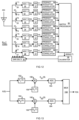
- Six product derivative correlators 52 generate product derivative factors F1, F2, F3, F4, F5, F5, F6 that form a matrix that is multiplied by the correlation matrix in matrix processor 50 to generate sign bit vector sign(2..6) that controls calibrator 55 adjusting delay values in SAR delay 40.
- F ⁇ E Y 1 n ⁇ 1 Y 2 n ⁇ 1 ⁇ Y 6 n ⁇ 2 E Y 2 n ⁇ 1 Y 3 n ⁇ 1 ⁇ Y 1 n ⁇ 1 E Y 3 n ⁇ 1 Y 4 n ⁇ 1 ⁇ Y 2 n ⁇ 1 E Y 4 n ⁇ 1 Y 5 n ⁇ 1 ⁇ Y 3 n ⁇ 1 E Y 5 n ⁇ 1 Y 6 n ⁇ 1 ⁇ Y 4 n ⁇ 1 E Y 6 n ⁇ 1 Y 1 n ⁇ Y 5 n ⁇ 1
- Figure 12 shows a non-binary odd number of ADCs interleaved and calibrated with product derivative correlators and a matrix processor.
- N 7 ADC channels that generate filtered outputs Y1, Y2, Y3, ... Y7.
- Switches 20-27 sample the analog input to ADC 10-16, 19, which are filtered by FIR filters 17 and drive seven product derivative correlators 52.
- Seven product derivative correlators 52 generate product derivative factors F1, F2, F3, F4, F5, F5, F6, F7 that form a matrix that is multiplied by the correlation matrix in matrix processor 50 to generate sign bit vector sign(2..7) that controls calibrator 55 adjusting delay values in SAR delay 40.
- ⁇ T i denotes the timing skew mismatch in a channel i relative to a reference channel.
- Figure 13 shows a model of an interleaved ADC.
- An analog input X(S) is sampled by first sampler 152 as function H 1 (S), which is multiplied by first multiplier 158 with first delay 156 D 1 (T) to generate X S1 (S) that is input to first ADC 154.
- analog input X(S) is also sampled by second sampler 162 as function H 2 (S), which is multiplied by second multiplier 168 with second delay 166 D 2 (T) to generate X S2 (S) that is input to second ADC 164.
- the digital outputs of first ADC 154 and second ADC 164 are muxed together by mux 150 to generate output Y(S).
- sampled analog signal (odd) and (even) are given by:
- Odd image replica from H 2 (s) is well-cancelled with Hi(s), in other words, bandwidth of X(s) could be double due to ping-pong sampling system as expected.
- error image i.e. uncorrected odd image replica
- H 1 (s) ⁇ H 2 (s) if ⁇ T ⁇ 0.
- E bw (s) and E sk (s) account the effect of finite bandwidth and timing-skew mismatches, respectively.
- H(s) is a desired response of loop filter common to ping-pong channels
- the above equation is also identical to: e sk t ⁇ ⁇ x ⁇ t ⁇ 1 ⁇ o ⁇ 2 x ⁇ t 2 + 1 ⁇ o 2 ⁇ 3 x ⁇ t 3 ⁇ 1 ⁇ o 3 ⁇ 4 x ⁇ t 4 + ⁇ ⁇ T e bw t ⁇ ⁇ 1 ⁇ o ⁇ x ⁇ t ⁇ 2 ⁇ o 2 ⁇ 2 x ⁇ t 2 + 3 ⁇ o 3 ⁇ 3 x ⁇ t 3 ⁇ 4 ⁇ o 4 ⁇ 4 x ⁇ t 4 + ⁇ ⁇ ⁇ o o
- first order error term is bounded by +/- 1.064ps (in modern multi-GS/s ADC).
- linearity performance can be reduced by design of a wider sampling bandwidth (lower ⁇ SAMP ) that tradeoff fundamentally with noise, power and other circuit design physical constraints.
- Error signal is proportional to amplitude A and Frequency of signal.
- Error signals appear at 90deg, 180deg, 270deg and so on (i.e. integer*Fs/2 ⁇ Fin) -> spurious tones. Both sampling pulse and finite bandwidth mismatches appear as pulse width difference error among channels. Therefore, it is possible to cancel it by adjusting the sampling pulse width via variable delay elements before samplers to align their effective sampling pulse width.
- clocks may be derived from other clocks and thus synchronized.
- Clocks may be buffered, enabled, and qualified by logic.
- the analog input signal may be buffered in a variety of ways and buffer arrangements or trees. While initial clearing of all bits in all SARs has been described, the SAR bits could all be initially cleared to a high state rather than to a low state. Active-low rather than active-high bit could be used.
- Binary-weighted capacitors 110, 108, 106, 104, ... 102 could be connected to the power-supply or to some other voltage rather than to ground. These capacitors may be enabled by p-channel or n-channel transistors, and the bits stored in SAR delay 40 may be active-high or active-low, and these bits may be encoded in various ways and need to be decoded by a decoder in SAR delay 40. While binary-weighted capacitors 110, 108, 106, 104, ...
- these capacitors could have other weight sequences, such as 1C, 1C, 2C, 5C, 11C, 15C, etc., and the Successive-Approximation-Register (SAR) programming could be adjusted for these non-binary sequence of weights.
- SAR delay 40 could employ other weighted delay elements, such as resistors, transistors or buffers of various sizes or weights. While binary-weighted capacitors have been described, other weightings could be substituted, such as decimally-weighted, prime-weighted, or linearly-weighted, or octal-weighted.
- the digital delay value in the SAR could be in these other number systems, such as octal numbers rather than binary numbers.
- Other kinds of delay elements could be substituted, such as parallel current sources, resistors, or various combinations, and in parallel, serial, or combined network arrangements. Values may be shifted, transformed, or processed in a variety of ways.
- Switches 20, 22, 23, 24 may be simple transistor switches, pass transistors, transmission gates, or other kinds of switches.
- Sample delay 11, 146, 148 may be implemented as a latch or other storage element or as a delay with combinational logic including NAND, NOR, XOR, XNOR gates. Rather than use capacitors for delay elements, MOSFETs, FinFETs, or other devices, either p-channel or n-channel, driven to power or ground, may be used as delay elements.
- first channel's SAR delay 40 has been described in step 204 as being initialized to the midpoint value of 1000..0, a different channel could be initialized, or the initial value could be another value, such as 0100..0, 0010..0, etc. Any channel could act as the fixed timing reference, and the timing delay of that fixed reference could be any value.
- Matrix processor 50 may use a Digital Signal Processor (DSP) or other processor that is efficient when performing matrix operations.
- Product derivative correlators 52 may be implemented in hardware and in parallel for high-speed calibration. Various combinations of hardware, firmware, and software may be used in these implementations and for calibrator 55.
- FIR filters 17 can act as lowpass or bandpass filters for calibration, as long as the polarity of its correlation derivatives is known. FIR filtering can help define the polarity of its correlation derivatives to a well-defined value or specification to calibrate the interleaved ADC for a known frequency range. Since correlation derivatives are frequency dependent, FIR filtering can prevent any potential convergence problems during calibration.
- Sample delays 11, 146, 148 each could be reduced by 1 sample delay period for very fast logic that does not require pipelining to meet timing requirements. Alternately, these sample delays could be increased by 1 or more samples for very fast pipelined systems with slow logic delays.
- the process steps could be performed serially, or some steps may be performed in parallel. Various sequences may be adjusted or modified. Higher-level operations may be performed in software or firmware, such as SAR testing and decision logic, while lower-level functions may be performed in hardware, such as using product derivative correlator 52 to generate product derivative factors F1, F2, F3, F4. Some or all of the calibration routine could be replaced with hardware such as programmable logic, FPGA, or other logic gates on an Integrated Circuit (IC) or another chip. Various combinations of hardware, software, firmware, etc. may be substituted.
- Product derivative correlators could operate upon more than 3 inputs as another alternative.
- Analog input buffers could be rearranged, so that one analog input buffer drives 4 or 2 ADCs, or there may be a tree structure of analog input buffers with multiple levels.
- the number of samples averaged M could be different for foreground and background calibration and could even differ for different capacitor bit-positions, such as more samples for LSB's that are more sensitive and fewer samples for MSBs. M could also differ for other reasons such as varying voltage or temperature conditions.
- the analog input signal AIN does not have to be a sine wave, but could be other forms of AC signals, such as a triangular wave, sine waves of different frequencies that are superimposed, or any wireless baseband signal.
- these signals may be used as input signals for calibration.
- Averaging of the product derivative factors F1, F2, F3, F4 could be performed by setting a flip-flop when the sign bit is 1 and clearing the flip-flop when the sign bit is 0 for the current sum.
- a flip limit FL may be used for ending background calibration when incrementing the LSB keeps flipping sign bits more than the FL times.
- background calibration can end when the sign bits first flip.
- the number of channels N can be binary, non-binary, even or odd. While 4 channel interleaving has been shown in detail, 8-channel, 7-channel, 6-channel, 16-channel, 32-channel, or N-channel interleaved ADC's may be substituted. The interleave order of the channels may be changed. Interleaving may be nested or may be one long loop at level 1.
- Additional components may be added at various nodes, such as resistors, capacitors, inductors, transistors, etc., and parasitic components may also be present. Enabling and disabling the circuit could be accomplished with additional transistors or in other ways. Pass-gate transistors or transmission gates could be added for isolation. Inversions may be added, or extra buffering. Capacitors may be connected together in parallel to create larger capacitors that have the same fringing or perimeter effects across several capacitor sizes. Switches could be n-channel transistors, p-channel transistors, or transmission gates with parallel n-channel and p-channel transistors, or more complex circuits, either passive or active, amplifying or non-amplifying.
- the number of ADC digital bits may be adjusted. For example, a 15 bit ADC could be used, or an 8-bit, 6-bit, 22-bit, or 18-bit. A different number of bits could be substituted for a different precision, and the number of bits could be fixed or could be variable.
- the background of the invention section may contain background information about the problem or environment of the invention rather than describe prior art by others. Thus, inclusion of material in the background section is not an admission of prior art by the Applicant.
- Tangible results generated may include reports or other machine-generated displays on display devices such as computer monitors, projection devices, audio-generating devices, and related media devices, and may include hardcopy printouts that are also machine-generated. Computer control of other machines is another tangible result.
Landscapes
- Engineering & Computer Science (AREA)
- Theoretical Computer Science (AREA)
- Analogue/Digital Conversion (AREA)
Applications Claiming Priority (1)
| Application Number | Priority Date | Filing Date | Title |
|---|---|---|---|
| US17/537,460 US11641210B1 (en) | 2021-11-18 | 2021-11-29 | Matrix processor generating SAR-searched input delay adjustments to calibrate timing skews in a multi-channel interleaved analog-to-digital converter (ADC) |
Publications (3)
| Publication Number | Publication Date |
|---|---|
| EP4187792A1 true EP4187792A1 (de) | 2023-05-31 |
| EP4187792B1 EP4187792B1 (de) | 2025-03-19 |
| EP4187792C0 EP4187792C0 (de) | 2025-03-19 |
Family
ID=81997409
Family Applications (1)
| Application Number | Title | Priority Date | Filing Date |
|---|---|---|---|
| EP22178075.2A Active EP4187792B1 (de) | 2021-11-29 | 2022-06-09 | Matrixprozessor, der sar-gesuchte eingangsverzögerungseinstellungen erzeugt, um zeitversätze in einem mehrkanaligen verschachtelten analog-digital-wandler (adc) zu kalibrieren |
Country Status (2)
| Country | Link |
|---|---|
| EP (1) | EP4187792B1 (de) |
| CN (1) | CN114650056B (de) |
Families Citing this family (1)
| Publication number | Priority date | Publication date | Assignee | Title |
|---|---|---|---|---|
| CN116318142B (zh) * | 2023-02-08 | 2024-05-03 | 北京士模微电子有限责任公司 | 一种模数转换器的校准方法和模数转换器 |
Citations (2)
| Publication number | Priority date | Publication date | Assignee | Title |
|---|---|---|---|---|
| US8159377B2 (en) * | 2010-08-31 | 2012-04-17 | Texas Instruments Incorporated | System, method, and circuitry for blind timing mismatch estimation of interleaved analog-to-digital converters |
| US20180358976A1 (en) * | 2015-07-08 | 2018-12-13 | No. 24 Research Institute of China Electronics Technology Group Corporation | Device and method for correcting error estimation of analog-to-digital converter |
Family Cites Families (5)
| Publication number | Priority date | Publication date | Assignee | Title |
|---|---|---|---|---|
| EP2457328B1 (de) * | 2009-07-24 | 2014-03-26 | Technion Research and Development Foundation, Ltd. | Auf Mehrphasen-Interferometrie basierender photonischer Ultrahochgeschwindigkeits-A/D-Wandler |
| CN101718562B (zh) * | 2009-11-20 | 2011-04-20 | 电子科技大学 | 一种多通道高速并行交替采集系统的误差实时校正方法 |
| US9281834B1 (en) * | 2012-09-05 | 2016-03-08 | IQ-Analog Corporation | N-path interleaving analog-to-digital converter (ADC) with offset gain and timing mismatch calibration |
| US10033395B1 (en) * | 2017-08-23 | 2018-07-24 | Xilinx, Inc. | Systems and methods for analog to digital conversion |
| WO2021061857A1 (en) * | 2019-09-23 | 2021-04-01 | Brigham Young University | Time-interleaved successive approximation register analog to digital converter with grouped digital to analog capacitors |
-
2022
- 2022-04-06 CN CN202210359547.5A patent/CN114650056B/zh active Active
- 2022-06-09 EP EP22178075.2A patent/EP4187792B1/de active Active
Patent Citations (2)
| Publication number | Priority date | Publication date | Assignee | Title |
|---|---|---|---|---|
| US8159377B2 (en) * | 2010-08-31 | 2012-04-17 | Texas Instruments Incorporated | System, method, and circuitry for blind timing mismatch estimation of interleaved analog-to-digital converters |
| US20180358976A1 (en) * | 2015-07-08 | 2018-12-13 | No. 24 Research Institute of China Electronics Technology Group Corporation | Device and method for correcting error estimation of analog-to-digital converter |
Non-Patent Citations (2)
| Title |
|---|
| MANAR EL-CHAMMAS ET AL: "A 12-GS/s 81-mW 5-bit Time-Interleaved Flash ADC With Background Timing Skew Calibration", IEEE JOURNAL OF SOLID-STATE CIRCUITS, IEEE, USA, vol. 46, no. 4, 3 March 2011 (2011-03-03), pages 838 - 847, XP011351080, ISSN: 0018-9200, DOI: 10.1109/JSSC.2011.2108125 * |
| YI RU ET AL: "Digital Compensation for Timing Mismatches in Interleaved ADCs", ASIAN TEST SYMPOSIUM. PROCEEDINGS, IEEE, US, 18 November 2013 (2013-11-18), pages 134 - 139, XP032536904, ISSN: 1081-7735, [retrieved on 20131220], DOI: 10.1109/ATS.2013.34 * |
Also Published As
| Publication number | Publication date |
|---|---|
| EP4187792B1 (de) | 2025-03-19 |
| EP4187792C0 (de) | 2025-03-19 |
| CN114650056B (zh) | 2026-03-03 |
| CN114650056A (zh) | 2022-06-21 |
Similar Documents
| Publication | Publication Date | Title |
|---|---|---|
| US11641210B1 (en) | Matrix processor generating SAR-searched input delay adjustments to calibrate timing skews in a multi-channel interleaved analog-to-digital converter (ADC) | |
| US11632121B1 (en) | Calibration of timing skews in a multi-channel interleaved analog- to-digital converter (ADC) by auto-correlation of muxed-together channels in binary output tree | |
| Matsuno et al. | All-digital background calibration technique for time-interleaved ADC using pseudo aliasing signal | |
| US9608652B2 (en) | Methods and apparatus for reducing timing-skew errors in time-interleaved analog-to-digital converters | |
| Razavi | Problem of timing mismatch in interleaved ADCs | |
| US6177893B1 (en) | Parallel processing analog and digital converter | |
| US20130106632A1 (en) | Calibration of interleaved adc | |
| US6339390B1 (en) | Adaptive parallel processing analog and digital converter | |
| US7839323B2 (en) | Error estimation and correction in a two-channel time-interleaved analog-to-digital converter | |
| EP2690787B1 (de) | Fehlanpassungskorrektur eines Zeitverschachtelten Analog-Digital-Wandlers | |
| US8730072B2 (en) | Interleaved ADC calibration | |
| JP5288003B2 (ja) | A/d変換装置とその補正制御方法 | |
| EP4475441B1 (de) | Analog-digital-wandler (adc) mit attenuiertem eingangsempfang zum erzeugen von fehlercodes für zweite und dritte durch zählen von negativen und positiven codes | |
| US20130049999A1 (en) | Analog/digital converter and semiconductor integrated circuit device | |
| CN104753536A (zh) | A/d转换器电路和半导体集成电路 | |
| JP2016213826A (ja) | タイムインターリーブ型ad変換器 | |
| US20230155599A1 (en) | Multi-Channel Interleaved Analog-to-Digital Converter (ADC) using Overlapping Multi-Phase Clocks with SAR-Searched Input-Clock Delay Adjustments and Background Offset and Gain Correction | |
| JP2008515341A (ja) | 周波数合成の方法と装置 | |
| CN108768396A (zh) | 一种用于多通道adc的时钟相位失配校准电路 | |
| EP4187792A1 (de) | Matrixprozessor, der sar-gesuchte eingangsverzögerungseinstellungen erzeugt, um zeitversätze in einem mehrkanaligen verschachtelten analog-digital-wandler (adc) zu kalibrieren | |
| Hovakimyan et al. | Digital correction of time interleaved DAC mismatches | |
| CN114650057B (zh) | 使用具有输入时钟延迟调整、背景偏移和增益校正的重叠多相时钟的多通道交替式adc | |
| Xiong et al. | Fast convergent background calibration technique for timing mismatch in M-channel time-interleaved ADCs | |
| Vogel et al. | Modeling of time-interleaved ADCs with nonlinear hybrid filter banks | |
| Qin et al. | Machine-learning-based mismatch calibration for time-interleaved ADCs |
Legal Events
| Date | Code | Title | Description |
|---|---|---|---|
| PUAI | Public reference made under article 153(3) epc to a published international application that has entered the european phase |
Free format text: ORIGINAL CODE: 0009012 |
|
| STAA | Information on the status of an ep patent application or granted ep patent |
Free format text: STATUS: REQUEST FOR EXAMINATION WAS MADE |
|
| 17P | Request for examination filed |
Effective date: 20220609 |
|
| AK | Designated contracting states |
Kind code of ref document: A1 Designated state(s): AL AT BE BG CH CY CZ DE DK EE ES FI FR GB GR HR HU IE IS IT LI LT LU LV MC MK MT NL NO PL PT RO RS SE SI SK SM TR |
|
| STAA | Information on the status of an ep patent application or granted ep patent |
Free format text: STATUS: EXAMINATION IS IN PROGRESS |
|
| 17Q | First examination report despatched |
Effective date: 20231019 |
|
| GRAP | Despatch of communication of intention to grant a patent |
Free format text: ORIGINAL CODE: EPIDOSNIGR1 |
|
| STAA | Information on the status of an ep patent application or granted ep patent |
Free format text: STATUS: GRANT OF PATENT IS INTENDED |
|
| INTG | Intention to grant announced |
Effective date: 20241106 |
|
| GRAJ | Information related to disapproval of communication of intention to grant by the applicant or resumption of examination proceedings by the epo deleted |
Free format text: ORIGINAL CODE: EPIDOSDIGR1 |
|
| STAA | Information on the status of an ep patent application or granted ep patent |
Free format text: STATUS: EXAMINATION IS IN PROGRESS |
|
| INTC | Intention to grant announced (deleted) | ||
| GRAP | Despatch of communication of intention to grant a patent |
Free format text: ORIGINAL CODE: EPIDOSNIGR1 |
|
| STAA | Information on the status of an ep patent application or granted ep patent |
Free format text: STATUS: GRANT OF PATENT IS INTENDED |
|
| GRAS | Grant fee paid |
Free format text: ORIGINAL CODE: EPIDOSNIGR3 |
|
| INTG | Intention to grant announced |
Effective date: 20250113 |
|
| GRAA | (expected) grant |
Free format text: ORIGINAL CODE: 0009210 |
|
| STAA | Information on the status of an ep patent application or granted ep patent |
Free format text: STATUS: THE PATENT HAS BEEN GRANTED |
|
| AK | Designated contracting states |
Kind code of ref document: B1 Designated state(s): AL AT BE BG CH CY CZ DE DK EE ES FI FR GB GR HR HU IE IS IT LI LT LU LV MC MK MT NL NO PL PT RO RS SE SI SK SM TR |
|
| REG | Reference to a national code |
Ref country code: GB Ref legal event code: FG4D |
|
| REG | Reference to a national code |
Ref country code: CH Ref legal event code: EP |
|
| REG | Reference to a national code |
Ref country code: IE Ref legal event code: FG4D |
|
| REG | Reference to a national code |
Ref country code: DE Ref legal event code: R096 Ref document number: 602022011869 Country of ref document: DE |
|
| U01 | Request for unitary effect filed |
Effective date: 20250409 |
|
| U07 | Unitary effect registered |
Designated state(s): AT BE BG DE DK EE FI FR IT LT LU LV MT NL PT RO SE SI Effective date: 20250416 |
|
| U20 | Renewal fee for the european patent with unitary effect paid |
Year of fee payment: 4 Effective date: 20250528 |
|
| PG25 | Lapsed in a contracting state [announced via postgrant information from national office to epo] |
Ref country code: RS Free format text: LAPSE BECAUSE OF FAILURE TO SUBMIT A TRANSLATION OF THE DESCRIPTION OR TO PAY THE FEE WITHIN THE PRESCRIBED TIME-LIMIT Effective date: 20250619 |
|
| PG25 | Lapsed in a contracting state [announced via postgrant information from national office to epo] |
Ref country code: NO Free format text: LAPSE BECAUSE OF FAILURE TO SUBMIT A TRANSLATION OF THE DESCRIPTION OR TO PAY THE FEE WITHIN THE PRESCRIBED TIME-LIMIT Effective date: 20250619 |
|
| PG25 | Lapsed in a contracting state [announced via postgrant information from national office to epo] |
Ref country code: HR Free format text: LAPSE BECAUSE OF FAILURE TO SUBMIT A TRANSLATION OF THE DESCRIPTION OR TO PAY THE FEE WITHIN THE PRESCRIBED TIME-LIMIT Effective date: 20250319 |
|
| PG25 | Lapsed in a contracting state [announced via postgrant information from national office to epo] |
Ref country code: GR Free format text: LAPSE BECAUSE OF FAILURE TO SUBMIT A TRANSLATION OF THE DESCRIPTION OR TO PAY THE FEE WITHIN THE PRESCRIBED TIME-LIMIT Effective date: 20250620 |
|
| PG25 | Lapsed in a contracting state [announced via postgrant information from national office to epo] |
Ref country code: SM Free format text: LAPSE BECAUSE OF FAILURE TO SUBMIT A TRANSLATION OF THE DESCRIPTION OR TO PAY THE FEE WITHIN THE PRESCRIBED TIME-LIMIT Effective date: 20250319 |
|
| PG25 | Lapsed in a contracting state [announced via postgrant information from national office to epo] |
Ref country code: ES Free format text: LAPSE BECAUSE OF FAILURE TO SUBMIT A TRANSLATION OF THE DESCRIPTION OR TO PAY THE FEE WITHIN THE PRESCRIBED TIME-LIMIT Effective date: 20250319 |
|
| PG25 | Lapsed in a contracting state [announced via postgrant information from national office to epo] |
Ref country code: PL Free format text: LAPSE BECAUSE OF FAILURE TO SUBMIT A TRANSLATION OF THE DESCRIPTION OR TO PAY THE FEE WITHIN THE PRESCRIBED TIME-LIMIT Effective date: 20250319 |
|
| PG25 | Lapsed in a contracting state [announced via postgrant information from national office to epo] |
Ref country code: CZ Free format text: LAPSE BECAUSE OF FAILURE TO SUBMIT A TRANSLATION OF THE DESCRIPTION OR TO PAY THE FEE WITHIN THE PRESCRIBED TIME-LIMIT Effective date: 20250319 |
|
| PG25 | Lapsed in a contracting state [announced via postgrant information from national office to epo] |
Ref country code: SK Free format text: LAPSE BECAUSE OF FAILURE TO SUBMIT A TRANSLATION OF THE DESCRIPTION OR TO PAY THE FEE WITHIN THE PRESCRIBED TIME-LIMIT Effective date: 20250319 |
|
| PG25 | Lapsed in a contracting state [announced via postgrant information from national office to epo] |
Ref country code: IS Free format text: LAPSE BECAUSE OF FAILURE TO SUBMIT A TRANSLATION OF THE DESCRIPTION OR TO PAY THE FEE WITHIN THE PRESCRIBED TIME-LIMIT Effective date: 20250719 |
|
| U1N | Appointed representative for the unitary patent procedure changed after the registration of the unitary effect |
Representative=s name: SANTARELLI; FR |
|
| PLBE | No opposition filed within time limit |
Free format text: ORIGINAL CODE: 0009261 |
|
| STAA | Information on the status of an ep patent application or granted ep patent |
Free format text: STATUS: NO OPPOSITION FILED WITHIN TIME LIMIT |
|
| REG | Reference to a national code |
Ref country code: CH Ref legal event code: H13 Free format text: ST27 STATUS EVENT CODE: U-0-0-H10-H13 (AS PROVIDED BY THE NATIONAL OFFICE) Effective date: 20260127 |
|
| REG | Reference to a national code |
Ref country code: CH Ref legal event code: L10 Free format text: ST27 STATUS EVENT CODE: U-0-0-L10-L00 (AS PROVIDED BY THE NATIONAL OFFICE) Effective date: 20260128 |
|
| PG25 | Lapsed in a contracting state [announced via postgrant information from national office to epo] |
Ref country code: MC Free format text: LAPSE BECAUSE OF FAILURE TO SUBMIT A TRANSLATION OF THE DESCRIPTION OR TO PAY THE FEE WITHIN THE PRESCRIBED TIME-LIMIT Effective date: 20250319 |
|
| 26N | No opposition filed |
Effective date: 20251222 |
|
| PG25 | Lapsed in a contracting state [announced via postgrant information from national office to epo] |
Ref country code: IE Free format text: LAPSE BECAUSE OF NON-PAYMENT OF DUE FEES Effective date: 20250609 |