EP4187883B1 - Verfahren und system zur notrufweiterleitung bei einem psap-ausfall - Google Patents
Verfahren und system zur notrufweiterleitung bei einem psap-ausfall Download PDFInfo
- Publication number
- EP4187883B1 EP4187883B1 EP21211526.5A EP21211526A EP4187883B1 EP 4187883 B1 EP4187883 B1 EP 4187883B1 EP 21211526 A EP21211526 A EP 21211526A EP 4187883 B1 EP4187883 B1 EP 4187883B1
- Authority
- EP
- European Patent Office
- Prior art keywords
- psap
- fallback
- failed
- call
- sip
- Prior art date
- Legal status (The legal status is an assumption and is not a legal conclusion. Google has not performed a legal analysis and makes no representation as to the accuracy of the status listed.)
- Active
Links
Images




Classifications
-
- H—ELECTRICITY
- H04—ELECTRIC COMMUNICATION TECHNIQUE
- H04W—WIRELESS COMMUNICATION NETWORKS
- H04W76/00—Connection management
- H04W76/50—Connection management for emergency connections
-
- H—ELECTRICITY
- H04—ELECTRIC COMMUNICATION TECHNIQUE
- H04L—TRANSMISSION OF DIGITAL INFORMATION, e.g. TELEGRAPHIC COMMUNICATION
- H04L65/00—Network arrangements, protocols or services for supporting real-time applications in data packet communication
- H04L65/1066—Session management
- H04L65/1083—In-session procedures
-
- H—ELECTRICITY
- H04—ELECTRIC COMMUNICATION TECHNIQUE
- H04L—TRANSMISSION OF DIGITAL INFORMATION, e.g. TELEGRAPHIC COMMUNICATION
- H04L65/00—Network arrangements, protocols or services for supporting real-time applications in data packet communication
- H04L65/10—Architectures or entities
- H04L65/1063—Application servers providing network services
-
- H—ELECTRICITY
- H04—ELECTRIC COMMUNICATION TECHNIQUE
- H04L—TRANSMISSION OF DIGITAL INFORMATION, e.g. TELEGRAPHIC COMMUNICATION
- H04L69/00—Network arrangements, protocols or services independent of the application payload and not provided for in the other groups of this subclass
- H04L69/40—Network arrangements, protocols or services independent of the application payload and not provided for in the other groups of this subclass for recovering from a failure of a protocol instance or entity, e.g. service redundancy protocols, protocol state redundancy or protocol service redirection
-
- H—ELECTRICITY
- H04—ELECTRIC COMMUNICATION TECHNIQUE
- H04W—WIRELESS COMMUNICATION NETWORKS
- H04W76/00—Connection management
- H04W76/10—Connection setup
- H04W76/15—Setup of multiple wireless link connections
-
- H—ELECTRICITY
- H04—ELECTRIC COMMUNICATION TECHNIQUE
- H04W—WIRELESS COMMUNICATION NETWORKS
- H04W76/00—Connection management
- H04W76/10—Connection setup
- H04W76/18—Management of setup rejection or failure
Definitions
- the present invention relates to a method and a system for re-establishing a disconnected emergency call to an emergency call network.
- PSAP Public Safety Answering Point
- the PSAPs comprise one of the most important elements of the NG911 architecture. This holds true for two main reasons. The first one relates to the positioning of these elements in the ESlnet, and the second one to the fact that they host the actual trained professionals that will answer an emergency call. In this respect, it becomes apparent that the efficient selection, along with providing accurate data of the appropriate PSAP that will handle the emergency call, is very important for the overall handling of the emergency incident.
- One problem that can occur during an emergency call is a disconnection of the emergency call between the caller and the call taker, for example due to a failure of a component in the communication path, for instance the PSAP call process equipment.
- the call taker could redial the caller's number, but this requires time that may not be available in an emergency.
- other conditions must be met, such as the caller hanging up the original call and/or then answering the phone.
- manual steps are required by the caller and call taker for a disconnected call to get reconnected again.
- Other possibilities for reconnecting disconnected emergency calls described in the art focus on redundancy and failover concepts inside the PSAP. The concept is mainly that when an equipment fails there will be a redundant server that shares some part of the call state and as such the redundant server can take over.
- US 9,907,096 B2 for example describes a system, method and apparatus for re-establishing a video call received at a public safety answering point.
- a Session Initiation Protocol (SIP) video call establishment request is received at an emergency call answer node.
- the video call establishment request has an indication of a previously established emergency messaging session between an operator workstation and a sending device to re-establish.
- the emergency call answer node checks a recovery queue for a previously received call establishment request having a matching indication for the previously established video call to re-establish.
- the emergency call answer node bridges a session leg for the received call establishment request and a session leg for the previously received call establishment request having the matching indication for the previously established messaging session to re-establish the messaging session when a match is found.
- Said approaches for re-establishing an emergency call have various limitations.
- One limitation is that redundancy is offered inside the PSAP, so if there are connectivity problems with the PSAP from the emergency network, or if a catastrophic failure occurs in the PSAP itself, those approaches will not work in a NG911/NG112 environment. Such a catastrophic failure could be, for example, an earthquake, a terrorist attack, or other incidents that may cause the PSAP to become unreachable and unrecoverable, e. g. by losing the internet connectivity to necessary systems.
- Another limitation is that such approaches usually lack the ability to scale when considering more than one PSAP. Thus, the information that needs to be shared among the PSAPs will make said approaches quite complex and expensive.
- overloads can only be handled if the whole system is designed to handle 200 % of the predicted maximum load so that when one of the components fails, the redundant component can take over all the traffic alone. This means that such approaches are expensive as they require double the number of components to address the redundancy needs.
- a fully redundant system shares the state of all established calls with the failover equipment so that a call can continue without any problems from the redundant system.
- such a functionality cannot be scaled to cover all possible PSAPs.
- the object of the present invention is to overcome the limitations of the state of the art and to provide a method for emergency call continuation after a failure occurred which does not require any manual steps by the caller and/or the call taker.
- the present invention is based on the object to provide a method for re-establishing an emergency call after PSAP failure(s) through a different PSAP but using the same call taker with the same SIP end device, which also has to re-register to the failover PSAP equipment (also called fallback PSAP in the present description), and a corresponding system for conducting the inventive method.
- the registration status is shared among all the redundant equipment.
- This existing solution cannot scale to include any dynamically designated fallback PSAP as this would require that the registration state is shared among all possible PSAPs in the network.
- the present invention is, on the contrary, based on the ESlnet architecture and not just the PSAP.
- the present invention goes beyond typical geographical redundancy schemes of the prior art and takes advantage of the existence of multiple PSAPs to address the redundancy concept.
- the present invention is dynamic, and resources can be allocated based on needs. This way it is not necessary to create separate data centers for each PSAP.
- a re-routing of the failed call to another PSAP is provided according to the invention instead of trying to address the redundancy in the same PSAP which will be complex and requires bigger investment from the PSAPs.
- the invention addresses a total PSAP outage.
- the failover PSAP is dynamically determined based on current configured rules.
- the failover PSAP is unavailable or overloaded, then a next failover PSAP will be chosen. In this way a chain of failover PSAPs is created.
- the initial call taker will also join the call to provide the necessary emergency support since said call taker is aware of the incident already.
- NGCS Generation Core Services
- the call taker's (e. g. agent's) device after detecting a failure will register on the same fallback PSAP and will receive the emergency call so that the emergency caller can continue the emergency session with the same call taker.
- a chain of PSAPs can be created so that each PSAP can fail over to another PSAP and as a result the whole network of PSAPs in a NG911/NG112 environment can be available as a failover destination in case any one of the PSAPs fails, without the need of any manual actions done by the caller and/or the call taker.
- a method/system/device for emergency call continuation in case of PSAP failures in an emergency network comprising the steps:
- the failure of the PSAP comprises a problem in the network connection between the NGCS and the PSAP, a problem in the PSAP datacenter and/or a problem in the connection between the PSAP and the end device.
- a first problem lies in the network connection between the NGCS and the PSAP.
- a second problem lies in the PSAP datacenter (or a major failure of the Border Control Function (BCF) inside the datacenter).
- BCF Border Control Function
- the first and second problem could be identified by the NGCS either using SIP OPTIONS messages or by detecting the interruption in the Real-Time Transport Protocol/Secure Real-Time Transport Protocol (RTP/SRTP) stream.
- the third problem could be identified by the PSAP equipment and is able to indicate the NGCS that there is a problem with the connection and trigger the failover. This can be done by stopping to reply to SIP OPTIONS messages for example, by the usage of the i3 subscribe/notify mechanism as described by NENA and/or if none of the above is available, the Private Branch Exchange (PBX) in the PSAP can implement a method to send a SIP INFO message specifically to this functionality.
- PBX Private Branch Exchange
- the NGCS could implement a logic element to trigger the PSAP failover functionality when receiving the specific SIP INFO message.
- the first problem may also be identified by the PSAP equipment which implements a similar SIP INFO message as described for the NGCS, which could indicate to the end device that the connection is lost and that the PSAP failover functionality must be triggered.
- the agent's device may implement a logic element of triggering a PSAP failover upon receiving the specific SIP INFO message. If the end user device loses connectivity to the PSAP either because the PSAP is down or the connection between the PSAP and the device is lost without the possibility to reconnect, then the device will identify the failure (the fact that it cannot connect anymore to the PSAP) and trigger the PSAP failover functionality. In general, the failure could also be detected using session timers for both the Next Generation Core Services (NGCS) and the end user device for all failure problems.
- NGCS Next Generation Core Services
- the detector element is a NGCS or one or more end devices.
- the end device can also be called agent's device, call taker's device, or user end device (UE).
- the step of detecting a failed PSAP is conducted by the NGCS and/or the one or more end device.
- the step of detecting a failed PSAP by the NGCS is performed by using at least one of SIP OPTIONS messages, detecting an interruption in the RTP/SRTP stream or SIP INFO messages.
- the step of detecting a failed PSAP, by the one or more end device is performed by using at least one of detecting a connectivity failure with the PSAP equipment on the media or signaling interface or SIP INFO messages for the PSAP. Therefore, the device will either get a SIP INFO message for the PSAP (in case of NGCS connection failure) or will detect a connectivity failure with the PSAP equipment on the media or signaling interface.
- a SIP-URI of the fallback PSAP for each PSAP is described in PSAP PRF policies.
- the fallback server could fetch those policies to deduct the fallback PSAP for each PSAP for emergency calls.
- This process allows for the dynamic configuration of the fallback PSAP SIP-URI for each PSAP as this can change at any time.
- the fallback PSAP that is chosen for a specific PSAP is also a normal PSAP and can have on its own another fallback PSAP. This way a virtual chain of fallback PSAPs can be created.
- the fallback PSAP will be retrieved by the policies and if this PSAP has also failed, the fallback PSAP of that second PSAP will be chosen. This will repeat until an available PSAP has been identified.
- overloaded PSAPs that cannot handle any more traffic will also be considered as failed PSAPs until a non-failed PSAP is chosen.
- the SIP registrar address that is needed for the agent's device to register on the fallback PSAP will not be stored in the PSAP policy and so this needs to be stored in the fallback server itself.
- the fallback server comprises a record that matches a retrieved SIP-URI of a PSAP from the PSAP policies with the SIP registrar of that PSAP.
- the SIP-URI and the SIP registrar of the fallback PSAP are stored as one record in the fallback server and on request either the SIP-URI and/or the SIP registrar are returned.
- a configuration interface is used to configure the SIP-URI and SIP registrar of the fallback PSAP and/or to configure the fallback PSAP for each PSAP.
- a user interface (Ul) or an Application Programming Interface (API) on the fallback server (such as a web interface or a HTTP REST API) can be used.
- API Application Programming Interface
- the information will be stored locally on the fallback server and will be able to change on demand.
- the identification of the fallback PSAP can be done through a configuration interface of the fallback server alone or with the combination of using policies.
- the NGCS when requesting the fallback PSAP for a PSAP that failed from the fallback server will at the end use a SIP-URI to route failed calls to the fallback PSAP.
- the agent's device that registers on the fallback PSAP after a failure may use an IP address or FQDN/DNS (Fully Qualified Domain/Domain Name System) address to find the fallback PSAP to register to.
- the SIP interface for incoming calls to a PSAP and the SIP interface for registering the agent's device may be different. They could even be on a different network.
- the fallback PSAP information contains both the fallback PSAP SIP-URI for routing emergency calls and the fallback PSAP SIP Registrar address for being able to register the agent's device.
- policies are used to decide on the fallback PSAP for each PSAP then in addition a lookup table or record on the fallback server to match the SIP-URI of the fallback PSAP with the fallback PSAP SIP Registrar address may be used.
- both the fallback PSAP SIP-URI and the fallback PSAP SIP Registrar address will be configured as a single record that contains the necessary information for each (fallback) PSAP.
- the step of identifying a fallback PSAP for the failed PSAP is repeated in case the next available PSAP is also considered a failed PSAP.
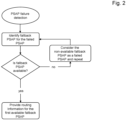
- a fallback PSAP is identified for the failed PSAP. If said fallback PSAP is available, routing information for the fallback PSAP is provided. In case the fallback PSAP is not available, it is considered a failed PSAP and the identification of a fallback PSAP for the failed PSAP is repeated.
- a logic element may be used by the NGCS to identify the next available fallback PSAP. For identification of the fallback PSAP, the NGCS requests a fallback PSAP for the failed PSAP from the fallback server.
- This fallback server may be located in a demilitarized (DMZ) zone so as to be accessible through the public internet and thus also through the end device.
- the fallback server responds to the NGCS's request with a fallback PSAP for the failed PSAP.
- the end device may query the fallback server using a specific Application Programming Interface (API) that can provide the fallback PSAP since the end device is not part of the NGCS network.
- API Application Programming Interface
- the logic element which may be implemented by the fallback server must be the same as the one used by the NGCS to identify the fallback PSAP if such a logic element is implemented there.
- either the NGCS may use a similar but internal API to the fallback server or it may implement the same logic as the fallback server.
- the NGCS after detecting a PSAP failure and identifying the fallback PSAP using the steps described above, sends all emergency calls that were active on the failed PSAP to the fallback PSAP.
- the emergency calls that were also sent to the failed PSAP but were still in the queue and not answered by an agent can be requeued to a different PSAP.
- the calls which are send, by the NGCS, to the identified fallback PSAP all carry a call-info header comprising an emergency call-ID and an incident call-ID.
- the NGCS adds a history-info header for those calls that were active on the failed PSAP, wherein the history-info header indicates that said calls were active and have been sent to the identified fallback PSAP. Said calls carrying the history-info header will be sent immediately to the same end device if said device has re-registered to the fallback PSAP after the previous PSAP has failed.
- the step of matching the calls with the one or more end device is performed by using the emergency call-ID and the incident call-ID. If the call arrives at the fallback PSAP with a history-info header but after some pre-determined time (for example, 1 second) in which no device with the same emergency call-ID and incident call-ID has registered, the call can be requeued to the fallback PSAP to be handled by another agent. If the end device with the same emergency call-ID and incident call-ID registers after the call is queued, the call is sent directly to this end device. If the end device with the same emergency call-ID and incident call-ID registers after the call is answered by another agent, a conference call is created with the other PSAP agent that answered said emergency call in the fallback PSAP and the initial PSAP agent using this end device.
- some pre-determined time for example, 1 second
- the one or more end device uses a SIP REGISTER message to re-register on the identified fallback PSAP.
- a system for emergency call continuation in case of PSAP failures in an emergency network wherein the system is configured to perform the method according to any one of the claims 1 to 12.
- the system comprises one or more detector element, a logic element as part of the one or more detector element, a fallback server and/or a fallback PSAP.
- Fig. 1 schematically shows possible PSAP communication failures.
- a caller is shown who is or will be connected to the emergency call network, e. g. ESlnet, via a service provider.
- the emergency network comprises a NGCS, a fallback server connected to it and several PSAPs which in turn have user end devices with which the call taker or agent of the respective PSAP can communicate with a caller.
- This architecture may cause various failures that require a reconnection between the caller and the call taker.
- One is a problem in the network connection between the NGCS and the PSAP (1).
- the second is a problem in the PSAP datacenter (or major failure of the Border Control Function (BCF) inside the datacenter, 2).
- BCF Border Control Function
- Fig. 2 shows in another embodiment of the invention a flowchart of a logic element for identifying a fallback PSAP.
- a logic element of a one or more detector element triggers a failover event by which a fallback PSAP for the failed PSAP is identified. If said fallback PSAP is available, routing information is provided. If said fallback PSAP is not available, it is also considered a failed PSAP, and the identification of another fallback PSAP is repeated.
- the repeated processing of the identification of another fallback PSAP can be managed using policy rules and policy routing functions (PRF) in order to send the emergency call to the proper fallback PSAP.
- PRF policy rules and policy routing functions
- the fallback server could fetch those policies to deduct the fallback PSAP for each PSAP for emergency calls.
- the SIP registrar address that is needed for the agent's device to register on the fallback PSAP will not be stored in the PSAP policy and so this needs to be stored in the fallback server itself.
- the fallback server comprises a record that matches a retrieved SIP-URI of a PSAP from the PSAP policies with the SIP registrar of that PSAP.
- the SIP-URI and the SIP registrar of the fallback PSAP can be stored as one record at the fallback server and on request either the SIP-URI or the SIP registrar or both will be returned.
- a user interface (Ul) can be used to configure the SIP-URI and SIP registrar of the fallback PSAP and/or to configure the fallback PSAP for each PSAP.
- Fig. 3 depicts the method according to another embodiment of the invention schematically.
- a PSAP fails (step 1).
- This failure is detected by the NGCS (step 2a), which in turn requests a fallback PSAP for the failed PSAP through the fallback server (step 2b).
- the NGCS gets a response from the fallback server indicating the available PSAP (PSAP2, step 2c).
- the failed PSAP is also detected by the agent's device (UE, step 3a), which in turn requests a fallback PSAP for the failed PSAP through the fallback server (step 3b) and gets a response with the fallback server indicating the same fallback PSAP (PSAP2, step 3c).
- a NGCS requests a fallback PSAP from the fallback server as already described above in Fig. 3 .
- the NGCS gets a response from the fallback server indicating an available fallback PSAP (PSAP2), it sends an INVITE message to said fallback PSAP including the call-info header with the emergency call-ID and the incident call-ID of the disconnected call.
- an INVITE massage may also comprise the history-info header which is necessary for knowing that a certain call was already established in another PSAP.
- Fig. 5 is a flowchart, depicting a setup of a new call according to another embodiment of the invention. If a new emergency call arrives at a fallback PSAP, a logic element checks whether the history-info header of said call including a fallback indication is present. If so, the fallback PSAP reassesses whether an end device carrying the same history-info header as the newly arrived call has registered on the fallback PSAP. If this is the case, the arrived call is sent directly to said end device. In case no history-info header is present on the new call, said call is put in the default emergency queue for normal handling. This is also true for calls which do carry a history-info header but no end device with the same history-info header has registered on the fallback PSAP.
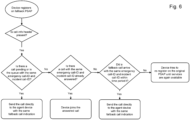
- the flowchart of Fig. 6 depicts the steps of the fallback registration by an end device according to another embodiment of the invention.
- an end device registers on the fallback PSAP.
- the fallback PSAP checks whether a call-info header is present. If this is not the case, other emergency calls which are in queue may be distributed to said end device, however this may be difficult to achieve, since it is very likely that the agent will not be able to start working as a full member of a different PSAP. This means it will not be easy for the agent to start receiving calls as it will not be evident that the agent will have access to all necessary systems and the appropriate training for all other PSAPs.
- Each PSAP may have different technology and training to use that technology and the agent may not be able to login to the necessary systems to do her/his job properly.
- the agent only registers to the fallback PSAP for the failed call. Therefore, the SIP interface is used for establishing emergency voice/video calls.
- the agent's device will be able to register on the fallback PSAP, the network path/connectivity is available and specific interfaces can be used for registering.
- the next step is to check whether there is a call pending or in queue with the same emergency call-ID and incident call-ID. If this is the case, the call is sent directly to the end device carrying the same fallback call indication.
- this last decision can be handled on time base, for example, it can be configurable how long an agent will wait on the fallback PSAP, e. g. a preconfigured time period t can be established which may reach from a few seconds to minutes.
- the agent's device which temporarily registered on the fallback PSAP may try to reregister on the original PSAP as it will no longer be needed. It really depends if the agent can fully operate on the fallback PSAP as a normal agent and receives calls and stays there. Or, in case the agent is not able to become a full PSAP member on the fallback PSAP then after the fallback call terminates the agent may try to re-register back on the original PSAP when it comes back online.
- Fig. 7 is a schematic illustration showing the end device registering on the fallback PSAP according to another embodiment of the invention.
- the user end device upon detecting a PSAP failure and getting from the fallback server the next fallback PSAP (step 3a), will re-register on a fallback PSAP using a SIP REGISTER message with a call-info header indicating the emergency call-ID and the incident call-ID of the call it was handling at the time of failure (step 3b).
- the fallback PSAP PSAP2 will send an emergency call, carrying the same emergency call-ID and incident call-ID to the registered end device (step 4).
Landscapes
- Engineering & Computer Science (AREA)
- Computer Networks & Wireless Communication (AREA)
- Signal Processing (AREA)
- Multimedia (AREA)
- Business, Economics & Management (AREA)
- General Business, Economics & Management (AREA)
- Computer Security & Cryptography (AREA)
- Telephonic Communication Services (AREA)
Claims (15)
- Verfahren zur Fortführung von Notrufen bei einem Ausfall der öffentlichen Notrufabfragestelle, PSAP, in einem Notrufnetzwerk,
das Verfahren umfassend die folgenden Schritte:- Feststellen einer ausgefallenen PSAP durch ein oder mehrere Detektorelemente,- Auslösen eines Ausfallereignisses durch ein Logikelement des einen oder der mehreren Detektorelemente, wenn die ausgefallene PSAP festgestellt wird,- Anfordern einer Ausfall-PSAP von einem Ausfallserver durch das eine oder mehrere Detektorelemente- Identifizieren einer Ausfall-PSAP durch den Ausfallserver,- Antworten, durch den Ausfallserver, auf die identifizierte Ausfall-PSAP an einen Kerndienst der nächsten Generation, NGCS und alle Endvorrichtungen der ausgefallenen PSAP, sofern diese verfügbar sind,- Senden aller Anrufe, die bei der ausgefallenen PSAP aktiv waren, durch den NGCS an die identifizierte Ausfall-PSAP,- Neuregistrieren der bei der ausgefallenen PSAP registrierten Endvorrichtungen, sofern diese verfügbar sind, auf der identifizierten Ausfall-PSAP, und- Abgleichen der Anrufe, die auf der ausgefallenen PSAP aktiv waren, mit den Endvorrichtungen, die diesen Anrufen auf der ausgefallenen PSAP zugewiesen waren und sich auf der identifizierten Ausfall-PSAP neu registriert haben. - Verfahren nach Anspruch 1, wobei der Ausfall der PSAP ein Problem in der Netzwerkverbindung zwischen dem NGCS und der PSAP, ein Problem im PSAP-Datenzentrum und/oder ein Problem in der Verbindung zwischen der PSAP und der Endvorrichtung umfasst.
- Verfahren nach einem der vorstehenden Ansprüche, wobei das Erfassungselement ein NGCS oder eine oder mehrere Endvorrichtungen ist.
- Verfahren nach einem der vorstehenden Ansprüche, wobei der Schritt des Feststellens einer ausgefallenen PSAP durch den NGCS und/oder die eine oder mehrere Endvorrichtungen durchgeführt wird.
- Verfahren nach Anspruch 4, wobei der Schritt des Feststellens einer ausgefallenen PSAP durch den NGCS ausgeführt wird, indem mindestens eine von SIP OPTIONS-Meldungen, das Feststellen einer Unterbrechung im RTP/SRTP-Stream oder SIP INFO-Meldungen verwendet wird.
- Verfahren nach Anspruch 4, wobei der Schritt des Feststellens einer ausgefallenen PSAP durch die eine oder mehrere Endvorrichtungen ausgeführt wird, indem mindestens eines von einem Feststellen eines Ausfalls der Verbindung mit der PSAP-Ausrüstung auf der Medien- oder Signalisierungsschnittstelle oder SIP INFO-Meldungen für die PSAP verwendet werden.
- Verfahren nach einem der vorstehenden Ansprüche,
wobei eine SIP-URI der Ausfall-PSAP in den PSAP-PRF-Richtlinien beschrieben ist und der Ausfallserver einen Datensatz umfasst, der eine abgerufene SIP-URI einer PSAP aus den PSAP-PRF-Richtlinien mit einem SIP-Registrar dieser PSAP angleicht. - Verfahren nach Anspruch 7, wobei die SIP-URI und der SIP-Registrar der Ausfall-PSAP als ein Datensatz im Ausfallserver gespeichert werden und auf Anfrage entweder die SIP-URI und/oder der SIP-Registrar zurückgegeben werden.
- Verfahren nach einem der vorstehenden Ansprüche, wobei der Schritt des Identifizierens einer Ausfall-PSAP für die ausgefallene PSAP wiederholt wird, wenn die nächste verfügbare PSAP ebenfalls als ausgefallene PSAP betrachtet wird.
- Verfahren nach einem der vorstehenden Ansprüche, wobei die Anrufe, die von dem NGCS an die identifizierte Ausfall-PSAP gesendet werden, alle einen Anrufinformationskopf tragen, der eine Notruf-ID und eine Vorfall-ID umfasst.
- Verfahren nach einem der vorstehenden Ansprüche, wobei der NGCS einen Verlaufsinformationskopf für diejenigen Anrufe hinzufügt, die bei der ausgefallenen PSAP aktiv waren, wobei der Verlaufsinformationskopf angibt, dass die Anrufe aktiv waren und an die identifizierte Ausfall-PSAP gesendet wurden.
- Verfahren nach einem der vorstehenden Ansprüche, wobei der Schritt des Übereinstimmens der Anrufe mit der einen oder den mehreren Endvorrichtungen unter Verwendung der Notruf-ID und der Vorfall-ID ausgeführt wird.
- Verfahren nach einem der vorstehenden Ansprüche, wobei die eine oder die mehreren Endvorrichtungen eine SIP REGISTER-Meldung verwenden, um sich erneut bei der identifizierten Ausfall-PSAP zu registrieren.
- System für die Fortführung von Notrufen bei PSAP-Ausfällen in einem Notrufnetzwerk, wobei das System konfiguriert ist, um das Verfahren nach einem der Ansprüche 1 bis 13 auszuführen.
- System nach Anspruch 14, wobei das System ein oder mehrere Erfassungselemente, ein Logikelement als Teil des einen oder der mehreren Erfassungselemente, einen Ausfallserver und eine Ausfall-PSAP umfasst.
Priority Applications (2)
| Application Number | Priority Date | Filing Date | Title |
|---|---|---|---|
| EP21211526.5A EP4187883B1 (de) | 2021-11-30 | 2021-11-30 | Verfahren und system zur notrufweiterleitung bei einem psap-ausfall |
| US17/948,431 US12490338B2 (en) | 2021-11-30 | 2022-09-20 | Method and system for emergency call continuation in case of a psap failure |
Applications Claiming Priority (1)
| Application Number | Priority Date | Filing Date | Title |
|---|---|---|---|
| EP21211526.5A EP4187883B1 (de) | 2021-11-30 | 2021-11-30 | Verfahren und system zur notrufweiterleitung bei einem psap-ausfall |
Publications (2)
| Publication Number | Publication Date |
|---|---|
| EP4187883A1 EP4187883A1 (de) | 2023-05-31 |
| EP4187883B1 true EP4187883B1 (de) | 2024-02-28 |
Family
ID=78820422
Family Applications (1)
| Application Number | Title | Priority Date | Filing Date |
|---|---|---|---|
| EP21211526.5A Active EP4187883B1 (de) | 2021-11-30 | 2021-11-30 | Verfahren und system zur notrufweiterleitung bei einem psap-ausfall |
Country Status (2)
| Country | Link |
|---|---|
| US (1) | US12490338B2 (de) |
| EP (1) | EP4187883B1 (de) |
Families Citing this family (1)
| Publication number | Priority date | Publication date | Assignee | Title |
|---|---|---|---|---|
| US12477062B2 (en) * | 2023-06-09 | 2025-11-18 | Motorola Solutions, Inc. | Dynamic number identification management based on call type determination |
Family Cites Families (15)
| Publication number | Priority date | Publication date | Assignee | Title |
|---|---|---|---|---|
| US5239570A (en) * | 1990-07-25 | 1993-08-24 | Teltone Corporation | 9-1-1 Switched access system |
| EP2139195B1 (de) * | 2008-06-23 | 2015-11-11 | Alcatel Lucent | Verfahren, Vorrichtung und System zur Registrierung eines Endgerätes mit einem Anwendungsserver in einem IMS |
| US8638907B1 (en) * | 2012-08-20 | 2014-01-28 | Sprint Communications Company L.P. | Optimizing identification of public safety answering platform next generation 911 media support |
| US9426833B2 (en) * | 2013-03-01 | 2016-08-23 | T-Mobile Usa, Inc. | Systems and methods for emergency call route failover |
| US9907096B2 (en) | 2013-09-27 | 2018-02-27 | Solacom Technologies Inc. | Recovery of established emergency video calls |
| US9357070B2 (en) * | 2013-09-27 | 2016-05-31 | Solacom Technologies Inc. | Recovery of established emergency calls |
| US9148522B2 (en) * | 2013-09-27 | 2015-09-29 | Oracle International Corporation | Methods, systems, and computer readable media for determining policy information associated with an emergency call |
| US9681282B2 (en) * | 2014-10-08 | 2017-06-13 | Qualcomm Incorporated | Techniques for supporting telematics-enhanced emergency calls from mobile phones |
| US10771396B2 (en) * | 2015-05-08 | 2020-09-08 | Ooma, Inc. | Communications network failure detection and remediation |
| US9582985B2 (en) * | 2015-06-26 | 2017-02-28 | Telefonaktiebolaget Lm Ericsson (Publ) | System and method for mitigating emergency call failure |
| WO2017027058A1 (en) * | 2015-08-07 | 2017-02-16 | Intel IP Corporation | Ims emergency call routing techniques |
| CA3293804A1 (en) * | 2016-05-09 | 2026-03-02 | Rapidsos, Inc. | Systems and methods for emergency communications |
| US10104237B1 (en) * | 2017-09-21 | 2018-10-16 | T-Mobile Usa, Inc. | Mitigating attacks on emergency telephone services |
| US10375556B2 (en) * | 2017-12-21 | 2019-08-06 | International Business Machines Corporation | Emergency call service backup using device user plane communications |
| EP4301041A4 (de) * | 2021-03-31 | 2024-10-09 | Samsung Electronics Co., Ltd. | Verfahren und vorrichtung zur mobilitätsverwaltung, sitzungsverwaltung oder verbindungsverwaltung eines benutzergeräts in einem mobilkommunikationssystem |
-
2021
- 2021-11-30 EP EP21211526.5A patent/EP4187883B1/de active Active
-
2022
- 2022-09-20 US US17/948,431 patent/US12490338B2/en active Active
Also Published As
| Publication number | Publication date |
|---|---|
| EP4187883A1 (de) | 2023-05-31 |
| US12490338B2 (en) | 2025-12-02 |
| US20230171847A1 (en) | 2023-06-01 |
Similar Documents
| Publication | Publication Date | Title |
|---|---|---|
| US7613170B1 (en) | Method and apparatus for PSTN-based IP active call recovery and re-routing | |
| US8468131B2 (en) | Connecting devices in a peer-to-peer network with a service provider | |
| EP2501120B1 (de) | Sicherungs-SIP-Server für Überlebensfähigkeit eines SIP-Unternehmensnetzwerks | |
| US8125888B2 (en) | Session initiation protocol survivable server | |
| CN101557393B (zh) | Sip可存活网络配置中的同时活动注册 | |
| EP1847110B1 (de) | Elastische registrierung mit einem anrufmanager | |
| US10348893B2 (en) | System to deploy a disaster-proof geographically-distributed call center | |
| EP2092722B1 (de) | Voip-konferenzen | |
| US20050047579A1 (en) | Telecommunication call distribution system | |
| CN101547128A (zh) | 在sip可存活配置中使用sip消息的故障转移/故障恢复触发 | |
| CN101557305A (zh) | 在sip网络配置中使用sip信令的可存活电话行为 | |
| EP2140670B1 (de) | Implementieren einer notdienstlösung | |
| US8972586B2 (en) | Bypassing or redirecting a communication based on the failure of an inserted application | |
| US9389969B2 (en) | Method for SIP proxy failover | |
| US8930768B2 (en) | System and method of failover for an initiated SIP session | |
| WO2008066867A2 (en) | Remote redundant voice server system | |
| EP4187883B1 (de) | Verfahren und system zur notrufweiterleitung bei einem psap-ausfall | |
| US8054955B2 (en) | Telephone system, associated exchange, and transmission control method | |
| JP2007235556A (ja) | 中継サーバ及び接続制御方法並びにプログラム | |
| US8630163B1 (en) | Server driven endpoint re-homing | |
| GB2458553A (en) | Internet telephony PBX with monitoring of SIP server availability and failover to PSTN in event of server failure | |
| CA2551338C (en) | Connecting devices in a peer-to-peer network with a service provider | |
| HK1070511B (en) | Apparatus and method for computer telephone integration in packet switched telephone networks | |
| HK1070511A1 (en) | Apparatus and method for computer telephone integration in packet switched telephone networks |
Legal Events
| Date | Code | Title | Description |
|---|---|---|---|
| PUAI | Public reference made under article 153(3) epc to a published international application that has entered the european phase |
Free format text: ORIGINAL CODE: 0009012 |
|
| STAA | Information on the status of an ep patent application or granted ep patent |
Free format text: STATUS: THE APPLICATION HAS BEEN PUBLISHED |
|
| AK | Designated contracting states |
Kind code of ref document: A1 Designated state(s): AL AT BE BG CH CY CZ DE DK EE ES FI FR GB GR HR HU IE IS IT LI LT LU LV MC MK MT NL NO PL PT RO RS SE SI SK SM TR |
|
| STAA | Information on the status of an ep patent application or granted ep patent |
Free format text: STATUS: REQUEST FOR EXAMINATION WAS MADE |
|
| REG | Reference to a national code |
Ref country code: DE Ref legal event code: R079 Ipc: H04L0065106300 Ref country code: DE Ref legal event code: R079 Ref document number: 602021009810 Country of ref document: DE Free format text: PREVIOUS MAIN CLASS: H04L0069400000 Ipc: H04L0065106300 |
|
| 17P | Request for examination filed |
Effective date: 20230704 |
|
| RBV | Designated contracting states (corrected) |
Designated state(s): AL AT BE BG CH CY CZ DE DK EE ES FI FR GB GR HR HU IE IS IT LI LT LU LV MC MK MT NL NO PL PT RO RS SE SI SK SM TR |
|
| GRAP | Despatch of communication of intention to grant a patent |
Free format text: ORIGINAL CODE: EPIDOSNIGR1 |
|
| STAA | Information on the status of an ep patent application or granted ep patent |
Free format text: STATUS: GRANT OF PATENT IS INTENDED |
|
| RIC1 | Information provided on ipc code assigned before grant |
Ipc: H04L 69/40 20220101ALI20230720BHEP Ipc: H04L 65/1083 20220101ALI20230720BHEP Ipc: H04L 65/1063 20220101AFI20230720BHEP |
|
| INTG | Intention to grant announced |
Effective date: 20230821 |
|
| GRAS | Grant fee paid |
Free format text: ORIGINAL CODE: EPIDOSNIGR3 |
|
| GRAA | (expected) grant |
Free format text: ORIGINAL CODE: 0009210 |
|
| STAA | Information on the status of an ep patent application or granted ep patent |
Free format text: STATUS: THE PATENT HAS BEEN GRANTED |
|
| RAP1 | Party data changed (applicant data changed or rights of an application transferred) |
Owner name: ATOS PUBLIC SAFETY LLC |
|
| AK | Designated contracting states |
Kind code of ref document: B1 Designated state(s): AL AT BE BG CH CY CZ DE DK EE ES FI FR GB GR HR HU IE IS IT LI LT LU LV MC MK MT NL NO PL PT RO RS SE SI SK SM TR |
|
| REG | Reference to a national code |
Ref country code: GB Ref legal event code: FG4D |
|
| REG | Reference to a national code |
Ref country code: CH Ref legal event code: EP |
|
| REG | Reference to a national code |
Ref country code: DE Ref legal event code: R096 Ref document number: 602021009810 Country of ref document: DE |
|
| REG | Reference to a national code |
Ref country code: IE Ref legal event code: FG4D |
|
| P01 | Opt-out of the competence of the unified patent court (upc) registered |
Effective date: 20240301 |
|
| REG | Reference to a national code |
Ref country code: LT Ref legal event code: MG9D |
|
| PG25 | Lapsed in a contracting state [announced via postgrant information from national office to epo] |
Ref country code: IS Free format text: LAPSE BECAUSE OF FAILURE TO SUBMIT A TRANSLATION OF THE DESCRIPTION OR TO PAY THE FEE WITHIN THE PRESCRIBED TIME-LIMIT Effective date: 20240628 |
|
| REG | Reference to a national code |
Ref country code: NL Ref legal event code: MP Effective date: 20240228 |
|
| PG25 | Lapsed in a contracting state [announced via postgrant information from national office to epo] |
Ref country code: LT Free format text: LAPSE BECAUSE OF FAILURE TO SUBMIT A TRANSLATION OF THE DESCRIPTION OR TO PAY THE FEE WITHIN THE PRESCRIBED TIME-LIMIT Effective date: 20240228 |
|
| PG25 | Lapsed in a contracting state [announced via postgrant information from national office to epo] |
Ref country code: GR Free format text: LAPSE BECAUSE OF FAILURE TO SUBMIT A TRANSLATION OF THE DESCRIPTION OR TO PAY THE FEE WITHIN THE PRESCRIBED TIME-LIMIT Effective date: 20240529 |
|
| PG25 | Lapsed in a contracting state [announced via postgrant information from national office to epo] |
Ref country code: HR Free format text: LAPSE BECAUSE OF FAILURE TO SUBMIT A TRANSLATION OF THE DESCRIPTION OR TO PAY THE FEE WITHIN THE PRESCRIBED TIME-LIMIT Effective date: 20240228 Ref country code: NL Free format text: LAPSE BECAUSE OF FAILURE TO SUBMIT A TRANSLATION OF THE DESCRIPTION OR TO PAY THE FEE WITHIN THE PRESCRIBED TIME-LIMIT Effective date: 20240228 Ref country code: RS Free format text: LAPSE BECAUSE OF FAILURE TO SUBMIT A TRANSLATION OF THE DESCRIPTION OR TO PAY THE FEE WITHIN THE PRESCRIBED TIME-LIMIT Effective date: 20240528 |
|
| PG25 | Lapsed in a contracting state [announced via postgrant information from national office to epo] |
Ref country code: ES Free format text: LAPSE BECAUSE OF FAILURE TO SUBMIT A TRANSLATION OF THE DESCRIPTION OR TO PAY THE FEE WITHIN THE PRESCRIBED TIME-LIMIT Effective date: 20240228 |
|
| PG25 | Lapsed in a contracting state [announced via postgrant information from national office to epo] |
Ref country code: RS Free format text: LAPSE BECAUSE OF FAILURE TO SUBMIT A TRANSLATION OF THE DESCRIPTION OR TO PAY THE FEE WITHIN THE PRESCRIBED TIME-LIMIT Effective date: 20240528 Ref country code: NO Free format text: LAPSE BECAUSE OF FAILURE TO SUBMIT A TRANSLATION OF THE DESCRIPTION OR TO PAY THE FEE WITHIN THE PRESCRIBED TIME-LIMIT Effective date: 20240528 Ref country code: NL Free format text: LAPSE BECAUSE OF FAILURE TO SUBMIT A TRANSLATION OF THE DESCRIPTION OR TO PAY THE FEE WITHIN THE PRESCRIBED TIME-LIMIT Effective date: 20240228 Ref country code: LT Free format text: LAPSE BECAUSE OF FAILURE TO SUBMIT A TRANSLATION OF THE DESCRIPTION OR TO PAY THE FEE WITHIN THE PRESCRIBED TIME-LIMIT Effective date: 20240228 Ref country code: IS Free format text: LAPSE BECAUSE OF FAILURE TO SUBMIT A TRANSLATION OF THE DESCRIPTION OR TO PAY THE FEE WITHIN THE PRESCRIBED TIME-LIMIT Effective date: 20240628 Ref country code: HR Free format text: LAPSE BECAUSE OF FAILURE TO SUBMIT A TRANSLATION OF THE DESCRIPTION OR TO PAY THE FEE WITHIN THE PRESCRIBED TIME-LIMIT Effective date: 20240228 Ref country code: GR Free format text: LAPSE BECAUSE OF FAILURE TO SUBMIT A TRANSLATION OF THE DESCRIPTION OR TO PAY THE FEE WITHIN THE PRESCRIBED TIME-LIMIT Effective date: 20240529 Ref country code: FI Free format text: LAPSE BECAUSE OF FAILURE TO SUBMIT A TRANSLATION OF THE DESCRIPTION OR TO PAY THE FEE WITHIN THE PRESCRIBED TIME-LIMIT Effective date: 20240228 Ref country code: ES Free format text: LAPSE BECAUSE OF FAILURE TO SUBMIT A TRANSLATION OF THE DESCRIPTION OR TO PAY THE FEE WITHIN THE PRESCRIBED TIME-LIMIT Effective date: 20240228 Ref country code: BG Free format text: LAPSE BECAUSE OF FAILURE TO SUBMIT A TRANSLATION OF THE DESCRIPTION OR TO PAY THE FEE WITHIN THE PRESCRIBED TIME-LIMIT Effective date: 20240228 |
|
| PG25 | Lapsed in a contracting state [announced via postgrant information from national office to epo] |
Ref country code: PT Free format text: LAPSE BECAUSE OF FAILURE TO SUBMIT A TRANSLATION OF THE DESCRIPTION OR TO PAY THE FEE WITHIN THE PRESCRIBED TIME-LIMIT Effective date: 20240628 Ref country code: PL Free format text: LAPSE BECAUSE OF FAILURE TO SUBMIT A TRANSLATION OF THE DESCRIPTION OR TO PAY THE FEE WITHIN THE PRESCRIBED TIME-LIMIT Effective date: 20240228 |
|
| REG | Reference to a national code |
Ref country code: AT Ref legal event code: MK05 Ref document number: 1662294 Country of ref document: AT Kind code of ref document: T Effective date: 20240228 |
|
| PG25 | Lapsed in a contracting state [announced via postgrant information from national office to epo] |
Ref country code: SE Free format text: LAPSE BECAUSE OF FAILURE TO SUBMIT A TRANSLATION OF THE DESCRIPTION OR TO PAY THE FEE WITHIN THE PRESCRIBED TIME-LIMIT Effective date: 20240228 Ref country code: PT Free format text: LAPSE BECAUSE OF FAILURE TO SUBMIT A TRANSLATION OF THE DESCRIPTION OR TO PAY THE FEE WITHIN THE PRESCRIBED TIME-LIMIT Effective date: 20240628 Ref country code: PL Free format text: LAPSE BECAUSE OF FAILURE TO SUBMIT A TRANSLATION OF THE DESCRIPTION OR TO PAY THE FEE WITHIN THE PRESCRIBED TIME-LIMIT Effective date: 20240228 Ref country code: LV Free format text: LAPSE BECAUSE OF FAILURE TO SUBMIT A TRANSLATION OF THE DESCRIPTION OR TO PAY THE FEE WITHIN THE PRESCRIBED TIME-LIMIT Effective date: 20240228 |
|
| PG25 | Lapsed in a contracting state [announced via postgrant information from national office to epo] |
Ref country code: DK Free format text: LAPSE BECAUSE OF FAILURE TO SUBMIT A TRANSLATION OF THE DESCRIPTION OR TO PAY THE FEE WITHIN THE PRESCRIBED TIME-LIMIT Effective date: 20240228 |
|
| PG25 | Lapsed in a contracting state [announced via postgrant information from national office to epo] |
Ref country code: SM Free format text: LAPSE BECAUSE OF FAILURE TO SUBMIT A TRANSLATION OF THE DESCRIPTION OR TO PAY THE FEE WITHIN THE PRESCRIBED TIME-LIMIT Effective date: 20240228 |
|
| PG25 | Lapsed in a contracting state [announced via postgrant information from national office to epo] |
Ref country code: EE Free format text: LAPSE BECAUSE OF FAILURE TO SUBMIT A TRANSLATION OF THE DESCRIPTION OR TO PAY THE FEE WITHIN THE PRESCRIBED TIME-LIMIT Effective date: 20240228 Ref country code: CZ Free format text: LAPSE BECAUSE OF FAILURE TO SUBMIT A TRANSLATION OF THE DESCRIPTION OR TO PAY THE FEE WITHIN THE PRESCRIBED TIME-LIMIT Effective date: 20240228 |
|
| PG25 | Lapsed in a contracting state [announced via postgrant information from national office to epo] |
Ref country code: AT Free format text: LAPSE BECAUSE OF FAILURE TO SUBMIT A TRANSLATION OF THE DESCRIPTION OR TO PAY THE FEE WITHIN THE PRESCRIBED TIME-LIMIT Effective date: 20240228 |
|
| PG25 | Lapsed in a contracting state [announced via postgrant information from national office to epo] |
Ref country code: SK Free format text: LAPSE BECAUSE OF FAILURE TO SUBMIT A TRANSLATION OF THE DESCRIPTION OR TO PAY THE FEE WITHIN THE PRESCRIBED TIME-LIMIT Effective date: 20240228 |
|
| PG25 | Lapsed in a contracting state [announced via postgrant information from national office to epo] |
Ref country code: SM Free format text: LAPSE BECAUSE OF FAILURE TO SUBMIT A TRANSLATION OF THE DESCRIPTION OR TO PAY THE FEE WITHIN THE PRESCRIBED TIME-LIMIT Effective date: 20240228 Ref country code: SK Free format text: LAPSE BECAUSE OF FAILURE TO SUBMIT A TRANSLATION OF THE DESCRIPTION OR TO PAY THE FEE WITHIN THE PRESCRIBED TIME-LIMIT Effective date: 20240228 Ref country code: RO Free format text: LAPSE BECAUSE OF FAILURE TO SUBMIT A TRANSLATION OF THE DESCRIPTION OR TO PAY THE FEE WITHIN THE PRESCRIBED TIME-LIMIT Effective date: 20240228 Ref country code: EE Free format text: LAPSE BECAUSE OF FAILURE TO SUBMIT A TRANSLATION OF THE DESCRIPTION OR TO PAY THE FEE WITHIN THE PRESCRIBED TIME-LIMIT Effective date: 20240228 Ref country code: DK Free format text: LAPSE BECAUSE OF FAILURE TO SUBMIT A TRANSLATION OF THE DESCRIPTION OR TO PAY THE FEE WITHIN THE PRESCRIBED TIME-LIMIT Effective date: 20240228 Ref country code: CZ Free format text: LAPSE BECAUSE OF FAILURE TO SUBMIT A TRANSLATION OF THE DESCRIPTION OR TO PAY THE FEE WITHIN THE PRESCRIBED TIME-LIMIT Effective date: 20240228 Ref country code: AT Free format text: LAPSE BECAUSE OF FAILURE TO SUBMIT A TRANSLATION OF THE DESCRIPTION OR TO PAY THE FEE WITHIN THE PRESCRIBED TIME-LIMIT Effective date: 20240228 |
|
| REG | Reference to a national code |
Ref country code: DE Ref legal event code: R097 Ref document number: 602021009810 Country of ref document: DE |
|
| PG25 | Lapsed in a contracting state [announced via postgrant information from national office to epo] |
Ref country code: IT Free format text: LAPSE BECAUSE OF FAILURE TO SUBMIT A TRANSLATION OF THE DESCRIPTION OR TO PAY THE FEE WITHIN THE PRESCRIBED TIME-LIMIT Effective date: 20240228 |
|
| PG25 | Lapsed in a contracting state [announced via postgrant information from national office to epo] |
Ref country code: IT Free format text: LAPSE BECAUSE OF FAILURE TO SUBMIT A TRANSLATION OF THE DESCRIPTION OR TO PAY THE FEE WITHIN THE PRESCRIBED TIME-LIMIT Effective date: 20240228 |
|
| PLBE | No opposition filed within time limit |
Free format text: ORIGINAL CODE: 0009261 |
|
| STAA | Information on the status of an ep patent application or granted ep patent |
Free format text: STATUS: NO OPPOSITION FILED WITHIN TIME LIMIT |
|
| 26N | No opposition filed |
Effective date: 20241129 |
|
| PG25 | Lapsed in a contracting state [announced via postgrant information from national office to epo] |
Ref country code: SI Free format text: LAPSE BECAUSE OF FAILURE TO SUBMIT A TRANSLATION OF THE DESCRIPTION OR TO PAY THE FEE WITHIN THE PRESCRIBED TIME-LIMIT Effective date: 20240228 |
|
| REG | Reference to a national code |
Ref country code: CH Ref legal event code: PL |
|
| PG25 | Lapsed in a contracting state [announced via postgrant information from national office to epo] |
Ref country code: MC Free format text: LAPSE BECAUSE OF FAILURE TO SUBMIT A TRANSLATION OF THE DESCRIPTION OR TO PAY THE FEE WITHIN THE PRESCRIBED TIME-LIMIT Effective date: 20240228 |
|
| PG25 | Lapsed in a contracting state [announced via postgrant information from national office to epo] |
Ref country code: LU Free format text: LAPSE BECAUSE OF NON-PAYMENT OF DUE FEES Effective date: 20241130 |
|
| REG | Reference to a national code |
Ref country code: CH Ref legal event code: PL |
|
| PG25 | Lapsed in a contracting state [announced via postgrant information from national office to epo] |
Ref country code: CH Free format text: LAPSE BECAUSE OF NON-PAYMENT OF DUE FEES Effective date: 20241130 |
|
| REG | Reference to a national code |
Ref country code: BE Ref legal event code: MM Effective date: 20241130 |
|
| PG25 | Lapsed in a contracting state [announced via postgrant information from national office to epo] |
Ref country code: BE Free format text: LAPSE BECAUSE OF NON-PAYMENT OF DUE FEES Effective date: 20241130 |
|
| PG25 | Lapsed in a contracting state [announced via postgrant information from national office to epo] |
Ref country code: IE Free format text: LAPSE BECAUSE OF NON-PAYMENT OF DUE FEES Effective date: 20241130 |
|
| PGFP | Annual fee paid to national office [announced via postgrant information from national office to epo] |
Ref country code: DE Payment date: 20251118 Year of fee payment: 5 |
|
| PGFP | Annual fee paid to national office [announced via postgrant information from national office to epo] |
Ref country code: GB Payment date: 20251120 Year of fee payment: 5 |
|
| PGFP | Annual fee paid to national office [announced via postgrant information from national office to epo] |
Ref country code: FR Payment date: 20251120 Year of fee payment: 5 |
|
| PG25 | Lapsed in a contracting state [announced via postgrant information from national office to epo] |
Ref country code: CY Free format text: LAPSE BECAUSE OF FAILURE TO SUBMIT A TRANSLATION OF THE DESCRIPTION OR TO PAY THE FEE WITHIN THE PRESCRIBED TIME-LIMIT; INVALID AB INITIO Effective date: 20211130 |