EP4189162B1 - Herstellungsverfahren eines papier und karton - Google Patents
Herstellungsverfahren eines papier und karton Download PDFInfo
- Publication number
- EP4189162B1 EP4189162B1 EP21743222.8A EP21743222A EP4189162B1 EP 4189162 B1 EP4189162 B1 EP 4189162B1 EP 21743222 A EP21743222 A EP 21743222A EP 4189162 B1 EP4189162 B1 EP 4189162B1
- Authority
- EP
- European Patent Office
- Prior art keywords
- polymer
- weight
- oily suspension
- water
- anhydrous
- Prior art date
- Legal status (The legal status is an assumption and is not a legal conclusion. Google has not performed a legal analysis and makes no representation as to the accuracy of the status listed.)
- Active
Links
Images
Classifications
-
- D—TEXTILES; PAPER
- D21—PAPER-MAKING; PRODUCTION OF CELLULOSE
- D21H—PULP COMPOSITIONS; PREPARATION THEREOF NOT COVERED BY SUBCLASSES D21C OR D21D; IMPREGNATING OR COATING OF PAPER; TREATMENT OF FINISHED PAPER NOT COVERED BY CLASS B31 OR SUBCLASS D21G; PAPER NOT OTHERWISE PROVIDED FOR
- D21H21/00—Non-fibrous material added to the pulp, characterised by its function, form or properties; Paper-impregnating or coating material, characterised by its function, form or properties
- D21H21/06—Paper forming aids
- D21H21/10—Retention agents or drainage improvers
-
- D—TEXTILES; PAPER
- D21—PAPER-MAKING; PRODUCTION OF CELLULOSE
- D21H—PULP COMPOSITIONS; PREPARATION THEREOF NOT COVERED BY SUBCLASSES D21C OR D21D; IMPREGNATING OR COATING OF PAPER; TREATMENT OF FINISHED PAPER NOT COVERED BY CLASS B31 OR SUBCLASS D21G; PAPER NOT OTHERWISE PROVIDED FOR
- D21H17/00—Non-fibrous material added to the pulp, characterised by its constitution; Paper-impregnating material characterised by its constitution
- D21H17/20—Macromolecular organic compounds
- D21H17/33—Synthetic macromolecular compounds
- D21H17/34—Synthetic macromolecular compounds obtained by reactions only involving carbon-to-carbon unsaturated bonds
-
- D—TEXTILES; PAPER
- D21—PAPER-MAKING; PRODUCTION OF CELLULOSE
- D21H—PULP COMPOSITIONS; PREPARATION THEREOF NOT COVERED BY SUBCLASSES D21C OR D21D; IMPREGNATING OR COATING OF PAPER; TREATMENT OF FINISHED PAPER NOT COVERED BY CLASS B31 OR SUBCLASS D21G; PAPER NOT OTHERWISE PROVIDED FOR
- D21H17/00—Non-fibrous material added to the pulp, characterised by its constitution; Paper-impregnating material characterised by its constitution
- D21H17/20—Macromolecular organic compounds
- D21H17/33—Synthetic macromolecular compounds
- D21H17/34—Synthetic macromolecular compounds obtained by reactions only involving carbon-to-carbon unsaturated bonds
- D21H17/41—Synthetic macromolecular compounds obtained by reactions only involving carbon-to-carbon unsaturated bonds containing ionic groups
- D21H17/42—Synthetic macromolecular compounds obtained by reactions only involving carbon-to-carbon unsaturated bonds containing ionic groups anionic
- D21H17/43—Carboxyl groups or derivatives thereof
-
- D—TEXTILES; PAPER
- D21—PAPER-MAKING; PRODUCTION OF CELLULOSE
- D21H—PULP COMPOSITIONS; PREPARATION THEREOF NOT COVERED BY SUBCLASSES D21C OR D21D; IMPREGNATING OR COATING OF PAPER; TREATMENT OF FINISHED PAPER NOT COVERED BY CLASS B31 OR SUBCLASS D21G; PAPER NOT OTHERWISE PROVIDED FOR
- D21H17/00—Non-fibrous material added to the pulp, characterised by its constitution; Paper-impregnating material characterised by its constitution
- D21H17/20—Macromolecular organic compounds
- D21H17/33—Synthetic macromolecular compounds
- D21H17/34—Synthetic macromolecular compounds obtained by reactions only involving carbon-to-carbon unsaturated bonds
- D21H17/41—Synthetic macromolecular compounds obtained by reactions only involving carbon-to-carbon unsaturated bonds containing ionic groups
- D21H17/44—Synthetic macromolecular compounds obtained by reactions only involving carbon-to-carbon unsaturated bonds containing ionic groups cationic
- D21H17/45—Nitrogen-containing groups
- D21H17/455—Nitrogen-containing groups comprising tertiary amine or being at least partially quaternised
-
- D—TEXTILES; PAPER
- D21—PAPER-MAKING; PRODUCTION OF CELLULOSE
- D21H—PULP COMPOSITIONS; PREPARATION THEREOF NOT COVERED BY SUBCLASSES D21C OR D21D; IMPREGNATING OR COATING OF PAPER; TREATMENT OF FINISHED PAPER NOT COVERED BY CLASS B31 OR SUBCLASS D21G; PAPER NOT OTHERWISE PROVIDED FOR
- D21H17/00—Non-fibrous material added to the pulp, characterised by its constitution; Paper-impregnating material characterised by its constitution
- D21H17/63—Inorganic compounds
- D21H17/66—Salts, e.g. alums
-
- D—TEXTILES; PAPER
- D21—PAPER-MAKING; PRODUCTION OF CELLULOSE
- D21H—PULP COMPOSITIONS; PREPARATION THEREOF NOT COVERED BY SUBCLASSES D21C OR D21D; IMPREGNATING OR COATING OF PAPER; TREATMENT OF FINISHED PAPER NOT COVERED BY CLASS B31 OR SUBCLASS D21G; PAPER NOT OTHERWISE PROVIDED FOR
- D21H17/00—Non-fibrous material added to the pulp, characterised by its constitution; Paper-impregnating material characterised by its constitution
- D21H17/63—Inorganic compounds
- D21H17/67—Water-insoluble compounds, e.g. fillers, pigments
- D21H17/675—Oxides, hydroxides or carbonates
-
- D—TEXTILES; PAPER
- D21—PAPER-MAKING; PRODUCTION OF CELLULOSE
- D21H—PULP COMPOSITIONS; PREPARATION THEREOF NOT COVERED BY SUBCLASSES D21C OR D21D; IMPREGNATING OR COATING OF PAPER; TREATMENT OF FINISHED PAPER NOT COVERED BY CLASS B31 OR SUBCLASS D21G; PAPER NOT OTHERWISE PROVIDED FOR
- D21H17/00—Non-fibrous material added to the pulp, characterised by its constitution; Paper-impregnating material characterised by its constitution
- D21H17/71—Mixtures of material ; Pulp or paper comprising several different materials not incorporated by special processes
- D21H17/74—Mixtures of material ; Pulp or paper comprising several different materials not incorporated by special processes of organic and inorganic material
-
- D—TEXTILES; PAPER
- D21—PAPER-MAKING; PRODUCTION OF CELLULOSE
- D21H—PULP COMPOSITIONS; PREPARATION THEREOF NOT COVERED BY SUBCLASSES D21C OR D21D; IMPREGNATING OR COATING OF PAPER; TREATMENT OF FINISHED PAPER NOT COVERED BY CLASS B31 OR SUBCLASS D21G; PAPER NOT OTHERWISE PROVIDED FOR
- D21H21/00—Non-fibrous material added to the pulp, characterised by its function, form or properties; Paper-impregnating or coating material, characterised by its function, form or properties
- D21H21/50—Non-fibrous material added to the pulp, characterised by its function, form or properties; Paper-impregnating or coating material, characterised by its function, form or properties characterised by form
- D21H21/52—Additives of definite length or shape
-
- D—TEXTILES; PAPER
- D21—PAPER-MAKING; PRODUCTION OF CELLULOSE
- D21H—PULP COMPOSITIONS; PREPARATION THEREOF NOT COVERED BY SUBCLASSES D21C OR D21D; IMPREGNATING OR COATING OF PAPER; TREATMENT OF FINISHED PAPER NOT COVERED BY CLASS B31 OR SUBCLASS D21G; PAPER NOT OTHERWISE PROVIDED FOR
- D21H23/00—Processes or apparatus for adding material to the pulp or to the paper
- D21H23/02—Processes or apparatus for adding material to the pulp or to the paper characterised by the manner in which substances are added
- D21H23/04—Addition to the pulp; After-treatment of added substances in the pulp
- D21H23/06—Controlling the addition
Definitions
- the present invention relates to a process for manufacturing paper and board having improved total retention, charge retention and drainage properties, and/or superior mechanical characteristics of the paper/board. More specifically, the subject of the invention is a manufacturing process involving the prior preparation of a stock solution of at least one water-soluble polymer with specific dissolution properties before its addition to the fibrous suspension.
- the present invention also relates to the papers and cardboards obtained by this process.
- retention properties we mean the ability to retain suspended matter from the paper pulp (fibers, fillers (calcium carbonate, titanium oxide, etc.), etc.) on the forming fabric, therefore in the fibrous mattress which will constitute the final sheet.
- the mode of action of retention agents is based on the flocculation of these materials suspended in water. In fact, the flocs formed are more easily retained on the forming fabric.
- Charge retention consists of specifically retaining charges (small mineral species with little affinity with cellulose). The significant improvement in charge retention results in clarification of white water by retaining charges in the sheet of paper as well as increasing its weight. This also gives the possibility of replacing part of the fibers (the most expensive component in the composition of paper) with fillers (lower costs) to reduce paper manufacturing costs.
- this is the ability of the fibrous mattress to evacuate or drain the maximum amount of water so that the sheet dries as quickly as possible, particularly during its manufacture.
- All retention and drainage systems known in the prior art are characterized by the fact that their main retention agent is water-soluble polymers of high molecular weight, greater than 1 million g/mol, generally greater than 3 million g/mol, called flocculants. They are generally cationic and have the particularity, due to their high molecular weight, of being able to be in the form of emulsion (inverse), oily suspension (distilled inverse emulsion), microemulsion or powder. These polymers are generally introduced at a level of 50 to 800 g/t of dry polymer compared to dry paper.
- WO 2006/071175 describes a composition and its use in papermaking.
- This composition includes a polymer and a hydrocarbon compound (oil, grease or wax). During papermaking, it can be added to a fiber suspension directly or after being emulsified. It is not used to form an aqueous solution before adding it to a fiber suspension. It can also be applied to the sheet of paper.
- a hydrocarbon compound oil, grease or wax
- paper processes may also involve sheet strength agents, in the dry and/or wet state.
- Some dry strength agents are water-soluble polymers with an average molecular weight of at least 750,000 Dalton, and may be in powder or reverse emulsion form. As a result, these products have the same disadvantages with regard to their preparation time. This is all the more true as the dosages of additives introduced into the paper pulp are of the order of 500 to 5000 g/t of dry matter (generally cellulosic fibers + fillers). The speed of dissolution of these polymers is therefore a primary factor in reducing the footprint of the preparation units.
- a papermaking process using an aqueous solution A containing at least one water-soluble polymer P at a concentration by weight C of between 0.1 and 0.5% by weight makes it possible to achieve improved drainage performance, fiber and fines retention, load retention, or mechanical characteristics of the paper/cardboard compared to other forms of products after two minutes, or less, of preparation at 25°C , which implies that the dissolution time of the polymer P is reduced.
- the residence time of the polymer P in the preparation unit of the aqueous solution A is shorter, with a lower volume of maturation preparation tank and therefore a reduced footprint within the paper mill.
- the viscometer equipped with a helical geometry operates on the basis of an air bearing motor driving a geometry allowing controlled shear or controlled shear stress tests.
- dry matter corresponds to the dry extract obtained after evaporation of water from the fibrous suspension used in a process for manufacturing a sheet of paper or cardboard.
- the dry material is generally based on cellulosic fibers and fillers, advantageously consisting of cellulosic fibers and fillers.
- cellulosic fibers encompasses any cellulosic entity, including fibers, fines, microfibrils or nanofibrils.
- polymer refers to both homopolymers and copolymers.
- water-soluble polymer means a polymer which gives an aqueous solution without insoluble particles when dissolved with stirring for 4 hours at 25°C and with a concentration of 20 gL -1 in water .
- fibrous suspension is meant the thick paste or the diluted paste which is based on water and cellulosic fibers and fillers.
- the thick stock (Thick Stock), having a concentration by weight of dry matter greater than 1%, or even greater than 3%, is upstream of the mixing pump (“fan-pump”).
- the diluted paste (“thin stock”), having a concentration by weight of dry matter generally less than 1%, is located downstream of the mixing pump.
- the aqueous solution A of polymer P can also be called the stock solution of polymer P. Before its addition to the fibrous suspension, this solution A, filtered at 300 ⁇ m, shows no trace of undissolved polymer P.
- the viscosity of solution A over time is determined, in water at 25°C, using a viscometer, preferably of the Thermo Scientific HAAKE iQ Air type equipped with a helical geometry.
- an alkyl group designates a hydrocarbon group C n H 2n+1 , n being advantageously between 1 and 5, more advantageously between 1 and 3.
- YY and/or ZZ is meant according to the invention either YY, or ZZ or YY and ZZ.
- the water-soluble polymer P can be linear or structured.
- structured means that the polymer can be in the form of a branched polymer, for example in the form of a comb or in the form of a star.
- the water-soluble polymer P can also be structured by at least one structural agent, which can be chosen from the group comprising polyethylenically unsaturated monomers (that is to say having at least two unsaturated functions), such as for example the functions vinyl, allylic, acrylic and epoxy.
- structural agent such as for example the functions vinyl, allylic, acrylic and epoxy.
- examples include methylene bis acrylamide (MBA), triallyamine, tetraallylammonium chloride and 1,2 dihydroxyethylene bis-(N-acrylamide).
- the water-soluble polymer P can be obtained by radical polymerization according to the following polymerization techniques which are well known to those skilled in the art: gel polymerization, precipitation polymerization, inverse emulsion polymerization (optionally followed by distillation).
- the polymerization is generally free radical polymerization.
- free radical polymerization we include free radical polymerization using UV, azo, redox or thermal initiators as well as controlled radical polymerization (CRP) techniques or matrix polymerization techniques.
- CRP controlled radical polymerization
- the polymer P Prior to the formation of the aqueous solution A, the polymer P is in the form of an anhydrous oily suspension, generally obtained by suspending particles of polymer P in an oil. The absence of adding water to the suspension guarantees the anhydrous character.
- the polymer P is, prior to the formation of the aqueous solution A, in the form of anhydrous oily suspension containing between 20 and 60% by weight of polymer P under form of particles with an average diameter of between 0.1 ⁇ m and less than 300 ⁇ m, and more advantageously between 1 and less than 300 ⁇ m.
- the average diameter refers to the number average diameter of the polymer particles.
- the oil of the anhydrous oily suspension of polymer P is chosen from mineral oils (containing saturated hydrocarbons such as paraffins, isoparaffins or cycloparaffins) and/or synthetic oils.
- the oil can advantageously represent 40 to 80% by weight of the anhydrous oily suspension, for example 45 to 70%.
- the anhydrous oily suspension of polymer P comprises between 20 and 60%, more advantageously between 30 and 55%, by weight of water-soluble polymer P, which is advantageously in the form of particles with a lower average diameter of between 0.1 and less than 300 ⁇ m. .
- the particles of water-soluble polymer P in the anhydrous oily suspension have an average diameter of between 0.1 ⁇ m and less than 300 ⁇ m, and preferably from 1 to less than 300 ⁇ m.
- the average diameter of the particles can be determined by any method known to those skilled in the art, such as for example by binocular microscopy.
- the anhydrous oily suspension of polymer P may contain a rheology modifying agent and/or an emulsifying agent and/or an inverting agent.
- the percentage by weight of oil (advantageously 40 to 80%) is adjusted to reach, or not exceed, 100.
- the anhydrous oily suspension of polymer P can consist of the polymer P, oil and at least one additive chosen from a rheology modifying agent, an emulsifying agent, an inverting agent and their mixtures.
- the rheology modifier is chosen from hydroxyethylcellulose, attapulgite, laponite, hectorite, montmorillonite, bentonite, fumed silicas and mixtures thereof.
- the anhydrous oily suspension of polymer P advantageously contains between 0.05 and 5.00% by weight of rheology modifying agent, more advantageously between 0.05 and 1.5%, even more advantageously between 0.1 and 1.0 % by weight (relative to the weight of the anhydrous oily suspension).
- the emulsifying agent is advantageously chosen from sorbitan esters, polyethoxylated sorbitan esters, diethoxylated oleocetyl alcohol, polyesters having an average molecular weight of between 1000 and 3000 Dalton resulting from the condensation between a poly(isobutenyl) succinic acid. or its anhydride and a polyethylene glycol, block copolymers with an average molecular weight of between 2500 and 3500 Dalton resulting from the condensation between hydroxystearic acid and a polyethylene glycol, ethoxylated fatty amines, derivatives of di-alkanol amides, copolymers stearyl methacrylate, and mixtures thereof.
- the anhydrous oily suspension of polymer P advantageously contains between 0.5 and 5.0% by weight of emulsifying agent, more preferably between 1.0 and 2.0% by weight (relative to the weight of the anhydrous oily suspension).
- the reversing agent is advantageously chosen from ethoxylated nonylphenols, preferably having 4 to 10 ethoxylations; ethoxy and propoxylated alcohols preferably having an ethoxy/propoxylation comprising between 12 and 25 carbon atoms; ethoxylated tridecyl alcohols; ethoxy/propoxylated fatty alcohols; ethoxylated sorbitan esters (advantageously 20 molar equivalents of ethylene oxide); polyethoxylated sorbitan laurate (advantageously 20 molar equivalents of ethylene oxide); polyethoxylated castor oil (advantageously 40 molar equivalents of ethylene oxide); decaethoxylated oleodecyl alcohol; heptaoxyethyl lauryl alcohol; polyethoxylated sorbitan monostearate (advantageously 20 molar equivalents of ethylene oxide); polyethoxylated phenol alkyls (
- the anhydrous oily suspension of polymer P advantageously contains between 0.1 and 4.0% by weight of inverting agent, advantageously between 0.2 and 2.0% by weight (relative to the weight of the anhydrous oily suspension).
- the anhydrous oily suspension of polymer P can contain between 0.05 and 5.0% by weight of rheology modifying agent, between 0.5 and 5.0% by weight of emulsifying agent and between 0.1 and 4.0% by weight of reversing agent.
- the oil and any additional compounds in the anhydrous oily suspension have no effect on the development of the viscosity of the aqueous polymer solution. These compounds therefore have no effect on the factor F (c) . Their possible presence is therefore not harmful (and not necessary) when measuring the factor F (C) .
- the polymer P is introduced into the fibrous suspension at a rate of 100 to 5000 gt -1 of dry matter (cellulosic fibers + fillers).
- the fibrous suspension includes the possible use of different fibers: virgin fibers, recycled fibers, chemical pulp, mechanical pulp, micro or nano fibrillated cellulose, with all types of fillers such as TiO 2 , CaCO 3 (crushed or precipitated), kaolin, organic fillers and their mixtures.
- the water-soluble polymer P can be used within the papermaking process in combination with other products such as mineral or organic coagulants, dry strength agents, wet strength agents, natural polymers such as starches or carboxymethylcellulose. (CMC), inorganic microparticles such as bentonite microparticles and colloidal silica microparticles, organic polymers of any ionic nature (cationic, anionic, or amphoteric) and which can be (without being limiting) linear, branched, crosslinked, hydrophobic, or associative.
- CMC carboxymethylcellulose
- inorganic microparticles such as bentonite microparticles and colloidal silica microparticles
- organic polymers of any ionic nature cationic, anionic, or amphoteric
- Wet pulp is obtained by disintegration of dry pulp to obtain a final aqueous concentration of 1% by weight. It is a neutral pH pulp composed, by weight, of 90% bleached virgin long fibers, 10% bleached virgin short fibers, and 30% additional GCC (crushed calcium carbonate) (Hydrocal ® 55 from Omya) in relation to the weight of the fibers.
- GCC crushed calcium carbonate
- Wet pulp is obtained by disintegration of dry pulp to obtain a final aqueous concentration of 1% by weight. It is a pH-neutral paste made from 100% recycled cardboard fibers.
- the paste is treated, subjected to a stirring speed of 1000 revolutions per minute.
- This liter of dough is transferred to the “Canadian Standard Freeness Tester” and the TAPPI T227om-99 procedure is applied.
- the volume, expressed in mL, recovered by the lateral tubing gives a measurement of gravity dripping. The higher this value, the better the gravity drainage.
- the pressure under the canvas is recorded as a function of time.
- the air passes through it causing a break in slope to appear on the curve representing the pressure under the canvas as a function of time.
- the time, expressed in seconds, recorded at this break in slope corresponds to the draining time. The lower the time, the better the vacuum draining.
- the necessary quantity of paste is taken so as to ultimately obtain a sheet with a weight of 90 gm -2 .
- the wet dough is introduced into the vat of the dynamic former and is kept stirring.
- the different components of the system are injected into this paste according to the predefined sequence.
- a contact time of 30 to 45 seconds is generally respected between each addition of polymer.
- Paper shapes are made with an automatic dynamic shaper: a blotter and the forming cloth are placed in the bowl of the dynamic shaper before starting the rotation of the bowl at 1000 rpm -1 and building the water wall .
- the treated pulp is spread over the water wall to form the fibrous mat on the forming cloth.
- the fibrous mattress is collected, pressed under a press delivering 4 bar, then dried at 117°C.
- the sheet obtained is conditioned overnight in a room with controlled humidity and temperature (50% relative humidity and 23°C). The dry strength properties of all sheets obtained by this procedure are then measured.
- the bursting is measured with a Messmer Buchel M 405 burstometer according to the TAPPI T403 om-02 standard. The result is expressed in kPa.
- the burst index expressed in kPa.m 2 /g, is determined by dividing this value by the weight of the sheet tested.
- the breaking length in the dry state is measured in the machine direction with a Testometric AX tensile device according to the TAPPI T494 om-01 standard. The result is expressed in km.
- type A products are anionic and type C products are cationic.
- Type X products are high charge density products that can each be used, for example, as a coagulant.
- Product Xi is inorganic in nature, while product X 2 is organic.
- Polymer A 1 Water-soluble polymer composed of 30 mol% sodium acrylate and 70 mol% acrylamide in the form of an inverse emulsion, this emulsion comprising 29% A 1 , 30% water, and 30% in weight of oil.
- a 1 has an average molecular weight of 20 million Daltons (Brookfield viscosity of 8.16 cps (applicable for all polymers below: UL module, 0.1%, 1M NaCl, 60 rpm -1 , 23°C)).
- Polymer A 2 Water-soluble polymer composed of 30 mol% sodium acrylate and 70 mol% acrylamide in oily suspension form (distilled inverse emulsion). This suspension contains 50% by weight of A 2 , 40 % by weight of oil, 5% of water. A 2 has an average molecular weight of 18 million Daltons (Brookfield viscosity of 7.76 cps).
- Polymer A 3 Water-soluble polymer composed of 30 mol% sodium acrylate and 70 mol% acrylamide in powder form. As has an average molecular weight of 18 million Dalton (Brookfield viscosity 7.71 cps).
- Polymer A 4 Water-soluble polymer composed of 30 mol% sodium acrylate and 70 mol% acrylamide in powder form. A 4 has an average molecular weight of 5 million Dalton (Brookfield viscosity 2.21 cps).
- Polymer A 5 (invention): Water-soluble polymer composed of 30 mol% sodium acrylate and 70 mol% acrylamide in the form of anhydrous oily suspension. The average size of the polymer particles is between 1 and less than 300 ⁇ m.
- the oily suspension contains 55.5% by weight of polymer A 5 , 37.5% by weight of oil, 4.5% by weight of bentonite, 2% by weight of sorbitan monooleate, and 0.5% by weight of C13 oxo ethoxylated alcohol, A 5 has an average molecular weight of 18 million Dalton (Brookfield viscosity 7.71 cps).
- Polymer A 6 (invention): Water-soluble polymer composed of 30 mol% sodium acrylate and 70 mol% acrylamide in the form of anhydrous oily suspension. The average size of the polymer particles is between 1 and less than 300 ⁇ m.
- the oily suspension contains 52.5% by weight of polymer A 6 , 40.5% by weight of oil, 4.5% by weight of bentonite, 2% by weight of sorbitan monooleate, and 0.5% by weight of C13 oxo ethoxylated alcohol, A 6 has an average molecular weight of 5 million Dalton (Brookfield viscosity 2.21 cps).
- Polymer C 1 Water-soluble polymer composed of 15 mol% of chloromethylated dimethylaminoethyl acrylate (ADAME) and 85 mol% of acrylamide in the form of an inverse emulsion, this emulsion containing 35% of C 1 , 30% of water , and 30% in weight of oil.
- C 1 has an average molecular weight of 8 million Daltons (Brookfield viscosity of 4.86 cps).
- Polymer C 2 Water-soluble polymer composed of 15 mol% chloromethylated dimethylaminoethyl acrylate (ADAME) and 85 mol% acrylamide in oily suspension form (distilled inverse emulsion). This suspension contains 50% by weight of C 2 , 40% by weight of oil, and 5% of water. C 2 has an average molecular weight of 8 million Daltons (Brookfield viscosity of 4.96 cps).
- Polymer C 3 Water-soluble polymer composed of 15 mol% chloromethylated dimethylaminoethyl acrylate (ADAME) and 85 mol% acrylamide in powder form.
- C 3 has an average molecular weight of 9 million Dalton (Brookfield viscosity 4.96 cps).
- Polymer C 4 (invention): Water-soluble polymer composed of 15 mol% of chloromethylated dimethylaminoethyl acrylate (ADAME) and 85 mol% of acrylamide in the form of anhydrous oily suspension.
- the average size of the polymer particles is between 1 and less than 300 ⁇ m.
- the oily suspension contains 52.5% by weight of C 4 polymer, 40.5% by weight of oil, 4.5% by weight of bentonite, 2% by weight of sorbitan mono oleate, and 0.5% in weight of alcohol C 13 oxo ethoxylated.
- C 4 has an average molecular weight of 8 million Dalton (Brookfield viscosity 4.96 cps).
- Product Xi Polyaluminum chloride containing 18% by weight of alumina (Al 2 O 3 ).
- Product X 2 Cationic product with a cationic charge density of 5.5 meq/g, resulting from the Hofmann reaction on a polyacrylamide.
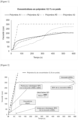
- FIG. 1 represents the viscosity versus time curves for polymers A 1 , A 2 and A 3 and A 5 for a polymer concentration of 0.3% by weight in water.
- FIG. 2 represents the viscosity versus time curve for the polymer As and details the method for calculating the factor F (c) .
- polymer solutions are prepared at the desired concentration (0.1%, 0.3%, or 0.5% by weight). After 2 minutes of preparation, the polymer solutions are filtered through a filter calibrated at 300 ⁇ m. If the filter is covered with polymer particles, the application test is not carried out (NA: Not Applicable). The filtrates are directly used for application tests.
- the best performances are obtained with the polymers A 5 , A 6 and C 4 which have factors F (c) greater than 4. They show the importance of the shape of the polymer (anhydrous oily suspension) beforehand. when it is put into solution and the factor F (c) in order to improve the drainage, retention and mechanical properties of the sheet of paper or cardboard.
Landscapes
- Chemical & Material Sciences (AREA)
- Inorganic Chemistry (AREA)
- Chemical Kinetics & Catalysis (AREA)
- Paper (AREA)
- Organic Low-Molecular-Weight Compounds And Preparation Thereof (AREA)
- Addition Polymer Or Copolymer, Post-Treatments, Or Chemical Modifications (AREA)
Claims (13)
- Verfahren zur Herstellung eines Blattes aus Papier oder Karton, wobei das Verfahren die Zugabe eines wasserlöslichen Polymers P mit einem gewichtsmittleren Molekulargewicht von mehr als 750.000 Dalton zu einer Fasersuspension in einer Menge von 100 bis 5.000 g/t-1 Trockenmasse umfasst, dadurch gekennzeichnet, dass es folgende aufeinanderfolgende Schritte umfasst:- Herstellung einer wässrigen Lösung A, die mindestens ein wasserlösliches Polymer P in einer Konzentration C zwischen 0,1 und 0,5 Gew.-% enthält, wobei das Polymer P einen Faktor F(c) von streng über 4 aufweist, mit F(c) = Δ600/C, wobei Δ600 der Anstieg zum Erreichen von 90 % der Viskosität ist, die von der wässrigen Lösung A nach 600 Sekunden bei 25°C entwickelt wird, die aus der Viskositätskurve der wässrigen Lösung A in Abhängigkeit von der Zeit bei der gegebenen Konzentration C bei 25°C erhalten wird, wobei das Polymer P vor der Bildung der wässrigen Lösung A in Form einer wasserfreien öligen Suspension vorliegt, die zwischen 20 und 60 Gew.-% des Polymers P in Form von Teilchen mit einem zahlendurchschnittlichen Durchmesser von zwischen 0,1 µm und weniger als 300 µm enthält, wobei die Viskosität der Lösung A im Laufe der Zeit bei 25°C mithilfe eines Viskosimeters mit einer schraubenförmigen Geometrie bestimmt wird,- Zugabe einer wässrigen Lösung A an einer oder mehreren Injektionsstellen zu der Faserstoffsuspension,- Bildung eines Blatt Papiers oder Kartons.
- Verfahren nach Anspruch 1, dadurch gekennzeichnet, dass das Polymer P aus einem Polymer mit mindestens einem wasserlöslichen, einfach ethylenisch ungesättigtem Monomer besteht, das ausgewählt ist aus:- mindestens einem nichtionischen Monomer, ausgewählt aus der Gruppe bestehend aus Acrylamid, Methacrylamid, N-Alkylacrylamiden, N-Alkylmethacrylamiden, N,N-Dialkylacrylamiden, N,N-Dialkylmethacrylamiden, alkoxylierten Acrylsäureestern, alkoxylierten Methacrylsäureestern, N-Vinylpyridin, N-Vinylpyrrolidon, Hydroxy-alkylacrylaten und Hydroxyalkylmethacrylaten, vorzugsweise Acrylamid,- mindestens einem anionisches Monomer, ausgewählt aus der Gruppe bestehend aus Monomeren mit einer Carboxygruppe und deren Salzen, einschließlich Acrylsäure, Methacrylsäure, Itaconsäure, Maleinsäure; Monomere mit einer Sulfonsäuregruppe und deren Salze, darunter Acrylamido-tert-butylsulfonsäure (ATBS), Allylsulfonsäure und Methallylsulfonsäure, und deren Alkali- oder Erdalkalisalzen, und Monomeren mit einer Phosphonsäuregruppe und ihren Salzen,- mindestens einem kationischen Monomer, ausgewählt aus der Gruppe bestehend aus quatemisiertem oder in ein Salz überführtem Dimethylaminoethylacrylat (ADAME); quatemisiertem oder in ein Salz überführtem Dimethylaminoethylmethacrylat (MADAME), Diallyldimethylammoniumchlorid (DADMAC), AcrylamidopropylTrimethylammonium-chlorid (APTAC) und Methacrylamidopropyl-Trimethylammoniumchlorid (MAPTAC),- mindestens einem zwitterionischen Monomer, ausgewählt aus der Gruppe bestehend aus Sulfobetain-Monomeren wie Sulfopropyldimethylammoniumethylmethacrylat, Sulfopropyldimethylammoniumpropylmethacrylamid und Sulfopropyl-2-vinylpyridinium; Phosphobetain-Monomeren wie Phosphataethyltrimethylammoniumethylmethacrylat und Carboxybetain-Monomeren.
- Verfahren nach Anspruch 1 oder 2, dadurch gekennzeichnet, dass die wasserfreie ölige Suspension des Polymers P zwischen 30 und 55 Gew.-% wasserlösliches Polymer P umfasst.
- Verfahren nach einem der Ansprüche 1 bis 3, dadurch gekennzeichnet, dass die wasserfreie ölige Suspension des Polymers P zwischen 0,05 und 5,0 Gew.-% eines Rheologiemodifizierungsmittels enthält.
- Verfahren nach einem der Ansprüche 1 bis 4, dadurch gekennzeichnet, dass die wasserfreie ölige Suspension des Polymers P zwischen 0,05 und 5,0 Gew.-% eines Rheologiemodifizierungsmittels enthält, das aus Hydroxyethylcellulose, Attapulgit, Laponit, Hectorit, Montmorillonit, Bentonit, pyrogenen Kieselsäuren und deren Gemischen ausgewählt ist.
- Verfahren nach einem der Ansprüche 1 bis 5, dadurch gekennzeichnet, dass die wasserfreie ölige Suspension des Polymers P zwischen 0,5 und 5,0 Gew.-% eines Emulgators enthält.
- Verfahren nach einem der Ansprüche 1 bis 6, dadurch gekennzeichnet, dass die wasserfreie ölige Suspension des Polymers P zwischen 0,5 und 5,0 Gew.-% eines Emulgators enthält, der ausgewählt ist aus Sorbitanestern, polyethoxylierten Sorbitanestern, diethoxyliertem Oleocetylalkohol, Polyestern mit einem mittleren Molekulargewicht zwischen 1.000 und 3.000 Dalton, die aus der Kondensation zwischen einer Poly(isobutenyl)bernsteinsäure oder ihrem Anhydrid und einem Polyethylenglycol resultieren, Blockcopolymeren mit einem mittleren Molekulargewicht zwischen 2.500 und 3.500 Dalton, die aus der Kondensation zwischen Hydroxystearinsäure und einem Polyethylenglycol resultieren, ethoxylierten Fettaminen, Derivaten von Di-Alkanolamiden, Copolymeren von Stearylmethacrylat und deren Mischungen.
- Verfahren nach einem der Ansprüche 1 bis 7, dadurch gekennzeichnet, dass die wasserfreie ölige Suspension des Polymers P zwischen 0,1 und 4,0 Gew.-% eines Umkehrmittel enthält.
- Verfahren nach einem der Ansprüche 1 bis 8, dadurch gekennzeichnet, dass die wasserfreie ölige Suspension des Polymers P zwischen 0,1 und 4,0 Gew.-% eines Umkehrmittels enthält, ausgewählt aus ethoxylierten Nonylphenolen; ethoxylierten und propoxylierten Alkoholen; ethoxylierten Tridecylalkoholen; ethoxylierten/propoxylierten Fettalkoholen; ethoxylierten Sorbitanestern; polyethoxyliertem Sorbitanlaurat; polyethoxyliertem Ricinusöl; deca-ethoxyliertem Oleodecylalkohol; heptaoxyethyliertem Laurylalkohol; polyethoxyliertem Sorbitanmonostearat; polyethoxyliertem Alkylphenol-cetylethern; Polyethylenoxid-Alkylarylethern; N-Cetyl-N-Ethylmorpholiniumethosulfat; Natriumlaurylsulfat; Kondensationsprodukten von Fettalkoholen mit Ethylenoxid; Kondensationsprodukten von Alkylphenolen und Ethylenoxid; Kondensationsprodukten von Fettaminen mit 5 oder mehr Moläquivalenten Ethylenoxid; ethoxylierten Tristyrylphenolen; Kondensaten von Ethylenoxid mit mehrwertigen Alkoholen, die teilweise mit Fettketten verestert sind, sowie deren wasserfreien Formen; Aminoxiden; Alkylpolyglucosiden; Glucamid; Phosphatestern; Alkylbenzensulfonsäuren und deren Salzen; wasserlöslichen Surfactantpolymeren und deren Gemischen.
- Verfahren nach einem der Ansprüche 1 bis 9, dadurch gekennzeichnet, dass das Polymer P linear oder strukturiert ist.
- Verfahren nach einem der Ansprüche 1 bis 10, dadurch gekennzeichnet, dass das Polymer P der wasserfreien öligen Suspension in Form von Partikeln mit einem mittleren Durchmesser zwischen 1 µm und und unter 300 µm vorliegt.
- Verfahren nach einem der Ansprüche 1 bis 11, dadurch gekennzeichnet, dass das Öl der wasserfreien öligen Suspension des Polymers P aus Mineralölen und/oder synthetischen Ölen ausgewählt ist.
- Verfahren nach einem der Ansprüche 1 bis 12, dadurch gekennzeichnet, dass das Öl 40 bis 80 Gew.-% der wasserfreien öligen Suspension des Polymers P ausmacht.
Applications Claiming Priority (2)
| Application Number | Priority Date | Filing Date | Title |
|---|---|---|---|
| FR2008078A FR3113069B1 (fr) | 2020-07-30 | 2020-07-30 | Procede de fabrication de papier et de carton |
| PCT/FR2021/051158 WO2022023631A1 (fr) | 2020-07-30 | 2021-06-24 | Procede de fabrication de papier et de carton |
Publications (3)
| Publication Number | Publication Date |
|---|---|
| EP4189162A1 EP4189162A1 (de) | 2023-06-07 |
| EP4189162B1 true EP4189162B1 (de) | 2024-08-07 |
| EP4189162C0 EP4189162C0 (de) | 2024-08-07 |
Family
ID=73038174
Family Applications (1)
| Application Number | Title | Priority Date | Filing Date |
|---|---|---|---|
| EP21743222.8A Active EP4189162B1 (de) | 2020-07-30 | 2021-06-24 | Herstellungsverfahren eines papier und karton |
Country Status (6)
| Country | Link |
|---|---|
| US (1) | US12234609B2 (de) |
| EP (1) | EP4189162B1 (de) |
| CN (1) | CN116096963B (de) |
| CA (1) | CA3187065A1 (de) |
| FR (1) | FR3113069B1 (de) |
| WO (1) | WO2022023631A1 (de) |
Family Cites Families (6)
| Publication number | Priority date | Publication date | Assignee | Title |
|---|---|---|---|---|
| FR2779752B1 (fr) * | 1998-06-12 | 2000-08-11 | Snf Sa | Procede de fabrication de papier et carton et nouveaux agents de retention correspondants, et papiers et cartons ainsi obtenus |
| US7396874B2 (en) * | 2002-12-06 | 2008-07-08 | Hercules Incorporated | Cationic or amphoteric copolymers prepared in an inverse emulsion matrix and their use in preparing cellulosic fiber compositions |
| CN101094956B (zh) * | 2004-12-30 | 2011-05-25 | 阿克佐诺贝尔公司 | 组合物及其在造纸中的用途 |
| FR2882373B1 (fr) * | 2005-02-24 | 2007-04-27 | Snf Sas Soc Par Actions Simpli | Procede de fabrication de papier et carton de grande resistance a sec et papiers et cartons ainsi obtenus |
| FR2963364B1 (fr) * | 2010-08-02 | 2014-12-26 | Snf Sas | Procede de fabrication de papier et carton presentant des proprietes de retention et d'egouttage ameliorees. |
| FR3048436B1 (fr) * | 2016-03-03 | 2018-03-23 | S.P.C.M. Sa | Procede de fabrication de papier et de carton |
-
2020
- 2020-07-30 FR FR2008078A patent/FR3113069B1/fr active Active
-
2021
- 2021-06-24 EP EP21743222.8A patent/EP4189162B1/de active Active
- 2021-06-24 CN CN202180058288.6A patent/CN116096963B/zh active Active
- 2021-06-24 WO PCT/FR2021/051158 patent/WO2022023631A1/fr not_active Ceased
- 2021-06-24 US US18/006,280 patent/US12234609B2/en active Active
- 2021-06-24 CA CA3187065A patent/CA3187065A1/en active Pending
Also Published As
| Publication number | Publication date |
|---|---|
| EP4189162A1 (de) | 2023-06-07 |
| WO2022023631A1 (fr) | 2022-02-03 |
| FR3113069A1 (fr) | 2022-02-04 |
| BR112023001079A2 (pt) | 2023-03-07 |
| US20230295877A1 (en) | 2023-09-21 |
| FR3113069B1 (fr) | 2022-10-14 |
| EP4189162C0 (de) | 2024-08-07 |
| CN116096963B (zh) | 2024-05-17 |
| US12234609B2 (en) | 2025-02-25 |
| CN116096963A (zh) | 2023-05-09 |
| CA3187065A1 (en) | 2022-02-03 |
Similar Documents
| Publication | Publication Date | Title |
|---|---|---|
| US8480853B2 (en) | Papermaking and products made thereby with ionic crosslinked polymeric microparticle | |
| EP3423630B1 (de) | Verfahren zur herstellung von papier und pappe | |
| EP1086276B1 (de) | Verfahren zur herstellung von papier und pappe | |
| WO2012017172A1 (fr) | Procede de fabrication de papier et carton presentant des proprietes de retention et d'egouttage ameliorees | |
| WO2009136024A2 (fr) | Procédé de fabrication de papier et carton | |
| WO1997016598A1 (fr) | Procede pour ameliorer la retention dans un procede de fabrication du papier, et agent de retention | |
| EP1090185B1 (de) | Verfahren zur ausflockung bei der herstellung einer papierbahn | |
| EP4189162B1 (de) | Herstellungsverfahren eines papier und karton | |
| EP4121466B1 (de) | Neue wasserlösliche polymerkomplexe in form einer inversen emulsion und verwendungen davon | |
| FR3127507A1 (fr) | Procede de fabrication de papier et de carton | |
| EP4323586A1 (de) | Verfahren zur herstellung von papier und karton | |
| EP3990700B1 (de) | Verfahren zur herstellung von papier oder karton | |
| FR3094980A1 (fr) | Nouvel additif a base de polymeres hydrosolubles et ses utilisations | |
| JP3614609B2 (ja) | 製紙用薬剤、抄紙方法および製紙用薬剤の製造方法 | |
| EP4267794A1 (de) | Verfahren zur herstellung von papier oder karton | |
| FR3121941A1 (fr) | Procede de fabrication de papier et de carton |
Legal Events
| Date | Code | Title | Description |
|---|---|---|---|
| STAA | Information on the status of an ep patent application or granted ep patent |
Free format text: STATUS: UNKNOWN |
|
| STAA | Information on the status of an ep patent application or granted ep patent |
Free format text: STATUS: THE INTERNATIONAL PUBLICATION HAS BEEN MADE |
|
| PUAI | Public reference made under article 153(3) epc to a published international application that has entered the european phase |
Free format text: ORIGINAL CODE: 0009012 |
|
| STAA | Information on the status of an ep patent application or granted ep patent |
Free format text: STATUS: REQUEST FOR EXAMINATION WAS MADE |
|
| 17P | Request for examination filed |
Effective date: 20230125 |
|
| AK | Designated contracting states |
Kind code of ref document: A1 Designated state(s): AL AT BE BG CH CY CZ DE DK EE ES FI FR GB GR HR HU IE IS IT LI LT LU LV MC MK MT NL NO PL PT RO RS SE SI SK SM TR |
|
| P01 | Opt-out of the competence of the unified patent court (upc) registered |
Effective date: 20230609 |
|
| DAV | Request for validation of the european patent (deleted) | ||
| DAX | Request for extension of the european patent (deleted) | ||
| GRAP | Despatch of communication of intention to grant a patent |
Free format text: ORIGINAL CODE: EPIDOSNIGR1 |
|
| STAA | Information on the status of an ep patent application or granted ep patent |
Free format text: STATUS: GRANT OF PATENT IS INTENDED |
|
| INTG | Intention to grant announced |
Effective date: 20240304 |
|
| GRAS | Grant fee paid |
Free format text: ORIGINAL CODE: EPIDOSNIGR3 |
|
| GRAA | (expected) grant |
Free format text: ORIGINAL CODE: 0009210 |
|
| STAA | Information on the status of an ep patent application or granted ep patent |
Free format text: STATUS: THE PATENT HAS BEEN GRANTED |
|
| AK | Designated contracting states |
Kind code of ref document: B1 Designated state(s): AL AT BE BG CH CY CZ DE DK EE ES FI FR GB GR HR HU IE IS IT LI LT LU LV MC MK MT NL NO PL PT RO RS SE SI SK SM TR |
|
| REG | Reference to a national code |
Ref country code: GB Ref legal event code: FG4D Free format text: NOT ENGLISH |
|
| REG | Reference to a national code |
Ref country code: CH Ref legal event code: EP |
|
| REG | Reference to a national code |
Ref country code: DE Ref legal event code: R096 Ref document number: 602021016904 Country of ref document: DE |
|
| REG | Reference to a national code |
Ref country code: IE Ref legal event code: FG4D Free format text: LANGUAGE OF EP DOCUMENT: FRENCH |
|
| U01 | Request for unitary effect filed |
Effective date: 20240814 |
|
| P04 | Withdrawal of opt-out of the competence of the unified patent court (upc) registered |
Free format text: CASE NUMBER: APP_48688/2024 Effective date: 20240826 |
|
| U07 | Unitary effect registered |
Designated state(s): AT BE BG DE DK EE FI FR IT LT LU LV MT NL PT RO SE SI Effective date: 20240902 |
|
| P05 | Withdrawal of opt-out of the competence of the unified patent court (upc) changed |
Free format text: CASE NUMBER: APP_48688/2024 Effective date: 20240902 |
|
| PG25 | Lapsed in a contracting state [announced via postgrant information from national office to epo] |
Ref country code: NO Free format text: LAPSE BECAUSE OF FAILURE TO SUBMIT A TRANSLATION OF THE DESCRIPTION OR TO PAY THE FEE WITHIN THE PRESCRIBED TIME-LIMIT Effective date: 20241107 |
|
| PG25 | Lapsed in a contracting state [announced via postgrant information from national office to epo] |
Ref country code: GR Free format text: LAPSE BECAUSE OF FAILURE TO SUBMIT A TRANSLATION OF THE DESCRIPTION OR TO PAY THE FEE WITHIN THE PRESCRIBED TIME-LIMIT Effective date: 20241108 Ref country code: PL Free format text: LAPSE BECAUSE OF FAILURE TO SUBMIT A TRANSLATION OF THE DESCRIPTION OR TO PAY THE FEE WITHIN THE PRESCRIBED TIME-LIMIT Effective date: 20240807 |
|
| PG25 | Lapsed in a contracting state [announced via postgrant information from national office to epo] |
Ref country code: IS Free format text: LAPSE BECAUSE OF FAILURE TO SUBMIT A TRANSLATION OF THE DESCRIPTION OR TO PAY THE FEE WITHIN THE PRESCRIBED TIME-LIMIT Effective date: 20241207 |
|
| PG25 | Lapsed in a contracting state [announced via postgrant information from national office to epo] |
Ref country code: HR Free format text: LAPSE BECAUSE OF FAILURE TO SUBMIT A TRANSLATION OF THE DESCRIPTION OR TO PAY THE FEE WITHIN THE PRESCRIBED TIME-LIMIT Effective date: 20240807 |
|
| PG25 | Lapsed in a contracting state [announced via postgrant information from national office to epo] |
Ref country code: RS Free format text: LAPSE BECAUSE OF FAILURE TO SUBMIT A TRANSLATION OF THE DESCRIPTION OR TO PAY THE FEE WITHIN THE PRESCRIBED TIME-LIMIT Effective date: 20241107 Ref country code: ES Free format text: LAPSE BECAUSE OF FAILURE TO SUBMIT A TRANSLATION OF THE DESCRIPTION OR TO PAY THE FEE WITHIN THE PRESCRIBED TIME-LIMIT Effective date: 20240807 |
|
| PG25 | Lapsed in a contracting state [announced via postgrant information from national office to epo] |
Ref country code: RS Free format text: LAPSE BECAUSE OF FAILURE TO SUBMIT A TRANSLATION OF THE DESCRIPTION OR TO PAY THE FEE WITHIN THE PRESCRIBED TIME-LIMIT Effective date: 20241107 Ref country code: PL Free format text: LAPSE BECAUSE OF FAILURE TO SUBMIT A TRANSLATION OF THE DESCRIPTION OR TO PAY THE FEE WITHIN THE PRESCRIBED TIME-LIMIT Effective date: 20240807 Ref country code: NO Free format text: LAPSE BECAUSE OF FAILURE TO SUBMIT A TRANSLATION OF THE DESCRIPTION OR TO PAY THE FEE WITHIN THE PRESCRIBED TIME-LIMIT Effective date: 20241107 Ref country code: IS Free format text: LAPSE BECAUSE OF FAILURE TO SUBMIT A TRANSLATION OF THE DESCRIPTION OR TO PAY THE FEE WITHIN THE PRESCRIBED TIME-LIMIT Effective date: 20241207 Ref country code: HR Free format text: LAPSE BECAUSE OF FAILURE TO SUBMIT A TRANSLATION OF THE DESCRIPTION OR TO PAY THE FEE WITHIN THE PRESCRIBED TIME-LIMIT Effective date: 20240807 Ref country code: GR Free format text: LAPSE BECAUSE OF FAILURE TO SUBMIT A TRANSLATION OF THE DESCRIPTION OR TO PAY THE FEE WITHIN THE PRESCRIBED TIME-LIMIT Effective date: 20241108 Ref country code: ES Free format text: LAPSE BECAUSE OF FAILURE TO SUBMIT A TRANSLATION OF THE DESCRIPTION OR TO PAY THE FEE WITHIN THE PRESCRIBED TIME-LIMIT Effective date: 20240807 |
|
| PG25 | Lapsed in a contracting state [announced via postgrant information from national office to epo] |
Ref country code: SM Free format text: LAPSE BECAUSE OF FAILURE TO SUBMIT A TRANSLATION OF THE DESCRIPTION OR TO PAY THE FEE WITHIN THE PRESCRIBED TIME-LIMIT Effective date: 20240807 |
|
| PG25 | Lapsed in a contracting state [announced via postgrant information from national office to epo] |
Ref country code: CZ Free format text: LAPSE BECAUSE OF FAILURE TO SUBMIT A TRANSLATION OF THE DESCRIPTION OR TO PAY THE FEE WITHIN THE PRESCRIBED TIME-LIMIT Effective date: 20240807 |
|
| PG25 | Lapsed in a contracting state [announced via postgrant information from national office to epo] |
Ref country code: SK Free format text: LAPSE BECAUSE OF FAILURE TO SUBMIT A TRANSLATION OF THE DESCRIPTION OR TO PAY THE FEE WITHIN THE PRESCRIBED TIME-LIMIT Effective date: 20240807 |
|
| PLBE | No opposition filed within time limit |
Free format text: ORIGINAL CODE: 0009261 |
|
| STAA | Information on the status of an ep patent application or granted ep patent |
Free format text: STATUS: NO OPPOSITION FILED WITHIN TIME LIMIT |
|
| 26N | No opposition filed |
Effective date: 20250508 |
|
| U20 | Renewal fee for the european patent with unitary effect paid |
Year of fee payment: 5 Effective date: 20250630 |
|
| REG | Reference to a national code |
Ref country code: CH Ref legal event code: H13 Free format text: ST27 STATUS EVENT CODE: U-0-0-H10-H13 (AS PROVIDED BY THE NATIONAL OFFICE) Effective date: 20260127 |
|
| PG25 | Lapsed in a contracting state [announced via postgrant information from national office to epo] |
Ref country code: MC Free format text: LAPSE BECAUSE OF FAILURE TO SUBMIT A TRANSLATION OF THE DESCRIPTION OR TO PAY THE FEE WITHIN THE PRESCRIBED TIME-LIMIT Effective date: 20240807 |
|
| GBPC | Gb: european patent ceased through non-payment of renewal fee |
Effective date: 20250624 |
|
| PG25 | Lapsed in a contracting state [announced via postgrant information from national office to epo] |
Ref country code: GB Free format text: LAPSE BECAUSE OF NON-PAYMENT OF DUE FEES Effective date: 20250624 |
|
| PG25 | Lapsed in a contracting state [announced via postgrant information from national office to epo] |
Ref country code: IE Free format text: LAPSE BECAUSE OF NON-PAYMENT OF DUE FEES Effective date: 20250624 |
|
| PG25 | Lapsed in a contracting state [announced via postgrant information from national office to epo] |
Ref country code: CH Free format text: LAPSE BECAUSE OF NON-PAYMENT OF DUE FEES Effective date: 20250630 |