EP4190200A1 - Verbindungsstruktur und wearable-vorrichtung - Google Patents
Verbindungsstruktur und wearable-vorrichtung Download PDFInfo
- Publication number
- EP4190200A1 EP4190200A1 EP22203243.5A EP22203243A EP4190200A1 EP 4190200 A1 EP4190200 A1 EP 4190200A1 EP 22203243 A EP22203243 A EP 22203243A EP 4190200 A1 EP4190200 A1 EP 4190200A1
- Authority
- EP
- European Patent Office
- Prior art keywords
- pin
- catch
- recess
- pin catch
- holder
- Prior art date
- Legal status (The legal status is an assumption and is not a legal conclusion. Google has not performed a legal analysis and makes no representation as to the accuracy of the status listed.)
- Granted
Links
Images





Classifications
-
- G—PHYSICS
- G04—HOROLOGY
- G04B—MECHANICALLY-DRIVEN CLOCKS OR WATCHES; MECHANICAL PARTS OF CLOCKS OR WATCHES IN GENERAL; TIME PIECES USING THE POSITION OF THE SUN, MOON OR STARS
- G04B37/00—Cases
- G04B37/14—Suspending devices, supports or stands for time-pieces insofar as they form part of the case
- G04B37/16—Fastening the case to the bracelet
-
- A—HUMAN NECESSITIES
- A44—HABERDASHERY; JEWELLERY
- A44C—PERSONAL ADORNMENTS, e.g. JEWELLERY; COINS
- A44C5/00—Bracelets; Wrist-watch straps; Fastenings for bracelets or wrist-watch straps
- A44C5/02—Link constructions
- A44C5/10—Link constructions not extensible
- A44C5/107—Link constructions not extensible with links made of more than two elements including connecting elements
-
- A—HUMAN NECESSITIES
- A44—HABERDASHERY; JEWELLERY
- A44C—PERSONAL ADORNMENTS, e.g. JEWELLERY; COINS
- A44C5/00—Bracelets; Wrist-watch straps; Fastenings for bracelets or wrist-watch straps
- A44C5/14—Bracelets; Wrist-watch straps; Fastenings for bracelets or wrist-watch straps characterised by the way of fastening to a wrist-watch or the like
-
- G—PHYSICS
- G04—HOROLOGY
- G04B—MECHANICALLY-DRIVEN CLOCKS OR WATCHES; MECHANICAL PARTS OF CLOCKS OR WATCHES IN GENERAL; TIME PIECES USING THE POSITION OF THE SUN, MOON OR STARS
- G04B37/00—Cases
- G04B37/14—Suspending devices, supports or stands for time-pieces insofar as they form part of the case
- G04B37/1486—Arrangements for fixing to a bracelet
Definitions
- the present disclosure relates to a connecting structure and a wearable device.
- a connecting structure of this kind disclosed in JP 2007-82597 A includes: an engaging recess that is located in the center of a connecting pin in its longitudinal direction and circles its circumference; and a pin catch that is provided in a storage space of one of the two members and moves in a direction perpendicular to the connecting pin. The engaging recess engages the tip of the pin catch, so that the connecting pin is caught so as not to come off the through holes.
- a connecting structure including:
- a wearable device including:
- FIG. 1 is a diagram showing a configuration of a timepiece 1 of the present embodiment.
- the timepiece 1 is a wristwatch having a device body 2 and a band 3 used when worn on a wrist.
- the device body 2 has an outer member (case) and various components (for example, a dial, hands, mechanisms and circuits for operating the hands, and the like) incorporated in this outer member.
- the side of the device body 2 on which the hands are located is referred to as a front surface, and the side opposite to the front surface is referred to as a back surface.
- the device body 2 has band attachments 2a to which the band 3 is attached at respective portions corresponding to the 12 o'clock position and 6 o'clock position of the dial on an outer circumference of the outer member.
- the band 3 has attachment ends 3a that are attached to the respective two band attachments 2a.
- Each of the attachment ends 3a may be, for example, one of a plurality of pieces constituting the band 3.
- the timepiece 1 has band connecting structures 100 (connecting structures) that each connect one of the band attachments 2a and one of the attachment ends 3a of the band 3 to each other.
- the band connecting structure 100 connects the device body 2 and the band 3 to each other.
- Each of the band connecting structures 100 connects the device body 2 (band attachment 2a) and the band 3 (attachment end 3a) and can be attached and detached in response to user operation. Therefore, the user can replace the band 3 according to his/her preference or situation.
- the device body 2 corresponds to a connecting object by the band connecting structures 100
- the band 3 corresponds to a connected object by the band connecting structure 100.
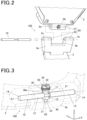
- FIG. 2 is a diagram showing the schematic structure of the band connecting structure 100.
- the band attachment 2a of the device body 2 is on the outer circumference of the device body 2 and protrudes to form a connection protrusion.
- the attachment end 3a of the band 3 has a connection recess 3b shaped such that the band attachment 2a fits into the connection recess 3b.
- a pair of tips 3c of the attachment end 3a that are separated because of the connection recess 3b have respective band-side insertion holes 22 ((second) insertion hole) extending in the width direction of the band 3.
- the band attachment 2a has a body-side insertion hole 21 ((first) insertion hole) extending in the width direction of the band 3.
- the band connecting structure 100 includes a connecting pin 10 that is inserted into this communicating insertion hole 20 and connect the band attachment2a and the attachment end 3a.
- the connecting pin 10 is detached from the communicating insertion hole 20, the connection between the band attachment 2a and the attachment end 3a can be released.
- FIG. 3 is a diagonal view showing a configuration of the band connecting structure 100.
- the band 3 is omitted, and the device body 2 is illustrated transparently in FIG. 3 , in order that the configuration of the band connecting structure 100 can be easily seen.
- the back surface of the device body 2 is oriented upward.
- an XYZ coordinate system is used to explain the orientation of each member of the band connecting structure 100.
- the X direction is parallel to an insertion axis A1 passing through the center of the insertion hole 20.
- FIG. 4 and FIG. 6 are diagrams each showing a cross section of the band connecting structure 100 perpendicular to the X direction.
- FIG. 5 and FIG. 7 are diagrams each showing a cross section perpendicular to the Y direction of the band connecting structure 100. In FIG. 5 and FIG. 7 , the band 3 is omitted.
- the band connecting structure 100 includes the connecting pin 10, a pin catch 30, a lid 50 (holder), and a spring 60 (biasing member). Among these, the spring 60 is omitted in FIG. 3 .
- the materials of the band attachment 2a, the attachment end 3a, the connecting pin 10, the pin catch 30, the lid 50, and the spring 60 may be a metal such as a titanium alloy or stainless steel. However, the materials are not limited to a metal, but may be any materials of a certain level of strength such as a resin.
- the band attachment 2a has a recess 40 that communicates with the body-side insertion hole 21 from the back surface side in the -Z direction. The recess 40 extends in a direction parallel to the Z direction and perpendicular to the insertion axis A1.
- the pin catch 30 and the spring 60 are located in the recess 40 (stored in the recess 40).
- the lid 50 is detachably attached to an opening edge 41 of the recess 40.
- the pin catch 30 and the spring 60 are stored in the recess 40 so as not to come off the recess 40.
- the pin catch 30 can move in the Z direction in the recess 40.
- FIG. 4 to FIG. 7 each show a cross section through the central axis A2 of the pin catch 30 (an axis passing the center of the cross section that is perpendicular to the moving directions of the pin catch 30) located in the recess 40.
- the spring 60 is, for example, a compression coil spring, located between the bottom of the recess 40 and the pin catch 30, and biases the pin catch 30 toward the lid 50 (toward the opening of the recess 40).
- the pin catch 30 biased by the spring 60 keeps abutting on the lid 50.
- the lid 50 holds the pin catch 30 in cooperation with the spring 60.
- the lid 50 has an opening 53 through which the inside and the outside of the recess 40 are communicated (that is, the opening 53 penetrates the lid 50). Through the opening 53, the pin catch 30 can be pushed (moved) in the -Z direction against the elastic force of the spring 60.
- the pin catch 30 can move in moving directions (Z direction, -Z direction) that are not parallel to the extending direction in which the insertion hole 20 extends (the direction of the insertion axis A1; X direction).
- the pin catch 30 has a pin insertion path 30a (cutout) at a portion where the insertion axis A1 passes having a size that allows the connecting pin 10 inserted into the body-side insertion hole 21 (communicating insertion hole 20) to pass through.
- the connecting pin 10 has an almost round bar shape and has a first portion 11 and second portions 12 that are located on both sides of the first portion 11 and have a larger diameter than the first portion 11 (thicker than the first portion).
- the pin catch 30 when the pin catch 30 is biased by the spring 60 to abut on the lid 50, the step 13 between the first portion 11 and the second portion 12 of the connecting pin 10 is caught by the edge 30b of the pin insertion path 30a of the pin catch 30 (see FIG. 5 and FIG. 10A to FIG. 10C ). As a result, the pin catch 30 catches the connecting pin 10.
- the position of the pin catch 30 in abutting on the lid 50 (when the pin catch 30 is held in response to cooperation of the spring 60 and the lid 50) is referred to as a "first position".
- the edge 30b of the pin insertion path 30a in the pin catch 30 corresponds to a "pin engagement portion" that engages the step 13 of the connecting pin 10.
- the recess 40 has an opening edge 41 located at an end in the +Z direction and a major portion 42 located on the -Z direction of the opening edge 41.
- the major portion 42 extends in the -Z direction beyond the body-side insertion hole 21.
- the recess 40 (major portion 42) has a bottom 40a (wall) parallel to the X-Y plane. A part of the major portion 42 intersects the body-side insertion hole 21.
- the sidewall surface of the major portion 42 corresponds to the sidewall surface among the walls of the recess 40 extending in the moving directions of the pin catch 30.
- the sidewall surface of the major portion 42 abuts on the side surface of the pin catch 30 (the side surface of the pin catch 30 extending in the moving directions of the pin catch 30).
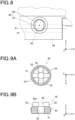
- FIG. 8 is a diagram showing the recess 40 in a view from the +Z direction.
- the recess 40 is illustrated with the connecting pin 10, the pin catch 30, the lid 50, and the spring 60 are removed.
- the shape of the major portion 42 in a view from the direction in which the central axis A2 extends (hereinafter referred to as a "central axis A2 direction"), has a smaller size in the X direction (the first direction) than in the Y direction (second direction).
- the major portion 42 of the present embodiment has a shape of an oval (rounded rectangle) that is long in the Y direction in a view from the central axis A2 direction.
- the major portion 42 has a shape formed by hollowing out the band attachment 2a such that an oval cylinder, whose cross section perpendicular to the central axis A2 is an oval, is cut out from the band attachment 2a.
- the sidewall surface of the main part 42 has the shape of the side surface of the oval cylinder.
- the major portion 42 may have a shape formed by cutting out an elliptical cylinder from the band attachment 2a. In this case, the shape of the major portion 42 in a view from the central axis A2 direction is an ellipse.
- the opening edge 41 of the recess 40 has a circular shape in a view from the central axis A2 direction, which fits into the outer circumference of the lid 50. As shown in FIG. 4 to FIG. 7 , the opening edge 41 has a thread groove on its cylindrical sidewall surface for screwing the lid 50.
- the central axis A2 of the pin catch 30 in the recess 40 does not intersect the insertion axis A1 of the body-side insertion hole 21, but is shifted in the +Y direction relative to the insertion axis A1.
- FIG. 9A and FIG. 9B are diagrams each showing the configuration of the lid 50.
- FIG. 9A is a diagram showing the lid 50 in a view from the +Z direction
- FIG. 9B is a diagram showing a cross section of the lid 50 perpendicular to the X direction, passing through the center of the opening 53.
- the lid 50 is an approximately cylindrical member having a base 51 and a protrusion 52.
- the base 51 has the opening 53.
- the protrusion 52 protrude from the base 51 outwardly in the moving direction (+Z direction) of the pin catch 30.
- the opening 53 penetrates the base 51 in the Z direction so that the inside and outside of the recess 40 are communicated.
- the opening 53 is at the center of the lid 50 in a view from the Z direction.
- the sidewall surface of the opening 53 shown in FIG. 9A and FIG. 9B is a cylindrical surface, but is not limited to this.
- the side surface of the base 51 has a thread ridge 55 that fits into the thread groove on the sidewall of the opening edge 41 of the recess 40.
- This thread ridge 55 allows the base 51 of the lid 50 to be screwed into the opening edge 41 of the recess 40.
- the lid 50 is thus detachably attached to the opening edge 41 of the recess 40.
- the state in which the lid 50 is attached to the opening edge 41 is a "first state" in which the lid 50 holds the pin catch 30 in cooperation with the spring 60.
- the protrusion 52 On a top surface 50a (end surface in the +Z direction) that is opposite to a surface facing the spring 60 (on the side of the recess 40), the protrusion 52 has a groove 54 that fits a tool (such as a screwdriver) used to rotate the lid 50 when attaching the lid 50 to the opening edge 41 of the recess 40 and when detaching the lid 50 from the opening edge 41.
- the groove 54 is formed in the X and Y directions to be a cross-shaped groove 54 that fits a Phillips screwdriver or the like, but is not limited to this.
- the groove 54 may have a straight line shape that fits a flat-blade screwdriver or the like, or may be a groove shaped to fit any other suitable tool (for example, a hexagonal wrench).
- the lid 50 is attached to the opening edge 41 while the pin catch 30 and the spring 60 are stored in the recess 40.
- the pin catch 30 and/or the spring 60 can be taken out with the lid 50 removed, which allows for easy maintenance such as repair or replacement.
- the state in which the lid 50 is detached from the opening edge 41 is a "second state" in which the pin catch 30 can be detached from the recess 40.
- the lid 50 is in the first state when attached to the device body 2 and is in the second state when detached from the device body 2. That is, the lid 50 can be selectively operated to be in the first state and in the second state.
- the connecting pin 10 inserted into the body-side insertion hole 21 has the first portion 11 and the second portions 12.
- the first portion 11 is located in the center of the connecting pin 10 in the X direction and has a cylindrical shape.
- the second portions 12 are located on both sides of the first portion 11 and have a larger diameter than the first portion 11.
- the cylindrical shape may have a tapered end(s) in the embodiment.
- the shape of the connecting pin 10 can be also described as a shape having a groove around the outer circumference at the first portion 11 so that the diameter of the first portion 11 is smaller than those of the adjacent second portions 12.
- the connecting pin 10 of such a configuration has a step(s) 13 at a border between the first portion 11 and the second portion (s) 12.
- the step 13 has a shelf-like stepping surface perpendicular to the X direction.
- the length of the first portion 11 in the X direction is slightly longer than the width of the pin catch 30 in the X direction.
- the end of the connecting pin 10 (the end of the second portion 12 opposite to the side of the first portion 11) has a taper 14 with a chamfered corner on the end surface.
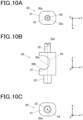
- FIG. 10A to FIG. 10C are diagrams each showing a configuration of the pin catch 30.
- the pin catch 30 includes a main body 31, a pusher 32 located on the +Z direction of the main body 31, and an abutment 33 located on the -Z direction of the main body 31.
- the central axis A2 of the pin catch 30 is illustrated in FIG. 10A to FIG. 10C .
- the main body 31 has a shape of an oval pillar which is oval in a view from the central axis A2 direction, having the pin insertion path 30a (cutout). As shown in FIG. 3 to FIG. 7 , the side surface of the main body 31 abuts on the sidewall surface of the major portion 42 of the recess 40. In other words, the main body 31 corresponds to a portion of the pin catch 30 that abuts on the recess 40. The side surface of the main body 31 corresponds to the side surface of the pin catch 30 that extends in the moving directions of the pin catch 30.
- the main body 31 When the pin catch 30 is in the first position, a surface (upper surface) on the +Z direction side of the main body 31 abuts on a surface (lower surface) on the -Z direction side of the lid 50.
- the shape of the main body 31 in a view from the central axis A2 direction has a smaller size in the X direction (the first direction) than in the Y direction (the second direction).
- the main body 31 has a shape in a view from the central axis A2 direction that ensures a certain gap between the sidewall surface of the major portion 42 of the recess 40 (a shape such as a similar shape that is one size smaller than the sidewall surface of the major portion 42).
- the shape of the major portion 42 is ellipse in a view from the central axis A2 direction
- the shape of the main body 31 is also ellipse. Since the gap is very narrow, the gap is not illustrated in FIG. 3 to FIG. 7 .
- the pin insertion path 30a is sized and located such that all of the first portion 11 and the second portions 12 of the connecting pin 10 can pass through the pin insertion path 30a when the pin catch 30 is in the second position.
- the pin insertion path 30a has a shape formed by hollowing out the main body 31 such that a portion corresponding to an oval column whose axis is perpendicular to the central axis A2, does not intersect the central axis A2, and is parallel to the insertion axis A1 is cut out from the main body 31.
- the pusher 32 has a cylindrical shape and has a diameter smaller than the minor axis of the oval of the main body 31.
- the diameter of the pusher 32 is sized so as to pass through the opening 53 of the lid 50.
- the end surface 32a on the +Z direction side of the pusher 32 is an exposed surface that is exposed through the opening 53 of the lid 50 when the pin catch 30 is in the first position.
- the end surface 32a of the pusher 32 is closer to the spring 40 (bottom 40a of the recess 40) than the top surface 50a (protrusion top surface) of the protrusion 52 of the lid 50 is.
- the position P2 in the Z direction of the end surface 32a of the pusher 32 is closer to the recess 40 than the position P1 of the top surface 50a (holder top surface) of the lid 50 is.
- the protrusion 52 of the lid 50 is around the end surface 32a exposed through the opening 53 in a view from the moving direction (the Z direction) of the pin catch 30.
- the end surface 32a of the pusher 32 has a hole that is deeper toward the center. This hole makes it easier to push the center of the end surface 32a of the pusher 32 through the opening 53 with a thin rod member or the like.
- the abutment 33 has a cylindrical shape, and the diameter of the abutment 33 is smaller than the short axis of the oval of the main body 31.
- the diameter of the abutment 33 is smaller than the inner diameter of the spring 60, which is a compression coil spring, and the abutment 33 is located inside the spring 60.
- the pin catch 30 in such a shape limits the rotation of the main body 31 around the central axis A2, because the shape of the main body 31 in a view from the central axis A2 direction is only slightly smaller than the sidewall surface of the major portion 42 of the recess 40, and is not a perfect circle but an oval. That is, the recess 40 and the pin catch 30 have a shape that limits the rotation of the pin catch 30 around the central axis A2 in the recess 40.
- the recess 40 and the pin catch 30 are shaped so as to limit the rotation of the pin catch 30 in the recess 40 around a virtual axis extending in the moving directions of the pin catch 30 (Z direction) and passing through the pin catch 30 to a range that allows the edge(s) 30b (pin engagement portion) of the pin insertion path 30a to engage the step(s) 13 of the connecting pin 10.
- the virtual axis corresponds to the central axis A2 of the pin catch 30 in the following example, but may not correspond to the central axis A2.
- FIG. 11A to FIG. 11C are diagrams each illustrating the limitation of rotation of the pin catch 30 in the recess 40.
- the hatching (dots) indicate where the pin insertion path 30 is formed.
- FIG. 11A shows the pin catch 30 (when the gap (play) between the sidewall surface of the recess 40 and the side surface of the pin catch 30, the pin catch 30 can rotate slightly around the central axis A2 in the recess 40.
- FIG. 11A shows the direction B1 of the major axis of the pin catch 30 (main body 31) rotated clockwise to its maximum and the direction B2 of the major axis of the pin catch 30 rotated counterclockwise at its maximum.
- the pin catch 30 can rotate within the rotatable range R from a state in which the direction of the major axis is B1 to a state in which the direction of the major axis is B2.
- the rotatable range R is exaggerated and drawn larger than it actually is for the sake of explanation.
- the pin catch 30 is shaped so as to pass the first portions 11 and the second portions 12 of the connecting pin 10 through the pin insertion path 30a when in the second position, as long as the direction of the major axis of the pin catch 30 is within the rotatable range R. That is, in any state between the state in which the direction of the major axis of the pin catch 30 is B1 as shown in FIG. 11B and the state in which the direction of the major axis of the pin catch 30 is B2 as shown in FIG. 11C , the insertion hole 20 passes through the cutout (dotted area) as the pin insertion path 30a, and is not interrupted by the pin catch 30. As a result, when the pin catch 30 is moved to the second position, the connecting pin 10 can pass through the pin insertion path 30a without adjustment of the rotational direction of the pin catch 30.
- the connecting pin 10 may be configured not to pass through the pin insertion path 30a. As the connecting pin 10 can pass through the pin insertion path 30a in most of the rotatable range R even in such a configuration, the direction of the pin catch 30 can be adjusted with ease to some extent.
- the end surface 32a of the pin catch 30 may have a groove that fits a tool for rotating the pin catch 30.
- the spring 60 is located between the bottom 40a of the recess 40 and the pin catch 30.
- the end of the spring 60 in the +Z direction abuts on the end surface of the main body 31 of the pin catch 30 in the -Z direction.
- the spring 60 exerts an elastic force in the +Z direction on the pin catch 30.
- the spring 60 biases the pin catch 30 in the +Z direction until the pin catch 30 abuts on the lid 50.
- the spring 60 contracts in the Z direction until the abutment 33 of the pin catch 30 abuts on the bottom 40a of the recess 40 depending on the force in the -Z direction received from the pin catch 30.
- the connecting pin catching state shown in FIG. 3 to FIG. 5 can be achieved.
- the connecting pin 10 is inserted into the communicating insertion hole 20 with the pin catch 30 being in the first position
- the taper 14 on the tip of the connecting pin 10 abuts on the edge 30b of the pin insertion path 30a as shown in FIG. 12A .
- the taper 14 pushes the edge 30b of the pin insertion path 30a down in the -Z direction, and the second portion 12 of the connecting pin 10 passes through the pin insertion path 30a as shown in FIG. 12B .
- the connecting pin 10 may be inserted through the pin insertion path 30a in a state where the pin catch 30 (pusher 32) is pushed from outside of the recess 40 through the opening 53 of the lid 50 in the -Z direction in response to user operation and moves to the second position or a position between the first position and the second position.
- the pin catch 30 (pusher 32) in the connecting pin catching state is pushed in response to user operation in the -Z direction from outside the recess 40 through the opening 53 in the lid 50 to move until the abutment 33 abuts on the bottom 40a of the recess 40, the pin catch 30 is in the second position shown in FIG. 6 and FIG. 7 , and is in the connecting pin releasing state.
- the edge 30b of the pin insertion path 30a no longer hooks the step 13 of the connecting pin 10, and the first portion 11 and the second portions 12 of the connecting pin 10 can pass through the pin insertion path 30a.
- the connecting pin 10 can be detached from the communicating insertion hole 20 by being pushed in the X direction, and thus the connection between the device body 2 and the band 3 can be released.
- Variation Example 1 of the above embodiment differs from the above embodiment in the shapes of the recess 40 and the pin catch 30. In the following, the differences from the above embodiment are described, and the common points to the above embodiment are omitted.
- FIG. 13 is a diagram showing the recess 40 according to Variation Example 1 in a view from the +Z direction.
- the major portion 42 (the portion abutting on the pin catch 30) of the recess 40 according to Variation Example 1 has a rotationally asymmetric shape in a view from the central axis A2 direction.
- having the rotationally asymmetric shape means that the major portion 42 has the same shape as the original when rotated around the central axis A2 by an angle of 360°/n only when n is 1.
- the outline of the major portion 42 in a view from the central axis A2 direction consists of a part of a circumference of a circle and a string of the circle.
- the sidewall surface of major portion 42 has a curved portion which is a part of a side surface of a cylinder and a plane 42f that is parallel to and does not intersect the central axis A2.
- the plane 42f and the curved portion of the sidewall surface of the major portion 42 may be smoothly connected so as not to form a sharp ridge.
- FIG. 14A to FIG. 14C are diagrams each showing a configuration of the pin catch 30 according to Variation Example 1.
- the main body 31 (the portion abutting on the recess 40) of the pin catch 30 according to Variation Example 1 has a rotationally asymmetric shape in a view from the central axis A2 direction.
- the outline of the main body 31 in a view from the central axis A2 direction consists of a part of a circumference of a circle and a string of the circle. That is, the main body 31 has a curved portion which is a part of a cylinder cut at a plane 31f that is parallel to and does not intersect the central axis A2.
- the plane 31f and the curved portion of the side surface of the main body 31 may be smoothly connected so as not to form a sharp ridge.
- the shape of the main body 31 in a view from the central axis A2 direction is one size smaller than the sidewall surface of the major portion 42 such that a certain gap can be secured between the main body 31 and the sidewall surface of the major portion 42 of the recess 40.
- the pin catch 30 can enter the recess 40 only when it is in a certain orientation. (However, deviation in the rotatable range due to the gap mentioned above is allowed) In other words, the orientation of the pin catch 30 within the recess 40 can be limited to a certain orientation.
- the plane 42f of the recess 40 faces the plane 31f of the pin catch 30 in the above certain orientation.
- the pin insertion path 30a is located in a position and a range so as to be connected to the body-side insertion hole 21 (communicating insertion hole 20).
- the shape of the recess 40 and the pin catch 30 may be any rotationally asymmetric shape in a view from the central axis A2 direction, and are not limited to those shown in FIG. 13 and FIG. 14A to FIG. 14C .
- the outline of the recess 40 and the pin catch 30 in a view from the central axis A2 direction may consist of a part of a circumference of an ellipse and a string of the ellipse.
- one of the recess 40 and the pin catch 30 may have a protruding portion in a view from the central axis A2 direction, and the other may have a depressed portion that fits the protruding portion.
- Variation Example 2 differs from the above embodiment in that the recess 40 is formed at the attachment end 3a and the like. Variation Example 2 may be combined with Variation Example 1.
- FIG. 15 is a diagram showing the configuration of the timepiece 1 and the band connecting structure 100 according to Variation Example 2.
- the attachment end 3a of the band 3 forms the connection protrusion
- the band attachment 2a of the device body 2 has a connection recess shaped to fit the attachment end 3a of the band 3.
- the attachment end 3a has the band-side insertion hole 22, and a pair of tips of the band attachment 2a have respective body-side insertion holes 21.
- the body-side insertion holes 21 and the band-side insertion hole 22 communicate with each other to form a communicating insertion hole 20 through which the connecting pin 10 is inserted.
- the attachment end 3a has the recess 40.
- This recess 40 stores the pin catch 30 and the spring 60, and the lid 50 is attached to the opening edge 41 of the recess 40.
- the structure of the band connecting structure 100 according to Variation Example 2 is the same as that of the above embodiment, except for the position of the recess 40.
- Variation Example 3 differs from the above embodiment in the structure of the lid 50. Variation Example 3 may be combined with at least one of Variation Example 1 and Variation Example 2.
- FIG. 16 is a diagram showing a cross section perpendicular to the X direction of a band connecting structure according to Variation Example 3.
- the lid 50 has a hinge 56 fixed to the band attachment 2a of the device body 2 and pivots on the hinge 56.
- the lid 50 can pivot between a state of closing the opening of the recess 40 indicated by solid lines in FIG. 16 and a state of opening the recess 40 indicated by dashed lines in FIG. 16 .
- the lid 50 has a clasp (for example, a snap), not shown in the drawing, at an end opposite to the hinge 56.
- the clasp fixes the end to the band attachment 2a and holds the lid 50 in a closing state (in the state indicated by the solid lines).
- the lid 50 in the state fixed by the clasp holds the pin catch 30 against the biasing force by the spring 60.
- the state in which the lid 50 is closing the opening of the recess 40 indicated by the solid lines corresponds to the "first state", in which the lid 50 holds the pin catch 30 in cooperation with the spring 60.
- the state in which the lid 50 is opening the opening of the recess 40 indicated by the dashed lines corresponds to the "second state", in which the pin catch 30 can be taken out of the recess 40. Therefore, the lid 50 can be selectively operated to be in the "first state” and the "second state” by pivoting on the hinge 56.
- the lid 50 is not limited to one that pivots on the hinge 56, but may be, for example, a sliding shutter that can slide in a direction parallel to the XY plane in FIG. 16 .
- the band connecting structure 100 as the connecting structure of the present embodiment includes: the connecting pin 10 that has the first portion 11 and the second portion (s) 12 thicker than the first portion with the step(s) 13 between the first portion 11 and the second portion(s) 12 and that is inserted into the body-side insertion hole 21 of the device body 2 as the connecting object and the band-side insertion hole 22 of the band 3 as the connected object to connect the device body 2 and the band 3 to each other; the pin catch 30 that moves in the recess 40 in the device body 2 in the moving directions (Z direction, -Z direction) that are not parallel to the extending direction in which the body-side insertion hole 21 of the device body 2 extends and that has the edge(s) 30b (pin engagement portion) of the pin insertion path 30a that engages the step(s) 13 of the connecting pin 10; the spring 60 as the biasing member that biases the pin catch 30 in one direction among the above moving directions; and the lid 50 as a holder that is provided on the device body 2 and transition
- the pin catch 30 and/or the spring 60 stored in the recess 40 can be taken out when the lid 50 is set to be in the second state. Therefore, the pin catch 30 and/or the spring 60 can be easily repaired or replaced, and the band connecting structure 100 can be easily maintained.
- the lid 50 detachably attached to the device body 2 enters the first state by being attached to the device body 2 and enters the second state by being detached from one of the connecting object and the connected object. Since the lid 50 is configured to be completely detachable from the device body 2, the pin catch 30 and/or the spring 60 can be easily taken out. Also, the lid 50 can be replaced easily.
- the lid 50 in the first state is screwed to the device body 2. This allows the lid 50 to be attached or detached with a simple operation of rotating the lid 50.
- the lid 50 has, on the surface opposite to the surface facing the spring 60, the groove 54 that is configured to fit a tool used to rotate the lid 50 when attaching the lid 50 to the device body. This allows the lid 50 to be firmly fixed using the tool, and the firmly fixed lid 50 to be easily detached using the tool.
- the central axis A2 passing the center of the cross section perpendicular to the moving directions of the pin catch 30 does not intersect the insertion axis A1 passing the center of the cross section perpendicular to the longitudinal direction.
- the pin engagement portion that engage the connecting pin 10 at the step 13 is the edge 30b of the pin insertion path 30a (cutout) in the pin catch 30, and the cutout is formed at least at a portion where the insertion axis A1 passes.
- the pin catch 30 can be downsized due to its smaller maximum width in the direction perpendicular to the central axis A2 compared to the configuration where the central axis A2 intersects the insertion axis A1 at a single point and the pin engagement portion is the edge of a hole through the pin catch 30. Also, since the diameter of the connecting pin 10 is not limited to less than the maximum width of the pin catch 30, the connecting pin 10 can be designed freely.
- the pin catch 30 can move in the recess 40 in the moving directions between the first position and the second position, where the second position is different from the first position.
- the connecting pin 10 engages the edge 30b of the pin insertion path 30a at the step 13.
- the pin catch 30 is in the second position in response to user operation against the biasing force by the spring 60, the second portion 12 can pass through the edge 30b of the pin insertion path 30a.
- the contact area between the pin catch 30 and the connecting pin 10 can be large, which allows the connecting pin 1 0 to be caught more securely. Therefore, even when the band connecting structure 100 is subjected to a shock, the connecting pin 10 is not easily released. Therefore, it is possible to prevent unintentional detachment of the band 3.
- the pin catch 30 has the abutment 33 which, when the pin catch 30 is in the second position, abuts on the bottom 40a (wall) of the recess 40 intersecting a line in the above moving directions through the recess at a point. This allows the pin catch 30 to move to the second position and to release the connecting pin 10 using a clear operation of pushing the pin catch 30 until the abutment 33 abuts on the bottom 40a of the recess 40.
- the elastic member is the spring 60, which is a compression coil spring
- the abutment 33 is located inside the spring 60
- the spring 60 and the abutment 33 can be compactly stored in the recess 40. Therefore, the recess 40 and the band connecting structure 100 can be downsized.
- the end surface 32a as the exposed surface of the surface of the pin catch 30 is exposed from the lid 50, and closer to the spring 60 than the top surface 50a of the lid 50 is.
- the top surface 50a is opposite to the surface of the lid 50 facing the spring 60.
- the end surface 32a as the exposed surface moves in the opening of the lid 50 in the above moving direction.
- the end surface 32a can be pushed in by a simple method of inserting a rod or the like in the opening 53, such that the pin catch 30 can be moved to the second position.
- the position of the end surface 32a when it is pushed in is stabilized by being regulated by the inner wall surface of the opening 53, the end surface 32a can be easily pushed in.
- the lid 50 has the base 51 and the protrusion 52.
- the base 51 has the opening 53.
- the protrusion 52 protrude from the base 51 outwardly in the above moving direction.
- the connecting pin 10 engages the edge 30b of the pin insertion path 30a as the pin engagement portion at the step 13
- the end surface 32a is located closer to the spring 60 than the top surface 50a of the protrusion 52 is.
- the top surface 50a is opposite to the surface facing the spring 60 of the protrusion 52.
- the protrusion 52 is located around the end surface 32a, in a view from the above moving directions.
- the timepiece 1 as the wearable device of the present embodiment includes the device body 2 as the connecting object, the band 3 as the connected object for attaching the device body 2 to the object, and the band connecting structure 100 described above.
- the band 3 can be replaced with a simple operation.
- the band connecting structure 100 can be easily maintained.
- the disconnection between the device body 2 and the band 3 due to mishandling can be less likely to occur.
- the wearable device examples include the timepiece 1, but are not limited to this.
- the wearable device may be any device that the user wears on the body, such as a health care device like an activity meter.
- the connecting object is not limited to the device body 2 of the timepiece 1, and the connected object is not limited to the band 3 of the timepiece 1.
- the connecting object and the connected object each may be one of a plurality of pieces constituting the band 3.
- the connecting structure may be used to connect the pieces that constitute the band 3.
- the attachment method of the lid 50 to the device body 2 or the band 3 is exemplified by, but is not limited to, screwing.
- the attachment method can be any method that enables attachment and detachment without destroying the attachment site (opening edge 41 in the above embodiment) on the device body 2 or the band and the lid 50.
- the lid 50 may be attached to the opening edge 41 of the recess 40 with a snap fit in which a protruding portion and a recessed portion respectively on the opening edge 41 and the lid 50 are fitted together.
- the holder is not limited to the lid 50 attached to the opening edge 41 of the recess 40, but may be in any position and shape as long as it can limit the movement of the pin catch 30 in the recess 40.
- the holder may be a member attached to the sidewall surface of the recess 40 or a projecting member on the sidewall surface of the recess 40.
- the example shows the configuration in which the recess 40 extends in the Z direction, but does not limit the present invention.
- the direction in which the recess 40 extends may be inclined with respect to the Z direction.
- the insertion axis A1 may intersect the central axis A2 at a single point.
- the pin insertion path 30a is a hole through the pin catch 30 so that the connecting pin 10 inserted into the communicating insertion hole 20 can pass through the center of the pin catch 30 located in the recess 40.
- the pin catch 30 has a pin insertion path 30a, and the edge 30b of the pin insertion path 30a corresponds to the pin engagement portion in the above example, but is not limited to this.
- the pin catch may have a projecting pin engagement portion at the tip that engages the step 13 of the connecting pin 10.
- the groove at the first portion 11 of the connecting pin 10 does not have to circle around the outer circumference, but may be provided partially on the outer circumference.
- the groove only needs to be at least large enough to allow engagement of the pin engagement portion.
- the communicating insertion hole 20 is not necessarily a through hole through the band attachment 2a of the device body 2 and the attachment end 3a of the band 3.
- One end of the through hole (the farther end from the body-side insertion hole 21 of the ends of one of the band-side insertion holes 22 when the communicating insertion hole 20 is applied to the embodiment in FIG. 2 ) may be closed and used as the communicating insertion hole 20.
- the connecting pin 10 may have only one second portion 12 on a closed-end side of the first portion 11. According to this configuration, the movement of the connecting pin 10 toward the closed end is limited by the closed end, and the movement toward the side opposite to the closed end is limited by the engagement of the step 13 with the pin catch 30.
- the biasing member is exemplified by the spring 60, which is a compression coil spring, but is not limited to this.
- the biasing member may be a spring having a shape other than a coil shape or a member made of an elastic material such as silicon.
- the biasing member may be a tensile spring provided between the pin catch 30 and the lid 50 and attached to both the pin catch 30 and the lid 50. In this case, the tensile spring may be detachable or non-detachable from both pin catch 30 and the lid 50.
- the biasing member may be one that magnetically biases the pin catch 30 toward the lid 50.
- the pusher 30 of the pin catch 30 is pushed in the - Z direction.
- the pin catch 30 may be pulled in the -Z direction from the side opposite to the lid 50 to move.
- the bottom 40a of the recess 40 is partially penetrated in a direction opposite to the opening edge 41, and the pin catch 30 protrudes out of the through hole such that the user can pull it.
- the wall of the recess 40 on which the abutment 33 of the pin catch 30 abuts is exemplified by the bottom 40a having a plane parallel to the X-Y plane, but is not limited to this.
- the wall may be in any shape on which the abutment 33 of the pin catch 30 can abut.
- a part of the bottom of the recess 40 may have a through hole that penetrates to the side opposite to the opening edge 41 of the recess 40.
- the lid 50 is detachably attached in the above examples, but is not limited to this.
- the lid 50 may be fixed to the opening edge 41 of the recess 40 in a non-detachable manner.
- the lid 50 may be a part of the band attachment 2a (attachment end 3a in Variation Example 2: the same applies below). In other words, the lid 50 may be integral with the band attachment 2a.
Landscapes
- Physics & Mathematics (AREA)
- General Physics & Mathematics (AREA)
- Clamps And Clips (AREA)
- Snaps, Bayonet Connections, Set Pins, And Snap Rings (AREA)
Priority Applications (1)
| Application Number | Priority Date | Filing Date | Title |
|---|---|---|---|
| EP24214465.7A EP4516152A1 (de) | 2021-12-06 | 2022-10-24 | Verbindungsstruktur und wearable-vorrichtung |
Applications Claiming Priority (2)
| Application Number | Priority Date | Filing Date | Title |
|---|---|---|---|
| JP2021197436A JP7400796B2 (ja) | 2021-12-06 | 2021-12-06 | 連結構造及び装着型機器 |
| JP2021197439A JP7414054B2 (ja) | 2021-12-06 | 2021-12-06 | 連結構造及び装着型機器 |
Related Child Applications (2)
| Application Number | Title | Priority Date | Filing Date |
|---|---|---|---|
| EP24214465.7A Division-Into EP4516152A1 (de) | 2021-12-06 | 2022-10-24 | Verbindungsstruktur und wearable-vorrichtung |
| EP24214465.7A Division EP4516152A1 (de) | 2021-12-06 | 2022-10-24 | Verbindungsstruktur und wearable-vorrichtung |
Publications (2)
| Publication Number | Publication Date |
|---|---|
| EP4190200A1 true EP4190200A1 (de) | 2023-06-07 |
| EP4190200B1 EP4190200B1 (de) | 2025-01-01 |
Family
ID=83995113
Family Applications (2)
| Application Number | Title | Priority Date | Filing Date |
|---|---|---|---|
| EP24214465.7A Withdrawn EP4516152A1 (de) | 2021-12-06 | 2022-10-24 | Verbindungsstruktur und wearable-vorrichtung |
| EP22203243.5A Active EP4190200B1 (de) | 2021-12-06 | 2022-10-24 | Verbindungsstruktur und wearable-vorrichtung |
Family Applications Before (1)
| Application Number | Title | Priority Date | Filing Date |
|---|---|---|---|
| EP24214465.7A Withdrawn EP4516152A1 (de) | 2021-12-06 | 2022-10-24 | Verbindungsstruktur und wearable-vorrichtung |
Country Status (2)
| Country | Link |
|---|---|
| US (1) | US12449771B2 (de) |
| EP (2) | EP4516152A1 (de) |
Families Citing this family (4)
| Publication number | Priority date | Publication date | Assignee | Title |
|---|---|---|---|---|
| JP1713455S (ja) * | 2021-06-01 | 2022-04-25 | 腕時計側 | |
| EP4190201B1 (de) * | 2021-12-06 | 2025-12-10 | Casio Computer Co., Ltd. | Verbindungsstruktur und wearable-vorrichtung |
| JP7683621B2 (ja) * | 2023-03-08 | 2025-05-27 | カシオ計算機株式会社 | 中留及びバンド |
| JP7718475B2 (ja) * | 2023-12-21 | 2025-08-05 | セイコーエプソン株式会社 | バンド保持機構、リスト機器、リスト機器本体部、バンド保持装置、および、バンド |
Citations (3)
| Publication number | Priority date | Publication date | Assignee | Title |
|---|---|---|---|---|
| FR2766587A1 (fr) * | 1997-07-23 | 1999-01-29 | Meca Control | Boitier de montre pour bracelet interchangeable sans outil |
| JP2007082597A (ja) | 2005-09-20 | 2007-04-05 | Seiko Epson Corp | 連結装置、バンドおよび時計 |
| US20080245105A1 (en) * | 2007-04-05 | 2008-10-09 | Glashutter Uhrenbetrieb Gmbh | Bracelet formed of hinged links |
Family Cites Families (8)
| Publication number | Priority date | Publication date | Assignee | Title |
|---|---|---|---|---|
| GB2227155B (en) * | 1988-10-14 | 1992-06-17 | Kanjanapas Kriangkrai | Bracelet for wrist watches |
| JP2004294284A (ja) | 2003-03-27 | 2004-10-21 | Seiko Epson Corp | 時計ケースとバンドの取付構造及び時計 |
| WO2004095969A1 (ja) * | 2003-05-02 | 2004-11-11 | Ken Hirata | 環状装飾品 |
| US9092012B2 (en) * | 2012-10-15 | 2015-07-28 | Timex Group Usa, Inc. | Coupling assembly for coupling a wristworn device to a strap |
| JP3194514U (ja) | 2014-09-16 | 2014-11-27 | 株式会社バンビ | 時計ケースと時計バンドの嵌合構造 |
| CH713709B1 (fr) * | 2017-04-11 | 2026-02-13 | Richemont Int Sa | Maillon de bracelet. |
| JP7322706B2 (ja) * | 2017-11-20 | 2023-08-08 | ソニーグループ株式会社 | バンド装置、腕時計およびエンドピース |
| CN110881757A (zh) | 2019-10-22 | 2020-03-17 | 瑞信五金(河源)有限公司 | 快拆表带及手表 |
-
2022
- 2022-10-24 EP EP24214465.7A patent/EP4516152A1/de not_active Withdrawn
- 2022-10-24 EP EP22203243.5A patent/EP4190200B1/de active Active
- 2022-12-06 US US18/075,654 patent/US12449771B2/en active Active
Patent Citations (3)
| Publication number | Priority date | Publication date | Assignee | Title |
|---|---|---|---|---|
| FR2766587A1 (fr) * | 1997-07-23 | 1999-01-29 | Meca Control | Boitier de montre pour bracelet interchangeable sans outil |
| JP2007082597A (ja) | 2005-09-20 | 2007-04-05 | Seiko Epson Corp | 連結装置、バンドおよび時計 |
| US20080245105A1 (en) * | 2007-04-05 | 2008-10-09 | Glashutter Uhrenbetrieb Gmbh | Bracelet formed of hinged links |
Also Published As
| Publication number | Publication date |
|---|---|
| EP4190200B1 (de) | 2025-01-01 |
| US12449771B2 (en) | 2025-10-21 |
| US20230176528A1 (en) | 2023-06-08 |
| EP4516152A1 (de) | 2025-03-05 |
Similar Documents
| Publication | Publication Date | Title |
|---|---|---|
| EP4516152A1 (de) | Verbindungsstruktur und wearable-vorrichtung | |
| US11464301B2 (en) | Device for attaching a bracelet | |
| US11022943B2 (en) | Device for attaching a bracelet | |
| JP4352000B2 (ja) | 腕時計バンドを腕時計ケースに固定する装置 | |
| US8240011B2 (en) | Device for fastening interchangeable watchstraps with sliding lock mechanism | |
| EP4190201A1 (de) | Verbindungsstruktur und wearable-vorrichtung | |
| US9877552B2 (en) | Jewelry with interchangable jewel | |
| US6564540B2 (en) | Bracelet comprising removable links | |
| US9271549B2 (en) | Bracelet formed of hinged links | |
| US20180299832A1 (en) | Watch case comprising removable horns | |
| JP4749430B2 (ja) | 腕輪用の展開型中留 | |
| US7017368B2 (en) | Articulated open ring | |
| JP7439857B2 (ja) | 連結構造及び装着型機器 | |
| US11540600B2 (en) | Link bracelet | |
| JP7593466B2 (ja) | 連結構造及び装着型機器 | |
| JP7400796B2 (ja) | 連結構造及び装着型機器 | |
| CN118201524A (zh) | 表带链节与表壳的连接 | |
| JP7677925B2 (ja) | バンドおよび時計 | |
| US20240197044A1 (en) | Bracelet fastening device | |
| US447908A (en) | Berniiart schiff and louis mayer | |
| HK1124741B (en) | Bracelet formed of hinged links | |
| CN109073912A (zh) | 一种用于眼镜的框架 | |
| HK1155823A1 (en) | Assembly for securing the outer end of the balance-spring of a timepiece sprung balance device |
Legal Events
| Date | Code | Title | Description |
|---|---|---|---|
| PUAI | Public reference made under article 153(3) epc to a published international application that has entered the european phase |
Free format text: ORIGINAL CODE: 0009012 |
|
| STAA | Information on the status of an ep patent application or granted ep patent |
Free format text: STATUS: REQUEST FOR EXAMINATION WAS MADE |
|
| 17P | Request for examination filed |
Effective date: 20221024 |
|
| AK | Designated contracting states |
Kind code of ref document: A1 Designated state(s): AL AT BE BG CH CY CZ DE DK EE ES FI FR GB GR HR HU IE IS IT LI LT LU LV MC ME MK MT NL NO PL PT RO RS SE SI SK SM TR |
|
| RBV | Designated contracting states (corrected) |
Designated state(s): AL AT BE BG CH CY CZ DE DK EE ES FI FR GB GR HR HU IE IS IT LI LT LU LV MC ME MK MT NL NO PL PT RO RS SE SI SK SM TR |
|
| STAA | Information on the status of an ep patent application or granted ep patent |
Free format text: STATUS: EXAMINATION IS IN PROGRESS |
|
| 17Q | First examination report despatched |
Effective date: 20240215 |
|
| GRAP | Despatch of communication of intention to grant a patent |
Free format text: ORIGINAL CODE: EPIDOSNIGR1 |
|
| STAA | Information on the status of an ep patent application or granted ep patent |
Free format text: STATUS: GRANT OF PATENT IS INTENDED |
|
| INTG | Intention to grant announced |
Effective date: 20240816 |
|
| GRAS | Grant fee paid |
Free format text: ORIGINAL CODE: EPIDOSNIGR3 |
|
| GRAA | (expected) grant |
Free format text: ORIGINAL CODE: 0009210 |
|
| STAA | Information on the status of an ep patent application or granted ep patent |
Free format text: STATUS: THE PATENT HAS BEEN GRANTED |
|
| AK | Designated contracting states |
Kind code of ref document: B1 Designated state(s): AL AT BE BG CH CY CZ DE DK EE ES FI FR GB GR HR HU IE IS IT LI LT LU LV MC ME MK MT NL NO PL PT RO RS SE SI SK SM TR |
|
| REG | Reference to a national code |
Ref country code: GB Ref legal event code: FG4D |
|
| REG | Reference to a national code |
Ref country code: CH Ref legal event code: EP |
|
| REG | Reference to a national code |
Ref country code: DE Ref legal event code: R096 Ref document number: 602022009290 Country of ref document: DE |
|
| REG | Reference to a national code |
Ref country code: IE Ref legal event code: FG4D |
|
| REG | Reference to a national code |
Ref country code: LT Ref legal event code: MG9D |
|
| REG | Reference to a national code |
Ref country code: NL Ref legal event code: MP Effective date: 20250101 |
|
| REG | Reference to a national code |
Ref country code: AT Ref legal event code: MK05 Ref document number: 1755339 Country of ref document: AT Kind code of ref document: T Effective date: 20250101 |
|
| PG25 | Lapsed in a contracting state [announced via postgrant information from national office to epo] |
Ref country code: NL Free format text: LAPSE BECAUSE OF FAILURE TO SUBMIT A TRANSLATION OF THE DESCRIPTION OR TO PAY THE FEE WITHIN THE PRESCRIBED TIME-LIMIT Effective date: 20250101 |
|
| PG25 | Lapsed in a contracting state [announced via postgrant information from national office to epo] |
Ref country code: FI Free format text: LAPSE BECAUSE OF FAILURE TO SUBMIT A TRANSLATION OF THE DESCRIPTION OR TO PAY THE FEE WITHIN THE PRESCRIBED TIME-LIMIT Effective date: 20250101 |
|
| PG25 | Lapsed in a contracting state [announced via postgrant information from national office to epo] |
Ref country code: PL Free format text: LAPSE BECAUSE OF FAILURE TO SUBMIT A TRANSLATION OF THE DESCRIPTION OR TO PAY THE FEE WITHIN THE PRESCRIBED TIME-LIMIT Effective date: 20250101 |
|
| PG25 | Lapsed in a contracting state [announced via postgrant information from national office to epo] |
Ref country code: ES Free format text: LAPSE BECAUSE OF FAILURE TO SUBMIT A TRANSLATION OF THE DESCRIPTION OR TO PAY THE FEE WITHIN THE PRESCRIBED TIME-LIMIT Effective date: 20250101 |
|
| PG25 | Lapsed in a contracting state [announced via postgrant information from national office to epo] |
Ref country code: IS Free format text: LAPSE BECAUSE OF FAILURE TO SUBMIT A TRANSLATION OF THE DESCRIPTION OR TO PAY THE FEE WITHIN THE PRESCRIBED TIME-LIMIT Effective date: 20250501 Ref country code: NO Free format text: LAPSE BECAUSE OF FAILURE TO SUBMIT A TRANSLATION OF THE DESCRIPTION OR TO PAY THE FEE WITHIN THE PRESCRIBED TIME-LIMIT Effective date: 20250401 |
|
| PG25 | Lapsed in a contracting state [announced via postgrant information from national office to epo] |
Ref country code: HR Free format text: LAPSE BECAUSE OF FAILURE TO SUBMIT A TRANSLATION OF THE DESCRIPTION OR TO PAY THE FEE WITHIN THE PRESCRIBED TIME-LIMIT Effective date: 20250101 |
|
| PG25 | Lapsed in a contracting state [announced via postgrant information from national office to epo] |
Ref country code: LV Free format text: LAPSE BECAUSE OF FAILURE TO SUBMIT A TRANSLATION OF THE DESCRIPTION OR TO PAY THE FEE WITHIN THE PRESCRIBED TIME-LIMIT Effective date: 20250101 Ref country code: PT Free format text: LAPSE BECAUSE OF FAILURE TO SUBMIT A TRANSLATION OF THE DESCRIPTION OR TO PAY THE FEE WITHIN THE PRESCRIBED TIME-LIMIT Effective date: 20250502 |
|
| PG25 | Lapsed in a contracting state [announced via postgrant information from national office to epo] |
Ref country code: BG Free format text: LAPSE BECAUSE OF FAILURE TO SUBMIT A TRANSLATION OF THE DESCRIPTION OR TO PAY THE FEE WITHIN THE PRESCRIBED TIME-LIMIT Effective date: 20250101 Ref country code: GR Free format text: LAPSE BECAUSE OF FAILURE TO SUBMIT A TRANSLATION OF THE DESCRIPTION OR TO PAY THE FEE WITHIN THE PRESCRIBED TIME-LIMIT Effective date: 20250402 |
|
| PG25 | Lapsed in a contracting state [announced via postgrant information from national office to epo] |
Ref country code: AT Free format text: LAPSE BECAUSE OF FAILURE TO SUBMIT A TRANSLATION OF THE DESCRIPTION OR TO PAY THE FEE WITHIN THE PRESCRIBED TIME-LIMIT Effective date: 20250101 |
|
| PG25 | Lapsed in a contracting state [announced via postgrant information from national office to epo] |
Ref country code: CZ Free format text: LAPSE BECAUSE OF FAILURE TO SUBMIT A TRANSLATION OF THE DESCRIPTION OR TO PAY THE FEE WITHIN THE PRESCRIBED TIME-LIMIT Effective date: 20250101 |
|
| PG25 | Lapsed in a contracting state [announced via postgrant information from national office to epo] |
Ref country code: SE Free format text: LAPSE BECAUSE OF FAILURE TO SUBMIT A TRANSLATION OF THE DESCRIPTION OR TO PAY THE FEE WITHIN THE PRESCRIBED TIME-LIMIT Effective date: 20250101 |
|
| REG | Reference to a national code |
Ref country code: DE Ref legal event code: R097 Ref document number: 602022009290 Country of ref document: DE |
|
| PG25 | Lapsed in a contracting state [announced via postgrant information from national office to epo] |
Ref country code: SM Free format text: LAPSE BECAUSE OF FAILURE TO SUBMIT A TRANSLATION OF THE DESCRIPTION OR TO PAY THE FEE WITHIN THE PRESCRIBED TIME-LIMIT Effective date: 20250101 |
|
| PG25 | Lapsed in a contracting state [announced via postgrant information from national office to epo] |
Ref country code: DK Free format text: LAPSE BECAUSE OF FAILURE TO SUBMIT A TRANSLATION OF THE DESCRIPTION OR TO PAY THE FEE WITHIN THE PRESCRIBED TIME-LIMIT Effective date: 20250101 |
|
| PG25 | Lapsed in a contracting state [announced via postgrant information from national office to epo] |
Ref country code: IT Free format text: LAPSE BECAUSE OF FAILURE TO SUBMIT A TRANSLATION OF THE DESCRIPTION OR TO PAY THE FEE WITHIN THE PRESCRIBED TIME-LIMIT Effective date: 20250101 |
|
| PGFP | Annual fee paid to national office [announced via postgrant information from national office to epo] |
Ref country code: FR Payment date: 20250908 Year of fee payment: 4 |
|
| PG25 | Lapsed in a contracting state [announced via postgrant information from national office to epo] |
Ref country code: EE Free format text: LAPSE BECAUSE OF FAILURE TO SUBMIT A TRANSLATION OF THE DESCRIPTION OR TO PAY THE FEE WITHIN THE PRESCRIBED TIME-LIMIT Effective date: 20250101 |
|
| PG25 | Lapsed in a contracting state [announced via postgrant information from national office to epo] |
Ref country code: RO Free format text: LAPSE BECAUSE OF FAILURE TO SUBMIT A TRANSLATION OF THE DESCRIPTION OR TO PAY THE FEE WITHIN THE PRESCRIBED TIME-LIMIT Effective date: 20250101 |
|
| PG25 | Lapsed in a contracting state [announced via postgrant information from national office to epo] |
Ref country code: SK Free format text: LAPSE BECAUSE OF FAILURE TO SUBMIT A TRANSLATION OF THE DESCRIPTION OR TO PAY THE FEE WITHIN THE PRESCRIBED TIME-LIMIT Effective date: 20250101 |
|
| PLBE | No opposition filed within time limit |
Free format text: ORIGINAL CODE: 0009261 |
|
| STAA | Information on the status of an ep patent application or granted ep patent |
Free format text: STATUS: NO OPPOSITION FILED WITHIN TIME LIMIT |
|
| 26N | No opposition filed |
Effective date: 20251002 |
|
| PGFP | Annual fee paid to national office [announced via postgrant information from national office to epo] |
Ref country code: DE Payment date: 20250902 Year of fee payment: 4 |