EP4190890A1 - Mikrofluidisches nukleinsäurenachweiskit und nachweisvorrichtung - Google Patents
Mikrofluidisches nukleinsäurenachweiskit und nachweisvorrichtung Download PDFInfo
- Publication number
- EP4190890A1 EP4190890A1 EP22803821.2A EP22803821A EP4190890A1 EP 4190890 A1 EP4190890 A1 EP 4190890A1 EP 22803821 A EP22803821 A EP 22803821A EP 4190890 A1 EP4190890 A1 EP 4190890A1
- Authority
- EP
- European Patent Office
- Prior art keywords
- nucleic acid
- cavity
- acid amplification
- kit
- detection
- Prior art date
- Legal status (The legal status is an assumption and is not a legal conclusion. Google has not performed a legal analysis and makes no representation as to the accuracy of the status listed.)
- Granted
Links
Images







Classifications
-
- C—CHEMISTRY; METALLURGY
- C12—BIOCHEMISTRY; BEER; SPIRITS; WINE; VINEGAR; MICROBIOLOGY; ENZYMOLOGY; MUTATION OR GENETIC ENGINEERING
- C12Q—MEASURING OR TESTING PROCESSES INVOLVING ENZYMES, NUCLEIC ACIDS OR MICROORGANISMS; COMPOSITIONS OR TEST PAPERS THEREFOR; PROCESSES OF PREPARING SUCH COMPOSITIONS; CONDITION-RESPONSIVE CONTROL IN MICROBIOLOGICAL OR ENZYMOLOGICAL PROCESSES
- C12Q1/00—Measuring or testing processes involving enzymes, nucleic acids or microorganisms; Compositions therefor; Processes of preparing such compositions
- C12Q1/68—Measuring or testing processes involving enzymes, nucleic acids or microorganisms; Compositions therefor; Processes of preparing such compositions involving nucleic acids
- C12Q1/6844—Nucleic acid amplification reactions
-
- B—PERFORMING OPERATIONS; TRANSPORTING
- B01—PHYSICAL OR CHEMICAL PROCESSES OR APPARATUS IN GENERAL
- B01L—CHEMICAL OR PHYSICAL LABORATORY APPARATUS FOR GENERAL USE
- B01L3/00—Containers or dishes for laboratory use, e.g. laboratory glassware; Droppers
- B01L3/50—Containers for the purpose of retaining a material to be analysed, e.g. test tubes
- B01L3/502—Containers for the purpose of retaining a material to be analysed, e.g. test tubes with fluid transport, e.g. in multi-compartment structures
- B01L3/5027—Containers for the purpose of retaining a material to be analysed, e.g. test tubes with fluid transport, e.g. in multi-compartment structures by integrated microfluidic structures, i.e. dimensions of channels and chambers are such that surface tension forces are important, e.g. lab-on-a-chip
- B01L3/502715—Containers for the purpose of retaining a material to be analysed, e.g. test tubes with fluid transport, e.g. in multi-compartment structures by integrated microfluidic structures, i.e. dimensions of channels and chambers are such that surface tension forces are important, e.g. lab-on-a-chip characterised by interfacing components, e.g. fluidic, electrical, optical or mechanical interfaces
-
- B—PERFORMING OPERATIONS; TRANSPORTING
- B01—PHYSICAL OR CHEMICAL PROCESSES OR APPARATUS IN GENERAL
- B01L—CHEMICAL OR PHYSICAL LABORATORY APPARATUS FOR GENERAL USE
- B01L3/00—Containers or dishes for laboratory use, e.g. laboratory glassware; Droppers
- B01L3/50—Containers for the purpose of retaining a material to be analysed, e.g. test tubes
- B01L3/502—Containers for the purpose of retaining a material to be analysed, e.g. test tubes with fluid transport, e.g. in multi-compartment structures
- B01L3/5027—Containers for the purpose of retaining a material to be analysed, e.g. test tubes with fluid transport, e.g. in multi-compartment structures by integrated microfluidic structures, i.e. dimensions of channels and chambers are such that surface tension forces are important, e.g. lab-on-a-chip
- B01L3/50273—Containers for the purpose of retaining a material to be analysed, e.g. test tubes with fluid transport, e.g. in multi-compartment structures by integrated microfluidic structures, i.e. dimensions of channels and chambers are such that surface tension forces are important, e.g. lab-on-a-chip characterised by the means or forces applied to move the fluids
-
- B—PERFORMING OPERATIONS; TRANSPORTING
- B01—PHYSICAL OR CHEMICAL PROCESSES OR APPARATUS IN GENERAL
- B01L—CHEMICAL OR PHYSICAL LABORATORY APPARATUS FOR GENERAL USE
- B01L7/00—Heating or cooling apparatus; Heat insulating devices
- B01L7/52—Heating or cooling apparatus; Heat insulating devices with provision for submitting samples to a predetermined sequence of different temperatures, e.g. for treating nucleic acid samples
-
- B—PERFORMING OPERATIONS; TRANSPORTING
- B01—PHYSICAL OR CHEMICAL PROCESSES OR APPARATUS IN GENERAL
- B01L—CHEMICAL OR PHYSICAL LABORATORY APPARATUS FOR GENERAL USE
- B01L2200/00—Solutions for specific problems relating to chemical or physical laboratory apparatus
- B01L2200/04—Exchange or ejection of cartridges, containers or reservoirs
-
- B—PERFORMING OPERATIONS; TRANSPORTING
- B01—PHYSICAL OR CHEMICAL PROCESSES OR APPARATUS IN GENERAL
- B01L—CHEMICAL OR PHYSICAL LABORATORY APPARATUS FOR GENERAL USE
- B01L2200/00—Solutions for specific problems relating to chemical or physical laboratory apparatus
- B01L2200/06—Fluid handling related problems
- B01L2200/0684—Venting, avoiding backpressure, avoid gas bubbles
-
- B—PERFORMING OPERATIONS; TRANSPORTING
- B01—PHYSICAL OR CHEMICAL PROCESSES OR APPARATUS IN GENERAL
- B01L—CHEMICAL OR PHYSICAL LABORATORY APPARATUS FOR GENERAL USE
- B01L2200/00—Solutions for specific problems relating to chemical or physical laboratory apparatus
- B01L2200/10—Integrating sample preparation and analysis in single entity, e.g. lab-on-a-chip concept
-
- B—PERFORMING OPERATIONS; TRANSPORTING
- B01—PHYSICAL OR CHEMICAL PROCESSES OR APPARATUS IN GENERAL
- B01L—CHEMICAL OR PHYSICAL LABORATORY APPARATUS FOR GENERAL USE
- B01L2200/00—Solutions for specific problems relating to chemical or physical laboratory apparatus
- B01L2200/16—Reagents, handling or storing thereof
-
- B—PERFORMING OPERATIONS; TRANSPORTING
- B01—PHYSICAL OR CHEMICAL PROCESSES OR APPARATUS IN GENERAL
- B01L—CHEMICAL OR PHYSICAL LABORATORY APPARATUS FOR GENERAL USE
- B01L2300/00—Additional constructional details
- B01L2300/02—Identification, exchange or storage of information
- B01L2300/023—Sending and receiving of information, e.g. using Bluetooth®
-
- B—PERFORMING OPERATIONS; TRANSPORTING
- B01—PHYSICAL OR CHEMICAL PROCESSES OR APPARATUS IN GENERAL
- B01L—CHEMICAL OR PHYSICAL LABORATORY APPARATUS FOR GENERAL USE
- B01L2300/00—Additional constructional details
- B01L2300/02—Identification, exchange or storage of information
- B01L2300/025—Displaying results or values with integrated means
- B01L2300/027—Digital display, e.g. LCD, LED
-
- B—PERFORMING OPERATIONS; TRANSPORTING
- B01—PHYSICAL OR CHEMICAL PROCESSES OR APPARATUS IN GENERAL
- B01L—CHEMICAL OR PHYSICAL LABORATORY APPARATUS FOR GENERAL USE
- B01L2300/00—Additional constructional details
- B01L2300/04—Closures and closing means
- B01L2300/041—Connecting closures to device or container
- B01L2300/042—Caps; Plugs
-
- B—PERFORMING OPERATIONS; TRANSPORTING
- B01—PHYSICAL OR CHEMICAL PROCESSES OR APPARATUS IN GENERAL
- B01L—CHEMICAL OR PHYSICAL LABORATORY APPARATUS FOR GENERAL USE
- B01L2300/00—Additional constructional details
- B01L2300/04—Closures and closing means
- B01L2300/041—Connecting closures to device or container
- B01L2300/043—Hinged closures
-
- B—PERFORMING OPERATIONS; TRANSPORTING
- B01—PHYSICAL OR CHEMICAL PROCESSES OR APPARATUS IN GENERAL
- B01L—CHEMICAL OR PHYSICAL LABORATORY APPARATUS FOR GENERAL USE
- B01L2300/00—Additional constructional details
- B01L2300/06—Auxiliary integrated devices, integrated components
- B01L2300/0627—Sensor or part of a sensor is integrated
- B01L2300/0663—Whole sensors
-
- B—PERFORMING OPERATIONS; TRANSPORTING
- B01—PHYSICAL OR CHEMICAL PROCESSES OR APPARATUS IN GENERAL
- B01L—CHEMICAL OR PHYSICAL LABORATORY APPARATUS FOR GENERAL USE
- B01L2300/00—Additional constructional details
- B01L2300/08—Geometry, shape and general structure
- B01L2300/0809—Geometry, shape and general structure rectangular shaped
- B01L2300/0816—Cards, e.g. flat sample carriers usually with flow in two horizontal directions
-
- B—PERFORMING OPERATIONS; TRANSPORTING
- B01—PHYSICAL OR CHEMICAL PROCESSES OR APPARATUS IN GENERAL
- B01L—CHEMICAL OR PHYSICAL LABORATORY APPARATUS FOR GENERAL USE
- B01L2300/00—Additional constructional details
- B01L2300/08—Geometry, shape and general structure
- B01L2300/0861—Configuration of multiple channels and/or chambers in a single devices
- B01L2300/0877—Flow chambers
-
- B—PERFORMING OPERATIONS; TRANSPORTING
- B01—PHYSICAL OR CHEMICAL PROCESSES OR APPARATUS IN GENERAL
- B01L—CHEMICAL OR PHYSICAL LABORATORY APPARATUS FOR GENERAL USE
- B01L2400/00—Moving or stopping fluids
- B01L2400/04—Moving fluids with specific forces or mechanical means
- B01L2400/0475—Moving fluids with specific forces or mechanical means specific mechanical means and fluid pressure
- B01L2400/0478—Moving fluids with specific forces or mechanical means specific mechanical means and fluid pressure pistons
-
- B—PERFORMING OPERATIONS; TRANSPORTING
- B01—PHYSICAL OR CHEMICAL PROCESSES OR APPARATUS IN GENERAL
- B01L—CHEMICAL OR PHYSICAL LABORATORY APPARATUS FOR GENERAL USE
- B01L2400/00—Moving or stopping fluids
- B01L2400/04—Moving fluids with specific forces or mechanical means
- B01L2400/0475—Moving fluids with specific forces or mechanical means specific mechanical means and fluid pressure
- B01L2400/0487—Moving fluids with specific forces or mechanical means specific mechanical means and fluid pressure fluid pressure, pneumatics
-
- B—PERFORMING OPERATIONS; TRANSPORTING
- B01—PHYSICAL OR CHEMICAL PROCESSES OR APPARATUS IN GENERAL
- B01L—CHEMICAL OR PHYSICAL LABORATORY APPARATUS FOR GENERAL USE
- B01L2400/00—Moving or stopping fluids
- B01L2400/06—Valves, specific forms thereof
- B01L2400/0622—Valves, specific forms thereof distribution valves, valves having multiple inlets and/or outlets, e.g. metering valves, multi-way valves
Definitions
- the present disclosure relates to the field of in vitro diagnosis (IVD) equipment and in particular to a microfluidic nucleic acid detection kit and a detection device for a point-of-care testing (POCT) scenario.
- IVD in vitro diagnosis
- POCT point-of-care testing
- the IVD technology refers to a product and service by which relevant clinical diagnostic information can be acquired through in vitro detection of samples including blood, bodily fluids, and tissues of the body to help determine a disease or a body function.
- the IVD field involves an extremely-broad scope, including blood tests, clinical biochemistry, cytodiagnosis, microbiological diagnosis, coagulation diagnosis, immunochemistry, molecular diagnosis, POCT, and the like.
- IVD which has great development potential and fast growth, refers to molecular diagnosis and POCT that are mainly based on nucleic acid detection.
- nucleic acid detection kits on the market cannot be used outside a professional biological laboratory. Sample processing using these kits should not be exposed to contamination and thus must be completed in a laboratory, and the entire process of detection requires various professional devices to complete the lysis of a biological sample, the extraction of nucleic acid, the PCR amplification of nucleic acid, the acquisition of an optical signal, and the data analysis.
- nucleic acid detection POCT kits and supporting devices thereof have gradually been developed in the industry, such as the Xpert ® product of Cypheid in the United States, the FilmArray ® product of BioFire in the United States, and the Vivalytic product of Bosch in Germany. External power is required for these products to operate the components in the kits to control various liquid flows in the kits, thereby achieving the automation of the whole process of lysis, extraction, amplification, and detection of a nucleic acid sample.
- these products involve expensive detection instruments and reagent cards, and the detection instruments are still complicated and bulky and are not portable.
- Some POCT kits adopt the constant-temperature amplification technology and the one-step nucleic acid lysis and extraction technology to greatly simplify reagent cards and detection instruments and even realize home nucleic acid detectors.
- the home nucleic acid detection products of Lucira TM in the United States realize the sample extraction and amplification in a kit without relying on the external equipment.
- a filter membrane is optionally arranged at the gas outlet to prevent aerosol pollution, but the filter membrane cannot completely prevent the overflow of an aerosol.
- the loop-mediated isothermal amplification (LAMP) adopted will lead to a high virus concentration in a cavity and a gas after nucleic acid amplification.
- the present disclosure is intended to provide an integrated and fully-automated POCT microfluidic nucleic acid detection kit and a detection device including the same, which solves the technical problems in the prior art that the existing kits cannot be used for detection completely outside a laboratory, cannot be completely sealed and free of contamination, and lead to complicated equipment systems due to the use of external power.
- a microfluidic nucleic acid detection kit including a kit body and a reagent card that are interconnected, where the kit body can slide relative to the reagent card to control the kit to work.
- the microfluidic nucleic acid detection kit further includes a plurality of cavities and a plurality of flow channels that communicate with the plurality of cavities.
- the plurality of cavities and the plurality of flow channels form a closed system.
- the plurality of cavities at least includes:
- a check valve is provided at the exhaust gas flow channel, and the check valve is configured to block the circulation of a liquid and discharge gas.
- the plurality of cavities further includes a bubble storage cavity, the bubble storage cavity is arranged between the exhaust gas flow channel and the nucleic acid amplification cavity, and the bubble storage cavity communicates with the nucleic acid amplification cavity.
- the kit body and the reagent card are connected through a buckle assembly;
- the buckle assembly includes a buckle fastener arranged on the reagent card and a bayonet buckle arranged on the kit body.
- the buckle fastener includes a buckle strip. One end of the buckle strip is connected with the reagent card, and the other end of the buckle strip is a free end that extends toward the kit body along the buckle strip.
- the buckle strip is provided with a first cantilever, and the reagent card is provided with a second cantilever.
- the second cantilever is located above the first cantilever.
- the bayonet buckle includes a first bayonet corresponding to the first cantilever and a second bayonet corresponding to the second cantilever.
- both the first cantilever and the second cantilever abut against the kit body, the gas source cavity and the gas tail cavity have the same gas pressure, and the liquid in the liquid cavity does not flow into the nucleic acid amplification cavity.
- the gas source cavity is squeezed, and gas pressure in the gas source cavity increases to push the liquid reagent in the liquid cavity to be injected through the sample injection flow channel into the nucleic acid amplification cavity.
- the flow of the liquid reagent pushes gas in the nucleic acid amplification cavity to be injected into the gas tail cavity, and the liquid reagent in the liquid cavity stops flowing when reaching the check valve, such that the liquid reagent is accurately injected into the nucleic acid amplification cavity.
- a solid reagent required for nucleic acid amplification is placed in the nucleic acid amplification cavity, and the solid reagent includes a dry powder reagent, a lyophilized pellet for a reagent, or an internal standard reagent for quality control (QC).
- a nucleic acid lysis extract is placed in the liquid cavity with a space reserved for sample addition, and the nucleic acid lysis extract has a volume of 100 ⁇ L to 5,000 ⁇ L.
- a main flow channel is provided between the nucleic acid amplification cavity and the sample injection flow channel
- a wax column is provided between the sample injection flow channel and the main flow channel.
- the plurality of cavities further includes a QC internal standard cavity arranged in the kit body.
- a first lyophilized pellet is placed in the QC internal standard cavity, and the first lyophilized pellet includes a reagent component required for internal QC.
- a second lyophilized pellet or a lyophilized powder is placed in the nucleic acid amplification cavity, and the second lyophilized pellet or the lyophilized powder includes a reagent component required for nucleic acid amplification.
- nucleic acid amplification cavity the check valve, and the gas tail cavity are provided in the same number and correspond to each other.
- the bottom of the QC internal standard cavity is inclined at a specified angle with a horizontal plane, and a first lyophilized pellet outlet is formed at the lowest position of the bottom of the QC internal standard cavity.
- an end of the sample injection flow channel close to the liquid cavity is provided with a puncture needle.
- the puncture needle is able to be inserted into the liquid cavity, such that the puncture needle extends into the liquid cavity to make the sample injection flow channel communicate with the liquid cavity.
- the reagent card is provided with a piston rod, and the end of the piston rod is provided with a rubber piston.
- the gas source cavity is shaped like a blind hole on the kit body.
- the end of the piston rod provided with the rubber piston extends into a blind end of the gas source cavity through an open end of the gas source cavity, and the gas source flow channel is arranged near the blind end of the gas source cavity.
- the rubber piston is located in the gas source cavity at a position lower than the gas source flow channel.
- the rubber piston moves toward the blind end to feed gas from the gas source cavity into the liquid cavity.
- a sample injection port is formed on the kit body, and the sample injection port is in communication with the liquid cavity.
- the sample injection port is formed at the end of the liquid cavity away from the sample injection flow channel.
- a first lyophilized pellet inlet and a first lyophilized pellet outlet are formed in the QC internal standard cavity, and the first lyophilized pellet outlet communicates with the liquid cavity and the QC internal standard cavity.
- the kit body further includes an upper cover.
- the upper cover is provided with a protrusion to seal the sample injection port and the first lyophilized pellet outlet, and the upper cover can cover the first lyophilized pellet inlet.
- the end of the liquid cavity away from the sample injection port is provided with a second sealing membrane, and the puncture needle can be inserted into the liquid cavity such that the end of the puncture needle penetrates through the second sealing membrane and communicates with the liquid cavity.
- a third sealing membrane is provided at the first lyophilized pellet inlet, and a fourth sealing membrane is provided at the first lyophilized pellet outlet.
- the fourth sealing membrane includes a first portion, a second portion, and a third portion that are integrally formed.
- the first portion seals the first lyophilized pellet outlet
- the second portion seals the liquid cavity
- the third portion is a ring-pull structure that is able to extend out of the sample injection port.
- sample injection flow channel tapers from the end away from the main flow channel to the end close to the main flow channel.
- a nucleic acid detection kit is provided. Because the whole process of the kit body sliding relative to the reagent card is implemented in the nucleic acid detection kit, there is no need to form a gas outlet in the nucleic acid detection kit, such that the nucleic acid detection kit can be fully sealed and used completely outside the laboratory without pollution.
- the nucleic acid detection kit can work without external power and involves simple detection devices. The fully sealing is conceived by the inventors based on the principle that a gas can be compressed while a liquid cannot be compressed.
- the gas source cavity and the gas tail cavity have the same gas pressure and the second sealing membrane is not punctured, such that the liquid in the liquid cavity will not flow into the nucleic acid amplification cavity.
- the gas source cavity is compressed, and gas pressure in the gas source cavity increases to push a liquid reagent in the liquid cavity to be injected through the sample injection flow channel into the nucleic acid amplification cavity.
- the flow of the liquid reagent pushes gas in the nucleic acid amplification cavity to be injected into the gas tail cavity, and the liquid reagent in the liquid cavity stops flowing when the check valve is reached, such that the liquid reagent is accurately injected into the nucleic acid amplification cavity.
- a detection device including the microfluidic nucleic acid detection kit described above, a first housing, a power module, and a display module, where the microfluidic nucleic acid detection kit is removably inserted into the first housing.
- the detection device further includes:
- the detection device further includes: a first circuit board arranged in the first housing and a control unit arranged on the first circuit board.
- the control unit is electrically connected with the first heating module to control the first heating module to heat the nucleic acid amplification cavity.
- the first heating module includes a heating member closely surrounding the nucleic acid amplification cavity, a first heating plate that is arranged at the bottom of the heating member and is in contact with the heating member for heat conduction, and a temperature sensor adjacent to the first heating plate.
- the temperature sensor is electrically connected to the control unit, and a heat dissipation space is formed between the first heating module and the first circuit board.
- a heating groove and first and second holes arranged oppositely are formed in the heating member.
- the first hole and the second hole both penetrate through the heating groove.
- the nucleic acid amplification cavity extends into the heating groove and is located between the first hole and the second hole.
- the first detection module includes a light source and a light sensor each of which are electrically connected to the first circuit board.
- the light source and the light sensor both are arranged outside the heating member.
- the light source is attached to the first hole, and the light sensor is attached to the second hole.
- the first circuit board is provided with a processing unit configured to process and analyze an optical signal acquired by the detection module and then feed an analysis result back to the display module.
- the processing unit includes a data acquisition circuit, an ADC chip, and a processor.
- a signal of the light sensor is acquired by the data acquisition circuit, subjected to analog-to-digital conversion by the ADC chip, and transmitted to the processor for processing and analysis of a digital signal, and an analysis result is fed back to the display module to obtain detection data.
- the first circuit board is provided with a data communication unit configured to transmit the detection data to a wireless terminal.
- the wireless terminal includes, but is not limited to, one or more selected from the group consisting of a mobile terminal, a computer, and a network server.
- the first housing includes a housing body with an opening formed at an upper end and an upper housing cover that is rotatably connected with the housing body and configured to cover the opening.
- the nucleic acid detection kit is removably inserted into the opening.
- a mounting position for arranging the display module is provided on the housing body, and the display module is arranged at the mounting position.
- the nucleic acid detection kit is removably inserted into the detection device, and the nucleic acid detection kit is disposable.
- the nucleic acid detection device can be used completely outside the laboratory, processes samples and injects and detects samples in a full-sealed manner, and eliminates aerosol pollution and other pollution risks.
- a third aspect of the present disclosure adopts the following technical solutions:
- An integrated detection device including the microfluidic nucleic acid detection kit described in the first aspect and a second housing.
- the integrated detection device further includes:
- the housing may be integrated or the first housing includes a front cover and a rear cover that are removably connected.
- the front cover and the rear cover cooperate to hold the microfluidic nucleic acid detection kit, and the second detection module is arranged between the front cover and the rear cover.
- the integrated detection device further includes: a second circuit board arranged between the front cover and the rear cover and a control unit arranged on the second circuit board.
- the control unit is electrically connected with the second heating module to control the second heating module to heat the nucleic acid amplification cavity, and the second circuit board is provided with a power socket.
- the second heating module includes a second heating plate closely surrounding the nucleic acid amplification cavity and a temperature sensor that is arranged on the inner surface of the second heating plate and is in contact with the reagent card; the temperature sensor is electrically connected with the control unit.
- the second detection module includes a light source and a light guide column both of which are electrically connected to the second circuit board.
- the light source and the light guide column are respectively located on two sides of the reagent card.
- the second circuit board is provided with a processing unit configured to process and analyze an optical signal acquired by the second detection module to obtain detection data.
- the processing unit includes a data acquisition circuit, an ADC chip, and a processor.
- a signal from the light sensor is acquired by the data acquisition circuit, subjected to analog-to-digital conversion by the ADC chip, and transmitted to the processor for processing and analysis of a digital signal to obtain detection data.
- the second circuit board is provided with a data communication unit configured to transmit the detection data to a mobile terminal, a computer, a network server, or another wireless terminal.
- the nucleic acid detection kit and the detection device are integrated to produce an integrated nucleic acid detection device, and the nucleic acid detection kit is disposable and can be changed after one-time detection, which prevents the detection device from contaminating the reagent card.
- the integrated nucleic acid detection device can be used completely outside a laboratory, can achieve fully-sealed sample injection and detection, and completely eliminate aerosol pollution and other pollution risks.
- connection may be a fixed connection, removable connection, or integral connection; may be a mechanical connection or electrical connection; may be a direct connection or indirect connection through an intermediate medium; and may be a communication or interaction between two elements.
- connection may be a fixed connection, removable connection, or integral connection; may be a mechanical connection or electrical connection; may be a direct connection or indirect connection through an intermediate medium; and may be a communication or interaction between two elements.
- a first feature that is “above” or “below” a second feature may include the first feature being in direct contact with the second feature, or that the first feature and the second feature are not in direct contact with each other but are in contact by another feature therebetween.
- the first feature that is “over”, “above”, and “on” the second feature includes the first feature being directly above and diagonally above the second feature, or simply indicates that a horizontal height of the first feature is above that of the second feature.
- the first feature that is “beneath”, “below”, and “under” the second feature includes the first feature being directly below and diagonally below the second feature, or simply indicates that the horizontal height of the first feature is lower than that of the second feature.
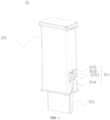
- This example of the present disclosure provides a nucleic acid detection kit 21 that can be used completely outside a laboratory.
- the nucleic acid extraction can be directly completed in the nucleic acid detection kit 21.
- An internal gas pressure balance system is adopted in the nucleic acid detection kit 21 to store an exhaust gas in the nucleic acid detection kit 21, such that the fully-sealed sample injection and detection can be achieved and the aerosol pollution and other pollution risks are completely eliminated.
- the sample injection is promoted in the nucleic acid detection kit 21, which reduces the external power of the equipment and simplifies the complexity of the detection equipment.
- a microfluidic nucleic acid detection kit 21 including a kit body 212 and a reagent card 211 that are interconnected, where the kit body 212 can slide relative to the reagent card 211 to control the kit to work.
- the microfluidic nucleic acid detection kit further includes a plurality of cavities and a plurality of flow channels that communicate with the plurality of cavities.
- the plurality of cavities and the plurality of flow channels form a closed system, and the plurality of cavities at least include:
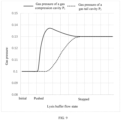
- the principle of the plurality of cavities and the plurality of flow channels to form an internal gas pressure balance process in the microfluidic nucleic acid detection kit 21 is as follows: Before the kit body 212 slides relative to the reagent card 211, the gas source cavity 2122 and the gas tail cavity 2112 have the same gas pressure and the liquid in the liquid cavity 2121 will not flow into the nucleic acid amplification cavity 2111.
- the gas source cavity 2122 When the kit body 212 slides relative to the reagent card 211, the gas source cavity 2122 is compressed, the gas pressure in the gas source cavity 2122 increases to push a liquid reagent in the liquid cavity 2121 to be injected through the sample injection flow channel 2113 into the nucleic acid amplification cavity 2111, and the flow of the liquid reagent pushes a gas in the nucleic acid amplification cavity 2111 to be injected into the gas tail cavity 2112.
- the liquid reagent in the liquid cavity 2121 stops flowing, such that the liquid reagent is accurately injected into the nucleic acid amplification cavity 2111.
- a solid reagent required for nucleic acid amplification is placed in the nucleic acid amplification cavity 2111, and the solid reagent includes a dry powder reagent, a lyophilized pellet for a reagent, or an internal standard reagent for QC.
- a nucleic acid lysis extract is placed in the liquid cavity 2121 with a space reserved for sample addition, where the liquid cavity 2121 has a volume of 100 ⁇ L to 3,000 ⁇ L and the nucleic acid lysis extract has a volume of 100 ⁇ L to 5,000 ⁇ L.
- the volume of the gas source cavity 2122 is V 1
- the volume of air in the liquid cavity 2121 is V 2
- the volume of the nucleic acid amplification cavity 2111 is V 3
- the volume of the gas tail cavity 2112 is V 4 .
- the liquid flow formulas are as follows:
- a lysis buffer flow state changes to a pushed state, and then P 2 gradually increases.
- the lysis buffer flow state changes to a stopped state, at which point P 1 is still greater than P 2 .
- the volume of the gas source cavity 2122 is set as 300 ⁇ L
- the volume of air in the liquid cavity 2121 is set as 800 ⁇ L
- the volume of the nucleic acid amplification cavity 2111 is set as 80 ⁇ L
- the volume of the gas tail cavity 2112 is set as 500 ⁇ L for illustration below:
- a main flow channel 2114 is provided between the nucleic acid amplification cavity 2111 and the sample injection flow channel 2113.
- a wax column 2119 is provided between the sample injection flow channel 2113 and the main flow channel 2114, which serves as a valve.
- the wax column 2119 can be melted by a heating device to make the wax column 2119 change from a solid state to a liquid state, such that the sample injection flow channel 2113 communicates with the main flow channel 2114.
- the plurality of cavities further includes a QC internal standard cavity 2126 arranged in the kit body 212.
- a first lyophilized pellet 80 is placed in the QC internal standard cavity 2126, and the first lyophilized pellet 80 includes a reagent component required for internal QC.
- a second lyophilized pellet or a lyophilized powder is placed in the nucleic acid amplification cavity 2111, and the second lyophilized pellet or the lyophilized powder includes a reagent component required for nucleic acid amplification.
- the nucleic acid amplification cavity 2111 and the gas tail cavity 2112 are provided in the same number and correspond to each other, and similarly, a corresponding check valve 90 is provided between a nucleic acid amplification cavity 2111 and a gas tail cavity 2112.
- a number of nucleic acid amplification cavities 2111 can be changed according to actual needs.
- the nucleic acid amplification cavity 2111 includes a nucleic acid amplification cavity I, a nucleic acid amplification cavity II, and a nucleic acid amplification cavity III.
- the gas tail cavity 2112 accordingly includes a gas tail cavity I, a gas tail cavity II, and a gas tail cavity III.
- the check valve 90 accordingly includes a check valve I 91, a check valve II 92, and a check valve III 93.
- a bubble storage cavity I is formed between the check valve I 91 and the nucleic acid amplification cavity I.
- a bubble storage cavity II is formed between the check valve II 92 and the nucleic acid amplification cavity II, and a bubble storage cavity III is formed between the check valve III 93 and the nucleic acid amplification cavity III.
- the gas tail cavity 2112 communicates with the nucleic acid amplification cavity 2111 through the exhaust gas flow channel 2115, that is, the check valve 90 is arranged on the exhaust gas flow channel 2115.
- the nucleic acid amplification cavity I communicates with the main flow channel 2114 through a shunt channel I 2116
- the nucleic acid amplification cavity II communicates with the main flow channel 2114 through a shunt channel II 2117
- the nucleic acid amplification cavity III communicates with the main flow channel 2114 through a shunt channel III 2118.
- a lyophilized pellet I 81 is pre-filled in the nucleic acid amplification cavity I.
- a lyophilized pellet II 82 is pre-filled in the nucleic acid amplification cavity II.
- a lyophilized pellet III 83 is pre-filled in the nucleic acid amplification cavity III 2111.
- the lyophilized pellet I 81, the lyophilized pellet II 82, and the lyophilized pellet III 83 are reagent systems (enzyme, template concentration, and primer) required for amplification.
- Primers for the lyophilized pellet I 81, the lyophilized pellet II 82, and the lyophilized pellet III 83 are different, and are a target point I primer for a target sample, a target point II primer for a target sample, and a primer for an internal standard, respectively.
- the internal gas pressure of each of the lyophilized pellet I 81, the lyophilized pellet II 82, and the lyophilized pellet III 83 can be 0 kPa to 100 kPa.
- the end of the sample injection flow channel 2113 close to the liquid cavity 2121 is provided with a puncture needle 25.
- the combination of the sample injection flow channel 2113 and the puncture needle 25 is a puncture tube, and an O-ring seal 27 is provided between the puncture tube and an extraction cavity.
- the puncture needle 25 can be inserted into the liquid cavity 2121 to make the puncture needle 25 extend into the liquid cavity 2121, such that the sample injection flow channel 2113 communicates with the liquid cavity 2121.
- the sample injection flow channel 2113 tapers from the end away from the main flow channel 2114 to the end close to the main flow channel 2114.
- the reagent card 211 is provided with a piston rod 23, and the end of the piston rod 23 is provided with a rubber piston 24.
- the gas source cavity 2122 is shaped like a blind hole on the kit body 212.
- the end of the piston rod 23 provided with a rubber piston 24 extends into a blind end of the gas source cavity 2122 through an open end of the gas source cavity 2122.
- the gas source flow channel 2129 is arranged near the blind end of the gas source cavity 2122.
- the rubber piston 24 is located in the gas source cavity 2122 at a position lower than the gas source flow channel 2129.
- the distance between the rubber piston 24 and the blind end is 1 mm to 10 mm and preferably 5 mm.
- a sample injection port 2124 is formed on the kit body 212, and the sample injection port 2124 can communicate with the liquid cavity 2121.
- the nucleic acid detection kit 21 further includes an upper cover 2123 connected with the kit body 212, and the upper cover 2123 is provided with a protrusion 2125 to seal the sample injection port 2124.
- a first lyophilized pellet inlet 21211 and a first lyophilized pellet outlet 21212 are formed in the QC internal standard cavity 2126, and the first lyophilized pellet outlet 21212 communicates with the liquid cavity 2121 and the QC internal standard cavity 2126.
- the upper cover 2123 can also cover the first lyophilized pellet inlet 21211.
- the first lyophilized pellet 80 is an internal standard for verification of a lysis buffer stored in the liquid cavity 2121, a lysis buffer stored in the nucleic acid amplification cavity 2111, a lyophilized pellet system stored in the nucleic acid amplification cavity 2111, a heating module, a detection module, and a display module.
- the bottom of the QC internal standard cavity 2126 is inclined at a specified angle with a horizontal plane, and the first lyophilized pellet outlet 21212 is located at the lowest position of the inclined bottom, such that the first lyophilized pellet 80 can move downward along the inclined bottom and enter the liquid cavity 2121 through the first lyophilized pellet outlet 21212.
- a plastic ball 84 is pre-stored in the QC internal standard cavity 2126, and the plastic ball 84 can be a polypropylene (PP) plastic ball.
- PP polypropylene
- the end of the liquid cavity 2121 away from the sample injection port 2124 is provided with a second sealing membrane 26, and the puncture needle 25 can be inserted into the liquid cavity 2121 to make the end of the puncture needle 25 penetrate through the second sealing membrane 26 to communicate with the liquid cavity 2121.
- the third sealing membrane 2127 is arranged at the first lyophilized pellet inlet 21211, a fourth sealing membrane 2128 is arranged at the first lyophilized pellet outlet 21212, and the second sealing membrane 26 and the third sealing membrane 2127 can be each an aluminum membrane.
- the wax column 2119, the sample injection flow channel 2113, the main flow channel 2114, the exhaust gas flow channel 2115, the nucleic acid amplification cavity 2111, and the gas tail cavity 2112 are sealed by a first sealing membrane 2110, and the first sealing membrane 2110 can be an aluminum membrane.
- the fourth sealing membrane 2128 includes a first portion 21281, a second portion 21282, and a third portion 21283 that are integrally formed.
- the first portion 21281, the second portion 21282, and the third portion 21283 have similar "concave" shapes.
- the first portion 21281 seals the first lyophilized pellet outlet 21212
- the second portion 21282 seals an upper end of the liquid cavity 2121
- the third portion 21283 is a ring-pull structure and can extend out of the sample injection port 2124.
- the fourth sealing membrane 2128 can be an aluminum-plastic composite membrane.
- the nucleic acid detection kit 21 includes a kit body 212 and a reagent card 211 that are connected through a connector.
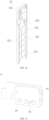
- the connector to connect the kit body 212 and the reagent card 211 is a buckle assembly 213 including a buckle fastener arranged on the reagent card 211 and a bayonet buckle 2132 arranged on the kit body 212.
- the buckle fastener includes a buckle strip 2131. One end of the buckle strip 2131 is connected with the reagent card 211, and the other end of the buckle strip is a free end that extends toward the kit body 212 along the buckle strip 2131.
- the buckle strip 2131 is provided with a first cantilever 21311, the reagent card 211 is provided with a second cantilever 2133, and the second cantilever 2133 is located above the first cantilever 21311.
- the bayonet buckle 2132 includes a first bayonet corresponding to the first cantilever 21311 and a second bayonet corresponding to the second cantilever 2133.
- the first cantilever 21311 and the second cantilever 2133 both abut against the kit body 212 to ensure that there will be no displacement between the reagent card 211 and the kit body 212.
- the first cantilever 21311 is coupled with the first bayonet and the second cantilever 2133 is coupled with the second bayonet.
- the microfluidic nucleic acid detection kit 21 can be used completely outside the laboratory.
- the nucleic acid extraction can be directly completed in the nucleic acid detection kit 21.
- An internal gas pressure balance system is adopted in the nucleic acid detection kit 21 to store an exhaust gas in the nucleic acid detection kit 21, such that the fully-sealed sample injection and detection can be achieved and the aerosol pollution and other pollution risks are completely eliminated.
- the sample injection is promoted in the nucleic acid detection kit 21, which reduces the external power of the equipment.
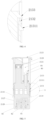
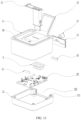
- a nucleic acid detection device including a first housing 10 (the first housing 10 has a housing body 11 and the microfluidic nucleic acid detection kit 21 provided in Example 1 is arranged in the housing body 11), a first heating module, and a first detection module.
- the nucleic acid detection device also includes a display module arranged on the housing body 11.
- the display module includes an LED lamp with a display function, which is convenient for an operator to determine a detection result.
- a mounting base plate 12 is provided at the bottom of the housing body 11, and the housing body 11 is connected with the mounting base plate 12.
- the housing body 11 has an opening formed at an upper end face and an upper housing cover 13 that is rotatably connected with the housing body 11 and configured to cover the opening.
- the nucleic acid detection kit 21 is inserted into the opening.
- the housing body 11 is provided with a mounting position for arranging the display module, and the display module is arranged at the mounting position.
- the back side of the housing body 11 is provided with a back shell 14.
- the mounting base plate 12 is provided with a back shell 14 mounting bottom notch 122.
- the housing body 11 is provided with a back shell 14 mounting upper notch.
- the back shell 14 is clamped between the bottom notch 122 and the upper notch.
- the back shell 14 is provided with a debugging interface 15, a first power socket 16, and a power switch 17 interface.
- a power module, a data transmission and processing module, and a control module are also provided in the housing body 11.
- the nucleic acid detection device also has Bluetooth and WIFI functions, which can be operated remotely by a mobile terminal.
- the status, data, and detection result of the nucleic acid detection device can be viewed in real-time by a mobile terminal.
- a principle of electrical control is not repeated here and can refer to the prior art.
- the nucleic acid detection device includes a first circuit board 22 arranged on the mounting base plate 12 in the first housing 10 and a control unit arranged on the first circuit board 22.
- the nucleic acid detection kit 21 can be inserted into the opening on the housing body 11.
- the control unit is electrically connected with the first heating module 3 to control the first heating module 3 to heat the nucleic acid amplification cavity 2111.
- the first heating module 3 includes a heating member 31 closely surrounding a reaction cavity, a first heating plate 32 that is arranged at a bottom of the heating member 31 and is in contact with the heating member 31 for heat conduction, and a temperature sensor adjacent to the first heating plate 32.
- the temperature sensor is electrically connected to the control unit, and a heat dissipation space is formed between the first heating module 3 and the first circuit board 22.
- the heating member 31 is provided with a heating groove 311 matching the nucleic acid amplification cavity 2111 arranged in the reagent card 211.
- the nucleic acid amplification cavity 2111 can extend into the heating groove 311.
- a first hole 312 and a second hole are formed oppositely in the heating member 31. The first hole 312 and the second hole both penetrate through the heating groove 311.
- the nucleic acid amplification cavity 2111 is arranged between the first hole 312 and the second hole.
- the first hole 312 includes a first hole I, a first hole II, and a first hole III.
- the second hole also includes a second hole I corresponding to the first hole I, a second hole II corresponding to the first hole II, and a second hole III corresponding to the first hole III.
- the nucleic acid amplification cavity I is arranged between the first hole I and the second hole I.
- the nucleic acid amplification cavity II is arranged between the first hole II and the second hole II, and the nucleic acid amplification cavity III is arranged between the first hole III and the second hole III.
- the first detection module can design different detection methods according to needs, and the nucleic acid detection methods include fluorescence hybridization, loop-mediated isothermal amplification (LAMP), real-time fluorescent polymerase chain reaction (PCR), high-resolution melting analysis (HRM), electrochemical aptamer-based analysis, or the like.
- LAMP loop-mediated isothermal amplification
- PCR real-time fluorescent polymerase chain reaction
- HRM high-resolution melting analysis
- electrochemical aptamer-based analysis or the like.
- a corresponding detection module is designed according to a detection method.
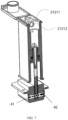
- the first detection module includes a light source 41 and a light sensor 42 that are electrically connected with the first circuit board 22.
- the light source 41 and the light sensor 42 both are arranged outside the heating member 31.
- the light source 41 is attached to the first hole 312, and the light sensor 42 is attached to the second hole.
- the first heating module 3 heats the nucleic acid amplification cavity I, the nucleic acid amplification cavity II, and the nucleic acid amplification cavity III.
- the light source 41 reaches the light sensor 42 through the nucleic acid amplification cavity I, the nucleic acid amplification cavity II, and the nucleic acid amplification cavity III.
- the light sensor 42 receives a change value of an optical signal.
- the first circuit board 22 is arranged on the circuit board mounting base 121.
- the circuit board mounting base 121 is arranged in the mounting base plate 12.
- the first circuit board 22 is provided with a circuit board cover plate 123.
- the first circuit board 22 includes a processing unit configured to process and analyze an optical signal acquired by the first detection module 3 and then feed an analysis result back to the display module.
- the processing unit includes a data acquisition circuit, an ADC chip, and a processor.
- a signal from the light sensor is acquired by the data acquisition circuit, subjected to analog-to-digital conversion by the ADC chip, and transmitted to the processor for processing and analysis of a digital signal, and an analysis result is fed back to the display module. That is, the processing unit first acquires an optical signal on the light sensor, then the optical signal is fed back to an LED lamp, a changed optical signal is subjected to analog-to-digital conversion and then transmitted to the processor for processing and analysis of a digital signal, and an analysis result is fed back to the display module.
- An upper cover 2123 of the kit body 212 is opened and the aluminum composite membrane is removed, such that the first lyophilized pellet 80 falls into the liquid cavity 2121 under a pushing action of the plastic ball 84.
- a throat swab is rinsed more than ten times in a lysis buffer, and during the process of repeatedly rinsing the throat swab, the first lyophilized pellet 80 is evenly dispersed in the lysis buffer. After the rinsing is completed, the kit body is covered by the upper cover 2123.
- the reagent card 211 of the nucleic acid detection kit 21 is inserted into the opening on the housing body 11, and the kit body 212 is gently pressed down until the first cantilever is coupled with the first bayonet and the second cantilever is coupled with the second bayonet, such that the puncture needle 25 punctures the second sealing membrane 26 and the rubber piston 24 pushes gas from the gas source cavity 2122 to the liquid cavity 2121, thereby increasing gas pressure in the liquid cavity 2121.
- atmospheric pressure in the liquid cavity 2121 is 0.137 MPa and a sample is lysed in the lysis buffer for 10 min.
- the first heating module 3 heats the wax column 2111 to melt the wax column 2119, such that all flow channels are open. Under the action of a pressure difference, a liquid enters the main flow channel 2114 through the sample injection flow channel 2113 and then enters the nucleic acid amplification cavity I, the nucleic acid amplification cavity II, and the nucleic acid amplification cavity III through shunt channels.
- a lyophilized pellet I 81 is pre-embedded in the nucleic acid amplification cavity I
- a lyophilized pellet II 82 is pre-embedded in the nucleic acid amplification cavity II 2111
- a lyophilized pellet III 83 is pre-embedded in the nucleic acid amplification cavity III.
- the first heating module 3 heats the nucleic acid amplification cavity I, the nucleic acid amplification cavity II, and the nucleic acid amplification cavity III.
- nucleic acid amplification cavity I After the amplification is completed, amplification results of the nucleic acid amplification cavity I, the nucleic acid amplification cavity II, and the nucleic acid amplification cavity III are detected.
- the device involves simple and convenient operations.
- the sample extraction can be conducted at the sample injection port, and there is no gas outlet in the nucleic acid detection kit 21, such that the nucleic acid detection kit can achieve fully-sealed detection without pollution and can be used completely outside the laboratory.
- the nucleic acid detection device can achieve the sample injection under the pushing action in the card without external power, and the nucleic acid detection device is simple, which simplifies the complexity of the detection equipment.
- this example provides an integrated nucleic acid detection device, including the microfluidic nucleic acid detection kit 21 provided in Example 1 and a second housing configured to accommodate the nucleic acid detection kit 21.
- the second housing can be integrated, or the second housing can also include a front cover 51 and a rear cover 52 for holding the nucleic acid detection kit 21, and the nucleic acid detection kit 21 is arranged between the front cover 51 and the rear cover 52.
- the integrated detection device further includes a second heating module 6 configured to heat the nucleic acid amplification cavity 2111 and a second detection module arranged between the front cover 51 and the rear cover 52 and configured to detect a change of an optical signal in the nucleic acid amplification cavity 2111.
- the optical signal includes one or more selected from the group consisting of color, brightness, and fluorescence saturation signals.
- the nucleic acid detection kit 21 and the detection device in the integrated nucleic acid detection device are integrated to produce an integrated nucleic acid detection device, and the nucleic acid detection kit is disposable and can be changed after one-time detection, which prevents the detection device from contaminating the reagent card.
- the integrated nucleic acid detection device can be used completely outside a laboratory, which can achieve fully-sealed sample injection and detection and completely eliminate aerosol pollution and other pollution risks.
- the front cover 51 and the rear cover 52 can be in a clamped connection.
- the front cover 51 includes a first bottom surface 514, a first side I 515, a second side I 516, and a third side I 517 that are integrally formed.
- the first bottom surface 514, the first side I 515, the second side I 516, and the third side I 517 enclose a "concave" shape.
- the first side I 515 and the second side I 516 are symmetrically arranged at two sides of the first bottom surface 514, and a plurality of fixing columns 512 are symmetrically arranged on the first side I 515 and the second side I 516 to connect the rear cover 52.
- the rear cover 52 has a "concave" shape and includes a second bottom surface 522, a first side II 523, a second side II 524, and a third side II 525 that are integrally formed.
- the first side II 523 and the second side II 524 are symmetrically arranged at two sides of the second bottom surface 522.
- Fixing slots 521 matching the fixing columns 512 are symmetrically arranged on the first side II 523 and the second side II 524.
- the front cover 51 and rear cover 52 are clamped together by clamping the fixing columns 512 with the fixing slots 521.
- the first side I 515 is docked with the first side II 523 to form a first side edge of the housing
- the second side I 516 is docked with the second side II 524 to form a second side edge of the housing
- the third side I 517 is docked with the third side II 525 to form the bottom plate of the housing.
- a cavity formed after the front cover 51 is docked with the rear cover 52 can accommodate the microfluidic nucleic acid detection kit 21 in the above example, and a cavity enclosed by the front cover 51 and the rear cover 52 of the kit body 212 of the nucleic acid detection kit 21 is exposed.
- a second circuit board 62 is also provided between the front cover 51 and the rear cover 52.
- the end of the second circuit board 62 is inserted into the kit body 212 of the nucleic acid detection kit 21, and the other end is exposed outside the kit body 212 and is flush with the reagent card 211.
- the second circuit board 62 is provided with a second LED lamp 72 and a control unit.
- the control unit is electrically connected with the second heating module 6 to control the second heating module 6 to heat the nucleic acid amplification cavity 2111.
- the second circuit board 62 is also provided with a second power socket 621, and a gap is reserved at the side edge of each of the front cover 51 and the rear cover 52 to expose the second power socket 621.
- the second circuit board 62 is provided with a data communication unit configured to transmit the detection data to a wireless terminal.
- the wireless terminal includes, but is not limited to, a mobile terminal, a computer, or a network server.
- the second circuit board 62 is arranged on the rear cover 52, and the second circuit board 62 includes a processing unit configured to process and analyze an optical signal acquired by the detection module to obtain detection data.
- the processing unit includes a data acquisition circuit, an ADC chip, and a processor.
- a signal from the temperature sensor 63 is acquired by the data acquisition circuit and subjected to analog-to-digital conversion by the ADC chip, and an analysis result is fed back to the processing unit.
- the second heating module 6 includes a second heating plate 61.
- Two second heating plates 61 are oppositely arranged. One end of one of the two second heating plates 61 is connected with one end of the other one of the two second heating plates through a connector, and the other end of each of the two second heating plates 61 is opened.
- the two second heating plates 61 enclose the nucleic acid amplification cavity 2111.
- Three third holes 64 are formed on one of the two second heating plates 61, and fourth holes corresponding to the third holes 64 are formed on the other one of the two second heating plates.
- Three third holes and three fourth holes are provided to surround the nucleic acid amplification cavity I, the nucleic acid amplification cavity II, and the nucleic acid amplification cavity III, respectively.
- the second detection module can design different detection methods according to needs, and the nucleic acid detection methods include fluorescence hybridization, LAMP, real-time fluorescent PCR, HRM analysis, electrochemical aptamer-based analysis, or the like.
- a corresponding detection module is designed according to a detection method.
- the second detection module includes a second LED lamp 72 (a light source) and a light guide column 71 that are electrically connected to the second circuit board 62.
- the LED lamp 72 and the light guide column 71 are respectively arranged at two sides of the reagent card 211.
- the second heating module 6 heats the nucleic acid amplification cavity I, the nucleic acid amplification cavity II, and the nucleic acid amplification cavity III.
- the LED lamp 72 reaches the light guide column 71 through the nucleic acid amplification cavity I, the nucleic acid amplification cavity II, and the nucleic acid amplification cavity III. A user can observe a color change in the light guide column 71.
Landscapes
- Chemical & Material Sciences (AREA)
- Health & Medical Sciences (AREA)
- Life Sciences & Earth Sciences (AREA)
- Organic Chemistry (AREA)
- General Health & Medical Sciences (AREA)
- Chemical Kinetics & Catalysis (AREA)
- Analytical Chemistry (AREA)
- Proteomics, Peptides & Aminoacids (AREA)
- Zoology (AREA)
- Wood Science & Technology (AREA)
- Engineering & Computer Science (AREA)
- Clinical Laboratory Science (AREA)
- Biochemistry (AREA)
- Dispersion Chemistry (AREA)
- Molecular Biology (AREA)
- Hematology (AREA)
- Biotechnology (AREA)
- Microbiology (AREA)
- Immunology (AREA)
- Biophysics (AREA)
- Physics & Mathematics (AREA)
- Bioinformatics & Cheminformatics (AREA)
- General Engineering & Computer Science (AREA)
- Genetics & Genomics (AREA)
- Apparatus Associated With Microorganisms And Enzymes (AREA)
- Measuring Or Testing Involving Enzymes Or Micro-Organisms (AREA)
Applications Claiming Priority (3)
| Application Number | Priority Date | Filing Date | Title |
|---|---|---|---|
| CN202110540815.9A CN113897283A (zh) | 2021-05-18 | 2021-05-18 | 一种微流控核酸检测试剂盒及检测装置 |
| CN202210387718.5A CN114854562B (zh) | 2021-05-18 | 2022-04-14 | 一种微流控核酸检测试剂盒及检测装置 |
| PCT/CN2022/091872 WO2022242499A1 (zh) | 2021-05-18 | 2022-05-10 | 一种微流控核酸检测试剂盒及检测装置 |
Publications (3)
| Publication Number | Publication Date |
|---|---|
| EP4190890A1 true EP4190890A1 (de) | 2023-06-07 |
| EP4190890A4 EP4190890A4 (de) | 2024-09-04 |
| EP4190890B1 EP4190890B1 (de) | 2025-06-18 |
Family
ID=79187454
Family Applications (1)
| Application Number | Title | Priority Date | Filing Date |
|---|---|---|---|
| EP22803821.2A Active EP4190890B1 (de) | 2021-05-18 | 2022-05-10 | Mikrofluidisches nukleinsäurenachweiskit und nachweisvorrichtung |
Country Status (4)
| Country | Link |
|---|---|
| US (1) | US20230295700A1 (de) |
| EP (1) | EP4190890B1 (de) |
| CN (2) | CN113897283A (de) |
| WO (1) | WO2022242499A1 (de) |
Families Citing this family (16)
| Publication number | Priority date | Publication date | Assignee | Title |
|---|---|---|---|---|
| CN113897283A (zh) * | 2021-05-18 | 2022-01-07 | 成都万众壹芯生物科技有限公司 | 一种微流控核酸检测试剂盒及检测装置 |
| CN114836308B (zh) * | 2022-03-13 | 2023-03-21 | 首玺(广州)医疗科技有限责任公司 | 一种核酸检测试剂盒及其制备工艺 |
| CN117181321A (zh) * | 2022-05-30 | 2023-12-08 | 广州达安基因股份有限公司 | 一种手持微流控芯片核酸检测装置及其使用方法 |
| WO2023236313A1 (zh) * | 2022-06-06 | 2023-12-14 | 广州达安基因股份有限公司 | 一种微流控芯片检测卡盒 |
| CN114752489B (zh) * | 2022-06-16 | 2022-11-18 | 上海简逸生物科技有限公司 | 一种核酸快速检测仪器及试剂盒 |
| CN115029229A (zh) * | 2022-06-21 | 2022-09-09 | 成都万众壹芯生物科技有限公司 | 一种基于负压系统的核酸检测试剂盒 |
| CN114989959B (zh) * | 2022-06-21 | 2026-03-24 | 成都万众壹芯生物科技有限公司 | 一种基于负压系统的核酸检测试剂盒 |
| CN116042369A (zh) * | 2022-10-28 | 2023-05-02 | 西安交通大学 | 一种核酸检测装置及采样试管 |
| CN115558591B (zh) * | 2022-10-28 | 2025-12-16 | 西安交通大学 | 一种传染病检测装置、反应芯片、采样试管及检测方法 |
| CN115747037A (zh) * | 2023-01-09 | 2023-03-07 | 深圳市科瑞达生物技术有限公司 | 核酸分析卡及其使用方法 |
| CN116875440A (zh) * | 2023-06-21 | 2023-10-13 | 无锡百泰克生物技术有限公司 | 一种基于层析的多重核酸检测仪、试纸及方法 |
| CN117680211B (zh) * | 2023-12-04 | 2026-04-28 | 苏州雅睿生物技术股份有限公司 | 一种微流控芯片、微流控检测装置及检测方法 |
| CN118291232A (zh) * | 2024-03-29 | 2024-07-05 | 中国科学院过程工程研究所 | 一种微流控芯片及使用方法 |
| CN118165805B (zh) * | 2024-05-13 | 2024-09-06 | 苏州天隆生物科技有限公司 | 一种多驱动源试剂盒、扩增检测设备及扩增检测方法 |
| CN118146913B (zh) * | 2024-05-13 | 2024-08-20 | 苏州天隆生物科技有限公司 | 一种试剂盒、试剂盒制造方法及扩增检测方法 |
| CN119060831B (zh) * | 2024-09-24 | 2025-04-29 | 芜湖森爱驰生物科技有限公司 | 基于恒温扩增加试纸条的多靶标核酸检测装置及检测方法 |
Family Cites Families (19)
| Publication number | Priority date | Publication date | Assignee | Title |
|---|---|---|---|---|
| CA1338505C (en) * | 1989-02-03 | 1996-08-06 | John Bruce Findlay | Containment cuvette for pcr and method of use |
| JP4646716B2 (ja) * | 2005-02-03 | 2011-03-09 | 三洋電機株式会社 | 微生物検出装置及び微生物検出用カセット |
| GB2516669B (en) * | 2013-07-29 | 2015-09-09 | Atlas Genetics Ltd | A method for processing a liquid sample in a fluidic cartridge |
| JP6516990B2 (ja) * | 2014-09-02 | 2019-05-22 | キヤノンメディカルシステムズ株式会社 | 核酸検出カセット |
| EP3286546B1 (de) * | 2015-04-24 | 2023-07-19 | Mesa Biotech, Inc. | Fluidische testkassette |
| CN109843436B (zh) * | 2016-09-30 | 2022-03-29 | 皇家飞利浦有限公司 | 用于给样本施加试剂的系统 |
| GB201700340D0 (en) * | 2017-01-09 | 2017-02-22 | Gsg Tech Ltd | fluid manipulation cartridge and controller mechanism |
| BR112019017947A2 (pt) * | 2017-02-28 | 2020-05-19 | Alere San Diego Inc | dispositivo microfluídico, leitor configurado para recebê-lo e método |
| US10046322B1 (en) * | 2018-03-22 | 2018-08-14 | Talis Biomedical Corporation | Reaction well for assay device |
| CN110331089B (zh) * | 2019-05-21 | 2023-07-21 | 四川迪亚生物科技集团有限公司 | 一种全自动核酸提取扩增检测微流控芯片盒及其应用 |
| CN110257245A (zh) * | 2019-07-16 | 2019-09-20 | 东莞博识生物科技有限公司 | 核酸检测试剂卡 |
| CN111269826A (zh) * | 2020-03-20 | 2020-06-12 | 基蛋生物科技股份有限公司 | 全封闭微流控试剂盒 |
| CN111575152B (zh) * | 2020-05-27 | 2023-09-08 | 合肥中科易康达生物医学有限公司 | 一种集成核酸提取扩增检测功能于一体的封闭式卡盒及检测方法 |
| CN111704993B (zh) * | 2020-08-18 | 2020-11-20 | 中国农业大学 | 一种一体化核酸poct检测装置及方法 |
| CN112300927A (zh) * | 2020-11-30 | 2021-02-02 | 北京乐普智慧医疗科技有限公司 | 一种便携式全自动微流控核酸检测一体机 |
| CN112680340B (zh) * | 2020-12-23 | 2024-07-16 | 广州和实生物技术有限公司 | 一种全自动的核酸检测装置及其检测方法 |
| CN113897283A (zh) * | 2021-05-18 | 2022-01-07 | 成都万众壹芯生物科技有限公司 | 一种微流控核酸检测试剂盒及检测装置 |
| CN114989959B (zh) * | 2022-06-21 | 2026-03-24 | 成都万众壹芯生物科技有限公司 | 一种基于负压系统的核酸检测试剂盒 |
| CN117229898B (zh) * | 2023-08-15 | 2024-10-25 | 祥符实验室 | 一种基于微流控技术的快速核酸检测芯片卡盒 |
-
2021
- 2021-05-18 CN CN202110540815.9A patent/CN113897283A/zh active Pending
-
2022
- 2022-04-14 CN CN202210387718.5A patent/CN114854562B/zh active Active
- 2022-05-10 US US18/020,948 patent/US20230295700A1/en active Pending
- 2022-05-10 EP EP22803821.2A patent/EP4190890B1/de active Active
- 2022-05-10 WO PCT/CN2022/091872 patent/WO2022242499A1/zh not_active Ceased
Also Published As
| Publication number | Publication date |
|---|---|
| CN114854562B (zh) | 2026-01-02 |
| CN114854562A (zh) | 2022-08-05 |
| CN113897283A (zh) | 2022-01-07 |
| EP4190890A4 (de) | 2024-09-04 |
| US20230295700A1 (en) | 2023-09-21 |
| EP4190890B1 (de) | 2025-06-18 |
| WO2022242499A1 (zh) | 2022-11-24 |
Similar Documents
| Publication | Publication Date | Title |
|---|---|---|
| EP4190890A1 (de) | Mikrofluidisches nukleinsäurenachweiskit und nachweisvorrichtung | |
| KR101767978B1 (ko) | 분자진단 현장검사 장치용 스트립센서 모듈 | |
| CN217781144U (zh) | 一种微流控芯片检测卡盒 | |
| US12153015B2 (en) | Gel electrophoresis diagnostic kit and methods of using the same | |
| EP3683297A1 (de) | Mit mikrofluidischer oder nanofluidischer struktur ausgestattete bioreaktorvorrichtung | |
| CN108865821B (zh) | 一种集成热裂解的核酸等温扩增芯片及使用方法 | |
| WO2023236313A1 (zh) | 一种微流控芯片检测卡盒 | |
| CN221644902U (zh) | 一种基因分型检测微流控芯片 | |
| CN117229896A (zh) | 一种微流控芯片检测卡盒 | |
| CN116121039A (zh) | 样品检测耗材及样品检测方法 | |
| CN217466332U (zh) | 一种pcr检测的样品收集混液装置 | |
| CN116445269B (zh) | 基于旋扭隔离阀的核酸检测卡及检测方法 | |
| CN114964900B (zh) | 一种pcr检测的样品收集混液装置 | |
| CN217688681U (zh) | 一种样本分析仪 | |
| EP4176971A1 (de) | Integrierte molekulare diagnosevorrichtung | |
| CN215365737U (zh) | 防污染核酸检测装置 | |
| CN210752742U (zh) | 一种多功能微流控芯片 | |
| WO2023088184A1 (zh) | 微流控芯片及微流控芯片检测系统 | |
| CN107955778B (zh) | 新型分子诊断设备 | |
| CN221117443U (zh) | 核酸检测装置 | |
| CN219456181U (zh) | 一种用于胶体金法检测粪便样本中便隐血的多联装置 | |
| CN223292546U (zh) | 核酸检测卡盒 | |
| CN221608091U (zh) | 一种可视化基因分型检测微流控芯片 | |
| CN220766998U (zh) | 一种用于核酸检测的小型内置试剂反应管 | |
| CN221971577U (zh) | 一种便携式等温扩增快速检测装置 |
Legal Events
| Date | Code | Title | Description |
|---|---|---|---|
| STAA | Information on the status of an ep patent application or granted ep patent |
Free format text: STATUS: THE INTERNATIONAL PUBLICATION HAS BEEN MADE |
|
| PUAI | Public reference made under article 153(3) epc to a published international application that has entered the european phase |
Free format text: ORIGINAL CODE: 0009012 |
|
| STAA | Information on the status of an ep patent application or granted ep patent |
Free format text: STATUS: REQUEST FOR EXAMINATION WAS MADE |
|
| 17P | Request for examination filed |
Effective date: 20230228 |
|
| AK | Designated contracting states |
Kind code of ref document: A1 Designated state(s): AL AT BE BG CH CY CZ DE DK EE ES FI FR GB GR HR HU IE IS IT LI LT LU LV MC MK MT NL NO PL PT RO RS SE SI SK SM TR |
|
| DAV | Request for validation of the european patent (deleted) | ||
| DAX | Request for extension of the european patent (deleted) | ||
| A4 | Supplementary search report drawn up and despatched |
Effective date: 20240806 |
|
| RIC1 | Information provided on ipc code assigned before grant |
Ipc: B01L 7/00 20060101ALI20240731BHEP Ipc: C12Q 1/6844 20180101ALI20240731BHEP Ipc: B01L 3/00 20060101ALI20240731BHEP Ipc: C12M 1/00 20060101ALI20240731BHEP Ipc: C12M 1/36 20060101ALI20240731BHEP Ipc: C12M 1/38 20060101AFI20240731BHEP |
|
| GRAP | Despatch of communication of intention to grant a patent |
Free format text: ORIGINAL CODE: EPIDOSNIGR1 |
|
| STAA | Information on the status of an ep patent application or granted ep patent |
Free format text: STATUS: GRANT OF PATENT IS INTENDED |
|
| INTG | Intention to grant announced |
Effective date: 20250114 |
|
| GRAS | Grant fee paid |
Free format text: ORIGINAL CODE: EPIDOSNIGR3 |
|
| GRAA | (expected) grant |
Free format text: ORIGINAL CODE: 0009210 |
|
| STAA | Information on the status of an ep patent application or granted ep patent |
Free format text: STATUS: THE PATENT HAS BEEN GRANTED |
|
| AK | Designated contracting states |
Kind code of ref document: B1 Designated state(s): AL AT BE BG CH CY CZ DE DK EE ES FI FR GB GR HR HU IE IS IT LI LT LU LV MC MK MT NL NO PL PT RO RS SE SI SK SM TR |
|
| REG | Reference to a national code |
Ref country code: GB Ref legal event code: FG4D |
|
| REG | Reference to a national code |
Ref country code: CH Ref legal event code: EP |
|
| REG | Reference to a national code |
Ref country code: DE Ref legal event code: R096 Ref document number: 602022016204 Country of ref document: DE |
|
| REG | Reference to a national code |
Ref country code: CH Ref legal event code: EP |
|
| REG | Reference to a national code |
Ref country code: IE Ref legal event code: FG4D |
|
| PG25 | Lapsed in a contracting state [announced via postgrant information from national office to epo] |
Ref country code: FI Free format text: LAPSE BECAUSE OF FAILURE TO SUBMIT A TRANSLATION OF THE DESCRIPTION OR TO PAY THE FEE WITHIN THE PRESCRIBED TIME-LIMIT Effective date: 20250618 |
|
| REG | Reference to a national code |
Ref country code: LT Ref legal event code: MG9D |
|
| PG25 | Lapsed in a contracting state [announced via postgrant information from national office to epo] |
Ref country code: NO Free format text: LAPSE BECAUSE OF FAILURE TO SUBMIT A TRANSLATION OF THE DESCRIPTION OR TO PAY THE FEE WITHIN THE PRESCRIBED TIME-LIMIT Effective date: 20250918 Ref country code: GR Free format text: LAPSE BECAUSE OF FAILURE TO SUBMIT A TRANSLATION OF THE DESCRIPTION OR TO PAY THE FEE WITHIN THE PRESCRIBED TIME-LIMIT Effective date: 20250919 |
|
| PG25 | Lapsed in a contracting state [announced via postgrant information from national office to epo] |
Ref country code: BG Free format text: LAPSE BECAUSE OF FAILURE TO SUBMIT A TRANSLATION OF THE DESCRIPTION OR TO PAY THE FEE WITHIN THE PRESCRIBED TIME-LIMIT Effective date: 20250618 |
|
| PG25 | Lapsed in a contracting state [announced via postgrant information from national office to epo] |
Ref country code: HR Free format text: LAPSE BECAUSE OF FAILURE TO SUBMIT A TRANSLATION OF THE DESCRIPTION OR TO PAY THE FEE WITHIN THE PRESCRIBED TIME-LIMIT Effective date: 20250618 |
|
| PG25 | Lapsed in a contracting state [announced via postgrant information from national office to epo] |
Ref country code: RS Free format text: LAPSE BECAUSE OF FAILURE TO SUBMIT A TRANSLATION OF THE DESCRIPTION OR TO PAY THE FEE WITHIN THE PRESCRIBED TIME-LIMIT Effective date: 20250918 |
|
| REG | Reference to a national code |
Ref country code: NL Ref legal event code: MP Effective date: 20250618 |
|
| PG25 | Lapsed in a contracting state [announced via postgrant information from national office to epo] |
Ref country code: LV Free format text: LAPSE BECAUSE OF FAILURE TO SUBMIT A TRANSLATION OF THE DESCRIPTION OR TO PAY THE FEE WITHIN THE PRESCRIBED TIME-LIMIT Effective date: 20250618 |
|
| PG25 | Lapsed in a contracting state [announced via postgrant information from national office to epo] |
Ref country code: NL Free format text: LAPSE BECAUSE OF FAILURE TO SUBMIT A TRANSLATION OF THE DESCRIPTION OR TO PAY THE FEE WITHIN THE PRESCRIBED TIME-LIMIT Effective date: 20250618 |
|
| PG25 | Lapsed in a contracting state [announced via postgrant information from national office to epo] |
Ref country code: PT Free format text: LAPSE BECAUSE OF FAILURE TO SUBMIT A TRANSLATION OF THE DESCRIPTION OR TO PAY THE FEE WITHIN THE PRESCRIBED TIME-LIMIT Effective date: 20251020 |
|
| REG | Reference to a national code |
Ref country code: AT Ref legal event code: MK05 Ref document number: 1804209 Country of ref document: AT Kind code of ref document: T Effective date: 20250618 |
|
| PG25 | Lapsed in a contracting state [announced via postgrant information from national office to epo] |
Ref country code: IS Free format text: LAPSE BECAUSE OF FAILURE TO SUBMIT A TRANSLATION OF THE DESCRIPTION OR TO PAY THE FEE WITHIN THE PRESCRIBED TIME-LIMIT Effective date: 20251018 |
|
| PG25 | Lapsed in a contracting state [announced via postgrant information from national office to epo] |
Ref country code: AT Free format text: LAPSE BECAUSE OF FAILURE TO SUBMIT A TRANSLATION OF THE DESCRIPTION OR TO PAY THE FEE WITHIN THE PRESCRIBED TIME-LIMIT Effective date: 20250618 Ref country code: SM Free format text: LAPSE BECAUSE OF FAILURE TO SUBMIT A TRANSLATION OF THE DESCRIPTION OR TO PAY THE FEE WITHIN THE PRESCRIBED TIME-LIMIT Effective date: 20250618 |
|
| PG25 | Lapsed in a contracting state [announced via postgrant information from national office to epo] |
Ref country code: CZ Free format text: LAPSE BECAUSE OF FAILURE TO SUBMIT A TRANSLATION OF THE DESCRIPTION OR TO PAY THE FEE WITHIN THE PRESCRIBED TIME-LIMIT Effective date: 20250618 |
|
| PG25 | Lapsed in a contracting state [announced via postgrant information from national office to epo] |
Ref country code: PL Free format text: LAPSE BECAUSE OF FAILURE TO SUBMIT A TRANSLATION OF THE DESCRIPTION OR TO PAY THE FEE WITHIN THE PRESCRIBED TIME-LIMIT Effective date: 20250618 |
|
| PG25 | Lapsed in a contracting state [announced via postgrant information from national office to epo] |
Ref country code: EE Free format text: LAPSE BECAUSE OF FAILURE TO SUBMIT A TRANSLATION OF THE DESCRIPTION OR TO PAY THE FEE WITHIN THE PRESCRIBED TIME-LIMIT Effective date: 20250618 |
|
| PG25 | Lapsed in a contracting state [announced via postgrant information from national office to epo] |
Ref country code: SK Free format text: LAPSE BECAUSE OF FAILURE TO SUBMIT A TRANSLATION OF THE DESCRIPTION OR TO PAY THE FEE WITHIN THE PRESCRIBED TIME-LIMIT Effective date: 20250618 |
|
| PG25 | Lapsed in a contracting state [announced via postgrant information from national office to epo] |
Ref country code: ES Free format text: LAPSE BECAUSE OF FAILURE TO SUBMIT A TRANSLATION OF THE DESCRIPTION OR TO PAY THE FEE WITHIN THE PRESCRIBED TIME-LIMIT Effective date: 20250618 |
|
| PG25 | Lapsed in a contracting state [announced via postgrant information from national office to epo] |
Ref country code: DK Free format text: LAPSE BECAUSE OF FAILURE TO SUBMIT A TRANSLATION OF THE DESCRIPTION OR TO PAY THE FEE WITHIN THE PRESCRIBED TIME-LIMIT Effective date: 20250618 |
|
| PG25 | Lapsed in a contracting state [announced via postgrant information from national office to epo] |
Ref country code: IT Free format text: LAPSE BECAUSE OF FAILURE TO SUBMIT A TRANSLATION OF THE DESCRIPTION OR TO PAY THE FEE WITHIN THE PRESCRIBED TIME-LIMIT Effective date: 20250618 |
|
| PLBE | No opposition filed within time limit |
Free format text: ORIGINAL CODE: 0009261 |
|
| STAA | Information on the status of an ep patent application or granted ep patent |
Free format text: STATUS: NO OPPOSITION FILED WITHIN TIME LIMIT |
|
| REG | Reference to a national code |
Ref country code: CH Ref legal event code: L10 Free format text: ST27 STATUS EVENT CODE: U-0-0-L10-L00 (AS PROVIDED BY THE NATIONAL OFFICE) Effective date: 20260430 |