EP4192192A2 - Chauffage électrique de surface basé sur une structure de base en forme de grille dotée d'éléments de fibres différents - Google Patents
Chauffage électrique de surface basé sur une structure de base en forme de grille dotée d'éléments de fibres différents Download PDFInfo
- Publication number
- EP4192192A2 EP4192192A2 EP22211148.6A EP22211148A EP4192192A2 EP 4192192 A2 EP4192192 A2 EP 4192192A2 EP 22211148 A EP22211148 A EP 22211148A EP 4192192 A2 EP4192192 A2 EP 4192192A2
- Authority
- EP
- European Patent Office
- Prior art keywords
- heating
- fiber element
- surface heating
- fiber
- electric
- Prior art date
- Legal status (The legal status is an assumption and is not a legal conclusion. Google has not performed a legal analysis and makes no representation as to the accuracy of the status listed.)
- Pending
Links
Images

Classifications
-
- H—ELECTRICITY
- H05—ELECTRIC TECHNIQUES NOT OTHERWISE PROVIDED FOR
- H05B—ELECTRIC HEATING; ELECTRIC LIGHT SOURCES NOT OTHERWISE PROVIDED FOR; CIRCUIT ARRANGEMENTS FOR ELECTRIC LIGHT SOURCES, IN GENERAL
- H05B3/00—Ohmic-resistance heating
- H05B3/20—Heating elements having extended surface area substantially in a two-dimensional [2D] plane, e.g. plate-heater
- H05B3/34—Heating elements having extended surface area substantially in a two-dimensional [2D] plane, e.g. plate-heater flexible, e.g. heating nets or webs
- H05B3/342—Heating elements having extended surface area substantially in a two-dimensional [2D] plane, e.g. plate-heater flexible, e.g. heating nets or webs heaters used in textiles
- H05B3/347—Heating elements having extended surface area substantially in a two-dimensional [2D] plane, e.g. plate-heater flexible, e.g. heating nets or webs heaters used in textiles woven fabrics
-
- H—ELECTRICITY
- H05—ELECTRIC TECHNIQUES NOT OTHERWISE PROVIDED FOR
- H05B—ELECTRIC HEATING; ELECTRIC LIGHT SOURCES NOT OTHERWISE PROVIDED FOR; CIRCUIT ARRANGEMENTS FOR ELECTRIC LIGHT SOURCES, IN GENERAL
- H05B2203/00—Aspects relating to Ohmic resistive heating covered by group H05B3/00
- H05B2203/002—Heaters using a particular layout for the resistive material or resistive elements
-
- H—ELECTRICITY
- H05—ELECTRIC TECHNIQUES NOT OTHERWISE PROVIDED FOR
- H05B—ELECTRIC HEATING; ELECTRIC LIGHT SOURCES NOT OTHERWISE PROVIDED FOR; CIRCUIT ARRANGEMENTS FOR ELECTRIC LIGHT SOURCES, IN GENERAL
- H05B2203/00—Aspects relating to Ohmic resistive heating covered by group H05B3/00
- H05B2203/026—Heaters specially adapted for floor heating
Definitions
- the invention relates to an electric surface heating for the construction sector with a lattice-like basic structure, which has fiber elements with different properties in the longitudinal and transverse direction. Furthermore, the invention relates to a surface heating system which has the electric surface heating. Furthermore, the invention relates to a method for producing the electric surface heating. In addition, the invention relates to the use of a woven basic structure as an electric panel heater.
- the invention can thus relate to the technical field of heating systems, in particular electrical panel heating systems.
- Electric panel heaters with electric heating elements are known as flat resistance heaters or systems based on heating cables.
- EFHs can pose reliability and safety risks.
- EFHs can, for example, be firmly connected to a structure or covering that stresses, particularly tensile stresses, from the building (e.g. settlement cracks in the concrete) or from the covering (e.g. shrinkage of plastic floors due to ageing) are transferred to the heating element. This is particularly the case with designs that are provided with holes or recesses for mortar or adhesive to penetrate.
- heating elements can often have a proportion of carbon, in particular graphite, as the active heating material, which is then subjected to the tensile stresses described above. These tensile stresses act on the carbon (graphite) components and can negatively change their resistance and thus their heating behavior. This problem can be particularly noticeable with foil systems (or other thin and elastic embeddings of heating elements).
- a woven lattice-like basic structure which has electrically insulating fibers with a coating of heating material, is described as being used as elastic electric surface heating.
- an eFH can be understood in particular as a device which emits thermal energy when electrical energy is supplied to it.
- the eFH is preferably flat, ie it has two main directions of extension (length direction x and width direction y).
- An eFH can have a heating element, eg a heating wire, a heating cable, a heating foil, or a heating surface.
- a heating wire e.g a heating wire, a heating cable, a heating foil, or a heating surface.
- a heating cable is used as the heating element.
- a heating cable in particular in a curved, more particularly meandering arrangement, can be attached to a carrier material or embedded in the carrier material.
- the carrier structure can be designed as a film, which can then be transported on rollers. To lay the eFH as a wall, ceiling or floor covering, the rolls can then be unrolled and fastened.
- the installed eFH can be covered with a floor, eg parquet, or with wallpaper.
- electric panel heating can be used in the construction sector, for example house construction and building construction.
- An eFH can have a modular structure and have a number of heating components. In one example, the term "construction" does not include industrial or aviation applications.
- heating component or “heating element” can in particular refer to an element which is particularly suitable for dissipating heat to the environment when electrical energy is supplied.
- a heating element can, for example, comprise a heating wire, a heating cable, a heating foil, or a heating surface.
- a heating element can also be realized, for example, by a copper track or a heating material such as a heating lacquer.
- the term “basic structure” can refer in particular to a material structure that can be used as a framework for an eFH.
- the basic structure can have a stabilizing effect against tension.
- there should be a certain elasticity so that an elastic eFH is possible.
- the basic structure is structured as a fabric, lattice, or mesh.
- the basic structure is constructed as a fleece and/or from fibers.
- the (lattice-shaped) basic structure can in particular have longitudinal elements and transverse elements. These elements in turn have fiber elements.
- the material of the fiber elements can have an increased tensile strength, for example glass fiber can be used as a material.
- the basic structure can be manufactured for use as an eFH scaffold. This can have the advantage that a large area can be covered with little material, and yet there is a (tensile) stress-stabilizing effect.
- Corresponding structures are known from reinforcement fabric and plaster reinforcements, but have hitherto been used for a different purpose.
- fiber element (alternatively: filament) can be understood in particular as a linear element of the basic structure which has an extension in one spatial direction that is significantly greater than the extension in the other two spatial directions.
- a fiber element is characterized in that it is particularly long and thin (and elastic).
- a fiber element can have an inorganic material (eg glass fiber) or an organic material (carbon fiber, plastic).
- a fiber element comprises a metal, eg copper.
- the fiber element can be configured like a cable, for example.
- the fiber material is preferably non-combustible.
- the first fiber element comprises a metal
- the second and third fiber elements comprise a glass fiber reinforced one have plastic. In this case, the first fiber element has a low resistance, while the second and the third fiber element have a high resistance.
- a fiber element refers here in particular to the longitudinal extension.
- a fiber element may comprise a single fiber or a multiplicity of fibers (e.g. fiber bundles).
- a fiber element can have a large number of glass fibers.
- a metal cable without individual fibers can also be referred to as a fiber element in this context.
- a specific exemplary embodiment of a second/third fiber element can be: Carbon Roving ZOLTEK PX35 from Zoltek Europe, H-2537 Nyergesüjfalu in Hungary.
- the term "electrically conductive heating material” can in particular refer to an electrically conductive material which is suitable for use as a coating (for an electrically insulating base element) and which is also suitable for functioning as a heating element.
- the heating material can be a heating lacquer.
- a heating lacquer can be an electrically conductive substance that can be processed in liquid form and can change into a hard or gelled form, e.g. by means of curing, drying out, or reacting. This heating material is used in particular as a heating component in the surface heating system described here.
- the third fiber element is provided with a heating material.
- the electrically conductive first fiber element can be used here as a power supply for the heating material.
- the term "elastic insulating material” can in particular refer to an electrically insulating material which is suitable for embedding the (coated) base element.
- a thermoplastic elastomer or silicone for example, can be suitable.
- an elastic material e.g. an eFH
- an elastic eFH can return to its original shape (essentially) non-destructively after the action of a force.
- an elastic eFH can be rolled up, while this is not possible with a non-elastic eFH.
- tensile strength (or tear strength) can relate in particular to a strength parameter of the basic structure.
- the tensile strength can be determined according to ISO 537.
- the term “surface heating module” can in particular refer to one or more heating elements, which can be summarized as a module.
- a module can, for example, be specifically controlled/regulated by a control device.
- such a heating component can be distinguished from another heating component.
- a heating component can particularly preferably be a module which can be controlled/regulated independently of other heating components.
- an eFH can (at least partially) have a modular structure, ie have a plurality of heating component modules.
- a heating component can, for example, be a specific section of a heating element (e.g. heating cable) or a lattice structure made up of a number of rod-shaped heating elements.
- a heating component can be a heating field (or heating zone) in a heating surface.
- a heating component can be a partitioned or separable area.
- a heating component can be arranged (also inseparably) together with other heating components in the same area (e.g. floor of a room), in which case each heating component can still be controlled/regulated independently of the other heating components.
- a heating component can represent a surface heating module or be part of a surface heating module.
- a surface heating module can also have a control device or control device, in particular the control device/control device being integrated into the surface heating module.
- the invention can be based on the idea that an (elastic) electric surface heating can be provided for the construction sector, which is stable on the one hand and is also supplied with electricity safely and reliably on the other if a grid-shaped (longitudinal element and transverse elements) basic structure is selected, in which (isolated) first fiber elements are introduced as longitudinal elements, which have a significantly higher electrical conductivity (and a higher coefficient of expansion) than second and third fiber elements.
- second/third high-impedance fiber elements with a low expansion coefficient in combination with first low-impedance (high current-carrying capacity) fiber elements with a higher expansion coefficient causes stabilization and improvement of the electrical properties can be.
- a higher coefficient of thermal expansion e.g. second fiber element e-glass (5 ⁇ 10-6/Kelvin) and first fiber element copper (16 ⁇ 10-6/Kelvin) or aluminum (23 ⁇ 10-6/Kelvin
- second fiber element e-glass 5 ⁇ 10-6/Kelvin
- first fiber element copper (16 ⁇ 10-6/Kelvin) or aluminum (23 ⁇ 10-6/Kelvin) can increase by a factor of 2 to 3. If the eFH basic structure is completely embedded in a solid mass (e.g.
- the fiber elements have no alternative but create shear or tensile stresses when the temperature changes than the (parallel) second fiber elements. This expansion of the first fiber elements can lead to improved contact between the fiber elements (heating lines) and to a reduction in hotspot formation at the transitions/interfaces.
- the low-impedance fiber elements e.g. copper cables
- the low-impedance fiber elements can also be used as feed lines and/or heating elements.
- the chassis is formed (at least in part) as a woven fabric, with the longitudinal members forming the warp(s) of the fabric and the transverse members forming the weft of the fabric.
- Weaving can also achieve some self-retaining of the weft in the transverse direction if the warps are kept under enough tension in the longitudinal direction. This can be of particular importance given the large openings (compared to the area occupied by the material of the net) in the net (so that when installed in a surface the adhesive, screed, cement, etc. can pass through these openings and solidify the net), since straight in the case of large openings in a netting product, there is no longer any great cohesion between warp and weft.
- Subsequent coating with a binder can have a stabilizing effect, but until the binder is stiffened, high tensile stress on the warp can reduce or prevent slipping at the interfaces between warp and weft.
- the special feature of the material selection for the fiber elements can play a role here: if, for example, a particularly high-tensile non-conductor (e.g. made of e-glass) is placed in the immediate vicinity of the first fiber element, the tension on the chain filaments required to prevent slipping can be maintained without that the first fiber element experiences an overstretching.
- the basic structure is formed (at least in part) by means of at least one of weaving, fixing, knotting, or knitting, the fibers of the longitudinal elements and the transverse elements.
- This production of the net structure can be achieved by several different production processes, including lattice-like laying of filaments and fixing at the crossing points, knotted filaments, knotless knitting (textile net forming techniques), knitting.
- the first fiber element has metal, in particular copper or aluminum.
- the first fiber element is designed as a cable.
- an electrically conductive material with a comparatively high thermal expansion can be provided in a cost-effective manner.
- the first fiber element can also be used as an electrical supply line or even as a heating material.
- the second fiber element and/or the third fiber element has a high resistance, in particular an electrically insulating design.
- a plurality of second fiber elements which have different physical properties, are preferably arranged parallel to the first fiber element in order to enable the behavior described above.
- the second fiber elements can be designed like the third fiber elements (also with heating material), but they can also have a different composition.
- the second fiber element and/or the third fiber element has at least one from the group consisting of: polyethylene, HP-polyethylene, polyamide, polypropylene, polyethylene terephthalate, polyetheretherketone, aramid, para-aramid, in particular Kevlar, carbon , Glass, cellulose, flax, jute, cotton, basalt, a non-combustible material, an inorganic material. This can have the advantage that proven and industry-relevant materials can be implemented directly.
- the eFH also has an electrically conductive heating material as a heating component, which at least partially encloses the third fiber element (in one example also second fiber elements).
- the electrically conductive heating material has penetrated at least partially into the material of the basic structure, in particular has flowed into spaces between fibers (in particular glass fibers) of the basic structure.
- the basic structure or the second/third fiber element for the application of heating material is soaked in heating material in a processing step, whereby this penetrates into the material.
- heating material e.g. heating lacquer
- this also becomes electrically conductive inside and becomes a heat generator. Penetration allows more heating material to accumulate per volume, which can result in deeper resistance. This can be of particular advantage in the case of longer current paths and low supply voltages, because this allows a higher heating output to be achieved (in particular with operating voltages of, for example, below 60 V).
- the heating material has at least one from the group consisting of: heating lacquer (e.g. EHC-OL-SC), carbon, in particular graphite, conductive carbon black, copper, aluminum, silver, a 2K material, an electrically conductive hardener, an electrically conductive binding material, a thermoplastic elastomer, an ester, in particular polyvinyl ester, polyacrylic, polyacrylonitrile.
- heating lacquer e.g. EHC-OL-SC
- carbon in particular graphite
- conductive carbon black copper, aluminum, silver, a 2K material
- an electrically conductive hardener an electrically conductive binding material
- thermoplastic elastomer an ester, in particular polyvinyl ester, polyacrylic, polyacrylonitrile.
- the heating material has an elastic extensibility which is greater than an elastic extensibility of the second/third fiber element.
- An advantageous aspect can be an adjustability of the elasticity of the heating material. If this is selected in such a way that the elastic extensibility is greater than that of the fiber elements, the heating material is not stretched to the deformation limit when the tensile loads are transferred to the eFH and can thus largely retain its electrical properties.
- the electrically conductive heating material is 1/100 or more, in particular 1/20 or more, further in particular 1/5 or more, of the volume (or thickness and/or density) of the second/third Fiber element (especially a single fiber or a fiber bundle) penetrated or flowed.
- the capillary suction capability of a heterogeneous matrix material e.g. staple fiber: air and fiber material
- a heterogeneous matrix material e.g. staple fiber: air and fiber material
- the heating material not only adheres to the surface of the basic structure, but at least partially penetrates more than one tenth of the diameter of a carrier thread, preferably more than one fifth, particularly preferably more than half of the carrier thread.
- a higher temperature is provided inside the basic structure than on the surface of the basic structure. As described above, this can be due to the fact that heating material has penetrated into the interstices of the basic structure.
- the interior of the basic structure also becomes electrically conductive and becomes a heat generator. Since the heat is only dissipated outside, depending on the design variant, heat builds up inside and the temperature is therefore higher than outside.
- the eFH has a binder which at least partially encloses the second/third fiber element.
- the binder can be electrically conductive or electrically insulating.
- the binder can shrink by more than 0.5%, in particular by more than 2%, more particularly by more than 8% of its volume.
- the heating material replaces or supplements the binder, which can lead to material savings.
- an area of the basic structure can be left without heating material.
- normal insulating binders can be used or, alternatively, reinforcement elements made of other materials can be used (e.g. subrack materials for electronic components, which also contain the power supply lines to the heating material).
- areas of the basic structure can be free of heating material, in particular reinforced by a non-conductive stiffening material (binder, carrier material for electronic components, etc.), in particular with electrical leads also being introduced in this area.
- a non-conductive stiffening material binder, carrier material for electronic components, etc.
- the binder is (at least partially) introduced, in particular attached to the recesses.
- independent heating components/panel heating modules can be delimited in an electrically insulating and stabilizing manner.
- binders by using suitable binders, it can be achieved that they experience shrinkage (e.g. volume reduction due to loss of solvent/water) when a higher viscosity is reached (as part of the gelation process) or during final curing.
- shrinkage e.g. volume reduction due to loss of solvent/water
- This can be used with suitable dimensioning of material diameters (low-resistance conductor or heating filament) in relation to binder sheath thickness to increase the contact pressure between heating filament (heating material) and low-resistance conductor (first fiber elements).
- material diameters low-resistance conductor or heating filament
- binder sheath thickness to increase the contact pressure between heating filament (heating material) and low-resistance conductor (first fiber elements).
- this mechanism is also supported by capillary, adhesive and cohesive forces.
- volume reduction process taking place here according to the invention does not take place through thermal change, but through chemical/physical volume reduction in the transition from "slightly stiff” to "stiffened” of the binder takes place - the compression effect can, however, be subject to the same geometry mechanics.
- This radial compression can increase the contact pressure between the two types of conductors (fiber elements) for a better connection.
- Corresponding improvements in contact have already been found in binders with a volume reduction/shrinkage of more than 0.5%, in particular more than 2%, preferably more than 8%.
- the second fiber elements and/or the third fiber elements are coated with a coating, in particular the heating material and/or the binder.
- the coating has a thickness in the range of 0.01 to 4 mm, in particular 0.05 and 2 mm, more particularly 0.1 and 1 mm.
- an interface between the first fiber element and the third fiber element is at least partially covered with the coating.
- the eFH also has: insulation and/or separation at an interface between the first fiber element and the third fiber element.
- a coating can advantageously increase the contact pressure.
- An additional increase in contact pressure can be achieved by multiple coatings (application of a coatings when the underlying coating is at least half stiffened) can be achieved. If you want to increase this effect, you can also use more strongly shrinking materials for the outer covering, such as those used for heat-shrink films (and thus, for example, laminate the net-shaped basic structure between two layers of heat-shrink film and then thermally shrink them).
- an outer covering of the point of intersection of the third fiber element and the first fiber element is preferably minimally covered by coating, more preferably a large-area coating covering is provided.
- heating material binder, and coating can also overlap.
- individual warp threads are insulated so that they have no contact with the heating lacquer/heating element or electrically conductive weft of the third fiber element (e.g. carbon rovings).
- This can allow later installation of a controller (control unit) for individual bays using a separate connection.
- This can, for example, be produced using insulation displacement technology in such a way that the controller can draw the energy from the isolated chain and regulate it when it is released to the field.
- this insulation can only be temporary and can be removed again after impregnation.
- the eFH has an (elastic) insulating material in which the basic structure is at least partially embedded.
- the elastic insulation material has at least one from the group consisting of: silicone, polyurethane, in particular a polyurethane dispersion, a 2K elastomer, in particular based on at least one of epoxy, polyurethane, polyurea.
- the elastic insulation material can be cured by means of UV light and/or polyaddition. This can have the advantage that proven and industry-relevant materials can be implemented directly.
- the enveloping external insulation can be made alkali-resistant.
- UV-crosslinking silicone has in resistance to weak acids and alkalis on the various design variants.
- the insulation material can continue to provide the basic functionalities of reinforcement fabrics/plaster reinforcements in the area close to the surface: bridging cracks in the plaster, prevention of damage, slip resistance during installation, surface irregularities can be compensated for, absorption of stresses caused by temperature (e.g. interesting for thermal insulation composite systems (ETICS) and stabilization).
- bridging cracks in the plaster e.g. interesting for thermal insulation composite systems (ETICS) and stabilization).
- the electric surface heating is designed as a heating foil. This can have the advantage that the elastic eFH can be transported efficiently and installed with little effort and a low installation height.
- the electric surface heating can be rolled up.
- it can be rolled up into rolls with a diameter of 2 m or less, in particular 1.2 m or less, more particularly 65 cm or less, more particularly 40 cm or less. This measure also enables efficient transport and simple assembly.
- the eFH is wheeled for transport to the destination.
- the eFH described can now make it possible to produce narrow rolls for transport by combining it with a correspondingly suitable insulation material with a high restoring force.
- the non-plastic deformation of the base element can be used, which can consist of a plurality of individual fibers (a so-called roving), for example. These measures can make it possible to roll the eFH with a particularly small diameter (diameter seen overall).
- the waviness of the electrical surface heating after it has been unrolled is 20 cm or less, in particular 12 cm or less, more particularly 5 cm or less, more particularly 2 cm or less.
- a particularly efficient and robust embedding in a floor covering e.g. mortar, adhesive, plaster, etc. can therefore be made possible.
- waviness can refer to uneven surfaces that occur periodically at longer intervals than roughness, which can be defined as a deviation from an ideal surface that repeatedly occurs at relatively longer intervals than depth.
- the memory effect of bending the heating track is reduced.
- the undesired memory effect of a heating track being "rolled up" e.g. due to the imprinting of the roll shape when a heating track is stored for a long time
- This memory effect can be reduced by using a very thin structure or by adjusting the properties of the binder appropriately. This is shown, for example, by the fact that after a heating sheet has been unrolled, it does not have any bulging in relation to the lying surface of more than 10 cm, preferably more than 3 cm, in particular more than 1 cm. Small bumps are kept flat, e.g. by the adhesive force (or the adhesion forces in the fluid or gel phase) of the binding material (adhesive, mortar, etc.).
- the electric surface heating also has: a control unit for controlling/regulating a heating output, in particular with the control unit being coupled to the first fiber element, further in particular with this first fiber element being formed separately from the third fiber element.
- a control unit for controlling/regulating a heating output, in particular with the control unit being coupled to the first fiber element, further in particular with this first fiber element being formed separately from the third fiber element.
- the electric surface heating also has: a sensor unit, in particular a temperature sensor, which is coupled to the basic structure via a sensor line, in particular woven into it.
- the openings of the basic structure have a diameter in the range of 0.5 mm to 120 mm, in particular 1.5 mm to 80 mm, more particularly 3 mm to 45 mm, in the plan view. This can result in a stable yet elastic mesh and the embedding material can pass through these openings.
- the electric surface heating at least partially has a thickness (z) of 10 mm or less, more particularly 8 mm or less, more particularly 5 mm or less, more particularly 3 mm or less. This advantageously results in a particularly small installation height. With particularly thin but high-strength base materials or with flat (not round, i.e. oval or flat-lying rectangular) strands of the base element, a very small construction height can be achieved.
- the low installation height can be achieved, e.g. ⁇ 20 mm (reinforcement fabric laid in adhesive for tiles), in particular ⁇ 10 mm (e.g. plaster reinforcement with finished plaster on top for a wall).
- the installation height is measured without taking into account the height/thickness of connection cables and/or power supply units.
- the nominal heating power is between 50 W and 200 W per m 2 , in particular between 100 W and 200 W per m 2 . This ensures efficient heating performance.
- the first fiber element should have a current carrying capacity (or current carrying capacity) of > 5 A so that sufficient energy can be fed into the heating element to achieve the nominal heating power.
- the nominal heat output can be understood as the output under the intended normal voltage (depending on the system design, this can be 48 V AC or 60 V DC for low-voltage systems, for example). Excessive heat output can lead to overheating of locally thermally insulating items on the floor (e.g. clothes) - but can also lead to local overheating in the transition from the low-impedance conductor (first fiber element) to the heating filament (heating element). A heating output that is too low In one example, this may not be enough to bring the room up to the target temperature within a short time.
- the electric panel heater is configured to operate heating components with a voltage of 60 V or less. As a result, energy can be saved while operational reliability can be increased.
- the flexural rigidity of the electric surface heating is different in the longitudinal direction (MD) and transverse direction (CD), in particular the difference being more than 1%, in particular more than 5%, more particularly more than 10%.
- MD longitudinal direction
- CD transverse direction
- Appropriate measures can thus be taken to achieve different rigidity in MD and CD. If, for example, the heater only has to be rolled in MD for transport, a different rigidity can be set in CD. With higher stiffness in CD, more stability for lying flat in CD is achieved. With a higher stiffness in MD, the risk of buckling around a fiber element in CD is reduced. Depending on the detailed requirements of the heating system, a different rigidity can be adjusted. This can be achieved, for example, by adapting the cross sections and/or the aspect ratios of cross sections of the fiber elements. For example, a copper strand with a square cross-section is stiffer in MD than a copper strand with a large width and small height (i.e. a thin ribbon in MD).
- this can be achieved by pre-treating the fiber elements (liquid-repellent/liquid-attracting, compared to the binder) or by pre-stiffening the fiber elements.
- rigidity can be understood as meaning the flexural rigidity of the finished heating track.
- the electric surface heating also has: at least one electric supply line, which is coupled to a heating component of the eFH.
- a heating component of the eFH In particular by means of at least one from the group consisting of: clamps, soldering, gluing, welding, insulation displacement connections, knots, further in particular with the electrical supply line being woven into the basic structure.
- the heating material can be supplied directly with electrical energy (e.g. from the socket) using tried-and-tested and established technology.
- a contact-improving measure (relating to the electrical contact) is applied to improve the electrical connection (i.e. to reduce the contact resistance) at at least individual (if not all) crossing points between the heating filament (third fiber element) and the supply filament (supply line and/or first fiber element).
- the insulating material embeds the at least one electrical supply line (at least partially).
- the at least one electrical supply line at least partially.
- the second fiber element and/or the third fiber element has a tensile strength of 10 MPa or more, in particular 100 MPa or more, in particular 1000 MPa or more, further in particular 1200 MPa or more.
- the tensile strength of the materials used for the mesh is at least similar to a tensile strength of graphite (depending on 20-70 MPa). Tensile strengths above 100 MPa and above 1000 MPa can be preferred. While common (simple) plastics can be used for lower tensile strengths (e.g. PE, PA, PP, PET, etc.), more special plastics (PEEK and similar) are available for higher tensile strengths (> 100 MPa). With a material class of over > 1000 MPa, e.g. HP-PE, aramid fibers or glass fibers are possible. In the case of organic materials in the medium tensile strength range, natural fibers such as flax, jute, cellulose, cotton, basalt fibers etc. can also be considered.
- the fiber elements have at least one from the group consisting of: a fleece, an inorganic material, a non-combustible material.
- a fleece can have the advantage that the heating material can be absorbed particularly efficiently, resulting in a low-impedance heating element that can be particularly suitable for low supply voltages.
- This fleece can have recesses for the penetration of adhesive/plaster/mortar, etc.
- this fleece contains glass fibers or consists of glass fibers (for example glass fiber fleeces such as are used to repair damage to the bodywork of automobiles).
- Inorganic and/or non-combustible materials can be laid on/in a substrate in a particularly safe and robust manner.
- fibers are used to produce a thread, a rope, a bundle or a twine, from which the basic fabric of the basic structure is then produced.
- this allows good flexibility to be achieved and, on the other hand, the heating material can either "claw" at the surface of the thread (or the fibers) or penetrate at least into the upper areas of the thread (or the fibers) through capillary forces and thus particularly good adhesion to reach.
- the high temperature insensitivity of glass fibers can be advantageous here with regard to aging (e.g. compared to a plastic, which would promote thermal oxidation).
- a concrete (example) implementation consists of a glass fiber net, which is made up of strands of 6 yarns with 300 tex in the y-direction and a roving with 2400 tex in the x-direction and has a mesh size of 4 cm (e.g. the basic net from PFL 130 40x40 from Solidian).
- the tear strength of the electrical surface heating (or the high-tensile basic structure) in the main directions of extension (MD, CD) is 200 N/5 cm or more, in particular 1000 N/5 cm or more, more particularly 2000 N/5 cm or more more.
- the tear strength after manufacture of the electric surface heating is reduced by 50% or less within 10 years. As a result, a particularly stable and high-tensile eFH can be provided.
- Efficient resistance to aging can be achieved in particular by using rovings in combination with the outer hermetic covering (insulation material): in one example, after aging for ten years, the above values will be reduced by less than 50%.
- the heating element hardens over a period of several years.
- the material is harder two years after production than 24 hours after production; this hardness is in particular 5% or more, more particularly 15% or more, more particularly 30% or more.
- a special elastic heating lacquer is used. This can be of great importance for the time between fabrication and laying on site. In one example, the hardening and embrittlement changes in the heating lacquer that take place after installation in the building object can no longer be a problem. On the contrary, it can even be desirable after installation if the heating lacquer adheres extremely firmly to the base material. For this reason, a heating lacquer is used in this example, which initially has special elastic properties after production, but which then becomes harder and more brittle over time.
- the electric surface heating also has: a further insulating material, which is applied to the insulating material.
- a second (independent) layer of insulation/protection and/or a grounding shield is applied to the outer electrical insulation. This allows additional personal protection, especially when the system is operated with voltages above 60 V.
- the basic structure has recesses on which no heating component is arranged.
- these recesses serve as a delimitation for separate panel heating modules. This can have the advantage that surface heating modules that are independent of one another can be provided, which can be clearly defined (in particular can be controlled/regulated independently of one another).
- heating area can in particular refer to an area within an electric surface heating system which has an electric heating component and is therefore not suitable for being processed (in particular drilled through).
- a heating cable is embedded in a support structure of the electric surface heating.
- the probability of damaging the heating component e.g. the heating cable, the heating foil
- the heating area underneath e.g. through the support structure of the electric surface heating
- This probability can be so increased in the heating area that a person skilled in the art advises against piercing because the risk of damage is too great.
- heating area refers not only to the heating component itself, but also to the surrounding area around the heating component, in which machining or drilling would generally not be carried out because safety is jeopardized.
- heating area of an electric surface heating is defined or documented.
- the term "free area" can in particular refer to an area within an electric surface heating system which has no electric heating component or no heating element and is therefore suitable for being processed (in particular drilled through).
- no heating cable is embedded in an area of the support structure of the electric surface heating.
- a heating foil has free areas without a heating function.
- heating foil sections are used as heating areas, between which free areas are then left.
- the free area can have appropriate dimensions so that drilling through non-transparent covering material and the free area underneath is possible without risk.
- the size of the free area can be selected in such a way that the probability of missing the free area when drilling becomes negligibly small.
- the electric surface heating has, at least in sections, 10 or more per square meter in particular 20, further in particular 40 or more free areas, in particular recesses.
- the eFH can be designed in such a way that it has a plurality of cutouts which are larger than 1 cm in the x and y direction, preferably larger than 2 cm, particularly preferably larger than 3 cm .
- assembly fluid can pass through these openings and thus form a stable connection between the subfloor and the top covering after the mounting fluid has hardened (in certain cases, the mounting fluid can also form the top covering immediately after hardening (poured floor).
- the electric surface heating also has: at least one control device.
- the control device is configured to control and/or regulate an energy supply to a heating component of the eFH, and wherein the control device is further configured to control the energy quantity of the energy supply in such a way that a time-limited energy burst is sent to the heating component provided to the eFH.
- control device can refer in particular to a device, e.g. a computer, a PLC (programmable logic controller), a computer system, a processor, which is suitable for controlling the energy supply to an electric surface heating or to control (and regulate) individual heating components.
- a device e.g. a computer, a PLC (programmable logic controller), a computer system, a processor, which is suitable for controlling the energy supply to an electric surface heating or to control (and regulate) individual heating components.
- the term “energy supply” can relate in particular to an electric energy supply.
- the energy supply is realized by a power cable, which provides electricity to the electric surface heating or a heating element of the eFH.
- the control device can be implemented in such a way that the amount of electrical energy provided to the eFH is controlled or regulated, e.g. by means of a control computer.
- a plurality of energy supply lines are controlled by a computer system and readjusted during operation by means of a sensor network.
- control device can be set up in such a way that the amount of energy in an energy burst can be variably adjusted.
- the control device can use this amount of energy determine it yourself or have it specified (e.g. by a user or another control system).
- control device can refer to a single device or a plurality of devices, each of which can be referred to as a "controller".
- an eFH can have a control device which consists of a plurality of control units, each of which is assigned to a heating component (in particular is integrated into the respective heating component).
- the control device can measure the local temperature of a heating component by means of a temperature sensor system (e.g. temperature sensor) and possibly determine the current energy consumption.
- the control device can be set up to provide a specific temperature characteristic(s) (heat profile) to a specific heating component.
- the term “energy surge” can refer in particular to an amount of energy (in the context of an energy supply to an eFH) that is significantly higher than the usual amount of energy that is supplied to an eFH during operation.
- the amount of energy in an energy burst can be at least 40% or more, in particular twice (or more) the usual amount of energy that is supplied to an eFH in steady-state operation.
- the amount of energy of the energy burst may essentially correspond to the maximum (heating) output).
- the energy requirement is 50 W/m 2 with leveled-off operation in the height of winter, with the maximum output being 80 to 150 W/m 2 .
- the significantly higher amount of energy of the energy surge can lead to a corresponding heat surge (or a heat surge that corresponds to the energy amount of the energy surge) in an eFH, or an initial thermal overheating.
- a thermal shock can lead to a sudden, extremely rapid heating of the eFH and thus also of the surrounding space.
- immediate heating to a comfortable temperature not necessarily reaching an absolute temperature
- such an energy burst can be carried out on a heating cable, but not on a self-limiting heating cable (which limits the temperature using a PTC thermistor or PTC effect achieved, whereby an increase in temperature leads to an increase in resistance and thus a reduction in energy), because in the latter the temperature-dependent resistance of the self-limiting material (see below) would counteract rapid heating.
- the duration of the energy burst is in the range of 20 seconds to 20 minutes (in particular 10 minutes, more particularly 5 minutes, more particularly 2 minutes).
- the energy burst has at least one characteristic from the group consisting of: locally variable, dependent on historical data, dependent on the environmental conditions. Accordingly, the energy burst can advantageously be used in a dynamic manner. In particular, heating components can be subjected to different energy bursts independently of one another.
- An electric panel heater can be provided which allows selective and rapid heating, but is at the same time safe and reliable if a control device of the eFH applies specific temperature characteristics to different heating components of the eFH independently of one another.
- a region of the third fiber element has no heating material, with this region forming a boundary between the first surface heating module and the second surface heating module.
- the electrical surface heating is (at least partially) embedded in a substrate material.
- the substrate material includes at least one of the group consisting of floor covering, wall covering, wallpaper, concrete, cement, screed, tile, wood, laminate, plastic, adhesive.
- the substrate material also has: a surface heating top layer, which is arranged on the electric surface heating, wherein a temperature difference, in the operating mode, between the heating element and the surface heating top layer is 10 ° C or less, in particular 7 ° C or less, more particularly 5°C or less.
- a temperature difference, in the operating mode, between the heating element and the surface heating top layer is 10 ° C or less, in particular 7 ° C or less, more particularly 5°C or less.
- surface heating can be implemented in such a way that it can be installed as close as possible to the surface of the building volume to be heated.
- the heater when used as a reinforcement fabric, the heater can be used very close to the surface without the negative effects of mechanical loads.
- Usual sensitive electrical heaters have to be installed deeper in the structure of a wall or floor (because they are either thicker or have to be installed deeper in the floor/wall due to sensitivity (necessary pressure load distribution of point surface loads) to mechanical loads).
- the joining comprises: at least partially weaving the basic structure, wherein the longitudinal elements form the warp of the fabric and the transverse elements form the weft of the fabric (see above).
- the method also includes: enclosing the third fiber element with a binder and/or a heating material.
- the third fiber element is first surrounded by the heating material. According to a further exemplary embodiment, the third fiber element is first surrounded by the binder.
- the method also includes: leaving an area of the third fiber element free, in particular this area forming a boundary between surface heating modules.
- the electrically conductive heating material liquid or solid when enclosing.
- the enclosing has at least one from the group consisting of: impregnation, imprinting, laminating, plasma coating, etching, vapor deposition, spraying, brushing, gluing, printing.
- the enclosing involves immersing or immersing the base element in a liquid that forms the heating element (simple variant: lacquer with copper or carbon particles).
- a liquid that forms the heating element simple variant: lacquer with copper or carbon particles.
- Other variants of this configuration apply a solid or liquid heating material by spraying, painting, vaporizing, gluing or similar methods.
- a corresponding application can be structured below.
- the provision also includes: modifying the surface properties of the base element, in particular by means of coating.
- the surface properties of the base element material material selection/coating/treatment
- penetration of the heating material into the base material can be achieved even if the heating material is only superficially added (e.g. by printing), e.g. due to the capillary effect of fiber bundles. This advantageously reduces the superficial damage sensitivity of the eFH.
- the method further comprises: isolating and/or separating the heating material from the first fiber element at an interface of the first fiber element and the third fiber element.
- the enclosing also includes: leaving areas of the basic structure free to provide recesses, in particular by means of at least one from the group consisting of: screen printing, reserve printing, in particular wax reserve printing, temporary covering.
- the base element is covered in places before being coated with the heating material. This can be done using stencils, temporary coverings (e.g. wax or resin that can be removed later), printing industry mechanisms, etc. This can have the advantage that the surface heating can be divided up so that several heating components (fields) or surface heating modules can be implemented.
- the embedding further includes: soaking the base element enclosed by the heating element in the elastic insulating material.
- the embedding also includes: curing of the elastic insulation material, in particular by means of UV radiation and/or polyaddition.
- the method is carried out (at least in part) in a reel-to-reel process.
- the outer electrical insulation of the eFH is applied in a roll-to-roll production.
- the insulation material can consist of a silicone material, for example, through which the base element is pulled (soaked) after the heating material has been applied and dried. Subsequent curing by means of UV curing can allow rapid curing, so that the insulation material can then be rolled up again on rolls.
- a copper cable is used for the first time as a single warp (or as an addition to individual warp threads) for weaving an electrical panel heating element. Furthermore, for the first time, a conductively coated glass fiber or a carbon filament is used as a weft (in the case of mostly insulating glass fibers as a warp) in an eFH. A net-like surface heating is provided, with at least individual filaments being used in MD, which have low-resistance properties with high current-carrying capacity.
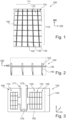
- figure 1 shows a plan view of a basic structure 110 of an electric surface heating (eFH) 100 according to an embodiment of the invention.
- the electric panel heater 100 is elastic and the basic structure 110 is grid-shaped or net-shaped, resulting in a plurality of openings 115 .
- a plurality of longitudinal elements 111 extend along a longitudinal direction MD (machine direction) of the basic structure and a plurality of transverse elements 112 extend along a transverse direction CD (cross direction) of the basic structure 110.
- the basic structure 110 is designed as a woven fabric, wherein the longitudinal elements 111 form the warp of the fabric, and the transverse elements 112 form the weft of the fabric.
- the longitudinal elements 111 have at least a first fiber element 120 and second fiber elements 130 parallel to one another, with the number of second fiber elements 130 being higher.
- the first fiber element 120 has a low resistance, has a permanent current-carrying capacity of at least 5 A, and has a high coefficient of thermal expansion compared to the second fiber element 130 (in at least one coordinate direction).
- the first fiber element 120 comprises a metal (in particular copper or aluminum) and is preferably designed as a cable (a thick carbon filament is also possible, for example).
- the second fiber element 130 has a high resistance, is essentially electrically insulating, and has e-glass, for example.
- the transverse elements 112 have third fiber elements 140 which can be configured similarly to the second fiber elements 130 .
- the third fiber elements 140 also have a lower electrical conductivity and a lower thermal expansion coefficient than the first fiber element 120.
- the third fiber elements 140 also have an electrically conductive heating material 160 as a heating component/heating element, which is applied, for example, as a heating lacquer layer.
- the heating material 160 preferably has an elastic extensibility which is greater than an elastic extensibility of the third fiber element 140.
- FIG 2 shows a detailed view of the basic structure 110 of the electric surface heating 100 according to a further exemplary embodiment of the invention.
- a first fiber element 120 is designed as a copper cable and third fiber elements 140 are alternately pushed through between two parallel parts of the first fiber element 120 . There are thus interfaces/crossing points 125 at the push-through points.
- FIG 3 shows a plan view of an electric panel heater 100 according to an embodiment of the invention.
- the eFH 100 has the basic structure 110 described above, which is embedded by an (elastic) insulating material 130 as a carrier structure.
- the basic structure 110 forms the heating element of the eFH 100.
- the electric panel heater 100 also has: a heating area 102 in which the heating element 110 is arranged, and a free area 104 in which the heating element 110 is not arranged.
- the latter serves as a free zone, for example to drill holes if the electric surface heating 100 is covered by a floor or wallpaper and is no longer visible.
- the electric surface heating 100 has a first surface heating module 108 (first zone) in which a first heating element (first field) is arranged, and a second surface heating module 109 (second zone) in which the second heating element (second field) is arranged. Both surface heating modules 108, 109 are connected to one another via a connecting element 170. Furthermore, the eFH 100 can have a control device, not shown (e.g. integrated into the connection element 170). In one exemplary embodiment, the control device can control or regulate the surface heating modules 108, 109 (or their heating components) independently of one another.
- the heating element 110 is connected to a source of electrical power by means of leads 171,172.
- the feed lines 171, 172 are embedded in the insulating material 150 at least in sections.
- FIGS. 4a to 4c show detailed views of fiber elements of the electrical surface heating 100 according to embodiments of the invention.
- Figure 4a shows a cross section through a third fiber element 140, which is embedded in the insulation material 150.
- a layer (or a coating) of an electrically conductive heating material encloses the fiber element 140.
- the latter is electrically insulating, so that the heating material 160 can be controlled in a targeted manner.
- Figure 4b also shows a cross section through a third fiber element 140 with the difference that glass fiber bundles are used. Gaps are thus created between the glass fibers, into which electrically conductive heating material 160 can flow during a manufacturing process (eg impregnation).
- a manufacturing process eg impregnation
- a higher temperature can be reached inside the fiber element 140 than on the surface of the fiber element 140.
- Figure 4c 12 shows an interface 125 between a first fiber element 110 in the longitudinal direction MD and a third fiber element 140 in the transverse direction CD.
- the interface 125 is essentially covered or at least once surrounded by a binder 165 .
- the Figures 5a to 5c 12 show interfaces 125 between longitudinal elements 111 and transverse elements 112 according to embodiments of the invention.
- the Figures 5a and 5b show knotted intersections 125, particularly twisted and braided.
- the Figure 5c shows a non-knotted, woven interface 125.
- FIG 6 shows a plan view of an electric surface heating 100, which has surface heating modules 108, 109, according to an embodiment of the invention.
- the section shown can have an area of approximately 1 m ⁇ 1 m.
- the surface heating modules 108, 109 are designed as individually controllable fields: Auxiliary lines (first and second fiber elements) are woven into the basic structure 110, which can then be separated at suitable points.
- a control unit 170 is arranged within a surface heating module 108 and can specifically control this field, for example.
- Sensor lines 180 may be coupled to controller 160 .
- Separate temperature sensors 185 can measure the temperature in individual fields and thus provide the temperature data required for regulation.
- the temperature can be measured at several points within a field and, if there is a risk of overheating, the amount of energy supplied to an entire field can be throttled. This prevents local overheating and, for example, small children playing on the bathroom floor cannot injure themselves.
- supply lines 171, 172 to the individual panel heating modules 108, 109 are provided. These can also be integrated with first fiber elements 120 .
Landscapes
- Engineering & Computer Science (AREA)
- Textile Engineering (AREA)
- Resistance Heating (AREA)
- Central Heating Systems (AREA)
- Surface Heating Bodies (AREA)
Applications Claiming Priority (1)
| Application Number | Priority Date | Filing Date | Title |
|---|---|---|---|
| DE102021131971.4A DE102021131971A1 (de) | 2021-12-03 | 2021-12-03 | Elektrische Flächenheizung basierend auf einer Gitter-förmigen Grundstruktur mit unterschiedlichen Faserelementen |
Publications (2)
| Publication Number | Publication Date |
|---|---|
| EP4192192A2 true EP4192192A2 (fr) | 2023-06-07 |
| EP4192192A3 EP4192192A3 (fr) | 2023-10-11 |
Family
ID=84387750
Family Applications (1)
| Application Number | Title | Priority Date | Filing Date |
|---|---|---|---|
| EP22211148.6A Pending EP4192192A3 (fr) | 2021-12-03 | 2022-12-02 | Chauffage électrique de surface basé sur une structure de base en forme de grille dotée d'éléments de fibres différents |
Country Status (2)
| Country | Link |
|---|---|
| EP (1) | EP4192192A3 (fr) |
| DE (1) | DE102021131971A1 (fr) |
Family Cites Families (12)
| Publication number | Priority date | Publication date | Assignee | Title |
|---|---|---|---|---|
| NL7315574A (nl) * | 1973-11-14 | 1975-05-16 | Benoit De La Bretoniere Andre | Weefsel. |
| DE4019357C1 (en) | 1990-06-18 | 1991-08-01 | G. Bopp & Co Ag, Zuerich, Ch | Flexible, electrically heatable, transparent panel - has heating grid embedded in sheet of thermoplastic material suitable for rear window of convertible car |
| DE19910677B4 (de) | 1999-03-11 | 2005-02-17 | Eht Haustechnik Gmbh | Muffenlose elektrische Verbindung |
| US6649886B1 (en) * | 2002-05-11 | 2003-11-18 | David Kleshchik | Electric heating cloth and method |
| DE10211721B4 (de) | 2002-03-18 | 2004-07-22 | Heitexx Ltd. | Heizleiter und Verwendung des Heizleiters |
| DE202005000886U1 (de) | 2005-01-19 | 2006-06-29 | Kronospan Technical Co. Ltd., Engomi | Heizeinrichtung für Wand-, Decken- oder Fußbodenbeläge |
| FR2922405B1 (fr) | 2007-10-15 | 2010-10-15 | Mdb Texinov Sas | Armures chauffantes |
| TW200925344A (en) | 2007-12-12 | 2009-06-16 | Everest Textile Co Ltd | Electric heating fabric device |
| EP2116778B1 (fr) | 2008-05-09 | 2016-03-16 | Kronoplus Technical AG | Système de revêtement chauffable |
| GB2544163A (en) * | 2015-04-22 | 2017-05-10 | Apollo Sun Global Co Ltd | A conductive fabric including conductive yarns |
| KR101754924B1 (ko) | 2016-04-11 | 2017-08-09 | 주식회사 이에스에너지 | 가요성 탄소발열패드의 제조방법 |
| DE102019131880B4 (de) | 2019-11-25 | 2023-02-09 | Ke Kelit Kunststoffwerk Gmbh | Elektrische Flächenheizung mit über Bereichsmarker bestimmbarem Freibereich |
-
2021
- 2021-12-03 DE DE102021131971.4A patent/DE102021131971A1/de active Pending
-
2022
- 2022-12-02 EP EP22211148.6A patent/EP4192192A3/fr active Pending
Also Published As
| Publication number | Publication date |
|---|---|
| DE102021131971A1 (de) | 2023-06-07 |
| EP4192192A3 (fr) | 2023-10-11 |
Similar Documents
| Publication | Publication Date | Title |
|---|---|---|
| EP3058597B1 (fr) | Panneau photovoltaïque et son procédé de fabrication | |
| EP1835786B1 (fr) | Elément chauffant pour surface et procédé de fabrication d'un élément chauffant pour surface | |
| EP2753881B1 (fr) | Élément chauffant et procédé de fabrication d'un élément chauffant | |
| DE4447407C2 (de) | Flexibles Flächenheizelement und Verfahren zur Herstellung eines flexiblen Flächenheizelementes | |
| EP2563574A2 (fr) | Elément composite renforcé par des fibres à effet actionneur, détecteur et/ou générateur et son procédé de fabrication | |
| WO2012163325A1 (fr) | Procédé de production d'une structure de surface munie d'une protection contre la foudre ainsi que structure de surface pouvant être produite par ledit procédé | |
| AT525149A2 (de) | Elektrische Flächenheizung basierend auf einem mit Heizelement umschlossenen Grundelement | |
| EP4192192A2 (fr) | Chauffage électrique de surface basé sur une structure de base en forme de grille dotée d'éléments de fibres différents | |
| EP4282225B1 (fr) | Element de chauffage de surface et procede pour sa fabrication | |
| EP1842394A1 (fr) | Dispositif chauffant pour revetements muraux, revetements de plafond et de sol | |
| DE102014004118A1 (de) | Neuartiges blitzschutzmaterial für faerverbundbauteile | |
| EP3325267A1 (fr) | Matériau pourvu d'au moins une enveloppe bicouche | |
| DE102014105215A1 (de) | Heizelement | |
| EP3144138A1 (fr) | couche velcro de support pour système de montage pour système de régulation de température de surface, système de régulation de température de surface comprenant d'une telle couche et procédé mis en oeuvre dans un tel système | |
| EP3144136A1 (fr) | Feuille de support pour un systeme de bande velcro d'un systeme de climatisation des surfaces, ledit systeme de climatisation des surfaces et procede destine a la fabrication d'un systeme de climatisation des surfaces | |
| DE10291136B4 (de) | Verfahren zur Herstellung von adaptronischen Mikrosystemen | |
| WO2012100997A2 (fr) | Matière plastique composite renforcée par des fibres et son procédé de production | |
| EP3016475B1 (fr) | Dispositif dote de surfaces pouvant etre chauffees pour la dissipation homogene de chaleur | |
| EP2749711A2 (fr) | Tissu en fibres multifonction | |
| DE102018101719A1 (de) | Bodenheizung | |
| WO2017202551A1 (fr) | Bande isolante, machine électrique et procédé pour fabriquer la bande isolante et la machine électrique | |
| DE102022104390B4 (de) | Verfahren zum elektrischen Kontaktieren, Kontaktierungsgarn und Verwendung des Kontaktierungsgarns | |
| DE102023113534A1 (de) | Elektrische Heizschicht und Verfahren zu deren Herstellung | |
| DE102019124647A1 (de) | Fliese und Verfahren zur Herstellung einer Fliese | |
| EP2716436B1 (fr) | Composant composite en carbone |
Legal Events
| Date | Code | Title | Description |
|---|---|---|---|
| PUAI | Public reference made under article 153(3) epc to a published international application that has entered the european phase |
Free format text: ORIGINAL CODE: 0009012 |
|
| STAA | Information on the status of an ep patent application or granted ep patent |
Free format text: STATUS: THE APPLICATION HAS BEEN PUBLISHED |
|
| AK | Designated contracting states |
Kind code of ref document: A2 Designated state(s): AL AT BE BG CH CY CZ DE DK EE ES FI FR GB GR HR HU IE IS IT LI LT LU LV MC ME MK MT NL NO PL PT RO RS SE SI SK SM TR |
|
| PUAL | Search report despatched |
Free format text: ORIGINAL CODE: 0009013 |
|
| AK | Designated contracting states |
Kind code of ref document: A3 Designated state(s): AL AT BE BG CH CY CZ DE DK EE ES FI FR GB GR HR HU IE IS IT LI LT LU LV MC ME MK MT NL NO PL PT RO RS SE SI SK SM TR |
|
| RIC1 | Information provided on ipc code assigned before grant |
Ipc: H05B 3/34 20060101AFI20230905BHEP |
|
| STAA | Information on the status of an ep patent application or granted ep patent |
Free format text: STATUS: REQUEST FOR EXAMINATION WAS MADE |
|
| 17P | Request for examination filed |
Effective date: 20240327 |
|
| RBV | Designated contracting states (corrected) |
Designated state(s): AL AT BE BG CH CY CZ DE DK EE ES FI FR GB GR HR HU IE IS IT LI LT LU LV MC ME MK MT NL NO PL PT RO RS SE SI SK SM TR |
|
| STAA | Information on the status of an ep patent application or granted ep patent |
Free format text: STATUS: EXAMINATION IS IN PROGRESS |
|
| 17Q | First examination report despatched |
Effective date: 20251203 |