EP4194672B1 - Système d'allumage - Google Patents
Système d'allumage Download PDFInfo
- Publication number
- EP4194672B1 EP4194672B1 EP21853435.2A EP21853435A EP4194672B1 EP 4194672 B1 EP4194672 B1 EP 4194672B1 EP 21853435 A EP21853435 A EP 21853435A EP 4194672 B1 EP4194672 B1 EP 4194672B1
- Authority
- EP
- European Patent Office
- Prior art keywords
- spray hole
- ignition
- center
- chamber
- spark
- Prior art date
- Legal status (The legal status is an assumption and is not a legal conclusion. Google has not performed a legal analysis and makes no representation as to the accuracy of the status listed.)
- Active
Links
Images


Classifications
-
- F—MECHANICAL ENGINEERING; LIGHTING; HEATING; WEAPONS; BLASTING
- F02—COMBUSTION ENGINES; HOT-GAS OR COMBUSTION-PRODUCT ENGINE PLANTS
- F02P—IGNITION, OTHER THAN COMPRESSION IGNITION, FOR INTERNAL-COMBUSTION ENGINES; TESTING OF IGNITION TIMING IN COMPRESSION-IGNITION ENGINES
- F02P13/00—Sparking plugs structurally combined with other parts of internal-combustion engines
-
- F—MECHANICAL ENGINEERING; LIGHTING; HEATING; WEAPONS; BLASTING
- F02—COMBUSTION ENGINES; HOT-GAS OR COMBUSTION-PRODUCT ENGINE PLANTS
- F02B—INTERNAL-COMBUSTION PISTON ENGINES; COMBUSTION ENGINES IN GENERAL
- F02B19/00—Engines characterised by precombustion chambers
- F02B19/10—Engines characterised by precombustion chambers with fuel introduced partly into pre-combustion chamber, and partly into cylinder
- F02B19/1019—Engines characterised by precombustion chambers with fuel introduced partly into pre-combustion chamber, and partly into cylinder with only one pre-combustion chamber
- F02B19/1023—Engines characterised by precombustion chambers with fuel introduced partly into pre-combustion chamber, and partly into cylinder with only one pre-combustion chamber pre-combustion chamber and cylinder being fed with fuel-air mixture(s)
-
- F—MECHANICAL ENGINEERING; LIGHTING; HEATING; WEAPONS; BLASTING
- F02—COMBUSTION ENGINES; HOT-GAS OR COMBUSTION-PRODUCT ENGINE PLANTS
- F02B—INTERNAL-COMBUSTION PISTON ENGINES; COMBUSTION ENGINES IN GENERAL
- F02B19/00—Engines characterised by precombustion chambers
- F02B19/12—Engines characterised by precombustion chambers with positive ignition
-
- F—MECHANICAL ENGINEERING; LIGHTING; HEATING; WEAPONS; BLASTING
- F02—COMBUSTION ENGINES; HOT-GAS OR COMBUSTION-PRODUCT ENGINE PLANTS
- F02B—INTERNAL-COMBUSTION PISTON ENGINES; COMBUSTION ENGINES IN GENERAL
- F02B19/00—Engines characterised by precombustion chambers
- F02B19/16—Chamber shapes or constructions not specific to sub-groups F02B19/02 - F02B19/10
- F02B19/18—Transfer passages between chamber and cylinder
-
- F—MECHANICAL ENGINEERING; LIGHTING; HEATING; WEAPONS; BLASTING
- F02—COMBUSTION ENGINES; HOT-GAS OR COMBUSTION-PRODUCT ENGINE PLANTS
- F02P—IGNITION, OTHER THAN COMPRESSION IGNITION, FOR INTERNAL-COMBUSTION ENGINES; TESTING OF IGNITION TIMING IN COMPRESSION-IGNITION ENGINES
- F02P5/00—Advancing or retarding ignition; Control therefor
- F02P5/04—Advancing or retarding ignition; Control therefor automatically, as a function of the working conditions of the engine or vehicle or of the atmospheric conditions
- F02P5/145—Advancing or retarding ignition; Control therefor automatically, as a function of the working conditions of the engine or vehicle or of the atmospheric conditions using electrical means
- F02P5/15—Digital data processing
- F02P5/1502—Digital data processing using one central computing unit
-
- F—MECHANICAL ENGINEERING; LIGHTING; HEATING; WEAPONS; BLASTING
- F02—COMBUSTION ENGINES; HOT-GAS OR COMBUSTION-PRODUCT ENGINE PLANTS
- F02P—IGNITION, OTHER THAN COMPRESSION IGNITION, FOR INTERNAL-COMBUSTION ENGINES; TESTING OF IGNITION TIMING IN COMPRESSION-IGNITION ENGINES
- F02P5/00—Advancing or retarding ignition; Control therefor
- F02P5/04—Advancing or retarding ignition; Control therefor automatically, as a function of the working conditions of the engine or vehicle or of the atmospheric conditions
- F02P5/145—Advancing or retarding ignition; Control therefor automatically, as a function of the working conditions of the engine or vehicle or of the atmospheric conditions using electrical means
-
- Y—GENERAL TAGGING OF NEW TECHNOLOGICAL DEVELOPMENTS; GENERAL TAGGING OF CROSS-SECTIONAL TECHNOLOGIES SPANNING OVER SEVERAL SECTIONS OF THE IPC; TECHNICAL SUBJECTS COVERED BY FORMER USPC CROSS-REFERENCE ART COLLECTIONS [XRACs] AND DIGESTS
- Y02—TECHNOLOGIES OR APPLICATIONS FOR MITIGATION OR ADAPTATION AGAINST CLIMATE CHANGE
- Y02T—CLIMATE CHANGE MITIGATION TECHNOLOGIES RELATED TO TRANSPORTATION
- Y02T10/00—Road transport of goods or passengers
- Y02T10/10—Internal combustion engine [ICE] based vehicles
- Y02T10/12—Improving ICE efficiencies
Definitions
- This disclosure relates generally to an ignition system which works to ignite fuel in a combustion chamber.
- Some ignition systems are equipped with a dividing wall and a spark plug.
- the dividing wall isolates between a main chamber and a pre-chamber in a combustion chamber of an engine.
- the dividing wall has formed therein a plurality of spray holes communicating the main chamber with the prechamber.
- the spark plug works to create an electrical spark to ignite fuel upon application of voltage across a spark gap within the pre-chamber.
- Such a type of spark plug is taught in the following patent literature 1.
- WO 2021/153275 A1 discloses the following:
- This ignition system has a spark plug and an ignition control unit that controls the spark plug.
- the ignition control unit When an engine is in a predetermined operating state, the ignition control unit performs post-top-dead-center ignition control in which ignition is performed at a point after top dead center of compression.
- the ignition system has an airflow assistance structure that enables an airflow to flow easily to a discharge gap at least at the point after top dead center of compression.
- the ignition system is configured so that due to the airflow assistance structure and an ignition timing, an airflow of a speed 5 m/s or greater flows to the discharge gap in a post-top-dead-center spark period, which is a period in which a discharge spark occurs in the post-top-dead-center ignition control.
- a subsidiary chamber type ignition system comprises: a partition wall that partitions a combustion chamber of an engine into a subsidiary chamber and a main chamber; and an ignition plug that ignites fuel inside the subsidiary chamber.
- an ignition control unit calculates optimum ignition timing earlier by a combustion time than prescribed optimum combustion timing, and performs optimum ignition control to control ignition timing at the optimum ignition timing.
- a jetting control unit performs jetting delay prevention control to prevent a jetting time from being longer compared with the high load state to prevent the combustion time from being long, while the ignition control unit performs the above optimum ignition control.
- US 1 403 886 A discloses the following: A spark plug body is provided with a chamber having a closure at its lower end provided with a central opening and gas passages surrounding the central opening, a sparking terminal insulated from the body and extending into the opening in spaced relation to the walls thereof to form a spark gap and inwardly opening valves in said passages.
- EP 2 146 070 B1 discloses the following: Disclosed is a direct-injection spark-ignition engine designed to promote catalyst activation during cold engine operation.
- a fuel injection timing for a fuel injection period in an compression stroke is set to allow a first fuel spray injected from a first spray hole to enter a cavity in a piston crown surface, and allow a second fuel spray to impinge against a region of the piston crown surface located closer to an injector than the cavity, so as to cause the second fuel spray having a lowered penetration force due to the impingement to be pulled toward the cavity by a negative pressure generated in the cavity as a result of passing of the first fuel spray therethrough,
- the direct-injection spark-ignition engine can maximally hold an injected fuel spray around a spark plug to reliably stabilize a combustion state in a combustion mode for promoting catalyst activation during cold engine operation, while enhancing combustion efficiency in a homogenous combustion mode during normal engine operation.
- Patent Literature 1 Japanese Patent No. 5122367
- the above type of ignition system works to perform a before-top-dead-center ignition task to ignite fuel before the top dead center of the compression stroke, in other words, during the compression stroke in the engine in a normal operation mode.
- the before-top-dead-center ignition task is to elongate a spark, as created in the pre-chamber, by means of tumble or swirl occurring in the combustion chamber.
- the elongated spark then ignites fuel to produce a flame which, in turn, jets into the main chamber, thereby facilitating the combustion of the fuel within the combustion chamber.
- the ignition system When a given condition is encountered, the ignition system alternatively performs an after-top-dead-center ignition task to ignite fuel in the expansion stroke after the top dead center of the compression stroke, i.e., during the expansion stroke. Specifically, for instance, in a first idling mode of the engine operation to warm up the catalyst installed in an exhaust path of the engine, the ignition system starts the ignition of fuel as late as possible in order to enhance the efficiency in transmitting thermal energy, as generated by the combustion of fuel, to the catalyst. The ignition system, therefore, ignites the fuel after the top dead center of the compression stroke.
- the flow of the mixture in the pre-chamber is usually reduced in strength due to the breaking of the tumble or swirl when the piston passes through the top dead center of the compression stroke. This will result in a decrease in elongation of the spark, thereby reducing the ease of ignition of the fuel, thereby increasing the length of time in which the fuel is ignited in the pre-chamber, and the flame is jetted from the pre-chamber into the main chamber, in other words, decreasing the speed of propagation of the flame to the main chamber.
- This disclosure was made in view of the above problem. It is a principal object to achieve quick propagation of a flame to a main chamber in an after-top-dead-center ignition control mode.
- An ignition system in this disclosure comprises a dividing wall and a spark plug.
- the dividing wall divides a combustion chamber of an engine into a main chamber and a pre-chamber.
- The has formed therein at least one spray hole which communicates between the main chamber and the pre-chamber.
- the spark plug works to create a spark by applying voltage across a spark gap between a first electrode and a second electrode to ignite fuel.
- the pre-chamber has the first electrode.
- the dividing wall or a member which electrically conducts with the dividing wall has the second electrode.
- the timing when the voltage starts to be applied across the spark gap will be referred to as an ignition timing.
- the center of an opening of the spray hole which is located close to the pre-chamber will be referred to as a spray hole center.
- a region which is located 3mm or less away from the spray hole center within the pre-chamber will be referred to as a spray hole-nearby region.
- the ignition system works to execute an after-top-dead-center ignition control mode in which an ignition operation to ignite the fuel is performed after a compression stroke top dead center is reached when a given operating condition of the engine is met.
- an ignition source is provided in the form of a self-growable flame kernel within the spray hole-nearby region, the spray hole, or the main chamber within a crank angle of 20° after the ignition timing is reached.
- the ignition source is provided in the spray hole-nearby region, the spray hole, or the main chamber early, e.g., within a crank angle of 20° following the ignition timing.
- the ignition source When the ignition source is provided in the spray hole-nearby region or the spray hole, it facilitates the jetting of a flame, as grown from the ignition source, from the spray hole into the main chamber.
- the ignition source when the ignition source is provided in the main chamber, it will cause a flame grown from the ignition source to propagate as it is to the main chamber. It is, therefore, possible to propagate the flame quickly to the main chamber in the after-top-dead-center ignition control mode.
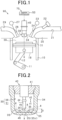
- Fig. 1 is a cross sectional view which illustrates the engine 90 on which the ignition system 70 in this embodiment is mounted.
- the engine 90 is implemented by a four-stroke engine in which a piston completes one combustion cycle made up of a sequence of four separate strokes (i.e., 720° crank angle): intake stroke, compression stroke, expansion stroke, and exhaust stroke.
- a top dead center between the compression stroke and the expansion stroke will be referred to as a compression stroke top dead center Td.
- the engine 90 includes the cylinder 10 and the head 20 mounted on the cylinder 10.
- a lengthwise direction of the center line X of the cylinder 10 illustrated in the drawings will be referred to as a vertical direction.
- the engine 90 and/or the ignition system 70 may be optionally oriented in various directions.
- the engine 90 and/or the ignition system 70 may be oriented to have the center line X which extends obliquely to the vertical direction or alternatively extends the horizontal direction.
- the cylinder 10 has the piston 18 disposed therein.
- the piston 18 is connected to the crankshaft 11 through the link 12 and reciprocates vertically following rotation of the crankshaft 11. Space surrounded by an upper surface of the piston 18, an inner peripheral surface of the cylinder 10, and a lower surface of the head 20 defines the combustion chamber 30.
- the head 20 has formed therein the intake path 21 through which air is inducted into the combustion chamber 30 and the exhaust path 29 from which gas discharged from the combustion chamber 30.
- the intake path 21 has the intake valve 24 installed therein.
- the exhaust path 29 has the exhaust valve 26 installed therein.
- the intake valve 24 is driven by the intake cam 23, while the exhaust valve 26 is driven by the exhaust cam 27.
- the head 20 has the fuel injector 22 mounted in the intake path 21.
- the fuel injector 23 works to spray fuel.
- the ignition system 70 is equipped with the dividing wall 34, the spark plug 40, and the ignition controller 50.
- the ignition controller 50 is implemented by a portion of an electronic control unit (ECU) and works to analyze information derived by sensors installed in the engine 90 to control an operation of the spark plug 40.
- the sensors include, for example, a crank angle sensor, a knock sensor, an intake pressure sensor, an exhaust pressure sensor, an in-cylinder pressure sensor, and a catalyst temperature sensor.
- Fig. 2 is a cross sectional view which illustrates the prechamber 38 and a region therearound.
- the spark plug 40 includes the first electrode 44 and the porcelain insulator 41 disposed around the outer periphery of the first electrode 44.
- the dividing wall 34 is secured to a lower end portion of the porcelain insulator 41.
- the dividing wall 34 defines the prechamber 38 and the main chamber 31.
- the pre-chamber 38 is located inside the diving wall 34.
- the main chamber 31 is located outside the dividing wall 34.
- the dividing wall 34 isolates the combustion chamber 30 of the engine 90 into the main chamber 31 and the pre-chamber 38.
- the dividing wall 34 has formed therein a plurality of spray holes 35 communicating between the main chamber 31 and the pre-chamber 38.
- the dividing wall 34 is made from an electrically conductive material and functions as the second electrode 46 of the spark plug 40.
- the spark plug 40 is subjected to application of voltage across the spark gap 45 between the first electrode 44 and the second electrode 46 to create an electric spark f which ignites the fuel.
- the spark plug 40 is equipped with a primary coil and a secondary coil.
- electromagnetic energy is charged in the primary coil.
- stopping the application of current will cause the electromagnetic energy stored in the primary coil to induce voltage at the secondary coil.
- the induced voltage is then applied to the spark gap 45 to create the spark f within the spark gap 45.
- the time when the application of current to the primary coil is stopped will, therefore, coincide with an ignition timing Ts when the voltage starts to be applied across the spark gap 45 to initiate ignition of fuel.
- the center spray hole 35c extends vertically through the thickness of the dividing wall 34.
- the first electrode 44 has a lower end located just above the center spray hole 35c. In other words, the lower portion of the first electrode 44 protrudes greatly downward from the lower end the porcelain insulator 41, so that it is located closest to the center spray hole 35c among the spray holes 35.
- the gap between the lower end of the first electrode 44 and an upper periphery of the center spray hole 35c in the dividing wall 34 defines the spark gap 45.
- the spray holes 35 other than the center spray hole 35c are arranged around the center spray hole 35c in the dividing wall 34.
- the center spray hole 35c and the other spray holes 35 may be designed to be identical or different in sectional area or configuration with or from each other.
- the ignition system 70 executes a before-top-dead-center ignition control mode to ignite fuel before the compression stroke top dead center Td.
- a given operating condition of the engine 90 e.g., a fast idling mode of operation to warm up a catalyst installed in the exhaust path 29, is entered
- the ignition system 70 executes an after-top dead center ignition control mode to ignite fuel after the compression stroke top dead center Td.
- a gas flow passing through the spark gap 45 will also be referred to as an in-gap gas flow.
- a direction from the first electrode 44 toward the center spray hole 35c will also be referred to as a spray hole direction d1.
- a direction opposite to the spray hole direction d1 will also be referred to as a spray hole opposite direction d2 .
- the spray hole direction d1 represents a downward direction.
- the spray hole opposite direction d2 represents an upward direction.
- a direction including the spray hole direction d1 as a component will also be referred to below as a spray hole direction d1 -side or merely referred to as the spray hole direction d1.
- a direction including the spray hole opposite direction d2 as a component will also be referred to as a spray hole opposite direction d2 -side or merely referred to as the spray hole direction d2 .
- the center of an opening of the center spray hole 35c which is exposed to the pre-chamber 38 will be also referred to below as a spray hole center.
- a region located within the pre-chamber 38 at an interval of 3mm or less away from the spray hole will be referred to below as a spray hole-nearby region R.
- the ignition system 70 works at an early stage within a crank angle of 20° following the ignition timing Ts to place an ignition source in the form of a flame kernel large in size enough to self-grow in the spray hole-nearby region R , the center spray hole 35c, or the main chamber 31.
- the spray hole-nearby region R the center spray hole 35c or the main chamber 31
- the spray hole-nearby region R the spray hole-nearby region R , etc.
- the placement of the ignition source within the spray hole-nearby region R, etc. in the early stage is achieved by selecting a spray hole distance D that is a distance between the first electrode 44 and the center spray hole 35c, a prechamber volume V that is a volume of the pre-chamber 38, a total spray hole area S that is the sum of sectional areas of all the spray holes 35 formed in the dividing wall 34, and/or a discharge voltage that is a voltage applied across the spark gap 45. This will be described below in detail.
- each of the spray holes 35 are partially constricted, so that a sectional area of each of the spray holes 35 is ununiform, the smallest sectional area of each of the spray holes 35 will be simply referred to as a sectional area of each of the spray holes 35.
- the spray hole distance D will be described.
- the shorter the spray hole distance D the greater the effects of flows of gas passing through the center spray hole 35c on a flame kernel. This facilitates the growth of the flame kernel, especially, in the spray hole-nearby region R , etc., and its peripheral region. For this reason, the shorter the spray hole distance D , the easier the creation of an ignition source in the spray hole-nearby region R , etc., in the early stage.
- the prechamber volume V and the total spray hole area S will be described in detail.
- the more the prechamber volume V the faster a flow of gas moving through the center hole 35c in the after-top-dead-center ignition control mode. This is because the larger the prechamber volume V , the more slowly the pressure in the pre-chamber 38 drops following a drop in pressure in the main chamber 31 as long as the flow rate of gas moving out of the pre-chamber 38 into the main chamber 31 is kept constant, thereby resulting in an increased difference in pressure between the pre-chamber 38 and the main chamber 31, which increases the velocity of gas passing through the center spray hole 35c.
- the increase in velocity of gas passing through the center spray hole 35c will facilitate the elongation of the spark f to the spray hole direction d1 -side. This facilitates the growth of a flame kernel in the early stage, especially, in the spray hole-nearby region R , etc. and its peripheral region.
- the smaller a spray hole ratio ( S / V ) that is a ratio of the total spray hole area S to the prechamber volume V the more easily the ignition source is created in the spray hole-nearby region R , etc. at the early stage.
- the discharge voltage will be described below.
- the higher the discharge voltage the easier a flame kernel is to grow. Additionally, the higher the discharge voltage, the higher the stability of the flame kernel, thereby facilitating the ease with which the spark f is elongated by the gas flow into the spray hole-nearby region R , etc. or its peripheral region. Consequently, the higher the discharge voltage, the more easily the ignition source is created in the spray hole-nearby region R, etc. at the early stage.
- the spray hole distance D or the spray hole ratio ( S / V ) or the higher the discharge voltage the more easily the ignition source is created in the spray hole-nearby region R , etc. at the early stage. Too small the spray hole distance D or the spray hole ratio ( S / V ) or too high the discharge voltage will, however, result in another adverse effect.
- the early creation of the ignition source in the spray hole-nearby region R , etc. is achieved by decreasing the spray hole distance D or the spray hole ratio ( S / V ) and/or increasing the discharge voltage to an extent that no above adverse effect occurs.
- the creation of an ignition source in the spray hole-nearby region R or the spray holes 35 usually causes a flame grown from the ignition source to be quickly jetted into the main chamber 31.
- the creation of an ignition source within the main chamber 31 causes a flame grown from the ignition source to propagate directly into the main chamber 31. Such cases achieve the quick propagation of a flame into the main chamber 31.
- Fig. 3 is a graph which represents a relation between the distance between an ignition source and the spray hole center and a combustion stability index (which will also be referred to below as a coefficient of variation).
- the coefficient of variation is an index indicating a degree of fuel combustion in a range of the lowest stability of combustion of fuel, i.e., a misfire to the highest stability of combustion of fuel, i.e., complete combustion of fuel.
- the higher value of the coefficient of variation represents the higher stability of combustion of fuel.
- the graph in Fig. 3 shows that the greater the distance between the ignition source and the spray hole center, the greater the coefficient of variation will be and that when the ignition source is located 3mm or more away from the spray hole center, the coefficient of variation will become large at an increased rate.
- the ignition source is arranged in the spray hole-nearby region R which lies 3mm or less away from the spray hole center.
- Fig. 5 is a graph which demonstrates a change in pressure in the combustion chamber and shows that the pressure raises with advance of the crank angle before the compression stroke top dead center Td and then drops with advance of the crank angle after the compression stroke top dead center Td in each of this embodiment and the comparative examples i and ii.
- the graph also shows that upon ignition, the pressure will rise again in this embodiment and the comparative example i .
- the flame kernel grows faster in this embodiment than in the comparative example i , and the propagation of the flame is faster in this embodiment than in the comparative example i , thereby causing the pressure in the combustion chamber to elevate quickly in this embodiment.
- the flame burns out like in the comparative example, it will cause the pressure in the combustion chamber not to rise.
- Fig. 6 is a view which shows a flowchart of a sequence of steps in a production process for the ignition system 70.
- the production process incudes a setting step p1 and a production step p2 .
- a spray hole ratio ( S / V ) is calculated.
- the dimensions of the pre-chamber 38 and the spray holes 35 are determined as a function of the spray hole ratio ( S / V ) and the spray hole distance D .
- the setting step p1 will also be described below in detail with reference to Fig. 7 .
- the ignition system 70 is produced to have the dimensions set in the setting step p1.
- Fig. 7 is a graph which represents a relation among the spray hole distance, the spray hole ratio, and the in-gap gas flow.
- the horizontal axis indicates the spray hole distance D .
- the vertical axis indicates the spray hole ratio ( S / V ).
- the curve a represents a relation between the spray hole ratio ( S / V ) and the spray hole distance D when the in-gap gas flow in the spray hole direction d1 is 5m/s at the ignition timing in the after-top-dead-center ignition control mode.
- the curve a may be mathematically expressed using the following approximation formula A .
- V denotes the prechamber volume V [cc (cubic centimeter)]
- S denotes the total spray hole area (i.e., a total sectional area of the spray holes 35) [mm ⁇ 2]
- D denotes the spray hole distance D [mm]
- ⁇ represents a power. Note that " ⁇ 3" is a cube, and “ ⁇ 2" represents a square.
- the in-gap gas flow at the ignition timing Ts in the after-top-dead-center ignition control mode is lower than 5m/s in the spray hole direction d1, while on the lower side below the curve a , the in-gap gas flow at the ignition timing Ts in the after-top-dead-center ignition control mode is higher than 5m/s in the spray hole direction d1.
- the value of the spray hole ratio ( S / V ) is selected in a region ⁇ including the curve a and the lower side below the curve a .
- Eq. B sets the in-gap gas flow in the spray hole direction d1 to be higher than or equal to 5m/s at the ignition timing Ts in the after-top-dead-center ignition control mode.
- the curve a usually changes with a change in environment. For instance, when the speed of rotation of the engine 90 becomes high, the quantity of intake air increases, or the engine 90 is implemented by a high-compression engine, the curve a will be shifted to an upper right-hand side in Fig. 7 . Alternatively, when the speed of rotation of the engine 90 becomes low, the quantity of intake air decreases, or the engine 90 is implemented by a low-compression engine, the curve a will be shifted to a lower left-hand side in Fig. 7 . In such a case, it is advisable that Eq. B be corrected as needed.
- the acceptable in-gap gas flow is expected to be obtained at the ignition timing Ts in the after-top-dead-center ignition control mode during the fast idle mode of engine operation in which the speed of the engine, the quantity of intake air, and the compression ratio are normal.
- the spray hole ratio ( S / V ) when the spray hole ratio ( S / V ) is lower than 0.3, it causes a risk that too strong a gas flow may pass through the spray holes 35, so that the flame is blown away. It is, therefore, preferable that the spray hole ratio ( S / V ) be selected to be 0.3 or more.
- the spray hole distance D is zero in Eq. B, the right side will be 2.1. Satisfying Eq. B, therefore, requires selecting the value of the spray hole ratio ( S / V ) to be 2.1 or less. Consequently, the value of the spray hole ratio ( S / V ) is determined to meet the following Eq. C in addition to Eq. B. 0.3 ⁇ S / V ⁇ 2.1
- each of the spray holes 35 be selected to be 0.3mm or more in order to eliminate a risk that a flame passing through each of the spray holes 35 may disappear due to thermal loss thereof. It is also advisable that the prechamber volume V be selected to be 0.2cc or more in order to ensure an amount of gas jetting from the prechamber 38 (i.e., the quantity of heat) large enough to enhance the propagation of a flame within the main chamber 31.
- the spray hole distance D is preferably selected in light of blowing out of the spark f or the amount of electrical power consumed by the spark plug 40 as a function of the size of the spark gap 45 because the spray hole distance D impinges on the size of the spark gap 45.
- the area of a cross section of the center spray hole 35c is also preferably selected in light of adverse effects thereof on the spark gap 45.
- the spray hole ratio ( S / V ) is preferably determined by selecting cross-sectional areas of the spray holes 35 other than the center spray hole 35c.
- the spray hole ratio ( S / V ) is set in the above way. Physical parameters of the spark plug 40 other than the spray hole ratio ( S / V ) may be determined in a known manner.
- the ignition system 70 are made to meet the dimensions or parameters determined in step p1 to complete the ignition system 70.
- Fig. 8(a) is a sectional view which illustrates the ignition system 70 in the first comparative example which is different from this embodiment in that there is no dividing wall 34, but the second electrode 46 (i.e., ground electrode) is arranged alone.
- Fig. 8(b) is a sectional view which illustrates the ignition system 70 in the second comparative example which is different from the first comparative example in that it includes the dividing wall 34, but does not have the center spray hole 35c.
- the first electrode 44 does not protrude downward more than in this embodiment, but instead the second electrode 46 (i.e., ground electrode), unlike this embodiment, protrude greatly from the dividing wall 34 toward the first electrode 44 (i.e., center electrode).
- the second comparative example is designed not to meet the above Eq.
- the center of gravity of the spray holes 35 located closest to each other lies beneath the spark gap 45.
- the downward direction in the second comparative example will be, therefore, referred to, like this embodiment, as the spray hole direction d1, while the upward direction will be referred to as the spray hole opposite direction d2 .
- Fig. 8(c) is a sectional view which illustrates the ignition system 70 in the first mode of this embodiment.
- Fig. 8(d) is a sectional view which illustrates the ignition system 70 in the second mode of this embodiment.
- the spray hole ratio ( S / V ) or the spray hole distance D in the first mode is smaller than that in the second mode.
- the spray hole distance D in Fig. 8(d) is shorter than that in Fig. 8(c) , thereby causing the in-gap gas flow in the spray hole direction d1 to be greater in the second mode than in the first mode at the ignition timing Ts in the after-top-dead-center ignition control mode. Consequently, an initial ignition source is generated in the pre-chamber 38 and/or the center spray hole 35c in the first mode, while it is created in the pre-chamber 38, the center spray hole 35c, and/or the main chamber 31 in the second mode.
- Fig. 9 is a timing chart which demonstrates the development of combustion of fuel in the after-top-dead-center ignition control mode in the first and second comparative examples.
- the combustion of fuel proceeds from the spark phase s1, to the main chamber ignition phase s2', and then to the main chamber flame propagation phase s5.
- the beginning of the spark phase s1 occurs at the ignition timing Ts.
- the spark phase s1 is a phase in which the voltage has started to be applied across the spark gap 45, but a flame kernel is not yet generated in the combustion chamber 30.
- the main chamber ignition phase s2' is a phase in which a flame kernel is growing to a self-growable ignition source within the main chamber.
- the end of the main chamber ignition phase s2' coincides with the main chamber ignition timing Tj that is the timing when an ignition source is created within the main chamber 31.
- the main chamber flame propagation phase s5 is a phase in which the ignition source is propagating to the main chamber 31.
- the end of the main chamber flame propagation phase s5 coincides with the combustion end timing Te when the fuel is expected to have been burned completely.
- the combustion of fuel proceeds from the spark phase s1 to the pre-chamber ignition phase s2, to the pre-chamber flame propagation phase s3, to the gas jetting phase s4, and then to the main chamber flame propagation phase s5.
- the prechamber ignition phase s2 is a phase in which a flame kernel is growing to a self-growable ignition source in the pre-chamber.
- the end of the pre-chamber ignition phase s2 coincides with the pre-chamber ignition timing Ti that is the timing when the ignition source is created in the pre-chamber 38.
- the pre-chamber flame propagation phase s3 is a phase in which the ignition source is propagating to the pre-chamber 38.
- the flame jetting phase s4 is a phase in which a flame in the pre-chamber 38, that is, an ignition source is jetting from each of the spray holes 35 into the main chamber 31.
- the beginning of the flame jetting phase s4 coincides with the main chamber ignition timing Tj that is the timing when the ignition source is placed in the main chamber 31.
- the spark f extends from inside the pre-chamber 38 into the main chamber 31 through the center spray hole 35c, thereby causing ignition sources to be created by the spark f within the main chamber 31 as well as the prechamber 38 and the center spray hole 35c. Consequently, like in the first mode, the combustion of fuel proceeds from the spark phase s1, to the main chamber ignition phase s2', and then to the main chamber flame propagation phase s5 in parallel to a series of ignition source development from the spark phase s1, to the pre-chamber ignition phase s2, to the pre-chamber flame propagation phase s3, to the flame jetting phase s4, and then the main chamber flame propagation phase s5. This causes the main chamber ignition timing Tj to appear earlier than in the first mode.
- the combustion end timing Te is required to be earlier than the exhaust start time To that is the time when the exhaust valve 26 starts to open in order to avoid emission of unburned fuel. Accordingly, in any case, the combustion end timing Te is first determined prior to the exhaust start time To. Subsequently, the ignition timing Ts is determined to have fuel completely combusted at the combustion end timing Te. In other words, the ignition timing Ts is calculated back from the combustion end timing Te. Therefore, the combustion end timings Te almost coincide with each other in the first and second comparative examples and the first and second modes, while the ignition timings Ts are different from each other.
- Fig. 10 is a graph which demonstrates the timing chart illustrated in Fig. 9 where the ignition timings Ts in the first and second comparative examples and the first and second modes are altered to coincide with each other for the sake of convenience.
- the spark gap 45 is located away from the spray holes 35, so that the ignition source is arranged within the spray hole-nearby region R near the end of the pre-chamber flame propagation phase s3.
- the end of the pre-chamber flame propagation phase s3 in the second comparative example substantially coincides with a time, a crank angle of 20° or more after the ignition timing Ts.
- the ignition source is arranged within the spray hole-nearby region R at a time, a crank angle of 20° or more after the ignition timing Ts. This causes the main chamber ignition timing Tj to retard, so that the development of combustion of fuel becomes slower than that in the first comparative example which does not include the prechamber 38.
- the spark gap 45 is located closer to the center spray hole 35c, thereby causing the time when the ignition source appears in the spray hole-nearby region R to lie in the first half of the pre-chamber flame propagation phase s3.
- the first half of the pre-chamber flame propagation phase s3 in the first mode lies within a crank angle of 20° after the ignition timing Ts.
- the ignition source therefore, appears in the spray hole-nearby region R within a crank angle of 20° after the ignition timing Ts. This results in smaller delay in the main chamber ignition timing Tj than in the first comparative example, so that the development of combustion of fuel becomes faster than that in the first comparative example which does not include the pre-chamber 38.
- the time when the ignition source is created by the spark f within the main chamber 31 coincides with the main chamber ignition timing Tj corresponding to the end of the main chamber ignition phase s2'.
- the main chamber ignition timing Tj in the second mode lies within a crank angle of 20° after the ignition timing Ts. This causes the ignition source to appear in the main chamber 31 within a crank angle of 20° after the ignition timing Ts, so that the development of combustion of fuel becomes faster than in the first mode.
- Fig. 11 is a graph which demonstrates transitions in combustion percentage in the first and second comparative examples, and the first mode of this embodiment.
- the percentage of combustion of fuel changes more slowly than in the first comparative example which does not include the pre-chamber 38, while it changes in the first mode of this embodiment faster than in the first comparative example.
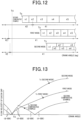
- Fig. 12 is a graph which illustrates an enlarged portion of Fig. 9 .
- Fig. 13 is a graph which demonstrates transitions in the in-gap gas flow in a period illustrated in Fig. 13 in the second comparative example and the first and second modes of this embodiment.
- the in-gap gas flow is still oriented in the spray hole opposite direction d2 at the ignition timing Ts in the after-top-dead-center ignition control mode. This is because the in-gap gas flow is kept oriented by inertia thereof in the spray hole opposite direction d2 in a deep portion of the pre-chamber 38 for a while after the compression stroke top dead center Td is passed.
- the strength of the in-gap gas flow temporarily becomes zero, after which the direction of the in-gap gas flow turns in the spray hole direction d1.
- the gas flow in such a period of time is, therefore, very weak, so that the spark f does not extend sufficiently, thus facing a risk of failure in igniting the fuel.
- the in-gap gas flow has already turned from the spray hole opposite direction d2 to the spray hole direction d1 before the ignition timing Ts in the after-top-dead-center ignition control mode.
- This causes a strong flow of gas to be created, for example, at 5m/s or more in the spray hole direction d1 at the ignition timing Ts, thereby facilitating extension of the spark f in the spray hole direction d1, which enhances the growth of a flame kernel in or around the spray hole-nearby region R. Consequently, the first and second modes of this embodiment are capable of creating the ignition source quickly within the spray hole-nearby region R.
- the combustion end timing Te is, as described above, required to be earlier than the exhaust start time To. It is, therefore, impossible to retard the ignition timing Ts sufficiently in the fast idling mode in which the timing of fuel combustion needs to be as late as possible in the first and second comparative examples in which a combustion time period that is an interval between the ignition timing Ts and the combustion end timing Te, thereby resulting in a difficulty in sufficiently retarding the combustion center-of-gravity Tc that is equivalent to a time when 50% of fuel has been combusted, which may lead to a lack in warming the catalyst in the fast idling mode.
- the first and second modes of this embodiment are capable of shortening the combustion period of time that is an interval between the ignition timing Ts and the combustion end timing Te as compared with the first and second comparative examples, thereby enabling the ignition timing Ts to be retarded sufficiently.
- This permits the combustion center-of-gravity Tc to be retarded greatly as compared with the first and second comparative examples, thereby ensuring the stability in warning the catalyst in the fast idling mode, which leads to a decreased duration of the fast idling mode to improve the fuel consumption in the engine 90 and reduce exhaust emissions from the engine 90.
- the ignition source is created in the spray hole-nearby region R, the center spray hole 35c, or the main chamber 31 shown in Fig. 2 early, e.g., within a crank angle of 20° following the ignition timing Ts.
- the ignition source is arranged in the spray hole-nearby region R or the center spray hole 35c, it facilitates the jetting of a flame, as grown from the ignition source, from the center spray hole 35c into the main chamber 31.
- the ignition source is provided in the main chamber 31, it will cause a flame grown from the ignition source to propagate as it is in the main chamber 31. It is, therefore, possible to propagate the flame quickly to or in the main chamber 31 in the after-top-dead-center ignition control mode.
- the second mode of this embodiment offers the following beneficial advantages.
- the spark f is extended to reach the inside of the main chamber 31, thereby creating the ignition source within the main chamber 31 at an early point within a crank angle of 20° after the ignition timing.
- the second mode therefore, ensures quick propagation of the flame to the main chamber 31.
- the dimensions of the pre-chamber 38 and the spray holes 35 are selected to meet the above Eq. B in order to have the spray hole ratio ( S / V ) falling in the region ⁇ illustrated in Fig. 7 .
- the region ⁇ is, as described above, a region where the in-gap gas flow at the ignition timing Ts in the after-top-dead-center ignition control mode moves at 5m/s or more in the spray hole direction d1.
- the in-gap gas flow which moves at 5m/s or more in the spray hole direction d1 serves to facilitate early creation of the ignition source in the spray hole-nearby region R .
- the region ⁇ depends slightly on the circumferences, but however, is expected to produce a required degree of the in-gap gas flow at the ignition timing Ts in the after-top-dead-center ignition control mode when the engine 90 is operated at a usual speed, with a usual quantity of intake air, and at a usual compression ratio.
- the quick creation of the ignition source in the spray hole-nearby region R is, therefore, achieved easily by selecting the spray hole ratio ( S / V ) to lie in the region ⁇ .
- the second mode also has the following beneficial advantage.
- the spray hole ratio ( S / V) is less than 0.3, it will, as described above, result in too strong a flow of gas passing through the spray holes 35, thereby undesirably blowing away the flame.
- This embodiment is, as described above, configured to set the spray hole ratio ( S / V ) to be 0.3 or more, thus eliminating the above problem.
- the second mode also has the following beneficial advantage.
- the in-gap gas flow turns from the spray hole opposite direction d2 (i.e., the spray hole opposite direction d2 -side) to the spray hole direction d1 (i.e., the spray hole opposite direction d1 -side) until the ignition timing Ts is reached in the after-top-dead-center ignition control mode.
- This causes the in-gap gas flow to be oriented in the spray hole direction d1 at the ignition timing Ts in the after-top-dead-center ignition control mode, thereby ensuring the stability in extending the spark f in the spray hole direction d1. This facilitates the quick creation of an ignition source within the spray hole-nearby region R.
- the dividing wall 34 has a plurality of spray holes 35 formed therein, but may alternatively be designed to have only the single center spray 35c.
- the first embodiment has the first electrode 44 located closest to the center spray hole 35c, but however, may alternatively be designed to arrange the first electrode 44 closest to one(s) of the other spray holes 35 to extend the spark f toward it.
- the dividing wall 34 in the first embodiment also works as the second electrode 46 and is attached to the head 20 in electrical conduction therewith, but however, it may be configured to have a protrusion(s) which is in electrical conduction to the dividing wall 34 and serves as the second electrode 46.
- the second electrode 46 may be made of a member which is discrete from the dividing wall 34 and electrically connects with the head 20.
- the first embodiment has the dividing wall 34 secured to the porcelain insulator 41 of the spark plug 40, but however, the dividing wall 34 may alternatively be attached to the head 20. Additionally, the spark plug 40 may be arranged to have the porcelain insulator 41 arranged in engagement with the dividing wall 34 of the head 20.
Landscapes
- Engineering & Computer Science (AREA)
- Chemical & Material Sciences (AREA)
- Combustion & Propulsion (AREA)
- Mechanical Engineering (AREA)
- General Engineering & Computer Science (AREA)
- Theoretical Computer Science (AREA)
- Signal Processing (AREA)
- Combustion Methods Of Internal-Combustion Engines (AREA)
- Ignition Installations For Internal Combustion Engines (AREA)
Claims (5)
- Système d'allumage comprenant :une paroi de séparation (34) qui divise une chambre de combustion (30) d'un moteur (90) en une chambre principale (31) et une préchambre (38) et dans laquelle est formé au moins un trou de pulvérisation (35) qui communique entre la chambre principale (31) et la préchambre (38) ; etune bougie d'allumage (40) dans laquelle une tension est appliquée à travers un éclateur (45) entre une première électrode (44) et une seconde électrode (46) pour créer une étincelle électrique (f) afin d'enflammer le carburant, dans lequella préchambre (38) abrite la bougie d'allumage (40) avec la première électrode (44),la paroi de séparation (34) ou un élément relié électriquement à la paroi de séparation (34) comporte la seconde électrode (46),un mode de commande d'allumage après le point mort haut dans lequel une opération d'allumage pour enflammer le carburant à l'aide de la bougie d'allumage (40) est effectuée après l'exécution d'une course de compression au point mort haut (Td) lorsqu'une condition de fonctionnement donnée du moteur (90) est remplie, etdans le mode de commande d'allumage après le point mort haut, une source d'allumage qui se présente sous la forme d'un noyau de flamme auto-croissant est fournie dans une région proche du trou de pulvérisation (R) à l'intérieur de la préchambre (38), du trou de pulvérisation (35), ou dans la chambre principale (31) à un angle de vilebrequin de 20° après un moment d'allumage (Ts) où le moment d'allumage (Ts) est un moment où la tension commence à être appliquée à travers l'éclateur (45), et la région proche du trou de pulvérisation (R) est une région qui est située à 3 mm ou moins du centre du trou de pulvérisation qui est un centre d'une ouverture du trou de pulvérisation (35) qui fait face à la préchambre (38), caractérisé par le fait queune relation de S/V ≤ -0.025D^3 + 0.34D^2 - 1.4D + 2.1, où V est un volume de la préchambre (38) en unités de centimètres cubes, S est une surface de section totale du au moins un trou de pulvérisation (35) dans la paroi de séparation (34) en unités de mm^2, et D est une distance entre la première électrode (44) et le trou de pulvérisation (35) en unités de mm ou, lorsque la paroi de séparation (34) comporte une pluralité de trous de pulvérisation (35), D représente une distance entre la première électrode (44) et l'un (35s) des trous de pulvérisation (35) qui est situé le plus près de l'éclateur (45).
- Le système d'allumage selon la revendication 1, dans lequel dans le mode de contrôle d'allumage après le point mort haut, l'étincelle est étendue pour atteindre l'intérieur de la chambre principale (31) afin de fournir la source d'allumage dans la chambre principale (31) dans un angle de vilebrequin de 20° après le moment de l'allumage (Ts).
- Le système d'allumage selon la revendication 1 ou 2, dans lequel un flux de gaz traverse l'éclateur (45) à une vitesse de 5 m/s ou plus pendant la période de temps au cours de laquelle l'étincelle est créée dans le mode de commande d'allumage après le point mort haut.
- Le système d'allumage selon l'une des revendications 1 à 3, dans lequel une relation de 0,3 ≤ S/V ≤ 2,1 est respectée, où V est un volume de la préchambre (38) en unités de centimètres cubes, et S est une surface sectionnelle totale du trou de pulvérisation (35) dans la paroi de séparation (34) en unités de mm^2.
- Le système d'allumage selon l'une des revendications 1 à 4, dans lequel un flux de gaz d'entrefer tourne d'un côté de direction opposée du trou de pulvérisation (35) (d2) vers un côté de direction du trou de pulvérisation (35) (d1) jusqu'à ce que le moment d'allumage (Ts) soit atteint dans le mode de commande d'allumage après le point mort supérieur pour que le flux de gaz d'entrefer soit orienté vers le côté de direction du trou de pulvérisation (35) (d1) au moment d'allumage (Ts) où le côté de direction du trou de pulvérisation (35) (d1) représente une direction qui comprend, comme composante, une direction du trou de vaporisation (35) qui est une direction orientée de la première électrode (44) vers le trou de vaporisation (35), le côté de la direction opposée du trou de pulvérisation (35) (d2) représente une direction qui comprend, en tant que composant, une direction opposée du trou de pulvérisation (35) orientée à l'opposé de la direction du trou de pulvérisation (35), ou lorsque la paroi de séparation (34) comporte une pluralité de trous de pulvérisation (35), la direction du trou de pulvérisation (35) est une direction orientée de la première électrode (44) à l'un (35s) des trous de pulvérisation (35) qui est situé le plus près de la première électrode (44), et le flux de gaz dans l'entrefer désigne un flux de gaz dans l'éclateur (45).
Applications Claiming Priority (2)
| Application Number | Priority Date | Filing Date | Title |
|---|---|---|---|
| JP2020134723A JP7563035B2 (ja) | 2020-08-07 | 2020-08-07 | 点火システム |
| PCT/JP2021/025838 WO2022030175A1 (fr) | 2020-08-07 | 2021-07-08 | Système d'allumage |
Publications (3)
| Publication Number | Publication Date |
|---|---|
| EP4194672A1 EP4194672A1 (fr) | 2023-06-14 |
| EP4194672A4 EP4194672A4 (fr) | 2024-02-07 |
| EP4194672B1 true EP4194672B1 (fr) | 2025-06-11 |
Family
ID=80118131
Family Applications (1)
| Application Number | Title | Priority Date | Filing Date |
|---|---|---|---|
| EP21853435.2A Active EP4194672B1 (fr) | 2020-08-07 | 2021-07-08 | Système d'allumage |
Country Status (5)
| Country | Link |
|---|---|
| US (1) | US20230184160A1 (fr) |
| EP (1) | EP4194672B1 (fr) |
| JP (1) | JP7563035B2 (fr) |
| CN (1) | CN116194662B (fr) |
| WO (1) | WO2022030175A1 (fr) |
Families Citing this family (2)
| Publication number | Priority date | Publication date | Assignee | Title |
|---|---|---|---|---|
| EP4098857A4 (fr) * | 2020-01-29 | 2023-11-29 | Denso Corporation | Système d'allumage |
| CN115355080B (zh) * | 2022-10-14 | 2023-04-11 | 潍柴动力股份有限公司 | 一种燃烧系统以及气体发动机 |
Family Cites Families (24)
| Publication number | Priority date | Publication date | Assignee | Title |
|---|---|---|---|---|
| US1403886A (en) * | 1920-05-24 | 1922-01-17 | Young Monte | Spark plug |
| US4029072A (en) * | 1973-08-27 | 1977-06-14 | Toyota Jidosha Kogyo Kabushiki Kaisha | Igniting apparatus for internal combustion engines |
| JPS5142835A (ja) * | 1974-10-08 | 1976-04-12 | Hiroaki Yokono | Jonenshitsuojusurunainenkikanno tenkapuragu |
| DE2606014A1 (de) * | 1976-02-14 | 1977-08-25 | Porsche Ag | Gemischverdichtende, fremdgezuendete viertakt-brennkraftmaschine mit ladungsschichtung |
| DE3241697A1 (de) * | 1982-11-11 | 1984-05-17 | Robert Bosch Gmbh, 7000 Stuttgart | Zuendvorrichtung mit einer zuendkammer und zuendelektroden |
| US4924829A (en) * | 1989-09-11 | 1990-05-15 | General Motors Corporation | Apparatus for torch jet assisted spark ignition |
| DE112005001606B4 (de) * | 2004-07-12 | 2010-06-02 | General Motors Corp. (N.D.Ges.D. Staates Delaware), Detroit | Brennkammer und Verfahren für einen Selbstzündungsbenzinmotor |
| JP4379286B2 (ja) * | 2004-09-30 | 2009-12-09 | 日産自動車株式会社 | 筒内直接噴射式火花点火内燃機関の制御装置 |
| JP4539439B2 (ja) | 2005-05-31 | 2010-09-08 | 日産自動車株式会社 | 筒内直接噴射式火花点火内燃機関の制御装置 |
| JP5122367B2 (ja) | 2008-05-09 | 2013-01-16 | 大阪瓦斯株式会社 | エンジン及びエンジン用点火プラグ |
| JP4582217B2 (ja) * | 2008-07-17 | 2010-11-17 | マツダ株式会社 | 火花点火式直噴エンジン |
| JP2011034828A (ja) | 2009-08-03 | 2011-02-17 | Ud Trucks Corp | 内燃機関の点火プラグ |
| US8567369B2 (en) * | 2010-11-11 | 2013-10-29 | Cameron International Corporation | Spark ignited radical injection system |
| JP5569468B2 (ja) * | 2011-05-25 | 2014-08-13 | マツダ株式会社 | 火花点火式エンジンの制御装置 |
| JP5988628B2 (ja) * | 2012-01-10 | 2016-09-07 | ウッドワード, インコーポレーテッドWoodward, Inc. | 燃料供給機能を有するプレチャンバスパークプラグにおけるスパーク点火火炎核流れの制御 |
| JP6015678B2 (ja) | 2014-01-09 | 2016-10-26 | 株式会社デンソー | 内燃機関用のスパークプラグ |
| JP6382017B2 (ja) * | 2014-08-04 | 2018-08-29 | 株式会社Soken | 副室付点火装置とその制御方法 |
| JP6478575B2 (ja) | 2014-11-13 | 2019-03-06 | 株式会社Soken | 点火プラグ |
| JP2018003752A (ja) * | 2016-07-05 | 2018-01-11 | トヨタ自動車株式会社 | 内燃機関 |
| EP3306075B1 (fr) * | 2016-10-07 | 2024-05-22 | Caterpillar Energy Solutions GmbH | Surveillance de bougie d'allumage dans un moteur à combustion interne |
| WO2018106924A1 (fr) * | 2016-12-09 | 2018-06-14 | Cummins Inc. | Bougie d'allumage pour un moteur à combustion interne comportant une préchambre de combustion |
| JP2018150820A (ja) * | 2017-03-10 | 2018-09-27 | 本田技研工業株式会社 | ガスエンジン |
| EP4098857A4 (fr) * | 2020-01-29 | 2023-11-29 | Denso Corporation | Système d'allumage |
| JP7334636B2 (ja) * | 2020-02-05 | 2023-08-29 | 株式会社デンソー | 副室式点火システム |
-
2020
- 2020-08-07 JP JP2020134723A patent/JP7563035B2/ja active Active
-
2021
- 2021-07-08 CN CN202180057868.3A patent/CN116194662B/zh active Active
- 2021-07-08 WO PCT/JP2021/025838 patent/WO2022030175A1/fr not_active Ceased
- 2021-07-08 EP EP21853435.2A patent/EP4194672B1/fr active Active
-
2023
- 2023-02-03 US US18/105,561 patent/US20230184160A1/en not_active Abandoned
Also Published As
| Publication number | Publication date |
|---|---|
| JP7563035B2 (ja) | 2024-10-08 |
| CN116194662A (zh) | 2023-05-30 |
| EP4194672A4 (fr) | 2024-02-07 |
| US20230184160A1 (en) | 2023-06-15 |
| CN116194662B (zh) | 2025-10-17 |
| WO2022030175A1 (fr) | 2022-02-10 |
| JP2022030604A (ja) | 2022-02-18 |
| EP4194672A1 (fr) | 2023-06-14 |
Similar Documents
| Publication | Publication Date | Title |
|---|---|---|
| RU2615741C1 (ru) | Контроллер двигателя | |
| US9638146B2 (en) | Gasoline direct-injection engine | |
| CN105247204B (zh) | 内燃机的控制系统 | |
| US10605222B2 (en) | Internal combustion engine and method of igniting a fuel | |
| KR101016924B1 (ko) | 내연기관의 연료 분사 제어 장치 및 연료 분사 방법 | |
| US6397827B1 (en) | Spark ignition device for direct injection-type engines | |
| WO2008015560A2 (fr) | Moteur à combustion interne à allumage commandé à injection directe et procédé de commande d'injection de carburant pour ledit moteur | |
| KR101932367B1 (ko) | 점화 어셈블리 및 내연 피스톤 엔진의 연소 챔버에서 연소 가능한 연료 혼합물을 점화하는 방법 | |
| WO2016075358A1 (fr) | Ensemble chambre de précombustion adaptable dans une culasse d'un moteur à combustion interne, et culasse | |
| US20230184160A1 (en) | Ignition system | |
| US6176216B1 (en) | Ignition control for fuel direct injection type engine | |
| JP3952710B2 (ja) | 圧縮自己着火式内燃機関 | |
| JP6392535B2 (ja) | 内燃機関の制御装置 | |
| CN109555593A (zh) | 一种用于内燃机的预燃烧室结构 | |
| JP6943229B2 (ja) | 予混合圧縮着火式エンジン | |
| WO2021157322A1 (fr) | Système d'allumage de type à chambre auxiliaire | |
| JP7124921B2 (ja) | エンジンの制御装置 | |
| JP2008088947A (ja) | エンジンの点火制御装置 | |
| JP6969525B2 (ja) | 予混合圧縮着火式エンジン | |
| JP2004108225A (ja) | 圧縮着火式内燃機関における燃焼制御装置 | |
| JP2006046276A (ja) | 直噴火花点火式内燃機関の点火制御装置 | |
| WO2021153275A1 (fr) | Système d'allumage | |
| JP6965853B2 (ja) | 予混合圧縮着火式エンジン | |
| JP6943228B2 (ja) | 予混合圧縮着火式エンジン | |
| JP6969526B2 (ja) | 予混合圧縮着火式エンジン |
Legal Events
| Date | Code | Title | Description |
|---|---|---|---|
| STAA | Information on the status of an ep patent application or granted ep patent |
Free format text: STATUS: THE INTERNATIONAL PUBLICATION HAS BEEN MADE |
|
| PUAI | Public reference made under article 153(3) epc to a published international application that has entered the european phase |
Free format text: ORIGINAL CODE: 0009012 |
|
| STAA | Information on the status of an ep patent application or granted ep patent |
Free format text: STATUS: REQUEST FOR EXAMINATION WAS MADE |
|
| 17P | Request for examination filed |
Effective date: 20230201 |
|
| AK | Designated contracting states |
Kind code of ref document: A1 Designated state(s): AL AT BE BG CH CY CZ DE DK EE ES FI FR GB GR HR HU IE IS IT LI LT LU LV MC MK MT NL NO PL PT RO RS SE SI SK SM TR |
|
| DAV | Request for validation of the european patent (deleted) | ||
| DAX | Request for extension of the european patent (deleted) | ||
| STAA | Information on the status of an ep patent application or granted ep patent |
Free format text: STATUS: EXAMINATION IS IN PROGRESS |
|
| A4 | Supplementary search report drawn up and despatched |
Effective date: 20240108 |
|
| RIC1 | Information provided on ipc code assigned before grant |
Ipc: F02P 5/145 20060101ALN20240102BHEP Ipc: F02B 19/18 20060101ALI20240102BHEP Ipc: F02B 19/12 20060101ALI20240102BHEP Ipc: F02P 13/00 20060101ALI20240102BHEP Ipc: F02B 23/08 20060101AFI20240102BHEP |
|
| 17Q | First examination report despatched |
Effective date: 20240119 |
|
| GRAP | Despatch of communication of intention to grant a patent |
Free format text: ORIGINAL CODE: EPIDOSNIGR1 |
|
| STAA | Information on the status of an ep patent application or granted ep patent |
Free format text: STATUS: GRANT OF PATENT IS INTENDED |
|
| INTG | Intention to grant announced |
Effective date: 20250226 |
|
| GRAS | Grant fee paid |
Free format text: ORIGINAL CODE: EPIDOSNIGR3 |
|
| GRAA | (expected) grant |
Free format text: ORIGINAL CODE: 0009210 |
|
| STAA | Information on the status of an ep patent application or granted ep patent |
Free format text: STATUS: THE PATENT HAS BEEN GRANTED |
|
| AK | Designated contracting states |
Kind code of ref document: B1 Designated state(s): AL AT BE BG CH CY CZ DE DK EE ES FI FR GB GR HR HU IE IS IT LI LT LU LV MC MK MT NL NO PL PT RO RS SE SI SK SM TR |
|
| REG | Reference to a national code |
Ref country code: GB Ref legal event code: FG4D |
|
| REG | Reference to a national code |
Ref country code: CH Ref legal event code: EP |
|
| REG | Reference to a national code |
Ref country code: IE Ref legal event code: FG4D |
|
| REG | Reference to a national code |
Ref country code: DE Ref legal event code: R096 Ref document number: 602021032246 Country of ref document: DE |
|
| PG25 | Lapsed in a contracting state [announced via postgrant information from national office to epo] |
Ref country code: ES Free format text: LAPSE BECAUSE OF FAILURE TO SUBMIT A TRANSLATION OF THE DESCRIPTION OR TO PAY THE FEE WITHIN THE PRESCRIBED TIME-LIMIT Effective date: 20250611 Ref country code: FI Free format text: LAPSE BECAUSE OF FAILURE TO SUBMIT A TRANSLATION OF THE DESCRIPTION OR TO PAY THE FEE WITHIN THE PRESCRIBED TIME-LIMIT Effective date: 20250611 |
|
| PGFP | Annual fee paid to national office [announced via postgrant information from national office to epo] |
Ref country code: DE Payment date: 20250722 Year of fee payment: 5 |
|
| REG | Reference to a national code |
Ref country code: LT Ref legal event code: MG9D |
|
| PG25 | Lapsed in a contracting state [announced via postgrant information from national office to epo] |
Ref country code: GR Free format text: LAPSE BECAUSE OF FAILURE TO SUBMIT A TRANSLATION OF THE DESCRIPTION OR TO PAY THE FEE WITHIN THE PRESCRIBED TIME-LIMIT Effective date: 20250912 Ref country code: NO Free format text: LAPSE BECAUSE OF FAILURE TO SUBMIT A TRANSLATION OF THE DESCRIPTION OR TO PAY THE FEE WITHIN THE PRESCRIBED TIME-LIMIT Effective date: 20250911 |
|
| REG | Reference to a national code |
Ref country code: NL Ref legal event code: MP Effective date: 20250611 |
|
| PG25 | Lapsed in a contracting state [announced via postgrant information from national office to epo] |
Ref country code: BG Free format text: LAPSE BECAUSE OF FAILURE TO SUBMIT A TRANSLATION OF THE DESCRIPTION OR TO PAY THE FEE WITHIN THE PRESCRIBED TIME-LIMIT Effective date: 20250611 |
|
| PG25 | Lapsed in a contracting state [announced via postgrant information from national office to epo] |
Ref country code: HR Free format text: LAPSE BECAUSE OF FAILURE TO SUBMIT A TRANSLATION OF THE DESCRIPTION OR TO PAY THE FEE WITHIN THE PRESCRIBED TIME-LIMIT Effective date: 20250611 |
|
| PGFP | Annual fee paid to national office [announced via postgrant information from national office to epo] |
Ref country code: FR Payment date: 20250805 Year of fee payment: 5 Ref country code: AT Payment date: 20251020 Year of fee payment: 5 |
|
| PG25 | Lapsed in a contracting state [announced via postgrant information from national office to epo] |
Ref country code: RS Free format text: LAPSE BECAUSE OF FAILURE TO SUBMIT A TRANSLATION OF THE DESCRIPTION OR TO PAY THE FEE WITHIN THE PRESCRIBED TIME-LIMIT Effective date: 20250911 |
|
| PG25 | Lapsed in a contracting state [announced via postgrant information from national office to epo] |
Ref country code: LV Free format text: LAPSE BECAUSE OF FAILURE TO SUBMIT A TRANSLATION OF THE DESCRIPTION OR TO PAY THE FEE WITHIN THE PRESCRIBED TIME-LIMIT Effective date: 20250611 |
|
| PG25 | Lapsed in a contracting state [announced via postgrant information from national office to epo] |
Ref country code: NL Free format text: LAPSE BECAUSE OF FAILURE TO SUBMIT A TRANSLATION OF THE DESCRIPTION OR TO PAY THE FEE WITHIN THE PRESCRIBED TIME-LIMIT Effective date: 20250611 |
|
| PG25 | Lapsed in a contracting state [announced via postgrant information from national office to epo] |
Ref country code: PT Free format text: LAPSE BECAUSE OF FAILURE TO SUBMIT A TRANSLATION OF THE DESCRIPTION OR TO PAY THE FEE WITHIN THE PRESCRIBED TIME-LIMIT Effective date: 20251013 |
|
| REG | Reference to a national code |
Ref country code: AT Ref legal event code: MK05 Ref document number: 1802430 Country of ref document: AT Kind code of ref document: T Effective date: 20250611 |
|
| PG25 | Lapsed in a contracting state [announced via postgrant information from national office to epo] |
Ref country code: IS Free format text: LAPSE BECAUSE OF FAILURE TO SUBMIT A TRANSLATION OF THE DESCRIPTION OR TO PAY THE FEE WITHIN THE PRESCRIBED TIME-LIMIT Effective date: 20251011 |
|
| PG25 | Lapsed in a contracting state [announced via postgrant information from national office to epo] |
Ref country code: AT Free format text: LAPSE BECAUSE OF FAILURE TO SUBMIT A TRANSLATION OF THE DESCRIPTION OR TO PAY THE FEE WITHIN THE PRESCRIBED TIME-LIMIT Effective date: 20250611 Ref country code: SM Free format text: LAPSE BECAUSE OF FAILURE TO SUBMIT A TRANSLATION OF THE DESCRIPTION OR TO PAY THE FEE WITHIN THE PRESCRIBED TIME-LIMIT Effective date: 20250611 |
|
| PG25 | Lapsed in a contracting state [announced via postgrant information from national office to epo] |
Ref country code: CZ Free format text: LAPSE BECAUSE OF FAILURE TO SUBMIT A TRANSLATION OF THE DESCRIPTION OR TO PAY THE FEE WITHIN THE PRESCRIBED TIME-LIMIT Effective date: 20250611 |
|
| PG25 | Lapsed in a contracting state [announced via postgrant information from national office to epo] |
Ref country code: PL Free format text: LAPSE BECAUSE OF FAILURE TO SUBMIT A TRANSLATION OF THE DESCRIPTION OR TO PAY THE FEE WITHIN THE PRESCRIBED TIME-LIMIT Effective date: 20250611 |
|
| PG25 | Lapsed in a contracting state [announced via postgrant information from national office to epo] |
Ref country code: EE Free format text: LAPSE BECAUSE OF FAILURE TO SUBMIT A TRANSLATION OF THE DESCRIPTION OR TO PAY THE FEE WITHIN THE PRESCRIBED TIME-LIMIT Effective date: 20250611 |
|
| PG25 | Lapsed in a contracting state [announced via postgrant information from national office to epo] |
Ref country code: SK Free format text: LAPSE BECAUSE OF FAILURE TO SUBMIT A TRANSLATION OF THE DESCRIPTION OR TO PAY THE FEE WITHIN THE PRESCRIBED TIME-LIMIT Effective date: 20250611 |
|
| REG | Reference to a national code |
Ref country code: CH Ref legal event code: H13 Free format text: ST27 STATUS EVENT CODE: U-0-0-H10-H13 (AS PROVIDED BY THE NATIONAL OFFICE) Effective date: 20260224 |
|
| PG25 | Lapsed in a contracting state [announced via postgrant information from national office to epo] |
Ref country code: RO Free format text: LAPSE BECAUSE OF FAILURE TO SUBMIT A TRANSLATION OF THE DESCRIPTION OR TO PAY THE FEE WITHIN THE PRESCRIBED TIME-LIMIT Effective date: 20250611 |
|
| REG | Reference to a national code |
Ref country code: DE Ref legal event code: R097 Ref document number: 602021032246 Country of ref document: DE |
|
| PG25 | Lapsed in a contracting state [announced via postgrant information from national office to epo] |
Ref country code: LU Free format text: LAPSE BECAUSE OF NON-PAYMENT OF DUE FEES Effective date: 20250708 |
|
| REG | Reference to a national code |
Ref country code: BE Ref legal event code: MM Effective date: 20250731 |
|
| PG25 | Lapsed in a contracting state [announced via postgrant information from national office to epo] |
Ref country code: MC Free format text: LAPSE BECAUSE OF FAILURE TO SUBMIT A TRANSLATION OF THE DESCRIPTION OR TO PAY THE FEE WITHIN THE PRESCRIBED TIME-LIMIT Effective date: 20250611 |
|
| PG25 | Lapsed in a contracting state [announced via postgrant information from national office to epo] |
Ref country code: DK Free format text: LAPSE BECAUSE OF FAILURE TO SUBMIT A TRANSLATION OF THE DESCRIPTION OR TO PAY THE FEE WITHIN THE PRESCRIBED TIME-LIMIT Effective date: 20250611 |
|
| PG25 | Lapsed in a contracting state [announced via postgrant information from national office to epo] |
Ref country code: IT Free format text: LAPSE BECAUSE OF FAILURE TO SUBMIT A TRANSLATION OF THE DESCRIPTION OR TO PAY THE FEE WITHIN THE PRESCRIBED TIME-LIMIT Effective date: 20250611 Ref country code: BE Free format text: LAPSE BECAUSE OF NON-PAYMENT OF DUE FEES Effective date: 20250731 |
|
| PLBE | No opposition filed within time limit |
Free format text: ORIGINAL CODE: 0009261 |
|
| STAA | Information on the status of an ep patent application or granted ep patent |
Free format text: STATUS: NO OPPOSITION FILED WITHIN TIME LIMIT |
|
| PG25 | Lapsed in a contracting state [announced via postgrant information from national office to epo] |
Ref country code: CH Free format text: LAPSE BECAUSE OF NON-PAYMENT OF DUE FEES Effective date: 20250731 |
|
| REG | Reference to a national code |
Ref country code: CH Ref legal event code: L10 Free format text: ST27 STATUS EVENT CODE: U-0-0-L10-L00 (AS PROVIDED BY THE NATIONAL OFFICE) Effective date: 20260423 |