EP4196337B1 - Entraînement pour mâchoires de scellage - Google Patents
Entraînement pour mâchoires de scellage Download PDFInfo
- Publication number
- EP4196337B1 EP4196337B1 EP21762689.4A EP21762689A EP4196337B1 EP 4196337 B1 EP4196337 B1 EP 4196337B1 EP 21762689 A EP21762689 A EP 21762689A EP 4196337 B1 EP4196337 B1 EP 4196337B1
- Authority
- EP
- European Patent Office
- Prior art keywords
- motor
- seal
- wrapper
- web
- jaws
- Prior art date
- Legal status (The legal status is an assumption and is not a legal conclusion. Google has not performed a legal analysis and makes no representation as to the accuracy of the status listed.)
- Active
Links
Images


Classifications
-
- B—PERFORMING OPERATIONS; TRANSPORTING
- B29—WORKING OF PLASTICS; WORKING OF SUBSTANCES IN A PLASTIC STATE IN GENERAL
- B29C—SHAPING OR JOINING OF PLASTICS; SHAPING OF MATERIAL IN A PLASTIC STATE, NOT OTHERWISE PROVIDED FOR; AFTER-TREATMENT OF THE SHAPED PRODUCTS, e.g. REPAIRING
- B29C65/00—Joining or sealing of preformed parts, e.g. welding of plastics materials; Apparatus therefor
- B29C65/02—Joining or sealing of preformed parts, e.g. welding of plastics materials; Apparatus therefor by heating, with or without pressure
-
- B—PERFORMING OPERATIONS; TRANSPORTING
- B29—WORKING OF PLASTICS; WORKING OF SUBSTANCES IN A PLASTIC STATE IN GENERAL
- B29C—SHAPING OR JOINING OF PLASTICS; SHAPING OF MATERIAL IN A PLASTIC STATE, NOT OTHERWISE PROVIDED FOR; AFTER-TREATMENT OF THE SHAPED PRODUCTS, e.g. REPAIRING
- B29C65/00—Joining or sealing of preformed parts, e.g. welding of plastics materials; Apparatus therefor
- B29C65/74—Joining or sealing of preformed parts, e.g. welding of plastics materials; Apparatus therefor by welding and severing, or by joining and severing, the severing being performed in the area to be joined, next to the area to be joined, in the joint area or next to the joint area
-
- B—PERFORMING OPERATIONS; TRANSPORTING
- B29—WORKING OF PLASTICS; WORKING OF SUBSTANCES IN A PLASTIC STATE IN GENERAL
- B29C—SHAPING OR JOINING OF PLASTICS; SHAPING OF MATERIAL IN A PLASTIC STATE, NOT OTHERWISE PROVIDED FOR; AFTER-TREATMENT OF THE SHAPED PRODUCTS, e.g. REPAIRING
- B29C65/00—Joining or sealing of preformed parts, e.g. welding of plastics materials; Apparatus therefor
- B29C65/78—Means for handling the parts to be joined, e.g. for making containers or hollow articles, e.g. means for handling sheets, plates, web-like materials, tubular articles, hollow articles or elements to be joined therewith; Means for discharging the joined articles from the joining apparatus
- B29C65/7858—Means for handling the parts to be joined, e.g. for making containers or hollow articles, e.g. means for handling sheets, plates, web-like materials, tubular articles, hollow articles or elements to be joined therewith; Means for discharging the joined articles from the joining apparatus characterised by the feeding movement of the parts to be joined
- B29C65/7888—Means for handling of moving sheets or webs
- B29C65/7894—Means for handling of moving sheets or webs of continuously moving sheets or webs
-
- B—PERFORMING OPERATIONS; TRANSPORTING
- B29—WORKING OF PLASTICS; WORKING OF SUBSTANCES IN A PLASTIC STATE IN GENERAL
- B29C—SHAPING OR JOINING OF PLASTICS; SHAPING OF MATERIAL IN A PLASTIC STATE, NOT OTHERWISE PROVIDED FOR; AFTER-TREATMENT OF THE SHAPED PRODUCTS, e.g. REPAIRING
- B29C66/00—General aspects of processes or apparatus for joining preformed parts
- B29C66/01—General aspects dealing with the joint area or with the area to be joined
- B29C66/05—Particular design of joint configurations
- B29C66/10—Particular design of joint configurations particular design of the joint cross-sections
- B29C66/11—Joint cross-sections comprising a single joint-segment, i.e. one of the parts to be joined comprising a single joint-segment in the joint cross-section
- B29C66/112—Single lapped joints
- B29C66/1122—Single lap to lap joints, i.e. overlap joints
-
- B—PERFORMING OPERATIONS; TRANSPORTING
- B29—WORKING OF PLASTICS; WORKING OF SUBSTANCES IN A PLASTIC STATE IN GENERAL
- B29C—SHAPING OR JOINING OF PLASTICS; SHAPING OF MATERIAL IN A PLASTIC STATE, NOT OTHERWISE PROVIDED FOR; AFTER-TREATMENT OF THE SHAPED PRODUCTS, e.g. REPAIRING
- B29C66/00—General aspects of processes or apparatus for joining preformed parts
- B29C66/40—General aspects of joining substantially flat articles, e.g. plates, sheets or web-like materials; Making flat seams in tubular or hollow articles; Joining single elements to substantially flat surfaces
- B29C66/41—Joining substantially flat articles ; Making flat seams in tubular or hollow articles
- B29C66/43—Joining a relatively small portion of the surface of said articles
- B29C66/431—Joining the articles to themselves
- B29C66/4312—Joining the articles to themselves for making flat seams in tubular or hollow articles, e.g. transversal seams
-
- B—PERFORMING OPERATIONS; TRANSPORTING
- B29—WORKING OF PLASTICS; WORKING OF SUBSTANCES IN A PLASTIC STATE IN GENERAL
- B29C—SHAPING OR JOINING OF PLASTICS; SHAPING OF MATERIAL IN A PLASTIC STATE, NOT OTHERWISE PROVIDED FOR; AFTER-TREATMENT OF THE SHAPED PRODUCTS, e.g. REPAIRING
- B29C66/00—General aspects of processes or apparatus for joining preformed parts
- B29C66/40—General aspects of joining substantially flat articles, e.g. plates, sheets or web-like materials; Making flat seams in tubular or hollow articles; Joining single elements to substantially flat surfaces
- B29C66/41—Joining substantially flat articles ; Making flat seams in tubular or hollow articles
- B29C66/43—Joining a relatively small portion of the surface of said articles
- B29C66/432—Joining a relatively small portion of the surface of said articles for making tubular articles or closed loops, e.g. by joining several sheets ; for making hollow articles or hollow preforms
- B29C66/4322—Joining a relatively small portion of the surface of said articles for making tubular articles or closed loops, e.g. by joining several sheets ; for making hollow articles or hollow preforms by joining a single sheet to itself
-
- B—PERFORMING OPERATIONS; TRANSPORTING
- B29—WORKING OF PLASTICS; WORKING OF SUBSTANCES IN A PLASTIC STATE IN GENERAL
- B29C—SHAPING OR JOINING OF PLASTICS; SHAPING OF MATERIAL IN A PLASTIC STATE, NOT OTHERWISE PROVIDED FOR; AFTER-TREATMENT OF THE SHAPED PRODUCTS, e.g. REPAIRING
- B29C66/00—General aspects of processes or apparatus for joining preformed parts
- B29C66/80—General aspects of machine operations or constructions and parts thereof
- B29C66/82—Pressure application arrangements, e.g. transmission or actuating mechanisms for joining tools or clamps
- B29C66/822—Transmission mechanisms
- B29C66/8221—Scissor or lever mechanisms, i.e. involving a pivot point
-
- B—PERFORMING OPERATIONS; TRANSPORTING
- B29—WORKING OF PLASTICS; WORKING OF SUBSTANCES IN A PLASTIC STATE IN GENERAL
- B29C—SHAPING OR JOINING OF PLASTICS; SHAPING OF MATERIAL IN A PLASTIC STATE, NOT OTHERWISE PROVIDED FOR; AFTER-TREATMENT OF THE SHAPED PRODUCTS, e.g. REPAIRING
- B29C66/00—General aspects of processes or apparatus for joining preformed parts
- B29C66/80—General aspects of machine operations or constructions and parts thereof
- B29C66/82—Pressure application arrangements, e.g. transmission or actuating mechanisms for joining tools or clamps
- B29C66/822—Transmission mechanisms
- B29C66/8225—Crank mechanisms
-
- B—PERFORMING OPERATIONS; TRANSPORTING
- B29—WORKING OF PLASTICS; WORKING OF SUBSTANCES IN A PLASTIC STATE IN GENERAL
- B29C—SHAPING OR JOINING OF PLASTICS; SHAPING OF MATERIAL IN A PLASTIC STATE, NOT OTHERWISE PROVIDED FOR; AFTER-TREATMENT OF THE SHAPED PRODUCTS, e.g. REPAIRING
- B29C66/00—General aspects of processes or apparatus for joining preformed parts
- B29C66/80—General aspects of machine operations or constructions and parts thereof
- B29C66/82—Pressure application arrangements, e.g. transmission or actuating mechanisms for joining tools or clamps
- B29C66/824—Actuating mechanisms
- B29C66/8246—Servomechanisms, e.g. servomotors
-
- B—PERFORMING OPERATIONS; TRANSPORTING
- B29—WORKING OF PLASTICS; WORKING OF SUBSTANCES IN A PLASTIC STATE IN GENERAL
- B29C—SHAPING OR JOINING OF PLASTICS; SHAPING OF MATERIAL IN A PLASTIC STATE, NOT OTHERWISE PROVIDED FOR; AFTER-TREATMENT OF THE SHAPED PRODUCTS, e.g. REPAIRING
- B29C66/00—General aspects of processes or apparatus for joining preformed parts
- B29C66/80—General aspects of machine operations or constructions and parts thereof
- B29C66/83—General aspects of machine operations or constructions and parts thereof characterised by the movement of the joining or pressing tools
- B29C66/834—General aspects of machine operations or constructions and parts thereof characterised by the movement of the joining or pressing tools moving with the parts to be joined
- B29C66/8351—Jaws mounted on rollers, cylinders, drums, bands, belts or chains; Flying jaws
- B29C66/83541—Jaws mounted on rollers, cylinders, drums, bands, belts or chains; Flying jaws flying jaws, e.g. jaws mounted on crank mechanisms or following a hand over hand movement
- B29C66/83543—Jaws mounted on rollers, cylinders, drums, bands, belts or chains; Flying jaws flying jaws, e.g. jaws mounted on crank mechanisms or following a hand over hand movement cooperating flying jaws
-
- B—PERFORMING OPERATIONS; TRANSPORTING
- B29—WORKING OF PLASTICS; WORKING OF SUBSTANCES IN A PLASTIC STATE IN GENERAL
- B29C—SHAPING OR JOINING OF PLASTICS; SHAPING OF MATERIAL IN A PLASTIC STATE, NOT OTHERWISE PROVIDED FOR; AFTER-TREATMENT OF THE SHAPED PRODUCTS, e.g. REPAIRING
- B29C66/00—General aspects of processes or apparatus for joining preformed parts
- B29C66/80—General aspects of machine operations or constructions and parts thereof
- B29C66/84—Specific machine types or machines suitable for specific applications
- B29C66/849—Packaging machines
-
- B—PERFORMING OPERATIONS; TRANSPORTING
- B65—CONVEYING; PACKING; STORING; HANDLING THIN OR FILAMENTARY MATERIAL
- B65B—MACHINES, APPARATUS OR DEVICES FOR, OR METHODS OF, PACKAGING ARTICLES OR MATERIALS; UNPACKING
- B65B51/00—Devices for, or methods of, sealing or securing package folds or closures; Devices for gathering or twisting wrappers, or necks of bags
- B65B51/10—Applying or generating heat or pressure or combinations thereof
- B65B51/26—Devices specially adapted for producing transverse or longitudinal seams in webs or tubes
- B65B51/30—Devices, e.g. jaws, for applying pressure and heat, e.g. for subdividing filled tubes
- B65B51/303—Devices, e.g. jaws, for applying pressure and heat, e.g. for subdividing filled tubes reciprocating along only one axis
-
- B—PERFORMING OPERATIONS; TRANSPORTING
- B29—WORKING OF PLASTICS; WORKING OF SUBSTANCES IN A PLASTIC STATE IN GENERAL
- B29C—SHAPING OR JOINING OF PLASTICS; SHAPING OF MATERIAL IN A PLASTIC STATE, NOT OTHERWISE PROVIDED FOR; AFTER-TREATMENT OF THE SHAPED PRODUCTS, e.g. REPAIRING
- B29C65/00—Joining or sealing of preformed parts, e.g. welding of plastics materials; Apparatus therefor
- B29C65/78—Means for handling the parts to be joined, e.g. for making containers or hollow articles, e.g. means for handling sheets, plates, web-like materials, tubular articles, hollow articles or elements to be joined therewith; Means for discharging the joined articles from the joining apparatus
- B29C65/7858—Means for handling the parts to be joined, e.g. for making containers or hollow articles, e.g. means for handling sheets, plates, web-like materials, tubular articles, hollow articles or elements to be joined therewith; Means for discharging the joined articles from the joining apparatus characterised by the feeding movement of the parts to be joined
- B29C65/7888—Means for handling of moving sheets or webs
- B29C65/7891—Means for handling of moving sheets or webs of discontinuously moving sheets or webs
Definitions
- the invention relates to a vertical flow-wrapper comprising:
- a flow-wrapper also called flow wrapping machine, is a packaging machine that receives a plane continuous web, for example a film of plastic material, e.g., a thermoplastic material, which is transported, preferably continuously, and passed downwardly over a form shoulder and a vertical form-fill tube and is thereby shaped into a tubular form, i.e. into a tubular web, by being wrapped around the vertical form-fill tube of the flow-wrapper.
- a plane continuous web for example a film of plastic material, e.g., a thermoplastic material
- the web After being wrapped around the vertical form-fill tube, the web is longitudinally closed by means of a longitudinally extending seal, which is applied to the web especially by heat sealing the lateral/longitudinal margins of the web or by heat sealing in the vicinity of these margins thereby joining them.
- This is carried out by so called longitudinal-sealing means.
- the tubular web has conventionally a rectangular, elliptical, circular, pentagonal or irregular shaped cross-sectional area.
- the tubular web is closed by cross-sealing means, preferably in a direction mainly perpendicular to the direction of flow of the web, i.e. transversely. Thereby, individual packages are defined out of the continuous tubular web.
- a product such as a foodstuff
- the tubular web is transversely open at its upper end, i.e. not cross-sealed.
- the tubular web together with the product is moved downwardly and then a top cross-seal is formed above the product and thereby a hermetically closed package is produced.
- the package is separated from the tubular web by cutting means.
- a product such as a foodstuff
- a product is introduced into the packages by dropping the product through a form-fill tube and into the tubular web.
- the tubular web is transversely open at its upper end, i.e. not cross-sealed.
- the tubular web together with the product is moved downwardly and then a top cross-seal is formed above the product and thereby a hermetically closed package is produced.
- each package is separated from the tubular web by cutting means.
- the cutting means are preferably part of the cross-sealing means.
- the cross-sealing means comprises two seal-jaws, a closing motor and a jaw closing mechanism provided between the closing motor and the seal-jaws.
- the closing motor is preferably an electro-motor, more preferably a servo-motor or a motor with a position transmitter at the output shaft.
- the jaw closing mechanism preferably converts a rotation of the motor shaft into a linear movement of the seal-jaws.
- the closing motor and the jaw closing mechanism move the seal-jaws relative to each other between an open- and a sealing-position.
- the skilled person understands that only one seal jaw needs to be moved. However, the movement of both seal jaws is preferred. In the open-position, the seal jaws are distant from each other; i.e.
- the seal jaws and the jaw closing mechanism are reciprocated between an upper and a lower vertical position.
- the application of the cross-seal at the continuously moving web tube takes place.
- the cross-sealing means are moved upwards again.
- This movement is driven by a reciprocation motor, preferably an electro-motor, more preferably a servo-motor or a motor with a position transmitter at the output shaft.
- the cross-sealing means and the jaw closing mechanism preferably reciprocate between an upper- and a lower dead centre.
- the reciprocation motor that drives this movement is preferably fixed to the frame of the vertical flow wrapper.
- a crank mechanism or a linear system like a spindle or a linear power transmission can be used.
- the closing motor which opens and closes the seal-jaws is provided at the frame of the vertical flow-wrapper and a torque transfer means is provided between the closing motor and the jaw closing mechanism.
- the torque transfer means is connected to the output shaft of the closing motor and to an input shaft of the jaw closing mechanism.
- the torque transfers the rotation from the output shaft of the closing motor to the input shaft of the jaw closing mechanism.
- the gear ratio is preferably, at least approximately, 1:1.
- the closing motor and the reciprocation motor are operated independently from each other. Particularly, during the movement of the seal jaws from the upper- to the lower vertical position, more preferably during the sealing, the closing motor does not need to adjust the position of the seal jaws and/or the rotational position of the torque transfer mechanism. During sealing, the position of the closing mechanism is not adjusted. The closing motor is only needed to open and close the seal jaws but not to maintain the seal jaws opened or closed during the vertical reciprocation of seal jaws and the jaw closing mechanism.
- the closing motor which actuates the seal jaw(s) does not participate at all or very little in the upward- and/or downward movement of the seal jaws and the jaw closing mechanism. This reduces the inertia of the cross sealing means for the upwards and downwards movement and can result in a faster vertical movement of the cross-sealing jaws and/or in less energy consumption and/or in less vibration.
- the control system of the inventive flow wrapper can be simplified, because it preferably does not need to provide continuously or semi-continuously set values to the closing motor during the vertical reciprocation of the seal jaws and the jaw closing mechanism.
- the closing motor only needs a signal in which vertical position the seal jaws need to be opened or closed.
- the output shaft of the closing motor does not rotate to compensate a movement of the seal jaws resulting from their vertical movement.
- the closing motor is preferably exclusively needed to open and close the seal jaws.
- the motor adapts its torque to adapt the needed sealing force during the sealing process.
- the film material is partly melted, so that the thickness of the film decreases.
- the position of the sealing jaws is corrected during the sealing process.
- the closing motor is connected to the frame by a slide bearing, preferably a slide bearing which allows a movement only along one plane, preferably almost horizontal plane, preferably by a linearly moving platform.
- the closing motor is pivotably connected to the frame.
- the plane is provided at a small angle, preferably ⁇ 20°, more preferably ⁇ 10° and even more preferably ⁇ 5° relative to a horizontal plane.
- the closing motor is preferably provided at frame in a location between an upper- and the lower dead-end centre of the movement of the seal-jaws, preferably near or in the middle of the vertical distance between the upper- and the lower dead-end centre.
- vertical movement of the seal jaws and the jaw closing mechanism does not influence the position of the seal jaws.
- the jaw closing mechanism and the reciprocation of the seal jaws and the jaw closing mechanism are mechanically decoupled.
- the seal jaws are neither opened nor closed by their vertical movement.
- the seal pressure provided by the closing motor and the closing mechanism remains constant throughout the entire sealing operation.
- the closing motor does not need to readjust the position of the sealing jaws during the vertical reciprocation of the seal jaws and the jaw closing mechanism.
- the stiffness of the closing mechanism does not change during the vertical reciprocation of the seal jaws and the jaw closing mechanism. In case the stiffness of the closing mechanism changes during the vertical reciprocation of the seal jaws, this is preferably compensated by jaw closing mechanism.
- the extent of the vertical movement of the jaws is larger than the extent of the movement, particularly the horizontal movement of the closing motor which drives the jaws.
- Movement of the closing motor according to the present invention means the movement of the closing motor in its entirety.
- the movement of the closing motor can be a linear and/or a rotational movement.
- the movement of the closing motor is zero or essentially zero during the entire operation of the vertical flow wrapper. Only the output shaft of the closing motor rotates.
- the closing motor slides, during the reciprocation of the seal jaws between the upper and the lower vertical position along a plane which has at least a horizontal component, preferably along a horizontal plane.
- the frame of the vertical flow wrapper comprises a platform and the closing motor which opens and closes the seal jaws is slidably provided on this platform.
- the closing motor rotates relative to the frame during the reciprocation of the seal jaws between the upper and the lower vertical position, preferably around an axis that is perpendicular to the movement of the web or perpendicular to the vertical.
- the torque transfer means comprises at least two rotational bodies, more preferably at least two wheels, wherein preferably one rotational body is connected to the shaft of the closing motor and one rotational body is connected to the input shaft of the jaw closing mechanism.
- the two rotational bodies are rotationally connected, preferably slip-free, which transfers the rotation from one rotational body to the other.
- the rotational bodies preferably have the same diameter.
- the connection can be at least one rod, each attached eccentrically to two adjacent rotational bodies.
- two rotational bodies can be connected by an endless belt, preferably a toothed belt or a metal-band, which is fixedly connected to the two rotational bodies.
- distancing means are provided between two adjacent rotational bodies, so that a certain distance between two rotational bodies is maintained.
- the distancing means is preferably a rod or a bar.
- the distancing means is provided between the axis of rotation of the two rotational bodies.
- the means to transfer the torque from the motor to the jaw closing mechanism is a Schmidt-coupling.
- a Schmidt-coupling is for example disclosed by www.schmidt-kupplung.com. Due to the Schmidt-coupling as the torque transfer means, the movement of the motor is zero during the vertical reciprocation of the seal jaws.
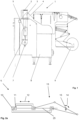
- the flow-wrapper 1 according to the invention is schematically shown, which comprises a frame 8.
- a web here a film 4, especially a weldable plastic film 4
- a form shoulder 3 which shapes the web 4 into a tubular form around a form-fill tube 2.
- a "tubular form" of the packages 7 or of the web 4 means any cross-sectional form including a circular form or another form, and especially a rectangular- or generally a polygonal form.
- Cross sealing means 6 provide cross seals to the tubular web 4 at the downstream end of each package 7 and subsequently, the package is filled with a packaging item. Finally, an upstream cross seal is applied to the web tube 4 by means of the cross sealing means 6, which hermetically closes each package 7.
- the cross sealing means 6 preferably apply simultaneously an upstream cross-seal closing the top of the package 7 and a downstream cross-seal defining the bottom of the subsequent, upstream package 7.
- the packages 7 are separated from one another by a cutting means 6, which are preferably incorporated into the cross-sealing means 6.
- the seal jaws are reciprocated from an open position, in which the seal jaws are spaced apart to a sealing position, in which the seal jaws are pressed together and apply a pressure on the film tube.
- the seal jaws are reciprocated between an upper- and a lower dead end centre.
- the distance between the two dead end centre depends on the length of the package to be produced.
- the cross seal is applied.
- the jaws move essentially with the same speed as the continuously fed web in this direction.
- Figures 2a - 2c each depict different embodiments of the jaw closing mechanism 13, that opens and closes the seal jaws 10, 11.
- the reciprocation of the seal jaws 10, 11 between the open- and the closing position is symbolized by the double arrow 12 and is conventionally a horizontal movement transversely to the transport direction of the web.
- the seal jaws move along guiding means 25.
- the seal jaws are driven by a closing motor M (not depicted), which provides a torque and hence the rotation 14.
- the jaw closing mechanism 13 is provided that converts the rotation 14 of the closing motor M into a linear movement of the jaws 10, 11 along the guiding means 25.
- the jaw closing mechanism 13 preferably uses a linkage system and even more preferably is a knee lever system. These systems have the advantage of amplifying the force provided by the closing motor when the jaws are closed and ensure a fast movement during the opening of the jaws 10, 11.
- FIG. 2a a knee-lever system as the jaw closing mechanism is depicted.
- a lever is pivoted clockwise and counter clockwise as indicated by the double arrow 14 around a pivot point 15. Both ends of this driven lever are connected with additional levers, wherein each of these levers is connected to a seal jaw 10, 11.
- the jaws 10, 11 are distanced from each other, so that the seal jaws move to the open position, while counter clockwise rotation move the seal jaws to the sealing position.
- a jaw closing mechanism 13 with two knee-lever systems and two pivot points 15 is depicted.
- a motor (not depicted) provides the rotational movement 14 which is transferred to a first knee-lever system.
- the second lever of this knee-lever system actuates the second knee-lever system, the knee-lever system according to Figure 2b .
- a clockwise rotation of the motor results in an opening of the seal jaws, while a counter clockwise rotation moves the seal jaws into the sealing position.
- FIG 2d a simplified sketch of the seal jaws 10, 11and the jaw closing mechanism 13 is depicted.
- the jaw closing mechanism 13 maybe provided as shown in Figures 2a - 2c .
- the skilled person understands that the jaw closing mechanism can differ from the embodiments shown in Figures 2a - 2c .
- the seal jaws and the jaw closing mechanism optionally reciprocate between an upper- and a lower vertical position, preferably between an upper- and a lower dead end centre. The movement is indicated by double-arrow 16.
- FIG 3 shows an embodiment according to the state in the art.
- the motor M is moved together with the seal jaws 10, 11 during their vertical movement 16. Due to the larger mass of inertia the system is less dynamic.
- Figures 4a - 4f show different embodiments of the present invention. All examples have in common that the movement 16 of the seal jaws 10, 11 is decoupled from the closing motor M.
- the closing motor M does not participate at all or only to a reduced extent in the movement 16 of the seal jaws.
- the motor is fixed to frame and not, as depicted in the embodiment according to the embodiment in Figure 3 , fixed to the seal jaws 10, 11 and/or the jaws closing mechanism 13.
- the closing motor does not need to adjust the position of the seal jaws depending on their vertical position.
- the closing motor and the rotational body 17 can be pivoted around a pivot bearing 22, which is provided at the frame of the inventive vertical flow wrapper. This rotation indicated by the double arrow takes place during the movement 16. This results in less inertia and hence a higher dynamic system in comparison to the embodiment according to Figure 3 .
- Figure 4c essentially depicts the embodiment of Figure 4a , so that reference can be made to the description of the Figure 4a .
- rod 18 is provided which is provided between two adjacent rotational bodies.
- FIG. 4f shows another inventive embodiment of the present invention.
- a so-called Schmidt-coupling is provided between the closing motor and the jaw closing mechanism 13.
- the Schmidt-coupling comprises here three rotational bodies 17, 19 and 26, wherein two adjacent rotational bodies are torque-wise connected, for example by torque transfer means 18.
- the attachments points of the torque transfer means 18 are selected such, that during the vertical movement 16 of the seal jaws 10, 11 no movement at all of closing motor M takes place.
Landscapes
- Engineering & Computer Science (AREA)
- Mechanical Engineering (AREA)
- Package Closures (AREA)
- Containers And Plastic Fillers For Packaging (AREA)
Claims (11)
- Machine d'emballage tubulaire verticale (1) comprenant :- un bâti (8),- un dispositif d'amenée de bande qui, de préférence de façon continue, amène une bande (4) à un épaulement de formage (3) et un tube de formage-remplissage (2), qui mettent la bande (4) sous la forme d'un tube de bande,- un moyen de scellage longitudinal (5) servant à joindre par scellage les bords longitudinaux du tube de bande et- un moyen de scellage transversal (6) servant à former un joint transversal sur le tube de bande afin de produire des emballages individuels,le moyen de scellage transversal (6) comprenant des mâchoires de scellage (10, 11), un moteur de fermeture (M) et un mécanisme de fermeture de mâchoires (13) placé entre le moteur de fermeture (M) et les mâchoires de scellage (10, 11), et les mâchoires de scellage (10, 11) et le mécanisme de fermeture de mâchoires (13) étant animés d'un mouvement alternatif entre des positions verticales supérieure et inférieure par un moteur d'entraînement en mouvement alternatif,le moteur de fermeture (M) étant placé au niveau du bâti (8) et un moyen de transfert de couple (20) étant placé entre le moteur de fermeture (M) et le mécanisme de fermeture (13),le moteur de fermeture et le moteur d'entraînement en mouvement alternatif étant actionnés indépendamment l'un de l'autre,caractérisé en ce que le moteur de fermeture est raccordé au bâti par un palier à glissement ou en ce que le moteur de fermeture est raccordé de manière pivotante au bâti.
- Machine d'emballage tubulaire verticale selon la revendication 1, dans laquelle le mouvement vertical des mâchoires de scellage (10, 11) et du mécanisme de fermeture de mâchoires (13) n'a pas d'influence sur la position des mâchoires de scellage (10, 11).
- Machine d'emballage tubulaire verticale selon l'une des revendications précédentes, dans laquelle l'amplitude du mouvement vertical des mâchoires (10, 11) est supérieure à une amplitude d'un mouvement horizontal du moteur de fermeture (M).
- Machine d'emballage tubulaire verticale selon l'une des revendications précédentes, dans laquelle le mouvement vertical du moteur de fermeture (M) ou l'intégralité du mouvement du moteur de fermeture (M) est nul ou sensiblement nul.
- Machine d'emballage tubulaire verticale (1) selon l'une des revendications précédentes, dans laquelle le moteur (M) glisse, durant le mouvement alternatif des mâchoires de scellage (10, 11) entre les positions verticales supérieure et inférieure, le long d'un plan qui comporte au moins une composante horizontale, de préférence le long d'un plan horizontal.
- Machine d'emballage tubulaire verticale (1) selon les revendications 1 à 5, dans laquelle le moteur (M) tourne relativement au bâti (8) durant le mouvement alternatif des mâchoires de scellage (10, 11) entre les positions verticales supérieure et inférieure, de préférence autour d'un axe horizontal.
- Machine d'emballage tubulaire verticale (1) selon l'une des revendications précédentes, dans laquelle le moyen de transfert (20) comprend au moins deux corps rotatifs (17, 19, 26), de préférence des roues, qui sont raccordés en rotation, de préférence sans glissement.
- Machine d'emballage tubulaire verticale (1) selon la revendication 7, dans laquelle au moins une tige (18) est attachée de manière excentrique à deux corps rotatifs (17, 19, 26) .
- Machine d'emballage tubulaire verticale (1) selon la revendication 7 ou 8, dans laquelle deux corps (17, 19, 26) sont raccordés en rotation par une courroie sans fin, de préférence une courroie crantée ou une bande métallique raccordée fixement aux deux corps rotatifs (17, 19, 26) .
- Machine d'emballage tubulaire verticale (1) selon l'une des revendications 7 à 9, dans laquelle un moyen d'espacement (24) est placé entre deux corps rotatifs (17, 19, 26) .
- Machine d'emballage tubulaire verticale (1) selon l'une des revendications 7 à 10, dans laquelle le moyen (20) est un accouplement de SCHMIDT KUPPLUNG.
Applications Claiming Priority (2)
| Application Number | Priority Date | Filing Date | Title |
|---|---|---|---|
| EP20191156 | 2020-08-14 | ||
| PCT/EP2021/072724 WO2022034243A1 (fr) | 2020-08-14 | 2021-08-16 | Entraînement pour mâchoires de scellage |
Publications (2)
| Publication Number | Publication Date |
|---|---|
| EP4196337A1 EP4196337A1 (fr) | 2023-06-21 |
| EP4196337B1 true EP4196337B1 (fr) | 2025-01-29 |
Family
ID=72087980
Family Applications (1)
| Application Number | Title | Priority Date | Filing Date |
|---|---|---|---|
| EP21762689.4A Active EP4196337B1 (fr) | 2020-08-14 | 2021-08-16 | Entraînement pour mâchoires de scellage |
Country Status (7)
| Country | Link |
|---|---|
| US (1) | US12179951B2 (fr) |
| EP (1) | EP4196337B1 (fr) |
| CN (1) | CN116096640B (fr) |
| BR (1) | BR112023000558A2 (fr) |
| ES (1) | ES3028384T3 (fr) |
| MX (1) | MX2023000611A (fr) |
| WO (1) | WO2022034243A1 (fr) |
Families Citing this family (2)
| Publication number | Priority date | Publication date | Assignee | Title |
|---|---|---|---|---|
| US20230405960A1 (en) * | 2022-06-08 | 2023-12-21 | Conagra Foods Rdm, Inc. | Fluorochemical-free microwave popcorn package and production process |
| US12246875B2 (en) * | 2022-09-13 | 2025-03-11 | Mamata Machinery Private Limited | Cross sealing device |
Family Cites Families (13)
| Publication number | Priority date | Publication date | Assignee | Title |
|---|---|---|---|---|
| US5279098A (en) * | 1990-07-31 | 1994-01-18 | Ishida Scales Mfg. Co., Ltd. | Apparatus for and method of transverse sealing for a form-fill-seal packaging machine |
| EP0765812B1 (fr) * | 1991-10-03 | 2000-08-16 | ISHIDA CO., Ltd. | Dispositif de scellement transversal pour machine d'emballage |
| JP3512127B2 (ja) * | 1994-12-23 | 2004-03-29 | 株式会社イシダ | 製袋包装機の横シ−ル機構 |
| US6088994A (en) * | 1998-01-20 | 2000-07-18 | Ishida Co., Ltd. | Packaging machine incorporating device for adjusting position for cutting bags |
| US6427422B2 (en) * | 1998-07-23 | 2002-08-06 | Ishida Co., Ltd. | Packaging method |
| US6691491B2 (en) * | 2000-08-18 | 2004-02-17 | Pacmac, Inc. | Vertical form, fill and seal packaging machine |
| JP3990680B2 (ja) * | 2004-04-30 | 2007-10-17 | オリヒロエンジニアリング株式会社 | 縦型充填包装機 |
| JP4675665B2 (ja) * | 2005-04-11 | 2011-04-27 | 株式会社イシダ | 包装機 |
| EP2088081A4 (fr) * | 2006-10-31 | 2011-11-23 | Ishida Seisakusho | Machine à emballer faisant les sacs, et procédé d'emballage faisant les sacs |
| DE102007003930B4 (de) | 2007-01-26 | 2021-01-21 | Rovema Gmbh | Schlauchbeutelmaschine |
| DE102013203295A1 (de) | 2013-02-27 | 2014-08-28 | Rovema Gmbh | Schlauchbeutelmaschine mit kombiniertem Antrieb für zwei Achsen |
| DE102013217548A1 (de) * | 2013-09-03 | 2015-03-05 | Robert Bosch Gmbh | Horizontalquersiegelstation |
| CN108349609B (zh) * | 2015-11-17 | 2019-05-10 | 株式会社石田 | 制袋包装机 |
-
2021
- 2021-08-16 EP EP21762689.4A patent/EP4196337B1/fr active Active
- 2021-08-16 CN CN202180058067.9A patent/CN116096640B/zh active Active
- 2021-08-16 BR BR112023000558A patent/BR112023000558A2/pt unknown
- 2021-08-16 ES ES21762689T patent/ES3028384T3/es active Active
- 2021-08-16 WO PCT/EP2021/072724 patent/WO2022034243A1/fr not_active Ceased
- 2021-08-16 US US18/020,444 patent/US12179951B2/en active Active
- 2021-08-16 MX MX2023000611A patent/MX2023000611A/es unknown
Also Published As
| Publication number | Publication date |
|---|---|
| US20230294863A1 (en) | 2023-09-21 |
| BR112023000558A2 (pt) | 2023-02-28 |
| MX2023000611A (es) | 2023-02-13 |
| ES3028384T3 (en) | 2025-06-19 |
| CN116096640B (zh) | 2025-06-20 |
| EP4196337A1 (fr) | 2023-06-21 |
| WO2022034243A1 (fr) | 2022-02-17 |
| US12179951B2 (en) | 2024-12-31 |
| CN116096640A (zh) | 2023-05-09 |
Similar Documents
| Publication | Publication Date | Title |
|---|---|---|
| US8919081B2 (en) | Packaging method for producing sealed packages of a food product pourable into a tube of packaging material | |
| CN113453987B (zh) | 用于生产密封包装的包装机和方法 | |
| JP4620787B2 (ja) | 三方シールフイルム包装機 | |
| US12179951B2 (en) | Drive for sealing jaws | |
| CN113710581A (zh) | 用于生产密封包装的包装机和方法 | |
| JP2005313962A (ja) | 縦型充填包装機 | |
| CN100379651C (zh) | 用于由薄片包装材料制成的管生产密封包装的成形设备 | |
| JP2597942B2 (ja) | 包装機のシール圧制御装置 | |
| JP6695675B2 (ja) | センターシール装置 | |
| JP6245689B2 (ja) | ガゼット形成装置及びエンドシール装置 | |
| EP2921282A1 (fr) | Emballage d'écoulement vertical avec un engrenage épicycloïdal | |
| JP2006001648A (ja) | 包装充填装置の改良を特徴とする、注ぎ可能な食品の密封包装をつくる包装機械 | |
| JP2019073302A (ja) | ベルト隙間設定機能を備えた製袋充填包装機 | |
| EP4037976B1 (fr) | Machine d'emballage à circulation verticale et procédé de fabrication d'un sachet | |
| EP4410523B1 (fr) | Appareil de formation d'emballages pour une machine d'emballage et machine d'emballage pour former des emballages remplis d'un produit versable | |
| CN221757958U (zh) | 一种立式包装机 | |
| EP4506270A1 (fr) | Unité de formation pour former des emballages scellés contenant un produit versable et procédé de formation d'emballages scellés contenant un produit versable | |
| EP4454864A1 (fr) | Appareil de formation d'emballages pour une machine d'emballage et machine d'emballage pour former des emballages remplis d'un produit versable | |
| WO2018189256A1 (fr) | Enveloppeuse à écoulement vertical dotée d'un mécanisme à manivelle | |
| JP4976944B2 (ja) | 横シール装置 | |
| WO2025109102A1 (fr) | Filmeuse verticale à temps de production amélioré | |
| JP2025001858A (ja) | 縦ピロー充填包装機の横シール装置 | |
| JP2022083360A (ja) | 縦型製袋充填包装機 | |
| HK1159576A (en) | Packaging method and unit for producing sealed packages of a food product pourable into a tube of packaging material |
Legal Events
| Date | Code | Title | Description |
|---|---|---|---|
| STAA | Information on the status of an ep patent application or granted ep patent |
Free format text: STATUS: UNKNOWN |
|
| STAA | Information on the status of an ep patent application or granted ep patent |
Free format text: STATUS: THE INTERNATIONAL PUBLICATION HAS BEEN MADE |
|
| PUAI | Public reference made under article 153(3) epc to a published international application that has entered the european phase |
Free format text: ORIGINAL CODE: 0009012 |
|
| STAA | Information on the status of an ep patent application or granted ep patent |
Free format text: STATUS: REQUEST FOR EXAMINATION WAS MADE |
|
| 17P | Request for examination filed |
Effective date: 20230306 |
|
| AK | Designated contracting states |
Kind code of ref document: A1 Designated state(s): AL AT BE BG CH CY CZ DE DK EE ES FI FR GB GR HR HU IE IS IT LI LT LU LV MC MK MT NL NO PL PT RO RS SE SI SK SM TR |
|
| DAV | Request for validation of the european patent (deleted) | ||
| DAX | Request for extension of the european patent (deleted) | ||
| STAA | Information on the status of an ep patent application or granted ep patent |
Free format text: STATUS: EXAMINATION IS IN PROGRESS |
|
| 17Q | First examination report despatched |
Effective date: 20231219 |
|
| GRAP | Despatch of communication of intention to grant a patent |
Free format text: ORIGINAL CODE: EPIDOSNIGR1 |
|
| STAA | Information on the status of an ep patent application or granted ep patent |
Free format text: STATUS: GRANT OF PATENT IS INTENDED |
|
| RIC1 | Information provided on ipc code assigned before grant |
Ipc: B65B 51/30 20060101ALI20240801BHEP Ipc: B29C 65/78 20060101ALI20240801BHEP Ipc: B29C 65/74 20060101ALI20240801BHEP Ipc: B29C 65/02 20060101AFI20240801BHEP |
|
| INTG | Intention to grant announced |
Effective date: 20240904 |
|
| GRAS | Grant fee paid |
Free format text: ORIGINAL CODE: EPIDOSNIGR3 |
|
| GRAA | (expected) grant |
Free format text: ORIGINAL CODE: 0009210 |
|
| STAA | Information on the status of an ep patent application or granted ep patent |
Free format text: STATUS: THE PATENT HAS BEEN GRANTED |
|
| AK | Designated contracting states |
Kind code of ref document: B1 Designated state(s): AL AT BE BG CH CY CZ DE DK EE ES FI FR GB GR HR HU IE IS IT LI LT LU LV MC MK MT NL NO PL PT RO RS SE SI SK SM TR |
|
| REG | Reference to a national code |
Ref country code: GB Ref legal event code: FG4D |
|
| REG | Reference to a national code |
Ref country code: CH Ref legal event code: EP |
|
| REG | Reference to a national code |
Ref country code: DE Ref legal event code: R096 Ref document number: 602021025464 Country of ref document: DE |
|
| REG | Reference to a national code |
Ref country code: IE Ref legal event code: FG4D |
|
| P01 | Opt-out of the competence of the unified patent court (upc) registered |
Free format text: CASE NUMBER: APP_3770/2025 Effective date: 20250123 |
|
| REG | Reference to a national code |
Ref country code: NL Ref legal event code: FP |
|
| REG | Reference to a national code |
Ref country code: ES Ref legal event code: FG2A Ref document number: 3028384 Country of ref document: ES Kind code of ref document: T3 Effective date: 20250619 |
|
| PG25 | Lapsed in a contracting state [announced via postgrant information from national office to epo] |
Ref country code: RS Free format text: LAPSE BECAUSE OF FAILURE TO SUBMIT A TRANSLATION OF THE DESCRIPTION OR TO PAY THE FEE WITHIN THE PRESCRIBED TIME-LIMIT Effective date: 20250429 |
|
| PG25 | Lapsed in a contracting state [announced via postgrant information from national office to epo] |
Ref country code: FI Free format text: LAPSE BECAUSE OF FAILURE TO SUBMIT A TRANSLATION OF THE DESCRIPTION OR TO PAY THE FEE WITHIN THE PRESCRIBED TIME-LIMIT Effective date: 20250129 |
|
| PG25 | Lapsed in a contracting state [announced via postgrant information from national office to epo] |
Ref country code: PL Free format text: LAPSE BECAUSE OF FAILURE TO SUBMIT A TRANSLATION OF THE DESCRIPTION OR TO PAY THE FEE WITHIN THE PRESCRIBED TIME-LIMIT Effective date: 20250129 |
|
| REG | Reference to a national code |
Ref country code: LT Ref legal event code: MG9D |
|
| PG25 | Lapsed in a contracting state [announced via postgrant information from national office to epo] |
Ref country code: NO Free format text: LAPSE BECAUSE OF FAILURE TO SUBMIT A TRANSLATION OF THE DESCRIPTION OR TO PAY THE FEE WITHIN THE PRESCRIBED TIME-LIMIT Effective date: 20250429 Ref country code: IS Free format text: LAPSE BECAUSE OF FAILURE TO SUBMIT A TRANSLATION OF THE DESCRIPTION OR TO PAY THE FEE WITHIN THE PRESCRIBED TIME-LIMIT Effective date: 20250529 |
|
| REG | Reference to a national code |
Ref country code: AT Ref legal event code: MK05 Ref document number: 1763040 Country of ref document: AT Kind code of ref document: T Effective date: 20250129 |
|
| PG25 | Lapsed in a contracting state [announced via postgrant information from national office to epo] |
Ref country code: HR Free format text: LAPSE BECAUSE OF FAILURE TO SUBMIT A TRANSLATION OF THE DESCRIPTION OR TO PAY THE FEE WITHIN THE PRESCRIBED TIME-LIMIT Effective date: 20250129 |
|
| PG25 | Lapsed in a contracting state [announced via postgrant information from national office to epo] |
Ref country code: LV Free format text: LAPSE BECAUSE OF FAILURE TO SUBMIT A TRANSLATION OF THE DESCRIPTION OR TO PAY THE FEE WITHIN THE PRESCRIBED TIME-LIMIT Effective date: 20250129 Ref country code: PT Free format text: LAPSE BECAUSE OF FAILURE TO SUBMIT A TRANSLATION OF THE DESCRIPTION OR TO PAY THE FEE WITHIN THE PRESCRIBED TIME-LIMIT Effective date: 20250529 |
|
| PG25 | Lapsed in a contracting state [announced via postgrant information from national office to epo] |
Ref country code: BG Free format text: LAPSE BECAUSE OF FAILURE TO SUBMIT A TRANSLATION OF THE DESCRIPTION OR TO PAY THE FEE WITHIN THE PRESCRIBED TIME-LIMIT Effective date: 20250129 Ref country code: GR Free format text: LAPSE BECAUSE OF FAILURE TO SUBMIT A TRANSLATION OF THE DESCRIPTION OR TO PAY THE FEE WITHIN THE PRESCRIBED TIME-LIMIT Effective date: 20250430 |
|
| PG25 | Lapsed in a contracting state [announced via postgrant information from national office to epo] |
Ref country code: AT Free format text: LAPSE BECAUSE OF FAILURE TO SUBMIT A TRANSLATION OF THE DESCRIPTION OR TO PAY THE FEE WITHIN THE PRESCRIBED TIME-LIMIT Effective date: 20250129 |
|
| PG25 | Lapsed in a contracting state [announced via postgrant information from national office to epo] |
Ref country code: SE Free format text: LAPSE BECAUSE OF FAILURE TO SUBMIT A TRANSLATION OF THE DESCRIPTION OR TO PAY THE FEE WITHIN THE PRESCRIBED TIME-LIMIT Effective date: 20250129 |
|
| PG25 | Lapsed in a contracting state [announced via postgrant information from national office to epo] |
Ref country code: SM Free format text: LAPSE BECAUSE OF FAILURE TO SUBMIT A TRANSLATION OF THE DESCRIPTION OR TO PAY THE FEE WITHIN THE PRESCRIBED TIME-LIMIT Effective date: 20250129 |
|
| PGFP | Annual fee paid to national office [announced via postgrant information from national office to epo] |
Ref country code: ES Payment date: 20250917 Year of fee payment: 5 |
|
| PG25 | Lapsed in a contracting state [announced via postgrant information from national office to epo] |
Ref country code: DK Free format text: LAPSE BECAUSE OF FAILURE TO SUBMIT A TRANSLATION OF THE DESCRIPTION OR TO PAY THE FEE WITHIN THE PRESCRIBED TIME-LIMIT Effective date: 20250129 |
|
| PGFP | Annual fee paid to national office [announced via postgrant information from national office to epo] |
Ref country code: DE Payment date: 20250826 Year of fee payment: 5 |
|
| PGFP | Annual fee paid to national office [announced via postgrant information from national office to epo] |
Ref country code: NL Payment date: 20250828 Year of fee payment: 5 Ref country code: IT Payment date: 20250827 Year of fee payment: 5 |
|
| PGFP | Annual fee paid to national office [announced via postgrant information from national office to epo] |
Ref country code: FR Payment date: 20250828 Year of fee payment: 5 |
|
| PG25 | Lapsed in a contracting state [announced via postgrant information from national office to epo] |
Ref country code: EE Free format text: LAPSE BECAUSE OF FAILURE TO SUBMIT A TRANSLATION OF THE DESCRIPTION OR TO PAY THE FEE WITHIN THE PRESCRIBED TIME-LIMIT Effective date: 20250129 |
|
| PGFP | Annual fee paid to national office [announced via postgrant information from national office to epo] |
Ref country code: CZ Payment date: 20250903 Year of fee payment: 5 |
|
| PG25 | Lapsed in a contracting state [announced via postgrant information from national office to epo] |
Ref country code: RO Free format text: LAPSE BECAUSE OF FAILURE TO SUBMIT A TRANSLATION OF THE DESCRIPTION OR TO PAY THE FEE WITHIN THE PRESCRIBED TIME-LIMIT Effective date: 20250129 |
|
| PG25 | Lapsed in a contracting state [announced via postgrant information from national office to epo] |
Ref country code: SK Free format text: LAPSE BECAUSE OF FAILURE TO SUBMIT A TRANSLATION OF THE DESCRIPTION OR TO PAY THE FEE WITHIN THE PRESCRIBED TIME-LIMIT Effective date: 20250129 |
|
| REG | Reference to a national code |
Ref country code: DE Ref legal event code: R097 Ref document number: 602021025464 Country of ref document: DE |
|
| PLBE | No opposition filed within time limit |
Free format text: ORIGINAL CODE: 0009261 |
|
| STAA | Information on the status of an ep patent application or granted ep patent |
Free format text: STATUS: NO OPPOSITION FILED WITHIN TIME LIMIT |
|
| REG | Reference to a national code |
Ref country code: CH Ref legal event code: L10 Free format text: ST27 STATUS EVENT CODE: U-0-0-L10-L00 (AS PROVIDED BY THE NATIONAL OFFICE) Effective date: 20251210 |
|
| 26N | No opposition filed |
Effective date: 20251030 |
|
| REG | Reference to a national code |
Ref country code: CH Ref legal event code: H13 Free format text: ST27 STATUS EVENT CODE: U-0-0-H10-H13 (AS PROVIDED BY THE NATIONAL OFFICE) Effective date: 20260324 |
|
| PG25 | Lapsed in a contracting state [announced via postgrant information from national office to epo] |
Ref country code: MC Free format text: LAPSE BECAUSE OF FAILURE TO SUBMIT A TRANSLATION OF THE DESCRIPTION OR TO PAY THE FEE WITHIN THE PRESCRIBED TIME-LIMIT Effective date: 20250129 |
|
| PG25 | Lapsed in a contracting state [announced via postgrant information from national office to epo] |
Ref country code: LU Free format text: LAPSE BECAUSE OF NON-PAYMENT OF DUE FEES Effective date: 20250816 |
|
| PG25 | Lapsed in a contracting state [announced via postgrant information from national office to epo] |
Ref country code: CH Free format text: LAPSE BECAUSE OF NON-PAYMENT OF DUE FEES Effective date: 20250831 |
|
| GBPC | Gb: european patent ceased through non-payment of renewal fee |
Effective date: 20250816 |