EP4196978B1 - Détection et atténuation automatiques d'événements de bruit d'articulation de la parole - Google Patents
Détection et atténuation automatiques d'événements de bruit d'articulation de la parole Download PDFInfo
- Publication number
- EP4196978B1 EP4196978B1 EP21758684.1A EP21758684A EP4196978B1 EP 4196978 B1 EP4196978 B1 EP 4196978B1 EP 21758684 A EP21758684 A EP 21758684A EP 4196978 B1 EP4196978 B1 EP 4196978B1
- Authority
- EP
- European Patent Office
- Prior art keywords
- speech
- event
- measure
- kurtosis
- predefined
- Prior art date
- Legal status (The legal status is an assumption and is not a legal conclusion. Google has not performed a legal analysis and makes no representation as to the accuracy of the status listed.)
- Active
Links
Images



Classifications
-
- G—PHYSICS
- G10—MUSICAL INSTRUMENTS; ACOUSTICS
- G10L—SPEECH ANALYSIS TECHNIQUES OR SPEECH SYNTHESIS; SPEECH RECOGNITION; SPEECH OR VOICE PROCESSING TECHNIQUES; SPEECH OR AUDIO CODING OR DECODING
- G10L21/00—Speech or voice signal processing techniques to produce another audible or non-audible signal, e.g. visual or tactile, in order to modify its quality or its intelligibility
- G10L21/02—Speech enhancement, e.g. noise reduction or echo cancellation
- G10L21/0208—Noise filtering
- G10L21/0264—Noise filtering characterised by the type of parameter measurement, e.g. correlation techniques, zero crossing techniques or predictive techniques
-
- G—PHYSICS
- G10—MUSICAL INSTRUMENTS; ACOUSTICS
- G10L—SPEECH ANALYSIS TECHNIQUES OR SPEECH SYNTHESIS; SPEECH RECOGNITION; SPEECH OR VOICE PROCESSING TECHNIQUES; SPEECH OR AUDIO CODING OR DECODING
- G10L21/00—Speech or voice signal processing techniques to produce another audible or non-audible signal, e.g. visual or tactile, in order to modify its quality or its intelligibility
- G10L21/02—Speech enhancement, e.g. noise reduction or echo cancellation
- G10L21/0208—Noise filtering
- G10L21/0216—Noise filtering characterised by the method used for estimating noise
- G10L21/0232—Processing in the frequency domain
-
- G—PHYSICS
- G10—MUSICAL INSTRUMENTS; ACOUSTICS
- G10L—SPEECH ANALYSIS TECHNIQUES OR SPEECH SYNTHESIS; SPEECH RECOGNITION; SPEECH OR VOICE PROCESSING TECHNIQUES; SPEECH OR AUDIO CODING OR DECODING
- G10L21/00—Speech or voice signal processing techniques to produce another audible or non-audible signal, e.g. visual or tactile, in order to modify its quality or its intelligibility
- G10L21/02—Speech enhancement, e.g. noise reduction or echo cancellation
- G10L21/0316—Speech enhancement, e.g. noise reduction or echo cancellation by changing the amplitude
- G10L21/0364—Speech enhancement, e.g. noise reduction or echo cancellation by changing the amplitude for improving intelligibility
-
- G—PHYSICS
- G10—MUSICAL INSTRUMENTS; ACOUSTICS
- G10L—SPEECH ANALYSIS TECHNIQUES OR SPEECH SYNTHESIS; SPEECH RECOGNITION; SPEECH OR VOICE PROCESSING TECHNIQUES; SPEECH OR AUDIO CODING OR DECODING
- G10L25/00—Speech or voice analysis techniques not restricted to a single one of groups G10L15/00 - G10L21/00
- G10L25/03—Speech or voice analysis techniques not restricted to a single one of groups G10L15/00 - G10L21/00 characterised by the type of extracted parameters
- G10L25/18—Speech or voice analysis techniques not restricted to a single one of groups G10L15/00 - G10L21/00 characterised by the type of extracted parameters the extracted parameters being spectral information of each sub-band
-
- G—PHYSICS
- G10—MUSICAL INSTRUMENTS; ACOUSTICS
- G10L—SPEECH ANALYSIS TECHNIQUES OR SPEECH SYNTHESIS; SPEECH RECOGNITION; SPEECH OR VOICE PROCESSING TECHNIQUES; SPEECH OR AUDIO CODING OR DECODING
- G10L25/00—Speech or voice analysis techniques not restricted to a single one of groups G10L15/00 - G10L21/00
- G10L25/03—Speech or voice analysis techniques not restricted to a single one of groups G10L15/00 - G10L21/00 characterised by the type of extracted parameters
- G10L25/21—Speech or voice analysis techniques not restricted to a single one of groups G10L15/00 - G10L21/00 characterised by the type of extracted parameters the extracted parameters being power information
-
- G—PHYSICS
- G10—MUSICAL INSTRUMENTS; ACOUSTICS
- G10L—SPEECH ANALYSIS TECHNIQUES OR SPEECH SYNTHESIS; SPEECH RECOGNITION; SPEECH OR VOICE PROCESSING TECHNIQUES; SPEECH OR AUDIO CODING OR DECODING
- G10L25/00—Speech or voice analysis techniques not restricted to a single one of groups G10L15/00 - G10L21/00
- G10L25/45—Speech or voice analysis techniques not restricted to a single one of groups G10L15/00 - G10L21/00 characterised by the type of analysis window
-
- G—PHYSICS
- G10—MUSICAL INSTRUMENTS; ACOUSTICS
- G10L—SPEECH ANALYSIS TECHNIQUES OR SPEECH SYNTHESIS; SPEECH RECOGNITION; SPEECH OR VOICE PROCESSING TECHNIQUES; SPEECH OR AUDIO CODING OR DECODING
- G10L25/00—Speech or voice analysis techniques not restricted to a single one of groups G10L15/00 - G10L21/00
- G10L25/93—Discriminating between voiced and unvoiced parts of speech signals
-
- G—PHYSICS
- G10—MUSICAL INSTRUMENTS; ACOUSTICS
- G10L—SPEECH ANALYSIS TECHNIQUES OR SPEECH SYNTHESIS; SPEECH RECOGNITION; SPEECH OR VOICE PROCESSING TECHNIQUES; SPEECH OR AUDIO CODING OR DECODING
- G10L21/00—Speech or voice signal processing techniques to produce another audible or non-audible signal, e.g. visual or tactile, in order to modify its quality or its intelligibility
- G10L21/02—Speech enhancement, e.g. noise reduction or echo cancellation
- G10L21/0316—Speech enhancement, e.g. noise reduction or echo cancellation by changing the amplitude
-
- G—PHYSICS
- G10—MUSICAL INSTRUMENTS; ACOUSTICS
- G10L—SPEECH ANALYSIS TECHNIQUES OR SPEECH SYNTHESIS; SPEECH RECOGNITION; SPEECH OR VOICE PROCESSING TECHNIQUES; SPEECH OR AUDIO CODING OR DECODING
- G10L25/00—Speech or voice analysis techniques not restricted to a single one of groups G10L15/00 - G10L21/00
- G10L25/03—Speech or voice analysis techniques not restricted to a single one of groups G10L15/00 - G10L21/00 characterised by the type of extracted parameters
- G10L25/09—Speech or voice analysis techniques not restricted to a single one of groups G10L15/00 - G10L21/00 characterised by the type of extracted parameters the extracted parameters being zero crossing rates
-
- G—PHYSICS
- G10—MUSICAL INSTRUMENTS; ACOUSTICS
- G10L—SPEECH ANALYSIS TECHNIQUES OR SPEECH SYNTHESIS; SPEECH RECOGNITION; SPEECH OR VOICE PROCESSING TECHNIQUES; SPEECH OR AUDIO CODING OR DECODING
- G10L25/00—Speech or voice analysis techniques not restricted to a single one of groups G10L15/00 - G10L21/00
- G10L25/03—Speech or voice analysis techniques not restricted to a single one of groups G10L15/00 - G10L21/00 characterised by the type of extracted parameters
- G10L25/24—Speech or voice analysis techniques not restricted to a single one of groups G10L15/00 - G10L21/00 characterised by the type of extracted parameters the extracted parameters being the cepstrum
-
- G—PHYSICS
- G10—MUSICAL INSTRUMENTS; ACOUSTICS
- G10L—SPEECH ANALYSIS TECHNIQUES OR SPEECH SYNTHESIS; SPEECH RECOGNITION; SPEECH OR VOICE PROCESSING TECHNIQUES; SPEECH OR AUDIO CODING OR DECODING
- G10L25/00—Speech or voice analysis techniques not restricted to a single one of groups G10L15/00 - G10L21/00
- G10L25/78—Detection of presence or absence of voice signals
- G10L25/84—Detection of presence or absence of voice signals for discriminating voice from noise
Definitions
- the present disclosure is directed to the general area of performing automatic audio enhancement, such as automatic detection and attenuation, of speech-articulation noise events (e.g., mouth clicks, speech plosives, etc.).
- automatic audio enhancement such as automatic detection and attenuation, of speech-articulation noise events (e.g., mouth clicks, speech plosives, etc.).
- speech enhancement algorithms may deal with two types of unwanted "noise”: noise produced by background sources and noise produced by articulation.
- Plosive sounds belong to the second type. They generally occur when a burst of air is generated from the mouth (e.g., as during the pronunciation of syllables containing a "p” or “t") and causes large oscillations of the microphone's diaphragm on impact of the burst of air.
- the term "plosive” is broadly used to include any burst of air from the mouth that causes large oscillations of the microphone's diaphragm (e.g., including short fricative sounds like "f", "z”).
- plosives may often produce a sudden low frequency boost, so-called "pop", resulting in unpleasant listening experience.
- Mouth clicks are another type of transient sounds caused by speech articulation using tongue/teeth/lips mixed with saliva. They may occur in speech parts as well as non-speech parts, often audible for high SNR recordings through headphones/earphones. Mouth clicks are short in general, often of a duration between 10 - 100ms, and can also appear as several consecutive transients.
- the focus of the present disclosure is to propose techniques of performing automatic audio enhancement (including, but is not limited to detection and attenuation) of audio signals including one or more speech-articulation noise events (e.g., mouth clicks, speech plosives, etc.).
- automatic audio enhancement including, but is not limited to detection and attenuation
- audio signals including one or more speech-articulation noise events (e.g., mouth clicks, speech plosives, etc.).
- Document WO 2019/079909 A1 generally describes a method for training a classification module of nonverbal audio events and a classification module for use in a variety of nonverbal audio event monitoring, detection and command systems.
- the method comprises capturing an in-ear audio signal from an occluded ear and defining at least one nonverbal audio event associated to the captured in-ear audio signal. Then sampling and extracting features from the in-ear audio signal. Once the extracted features are validated, associating the extracted features to the at least one nonverbal audio event and updating the classification module with the association.
- the nonverbal audio event comprises one or a combination of user-induced or externally-induced nonverbal audio events such as teeth clicking, tongue clicking, blinking, eye closing, teeth grinding, throat clearing, saliva noise, swallowing, coughing, talking, yawning with inspiration, yawning with expiration, respiration, heartbeat and head or body movement, wind, earpiece insertion or removal, degrading parts, etc.
- the present disclosure generally provides methods of performing automatic audio enhancement on an input audio signal including at least one speech-articulation noise event, as well as a corresponding apparatus, program, and computer-readable storage media, having the features of the respective independent claims.
- a method of performing automatic audio enhancement on an input audio signal including at least one speech-articulation noise event is provided.
- the automatic audio enhancement may involve any suitable audio enhancement means, including (but not limited to) automatic detection and attenuation of the speech-articulation noise event(s) within the input audio signal.
- speech-articulation noise event may be understood in a broad sense, e.g., used to refer to a noise event that is somehow related to speech articulation or that is somehow caused by (i.e., resulting from) speech articulation.
- the method comprises segmenting (e.g., by using one or more suitable windows) the input audio signal into a number of audio frames (e.g., of size of 100ms).
- the method further comprises obtaining (e.g., determining, calculating, extracting, etc.) at least one feature parameter from the (segmented) audio frames.
- the feature parameter so obtained is considered to be associated with a type of the (to-be-detected) speech-articulation noise event.
- the method further comprises determining (e.g., detecting, calculating, etc.), based at least in part on the obtained feature parameter, a respective type of the speech-articulation noise event and a respective range (e.g., time and/or frequency range) associated with the speech-articulation noise event within the input audio signal.
- the proposed method can provide an efficient and flexible mechanism for determining (detecting) potential speech-articulation noise event(s) (e.g., artifacts) comprised within the input audio signal.
- appropriate further enhancement (post-)processing e.g., attenuation
- further enhancement e.g., attenuation
- tedious manual editing/processing previously required for identifying and attenuating the noise event(s) in the audio signal can be largely avoided.
- the listening experience at the listener side
- the determined range may comprise at least one boundary of the determined speech-articulation noise event, in the time and/or spectral domain. That is, the range so determined by the proposed method may comprise information indicative of one or more boundaries of the (detected) speech-articulation noise event. More particularly, as will be understood and appreciated by the skilled person, such boundary may be in the time domain, the spectral domain, or both.
- the method further comprises attenuating the speech-articulation noise event in accordance with the determined type and range thereof.
- the attenuation may be performed by any suitable means, e.g., by applying a suitable attenuation gain according to the determined type and range of the speech-articulation noise event.
- the speech-articulation noise event comprises at least one of: a mouth click event or a speech plosive event.
- a mouth click event or a speech plosive event.
- Plosive sounds belong to the second type. They occur when a burst of air is generated from the mouth (as during the pronunciation of syllables containing a "p" or "t") and causes a large oscillation of the microphone's diaphragm as in the case of wind impact.
- the term "plosive” is broadly used to include any burst of air from the mouth that causes large oscillations of the microphone's diaphragm (e.g., including short fricative sounds like "f", "z”). Even for speech content recorded in well-controlled acoustic environments, plosives often produce a sudden low frequency boost, so-called "pop", resulting in unpleasant listening experience.
- mouth clicks are another type of transient sounds caused by the speech articulation using tongue/teeth/lips mixed with saliva. They may occur in the speech part as well as the non-speech part, often audible for high SNR recordings through headphones/earphones.
- Mouth clicks are short in general, often of a duration between 10 - 100ms and they can also appear as several consecutive transients.
- the proposed method(s) may likewise be applied to detecting (and optionally attenuating) any other suitable speech-articulation noise event(s).
- the speech-articulation noise event may comprise one or more mouth click events.
- the one or more mouth click events may comprise at least one of: a non-speech click event, a speech click event, or a lip smack event.
- the lip smacks may in some cases be seen as a special kind of non-speech clicks, which may often occur right before speech starts.
- the lip smacks may usually be made intentionally and therefore appear as a strong and long transient event.
- lip smack events may generally be detected separately from non-speech click events.
- the method may further comprise classifying (e.g., determining) the audio frames as either speech frames or non-speech frames. That is, the segmented audio frames may be individually determined, e.g., according to whether that audio frame contains speech or not, as a speech frame (i.e., containing speech) or a non-speech frame (i.e., not containing speech). As will be understood and appreciated by the skilled person, such classification may be performed in any suitable manner.
- the input audio signal may be identified and segmented into the speech frames and the non-speech frames by using a voice activity detector (VAD). That is, the VAD may be used for identifying whether each (segmented) audio frame/block (e.g., short-time audio frame/block) contains speech or not.
- VAD voice activity detector
- the mouth clicks found in the non-speech part may be referred to as "non-speech clicks" and those found in the speech part may be referred to as “speech clicks”, which are detected separately.
- lip smacks are a special kind of non-speech clicks (often occurring right before speech starts), which, in the context of the present disclosure, may be detected separately from the non-speech clicks.
- the segmentation may be performed by using two different window sizes. Particularly, one of the two window sizes may be shorter (smaller) than the other.
- the shorter (smaller) window size may be used (mainly) for detecting speech click events in the speech frames
- the longer window size may be used (mainly) for detecting non-speech click events in the non-speech frames.
- both short and long transient events may be efficiently and reliably detected.
- (one or more) hop sizes that are sufficiently small may be optionally used for achieving fine time resolution, as will be appreciated by the skilled person.
- obtaining at least one feature parameter from the audio frames comprises, for each audio frame, obtaining at least one measure of kurtosis based on time-domain sample amplitudes of the audio frames.
- determining, based on the obtained feature parameter, a respective type of the speech-articulation noise event and a respective range thereof in the input audio signal comprises: comparing the obtained measure of kurtosis to a predefined kurtosis threshold; and if the measure of kurtosis exceeds the predefined kurtosis threshold, determining that the audio frame comprises a mouth click event, and determining start and end boundaries of the mouth click event based on respective positions at which the measure of kurtosis rises above and falls below the predefined kurtosis threshold.
- estimation e.g., determination
- a first (rough) range of the mouth click event(s) can be achieved in an efficient manner, which enables further refinement, if necessary.
- obtaining at least one feature parameter from the audio frames may comprise, for each speech frame, obtaining a respective approximation of residual without speech harmonic components and a respective first measure of kurtosis of (time-domain) sample amplitudes for the approximation of residual.
- determining, based on the obtained feature parameter, a respective type of the speech-articulation noise event and a respective range thereof in the input audio signal may comprise: comparing the obtained first measure of kurtosis to a first predefined kurtosis threshold; and if the first measure of kurtosis exceeds the first predefined kurtosis threshold, determining that the speech frame comprises a speech click event, and determining start and end boundaries of the speech click event based on respective positions at which the first measure of kurtosis rises above and falls below the first predefined kurtosis threshold.
- a first (rough) range of the mouth click event(s) can be estimated (e.g., determined) in an efficient manner, which enables further refinement, if necessary.
- the approximation of residual without speech harmonic components may be a second-order waveform difference.
- the method may further comprise obtaining a second measure of kurtosis from residual sample amplitudes of the speech frame.
- the type and range of the speech-articulation noise event may be determined based on the second measure of kurtosis relative to the first measure of kurtosis.
- determining the type and range of the speech-articulation noise event based on the second measure of kurtosis relative to the first measure of kurtosis may involve determining the type and range of the speech-articulation noise event based on a difference between the second measure of kurtosis and the first measure of kurtosis.
- the method may further comprise refining (e.g., limiting) the determined (rough) range of the speech click event by: locating a sample position with the largest second-order difference within the determined range of the speech click event; and determining the refined range of the speech click event by applying a predefined speech click event duration (e.g., 5ms) around (e.g., before and after, possibly centered on) the located sample position.
- a predefined speech click event duration e.g., 5ms
- the refined range of the speech click event may be determined as half of the predefined speech click event duration (e.g., 2.5ms) before the located sample position and half of the predefined speech click event duration (e.g., 2.5ms) after the located sample position.
- any other suitable measures may be adopted, depending on respective implementations.
- the method may further comprise determining the range of the speech click event further based on a min/max change rate calculated from local minima and maxima in the speech frame.
- this range determination (or refinement) process may be generally seen as to detect the fast modulation within the (rough) click range.
- min/max change rate the corresponding zero-crossing rate
- obtaining at least one feature parameter from the audio frames may comprise, for each non-speech frame, obtaining a respective third measure of kurtosis of time-domain sample amplitudes in the non-speech frame.
- determining, based on the obtained feature parameter, a respective type of the speech-articulation noise event and a respective range thereof in the input audio signal may comprise: comparing the obtained third measure of kurtosis to a second predefined kurtosis threshold; and if the third measure of kurtosis exceeds the second predefined kurtosis threshold, determining that the non-speech frame comprises a non-speech click event; and determining start and end boundaries of the non-speech click event based on respective positions at which the third measure of kurtosis rises above and falls below the second predefined kurtosis threshold.
- the method may further comprise, if two neighboring non-speech click events are within a predefined gap threshold, merging (e.g., merging for purposes of attenuation) the two neighboring non-speech click events into a single speech click event.
- merging e.g., merging for purposes of attenuation
- non-speech clicks typically tend to be relatively long (e.g., 50ms).
- the method may further comprise, for a determined non-speech click event in a non-speech frame immediately preceding a speech frame, calculating a high/low-band peak ratio as an amplitude ratio between the largest peak above a predefined frequency and the largest peak below the predefined frequency; and if the calculated high/low-band peak ratio is above a predefined ratio threshold, determining the non-speech click event as a lip smack event.
- the high/low-band peak ratio may be calculated as an amplitude ratio between the largest peak above a predefined frequency (e.g., 1.5 kHz) and the largest peak below the predefined frequency but above a further predefined low frequency (e.g., 100Hz).
- a predefined frequency e.g. 1.5 kHz
- the predefined frequency may be so selected as the limit frequency from which harmonics are dominant.
- any other suitable ways of calculation may be adopted, depending on various implementations and/or requirements.
- the method may further comprise refining the determined range of the lip smack event based on the high/low-band peak ratio, a spectral slope and/or an energy envelope.
- refining the determined range of the lip smack event may comprise extending the end position of the lip smack event determined by using the third measure of kurtosis as long as: the high/low-band peak ratio is above the predefined ratio threshold, the spectral slope is below a predefined slope threshold and/or energy in the energy envelope decreases.
- the method may further comprise determining the speech-articulation noise event further based on the center of gravity (COG) calculated for the speech frames in accordance with a further predefined threshold, for distinguishing mouth click events from speech transients.
- COG center of gravity
- speech transients may typically share similarity in nature to mouth clicks, but may generally be of different magnitude or spectral characteristics.
- VAD and/or COG the mean time of signal
- COG the mean time of signal
- the short-time speech waveform the waveform of a short-time frame in the time domain
- the method may further comprise attenuating the determined one or more mouth click events based on respective spectral gains derived from spectral envelopes of the audio frames containing the detected mouth click events and target envelopes calculated based on respective reference frames.
- the reference frames may comprise an audio frame before the audio frame containing the detected mouth click event and an audio frame thereafter.
- the target envelope may be calculated by interpolating spectral envelopes of the reference frames.
- the attenuation may be applied for frequency bands higher than a predefined high frequency threshold (e.g., 4kHz).
- a predefined high frequency threshold e.g. 4kHz.
- a further constraint could be optionally applied for speech clicks, to allow high frequency attenuation only (above 4kHz, for example) in order to avoid unintentionally modifying speech harmonics.
- the method may further comprise replacing the determined one or more mouth click events based on respective neighboring audio frames.
- the correction of speech clicks it might also be possible, for the correction of speech clicks, to use autoregressive modeling or the granular-based approach similar to pitch-synchronous waveform modeling. That is, given the click event position, it may be possible to estimate the local period to the left and to the right. By means of comparing the neighboring periods, the "waveform slice" matching the relative click position within the period may be used to replace the click with simple crossfade.
- to select the left or the right period for the correction it may be possible to simply choose the one with the smaller waveform differences.
- any other suitable means may be adopted, depending on respective implementations and/or requirements.
- the speech-articulation noise event may comprise at least one speech plosive event.
- obtaining at least one feature parameter from the audio frames may comprise obtaining a respective measure of low frequency energy (LFE) for each of the audio frames, for identifying outliers thereof.
- LFE low frequency energy
- the measure of LFE may be calculated either in the time domain or in the spectral domain.
- any suitable means may be adopted for calculating the measure of LFE, depending on respective implementations and/or requirements.
- the LFE may be calculated as the root mean square (RMS) energy of the lowpass filtered signal.
- the lowpass filter could for example be a 4-th order Butterworth filter with a pre-defined cutoff frequency at, for example, 80Hz.
- the LFE may be calculated from the spectrum as the RMS energy below the cutoff frequency.
- the method may further comprise determining the range of the speech plosive event in accordance with the outliers identified from the measure of LFE and a threshold calculated based on the measure of LFE; or in accordance with an LFE ratio calculated from the previous and current audio frames.
- the method may further comprise obtaining a respective measure of zero crossing maximum (ZCM) for each of the audio frames, for refining the range of the speech plosive event that has been determined based on the measure of LFE.
- ZCM zero crossing maximum
- the measure of ZCM may be seen as indicative of a length of the maximum interval of consecutive zero crossings within the audio frame.
- the measure of ZCM may be further normalized by the window size (e.g., the size of the window that is used for segmenting the audio frames).
- the method may further comprise attenuating the determined speech plosive event.
- the attenuation may be performed either in the time domain or in the spectral domain.
- the time domain attenuation may be performed by applying a high-pass filter (e.g., a Butterworth high-pass filter).
- a cut-off frequency of the filter may be determined based on the measures of ZCM for the audio frames within the range of the determined speech plosive event; and an order of the filter may be determined based on the measures of LFE for the audio frames within the range of the determined speech plosive event.
- any other suitable high-pass filter, or more generally, any other suitable time domain attenuation may be determined and used, depending on various implementations and/or requirements.
- the spectral domain attenuation may be performed by using overlap-and-add short-time Fourier Transform (STFT) with adaptive spectral slope and frequency.
- STFT short-time Fourier Transform
- the spectral domain attenuation may involve processing the audio frames with fast Fourier Transform (FFT), applying an attenuation gain with adaptive slope and frequency, applying inverse FFT, windowing and overlap-adding in order to produce an attenuated output audio signal.
- FFT fast Fourier Transform
- the frequency may be determined based on the measures of ZCM for the audio frames within the range of the determined speech plosive event; and the slope may be determined based on the measures of LFE for the audio frames within the range of the determined speech plosive event.
- any other suitable spectral domain attenuation may be adopted, depending on respective implementations and/or requirements.
- the method may further comprise applying noise spectrum estimation for limiting the attenuation gain to prevent over-suppression. That is to say, in some possible implementations, the noise spectrum estimation may be used to limit the gain reduction such that the attenuation does not affect the overall spectral profile of the noise spectrum, particularly in the low frequency region.
- the proposed method of the present disclosure generally attenuates faster pops with higher cutoff frequency, therefore effectively adapting to the pitch of the speakers voice. Further, it also attenuates stronger pops with steeper cutoff frequency slope, therefore effectively adapting to weak and strong plosives.
- the method may further comprise applying a content classifier (e.g., a VAD) to the audio frames for distinguishing speech frames from non-speech frames in order to determine the speech plosive event.
- a content classifier e.g., a VAD
- the proposed algorithm may be sensitive to low-frequency transients such as those generated by kick drum or bass.
- a content classifier e.g., a voice/music activity detector
- computing the probability p(n) that a given frame n contains speech may be used to modify the detection or attenuation parameters, thereby ensuring the music content is not affected by the deplosive processing.
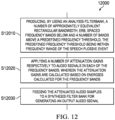
- the spectral domain attenuation may involve: producing, by using an analysis filterbank, a number of approximately equivalent rectangular bandwidth (ERB) spaced frequency bands below and a number of bands above a predefined frequency threshold, the predefined frequency threshold being within the frequency range of the determined speech plosive event; applying a number of attenuation gains respectively to audio signals in each of the frequency bands, wherein the attenuation gains are calculated based on energies calculated for the frequency bands; and feeding the attenuated audio samples to a synthesis filterbank for generating an output audio signal.
- this spectral domain attenuation may generally be used when computational complexity permits.
- the attenuation gain in each frequency band may be further constrained to not reduce the energy of that frequency band below an estimated noise floor in that frequency band.
- the (attenuation) gains may be clipped to ensure that the power in each band is not reduced below the estimated noise floor in the respective band. Generally speaking, this would avoid an audible dip in the noise when there is a plosive in the presence of significant background noise.
- the method may further comprise calculating a time smoothed low frequency energy estimate of audio samples above the estimated noise floor, for distinguishing speech plosive events from higher frequency contents in the input audio signal.
- the method may further comprise calculating a measure of speech harmonic protection in the spectrum of the input audio signal; and calculating the attenuation gains in accordance with the measure of speech harmonic protection and with the time smoothed low frequency energy estimate.
- the measure of speech harmonic protection may be a measure of periodicity or tonality.
- the measure of periodicity in the spectrum may be calculated from a cepstrum of the audio samples prior to the final band calculations of the analysis filterbank.
- the measure of tonality in the spectrum may be calculated based on the main lobe of a spectral peak compared to that of a sinusoidal peak prior to the final band calculations of the analysis filterbank.
- the method may further comprise further constraining the calculated attenuation gain based on the frequency band immediately lower in frequency.
- the gains may be constrained so that for bands above a certain threshold, e.g. 70Hz, the gain may not be attenuated more than the band immediately lower in frequency.
- this would enforce the reduction or attenuation to follow the physical reduction of the plosive energy with frequency. That is to say, when a lower band is significantly reduced in energy, if the next higher band has more energy it is more likely to be genuine speech energy rather than plosive related energy.
- the very lowest bands (below e.g., 70Hz) may not follow this trend, for example, excess 60Hz mains hum may make one band louder, or a DC blocking filter may attenuate the lowest bands, and this should not restrict attenuation of plosive energy.
- a method of performing automatic audio enhancement on an input audio signal for detecting and/or attenuating at least one speech-articulation noise event contained therein is provided.
- the automatic audio enhancement may involve any other suitable audio enhancement means.
- the speech-articulation noise event may comprise, among others, at least one speech plosive event.
- the method may comprise producing, by using an analysis filterbank, a number of approximately equivalent rectangular bandwidth (ERB) spaced frequency bands below and a number of bands above a predefined frequency threshold, the predefined frequency threshold being within frequency range of the speech plosive event.
- the method may further comprise applying a number of attenuation gains respectively to audio signals in each of the frequency bands, wherein the attenuation gains are calculated based on energies calculated for the frequency bands.
- the method may yet further comprise feeding the attenuated audio samples to a synthesis filter bank for generating an output audio signal.
- the proposed method provides an efficient and flexible mechanism for determining (detecting) and attenuating possible/potential speech-articulation noise event(s) (e.g., speech plosive events) comprised within the input audio signal.
- possible/potential speech-articulation noise event(s) e.g., speech plosive events
- the listening experience at the listener side
- the attenuation gain in each frequency band may be further constrained to not reduce the energy of that frequency band below an estimated noise floor in that frequency band.
- the (attenuation) gains may be clipped to ensure that the power in each band is not reduced below the estimated noise floor in the respective band. Generally speaking, this would avoid an audible dip in noise when there is a plosive in the presence of significant background noise.
- the method may further comprise calculating a time smoothed low frequency energy estimate of audio samples above the estimated noise floor, for distinguishing speech plosive events from higher frequency contents in the input audio signal.
- the method may further comprise calculating a measure of speech harmonic protection in the spectrum of the input audio signal; and calculating the attenuation gains in accordance with the measure of speech harmonic protection and with the time smoothed low frequency energy estimate.
- the measure of speech harmonic protection may be a measure of periodicity or tonality.
- the measure of periodicity in the spectrum may be calculated from a cepstrum of the audio samples prior to the final band calculations of the analysis filterbank.
- the measure of tonality in the spectrum may be calculated based on the main lobe of a spectral peak compared to that of a sinusoidal peak prior to the final band calculations of the analysis filterbank.
- the method may further comprise further constraining the calculated attenuation gain based on the frequency band immediately lower in frequency.
- the gains may be constrained so that for bands above a certain threshold, e.g. 70Hz, the gain may not be attenuated more than for the band immediately lower in frequency.
- this would enforce the reduction or attenuation to follow the physical reduction of the plosive energy with increasing frequency. That is to say, when a lower band is significantly reduced in energy, if the next higher band has more energy it is more likely to be genuine speech energy rather than plosive related energy.
- the very lowest bands (below e.g., 70Hz) may not follow this trend, for example, excess 60Hz mains hum may make one band louder, or a DC blocking filter may attenuate the lowest bands, and this should not restrict attenuation of plosive energy.
- the input audio signal may be processed in continuous manner with a predefined look-ahead frame (window) size (e.g., 50ms).
- a predefined look-ahead frame (window) size e.g., 50ms.
- an apparatus including a processor and a memory coupled to the processor.
- the processor may be adapted to cause the apparatus to carry out all steps of the example methods described throughout the disclosure.
- the computer program may include instructions that, when executed by a processor, cause the processor to carry out all steps of the example methods described throughout the disclosure.
- a computer-readable storage medium may store the aforementioned computer program.
- connecting elements such as solid or dashed lines or arrows
- the absence of any such connecting elements is not meant to imply that no connection, relationship, or association can exist.
- some connections, relationships, or associations between elements are not shown in the drawings so as not to obscure the disclosure.
- a single connecting element is used to represent multiple connections, relationships or associations between elements.
- a connecting element represents a communication of signals, data, or instructions
- such element represents one or multiple signal paths, as may be needed, to affect the communication.
- speech enhancement algorithms typically try to address two types of unwanted "noise” events, namely, noise produced by background sources and noise produced by articulation.
- noise produced by background sources e.g., speech produced by speech articulation.
- plosive sounds and also mouth clicks both belong to the second type.
- plosives often occur when a burst of air is generated from the mouth (as during the pronunciation of syllables containing a "p” or “t") and cause a large oscillation of the microphone's diaphragm as in the case of wind impact.
- the term "plosive” may be broadly used to include any burst of air from the mouth that causes large oscillations of the microphone's diaphragm (e.g., including short fricative sounds like "f", "z”).
- plosives may often produce a sudden low frequency boost, so-called "pop", resulting in an unpleasant listening experience.
- An illustrative example of the speech plosive events may be seen from for example diagram 8200 in Fig. 8 (in particular the white portions in the low frequency part, which will be discussed in more detail later).
- Another feasible solution generally provides three user parameters (sensitivity/strength/frequency limit) for its deplosive module.
- users might need to manually edit the automation curve for these parameters because plosives vary in strength and frequency in the same recording, and users may want to attenuate them accordingly. As a result, this process might be time consuming.
- mouth clicks are generally the transient sounds caused by the speech articulation using tongue/teeth/lips mixed with saliva. They typically occur in the speech part as well as the non-speech part, often audible for high SNR recordings through headphones/earphones. Mouth clicks are short in general, often of a duration between 10 - 100ms and they can also appear as several consecutive transients. In the context of professional recordings such as TV/film/game dialogues, click-free speech quality may be considered very demanding.
- the mouth clicks tend to become very audible because of the popularity of earphone/headphone listening.
- the proposed method generally seeks to address three types of mouth clicks, namely: 1) non-speech clicks; 2) speech clicks; and 3) lip smacks (which may also be considered as a special kind/type of non-speech clicks).
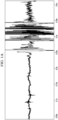
- Fig. 1A schematically illustrates an example of non-speech clicks (e.g., at approximately 0.1s);
- Fig. 1B schematically illustrates an example of speech clicks (shown in particular at the end of the left-most cycle at approximately 0.7056s, indicated by a circle);
- Fig. 1C schematically illustrates an example of lip smacks (shown in particular as a strong transient right before the speech segment at approximately 2.1s).
- the present disclosure presents methods to perform automatic audio enhancement on input audio signal(s) including one or more of such speech-articulation (related or caused) noise events. More particularly, the present disclosure seeks to provide methods to perform automatic detection and attenuation of, among other noise events, speech plosives and mouth clicks comprised within the input audio signal, thereby avoiding manual editing, while at the same time preserving or even improving audio quality at the listener side.
- the methods for automatic detection and attenuation of mouth clicks described in the present disclosure mainly include two key aspects. That is, as a first aspect, the detection algorithm generally targets mouth clicks in the non-speech region and those in the speech region respectively. The kurtosis measure of the waveform amplitudes is used as the main criterion, which applies to both the original waveforms and also its 2nd-order difference, where the 2 nd order difference serves as an approximation to the non-harmonic signal parts. The roughly detected click positions are further refined to more accurately define the click sample regions.
- the attenuation of mouth clicks is generally based on spectral gain attenuation which is derived from spectral envelope interpolation across the short-time frames containing the (detected) clicks.
- an input audio signal may be provided, e.g., in the form of an input file or stream (or in any other suitable forms).
- the input audio signal may need to undergo a suitable segmentation process to be divided into, for example, a number of (short-time) audio frames (e.g., with equal or different frame sizes).
- an optional denoising process (shown as the dashed block 6020) could be applied to the input signal to better reveal the underlying mouth clicks.
- each short-time block (audio frame) of a speech signal can be identified as containing speech or not.
- VAD voice activity detector
- the mouth clicks found in the non-speech parts are generally called “non-speech clicks” (e.g., as shown in Fig. 1A ) and those found in the speech parts are called “speech clicks" (e.g., as shown in Fig. 1B ), which are detected separately.
- lip smacks are generally considered as a special kind of non-speech clicks, which often occur right before the speech starts. Lip smacks are usually made intentionally and therefore appear as a strong and long transient events (e.g., as shown in Fig. 1C ). Therefore, in order to detect both short and long transient events, it may be considered beneficial to use two (different) window sizes. Particularly, in some possible implementations, the shorter (smaller) window size may be used (mainly) for detecting speech click events in speech frames and the longer window size may be used (mainly) for detecting non-speech click events in non-speech frames. As such, both short and long transient events may be efficiently and reliably detected. Additionally, in some possible implementations, hop sizes sufficiently small may also be used for achieving fine time resolution.
- non-speech click events although weak in energy, they are generally stronger than the background noise and thus can be identified by the transient detection algorithms.
- a (first) measure of kurtosis of the short-time waveform (time-domain) amplitudes k w (block 6040) to identify and distinguish a peaky distribution (in some cases also referred to as large outliers) from a flat distribution.
- the measure of kurtosis k w may then be compared to a predefined threshold (block 6100) to detect (or determine) the mouth clicks (in the present case, the non-speech clicks) as shown in block 6060.
- the start and/or end position(s) of the so-detected non-speech click event(s) may then be simply defined as the position(s) of which the kurtosis rises above and/or drops below the predefined threshold.
- non-speech clicks may tend to be relatively long (e.g., 50ms) and thus it may be, in some cases, beneficial to merge (for purposes of attenuation, for example) neighboring click events that are within by a pre-defined gap/threshold, for instance, 25ms.
- a (second) measure of short-time kurtosis k D may be calculated for the difference (residual) waveform (block 6040 again).
- a (second) measure of short-time kurtosis k D may be calculated for the difference (residual) waveform (block 6040 again).
- other forms of residual signals apart from the 2 nd -order sample difference may be used at this stage, as long as they allow identifying underlying transients.
- speech clicks may tend to be very short and therefore it may generally be necessary to refine the above-defined (rough) click event position with better sample precision.
- a simple method may be to locate the largest second-order difference (which generally means the fastest changes) within the rough click range detected by kurtosis. Then, a pre-defined speech click duration of, 5ms for example, can be used to determine the refined start and/or end position around the fastest changing sample position. As will be understood and appreciated by the skilled person, this may be achieved in any suitable means. For instance (not as limitation), such speech click duration (e.g., 5ms) may be simply evenly divided before and after said fastest changing sample position, in the sense that an interval corresponding to the speech click duration may be centered on said fastest changing sample position.
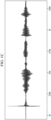
- waveform 2100 generally shows an original input audio waveform
- waveform 2200 generally shows the 2 nd -order difference waveform obtained from the original waveform 2100.
- a refined range 2300 of the non-speech click event can be determined based on the 2 nd -order difference waveform 2200.
- Another possible refinement method may be to detect the fast modulation within the rough click range. Particularly, by means of converting local minima/maxima into e.g. -1 and +1 values (or any other suitable values, for example with different sign and equal magnitude), the corresponding zero-crossing rate (ZCR), hereinafter also referred to as the "min/max change rate”, may be used to characterize how fast the modulation is.
- ZCR zero-crossing rate
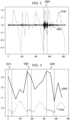
- FIG. 3 An example of this refinement process is schematically shown in Fig. 3 .
- waveform 3100 generally shows an original input audio waveform.
- the min/max change rate waveform 3200 is obtained from the original waveform 3100.
- the refined ranges 3310, 3320 and 3330 of the non-speech click events can be determined based on the min/max change rate waveform 3200, as shown in Fig. 3 .
- the thresholds of kurtosis and the min/max change rate may be used in combination for detecting speech clicks with better precision.
- lip smack events generally appear as a strong transient often right before speech (as shown in the example of Fig. 1C ).
- the speech clicks and the regular non-speech clicks it may be considered to rely on verifying the sudden change of resonance, e.g., by means of using spectral features.
- the feature ratioHL may be calculated as the amplitude ratio between the largest peak above a pre-defined frequency freq HL (e.g., 1.5 kHz) and the largest peak below the freq HL .
- a non-speech click detected right before speech it may be subsequently considered as a lip smack candidate (e.g., as shown in block 6070 of Fig. 6 ) if ratioHL > th R , where th R can be a pre-defined threshold.
- the high/low-band peak ratio ratioHL may tend to become larger and also the spectral slope may tend to become steeper due to the highfrequency resonance. Since lip smack events are typically considerably longer (e.g., typically of 100ms duration) compared to small (regular) mouth clicks, it may be generally proposed to refine the event start/end position(s) based on the features including ratioHL, SpS and energy envelope.
- the initial (rough) end position (i.e., that is detected by k W ) may be continuously extended as long as one of the following conditions holds: 1) ratioHL > th R ; 2) SpS ⁇ th S , where th S is a pre-defined threshold; and 3) the energy decreases.
- An additional verification of the extended end position may be carried out by means of comparing the skewness before and after the event position refinement. That is, the extension of the event might only add samples of smaller amplitudes such that the sample amplitude distribution becomes "skewer".
- Fig. 4 is a schematic illustration of a diagram showing an example of detection of lip smacks according to an embodiment of the present disclosure.
- the waveforms in Fig. 4 generally and illustratively show the original waveform, the spectral slope (SpS), the energy and also the high/low-band peak ratio ( ratioHL ), respectively.
- speech transients may typically share some kind of similarity in nature to mouth clicks, but on the other hand are typically of different magnitude and/or spectral characteristics.
- VAD and/or center of gravity (COG, which may generally be seen as the mean time of signal) of the short-time speech waveform it may be possible to positively identify speech transients and therefore avoid false detection as mouth clicks.
- the reason of using a "normalized” measure is to treat the speech transients more equivalently while using a “non-normalized” measure (i.e., the kurtosis) generally facilitates the selection of various levels of transientness for correction.
- the attenuation (or correction) of those clicks may be the next step.
- the de-click processing as proposed in the present disclosure is generally based on spectral gain attenuation (block 6090 of Fig. 6 ) derived from the observed spectral envelopes (hereinafter denoted as "E") and the target envelopes (hereinafter denoted as "E T " ) as exemplified in block 6080 of Fig. 6 .
- E observed spectral envelopes
- E T target envelopes
- the start/end position(s) of the click it is generally proposed to take one block before (with envelope E 0 ) and after (with envelope E 1 ) the click as reference frames.
- the spectral envelope of those two reference frames may then serve to estimate the target envelopes of each short-time block covering the click event.
- a further constraint may be optionally applied to allow for high frequency attenuation only (e.g., above 4 kHz), in order to avoid unintentionally modifying speech harmonics.
- the residual estimation (harmonic components removed) is available (e.g., as exemplified in block 13040 of Fig. 13 )
- the above-mentioned methods may sometimes be less effective and a more generative approach may then become a better option.
- Fig. 5 is a schematic illustration of a diagram showing an example of spectral attenuation according to an embodiment of the present disclosure, wherein the observed spectral waveform, the processed spectral waveform, the observed envelope and the target envelope are illustratively shown, respectively.
- spectral regions of the (detected) clicks are attenuated.
- an analogous or similar attenuation concept could also be applied to the "deplosive" scenarios. This may involve, in some implementations, smoothing the envelopes of the residual spectrum, for example, as will be appreciated by the skilled person.
- the methods for automatic detection and adaptive attenuation of speech plosives described in the present disclosure mainly include two key aspects. That is, as a first aspect, a feature of a zero-crossing maximum (ZCM) measure is used. Compared to the measure of zero-crossing rate (ZCR), the ZCM may be seen to simply take the maximal zero-crossing length. Therefore, the ZCM may be generally considered to be robust against the noisy crossing information, especially when used in an average manner as in the case of ZCR. In addition, as a second aspect, precise detection of the plosive event boundaries may be performed based on the low frequency energy (LFE) and ZCM.
- LFE low frequency energy
- the outliers from the observed low frequency energy distribution may be selected as the possible (annoying) plosive events, and then the ZCM could be used to refine the event time positions/boundaries.
- the attenuation of plosives may generally be performed based on high-pass filtering in either the time domain or the spectral domain with the filter order adaptive to LFE and the filter frequency adaptive to ZCM of a detected plosive.
- Fig. 9 and/or Fig. 10 respectively provide a schematic functional overview of (de-plosive) techniques according to embodiments of the present disclosure.
- Fig. 9 may be seen as a more general example while Fig. 10 may be seen as a more detailed example of a specific possible implementation. Therefore, the examples shown in Figs. 9 and 10 may exhibit some extent of similarities (e.g., in some blocks) and differences (e.g., in some other blocks) at the same time, as will be understood and appreciated by the skilled person.
- an input audio signal is provided and may be segmented/divided into a number of (short-time) overlapping audio frames (e.g., with equal frame size).
- This may be achieved in any suitable manner, as will be understood and appreciated by the skilled person.
- this segmentation of audio frames may be achieved by carrying out a short-time frame analysis using a hamming window.
- the frame size may be set to be sufficiently large to allow for extracting a reliable value of zero-crossing maximum.
- the overlap size may be set to be sufficiently large to track the short-time features with fine time resolution.
- two short-time features may be calculated (obtained), namely: the low frequency energy (LFE) as exemplified in block 9020 or 10020 and the zero crossing maximum (ZCM) as exemplified in block 9040 or 10050.
- LFE low frequency energy
- ZCM zero crossing maximum
- the LFE can be calculated either in time domain or in the spectral domain, and by using any suitable means.
- the LFE may be calculated as the root mean square (RMS) energy of the lowpass filtered signal.
- the lowpass filter could be a 4 th -order Butterworth filter with a pre-defined cut-off frequency at, for example, 80Hz.
- LFE may be calculated from the spectrum as the RMS energy below the cut-off frequency.
- the ZCM is generally the length of the maximum interval of consecutive zero crossings within the short-time frame, possibly further normalized by the window size.
- the technique proposed in the present disclosure generally does not rely on the ZCR, which is typically used in plosive detection mechanisms.
- the detection of plosive may be started by identifying the outliers of the observed LFE distribution (block 9030 or 10030).
- an outlier may be passed to the next threshold detection stage. Otherwise, it may be assumed that there are no potentially (annoying) plosives that necessitate further processing.
- an outlier may be indicated by z > 1 (or any other suitable value).
- the th z is adapted to be above the mean by a predefined factor z 0 of standard deviation.
- the multiplication factor ⁇ in equation (5) can be set to adjust detection sensitivity.
- the ratio may be computed with respect to the previously valid LFE.
- the detection function may then be expressed as R > 1 + f ( ⁇ ) , where f ( ⁇ ) is a customizable mapping function. Accordingly, the detection function could also be simply written as R > 1 + ⁇ .
- the frames exceeding a detection threshold may be used to define the signal regions considered as plosive events to be attenuated, which also implicitly defines the (initial) time positions where a plosive event starts and/or ends (block 9030 or 10040).
- the event boundaries may need further refinement (block 9050 or 10060), typically because the actual plosive might start and/or end with very low energy. Therefore, in some possible implementations, the ZCM measure (block 9040 or 10050) may be used for extending the boundaries to the frames where ZCM ⁇ 0.1 (or any other suitable value), for instance.
- plosive events may overlap or be very close, they may be merged as one single plosive event (e.g., for further "de-plosive” processing).
- Fig. 7 schematically illustrates an example of comparison between the ZCM and ZCR.
- the ZCM diagram 7100 is generally less noisy than the ZCR diagram 7200, and therefore is better suited for identification of the underlying plosive events.
- the attenuation (or correction) of these plosives may be the next step (block 9110).
- the attenuation may be performed by using high-pass filtering (e.g., as exemplified in block 10070).
- the attenuation of the speech plosives may also be carried out either in the time domain or in the spectral domain.
- time domain attenuation may use a Butterworth high-pass filter with adaptive order and frequency (or any other suitable means); whilst the spectral domain attenuation may use an overlap-and-add short-time Fourier Transform (STFT) with adaptive spectral slope and frequency (or any other suitable means).
- STFT short-time Fourier Transform
- the attenuation frequency (block 9070) or, in some possible implementations, the filter (cut-off) frequency freq C may be set to be adaptive to the "speed" of the plosive event (block 9070), which may be generally defined as the 1 - max ( ZCM plosive ), where ZCM used here is normalized between 0 and 1, and max( ZCM plosive ) is the maximum ZCM from the start frame to the end frame of the plosive event.
- any other suitable range may be adopted as well, depending on respective implementations and/or requirements.
- the order of the Butterworth filter may be adaptive to the strength of the plosive event (block 9060).
- any other suitable range may be adopted as well, depending on respective implementations and/or requirements.
- a crossfade region of for example 10ms may be further used to create a smooth transition from the input signal to the filtered signal.
- the input short-time signal may in some possible implementations be processed with a fast Fourier transform (FFT), followed by application of the attenuation gain with adaptive cut-off frequency and slope, application of the inverse FFT, and finally application of windowing and overlap-add to produce the (attenuated) output.
- FFT fast Fourier transform
- any other suitable attenuation mechanism may be applied as well, depending on respective implementations.
- the spectral low-cut/high-pass gain slope may also be estimated based on the plosive strength.
- the ratio may be expressed directly as the target gain.
- a noise spectrum estimation may be used to limit the gain reduction such that the attenuation does not affect the overall spectral profile in the low frequency region.
- the proposed method generally attenuates faster pops with higher cut-off frequency, therefore effectively adapting to the pitch of a speaker's voice. It also attenuates stronger pops with steeper cut-off frequency slope, therefore effectively adapting to weak and strong plosives.
- the algorithm may be sensitive to low-frequency transients such as those generated by kick drums or bass.
- a content classifier e.g., a voice/music activity detector
- computing the probability p(n) that a given frame n contains speech (or not) may be used to modify the detection or attenuation parameters, thereby ensuring that music content would not be affected by the deplosive processing.
- the frames where p(n) > th p may be removed from the pool of LFE and ZCM to ensure relevant plosive detection and attenuation.
- ⁇ generally represents the steepness parameter of the mapping.
- an analysis filterbank to produce (approximately) equivalent rectangular band (ERB) spaced frequency bands over the plosive frequency region below a (predefined) frequency threshold (e.g., approximately 500Hz), and additionally one or more bands above this frequency threshold (e.g., 500Hz) in order to cover the remaining frequency range.
- a frequency threshold e.g., approximately 500Hz
- the energy (denoted as e(b,t) ) in each of these bands b is used to control the reduction process to create a series of gains g(b,t) that is applied to each filtered signal.
- the result is then fed to a synthesis filterbank to create the output signal with reduced plosive energy.
- the compression curve is 0dB at low energy and can give only attenuation as the energy increases. It is also understood that T may be adapted dynamically with the time smoothed energy envelope of speech over time.
- n dB ⁇ b t min ⁇ e dB b , t + ⁇ , t1 ⁇ ⁇ ⁇ t2
- a negative value of t1 means the use of the estimation history and a positive value of t2 may in some cases require some latency compensation for causality and thus could be set to 0.
- a difficult case to handle may be to distinguish between the undesirable low frequency energy of plosive events, and the desirable low frequency energy in vowel sounds, when the lowest frequency is around for example 80Hz.
- some tools may generally be used to resolve these conditions.
- a time smoothed low frequency energy estimate of the signal above noise floor which seeks to maintain the compression gain
- a tonality measure or in some possible implementations, a measure of (some sort of) periodicity
- This estimate may be then smoothed over time with an exponential smoother with an attack time of for example 50ms and a release time of for example 100ms, which gives the smoothed LFE s .
- LFE n 10 log 10 LFE s ⁇ 10 log 10 n ⁇ t
- tonality (or in some cases, a measure of periodicity) may be (best) estimated prior to conversion into the filterbank domain.
- the tonality measure might instead be calculated by searching for the largest spectral peak in p(k) in for example the frequency range 60Hz to 250Hz, and requiring the peak to be a reasonable sinusoidal peak (the main lobe should be narrow and deep enough).
- the tonality measure may scale from 0 to 1 (e.g., linearly) as the depth at peak center plus or minus 60Hz ranges from 5 to 15dB.
- This value may also be smoothed over time for example with 75ms attack and 300ms release time giving the smoothed tonality.
- periodicity/tonality measure may also be referred to as a "speech harmonic protection measure" in the context of the present disclosure. Further, periodicity and tonality measures may be used interchangeably.
- a certain threshold e.g., 70Hz
- the above proposed method generally enforces the reduction to follow the physical reduction of plosive energy with increasing frequency.
- a lower band is significantly reduced in energy, if the next higher band has more energy it is more likely to be genuine speech energy rather than plosive related energy.
- the very lowest bands (below e.g., 70Hz) may not follow this trend, for example, excess 60Hz mains hum may make one band louder, or a DC blocking filter may attenuate the lowest bands, and this should not restrict attenuation of plosive energy.
- these gains g 4 ( b, t) may be further smoothed over time with for example attack times of 20ms and release time of 50ms to produce the final gains g ( b, t ) that will be applied to the filtered signal (e.g., subband signal).
- the final gains may be applied in band-wise manner, for example.
- Fig. 8 is a schematic illustration of a diagram showing an example of attenuation of speech plosives according to an embodiment of the present disclosure.
- the speech plosive events cf. the white regions in the low frequency parts of diagram 8200
- the speech plosive events have been effectively attenuated in the corresponding attenuated diagram 8100.
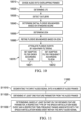
- Fig. 11 is a schematic flowchart illustrating an example of a method 11000 of performing automatic audio enhancement on an input audio signal including at least one speech-articulation noise event according to an embodiment of the disclosure.
- the method 11000 described herein may be applied to perform automatic audio enhancement (e.g., detection, attenuation, etc.) either for speech plosive noise events or mouth click noise events.
- automatic audio enhancement e.g., detection, attenuation, etc.
- the method 11000 may start with step S1 1010 by segmenting (e.g., by using one or more suitable windows) the input audio signal into a number of audio frames (e.g., of size of 100ms).
- the method 11000 may then continue with step S11020 by obtaining (e.g., determining, calculating, extracting, etc.) at least one feature parameter from the (segmented) audio frames.
- the feature parameter so obtained may be considered to be associated with a type of the (to-be-detected) speech-articulation noise event. That is to say, in some possible example implementations, depending on the type of the (to-be-detected) speech-articulation noise event, different feature parameters will have to be obtained from the audio frames.
- the method 11000 may continue with step S11030 by determining (e.g., detecting, calculating, etc.), based at least in part on the obtained feature parameter, a respective type of the speech-articulation noise event and a respective range (e.g., time and/or frequency range) associated with the speech-articulation noise event within the input audio signal.
- determining e.g., detecting, calculating, etc.
- a respective type of the speech-articulation noise event e.g., time and/or frequency range
- the proposed method 11000 provides an efficient and flexible mechanism for determining (detecting) possible/potential speech-articulation noise event(s) (e.g., artifacts) comprised within the input audio signal. Thereby, appropriate further enhancement (post-)processing (e.g., attenuation) may be facilitated. As a result, manual editing/processing previously required for identifying and attenuating the noise event(s) in the audio signal can be largely avoided. At the same time, listening experience can be greatly improved.
- post-processing e.g., attenuation
- Fig. 12 is a schematic flowchart illustrating an example of a method 12000 of performing automatic audio enhancement on an input audio signal for detecting and/or attenuating at least one speech-articulation noise event contained therein according to another embodiment of the disclosure.
- the speech-articulation noise event may comprise, among others, at least one speech plosive event.
- the method 12000 described herein could be specifically suitable for performing automatic audio enhancement (e.g., detection, attenuation, etc.) for speech plosive noise events.
- the method 12000 may start with step S12010 by producing, by using an analysis filterbank, a number of approximately equivalent rectangular bandwidth (ERB) spaced frequency bands below and a number of bands above a predefined frequency threshold, the predefined frequency threshold being within frequency range of the speech plosive event.
- the method 12000 may then continue with step S12020 by applying a number of attenuation gains respectively to audio signals in each of the frequency bands, wherein the attenuation gains are calculated based on energies calculated for the frequency bands.
- the method 12000 may yet further continue with step S12030 by feeding the attenuated audio samples to a synthesis filter bank for generating an output audio signal.
- the proposed method 12000 provides an efficient and flexible mechanism for determining (detecting) and attenuating possible/potential speech-articulation noise event(s) (e.g., speech plosive events) comprised within the input audio signal.
- possible/potential speech-articulation noise event(s) e.g., speech plosive events
- the listening experience can be greatly improved.
- the filterbank approach (which is described above in the context of deplosive processing) can also be applied to declick, where the spectral envelopes may be defined by the ERB band energy and a similar multi-band compression (compressor ratio determined by the target attenuation gain, with respective attack/release time) scheme may be applied. It may be noticed that the effective ERB bands may spread up to the Nyquist limit for the declick techniques but they are limited to low-frequency (e.g., 500Hz) for the deplosive process.
- the spectral envelopes may be defined by the ERB band energy and a similar multi-band compression (compressor ratio determined by the target attenuation gain, with respective attack/release time) scheme may be applied.
- the effective ERB bands may spread up to the Nyquist limit for the declick techniques but they are limited to low-frequency (e.g., 500Hz) for the deplosive process.
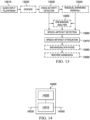
- Fig. 13 illustratively shows an example aiming at combining techniques for both declick processing and also deplosive processing in a (single) functional overview.
- an ERB banding analysis (dashed block 13050) may be applied for detecting the corresponding speech artefact, in the present case the speech plosive events (as exemplified in block 13060) and subsequently attenuating such speech artefact (block 13070).
- the ERB-related procedure (or in some cases also referred to as filterbank approach) may be performed after the speech artefact, in the present case the mouth click events, have been detected (block 13060).
- ERB banding synthesis (as exemplified in the dashed block 13080) that is used for attenuating the detected mouth clicks (block 13070).
- the filterbank approach which is described above in the context of deplosive processing
- the spectral envelopes may be defined by the ERB band energy and a similar multi-band compression (compressor ratio determined by the target attenuation gain, with respective attack/release time, or envelope interpolation) scheme may be applied.
- any other or further suitable process may be adopted, depending on various implementations and/or requirements.
- the techniques described herein may further (optionally) make use of the "residuals" (e.g., by removing speech harmonic components, as exemplified in dashed block 13040) for both the declick processing and also the deplosive processing (where it is used as an alternative to the periodicity/tonality measure).
- the harmonics may have to be restored or added back eventually (as exemplified in the dashed/optional block 13090), for instance after the envelope attenuation has been applied to the residual signal.
- Fig. 14 shows an example of such apparatus 14000.
- Said apparatus 14000 comprises a processor 14010 and a memory 14020 coupled to the processor 14010.
- the memory 14020 may store instructions for the processor 14010.
- the processor 14010 may receive audio data 14030 as input.
- the audio data 14030 may have the properties described above in the context of respective methods of performing automatic audio enhancement on an input audio signal for detecting and/or attenuating at least one speech-articulation noise event contained therein.
- the processor 14010 may be adapted to carry out the methods/techniques described throughout this disclosure. Accordingly, the processor 14010 may output denoised (e.g., declicked, deplosived) audio data 14040.
- the processor 14010 may also be enabled to receive further input (e.g., control parameters, not shown in Fig. 14 ), for example for controlling the audio enhancement processing behavior.
- a computing device implementing the techniques described above can have the following example architecture.
- Other architectures are possible, including architectures with more or fewer components.
- the example architecture includes one or more processors (e.g., dual-core Intel ® Xeon ® Processors), one or more output devices (e.g., LCD), one or more network interfaces, one or more input devices (e.g., mouse, keyboard, touch-sensitive display) and one or more computer-readable mediums (e.g., RAM, ROM, SDRAM, hard disk, optical disk, flash memory, etc.).
- These components can exchange communications and data over one or more communication channels (e.g., buses), which can utilize various hardware and software for facilitating the transfer of data and control signals between components.
- computer-readable medium refers to a medium that participates in providing instructions to processor for execution, including without limitation, non-volatile media (e.g., optical or magnetic disks), volatile media (e.g., memory) and transmission media.
- Transmission media includes, without limitation, coaxial cables, copper wire and fiber optics.
- Computer-readable medium can further include operating system (e.g., a Linux ® operating system), network communication module, audio interface manager, audio processing manager and live content distributor.
- Operating system can be multi-user, multiprocessing, multitasking, multithreading, real time, etc.
- Operating system performs basic tasks, including but not limited to: recognizing input from and providing output to network interfaces and/or devices; keeping track and managing files and directories on computer-readable mediums (e.g., memory or a storage device); controlling peripheral devices; and managing traffic on the one or more communication channels.
- Network communications module includes various components for establishing and maintaining network connections (e.g., software for implementing communication protocols, such as TCP/IP, HTTP, etc.).
- Architecture can be implemented in a parallel processing or peer-to-peer infrastructure or on a single device with one or more processors.
- Software can include multiple software components or can be a single body of code.
- the described features can be implemented advantageously in one or more computer programs that are executable on a programmable system including at least one programmable processor coupled to receive data and instructions from, and to transmit data and instructions to, a data storage system, at least one input device, and at least one output device.
- a computer program is a set of instructions that can be used, directly or indirectly, in a computer to perform a certain activity or bring about a certain result.
- a computer program can be written in any form of programming language (e.g., Objective-C, Java), including compiled or interpreted languages, and it can be deployed in any form, including as a stand-alone program or as a module, component, subroutine, a browser-based web application, or other unit suitable for use in a computing environment.
- Suitable processors for the execution of a program of instructions include, by way of example, both general and special purpose microprocessors, and the sole processor or one of multiple processors or cores, of any kind of computer.
- a processor will receive instructions and data from a read-only memory or a random access memory or both.
- the essential elements of a computer are a processor for executing instructions and one or more memories for storing instructions and data.
- a computer will also include, or be operatively coupled to communicate with, one or more mass storage devices for storing data files; such devices include magnetic disks, such as internal hard disks and removable disks; magneto-optical disks; and optical disks.
- Storage devices suitable for tangibly embodying computer program instructions and data include all forms of non-volatile memory, including by way of example semiconductor memory devices, such as EPROM, EEPROM, and flash memory devices; magnetic disks such as internal hard disks and removable disks; magneto-optical disks; and CD-ROM and DVD-ROM disks.
- semiconductor memory devices such as EPROM, EEPROM, and flash memory devices
- magnetic disks such as internal hard disks and removable disks
- magneto-optical disks and CD-ROM and DVD-ROM disks.
- the processor and the memory can be supplemented by, or incorporated in, ASICs (application-specific integrated circuits).
- ASICs application-specific integrated circuits
- the features can be implemented on a computer having a display device such as a CRT (cathode ray tube) or LCD (liquid crystal display) monitor or a retina display device for displaying information to the user.
- the computer can have a touch surface input device (e.g., a touch screen) or a keyboard and a pointing device such as a mouse or a trackball by which the user can provide input to the computer.
- the computer can have a voice input device for receiving voice commands from the user.
- the features can be implemented in a computer system that includes a back-end component, such as a data server, or that includes a middleware component, such as an application server or an Internet server, or that includes a front-end component, such as a client computer having a graphical user interface or an Internet browser, or any combination of them.
- the components of the system can be connected by any form or medium of digital data communication such as a communication network. Examples of communication networks include, e.g., a LAN, a WAN, and the computers and networks forming the Internet.
- the computing system can include clients and servers.
- a client and server are generally remote from each other and typically interact through a communication network. The relationship of client and server arises by virtue of computer programs running on the respective computers and having a client-server relationship to each other.
- a server transmits data (e.g., an HTML page) to a client device (e.g., for purposes of displaying data to and receiving user input from a user interacting with the client device).
- client device e.g., for purposes of displaying data to and receiving user input from a user interacting with the client device.
- Data generated at the client device e.g., a result of the user interaction
- a system of one or more computers can be configured to perform particular actions by virtue of having software, firmware, hardware, or a combination of them installed on the system that in operation causes or cause the system to perform the actions.
- One or more computer programs can be configured to perform particular actions by virtue of including instructions that, when executed by data processing apparatus, cause the apparatus to perform the actions.
- any one of the terms comprising, comprised of or which comprises is an open term that means including at least the elements/features that follow, but not excluding others.
- the term comprising, when used in the claims should not be interpreted as being limitative to the means or elements or steps listed thereafter.
- the scope of the expression a device comprising A and B should not be limited to devices consisting only of elements A and B.
- Any one of the terms including or which includes or that includes as used herein is also an open term that also means including at least the elements/features that follow the term, but not excluding others. Thus, including is synonymous with and means comprising.
Landscapes
- Engineering & Computer Science (AREA)
- Physics & Mathematics (AREA)
- Human Computer Interaction (AREA)
- Signal Processing (AREA)
- Health & Medical Sciences (AREA)
- Audiology, Speech & Language Pathology (AREA)
- Computational Linguistics (AREA)
- Acoustics & Sound (AREA)
- Multimedia (AREA)
- Quality & Reliability (AREA)
- Spectroscopy & Molecular Physics (AREA)
- Circuit For Audible Band Transducer (AREA)
- Control Of Amplification And Gain Control (AREA)
Claims (15)
- Procédé permettant d'effectuer une amélioration audio automatique sur un signal audio d'entrée comprenant au moins un événement de bruit d'articulation de la parole, le procédé comprenant :la segmentation (S11010) du signal audio d'entrée en un nombre de trames audio ;l'obtention (S11020) d'au moins un paramètre de caractéristique associé à l'événement de bruit d'articulation de la parole respectif à partir des trames audio ;la détermination (S11030), sur la base au moins en partie du paramètre de caractéristique obtenu, d'un type respectif de l'événement de bruit d'articulation de la parole et d'une plage de temps-fréquence respective associée à l'événement de bruit d'articulation de la parole dans le signal audio d'entrée ; etl'atténuation de l'événement de bruit d'articulation de la parole en fonction du type et de la portée déterminés de celui-ci,dans lequel l'événement de bruit d'articulation de la parole comprend au moins l'un des éléments suivants : un événement de clic de bouche ou un événement d'occlusion de la parole ; etcaractérisé en ce quel'obtention (S11020) d'au moins un paramètre de caractéristique à partir des trames audio comprend :pour chaque trame audio, l'obtention d'au moins une mesure de kurtosis basée sur les amplitudes d'échantillons du domaine temporel des trames audio, etdans lequel la détermination (S11030), sur la base du paramètre de caractéristique obtenu, d'un type respectif de l'événement de bruit d'articulation de la parole et d'une plage respective de celui-ci dans le signal audio d'entrée comprend :la comparaison de la mesure de kurtosis obtenue à un seuil de kurtosis prédéfini ; etsi la mesure de kurtosis dépasse le seuil de kurtosis prédéfini, la détermination que la trame audio comprend un événement de clic de bouche, et la détermination des limites de début et de fin de l'événement de clic de bouche en fonction des positions respectives auxquelles la mesure de kurtosis s'élève au-dessus et descend en dessous du seuil de kurtosis prédéfini.
- Procédé selon la revendication 1, dans lequel l'événement de bruit d'articulation de la parole comprend un ou plusieurs événements de clic de bouche ; et dans lequel les un ou plusieurs événements de clic de bouche comprennent au moins l'un des éléments suivants : un événement de clic non vocal, un événement de clic vocal ou un événement de claquement de lèvres,
dans lequel, éventuellement, après la segmentation (S11010) du signal audio d'entrée en un certain nombre de trames audio, le procédé comprend en outre :le classement des trames audio en trames de parole ou en trames non vocales ; etdans lequel, éventuellement, le signal audio d'entrée est identifié et segmenté en trames de parole et en trames de non-parole à l'aide d'un détecteur d'activité vocale, VAD. - Procédé selon la revendication 2, dans lequel la segmentation est effectuée en utilisant deux tailles de fenêtre différentes, l'une des deux tailles de fenêtre étant plus courte que l'autre.
- Procédé selon la revendication 2 ou 3, dans lequel l'obtention (S11020) d'au moins un paramètre de caractéristique à partir des trames audio comprend :pour chaque trame de parole, l'obtention d'une approximation respective du résidu sans composantes harmoniques de parole et d'une première mesure respective de kurtosis des amplitudes d'échantillon pour l'approximation du résidu,dans lequel la détermination (S11030), sur la base du paramètre de caractéristique obtenu, d'un type respectif de l'événement de bruit d'articulation de la parole et d'une plage respective de celui-ci dans le signal audio d'entrée comprend :la comparaison de la première mesure de kurtosis obtenue à un premier seuil de kurtosis prédéfini ; etsi la première mesure de kurtosis dépasse le premier seuil de kurtosis prédéfini, la détermination que la trame de parole comprend un événement de clic de parole, et la détermination des limites de début et de fin de l'événement de clic de parole en fonction des positions respectives auxquelles la première mesure de kurtosis s'élève au-dessus et descend en dessous du premier seuil de kurtosis prédéfini ; etdans lequel, éventuellement, l'approximation du résidu sans composantes harmoniques de la parole est une différence de forme d'onde du second ordre.
- Procédé selon la revendication 4, comprenant en outre :l'obtention d'une deuxième mesure de kurtosis à partir des amplitudes résiduelles des échantillons de la trame vocale ;dans lequel le type et la portée de l'événement de bruit d'articulation de la parole sont déterminés sur la base de la deuxième mesure de kurtosis par rapport à la première mesure de kurtosis, et/oule procédé comprenant en outre :
l'affinage de la plage déterminée de l'événement de clic vocal par :localisation d'une position d'échantillon avec la plus grande différence de second ordre dans la plage déterminée de l'événement de clic vocal ; etdétermination de la plage affinée de l'événement de clic vocal en appliquant une durée d'événement de clic vocal prédéfinie autour de la position d'échantillon localisée, et/oule procédé comprenant en outre :
la détermination de la portée de l'événement de clic vocal en outre sur la base d'un taux de changement min/max calculé à partir des minima et maxima locaux dans le cadre de la parole. - Procédé selon l'une quelconque des revendications 2 à 5, dans lequel l'obtention (S11020) d'au moins un paramètre de caractéristique à partir des trames audio comprendpour chaque trame non vocale, l'obtention d'une troisième mesure respective de kurtosis des amplitudes d'échantillons du domaine temporel dans la trame non vocale,dans lequel la détermination (S11030), sur la base du paramètre de caractéristique obtenu, d'un type respectif de l'événement de bruit d'articulation de la parole et d'une plage respective de celui-ci dans le signal audio d'entrée comprend :la comparaison de la troisième mesure de kurtosis obtenue à un deuxième seuil de kurtosis prédéfini ; etsi la troisième mesure de kurtosis dépasse le deuxième seuil de kurtosis prédéfini, la détermination que la trame non vocale comprend un événement de clic non vocal ; et la détermination des limites de début et de fin de l'événement de clic non vocal en fonction des positions respectives auxquelles la troisième mesure de kurtosis s'élève au-dessus et descend en dessous du deuxième seuil de kurtosis prédéfini, etdans lequel, éventuellement, le procédé comprend en outre :
si deux événements de clic non vocaux voisins se situent dans un seuil d'écart prédéfini, la fusion des deux événements de clic non vocaux voisins en un seul événement de clic vocal. - Procédé selon la revendication 6, dans lequel
pour un événement de clic non vocal déterminé dans une trame non vocale précédant immédiatement une trame vocale :le calcul d'un rapport de crête à bande élevée/faible en tant que rapport d'amplitude entre la crête la plus élevée au-dessus d'une fréquence prédéfinie et la crête la plus élevée en dessous de la fréquence prédéfinie ; etsi le rapport de crête à bande élevée/faible calculé est supérieur à un rapport seuil prédéfini, la détermination de l'événement de clic non vocal comme un événement de claquement de lèvres,dans lequel, éventuellement, le rapport de crête à bande élevée/faible est calculé comme un rapport d'amplitude entre la crête la plus élevée au-dessus d'une fréquence prédéfinie et la crête la plus élevée en dessous de la fréquence prédéfinie mais au-dessus d'une autre basse fréquence prédéfinie,dans lequel, éventuellement, le procédé comprend en outre :l'affinage de la plage déterminée de l'événement de claquement des lèvres en fonction du rapport de crête à bande élevée/faible, une pente spectrale et une enveloppe énergétique, etdans lequel, éventuellement, l'affinage de la plage déterminée de l'événement de claquement de lèvres comprend :
l'extension de la position finale de l'événement de claquement des lèvres déterminée en utilisant la troisième mesure de kurtosis tant que : le rapport de crête à bande élevée/faible est supérieur au rapport seuil prédéfini, la pente spectrale est inférieure à une pente seuil prédéfinie et l'énergie dans l'enveloppe énergétique diminue. - Procédé selon l'une quelconque des revendications 2 à 5, comprenant en outre :
la détermination de l'événement de bruit d'articulation de la parole en se basant en outre sur le centre de gravité, COG, calculé pour les trames de parole conformément à un autre seuil prédéfini, pour distinguer les événements de clic de bouche des transitoires de parole. - Procédé selon l'une quelconque des revendications 4 à 8, comprenant en outre :l'atténuation d'un ou plusieurs événements de clic de bouche déterminés en fonction des gains spectraux respectifs dérivés des enveloppes spectrales des trames audio contenant les événements de clic de bouche détectés et des enveloppes cibles calculées en fonction des trames de référence respectives, oule remplacement d'un ou plusieurs événements de clic de bouche déterminés en fonction des trames audio voisines respectives.
- Procédé selon l'une quelconque des revendications précédentes, dans lequel l'événement de bruit d'articulation de la parole comprend au moins un événement occlusif de la parole ; et dans lequel l'obtention d'au moins un paramètre de caractéristique à partir des trames audio comprend :l'obtention d'une mesure respective de l'énergie basse fréquence, LFE, pour chacune des trames audio, afin d'identifier les valeurs aberrantes de celles-ci,dans lequel, éventuellement, la mesure de LFE est calculée soit dans le domaine temporel, soit dans le domaine spectral.
- Procédé selon la revendication 10, comprenant en outre :la détermination de la portée de l'événement occlusif de la parole en fonction des valeurs aberrantes identifiées à partir de la mesure de LFE et d'un seuil calculé sur la base de la mesure de LFE ; ou en fonction d'un rapport LFE calculé à partir des trames audio précédentes et actuelles, etdans lequel, éventuellement, le procédé comprend en outre :l'obtention d'une mesure respective du maximum de passage à zéro, ZCM, pour chacune des trames audio, pour affiner la plage de l'événement occlusif de parole qui a été déterminé sur la base de la mesure de LFE,dans lequel la mesure de ZCM indique une longueur de l'intervalle maximal de passages à zéro consécutifs dans la trame audio, etdans lequel, éventuellement, le procédé comprend en outre :
l'atténuation de l'événement occlusif de parole déterminé, dans lequel l'atténuation est effectuée soit dans le domaine temporel, soit dans le domaine spectral. - Procédé selon la revendication 11, dans lequel l'atténuation du domaine spectral implique :la production, en utilisant un banc de filtres d'analyse, d'un nombre de bandes de fréquences à bande passante rectangulaire équivalente, ERB, espacées en dessous et un nombre de bandes au-dessus d'une fréquence seuil prédéfinie, la fréquence seuil prédéfinie étant dans la plage de fréquences de l'événement occlusif de parole déterminé ;l'application d'un nombre de gains d'atténuation respectivement aux signaux audio dans chacune des bandes de fréquences, dans lequel les gains d'atténuation sont calculés sur la base des énergies calculées pour les bandes de fréquences ; etl'alimentation des échantillons audio atténués vers un banc de filtres de synthèse pour générer un signal audio de sortie,où, éventuellement, le gain d'atténuation dans chaque bande de fréquence est en outre limité pour ne pas réduire l'énergie de cette bande de fréquence en dessous d'un plancher de bruit estimé dans cette bande de fréquence,dans lequel, éventuellement, le procédé comprend en outre :le calcul d'une estimation de l'énergie basse fréquence lissée dans le temps des échantillons audio au-dessus du plancher de bruit estimé, pour distinguer les événements occlusifs de la parole des contenus de fréquence plus élevée dans le signal audio d'entrée,dans lequel, éventuellement, le procédé comprend en outre :le calcul d'une mesure de protection harmonique de la parole dans le spectre du signal audio d'entrée ; etle calcul des gains d'atténuation en fonction de la mesure de protection harmonique de la parole et de l'estimation de l'énergie basse fréquence lissée dans le temps,dans lequel, éventuellement, la mesure de protection harmonique de la parole est une mesure de périodicité ou de tonalité,dans lequel, éventuellement, la mesure de périodicité dans le spectre est calculée à partir d'un cepstre des échantillons audio avant les calculs de bande finaux du banc de filtres d'analyse, etdans lequel, éventuellement, la mesure de tonalité dans le spectre est calculée sur la base du lobe principal d'une crête spectrale comparé à celui d'une crête sinusoïdale avant les calculs de bande finale du banc de filtres d'analyse.
- Appareil comprenant un processeur et une mémoire couplée au processeur, dans lequel le processeur est adapté pour amener l'appareil à exécuter le procédé selon l'une quelconque des revendications précédentes.
- Programme comprenant des instructions qui, lorsqu'elles sont exécutées par un processeur, amènent le processeur à exécuter le procédé selon l'une quelconque des revendications 1 à 12.
- Support de stockage lisible par ordinateur stockant le programme selon la revendication 14.
Applications Claiming Priority (3)
| Application Number | Priority Date | Filing Date | Title |
|---|---|---|---|
| ES202030864 | 2020-08-12 | ||
| US202063107012P | 2020-10-29 | 2020-10-29 | |
| PCT/EP2021/072384 WO2022034139A1 (fr) | 2020-08-12 | 2021-08-11 | Détection et atténuation automatiques d'événements de bruit d'articulation de la parole |
Publications (2)
| Publication Number | Publication Date |
|---|---|
| EP4196978A1 EP4196978A1 (fr) | 2023-06-21 |
| EP4196978B1 true EP4196978B1 (fr) | 2024-12-11 |
Family
ID=80247752
Family Applications (1)
| Application Number | Title | Priority Date | Filing Date |
|---|---|---|---|
| EP21758684.1A Active EP4196978B1 (fr) | 2020-08-12 | 2021-08-11 | Détection et atténuation automatiques d'événements de bruit d'articulation de la parole |
Country Status (5)
| Country | Link |
|---|---|
| US (1) | US20230267945A1 (fr) |
| EP (1) | EP4196978B1 (fr) |
| JP (1) | JP2023543382A (fr) |
| CN (1) | CN116670755B (fr) |
| WO (1) | WO2022034139A1 (fr) |
Families Citing this family (8)
| Publication number | Priority date | Publication date | Assignee | Title |
|---|---|---|---|---|
| CN115910088B (zh) * | 2022-12-08 | 2026-01-02 | 武汉斗鱼鱼乐网络科技有限公司 | 降噪增益处理方法、装置、介质、设备及语音降噪方法 |
| CN116343796B (zh) * | 2023-03-20 | 2025-09-19 | 安徽听见科技有限公司 | 音频转写方法、装置及电子设备、存储介质 |
| CN121532827A (zh) * | 2023-06-20 | 2026-02-13 | 杜比实验室特许公司 | 内容感知音频噪声管理 |
| CN117912487B (zh) * | 2024-01-18 | 2024-11-12 | 哈尔滨工业大学 | 用于多余物检测的两级自适应多门限脉冲提取方法 |
| CN118262746B (zh) * | 2024-05-08 | 2024-11-05 | 北京市生态环境保护科学研究院 | 智能化噪声识别方法 |
| CN119360874B (zh) * | 2024-12-25 | 2025-03-25 | 宁波蛙声科技有限公司 | 一种跨域特征融合的语音增强方法、装置及系统 |
| CN120279908B (zh) * | 2025-04-18 | 2026-03-13 | 国网黑龙江省电力有限公司超高压公司 | 一种用于虚拟现实训练平台的语音交互方法及系统 |
| CN120833782B (zh) * | 2025-09-16 | 2025-11-21 | 广州思正电子股份有限公司 | 跨语言的实时语音识别拾音方法及系统 |
Citations (4)
| Publication number | Priority date | Publication date | Assignee | Title |
|---|---|---|---|---|
| WO1996003741A1 (fr) * | 1994-07-21 | 1996-02-08 | International Meta Systems, Inc. | Systeme et procedes facilitant la transcription de la parole |
| US6889186B1 (en) * | 2000-06-01 | 2005-05-03 | Avaya Technology Corp. | Method and apparatus for improving the intelligibility of digitally compressed speech |
| US20160365099A1 (en) * | 2014-03-04 | 2016-12-15 | Indian Institute Of Technology Bombay | Method and system for consonant-vowel ratio modification for improving speech perception |
| WO2021156375A1 (fr) * | 2020-02-04 | 2021-08-12 | Gn Hearing A/S | Procédé de détection de parole et détecteur de parole pour rapports signal sur bruit faibles |
Family Cites Families (13)
| Publication number | Priority date | Publication date | Assignee | Title |
|---|---|---|---|---|
| JPH0634184B2 (ja) * | 1984-09-21 | 1994-05-02 | 株式会社リコー | 音声認識方法 |
| JP2737109B2 (ja) * | 1985-09-20 | 1998-04-08 | 株式会社リコー | 音声区間検出方式 |
| JPH04130500A (ja) * | 1990-09-21 | 1992-05-01 | Oki Electric Ind Co Ltd | 音声信号の判別方法 |
| KR100283673B1 (ko) * | 1998-11-30 | 2001-03-02 | 전주범 | 구간분할에 의한 피크성 잡음 검출방법 |
| JP4946293B2 (ja) * | 2006-09-13 | 2012-06-06 | 富士通株式会社 | 音声強調装置、音声強調プログラムおよび音声強調方法 |
| CN100589183C (zh) * | 2007-01-26 | 2010-02-10 | 北京中星微电子有限公司 | 数字自动增益控制方法及装置 |
| US20120245927A1 (en) * | 2011-03-21 | 2012-09-27 | On Semiconductor Trading Ltd. | System and method for monaural audio processing based preserving speech information |
| US9208794B1 (en) * | 2013-08-07 | 2015-12-08 | The Intellisis Corporation | Providing sound models of an input signal using continuous and/or linear fitting |
| EP3038106B1 (fr) * | 2014-12-24 | 2017-10-18 | Nxp B.V. | Amélioration d'un signal audio |
| US10242696B2 (en) * | 2016-10-11 | 2019-03-26 | Cirrus Logic, Inc. | Detection of acoustic impulse events in voice applications |
| AU2018354718B2 (en) * | 2017-10-27 | 2024-06-06 | Ecole De Technologie Superieure | In-ear nonverbal audio events classification system and method |
| CN113113039B (zh) * | 2019-07-08 | 2022-03-18 | 广州欢聊网络科技有限公司 | 一种噪声抑制方法、装置和移动终端 |
| US11227586B2 (en) * | 2019-09-11 | 2022-01-18 | Massachusetts Institute Of Technology | Systems and methods for improving model-based speech enhancement with neural networks |
-
2021
- 2021-08-11 JP JP2023509781A patent/JP2023543382A/ja active Pending
- 2021-08-11 CN CN202180062729.XA patent/CN116670755B/zh active Active
- 2021-08-11 WO PCT/EP2021/072384 patent/WO2022034139A1/fr not_active Ceased
- 2021-08-11 US US18/007,324 patent/US20230267945A1/en active Pending
- 2021-08-11 EP EP21758684.1A patent/EP4196978B1/fr active Active
Patent Citations (4)
| Publication number | Priority date | Publication date | Assignee | Title |
|---|---|---|---|---|
| WO1996003741A1 (fr) * | 1994-07-21 | 1996-02-08 | International Meta Systems, Inc. | Systeme et procedes facilitant la transcription de la parole |
| US6889186B1 (en) * | 2000-06-01 | 2005-05-03 | Avaya Technology Corp. | Method and apparatus for improving the intelligibility of digitally compressed speech |
| US20160365099A1 (en) * | 2014-03-04 | 2016-12-15 | Indian Institute Of Technology Bombay | Method and system for consonant-vowel ratio modification for improving speech perception |
| WO2021156375A1 (fr) * | 2020-02-04 | 2021-08-12 | Gn Hearing A/S | Procédé de détection de parole et détecteur de parole pour rapports signal sur bruit faibles |
Non-Patent Citations (1)
| Title |
|---|
| WEIGELT L F ET AL: "PLOSIVE/FRICATIVE DISTINCTION: THE VOICELESS CASE", THE JOURNAL OF THE ACOUSTICAL SOCIETY OF AMERICA, AMERICAN INSTITUTE OF PHYSICS, 2 HUNTINGTON QUADRANGLE, MELVILLE, NY 11747, vol. 87, no. 6, 1 June 1990 (1990-06-01), pages 2729 - 2737, XP000168512, ISSN: 0001-4966, DOI: 10.1121/1.399063 * |
Also Published As
| Publication number | Publication date |
|---|---|
| US20230267945A1 (en) | 2023-08-24 |
| WO2022034139A1 (fr) | 2022-02-17 |
| JP2023543382A (ja) | 2023-10-16 |
| EP4196978A1 (fr) | 2023-06-21 |
| CN116670755B (zh) | 2026-02-06 |
| CN116670755A (zh) | 2023-08-29 |
Similar Documents
| Publication | Publication Date | Title |
|---|---|---|
| CN116670755B (zh) | 言语发音噪声事件的自动检测和衰减 | |
| JP7566835B2 (ja) | ボリューム平準化器コントローラおよび制御方法 | |
| JP6921907B2 (ja) | オーディオ分類および処理のための装置および方法 | |
| CN112951259B (zh) | 音频降噪方法、装置、电子设备及计算机可读存储介质 | |
| US10867620B2 (en) | Sibilance detection and mitigation | |
| JP5666444B2 (ja) | 特徴抽出を使用してスピーチ強調のためにオーディオ信号を処理する装置及び方法 | |
| CN100510672C (zh) | 在存在背景噪声时用于语音增强的方法和设备 | |
| EP2979359B1 (fr) | Contrôleur d'égaliseur et procédé de commande | |
| Ibrahim | Preprocessing technique in automatic speech recognition for human computer interaction: an overview | |
| US10176824B2 (en) | Method and system for consonant-vowel ratio modification for improving speech perception | |
| CN107533848A (zh) | 用于话音恢复的系统和方法 | |
| JP2023543382A5 (fr) | ||
| JP2014518404A (ja) | 雑音の入った音声信号中のインパルス性干渉の単一チャネル抑制 | |
| CN120340477A (zh) | 语音特征处理方法、装置、设备及介质 | |
| CN120164455B (zh) | 一种基于蓝牙耳机的语音翻译系统 | |
| EP3261089B1 (fr) | Détection et atténuation de la sibilance | |
| US20150162014A1 (en) | Systems and methods for enhancing an audio signal | |
| Uhle et al. | Speech enhancement of movie sound | |
| CN111508512A (zh) | 语音信号中的摩擦音检测 | |
| JP2006126859A (ja) | 音声処理装置及び音声処理方法 | |
| Kabal et al. | Adaptive postfiltering for enhancement of noisy speech in the frequency domain | |
| JP7862500B2 (ja) | ボリューム平準化器コントローラおよび制御方法 | |
| MENON et al. | Real-Time Adaptive Transparency Framework with low-complexity for Hearables via Spectral Analysis and Loudness Optimization | |
| Brouckxon et al. | An overview of the VUB entry for the 2013 hurricane challenge. | |
| Cabañas-Molero et al. | Paper B Voicing Detection based on Adaptive Aperiodicity Thresholding for Speech Enhancement in Non-stationary Noise |
Legal Events
| Date | Code | Title | Description |
|---|---|---|---|
| STAA | Information on the status of an ep patent application or granted ep patent |
Free format text: STATUS: UNKNOWN |
|
| STAA | Information on the status of an ep patent application or granted ep patent |
Free format text: STATUS: THE INTERNATIONAL PUBLICATION HAS BEEN MADE |
|
| PUAI | Public reference made under article 153(3) epc to a published international application that has entered the european phase |
Free format text: ORIGINAL CODE: 0009012 |
|
| STAA | Information on the status of an ep patent application or granted ep patent |
Free format text: STATUS: REQUEST FOR EXAMINATION WAS MADE |
|
| 17P | Request for examination filed |
Effective date: 20230302 |
|
| AK | Designated contracting states |
Kind code of ref document: A1 Designated state(s): AL AT BE BG CH CY CZ DE DK EE ES FI FR GB GR HR HU IE IS IT LI LT LU LV MC MK MT NL NO PL PT RO RS SE SI SK SM TR |
|
| P01 | Opt-out of the competence of the unified patent court (upc) registered |
Effective date: 20230808 |
|
| DAV | Request for validation of the european patent (deleted) | ||
| DAX | Request for extension of the european patent (deleted) | ||
| STAA | Information on the status of an ep patent application or granted ep patent |
Free format text: STATUS: EXAMINATION IS IN PROGRESS |
|
| 17Q | First examination report despatched |
Effective date: 20231218 |
|
| GRAP | Despatch of communication of intention to grant a patent |
Free format text: ORIGINAL CODE: EPIDOSNIGR1 |
|
| STAA | Information on the status of an ep patent application or granted ep patent |
Free format text: STATUS: GRANT OF PATENT IS INTENDED |
|
| INTG | Intention to grant announced |
Effective date: 20240703 |
|
| GRAS | Grant fee paid |
Free format text: ORIGINAL CODE: EPIDOSNIGR3 |
|
| GRAA | (expected) grant |
Free format text: ORIGINAL CODE: 0009210 |
|
| STAA | Information on the status of an ep patent application or granted ep patent |
Free format text: STATUS: THE PATENT HAS BEEN GRANTED |
|
| AK | Designated contracting states |
Kind code of ref document: B1 Designated state(s): AL AT BE BG CH CY CZ DE DK EE ES FI FR GB GR HR HU IE IS IT LI LT LU LV MC MK MT NL NO PL PT RO RS SE SI SK SM TR |
|
| REG | Reference to a national code |
Ref country code: GB Ref legal event code: FG4D |
|
| REG | Reference to a national code |
Ref country code: CH Ref legal event code: EP |
|
| REG | Reference to a national code |
Ref country code: DE Ref legal event code: R096 Ref document number: 602021023303 Country of ref document: DE |
|
| REG | Reference to a national code |
Ref country code: IE Ref legal event code: FG4D |
|
| REG | Reference to a national code |
Ref country code: LT Ref legal event code: MG9D |
|
| PG25 | Lapsed in a contracting state [announced via postgrant information from national office to epo] |
Ref country code: HR Free format text: LAPSE BECAUSE OF FAILURE TO SUBMIT A TRANSLATION OF THE DESCRIPTION OR TO PAY THE FEE WITHIN THE PRESCRIBED TIME-LIMIT Effective date: 20241211 |
|
| PG25 | Lapsed in a contracting state [announced via postgrant information from national office to epo] |
Ref country code: FI Free format text: LAPSE BECAUSE OF FAILURE TO SUBMIT A TRANSLATION OF THE DESCRIPTION OR TO PAY THE FEE WITHIN THE PRESCRIBED TIME-LIMIT Effective date: 20241211 |
|
| PG25 | Lapsed in a contracting state [announced via postgrant information from national office to epo] |
Ref country code: BG Free format text: LAPSE BECAUSE OF FAILURE TO SUBMIT A TRANSLATION OF THE DESCRIPTION OR TO PAY THE FEE WITHIN THE PRESCRIBED TIME-LIMIT Effective date: 20241211 |
|
| REG | Reference to a national code |
Ref country code: NL Ref legal event code: MP Effective date: 20241211 |
|
| PG25 | Lapsed in a contracting state [announced via postgrant information from national office to epo] |
Ref country code: ES Free format text: LAPSE BECAUSE OF FAILURE TO SUBMIT A TRANSLATION OF THE DESCRIPTION OR TO PAY THE FEE WITHIN THE PRESCRIBED TIME-LIMIT Effective date: 20241211 |
|
| PG25 | Lapsed in a contracting state [announced via postgrant information from national office to epo] |
Ref country code: NO Free format text: LAPSE BECAUSE OF FAILURE TO SUBMIT A TRANSLATION OF THE DESCRIPTION OR TO PAY THE FEE WITHIN THE PRESCRIBED TIME-LIMIT Effective date: 20250311 |
|
| PG25 | Lapsed in a contracting state [announced via postgrant information from national office to epo] |
Ref country code: LV Free format text: LAPSE BECAUSE OF FAILURE TO SUBMIT A TRANSLATION OF THE DESCRIPTION OR TO PAY THE FEE WITHIN THE PRESCRIBED TIME-LIMIT Effective date: 20241211 Ref country code: GR Free format text: LAPSE BECAUSE OF FAILURE TO SUBMIT A TRANSLATION OF THE DESCRIPTION OR TO PAY THE FEE WITHIN THE PRESCRIBED TIME-LIMIT Effective date: 20250312 |
|
| PG25 | Lapsed in a contracting state [announced via postgrant information from national office to epo] |
Ref country code: RS Free format text: LAPSE BECAUSE OF FAILURE TO SUBMIT A TRANSLATION OF THE DESCRIPTION OR TO PAY THE FEE WITHIN THE PRESCRIBED TIME-LIMIT Effective date: 20250311 |
|
| PG25 | Lapsed in a contracting state [announced via postgrant information from national office to epo] |
Ref country code: NL Free format text: LAPSE BECAUSE OF FAILURE TO SUBMIT A TRANSLATION OF THE DESCRIPTION OR TO PAY THE FEE WITHIN THE PRESCRIBED TIME-LIMIT Effective date: 20241211 |
|
| REG | Reference to a national code |
Ref country code: AT Ref legal event code: MK05 Ref document number: 1751036 Country of ref document: AT Kind code of ref document: T Effective date: 20241211 |
|
| PG25 | Lapsed in a contracting state [announced via postgrant information from national office to epo] |
Ref country code: SM Free format text: LAPSE BECAUSE OF FAILURE TO SUBMIT A TRANSLATION OF THE DESCRIPTION OR TO PAY THE FEE WITHIN THE PRESCRIBED TIME-LIMIT Effective date: 20241211 |
|
| PG25 | Lapsed in a contracting state [announced via postgrant information from national office to epo] |
Ref country code: PL Free format text: LAPSE BECAUSE OF FAILURE TO SUBMIT A TRANSLATION OF THE DESCRIPTION OR TO PAY THE FEE WITHIN THE PRESCRIBED TIME-LIMIT Effective date: 20241211 |
|
| PG25 | Lapsed in a contracting state [announced via postgrant information from national office to epo] |
Ref country code: IS Free format text: LAPSE BECAUSE OF FAILURE TO SUBMIT A TRANSLATION OF THE DESCRIPTION OR TO PAY THE FEE WITHIN THE PRESCRIBED TIME-LIMIT Effective date: 20250411 |
|
| PG25 | Lapsed in a contracting state [announced via postgrant information from national office to epo] |
Ref country code: PT Free format text: LAPSE BECAUSE OF FAILURE TO SUBMIT A TRANSLATION OF THE DESCRIPTION OR TO PAY THE FEE WITHIN THE PRESCRIBED TIME-LIMIT Effective date: 20250411 |
|
| PG25 | Lapsed in a contracting state [announced via postgrant information from national office to epo] |
Ref country code: EE Free format text: LAPSE BECAUSE OF FAILURE TO SUBMIT A TRANSLATION OF THE DESCRIPTION OR TO PAY THE FEE WITHIN THE PRESCRIBED TIME-LIMIT Effective date: 20241211 |
|
| PG25 | Lapsed in a contracting state [announced via postgrant information from national office to epo] |
Ref country code: RO Free format text: LAPSE BECAUSE OF FAILURE TO SUBMIT A TRANSLATION OF THE DESCRIPTION OR TO PAY THE FEE WITHIN THE PRESCRIBED TIME-LIMIT Effective date: 20241211 Ref country code: AT Free format text: LAPSE BECAUSE OF FAILURE TO SUBMIT A TRANSLATION OF THE DESCRIPTION OR TO PAY THE FEE WITHIN THE PRESCRIBED TIME-LIMIT Effective date: 20241211 |
|
| PG25 | Lapsed in a contracting state [announced via postgrant information from national office to epo] |
Ref country code: SK Free format text: LAPSE BECAUSE OF FAILURE TO SUBMIT A TRANSLATION OF THE DESCRIPTION OR TO PAY THE FEE WITHIN THE PRESCRIBED TIME-LIMIT Effective date: 20241211 |
|
| PG25 | Lapsed in a contracting state [announced via postgrant information from national office to epo] |
Ref country code: CZ Free format text: LAPSE BECAUSE OF FAILURE TO SUBMIT A TRANSLATION OF THE DESCRIPTION OR TO PAY THE FEE WITHIN THE PRESCRIBED TIME-LIMIT Effective date: 20241211 |
|
| PG25 | Lapsed in a contracting state [announced via postgrant information from national office to epo] |
Ref country code: IT Free format text: LAPSE BECAUSE OF FAILURE TO SUBMIT A TRANSLATION OF THE DESCRIPTION OR TO PAY THE FEE WITHIN THE PRESCRIBED TIME-LIMIT Effective date: 20241211 |
|
| PG25 | Lapsed in a contracting state [announced via postgrant information from national office to epo] |
Ref country code: SE Free format text: LAPSE BECAUSE OF FAILURE TO SUBMIT A TRANSLATION OF THE DESCRIPTION OR TO PAY THE FEE WITHIN THE PRESCRIBED TIME-LIMIT Effective date: 20241211 |
|
| REG | Reference to a national code |
Ref country code: DE Ref legal event code: R097 Ref document number: 602021023303 Country of ref document: DE |
|
| PG25 | Lapsed in a contracting state [announced via postgrant information from national office to epo] |
Ref country code: DK Free format text: LAPSE BECAUSE OF FAILURE TO SUBMIT A TRANSLATION OF THE DESCRIPTION OR TO PAY THE FEE WITHIN THE PRESCRIBED TIME-LIMIT Effective date: 20241211 |
|
| PGFP | Annual fee paid to national office [announced via postgrant information from national office to epo] |
Ref country code: DE Payment date: 20250724 Year of fee payment: 5 |
|
| PGFP | Annual fee paid to national office [announced via postgrant information from national office to epo] |
Ref country code: GB Payment date: 20250724 Year of fee payment: 5 |
|
| PLBE | No opposition filed within time limit |
Free format text: ORIGINAL CODE: 0009261 |
|
| STAA | Information on the status of an ep patent application or granted ep patent |
Free format text: STATUS: NO OPPOSITION FILED WITHIN TIME LIMIT |
|
| PGFP | Annual fee paid to national office [announced via postgrant information from national office to epo] |
Ref country code: FR Payment date: 20250725 Year of fee payment: 5 |
|
| REG | Reference to a national code |
Ref country code: CH Ref legal event code: L10 Free format text: ST27 STATUS EVENT CODE: U-0-0-L10-L00 (AS PROVIDED BY THE NATIONAL OFFICE) Effective date: 20251022 |
|
| 26N | No opposition filed |
Effective date: 20250912 |
|
| REG | Reference to a national code |
Ref country code: CH Ref legal event code: H13 Free format text: ST27 STATUS EVENT CODE: U-0-0-H10-H13 (AS PROVIDED BY THE NATIONAL OFFICE) Effective date: 20260324 |
|
| PG25 | Lapsed in a contracting state [announced via postgrant information from national office to epo] |
Ref country code: MC Free format text: LAPSE BECAUSE OF FAILURE TO SUBMIT A TRANSLATION OF THE DESCRIPTION OR TO PAY THE FEE WITHIN THE PRESCRIBED TIME-LIMIT Effective date: 20241211 |
|
| PG25 | Lapsed in a contracting state [announced via postgrant information from national office to epo] |
Ref country code: LU Free format text: LAPSE BECAUSE OF NON-PAYMENT OF DUE FEES Effective date: 20250811 |
|
| PG25 | Lapsed in a contracting state [announced via postgrant information from national office to epo] |
Ref country code: CH Free format text: LAPSE BECAUSE OF NON-PAYMENT OF DUE FEES Effective date: 20250831 |