EP4197893A1 - Dérailleur arrière pour un quadrilatère ouvert - Google Patents
Dérailleur arrière pour un quadrilatère ouvert Download PDFInfo
- Publication number
- EP4197893A1 EP4197893A1 EP21383168.8A EP21383168A EP4197893A1 EP 4197893 A1 EP4197893 A1 EP 4197893A1 EP 21383168 A EP21383168 A EP 21383168A EP 4197893 A1 EP4197893 A1 EP 4197893A1
- Authority
- EP
- European Patent Office
- Prior art keywords
- rotation axis
- respect
- component
- rear derailleur
- axis
- Prior art date
- Legal status (The legal status is an assumption and is not a legal conclusion. Google has not performed a legal analysis and makes no representation as to the accuracy of the status listed.)
- Withdrawn
Links
- 238000004873 anchoring Methods 0.000 claims abstract description 73
- 238000004519 manufacturing process Methods 0.000 description 9
- 238000000926 separation method Methods 0.000 description 4
- 230000000694 effects Effects 0.000 description 2
- 230000010354 integration Effects 0.000 description 2
- 238000012423 maintenance Methods 0.000 description 2
- 230000036316 preload Effects 0.000 description 2
- 239000007795 chemical reaction product Substances 0.000 description 1
- 230000000295 complement effect Effects 0.000 description 1
- -1 dimensions Substances 0.000 description 1
- 239000000463 material Substances 0.000 description 1
- 238000000034 method Methods 0.000 description 1
- 239000000047 product Substances 0.000 description 1
- 238000007789 sealing Methods 0.000 description 1
- 230000035939 shock Effects 0.000 description 1
Images




Classifications
-
- B—PERFORMING OPERATIONS; TRANSPORTING
- B62—LAND VEHICLES FOR TRAVELLING OTHERWISE THAN ON RAILS
- B62M—RIDER PROPULSION OF WHEELED VEHICLES OR SLEDGES; POWERED PROPULSION OF SLEDGES OR SINGLE-TRACK CYCLES; TRANSMISSIONS SPECIALLY ADAPTED FOR SUCH VEHICLES
- B62M9/00—Transmissions characterised by use of an endless chain, belt, or the like
- B62M9/04—Transmissions characterised by use of an endless chain, belt, or the like of changeable ratio
- B62M9/06—Transmissions characterised by use of an endless chain, belt, or the like of changeable ratio using a single chain, belt, or the like
- B62M9/10—Transmissions characterised by use of an endless chain, belt, or the like of changeable ratio using a single chain, belt, or the like involving different-sized wheels, e.g. rear sprocket chain wheels selectively engaged by the chain, belt, or the like
- B62M9/12—Transmissions characterised by use of an endless chain, belt, or the like of changeable ratio using a single chain, belt, or the like involving different-sized wheels, e.g. rear sprocket chain wheels selectively engaged by the chain, belt, or the like the chain, belt, or the like being laterally shiftable, e.g. using a rear derailleur
- B62M9/121—Rear derailleurs
- B62M9/124—Mechanisms for shifting laterally
- B62M9/1242—Mechanisms for shifting laterally characterised by the linkage mechanisms
-
- B—PERFORMING OPERATIONS; TRANSPORTING
- B62—LAND VEHICLES FOR TRAVELLING OTHERWISE THAN ON RAILS
- B62M—RIDER PROPULSION OF WHEELED VEHICLES OR SLEDGES; POWERED PROPULSION OF SLEDGES OR SINGLE-TRACK CYCLES; TRANSMISSIONS SPECIALLY ADAPTED FOR SUCH VEHICLES
- B62M9/00—Transmissions characterised by use of an endless chain, belt, or the like
- B62M9/04—Transmissions characterised by use of an endless chain, belt, or the like of changeable ratio
- B62M9/06—Transmissions characterised by use of an endless chain, belt, or the like of changeable ratio using a single chain, belt, or the like
- B62M9/10—Transmissions characterised by use of an endless chain, belt, or the like of changeable ratio using a single chain, belt, or the like involving different-sized wheels, e.g. rear sprocket chain wheels selectively engaged by the chain, belt, or the like
- B62M9/12—Transmissions characterised by use of an endless chain, belt, or the like of changeable ratio using a single chain, belt, or the like involving different-sized wheels, e.g. rear sprocket chain wheels selectively engaged by the chain, belt, or the like the chain, belt, or the like being laterally shiftable, e.g. using a rear derailleur
- B62M9/121—Rear derailleurs
- B62M9/122—Rear derailleurs electrically or fluid actuated; Controls thereof
-
- B—PERFORMING OPERATIONS; TRANSPORTING
- B62—LAND VEHICLES FOR TRAVELLING OTHERWISE THAN ON RAILS
- B62M—RIDER PROPULSION OF WHEELED VEHICLES OR SLEDGES; POWERED PROPULSION OF SLEDGES OR SINGLE-TRACK CYCLES; TRANSMISSIONS SPECIALLY ADAPTED FOR SUCH VEHICLES
- B62M9/00—Transmissions characterised by use of an endless chain, belt, or the like
- B62M9/04—Transmissions characterised by use of an endless chain, belt, or the like of changeable ratio
- B62M9/06—Transmissions characterised by use of an endless chain, belt, or the like of changeable ratio using a single chain, belt, or the like
- B62M9/10—Transmissions characterised by use of an endless chain, belt, or the like of changeable ratio using a single chain, belt, or the like involving different-sized wheels, e.g. rear sprocket chain wheels selectively engaged by the chain, belt, or the like
- B62M9/12—Transmissions characterised by use of an endless chain, belt, or the like of changeable ratio using a single chain, belt, or the like involving different-sized wheels, e.g. rear sprocket chain wheels selectively engaged by the chain, belt, or the like the chain, belt, or the like being laterally shiftable, e.g. using a rear derailleur
- B62M9/121—Rear derailleurs
- B62M9/124—Mechanisms for shifting laterally
Definitions
- the present invention falls within the sector of rear deraille for bicycles.
- a rear derailleur for bicycles comprising: a base component configured to be coupled on an anchoring axis to a bicycle frame, or to an anchoring part solidly attached to the bicycle frame, and a moveable component, the base and moveable components being connected to each other by means of a first connector component articulated with respect to the base component by means of a first rotation axis and articulated with respect to the moveable component by means of a second rotation axis parallel to the first rotation axis, and a second connector component articulated with respect to the base component by means of a third rotation axis parallel to the first rotation axis and articulated with respect to the moveable component by means of a fourth rotation axis parallel to the first rotation axis, wherein the third rotation axis is arranged in the base component on the side opposite to the first rotation axis with respect to a central area containing the anchoring axis.
- This arrangement of the axes results in a greater distance between the first rotation axis and the third rotation axis than in the known configurations of the state of the art.
- a first advantage of this is that the forces on the axes are lower, therefore, the friction is lower and also the wear with use.
- the precision of the derailleur is less sensitive to the appearance of play.
- This advantage can be exploited commercially in several ways; derailleurs with more precise movement than current ones can be achieved using equivalent guiding solutions, or derailleurs of similar precision can be achieved by using simpler manufacturing and assembling techniques, which entail greater play, to reduce production costs.
- the product will age better with use, due to the fact that it experiences less wear and is also less sensitive to such wear.
- This arrangement of axes can also be expressed in mathematical terms by defining that the support distance between the first rotation axis and the third rotation axis is greater than a first distance defined between the first rotation axis and the anchoring point defined as the intersection of the anchoring axis with the contact plane between the base component and the bicycle frame, or the anchoring part solidly attached to the bicycle frame. And that the support distance is greater than a second distance defined between the anchoring point and the third rotation axis.
- the anchoring point is defined as the point of contact with an axial component between the base component and the bicycle frame, or the anchoring part, of greater value according to the rotation vector for advancing a cassette rotationally mounted to the bicycle frame with respect to the wheel axis, wherein if the contact occurs at several points, a vertex or a surface is considered the centroid thereof as an anchoring point.
- the support distance when the moveable base is in the position of least value according to the rotation vector, the support distance has an intermediate value between a third distance between the first rotation axis and the fourth rotation axis, and a fourth distance between the second rotation axis and the third rotation axis. In this manner, a more compact and aerodynamic rear derailleur is achieved than is known from the state of the art in the small pinion position, despite the distance between the axes of the base component and the moveable component being greater.
- the first rotation axis is arranged at an angle of between 10 and 80° with respect to the anchoring axis.
- the rear derailleur comprises a tensioner articulated with respect to the moveable component by means of a tensioner axis and a tension spring that forces the tensioner to rotate in the positive direction of the rotation vector with respect to the moveable component according to the tensioner axis.
- the tensioner that positions the pulleys with respect to the cassette and keeps the chain in tension may be actuated in a different way.
- the bicycle frame, or the anchoring part comprises a rotation stop, wherein the base component has a positioning screw, which when in contact with the rotation stop defines the minimum angular position of operation of the base component with respect to the bicycle frame in the direction of the rotation vector.
- the anchoring part comprises a single means of axial connection with respect to the bicycle frame in the form of a fixing screw that is concentric to the anchoring axis.
- the anchoring axis is collinear to the wheel axis.
- the wheel axis is a better reference for the position of the cassette with respect to the frame than the standard derailleur anchoring position, which varies by several millimetres among frame manufacturers. Being able to position the derailleur with respect to the cassette with greater precision enables it to function more precisely, even more so if the greater precision provided by the axis configuration proposed in this invention is added.
- the movement of the moveable component with respect to the base component is electrically actuated.
- the rear derailleur comprises a floating linear actuation unit, comprising an electric motor that drives a spindle-nut mechanism, a power source and a wireless unit, which is articulated with respect to a first component of the rear derailleur according to a fifth rotation axis parallel to the first rotation axis, and which is articulated with respect to a second component of the rear derailleur different from the first component according to a sixth rotation axis parallel to the first rotation axis.
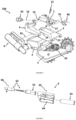
- the invention relates to a rear derailleur 100 for bicycles comprising:
- the third rotation axis 14 is arranged in the base component 1 on the side opposite to the first rotation axis 13 with respect to a central area containing the anchoring axis 19.
- This configuration entails a greater separation between the first rotation axis 13 and the third rotation axis 14 of the base component 1 than is known from the state of the art.
- the greater the separation between the axes of a deformable quadrilateral mechanism the greater the precision of movement thereof (less friction and less play), while offering better support to work loads.
- the configuration described in the invention entails very distinctive aesthetics, especially in the open quadrilateral position as shown in Figure 3A , with respect to the rear deraille currently on the market that are otherwise very similar to each other.
- the support distance 34 between the first rotation axis 13 and the third rotation axis 14 is greater than a first distance 39 defined between the first rotation axis 13 and the anchoring point 190 defined as the intersection of the anchoring axis 19 with the contact plane 910 between the base component 1 and the bicycle frame 9, or the anchoring part 90 solidly attached to the bicycle frame 9.
- the support distance 34 is greater than a second distance 49 defined between the anchoring point 190 and the third rotation axis 14.
- the anchoring point 190 corresponds to the point of contact with an axial component between the base component 1 and the bicycle frame 9, or the anchoring part 90, of greater value according to the rotation vector 80 for advancing a cassette 8 rotationally mounted to the bicycle frame 9 with respect to the wheel axis 89.
- the open rear derailleur with greater structural capacity that is achieved with this arrangement of the axes is especially interesting when the moveable component 2 is in its lowest position where it is more exposed to external shocks, and generally associated with a position of greater value according to the rotation vector 80 to bring the chain to the largest pinion of the cassette 8, as illustrated in Figures 3A and 3B .
- the support distance 34 has an intermediate value between a third distance 12 between the first rotation axis 13 and the fourth rotation axis 24, and a fourth distance 21 between the second rotation axis 23 and the third rotation axis 14.
- a drawback of the invention is the difficulty in achieving compact solutions due to the fact that the greater separation between the first rotation axis 13 and the third rotation axis 14 of the base component 1 causes more marked geometric interferences between the base component 1, the first connector component 3, the second connector component 3 and the moveable component 4, especially when the first rotation axis 13 is neither parallel nor perpendicular to the anchoring axis 19.
- the figures show configurations of the rear derailleur 100 wherein the first rotation axis 13 is arranged at an angle of between 10 and 80° with respect to the anchoring axis 19, and they are as compact or more compact than current solutions in the market.
- the rear derailleur 100 comprises a tensioner 5 articulated with respect to the moveable component 2 by means of a tensioner axis 25 and a tension spring 50 that forces the tensioner 5 to rotate in the positive direction of the rotation vector 80 with respect to the moveable component 2 according to the tensioner axis 25, to give tension to the chain in any of the positions of the rear derailleur 100, while preloading the base component 1 in the negative direction of the rotation vector 80 so that it maintains its position.
- the rear derailleur 100 which has an anchoring part 90 comprising a single means of axial connection with respect to the bicycle frame 9 in the form of a fixing screw 92 that is concentric to the anchoring axis 19, also comprises a rotation stop 91, which due to the preload of the tension spring 50 causes the anchoring part 90 to work in solidarity with the frame 9 (except when force is exerted against the torsion spring 50 for example by moving the derailleur 100 back to remove the wheel, wherein the anchoring part 90 could rotate with respect to the frame 9).
- the base component 1 of the rear derailleur 100 has a positioning screw 15, which in contact with the rotation stop 91 defines the minimum angular operating position of the base component 1 with respect to the bicycle frame 9 in the direction of the rotation vector 80.
- the entire rear derailleur 100 (except for the anchoring part 90 that works in solidarity with the frame 9) is rotated with respect to the frame 9 in the positive direction according to the rotation vector 80, so that the pulleys of the tensioner 5 move away from the cassette 8.
- the tension spring 50 causes the entire rear derailleur 100 (except for the anchoring part 90 that works in solidarity with the frame 9) to rotate with respect to the frame 9 in a negative direction according to the rotation vector 80, so that the pulleys of the tensioner 5 move closer to the cassette 8.
- the screw 15 is considered to be a fine adjustment screw of the position of the rear derailleur 100 with respect to the frame 9, and it enables the derailleur to work with the appropriate distances to the cassette 8 on different frames 9 that entail positions of the rotation stop 91 that are slightly different due to manufacturing tolerances or design parameters. Additionally, the positioning screw 15 can adjust the position of the derailleur to different sized cassettes 8 on the same frame 9.
- the movement of the moveable component 2 with respect to the base component 1 is electrically actuated.
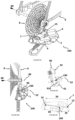
- the rear derailleur 100 comprises a floating linear actuation unit 6, which comprises an electric motor 61 that drives a spindle-nut mechanism 62, a power source 63 and a wireless unit 64, which is articulated with respect to a first component (second connector component 4 in the embodiment of Figure 6 ) of the rear derailleur 100 according to a fifth rotation axis 65 parallel to the first rotation axis 13, and which is articulated with respect to a second component (moveable component 2 in the embodiment of Figure 6 ) of the rear derailleur 100 different from the first component (second connector component 4 in the embodiment of Figure 6 ) according to a sixth rotation axis 66 parallel to the first rotation axis 13.
- An advantage of this embodiment is that the floating linear actuation unit 6 can be easily removed from the rear derailleur 100, leaving the tensioner 5 and the quadrilateral formed by the base component 1, the moveable component 2, the first connector component 3 and the second connector component 4 structurally operative. That is, the floating linear actuation unit 6 does not fulfil mechanical structural functions.
- This configuration in which the electrical part (floating linear actuation unit 6) differs from the mechanical part simplifies the manufacture of the rear derailleur 100, since no mechanical properties are required for the electrical part, nor are electrical properties (or sealing) required for the mechanical part.
- This configuration also facilitates maintenance work, since in the event of an electrical failure, the electrical part can be easily disassembled (without disassembling the mechanical part and losing alignment with the rest of the mechanical components of the bicycle) and independently shipped for repair. And in the event that replacement with a new unit is required, it is sufficient to replace the floating linear actuation unit 6 and not the entire derailleur 100, which implies a lower cost.
- a second preferred embodiment illustrated in Figures 8A to 8D differs from the first preferred embodiment in that the fixing screw 92 of the anchoring part 90 that fixes the rear derailleur 100 to the frame 9 or to a second anchoring part 90 solidly attached to the frame 9 is not concentric to the anchoring axis 19 of the base component 1.
- the frame does not determine the position of the anchoring axis 19 with respect to which the fine adjustment of the position of the rear derailleur 100 is performed according to the positioning screw 15.
- the anchoring axis 19 can be put into a position that results in a better adjustment of the rear derailleur 100 to different cassettes 8.
- it can also be used to facilitate wheel removal wherein it is required that the rear derailleur 100 be rotated in the positive direction of the vector 80 against the preload of the torsion spring 50.
- a third preferred embodiment illustrated in Figures 9A to 9D differs from the first preferred embodiment in that the anchoring part 90 is integrated into the frame 9, thus requiring the frame 9 to have a certain geometry including the rotation stop 91, or at least having a removable part, such as, for example, the removable leg 90 illustrated in Figure 8C .
- This embodiment unlike the first embodiment, requires the frame manufacturer to integrate the geometry required for the rear derailleur 100 into the design thereof, or that a removable leg 90 specific to each frame 9 be delivered together with the derailleur.
- the solution is similar to the second preferred embodiment, only the anchoring to the frame is not defined by any standard unlike the second embodiment which is configured to be able to be mounted on any frame that is prepared to carry a commercial rear derailleur. In this manner, this embodiment has much less compatibility with the frames on the market, but on the other hand it offers better integration with fewer, simpler parts.
- a fourth preferred embodiment illustrated in Figures 10A to 10D differs from the first preferred embodiment in that the anchoring axis 19 is collinear to the wheel axis 89.
- This embodiment has the advantage of exact control of the anchoring axis 19 with respect to the cassette 8 (they are coaxial) and it does not depend on how the frame was manufactured, so the rear derailleur 100 will be able to work in optimal conditions and without so much need for fine adjustment with the positioning screw 15.
- As a drawback like in the third embodiment, and unlike the first and second embodiments, it requires a frame with a specific geometry so it is a solution with poor compatibility with existing frames on the market.
Landscapes
- Engineering & Computer Science (AREA)
- Chemical & Material Sciences (AREA)
- Combustion & Propulsion (AREA)
- Transportation (AREA)
- Mechanical Engineering (AREA)
- Fittings On The Vehicle Exterior For Carrying Loads, And Devices For Holding Or Mounting Articles (AREA)
- Axle Suspensions And Sidecars For Cycles (AREA)
- Motorcycle And Bicycle Frame (AREA)
Priority Applications (3)
| Application Number | Priority Date | Filing Date | Title |
|---|---|---|---|
| EP21383168.8A EP4197893A1 (fr) | 2021-12-20 | 2021-12-20 | Dérailleur arrière pour un quadrilatère ouvert |
| PCT/EP2022/086991 WO2023118141A1 (fr) | 2021-12-20 | 2022-12-20 | Dérailleur arrière pour quadrilatère ouvert |
| DE212022000357.8U DE212022000357U1 (de) | 2021-12-20 | 2022-12-20 | Schaltwerk für ein offenes Viereck |
Applications Claiming Priority (1)
| Application Number | Priority Date | Filing Date | Title |
|---|---|---|---|
| EP21383168.8A EP4197893A1 (fr) | 2021-12-20 | 2021-12-20 | Dérailleur arrière pour un quadrilatère ouvert |
Publications (1)
| Publication Number | Publication Date |
|---|---|
| EP4197893A1 true EP4197893A1 (fr) | 2023-06-21 |
Family
ID=79270323
Family Applications (1)
| Application Number | Title | Priority Date | Filing Date |
|---|---|---|---|
| EP21383168.8A Withdrawn EP4197893A1 (fr) | 2021-12-20 | 2021-12-20 | Dérailleur arrière pour un quadrilatère ouvert |
Country Status (3)
| Country | Link |
|---|---|
| EP (1) | EP4197893A1 (fr) |
| DE (1) | DE212022000357U1 (fr) |
| WO (1) | WO2023118141A1 (fr) |
Citations (11)
| Publication number | Priority date | Publication date | Assignee | Title |
|---|---|---|---|---|
| FR978189A (fr) | 1941-11-27 | 1951-04-10 | Dispositif de changement de vitesse pour bicyclettes | |
| US3803933A (en) | 1971-09-17 | 1974-04-16 | R Huret | Gear shift device particularly for bicycles |
| US4027542A (en) | 1974-10-04 | 1977-06-07 | Shimano Industrial Company, Limited | Derailleur for bicycle |
| FR2506251A1 (fr) * | 1981-05-20 | 1982-11-26 | Bloy Georges | Derailleur arriere pour cycle a parallelogramme deformable |
| US4838837A (en) | 1987-07-02 | 1989-06-13 | Campagnolo S.P.A. | Rear derailleur for bicycle gears |
| US5470277A (en) | 1993-07-08 | 1995-11-28 | Campagnolo S.R.L. | Power operated gear change assembly for bicycles |
| US6315688B1 (en) | 1998-09-10 | 2001-11-13 | Sram Corporation | Derailleur link |
| CN2677286Y (zh) * | 2004-01-18 | 2005-02-09 | 慈溪市远大车业有限公司 | 自行车后拨链器 |
| US8277346B2 (en) | 2006-02-28 | 2012-10-02 | Shimano, Inc. | Low profile rear derailleur |
| DE102011118912A1 (de) | 2011-11-18 | 2013-05-23 | Sram Deutschland Gmbh | Umwerfereinrichtung für eine Fahrradschaltung, insbesondere hintere Umwerfereinrichtung |
| US9751590B2 (en) | 2014-08-15 | 2017-09-05 | Sram, Llc | Bicycle rear derailleur with a damper assembly |
-
2021
- 2021-12-20 EP EP21383168.8A patent/EP4197893A1/fr not_active Withdrawn
-
2022
- 2022-12-20 DE DE212022000357.8U patent/DE212022000357U1/de active Active
- 2022-12-20 WO PCT/EP2022/086991 patent/WO2023118141A1/fr not_active Ceased
Patent Citations (11)
| Publication number | Priority date | Publication date | Assignee | Title |
|---|---|---|---|---|
| FR978189A (fr) | 1941-11-27 | 1951-04-10 | Dispositif de changement de vitesse pour bicyclettes | |
| US3803933A (en) | 1971-09-17 | 1974-04-16 | R Huret | Gear shift device particularly for bicycles |
| US4027542A (en) | 1974-10-04 | 1977-06-07 | Shimano Industrial Company, Limited | Derailleur for bicycle |
| FR2506251A1 (fr) * | 1981-05-20 | 1982-11-26 | Bloy Georges | Derailleur arriere pour cycle a parallelogramme deformable |
| US4838837A (en) | 1987-07-02 | 1989-06-13 | Campagnolo S.P.A. | Rear derailleur for bicycle gears |
| US5470277A (en) | 1993-07-08 | 1995-11-28 | Campagnolo S.R.L. | Power operated gear change assembly for bicycles |
| US6315688B1 (en) | 1998-09-10 | 2001-11-13 | Sram Corporation | Derailleur link |
| CN2677286Y (zh) * | 2004-01-18 | 2005-02-09 | 慈溪市远大车业有限公司 | 自行车后拨链器 |
| US8277346B2 (en) | 2006-02-28 | 2012-10-02 | Shimano, Inc. | Low profile rear derailleur |
| DE102011118912A1 (de) | 2011-11-18 | 2013-05-23 | Sram Deutschland Gmbh | Umwerfereinrichtung für eine Fahrradschaltung, insbesondere hintere Umwerfereinrichtung |
| US9751590B2 (en) | 2014-08-15 | 2017-09-05 | Sram, Llc | Bicycle rear derailleur with a damper assembly |
Also Published As
| Publication number | Publication date |
|---|---|
| DE212022000357U1 (de) | 2024-08-22 |
| WO2023118141A1 (fr) | 2023-06-29 |
Similar Documents
| Publication | Publication Date | Title |
|---|---|---|
| US11845515B2 (en) | Electromechanical derailleur | |
| JP4592257B2 (ja) | 自転車ギアシフト用アクチュエータ | |
| US8910976B2 (en) | Steering apparatus for vehicle | |
| US11820462B2 (en) | Bicycle rear derailleur | |
| JP5521421B2 (ja) | 複式溶接ガン構造体 | |
| US20150111675A1 (en) | Electromechanical rear derailleur | |
| GB2524606A (en) | Power steering apparatus | |
| TWI742700B (zh) | 自行車後變速器 | |
| US11073204B2 (en) | Power steering assembly having a compensation mechanism | |
| US20170363176A1 (en) | Speed reducer | |
| US20130308262A1 (en) | Hinge module and portable electronic device | |
| EP4008623B1 (fr) | Dérailleur pour bicyclette | |
| JP2008051233A (ja) | ステアリング装置 | |
| EP4197893A1 (fr) | Dérailleur arrière pour un quadrilatère ouvert | |
| US6971777B2 (en) | Automotive lamp unit incorporating a pivot element supported on the housing | |
| CN117104385B (zh) | 一种自行车用拨链器 | |
| US8875835B2 (en) | Vehicular rear wheel steering device | |
| JP7535766B2 (ja) | ヒンジ | |
| US8567277B2 (en) | Transmission device | |
| CN212861777U (zh) | 自行车前变速器 | |
| KR101453400B1 (ko) | 자동차용 스티어링 기어의 유격 보상 장치 | |
| US20260046542A1 (en) | Electronic device | |
| CN223085962U (zh) | 一种导向机构、扶手屏装置及车辆 | |
| CN220840192U (zh) | 一种机械臂运动定位装置 | |
| CN223177346U (zh) | 一种防止汽车充电口盖开启后晃动的铰链装置及汽车 |
Legal Events
| Date | Code | Title | Description |
|---|---|---|---|
| PUAI | Public reference made under article 153(3) epc to a published international application that has entered the european phase |
Free format text: ORIGINAL CODE: 0009012 |
|
| STAA | Information on the status of an ep patent application or granted ep patent |
Free format text: STATUS: THE APPLICATION HAS BEEN PUBLISHED |
|
| AK | Designated contracting states |
Kind code of ref document: A1 Designated state(s): AL AT BE BG CH CY CZ DE DK EE ES FI FR GB GR HR HU IE IS IT LI LT LU LV MC MK MT NL NO PL PT RO RS SE SI SK SM TR |
|
| STAA | Information on the status of an ep patent application or granted ep patent |
Free format text: STATUS: THE APPLICATION HAS BEEN WITHDRAWN |
|
| 18W | Application withdrawn |
Effective date: 20231219 |