EP4197987A2 - Application de liant à base de pva pour cmc - Google Patents
Application de liant à base de pva pour cmc Download PDFInfo
- Publication number
- EP4197987A2 EP4197987A2 EP22212631.0A EP22212631A EP4197987A2 EP 4197987 A2 EP4197987 A2 EP 4197987A2 EP 22212631 A EP22212631 A EP 22212631A EP 4197987 A2 EP4197987 A2 EP 4197987A2
- Authority
- EP
- European Patent Office
- Prior art keywords
- ceramic
- binder
- preform
- ceramic material
- tows
- Prior art date
- Legal status (The legal status is an assumption and is not a legal conclusion. Google has not performed a legal analysis and makes no representation as to the accuracy of the status listed.)
- Pending
Links
- 239000011230 binding agent Substances 0.000 title claims abstract description 61
- 229910010293 ceramic material Inorganic materials 0.000 claims abstract description 36
- 238000000034 method Methods 0.000 claims abstract description 36
- 239000004372 Polyvinyl alcohol Substances 0.000 claims abstract description 22
- 229920002451 polyvinyl alcohol Polymers 0.000 claims abstract description 22
- XLYOFNOQVPJJNP-UHFFFAOYSA-N water Substances O XLYOFNOQVPJJNP-UHFFFAOYSA-N 0.000 claims abstract description 12
- OKTJSMMVPCPJKN-UHFFFAOYSA-N Carbon Chemical compound [C] OKTJSMMVPCPJKN-UHFFFAOYSA-N 0.000 claims abstract description 11
- 229910052799 carbon Inorganic materials 0.000 claims abstract description 11
- 239000011153 ceramic matrix composite Substances 0.000 claims abstract description 10
- 238000005507 spraying Methods 0.000 claims abstract description 5
- 238000010422 painting Methods 0.000 claims abstract description 4
- 239000000919 ceramic Substances 0.000 claims description 47
- 239000004744 fabric Substances 0.000 claims description 26
- 239000011159 matrix material Substances 0.000 claims description 7
- HBMJWWWQQXIZIP-UHFFFAOYSA-N silicon carbide Chemical compound [Si+]#[C-] HBMJWWWQQXIZIP-UHFFFAOYSA-N 0.000 claims description 7
- 229910010271 silicon carbide Inorganic materials 0.000 claims description 7
- 238000001035 drying Methods 0.000 claims description 5
- 238000007168 polymer infiltration and pyrolysis Methods 0.000 claims description 4
- 238000005229 chemical vapour deposition Methods 0.000 claims description 3
- 238000010438 heat treatment Methods 0.000 claims description 3
- 238000001764 infiltration Methods 0.000 claims description 3
- 230000008595 infiltration Effects 0.000 claims description 3
- 238000000626 liquid-phase infiltration Methods 0.000 claims description 3
- 239000000126 substance Substances 0.000 claims description 3
- 239000000835 fiber Substances 0.000 description 5
- 239000011248 coating agent Substances 0.000 description 4
- 238000000576 coating method Methods 0.000 description 4
- 238000000354 decomposition reaction Methods 0.000 description 4
- 238000000280 densification Methods 0.000 description 4
- 239000000463 material Substances 0.000 description 4
- 239000000203 mixture Substances 0.000 description 4
- 239000007789 gas Substances 0.000 description 3
- 239000011253 protective coating Substances 0.000 description 3
- IJGRMHOSHXDMSA-UHFFFAOYSA-N Atomic nitrogen Chemical compound N#N IJGRMHOSHXDMSA-UHFFFAOYSA-N 0.000 description 2
- 239000002131 composite material Substances 0.000 description 2
- 238000012986 modification Methods 0.000 description 2
- 230000004048 modification Effects 0.000 description 2
- 238000012545 processing Methods 0.000 description 2
- 239000002759 woven fabric Substances 0.000 description 2
- 230000009286 beneficial effect Effects 0.000 description 1
- 230000015572 biosynthetic process Effects 0.000 description 1
- 238000005520 cutting process Methods 0.000 description 1
- 238000000151 deposition Methods 0.000 description 1
- 238000007598 dipping method Methods 0.000 description 1
- 230000007613 environmental effect Effects 0.000 description 1
- 239000001257 hydrogen Substances 0.000 description 1
- 229910052739 hydrogen Inorganic materials 0.000 description 1
- 125000004435 hydrogen atom Chemical class [H]* 0.000 description 1
- 238000011065 in-situ storage Methods 0.000 description 1
- 238000004519 manufacturing process Methods 0.000 description 1
- 239000002952 polymeric resin Substances 0.000 description 1
- 238000012805 post-processing Methods 0.000 description 1
- 239000002243 precursor Substances 0.000 description 1
- 239000000376 reactant Substances 0.000 description 1
- 239000002904 solvent Substances 0.000 description 1
- 239000011877 solvent mixture Substances 0.000 description 1
- 230000006641 stabilisation Effects 0.000 description 1
- 238000011105 stabilization Methods 0.000 description 1
- 230000000153 supplemental effect Effects 0.000 description 1
- 229920003002 synthetic resin Polymers 0.000 description 1
- 239000012720 thermal barrier coating Substances 0.000 description 1
- 238000005979 thermal decomposition reaction Methods 0.000 description 1
Images

Classifications
-
- C—CHEMISTRY; METALLURGY
- C04—CEMENTS; CONCRETE; ARTIFICIAL STONE; CERAMICS; REFRACTORIES
- C04B—LIME, MAGNESIA; SLAG; CEMENTS; COMPOSITIONS THEREOF, e.g. MORTARS, CONCRETE OR LIKE BUILDING MATERIALS; ARTIFICIAL STONE; CERAMICS; REFRACTORIES; TREATMENT OF NATURAL STONE
- C04B35/00—Shaped ceramic products characterised by their composition; Ceramics compositions; Processing powders of inorganic compounds preparatory to the manufacturing of ceramic products
- C04B35/71—Ceramic products containing macroscopic reinforcing agents
- C04B35/78—Ceramic products containing macroscopic reinforcing agents containing non-metallic materials
- C04B35/80—Fibres, filaments, whiskers, platelets, or the like
-
- C—CHEMISTRY; METALLURGY
- C04—CEMENTS; CONCRETE; ARTIFICIAL STONE; CERAMICS; REFRACTORIES
- C04B—LIME, MAGNESIA; SLAG; CEMENTS; COMPOSITIONS THEREOF, e.g. MORTARS, CONCRETE OR LIKE BUILDING MATERIALS; ARTIFICIAL STONE; CERAMICS; REFRACTORIES; TREATMENT OF NATURAL STONE
- C04B35/00—Shaped ceramic products characterised by their composition; Ceramics compositions; Processing powders of inorganic compounds preparatory to the manufacturing of ceramic products
- C04B35/515—Shaped ceramic products characterised by their composition; Ceramics compositions; Processing powders of inorganic compounds preparatory to the manufacturing of ceramic products based on non-oxide ceramics
- C04B35/56—Shaped ceramic products characterised by their composition; Ceramics compositions; Processing powders of inorganic compounds preparatory to the manufacturing of ceramic products based on non-oxide ceramics based on carbides or oxycarbides
- C04B35/565—Shaped ceramic products characterised by their composition; Ceramics compositions; Processing powders of inorganic compounds preparatory to the manufacturing of ceramic products based on non-oxide ceramics based on carbides or oxycarbides based on silicon carbide
-
- C—CHEMISTRY; METALLURGY
- C04—CEMENTS; CONCRETE; ARTIFICIAL STONE; CERAMICS; REFRACTORIES
- C04B—LIME, MAGNESIA; SLAG; CEMENTS; COMPOSITIONS THEREOF, e.g. MORTARS, CONCRETE OR LIKE BUILDING MATERIALS; ARTIFICIAL STONE; CERAMICS; REFRACTORIES; TREATMENT OF NATURAL STONE
- C04B35/00—Shaped ceramic products characterised by their composition; Ceramics compositions; Processing powders of inorganic compounds preparatory to the manufacturing of ceramic products
- C04B35/622—Forming processes; Processing powders of inorganic compounds preparatory to the manufacturing of ceramic products
- C04B35/626—Preparing or treating the powders individually or as batches ; preparing or treating macroscopic reinforcing agents for ceramic products, e.g. fibres; mechanical aspects section B
- C04B35/628—Coating the powders or the macroscopic reinforcing agents
- C04B35/62844—Coating fibres
- C04B35/62857—Coating fibres with non-oxide ceramics
- C04B35/62873—Carbon
-
- C—CHEMISTRY; METALLURGY
- C04—CEMENTS; CONCRETE; ARTIFICIAL STONE; CERAMICS; REFRACTORIES
- C04B—LIME, MAGNESIA; SLAG; CEMENTS; COMPOSITIONS THEREOF, e.g. MORTARS, CONCRETE OR LIKE BUILDING MATERIALS; ARTIFICIAL STONE; CERAMICS; REFRACTORIES; TREATMENT OF NATURAL STONE
- C04B35/00—Shaped ceramic products characterised by their composition; Ceramics compositions; Processing powders of inorganic compounds preparatory to the manufacturing of ceramic products
- C04B35/622—Forming processes; Processing powders of inorganic compounds preparatory to the manufacturing of ceramic products
- C04B35/626—Preparing or treating the powders individually or as batches ; preparing or treating macroscopic reinforcing agents for ceramic products, e.g. fibres; mechanical aspects section B
- C04B35/63—Preparing or treating the powders individually or as batches ; preparing or treating macroscopic reinforcing agents for ceramic products, e.g. fibres; mechanical aspects section B using additives specially adapted for forming the products, e.g.. binder binders
- C04B35/632—Organic additives
- C04B35/634—Polymers
- C04B35/63404—Polymers obtained by reactions only involving carbon-to-carbon unsaturated bonds
- C04B35/63416—Polyvinylalcohols [PVA]; Polyvinylacetates
-
- C—CHEMISTRY; METALLURGY
- C04—CEMENTS; CONCRETE; ARTIFICIAL STONE; CERAMICS; REFRACTORIES
- C04B—LIME, MAGNESIA; SLAG; CEMENTS; COMPOSITIONS THEREOF, e.g. MORTARS, CONCRETE OR LIKE BUILDING MATERIALS; ARTIFICIAL STONE; CERAMICS; REFRACTORIES; TREATMENT OF NATURAL STONE
- C04B35/00—Shaped ceramic products characterised by their composition; Ceramics compositions; Processing powders of inorganic compounds preparatory to the manufacturing of ceramic products
- C04B35/622—Forming processes; Processing powders of inorganic compounds preparatory to the manufacturing of ceramic products
- C04B35/626—Preparing or treating the powders individually or as batches ; preparing or treating macroscopic reinforcing agents for ceramic products, e.g. fibres; mechanical aspects section B
- C04B35/63—Preparing or treating the powders individually or as batches ; preparing or treating macroscopic reinforcing agents for ceramic products, e.g. fibres; mechanical aspects section B using additives specially adapted for forming the products, e.g.. binder binders
- C04B35/638—Removal thereof
-
- C—CHEMISTRY; METALLURGY
- C04—CEMENTS; CONCRETE; ARTIFICIAL STONE; CERAMICS; REFRACTORIES
- C04B—LIME, MAGNESIA; SLAG; CEMENTS; COMPOSITIONS THEREOF, e.g. MORTARS, CONCRETE OR LIKE BUILDING MATERIALS; ARTIFICIAL STONE; CERAMICS; REFRACTORIES; TREATMENT OF NATURAL STONE
- C04B35/00—Shaped ceramic products characterised by their composition; Ceramics compositions; Processing powders of inorganic compounds preparatory to the manufacturing of ceramic products
- C04B35/622—Forming processes; Processing powders of inorganic compounds preparatory to the manufacturing of ceramic products
- C04B35/64—Burning or sintering processes
-
- C—CHEMISTRY; METALLURGY
- C04—CEMENTS; CONCRETE; ARTIFICIAL STONE; CERAMICS; REFRACTORIES
- C04B—LIME, MAGNESIA; SLAG; CEMENTS; COMPOSITIONS THEREOF, e.g. MORTARS, CONCRETE OR LIKE BUILDING MATERIALS; ARTIFICIAL STONE; CERAMICS; REFRACTORIES; TREATMENT OF NATURAL STONE
- C04B2235/00—Aspects relating to ceramic starting mixtures or sintered ceramic products
- C04B2235/02—Composition of constituents of the starting material or of secondary phases of the final product
- C04B2235/30—Constituents and secondary phases not being of a fibrous nature
- C04B2235/42—Non metallic elements added as constituents or additives, e.g. sulfur, phosphor, selenium or tellurium
- C04B2235/422—Carbon
-
- C—CHEMISTRY; METALLURGY
- C04—CEMENTS; CONCRETE; ARTIFICIAL STONE; CERAMICS; REFRACTORIES
- C04B—LIME, MAGNESIA; SLAG; CEMENTS; COMPOSITIONS THEREOF, e.g. MORTARS, CONCRETE OR LIKE BUILDING MATERIALS; ARTIFICIAL STONE; CERAMICS; REFRACTORIES; TREATMENT OF NATURAL STONE
- C04B2235/00—Aspects relating to ceramic starting mixtures or sintered ceramic products
- C04B2235/02—Composition of constituents of the starting material or of secondary phases of the final product
- C04B2235/30—Constituents and secondary phases not being of a fibrous nature
- C04B2235/48—Organic compounds becoming part of a ceramic after heat treatment, e.g. carbonising phenol resins
-
- C—CHEMISTRY; METALLURGY
- C04—CEMENTS; CONCRETE; ARTIFICIAL STONE; CERAMICS; REFRACTORIES
- C04B—LIME, MAGNESIA; SLAG; CEMENTS; COMPOSITIONS THEREOF, e.g. MORTARS, CONCRETE OR LIKE BUILDING MATERIALS; ARTIFICIAL STONE; CERAMICS; REFRACTORIES; TREATMENT OF NATURAL STONE
- C04B2235/00—Aspects relating to ceramic starting mixtures or sintered ceramic products
- C04B2235/02—Composition of constituents of the starting material or of secondary phases of the final product
- C04B2235/50—Constituents or additives of the starting mixture chosen for their shape or used because of their shape or their physical appearance
- C04B2235/52—Constituents or additives characterised by their shapes
- C04B2235/5208—Fibers
- C04B2235/5216—Inorganic
- C04B2235/524—Non-oxidic, e.g. borides, carbides, silicides or nitrides
- C04B2235/5244—Silicon carbide
-
- C—CHEMISTRY; METALLURGY
- C04—CEMENTS; CONCRETE; ARTIFICIAL STONE; CERAMICS; REFRACTORIES
- C04B—LIME, MAGNESIA; SLAG; CEMENTS; COMPOSITIONS THEREOF, e.g. MORTARS, CONCRETE OR LIKE BUILDING MATERIALS; ARTIFICIAL STONE; CERAMICS; REFRACTORIES; TREATMENT OF NATURAL STONE
- C04B2235/00—Aspects relating to ceramic starting mixtures or sintered ceramic products
- C04B2235/02—Composition of constituents of the starting material or of secondary phases of the final product
- C04B2235/50—Constituents or additives of the starting mixture chosen for their shape or used because of their shape or their physical appearance
- C04B2235/52—Constituents or additives characterised by their shapes
- C04B2235/5208—Fibers
- C04B2235/5252—Fibers having a specific pre-form
-
- C—CHEMISTRY; METALLURGY
- C04—CEMENTS; CONCRETE; ARTIFICIAL STONE; CERAMICS; REFRACTORIES
- C04B—LIME, MAGNESIA; SLAG; CEMENTS; COMPOSITIONS THEREOF, e.g. MORTARS, CONCRETE OR LIKE BUILDING MATERIALS; ARTIFICIAL STONE; CERAMICS; REFRACTORIES; TREATMENT OF NATURAL STONE
- C04B2235/00—Aspects relating to ceramic starting mixtures or sintered ceramic products
- C04B2235/02—Composition of constituents of the starting material or of secondary phases of the final product
- C04B2235/50—Constituents or additives of the starting mixture chosen for their shape or used because of their shape or their physical appearance
- C04B2235/52—Constituents or additives characterised by their shapes
- C04B2235/5208—Fibers
- C04B2235/5252—Fibers having a specific pre-form
- C04B2235/5256—Two-dimensional, e.g. woven structures
-
- C—CHEMISTRY; METALLURGY
- C04—CEMENTS; CONCRETE; ARTIFICIAL STONE; CERAMICS; REFRACTORIES
- C04B—LIME, MAGNESIA; SLAG; CEMENTS; COMPOSITIONS THEREOF, e.g. MORTARS, CONCRETE OR LIKE BUILDING MATERIALS; ARTIFICIAL STONE; CERAMICS; REFRACTORIES; TREATMENT OF NATURAL STONE
- C04B2235/00—Aspects relating to ceramic starting mixtures or sintered ceramic products
- C04B2235/60—Aspects relating to the preparation, properties or mechanical treatment of green bodies or pre-forms
- C04B2235/614—Gas infiltration of green bodies or pre-forms
-
- C—CHEMISTRY; METALLURGY
- C04—CEMENTS; CONCRETE; ARTIFICIAL STONE; CERAMICS; REFRACTORIES
- C04B—LIME, MAGNESIA; SLAG; CEMENTS; COMPOSITIONS THEREOF, e.g. MORTARS, CONCRETE OR LIKE BUILDING MATERIALS; ARTIFICIAL STONE; CERAMICS; REFRACTORIES; TREATMENT OF NATURAL STONE
- C04B2235/00—Aspects relating to ceramic starting mixtures or sintered ceramic products
- C04B2235/60—Aspects relating to the preparation, properties or mechanical treatment of green bodies or pre-forms
- C04B2235/616—Liquid infiltration of green bodies or pre-forms
Definitions
- the present invention relates to ceramic matrix composites and, more particularly, to woven ceramic fabrics for use in ceramic matrix composites.
- Binders can be used in the manufacture of ceramic matrix composites (CMCs) to stabilize fiber build materials for cutting, kitting, and handling operations. Binders also help bind together fiber layers during lay-up. Stabilization and binding of fiber build materials help the preform maintain the desired shape and withstand subsequent processing. Additionally, it can be beneficial to form a weak interfacial coating in the preform to give the final composite enhanced toughness and crack deflection. Thus, a binder that both acts as a binder and forms an interfacial coating is desirable.
- a method of forming a ceramic matrix composite that includes applying a binder comprising water and 5% to 15% polyvinyl alcohol to a ceramic material and decomposing the binder to leave behind a discontinuous carbon layer within the ceramic material.
- the step of applying the binder includes one of a spraying, pipetting, painting, immersing, and pre-pregging technique.
- a ceramic material that includes woven or braided ceramic tows and a binder applied to the tows, the binder comprising water and 5% to 15% polyvinyl alcohol.
- a ceramic preform that includes a plurality of ceramic subcomponents arranged in a layer-by-layer fashion.
- the plurality of ceramic subcomponents is formed from ceramic tows, each of which includes a plurality of filaments, and a carbon layer on a surface of at least a subset of the plurality of filaments.
- This disclosure presents a method of forming a CMC component from fibrous ceramic materials treated with a binder.
- the binder includes a mixture of a polymer resin and a solvent.
- the binder can further be decomposed to form an interfacial layer within treated materials.
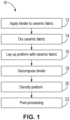
- FIG. 1 is a flowchart illustrating method 10 of forming a CMC component with ceramic material (e.g., a fabric or braid) treated with a binder.
- the binder can be applied to the ceramic material, which in an exemplary embodiment, is a fabric.
- the ceramic fabric can be a sheet of dry woven ceramic fabric formed from tows (shown and labeled in FIG. 2 ) of bundled filaments of silicon carbide (e.g., Hi-Nicalon TM Type S) or other suitable ceramics in various woven architectures.
- Woven architectures can include satin weaves (e.g., 3, 4, 5, 8-harness, etc.) as well as other woven architectures (e.g., plain, twill, bias, etc.).
- the woven fabric can further have an ends-per-inch (EPI) or picks-per-inch (PPI) value ranging from 10 to 22.
- the ceramic fabric can be a biaxial or triaxial braid.
- the binder can be a resin-solvent mixture of polyvinyl alcohol (PVA) and water.
- PVA polyvinyl alcohol
- the amount of PVA in the binder can range from 5% to 15%, and in an exemplary embodiment, can be 9% to 11%. As used herein, the percentage of PVA should be understood as a percentage by weight (wt%). Water can make up the remainder of the mixture.
- Various techniques can be used to apply the binder to the ceramic material, such as spraying, dipping, pipetting, dabbing, and submersion in a bath of the binder.
- the binder can be applied such that it reaches the individual filaments of the tows.
- the wt% of PVA in the fabric, as applied can range from 2% to 10%.
- the dry woven fabric can be impregnated with the PVA binder to form a pre-preg.
- Supplemental binder can be applied to the pre-preg, if desired, in any manner discussed above.
- ceramic fabric with applied binder can be dried, for example, by heating, vacuum, or other suitable means. Drying causes most of the water to evaporate and facilitates subsequent handling and processing of the fabric.
- the ceramic fabric can be incorporated into a preform.
- This can include laying up plies from a sheet of fabric and/or braided components (e.g., tubes).
- the preform can include only binder-treated fabric, or a mixture of binder-treated and non-binder treated fabric.
- the binder remaining on and within the fabric during preforming stabilizes the various fabric layers/structures and allows the preform to maintain its shape.
- it can be desirable to apply additional amounts of the binder during step 16 using any of the techniques described above.
- the binder can be broadly or selectively applied, for example, to areas requiring additional tack to become or remain adhered to another structure and/or to retain a certain shape during preforming.
- step 18 the remaining binder (predominantly PVA at this stage) within the preform can be decomposed.
- step 18 involves thermal decomposition carried out by placing the preform in an inert environment and exposing the preform to temperatures ranging from 800°F (426.7°C) to 1150°F (621.1°C).
- the inert environment can be predominantly nitrogen (N 2 ) gas, or a mixture of nitrogen (N 2 ) and hydrogen (H 2 ) gases.
- Decomposition can be carried out until only a small amount of PVA ash remains, forming a carbon interfacial layer, discussed in greater detail below with respect to FIG. 2 .
- decomposition is performed in situ such that it is carried out in the reactor chamber used in and just prior to step 20.
- the preform can undergo matrix formation and densification using one or a combination of chemical vapor infiltration or chemical vapor deposition (CVI or CVD).
- CVI or CVD chemical vapor infiltration or chemical vapor deposition
- the preform layers are infiltrated by reactant vapors, and a gaseous precursor deposits on the underlying fibers.
- the matrix material can be a silicon carbide or other suitable ceramic material. Densification is carried out until the resulting CMC has reached the desired residual porosity. In most cases, the extent of the matrix is such that it is disposed at least partially around and throughout the ceramic tows of the preform to achieve the desired final porosity of the particular component.
- densification can include other methodologies including, but not limited to, melt infiltration and polymer infiltration and pyrolysis (PIP).
- various post-processing steps can be performed, such as the application of one or more protective coatings (e.g., environmental and/or thermal barrier coatings).
- a bond coat can also be applied to facilitate bonding between the CMC and a protective coating.
- Other protective coatings especially those suitable for use in a gas turbine engine environment, are contemplated herein.
- FIG. 2 is a simplified cross-sectional view through tow 24 belonging to the ceramic fabric (or braid), showing filaments 26 and a discontinuous interfacial layer (shown as discrete interfacial layers 28) deposited on some portions of a subset of filaments 26.
- Interfacial layers 28 represent an amount residual carbon coating surfaces of filaments 26 after the decomposition of the binder at step 18. The number of filaments 26 coated and/or extent to which an individual filament 26 is coated can depend on such factors as degree of saturation of the fabric with the binder, the duration and/or intensity of decomposition, etc.
- implementation of method 10 can result in some amount of the discontinuous interfacial layer depositing on at least a subset of filaments 26 within a tow 24.
- Interfacial layers 28 impart improved mechanical properties to the final composite, such as improve toughness and crack deflection, and reduced fiber debonding.
- a CMC component formed with the disclosed ceramic materials can be incorporated into aerospace, maritime, or industrial equipment, to name a few, non-limiting examples.
- a method of forming a ceramic matrix composite includes applying a binder comprising water and 5% to 15% polyvinyl alcohol to a ceramic material and decomposing the binder to leave behind a discontinuous carbon layer within the ceramic material.
- the step of applying the binder includes one of a spraying, pipetting, painting, immersing, and pre-pregging technique.
- the method of the preceding paragraph can optionally include, additionally and/or alternatively, any one or more of the following features, configurations and/or additional components:
- the above method can further include drying the ceramic material after applying the binder, and incorporating the ceramic material into a preform.
- the ceramic material can be a woven ceramic fabric and incorporating the ceramic fabric into a preform can include forming a plurality of plies from the woven ceramic fabric and laying up the plurality of plies.
- the ceramic fabric can be a braid.
- Any of the above methods can further include additionally applying the binder to the preform.
- the step of drying the ceramic material can evaporate the water of the binder.
- the step of decomposing the binder can include heating the preform to a temperature ranging from 800°F (426.7°C) to 1150°F (621.1°C) in an inert environment.
- the step of decomposing the binder can create a carbon interfacial layer on filaments of tows of the ceramic fabric.
- Any of the above methods can further include densifying the preform using one or a combination of chemical vapor infiltration, chemical vapor deposition, polymer infiltration and pyrolysis, and melt infiltration.
- the binder can include 9% to 11% polyvinyl alcohol.
- an as-applied amount of polyvinyl alcohol on the ceramic material can range from 2% to 10%.
- a ceramic material includes woven or braided ceramic tows and a binder applied to the tows, the binder comprising water and 5% to 15% polyvinyl alcohol.
- the ceramic material of the preceding paragraph can optionally include, additionally and/or alternatively, any one or more of the following features, configurations and/or additional components:
- the ceramic tows can be formed from silicon carbide.
- the binder can include 9% to 11% polyvinyl alcohol.
- an as-applied amount of polyvinyl alcohol on the ceramic material can range from 2% to 10%.
- a ceramic preform includes a plurality of ceramic subcomponents arranged in a layer-by-layer fashion.
- the plurality of ceramic subcomponents is formed from ceramic tows, each of which includes a plurality of filaments, and a carbon layer on a surface of at least a subset of the plurality of filaments.
- the preform of the preceding paragraph can optionally include, additionally and/or alternatively, any one or more of the following features, configurations and/or additional components:
- the plurality of ceramic subcomponents can include one or a combination of plies and braids.
- the ceramic tows can be formed from silicon carbide.
- a ceramic matrix composite component can include any of the above preforms and a ceramic matrix at least partially disposed around and throughout the ceramic tows.
- the ceramic matrix can include silicon carbide.
Landscapes
- Chemical & Material Sciences (AREA)
- Engineering & Computer Science (AREA)
- Ceramic Engineering (AREA)
- Manufacturing & Machinery (AREA)
- Structural Engineering (AREA)
- Materials Engineering (AREA)
- Organic Chemistry (AREA)
- Inorganic Chemistry (AREA)
- Chemical Kinetics & Catalysis (AREA)
- Chemical Or Physical Treatment Of Fibers (AREA)
- Ceramic Products (AREA)
- Catalysts (AREA)
- Application Of Or Painting With Fluid Materials (AREA)
Applications Claiming Priority (1)
| Application Number | Priority Date | Filing Date | Title |
|---|---|---|---|
| US17/556,596 US20230192558A1 (en) | 2021-12-20 | 2021-12-20 | Pva based binder application for cmcs |
Publications (2)
| Publication Number | Publication Date |
|---|---|
| EP4197987A2 true EP4197987A2 (fr) | 2023-06-21 |
| EP4197987A3 EP4197987A3 (fr) | 2023-10-11 |
Family
ID=84487470
Family Applications (1)
| Application Number | Title | Priority Date | Filing Date |
|---|---|---|---|
| EP22212631.0A Pending EP4197987A3 (fr) | 2021-12-20 | 2022-12-09 | Application de liant à base de pva pour cmc |
Country Status (2)
| Country | Link |
|---|---|
| US (1) | US20230192558A1 (fr) |
| EP (1) | EP4197987A3 (fr) |
Families Citing this family (1)
| Publication number | Priority date | Publication date | Assignee | Title |
|---|---|---|---|---|
| US20250122126A1 (en) * | 2023-10-13 | 2025-04-17 | Rtx Corporation | Dispersion of filaments |
Family Cites Families (22)
| Publication number | Priority date | Publication date | Assignee | Title |
|---|---|---|---|---|
| US4704416A (en) * | 1985-12-19 | 1987-11-03 | Wacker-Chemie Gmbh | Aqueous redispersible powders which contain a water-soluble polymer and at least one organic silicon compound and a process for preparing the same |
| GB8828638D0 (en) * | 1988-12-08 | 1989-01-11 | Ici Plc | Production of fibre reinforced composite |
| US5387299A (en) * | 1988-12-27 | 1995-02-07 | General Electric Company | Ceramic composite containing coated fibrous material |
| US5336350A (en) * | 1989-10-31 | 1994-08-09 | General Electric Company | Process for making composite containing fibrous material |
| US5290491A (en) * | 1990-04-02 | 1994-03-01 | Societe Europeenne De Propulsion | Process for the manufacture of a thermostructural composite material having a carbon interphase between its reinforcement fibers and its matrix |
| US5240888A (en) * | 1991-04-19 | 1993-08-31 | Ube Industries, Ltd. | Inorganic fiber and process for the production thereof |
| FR2677641B1 (fr) * | 1991-06-17 | 1994-01-28 | Propulsion Ste Europeenne | Procede d'elaboration de pieces en materiau composite a matrice alumine. |
| WO1994018139A1 (fr) * | 1993-02-02 | 1994-08-18 | Lanxide Technology Company, Lp | Nouveaux procedes de fabrication de preforme pour procedes de formation de composites |
| US5510063A (en) * | 1994-04-15 | 1996-04-23 | Corning Incorporated | Method of making activated carbon honeycombs having varying adsorption capacities |
| US5628938A (en) * | 1994-11-18 | 1997-05-13 | General Electric Company | Method of making a ceramic composite by infiltration of a ceramic preform |
| US6153291A (en) * | 1998-10-13 | 2000-11-28 | Northrop Grumman Corporation | Ceramic-matrix composite component fabrication |
| US7686990B2 (en) * | 2004-12-31 | 2010-03-30 | General Electric Company | Method of producing a ceramic matrix composite article |
| GB201006625D0 (en) * | 2010-04-21 | 2010-06-02 | Rolls Royce Plc | A method of manufacturing a ceramic matrix composite article |
| US20130167374A1 (en) * | 2011-12-29 | 2013-07-04 | General Electric Company | Process of producing ceramic matrix composites and ceramic matrix composites formed thereby |
| JP2014189440A (ja) * | 2013-03-27 | 2014-10-06 | Ube Ind Ltd | 無機繊維結合型セラミックス及びその製造方法 |
| US10093585B2 (en) * | 2014-06-06 | 2018-10-09 | United Technologies Corporation | Method for combined desizing and interface coating of fibers for ceramic matrix composites |
| US10414142B2 (en) * | 2014-12-29 | 2019-09-17 | Rolls-Royce Corporation | Needle punching of composites for preform assembly and thermomechanical enhancement |
| US20170029339A1 (en) * | 2015-07-30 | 2017-02-02 | General Electric Company | Uniformity of fiber spacing in cmc materials |
| US20170029340A1 (en) * | 2015-07-30 | 2017-02-02 | General Electric Company | Uniformity of fiber spacing in cmc materials |
| US11434176B2 (en) * | 2017-12-11 | 2022-09-06 | Rolls-Royce High Temperature Composites Inc. | Fugitive fiber commingling to provide loft in ceramic fiber tows |
| US10822280B2 (en) * | 2017-12-15 | 2020-11-03 | Rolls-Royce High Temperature Composites Inc. | Method of making a fiber preform for ceramic matrix composite (CMC) fabrication utilizing a fugitive binder |
| EP3819280A1 (fr) * | 2019-11-06 | 2021-05-12 | Orkli, S. Coop. | Surfaces composites continues et surfaces de brûleurs |
-
2021
- 2021-12-20 US US17/556,596 patent/US20230192558A1/en active Pending
-
2022
- 2022-12-09 EP EP22212631.0A patent/EP4197987A3/fr active Pending
Also Published As
| Publication number | Publication date |
|---|---|
| US20230192558A1 (en) | 2023-06-22 |
| EP4197987A3 (fr) | 2023-10-11 |
Similar Documents
| Publication | Publication Date | Title |
|---|---|---|
| CN101863665B (zh) | 自愈合抗氧化功能纤维增强陶瓷基复合材料的制备方法 | |
| JP6170160B2 (ja) | Cmc製部品の製造方法 | |
| EP3046892B1 (fr) | Methode de densification d'un article cmc | |
| JP5539386B2 (ja) | セラミック繊維の処理方法 | |
| US10829418B2 (en) | Method of densifying a ceramic matrix composite using a filled tackifier | |
| US20210053882A1 (en) | Method of densifying a ceramic matrix composite using a filled tackifier | |
| US20250320640A1 (en) | Pressurized stabilization of plies for improved interlaminar properties | |
| EP4197987A2 (fr) | Application de liant à base de pva pour cmc | |
| JP7752004B2 (ja) | 水分及び環境への抵抗性を呈するセラミックマトリックス複合材料を作製する方法 | |
| EP4389415B1 (fr) | Précurseur de revêtement d'interface d'aérogel de nitrure de bore pour composites à matrice céramique | |
| US12330994B2 (en) | CVD functionalized particles for CMC applications | |
| EP4512789A1 (fr) | Préimprégné polymère pour composites à matrice céramique | |
| EP4201915A1 (fr) | Introduction de particules métalliques pour permettre la formation de carbures métalliques dans une matrice | |
| US20190023618A1 (en) | Composite material and method for making | |
| US20250122126A1 (en) | Dispersion of filaments | |
| US12552721B2 (en) | PVB-based sacrificial tackifier for CMC | |
| JP7134961B2 (ja) | アルミニウムドープ窒化ホウ素の相間層を含む複合材料部品 | |
| US20240400467A1 (en) | Particle enhanced ceramic matrix composite with no particles on surface plies | |
| US11858861B2 (en) | Localized PVB based tackifier application for CMC | |
| US11873249B2 (en) | Method to form aligned interface coating on silicon carbide fibers | |
| EP4431483A1 (fr) | Armure tridimensionnelle avec fibres z sacrificielles pour microstructure composite à matrice céramique améliorée |
Legal Events
| Date | Code | Title | Description |
|---|---|---|---|
| PUAI | Public reference made under article 153(3) epc to a published international application that has entered the european phase |
Free format text: ORIGINAL CODE: 0009012 |
|
| STAA | Information on the status of an ep patent application or granted ep patent |
Free format text: STATUS: THE APPLICATION HAS BEEN PUBLISHED |
|
| AK | Designated contracting states |
Kind code of ref document: A2 Designated state(s): AL AT BE BG CH CY CZ DE DK EE ES FI FR GB GR HR HU IE IS IT LI LT LU LV MC ME MK MT NL NO PL PT RO RS SE SI SK SM TR |
|
| PUAL | Search report despatched |
Free format text: ORIGINAL CODE: 0009013 |
|
| AK | Designated contracting states |
Kind code of ref document: A3 Designated state(s): AL AT BE BG CH CY CZ DE DK EE ES FI FR GB GR HR HU IE IS IT LI LT LU LV MC ME MK MT NL NO PL PT RO RS SE SI SK SM TR |
|
| RIC1 | Information provided on ipc code assigned before grant |
Ipc: C04B 35/638 20060101ALI20230905BHEP Ipc: C04B 35/628 20060101ALI20230905BHEP Ipc: C04B 35/80 20060101ALI20230905BHEP Ipc: C04B 35/634 20060101AFI20230905BHEP |
|
| RAP3 | Party data changed (applicant data changed or rights of an application transferred) |
Owner name: RTX CORPORATION |
|
| STAA | Information on the status of an ep patent application or granted ep patent |
Free format text: STATUS: REQUEST FOR EXAMINATION WAS MADE |
|
| 17P | Request for examination filed |
Effective date: 20240408 |
|
| RBV | Designated contracting states (corrected) |
Designated state(s): AL AT BE BG CH CY CZ DE DK EE ES FI FR GB GR HR HU IE IS IT LI LT LU LV MC ME MK MT NL NO PL PT RO RS SE SI SK SM TR |
|
| STAA | Information on the status of an ep patent application or granted ep patent |
Free format text: STATUS: EXAMINATION IS IN PROGRESS |
|
| 17Q | First examination report despatched |
Effective date: 20250408 |