EP4198775B1 - Verfahren und vorrichtung zur bestimmung anormaler benutzer, elektronisches gerät und speichermedium - Google Patents
Verfahren und vorrichtung zur bestimmung anormaler benutzer, elektronisches gerät und speichermedium Download PDFInfo
- Publication number
- EP4198775B1 EP4198775B1 EP21874154.4A EP21874154A EP4198775B1 EP 4198775 B1 EP4198775 B1 EP 4198775B1 EP 21874154 A EP21874154 A EP 21874154A EP 4198775 B1 EP4198775 B1 EP 4198775B1
- Authority
- EP
- European Patent Office
- Prior art keywords
- users
- abnormal
- moderated
- normal
- user
- Prior art date
- Legal status (The legal status is an assumption and is not a legal conclusion. Google has not performed a legal analysis and makes no representation as to the accuracy of the status listed.)
- Active
Links
Images



Classifications
-
- H—ELECTRICITY
- H04—ELECTRIC COMMUNICATION TECHNIQUE
- H04L—TRANSMISSION OF DIGITAL INFORMATION, e.g. TELEGRAPHIC COMMUNICATION
- H04L67/00—Network arrangements or protocols for supporting network services or applications
- H04L67/50—Network services
- H04L67/535—Tracking the activity of the user
-
- G—PHYSICS
- G06—COMPUTING OR CALCULATING; COUNTING
- G06F—ELECTRIC DIGITAL DATA PROCESSING
- G06F16/00—Information retrieval; Database structures therefor; File system structures therefor
- G06F16/20—Information retrieval; Database structures therefor; File system structures therefor of structured data, e.g. relational data
- G06F16/24—Querying
- G06F16/245—Query processing
- G06F16/2458—Special types of queries, e.g. statistical queries, fuzzy queries or distributed queries
- G06F16/2465—Query processing support for facilitating data mining operations in structured databases
-
- G—PHYSICS
- G06—COMPUTING OR CALCULATING; COUNTING
- G06F—ELECTRIC DIGITAL DATA PROCESSING
- G06F16/00—Information retrieval; Database structures therefor; File system structures therefor
- G06F16/90—Details of database functions independent of the retrieved data types
- G06F16/906—Clustering; Classification
-
- G—PHYSICS
- G06—COMPUTING OR CALCULATING; COUNTING
- G06F—ELECTRIC DIGITAL DATA PROCESSING
- G06F16/00—Information retrieval; Database structures therefor; File system structures therefor
- G06F16/90—Details of database functions independent of the retrieved data types
- G06F16/95—Retrieval from the web
- G06F16/953—Querying, e.g. by the use of web search engines
- G06F16/9536—Search customisation based on social or collaborative filtering
-
- G—PHYSICS
- G06—COMPUTING OR CALCULATING; COUNTING
- G06F—ELECTRIC DIGITAL DATA PROCESSING
- G06F17/00—Digital computing or data processing equipment or methods, specially adapted for specific functions
- G06F17/10—Complex mathematical operations
- G06F17/18—Complex mathematical operations for evaluating statistical data, e.g. average values, frequency distributions, probability functions, regression analysis
-
- G—PHYSICS
- G06—COMPUTING OR CALCULATING; COUNTING
- G06Q—INFORMATION AND COMMUNICATION TECHNOLOGY [ICT] SPECIALLY ADAPTED FOR ADMINISTRATIVE, COMMERCIAL, FINANCIAL, MANAGERIAL OR SUPERVISORY PURPOSES; SYSTEMS OR METHODS SPECIALLY ADAPTED FOR ADMINISTRATIVE, COMMERCIAL, FINANCIAL, MANAGERIAL OR SUPERVISORY PURPOSES, NOT OTHERWISE PROVIDED FOR
- G06Q10/00—Administration; Management
- G06Q10/40—Business processes related to social networking or social networking services
-
- H—ELECTRICITY
- H04—ELECTRIC COMMUNICATION TECHNIQUE
- H04L—TRANSMISSION OF DIGITAL INFORMATION, e.g. TELEGRAPHIC COMMUNICATION
- H04L67/00—Network arrangements or protocols for supporting network services or applications
- H04L67/01—Protocols
- H04L67/1396—Protocols specially adapted for monitoring users' activity
-
- Y—GENERAL TAGGING OF NEW TECHNOLOGICAL DEVELOPMENTS; GENERAL TAGGING OF CROSS-SECTIONAL TECHNOLOGIES SPANNING OVER SEVERAL SECTIONS OF THE IPC; TECHNICAL SUBJECTS COVERED BY FORMER USPC CROSS-REFERENCE ART COLLECTIONS [XRACs] AND DIGESTS
- Y02—TECHNOLOGIES OR APPLICATIONS FOR MITIGATION OR ADAPTATION AGAINST CLIMATE CHANGE
- Y02D—CLIMATE CHANGE MITIGATION TECHNOLOGIES IN INFORMATION AND COMMUNICATION TECHNOLOGIES [ICT], I.E. INFORMATION AND COMMUNICATION TECHNOLOGIES AIMING AT THE REDUCTION OF THEIR OWN ENERGY USE
- Y02D10/00—Energy efficient computing, e.g. low power processors, power management or thermal management
Definitions
- the present disclosure relates to the field of content moderation technologies, and in particular, relates to a method and apparatus for determining abnormal users, an electronic device and a storage medium.
- Patent document US 2016/261530 A1 discloses a method for identifying inappropriate behavior in an online social network by comparing the online actions to the identified patterns associated with inappropriate activity.
- Embodiments of the present disclosure provide a method and apparatus for determining abnormal users, an electronic device and a storage medium.
- the embodiments of the present disclosure provide a method for determining abnormal users in accordance with independent claim 1.
- the embodiments of the present disclosure provide an apparatus for determining abnormal users in accordance with independent claim 11.
- the embodiments of the present disclosure provide a computer-readable storage medium.
- the computer-readable storage medium stores one or more computer programs, wherein the one or more computer programs, when loaded and run by a processor, causes the processor to perform the above method for determining abnormal users.
- pedophilia users or other rule-violating users are determined as the abnormal users.
- the pedophilia users are major targets for moderation, and it is necessary to detect the pedophilia users from a large number of users and penalize the detected pedophilia users.
- inaccurate information is present in video data. For example, whether a video needs to be prohibited from the juveniles or whether a video is a pornographic video can fail to be determined.
- the pedophilia users have adversarial behaviors, for example, mutual follow, like, and other interaction behaviors among the pedophilia users.
- the pedophilia users follow each other and divulge information to escape from moderation, or the pedophilia users use variations of pornography understandable by the pedophilia users and even create pedophilia words specific to and only acknowledgeable by the pedophilia users to escape from moderation, such that the pedophilia users fail to be moderated due to failure to extract valid features associated with the pedophilia.
- a method for classifying the users includes acquiring classification of the users by inputting features of the users. Behaviors and a classification result of the users do not affect classification results of other users, and are not affected by the behaviors and the classification results of the other users. Thus, an algorithm for classifying the users fails to dynamically combine the interaction behaviors between the pedophilia users and thus fails to determine whether the users are pedophilia users.
- the pedophilia users fail to be moderated and penalized effectively and accurately due to inaccurate information, failure to extract valid features because of the adversarial behaviors of the pedophilia users, and failure to take consideration of interaction behaviors between the pedophilia users when classification of single users using a classification algorithm.
- FIG. 1 is a flowchart of a method for determining abnormal users according to a first embodiment of the present disclosure.
- the embodiments of the present disclosure are applicable to a case of determining pedophilia users or other rule-violating users by moderating abnormal users.
- the method is performed by an apparatus for determining abnormal users in the embodiments of the present disclosure, and the apparatus for determining abnormal users is achieved by hardware or software and is integrated in an electronic device in the embodiments of the present disclosure.
- the method for determining abnormal users in the embodiments of the present disclosure includes the following processes.
- history behavior data of a plurality of to-be-moderated users is acquired, wherein the history behavior data includes behavior data of interactions of the plurality of to-be-moderated users.
- the abnormal users are pedophilia users or other rule-violating users.
- the method for determining abnormal users is illustrated by taking the pedophilia users as an example in the embodiments of the present disclosure.
- the to-be-moderated users are users on short video and living streaming platforms, and the to-be-moderated users are a specific part of users or all users.
- the history behavior data includes data of behaviors of the to-be-moderated users on the short video and live stream platforms, for example, data recording videos watched by the users, videos liked by the users, comments, and other users followed by the users.
- the history behavior data further includes data of other users for the behaviors of the to-be-moderated users, for example, data of the other users that follow the to-be-moderated users and like, watch, and comment the videos and comments posted by the to-be-moderated users, and the like.
- the history behavior data further includes information of the to-be-moderated users, for example, user identifiers (UIDs) and genders of the to-be-moderated users, and the like.
- UIDs user identifiers
- the history behavior data of the to-be-moderated users is acquired through data event tracking by setting the data event tracking in the short video and live stream platforms, or the history behavior data of the to-be-moderated users is acquired by user logs, and the like, which is not limited in the embodiments of the present disclosure.
- a plurality of predetermined valid features are extracted from the history behavior data for each of the plurality of to-be-moderated users, wherein the predetermined valid features are features predetermined in sample data.
- a specific number of sample users are first determined, and the specific number of sample users are users with normal user tags and abnormal user tags.
- history behavior data of the specific number of sample users is acquired, behavior features are extracted from the history behavior data of the specific number of sample users, and validities of the behavior features are determined.
- the behavior features are determined as valid features in response to the behavior features being valid, and events associated with the valid features are determined. Probabilities that the users are the abnormal users upon occurrence of the events associated with the valid features are calculated by a statistical algorithm, and the probabilities are determined as the predetermined probabilities.
- the plurality of valid features and the sample data of the predetermined probabilities of the events associated with the plurality of valid features are acquired.
- the moderated users are determined as the sample users to update the sample data.
- the valid features are prohibited words associated with the pedophilia in comments of the to-be-moderated users, pornographic videos featuring the juveniles that are liked, commented, or watched by the to-be-moderated users, pornographic videos featuring the juveniles that are posted by the to-be-moderated users, and the like.
- corresponding predetermined valid features are extracted from the behavior data of the to-be-moderated users, such as commenting, watching, liking, posting, and the like.
- a probability that each of the plurality of to-be-moderated users is the abnormal user is determined based on predetermined probabilities of events associated with the plurality of valid features.
- the sample data includes the plurality of predetermined valid features and predetermined probabilities of the events associated with the plurality of predetermined valid features.
- the probability that each of the plurality of to-be-moderated users is the abnormal user is determined by summing the predetermined probabilities of the events associated with the plurality of predetermined valid features.
- a total probability function is established based on probabilities that the plurality of to-be-moderated users are the abnormal users.
- the total probability function is a sum of the probabilities that the plurality of to-be-moderated users are the abnormal users.
- a function value of the total probability function changes in the case that the to-be-moderated users change from the abnormal users to normal users, or from the normal users to abnormal users.
- candidate users are determined by solving, based on predetermined conditions, a maximum value of the total probability function.
- a proportion of the abnormal users to the specific number of sample users is acquired by performing statistical calculation on the sample users, and a number of abnormal users in the to-be-moderated users is acquired by multiplying the proportion by a total number of to-be-moderated users.
- a recall rate is also provided, and a product of the recall rate and the total number of to-be-moderated users is calculated.
- the constrains are: when the function value of the total probability function is maximum, a number of candidate users is greater than the product of the recall rate and the total number of to-be-moderated users and is less than the number of abnormal users in the to-be-moderated users.
- the to-be-moderated users are first organized to a set of abnormal users and a set of normal users. Assuming that the to-be-moderated users in the set of abnormal users are the abnormal users, and the to-be-moderated users in the set of normal users are the normal users, a first function value of the total probability function is calculated based on the set of abnormal users and the set of normal users.
- the set of normal users is traversed, and first to-be-moderated users currently traversed in the set of normal users are determined as the abnormal users.
- the set of abnormal users is traversed, and second to-be-moderated users currently traversed in the set of abnormal users are determined as the normal users.
- a plurality of second function values are acquired by calculating function values of the total probability function based on the current set of abnormal users and the current set of normal users, and a minimum second function value is determined in the plurality of second function values.
- second to-be-moderated users corresponding to the minimum second function value are determined in the set of abnormal users, the second to-be-moderated users corresponding to the minimum second function value are determined as the normal users, and shifted to the set of normal users.
- the currently traversed first to-be-moderated users are determined as the abnormal users and shifted from the set of normal users to the set of abnormal users. Processes of traversing the set of normal users, and determining the first to-be-moderated users currently traversed in the set of normal users as the abnormal users are returned until the set of normal users is traversed.
- a number of to-be-moderated users in the set of abnormal users is less than a total number of abnormal users in all the to-be-moderated users, and is greater than the product of the total number and the recall rate.
- the total number is a product of a predetermined proportion of the abnormal users and the number of to-be-moderated users, and the to-be-moderated users in the final set of abnormal users are the candidate users.
- the abnormal users are determined by moderating the candidate users.
- the user identifiers of the candidate users are sent to a moderation backend, such that the abnormal users are determined by artificially or manually moderating the candidate users in the moderation backend.
- the history behavior data of the plurality of to-be-moderated users includes the data of the interaction behaviors of the plurality of to-be-moderated users.
- the valid features are extracted based on the history behavior data, and the probabilities that the to-be-moderated users are the abnormal users are calculated.
- the total probability function is established based on the probabilities that the plurality of to-be-moderated users are the abnormal users, the candidate users are determined by solving, based on the predetermined conditions, the maximum value of the total probability function, and the abnormal users are determined by moderating the candidate users.
- the valid features are predetermined based on the sample data, and the valid features are extracted from the history behavior data and converted to the probabilities of the events associated with the valid features, such that the valid features for moderating the abnormal users are extracted based on the history data of the interactions of the plurality of to-be-moderated users, the features are converted to probability calculation, and the problem that the accuracy of moderating the abnormal users is affected by the inaccurate data information is solved.
- the candidate users are determined by establishing and solving the total probability function for all to-be-moderated users, such that the interaction behaviors between the to-be-moderated users are used, and the classification results of the to-be-moderated users are mutually affected. Thus, the candidate users are accurately determined to be moderated.
- FIG. 2 is a flowchart of a method for moderating abnormal users according to a second embodiment of the present disclosure. The embodiments are described on the basis of the first embodiments. As shown in FIG. 2 , the method for moderating abnormal users in the embodiments of the present disclosure includes the following processes.
- the sample data is acquired, wherein the sample data includes valid features, and predetermined probabilities that users are the abnormal users upon occurrence of events associated with the valid features.
- the sample data is predetermined based on the statistics.
- the sample data includes the valid features, and the predetermined probabilities that the users are the abnormal users upon occurrence of the events associated with the valid features.
- the history behavior data of a specific number (for example, 1000) of sample users is acquired, and the sample users are users with abnormal user tags and normal user tags.
- a plurality of valid features are extracted from the history behavior data of the sample users, and probabilities that the sample users are the abnormal users upon occurrence of the events associated with the valid features are determined as the predetermined probabilities.
- a plurality of behavior features are extracted from the history behavior data of the sample users. For each of the plurality of behavior features, a first user number of sample users that are the abnormal users, including the each of the plurality of behavior features is acquired, and a second user number of sample users that are the normal users, including the each of the plurality of behavior features is acquired.
- a third user number of abnormal users and a fourth user number of normal users in the specific number of sample users are acquired, a first ratio of the first user number to the third user number and a second ratio of the second user number to the fourth user number are calculated, an absolute value of a difference value of the first ratio and the second ratio is calculated, and the plurality of behavior features are determined as the valid features in response to the absolute value being greater than a predetermined threshold.
- the abnormal users are moderated to determine the pedophilia users.
- N behavior features are extracted from the history behavior data of the sample users, a behavior feature B is a prohibited word in the comments of the user, a proportion of the pedophilia users, including the behavior feature B, in the specific number of sample users to all pedophilia users is P_1, a proportion of the normal users, including the behavior feature B, in the specific number of sample users to all normal users is P_2.
- >d a threshold, and is set as 0.02
- the behavior feature B is differentiated, and thus the behavior feature B is determined to be valid.
- the behavior feature B is determined as a predetermined valid feature.
- the N behavior features are traversed, and a plurality of valid features and the probabilities of the events associated with the valid features are acquired.
- the events associated with the plurality of valid features are as follows.
- event A 0 the user is pedophilia; in event A 1 , the user likes pornographic videos featuring juveniles; in event A 2 , the comment sent by the user includes prohibited words; in event A 3 , the user follows an account of the pedophilia user; in event A 4 , the user is followed by an account of the pedophilia user; in event A 5 , the user watches pornographic videos featuring juveniles; in event A 6 , the user shares pornographic videos featuring juveniles; in event A 7 , a number of liked videos of the user divided by a number of posted videos is greater than 30; in event A 8 , a number of liked videos of the user divided by a number of posted videos is less than 30; in event A 9 , the user comments pornographic videos featuring juveniles; in event A 10 , the user is a male; in event A 11 , the user is a female; in event A 12 , a gender of the user is NULL; and A c represents the event A is not present.
- the number of sample users is specified, and the numbers of different events are counted in the history behavior data of all sample users, probabilities that the sample users are the pedophilia users upon occurrence of different events are analyzed and calculated based on the history behavior data of all sample users, and the probabilities that the sample users are the pedophilia users upon occurrence of different events are described in detail in the embodiments of the present disclosure.
- the behavior features are extracted from the history behavior data of the sample users, the valid features are determined, and the valid features are set for pedophilia or other rule-violating behaviors to detect the abnormal users, such that the problem that the valid features associated with the pedophilia fail to be extracted to detect the pedophilia users who have adversarial behaviors, and intentionally use variations of pornography understandable by the pedophilia users, and even create pedophilia words specific to and only acknowledgeable by the pedophilia users to escape from moderation in some practices is solved.
- the valid features are set for the pedophilia users to detect the pedophilia users, such that the accuracy of moderating the pedophilia users is improved.
- the history behavior data of the plurality of to-be-moderated users is acquired from event tracking of a plurality of platforms.
- the history behavior data of the to-be-moderated users is acquired through data event tracking by setting the data event tracking in the short video and living streaming platforms.
- the history behavior data includes at least one of: user genders, videos liked by the users, comments by the users, accounts followed by the users, accounts following the users, videos shared by the users, a number of videos liked by the users, a number of videos posted by the users.
- the history behavior data further includes other behavior data.
- a plurality of predetermined valid features are extracted from the history behavior data for each of the plurality of to-be-moderated users.
- corresponding predetermined valid features are extracted from the history behavior data of each of the plurality of to-be-moderated users.
- the probability that each of the plurality of to-be-moderated users is the abnormal user is acquired by summing the predetermined probabilities of the events associated with the plurality of valid features.
- the probability that each of the plurality of to-be-moderated users is the abnormal user is acquired by summing the predetermined probabilities of the events associated with the plurality of valid features of the to-be-moderated users for each of the plurality of to-be-moderated users.
- a total probability function is established based on probabilities that the plurality of to-be-moderated users are the abnormal users.
- the total probability function is acquired by summing of the probabilities that the plurality of to-be-moderated users are the abnormal users.
- a probability that the to-be-moderated user is the abnormal user changes, that is, a function value of the total probability function changes.
- a set of abnormal users and a set of normal users are initialized, and the plurality of to-be-moderated users are organized to the set of abnormal users and the set of normal users.
- all to-be-moderated users are determined as the normal users, a set of to-be-moderated users determined by solving the maximum value of the total probability function is determined as the set of abnormal users, a set of to-be-moderated users, other than the set of abnormal users, in the plurality of to-be-moderated users is determined as the set of normal users.
- a total number of to-be-moderated users is num( ⁇ ), a proportion of the abnormal users is determined as s based on the specific number of sample users, and the num( ⁇ 1 ) of abnormal users in the to-be-moderated users is determined by calculating a product of the proportion s and the total number num( ⁇ ) of the to-be-moderated users.
- the probability that each to-be-moderated user is the abnormal user is calculated, such that a set of num( ⁇ 1 ) to-be-moderated users determined by solving the maximum value of the total probability function is determined as the set of abnormal users P, and a set of other to-be-moderated users is determined as the set of normal users Q.
- classification results of the plurality of to-be-moderated users are acquired by inputting the history behavior data of the plurality of to-be-moderated users to a pre-trained classification model, the classification results are a probability that each of the plurality of to-be-moderated users is the abnormal user or the normal user, and each of the plurality of to-be-moderated users is organized to the set of abnormal users or the set of normal users based on the probability that each of the plurality of to-be-moderated users is the abnormal user or the normal user in the classification results.
- the to-be-moderated users are first classified by training a regression neural network, a deep neural network, a cyclic neural network, and other networks, classification probabilities that the plurality of to-be-moderated users are the abnormal users or the normal users are acquired, a set formed by num( ⁇ 1 ) to-be-moderated users with classification probabilities that the to-be-moderated users are the abnormal users being at the top is determined as the set of abnormal users, and a set of other to-be-moderated users is determined as the set of normal users.
- the set of abnormal users and the set of normal users may be initialized in other manners.
- a first function value of the total probability function is calculated based on the set of abnormal users and the set of normal users.
- the first function value of the total probability function is calculated by determining the to-be-moderated users in the set of abnormal users as the abnormal users and the to-be-moderated users in the set of normal users as the normal users.
- the total probability function is a sum of the probabilities of all to-be-moderated users, in the case that the to-be-moderated users are initialized as the normal users and the abnormal users, the probability of each to-be-moderated user changes, and the value of the total probability function changes to acquire the first function value S 0 .
- the set of normal users upon initialization of the set of normal users and the set of abnormal users, the set of normal users is traversed, and first to-be-moderated users currently traversed in the set of normal users are determined as the abnormal users.
- the set of abnormal users Upon the traverse of the first to-be-moderated users in the set of normal users, the set of abnormal users is traversed, and second to-be-moderated users currently traversed in the set of abnormal users are determined as the normal users.
- the second function value S 1 of the total probability function is calculated based on the current set of abnormal users and the current set of normal users.
- a plurality of second function values S 1 are acquired by repeating processes of traversing the set of abnormal users, determining the second to-be-moderated users currently traversed in the set of abnormal users as the normal users, and calculating, upon the traverse of the second to-be-moderated users in the set of abnormal users, the second function value of the total probability function based on the current set of abnormal users and the current set of normal users until the set of abnormal users is traversed.
- a minimum second function value S 1 min is determined in the plurality of second function values S1.
- the set of abnormal users and the set of normal users are updated based on the first function value and the second function value.
- the minimum second function value is determined in the plurality of second function values acquired by each traverse of the set of abnormal users.
- the second to-be-moderated users corresponding to the minimum second function value is determined in the set of abnormal users, and the second to-be-moderated users corresponding to the minimum second function value are determined as the normal users and shifted to the set of normal users.
- the currently traversed first to-be-moderated users are determined as the abnormal users and shifted from the set of normal users to the set of abnormal users, and processes of traversing the set of normal users, and determining the first to-be-moderated users currently traversed in the set of normal users as the abnormal users are returned.
- the processes of traversing the set of abnormal users and the set of normal users are as follows.
- the to-be-moderated user P1 in the set of abnormal users P is traversed, the to-be-moderated user P1 is changed to the normal user, the second function value S 11 of the total probability function is calculated based on the current set of abnormal users and the current set of normal users, and then the to-be-moderated user P1 is changed to the abnormal user.
- the to-be-moderated user P2 in the set of abnormal users P is traversed, the to-be-moderated user P2 is changed to the normal user, the second function value S 12 of the total probability function is calculated based on the current set of abnormal users and the current set of normal users, and then the to-be-moderated user P2 is changed to the abnormal user, and so on.
- One second function value S 1m is acquired upon each traverse of to-be-moderated user Pm in the set of abnormal users P, and a plurality of second function values are acquired upon the traverse of the set of abnormal users P.
- a minimum second function value S 1min is determined in the plurality of second function values S 1m .
- the to-be-moderated users Pm corresponding to the minimum second function value S 1min in the set of abnormal users P are determined as the normal users and shifted to the set of normal users
- the currently traversed to-be-moderated users Qn in the set of normal users Q are determined as the abnormal users and shifted to the set of abnormal users P
- S1 is returned.
- the next to-be-moderated user in the set of normal users Q is further traversed, and S1 to S5 are repeated until the to-be-moderated users in the set of normal users Q are traversed.
- the function value of the total probability function is increased to solve the maximum value, and the condition of stopping the traverse is that the number of to-be-moderated users in the set of abnormal users is less than the total number of abnormal users in the to-be-moderated users, and is greater than a product of the total number and the recall rate upon the traverse of the set of normal users.
- the total number is a product of a predetermined proportion of the abnormal users and the number of to-be-moderated users, and the total probability function is solved as follows.
- P ( x i ) represents the probability that an i th to-be-moderated user is the abnormal user
- ⁇ represents a set of all to-be-moderated users
- S.t. (subject to) represents one condition being met
- ⁇ x i ⁇ ⁇ represents any to-be-moderated user in the set of all to-be-moderated users
- r represents a predetermined recall rate
- V1 represents a set of abnormal users upon the traverse
- num(V 1 ) represents a number of abnormal users in the set of abnormal users
- num( ⁇ 1 ) represents a number of abnormal users in the to-be-moderated users
- num( ⁇ 1 ) s ⁇ num( ⁇ )
- s a predetermined proportion of the abnormal users.
- the to-be-moderated users in the set of abnormal users are determined as the candidate users upon stop of the traverse.
- the condition of stopping the traverse is that the number of to-be-moderated users in the set of abnormal users is less than the total number of abnormal users in the to-be-moderated users, and is greater than a product of the total number and the recall rate upon the traverse of the set of normal users.
- the total number is a product of a predetermined proportion of the abnormal users and the number of to-be-moderated users.
- the to-be-moderated users in the set of abnormal users determined by completing the traverse and meeting the predetermined condition are the candidate users, and the candidate users are moderated artificially.
- the abnormal users are determined by moderating the candidate users.
- the user identifiers of the candidate users are sent to the moderation backend, such that the candidate users are moderated in the moderation backend.
- the candidate users are determined as the abnormal users, such as the pedophilia users by artificially moderating, the candidate users are identified as the abnormal users, otherwise, identified as the normal users.
- abnormal user tags are assigned for the abnormal users
- normal user tags are assigned for the users, other than the abnormal users, in the plurality of to-be-moderated users, the users with the abnormal user tags or normal user tags are determined as the sample users, and the sample data is updated.
- the sample data including valid features and predetermined probabilities that users are the abnormal users upon occurrence of events associated with the valid features is acquired.
- a plurality of predetermined valid features are extracted from the history behavior data for each of the plurality of to-be-moderated users, the probability that each of the plurality of to-be-moderated users is the abnormal user is acquired by summing the predetermined probabilities of the events associated with the plurality of valid features, and a total probability function is established based on probabilities that the plurality of to-be-moderated users are the abnormal users.
- a first function value of the total probability function is calculated based on the set of abnormal users and the set of normal users, the set of abnormal users and the set of normal users are traversed, and a second function value of the total probability function is recalculated.
- the set of abnormal users and the set of normal users are updated based on the first function value and the second function value.
- a maximum function value of the total probability function is acquired upon acquisition of the set of normal users on the predetermined condition
- the to-be-moderated users in the set of abnormal users are determined as the candidate users, and the abnormal users are determined by moderating the candidate users.
- the valid features are predetermined based on the sample data, and the valid features are extracted from the history behavior data and converted to the probabilities of the events associated with the valid features, such that the valid features for moderating the abnormal users are extracted based on the history data of the interactions of the plurality of to-be-moderated users, the features are converted to probability calculation, and the problem that the accuracy of moderating the abnormal users is affected by the inaccurate data information is solved.
- the candidate users are determined by establishing and solving the total probability function for all to-be-moderated users, such that the interaction behaviors between the to-be-moderated users are used, and the classification results of the to-be-moderated users are mutually affected. Thus, the candidate users are accurately determined to be moderated.
- the behavior features are extracted from the history behavior data of the sample users, the valid features are determined, and the valid features are set for pedophilia or other rule-violating behaviors to moderate the abnormal users, such that the problem that the valid features associated with the pedophilia fail to be extracted to detect the pedophilia users as the pedophilia users have adversarial behaviors, and intentionally use variations of pornography understandable by the pedophilia users, and even create pedophilia words specific to and only acknowledgeable by the pedophilia users to escape from moderation in some practices is solved.
- the valid features are set for the pedophilia users to detect the pedophilia users, such that the accuracy of moderating the pedophilia users is improved.
- the abnormal user tags are assigned for the abnormal users, and the normal user tags are assigned for the normal users.
- the users with the tags are determined as the sample users, and the valid features of the sample data and the probabilities that the users are the abnormal users upon occurrence of the events associated with the valid features are updated.
- the sample data is dynamically updated to dynamically solve the candidate users, and data resources of the sample users are increased, and a cost of acquiring the sample users is reduced.
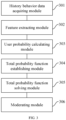
- FIG. 3 is a block diagram of an apparatus for determining abnormal users according to a third embodiment of the present disclosure. As shown in FIG. 3 , the apparatus for determining abnormal users in the embodiments of the present disclosure includes the following modules.
- a history behavior data acquiring module 301 configured to acquire history behavior data of a plurality of to-be-moderated users, wherein the history behavior data includes behavior data of interactions of the plurality of to-be-moderated users; a feature extracting module 302, configured to extract a plurality of predetermined valid features from the history behavior data for each of the plurality of to-be-moderated users, wherein the predetermined valid features are features predetermined in sample data; a user probability calculating module 303, configured to calculate, based on predetermined probabilities of events associated with the plurality of valid features, a probability that each of the plurality of to-be-moderated users is the abnormal user; a total probability function establishing module 304, configured to establish a total probability function based on probabilities that the plurality of to-be-moderated users are the abnormal users; a total probability function solving module 305, configured to determine candidate users by solving, based on predetermined conditions, a maximum value of the total probability function; and a moderating module 306, configured to determine the abnormal users by
- the apparatus for determining abnormal users in the embodiments of the present disclosure performs the method for determining abnormal users in the first or second embodiments of the present disclosure, and have corresponding functional modules and effects of the method.
- FIG. 4 is a schematic structural diagram of an electronic device according to a fourth embodiment of the present disclosure.
- the electronic device includes: a processor 401, a memory 402, a display screen 403 with a touch function, an input device 404, an output device 405, and a communication device 406.
- processors 401 are configured in the electronic device, and FIG. 4 is illustrated by taking one processor 401 as an example.
- the processor 401, the memory 402, the display screen 403, the input device 404, the output device 405, and the communication device 406 in the electronic device are connected by a bus or other manner, and FIG. 4 is illustrated by taking the bus as an example.
- the electronic device is used to perform the method for determining abnormal users in any embodiment of the present disclosure.
- a computer-readable storage medium is provided in the embodiments of the present disclosure.
- the instructions in the storage medium when loaded and executed by a processor of an electronic device, causes the electronic device to perform the method for determining abnormal users as defined in the above embodiments.
Landscapes
- Engineering & Computer Science (AREA)
- Physics & Mathematics (AREA)
- Theoretical Computer Science (AREA)
- General Physics & Mathematics (AREA)
- Data Mining & Analysis (AREA)
- Databases & Information Systems (AREA)
- General Engineering & Computer Science (AREA)
- Mathematical Physics (AREA)
- Mathematical Optimization (AREA)
- Mathematical Analysis (AREA)
- Pure & Applied Mathematics (AREA)
- Computational Mathematics (AREA)
- Operations Research (AREA)
- Software Systems (AREA)
- Probability & Statistics with Applications (AREA)
- Business, Economics & Management (AREA)
- Algebra (AREA)
- Bioinformatics & Cheminformatics (AREA)
- Bioinformatics & Computational Biology (AREA)
- Evolutionary Biology (AREA)
- Life Sciences & Earth Sciences (AREA)
- Signal Processing (AREA)
- Computer Networks & Wireless Communication (AREA)
- Entrepreneurship & Innovation (AREA)
- Tourism & Hospitality (AREA)
- Human Resources & Organizations (AREA)
- Quality & Reliability (AREA)
- Strategic Management (AREA)
- Economics (AREA)
- General Business, Economics & Management (AREA)
- Marketing (AREA)
- Computer Hardware Design (AREA)
- Fuzzy Systems (AREA)
- Computational Linguistics (AREA)
- Management, Administration, Business Operations System, And Electronic Commerce (AREA)
- Computing Systems (AREA)
- Information Transfer Between Computers (AREA)
- Debugging And Monitoring (AREA)
- Storage Device Security (AREA)
Claims (12)
- Verfahren zum Bestimmen anormaler Benutzer, umfassend:Erfassen (S101, S202) von historischen Verhaltensdaten einer Vielzahl zu moderierender Benutzer, wobei die historischen Verhaltensdaten Verhaltensdaten von Interaktionen der Vielzahl zu moderierender Benutzer umfassen;Extrahieren (S102, S203) einer Vielzahl von vorbestimmten gültigen Merkmalen aus den historischen Verhaltensdaten für jeden der Vielzahl zu moderierender Benutzer, wobei die Vielzahl von vorbestimmten gültigen Merkmalen Merkmale sind, die in Stichprobendaten vorbestimmt sind, wobei die Stichprobendaten die Vielzahl von vorbestimmten gültigen Merkmalen und vorbestimmte Wahrscheinlichkeiten von Ereignissen umfassen, die der Vielzahl von gültigen Merkmalen zugeordnet sind;Berechnen (S103), auf der Grundlage der vorbestimmten Wahrscheinlichkeiten der Ereignisse, die der Vielzahl von gültigen Merkmalen zugeordnet sind, einer Wahrscheinlichkeit, dass jeder der Vielzahl zu moderierender Benutzer der anormale Benutzer ist;Erstellen (S104, S205) einer Gesamtwahrscheinlichkeitsfunktion auf der Grundlage von Wahrscheinlichkeiten, dass die Vielzahl zu moderierender Benutzer die anormalen Benutzer sind, wobei die Gesamtwahrscheinlichkeitsfunktion eine Summe der Wahrscheinlichkeiten ist, dass die Vielzahl zu moderierender Benutzer die anormalen Benutzer sind, und ein Funktionswert der Gesamtwahrscheinlichkeitsfunktion sich in dem Fall ändert, dass die Vielzahl zu moderierender Benutzer von den anormalen Benutzern zu normalen Benutzern oder von den normalen Benutzern zu den anormalen Benutzern wechseln;Bestimmen (S105) von in Frage kommenden Benutzern durch Lösen, auf der Grundlage vorbestimmter Bedingungen, eines Maximalwertes der Gesamtwahrscheinlichkeitsfunktion; und Bestimmen (S106, S211) der anormalen Benutzer durch Moderieren der in Frage kommenden Benutzer;wobei das Bestimmen (S105) der in Frage kommenden Benutzer durch Lösen, auf der Grundlage der vorbestimmten Bedingungen, des Maximalwertes der Gesamtwahrscheinlichkeitsfunktion umfasst:Initialisieren (S206) eines Satzes anormaler Benutzer und eines Satzes normaler Benutzer, und Organisieren der Vielzahl zu moderierender Benutzer in den Satz anormaler Benutzer und den Satz normaler Benutzer;Berechnen (S207) eines ersten Funktionswertes der Gesamtwahrscheinlichkeitsfunktion auf der Grundlage des Satzes anormaler Benutzer und des Satzes normaler Benutzer;Durchlaufen (S208) des Satzes anormaler Benutzer und des Satzes normaler Benutzer, und Neuberechnen eines zweiten Funktionswertes der Gesamtwahrscheinlichkeitsfunktion;Aktualisieren (S209) des Satzes anormaler Benutzer und des Satzes normaler Benutzer auf der Grundlage des ersten Funktionswertes und des zweiten Funktionswertes, Zurückkehren zu Prozessen des Durchlaufens des Satzes anormaler Benutzer und des Satzes normaler Benutzer, und Neuberechnen des zweiten Funktionswertes der Gesamtwahrscheinlichkeitsfunktion, bis der Satz normaler Benutzer durchlaufen ist, wobei eine Anzahl der zu moderierenden Benutzer im Satz anormaler Benutzer kleiner ist als eine Gesamtzahl der anormalen Benutzer in der Vielzahl der zu moderierenden Benutzer und größer ist als ein Produkt aus der Gesamtzahl und einer Rückrufrate, wobei die Gesamtzahl ein Produkt aus einem vorbestimmten Anteil der anormalen Benutzer und einer Anzahl aus der Vielzahl zu moderierender Benutzer ist; undBestimmen (S210) der zu moderierenden Benutzer im Satz anormaler Benutzer als die in Frage kommenden Benutzer;wobei das Berechnen (S207) des ersten Funktionswertes der Gesamtwahrscheinlichkeitsfunktion auf der Grundlage des Satzes anormaler Benutzer und des Satzes normaler Benutzer umfasst: Berechnen des ersten Funktionswertes der Gesamtwahrscheinlichkeitsfunktion durch Bestimmen der zu moderierenden Benutzer im Satz anormaler Benutzer als die anormalen Benutzer und der zu moderierenden Benutzer im Satz normaler Benutzer als die normalen Benutzer; unddas Durchlaufen (S208) des Satzes anormaler Benutzer und des Satzes normaler Benutzer und das Neuberechnen des zweiten Funktionswertes der Gesamtwahrscheinlichkeitsfunktion umfassen: Durchlaufen des Satzes normaler Benutzer und Bestimmen erster zu moderierender Benutzer, die gegenwärtig im Satz normaler Benutzer durchlaufen werden, als die anormalen Benutzer; beim Durchlaufen der ersten zu moderierenden Benutzer im Satz normaler Benutzer, Durchlaufen des Satzes anormaler Benutzer und Bestimmen zweiter zu moderierender Benutzer, die gegenwärtig im Satz anormaler Benutzer durchlaufen werden, als die normalen Benutzer; Berechnen, beim Durchlaufen der zweiten zu moderierenden Benutzer im Satz anormaler Benutzer, des zweiten Funktionswertes der Gesamtwahrscheinlichkeitsfunktion auf der Grundlage des aktuellen Satzes anormaler Benutzer und des aktuellen Satzes normaler Benutzer; Erfassen einer Vielzahl von zweiten Funktionswerten durch Wiederholen von Prozessen des Durchlaufens des Satzes anormaler Benutzer, Bestimmen der zweiten zu moderierenden Benutzer, die gegenwärtig im Satz anormaler Benutzer durchlaufen werden, als die normalen Benutzer, und Berechnen, beim Durchlaufen der zweiten zu moderierenden Benutzer im Satz anormaler Benutzer, des zweiten Funktionswertes der Gesamtwahrscheinlichkeitsfunktion auf der Grundlage des gegenwärtigen Satzes anormaler Benutzer und des gegenwärtigen Satzes normaler Benutzer, bis der Satz anormaler Benutzer durchlaufen ist; und Bestimmen eines minimalen zweiten Funktionswertes in der Vielzahl der zweiten Funktionswerte; unddas Erfassen (S106, S211) der anormalen Benutzer durch Moderieren der in Frage kommenden Benutzer umfasst:
Senden von Benutzerkennungen der in Frage kommenden Benutzer an ein Moderations-Backend, derart, dass die in Frage kommenden Benutzer im Moderations-Backend künstlich moderiert werden; und Empfangen von Moderationsergebnissen, die vom Moderations-Backend gesendet werden, wobei die Moderationsergebnisse die aus den in Frage kommenden Benutzern bestimmten anormalen Benutzer umfassen. - Verfahren nach Anspruch 1, wobei das Verfahren vor dem Erfassen (S101, S202) der historischen Verhaltensdaten der Vielzahl zu moderierender Benutzer ferner umfasst:
Erfassen (S201) der Stichprobendaten, wobei die Stichprobendaten gültige Merkmale und vorbestimmte Wahrscheinlichkeiten umfassen, dass Benutzer bei Auftreten von Ereignissen, die den gültigen Merkmalen zugeordnet sind, anormale Benutzer sind. - Verfahren nach Anspruch 2, wobei das Erfassen (S201) der Stichprobendaten umfasst:Erfassen von historischen Verhaltensdaten einer spezifischen Anzahl von Stichprobenbenutzern, wobei es sich bei der spezifischen Anzahl von Stichprobenbenutzern um Benutzer mit "Anormaler Benutzer"-Tags und "Normaler Benutzer"-Tags handelt;Extrahieren einer Vielzahl von gültigen Merkmalen aus den historischen Verhaltensdaten der spezifischen Anzahl von Stichprobenbenutzern; undBestimmen von Wahrscheinlichkeiten, dass die Stichprobenbenutzer die anormalen Benutzer sind, wenn die den gültigen Merkmalen zugeordneten Ereignisse als die vorbestimmten Wahrscheinlichkeiten auftreten.
- Verfahren nach Anspruch 3, wobei das Extrahieren der Vielzahl von gültigen Merkmalen aus den historischen Verhaltensdaten der spezifischen Anzahl von Stichprobenbenutzern umfasst:Extrahieren einer Vielzahl von Verhaltensmerkmalen aus den historischen Verhaltensdaten der spezifischen Anzahl von Stichprobenbenutzern;für jedes der Vielzahl von Verhaltensmerkmalen, Erfassen einer ersten Benutzernummer der Stichprobenbenutzer, die die anormalen Benutzer sind, einschließlich jedes der Vielzahl von Verhaltensmerkmalen, und Erfassen einer zweiten Benutzernummer der Stichprobenbenutzer, die die normalen Benutzer sind, einschließlich jedes der Vielzahl von Verhaltensmerkmalen;Erfassen einer dritten Benutzernummer der anormalen Benutzer und einer vierten Benutzernummer der normalen Benutzer in der spezifischen Anzahl von Stichprobenbenutzern;Berechnen eines ersten Verhältnisses zwischen der ersten Benutzernummer und der dritten Benutzernummer und eines zweiten Verhältnisses zwischen der zweiten Benutzernummer und der vierten Benutzernummer;Berechnen eines Absolutwertes eines Differenzwertes des ersten Verhältnisses und des zweiten Verhältnisses; und Bestimmen der Vielzahl von Verhaltensmerkmalen als die gültigen Merkmale als Reaktion darauf, dass der Absolutwert größer als ein vorbestimmter Schwellenwert ist.
- Verfahren nach Anspruch 1, wobei das Erfassen (S101, S202) der historischen Verhaltensdaten der Vielzahl zu moderierender Benutzer umfasst:
Erfassen (S202) der historischen Verhaltensdaten der Vielzahl zu moderierender Benutzer aus Ereignisverfolgung einer Vielzahl von Plattformen, wobei die historischen Verhaltensdaten mindestens eines der folgenden Elemente umfassen: Benutzergeschlechter, Videos, für die die Benutzer "Gefällt mir" angegeben haben, Kommentare der Benutzer, Konten, denen die Benutzer folgen, Konten, die den Benutzern folgen, Videos, die von den Benutzern geteilt werden, eine Anzahl von Videos, für die die Benutzer "Gefällt mir" angegeben haben, eine Anzahl von Videos, die von den Benutzern gepostet werden. - Verfahren nach Anspruch 1, wobei das Berechnen (S103), auf der Grundlage der vorbestimmten Wahrscheinlichkeiten der Ereignisse, die der Vielzahl von gültigen Merkmalen zugeordnet sind, der Wahrscheinlichkeit, dass jeder der Vielzahl zu moderierender Benutzer der anormale Benutzer ist, umfasst:
Erfassen (S204) der Wahrscheinlichkeit, dass es sich bei jedem der Vielzahl zu moderierender Benutzer um den anormalen Benutzer handelt, durch Summieren der vorbestimmten Wahrscheinlichkeiten der der Vielzahl von gültigen Merkmalen zugeordneten Ereignisse. - Verfahren nach Anspruch 1, wobei das Initialisieren (S206) des Satzes anormaler Benutzer und des Satzes normaler Benutzer und das Organisieren der Vielzahl zu moderierender Benutzer in den Satz anormaler Benutzer und den Satz normaler Benutzer umfasst:Bestimmen der Vielzahl zu moderierender Benutzer als die normalen Benutzer und Bestimmen eines Satzes zu moderierender Benutzer, die durch Lösen des Maximalwertes der Gesamtwahrscheinlichkeitsfunktion erfasst wurden, als den Satz anormaler Benutzer; undBestimmen eines Satzes zu moderierender Benutzer, der sich vom Satz anormaler Benutzer unterscheidet, in der Vielzahl zu moderierender Benutzer als den Satz normaler Benutzer.
- Verfahren nach Anspruch 1, wobei das Initialisieren (S206) des Satzes anormaler Benutzer und des Satzes normaler Benutzer und das Organisieren der Vielzahl zu moderierender Benutzer in den Satz anormaler Benutzer und den Satz normaler Benutzer umfasst:Erfassen von Klassifizierungsergebnissen der Vielzahl zu moderierender Benutzer durch Eingeben der historischen Verhaltensdaten der Vielzahl zu moderierender Benutzer in ein vorab trainiertes Klassifizierungsmodell, wobei die Klassifizierungsergebnisse darin bestehen, dass jeder der Vielzahl zu moderierender Benutzer der anormale Benutzer oder der normale Benutzer ist; undOrganisieren jedes der Vielzahl zu moderierender Benutzer auf der Grundlage der Klassifizierungsergebnisse in den Satz anormaler Benutzer oder den Satz normaler Benutzer.
- Verfahren nach Anspruch 1, wobei das Aktualisieren des Satzes anormaler Benutzer und des Satzes normaler Benutzer auf der Grundlage des ersten Funktionswertes und des zweiten Funktionswertes umfasst:Bestimmen, als Reaktion darauf, dass der minimale zweite Funktionswert größer als der erste Funktionswert ist, der zweiten zu moderierenden Benutzer, die dem minimalen zweiten Funktionswert im Satz anormaler Benutzer entsprechen; undBestimmen der zweiten zu moderierenden Benutzer, die dem minimalen zweiten Funktionswert entsprechen, als die normalen Benutzer und Verschieben in den Satz normaler Benutzer, Bestimmen der gegenwärtig durchlaufenen ersten zu moderierenden Benutzer als die anormalen Benutzer und Verschieben vom Satz normaler Benutzer in den Satz anormaler Benutzer, und Zurückkehren zu Prozessen des Durchlaufens des Satzes normaler Benutzer und Bestimmen der ersten zu moderierenden Benutzer, die gegenwärtig im Satz normaler Benutzer durchlaufen werden, als die anormalen Benutzer.
- Verfahren nach Anspruch 1, wobei das Verfahren bei Empfang der vom Moderations-Backend gesendeten Moderationsergebnisse ferner umfasst:Zuweisen von "Anormaler Benutzer"-Tags für die anormalen Benutzer und von "Normaler Benutzer"-Tags für die Benutzer, die nicht die anormalen Benutzer sind, in der Vielzahl zu moderierender Benutzer; undBestimmen der Benutzer, denen die "Anormaler Benutzer"-Tags oder die "Normaler Benutzer"-Tags zugewiesen wurden, als Stichprobenbenutzer und Aktualisieren der Stichprobendaten.
- Vorrichtung zum Bestimmen anormaler Benutzer, umfassend:ein Modul (301) zum Erfassen historischer Verhaltensdaten, das dafür ausgelegt ist, historische Verhaltensdaten einer Vielzahl zu moderierender Benutzer zu erfassen, wobei die historischen Verhaltensdaten Verhaltensdaten von Interaktionen der Vielzahl zu moderierender Benutzer umfassen;ein Merkmalsextraktionsmodul (302), das dafür ausgelegt ist, eine Vielzahl von vorbestimmten gültigen Merkmalen aus den historischen Verhaltensdaten für jeden der Vielzahl zu moderierender Benutzer zu extrahieren, wobei die Vielzahl von vorbestimmten gültigen Merkmalen Merkmale sind, die in Stichprobendaten vorbestimmt sind, wobei die Stichprobendaten die Vielzahl von vorbestimmten gültigen Merkmalen und vorbestimmte Wahrscheinlichkeiten von Ereignissen umfassen, die der Vielzahl von gültigen Merkmalen zugeordnet sind;ein Benutzerwahrscheinlichkeitsberechnungsmodul (303), das dafür ausgelegt ist, auf der Grundlage der vorbestimmten Wahrscheinlichkeiten der Ereignisse, die der Vielzahl von gültigen Merkmalen zugeordnet sind, eine Wahrscheinlichkeit zu berechnen, dass jeder der Vielzahl zu moderierender Benutzer der anormale Benutzer ist;ein Gesamtwahrscheinlichkeitsfunktionserstellungsmodul (304), das dafür ausgelegt ist, eine Gesamtwahrscheinlichkeitsfunktion auf der Grundlage von Wahrscheinlichkeiten, dass die Vielzahl zu moderierender Benutzer die anormalen Benutzer sind, zu erstellen, wobei die Gesamtwahrscheinlichkeitsfunktion eine Summe der Wahrscheinlichkeiten ist, dass die Vielzahl zu moderierender Benutzer die anormalen Benutzer sind, und ein Funktionswert der Gesamtwahrscheinlichkeitsfunktion sich in dem Fall ändert, dass die Vielzahl zu moderierender Benutzer von den anormalen Benutzern zu normalen Benutzern oder von den normalen Benutzern zu den anormalen Benutzern wechseln;ein Gesamtwahrscheinlichkeitsfunktionslösungsmodul (305), das dafür ausgelegt ist, in Frage kommende Benutzer durch Lösen, auf der Grundlage vorbestimmter Bedingungen, eines Maximalwertes der Gesamtwahrscheinlichkeitsfunktion zu bestimmen; undein Moderationsmodul (306), das dafür ausgelegt ist, die anormalen Benutzer durch Moderieren der in Frage kommenden Benutzer zu bestimmen;wobei das Gesamtwahrscheinlichkeitsfunktionserstellungsmodul (304) ferner für folgende Vorgänge ausgelegt ist:Initialisieren eines Satzes anormaler Benutzer und eines Satzes normaler Benutzer, und Organisieren der Vielzahl zu moderierender Benutzer in den Satz anormaler Benutzern und den Satz normaler Benutzer;Berechnen eines ersten Funktionswertes der Gesamtwahrscheinlichkeitsfunktion auf der Grundlage des Satzes anormaler Benutzer und des Satzes normaler Benutzer;Durchlaufen des Satzes anormaler Benutzer und des Satzes normaler Benutzer, und Neuberechnen eines zweiten Funktionswertes der Gesamtwahrscheinlichkeitsfunktion;Aktualisieren des Satzes anormaler Benutzer und des Satzes normaler Benutzer auf der Grundlage des ersten Funktionswertes und des zweiten Funktionswertes, Zurückkehren zu Prozessen des Durchlaufens des Satzes anormaler Benutzer und des Satzes normaler Benutzer, und Neuberechnen des zweiten Funktionswertes der Gesamtwahrscheinlichkeitsfunktion, bis der Satz normaler Benutzer durchlaufen ist, wobei eine Anzahl der zu moderierenden Benutzer im Satz anormaler Benutzer kleiner ist als eine Gesamtzahl der anormalen Benutzer in der Vielzahl der zu moderierenden Benutzer und größer ist als ein Produkt aus der Gesamtzahl und einer Rückrufrate, wobei die Gesamtzahl ein Produkt aus einem vorbestimmten Anteil der anormalen Benutzer und einer Anzahl der Vielzahl der zu moderierenden Benutzer ist; undBestimmen der zu moderierenden Benutzer im Satz anormaler Benutzer als die in Frage kommenden Benutzer;wobei das Gesamtwahrscheinlichkeitsfunktionserstellungsmodul (304) ferner für folgende Vorgänge ausgelegt ist:Berechnen des ersten Funktionswertes der Gesamtwahrscheinlichkeitsfunktion durch Bestimmen der zu moderierenden Benutzer im Satz anormaler Benutzer als die anormalen Benutzer und der zu moderierenden Benutzer im Satz normaler Benutzer als die normalen Benutzer; undDurchlaufen des Satzes normaler Benutzer und Bestimmen erster zu moderierender Benutzer, die gegenwärtig im Satz normaler Benutzer durchlaufen werden, als die anormalen Benutzer; beim Durchlaufen der ersten zu moderierenden Benutzer im Satz normaler Benutzer, Durchlaufen des Satzes anormaler Benutzer und Bestimmen zweiter zu moderierender Benutzer, die gegenwärtig im Satz anormaler Benutzer durchlaufen werden, als die normalen Benutzer; Berechnen, beim Durchlaufen der zweiten zu moderierenden Benutzer im Satz anormaler Benutzer, des zweiten Funktionswertes der Gesamtwahrscheinlichkeitsfunktion auf der Grundlage des aktuellen Satzes anormaler Benutzer und des aktuellen Satzes normaler Benutzer; Erfassen einer Vielzahl von zweiten Funktionswerten durch Wiederholen von Prozessen des Durchlaufens des Satzes anormaler Benutzer, Bestimmen der zweiten zu moderierenden Benutzer, die gegenwärtig im Satz anormaler Benutzer durchlaufen werden, als die normalen Benutzer, und Berechnen, beim Durchlaufen der zweiten zu moderierenden Benutzer im Satz anormaler Benutzer, des zweiten Funktionswertes der Gesamtwahrscheinlichkeitsfunktion auf der Grundlage des gegenwärtigen Satzes anormaler Benutzer und des gegenwärtigen Satzes normaler Benutzer, bis der Satz anormaler Benutzer durchlaufen ist; und Bestimmen eines minimalen zweiten Funktionswertes in der Vielzahl zweiter Funktionswerte; unddas Moderationsmodul (306) ferner für folgenden Vorgang ausgelegt ist: Senden von Benutzerkennungen der in Frage kommenden Benutzer an ein Moderations-Backend, derart, dass die in Frage kommenden Benutzer im Moderations-Backend künstlich moderiert werden; und Empfangen von Moderationsergebnissen, die vom Moderations-Backend gesendet werden, wobei die Moderationsergebnisse die aus den in Frage kommenden Benutzern bestimmten anormalen Benutzer umfassen.
- Computerlesbares Speichermedium, das ein oder mehrere Computerprogramme speichert, wobei das eine oder die mehreren Computerprogramme, wenn sie von einem Prozessor (401) geladen und ausgeführt werden, den Prozessor (401) veranlassen, das in einem der Ansprüche 1 bis 10 definierte Verfahren zum Bestimmen anormaler Benutzer durchzuführen.
Applications Claiming Priority (2)
| Application Number | Priority Date | Filing Date | Title |
|---|---|---|---|
| CN202011066006.0A CN112199640B (zh) | 2020-09-30 | 2020-09-30 | 异常用户审核方法、装置、电子设备和存储介质 |
| PCT/CN2021/115230 WO2022068493A1 (zh) | 2020-09-30 | 2021-08-30 | 异常用户审核方法、装置、电子设备和存储介质 |
Publications (3)
| Publication Number | Publication Date |
|---|---|
| EP4198775A1 EP4198775A1 (de) | 2023-06-21 |
| EP4198775A4 EP4198775A4 (de) | 2024-03-13 |
| EP4198775B1 true EP4198775B1 (de) | 2024-11-06 |
Family
ID=74013675
Family Applications (1)
| Application Number | Title | Priority Date | Filing Date |
|---|---|---|---|
| EP21874154.4A Active EP4198775B1 (de) | 2020-09-30 | 2021-08-30 | Verfahren und vorrichtung zur bestimmung anormaler benutzer, elektronisches gerät und speichermedium |
Country Status (5)
| Country | Link |
|---|---|
| US (1) | US12250279B2 (de) |
| EP (1) | EP4198775B1 (de) |
| CN (1) | CN112199640B (de) |
| SA (1) | SA523440093B1 (de) |
| WO (1) | WO2022068493A1 (de) |
Families Citing this family (8)
| Publication number | Priority date | Publication date | Assignee | Title |
|---|---|---|---|---|
| CN112199640B (zh) * | 2020-09-30 | 2024-03-12 | 广州市百果园网络科技有限公司 | 异常用户审核方法、装置、电子设备和存储介质 |
| CN113163218A (zh) * | 2021-02-09 | 2021-07-23 | 百果园技术(新加坡)有限公司 | 直播间内用户的检测方法和系统、电子设备及存储介质 |
| CN113766256A (zh) * | 2021-02-09 | 2021-12-07 | 北京沃东天骏信息技术有限公司 | 一种直播风控方法和装置 |
| CN113255929B (zh) * | 2021-05-27 | 2023-04-18 | 支付宝(中国)网络技术有限公司 | 异常用户可解释原因的获取方法和装置 |
| CN113485305B (zh) * | 2021-07-28 | 2023-04-07 | 成都飞机工业(集团)有限责任公司 | 一种飞机外勤故障诊断系统与方法 |
| CN114205676B (zh) * | 2021-12-08 | 2024-05-28 | 广州方硅信息技术有限公司 | 直播监测方法、装置、介质以及计算机设备 |
| CN115994203B (zh) * | 2023-02-20 | 2023-06-23 | 广州佰锐网络科技有限公司 | 一种基于ai的数据标注处理方法、系统及ai中台 |
| CN116488934A (zh) * | 2023-05-29 | 2023-07-25 | 无锡车联天下信息技术有限公司 | 一种基于域控制器的网络安全管理方法及系统 |
Family Cites Families (14)
| Publication number | Priority date | Publication date | Assignee | Title |
|---|---|---|---|---|
| US7110914B2 (en) * | 2003-11-03 | 2006-09-19 | Microsoft Corporation | Flexible variable and execution matrix |
| US7693876B2 (en) * | 2007-01-24 | 2010-04-06 | Netapp, Inc. | Monitoring usage rate patterns in storage resources |
| US20080281622A1 (en) * | 2007-05-10 | 2008-11-13 | Mary Kay Hoal | Social Networking System |
| CN103853841A (zh) | 2014-03-19 | 2014-06-11 | 北京邮电大学 | 一种社交网用户异常行为的分析方法 |
| US9985916B2 (en) * | 2015-03-03 | 2018-05-29 | International Business Machines Corporation | Moderating online discussion using graphical text analysis |
| US20170124464A1 (en) * | 2015-10-28 | 2017-05-04 | Fractal Industries, Inc. | Rapid predictive analysis of very large data sets using the distributed computational graph |
| CN107517251B (zh) * | 2017-08-16 | 2020-12-15 | 北京星选科技有限公司 | 信息推送方法和装置 |
| US11025659B2 (en) * | 2018-10-23 | 2021-06-01 | Forcepoint, LLC | Security system using pseudonyms to anonymously identify entities and corresponding security risk related behaviors |
| CN110237530B (zh) * | 2019-06-14 | 2020-12-11 | 腾讯科技(深圳)有限公司 | 异常行为检测方法、装置和可读存储介质 |
| CN110929799B (zh) * | 2019-11-29 | 2023-05-12 | 上海盛付通电子支付服务有限公司 | 用于检测异常用户的方法、电子设备和计算机可读介质 |
| CN111090813B (zh) * | 2019-12-20 | 2021-09-28 | 腾讯科技(深圳)有限公司 | 一种内容处理方法、装置和计算机可读存储介质 |
| CN111339436B (zh) * | 2020-02-11 | 2021-05-28 | 腾讯科技(深圳)有限公司 | 一种数据识别方法、装置、设备以及可读存储介质 |
| CN111639680B (zh) * | 2020-05-09 | 2022-08-09 | 西北工业大学 | 一种基于专家反馈机制的身份识别方法 |
| CN112199640B (zh) * | 2020-09-30 | 2024-03-12 | 广州市百果园网络科技有限公司 | 异常用户审核方法、装置、电子设备和存储介质 |
-
2020
- 2020-09-30 CN CN202011066006.0A patent/CN112199640B/zh active Active
-
2021
- 2021-08-30 EP EP21874154.4A patent/EP4198775B1/de active Active
- 2021-08-30 WO PCT/CN2021/115230 patent/WO2022068493A1/zh not_active Ceased
- 2021-08-30 US US18/245,653 patent/US12250279B2/en active Active
-
2023
- 2023-03-28 SA SA523440093A patent/SA523440093B1/ar unknown
Also Published As
| Publication number | Publication date |
|---|---|
| WO2022068493A1 (zh) | 2022-04-07 |
| EP4198775A4 (de) | 2024-03-13 |
| US12250279B2 (en) | 2025-03-11 |
| SA523440093B1 (ar) | 2025-05-20 |
| US20230336637A1 (en) | 2023-10-19 |
| EP4198775A1 (de) | 2023-06-21 |
| CN112199640A (zh) | 2021-01-08 |
| CN112199640B (zh) | 2024-03-12 |
Similar Documents
| Publication | Publication Date | Title |
|---|---|---|
| US12250279B2 (en) | Method and apparatus for moderating abnormal users, electronic device, and storage medium | |
| CN111371767B (zh) | 恶意账号识别方法、恶意账号识别装置、介质及电子设备 | |
| CN109388674B (zh) | 数据处理方法、装置、设备及可读存储介质 | |
| CN110049372B (zh) | 主播稳定留存率的预测方法、装置、设备及存储介质 | |
| CN111061948B (zh) | 一种用户标签推荐方法、装置、计算机设备及存储介质 | |
| CN109165691B (zh) | 用于识别作弊用户的模型的训练方法、装置及电子设备 | |
| CN110348471B (zh) | 异常对象识别方法、装置、介质及电子设备 | |
| US20190334759A1 (en) | Unsupervised anomaly detection for identifying anomalies in data | |
| US20220261591A1 (en) | Data processing method and apparatus | |
| US11372805B2 (en) | Method and device for information processing | |
| US20180107953A1 (en) | Content delivery method, apparatus, and storage medium | |
| CN113301442A (zh) | 确定直播资源的方法、设备、介质及程序产品 | |
| EP2946312A2 (de) | Systeme und verfahren zur verteilung von benutzergenerierten inhalten | |
| CN114820085A (zh) | 用户筛选方法、相关装置及存储介质 | |
| CN109658120A (zh) | 一种业务数据处理方法以及装置 | |
| CN114399353A (zh) | 业务推荐方法、装置、电子设备和计算机可读介质 | |
| CN114066535A (zh) | 风险识别方法、装置、设备及可读存储介质 | |
| CN113076450A (zh) | 一种目标推荐列表的确定方法和装置 | |
| CN119397113A (zh) | 一种页面访问方法、装置、电子设备及计算机可读介质 | |
| CN115129926B (zh) | 一种视频数据推荐方法、装置、电子设备及存储介质 | |
| RU2834928C1 (ru) | Способ и устройство для отслеживания аномальных пользователей, электронное устройство и носитель данных | |
| CN115393100A (zh) | 资源推荐方法及装置 | |
| CN108629506A (zh) | 风控模型的建模方法、装置、计算机设备和存储介质 | |
| CN114329231A (zh) | 对象特征处理方法、装置、电子设备及存储介质 | |
| CN120165986B (zh) | 多源情报融合处理方法、装置、设备及介质 |
Legal Events
| Date | Code | Title | Description |
|---|---|---|---|
| STAA | Information on the status of an ep patent application or granted ep patent |
Free format text: STATUS: THE INTERNATIONAL PUBLICATION HAS BEEN MADE |
|
| PUAI | Public reference made under article 153(3) epc to a published international application that has entered the european phase |
Free format text: ORIGINAL CODE: 0009012 |
|
| STAA | Information on the status of an ep patent application or granted ep patent |
Free format text: STATUS: REQUEST FOR EXAMINATION WAS MADE |
|
| 17P | Request for examination filed |
Effective date: 20230316 |
|
| AK | Designated contracting states |
Kind code of ref document: A1 Designated state(s): AL AT BE BG CH CY CZ DE DK EE ES FI FR GB GR HR HU IE IS IT LI LT LU LV MC MK MT NL NO PL PT RO RS SE SI SK SM TR |
|
| DAV | Request for validation of the european patent (deleted) | ||
| DAX | Request for extension of the european patent (deleted) | ||
| A4 | Supplementary search report drawn up and despatched |
Effective date: 20240212 |
|
| RIC1 | Information provided on ipc code assigned before grant |
Ipc: G06Q 50/00 20120101ALI20240206BHEP Ipc: G06F 16/2458 20190101ALI20240206BHEP Ipc: G06F 16/9536 20190101ALI20240206BHEP Ipc: G06F 17/18 20060101AFI20240206BHEP |
|
| GRAP | Despatch of communication of intention to grant a patent |
Free format text: ORIGINAL CODE: EPIDOSNIGR1 |
|
| STAA | Information on the status of an ep patent application or granted ep patent |
Free format text: STATUS: GRANT OF PATENT IS INTENDED |
|
| RIC1 | Information provided on ipc code assigned before grant |
Ipc: G06F 16/906 20190101ALI20240614BHEP Ipc: G06Q 50/00 20120101ALI20240614BHEP Ipc: G06F 16/2458 20190101ALI20240614BHEP Ipc: G06F 16/9536 20190101ALI20240614BHEP Ipc: G06F 17/18 20060101AFI20240614BHEP |
|
| INTG | Intention to grant announced |
Effective date: 20240716 |
|
| GRAS | Grant fee paid |
Free format text: ORIGINAL CODE: EPIDOSNIGR3 |
|
| GRAA | (expected) grant |
Free format text: ORIGINAL CODE: 0009210 |
|
| STAA | Information on the status of an ep patent application or granted ep patent |
Free format text: STATUS: THE PATENT HAS BEEN GRANTED |
|
| AK | Designated contracting states |
Kind code of ref document: B1 Designated state(s): AL AT BE BG CH CY CZ DE DK EE ES FI FR GB GR HR HU IE IS IT LI LT LU LV MC MK MT NL NO PL PT RO RS SE SI SK SM TR |
|
| REG | Reference to a national code |
Ref country code: GB Ref legal event code: FG4D |
|
| REG | Reference to a national code |
Ref country code: CH Ref legal event code: EP |
|
| REG | Reference to a national code |
Ref country code: DE Ref legal event code: R096 Ref document number: 602021021631 Country of ref document: DE |
|
| REG | Reference to a national code |
Ref country code: IE Ref legal event code: FG4D |
|
| REG | Reference to a national code |
Ref country code: LT Ref legal event code: MG9D |
|
| REG | Reference to a national code |
Ref country code: NL Ref legal event code: MP Effective date: 20241106 |
|
| PG25 | Lapsed in a contracting state [announced via postgrant information from national office to epo] |
Ref country code: IS Free format text: LAPSE BECAUSE OF FAILURE TO SUBMIT A TRANSLATION OF THE DESCRIPTION OR TO PAY THE FEE WITHIN THE PRESCRIBED TIME-LIMIT Effective date: 20250306 Ref country code: HR Free format text: LAPSE BECAUSE OF FAILURE TO SUBMIT A TRANSLATION OF THE DESCRIPTION OR TO PAY THE FEE WITHIN THE PRESCRIBED TIME-LIMIT Effective date: 20241106 Ref country code: PT Free format text: LAPSE BECAUSE OF FAILURE TO SUBMIT A TRANSLATION OF THE DESCRIPTION OR TO PAY THE FEE WITHIN THE PRESCRIBED TIME-LIMIT Effective date: 20250306 |
|
| PG25 | Lapsed in a contracting state [announced via postgrant information from national office to epo] |
Ref country code: FI Free format text: LAPSE BECAUSE OF FAILURE TO SUBMIT A TRANSLATION OF THE DESCRIPTION OR TO PAY THE FEE WITHIN THE PRESCRIBED TIME-LIMIT Effective date: 20241106 Ref country code: NL Free format text: LAPSE BECAUSE OF FAILURE TO SUBMIT A TRANSLATION OF THE DESCRIPTION OR TO PAY THE FEE WITHIN THE PRESCRIBED TIME-LIMIT Effective date: 20241106 |
|
| REG | Reference to a national code |
Ref country code: AT Ref legal event code: MK05 Ref document number: 1740153 Country of ref document: AT Kind code of ref document: T Effective date: 20241106 |
|
| PG25 | Lapsed in a contracting state [announced via postgrant information from national office to epo] |
Ref country code: BG Free format text: LAPSE BECAUSE OF FAILURE TO SUBMIT A TRANSLATION OF THE DESCRIPTION OR TO PAY THE FEE WITHIN THE PRESCRIBED TIME-LIMIT Effective date: 20241106 |
|
| PG25 | Lapsed in a contracting state [announced via postgrant information from national office to epo] |
Ref country code: ES Free format text: LAPSE BECAUSE OF FAILURE TO SUBMIT A TRANSLATION OF THE DESCRIPTION OR TO PAY THE FEE WITHIN THE PRESCRIBED TIME-LIMIT Effective date: 20241106 |
|
| PG25 | Lapsed in a contracting state [announced via postgrant information from national office to epo] |
Ref country code: NO Free format text: LAPSE BECAUSE OF FAILURE TO SUBMIT A TRANSLATION OF THE DESCRIPTION OR TO PAY THE FEE WITHIN THE PRESCRIBED TIME-LIMIT Effective date: 20250206 |
|
| PG25 | Lapsed in a contracting state [announced via postgrant information from national office to epo] |
Ref country code: LV Free format text: LAPSE BECAUSE OF FAILURE TO SUBMIT A TRANSLATION OF THE DESCRIPTION OR TO PAY THE FEE WITHIN THE PRESCRIBED TIME-LIMIT Effective date: 20241106 Ref country code: GR Free format text: LAPSE BECAUSE OF FAILURE TO SUBMIT A TRANSLATION OF THE DESCRIPTION OR TO PAY THE FEE WITHIN THE PRESCRIBED TIME-LIMIT Effective date: 20250207 Ref country code: AT Free format text: LAPSE BECAUSE OF FAILURE TO SUBMIT A TRANSLATION OF THE DESCRIPTION OR TO PAY THE FEE WITHIN THE PRESCRIBED TIME-LIMIT Effective date: 20241106 |
|
| PG25 | Lapsed in a contracting state [announced via postgrant information from national office to epo] |
Ref country code: PL Free format text: LAPSE BECAUSE OF FAILURE TO SUBMIT A TRANSLATION OF THE DESCRIPTION OR TO PAY THE FEE WITHIN THE PRESCRIBED TIME-LIMIT Effective date: 20241106 |
|
| PG25 | Lapsed in a contracting state [announced via postgrant information from national office to epo] |
Ref country code: RS Free format text: LAPSE BECAUSE OF FAILURE TO SUBMIT A TRANSLATION OF THE DESCRIPTION OR TO PAY THE FEE WITHIN THE PRESCRIBED TIME-LIMIT Effective date: 20250206 |
|
| PG25 | Lapsed in a contracting state [announced via postgrant information from national office to epo] |
Ref country code: SM Free format text: LAPSE BECAUSE OF FAILURE TO SUBMIT A TRANSLATION OF THE DESCRIPTION OR TO PAY THE FEE WITHIN THE PRESCRIBED TIME-LIMIT Effective date: 20241106 |
|
| PG25 | Lapsed in a contracting state [announced via postgrant information from national office to epo] |
Ref country code: DK Free format text: LAPSE BECAUSE OF FAILURE TO SUBMIT A TRANSLATION OF THE DESCRIPTION OR TO PAY THE FEE WITHIN THE PRESCRIBED TIME-LIMIT Effective date: 20241106 |
|
| PG25 | Lapsed in a contracting state [announced via postgrant information from national office to epo] |
Ref country code: EE Free format text: LAPSE BECAUSE OF FAILURE TO SUBMIT A TRANSLATION OF THE DESCRIPTION OR TO PAY THE FEE WITHIN THE PRESCRIBED TIME-LIMIT Effective date: 20241106 |
|
| PG25 | Lapsed in a contracting state [announced via postgrant information from national office to epo] |
Ref country code: RO Free format text: LAPSE BECAUSE OF FAILURE TO SUBMIT A TRANSLATION OF THE DESCRIPTION OR TO PAY THE FEE WITHIN THE PRESCRIBED TIME-LIMIT Effective date: 20241106 |
|
| PG25 | Lapsed in a contracting state [announced via postgrant information from national office to epo] |
Ref country code: SK Free format text: LAPSE BECAUSE OF FAILURE TO SUBMIT A TRANSLATION OF THE DESCRIPTION OR TO PAY THE FEE WITHIN THE PRESCRIBED TIME-LIMIT Effective date: 20241106 |
|
| PG25 | Lapsed in a contracting state [announced via postgrant information from national office to epo] |
Ref country code: CZ Free format text: LAPSE BECAUSE OF FAILURE TO SUBMIT A TRANSLATION OF THE DESCRIPTION OR TO PAY THE FEE WITHIN THE PRESCRIBED TIME-LIMIT Effective date: 20241106 |
|
| PG25 | Lapsed in a contracting state [announced via postgrant information from national office to epo] |
Ref country code: IT Free format text: LAPSE BECAUSE OF FAILURE TO SUBMIT A TRANSLATION OF THE DESCRIPTION OR TO PAY THE FEE WITHIN THE PRESCRIBED TIME-LIMIT Effective date: 20241106 |
|
| REG | Reference to a national code |
Ref country code: DE Ref legal event code: R097 Ref document number: 602021021631 Country of ref document: DE |
|
| PG25 | Lapsed in a contracting state [announced via postgrant information from national office to epo] |
Ref country code: SE Free format text: LAPSE BECAUSE OF FAILURE TO SUBMIT A TRANSLATION OF THE DESCRIPTION OR TO PAY THE FEE WITHIN THE PRESCRIBED TIME-LIMIT Effective date: 20241106 |
|
| PLBE | No opposition filed within time limit |
Free format text: ORIGINAL CODE: 0009261 |
|
| STAA | Information on the status of an ep patent application or granted ep patent |
Free format text: STATUS: NO OPPOSITION FILED WITHIN TIME LIMIT |
|
| PGFP | Annual fee paid to national office [announced via postgrant information from national office to epo] |
Ref country code: DE Payment date: 20250819 Year of fee payment: 5 |
|
| 26N | No opposition filed |
Effective date: 20250807 |
|
| PGFP | Annual fee paid to national office [announced via postgrant information from national office to epo] |
Ref country code: GB Payment date: 20250709 Year of fee payment: 5 |
|
| PGFP | Annual fee paid to national office [announced via postgrant information from national office to epo] |
Ref country code: FR Payment date: 20250709 Year of fee payment: 5 |
|
| REG | Reference to a national code |
Ref country code: CH Ref legal event code: H13 Free format text: ST27 STATUS EVENT CODE: U-0-0-H10-H13 (AS PROVIDED BY THE NATIONAL OFFICE) Effective date: 20260324 |
|
| PG25 | Lapsed in a contracting state [announced via postgrant information from national office to epo] |
Ref country code: MC Free format text: LAPSE BECAUSE OF FAILURE TO SUBMIT A TRANSLATION OF THE DESCRIPTION OR TO PAY THE FEE WITHIN THE PRESCRIBED TIME-LIMIT Effective date: 20241106 |
|
| PG25 | Lapsed in a contracting state [announced via postgrant information from national office to epo] |
Ref country code: LU Free format text: LAPSE BECAUSE OF NON-PAYMENT OF DUE FEES Effective date: 20250830 |
|
| PG25 | Lapsed in a contracting state [announced via postgrant information from national office to epo] |
Ref country code: CH Free format text: LAPSE BECAUSE OF NON-PAYMENT OF DUE FEES Effective date: 20250831 |