EP4200298B1 - Dérivés de 1h-pyrrolo[3,2-c]pyridine and 1h-pyrrolo[2,3-c]pyridine en tant qu'inhibiteurs tlr9 pour le traitement de fibrose - Google Patents
Dérivés de 1h-pyrrolo[3,2-c]pyridine and 1h-pyrrolo[2,3-c]pyridine en tant qu'inhibiteurs tlr9 pour le traitement de fibrose Download PDFInfo
- Publication number
- EP4200298B1 EP4200298B1 EP21769261.5A EP21769261A EP4200298B1 EP 4200298 B1 EP4200298 B1 EP 4200298B1 EP 21769261 A EP21769261 A EP 21769261A EP 4200298 B1 EP4200298 B1 EP 4200298B1
- Authority
- EP
- European Patent Office
- Prior art keywords
- phenyl
- pyrrolo
- dimethyl
- methylsulfonyl
- pyridin
- Prior art date
- Legal status (The legal status is an assumption and is not a legal conclusion. Google has not performed a legal analysis and makes no representation as to the accuracy of the status listed.)
- Active
Links
Classifications
-
- C—CHEMISTRY; METALLURGY
- C07—ORGANIC CHEMISTRY
- C07D—HETEROCYCLIC COMPOUNDS
- C07D471/00—Heterocyclic compounds containing nitrogen atoms as the only ring hetero atoms in the condensed system, at least one ring being a six-membered ring with one nitrogen atom, not provided for by groups C07D451/00 - C07D463/00
- C07D471/02—Heterocyclic compounds containing nitrogen atoms as the only ring hetero atoms in the condensed system, at least one ring being a six-membered ring with one nitrogen atom, not provided for by groups C07D451/00 - C07D463/00 in which the condensed system contains two hetero rings
- C07D471/04—Ortho-condensed systems
-
- A—HUMAN NECESSITIES
- A61—MEDICAL OR VETERINARY SCIENCE; HYGIENE
- A61K—PREPARATIONS FOR MEDICAL, DENTAL OR TOILETRY PURPOSES
- A61K31/00—Medicinal preparations containing organic active ingredients
- A61K31/33—Heterocyclic compounds
- A61K31/395—Heterocyclic compounds having nitrogen as a ring hetero atom, e.g. guanethidine or rifamycins
- A61K31/435—Heterocyclic compounds having nitrogen as a ring hetero atom, e.g. guanethidine or rifamycins having six-membered rings with one nitrogen as the only ring hetero atom
- A61K31/44—Non condensed pyridines; Hydrogenated derivatives thereof
- A61K31/445—Non condensed piperidines, e.g. piperocaine
- A61K31/4523—Non condensed piperidines, e.g. piperocaine containing further heterocyclic ring systems
- A61K31/4545—Non condensed piperidines, e.g. piperocaine containing further heterocyclic ring systems containing a six-membered ring with nitrogen as a ring hetero atom, e.g. pipamperone, anabasine
-
- A—HUMAN NECESSITIES
- A61—MEDICAL OR VETERINARY SCIENCE; HYGIENE
- A61K—PREPARATIONS FOR MEDICAL, DENTAL OR TOILETRY PURPOSES
- A61K31/00—Medicinal preparations containing organic active ingredients
- A61K31/33—Heterocyclic compounds
- A61K31/395—Heterocyclic compounds having nitrogen as a ring hetero atom, e.g. guanethidine or rifamycins
- A61K31/495—Heterocyclic compounds having nitrogen as a ring hetero atom, e.g. guanethidine or rifamycins having six-membered rings with two or more nitrogen atoms as the only ring heteroatoms, e.g. piperazine or tetrazines
- A61K31/496—Non-condensed piperazines containing further heterocyclic rings, e.g. rifampin, thiothixene or sparfloxacin
-
- A—HUMAN NECESSITIES
- A61—MEDICAL OR VETERINARY SCIENCE; HYGIENE
- A61P—SPECIFIC THERAPEUTIC ACTIVITY OF CHEMICAL COMPOUNDS OR MEDICINAL PREPARATIONS
- A61P1/00—Drugs for disorders of the alimentary tract or the digestive system
- A61P1/16—Drugs for disorders of the alimentary tract or the digestive system for liver or gallbladder disorders, e.g. hepatoprotective agents, cholagogues, litholytics
-
- A—HUMAN NECESSITIES
- A61—MEDICAL OR VETERINARY SCIENCE; HYGIENE
- A61P—SPECIFIC THERAPEUTIC ACTIVITY OF CHEMICAL COMPOUNDS OR MEDICINAL PREPARATIONS
- A61P1/00—Drugs for disorders of the alimentary tract or the digestive system
- A61P1/18—Drugs for disorders of the alimentary tract or the digestive system for pancreatic disorders, e.g. pancreatic enzymes
-
- A—HUMAN NECESSITIES
- A61—MEDICAL OR VETERINARY SCIENCE; HYGIENE
- A61P—SPECIFIC THERAPEUTIC ACTIVITY OF CHEMICAL COMPOUNDS OR MEDICINAL PREPARATIONS
- A61P11/00—Drugs for disorders of the respiratory system
-
- A—HUMAN NECESSITIES
- A61—MEDICAL OR VETERINARY SCIENCE; HYGIENE
- A61P—SPECIFIC THERAPEUTIC ACTIVITY OF CHEMICAL COMPOUNDS OR MEDICINAL PREPARATIONS
- A61P13/00—Drugs for disorders of the urinary system
- A61P13/12—Drugs for disorders of the urinary system of the kidneys
-
- C—CHEMISTRY; METALLURGY
- C07—ORGANIC CHEMISTRY
- C07D—HETEROCYCLIC COMPOUNDS
- C07D451/00—Heterocyclic compounds containing 8-azabicyclo [3.2.1] octane, 9-azabicyclo [3.3.1] nonane, or 3-oxa-9-azatricyclo [3.3.1.0<2,4>] nonane ring systems, e.g. tropane or granatane alkaloids, scopolamine; Cyclic acetals thereof
- C07D451/02—Heterocyclic compounds containing 8-azabicyclo [3.2.1] octane, 9-azabicyclo [3.3.1] nonane, or 3-oxa-9-azatricyclo [3.3.1.0<2,4>] nonane ring systems, e.g. tropane or granatane alkaloids, scopolamine; Cyclic acetals thereof containing not further condensed 8-azabicyclo [3.2.1] octane or 3-oxa-9-azatricyclo [3.3.1.0<2,4>] nonane ring systems, e.g. tropane; Cyclic acetals thereof
-
- C—CHEMISTRY; METALLURGY
- C07—ORGANIC CHEMISTRY
- C07D—HETEROCYCLIC COMPOUNDS
- C07D451/00—Heterocyclic compounds containing 8-azabicyclo [3.2.1] octane, 9-azabicyclo [3.3.1] nonane, or 3-oxa-9-azatricyclo [3.3.1.0<2,4>] nonane ring systems, e.g. tropane or granatane alkaloids, scopolamine; Cyclic acetals thereof
- C07D451/02—Heterocyclic compounds containing 8-azabicyclo [3.2.1] octane, 9-azabicyclo [3.3.1] nonane, or 3-oxa-9-azatricyclo [3.3.1.0<2,4>] nonane ring systems, e.g. tropane or granatane alkaloids, scopolamine; Cyclic acetals thereof containing not further condensed 8-azabicyclo [3.2.1] octane or 3-oxa-9-azatricyclo [3.3.1.0<2,4>] nonane ring systems, e.g. tropane; Cyclic acetals thereof
- C07D451/04—Heterocyclic compounds containing 8-azabicyclo [3.2.1] octane, 9-azabicyclo [3.3.1] nonane, or 3-oxa-9-azatricyclo [3.3.1.0<2,4>] nonane ring systems, e.g. tropane or granatane alkaloids, scopolamine; Cyclic acetals thereof containing not further condensed 8-azabicyclo [3.2.1] octane or 3-oxa-9-azatricyclo [3.3.1.0<2,4>] nonane ring systems, e.g. tropane; Cyclic acetals thereof with hetero atoms directly attached in position 3 of the 8-azabicyclo [3.2.1] octane or in position 7 of the 3-oxa-9-azatricyclo [3.3.1.0<2,4>] nonane ring system
-
- C—CHEMISTRY; METALLURGY
- C07—ORGANIC CHEMISTRY
- C07D—HETEROCYCLIC COMPOUNDS
- C07D471/00—Heterocyclic compounds containing nitrogen atoms as the only ring hetero atoms in the condensed system, at least one ring being a six-membered ring with one nitrogen atom, not provided for by groups C07D451/00 - C07D463/00
- C07D471/02—Heterocyclic compounds containing nitrogen atoms as the only ring hetero atoms in the condensed system, at least one ring being a six-membered ring with one nitrogen atom, not provided for by groups C07D451/00 - C07D463/00 in which the condensed system contains two hetero rings
- C07D471/08—Bridged systems
-
- C—CHEMISTRY; METALLURGY
- C07—ORGANIC CHEMISTRY
- C07D—HETEROCYCLIC COMPOUNDS
- C07D487/00—Heterocyclic compounds containing nitrogen atoms as the only ring hetero atoms in the condensed system, not provided for by groups C07D451/00 - C07D477/00
- C07D487/02—Heterocyclic compounds containing nitrogen atoms as the only ring hetero atoms in the condensed system, not provided for by groups C07D451/00 - C07D477/00 in which the condensed system contains two hetero rings
- C07D487/08—Bridged systems
-
- C—CHEMISTRY; METALLURGY
- C07—ORGANIC CHEMISTRY
- C07D—HETEROCYCLIC COMPOUNDS
- C07D519/00—Heterocyclic compounds containing more than one system of two or more relevant hetero rings condensed among themselves or condensed with a common carbocyclic ring system not provided for in groups C07D453/00 or C07D455/00
Definitions
- references in the present description to methods of medical treatment or medical uses have to be understood as references to the compounds of the present invention for use in methods of medical treatment. Methods of medical treatment or medical uses are not encompassed by the claimed invention.
- the present invention generally relates to substituted heteroaryl compounds useful as inhibitors of signaling through Toll-like receptor 9 (TLR9).
- TLR9 Toll-like receptor 9
- substituted heteroaryl compounds Provided herein are substituted heteroaryl compounds, compositions comprising such compounds, and said compounds and compositions for use in methods of medical treatment.
- the invention further pertains to pharmaceutical compositions containing at least one compound according to the invention that are useful for the treatment or prophylaxis of fibrotic diseases and other diseases, disorders, and conditions for which a TLR9 inhibitor is indicated.
- TLRs Toll-like receptors
- PAMPs pattern-associated molecular patterns
- MAMPs microbe-associated molecular patterns
- a total of 10 human TLRs have been identified and can be located in the cell surface or, as in the case of TLR7, 8 and 9, in the endolysosomes.
- TLR9 recognizes unmethylated single-stranded DNA containing cytosine-phosphate-guanine (CpG) motifs that are typically found in bacterial and mitochondrial DNA (mtDNA).
- CpG cytosine-phosphate-guanine
- TLR9 may contribute to fibrogenesis by promoting inflammation via the MyD88-dependent signalling pathway that ultimately mediates activation of IL-6, IFN- ⁇ , IL-1 ⁇ , and TNF- ⁇ among others cytokines.
- International patent publication No. WO 2019/126082 A1 describes 6-azaindole compounds that are useful as inhibitors of signaling through TLR7, TLR8 and/or TLR9.
- WO 2018/089695 A1 and WO 2015/088045 A1 describe heterocyclic compounds which can act as antagonists or inhibitors of TLR7, TLR8 and/or TLR9. None of the aforementioned patent applications describes 1H-pyrrolopyridine derivatives as presently claimed.
- TLR9 levels are higher in lung biopsies of rapid idiopathic pulmonary fibrosis (IPF) progressors than in the healthy or stable IPF progressors ( Sci. Transl. Med. 2010, 2(57):57ra82 ). Circulating mtDNA, the ligand for TLR9 has recently been identified as a mechanism-based prognostic biomarker of IPF ( Am J. Resp. and Crit. Care Med. 2017, 196(12), 1502 ). In addition, it has been observed that TLR9 is up-regulated in human and murine non-alcoholic steatohepatitis (NASH) ( Clin. Sci.
- NASH non-alcoholic steatohepatitis
- TLR9 hepatocyte mitochondrial DNA drives NASH via activation of TLR9
- TLR9 inhibition has been recognized as a potential route to therapies for fibrotic diseases including idiopathic pulmonary fibrosis ( Trujillo et al. Sci. Transl. Med. 2010, 2(57):57ra82 ; Yoshizaki et al. Ann Rheum Dis. 2016 Oct;75(10):1858-65 ), non-alcoholic steatohepatitis ( Garcia-Martinez et al. J Clin Invest 2016, 126: 859-864 ; Gabele et al. Biochem Biophys Res Commun. 2008; 376:271-276 ), hepatic injury ( Shaker et al. Biochem Pharmacol. 2016. 112:90-101 ; Hoeque et al. J. Immun.
- TLR9 inhibitors Applicants have found potent compounds that have activity as TLR9 inhibitors. Further, applicants have found compounds that have activity as TLR9 inhibitors and are selective over TLR7 or TLR8. These compounds are provided to be useful as pharmaceuticals with desirable stability, bioavailability, therapeutic index, and toxicity values that are important to their drugability.
- the present disclosure relates to a new class of substituted heteroaryl compounds found to be effective inhibitors of signaling through TLR9. These compounds are provided to be useful as pharmaceuticals with desirable stability, bioavailability, therapeutic index, and toxicity values that are important to their drugability.
- the present disclosure relates to compounds that are useful as inhibitors of signaling through TLR9 and are useful for the treatment of fibrotic diseases, or stereoisomers, N-oxides, tautomers, pharmaceutically acceptable salts, solvates or prodrugs thereof.
- the present invention also provides pharmaceutical compositions comprising a pharmaceutically acceptable carrier and at least one of the compounds of the present invention or stereoisomers, tautomers, pharmaceutically acceptable salts, or solvates thereof.
- the present invention also provides compounds of the present invention or stereoisomers, tautomers, solvates or pharmaceutically acceptable salts thereof, for use in treating pathological fibrosis.
- the present invention provides a compound of Formula (I): or stereoisomers, tautomer, solvates or salts thereof, wherein:
- the disclosure relates to compounds of Formula (I): or stereoisomers, tautomers, solvates or salts thereof, wherein: one of X and Y is N and the other of X and Y is C-A; and one of Q 1 and Q 2 is G and the other Q 1 and Q 2 is R 3 .
- the disclosure also relates to compounds of Formula (I) or stereoisomers, tautomers, solvates or salts thereof, wherein X is C-A, Y is N, Q 1 is R 3 , and Q 2 is G, although such compounds are not claimed.
- the disclosure also relates to at least one compound of Formula (I): or a salt thereof, wherein:
- X may be C-A and Y may be N.
- Such compounds have the structure of Formula (II):
- a compound of Formula (I) or stereoisomers, tautomer, solvates or salts thereof wherein X is C-A and Y is N; and Q 1 is G and Q 2 is R 3 .
- Compounds of this embodiment have the structure of Formula (IIa):
- a compound of Formula (I) or stereoisomers, tautomer, solvates or salts thereof is provided wherein X is N and Y is C-A.
- Compounds of this embodiment have the structure of Formula (III):
- a compound of Formula (I) or stereoisomers, tautomer, solvates or salts thereof wherein X is N and Y is C-A; and Q 1 is G and Q 2 is R 3 .
- Compounds of this embodiment have the structure of Formula (IIIa):
- a compound of Formula (I) or stereoisomers, tautomer, solvates or salts thereof wherein X is N and Y is C-A; and Q 1 is R 3 and Q 2 is G.
- Compounds of this embodiment have the structure of Formula (IIIb):
- a compound of Formula (I) or stereoisomers, tautomer, solvates or salts thereof wherein G is phenyl substituted with 1 to 3 substituents independently selected from -OCH 3 , -S(O) 2 CH 3 , -S(O) 2 N(CH 3 ) 2 , -S(O) 2 (cyclopropyl), and -S(O)(NH)N(CH 3 ) 2 .
- G is phenyl substituted with 1 to 2 substituents independently selected from -OCH 3 , -S(O) 2 CH 3 , -S(O) 2 N(CH 3 ) 2 , and -S(O) 2 (cyclopropyl). Also included in this embodiment are compounds in which G is:
- a compound of Formula (I) or stereoisomers, tautomer, solvates or salts thereof wherein G is phenyl substituted with 1 to 2 substituents independently selected from -OCH 3 , -S(O) 2 CH 3 , -S(O) 2 N(CH 3 ) 2 , and -S(O)(NH)N(CH 3 ) 2 . Included in this embodiment are compounds in which G is phenyl substituted with 1 to 2 substituents independently selected from -OCH 3 and -S(O) 2 CH 3 .
- a compound of Formula (I) or stereoisomers, tautomer, solvates or salts thereof is provided wherein G is Included in this embodiment are compounds in which each R 2 is independently F, Cl, Br, -CN, -OH, -CH 3 , -CH 2 CH 3 , -CF 3 , -CH 2 OH, -C(CH 3 ) 2 OH, -CH 2 NH 2 , -OCH 3 , -OCH 2 CH 3 , -OCH(CH 3 ) 2 , -OCH 2 CH 2 OCH 3 , -OCH 2 CH 2 N(CH 3 ) 2 , -OCHF 2 , -C(O)OCH 3 , -C(O)NH 2 , -C(O)NH(CH 2 CH 3 ), -C(O)(thiazolyl), -NH 2 , -NH(CH 3 ), -NH(CH 2 CH 3 ), -N(CH 3 ) 2
- each R 2 is independently F, Cl, -CN, -CH 3 , -OCH 3 , -NH 2 , or cyclopropyl.
- p is 2; one R 2 is -CH 3 ; and the other R 2 is F, Cl, -CN, -CH 3 , -OCH 3 , -NH 2 , or cyclopropyl.
- a compound of Formula (I) or stereoisomers, tautomer, solvates or salts thereof is provided wherein G is a 9-membered heterocyclic ring selected from: Included in this embodiment are compounds in which G is:
- a compound of Formula (I) or stereoisomers, tautomer, solvates or salts thereof is provided wherein G is a 10-membered heterocyclic ring selected from: Included in this embodiment are compounds in which G is:
- a compound of Formula (I) or stereoisomers, tautomer, solvates or salts thereof is provided wherein p is zero, 1, 2, or 3. Included in this embodiment are compounds in which p is 1 or 2.
- a compound of Formula (I) or stereoisomers, tautomer, solvates or salts thereof is provided wherein A is piperidinyl, phenyl, pyridinyl, pyrimidinyl, 6-azabicyclo[3.2.1]octanyl, or azabicyclo[3.2.1]octanyl, each substituted with -L-R 4 and zero to 2 R 4b .
- a compound of Formula (I) or stereoisomers, tautomer, solvates or salts thereof is provided wherein A is piperidinyl, phenyl, pyridinyl, pyrimidinyl, 6-azabicyclo[3.2.1]octanyl, or azabicyclo[3.2.1]octanyl, each substituted with -L-R 4 and zero to 1 R 4b .
- a compound of Formula (I) or stereoisomers, tautomer, solvates or salts thereof is provided wherein A is piperidinyl, phenyl, or pyridinyl, each substituted with -L-R 4 and zero to 2 R 4b . Included in this embodiment are compounds in which A is piperidinyl or phenyl, each substituted with -L-R 4 and zero to 1 R 4b . Also, included in this embodiment are compounds in which A is phenyl or pyridinyl, each substituted with -L-R 4 and zero to 1 R 4b .
- a compound of Formula (I) or stereoisomers, tautomer, solvates or salts thereof is provided wherein A is piperidinyl, phenyl, or pyridinyl, each substituted with -L-R 4 and zero to 1 R 4b . Included in this embodiment are compounds in which A is piperidinyl or phenyl, each substituted with -L-R 4 and zero to 1 R 4b . Also, included in this embodiment are compounds in which A is phenyl or pyridinyl, each substituted with -L-R 4 and zero to 1 R 4b .
- a compound of Formula (I) or stereoisomers, tautomer, solvates or salts thereof wherein A is piperidinyl, phenyl, pyridinyl, or pyrimidinyl, each substituted with -L-R 4 and zero to 2 R 4b ; and L is a bond. Included in this embodiment are compounds in which A is piperidinyl, phenyl, or pyridinyl, each substituted with -L-R 4 and zero to 1 R 4b ; and L is a bond.
- a compound of Formula (I) or stereoisomers, tautomer, solvates or salts thereof wherein A is piperidinyl, phenyl, pyridinyl, or pyrimidinyl, each substituted with -L-R 4 and zero to 1 R 4b ; and L is a bond. Included in this embodiment are compounds in which A is piperidinyl, phenyl, or pyridinyl, each substituted with -L-R 4 and zero to 1 R 4b ; and L is a bond.
- a compound of Formula (I) or stereoisomers, tautomer, solvates or salts thereof is provided wherein L is a bond.
- a compound of Formula (I) or stereoisomers, tautomer, solvates or salts thereof is provided wherein L is -CR x R x -. Included in this embodiment are compounds in which L is -CH 2 -.
- a compound of Formula (I) or stereoisomers, tautomer, solvates or salts thereof is provided wherein L is -C(O)(CR x R x ) 0-2 -. Included in this embodiment are compounds in which L is -C(O)(CH 2 ) 0-2 -. Also included in this embodiment are compounds in which L is -C(O)(CH 2 ) 0-1 -. Additionally, included in this embodiment are compounds in which L is -C(O)-.
- a compound of Formula (I) or stereoisomers, tautomer, solvates or salts thereof wherein L is -CR x R x - or -C(O)(CR x R x ) 0-2 -. Included in this embodiment are compounds in which L is -CR x R x - or -C(O)(CR x R x ) 0-1 -. Also included in this embodiment are compounds in which L is -CR x R x - or -C(O)-. Additionally, included in this embodiment are compounds in which each R x is hydrogen.
- a compound of Formula (I) or stereoisomers, tautomer, solvates or salts thereof is provided wherein L is a bond, -CH 2 - or -C(O)(CH 2 ) 0-2 -. Included in this embodiment are compounds in which L is a bond or -C(O)-.
- a compound of Formula (I) or stereoisomers, tautomer, solvates or salts thereof is provided wherein R 4 is -N(CH 3 ) 2 .
- a compound of Formula (I) or stereoisomers, tautomer, solvates or salts thereof wherein R 4 is morpholinyl, pyrrolidinyl, piperidinyl, piperazinyl, pyridinyl, dioxothiomorpholinyl, azaspiro[3.3]heptanyl, azabicyclo[3.2.1]octanyl, diazabicyclo[2.2.2]octanyl, or diazabicyclo[3.2.1]octanyl, each substituted with zero to 4 R 4a .
- a compound of Formula (I) or stereoisomers, tautomer, solvates or salts thereof wherein R 4 is morpholinyl, pyrrolidinyl, piperidinyl, piperazinyl, pyridinyl, dioxothiomorpholinyl, azabicyclo[3.2.1]octanyl, diazabicyclo[2.2.2]octanyl, or diazabicyclo[3.2.1]octanyl, each substituted with zero to 4 R 4a .
- a compound of Formula (I) or stereoisomers, tautomer, solvates or salts thereof is provided wherein R 4 is pyrrolidinyl, piperidinyl, piperazinyl, or pyridinyl, each substituted with zero to 4 R 4a .
- a compound of Formula (I) or stereoisomers, tautomer, solvates or salts thereof is provided wherein R 4 is pyrrolidinyl, piperidinyl, piperazinyl, pyridinyl, azaspiro[3.3]heptanyl, or azabicyclo[3.2.1]octanyl, each substituted with zero to 2 R 4a .
- a compound of Formula (I) or stereoisomers, tautomer, solvates or salts thereof is provided wherein R 4 is pyrrolidinyl, piperidinyl, piperazinyl, or pyridinyl, each substituted with zero to 2 R 4a . Included in this embodiment are compounds in which R 4 is piperidinyl, piperazinyl, or pyridinyl. Also included in this embodiment are compounds in which R 4 is piperidinyl or piperazinyl.
- a compound of Formula (I) or stereoisomers, tautomer, solvates or salts thereof is provided wherein R 4 is Included in this embodiment are compounds in which n is 1 or 2. Also included in this embodiment are compounds in which n is 1. Additionally, included in this embodiment are compounds in which n is 2.
- a compound of Formula (I) or stereoisomers, tautomer, solvates or salts thereof is provided wherein R 4 is pyrrolidinyl, piperidinyl, piperazinyl, or pyridinyl, each substituted with zero to 2 R 4a ; or
- a compound of Formula (I) or stereoisomers, tautomer, solvates or salts thereof is provided wherein R 4 is pyrrolidinyl, piperidinyl, piperazinyl, or pyridinyl, each substituted with zero to 2 R 4a ; or Included in this embodiment are compounds in which R 4 is pyrrolidinyl, piperidinyl, piperazinyl, or pyridinyl, each substituted with zero to 2 R 4a ; or
- each R 4a is independently -OH, C 1-6 alkyl, C 1-3 fluoroalkyl, C 3-6 cycloalkyl, -CH 2 (C 3-6 cycloalkyl), -C(O)(C 1-4 alkyl), -C(O)(C 3-6 cycloalkyl), -C(O)(phenyl), -C(O)CH 2 (C 3-6 cycloalkyl), -C(O)CH 2 (phenyl), or -C(O)O(C 1-4 alkyl).
- each R 4a is independently -OH, C 1-6 alkyl, C 1-3 fluoroalkyl, -CH 2 (C 3-6 cycloalkyl), -C(O)(C 1-4 alkyl), -C(O)(phenyl), -C(O)CH 2 (phenyl), -C(O)OCH 2 CH 3 , or C 3-6 cycloalkyl.
- each R 4a is independently -OH, -CH 3 , -CHCH 3 , -CH(CH 3 ) 2 , -CH 2 CH(CH 3 ) 2 , -C(CH 3 ) 3 , -CH 2 C(CH 3 ) 3 , -CH 2 CH 2 C(CH 3 ) 3 , -CF 3 , -CH 2 CH 2 OH, -CH 2 CH 2 CH 2 OH, -CH 2 C(CH 3 ) 2 OH, -CH 2 CH 2 C(CH 3 ) 2 OH, -CH 2 CH 2 OCH 3 , -CH 2 (cyclopropyl), -C(O)CH 3 , -C(O)CH(CH 3 ) 2 , -C(O)CH 2 CH 3 , -C(O)(phenyl), -C(O)CH 2 (
- each R 4a is independently -OH, -CH 3 , -CHCH 3 , -CH(CH 3 ) 2 , -CH 2 CH(CH 3 ) 2 , -C(CH 3 ) 3 , -CF 3 , -CH 2 CH 2 OH, -CH 2 CH 2 CH 2 OH, -CH 2 C(CH 3 ) 2 OH, -CH 2 CH 2 C(CH 3 ) 2 OH, -CH 2 CH 2 OCH 3 , -CH 2 (cyclopropyl), -C(O)CH 3 , -C(O)(phenyl), -C(O)OCH 2 CH 3 , cyclopropyl, cyclobutyl, oxetanyl, tetrahydrofuranyl, tetrahydropyranyl, -(CH 2 ) 1-2
- each R 4b is independently F or -CH 3 . Included in this embodiment are compounds in which each R 4b is -CH 3 .
- a compound of Formula (I) or stereoisomers, tautomer, solvates or salts thereof is provided wherein R 4b is F or Cl. Included in this embodiment are compounds in which R 4b is F.
- a compound of Formula (I) or stereoisomers, tautomer, solvates or salts thereof is provided wherein A is phenyl substituted with -L-R 4 and zero to 2 R 4b . Included in this embodiment are compounds in which each R 4b is F.
- each R 4c is independently C 1-4 alkyl, C 1-2 fluoroalkyl, -CH 2 (C 3-6 cycloalkyl), -C(O)(C 1-3 alkyl), -C(O)(phenyl), -C(O)CH 2 (phenyl), -C(O)OCH 2 CH 3 , or C 3-6 cycloalkyl.
- each R 4c is independently C 1-3 alkyl, C 1-2 fluoroalkyl, -CH 2 (C 3-4 cycloalkyl), -C(O)(C 1-2 alkyl), -C(O)(phenyl), -C(O)CH 2 (phenyl), -C(O)OCH 2 CH 3 , or C 3-4 cycloalkyl.
- a compound of Formula (I) or stereoisomers, tautomer, solvates or salts thereof wherein R 1 is hydrogen, C 1-2 alkyl, -CH 2 F, -CHF 2 , -CF 3 , or C 3-4 cycloalkyl. Included in this embodiment are compounds in which R 1 is hydrogen, -CH 3 , -CF 3 , or cyclopropyl. Also included in this embodiment are compounds in which R 1 is hydrogen or -CH 3 .
- a compound of Formula (I) or stereoisomers, tautomer, solvates or salts thereof wherein R 1 is hydrogen, C 1-2 alkyl, -CH 2 F, -CHF 2 , -CF 3 , or cyclopropyl. Included in this embodiment are compounds in which R 1 is hydrogen, -CH 3 , -CHF 2 , or cyclopropyl. Also included in this embodiment are compounds in which R 1 is hydrogen. Also included in this embodiment are compounds in which R 1 is -CH 3 , -CHF 2 , or cyclopropyl.
- each R 2 is independently F, Cl, -CN, -OH, C 1-3 alkyl, C 1-2 fluoroalkyl, C 1-2 cyanoalkyl, C 1-3 hydroxyalkyl, C 1-2 aminoalkyl, -(CH 2 ) 0-2 O(C 1-3 alkyl), C 3-6 cycloalkyl, -NR x R x , -(CH 2 ) 0-2 C(O)NR x R x , -CH 2 (C 3-6 cycloalkyl), -CH 2 (phenyl), or phenyl.
- each R 2 is independently Cl, -CH 3 , -CH 2 CH 3 , -CH 2 OH, -CH 2 CH 2 OH, -CH 2 CN, -OCH 3 , -CH 2 OCH 3 , or -CH 2 CH 2 S(O) 2 CH 3 . Also, included in this embodiment are compounds in which each R 2 is independently Cl, -CH 3 , -CH 2 OH, or -OCH 3 .
- a compound of Formula (I) or stereoisomers, tautomer, solvates or salts thereof wherein R 2a is C 1-4 alkyl, C 1-2 fluoroalkyl, C 1-4 hydroxyalkyl, -(CH 2 ) 1-3 OCH 3 , C 3-6 cycloalkyl, -CH 2 C(O)NR x R x , -CH 2 (C 3-6 cycloalkyl), -CH 2 (phenyl), tetrahydrofuranyl, or phenyl; and each R 2b is independently H, F, Cl, -CN, -NR x R x , C 1-6 alkyl, C 1-2 fluoroalkyl, C 1-3 hydroxyalkyl, -(CH 2 ) 0-2 O(C 1-2 alkyl), -(CH 2 ) 0-2 C(O)NR x R x , -(CH 2 ) 1-3 (cyclopropyl),
- a compound of Formula (I) or stereoisomers, tautomer, solvates or salts thereof is provided wherein R 3 is hydrogen, F, C 1-3 alkyl, or C 3-4 cycloalkyl. Included in this embodiment are compounds in which R 3 is hydrogen, F, C 1-2 alkyl, or cyclopropyl. Also included in this embodiment are compounds in which R 3 is hydrogen, F, -CH 3 , or cyclopropyl.
- a compound of Formula (I) or stereoisomers, tautomer, solvates or salts thereof is provided wherein R 3 is hydrogen, C 1-2 alkyl, or C 3-4 cycloalkyl. Included in this embodiment are compounds in which R 3 is hydrogen, C 1-2 alkyl, or cyclopropyl. Also included in this embodiment are compounds in which R 3 is hydrogen or -CH 3 .
- each R 5 is independently hydrogen, F, Cl, C 1-3 alkyl, C 1-3 hydroxyalkyl, C 1-2 alkoxy, cyclopropyl, or morpholinyl. Included in this embodiment are compounds in which each R 5 is independently hydrogen, -CH 3 , -C(CH 3 ) 2 OH, -OCH 3 , or morpholinyl.
- each R 5 is independently hydrogen, F, Cl, -CH 3 , or cyclopropyl. Included in this embodiment are compounds in which each R 5 is independently hydrogen, -CH 3 , or cyclopropyl. Also included are compounds in which each R 5 is hydrogen or -CH 3 .
- G is phenyl substituted with 1 to 2 substituents independently selected from -OCH 3 , -S(O) 2 CH 3 , -S(O) 2 N(CH 3 ) 2 , and -S(O) 2 (cyclopropyl);
- A is piperidinyl, phenyl, or pyridinyl, each substituted with -L-R 4 and zero to 2 R 4b ;
- L is a bond, -CH 2 -, -C(O)-, -C(O)CH 2 -, or -C(O)CH 2 CH 2 -;
- R 1 is hydrogen, -CH 3 , -CHF 2 , or cyclopropyl;
- R 3 is hydrogen, F, -CH 3 , or cyclopropyl;
- R 4 is: (i) -N(CH 3 ) 2 ; or
- G is phenyl substituted with 1 to 2 substituents independently selected from -OCH 3 , -S(O) 2 CH 3 , -S(O) 2 N(CH 3 ) 2 , and -S(O) 2 (cyclopropyl);
- A is piperidinyl, phenyl, or pyridinyl, each substituted with -L-R 4 and zero to 2 R 4b ;
- L is a bond, -CH 2 -, -C(O)-, -C(O)CH 2 -, or -C(O)CH 2 CH 2 -;
- R 1 is hydrogen or -CH 3 ;
- R 3 is hydrogen, F, -CH 3 , or cyclopropyl;
- R 4 is: (i) -N(CH 3 ) 2 ; or (ii) pyrrolidinyl, piperidiny
- G is phenyl substituted with 1 to 2 substituents independently selected from -OCH 3 and -S(O) 2 CH 3 ;
- A is piperidinyl, phenyl, or pyridinyl, each substituted with -L-R 4 and zero to 1 R 4b ;
- L is a bond, -CH 2 -, -C(O)-, -C(O)CH 2 -, or -C(O)CH 2 CH 2 -;
- R 1 is hydrogen or -CH 3 ;
- R 3 is hydrogen or -CH 3 ;
- R 4 is: (i) -N(CH 3 ) 2 ; or (ii) pyrrolidinyl, piperidinyl, piperazinyl, or pyridinyl, each substituted with zero to 2 R 4a ;
- R 4a is independently -CH 3 , -CH
- a compound of Formula (I) or stereoisomers, tautomer, solvates or salts thereof wherein: X is C-A; Y is N; Q 1 is G; Q 2 is R 3 ; G is phenyl substituted with 2 substituents selected from -OCH 3 ; A is piperidinyl or phenyl, each substituted with -L-R 4 ; R 1 is hydrogen or -CH 3 ; R 3 is -CH 3 ; L is a bond, -C(O)-, -C(O)CH 2 -, or -C(O)CH 2 CH 2 -; R 4 is: (i) -N(CH 3 ) 2 ; or (ii) pyrrolidinyl, piperidinyl, piperazinyl, or pyridinyl, each substituted with zero to 2 R 4a ; R 4a is independently -CH 3 , -CH(CH 3 ) 2 , -CH 2 CH
- a compound of Formula (I) or stereoisomers, tautomer, solvates or salts thereof wherein: X is C-A; Y is N; Q 1 is R 3 ; Q 2 is G; G is phenyl substituted with 2 substituents selected from -OCH 3 ; A is piperidinyl or phenyl, each substituted with -L-R 4 ; L is a bond; R 1 is -CH 3 ; R 3 is -CH 3 ; R 4 is piperidinyl or piperazinyl, each substituted with R 4a ; R 4a is independently -CH(CH 3 ) 2 or -CH 2 CH(CH 3 ) 2 ; and each R 5 is hydrogen.
- a compound of Formula (I) or stereoisomers, tautomer, solvates or salts thereof wherein: X is N; Y is C-A; Q 1 is R 3 ; Q 2 is G; G is phenyl substituted with 1 to 2 substituents independently selected from -OCH 3 and -S(O) 2 CH 3 ; A is piperidinyl or phenyl, each substituted with -L-R 4 and zero to 1 R 4b ; L is a bond, -CH 2 -, or -C(O)CH 2 -; R 1 is -CH 3 ; R 3 is hydrogen; R 4 is: piperidinyl, piperazinyl, or pyridinyl, each substituted with zero to 2 R 4a ; R 4a is independently -CH 3 , -CH(CH 3 ) 2 , -CH 2 CH(CH 3 ) 2 , -CF 3 , -CH 2 (cyclopropyl), -
- One embodiment of the invention provides a compound, or stereoisomers, tautomer, solvates or salts thereof, as set out in the appended claim 9. More generally, the present disclosure describes a compound of Formula (I) or stereoisomers, tautomer, solvates or salts thereof, wherein said compound is: 2-(3,4-dimethoxyphenyl)-5-(4-(4-isopropylpiperazin-1-yl)phenyl)-3-methyl-1H-pyrrolo[2,3-c]pyridine (1); or 2-(3,4-dimethoxyphenyl)-5-(1'-isobutyl-[1,4'-bipiperidin]-4-yl)-1,3-dimethyl-1H-pyrrolo[2,3-c]pyridine (13).
- One embodiment provides a compound of Formula (I) or a salt thereof, wherein said compound is: 3-(3,4-dimethoxyphenyl)-5-(4-(4-isopropylpiperazin-1-yl)phenyl)-2-methyl-1H-pyrrolo[2,3-c]pyridine (2); 1-(4-(4-(3-(3,4-dimethoxyphenyl)-1,2-dimethyl-1H-pyrrolo[2,3-c]pyridin-5-yl)phenyl)piperazin-1-yl)-2-methylpropan-2-ol (3); benzyl 4-(3-(3,4-dimethoxyphenyl)-2-methyl-1H-pyrrolo[2,3-c]pyridin-5-yl)-[1,4'-bipiperidine]-1'-carboxylate (4); (1-cyclopropylpiperidin-4-yl)(4-(3-(3,4-dimethoxyphenyl)-2-methyl-1H
- One embodiment provides a compound of Formula (I) or stereoisomers, tautomer, solvates or salts thereof, wherein said compound is: ethyl 4-(2-(3,4-dimethoxyphenyl)-1-methyl-1H-pyrrolo[3,2-c]pyridin-6-yl)-[1,4'-bipiperidine]-1'-carboxylate (7); 2-(3,4-dimethoxyphenyl)-1-methyl-6-(1-((6-methylpyridin-3-yl)methyl)piperidin-4-yl)-1H-pyrrolo[3,2-c]pyridine (8); 6-(4-(4-(cyclopropylmethyl)piperazin-1-yl)phenyl)-2-(3,4-dimethoxyphenyl)-1-methyl-1H-pyrrolo[3,2-c]pyridine (9); 6-(4-(4-cyclobutylpiperazin-1-yl)phenyl)-2-(3,4-dimethoxyphen
- the present disclosure provides compounds of the Formula (I) having TLR9 IC 50 values of ⁇ 0.6 ⁇ M.
- Compounds of the Formula (I) may have TLR9 IC 50 values of ⁇ 0.1 ⁇ M.
- Compounds of the Formula (I) may have TLR9 IC 50 values of ⁇ 0.05 ⁇ M.
- Compounds of the Formula (I) may have TLR9 IC 50 values of ⁇ 0.025 ⁇ M.
- Compounds of the Formula (I) may have TLR9 IC 50 values of ⁇ 0.015 ⁇ M.
- Compounds of the Formula (I) may have TLR9 IC 50 values of 0.01 ⁇ M.
- the present disclosure describes a composition comprising at least one of the compounds of the present disclosure, or a stereoisomer, a tautomer, or a pharmaceutically acceptable salt or a solvate thereof.
- the present disclosure also describes a pharmaceutical composition
- a pharmaceutical composition comprising a pharmaceutically acceptable carrier and at least one of the compounds of the present disclosure or a stereoisomer, a tautomer, or a pharmaceutically acceptable salt or a solvate thereof.
- the pharmaceutical composition may comprise a pharmaceutically acceptable carrier and a therapeutically effective amount of at least one of the compounds of the present disclosure or a stereoisomer, a tautomer, or a pharmaceutically acceptable salt or a solvate thereof.
- the present disclosure further describes a process for making a compound of the present disclosure.
- the present disclosure also describes an intermediate for making a compound of the present disclosure.
- the present disclosure also describes a pharmaceutical composition as defined above further comprising one or more additional therapeutic agents.
- references made in the singular may also include the plural.
- references made in the singular may also include the plural.
- “a” and “an” may refer to either one, or one or more.
- a compound of Formula (I) includes a compound of Formula (I) and two or more compounds of Formula (I).
- any heteroatom with unsatisfied valences is assumed to have hydrogen atoms sufficient to satisfy the valences.
- halo and halogen, as used herein, refer to F, Cl, Br, and I.
- cyano refers to the group -CN.
- amino refers to the group -NH 2 .
- alkyl refers to both branched and straight-chain saturated aliphatic hydrocarbon groups containing, for example, from 1 to 12 carbon atoms, from 1 to 6 carbon atoms, and from 1 to 4 carbon atoms.
- alkyl groups include, but are not limited to, methyl (Me), ethyl (Et), propyl (e.g., n-propyl and i-propyl), butyl (e.g., n-butyl, i-butyl, sec-butyl, and t-butyl), and pentyl (e.g., n-pentyl, isopentyl, neopentyl), n-hexyl, 2-methylpentyl, 2-ethylbutyl, 3-methylpentyl, and 4-methylpentyl.
- Me methyl
- Et ethyl
- propyl e.g., n-propyl and i-propyl
- butyl e.g., n-butyl, i-butyl, sec-butyl, and t-butyl
- pentyl e.g., n-pentyl
- C 1-6 alkyl denotes straight and branched chain alkyl groups with one to six carbon atoms.
- fluoroalkyl as used herein is intended to include both branched and straight-chain saturated aliphatic hydrocarbon groups substituted with one or more fluorine atoms.
- C 1-4 fluoroalkyl is intended to include C 1 , C 2 , C 3 , and C 4 alkyl groups substituted with one or more fluorine atoms.
- Representative examples of fluoroalkyl groups include, but are not limited to, -CF 3 and -CH 2 CF 3 .
- hydroxyalkyl includes both branched and straight-chain saturated alkyl groups substituted with one or more hydroxyl groups.
- hydroxyalkyl includes -CH 2 OH, -CH 2 CH 2 OH, and C 1-4 hydroxyalkyl.
- aminoalkyl includes both branched and straight-chain saturated alkyl groups substituted with one or more amine groups.
- aminoalkyl includes -CH 2 NH 2 , -CH 2 CH 2 NH 2 , and C 1-4 aminoalkyl.
- cyanoalkyl includes both branched and straight-chain saturated alkyl groups substituted with one or more cyano groups.
- aminoalkyl includes -CH 2 CN, -CH 2 CH 2 CN, and C 1-4 cyanoalkyl.
- alkoxy refers to an alkyl group attached to the parent molecular moiety through an oxygen atom, for example, methoxy group (-OCH 3 ).
- -OCH 3 methoxy group
- C 1-3 alkoxy denotes alkoxy groups with one to three carbon atoms.
- fluoroalkoxy and “-O(fluoroalkyl)” represent a fluoroalkyl group as defined above attached through an oxygen linkage (-O-).
- C 1-4 fluoroalkoxy is intended to include C 1 , C 2 , C 3 , and C 4 fluoroalkoxy groups.
- alkoxyalkyl refers to an alkoxy group attached through its oxygen atom to an alkyl group, which is attached to the parent molecular moiety through a carbon atom, for example, methoxymethyl group (-CH 2 OCH 3 ).
- C 2-4 alkoxyalkyl denotes alkoxyalkyl groups with two to four carbon atoms, such as -CH 2 OCH 3 , -CH 2 CH 2 OCH 3 , -CH 2 OCH 2 CH 3 , and -CH 2 CH 2 OCH 2 CH 3 .
- cycloalkyl refers to a group derived from a nonaromatic monocyclic or polycyclic hydrocarbon molecule by removal of one hydrogen atom from a saturated ring carbon atom.
- Representative examples of cycloalkyl groups include, but are not limited to, cyclopropyl, cyclopentyl, and cyclohexyl.
- the subscript defines with more specificity the number of carbon atoms that a particular cycloalkyl group may contain.
- C 3-6 cycloalkyl denotes cycloalkyl groups with three to six carbon atoms.
- phrases "pharmaceutically acceptable” is employed herein to refer to those compounds, materials, compositions, and/or dosage forms which are, within the scope of sound medical judgment, suitable for use in contact with the tissues of human beings and animals without excessive toxicity, irritation, allergic response, or other problem or complication, commensurate with a reasonable benefit/risk ratio.
- the compounds of Formula (I) can be provided as amorphous solids or crystalline solids. Lyophilization can be employed to provide the compounds of Formula (I) as amorphous solids.
- solvates e.g., hydrates of the compounds of Formula (I) are also within the scope of the present disclosure.
- the term "solvate” means a physical association of a compound of Formula (I) with one or more solvent molecules, whether organic or inorganic. This physical association includes hydrogen bonding. In certain instances the solvate will be capable of isolation, for example when one or more solvent molecules are incorporated in the crystal lattice of the crystalline solid.
- “Solvate” encompasses both solution-phase and isolable solvates. Exemplary solvates include hydrates, ethanolates, methanolates, isopropanolates, acetonitrile solvates, and ethyl acetate solvates. Methods of solvation are known in the art.
- compounds of Formula (I), subsequent to their preparation, can be isolated and purified to obtain a composition containing an amount by weight equal to or greater than 99% of a compound of Formula (I), respectively ("substantially pure"), which is then used or formulated as described herein.
- substantially pure compounds of Formula (I) are also contemplated herein as part of the present disclosure.
- Solid compound and “stable structure” are meant to indicate a compound that is sufficiently robust to survive isolation to a useful degree of purity from a reaction mixture, and formulation into an efficacious therapeutic agent.
- the present disclosure and invention is intended to embody stable compounds.
- “Therapeutically effective amount” is intended to include an amount of a compound of the present disclosure alone or an amount of the combination of compounds claimed or an amount of a compound of the present disclosure in combination with other active ingredients effective to act as an inhibitor of TLR9, or effective to treat or prevent disorders associated with a fibrotic disease or disorder, dysregulation of bile acids, such as pathological fibrosis.
- treating cover the treatment of a disease-state in a mammal, particularly in a human, and include: (a) preventing the disease-state from occurring in a mammal, in particular, when such mammal is predisposed to the disease-state but has not yet been diagnosed as having it; (b) inhibiting the disease-state, i.e., arresting its development; and/or (c) relieving the disease-state, i.e., causing regression of the disease state.
- the compounds of the present disclosure and invention are intended to include all isotopes of atoms occurring in the present compounds.
- Isotopes include those atoms having the same atomic number but different mass numbers.
- isotopes of hydrogen include deuterium (D) and tritium (T).
- Isotopes of carbon include 13 C and 14 C.
- Isotopically-labeled compounds of the invention can generally be prepared by conventional techniques known to those skilled in the art or by processes analogous to those described herein, using an appropriate isotopically-labeled reagent in place of the non-labeled reagent otherwise employed.
- methyl (-CH 3 ) also includes deuterated methyl groups such as -CD 3 .
- the compounds of the disclosure are useful for inhibiting the TLR9 receptor. It is to be understood, even if not explicitly stated herein, that methods for the treatment of a disease, disorder, or condition refer to a substance or composition for use in such a method.
- One instance of the disclosure provides a method for the treatment of a disease, disorder, or condition associated with dysregulation of bile acids in a patient in need of such treatment, and the method comprises administering a therapeutically effective amount of a compound of the present disclosure, or a stereoisomer, a tautomer, or a pharmaceutically acceptable salt or solvate thereof, to the patient.
- One instance of the disclosure provides a method for the treatment of a disease, disorder, or condition associated with activity of the TLR9 receptor in a patient in need of such treatment comprising administering a therapeutically effective amount of a compound of the present disclosure, or a stereoisomer, a tautomer, or a pharmaceutically acceptable salt or solvate thereof, to the patient.
- a patient in need of such treatment may be administered a therapeutically effective amount of at least one of the compounds of the present disclosure, alone, or, optionally, in combination with another compound of the present disclosure and/or at least one other type of therapeutic agent.
- One instance of the disclosure provides a method for eliciting an TLR9 receptor agonizing effect in a patient comprising administering a therapeutically effective amount of a compound of the present disclosure, or a stereoisomer, a tautomer, or a pharmaceutically acceptable salt or solvate thereof, to the patient.
- TLR9 dysfunction Diseases, disorders, or conditions associated with TLR9 dysfunction include pathological fibrosis, cancer, inflammatory disorders, metabolic, or cholestatic disorders.
- a compound of the invention, or a pharmaceutical composition of the invention for use in treating pathological fibrosis.
- the disease, disorder, or condition to be treated in accordance with the present disclosure may be associated with fibrosis, including liver, biliary, renal, cardiac, dermal, ocular, and pancreatic fibrosis.
- the disease, disorder, or condition to be treated in accordance with the present disclosure may be associated with cell-proliferative disorders, such as cancer.
- the cancer may include solid tumor growth or neoplasia.
- the cancer may include tumor metastasis.
- the cancer may be of the liver, gall bladder, small intestine, large intestine, kidney, prostate, bladder, blood, bone, brain, breast, central nervous system, cervix, colon, endometrium, esophagus, genitalia, genitourinary tract, head, larynx, lung, muscle tissue, neck, oral or nasal mucosa, ovary, pancreas, skin, spleen, stomach, testicle, or thyroid.
- the cancer may be a carcinoma, sarcoma, lymphoma, leukemia, melanoma, mesothelioma, multiple myeloma, or seminoma.
- diseases, disorders, or conditions associated with the activity of FXR include, but are not limited to, transplant injection, fibrotic disorders (e. g., liver fibrosis, kidney fibrosis), inflammatory disorders (e.g., acute hepatitis, chronic hepatitis, non-alcoholic steatohepatitis (NASH), irritable bowel syndrome (IBS), inflammatory bowel disease (IBD)), as well as cell-proliferative disorders (e.g., cancer, myeloma, fibroma, hepatocellular carcinoma, colorectal cancer, prostate cancer, leukemia, Kaposi's sarcoma, solid tumors).
- fibrotic disorders e. g., liver fibrosis, kidney fibrosis
- inflammatory disorders e.g., acute hepatitis, chronic hepatitis, non-alcoholic steatohepatitis (NASH), irritable bowel syndrome (IBS), inflammatory bowel disease (IBD)
- fibrotic disorders, inflammatory disorders, as well as cell-proliferative disorders include, but are not limited to, non-alcoholic fatty liver disease (NAFLD), alcoholic or non-alcoholic steatohepatitis (NASH), acute hepatitis, chronic hepatitis, liver cirrhosis, primary biliary cirrhosis, primary sclerosing cholangitis, drug-induced hepatitis, biliary cirrhosis, portal hypertension, regenerative failure, liver hypofunction, hepatic blood flow disorder, nephropathy, irritable bowel syndrome (IBS), inflammatory bowel disease (IBD), abnormal pancreatic secretion, benign prostatic hyperplasia, neuropathic bladder disease, diabetic nephropathy, focal segmental glomerulosclerosis, IgA nephropathy, nephropathy induced by drugs or transplantation, autoimmune nephropathy, l
- NAFLD non-alcoholic fatty liver disease
- the present disclosure describes a method for the treatment of a fibrotic disorder, an inflammatory disorder, or a cell-proliferative disorder, comprising administering to a patient in need of such treatment a therapeutically effective amount of at least one of the compounds of the present disclosure, alone, or, optionally, in combination with another compound of the present disclosure and/or at least one other type of therapeutic agent.
- the present disclosure provides a compound of the present disclosure for use in therapy.
- a compound of the present disclosure may be used in therapy for the treatment of a fibrotic disorder, an inflammatory disorder, or a cell-proliferative disorder thereof.
- a method for the treatment of a fibrotic disorder, an inflammatory disorder, or a cell-proliferative disorder in accordance with the present disclosure may comprise administering to a patient in need thereof a therapeutically effective amount of a first and second therapeutic agent, wherein the first therapeutic agent is a compound of the present disclosure.
- the present disclosure describes a combined preparation of a compound of the present disclosure and additional therapeutic agent(s) for simultaneous, separate or sequential use in therapy.
- the combined preparation of a compound of the present disclosure and additional therapeutic agent(s) may be for simultaneous, separate or sequential use in the treatment of a fibrotic disorder, an inflammatory disorder, or a cell-proliferative disorder.
- the compounds of the present disclosure may be employed in combination with additional therapeutic agent(s), such as one or more anti-fibrotic and/or anti-inflammatory therapeutic agents.
- Additional therapeutic agent(s) used in combined pharmaceutical compositions or combined methods or combined uses may be selected from one or more, preferably one to three, of the following therapeutic agents: TGF ⁇ receptor inhibitors (for example, galunisertib), inhibitors of TGF ⁇ synthesis (for example, pirfenidone), inhibitors of vascular endothelial growth factor (VEGF), platelet-derived growth factor (PDGF) and fibroblast growth factor (FGF) receptor kinases (for example, nintedanib), humanized anti- ⁇ v ⁇ 6 integrin monoclonal antibody (for example, 3G9), human recombinant pentraxin-2, recombinant human Serum Amyloid P, recombinant human antibody against TGF ⁇ -1, -2, and -3, endothelin receptor antagonists (for example, macitentan), interferon gamma, c-Jun amino-terminal kinase (JNK) inhibitor (for example, 4-[[9-[(3S)-
- the therapeutic agents useful for the treatment of such fibrotic conditions include, but are not limited to, FXR agonists (for example OCA, GS-9674, and LJN452), LOXL2 inhibitors (for example pumpuzumab), LPA1 antagonists (for example, BMS-986020 and SAR 100842), PPAR modulators (for example, elafibrinor, pioglitazone, and saroglitazar, IVA337), SSAO/VAP-1 inhibitors (for example, PXS-4728A and SZE5302), ASK-1 inhibitors (for example GS-4997 or selonsertib), ACC inhibitors (for example, CP-640186 and NDI-010976 or GS-0976), FGF21 mimetics (for example, LY2405319 and BMS-986036), caspase inhibitors (for example, emricasan), NOX4 inhibitors (for example, GKT137831),
- additional therapeutic agent(s) used in combined pharmaceutical compositions or combined methods or combined uses are selected from one or more, preferably one to three, of immunoncology agents, such as Alemtuzumab, Atezolizumab, Ipilimumab, Nivolumab, Ofatumumab, Pembrolizumab, and Rituximab.
- immunoncology agents such as Alemtuzumab, Atezolizumab, Ipilimumab, Nivolumab, Ofatumumab, Pembrolizumab, and Rituximab.
- TLR9-associated condition or “TLR9-associated disease or disorder” are used herein, each is intended to encompass all of the conditions identified above as if repeated at length, as well as any other condition that is affected by inhibition of TLR9.
- compositions capable of treating TLR9-associated conditions when employed in combination with the compounds of the present disclosure, may be used, for example, in those amounts indicated in the Physicians' Desk Reference (PDR) or as otherwise determined by one of ordinary skill in the art.
- PDR Physicians' Desk Reference
- such other therapeutic agent(s) may be administered prior to, simultaneously with, or following the administration of the compounds described herein.
- the present disclosure also describes pharmaceutical compositions capable of treating TLR9-associated conditions.
- compositions described herein may contain other therapeutic agents as described above and may be formulated, for example, by employing conventional solid or liquid vehicles or diluents, as well as pharmaceutical additives of a type appropriate to the mode of desired administration (e.g., excipients, binders, preservatives, stabilizers, flavors, etc.) according to techniques such as those well known in the art of pharmaceutical formulation.
- pharmaceutical additives e.g., excipients, binders, preservatives, stabilizers, flavors, etc.
- compositions comprising one or more compounds of Formula (I) and a pharmaceutically acceptable carrier.
- a “pharmaceutically acceptable carrier” refers to media generally accepted in the art for the delivery of biologically active agents to animals, in particular, mammals.
- Pharmaceutically acceptable carriers are formulated according to a number of factors well within the purview of those of ordinary skill in the art. These include without limitation the type and nature of the active agent being formulated; the subject to which the agent-containing composition is to be administered; the intended route of administration of the composition; and, the therapeutic indication being targeted.
- Pharmaceutically acceptable carriers include both aqueous and non-aqueous liquid media, as well as a variety of solid and semi-solid dosage forms.
- Such carriers can include a number of different ingredients and additives in addition to the active agent, such additional ingredients being included in the formulation for a variety of reasons, e.g., stabilization of the active agent, binders, etc., well known to those of ordinary skill in the art.
- suitable pharmaceutically acceptable carriers, and factors involved in their selection are found in a variety of readily available sources such as, for example, Remington: The Science and Practice of Pharmacy, 22nd Edition (2013 ).
- Compounds in accordance with Formula (I) can be administered by any means suitable for the condition to be treated, which can depend on the need for site-specific treatment or quantity of Formula (I) compound to be delivered.
- the compounds of Formula (I) may be administered by any suitable route, preferably in the form of a pharmaceutical composition adapted to such a route, and in a dose effective for the treatment intended.
- the compounds and compositions of the present disclosure may, for example, be administered orally, mucosally, or parentally including intravascularly, intravenously, intraperitoneally, subcutaneously, intramuscularly, and intrasternally in dosage unit formulations containing conventional pharmaceutically acceptable carriers, adjuvants, and vehicles.
- the pharmaceutical carrier may contain a mixture of mannitol or lactose and microcrystalline cellulose.
- the mixture may contain additional components such as a lubricating agent, e.g. magnesium stearate and a disintegrating agent such as crospovidone.
- the carrier mixture may be filled into a gelatin capsule or compressed as a tablet.
- the pharmaceutical composition may be administered as an oral dosage form or an infusion, for example.
- the pharmaceutical composition may be in the form of, for example, a tablet, capsule, liquid capsule, suspension, or liquid.
- the pharmaceutical composition is preferably made in the form of a dosage unit containing a particular amount of the active ingredient.
- the pharmaceutical composition may be provided as a tablet or capsule comprising an amount of active ingredient in the range of from about 0.1 to 1000 mg, preferably from about 0.25 to 250 mg, and more preferably from about 0.5 to 100 mg.
- a suitable daily dose for a human or other mammal may vary widely depending on the condition of the patient and other factors, but, can be determined using routine methods.
- any pharmaceutical composition contemplated herein can, for example, be delivered orally via any acceptable and suitable oral preparations.
- Exemplary oral preparations include, but are not limited to, for example, tablets, troches, lozenges, aqueous and oily suspensions, dispersible powders or granules, emulsions, hard and soft capsules, liquid capsules, syrups, and elixirs.
- Pharmaceutical compositions intended for oral administration can be prepared according to any methods known in the art for manufacturing pharmaceutical compositions intended for oral administration.
- a pharmaceutical composition in accordance with the disclosure can contain at least one agent selected from sweetening agents, flavoring agents, coloring agents, demulcents, antioxidants, and preserving agents.
- a tablet can, for example, be prepared by admixing at least one compound of Formula (I) with at least one non-toxic pharmaceutically acceptable excipient suitable for the manufacture of tablets.
- excipients include, but are not limited to, for example, inert diluents, such as, for example, calcium carbonate, sodium carbonate, lactose, calcium phosphate, and sodium phosphate; granulating and disintegrating agents, such as, for example, microcrystalline cellulose, sodium crosscarmellose, com starch, and alginic acid; binding agents, such as, for example, starch, gelatin, polyvinyl-pyrrolidone, and acacia; and lubricating agents, such as, for example, magnesium stearate, stearic acid, and talc.
- inert diluents such as, for example, calcium carbonate, sodium carbonate, lactose, calcium phosphate, and sodium phosphate
- granulating and disintegrating agents such as, for
- a tablet can either be uncoated, or coated by known techniques to either mask the bad taste of an unpleasant tasting drug, or delay disintegration and absorption of the active ingredient in the gastrointestinal tract thereby sustaining the effects of the active ingredient for a longer period.
- exemplary water soluble taste masking materials include, but are not limited to, hydroxypropyl-methylcellulose and hydroxypropyl-cellulose.
- Exemplary time delay materials include, but are not limited to, ethyl cellulose and cellulose acetate butyrate.
- Hard gelatin capsules can, for example, be prepared by mixing at least one compound of Formula (I) with at least one inert solid diluent, such as, for example, calcium carbonate; calcium phosphate; and kaolin.
- at least one inert solid diluent such as, for example, calcium carbonate; calcium phosphate; and kaolin.
- Soft gelatin capsules can, for example, be prepared by mixing at least one compound of Formula (I) with at least one water soluble carrier, such as, for example, polyethylene glycol; and at least one oil medium, such as, for example, peanut oil, liquid paraffin, and olive oil.
- at least one water soluble carrier such as, for example, polyethylene glycol
- at least one oil medium such as, for example, peanut oil, liquid paraffin, and olive oil.
- An aqueous suspension can be prepared, for example, by admixing at least one compound of Formula (I) with at least one excipient suitable for the manufacture of an aqueous suspension.
- excipients suitable for the manufacture of an aqueous suspension include, but are not limited to, for example, suspending agents, such as, for example, sodium carboxymethylcellulose, methylcellulose, hydroxypropylmethylcellulose, sodium alginate, alginic acid, polyvinyl-pyrrolidone, gum tragacanth, and gum acacia; dispersing or wetting agents, such as, for example, a naturally-occurring phosphatide, e.g., lecithin; condensation products of alkylene oxide with fatty acids, such as, for example, polyoxyethylene stearate; condensation products of ethylene oxide with long chain aliphatic alcohols, such as, for example heptadecaethylene-oxycetanol; condensation products of ethylene oxide with partial esters derived from fatty acids and he
- An aqueous suspension can also contain at least one preservative, such as, for example, ethyl and n-propyl p-hydroxybenzoate; at least one coloring agent; at least one flavoring agent; and/or at least one sweetening agent, including but not limited to, for example, sucrose, saccharin, and aspartame.
- Oily suspensions can, for example, be prepared by suspending at least one compound of Formula (I) in either a vegetable oil, such as, for example, arachis oil; olive oil; sesame oil; and coconut oil; or in mineral oil, such as, for example, liquid paraffin.
- An oily suspension can also contain at least one thickening agent, such as, for example, beeswax; hard paraffin; and cetyl alcohol.
- at least one of the sweetening agents already described hereinabove, and/or at least one flavoring agent can be added to the oily suspension.
- An oily suspension can further contain at least one preservative, including, but not limited to, for example, an antioxidant, such as, for example, butylated hydroxyanisol, and alpha-tocopherol.
- Dispersible powders and granules can, for example, be prepared by admixing at least one compound of Formula (I) with at least one dispersing and/or wetting agent; at least one suspending agent; and/or at least one preservative.
- Suitable dispersing agents, wetting agents, and suspending agents are as already described above.
- Exemplary preservatives include, but are not limited to, for example, anti-oxidants, e.g., ascorbic acid.
- dispersible powders and granules can also contain at least one excipient, including, but not limited to, for example, sweetening agents; flavoring agents; and coloring agents.
- An emulsion of at least one compound of Formula (I) thereof can, for example, be prepared as an oil-in-water emulsion.
- the oily phase of the emulsions comprising compounds of Formula (I) may be constituted from known ingredients in a known manner.
- the oil phase can be provided by, but is not limited to, for example, a vegetable oil, such as, for example, olive oil and arachis oil; a mineral oil, such as, for example, liquid paraffin; and mixtures thereof. While the phase may comprise merely an emulsifier, it may comprise a mixture of at least one emulsifier with a fat or an oil or with both a fat and an oil.
- Suitable emulsifying agents include, but are not limited to, for example, naturally-occurring phosphatides, e.g., soy bean lecithin; esters or partial esters derived from fatty acids and hexitol anhydrides, such as, for example, sorbitan monooleate; and condensation products of partial esters with ethylene oxide, such as, for example, polyoxyethylene sorbitan monooleate.
- a hydrophilic emulsifier is included together with a lipophilic emulsifier which acts as a stabilizer. It is also preferred to include both an oil and a fat.
- emulsifier(s) with or without stabilizer(s) make-up the so-called emulsifying wax
- the wax together with the oil and fat make up the so-called emulsifying ointment base which forms the oily dispersed phase of the cream formulations.
- An emulsion can also contain a sweetening agent, a flavoring agent, a preservative, and/or an antioxidant.
- Emulsifiers and emulsion stabilizers suitable for use in the formulation of the present disclosure include Tween 60, Span 80, cetostearyl alcohol, myristyl alcohol, glyceryl monostearate, sodium lauryl sulfate, glyceryl distearate alone or with a wax, or other materials well known in the art.
- the compounds of Formula (I) can, for example, also be delivered intravenously, subcutaneously, and/or intramuscularly via any pharmaceutically acceptable and suitable injectable form.
- injectable forms include, but are not limited to, for example, sterile aqueous solutions comprising acceptable vehicles and solvents, such as, for example, water, Ringer's solution, and isotonic sodium chloride solution; sterile oil-in-water microemulsions; and aqueous or oleaginous suspensions.
- Formulations for parenteral administration may be in the form of aqueous or non-aqueous isotonic sterile injection solutions or suspensions. These solutions and suspensions may be prepared from sterile powders or granules using one or more of the carriers or diluents mentioned for use in the formulations for oral administration or by using other suitable dispersing or wetting agents and suspending agents.
- the compounds may be dissolved in water, polyethylene glycol, propylene glycol, ethanol, corn oil, cottonseed oil, peanut oil, sesame oil, benzyl alcohol, sodium chloride, tragacanth gum, and/or various buffers. Other adjuvants and modes of administration are well and widely known in the pharmaceutical art.
- the active ingredient may also be administered by injection as a composition with suitable carriers including saline, dextrose, or water, or with cyclodextrin (i.e. Captisol), cosolvent solubilization (i.e. propylene glycol) or micellar solubilization (i.e. Tween 80).
- suitable carriers including saline, dextrose, or water, or with cyclodextrin (i.e. Captisol), cosolvent solubilization (i.e. propylene glycol) or micellar solubilization (i.e. Tween 80).
- the sterile injectable preparation may also be a sterile injectable solution or suspension in a non-toxic parenterally acceptable diluent or solvent, for example as a solution in 1,3-butanediol.
- a non-toxic parenterally acceptable diluent or solvent for example as a solution in 1,3-butanediol.
- acceptable vehicles and solvents that may be employed are water, Ringer's solution, and isotonic sodium chloride solution.
- sterile, fixed oils are conventionally employed as a solvent or suspending medium.
- any bland fixed oil may be employed, including synthetic mono- or diglycerides.
- fatty acids such as oleic acid find use in the preparation of injectables.
- a sterile aqueous or oleaginous suspension can be prepared in accordance with methods already known in the art.
- a sterile aqueous solution or suspension can be prepared with a non-toxic parenterally-acceptable diluent or solvent, such as, for example, 1,3-butane diol; and a sterile oleaginous suspension can be prepared with a sterile non-toxic acceptable solvent or suspending medium, such as, for example, sterile fixed oils, e.g., synthetic mono- or diglycerides; and fatty acids, such as, for example, oleic acid.
- Cyclodextrins such as alpha-, beta-, and gamma-cyclodextrin, or chemically modified derivatives such as hydroxyalkylcyclodextrins, including 2- and 3-hydroxypropyl-cyclodextrins, or other solubilized derivatives may also be advantageously used to enhance delivery of compounds of the formulae described herein.
- the pharmaceutically active compounds of this disclosure can be processed in accordance with conventional methods of pharmacy to produce medicinal agents for administration to patients, including humans and other mammals.
- the pharmaceutical compositions may be subjected to conventional pharmaceutical operations such as sterilization and/or may contain conventional adjuvants, such as preservatives, stabilizers, wetting agents, emulsifiers, buffers etc. Tablets and pills can additionally be prepared with enteric coatings.
- Such compositions may also comprise adjuvants, such as wetting, sweetening, flavoring, and perfuming agents.
- the amounts of compounds that are administered and the dosage regimen for treating a disease condition with the compounds and/or compositions of this disclosure depends on a variety of factors, including the age, weight, sex, the medical condition of the subject, the type of disease, the severity of the disease, the route and frequency of administration, and the particular compound employed. Thus, the dosage regimen may vary widely, but can be determined routinely using standard methods.
- the daily dose can be administered in one to four doses per day. Other dosing schedules include one dose per week and one dose per two day cycle.
- the active compounds of this disclosure are ordinarily combined with one or more adjuvants appropriate to the indicated route of administration.
- the compounds may be admixed with lactose, sucrose, starch powder, cellulose esters of alkanoic acids, cellulose alkyl esters, talc, stearic acid, magnesium stearate, magnesium oxide, sodium and calcium salts of phosphoric and sulfuric acids, gelatin, acacia gum, sodium alginate, polyvinylpyrrolidone, and/or polyvinyl alcohol, and then tableted or encapsulated for convenient administration.
- Such capsules or tablets may contain a controlled-release formulation as may be provided in a dispersion of active compound in hydroxypropylmethyl cellulose.
- compositions of this disclosure comprise at least one compound of Formula (I) and optionally an additional agent selected from any pharmaceutically acceptable carrier, adjuvant, and vehicle.
- Alternate compositions of this disclosure comprise a compound of the Formula (I) described herein, or a prodrug thereof, and a pharmaceutically acceptable carrier, adjuvant, or vehicle.
- article of manufacture is intended to include, but not be limited to, kits and packages.
- the article of manufacture of the present disclosure comprises: (a) a first container; (b) a pharmaceutical composition located within the first container, wherein the composition, comprises: a first therapeutic agent, comprising: a compound of the present disclosure or a pharmaceutically acceptable salt form thereof; and, (c) a package insert stating that the pharmaceutical composition can be used for the treatment of a cardiovascular disorder, diuresis, and/or natriuresis.
- the package insert states that the pharmaceutical composition can be used in combination (as defined previously) with a second therapeutic agent to treat cardiovascular disorder, diuresis, and/or natriuresis.
- the article of manufacture can further comprise: (d) a second container, wherein components (a) and (b) are located within the second container and component (c) is located within or outside of the second container. Located within the first and second containers means that the respective container holds the item within its boundaries.
- the first container is a receptacle used to hold a pharmaceutical composition.
- This container can be for manufacturing, storing, shipping, and/or individual/bulk selling.
- First container is intended to cover a bottle, jar, vial, flask, syringe, tube (e.g., for a cream preparation), or any other container used to manufacture, hold, store, or distribute a pharmaceutical product.
- the second container is one used to hold the first container and, optionally, the package insert.
- the second container include, but are not limited to, boxes (e.g., cardboard or plastic), crates, cartons, bags (e.g., paper or plastic bags), pouches, and sacks.
- the package insert can be physically attached to the outside of the first container via tape, glue, staple, or another method of attachment, or it can rest inside the second container without any physical means of attachment to the first container.
- the package insert is located on the outside of the second container. When located on the outside of the second container, it is preferable that the package insert is physically attached via tape, glue, staple, or another method of attachment. Alternatively, it can be adjacent to or touching the outside of the second container without being physically attached.
- the package insert is a label, tag, marker, or other written sheet that recites information relating to the pharmaceutical composition located within the first container.
- the information recited will usually be determined by the regulatory agency governing the area in which the article of manufacture is to be sold (e.g., the United States Food and Drug Administration).
- the package insert specifically recites the indications for which the pharmaceutical composition has been approved.
- the package insert may be made of any material on which a person can read information contained therein or thereon.
- the package insert is a printable material (e.g., paper, plastic, cardboard, foil, adhesive-backed paper or plastic) on which the desired information has been formed (e.g., printed or applied).
- the compounds of the present disclosure can be prepared in a number of ways well known to one skilled in the art of organic synthesis.
- the compounds of the present disclosure can be synthesized using the methods described below, together with synthetic methods known in the art of synthetic organic chemistry, or variations thereon as appreciated by those skilled in the art. Preferred methods include, but are not limited to, those described below.
- Scheme 1 describes the synthesis of compounds of Formula (I) and (I').
- Cyclization of 1a and alkyne 1b in the presence of a palladium catalyst such as bis(triphenylphosphine)palladium(II) chloride together with copper(I) iodide can supply 1c and 1d.
- N-alkylation of 1c can provide 1e.
- Suzuki coupling of 1e with boronate ester 1f can afford the compounds of Formula (I) or the precursor to (I).
- Suzuki coupling of 1e with boronate ester 1g can yield 1h, which can be converted to the compounds of Formula (I') by hydrogenation, deprotection, and further modifications.
- Scheme 2 describes the synthesis of compounds of Formula (II) and (II').
- N-alkylation of 1d obtained from the cyclization of 1a and alkyne 1b in Scheme, can provide 1f.
- Suzuki coupling of 1f with boronate ester 1g can afford the compounds of Formula (II) or the precursor to (II).
- Suzuki coupling of 1f with boronate ester 1h can yield i, which can be converted to the compounds of Formula (II') by hydrogenation, deprotection, and further modifications.
- the phrase "dried and concentrated” generally refers to drying of a solution in an organic solvent over either sodium sulfate or magnesium sulfate, followed by filtration and removal of the solvent from the filtrate (generally under reduced pressure and at a temperature suitable to the stability of the material being dried and concentrated).
- reaction mixture Upon cooling to room temperature, the reaction mixture was diluted with methanol, filtered through an acrodisc, and injected to preparative HPLC (Column: Phenomenex Luna AXIA 5u C18 21.2 x 100. Solvent A: 90% H 2 O-10% methanol-0.1%TFA; Solvent B: 10% methanol-90% H 2 O 0.1% TFA. Flow rate: 20 mL/min. Gradient Time: 15 minutes. Start %B: 10; Final %B: 100). The correct fractions were concentrated under vacuum, basified with 1 N NaOH solution, and extracted with dichloromethane (4 x 40 mL). The combined extract was dried over anhydrous Na 2 SO 4 .
- reaction mixture Upon cooling to room temperature, the reaction mixture was diluted with methanol, filtered through an acrodisc, and injected to preparative HPLC (Column: Phenomenex Luna AXIA 5u C18 21.2 x 100. Solvent A: 90% H 2 O-10% methanol-0.1%TFA; Solvent B: 10% methanol-90% H 2 O 0.1% TFA. Flow rate: 20 mL/min. Gradient Time: 15 minutes. Start %B: 8; Final %B: 100). The correct fractions were concentrated under vacuum, basified with 1 N NaOH solution, and extracted with dichloromethane (4 x 40 mL). The combined extract was dried over anhydrous Na 2 SO 4 .
- reaction mixture Upon cooling to room temperature, the reaction mixture was diluted with methanol, filtered through an acrodisc, and injected to preparative HPLC (Column: Phenomenex Luna AXIA 5u C18 21.2 x 100. Solvent A: 90% H 2 O-10% methanol-0.1%TFA; Solvent B: 10% methanol-90% H 2 O 0.1% TFA. Flow rate: 20 mL/min. Gradient Time: 15 minutes. Start %B: 15; Final %B: 100). The correct fractions were concentrated under vacuum, basified with 1 N NaOH solution, and extracted with dichloromethane (4 x 40 mL). The combined extract was dried over anhydrous Na 2 SO 4 .
- Step 1 Benzyl 4-(3-(3,4-dimethoxyphenyl)-2-methyl-1H-pyrrolo[2,3-c]pyridin-5-yl)-3,6-dihydropyridine-1(2H)-carboxylate
- the heterogeneous mixture was diluted with ethyl acetate (10 mL) and filtered through Celite. The filtrate was concentrated under vacuum. The residue was diluted with methanol and injected to preparative HPLC (Column: Phenomenex Luna AXIA 5u C18 21.2 x 100. Solvent A: 90% H 2 O-10% methanol-0.1%TFA; Solvent B: 10% methanol-90% H 2 O 0.1% TFA. Flow rate: 20 mL/min. Gradient Time: 15 minutes. Start %B: 16; Final %B: 100). The correct fractions were concentrated under vacuum, basified with 2 N NaOH solution, and extracted with dichloromethane (4 x 30 mL).
- Solvent A 90% H 2 O-10% methanol-0.1%TFA; Solvent B: 10% methanol-90% H 2 O 0.1% TFA.
- Flow rate 20 mL/min.
- Gradient Time 15 minutes. Start %B: 13; Final %B: 100).
- the correct fractions were combined, concentrated under vacuum, basified with 1 N NaOH solution, and extracted with dichloromethane (3 x 35 mL). The combined extract was dried over anhydrous Na 2 SO 4 .
- the heterogeneous mixture was diluted with ethyl acetate (10 mL) and filtered through Celite. The filtrate was concentrated under vacuum. The residue was diluted with methanol and injected to preparative HPLC (Column: Phenomenex Luna AXIA 5u C18 21.2 x 100. Solvent A: 90% H 2 O-10% methanol-0.1%TFA; Solvent B: 10% methanol-90% H 2 O 0.1% TFA. Flow rate: 20 mL/min. Gradient Time: 15 minutes. Start %B: 12; Final %B: 100). The correct fractions were concentrated under vacuum, basified with 1 N NaOH solution, and extracted with dichloromethane (4 x 30 mL).
- Step 1 1-(Cyclopropylmethyl)-4-(4-(4,4,5,5-tetramethyl-1,3,2-dioxaborolan-2-yl)phenyl) piperazine
- reaction mixture Upon cooling to room temperature, the reaction mixture was diluted with methanol, filtered through an acrodisc, and injected to preparative HPLC (Column: Phenomenex Luna AXIA 5u C18 21.2 x 100. Solvent A: 90% H 2 O-10% methanol-0.1%TFA; Solvent B: 10% methanol-90% H 2 O 0.1% TFA. Flow rate: 20 mL/min. Gradient Time: 15 minutes. Start %B: 15; Final %B: 100). The correct fractions were concentrated under vacuum, basified with 1 N NaOH solution, and extracted with dichloromethane (4 x 40 mL). The combined extract was dried over anhydrous Na 2 SO 4 .
- reaction mixture Upon cooling to room temperature, the reaction mixture was diluted with methanol, filtered through an acrodisc, and injected to preparative HPLC (Column: Phenomenex Luna AXIA 5u C18 21.2 x 100. Solvent A: 90% H 2 O-10% methanol-0.1%TFA; Solvent B: 10% methanol-90% H 2 O 0.1% TFA. Flow rate: 20 mL/min. Gradient Time: 15 minutes. Start %B: 15; Final %B: 100). The correct fractions were concentrated under vacuum, basified with 1 N NaOH, and extracted with dichloromethane (4 x 40 mL). The combined extract was dried over anhydrous Na 2 SO 4 .
- N-(6-chloro-3-iodo-2-methylpyridin-4-yl)-N-(methylsulfonyl)methanesulfonamide (1.91 g, 4.50 mmol, 77 % yield), was isolated as a white solid by ISCO chromatography (220 g silica gel, 10-50% ethyl acetate/hexane).
- 1 H NMR 400 MHz, chloroform-d) ⁇ 7.17 (s, 1H), 3.60 (s, 6H), 2.89 (s, 3H).
- Solvent A 90% H 2 O-10% methanol-0.1%TFA; Solvent B: 10% methanol-90% H 2 O 0.1% TFA. Flow rate: 40 mL/min. Gradient Time: 12 minutes. Start %B: 11; Final %B: 100). The correct fractions were combined, concentrated under vacuum, basified with saturated NaHCO 3 solution to pH 10, and extracted with dichloromethane (3 x 50 mL). The combined extract was dried over anhydrous MgSO 4 .
- reaction mixture Upon cooling to room temperature, the reaction mixture was diluted with methanol, filtered through an acrodisc, and injected to preparative HPLC (Phenomenex Luna AXIA 5u C18 30.0 x 100. Solvent A: 90% H 2 O-10% methanol-0.1%TFA; Solvent B: 10% methanol-90% H 2 O 0.1% TFA. Flow rate: 40 mL/min. Gradient Time: 15 minutes. Start %B: 10; Final %B: 100). The correct fractions were concentrated under vacuum, basified with 1 N NaOH, and extracted with dichloromethane (4 x 40 mL). The combined extract was dried over anhydrous Na 2 SO 4 .
- reaction mixture Upon cooling to room temperature, the reaction mixture was diluted with methanol, filtered through an acrodisc, and injected to preparative HPLC (Column: Phenomenex Luna AXIA 5u C18 21.2 x 100. Solvent A: 90% H 2 O-10% methanol-0.1%TFA; Solvent B: 10% methanol-90% H 2 O 0.1% TFA. Flow rate: 20 mL/min. Gradient Time: 15 minutes. Start %B: 11; Final %B: 100). The correct fractions were concentrated under vacuum, basified with 1 N NaOH, and extracted with dichloromethane (4 x 40 mL).
- Step 1 tert-butyl 4-(4-(1,4-dimethyl-2-(4-(methylsulfonyl)phenyl)-1H-pyrrolo[3,2-c] pyridin-6-yl)phenyl)piperidine-1-carboxylate
- Step 1 4-(1,4-Dimethyl-2-(4-(methylsulfonyl)phenyl)-1H-pyrrolo[3,2-c]pyridin-6-yl) benzaldehyde
- Step 3 3-((1R,4R)-5-(4-(1,4-Dimethyl-2-(4-(methylsulfonyl)phenyl)-1H-pyrrolo[3,2-c] pyridin-6-yl)benzyl)-2,5-diazabicyclo[2.2.2]octan-2-yl)-2,2-dimethylpropan-1-ol
- the resulting mixture was degassed three times with nitrogen and then stirred at 90 °C under nitrogen. After 2 h, the mixture was cooled to room temperature and purified by reverse flash chromatography with the following conditions: column, C18 silica gel; mobile phase, ACN and water (0.05% TFA), 10% ACN to 70% ACN gradient in 20 min; detector, UV 254 nm.
- the product was purified by Prep-HPLC (Column: X Bridge Prep C18 OBD Column, 19*150 mm, 5 ⁇ m; Mobile Phase A: water (10 mmol/L NH 4 HCO 3 ), Mobile Phase B: ACN; Flow rate: 20 mL/min; Gradient: 50% B to 65% B in 4.5 min, 65% B; Wave Length: 254/210 nm;) to afford the title compound (35.6 mg, 35.5% yield) as a yellow solid.
- the reaction mixture was then diluted with saturated sodium bicarbonate solution and extracted with DCM (3 x 50 mL). The combined organic layers were dried over Na 2 SO 4 and concentrated under reduced pressure.
- the crude product was purified by Prep-HPLC (Column: Kinetex EVO C18 Column, 21.2*150, 5um; Mobile Phase A: water (10 mmol/L NH 4 HCO 3 ), Mobile Phase B: ACN; Flow rate: 20 mL/min; Gradient: 40% B to 60% B in 5.5 min, 60% B; Wave Length: 254/210 nm;) to afford the title compound (8.6 mg, 11.6 % yield) as an off-white solid.
- the pharmacological properties of the compounds of this disclosure may be confirmed by a number of biological assays.
- the exemplified biological assays, which follow, have been carried out with compounds of the disclosure.
- HEK-Blue TM -cells (Invivogen) overexpressing human TLR7, TLR8 or TLR9 receptors were used for screening inhibitors of these receptors using an inducible SEAP (secreted embryonic alkaline phosphatase) reporter gene under the control of the IFN- ⁇ minimal promoter fused to five NF- ⁇ B and AP-1-binding sites. Briefly, cells are seeded into Greiner 384 well plates (15000 cells per well for TLR7, 20,000 for TLR8 and 25,000 for TLR9) and then treated with test compounds in DMSO to yield a final dose response concentration range of 0.05 nM-50 ⁇ M.
- SEAP secreted embryonic alkaline phosphatase
- the cells are then stimulated with a TLR7 ligand (gardiquimod at a final concentration of 7.5 ⁇ M), TLR8 ligand (R848 at a final concentration of 15.9 ⁇ M) or TLR9 ligand (ODN2006 at a final concentration of 5 nM) to activate NF- ⁇ B and AP-1 which induce the production of SEAP.
- TLR7 ligand gardiquimod at a final concentration of 7.5 ⁇ M
- TLR8 ligand R848 at a final concentration of 15.9 ⁇ M
- ODN2006 TLR9 ligand
- n.d. 51 0.044 n.d. n.d. 52 0.202 n.d. n.d. 53 0.021 > 50 > 50 54 0.042 4.6 > 50 55 2.81 5.7 > 50 56 0.270 18.5 13.2 57 0.046 6.0 7.5 58 0.107 8.2 17.8 59 0.772 12.9 17.2 60 0.064 5.4 4.6 61 0.109 3.1 0.86 62 0.105 n.d. n.d. 63 0.146 n.d. n.d. 64 0.0064 n.d. n.d. 65 0.136 n.d. n.d. 66 0.136 n.d. n.d. 67 0.025 n.d. n.d.
Landscapes
- Chemical & Material Sciences (AREA)
- Organic Chemistry (AREA)
- Health & Medical Sciences (AREA)
- Medicinal Chemistry (AREA)
- Pharmacology & Pharmacy (AREA)
- Life Sciences & Earth Sciences (AREA)
- Animal Behavior & Ethology (AREA)
- General Health & Medical Sciences (AREA)
- Public Health (AREA)
- Veterinary Medicine (AREA)
- Nuclear Medicine, Radiotherapy & Molecular Imaging (AREA)
- Engineering & Computer Science (AREA)
- Bioinformatics & Cheminformatics (AREA)
- Chemical Kinetics & Catalysis (AREA)
- General Chemical & Material Sciences (AREA)
- Gastroenterology & Hepatology (AREA)
- Pulmonology (AREA)
- Urology & Nephrology (AREA)
- Epidemiology (AREA)
- Pharmaceuticals Containing Other Organic And Inorganic Compounds (AREA)
- Nitrogen Condensed Heterocyclic Rings (AREA)
- Nitrogen And Oxygen Or Sulfur-Condensed Heterocyclic Ring Systems (AREA)
Claims (14)
- Composé de Formule (I) :
 (i) X est C-A et Y est N ; et Q1 est G et Q2 est R3 ;(ii) X est N et Y est C-A ; et Q1 est G et Q2 est R3 ; ou(iii) X est N et Y est C-A ; et Q1 est R3 et Q2 est G ;G est :(i) un phényle substitué par 1 à 3 substituants indépendamment choisis parmi : -OCH3, -S(O)2CH3, -S(O)2N(CH3)2, -S(O)2(cyclopropyle) et -S(O)(NH)N(CH3)2 ;(ii)
 (iii)
(iii) (iv) un cycle hétérocyclique à 9 chaînons choisi parmi :







 (v) un cycle hétérocyclique à 10 chaînons choisi parmi :

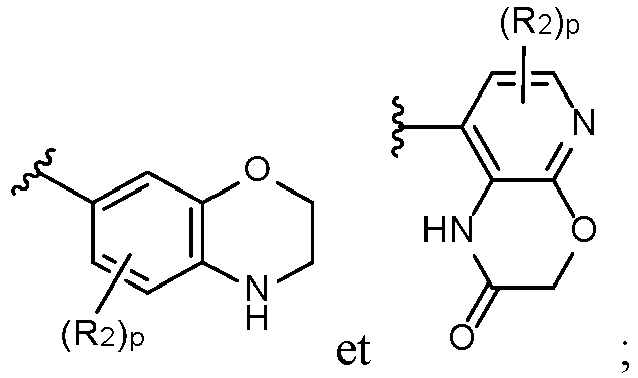 A est un pipéridinyle, phényle, pyridinyle, pyrimidinyle, 6-azabicyclo[3.2.1]octanyle ou azabicyclo[3.2.1]octanyle, chacun étant substitué par -L-R4 et zéro à 2 R4b ;L est une liaison, -CRxRx- ou -C(O)(CRxRx)0-2- ;R1 est un hydrogène, C1-3 alkyle, C1-2 fluoroalkyle ou C3-4 cycloalkyle ;chaque R2 est indépendamment : halo, -CN, -OH, -NO2, C1-4 alkyle, C1-2 fluoroalkyle, C1-2 cyanoalkyle, C1-3 hydroxyalkyle, C1-3 aminoalkyle, -O(CH2)1-2OH, -(CH2)0-4O(C1-4 alkyle), C1-3 fluoroalcoxy, -(CH2)1-4O(C1-3 alkyle), -O(CH2)1-2OC(O)(C1-3 alkyle), -O(CH2)1-2NRxRx, -C(O)O(C1-3 alkyle), -(CH2)0-2C(O)NRyRy, -C(O)NRx(C1-5 hydroxyalkyle), -C(O)NRx(C2-6 alcoxyalkyle), -C(O)NRx(C3-6 cycloalkyle), -NRyRy, -NRy(C1-3 fluoroalkyle), -NRy(C1-4 hydroxyalkyle), -NRxCH2(phényle), -NRxS(O)2(C3-6 cycloalkyle), -NRxC(O)(C1-3 alkyle), -NRxCH2(C3-6 cycloalkyle), -S(O)2(C1-3 alkyle), -S(O)2N(C1-3 alkyle)2, -S(O)(NH)N(C1-3 alkyle)2, -(CH2)0-2(C3-6 cycloalkyle), -(CH2)0-2(phényle), morpholinyle, dioxothiomorpholinyle, diméthylpyrazolyle, méthylpipéridinyle, méthylpipérazinyle, amino-oxadiazolyle, imidazolyle, triazolyle ou -C(O)(thiazolyle) ;R2a est un C1-6 alkyle, C1-3 fluoroalkyle, C1-6 hydroxyalkyle, C1-3 aminoalkyle, -(CH2)0-4O(C1-3 alkyle), C3-6 cycloalkyle, -(CH2)1-3C(O)NRxRx, -CH2(C3-6 cycloalkyle), -CH2(phényle), tétrahydrofuranyle, tétrahydropyranyle ou phényle ;chaque R2b est indépendamment : H, halo, -CN, -NRxRx, C1-6 alkyle, C1-3 fluoroalkyle, C1-3 hydroxyalkyle, C1-3 fluoroalcoxy, -(CH2)0-2O(C1-3 alkyle), -(CH2)0-3C(O)NRxRx, -(CH2)1-3(C3-6 cycloalkyle), -C(O)O(C1-3 alkyle), -C(O)NRx(C1-3 alkyle), -CRx=CRxRx ou -CRx=CH(C3-6 cycloalkyle) ;R2c est R2a ou R2b ;R2d est R2a ou R2b ; à condition que l'un de R2c et R2d soit R2a et l'autre de R2c et R2d soit R2b ;R3 est un hydrogène, F, C1-3 alkyle ou C3-4 cycloalkyle ;R4 est :(i) -N(CH3)2 ;(ii) un morpholinyle, pyrrolidinyle, pipéridinyle, pipérazinyle, pyridinyle, dioxothiomorpholinyle, azaspiro[3.3]heptanyle, azabicyclo[3.2.1]octanyle, diazabicyclo[2.2.2]octanyle ou diazabicyclo[3.2.1]octanyle, chacun étant substitué par zéro à 4 R4a ; ou(iii)
 chaque R4a est indépendamment : -OH, C1-6 alkyle, C1-3 fluoroalkyle, C3-6 cycloalkyle, -CH2(C3-6 cycloalkyle), -C(O)(C1-4 alkyle), -C(O)(C3-6 cycloalkyle), -C(O)(phényle), -C(O)CH2(C3-6 cycloalkyle), -C(O)CH2(phényle) ou -C(O)O(C1-4 alkyle) ;chaque R4b est indépendamment F, Cl ou -CH3 ;chaque R4c est indépendamment : -OH, C1-6 alkyle, C1-3 fluoroalkyle, -CH2(C3-6 cycloalkyle), -C(O)(C1-4 alkyle), -C(O)(phényle), -C(O)CH2(phényle), -C(O)OCH2CH3 ou C3-6 cycloalkyle ;chaque R5 est indépendamment : hydrogène, F, Cl, C1-3 alkyle, C1-3 hydroxyalkyle, C1-3 alcoxy, cyclopropyle ou morpholinyle ;chaque Rx est indépendamment H ou -CH3 ;chaque Ry est indépendamment H ou un C1-6 alkyle ;m est zéro, 1 ou 2 ;n est zéro, 1 ou 2 ; etp est zéro, 1, 2, 3 ou 4.
 - Composé selon la revendication 1 ou stéréoisomères, tautomère, solvates ou sels de celui-ci, présentant la structure de Formule (III) :

- Composé selon la revendication 1 ou stéréoisomères, tautomère, solvates ou sels de celui-ci, présentant la structure de Formule (IIIb) :

- Composé selon la revendication 1 ou stéréoisomères, tautomère, solvates ou sels de celui-ci, présentant la structure de Formule (IIa) :

- Composé selon la revendication 1 ou stéréoisomères, tautomère, solvates ou sels de celui-ci, ou sel de celui-ci, dans lequel :G est un phényle substitué par 1 à 2 substituants indépendamment choisis parmi : -OCH3, -S(O)2CH3, -S(O)2N(CH3)2 et -S(O)2(cyclopropyle) ;A est un pipéridinyle, phényle ou pyridinyle, chacun étant substitué par -L-R4 et zéro à 2 R4b ;L est une liaison, -CH2-, -C(O)-, -C(O)CH2- ou -C(O)CH2CH2- ;R1 est un hydrogène, -CH3, -CHF2 ou cyclopropyle ;R3 est un hydrogène, F, -CH3 ou cyclopropyle ;R4 est :(i) -N(CH3)2 ; ou(ii) un pyrrolidinyle, pipéridinyle, pipérazinyle ou pyridinyle, chacun étant substitué par zéro à 4 R4a ;chaque R4a est indépendamment : -OH, C1-6 alkyle, C1-3 fluoroalkyle, -CH2(C3-6 cycloalkyle), -C(O)(C1-4 alkyle), -C(O)(phényle), -C(O)CH2(phényle), -C(O)OCH2CH3 ou C3-6 cycloalkyle ;chaque R4b est indépendamment F, Cl ou -CH3 ;chaque R4c est indépendamment : C1-6 alkyle, C1-3 fluoroalkyle, -CH2(C3-6 cycloalkyle), -C(O)(C1-4 alkyle), -C(O)(phényle), -C(O)CH2(phényle), -C(O)OCH2CH3 ou C3-6 cycloalkyle ;chaque R5 est indépendamment : hydrogène, F, Cl, C1-3 alkyle, C1-3 hydroxyalkyle, C1-2 alcoxy, cyclopropyle ou morpholinyle ;m est zéro, 1 ou 2 ; etn est zéro, 1 ou 2.
- Composé selon la revendication 1 ou stéréoisomères, tautomère, solvates ou sels de celui-ci, dans lequel :G est un phényle substitué par 1 à 2 substituants indépendamment choisis parmi : -OCH3, -S(O)2CH3, -S(O)2N(CH3)2 et -S(O)2(cyclopropyle) ;A est un pipéridinyle, phényle ou pyridinyle, chacun étant substitué par -L-R4 et zéro à 2 R4b ;L est une liaison, -CH2-, -C(O)-, -C(O)CH2- ou -C(O)CH2CH2- ;R1 est un hydrogène ou -CH3 ;R3 est un hydrogène, F, -CH3 ou cyclopropyle ;R4 est :(i) -N(CH3)2 ; ou(ii) un pyrrolidinyle, pipéridinyle, pipérazinyle ou pyridinyle, chacun étant substitué par zéro à 4 R4a ;chaque R4a est indépendamment : -OH, -CH3, -CHCH3, -CH(CH3)2, -CH2CH(CH3)2, -C(CH3)3, -CH2C(CH3)3, -CH2CH2C(CH3)3, -CF3, -CH2CH2OH, -CH2CH2CH2OH, -CH2C(CH3)2OH, -CH2CH2C(CH3)2OH, -CH2CH2OCH3, -CH2(cyclopropyle), -C(O)CH3, -C(O)CH(CH3)2, -C(O)CH2CH3, -C(O)(phényle), -C(O)CH2(phényle), -C(O)OCH2CH3, -C(O)O(phényle), cyclopropyle, cyclobutyle, oxétanyle, tétrahydrofuranyle, tétrahydropyranyle, -(CH2)1-2(bromophényle) ou -(CH2)1-2(iodophényle) ;chaque R4b est F ; etchaque R5 est indépendamment un hydrogène, -CH3, -C(CH3)2OH, -OCH3 ou morpholinyle.
- Composé selon la revendication 1 ou stéréoisomères, tautomère, solvates ou sels de celui-ci, dans lequel :G est un phényle substitué par 1 à 2 substituants indépendamment choisis parmi : -OCH3, -S(O)2CH3, -S(O)2N(CH3)2 et -S(O)2(cyclopropyle) ;A est un pipéridinyle, phényle ou pyridinyle, chacun étant substitué par -L-R4 et zéro à 2 R4b ;L est une liaison, -CH2-, -C(O)-, -C(O)CH2- ou -C(O)CH2CH2- ;R1 est un hydrogène ou -CH3 ;R3 est un hydrogène, F, -CH3 ou cyclopropyle ;R4 est :(i) -N(CH3)2 ; ou(ii) un pyrrolidinyle, pipéridinyle, pipérazinyle ou pyridinyle, chacun étant substitué par zéro à 4 R4a ;chaque R4a est indépendamment : -OH, -CH3, -CHCH3, -CH(CH3)2, -CH2CH(CH3)2, -C(CH3)3, -CH2C(CH3)3, -CH2CH2C(CH3)3, -CF3, -CH2CH2OH, -CH2CH2CH2OH, -CH2C(CH3)2OH, -CH2CH2C(CH3)2OH, -CH2CH2OCH3, -CH2(cyclopropyle), -C(O)CH3, -C(O)CH(CH3)2, -C(O)CH2CH3, -C(O)(phényle), -C(O)CH2(phényle), -C(O)OCH2CH3, -C(O)O(phényle), cyclopropyle, cyclobutyle, oxétanyle, tétrahydrofuranyle, tétrahydropyranyle, -(CH2)1-2(bromophényle) ou -(CH2)1-2(iodophényle) ;chaque R4b est F ; etchaque R5 est indépendamment un hydrogène, -CH3, -C(CH3)2OH, -OCH3 ou morpholinyle.
- Composé selon la revendication 1 ou stéréoisomères, tautomère, solvates ou sels de celui-ci, dans lequel :X est N ;Y est C-A ;Q1 est R3 ;Q2 est G ;G est un phényle substitué par 1 à 2 substituants indépendamment choisis parmi : -OCH3, -S(O)2CH3, -S(O)2N(CH3)2 et -S(O)2(cyclopropyle) ;A est un pipéridinyle ou phényle, chacun étant substitué par -L-R4 et zéro à 2 R4b ;L est une liaison, -CH2- ou -C(O)CH2- ;R1 est -CH3 ;R3 est un hydrogène, F ou cyclopropyle ;R4 est un morpholinyle, pipéridinyle, pipérazinyle, pyridinyle, dioxothiomorpholinyle, azabicyclo[3.2.1]octanyle, diazabicyclo[2.2.2]octanyle ou diazabicyclo[3.2.1]octanyle, chacun étant substitué par zéro à 4 R4a ; ou(iii)
 chaque R4a est indépendamment : -OH, -CH3, -CHCH3, -CH(CH3)2, -CH2CH(CH3)2, -C(CH3)3, -CF3, -CH2CH2OH,-CH2CH2CH2OH, -CH2C(CH3)2OH, -CH2CH2C(CH3)2OH, -CH2CH2OCH3, -CH2(cyclopropyle), -C(O)CH3, -C(O)(phényle), -C(O)OCH2CH3, cyclopropyle, cyclobutyle, oxétanyle, tétrahydrofuranyle, tétrahydropyranyle, -(CH2)1-2(bromophényle) ou -(CH2)1-2(iodophényle) ;chaque R4b est F ; etchaque R5 est indépendamment : hydrogène, -CH3, -C(CH3)2OH, -OCH3 ou morpholinyle.
 - Composé selon la revendication 1 ou stéréoisomères, tautomère, solvates ou sels de celui-ci, où ledit composé est :3-(3,4-diméthoxyphényl)-5-(4-(4-isopropylpipérazin-1-yl)phényl)-2-méthyl-1H-pyrrolo[2,3-c]pyridine (2) ;1-(4-(4-(3-(3,4-diméthoxyphényl)-1,2-diméthyl-1H-pyrrolo[2,3-c]pyridin-5-yl)phényl)pipérazin-1-yl)-2-méthylpropan-2-ol (3) ;4-(3-(3,4-diméthoxyphényl)-2-méthyl-1H-pyrrolo[2,3-c]pyridin-5-yl)-[1,4'-bipipéridine]-1'-carboxylate de benzyle (4) ;(1-cyclopropylpipéridin-4-yl)(4-(3-(3,4-diméthoxyphényl)-2-méthyl-1H-pyrrolo[2,3-c]pyridin-5-yl)pipéridin-1-yl)méthanone (5) ;3-(3,4-diméthoxyphényl)-5-(1-(2,6-diméthylpyridin-4-yl)pipéridin-4-yl)-2-méthyl-1H-pyrrolo[2,3-c]pyridine (6) ;4-(2-(3,4-diméthoxyphényl)-1-méthyl-1H-pyrrolo[3,2-c]pyridin-6-yl)-[1,4'-bipipéridine]-1'-carboxylate d'éthyle (7) ;2-(3,4-diméthoxyphényl)-1-méthyl-6-(1-((6-méthylpyridin-3-yl)méthyl)pipéridin-4-yl)-1H-pyrrolo[3,2-c]pyridine (8) ;6-(4-(4-(cyclopropylméthyl)pipérazin-1-yl)phényl)-2-(3,4-diméthoxyphényl)-1-méthyl-1H-pyrrolo[3,2-c]pyridine (9) ;6-(4-(4-cyclobutylpipérazin-1-yl)phényl)-2-(3,4-diméthoxyphényl)-1-méthyl-1H-pyrrolo[3,2-c]pyridine (10) ;6-(4-(4-isopropylpipérazin-1-yl)phényl)-1,4-diméthyl-2-(4-(méthylsulfonyl)phényl)-1H-pyrrolo[3,2-c]pyridine (11) ;6-(3-fluoro-4-(4-isopropylpipérazin-1-yl)phényl)-1,4-diméthyl-2-(4-(méthylsulfonyl)phényl)-1H-pyrrolo[3,2-c]pyridine (12) ;(4-(3-(3,4-diméthoxyphényl)-2-méthyl-1H-pyrrolo[2,3-c]pyridin-5-yl)-[1,4'-bipipéridin]-1'-yl)(phényl)méthanone (14) ;1-(4-(3-(3,4-diméthoxyphényl)-2-méthyl-1H-pyrrolo[2,3-c]pyridin-5-yl)-[1,4'-bipipéridin]-1'-yl)-2-méthylpropan-1-one (15) ;1-(4-(3-(3,4-diméthoxyphényl)-2-méthyl-1H-pyrrolo[2,3-c]pyridin-5-yl)pipéridin-1-yl)-2-(pipéridin-1-yl)éthan-1-one (16) ;3-(3,4-diméthoxyphényl)-5-(1'-isobutyl-[1,4'-bipipéridin]-4-yl)-1,2-diméthyl-1H-pyrrolo[2,3-c]pyridine (17) ;1-(4-(3-(3,4-diméthoxyphényl)-1,2-diméthyl-1H-pyrrolo[2,3-c]pyridin-5-yl)-[1,4'-bipipéridin]-1'-yl)-2-méthylpropan-1-one (18) ;(4-(3-(3,4-diméthoxyphényl)-1,2-diméthyl-1H-pyrrolo[2,3-c]pyridin-5-yl)-[1,4'-bipipéridin]-1'-yl)(phényl)méthanone (19) ;4-(3-(3,4-diméthoxyphényl)-1,2-diméthyl-1H-pyrrolo[2,3-c]pyridin-5-yl)-[1,4'-bipipéridine]-1'-carboxylate d'éthyle (20) ;1-(4-(3-(3,4-diméthoxyphényl)-2-méthyl-1H-pyrrolo[2,3-c]pyridin-5-yl)pipéridin-1-yl)-2-(pyrrolidin-1-yl)éthan-1-one (21) ;1-(4-(3-(3,4-diméthoxyphényl)-2-méthyl-1H-pyrrolo[2,3-c]pyridin-5-yl)pipéridin-1-yl)-2-(diméthylamino)éthan-1-one (22) ;1-(4-(3-(3,4-diméthoxyphényl)-2-méthyl-1H-pyrrolo[2,3-c]pyridin-5-yl)pipéridin-1-yl)-3-(pyrrolidin-1-yl)propan-1-one (23) ;2-(3,4-diméthoxyphényl)-6-(4-(4-isopropylpipérazin-1-yl)phényl)-1-méthyl-1H-pyrrolo[3,2-c]pyridine (24) ;1-(4-(2-(3,4-diméthoxyphényl)-1-méthyl-1H-pyrrolo[3,2-c]pyridin-6-yl)pipéridin-1-yl)-2-(pipéridin-1-yl)éthan-1-one (25) ;(4-(2-(3,4-diméthoxyphényl)-1-méthyl-1H-pyrrolo[3,2-c]pyridin-6-yl)-[1,4'-bipipéridin]-1'-yl)(phényl)méthanone (26) ;2-(3,4-diméthoxyphényl)-1-méthyl-6-(4-(4-méthylpipérazin-1-yl)phényl)-1H-pyrrolo[3,2-c]pyridine (27) ;2-(3,4-diméthoxyphényl)-1-méthyl-6-(1-((6-(trifluorométhyl)pyridin-3-yl)méthyl)-pipéridin-4-yl)-1H-pyrrolo[3,2-c]pyridine (28) ;(4-(4-(2-(3,4-diméthoxyphényl)-1-méthyl-1H-pyrrolo[3,2-c]pyridin-6-yl)phényl)-pipérazin-1-yl)(phényl)méthanone (29) ;1-(4-(4-(2-(3,4-diméthoxyphényl)-1-méthyl-1H-pyrrolo[3,2-c]pyridin-6-yl)phényl)-pipérazin-1-yl)éthan-1-one (30) ;2-(3,4-diméthoxyphényl)-6-(6-(4-isopropylpipérazin-1-yl)pyridin-3-yl)-1-méthyl-1H-pyrrolo[3,2-c]pyridine (31) ;3-(3,4-diméthoxyphényl)-5-(4-(4-isopropylpipérazin-1-yl)phényl)-1,2-diméthyl-1H-pyrrolo[2,3-c]pyridine (32) ;4-(4-(4-(3-(3,4-diméthoxyphényl)-1,2-diméthyl-1H-pyrrolo[2,3-c]pyridin-5-yl)-phényl)pipérazin-1-yl)-2-méthylbutan-2-ol (33) ;6-(4-(4-isobutylpipérazin-1-yl)phényl)-1,4-diméthyl-2-(4-(méthylsulfonyl)phényl)-1H-pyrrolo[3,2-c]pyridine (34) ;1,4-diméthyl-2-(4-(méthylsulfonyl)phényl)-6-(4-(4-(tétrahydro-2H-pyran-4-yl)pipérazin-1-yl)phényl)-1H-pyrrolo[3,2-c]pyridine (35) ;3-(4-(4-(1,4-diméthyl-2-(4-(méthylsulfonyl)phényl)-1H-pyrrolo[3,2-c]pyridin-6-yl)-phényl)pipérazin-1-yl)propan-1-ol (36) ;1,4-diméthyl-2-(4-(méthylsulfonyl)phényl)-6-(4-(4-(tétrahydrofuran-3-yl)pipérazin-1-yl)phényl)-1H-pyrrolo[3,2-c]pyridine (37) ;6-(4-(4-(2-méthoxyéthyl)pipérazin-1-yl)phényl)-1,4-diméthyl-2-(4-(méthylsulfonyl)-phényl)-1H-pyrrolo[3,2-c]pyridine (38) ;6-(4-(4-isopropylpipérazin-1-yl)phényl)-1,4-diméthyl-2-(3-(méthylsulfonyl)phényl)-1H-pyrrolo[3,2-c]pyridine (39) ;6-(4-(4-isobutylpipérazin-1-yl)phényl)-1,4-diméthyl-2-(3-(méthylsulfonyl)phényl)-1H-pyrrolo[3,2-c]pyridine (40) ;3-(4-(4-(1,4-diméthyl-2-(4-(méthylsulfonyl)phényl)-1H-pyrrolo[3,2-c]pyridin-6-yl)-phényl)pipéridin-1-yl)propan-1-ol (41) ;2-(4-(cyclopropylsulfonyl)phényl)-6-(4-(4-isopropylpipérazin-1-yl)phényl)-1,4-diméthyl-1H-pyrrolo[3,2-c]pyridine (42) ;6-(2,5-difluoro-4-(pipérazin-1-yl)phényl)-1,4-diméthyl-2-(4-(méthylsulfonyl)phényl)-1H-pyrrolo[3,2-c]pyridine (43) ;1-(4-(4-(1,4-diméthyl-2-(4-(méthylsulfonyl)phényl)-1H-pyrrolo[3,2-c]pyridin-6-yl)-benzyl)pipérazin-1-yl)-2-méthylpropan-2-ol (44) ;3-((1R,4R)-5-(4-(1,4-diméthyl-2-(4-(méthylsulfonyl)phényl)-1H-pyrrolo[3,2-c]pyridin-6-yl)benzyl)-2,5-diazabicyclo[2.2.2]octan-2-yl)-2,2-diméthylpropan-1-ol (45) ;2-(4-(cyclopropylsulfonyl)phényl)-6-(4-(4-isobutylpipérazin-1-yl)phényl)-1,4-diméthyl-1H-pyrrolo[3,2-c]pyridine (46) ;3-(4-(4-(2-(4-(cyclopropylsulfonyl)phényl)-1,4-diméthyl-1H-pyrrolo[3,2-c]pyridin-6-yl)phényl)pipérazin-1-yl)propan-1-ol (47) ;2-(4-(cyclopropylsulfonyl)phényl)-6-(4-(4-(2-méthoxyéthyl)pipérazin-1-yl)phényl)-1,4-diméthyl-1H-pyrrolo[3,2-c]pyridine (48) ;4-(6-(4-(4-isopropylpipérazin-1-yl)phényl)-1,4-diméthyl-1H-pyrrolo[3,2-c]pyridin-2-yl)-N,N-diméthylbenzènesulfonamide (49) ;4-(1,4-diméthyl-6-(4-(4-(oxétan-3-yl)pipérazin-1-yl)phényl)-1H-pyrrolo[3,2-c]pyridin-2-yl)-N,N-diméthylbenzènesulfonamide (50) ;4-(6-(4-(4-(2-méthoxyéthyl)pipérazin-1-yl)phényl)-1,4-diméthyl-1H-pyrrolo[3,2-c]pyridin-2-yl)-N,N-diméthylbenzènesulfonamide (51) ;4-(1,4-diméthyl-6-(4-(4-(tétrahydrofuran-3-yl)pipérazin-1-yl)phényl)-1H-pyrrolo[3,2-c]pyridin-2-yl)-N,N-diméthylbenzènesulfonamide (52) ;6-(4-(4-isobutylpipérazin-1-yl)phényl)-1-méthyl-2-(4-(méthylsulfonyl)phényl)-1H-pyrrolo[3,2-c]pyridine (53) ;6-(4-(4-isopropylpipérazin-1-yl)phényl)-1-méthyl-2-(4-(méthylsulfonyl)phényl)-1H-pyrrolo[3,2-c]pyridine (54) ;3-(4-(4-(1,4-diméthyl-2-(4-(méthylsulfonyl)phényl)-1H-pyrrolo[3,2-c]pyridin-6-yl)-2,3-difluorophényl)pipérazin-1-yl)propan-1-ol (55) ;3-(4-(4-(1,4-diméthyl-2-(4-(méthylsulfonyl)phényl)-1H-pyrrolo[3,2-c]pyridin-6-yl)-2,5-difluorophényl)pipérazin-1-yl)propan-1-ol (56) ;6-(4-((4-isobutylpipérazin-1-yl)méthyl)phényl)-1,4-diméthyl-2-(4-(méthylsulfonyl)-phényl)-1H-pyrrolo[3,2-c]pyridine (57) ;3-(4-(4-(1,4-diméthyl-2-(4-(méthylsulfonyl)phényl)-1H-pyrrolo[3,2-c]pyridin-6-yl)-benzyl)pipérazin-1-yl)propan-1-ol (58) ;1-(4-(1,4-diméthyl-2-(4-(méthylsulfonyl)phényl)-1H-pyrrolo[3,2-c]pyridin-6-yl)benzyl)-4-méthylpipéridin-4-ol (59) ;4-(4-(4-(1,4-diméthyl-2-(4-(méthylsulfonyl)phényl)-1H-pyrrolo[3,2-c]pyridin-6-yl)-benzyl)pipérazin-1-yl)-2-méthylbutan-2-ol (60) ;4-((1S,4S)-5-(4-(1,4-diméthyl-2-(4-(méthylsulfonyl)phényl)-1H-pyrrolo[3,2-c]pyridin-6-yl)benzyl)-2,5-diazabicyclo[2.2.2]octan-2-yl)-2-méthylbutan-2-ol (61) ;6-(4-(4-cyclopropylpipérazin-1-yl)phényl)-1,4-diméthyl-2-(4-(méthylsulfonyl)phényl)-1H-pyrrolo[3,2-c]pyridine (62) ;6-(4-(hexahydropyrrolo[1,2-a]pyrazin-2(1H)-yl)phényl)-1,4-diméthyl-2-(4-(méthylsulfonyl)phényl)-1H-pyrrolo[3,2-c]pyridine (63) ;6-(4-(8-isopropyl-3,8-diazabicyclo[3.2.1]octan-3-yl)phényl)-1,4-diméthyl-2-(4-(méthylsulfonyl)phényl)-1H-pyrrolo[3,2-c]pyridine (64) ;6-(3-fluoro-4-(hexahydropyrrolo[1,2-a]pyrazin-2(1H)-yl)phényl)-1,4-diméthyl-2-(4-(méthylsulfonyl)phényl)-1H-pyrrolo[3,2-c]pyridine (65) ;6-(3-fluoro-4-(4-(2-méthoxyéthyl)pipérazin-1-yl)phényl)-1,4-diméthyl-2-(4-(méthylsulfonyl)phényl)-1H-pyrrolo[3,2-c]pyridine (66) ;6-(3-(4-isopropylpipérazin-1-yl)phényl)-1,4-diméthyl-2-(4-(méthylsulfonyl)phényl)-1H-pyrrolo[3,2-c]pyridine (67) ;6-(3-(4-cyclopropylpipérazin-1-yl)phényl)-1,4-diméthyl-2-(4-(méthylsulfonyl)phényl)-1H-pyrrolo[3,2-c]pyridine (68) ;2-(4-(4-(1,4-diméthyl-2-(4-(méthylsulfonyl)phényl)-1H-pyrrolo[3,2-c]pyridin-6-yl)-2-fluorophényl)pipérazin-1-yl)éthan-1-ol (69) ;6-(3-fluoro-4-(4-(tétrahydrofuran-3-yl)pipérazin-1-yl)phényl)-1,4-diméthyl-2-(4-(méthylsulfonyl)phényl)-1H-pyrrolo[3,2-c]pyridine (70) ;6-(3-fluoro-4-(4-(tétrahydro-2H-pyran-4-yl)pipérazin-1-yl)phényl)-1,4-diméthyl-2-(4-(méthylsulfonyl)phényl)-1H-pyrrolo[3,2-c]pyridine (71) ;6-(3-fluoro-4-(4-isobutylpipérazin-1-yl)phényl)-1,4-diméthyl-2-(4-(méthylsulfonyl)-phényl)-1H-pyrrolo[3,2-c]pyridine (72) ;6-(4-(8-isobutyl-3,8-diazabicyclo[3.2.1]octan-3-yl)phényl)-1,4-diméthyl-2-(4-(méthylsulfonyl)phényl)-1H-pyrrolo[3,2-c]pyridine (73) ;6-(4-(8-(2-méthoxyéthyl)-3,8-diazabicyclo[3.2.1]octan-3-yl)phényl)-1,4-diméthyl-2-(4-(méthylsulfonyl)phényl)-1H-pyrrolo[3,2-c]pyridine (74) ;6-(3-fluoro-4-(8-(2-méthoxyéthyl)-3,8-diazabicyclo[3.2.1]octan-3-yl)phényl)-1,4-diméthyl-2-(4-(méthylsulfonyl)phényl)-1H-pyrrolo[3,2-c]pyridine (75) ;3-(3-(4-(1,4-diméthyl-2-(4-(méthylsulfonyl)phényl)-1H-pyrrolo[3,2-c]pyridin-6-yl)-phényl)-3,8-diazabicyclo[3.2.1]octan-8-yl)propan-1-ol (76) ;3-(3-(4-(1,4-diméthyl-2-(4-(méthylsulfonyl)phényl)-1H-pyrrolo[3,2-c]pyridin-6-yl)-2-fluorophényl)-3,8-diazabicyclo[3.2.1]octan-8-yl)propan-1-ol (77) ;6-(2,5-difluoro-4-(8-(2-méthoxyéthyl)-3,8-diazabicyclo[3.2.1]octan-3-yl)phényl)-1,4-diméthyl-2-(4-(méthylsulfonyl)phényl)-1H-pyrrolo[3,2-c]pyridine (78) ;3-(3-(4-(1,4-diméthyl-2-(4-(méthylsulfonyl)phényl)-1H-pyrrolo[3,2-c]pyridin-6-yl)-2,5-difluorophényl)-3,8-diazabicyclo[3.2.1]octan-8-yl)propan-1-ol (79-80) ;6-(2,5-difluoro-4-(4-(tétrahydro-2H-pyran-4-yl)pipérazin-1-yl)phényl)-1,4-diméthyl-2-(4-(méthylsulfonyl)phényl)-1H-pyrrolo[3,2-c]pyridine (81) ;6-(2,3-difluoro-4-(4-isobutylpipérazin-1-yl)phényl)-1,4-diméthyl-2-(4-(méthylsulfonyl)phényl)-1H-pyrrolo[3,2-c]pyridine (82) ;6-(2,3-difluoro-4-(4-(tétrahydro-2H-pyran-4-yl)pipérazin-1-yl)phényl)-1,4-diméthyl-2-(4-(méthylsulfonyl)phényl)-1H-pyrrolo[3,2-c]pyridine (83) ;6-(3,5-difluoro-4-(4-isobutylpipérazin-1-yl)phényl)-1,4-diméthyl-2-(4-(méthylsulfonyl)phényl)-1H-pyrrolo[3,2-c]pyridine (84) ;4-(4-(1,4-diméthyl-2-(4-(méthylsulfonyl)phényl)-1H-pyrrolo[3,2-c]pyridin-6-yl)-phényl)thiomorpholine 1,1-dioxyde (85) ;4-(4-(1,4-diméthyl-2-(4-(méthylsulfonyl)phényl)-1H-pyrrolo[3,2-c]pyridin-6-yl)-phényl)morpholine (86) ;1-cyclopropyl-4-(4-(1,4-diméthyl-2-(4-(méthylsulfonyl)phényl)-1H-pyrrolo[3,2-c]pyridin-6-yl)phényl)pipéridin-4-ol (87) ;4-(4-(1,4-diméthyl-2-(4-(méthylsulfonyl)phényl)-1H-pyrrolo[3,2-c]pyridin-6-yl)phényl)-1-isopropylpipéridin-4-ol (88) ;6-(3,5-difluoro-4-(4-(tétrahydro-2H-pyran-4-yl)pipérazin-1-yl)phényl)-1,4-diméthyl-2-(4-(méthylsulfonyl)phényl)-1H-pyrrolo[3,2-c]pyridine (89) ;4-(4-(1,4-diméthyl-2-(4-(méthylsulfonyl)phényl)-1H-pyrrolo[3,2-c]pyridin-6-yl)-2-fluorophényl)-1-isobutylpipéridin-4-ol (90) ;(1R,3r,5S)-3-(4-(1,4-diméthyl-2-(4-(méthylsulfonyl)phényl)-1H-pyrrolo[3,2-c]pyridin-6-yl)-2-fluorophényl)-8-isobutyl-8-azabicyclo[3.2.1]octan-3-ol (91) ;4-(4-(1,4-diméthyl-2-(4-(méthylsulfonyl)phényl)-1H-pyrrolo[3,2-c]pyridin-6-yl)-2-fluorophényl)-1-(2-méthoxyéthyl)pipéridin-4-ol (92) ;1-cyclopropyl-4-(4-(1,4-diméthyl-2-(4-(méthylsulfonyl)phényl)-1H-pyrrolo[3,2-c]pyridin-6-yl)-2-fluorophényl)pipéridin-4-ol (93) ;4-(4-(1,4-diméthyl-2-(4-(méthylsulfonyl)phényl)-1H-pyrrolo[3,2-c]pyridin-6-yl)-2,5-difluorophényl)-1-isobutylpipéridin-4-ol (94) ;4-(4-(1,4-diméthyl-2-(4-(méthylsulfonyl)phényl)-1H-pyrrolo[3,2-c]pyridin-6-yl)-2,5-difluorophényl)-1-(2-méthoxyéthyl)pipéridin-4-ol (95) ;1-cyclopropyl-4-(4-(1,4-diméthyl-2-(4-(méthylsulfonyl)phényl)-1H-pyrrolo[3,2-c]pyridin-6-yl)-2,5-difluorophényl)pipéridin-4-ol (96) ;6-(2,5-difluoro-4-(hexahydropyrrolo[1,2-a]pyrazin-2(1H)-yl)phényl)-1,4-diméthyl-2-(4-(méthylsulfonyl)phényl)-1H-pyrrolo[3,2-c]pyridine (97) ;6-(3,5-difluoro-4-(hexahydropyrrolo[1,2-a]pyrazin-2(1H)-yl)phényl)-1,4-diméthyl-2-(4-(méthylsulfonyl)phényl)-1H-pyrrolo[3,2-c]pyridine (98) ;6-(2,3-difluoro-4-(hexahydropyrrolo[1,2-a]pyrazin-2(1H)-yl)phényl)-1,4-diméthyl-2-(4-(méthylsulfonyl)phényl)-1H-pyrrolo[3,2-c]pyridine (99) ;(1R,3r,5S)-3-(4-(1,4-diméthyl-2-(4-(méthylsulfonyl)phényl)-1H-pyrrolo[3,2-c]pyridin-6-yl)-2-fluorophényl)-8-isopropyl-8-azabicyclo[3.2.1]octan-3-ol (100) ;(1R,3r,5S)-3-(4-(1,4-diméthyl-2-(4-(méthylsulfonyl)phényl)-1H-pyrrolo[3,2-c]pyridin-6-yl)-2-fluorophényl)-8-éthyl-8-azabicyclo[3.2.1]octan-3-ol (101) ;(1R,3r,5S)-3-(4-(1,4-diméthyl-2-(4-(méthylsulfonyl)phényl)-1H-pyrrolo[3,2-c]pyridin-6-yl)-2-fluorophényl)-8-méthyl-8-azabicyclo[3.2.1]octan-3-ol (102) ;(1R,3r,5S)-3-(4-(1,4-diméthyl-2-(4-(méthylsulfonyl)phényl)-1H-pyrrolo[3,2-c]pyridin-6-yl)-3-fluorophényl)-8-isopropyl-8-azabicyclo[3.2.1]octan-3-ol (103) ;1-(tert-butyl)-4-(4-(1,4-diméthyl-2-(4-(méthylsulfonyl)phényl)-1H-pyrrolo[3,2-c]pyridin-6-yl)-2-fluorophényl)pipéridin-4-ol (104) ;(R)-4-(4-(1,4-diméthyl-2-(4-(méthylsulfonyl)phényl)-1H-pyrrolo[3,2-c]pyridin-6-yl)-2-fluorophényl)-1-isopropyl-2,2-diméthylpipéridin-4-ol (105) ;(S)-4-(4-(1,4-diméthyl-2-(4-(méthylsulfonyl)phényl)-1H-pyrrolo[3,2-c]pyridin-6-yl)-2-fluorophényl)-1-isopropyl-2,2-diméthylpipéridin-4-ol (106) ;4-(4-(1,4-diméthyl-2-(4-(méthylsulfonyl)phényl)-1H-pyrrolo[3,2-c]pyridin-6-yl)-2-fluorophényl)-1-isopropylpipéridin-4-ol (107) ;1-(tert-butyl)-4-(4-(1,4-diméthyl-2-(4-(méthylsulfonyl)phényl)-1H-pyrrolo[3,2-c]pyridin-6-yl)-3-fluorophényl)pipéridin-4-ol (108) ;4-(4-(1,4-diméthyl-2-(4-(méthylsulfonyl)phényl)-1H-pyrrolo[3,2-c]pyridin-6-yl)-3-fluorophényl)-1-isopropylpipéridin-4-ol (109) ;6-(4-(4-(4-iodophénéthyl)pipérazin-1-yl)phényl)-1,4-diméthyl-2-(4-(méthylsulfonyl)-phényl)-1H-pyrrolo[3,2-c]pyridine (110) ;6-(4-(4-(4-bromophénéthyl)pipérazin-1-yl)phényl)-1,4-diméthyl-2-(4-(méthylsulfonyl)phényl)-1H-pyrrolo[3,2-c]pyridine (111) ;6-(4-(4-(4-iodobenzyl)pipérazin-1-yl)phényl)-1,4-diméthyl-2-(4-(méthylsulfonyl)-phényl)-1H-pyrrolo[3,2-c]pyridine (112) ;6-(4-(4-(4-bromobenzyl)pipérazin-1-yl)phényl)-1,4-diméthyl-2-(4-(méthylsulfonyl)-phényl)-1H-pyrrolo[3,2-c]pyridine (113) ;6-(1-(8-isobutyl-8-azabicyclo[3.2.1]octan-3-yl)pipéridin-4-yl)-1,4-diméthyl-2-(4-(méthylsulfonyl)phényl)-1H-pyrrolo[3,2-c]pyridine (114) ;4-(4-(4-(3-fluoro-1,4-diméthyl-2-(4-(méthylsulfonyl)phényl)-1H-pyrrolo[3,2-c]pyridin-6-yl)benzyl)pipérazin-1-yl)-2-méthylbutan-2-ol (115) ;4-[4-[[4-[1-cyclopropyl-4-méthyl-2-(4-méthylsulfonylphényl)pyrrolo[3,2-c]pyridin-6-yl]phényl]méthyl]pipérazin-1-yl]-2-méthyl-butan-2-ol (116) ;4-[4-[[4-[1-(difluorométhyl)-4-méthyl-2-(4-méthylsulfonylphényl)pyrrolo[3,2-c]pyridin-6-yl]phényl]méthyl]pipérazin-1-yl]-2-méthyl-butan-2-ol (117) ;2-[6-[4-(4-isopropylpipérazin-1-yl)phényl]-1-méthyl-2-(4-méthylsulfonylphényl)-pyrrolo[3,2-c]pyridin-4-yl]propan-2-ol (118) ;6-[4-(4-isopropylpipérazin-1-yl)phényl]-4-méthoxy-1-méthyl-2-(4-méthylsulfonylphényl)pyrrolo[3,2-c]pyridine (119) ;4-[6-[4-(4-isopropylpipérazin-1-yl)phényl]-1-méthyl-2-(4-méthylsulfonylphényl)-pyrrolo[3,2-c]pyridin-4-yl]morpholine (120) ;1-[3-[[4-[1-cyclopropyl-2-(4-méthylsulfonylphényl)pyrrolo[3,2-c]pyridin-6-yl]phényl]méthyl]-3,8-diazabicyclo[3.2.1]octan-8-yl]-2-méthyl-propan-2-ol (121) ;1-(4-(4-(3-fluoro-1,4-diméthyl-2-(4-(méthylsulfonyl)phényl)-1H-pyrrolo[3,2-c]pyridin-6-yl)benzyl)pipérazin-1-yl)-2-méthylpropan-2-ol (122) ;1-(4-(4-(1-cyclopropyl-4-méthyl-2-(4-(méthylsulfonyl)phényl)-1H-pyrrolo[3,2-c]pyridin-6-yl)benzyl)pipérazin-1-yl)-2-méthylpropan-2-ol (123) ;1-(4-(4-(1-(difluorométhyl)-4-méthyl-2-(4-(méthylsulfonyl)phényl)-1H-pyrrolo[3,2-c]pyridin-6-yl)benzyl)pipérazin-1-yl)-2-méthylpropan-2-ol (124) ;2-(6-(4-((4-isopropylpipérazin-1-yl)méthyl)phényl)-1-méthyl-2-(4-(méthylsulfonyl)-phényl)-1H-pyrrolo[3,2-c]pyridin-4-yl)propan-2-ol (125) ;6-(4-((4-isopropylpipérazin-1-yl)méthyl)phényl)-4-méthoxy-1-méthyl-2-(4-(méthylsulfonyl)phényl)-1H-pyrrolo[3,2-c]pyridine (126) ;4-(6-(4-((4-isopropylpipérazin-1-yl)méthyl)phényl)-1-méthyl-2-(4-(méthylsulfonyl)-phényl)-1H-pyrrolo[3,2-c]pyridin-4-yl)morpholine (127) ;1-(4-(4-(1-cyclopropyl-2-(4-(méthylsulfonyl)phényl)-1H-pyrrolo[3,2-c]pyridin-6-yl)-benzyl)pipérazin-1-yl)-2-méthylpropan-2-ol (128) ;4-(4-(4-(1-cyclopropyl-2-(4-(méthylsulfonyl)phényl)-1H-pyrrolo[3,2-c]pyridin-6-yl)-benzyl)pipérazin-1-yl)-2-méthylbutan-2-ol (129) ; ou1-(8-(4-(1-cyclopropyl-2-(4-(méthylsulfonyl)phényl)-1H-pyrrolo[3,2-c]pyridin-6-yl)-benzyl)-3,8-diazabicyclo[3.2.1]octan-3-yl)-2-méthylpropan-2-ol (130).
- Composition pharmaceutique comprenant un ou plusieurs composés selon l'une quelconque des revendications 1 à 9 ou stéréoisomères, tautomère, solvates ou sels pharmaceutiquement acceptables de celui-ci ; et un véhicule pharmaceutiquement acceptable.
- Composé selon l'une quelconque des revendications 1 à 9 ou stéréoisomères, tautomères, solvates ou sels pharmaceutiquement acceptables de celui-ci ou composition pharmaceutique selon la revendication 10, pour utilisation dans le traitement d'une fibrose pathologique.
- Composé ou stéréoisomères, tautomères, solvates ou sel pharmaceutiquement acceptable de celui-ci ou sels pharmaceutiquement acceptables de celui-ci ou composition pharmaceutique, pour utilisation selon la revendication 11, où ladite fibrose pathologique est une fibrose du foie, une fibrose rénale, une fibrose biliaire ou une fibrose pancréatique.
- Composé selon l'une quelconque des revendications 1 à 9 ou stéréoisomères, tautomères, solvates ou sels pharmaceutiquement acceptables de celui-ci ou composition pharmaceutique selon la revendication 10, pour utilisation dans le traitement d'une stéatohépatite non alcoolique (NASH), d'une maladie du foie gras non alcoolique (NAFLD), d'une maladie du rein chronique, d'une maladie du rein diabétique, d'une cholangite sclérosante primitive (PSC) ou d'une cirrhose biliaire primitive (PBC).
- Composé selon l'une quelconque des revendications 1 à 9 ou stéréoisomères, tautomères, solvates ou sels pharmaceutiquement acceptables de celui-ci ou composition pharmaceutique selon la revendication 10, pour utilisation dans le traitement d'une fibrose pulmonaire idiopathique (IPF).
Applications Claiming Priority (2)
| Application Number | Priority Date | Filing Date | Title |
|---|---|---|---|
| US202063067465P | 2020-08-19 | 2020-08-19 | |
| PCT/US2021/046434 WO2022040267A1 (fr) | 2020-08-19 | 2021-08-18 | Dérivés de 1h-pyrrolo[3,2-c]pyridine et de 1h-pyrrolo[2,3-c]pyridine en tant qu'inhibiteurs de tlr9 pour le traitement de la fibrose |
Publications (2)
| Publication Number | Publication Date |
|---|---|
| EP4200298A1 EP4200298A1 (fr) | 2023-06-28 |
| EP4200298B1 true EP4200298B1 (fr) | 2025-05-21 |
Family
ID=77711459
Family Applications (1)
| Application Number | Title | Priority Date | Filing Date |
|---|---|---|---|
| EP21769261.5A Active EP4200298B1 (fr) | 2020-08-19 | 2021-08-18 | Dérivés de 1h-pyrrolo[3,2-c]pyridine and 1h-pyrrolo[2,3-c]pyridine en tant qu'inhibiteurs tlr9 pour le traitement de fibrose |
Country Status (14)
| Country | Link |
|---|---|
| US (1) | US12590091B2 (fr) |
| EP (1) | EP4200298B1 (fr) |
| JP (1) | JP2023538608A (fr) |
| KR (1) | KR20230053646A (fr) |
| CN (1) | CN115867549A (fr) |
| AR (1) | AR123285A1 (fr) |
| AU (1) | AU2021328577A1 (fr) |
| BR (1) | BR112023002646A2 (fr) |
| CA (1) | CA3189826A1 (fr) |
| ES (1) | ES3034264T3 (fr) |
| IL (1) | IL300643A (fr) |
| MX (1) | MX2023001929A (fr) |
| TW (1) | TW202214233A (fr) |
| WO (1) | WO2022040267A1 (fr) |
Families Citing this family (7)
| Publication number | Priority date | Publication date | Assignee | Title |
|---|---|---|---|---|
| US11807622B2 (en) | 2019-01-30 | 2023-11-07 | Insilico Medicine Ip Limited | TLR 9 inhibitors |
| KR20240148414A (ko) * | 2022-02-18 | 2024-10-11 | 브리스톨-마이어스 스큅 컴퍼니 | Tlr9의 억제제로서 유용한 치환된 이미다조피리디닐 화합물 |
| WO2024102886A1 (fr) * | 2022-11-10 | 2024-05-16 | Bristol-Myers Squibb Company | Composés de benzimidazole substitués utiles en tant qu'inhibiteurs de tlr9 |
| CN120152957A (zh) * | 2022-11-10 | 2025-06-13 | 百时美施贵宝公司 | 用作tlr9抑制剂的经取代的喹诺酮 |
| WO2024163380A1 (fr) * | 2023-01-31 | 2024-08-08 | Bristol-Myers Squibb Company | Composés de benzimidazole substitués utiles en tant qu'inhibiteurs de tlr9 |
| IL324670A (en) | 2023-06-30 | 2026-01-01 | Bristol Myers Squibb Co | KRAS inhibitors |
| WO2026039512A1 (fr) | 2024-08-14 | 2026-02-19 | Bristol-Myers Squibb Company | Inhibiteurs de kras |
Family Cites Families (27)
| Publication number | Priority date | Publication date | Assignee | Title |
|---|---|---|---|---|
| WO2007115306A2 (fr) | 2006-04-04 | 2007-10-11 | Myriad Genetics, Inc. | Composés pour le traitement de maladies et de troubles |
| US20060235037A1 (en) | 2005-04-15 | 2006-10-19 | Purandare Ashok V | Heterocyclic inhibitors of protein arginine methyl transferases |
| GB0602178D0 (en) | 2006-02-03 | 2006-03-15 | Merck Sharp & Dohme | Therapeutic treatment |
| CA2738929A1 (fr) | 2008-10-17 | 2010-04-22 | Boehringer Ingelheim International Gmbh | Composes indole a substitution heteroaryle utilises comme inhibiteurs de mmp-13 |
| US20130158049A1 (en) | 2011-12-20 | 2013-06-20 | Hoffmann-La Roche Inc. | 7-azaindole inhibitors of crac |
| US20130158066A1 (en) | 2011-12-20 | 2013-06-20 | Hoffmann-La Roche Inc. | 4-azaindole inhibitors of crac |
| WO2013156431A1 (fr) | 2012-04-17 | 2013-10-24 | Syngenta Participations Ag | Dérivés de thiazole et de thiadiazole substitués par pyridyle et pyrimidyle, actifs en tant que pesticides |
| EP2738172A1 (fr) | 2012-11-28 | 2014-06-04 | Almirall, S.A. | Nouveaux composés bicycliques utilisés comme modulateurs du canal crac |
| EP3080124A1 (fr) * | 2013-12-13 | 2016-10-19 | Takeda Pharmaceutical Company Limited | Dérivés de pyrrolo[3,2-c]pyridine comme inhibiteurs de tlr |
| AR107032A1 (es) | 2015-12-09 | 2018-03-14 | Padlock Therapeutics Inc | Inhibidores bicíclicos de pad4 |
| US10071079B2 (en) | 2016-06-29 | 2018-09-11 | Bristol-Myers Squibb Company | [1,2,4]triazolo[1,5-a]pyridinyl substituted indole compounds |
| MX391344B (es) | 2016-07-30 | 2025-03-21 | Bristol Myers Squibb Co | Compuestos indol sustituidos con dimetoxifenilo como inhibidores de receptores tipo toll 7, 8 o 9 (tlr7, tlr8 o tlr9). |
| KR102519535B1 (ko) | 2016-09-09 | 2023-04-06 | 브리스톨-마이어스 스큅 컴퍼니 | 피리딜 치환된 인돌 화합물 |
| US11370794B2 (en) * | 2016-11-11 | 2022-06-28 | Dynavax Technologies Corporation | Toll-like receptor antagonist compounds and methods of use |
| CN110891949B (zh) | 2017-07-05 | 2023-05-23 | 先正达参股股份有限公司 | 具有含硫取代基的杀有害生物活性杂环衍生物 |
| CN110997656B (zh) | 2017-08-04 | 2023-04-14 | 百时美施贵宝公司 | 用作tlr7/8/9抑制剂的取代的吲哚化合物 |
| ES2921020T3 (es) | 2017-08-04 | 2022-08-16 | Bristol Myers Squibb Co | Compuestos de indol sustituidos con [1,2,4]triazolo[4,3-a]piridinilo |
| CN111448190B (zh) | 2017-11-14 | 2023-09-26 | 百时美施贵宝公司 | 取代的吲哚化合物 |
| BR112020011668A2 (pt) | 2017-12-15 | 2020-11-17 | Bristol-Myers Squibb Company | compostos de éter de indol substituído |
| FI3728252T3 (fi) | 2017-12-18 | 2023-10-18 | Bristol Myers Squibb Co | 4-atsaindoliyhdisteitä |
| JP7313354B2 (ja) | 2017-12-19 | 2023-07-24 | ブリストル-マイヤーズ スクイブ カンパニー | Tlr阻害剤として有用なアミド置換されたインドール化合物 |
| WO2019126082A1 (fr) | 2017-12-19 | 2019-06-27 | Bristol-Myers Squibb Company | Composés de 6-azaindole |
| BR112020012084A2 (pt) | 2017-12-19 | 2020-11-24 | Bristol-Myers Squibb Company | compostos de indol substituído úteis como inibidores de tlr |
| CA3085942A1 (fr) | 2017-12-20 | 2019-06-27 | Bristol-Myers Squibb Company | Composes d'indole a substitution aryle et heteroaryle |
| US11299501B2 (en) | 2017-12-20 | 2022-04-12 | Bristol-Myers Squibb Company | Diazaindole compounds |
| BR112020011984A2 (pt) | 2017-12-20 | 2020-11-17 | Bristol-Myers Squibb Company | compostos de amino indol úteis como inibidores de tlr |
| MX2021001565A (es) | 2018-08-08 | 2021-04-19 | Bristol Myers Squibb Co | Inhibidores tipo indol y azaindol de enzimas peptidil arginina deiminasas (pad). |
-
2021
- 2021-08-18 AU AU2021328577A patent/AU2021328577A1/en not_active Abandoned
- 2021-08-18 KR KR1020237009022A patent/KR20230053646A/ko active Pending
- 2021-08-18 BR BR112023002646A patent/BR112023002646A2/pt not_active Application Discontinuation
- 2021-08-18 CN CN202180050340.3A patent/CN115867549A/zh active Pending
- 2021-08-18 MX MX2023001929A patent/MX2023001929A/es unknown
- 2021-08-18 TW TW110130428A patent/TW202214233A/zh unknown
- 2021-08-18 WO PCT/US2021/046434 patent/WO2022040267A1/fr not_active Ceased
- 2021-08-18 AR ARP210102329A patent/AR123285A1/es not_active Application Discontinuation
- 2021-08-18 US US18/042,069 patent/US12590091B2/en active Active
- 2021-08-18 ES ES21769261T patent/ES3034264T3/es active Active
- 2021-08-18 IL IL300643A patent/IL300643A/en unknown
- 2021-08-18 EP EP21769261.5A patent/EP4200298B1/fr active Active
- 2021-08-18 JP JP2023512162A patent/JP2023538608A/ja active Pending
- 2021-08-18 CA CA3189826A patent/CA3189826A1/fr active Pending
Also Published As
| Publication number | Publication date |
|---|---|
| US20230312565A1 (en) | 2023-10-05 |
| AU2021328577A1 (en) | 2023-03-23 |
| JP2023538608A (ja) | 2023-09-08 |
| KR20230053646A (ko) | 2023-04-21 |
| US12590091B2 (en) | 2026-03-31 |
| AR123285A1 (es) | 2022-11-16 |
| IL300643A (en) | 2023-04-01 |
| ES3034264T3 (en) | 2025-08-14 |
| TW202214233A (zh) | 2022-04-16 |
| MX2023001929A (es) | 2023-03-09 |
| CN115867549A (zh) | 2023-03-28 |
| WO2022040267A1 (fr) | 2022-02-24 |
| CA3189826A1 (fr) | 2022-02-24 |
| BR112023002646A2 (pt) | 2023-04-04 |
| EP4200298A1 (fr) | 2023-06-28 |
Similar Documents
| Publication | Publication Date | Title |
|---|---|---|
| EP4200298B1 (fr) | Dérivés de 1h-pyrrolo[3,2-c]pyridine and 1h-pyrrolo[2,3-c]pyridine en tant qu'inhibiteurs tlr9 pour le traitement de fibrose | |
| EP4200015B1 (fr) | Composés hétéroaryles substitués utiles en tant qu'inhibiteurs de tlr9 | |
| EP4200292B1 (fr) | Dérivés de 1h-benzo[d]imidazole en tant qu'inhibiteurs tlr9 pour le traitement de fibrose | |
| JP7813775B2 (ja) | 線維症の処置のためのtlr9の阻害剤としてのイミダゾ[1,2-a]ピリジンおよび[1,2,4]トリアゾロ[1,5-a]ピリジン誘導体 | |
| EA050843B1 (ru) | Замещенные гетероарильные соединения, пригодные для применения в качестве ингибиторов tlr9 | |
| WO2023159153A1 (fr) | Composés hétéroaryle bicycliques substitués utiles en tant qu'inhibiteurs de tlr9 | |
| KR20240148414A (ko) | Tlr9의 억제제로서 유용한 치환된 이미다조피리디닐 화합물 | |
| EA047759B1 (ru) | Замещенные гетероарильные соединения, пригодные для применения в качестве ингибиторов tlr9 | |
| EP4615572A1 (fr) | Composés de benzimidazole substitués utiles en tant qu'inhibiteurs de tlr9 |
Legal Events
| Date | Code | Title | Description |
|---|---|---|---|
| STAA | Information on the status of an ep patent application or granted ep patent |
Free format text: STATUS: UNKNOWN |
|
| STAA | Information on the status of an ep patent application or granted ep patent |
Free format text: STATUS: THE INTERNATIONAL PUBLICATION HAS BEEN MADE |
|
| PUAI | Public reference made under article 153(3) epc to a published international application that has entered the european phase |
Free format text: ORIGINAL CODE: 0009012 |
|
| STAA | Information on the status of an ep patent application or granted ep patent |
Free format text: STATUS: REQUEST FOR EXAMINATION WAS MADE |
|
| 17P | Request for examination filed |
Effective date: 20230317 |
|
| AK | Designated contracting states |
Kind code of ref document: A1 Designated state(s): AL AT BE BG CH CY CZ DE DK EE ES FI FR GB GR HR HU IE IS IT LI LT LU LV MC MK MT NL NO PL PT RO RS SE SI SK SM TR |
|
| DAV | Request for validation of the european patent (deleted) | ||
| DAX | Request for extension of the european patent (deleted) | ||
| STAA | Information on the status of an ep patent application or granted ep patent |
Free format text: STATUS: EXAMINATION IS IN PROGRESS |
|
| 17Q | First examination report despatched |
Effective date: 20240418 |
|
| GRAP | Despatch of communication of intention to grant a patent |
Free format text: ORIGINAL CODE: EPIDOSNIGR1 |
|
| STAA | Information on the status of an ep patent application or granted ep patent |
Free format text: STATUS: GRANT OF PATENT IS INTENDED |
|
| INTG | Intention to grant announced |
Effective date: 20241218 |
|
| GRAS | Grant fee paid |
Free format text: ORIGINAL CODE: EPIDOSNIGR3 |
|
| GRAA | (expected) grant |
Free format text: ORIGINAL CODE: 0009210 |
|
| STAA | Information on the status of an ep patent application or granted ep patent |
Free format text: STATUS: THE PATENT HAS BEEN GRANTED |
|
| P01 | Opt-out of the competence of the unified patent court (upc) registered |
Free format text: CASE NUMBER: APP_14394/2025 Effective date: 20250324 |
|
| AK | Designated contracting states |
Kind code of ref document: B1 Designated state(s): AL AT BE BG CH CY CZ DE DK EE ES FI FR GB GR HR HU IE IS IT LI LT LU LV MC MK MT NL NO PL PT RO RS SE SI SK SM TR |
|
| REG | Reference to a national code |
Ref country code: GB Ref legal event code: FG4D |
|
| REG | Reference to a national code |
Ref country code: CH Ref legal event code: EP |
|
| REG | Reference to a national code |
Ref country code: DE Ref legal event code: R096 Ref document number: 602021031178 Country of ref document: DE |
|
| REG | Reference to a national code |
Ref country code: IE Ref legal event code: FG4D |
|
| PGFP | Annual fee paid to national office [announced via postgrant information from national office to epo] |
Ref country code: GB Payment date: 20250623 Year of fee payment: 5 |
|
| PGFP | Annual fee paid to national office [announced via postgrant information from national office to epo] |
Ref country code: FR Payment date: 20250623 Year of fee payment: 5 |
|
| REG | Reference to a national code |
Ref country code: ES Ref legal event code: FG2A Ref document number: 3034264 Country of ref document: ES Kind code of ref document: T3 Effective date: 20250814 |
|
| REG | Reference to a national code |
Ref country code: NL Ref legal event code: MP Effective date: 20250521 |
|
| PG25 | Lapsed in a contracting state [announced via postgrant information from national office to epo] |
Ref country code: PT Free format text: LAPSE BECAUSE OF FAILURE TO SUBMIT A TRANSLATION OF THE DESCRIPTION OR TO PAY THE FEE WITHIN THE PRESCRIBED TIME-LIMIT Effective date: 20250922 Ref country code: FI Free format text: LAPSE BECAUSE OF FAILURE TO SUBMIT A TRANSLATION OF THE DESCRIPTION OR TO PAY THE FEE WITHIN THE PRESCRIBED TIME-LIMIT Effective date: 20250521 |
|
| PGFP | Annual fee paid to national office [announced via postgrant information from national office to epo] |
Ref country code: ES Payment date: 20250901 Year of fee payment: 5 |
|
| PGFP | Annual fee paid to national office [announced via postgrant information from national office to epo] |
Ref country code: DE Payment date: 20250626 Year of fee payment: 5 |
|
| REG | Reference to a national code |
Ref country code: LT Ref legal event code: MG9D |
|
| PG25 | Lapsed in a contracting state [announced via postgrant information from national office to epo] |
Ref country code: NO Free format text: LAPSE BECAUSE OF FAILURE TO SUBMIT A TRANSLATION OF THE DESCRIPTION OR TO PAY THE FEE WITHIN THE PRESCRIBED TIME-LIMIT Effective date: 20250821 Ref country code: GR Free format text: LAPSE BECAUSE OF FAILURE TO SUBMIT A TRANSLATION OF THE DESCRIPTION OR TO PAY THE FEE WITHIN THE PRESCRIBED TIME-LIMIT Effective date: 20250822 |
|
| PG25 | Lapsed in a contracting state [announced via postgrant information from national office to epo] |
Ref country code: NL Free format text: LAPSE BECAUSE OF FAILURE TO SUBMIT A TRANSLATION OF THE DESCRIPTION OR TO PAY THE FEE WITHIN THE PRESCRIBED TIME-LIMIT Effective date: 20250521 Ref country code: PL Free format text: LAPSE BECAUSE OF FAILURE TO SUBMIT A TRANSLATION OF THE DESCRIPTION OR TO PAY THE FEE WITHIN THE PRESCRIBED TIME-LIMIT Effective date: 20250521 |
|
| PGFP | Annual fee paid to national office [announced via postgrant information from national office to epo] |
Ref country code: IT Payment date: 20250808 Year of fee payment: 5 |
|
| PG25 | Lapsed in a contracting state [announced via postgrant information from national office to epo] |
Ref country code: BG Free format text: LAPSE BECAUSE OF FAILURE TO SUBMIT A TRANSLATION OF THE DESCRIPTION OR TO PAY THE FEE WITHIN THE PRESCRIBED TIME-LIMIT Effective date: 20250521 |
|
| PG25 | Lapsed in a contracting state [announced via postgrant information from national office to epo] |
Ref country code: HR Free format text: LAPSE BECAUSE OF FAILURE TO SUBMIT A TRANSLATION OF THE DESCRIPTION OR TO PAY THE FEE WITHIN THE PRESCRIBED TIME-LIMIT Effective date: 20250521 |
|
| PG25 | Lapsed in a contracting state [announced via postgrant information from national office to epo] |
Ref country code: RS Free format text: LAPSE BECAUSE OF FAILURE TO SUBMIT A TRANSLATION OF THE DESCRIPTION OR TO PAY THE FEE WITHIN THE PRESCRIBED TIME-LIMIT Effective date: 20250821 |
|
| PG25 | Lapsed in a contracting state [announced via postgrant information from national office to epo] |
Ref country code: IS Free format text: LAPSE BECAUSE OF FAILURE TO SUBMIT A TRANSLATION OF THE DESCRIPTION OR TO PAY THE FEE WITHIN THE PRESCRIBED TIME-LIMIT Effective date: 20250921 |
|
| PG25 | Lapsed in a contracting state [announced via postgrant information from national office to epo] |
Ref country code: LV Free format text: LAPSE BECAUSE OF FAILURE TO SUBMIT A TRANSLATION OF THE DESCRIPTION OR TO PAY THE FEE WITHIN THE PRESCRIBED TIME-LIMIT Effective date: 20250521 |
|
| REG | Reference to a national code |
Ref country code: AT Ref legal event code: MK05 Ref document number: 1796689 Country of ref document: AT Kind code of ref document: T Effective date: 20250521 |
|
| PG25 | Lapsed in a contracting state [announced via postgrant information from national office to epo] |
Ref country code: DK Free format text: LAPSE BECAUSE OF FAILURE TO SUBMIT A TRANSLATION OF THE DESCRIPTION OR TO PAY THE FEE WITHIN THE PRESCRIBED TIME-LIMIT Effective date: 20250521 Ref country code: AT Free format text: LAPSE BECAUSE OF FAILURE TO SUBMIT A TRANSLATION OF THE DESCRIPTION OR TO PAY THE FEE WITHIN THE PRESCRIBED TIME-LIMIT Effective date: 20250521 Ref country code: SM Free format text: LAPSE BECAUSE OF FAILURE TO SUBMIT A TRANSLATION OF THE DESCRIPTION OR TO PAY THE FEE WITHIN THE PRESCRIBED TIME-LIMIT Effective date: 20250521 |
|
| PG25 | Lapsed in a contracting state [announced via postgrant information from national office to epo] |
Ref country code: CZ Free format text: LAPSE BECAUSE OF FAILURE TO SUBMIT A TRANSLATION OF THE DESCRIPTION OR TO PAY THE FEE WITHIN THE PRESCRIBED TIME-LIMIT Effective date: 20250521 |
|
| PG25 | Lapsed in a contracting state [announced via postgrant information from national office to epo] |
Ref country code: EE Free format text: LAPSE BECAUSE OF FAILURE TO SUBMIT A TRANSLATION OF THE DESCRIPTION OR TO PAY THE FEE WITHIN THE PRESCRIBED TIME-LIMIT Effective date: 20250521 |
|
| PG25 | Lapsed in a contracting state [announced via postgrant information from national office to epo] |
Ref country code: SK Free format text: LAPSE BECAUSE OF FAILURE TO SUBMIT A TRANSLATION OF THE DESCRIPTION OR TO PAY THE FEE WITHIN THE PRESCRIBED TIME-LIMIT Effective date: 20250521 |
|
| REG | Reference to a national code |
Ref country code: DE Ref legal event code: R097 Ref document number: 602021031178 Country of ref document: DE |
|
| PG25 | Lapsed in a contracting state [announced via postgrant information from national office to epo] |
Ref country code: RO Free format text: LAPSE BECAUSE OF FAILURE TO SUBMIT A TRANSLATION OF THE DESCRIPTION OR TO PAY THE FEE WITHIN THE PRESCRIBED TIME-LIMIT Effective date: 20250521 |
|
| REG | Reference to a national code |
Ref country code: CH Ref legal event code: H13 Free format text: ST27 STATUS EVENT CODE: U-0-0-H10-H13 (AS PROVIDED BY THE NATIONAL OFFICE) Effective date: 20260324 |
|
| PLBE | No opposition filed within time limit |
Free format text: ORIGINAL CODE: 0009261 |
|
| STAA | Information on the status of an ep patent application or granted ep patent |
Free format text: STATUS: NO OPPOSITION FILED WITHIN TIME LIMIT |
|
| PG25 | Lapsed in a contracting state [announced via postgrant information from national office to epo] |
Ref country code: MC Free format text: LAPSE BECAUSE OF FAILURE TO SUBMIT A TRANSLATION OF THE DESCRIPTION OR TO PAY THE FEE WITHIN THE PRESCRIBED TIME-LIMIT Effective date: 20250521 |
|
| REG | Reference to a national code |
Ref country code: CH Ref legal event code: L10 Free format text: ST27 STATUS EVENT CODE: U-0-0-L10-L00 (AS PROVIDED BY THE NATIONAL OFFICE) Effective date: 20260402 |
|
| PG25 | Lapsed in a contracting state [announced via postgrant information from national office to epo] |
Ref country code: LU Free format text: LAPSE BECAUSE OF NON-PAYMENT OF DUE FEES Effective date: 20250818 |
|
| PG25 | Lapsed in a contracting state [announced via postgrant information from national office to epo] |
Ref country code: CH Free format text: LAPSE BECAUSE OF NON-PAYMENT OF DUE FEES Effective date: 20250831 |
|
| 26N | No opposition filed |
Effective date: 20260224 |