EP4200625B1 - Verfahren zur messung eines externen magnetfeldes mit mindestens einem magnetspeicherpunkt - Google Patents
Verfahren zur messung eines externen magnetfeldes mit mindestens einem magnetspeicherpunkt Download PDFInfo
- Publication number
- EP4200625B1 EP4200625B1 EP21762734.8A EP21762734A EP4200625B1 EP 4200625 B1 EP4200625 B1 EP 4200625B1 EP 21762734 A EP21762734 A EP 21762734A EP 4200625 B1 EP4200625 B1 EP 4200625B1
- Authority
- EP
- European Patent Office
- Prior art keywords
- switching
- storage layer
- magnetic field
- current
- voltage
- Prior art date
- Legal status (The legal status is an assumption and is not a legal conclusion. Google has not performed a legal analysis and makes no representation as to the accuracy of the status listed.)
- Active
Links
Images



Classifications
-
- G—PHYSICS
- G01—MEASURING; TESTING
- G01D—MEASURING NOT SPECIALLY ADAPTED FOR A SPECIFIC VARIABLE; ARRANGEMENTS FOR MEASURING TWO OR MORE VARIABLES NOT COVERED IN A SINGLE OTHER SUBCLASS; TARIFF METERING APPARATUS; MEASURING OR TESTING NOT OTHERWISE PROVIDED FOR
- G01D5/00—Mechanical means for transferring the output of a sensing member; Means for converting the output of a sensing member to another variable where the form or nature of the sensing member does not constrain the means for converting; Transducers not specially adapted for a specific variable
- G01D5/12—Mechanical means for transferring the output of a sensing member; Means for converting the output of a sensing member to another variable where the form or nature of the sensing member does not constrain the means for converting; Transducers not specially adapted for a specific variable using electric or magnetic means
- G01D5/14—Mechanical means for transferring the output of a sensing member; Means for converting the output of a sensing member to another variable where the form or nature of the sensing member does not constrain the means for converting; Transducers not specially adapted for a specific variable using electric or magnetic means influencing the magnitude of a current or voltage
-
- G—PHYSICS
- G01—MEASURING; TESTING
- G01R—MEASURING ELECTRIC VARIABLES; MEASURING MAGNETIC VARIABLES
- G01R19/00—Arrangements for measuring currents or voltages or for indicating presence or sign thereof
- G01R19/10—Measuring sum, difference or ratio
-
- G—PHYSICS
- G01—MEASURING; TESTING
- G01R—MEASURING ELECTRIC VARIABLES; MEASURING MAGNETIC VARIABLES
- G01R19/00—Arrangements for measuring currents or voltages or for indicating presence or sign thereof
- G01R19/165—Indicating that current or voltage is either above or below a predetermined value or within or outside a predetermined range of values
- G01R19/16528—Indicating that current or voltage is either above or below a predetermined value or within or outside a predetermined range of values using digital techniques or performing arithmetic operations
-
- G—PHYSICS
- G01—MEASURING; TESTING
- G01R—MEASURING ELECTRIC VARIABLES; MEASURING MAGNETIC VARIABLES
- G01R19/00—Arrangements for measuring currents or voltages or for indicating presence or sign thereof
- G01R19/30—Measuring the maximum or the minimum value of current or voltage reached in a time interval
-
- G—PHYSICS
- G01—MEASURING; TESTING
- G01R—MEASURING ELECTRIC VARIABLES; MEASURING MAGNETIC VARIABLES
- G01R33/00—Arrangements or instruments for measuring magnetic variables
- G01R33/0023—Electronic aspects, e.g. circuits for stimulation, evaluation, control; Treating the measured signals; calibration
- G01R33/0029—Treating the measured signals, e.g. removing offset or noise
-
- G—PHYSICS
- G01—MEASURING; TESTING
- G01R—MEASURING ELECTRIC VARIABLES; MEASURING MAGNETIC VARIABLES
- G01R33/00—Arrangements or instruments for measuring magnetic variables
- G01R33/0023—Electronic aspects, e.g. circuits for stimulation, evaluation, control; Treating the measured signals; calibration
- G01R33/0035—Calibration of single magnetic sensors, e.g. integrated calibration
-
- G—PHYSICS
- G01—MEASURING; TESTING
- G01R—MEASURING ELECTRIC VARIABLES; MEASURING MAGNETIC VARIABLES
- G01R33/00—Arrangements or instruments for measuring magnetic variables
- G01R33/02—Measuring direction or magnitude of magnetic fields or magnetic flux
- G01R33/06—Measuring direction or magnitude of magnetic fields or magnetic flux using galvano-magnetic devices
- G01R33/09—Magnetoresistive devices
- G01R33/093—Magnetoresistive devices using multilayer structures, e.g. giant magnetoresistance sensors
-
- G—PHYSICS
- G01—MEASURING; TESTING
- G01R—MEASURING ELECTRIC VARIABLES; MEASURING MAGNETIC VARIABLES
- G01R33/00—Arrangements or instruments for measuring magnetic variables
- G01R33/02—Measuring direction or magnitude of magnetic fields or magnetic flux
- G01R33/06—Measuring direction or magnitude of magnetic fields or magnetic flux using galvano-magnetic devices
- G01R33/09—Magnetoresistive devices
- G01R33/098—Magnetoresistive devices comprising tunnel junctions, e.g. tunnel magnetoresistance sensors
-
- G—PHYSICS
- G11—INFORMATION STORAGE
- G11C—STATIC STORES
- G11C11/00—Digital stores characterised by the use of particular electric or magnetic storage elements; Storage elements therefor
- G11C11/02—Digital stores characterised by the use of particular electric or magnetic storage elements; Storage elements therefor using magnetic elements
- G11C11/16—Digital stores characterised by the use of particular electric or magnetic storage elements; Storage elements therefor using magnetic elements using elements in which the storage effect is based on magnetic spin effect
- G11C11/161—Digital stores characterised by the use of particular electric or magnetic storage elements; Storage elements therefor using magnetic elements using elements in which the storage effect is based on magnetic spin effect details concerning the memory cell structure, e.g. the layers of the ferromagnetic memory cell
-
- G—PHYSICS
- G11—INFORMATION STORAGE
- G11C—STATIC STORES
- G11C11/00—Digital stores characterised by the use of particular electric or magnetic storage elements; Storage elements therefor
- G11C11/02—Digital stores characterised by the use of particular electric or magnetic storage elements; Storage elements therefor using magnetic elements
- G11C11/16—Digital stores characterised by the use of particular electric or magnetic storage elements; Storage elements therefor using magnetic elements using elements in which the storage effect is based on magnetic spin effect
- G11C11/165—Auxiliary circuits
- G11C11/1675—Writing or programming circuits or methods
-
- H—ELECTRICITY
- H10—SEMICONDUCTOR DEVICES; ELECTRIC SOLID-STATE DEVICES NOT OTHERWISE PROVIDED FOR
- H10N—ELECTRIC SOLID-STATE DEVICES NOT OTHERWISE PROVIDED FOR
- H10N50/00—Galvanomagnetic devices
- H10N50/80—Constructional details
-
- H—ELECTRICITY
- H10—SEMICONDUCTOR DEVICES; ELECTRIC SOLID-STATE DEVICES NOT OTHERWISE PROVIDED FOR
- H10N—ELECTRIC SOLID-STATE DEVICES NOT OTHERWISE PROVIDED FOR
- H10N50/00—Galvanomagnetic devices
- H10N50/20—Spin-polarised current-controlled devices
Definitions
- the technical field of the invention is that of spintronics and more particularly of sensors and magnetic memories operating using the principle of tunnel magnetoresistance.
- the present invention relates to a method for obtaining a linear magnetic field sensor functionality based on the use of at least one magnetic random access memory element such as, for example, a MRAM type memory according to the English name "Magnetic Random-Access Memory".
- a MRAM type memory according to the English name "Magnetic Random-Access Memory”.
- MRAM Magnetic Random-Access Memory
- a tunnel junction with perpendicular magnetic anisotropy may be mentioned.
- Perpendicular anisotropy MRAM devices with a spin transfer torque-based write mechanism comprise, in their simplest form, three elements. Such an MRAM device is shown in [ Fig. 1A ].
- the MRAM device 1 shown in [ Fig. 1A ] comprises a magnetic tunnel junction 10, the magnetic tunnel junction 10 comprising a reference layer 107 with a fixed magnetization direction 106, a so-called “free” or “storage” layer 101 with a variable magnetization direction 102 between two states and a tunnel barrier layer 105 separating the two layers 101 and 107, forming a magnetic tunnel junction.
- the magnetic layers 101 and 107 have a perpendicular magnetic anisotropy, so that the preferred magnetization direction is orthogonal to the substrate surface.
- the most common operating principle of such an MRAM device 1 is to have the reference layer 107 with a much higher magnetic anisotropy compared to that of the storage layer 101, so that the magnetic field required to reverse the magnetization direction of the storage layer 101 is much weaker than that of the reference layer 107.
- the magnetization 106 of the reference layer 107 can be considered fixed, pointing for example towards the top on the [ Fig. 1A ], while the magnetization 102 of the storage layer 101 can take one of the two preferred directions, either upwards or downwards, as shown in [ Fig. 1A ].
- the resistance state of the MRAM device 1 can be measured by measuring the resistance of the magnetic tunnel junction 10.
- the resistance measured as a function of the magnetic field varies between a minimum resistance when the magnetizations 106 and 102 point in the same direction and a maximum resistance state for opposite directions.
- a preferred method for switching from one resistance state to the other is to apply a current across such a magnetic tunnel junction 10.
- the magnetic tunnel junction 10 of the MRAM device 1 will typically have a reference layer 107 designed to reduce this dipole field. For example, this can be achieved by dividing the reference layer 107 into two magnetic sublayers having opposite magnetization directions as shown in [ Fig. 1B ].
- the MRAM device 1b comprises a magnetic tunnel junction 10b comprising a storage layer 101 having a magnetization direction 102, a tunnel barrier layer 105 and a reference layer 107b.
- the reference layer 107b comprises three sublayers: a magnetic sublayer 107 having a fixed magnetization direction 106 such as that of the MRAM device 10 of the [ Fig. 1 ], a magnetic sublayer 109 having a magnetization direction 110 and an antiferromagnetic coupling sublayer 108 allowing the magnetic sublayers 107 and 109 to be coupled together according to an RKKY (“Ruderman-Kittel-Kasuya-Yosida”) coupling.
- RKKY Random-Kittel-Kasuya-Yosida
- the RKKY (“Ruderman-Kittel-Kasuya-Yosida”) coupling is an interaction between the magnetic moments of two magnetic layers separated by a non-magnetic layer.
- This antiferromagnetic RKKY coupling is ensured by the presence of a non-magnetic spacer layer between the two coupled magnetic layers.
- the RKKY coupling between the two magnetic layers oscillates and changes from ferromagnetic to antiferromagnetic. This phenomenon is described by the document: Parkin et al, Phys. Rev. Lett. Vol 67 p 3598, 1991 .
- an antiferromagnetic coupling layer 108 e.g.
- Such a magnetic tunnel junction 10b has a dipole field lower than the dipole field of the magnetic tunnel junction 10 of the [ Fig. 1A ].
- the MRAM devices 1 and 1b described above will store information in the direction of the magnetization 102, which can be read through the resistance state of the magnetic tunnel junction 10 and 10b respectively.
- the transition from one state to the other can be achieved by applying a field or current greater than threshold values.
- the characteristics of the transfer curve are those of a hysteresis curve, where within a certain field or current range, both high and low resistance states are possible, and above the field or current switching thresholds, only one resistance state becomes possible.
- a single resistance state is meant a high, intermediate or low state, each resistance state not being defined by a single resistance value but by a set of resistance values, for example by a resistance interval.
- magnetic field sensors having linear characteristics rely on magnetic configurations in which the magnetization of the reference layer 107b and that of the detection layer 101 are orthogonal to each other. This is illustrated in [ Fig. 2 ], where the sensing layer 101 may have a magnetization direction 102 that is orthogonal to the magnetization direction of the reference layer 107b in the absence of a field (white arrow).
- the magnetic field sensor 1c shown in [ Fig. 2 ] may also not understand than a reference underlayer 107 instead of a SAF (Synthetic Anti-Ferromagnet corresponding to a multilayer 107b type reference layer).
- the magnetization can rotate between parallel and antiparallel alignment with the reference layer 107b.
- the electrical conductance of the magnetic tunnel junction 10c of the magnetic field sensor 1c varies as cos( ⁇ ), ⁇ being the relative angle between the magnetization directions of the reference layer 107b and the sensing layer 101.
- ⁇ being the relative angle between the magnetization directions of the reference layer 107b and the sensing layer 101.
- the resistance changes nearly linearly with the applied field.
- Techniques can be used to further linearize the output of the field sensor 1c, for example by combining multiple sensors 1c having opposite reference layer 107b directions in a full Wheatstone bridge or half Wheatstone bridge arrangement.
- each sensor always has the magnetization directions orthogonal between the sensing layers 101 and reference layers 107 or 107b when no magnetic field is applied, unlike a memory for which the magnetization direction of the sensing layers 101 and reference layers 107 or 107b must be aligned along the same axis.
- the invention provides a solution to the problems mentioned above, by making it possible to extend the functionalities of a storage memory point with perpendicular interface anisotropy beyond its information storage function, to also obtain a linear magnetic field sensor function using the same magnetization which optimizes the operation of the memory.
- Switching means changing the magnetization direction of the storage layer from a configuration parallel to the magnetization direction of the reference layer to a configuration antiparallel to the magnetization direction of the the reference layer or the transition from a configuration antiparallel to the magnetization direction of the reference layer to a configuration parallel to the magnetization direction of the reference layer as a function of the initial magnetization direction.
- the term "intensity of the external magnetic field” means the intensity of the vertical component of the external magnetic field, i.e. the intensity of the component along the axis of the direction of magnetization of the reference and storage layers.
- Minimum switching current or minimum switching voltage means the smallest current or voltage applied to the magnetic tunnel junction after the application of which the magnetization direction of the storage layer has been switched.
- the intensity of the perpendicular component of the external magnetic field can be obtained from the minimum switching voltage or the minimum switching current of the magnetic memory point, the minimum switching voltage or the minimum switching current being obtained by the successive application of currents or voltages of different amplitudes.
- the term "successive application of a plurality of currents or voltages” means an application of currents or voltages following one another, whether this application is discrete or continuous.
- the application of voltage or current pulses and the application of a voltage or current ramp are included in a successive application of a plurality of currents or voltages.
- the invention in fact advantageously uses the fact that the current and the voltage vary essentially linearly with respect to the applied external magnetic field, making it possible to have a voltage difference which is essentially linearly proportional to the intensity of the external magnetic field.
- the present invention makes it possible to advantageously reuse these means to achieve the magnetic field intensity capture functionality.
- sensor properties such as sensitivity and field range
- sensitivity and field range can be adjusted solely by modifying the sensor surface. (according to the layer plan), without the need to modify the material stacking.
- the invention thus makes it possible, with the same magnetic stack, to have the two functionalities of information storage and magnetic field capture without compromising on the realization of the storage and capture functionalities and while having a small footprint.
- the invention advantageously makes it possible to meet the different specification requirements of the sensors by simply adjusting the lateral dimensions of the memory point.
- Another aspect of the invention relates to a magnetic memory point characterized in that it is configured to implement the method for measuring an external magnetic field according to the invention, and in that it further comprises a controller configured to manage the measurement of the resistance of the magnetic memory point.
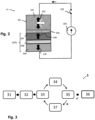
- FIG. 3 shows a schematic representation of a method for measuring the intensity of a magnetic field according to a first embodiment of the invention.
- substantially perpendicular means a direction deviating by plus or minus 15 degrees from the direction normal to the plane of the layers.
- the magnetic tunnel junction of the MRAM device used to implement the method 3 comprises a SAF 107b with two magnetic layers 107 and 109 antiferromagnetically coupled by a coupling spacer layer 108 in order to have less dipole field radiated by the MRAM device and thus have less interference to carry out the magnetic field measurements.
- the method 3 for measuring the intensity of the vertical component of a magnetic field external to the MRAM device comprises a first step 31 for determining a first resistance of the magnetic memory point. This determination can for example be carried out conventionally by carrying out a measurement of a voltage or a current at the terminals of the magnetic memory point.
- the method 3 then comprises a step 32 of comparing the first resistance obtained to a reference resistance value to identify a relative initial magnetization direction of the storage layer 101 with respect to the reference layer 107 or the SAF 107b.
- the reference layer 107 or the SAF 107b will be referred to in the same way as “reference layer 107”.
- This step 32 of comparing the measured resistance to at least one reference resistance makes it possible to determine the relative initial magnetization direction of the storage layer 101 with respect to the reference layer 107, that is to say to determine whether the alignment is parallel or antiparallel.
- a high resistance with respect to a resistance threshold is considered to be an alignment of the magnetization direction between the storage 101 and reference 107 layers that is antiparallel.
- a low resistance with respect to a resistance threshold is considered to be an alignment of the magnetization direction 102 between the storage 101 and reference 107 layers that is parallel.
- the method 3 comprises a step 33 of applying to the magnetic memory point a voltage or current pulse of a predefined amplitude and a polarity promoting the switching of the storage layer towards a direction opposite to the initial relative magnetization direction 102 of the storage layer 101 with respect to the reference layer 107.
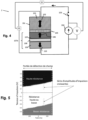
- a polarity promoting the switching of the storage layer towards an opposite direction is meant a positive or negative polarity depending on the initial magnetization direction 102. measured, i.e. as a function of the measured initial resistance, and allowing the switching of the magnetization direction 102 of the storage layer 101. This is shown in [ Fig. 5 ].
- [ Fig. 5 ] shows a resistance state diagram of an MRAM device.
- This diagram represents in particular the pulse voltage in Volts as a function of the magnetic field in Oersted, as well as the resistance as a function of these two axes.
- a pulse of positive polarity in the case represented in [ Fig. 5 ] we will try to make the alignment antiparallel, that is to say to go from a low resistance to a high resistance.
- a pulse of negative polarity in the case shown in [ Fig. 5 ] we will try to make the alignment parallel, that is to say to go from a high resistance to a low resistance.
- the second resistance determined in step 34 is compared to the same resistance threshold as that used in step 32 to determine whether a switching of the magnetization direction 102 of the storage layer 101 has taken place.
- step 37 of modifying the amplitude of the voltage or current applied in step 33 is carried out.
- the method is then repeated in step 33 of applying to the magnetic memory point a voltage or current pulse of the same polarity as previously determined, but of modified amplitude as defined in step 37.
- the pulses are all of the same temporal width. Indeed, the variations in pulse width during the switching sequence degrade the field resolution, so the pulse width should not vary significantly throughout the pulse sequence.
- the pulse width can take the same values as for memory uses, typically higher but close to 1ns. Larger pulse widths are also possible, but could result in a significant increase in the total time required to perform the measurement method 3.
- the minimum switching current or the minimum switching voltage is the current or the voltage applied in the previous step 33 of applying to the magnetic memory point a voltage or current pulse.
- the initial alignment of the magnetization directions between the storage layer 101 and the reference layer 107 is antiparallel, i.e. when the measured resistance is high, a minimum amplitude of about 0.38 Volts and a negative polarity are required to switch the magnetization direction 102 of the storage layer 101 and thus make the alignment parallel.
- we will start at a low predefined amplitude, for example close to 0, and we will increase the amplitude with each new pulse. This allows us to consume less energy than by starting for example with high amplitude currents or voltages and then choosing lower amplitudes.
- a step 36 of determining the intensity of the external magnetic field from the value of the minimum current or the minimum switching voltage of the magnetization direction 102 of the storage layer 101 is carried out.
- This determination step is enabled by the fact that the current and the voltage vary essentially linearly with respect to the applied external magnetic field.
- the intensity of the vertical component of the magnetic field can be determined by calculating the difference between the value of the minimum switching voltage or the minimum switching current obtained in step 35 and at least one value of the reference switching current or the reference switching voltage measured according to the same method under a reference external magnetic field. This difference is then multiplied by a proportionality constant and added to the intensity value of the orthogonal component of the reference field.
- the reference field can be the zero field.
- the difference between the amplitude of the minimum switching voltage or current and the amplitude of the minimum reference voltage or current multiplied by the proportionality constant is equal to the intensity value of the orthogonal component of the external magnetic field during the measurement.
- the proportionality constant can be determined by calculating a ratio between the difference between a calibration switching voltage or calibration switching current value and a reference switching voltage or reference switching current value and the difference between a calibration magnetic field intensity value and a reference magnetic field intensity value.
- the proportionality constant is determined by using the linear characteristic of the voltage or current variation relative to the applied external magnetic field, by performing a slope calculation prior to any measurement.
- this slope calculation taking into account two magnetic fields: one reference and one calibration, the proportionality constant is obtained which subsequently makes it possible to relate the minimum voltage or the minimum current used to switch the magnetization direction 102 of the storage layer 101 with the external magnetic field. It is thus possible to determine the intensity value of the vertical component of the magnetic field external from the minimum current value or the minimum switching voltage.
- the accuracy of the measurement can be increased by repeatedly applying method 3 and averaging successive minimum switching current or voltage values. This can be achieved by successively applying method 3 described above to determine the minimum switching current or voltage values of the two switching directions of the storage layer: from low to high resistance and from high to low resistance. By averaging the minimum switching current or voltage values in each direction and then subtracting the average of each of the two minimum switching current or voltage values under zero applied external field, a voltage difference is obtained that is essentially linearly proportional to the magnitude of the external field. This improves the measurement of the external magnetic field but requires a longer time and higher power consumption.
- the value of the minimum switching voltage or the minimum switching current is determined by applying, instead of the pulses, a voltage or current ramp, of a polarity favoring the switching of the storage layer towards a direction opposite to the initial relative magnetization direction of the storage layer with respect to the reference layer, until a switching of the magnetization direction of the storage layer is detected.
- a voltage or current ramp of a polarity favoring the switching of the storage layer towards a direction opposite to the initial relative magnetization direction of the storage layer with respect to the reference layer, until a switching of the magnetization direction of the storage layer is detected.
- An alternative to this ramp may consist in the use of any periodic signal comprising an ascending monotonic part followed by a descending monotonic part.
- the amplitude of the minimum switching voltage or the minimum switching current is then determined as a function of the total time of application of the voltage or current ramp to obtain the value of the minimum switching voltage or the minimum switching current by knowing the slope of the ramp.
- steps 33, 34, 35 and 37 are replaced by the application of a voltage or current ramp and the detection of a switching of the magnetization direction 102 of the storage layer 101.
- the other steps remain unchanged 31, 32 and 36 are necessary for the method 3 according to the second embodiment of the invention.
- the [ Fig. 10 ] shows a diagram representing the current flowing through an MRAM device when a periodic signal is applied according to the second embodiment of the invention.
- figure 10 a triangular voltage signal is applied, comprising a monotonic rising part and a monotonic falling part.
- the Figure 10 shows an oscilloscope trace representing the current flowing through the MRAM device.
- the abscissas represent time, for example at Figure 10 2 microseconds per division
- the ordinates represent the voltage, for example at the Figure 10 20 millivolts per division.
- the values on the abscissa and ordinate are not limiting. Thus, what is represented by the ordinate axis is indirectly the current flowing through the MRAM device.
- This current can for example be calculated as 50 Ohm times the voltage measured on the oscilloscope, in the current case in which the oscilloscope is configured with an internal impedance of 50 Ohm.
- the exact current value depends on the resistance of the MRAM device and the applied voltage.
- the voltage applied to the MRAM device at the Figure 10 is a triangle wave, which can be adjusted in amplitude and offset to achieve the positive and negative voltages that trigger the junction to switch.
- the applied external magnetic field favors a parallel configuration of the direction of the storage layer 101
- part B the applied external magnetic field favors an antiparallel configuration of the direction of the storage layer 101.
- the switching thresholds i to I i.e.
- the changes of resistance states are thus increased or decreased depending on the applied magnetic field.
- the descending monotonic part between the switching thresholds j and k is larger in part A than in part B, the switching threshold k in part B having been raised on this slope by the presence of the magnetic field favoring an antiparallel configuration.
- the point j has been raised on the rising slope in part B, i.e. it is located higher on the y-axis.
- the device changes resistance state at each switching threshold i to k, at different voltage thresholds, with transition zones shown by the discontinuities in the slope.
- the figure 10 thus shows that there is not a net change in resistance state but rather transition zones at the switching thresholds.
- the DC value obtained for the integration of a complete cycle is non-zero and proportional to the asymmetry of the thresholds of different polarity and then allows the external field to be calculated using for example the resistance state diagram at [ Fig. 5 ].
- the method 3 according to the first or second embodiment of the invention may further comprise an additional step of applying a pulse after detecting a switching of the magnetization direction 102 of the storage layer 101, the pulse having a polarity promoting the switching of the storage layer 101 towards the initial relative magnetization direction of the storage layer 101 with respect to the reference layer 107 and having an amplitude greater than the amplitude of the minimum switching current or the minimum switching voltage, in order to restore the initial state of the magnetic memory point and not impact its information storage functionality.
- Fig. 4 represents an MRAM device 2 used to implement the method 3 according to the first embodiment of the invention.
- the MRAM device 2 comprises a magnetic tunnel junction 10c as described above, as well as a controller 20 and a pulse generator 30.
- the controller 20 is configured to manage the measurement of the resistance of the magnetic tunnel junction 10c in steps 31 and 34 of the method 3 according to the first embodiment. embodiment of the invention.
- managing the resistance measurement is meant all the steps necessary to obtain a resistance measurement by the controller 20, comprising for example, depending on the controller used, sending a resistance measurement request signal and receiving a resistance measurement signal, for example receiving a voltage or current value applied to the magnetic tunnel junction.
- the controller 20 is further configured to manage the pulse generator 30 and in particular the amplitude of the voltage or current pulses and to perform at least part of the calculations included in the method 3, for example determining the value of the intensity of the magnetic field, preferably all the calculations included in the method 3.
- the MRAM device 2 must have dimensions such that the operation of the sensor is optimized for the linearity of the sensor and the range of the field. This is made possible by having lateral dimensions of the storage layer 101 smaller than 200 nm.
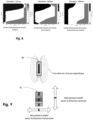
- lateral dimensions is meant for example diameter of a circle, major axis of an ellipse, length or width in the plane of the layers depending on the geometry of the magnetic stack. For these lateral dimensions smaller than 200 nm, the linearity of the switching voltage with respect to the external magnetic field is improved. Lateral dimensions larger than 200 nm show a clear deviation from the linear dependence, with significant nonlinear behavior at 500 nm and above, as shown in [ Fig. 8 ].
- the minimum switching voltage or current is changed. This is shown in [ Fig. 6 ], where two diagrams represent the minimum switching voltages in Volts for two different diameters, one of 50nm and one of 200nm.
- the lower limit size is determined by the area required for the magnetization 102 of the storage layer 101 to be perpendicular to the plane of the layer.
- the perpendicular stability of the storage layer (or detection layer in sensor use) 102 is ensured during the measurement time t m for the condition: e ⁇ > t m ⁇ 0
- ⁇ 0 is the switching attempt time (switching pulse) usually estimated around 1ns
- ⁇ is the thermal stability factor, corresponding to the ratio between the energy required to reverse the magnetization direction and the thermal energy (k B T).
- the thermal stability of the memory point can be calculated from the effective anisotropy Keff, and by convention Keff has a positive value for perpendicular magnetic anisotropy. In the case of perpendicular magnetic anisotropy from the interface, Keff can be calculated from the surface anisotropy (Ks), the layer thickness (t) and the saturation magnetization.
- Ks surface anisotropy
- t the layer thickness
- typical 102 storage layers are about 1-2 nm, adjacent to a tunnel barrier providing perpendicular interfacial anisotropy.
- the minimum stability requirement for memory operation sets a typical lower limit of lateral dimension of 15-20 nm. In the sub-20 nm range, the thermal stability of the cell is reduced, resulting in lower switching voltages, reduced linear range, and altered pulse voltage and sensitivity. Thus, the lateral dimensions can be adjusted to meet different sensor specification requirements.
- the method 3 according to the first or second embodiment can be used with several MRAM devices.
- the current or voltage pulses, the current or voltage ramp or the periodic current or voltage signal are applied in parallel to the different MRAM devices.
- This application can be simultaneous (to several MRAM devices in parallel at the same time) or successive (to each MRAM device individually).
- a single controller 20 can manage the application of the method 3 for all the MRAM devices.
- the amplitude of the current or the voltage is modified until the switching of all the managed MRAM devices is obtained.
- Another object of the invention relates to the use of the method 3 for measuring the intensity of the magnetic field by at least one memory point to determine the relative distance between the memory point and a magnetic object producing a magnetic field of 1mT to 500mT. This is shown in [ Fig. 9 ], where a magnetic object 40 is placed at a certain distance from the magnetic memory point 10.
- the magnetic memory point 10 implementing the method 3 is capable of measuring the external magnetic field generated by the magnetic object 40.
- the method 3 for measuring the intensity of the magnetic field is applied at several points in space, ideally at all points in space, to determine the amplitude and direction of the magnetic field generated by the magnetic element 40.
- the measured values can be used to calculate the relative distance between the memory point 10 and the magnetic object 40 on the basis of simulations of the magnetic field generated by the magnetic object 40.
- the detection can be carried out with one or more memory points 10, arranged in different relative orientations in order to have a detection with respect to the various components of the magnetic field generated by the object 40.
- the multiple memory points can be arranged in a probe to increase detection accuracy by interpolation or by adapting to an expected physical behavior of the system.
Landscapes
- Physics & Mathematics (AREA)
- General Physics & Mathematics (AREA)
- Condensed Matter Physics & Semiconductors (AREA)
- Engineering & Computer Science (AREA)
- Computer Hardware Design (AREA)
- Hall/Mr Elements (AREA)
- Mram Or Spin Memory Techniques (AREA)
- Semiconductor Memories (AREA)
Claims (15)
- Verfahren (3) zum Messen der Stärke eines externen Magnetfelds unter Verwendung von mindestens einem magnetischen Speicherpunkt (10; 10b; 10c), umfassend:- eine Speicherschicht (101) mit einer Magnetisierung (102), die zwischen zwei Magnetisierungsrichtungen umschaltbar ist, die im Wesentlichen senkrecht zur Ebene der Schicht liegen;- eine Referenzschicht (107) mit einer festen Magnetisierung (106), die senkrecht zur Ebene der Schicht verläuft;- eine Tunnelsperrschicht (105), die die Speicherschicht (101) und die Referenzschicht (107) trennt;wobei das Verfahren dadurch gekennzeichnet ist, dass es mindestens Folgendes umfasst:- einen Schritt des sukzessiven Anlegens einer Vielzahl von Strömen oder Spannungen mit unterschiedlichen Amplituden an den mindestens einen Speicherpunkt, bis ein Umschalten der Magnetisierungsrichtung der Speicherschicht stattfindet, um einen minimalen Umschaltstromwert der Magnetisierungsrichtung der Speicherschicht oder einen minimalen Umschaltspannungswert der Magnetisierungsrichtung der Speicherschicht zu bestimmen, wobei ein Umschalten der Magnetisierungsrichtung der Speicherschicht das Umschalten der Magnetisierungsrichtung der Speicherschicht von einer Konfiguration parallel zur Magnetisierungsrichtung der Referenzschicht zu einer Konfiguration antiparallel zur Magnetisierungsrichtung der Referenzschicht oder das Umschalten von einer Konfiguration antiparallel zur Magnetisierungsrichtung der Referenzschicht zu einer Konfiguration parallel zur Magnetisierungsrichtung der Referenzschicht in Abhängigkeit von einer anfänglichen Magnetisierungsrichtung der Speicherschicht ist,- einen Schritt zum Bestimmen der Stärke des zu messenden externen Magnetfelds anhand des Werts des minimalen Schaltstroms oder des Werts der minimalen Schaltspannung.
- Verfahren (3) zum Messen der Stärke eines externen Magnetfelds nach dem vorhergehenden Anspruch, dadurch gekennzeichnet, dass der mindestens eine Speicherpunkt (10; 10b; 10c) ein magnetischer Tunnelübergang mit einer Magnetisierung außerhalb der Ebene ist.
- Verfahren (3) zum Messen der Stärke eines externen Magnetfelds nach Anspruch 1 oder 2, dadurch gekennzeichnet, dass der Schritt des Bestimmens der Stärke des externen Magnetfelds außerdem mindestens die folgenden Unterschritte umfasst:- Berechnen der Differenz zwischen dem minimalen Schaltstromwert oder dem minimalen Schaltspannungswert und mindestens einem Referenzschaltstromwert oder Referenzschaltspannungswert, der nach demselben Verfahren unter einem externen Referenzmagnetfeld gemessen wurde, und- Berechnen eines Magnetfeldstärkewerts, umfassend das Multiplizieren der Differenz zwischen dem minimalen Schaltstromwert oder dem minimalen Schaltspannungswert und dem mindestens einen Referenzschaltstromwert oder Referenzschaltspannungswert mit einer Proportionalitätskonstante und das Addieren des erhaltenen Werts zu dem Referenzmagnetfeldstärkenwert.
- Verfahren (3) zum Messen der Stärke eines externen Magnetfelds nach dem vorhergehenden Anspruch, dadurch gekennzeichnet, dass die Proportionalitätskonstante bestimmt wird, indem ein Verhältnis zwischen der Differenz zwischen einem Kalibrierungsschaltstromwert oder Kalibrierungsschaltspannungswert und einem Referenzschaltstromwert oder Referenzschaltspannungswert und der Differenz zwischen einem Kalibrierungsmagnetfeldstärkenwert und einem Referenzmagnetfeldstärkenwert berechnet wird.
- Verfahren (3) zum Messen der Stärke eines externen Magnetfelds nach einem der vorhergehenden Ansprüche, dadurch gekennzeichnet, dass der Schritt des sukzessiven Anlegens einer Vielzahl von Strömen oder Spannungen mit unterschiedlichen Amplituden, bis eine Umschaltung der Magnetisierungsrichtung der Speicherschicht stattfindet, folgende Unterschritte umfasst:- Bestimmen eines ersten Widerstands des mindestens einen magnetischen Speicherpunkts, wobei das Bestimmen des ersten Widerstands das Messen eines Stroms oder einer Spannung über dem magnetischen Speicherpunkt umfasst,- Vergleichen des erhaltenen ersten Widerstands mit einem Referenzwiderstandswert, um eine relative Anfangsmagnetisierungsrichtung der Speicherschicht in Bezug auf die Referenzschicht zu identifizieren,- Anlegen eines Strom- oder Spannungsimpulses mit einer vordefinierten Amplitude und Polarität an den mindestens einen magnetischen Speicherpunkt, der das Schalten der Speicherschicht in eine Richtung entgegengesetzt zur relativen Anfangsmagnetisierungsrichtung der Speicherschicht in Bezug auf die Referenzschicht fördert,- Bestimmen eines zweiten Widerstands des mindestens einen magnetischen Speicherpunkts, wobei das Bestimmen des zweiten Widerstands das Messen eines Stroms oder einer Spannung über dem magnetischen Speicherpunkt nach dem Anlegen eines Strom- oder Spannungsimpulses an den magnetischen Speicherpunkt umfasst,- Vergleich des erhaltenen zweiten Widerstands mit dem Referenzwiderstandswert, um festzustellen, ob ein Umschalten der Magnetisierungsrichtung der Speicherschicht stattgefunden hat,- Wenn eine Umschaltung der Magnetisierungsrichtung der Speicherschicht stattgefunden hat:o ist der minimale Schaltstrom oder die minimale Schaltspannung der Strom oder die Spannung, der/die im vorherigen Schritt des Anlegens eines Strom- oder Spannungsimpulses an den Magnetspeicherpunkt angelegt wurde,- Wenn kein Umschalten der Magnetisierungsrichtung der Speicherschicht stattgefunden hat, werden die Teilschritte Anlegen eines Strom- oder Spannungsimpulses an den magnetischen Speicherpunkt, Bestimmen eines zweiten Widerstands und Vergleichen des zweiten Widerstands mit dem ersten Widerstand mit einem Strom- oder Spannungsimpuls mit einer veränderten Amplitude, die sich von der vorgegebenen Amplitude unterscheidet, wiederholt, bis ein Umschalten der Magnetisierungsrichtung der Speicherschicht stattgefunden hat.
- Verfahren (3) zum Messen der Stärke eines externen Magnetfelds nach dem vorhergehenden Anspruch, dadurch gekennzeichnet, dass die vorgegebene Amplitude eine niedrige Amplitude ist und dass die modifizierte Amplitude größer als die niedrige Amplitude ist.
- Verfahren (3) zum Messen der Stärke eines externen Magnetfelds nach einem der Ansprüche 1 bis 3, dadurch gekennzeichnet, dass der Schritt des sukzessiven Anlegens einer Vielzahl von Strömen oder Spannungen mit unterschiedlichen Amplituden, bis eine Umschaltung der Magnetisierungsrichtung der Speicherschicht stattfindet, folgende Unterschritte umfasst:- Anlegen einer Rampe oder eines periodischen Strom- oder Spannungssignals mit einer Polarität, die das Umschalten der Speicherschicht in eine Richtung entgegengesetzt zur anfänglichen relativen Magnetisierungsrichtung der Speicherschicht in Bezug auf die Referenzschicht fördert, bis ein Umschalten der Magnetisierungsrichtung der Speicherschicht erfasst wird,- Bestimmen der Amplitude des minimalen Umschaltstroms oder der minimalen Umschaltspannung in Abhängigkeit von der Gesamtzeit, in der die Strom- oder Spannungsrampe anliegt, um den Wert des minimalen Umschaltstroms oder der minimalen Umschaltspannung zu erhalten.
- Verfahren (3) zum Messen der Stärke eines externen Magnetfelds nach einem der vorhergehenden Ansprüche, dadurch gekennzeichnet, dass es einen zusätzlichen Schritt des Anlegens eines Impulses nach dem Erfassen eines Umschaltens der Magnetisierungsrichtung der Speicherschicht umfasst, wobei der Impuls eine Polarität aufweist, die das Umschalten der Speicherschicht in Richtung der anfänglichen relativen Magnetisierungsrichtung der Speicherschicht in Bezug auf die Referenzschicht begünstigt, und eine Amplitude aufweist, die größer ist als die Amplitude des minimalen Umschaltstroms oder der minimalen Umschaltspannung.
- Verfahren (3) zum Messen der Stärke eines externen Magnetfelds nach einem der vorhergehenden Ansprüche, dadurch gekennzeichnet, dass es eine Vielzahl von magnetischen Speicherpunkten verwendet und dass der Schritt des sukzessiven Anlegens einer Vielzahl von Strömen oder Spannungen mit unterschiedlichen Amplituden für die magnetischen Speicherpunkte der Vielzahl von magnetischen Speicherpunkten parallel durchgeführt wird.
- Verfahren (3) zum Messen der Stärke eines externen Magnetfelds nach dem vorhergehenden Anspruch, dadurch gekennzeichnet, dass der Schritt des sukzessiven Anlegens einer Vielzahl von Strömen oder Spannungen mit unterschiedlichen Amplituden parallel für jeden magnetischen Speicherpunkt der Vielzahl von magnetischen Speicherpunkten gleichzeitig durchgeführt wird und dass der minimale Stromwert oder der minimale Schaltspannungswert der Magnetisierungsrichtung der minimale Stromwert oder der minimale Schaltspannungswert der Magnetisierungsrichtung der Speicherschicht jedes magnetischen Speicherpunkts der Vielzahl von magnetischen Speicherpunkten ist.
- Magnetischer Speicherpunkt (10; 10b; 10c), dadurch gekennzeichnet, dass er so konfiguriert ist, dass er das Verfahren zum Messen eines externen Magnetfelds gemäß einem der vorhergehenden Ansprüche ausführt, und dass er ferner eine Steuereinheit (20) umfasst, die so konfiguriert ist, dass sie die Messung des Widerstands des magnetischen Speicherpunkts steuert.
- Magnetischer Speicherpunkt (10; 10b; 10c) nach dem vorhergehenden Anspruch, dadurch gekennzeichnet, dass er einen magnetischen Tunnelübergang mit Magnetisierung außerhalb der Ebene (oder senkrechte Anisotropie) umfasst.
- Magnetischer Speicherpunkt (10; 10b; 10c) nach Anspruch 11 oder 12, bei dem der magnetische Speicherpunkt dadurch gekennzeichnet ist, dass er weiterhin einen Impulsgenerator (30) umfasst und dass die Steuerung (20) weiterhin so konfiguriert ist, dass sie den Impulsgenerator steuert.
- Magnetischer Speicherpunkt (10; 10b; 10c) nach einem der Ansprüche 11 bis 13, dadurch gekennzeichnet, dass er Seitenabmessungen von weniger als 200 nm aufweist.
- Verfahren zum Bestimmen des relativen Abstands zwischen einem magnetischen Speicherpunkt (10) nach einem der Ansprüche 11 bis 14 und einem magnetischen Objekt (40), das ein Magnetfeld zwischen 1mT und 500mT erzeugt, wobei das Verfahren dadurch gekennzeichnet ist, dass es die folgenden Schritte umfasst:- Messen der senkrechten Komponente eines Magnetfelds gemäß dem Verfahren zur Messung eines externen Magnetfelds nach einem der Ansprüche 1 bis 10 an einer Vielzahl von Punkten im Raum, um eine Amplitude und eine Richtung des Magnetfelds zu bestimmen,- Berechnen des relativen Abstands zwischen der Speicherschicht des magnetischen Speicherpunkts und dem magnetischen Objekt anhand von Simulationen des vom magnetischen Objekt erzeugten Magnetfelds.
Applications Claiming Priority (2)
| Application Number | Priority Date | Filing Date | Title |
|---|---|---|---|
| FR2008638A FR3113519B1 (fr) | 2020-08-24 | 2020-08-24 | Procédé de mesure d’un champ magnétique extérieur par au moins un point mémoire magnétique |
| PCT/EP2021/073330 WO2022043292A1 (fr) | 2020-08-24 | 2021-08-24 | Procédé de mesure d'un champ magnétique extérieur par au moins un point mémoire magnétique |
Publications (3)
| Publication Number | Publication Date |
|---|---|
| EP4200625A1 EP4200625A1 (de) | 2023-06-28 |
| EP4200625C0 EP4200625C0 (de) | 2024-10-09 |
| EP4200625B1 true EP4200625B1 (de) | 2024-10-09 |
Family
ID=74045590
Family Applications (1)
| Application Number | Title | Priority Date | Filing Date |
|---|---|---|---|
| EP21762734.8A Active EP4200625B1 (de) | 2020-08-24 | 2021-08-24 | Verfahren zur messung eines externen magnetfeldes mit mindestens einem magnetspeicherpunkt |
Country Status (5)
| Country | Link |
|---|---|
| US (1) | US12292486B2 (de) |
| EP (1) | EP4200625B1 (de) |
| KR (1) | KR102813503B1 (de) |
| FR (1) | FR3113519B1 (de) |
| WO (1) | WO2022043292A1 (de) |
Families Citing this family (1)
| Publication number | Priority date | Publication date | Assignee | Title |
|---|---|---|---|---|
| US12405323B2 (en) | 2023-12-19 | 2025-09-02 | Western Digital Technologies, Inc. | Magnetic sensor half-bridge based on inverse spin hall effect with reduced thermal drift |
Family Cites Families (8)
| Publication number | Priority date | Publication date | Assignee | Title |
|---|---|---|---|---|
| US7038552B2 (en) * | 2003-10-07 | 2006-05-02 | Analog Devices, Inc. | Voltage controlled oscillator having improved phase noise |
| JP2008112841A (ja) * | 2006-10-30 | 2008-05-15 | Tdk Corp | 磁気抵抗効果素子、薄膜磁気ヘッド、基体、ウェハ、ヘッドジンバルアセンブリ、ハードディスク装置 |
| FR2918761B1 (fr) * | 2007-07-10 | 2009-11-06 | Commissariat Energie Atomique | Capteur de champ magnetique a faible bruit. |
| US20110169488A1 (en) * | 2010-01-08 | 2011-07-14 | Everspin Technologies, Inc. | Method and structure for testing and calibrating magnetic field sensing device |
| US9384812B2 (en) * | 2014-01-28 | 2016-07-05 | Qualcomm Incorporated | Three-phase GSHE-MTJ non-volatile flip-flop |
| JP6455806B2 (ja) * | 2015-04-15 | 2019-01-23 | Tdk株式会社 | 磁気抵抗効果発振器 |
| US10720570B2 (en) * | 2017-06-12 | 2020-07-21 | Western Digital Technologies, Inc. | Magnetic sensor using spin hall effect |
| FR3077917B1 (fr) * | 2018-02-15 | 2022-02-04 | Commissariat Energie Atomique | Empilement magnetique, jonction tunnel, point memoire et capteur comportant un tel empilement |
-
2020
- 2020-08-24 FR FR2008638A patent/FR3113519B1/fr active Active
-
2021
- 2021-08-24 KR KR1020237009923A patent/KR102813503B1/ko active Active
- 2021-08-24 EP EP21762734.8A patent/EP4200625B1/de active Active
- 2021-08-24 WO PCT/EP2021/073330 patent/WO2022043292A1/fr not_active Ceased
- 2021-08-24 US US18/042,697 patent/US12292486B2/en active Active
Also Published As
| Publication number | Publication date |
|---|---|
| EP4200625A1 (de) | 2023-06-28 |
| KR102813503B1 (ko) | 2025-05-27 |
| WO2022043292A1 (fr) | 2022-03-03 |
| KR20230104591A (ko) | 2023-07-10 |
| CN116324457A (zh) | 2023-06-23 |
| EP4200625C0 (de) | 2024-10-09 |
| FR3113519B1 (fr) | 2022-09-02 |
| FR3113519A1 (fr) | 2022-02-25 |
| US12292486B2 (en) | 2025-05-06 |
| US20230358826A1 (en) | 2023-11-09 |
Similar Documents
| Publication | Publication Date | Title |
|---|---|---|
| EP1055259B1 (de) | Tunneleffekt-magnetowiderstand und anwendung eines solchen magnetowiderstands in einem magnetischen sensor | |
| EP2038671B1 (de) | Verfahren und system zur einstellung der sensitivität eines magnetoresistiven sensors | |
| FR2876800A1 (fr) | Procede et dispositif de mesure de champ magnetique a l'aide d'un capteur magnetoresitif | |
| EP2597480B1 (de) | Magnetfeldsensor | |
| EP2836998B1 (de) | Magnetvorrichtung mit wärmeunterstütztem schreibverfahren | |
| EP3631484B1 (de) | System und verfahren zur unterdrückung von niederfrequenzrauschen aus magnetoresistiven sensoren | |
| EP3009853B1 (de) | Magnetfeldsensor zur erfassung von mindestens zwei komponenten eines magnetfelds | |
| EP3631485B1 (de) | System und verfahren zur unterdrückung von niederfrequenzrauschen aus magnetoresistiven sensoren mit tunnelmagnetowiderstand | |
| EP4200625B1 (de) | Verfahren zur messung eines externen magnetfeldes mit mindestens einem magnetspeicherpunkt | |
| EP2834658B1 (de) | Verfahren und vorrichtung zum messen eines magnetfeldes und der temperatur eines magnetoresistiven wandlers | |
| EP2802886B1 (de) | Magnetfeldsensor | |
| FR3101156A1 (fr) | Empilement magnétorésistif sans champ rayonné, capteur et système de cartographie magnétique comprenant un tel empilement | |
| CN116324457B (en) | Method for measuring an external magnetic field using at least one magnetic storage point | |
| EP3070462B1 (de) | Vorrichtung und verfahren zur detektion einer magnetischen inhomogenität in einem ferromagnetischen material | |
| EP3646046A1 (de) | Vorrichtung zur messung schwacher magnetfelder | |
| FR2772965A1 (fr) | Senseur de champ magnetique et tete magnetique de lecture utilisant un tel senseur | |
| FR2991780A1 (fr) | Procede de realisation de films a magnetoresistance anisotrope et procede et dispositifs de detection et/ou de mesure comprenant de tels films. |
Legal Events
| Date | Code | Title | Description |
|---|---|---|---|
| STAA | Information on the status of an ep patent application or granted ep patent |
Free format text: STATUS: UNKNOWN |
|
| STAA | Information on the status of an ep patent application or granted ep patent |
Free format text: STATUS: THE INTERNATIONAL PUBLICATION HAS BEEN MADE |
|
| PUAI | Public reference made under article 153(3) epc to a published international application that has entered the european phase |
Free format text: ORIGINAL CODE: 0009012 |
|
| STAA | Information on the status of an ep patent application or granted ep patent |
Free format text: STATUS: REQUEST FOR EXAMINATION WAS MADE |
|
| 17P | Request for examination filed |
Effective date: 20230317 |
|
| AK | Designated contracting states |
Kind code of ref document: A1 Designated state(s): AL AT BE BG CH CY CZ DE DK EE ES FI FR GB GR HR HU IE IS IT LI LT LU LV MC MK MT NL NO PL PT RO RS SE SI SK SM TR |
|
| DAV | Request for validation of the european patent (deleted) | ||
| DAX | Request for extension of the european patent (deleted) | ||
| RIC1 | Information provided on ipc code assigned before grant |
Ipc: G11C 11/16 20060101ALI20240327BHEP Ipc: G01R 33/09 20060101AFI20240327BHEP |
|
| GRAP | Despatch of communication of intention to grant a patent |
Free format text: ORIGINAL CODE: EPIDOSNIGR1 |
|
| STAA | Information on the status of an ep patent application or granted ep patent |
Free format text: STATUS: GRANT OF PATENT IS INTENDED |
|
| INTG | Intention to grant announced |
Effective date: 20240506 |
|
| GRAS | Grant fee paid |
Free format text: ORIGINAL CODE: EPIDOSNIGR3 |
|
| GRAA | (expected) grant |
Free format text: ORIGINAL CODE: 0009210 |
|
| STAA | Information on the status of an ep patent application or granted ep patent |
Free format text: STATUS: THE PATENT HAS BEEN GRANTED |
|
| AK | Designated contracting states |
Kind code of ref document: B1 Designated state(s): AL AT BE BG CH CY CZ DE DK EE ES FI FR GB GR HR HU IE IS IT LI LT LU LV MC MK MT NL NO PL PT RO RS SE SI SK SM TR |
|
| REG | Reference to a national code |
Ref country code: CH Ref legal event code: EP |
|
| RAP4 | Party data changed (patent owner data changed or rights of a patent transferred) |
Owner name: CENTRE NATIONAL DE LA RECHERCHE SCIENTIFIQUE(CNRS) Owner name: COMMISSARIAT A L'ENERGIE ATOMIQUE ET AUX ENERGIESALTERNATIVES |
|
| REG | Reference to a national code |
Ref country code: DE Ref legal event code: R096 Ref document number: 602021020021 Country of ref document: DE |
|
| REG | Reference to a national code |
Ref country code: IE Ref legal event code: FG4D Free format text: LANGUAGE OF EP DOCUMENT: FRENCH |
|
| U01 | Request for unitary effect filed |
Effective date: 20241029 |
|
| U07 | Unitary effect registered |
Designated state(s): AT BE BG DE DK EE FI FR IT LT LU LV MT NL PT RO SE SI Effective date: 20241108 |
|
| PG25 | Lapsed in a contracting state [announced via postgrant information from national office to epo] |
Ref country code: HR Free format text: LAPSE BECAUSE OF FAILURE TO SUBMIT A TRANSLATION OF THE DESCRIPTION OR TO PAY THE FEE WITHIN THE PRESCRIBED TIME-LIMIT Effective date: 20241009 Ref country code: IS Free format text: LAPSE BECAUSE OF FAILURE TO SUBMIT A TRANSLATION OF THE DESCRIPTION OR TO PAY THE FEE WITHIN THE PRESCRIBED TIME-LIMIT Effective date: 20250209 |
|
| PG25 | Lapsed in a contracting state [announced via postgrant information from national office to epo] |
Ref country code: ES Free format text: LAPSE BECAUSE OF FAILURE TO SUBMIT A TRANSLATION OF THE DESCRIPTION OR TO PAY THE FEE WITHIN THE PRESCRIBED TIME-LIMIT Effective date: 20241009 |
|
| PG25 | Lapsed in a contracting state [announced via postgrant information from national office to epo] |
Ref country code: NO Free format text: LAPSE BECAUSE OF FAILURE TO SUBMIT A TRANSLATION OF THE DESCRIPTION OR TO PAY THE FEE WITHIN THE PRESCRIBED TIME-LIMIT Effective date: 20250109 |
|
| PG25 | Lapsed in a contracting state [announced via postgrant information from national office to epo] |
Ref country code: GR Free format text: LAPSE BECAUSE OF FAILURE TO SUBMIT A TRANSLATION OF THE DESCRIPTION OR TO PAY THE FEE WITHIN THE PRESCRIBED TIME-LIMIT Effective date: 20250110 |
|
| PG25 | Lapsed in a contracting state [announced via postgrant information from national office to epo] |
Ref country code: PL Free format text: LAPSE BECAUSE OF FAILURE TO SUBMIT A TRANSLATION OF THE DESCRIPTION OR TO PAY THE FEE WITHIN THE PRESCRIBED TIME-LIMIT Effective date: 20241009 |
|
| PG25 | Lapsed in a contracting state [announced via postgrant information from national office to epo] |
Ref country code: RS Free format text: LAPSE BECAUSE OF FAILURE TO SUBMIT A TRANSLATION OF THE DESCRIPTION OR TO PAY THE FEE WITHIN THE PRESCRIBED TIME-LIMIT Effective date: 20250109 |
|
| PG25 | Lapsed in a contracting state [announced via postgrant information from national office to epo] |
Ref country code: SM Free format text: LAPSE BECAUSE OF FAILURE TO SUBMIT A TRANSLATION OF THE DESCRIPTION OR TO PAY THE FEE WITHIN THE PRESCRIBED TIME-LIMIT Effective date: 20241009 |
|
| PG25 | Lapsed in a contracting state [announced via postgrant information from national office to epo] |
Ref country code: SK Free format text: LAPSE BECAUSE OF FAILURE TO SUBMIT A TRANSLATION OF THE DESCRIPTION OR TO PAY THE FEE WITHIN THE PRESCRIBED TIME-LIMIT Effective date: 20241009 |
|
| PG25 | Lapsed in a contracting state [announced via postgrant information from national office to epo] |
Ref country code: CZ Free format text: LAPSE BECAUSE OF FAILURE TO SUBMIT A TRANSLATION OF THE DESCRIPTION OR TO PAY THE FEE WITHIN THE PRESCRIBED TIME-LIMIT Effective date: 20241009 |
|
| PLBE | No opposition filed within time limit |
Free format text: ORIGINAL CODE: 0009261 |
|
| STAA | Information on the status of an ep patent application or granted ep patent |
Free format text: STATUS: NO OPPOSITION FILED WITHIN TIME LIMIT |
|
| 26N | No opposition filed |
Effective date: 20250710 |
|
| U20 | Renewal fee for the european patent with unitary effect paid |
Year of fee payment: 5 Effective date: 20250826 |
|
| PGFP | Annual fee paid to national office [announced via postgrant information from national office to epo] |
Ref country code: GB Payment date: 20250825 Year of fee payment: 5 |
|
| PGFP | Annual fee paid to national office [announced via postgrant information from national office to epo] |
Ref country code: CH Payment date: 20250901 Year of fee payment: 5 |
|
| PGFP | Annual fee paid to national office [announced via postgrant information from national office to epo] |
Ref country code: IE Payment date: 20250821 Year of fee payment: 5 |
|
| PG25 | Lapsed in a contracting state [announced via postgrant information from national office to epo] |
Ref country code: MC Free format text: LAPSE BECAUSE OF FAILURE TO SUBMIT A TRANSLATION OF THE DESCRIPTION OR TO PAY THE FEE WITHIN THE PRESCRIBED TIME-LIMIT Effective date: 20241009 |