EP4201221A1 - Wiederkäuerfutter oder ergänzungsmittel für wiederkäuerfutter und verfahren zur herstellung davon - Google Patents
Wiederkäuerfutter oder ergänzungsmittel für wiederkäuerfutter und verfahren zur herstellung davon Download PDFInfo
- Publication number
- EP4201221A1 EP4201221A1 EP21217557.4A EP21217557A EP4201221A1 EP 4201221 A1 EP4201221 A1 EP 4201221A1 EP 21217557 A EP21217557 A EP 21217557A EP 4201221 A1 EP4201221 A1 EP 4201221A1
- Authority
- EP
- European Patent Office
- Prior art keywords
- process according
- meal
- ruminant feed
- lignocellulosic biomass
- protein
- Prior art date
- Legal status (The legal status is an assumption and is not a legal conclusion. Google has not performed a legal analysis and makes no representation as to the accuracy of the status listed.)
- Withdrawn
Links
Images
Classifications
-
- A—HUMAN NECESSITIES
- A23—FOODS OR FOODSTUFFS; TREATMENT THEREOF, NOT COVERED BY OTHER CLASSES
- A23K—FODDER
- A23K10/00—Animal feeding-stuffs
- A23K10/30—Animal feeding-stuffs from material of plant origin, e.g. roots, seeds or hay; from material of fungal origin, e.g. mushrooms
- A23K10/37—Animal feeding-stuffs from material of plant origin, e.g. roots, seeds or hay; from material of fungal origin, e.g. mushrooms from waste material
-
- A—HUMAN NECESSITIES
- A23—FOODS OR FOODSTUFFS; TREATMENT THEREOF, NOT COVERED BY OTHER CLASSES
- A23K—FODDER
- A23K10/00—Animal feeding-stuffs
- A23K10/30—Animal feeding-stuffs from material of plant origin, e.g. roots, seeds or hay; from material of fungal origin, e.g. mushrooms
-
- A—HUMAN NECESSITIES
- A23—FOODS OR FOODSTUFFS; TREATMENT THEREOF, NOT COVERED BY OTHER CLASSES
- A23K—FODDER
- A23K20/00—Accessory food factors for animal feeding-stuffs
- A23K20/10—Organic substances
- A23K20/142—Amino acids; Derivatives thereof
- A23K20/147—Polymeric derivatives, e.g. peptides or proteins
-
- A—HUMAN NECESSITIES
- A23—FOODS OR FOODSTUFFS; TREATMENT THEREOF, NOT COVERED BY OTHER CLASSES
- A23K—FODDER
- A23K20/00—Accessory food factors for animal feeding-stuffs
- A23K20/10—Organic substances
- A23K20/163—Sugars; Polysaccharides
-
- A—HUMAN NECESSITIES
- A23—FOODS OR FOODSTUFFS; TREATMENT THEREOF, NOT COVERED BY OTHER CLASSES
- A23K—FODDER
- A23K50/00—Feeding-stuffs specially adapted for particular animals
- A23K50/10—Feeding-stuffs specially adapted for particular animals for ruminants
-
- Y—GENERAL TAGGING OF NEW TECHNOLOGICAL DEVELOPMENTS; GENERAL TAGGING OF CROSS-SECTIONAL TECHNOLOGIES SPANNING OVER SEVERAL SECTIONS OF THE IPC; TECHNICAL SUBJECTS COVERED BY FORMER USPC CROSS-REFERENCE ART COLLECTIONS [XRACs] AND DIGESTS
- Y02—TECHNOLOGIES OR APPLICATIONS FOR MITIGATION OR ADAPTATION AGAINST CLIMATE CHANGE
- Y02P—CLIMATE CHANGE MITIGATION TECHNOLOGIES IN THE PRODUCTION OR PROCESSING OF GOODS
- Y02P60/00—Technologies relating to agriculture, livestock or agroalimentary industries
- Y02P60/80—Food processing, e.g. use of renewable energies or variable speed drives in handling, conveying or stacking
- Y02P60/87—Re-use of by-products of food processing for fodder production
Definitions
- the present invention relates to a novel process for the production of a ruminant feed or a supplement for a ruminant feed as well as to a ruminant feed or a supplement for a ruminant feed obtained by the inventive process.
- Plant-based protein is an essential source of amino acids for ruminants (herbivorous grazing mammals). As protein comes into the rumen (a stomach of the ruminants), the protein is broken down into peptides and then further digested into amino acids. The amino acids available to ruminal microbes are utilized directly or deaminated to yield carbon skeletons and ammonia.
- Cows need nutrients to produce milk and the ruminal microbes provide them with both energy and protein as they digest their food, particularly grass. If cows are to produce more milk, they need nutrients beyond what the microbes can supply.
- Typical dietary supplements are corn for energy and soybean meal for protein. The cow can digest these feedstuffs, but so can the ruminal microbes, which will digest about 60% of the protein in soybean meal, breaking it down to ammonia, and then using it to synthesize their own microbial protein. As the level of supplemental soybean meal increases, the bacteria continue to digest it, but are unable to keep up with re-synthesizing their protein. Ammonia then builds up in the rumen and moves into the bloodstream, increasing the levels also in the urine and milk, which indicates a waste of protein.
- rumen-bypass proteins modified proteins that are not degraded in the rumen but remain digestible to the ruminant itself
- bypass protein is highly sought-after and have been developed in the recent years.
- the bypass protein is then digested by enzymatic hydrolysis. Supplementation of this type of protein can improve productivity in terms of improved efficiency of meat, milk, and wool or hair production.
- Maillard reaction-based approach Different approaches for protecting proteins from rumen degradation, such as heat treatment, formaldehyde treatment, or chemical treatment with reducing sugars in a Maillard reaction (also referred to herein as the "Maillard reaction-based approach") have been developed. These methods are thought to act either by inhibiting proteolytic activity and/or by modifying protein structure in such a way that the number of protease specific bonds that can be cleaved by microbial enzymes is decreased.
- heat treatment of protein is the physical processes to reduce degradability and involves the use of dry heating, autoclaving (e.g. 15 min at 120-130 °C), and extrusion procedures.
- This method can change the structure of proteins in such a way that the proteins become less soluble, thereby lowering concentrations of ammonia in the rumen.
- heat treatment is sensitive and too little heat will not provide protection while too much heat will render the protein undigestible in the lower digestive tract.
- Formaldehyde treatment although effective in protecting the protein against rumen degradation, may negatively affect digestibility once in the small intestine. Further, due to its toxicity, it is generally desirable to avoid the use of formaldehyde. Further, the use of formaldehyde is restricted by regulations, in most jurisdictions.
- Animal feed compositions are usually comprised of an easily degradable fraction and a fiber-rich less readily degradable fraction (named roughage).
- roughage may be from grain and then usually consists of the outer covering of the grain. Examples of roughage include soybean hulls, oat hulls, corn cob fractions, wheat bran, rice hulls, and the like. Ruminants can feed upon and digest cellulose obtained from a variety of plant sources due to the presence of cellulolytic enzymes in the rumen of the animal. However, the ability of the cellulolytic enzymes to degrade cellulose varies considerably according to the nature and origin of the cellulose-containing substrate and the digestible energy content of animal feed compositions is often unsatisfactory.
- a ruminant feed or a supplement for a ruminant feed that comprises rumen-bypass proteins (i.e. modified proteins that are not degraded in the rumen but remain digestible to the ruminant itself).
- rumen-bypass proteins i.e. modified proteins that are not degraded in the rumen but remain digestible to the ruminant itself.
- rumen-bypass proteins i.e. modified proteins that are not degraded in the rumen but remain digestible to the ruminant itself.
- a ruminant feed or supplement for a ruminant feed that can easily be produced in a cost-efficient, sustainable, high raw material utilizing and environmentally friendly manner.
- a ruminant feed or a supplement for a ruminant feed that has a high digestible energy content.
- lignocellulosic raw materials that are readily available at a feed production site but are typically disposed or added as roughage to animal feeds (such as soybean hulls, wheat bran, rice hulls, corn bobs, and the like) can be efficiently used for producing reducing sugars, which can then be used for the production of rumen-bypass proteins according to a Maillard reaction-based approach.
- soybean hull stream present at a typical soybean crusher site / feed production site contains more than enough pentoses to convert the whole soybean meal stream into rumen bypass proteins.
- soybean hulls are considered as a low value by-product and are very often simply disposed.
- the present invention now allows to convert this low value by-product into a high value ruminant feed product.
- the step of subjecting the lignocellulosic biomass to hydrolysis not only leads to the production of monomeric reducing sugars, which can then be used for the production of the rumen-bypass proteins, but also to the production of cellulose fibers with increased digestible energy.
- the present invention allows for a process for the production of a ruminant feed or a supplement for a ruminant feed where the same species of crop can be used for providing (i) the lignocellulosic biomass used for producing reducing sugars and (ii) the protein source.
- the findings of the inventors of the present invention allow for the utilization of a low value stream of hemicellulose rich lignocellulosic biomass originating from the protein-comprising plant for the production of a high value product.
- the findings of the inventors allow for performing all process steps (from the harvested crop up to the final ruminant feed or supplement for a ruminant feed) at the same production site, thereby obviating the need for externally sourced reducing sugars, or any other component. This renders the overall process environmentally friendly and cost-efficient. Further, since the present invention uses lignocellulosic biomass that is very often disposed, the present invention also reduces potential waste disposal problems and maximizes the utilization of the total feedstock.
- the cost-efficient and environmentally friendly process of the present invention produces a high-quality ruminant feed or supplement for a ruminant feed that not only comprises a high amount of rumen bypass proteins but also a high digestible energy content.
- the ruminant feed or the supplement for a ruminant feed obtained by the inventive process improves the lactational performance of dairy ruminants.
- the process of the present invention is less complicated, more cost-efficient, and more environmentally friendly than prior art processes without compromising the quality of the feed or supplement thereof in any way.
- the present invention relates to a process for the production of a ruminant feed or a supplement for a ruminant feed.
- the present invention relates to a ruminant feed or a supplement for a ruminant feed obtained by the process according to the present invention.
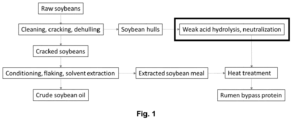
- Fig. 1 shows an example of an implementation of the inventive process.
- the present invention is based on the surprising finding that reducing sugars useful for the production of rumen-bypass proteins according to a Maillard reaction-based approach can be supplied locally by utilizing raw materials readily available at the feed production site. For example, it has been found that a soybean hull stream present at a typical soybean crusher site / feed production site contains more than enough pentoses to convert the whole soybean meal stream into rumen bypass proteins. Further, it has been found that the step of subjecting the lignocellulosic biomass to hydrolysis not only leads to the production of monomeric reducing sugars, which can then be used for the production of the rumen-bypass proteins, but also to the production of cellulose fibers with increased digestible energy.
- the present invention relates to a process for the production of a ruminant feed or a supplement for a ruminant feed, the process comprising the following steps:
- the lignocellulosic biomass and the protein source stem from the same crop.
- the process further comprises a step ( ⁇ ) performed prior to step (a).
- Step ( ⁇ ) comprises the following steps: ( ⁇ 1) providing one or more batches of harvested crops, preferably one batch; ( ⁇ 2) mechanically disintegrating the one or more batches of crops and separating a lignocellulosic biomass stream from a protein source stream.
- Step ( ⁇ ) is further characterized in that (i) the lignocellulosic biomass used in step (a) is derived from the lignocellulosic biomass stream obtained in step ( ⁇ 2) and (ii) the protein source used in step (c) is derived from the protein source stream obtained in step ( ⁇ 2).
- the lignocellulosic biomass stream usually comprises hulls, shells, and the like, and the protein source stream usually comprises the kernel (usually referred to as the "edible" part of a plant).
- the mechanical disintegration of the one or more batches of crops in step ( ⁇ 2) is performed by threshing, winnowing, milling, wet-milling, cracking and/or dehulling the one or more batches of crops.
- step (d) The reaction between the monomeric reducing sugars and the one or more proteins, which is induced by heat in step (d), is generally known as Maillard reaction and induces non-enzymatic browning of the mixture obtained from (c). "Non-enzymatic” means that no enzymes are necessary for or involved in the reaction between the monomeric reducing sugars and the one or more proteins in step (d).
- the lignocellulosic biomass subjected to hydrolysis in step (a) has a hemicellulose content of at least 1% w/w, dry matter, preferably at least 5% w/w, more preferably at least 10 w/w.
- the lignocellulosic biomass has a hemicellulose content, preferably a pentose polysaccharide content, more preferably a xylan content, of at least 1% w/w, dry matter, preferably at least 5% w/w, more preferably at least 10 w/w, and a lignin content of 5% w/w to 40% w/w.
- the lignin content is 10% w/w to 35% w/w, more preferably 15% w/w to 30% w/w.
- the hemicellulose content can be estimated by a sugar content assay based on TAPPI Standard T249 (85th Edition, 2009). By using lignocellulosic biomass with such a hemicellulose content it can be ensured that a sufficient amount of monomeric reducing sugars is generated in step (a).
- the lignin content can be estimated according to TAPPI Standard T222 (2006 edition).
- the indication % weight / weight means that the weight percentage is relative of the overall weight of the biomass.
- step (a) not only leads to the production of monomeric reducing sugars, which can then be used for the production of rumen-bypass proteins, but also to the production of cellulose fibers with increased digestible energy.
- the cellulose fibers comprised in the mixture obtained in step (a) are cellulose fibers with increased digestible energy compared to that of the fibers in the lignocellulosic biomass.
- Digestible energy can be determined by subtracting the gross energy in the feces from the gross energy fed to the animal. The gross energy can be measured by determining the total amount of heat produced from the combustion of the feed/feces.
- the digestible energy of a certain animal feed is usually only an estimate. However, assuming that the amount of cells sloughed off the gastrointestinal tract as the food passes through remains approximately constant, the digestible energy difference between two animal feeds can be determined within small or at least reasonable errors.
- the crop is preferably selected from legumes, cereals, and oil plants.
- Legumes are preferably selected from beans and soybeans.
- Cereals are preferably selected from oat, wheat, rise, barley, and corn.
- Oil plants are preferably selected from rapeseed, linseed, oil palm and sunflower.
- the inventors of the present invention have found that the reducing sugars can be supplied locally utilizing raw materials readily available at the feed production site. This allows for performing all process steps (from the harvested crop up to the final ruminant feed or supplement for a ruminant feed) at the same production site, which obviates the need for externally sourcing reducing sugars, or any other component, and allows to perform all process steps at the same production site.
- steps (a)-(d) are performed at the same production site. If step ( ⁇ ) is performed, then it is preferred that steps ( ⁇ ) and (a)-(d) are performed at the same production site.
- the lignocellulosic biomass comprises one or more members of the group consisting of legume shells, hulls, pods, stalks or leaves, preferably soybean hulls; peanut shells; oil seed shells, hulls, pods, husks, leaves, straw or stalks, preferably rapeseed pods or rapeseed straw; sesame stalks; sunflower stalks; palm kernel shells; empty fruit bunch; coconut shells or coconut husks; cereal hulls, bran, cobs, leaves, stalks or straw, preferably corn stover or corn cobs; oat hulls; rice hulls; barley straw; wheat bran; wheat straw; sorghum bagasse.
- Such lignocellulosic biomass is typically added to animal feeds as mere roughage while at the same time reducing sugars are externally sourced.
- lignocellulosic biomass can not only be used as simple roughage but can be directly used for producing reducing sugars, thereby rendering the process more simple, cost-efficient, and environmentally friendly.
- the lignocellulosic biomass consists of one or more members of the group consisting of soybean hulls, oat hulls, wheat bran, rice hulls, corn cobs, corn stover, palm kernel shells, empty fruit bunches, wheat straw.
- the hydrolysis of step (a) is acid hydrolysis or enzymatic hydrolysis. It is particularly preferred that the hydrolysis of step (a) is acid hydrolysis. It is further particularly preferred that the hydrolysis of step (a) is acid hydrolysis and a mineral acid and/or a gas is used as the acidic component for driving the hydrolysis reaction.
- the mineral acid is hydrochloric acid or sulfuric acid.
- the gas is preferably sulfur dioxide.
- the hydrolysis of step (a) is enzymatic hydrolysis and glucoside hydrolases, preferably xylanases (EC 3.2.1.8), are used.
- xylanases degrade the linear polysaccharide xylan into xylose monomers, thus breaking down hemicellulose.
- the hydrolysis step (a) is performed in a manner that maximizes the yield of xylose, preferably D-xylose, and minimizes the degradation of xylose to furfural.
- the mixture obtained in step (a) comprises (i) pentoses, preferably xylose and/or arabinose, more preferably D-xylose and/or arabinose, and (ii) hexoses, preferably mannose and/or galactose and/or glucose.
- the hydrolysis step (a) includes a combination of (i) acid hydrolysis, preferably dilute acid hydrolysis using diluted sulfuric acid, together with (ii) steam explosion and/or sulfite treatment and/or enzymatic hydrolysis.
- a combination of sulfuric acid treatment preferably 1-5% w/v, more preferably 1-4% w/v, more preferably 1-3% w/v, more preferably about 2% w/v
- steam explosion preferably performed at a temperature of 130-150 °C, preferably 135-145 °C
- step (b) is performed, i.e. at least one option of step (b) is not optional.
- step (b) comprises the step of adjusting the pH of the mixture obtained from step (a) to a pH of between 4.0 and 10.5, preferably between 6.0 and 9.5, more preferably between 7.0 and 9.5, even more preferably between 7.0 and 8.5 (in the following also referred to as the "pH adjustment step").
- step (b) comprises the step of introducing alkali metal cations and/or alkaline earth metal cations into the mixture obtained from step (a) (in the following also referred to as the "supplementation step").
- step (b) comprises the pH adjustment step and the supplementation step.
- both steps do not need to be performed separately from each other but can be performed simultaneously and, in particular, can be implemented into one single step. This, for example, is the case if alkali metal hydroxides or alkaline metal hydroxides are used for adjusting the pH.
- one or more alkali metal hydroxides and/or one or more alkaline metal hydroxides are used for adjusting the pH.
- the alkali metal hydroxides are selected from sodium hydroxide and potassium hydroxide
- the alkaline metal hydroxides are selected from magnesium hydroxide and calcium hydroxide.
- magnesium hydroxide is used for adjusting the pH.
- alkali metal cations and/or alkaline earth metal cations into the mixture obtained from step (a) is advantageous because such cations have been shown to affect Maillard reactions.
- the use of magnesium cations is particularly preferred, because Maillard reactions have been shown to be accelerated in the presence of magnesium ions, which is believed to be due to an increased sugar hydrolysis and the reduction of water mobility caused by the salt, counteracting the inhibitory effect of water on the Maillard reaction. It has in addition been proposed that magnesium serves as a Lewis acid catalyst to facilitate Maillard reactions, and that the presence of magnesium ions possibly can facilitate nucleophilic addition reactions between the carbonyl groups and amino groups after Lewis acid activation of the carbonyl group.
- step (a) it is preferred that one or more members of the group consisting of sodium ions, potassium ions, magnesium ions, and calcium ions are introduced into the mixture obtained from step (a).
- magnesium ions are introduced into the mixture obtained from step (a) for the reasons set out above
- the mixture obtained from step (b) has a magnesium ion content of at least 50 ppm.
- This concentration of magnesium ions has been shown to be particularly advantageous for Maillard reactions.
- the mixture obtained from step (b) mainly consists of reducing sugars, unhydrolyzed cellulose fibers, and mineral salts, wherein mainly consists means more than 80% w/w, dry matter, preferably more than 90% w/w, more preferably more than 95% w/w.
- DCAD dietary cation-anion difference
- the ruminant feed or supplement for a ruminant feed obtained from step (d) has a dietary cation-anion difference (DCAD) of 20 to 60 meq/100g dietary dry mass, preferably 25 to 55 meq/100g dietary dry mass, more preferably 30 to 50 meq/100g dietary dry mass. It is also preferred that the ruminant feed or supplement for a ruminant feed obtained from step (d) comprises potassium ions and sodium ions in an atomic ratio of potassium : sodium of between 1:1 and 5:1, preferably between 1.5:1 and 4:1, more preferably between 1.8:1 and 3.6:1.
- DCAD dietary cation-anion difference
- the ruminant feed or supplement for a ruminant feed obtained from step (d) comprises potassium ions and magnesium ions in a weight ratio of between 3:1 and 5:1, preferably between 3.5:1 and 4.5:1, more preferably between 3.7:1 and 3:1.
- This turns the resulting product mixture into a dietary supplement for incorporation in ruminant feedstocks, wherein the supplement is adapted to provide sodium, potassium and magnesium cations in calculated proportions to a basal ration.
- beneficial effects namely increased dry matter intake (DMI), increased milk yield (MY) and increased blood bicarbonate, were observed when such feedstock was administered to dairy cows during the early or in mid lactation phase.
- the protein source preferably comprises or consists of one or more members of the group consisting of: legume meals, preferably bean meal, more preferably soybean meal; peanut meal; oil seed meals or cakes, preferably rapeseed meal; cottonseed meal; linseed meal; safflower meal; sesame meal; sunflower seed meal; palm kernel cake; copra; cereals, barley; oat, corn; wheat; milo; sorghum; by-product protein feedstuffs, preferably corn gluten feed; distiller's grains; brewers' spent grain; silages; hays; alfalfa.
- the protein source comprises or consists of bean meal, preferably soybean meal, oil seed meal, preferably rapeseed meal or by-product protein feedstuff, preferably corn gluten feed.
- the one or more proteins comprise lysine.
- the one or more proteins comprised in the protein source comprise lysine and the blend obtained from step (c) comprises a molar ratio of reducing sugars to lysine of 0.3:1 to 1:1. It has surprisingly been found that this amount of reducing sugars is sufficient for forming the rumen bypass protein.
- the reducing sugars are pentoses, preferably xylose and/or arabinose, more preferably D-xylose and/or arabinose, and the one or more proteins comprised in the protein source comprise lysine, and the molar ratio of pentose to lysine is at least 1.
- pentoses preferably xylose and/or arabinose, more preferably D-xylose and/or arabinose
- the one or more proteins comprised in the protein source comprise lysine
- the molar ratio of pentose to lysine is at least 1.
- the use of xylose or arabinose in combination with lysine has been found to be particularly beneficial.
- step (d) is preferably performed at a temperature of 20 to 150 °C, preferably 70 to 120 °C, more preferably 85 to 105 °C. Further, it has been found that step (d) is preferably performed for a time period of 20 minutes to 72 hours, preferably 40 minutes to 8 hours, more preferably 1 hour to 4 hours.
- step (d) the amount of water affects the reaction of step (d) and that it is particularly advantageous if the blend obtained from step (c) that is subjected to heat treatment in step (d) has a moisture content of 6% to 40%, preferably 10% to 32%, more preferably 15% to 25%.
- the inventive process does not require for any separation, fractionation, or purification of the mixture obtained from step (a) before it is subjected to step (b) or (c).
- the mixture obtained from step (a) is not subjected to separation, fractionation, or purification before it is subjected to step (b) or step (c). This keeps down operating costs.
- no spent sulfite liquor or dried spent sulfite liquor is used in the process. It is also preferred that no formaldehyde is used in the process.
- step (b) is absent and no other step is performed between steps (a) and (c).
- step (b) is absent and no other step is performed between steps (c) and (d).
- step (b) is absent and no other step is performed between steps (a) and (c) and between steps (c) and (d).
- step (b) is present and no other step is performed between steps (a) and (b).
- step (b) is present and no other step is performed between steps (b) and (c).
- step (b) is present and no other step is performed between steps (c) and (d).
- step (b) is present and no other step is performed between steps (a) and (b), and between steps (b) and (c), and between steps (c) and (d).
- step (b) is present or absent.
- the present invention relates to a ruminant feed or a supplement for a ruminant feed obtained or obtainable by the inventive process.
- the inventive ruminant feed or a supplement for a ruminant feed comprises cellulose fibers with an increased digestible energy compared to that of fibers of typical lignocellulosic biomass.
- the process of the present invention was implemented into a conventional soybean processing plant.
- a facility for weak acid hydrolysis and neutralization has been added to a conventional soybean processing plant, making it possible to produce rumen bypass protein without external sourcing of reducing sugar additives.
- Raw soybeans were provided and then cleaned, cracked, and dehulled according to means known in the art.
- the soybean hulls were separated from the soybeans to provide a soybean hull feed and a soybean feed.
- the soybean feed was subjected to a conditioning, flaking, and solvent extraction step to provide for an extracted soybean meal and a crude soybean oil.
- the crude soybean oil can be subjected to further refining steps.
- the soybean hull feed was subjected to weak acid hydrolysis followed by neutralization.
- the extracted soybean meal was then combined with the product mixture obtained from the weak acid hydrolysis and neutralization step and subjected to a heat treatment step, thereby inducing a reaction between the monomeric reducing sugars and the one or more proteins.
- the obtained product can directly be used as a ruminant feed or can be combined with further ingredients and used as a supplement for a ruminant feed.
Landscapes
- Life Sciences & Earth Sciences (AREA)
- Chemical & Material Sciences (AREA)
- Polymers & Plastics (AREA)
- Engineering & Computer Science (AREA)
- Food Science & Technology (AREA)
- Animal Husbandry (AREA)
- Zoology (AREA)
- Proteomics, Peptides & Aminoacids (AREA)
- Health & Medical Sciences (AREA)
- Biotechnology (AREA)
- Botany (AREA)
- Molecular Biology (AREA)
- Mycology (AREA)
- Physiology (AREA)
- Birds (AREA)
- Fodder In General (AREA)
- Feed For Specific Animals (AREA)
Priority Applications (6)
| Application Number | Priority Date | Filing Date | Title |
|---|---|---|---|
| EP21217557.4A EP4201221A1 (de) | 2021-12-23 | 2021-12-23 | Wiederkäuerfutter oder ergänzungsmittel für wiederkäuerfutter und verfahren zur herstellung davon |
| PCT/EP2022/087598 WO2023118499A2 (en) | 2021-12-23 | 2022-12-22 | Ruminant feed or supplement for ruminant feed and process for preparing the same |
| CN202280091730.XA CN118695785A (zh) | 2021-12-23 | 2022-12-22 | 反刍动物饲料或反刍动物饲料的补充物及其制备方法 |
| MX2024007675A MX2024007675A (es) | 2021-12-23 | 2022-12-22 | Pienso para rumiantes o suplemento de pienso para rumiantes y procedimiento para su preparacion. |
| EP22843342.1A EP4451901A2 (de) | 2021-12-23 | 2022-12-22 | Futter oder ergänzungsmittel für wiederkäuer und verfahren zur herstellung davon |
| US18/721,531 US20250057190A1 (en) | 2021-12-23 | 2022-12-22 | Ruminant feed or supplement for ruminant feed and process for preparing the same |
Applications Claiming Priority (1)
| Application Number | Priority Date | Filing Date | Title |
|---|---|---|---|
| EP21217557.4A EP4201221A1 (de) | 2021-12-23 | 2021-12-23 | Wiederkäuerfutter oder ergänzungsmittel für wiederkäuerfutter und verfahren zur herstellung davon |
Publications (1)
| Publication Number | Publication Date |
|---|---|
| EP4201221A1 true EP4201221A1 (de) | 2023-06-28 |
Family
ID=79025202
Family Applications (2)
| Application Number | Title | Priority Date | Filing Date |
|---|---|---|---|
| EP21217557.4A Withdrawn EP4201221A1 (de) | 2021-12-23 | 2021-12-23 | Wiederkäuerfutter oder ergänzungsmittel für wiederkäuerfutter und verfahren zur herstellung davon |
| EP22843342.1A Pending EP4451901A2 (de) | 2021-12-23 | 2022-12-22 | Futter oder ergänzungsmittel für wiederkäuer und verfahren zur herstellung davon |
Family Applications After (1)
| Application Number | Title | Priority Date | Filing Date |
|---|---|---|---|
| EP22843342.1A Pending EP4451901A2 (de) | 2021-12-23 | 2022-12-22 | Futter oder ergänzungsmittel für wiederkäuer und verfahren zur herstellung davon |
Country Status (5)
| Country | Link |
|---|---|
| US (1) | US20250057190A1 (de) |
| EP (2) | EP4201221A1 (de) |
| CN (1) | CN118695785A (de) |
| MX (1) | MX2024007675A (de) |
| WO (1) | WO2023118499A2 (de) |
Citations (2)
| Publication number | Priority date | Publication date | Assignee | Title |
|---|---|---|---|---|
| CA2601889A1 (en) * | 2005-03-21 | 2006-09-28 | Archer-Daniels-Midland Company | Corn fiber hulls as a food additive or animal feed |
| US20080152755A1 (en) * | 2006-12-21 | 2008-06-26 | Lebo Stuart E | Bypass Protection for Protein and Starch in Animal Feed |
Family Cites Families (7)
| Publication number | Priority date | Publication date | Assignee | Title |
|---|---|---|---|---|
| US4957748A (en) * | 1987-03-23 | 1990-09-18 | The Board Of Regents Of The University Of Nebraska | Ruminant feed, method of making and method of using |
| KR101109802B1 (ko) * | 2003-07-15 | 2012-02-17 | 디에스엠 아이피 어셋츠 비.브이. | 지용성 활성 성분의 분말 제형 |
| AU2008223375B2 (en) * | 2007-03-05 | 2011-06-30 | Archer-Daniels-Midland Company | Method of preparing more digestible animal feed |
| IL207945A0 (en) * | 2010-09-02 | 2010-12-30 | Robert Jansen | Method for the production of carbohydrates |
| JP6564043B2 (ja) * | 2014-12-19 | 2019-08-21 | ヒルズ・ペット・ニュートリシャン・インコーポレーテッド | 歯科有効性のための動物用食品、製造方法、および使用 |
| WO2018218020A1 (en) * | 2017-05-24 | 2018-11-29 | Rupca Llc | Reduced pressure maillard synthesis of carbohydrate energy supplement for ruminant livestock |
| MX2021004444A (es) * | 2018-11-04 | 2021-05-12 | Nestle Sa | Composicion tratada termicamente que comprende proteinas vegetales y metodos de produccion y uso de esta. |
-
2021
- 2021-12-23 EP EP21217557.4A patent/EP4201221A1/de not_active Withdrawn
-
2022
- 2022-12-22 WO PCT/EP2022/087598 patent/WO2023118499A2/en not_active Ceased
- 2022-12-22 CN CN202280091730.XA patent/CN118695785A/zh active Pending
- 2022-12-22 MX MX2024007675A patent/MX2024007675A/es unknown
- 2022-12-22 US US18/721,531 patent/US20250057190A1/en active Pending
- 2022-12-22 EP EP22843342.1A patent/EP4451901A2/de active Pending
Patent Citations (2)
| Publication number | Priority date | Publication date | Assignee | Title |
|---|---|---|---|---|
| CA2601889A1 (en) * | 2005-03-21 | 2006-09-28 | Archer-Daniels-Midland Company | Corn fiber hulls as a food additive or animal feed |
| US20080152755A1 (en) * | 2006-12-21 | 2008-06-26 | Lebo Stuart E | Bypass Protection for Protein and Starch in Animal Feed |
Non-Patent Citations (2)
| Title |
|---|
| ANA CASSALES ET AL: "Optimization of soybean hull acid hydrolysis and its characterization as a potential substrate for bioprocessing", BIOMASS AND BIOENERGY, PERGAMON, AMSTERDAM, NL, vol. 35, no. 11, 29 September 2011 (2011-09-29), pages 4675 - 4683, XP028120972, ISSN: 0961-9534, [retrieved on 20111010], DOI: 10.1016/J.BIOMBIOE.2011.09.021 * |
| HUA-MIN LIU ET AL: "Application and Conversion of Soybean Hulls", 3 May 2017, SOYBEAN - THE BASIS OF YIELD, BIOMASS AND PRODUCTIVITY, INTECH OPEN, PAGE(S) 111 - 132, ISBN: 978-953-51-3117-5, XP009526114 * |
Also Published As
| Publication number | Publication date |
|---|---|
| WO2023118499A3 (en) | 2023-08-17 |
| US20250057190A1 (en) | 2025-02-20 |
| WO2023118499A2 (en) | 2023-06-29 |
| EP4451901A2 (de) | 2024-10-30 |
| CN118695785A (zh) | 2024-09-24 |
| MX2024007675A (es) | 2024-09-06 |
Similar Documents
| Publication | Publication Date | Title |
|---|---|---|
| Dale et al. | Protein feeds coproduction in biomass conversion to fuels and chemicals | |
| EP2515679B1 (de) | Verfahren zur modifizierung des proteinabbaus in wiederkäuerfutter | |
| CN105517450A (zh) | 提高木质纤维素生物质营养价值的方法和组合物 | |
| CN105472994A (zh) | 制备饲料添加剂的方法 | |
| KR20160113590A (ko) | 반추류의 사료의 효소 조성물의 이용 | |
| WO2013165968A1 (en) | Processes for producing animal feed from biomass | |
| US20100136176A1 (en) | RUMINANT FEEDS CONTAINING pH-ADJUSTED EDIBLE BYPRODUCTS AND HIGH DIGESTIVE EFFICIENCY GRAINS | |
| KR101556887B1 (ko) | 소 사료 조성물 및 그 제조방법 | |
| Macgregor | Directory of feeds & feed ingredients | |
| US20060204554A1 (en) | Compositions and methods providing rumen bypass protein in ruminant diets | |
| US20150056324A1 (en) | Archer daniels midland company | |
| US20160249643A1 (en) | Use of Enzymes to Condition Ruminant Feedstocks | |
| WO1993025616A1 (en) | Encapsulated starch for ruminant feed | |
| EP4201221A1 (de) | Wiederkäuerfutter oder ergänzungsmittel für wiederkäuerfutter und verfahren zur herstellung davon | |
| WO2005025323A1 (en) | Ruminants feed containing slowly digestible starch | |
| Kalscheur et al. | Feeding biofuel co-products to dairy cattle | |
| Ben-Ghedalia et al. | The effect of dietary barley on carbohydrate digestibility of sulphur dioxide-treated wheat straw by sheep | |
| JP3991310B2 (ja) | 飼養成績及び窒素、リンの消化率の高い家畜飼料 | |
| Preston | The use of sugar cane and by-products for livestock | |
| JP6422785B2 (ja) | 変性大豆及びそれを用いた飼料 | |
| Carlson et al. | Assessing alternative protein sources from by-products | |
| EP4301157B1 (de) | Aus biomassen von sojamehl stammender futterbestandteil | |
| National Academies of Sciences, Engineering, and Medicine | Feed By-Products | |
| Inborr et al. | The effect of enzyme treatment of cooked barley and supplementation of piglet diets on the digestibility of barley and piglet performance | |
| US20200054043A1 (en) | Balanced feed formulation based on tropical legumes and grasses with a high protein content and method for the production thereof |
Legal Events
| Date | Code | Title | Description |
|---|---|---|---|
| PUAI | Public reference made under article 153(3) epc to a published international application that has entered the european phase |
Free format text: ORIGINAL CODE: 0009012 |
|
| STAA | Information on the status of an ep patent application or granted ep patent |
Free format text: STATUS: THE APPLICATION HAS BEEN PUBLISHED |
|
| AK | Designated contracting states |
Kind code of ref document: A1 Designated state(s): AL AT BE BG CH CY CZ DE DK EE ES FI FR GB GR HR HU IE IS IT LI LT LU LV MC MK MT NL NO PL PT RO RS SE SI SK SM TR |
|
| STAA | Information on the status of an ep patent application or granted ep patent |
Free format text: STATUS: THE APPLICATION HAS BEEN WITHDRAWN |
|
| 18W | Application withdrawn |
Effective date: 20231219 |