EP4201429A1 - Intermédiaire conjugué anticorps-médicament comprenant sn38 et procédé de préparation associé - Google Patents
Intermédiaire conjugué anticorps-médicament comprenant sn38 et procédé de préparation associé Download PDFInfo
- Publication number
- EP4201429A1 EP4201429A1 EP22836026.9A EP22836026A EP4201429A1 EP 4201429 A1 EP4201429 A1 EP 4201429A1 EP 22836026 A EP22836026 A EP 22836026A EP 4201429 A1 EP4201429 A1 EP 4201429A1
- Authority
- EP
- European Patent Office
- Prior art keywords
- reaction
- solvent
- stirring
- drying
- completed
- Prior art date
- Legal status (The legal status is an assumption and is not a legal conclusion. Google has not performed a legal analysis and makes no representation as to the accuracy of the status listed.)
- Granted
Links
Images
Classifications
-
- A—HUMAN NECESSITIES
- A61—MEDICAL OR VETERINARY SCIENCE; HYGIENE
- A61P—SPECIFIC THERAPEUTIC ACTIVITY OF CHEMICAL COMPOUNDS OR MEDICINAL PREPARATIONS
- A61P35/00—Antineoplastic agents
-
- A—HUMAN NECESSITIES
- A61—MEDICAL OR VETERINARY SCIENCE; HYGIENE
- A61K—PREPARATIONS FOR MEDICAL, DENTAL OR TOILETRY PURPOSES
- A61K47/00—Medicinal preparations characterised by the non-active ingredients used, e.g. carriers or inert additives; Targeting or modifying agents chemically bound to the active ingredient
- A61K47/50—Medicinal preparations characterised by the non-active ingredients used, e.g. carriers or inert additives; Targeting or modifying agents chemically bound to the active ingredient the non-active ingredient being chemically bound to the active ingredient, e.g. polymer-drug conjugates
- A61K47/51—Medicinal preparations characterised by the non-active ingredients used, e.g. carriers or inert additives; Targeting or modifying agents chemically bound to the active ingredient the non-active ingredient being chemically bound to the active ingredient, e.g. polymer-drug conjugates the non-active ingredient being a modifying agent
- A61K47/68—Medicinal preparations characterised by the non-active ingredients used, e.g. carriers or inert additives; Targeting or modifying agents chemically bound to the active ingredient the non-active ingredient being chemically bound to the active ingredient, e.g. polymer-drug conjugates the non-active ingredient being a modifying agent the modifying agent being an antibody, an immunoglobulin or a fragment thereof, e.g. an Fc-fragment
- A61K47/6801—Drug-antibody or immunoglobulin conjugates defined by the pharmacologically or therapeutically active agent
- A61K47/6803—Drugs conjugated to an antibody or immunoglobulin, e.g. cisplatin-antibody conjugates
- A61K47/68037—Drugs conjugated to an antibody or immunoglobulin, e.g. cisplatin-antibody conjugates the drug being a camptothecin [CPT] or derivatives
-
- A—HUMAN NECESSITIES
- A61—MEDICAL OR VETERINARY SCIENCE; HYGIENE
- A61K—PREPARATIONS FOR MEDICAL, DENTAL OR TOILETRY PURPOSES
- A61K47/00—Medicinal preparations characterised by the non-active ingredients used, e.g. carriers or inert additives; Targeting or modifying agents chemically bound to the active ingredient
- A61K47/50—Medicinal preparations characterised by the non-active ingredients used, e.g. carriers or inert additives; Targeting or modifying agents chemically bound to the active ingredient the non-active ingredient being chemically bound to the active ingredient, e.g. polymer-drug conjugates
- A61K47/51—Medicinal preparations characterised by the non-active ingredients used, e.g. carriers or inert additives; Targeting or modifying agents chemically bound to the active ingredient the non-active ingredient being chemically bound to the active ingredient, e.g. polymer-drug conjugates the non-active ingredient being a modifying agent
- A61K47/62—Medicinal preparations characterised by the non-active ingredients used, e.g. carriers or inert additives; Targeting or modifying agents chemically bound to the active ingredient the non-active ingredient being chemically bound to the active ingredient, e.g. polymer-drug conjugates the non-active ingredient being a modifying agent the modifying agent being a protein, peptide or polyamino acid
- A61K47/65—Peptidic linkers, binders or spacers, e.g. peptidic enzyme-labile linkers
-
- A—HUMAN NECESSITIES
- A61—MEDICAL OR VETERINARY SCIENCE; HYGIENE
- A61K—PREPARATIONS FOR MEDICAL, DENTAL OR TOILETRY PURPOSES
- A61K47/00—Medicinal preparations characterised by the non-active ingredients used, e.g. carriers or inert additives; Targeting or modifying agents chemically bound to the active ingredient
- A61K47/50—Medicinal preparations characterised by the non-active ingredients used, e.g. carriers or inert additives; Targeting or modifying agents chemically bound to the active ingredient the non-active ingredient being chemically bound to the active ingredient, e.g. polymer-drug conjugates
- A61K47/51—Medicinal preparations characterised by the non-active ingredients used, e.g. carriers or inert additives; Targeting or modifying agents chemically bound to the active ingredient the non-active ingredient being chemically bound to the active ingredient, e.g. polymer-drug conjugates the non-active ingredient being a modifying agent
- A61K47/68—Medicinal preparations characterised by the non-active ingredients used, e.g. carriers or inert additives; Targeting or modifying agents chemically bound to the active ingredient the non-active ingredient being chemically bound to the active ingredient, e.g. polymer-drug conjugates the non-active ingredient being a modifying agent the modifying agent being an antibody, an immunoglobulin or a fragment thereof, e.g. an Fc-fragment
- A61K47/6835—Medicinal preparations characterised by the non-active ingredients used, e.g. carriers or inert additives; Targeting or modifying agents chemically bound to the active ingredient the non-active ingredient being chemically bound to the active ingredient, e.g. polymer-drug conjugates the non-active ingredient being a modifying agent the modifying agent being an antibody, an immunoglobulin or a fragment thereof, e.g. an Fc-fragment the modifying agent being an antibody or an immunoglobulin bearing at least one antigen-binding site
- A61K47/6849—Medicinal preparations characterised by the non-active ingredients used, e.g. carriers or inert additives; Targeting or modifying agents chemically bound to the active ingredient the non-active ingredient being chemically bound to the active ingredient, e.g. polymer-drug conjugates the non-active ingredient being a modifying agent the modifying agent being an antibody, an immunoglobulin or a fragment thereof, e.g. an Fc-fragment the modifying agent being an antibody or an immunoglobulin bearing at least one antigen-binding site the antibody targeting a receptor, a cell surface antigen or a cell surface determinant
-
- A—HUMAN NECESSITIES
- A61—MEDICAL OR VETERINARY SCIENCE; HYGIENE
- A61K—PREPARATIONS FOR MEDICAL, DENTAL OR TOILETRY PURPOSES
- A61K47/00—Medicinal preparations characterised by the non-active ingredients used, e.g. carriers or inert additives; Targeting or modifying agents chemically bound to the active ingredient
- A61K47/50—Medicinal preparations characterised by the non-active ingredients used, e.g. carriers or inert additives; Targeting or modifying agents chemically bound to the active ingredient the non-active ingredient being chemically bound to the active ingredient, e.g. polymer-drug conjugates
- A61K47/51—Medicinal preparations characterised by the non-active ingredients used, e.g. carriers or inert additives; Targeting or modifying agents chemically bound to the active ingredient the non-active ingredient being chemically bound to the active ingredient, e.g. polymer-drug conjugates the non-active ingredient being a modifying agent
- A61K47/68—Medicinal preparations characterised by the non-active ingredients used, e.g. carriers or inert additives; Targeting or modifying agents chemically bound to the active ingredient the non-active ingredient being chemically bound to the active ingredient, e.g. polymer-drug conjugates the non-active ingredient being a modifying agent the modifying agent being an antibody, an immunoglobulin or a fragment thereof, e.g. an Fc-fragment
- A61K47/6835—Medicinal preparations characterised by the non-active ingredients used, e.g. carriers or inert additives; Targeting or modifying agents chemically bound to the active ingredient the non-active ingredient being chemically bound to the active ingredient, e.g. polymer-drug conjugates the non-active ingredient being a modifying agent the modifying agent being an antibody, an immunoglobulin or a fragment thereof, e.g. an Fc-fragment the modifying agent being an antibody or an immunoglobulin bearing at least one antigen-binding site
- A61K47/6851—Medicinal preparations characterised by the non-active ingredients used, e.g. carriers or inert additives; Targeting or modifying agents chemically bound to the active ingredient the non-active ingredient being chemically bound to the active ingredient, e.g. polymer-drug conjugates the non-active ingredient being a modifying agent the modifying agent being an antibody, an immunoglobulin or a fragment thereof, e.g. an Fc-fragment the modifying agent being an antibody or an immunoglobulin bearing at least one antigen-binding site the antibody targeting a determinant of a tumour cell
- A61K47/6855—Medicinal preparations characterised by the non-active ingredients used, e.g. carriers or inert additives; Targeting or modifying agents chemically bound to the active ingredient the non-active ingredient being chemically bound to the active ingredient, e.g. polymer-drug conjugates the non-active ingredient being a modifying agent the modifying agent being an antibody, an immunoglobulin or a fragment thereof, e.g. an Fc-fragment the modifying agent being an antibody or an immunoglobulin bearing at least one antigen-binding site the antibody targeting a determinant of a tumour cell the tumour determinant being from breast cancer cell
-
- A—HUMAN NECESSITIES
- A61—MEDICAL OR VETERINARY SCIENCE; HYGIENE
- A61K—PREPARATIONS FOR MEDICAL, DENTAL OR TOILETRY PURPOSES
- A61K47/00—Medicinal preparations characterised by the non-active ingredients used, e.g. carriers or inert additives; Targeting or modifying agents chemically bound to the active ingredient
- A61K47/50—Medicinal preparations characterised by the non-active ingredients used, e.g. carriers or inert additives; Targeting or modifying agents chemically bound to the active ingredient the non-active ingredient being chemically bound to the active ingredient, e.g. polymer-drug conjugates
- A61K47/51—Medicinal preparations characterised by the non-active ingredients used, e.g. carriers or inert additives; Targeting or modifying agents chemically bound to the active ingredient the non-active ingredient being chemically bound to the active ingredient, e.g. polymer-drug conjugates the non-active ingredient being a modifying agent
- A61K47/68—Medicinal preparations characterised by the non-active ingredients used, e.g. carriers or inert additives; Targeting or modifying agents chemically bound to the active ingredient the non-active ingredient being chemically bound to the active ingredient, e.g. polymer-drug conjugates the non-active ingredient being a modifying agent the modifying agent being an antibody, an immunoglobulin or a fragment thereof, e.g. an Fc-fragment
- A61K47/6889—Conjugates wherein the antibody being the modifying agent and wherein the linker, binder or spacer confers particular properties to the conjugates, e.g. peptidic enzyme-labile linkers or acid-labile linkers, providing for an acid-labile immuno conjugate wherein the drug may be released from its antibody conjugated part in an acidic, e.g. tumoural or environment
-
- C—CHEMISTRY; METALLURGY
- C07—ORGANIC CHEMISTRY
- C07D—HETEROCYCLIC COMPOUNDS
- C07D491/00—Heterocyclic compounds containing in the condensed ring system both one or more rings having oxygen atoms as the only ring hetero atoms and one or more rings having nitrogen atoms as the only ring hetero atoms, not provided for by groups C07D451/00 - C07D459/00, C07D463/00, C07D477/00 or C07D489/00
- C07D491/22—Heterocyclic compounds containing in the condensed ring system both one or more rings having oxygen atoms as the only ring hetero atoms and one or more rings having nitrogen atoms as the only ring hetero atoms, not provided for by groups C07D451/00 - C07D459/00, C07D463/00, C07D477/00 or C07D489/00 in which the condensed system contains four or more hetero rings
-
- C—CHEMISTRY; METALLURGY
- C07—ORGANIC CHEMISTRY
- C07K—PEPTIDES
- C07K5/00—Peptides containing up to four amino acids in a fully defined sequence; Derivatives thereof
- C07K5/02—Peptides containing up to four amino acids in a fully defined sequence; Derivatives thereof containing at least one abnormal peptide link
- C07K5/021—Peptides containing up to four amino acids in a fully defined sequence; Derivatives thereof containing at least one abnormal peptide link containing the structure -NH-(X)n-C(=0)-, n being 5 or 6; for n > 6, classification in C07K5/06 - C07K5/10, according to the moiety having normal peptide bonds
-
- C—CHEMISTRY; METALLURGY
- C07—ORGANIC CHEMISTRY
- C07K—PEPTIDES
- C07K5/00—Peptides containing up to four amino acids in a fully defined sequence; Derivatives thereof
- C07K5/04—Peptides containing up to four amino acids in a fully defined sequence; Derivatives thereof containing only normal peptide links
- C07K5/06—Dipeptides
- C07K5/06008—Dipeptides with the first amino acid being neutral
- C07K5/06017—Dipeptides with the first amino acid being neutral and aliphatic
- C07K5/06034—Dipeptides with the first amino acid being neutral and aliphatic the side chain containing 2 to 4 carbon atoms
- C07K5/06052—Val-amino acid
-
- A—HUMAN NECESSITIES
- A61—MEDICAL OR VETERINARY SCIENCE; HYGIENE
- A61K—PREPARATIONS FOR MEDICAL, DENTAL OR TOILETRY PURPOSES
- A61K38/00—Medicinal preparations containing peptides
-
- Y—GENERAL TAGGING OF NEW TECHNOLOGICAL DEVELOPMENTS; GENERAL TAGGING OF CROSS-SECTIONAL TECHNOLOGIES SPANNING OVER SEVERAL SECTIONS OF THE IPC; TECHNICAL SUBJECTS COVERED BY FORMER USPC CROSS-REFERENCE ART COLLECTIONS [XRACs] AND DIGESTS
- Y02—TECHNOLOGIES OR APPLICATIONS FOR MITIGATION OR ADAPTATION AGAINST CLIMATE CHANGE
- Y02P—CLIMATE CHANGE MITIGATION TECHNOLOGIES IN THE PRODUCTION OR PROCESSING OF GOODS
- Y02P20/00—Technologies relating to chemical industry
- Y02P20/50—Improvements relating to the production of bulk chemicals
- Y02P20/55—Design of synthesis routes, e.g. reducing the use of auxiliary or protecting groups
Definitions
- the present disclosure relates to the field of antibody-drug conjugates, and in particular to an antibody-drug conjugate intermediate and a preparation method thereof.
- ADC Antibody-drug conjugate
- ADC Antibody-drug conjugate
- ADC drugs there are more than 60 ADC drugs in clinical trials for antitumor therapy.
- most of the toxins are tubulin inhibitors, and a small part are DNA inhibitors.
- DNA inhibitors have two advantages over tubulin inhibitors: 1) DNA inhibitors (picomolar IC50 values) are more active than tubulin inhibitors (sub-nanomolar IC50 values), and have better effects in treating tumors with few antigens; 2) it may kill cancer cells that are not in the division phase, and has advantages in treating solid tumors.
- Camptothecin compounds are clinically used topoisomerase 1 (TOP1) inhibitors, and have good clinical effects on slow-growing solid tumors.
- TOP1 topoisomerase 1
- camptothecin leads to poor water-solubility and lipid-solubility, which thus must be modified for water-solubility.
- ADC drugs with camptothecin as warhead provide a new solution for the above deficiencies.
- Enhertu trastuzumab deruxtecan
- Trodelvy Stacituzumab govitecan
- Enhertu developed by AstraZenecalDaiichi Sankyo
- GGFG tetrapeptide activated by cathepsin B is used as a linker, and a small section of self-cleaved structure is introduced to release Dxd, a derivative of Exatecan.
- Sacituzumab govitecan has a linker of Mcc-triazole spacer-PEG7-x-lysine-PABC, which breaks down in lysosomes (pH around 5) in cells to release camptothecin (SN38).
- the clinical phase II results of Sacituzumab govitecan for triple-negative breast cancer showed an effective rate as high as 30% and tumor shrinkage in 69.5% of patients, in the case that triple-negative breast cancer is almost "incurable" clinically.
- Sacituzumab govitecan may shrink tumors in 60% of patients.
- Sacituzumab govitecan showed a control rate up to 43%.
- ADC toxicity such as hematologic toxicity, neurotoxicity, pulmonary toxicity, skin toxicity, hepatotoxicity, ocular toxicity, metabolic abnormality, and cardiotoxicity. Therefore, improving the safety of ADC drugs is a problem that needs to be highly concerned and solved in the current drug development.
- Linker plays a vital role in the structure of ADC, and will affect the pharmacokinetic parameters, therapeutic indexes and efficacy of ADC.
- Linker can maintain the stability of ADC complex in the blood flow.
- the stability must be considered. Since ADC drug has a long half-life, the stability of linker is required to prevent linker from being broken down in the blood to release toxins in advance. If linker is not stable enough in the blood, it will lead to the decomposition of ADC before it enters the tumor cells, in which case the drug will have a reduced effect on tumor and even kill other cells by mistake. Moreover, in the process of internalization of ADC by tumor cells, linker should be able to release cytotoxic drugs rapidly.
- linker plays a significant decisive role in the safety and efficacy of the developed ADC drugs.
- different structures of linkers also greatly affect the difficulty factor, production cost, and environmental friendliness of the production process of ADC, and greatly affect the quality of ADC drugs, such as the stability of ADC, further affecting the safety of ADC drugs.
- the present disclosure provides an antibody-drug conjugate intermediate containing SN38 and a preparation method thereof.
- the preparation method is simple in steps and cost-saving, and does not introduce heavy metal ions in reactions with higher environmental friendliness.
- the antibody-drug conjugate intermediate synthesized by the preparation method has good stability, thereby significantly improving the safety of ADC drugs.
- the present disclosure relates to an antibody-drug conjugate intermediate represented by formula ( I ): wherein:
- X 1 is selected from the group consisting of -(CH 2 ) m - and -(CH 2 CH 2 O) p -, wherein m is selected from 1, 2, 3, 4, 5, and 6, preferably, m is 5; wherein p is selected from 1, 2, 3, 4, 5, and 6, preferably, P is 2.
- X 1 is selected from the group consisting of:
- R 1 or R 2 is selected from the group consisting of: H, methyl, ethyl, propyl, butyl, pentyl, heptyl, Cl, Br,
- X 2 is selected from the group consisting of:
- the antibody-drug conjugate intermediate has a structure represented by formula (1)-(16):
- the present disclosure also provides a method for producing an antibody-drug conjugate intermediate.
- the antibody-drug conjugate intermediate has a structure of: or or or
- R 1 is selected from the group consisting of hydrogen, substituted or unsubstituted C 1-6 alkyl, substituted or unsubstituted C 1-6 hydroxyalkyl, substituted or unsubstituted C 1-6 aminoalkyl, substituted or unsubstituted C 1-6 alkoxyl, substituted or unsubstituted C 1-6 alkylacyl, and substituted or unsubstituted C 1-6 alkylaldehyde;
- R 2 is selected from the group consisting of hydrogen and substituted or unsubstituted C 1-6 alkyl; wherein each substituted C 1-6 alkyl is optionally substituted with 1-5 substituents independently selected from the group consisting of halogen, hydroxyl, amino, carbonyl, carboxyl, 5-10-membered heterocyclyl and C 1-6 haloalkyl, wherein the 5-10-membered heterocyclyl has 1-3 heteroatoms selected from the group consisting of oxygen, nitrogen and sulfur.
- R 1 or R 2 is selected from the group consisting of: H, methyl, ethyl, propyl, butyl, pentyl, heptyl, methoxyl, ethoxyl, Cl, Br,
- the compound (I-1) is selected from the group consisting of the compound (1-2) is selected from the group consisting of:
- the "at low temperature" in any one of the above-mentioned reaction processes refers to in an ice water bath.
- the solvent in any one of the above-mentioned reaction processes may be independently polar solvent and/or non-polar solvent, wherein the polar solvent is selected from the group consisting of THF, DMF, DMA, NMP and a mixture thereof; and the non-polar solvent is selected from the group consisting of dichloromethane, carbon tetrachloride and a mixture thereof.
- organic base in any one of the above-mentioned reaction processes may be independently selected from the group consisting of N,N-diisopropylethylamine, triethylamine, pyridine, and a mixture thereof, preferably one or both of N,N-diisopropylethylamine and pyridine.
- the acid is one or two selected from the group consisting of hydrochloric acid, trifluoroacetic acid, and citric acid.
- the amine is primary amine or secondary amine.
- the extraction is performed using ethyl acetate, and the purification is performed by column chromatography using dichloromethane and methanol as eluent.
- the trituration is performed using ethyl acetate, hexane, dichloromethane, or a combination thereof.
- the purification is performed by column chromatography using dichloromethane and methanol as eluent.
- the purification is performed by column chromatography using dichloromethane and methanol as eluent.
- the purification is performed by column chromatography using dichloromethane and methanol as eluent.
- the purification is performed by preparative liquid chromatography method using MeCN and 0.1% HCOOH as mobile phase A, and H 2 O and 0.1% HCOOH as mobile phase B.
- the method for producing an antibody-drug conjugate intermediate (specifically a linker-SN38 covalent conjugate) provided by the present disclosure, in addition to the simple steps, reduces the safety problems caused by heavy metal residues. Moreover, the antibody-drug conjugate prepared by the antibody-drug conjugate intermediate has higher stability in vivo.
- an antibody-drug conjugate includes combinations of two or more antibody-drug conjugates and so on.
- antibody-drug conjugate represents a compound in which an antibody/antibody functional fragment, a linker, and a drug portion are linked together through a chemical reaction, and its structure is usually composed of three portions: an antibody or antibody ligand, a drug portion, and a linker that links the antibody or antibody ligand and the drug.
- the preparation of antibody-drug conjugates usually comprises two steps: in the first step, the linker and the drug portion are chemically reacted to form a "linker-drug” conjugate, and in the second step, the linker portion of the "linker-drug” conjugate is coupled covalently with the antibody/antibody functional fragment via a sulfhydryl group or an amino group.
- antibody-drug conjugate intermediate refers to the "linker-drug” conjugate described above. Further, the term “antibody-drug conjugate intermediate” as used in the present disclosure refers to the covalent conjugate of "linker” and SN38 in general.
- the "antibody-drug conjugate” used in the present disclosure is prepared by a common method in the art.
- the antibody-drug conjugate of the present disclosure is prepared by: preparing a 10 mg/mL solution of antibody with a PBS buffer at pH of 7.4, adding an appropriate equivalent of TCEP, shaking for 1 h to mix well, then adding 5.0 molar equivalents of linker-toxin (i.e., the compound shown in formula 1-formula 16), shaking to mix well for 1 h of reaction, removing the residual small molecules by ultrafiltration after the reaction is completed, and loading into hydrophobic interaction-high performance liquid chromatography (HIC-HPLC) to determine DAR, drug distribution, and antibody ratio.
- HIC-HPLC hydrophobic interaction-high performance liquid chromatography
- the present disclosure aims to provide a novel drug conjugate intermediate, and exemplary preparation of multiple ADCs with Heceptin is provided to validate the technical effect.
- the present disclosure has no limitation on the selection of the antibody, and the structure of specific ADCs is exemplarily provided.
- ADC-1 has a linker and toxin corresponding to the compound of formula (1), and is prepared with Heceptin by the above mentioned common method for preparing "antibody-drug conjugate" in the art (the following is the same: ADC-2 has a linker and toxin corresponding to the compound of formula (2); ADC-3 has a linker and toxin corresponding to the compound of formula (3); ADC-4 has a linker and toxin corresponding to the compound of formula (4); ADC-5 has a linker and toxin corresponding to the compound of formula (5); ADC-6 has a linker and toxin corresponding to the compound of formula (6); ADC-7 has a linker and toxin corresponding to the compound of formula (7); ADC-8 has a linker and toxin corresponding to the compound of formula (8); ADC-9 has a linker and toxin corresponding to the compound of formula (9); ADC-10 has a linker and toxin corresponding to the compound of formula (10); ADC-11 has
- linker used in the present disclosure refers to a molecule having bifunctional or multifunctional groups, which can react with a protein/antibody molecule and SN38 respectively, and thus act as a "bridge” linking the protein/antibody to SN38.
- the linker involved in the present disclosure specifically refers to a group containing acyl in the structure.
- Compound g (10-(2-N-methylethyl ethylene glycol)-camptothecin trifluoroacetate) was prepared according to the synthetic route of Example 1: Compound d (73.0 mg) was dissolved in 3 mL of dichloromethane and 3 mL of trifluoroacetic acid, placed in an ice water bath, and stirred at constant temperature for 1 h. The reaction was detected to be completed by LC-MS. After the reaction was completed, the solvent was rotating-dried. The residue was added with 2 mL of dichloromethane, rotating-dried twice, and monitored by LC-MS to collect the product to obtain compound g (70 mg), which was directly used in the next reaction. LC-MS: (M+H) + 580.6.
- Mc-VC-PAB-PNP maleimidohexanoic acid-L-valyl-L-citrulline-p-aminobenzyl-p-nitrophenyl carbonate
- 35 mg of compound j were dissolved in 2.5 mL of N,N-dimethylformamide, stirred in an ice water bath for 30 min, added dropwise with 129 mg of DIPEA, and stirred in the ice water bath for 0.5 h.
- the reaction was detected to be uncompleted by LC-MS.
- the reaction system was then added with 129 mg of DIPEA and stirred at room temperature for 0.5 h.
- the reaction solution turned yellow, and the reaction was detected to be completed by LC-MS.
- Compound of formula (1) and CL2A-SN38 intermediate were subjected to sulfhydryl coupling with Heceptin by conventional methods in the art, respectively (for example, see Example 12 in the Chinese Patent Application Publication No. CN102448494A ), to obtain ADC-1 and HER2-CL2A-SN38 (ADC-17) antibody-drug conjugates with an average DAR value of 8.
- NCI-N87 cells were digested by trypsin, then adjusted to a cell density of 50,000 cells/mL, added to a cell culture plate at 100 ⁇ L/well, and cultured in a 37°C, 5% CO 2 incubator for 14-20 h.
- the sample and control groups (see Table 1 for the composition of the test samples) were gradiently diluted with basal medium, respectively, transferred to the cell culture plate inoculated with cells at 100 ⁇ L/well, and cultured in a 37°C, 5% CO 2 incubator for 70-74 h.
- CCK-8 was diluted 10 times with culture medium.
- the old medium in the 96-well plate was discarded, and 100 ⁇ L of diluted CCK-8 solution was added to each well.
- Color development was performed under 5% CO 2 for 2-4 h. After centrifugation to remove air bubbles, the plates were detected by a microplate reader at a detection wavelength of 450 nm/655 nm for reading. The results are shown in Table 2.
- Table 1 Composition of test samples Number Test sample Average DAR Sample 1 ADC-1 8 Control group 1 ADC-17 8 Control group 2 HER2 antibody / Table 2 Inhibitory effect on NCI-N87 cells Number Test sample IC50 (ng/ml) Sample 1 ADC-1 251 Control group 1 ADC-17 210 Control group 2 HER2 antibody NA
- the compound of formula (1) prepared in the present disclosure had higher stability under weak acidic or neutral conditions in vivo, which is expected to significantly improve the safety of ADC drugs.
- BT474 cell line was thawed and passaged for 1-2 times. After the cells grew in a stable state, they were cultured on expansion. A suspension of tumor cells was prepared. Nude mice were inoculated with 0.2 ⁇ 10 7 BT474 cells in mammary fat pads, and a total of 60 female BALB/c nude mice were inoculated. When the average tumor volume reached about 70 mm 3 , 42 mice were selected and randomly divided into 6 groups according to the tumor volume: negative control group as control group 1 (normal saline group), control group 2 (ADC-17), experimental group 1 (ADC-4), experimental group 2 (ADC-12), experimental group 3 (ADC-1), and experimental group 4 (ADC-9), 7 mice in each group.
- control group 1 normal saline group
- ADC-17 experimental group 1
- ADC-4 experimental group 1
- ADC-12 experimental group 2
- ADC-1 experimental group 3
- experimental group 4 ADC-9
- control group 1 was intravenously given normal saline, and the remaining groups were intravenously given drugs at doses of 5 mg/kg for control group 2, 5 mg/kg for experimental group 1, 5 mg/kg for experimental group 2, 5 mg/kg for experimental group 3, and 5 mg/kg for experimental group 4, once a week for 21 weeks.
- the mice were weighed and the tumor volumes were measured 3 times a week, and the mice were weighed and the tumor volumes were measured on day 21.
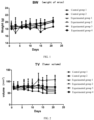
- mice Body weight of mice Group Number Weight (g) D1 D21 D1 D21 Control group 1 Normal saline 7 7 18.40 ⁇ 1.41 19.94 ⁇ 1.22 Control group 2 ADC-17 7 7 18.73 ⁇ 0.78 20.36 ⁇ 0.90 Experimental group 1 ADC-4 7 7 18.43 ⁇ 0.95 20.42 ⁇ 0.86 Experimental group 2 ADC-12 7 7 18.43 ⁇ 0.95 19.94 ⁇ 0.72 Experimental group 3 ADC-1 7 7 17.88 ⁇ 1.01 18.64 ⁇ 1.31 Experimental group 4 ADC-9 7 7 18.13 ⁇ 1.14 18.61 ⁇ 1.04
- each group of control group 2 (ADC-17 group), experimental group 1 (ADC-4), experimental group 2 (ADC-12), experimental group 3 (ADC-1), and experimental group 4 (ADC-9) showed no significant difference in body weight compared with control group 1. See Table 5 and FIG. 1 for details.
- mice Tumor volume (mm 3 )
- Control group 1 Normal saline 75.60 ⁇ 24.66 107.07 ⁇ 19.30 ## 1.52 ⁇ 0.39 ##
- Control group 2 ADC-17 67.95 ⁇ 15.73 49.17 ⁇ 13.29 ⁇ 0.75 ⁇ 0.19 ⁇ 49.30
- Experimental group 1 ADC-4 68.24 ⁇ 13.13 57.12 ⁇ 20.28 ⁇ 0.83 ⁇ 0.27 ⁇ 55.00
- Experimental group 2 ADC-12 70.73 ⁇ 16.36 66.26 ⁇ 21.37 ⁇ 0.95 ⁇ 0.26 ⁇ 62.58
- Experimental group 3 ADC-1 66.47 ⁇ 14.09 61.32 ⁇ 12.82 ⁇ 0.95 ⁇ 0.23 ⁇ 62.48
- Experimental group 4 ADC-9 70.73 ⁇ 17.99 75.76 ⁇ 46.18 ⁇ 1.02 ⁇ 0.35 ⁇ 67.19 Note: Each group was compared with control group 1 of normal saline group, where "*" represents P ⁇ 0.05
- control group 1 reached 107 ⁇ 19.30 mm 3 at Day 21 after administration, and the tumor volumes of control group 2, experimental group 1, experimental group 2, experimental group 3, and experimental group 4 were 49.17 ⁇ 13.29, 57.12 ⁇ 20.28, 66.26 ⁇ 21.37, 61.32 ⁇ 12.82, 75.76 ⁇ 46.18, and 75.19 ⁇ 25.99 mm 3 respectively (see Table 6).
- control group 2, experimental group 1, experimental group 2 and experimental group 3 were statistically very significantly different (P ⁇ 0.01) from control group 1 (normal saline group), and experimental group 4 was statistically significantly different (P ⁇ 0.05) from control group 1.
- the tumor volumes of experimental group 1, experimental group 2, and experimental group 3 were not statistically significantly different (P>0.05) from that of control group 2, and their relative tumor volumes were also not significantly different (P > 0.05), i.e., the effects were comparable.
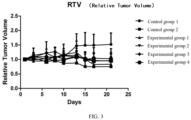
- the relative tumor proliferation rates (T/C) of control group 2, experimental group 1, experimental group 2, experimental group 3, and experimental group 4 were 49.30%, 55.00%, 62.58%, 62.48%, 67.19%, and 63.20%, respectively. From the above data, it can be known that all of the four antibody-drug conjugates corresponding to control group 2, experimental group 1, experimental group 2 and experimental group 3 tested in this experiment significantly inhibited the BT474 tumor growth with comparable effects, and experimental group 4 also inhibited the BT474 tumor growth.
- the changes in tumor volume and relative tumor volume of each group during the experiment are shown in FIG. 2 and FIG. 3 , respectively.
- the ADCs constructed with the drug conjugate intermediates of the present disclosure showed significant antitumor activity against the breast cancer BT474 cell model.
- the preferable ADC-1, ADC-4, and ADC-12 had significant advantages and were expected to significantly improve safety under in vivo conditions while providing tumor inhibitory effects comparable to that of the ADC-17 group.
Landscapes
- Health & Medical Sciences (AREA)
- Bioinformatics & Cheminformatics (AREA)
- Engineering & Computer Science (AREA)
- Life Sciences & Earth Sciences (AREA)
- Chemical & Material Sciences (AREA)
- Medicinal Chemistry (AREA)
- General Health & Medical Sciences (AREA)
- Veterinary Medicine (AREA)
- Public Health (AREA)
- Animal Behavior & Ethology (AREA)
- Pharmacology & Pharmacy (AREA)
- Epidemiology (AREA)
- Immunology (AREA)
- Organic Chemistry (AREA)
- Cell Biology (AREA)
- Proteomics, Peptides & Aminoacids (AREA)
- General Chemical & Material Sciences (AREA)
- Chemical Kinetics & Catalysis (AREA)
- Oncology (AREA)
- Nuclear Medicine, Radiotherapy & Molecular Imaging (AREA)
- Biochemistry (AREA)
- Biophysics (AREA)
- Genetics & Genomics (AREA)
- Molecular Biology (AREA)
- Crystallography & Structural Chemistry (AREA)
- Peptides Or Proteins (AREA)
- Medicines Containing Antibodies Or Antigens For Use As Internal Diagnostic Agents (AREA)
- Organic Low-Molecular-Weight Compounds And Preparation Thereof (AREA)
- Medicinal Preparation (AREA)
- Plural Heterocyclic Compounds (AREA)
Applications Claiming Priority (2)
| Application Number | Priority Date | Filing Date | Title |
|---|---|---|---|
| CN202111285580 | 2021-11-02 | ||
| PCT/CN2022/128912 WO2023078230A1 (fr) | 2021-11-02 | 2022-11-01 | Intermédiaire conjugué anticorps-médicament comprenant sn38 et procédé de préparation associé |
Related Child Applications (1)
| Application Number | Title | Priority Date | Filing Date |
|---|---|---|---|
| EP26168854.3 Division-Into | 2026-03-30 |
Publications (3)
| Publication Number | Publication Date |
|---|---|
| EP4201429A1 true EP4201429A1 (fr) | 2023-06-28 |
| EP4201429A4 EP4201429A4 (fr) | 2025-03-26 |
| EP4201429B1 EP4201429B1 (fr) | 2026-05-06 |
Family
ID=86028378
Family Applications (1)
| Application Number | Title | Priority Date | Filing Date |
|---|---|---|---|
| EP22836026.9A Active EP4201429B1 (fr) | 2021-11-02 | 2022-11-01 | Intermédiaire conjugué anticorps-médicament comprenant sn38 et procédé de préparation associé |
Country Status (7)
| Country | Link |
|---|---|
| US (1) | US20240408226A1 (fr) |
| EP (1) | EP4201429B1 (fr) |
| JP (1) | JP7753523B2 (fr) |
| KR (1) | KR20240040099A (fr) |
| CN (1) | CN116018160B (fr) |
| AU (1) | AU2022383308A1 (fr) |
| CA (1) | CA3228214A1 (fr) |
Families Citing this family (1)
| Publication number | Priority date | Publication date | Assignee | Title |
|---|---|---|---|---|
| CN119504932A (zh) * | 2023-08-23 | 2025-02-25 | 成都精西药业有限责任公司 | 一种连接子-药物的制备方法 |
Family Cites Families (7)
| Publication number | Priority date | Publication date | Assignee | Title |
|---|---|---|---|---|
| ES3000111T3 (en) * | 2009-02-13 | 2025-02-27 | Immunomedics Inc | Intermediates for preparing conjugates with an intracellularly-cleavable linkage |
| PT3056203T (pt) | 2010-04-21 | 2018-02-15 | Syntarga Bv | Conjugados de análogos de cc-1065 e ligantes bifuncionais |
| IL283313B2 (en) | 2018-11-20 | 2025-08-01 | Regeneron Pharma | Bis-octahydrophenanthrene carboxamide derivatives and protein conjugates thereof for use as lxr agonists |
| CN111620927B (zh) * | 2019-05-20 | 2022-11-11 | 烟台迈百瑞国际生物医药股份有限公司 | 一种抗体药物偶联物中间体的一锅法制备工艺 |
| WO2021077317A1 (fr) * | 2019-10-23 | 2021-04-29 | 烟台迈百瑞国际生物医药股份有限公司 | Intermédiaire de lieur oligopeptidique et son procédé de préparation |
| CN115298220B (zh) * | 2020-03-24 | 2024-12-20 | 上海翰森生物医药科技有限公司 | 抗体-药物偶联物及其医药用途 |
| KR20230015301A (ko) | 2021-07-19 | 2023-01-31 | 맙플렉스 인터내셔널 컴퍼니 리미티드 | 2성분 독소가 부하된 항체-약물 접합체 및 그의 용도 |
-
2022
- 2022-11-01 CN CN202280005164.6A patent/CN116018160B/zh active Active
- 2022-11-01 KR KR1020247006361A patent/KR20240040099A/ko active Pending
- 2022-11-01 CA CA3228214A patent/CA3228214A1/fr active Pending
- 2022-11-01 JP JP2024516810A patent/JP7753523B2/ja active Active
- 2022-11-01 EP EP22836026.9A patent/EP4201429B1/fr active Active
- 2022-11-01 AU AU2022383308A patent/AU2022383308A1/en active Pending
- 2022-11-01 US US18/016,275 patent/US20240408226A1/en active Pending
Also Published As
| Publication number | Publication date |
|---|---|
| US20240408226A1 (en) | 2024-12-12 |
| CN116018160B (zh) | 2026-03-03 |
| KR20240040099A (ko) | 2024-03-27 |
| JP2024533562A (ja) | 2024-09-12 |
| JP7753523B2 (ja) | 2025-10-14 |
| CN116018160A (zh) | 2023-04-25 |
| CA3228214A1 (fr) | 2023-05-11 |
| AU2022383308A1 (en) | 2024-02-22 |
| EP4201429A4 (fr) | 2025-03-26 |
| EP4201429B1 (fr) | 2026-05-06 |
Similar Documents
| Publication | Publication Date | Title |
|---|---|---|
| CN108727466B (zh) | 前列腺特异性膜抗原抗体药物结合物 | |
| EP3371179B1 (fr) | Nouveaux composes de cryptophycin et conjugues, leur preparation et leur application en therapeutique | |
| KR20200083605A (ko) | 프로그램가능한 중합체성 약물 | |
| CN110078788A (zh) | 含有非天然氨基酸连接的海兔毒素衍生物的组合物、涉及该海兔毒素衍生物的方法及其用途 | |
| EP2598507A1 (fr) | Dérivés anticancéreux, leur synthèse et leurs applications thérapeutiques | |
| AU2018329066B2 (en) | Amanitin antibody conjugate | |
| HK1256754A1 (en) | Novel cryptophycin compounds and conjugates, their preparation and their therapeutic use | |
| EP4671249A1 (fr) | Dérivé de camptothécine, conjugué de celui-ci, son procédé de préparation et son utilisation médicale | |
| EP2836493B1 (fr) | Dérivés de thiéno-indole fonctionnalisés pour le traitement du cancer | |
| EP3587426A1 (fr) | Nouveaux agents d'alkylation | |
| EP2824108B1 (fr) | Dérivés d'anthraquinone tétracyclique | |
| EP4201429A1 (fr) | Intermédiaire conjugué anticorps-médicament comprenant sn38 et procédé de préparation associé | |
| CA3076714C (fr) | Procede de production d'un conjugue anticorps-medicament intermediaire par l'ajout d'un acide et utilisation connexe | |
| RU2840789C2 (ru) | Промежуточное соединение конъюгата антитело-лекарственное средство, содержащее sn38, и способ его получения | |
| EP4733308A1 (fr) | Composé ciblant fap et complexe marqué par radionucléide basé sur celui-ci, procédé de préparation correspondant et utilisation associée | |
| WO2023078230A1 (fr) | Intermédiaire conjugué anticorps-médicament comprenant sn38 et procédé de préparation associé | |
| CN117750977A (zh) | 聚合型药物的自动合成 | |
| EP3049420B1 (fr) | Dérivés de thiéno[2,3-e]indole en tant que nouveaux agents antitumoraux | |
| RU2809116C2 (ru) | Конъюгат амантина с антителом | |
| CN121554528A (zh) | 一种共价多肽偶联药物化合物及其制备与应用 | |
| CN120285215A (zh) | 一种自稳定桥环连接单元及其在抗体-药物偶联物中的应用 | |
| CN118164994A (zh) | 一类喜树碱衍生物及其抗体药物偶联物 | |
| WO2024206459A2 (fr) | Composés, compositions et procédés de distribution d'agent thérapeutique spécifique à une cellule | |
| CN120302970A (zh) | 制备抗体药物缀合物的方法 | |
| KR20250049424A (ko) | 이중 치료학적 제제를 갖는 중합체 |
Legal Events
| Date | Code | Title | Description |
|---|---|---|---|
| STAA | Information on the status of an ep patent application or granted ep patent |
Free format text: STATUS: UNKNOWN |
|
| STAA | Information on the status of an ep patent application or granted ep patent |
Free format text: STATUS: THE INTERNATIONAL PUBLICATION HAS BEEN MADE |
|
| PUAI | Public reference made under article 153(3) epc to a published international application that has entered the european phase |
Free format text: ORIGINAL CODE: 0009012 |
|
| STAA | Information on the status of an ep patent application or granted ep patent |
Free format text: STATUS: REQUEST FOR EXAMINATION WAS MADE |
|
| 17P | Request for examination filed |
Effective date: 20230113 |
|
| AK | Designated contracting states |
Kind code of ref document: A1 Designated state(s): AL AT BE BG CH CY CZ DE DK EE ES FI FR GB GR HR HU IE IS IT LI LT LU LV MC ME MK MT NL NO PL PT RO RS SE SI SK SM TR |
|
| DAV | Request for validation of the european patent (deleted) | ||
| DAX | Request for extension of the european patent (deleted) | ||
| REG | Reference to a national code |
Ref country code: DE Ref legal event code: R079 Free format text: PREVIOUS MAIN CLASS: A61K0047640000 Ipc: C07K0005062000 Ref country code: DE Ref legal event code: R079 Ref document number: 602022036517 Country of ref document: DE Free format text: PREVIOUS MAIN CLASS: A61K0047640000 Ipc: C07K0005062000 |
|
| A4 | Supplementary search report drawn up and despatched |
Effective date: 20250221 |
|
| RIC1 | Information provided on ipc code assigned before grant |
Ipc: A61K 47/65 20170101ALI20250218BHEP Ipc: A61K 38/00 20060101ALI20250218BHEP Ipc: C07D 491/00 20060101ALI20250218BHEP Ipc: A61P 35/00 20060101ALI20250218BHEP Ipc: A61K 38/06 20060101ALI20250218BHEP Ipc: A61K 47/68 20170101ALI20250218BHEP Ipc: A61K 47/64 20170101ALI20250218BHEP Ipc: C07K 5/02 20060101ALI20250218BHEP Ipc: C07K 5/062 20060101AFI20250218BHEP |
|
| RIC1 | Information provided on ipc code assigned before grant |
Ipc: C07K 5/062 20060101AFI20251127BHEP Ipc: C07K 5/02 20060101ALI20251127BHEP Ipc: A61K 47/64 20170101ALI20251127BHEP Ipc: A61K 47/68 20170101ALI20251127BHEP Ipc: A61K 38/06 20060101ALI20251127BHEP Ipc: A61P 35/00 20060101ALI20251127BHEP Ipc: C07D 491/00 20060101ALI20251127BHEP Ipc: A61K 38/00 20060101ALI20251127BHEP Ipc: A61K 47/65 20170101ALI20251127BHEP Ipc: C07D 491/22 20060101ALI20251127BHEP |
|
| GRAP | Despatch of communication of intention to grant a patent |
Free format text: ORIGINAL CODE: EPIDOSNIGR1 |
|
| STAA | Information on the status of an ep patent application or granted ep patent |
Free format text: STATUS: GRANT OF PATENT IS INTENDED |
|
| INTG | Intention to grant announced |
Effective date: 20260105 |
|
| GRAS | Grant fee paid |
Free format text: ORIGINAL CODE: EPIDOSNIGR3 |
|
| GRAA | (expected) grant |
Free format text: ORIGINAL CODE: 0009210 |
|
| STAA | Information on the status of an ep patent application or granted ep patent |
Free format text: STATUS: THE PATENT HAS BEEN GRANTED |