EP4201517A1 - Articles catalytiques contenant du manganèse, systèmes de traitement de gaz d'échappement, et procédés - Google Patents
Articles catalytiques contenant du manganèse, systèmes de traitement de gaz d'échappement, et procédés Download PDFInfo
- Publication number
- EP4201517A1 EP4201517A1 EP21217681.2A EP21217681A EP4201517A1 EP 4201517 A1 EP4201517 A1 EP 4201517A1 EP 21217681 A EP21217681 A EP 21217681A EP 4201517 A1 EP4201517 A1 EP 4201517A1
- Authority
- EP
- European Patent Office
- Prior art keywords
- washcoat
- weight
- platinum
- catalytic article
- substrate
- Prior art date
- Legal status (The legal status is an assumption and is not a legal conclusion. Google has not performed a legal analysis and makes no representation as to the accuracy of the status listed.)
- Withdrawn
Links
Images


Classifications
-
- B—PERFORMING OPERATIONS; TRANSPORTING
- B01—PHYSICAL OR CHEMICAL PROCESSES OR APPARATUS IN GENERAL
- B01D—SEPARATION
- B01D53/00—Separation of gases or vapours; Recovering vapours of volatile solvents from gases; Chemical or biological purification of waste gases, e.g. engine exhaust gases, smoke, fumes, flue gases, aerosols
- B01D53/34—Chemical or biological purification of waste gases
- B01D53/92—Chemical or biological purification of waste gases of engine exhaust gases
- B01D53/94—Chemical or biological purification of waste gases of engine exhaust gases by catalytic processes
- B01D53/9459—Removing one or more of nitrogen oxides, carbon monoxide, or hydrocarbons by multiple successive catalytic functions; systems with more than one different function, e.g. zone coated catalysts
- B01D53/9463—Removing one or more of nitrogen oxides, carbon monoxide, or hydrocarbons by multiple successive catalytic functions; systems with more than one different function, e.g. zone coated catalysts with catalysts positioned on one brick
- B01D53/9472—Removing one or more of nitrogen oxides, carbon monoxide, or hydrocarbons by multiple successive catalytic functions; systems with more than one different function, e.g. zone coated catalysts with catalysts positioned on one brick in different zones
-
- B—PERFORMING OPERATIONS; TRANSPORTING
- B01—PHYSICAL OR CHEMICAL PROCESSES OR APPARATUS IN GENERAL
- B01J—CHEMICAL OR PHYSICAL PROCESSES, e.g. CATALYSIS OR COLLOID CHEMISTRY; THEIR RELEVANT APPARATUS
- B01J23/00—Catalysts comprising metals or metal oxides or hydroxides, not provided for in group B01J21/00
- B01J23/38—Catalysts comprising metals or metal oxides or hydroxides, not provided for in group B01J21/00 of noble metals
- B01J23/40—Catalysts comprising metals or metal oxides or hydroxides, not provided for in group B01J21/00 of noble metals of the platinum group metals
- B01J23/42—Platinum
-
- B—PERFORMING OPERATIONS; TRANSPORTING
- B01—PHYSICAL OR CHEMICAL PROCESSES OR APPARATUS IN GENERAL
- B01D—SEPARATION
- B01D53/00—Separation of gases or vapours; Recovering vapours of volatile solvents from gases; Chemical or biological purification of waste gases, e.g. engine exhaust gases, smoke, fumes, flue gases, aerosols
- B01D53/34—Chemical or biological purification of waste gases
- B01D53/92—Chemical or biological purification of waste gases of engine exhaust gases
- B01D53/94—Chemical or biological purification of waste gases of engine exhaust gases by catalytic processes
- B01D53/944—Simultaneously removing carbon monoxide, hydrocarbons or carbon making use of oxidation catalysts
-
- B—PERFORMING OPERATIONS; TRANSPORTING
- B01—PHYSICAL OR CHEMICAL PROCESSES OR APPARATUS IN GENERAL
- B01D—SEPARATION
- B01D53/00—Separation of gases or vapours; Recovering vapours of volatile solvents from gases; Chemical or biological purification of waste gases, e.g. engine exhaust gases, smoke, fumes, flue gases, aerosols
- B01D53/34—Chemical or biological purification of waste gases
- B01D53/92—Chemical or biological purification of waste gases of engine exhaust gases
- B01D53/94—Chemical or biological purification of waste gases of engine exhaust gases by catalytic processes
- B01D53/9445—Simultaneously removing carbon monoxide, hydrocarbons or nitrogen oxides making use of three-way catalysts [TWC] or four-way-catalysts [FWC]
- B01D53/9454—Simultaneously removing carbon monoxide, hydrocarbons or nitrogen oxides making use of three-way catalysts [TWC] or four-way-catalysts [FWC] characterised by a specific device
-
- B—PERFORMING OPERATIONS; TRANSPORTING
- B01—PHYSICAL OR CHEMICAL PROCESSES OR APPARATUS IN GENERAL
- B01D—SEPARATION
- B01D53/00—Separation of gases or vapours; Recovering vapours of volatile solvents from gases; Chemical or biological purification of waste gases, e.g. engine exhaust gases, smoke, fumes, flue gases, aerosols
- B01D53/34—Chemical or biological purification of waste gases
- B01D53/92—Chemical or biological purification of waste gases of engine exhaust gases
- B01D53/94—Chemical or biological purification of waste gases of engine exhaust gases by catalytic processes
- B01D53/9459—Removing one or more of nitrogen oxides, carbon monoxide, or hydrocarbons by multiple successive catalytic functions; systems with more than one different function, e.g. zone coated catalysts
- B01D53/9477—Removing one or more of nitrogen oxides, carbon monoxide, or hydrocarbons by multiple successive catalytic functions; systems with more than one different function, e.g. zone coated catalysts with catalysts positioned on separate bricks, e.g. exhaust systems
-
- B—PERFORMING OPERATIONS; TRANSPORTING
- B01—PHYSICAL OR CHEMICAL PROCESSES OR APPARATUS IN GENERAL
- B01J—CHEMICAL OR PHYSICAL PROCESSES, e.g. CATALYSIS OR COLLOID CHEMISTRY; THEIR RELEVANT APPARATUS
- B01J21/00—Catalysts comprising the elements, oxides, or hydroxides of magnesium, boron, aluminium, carbon, silicon, titanium, zirconium, or hafnium
- B01J21/02—Boron or aluminium; Oxides or hydroxides thereof
- B01J21/04—Alumina
-
- B—PERFORMING OPERATIONS; TRANSPORTING
- B01—PHYSICAL OR CHEMICAL PROCESSES OR APPARATUS IN GENERAL
- B01J—CHEMICAL OR PHYSICAL PROCESSES, e.g. CATALYSIS OR COLLOID CHEMISTRY; THEIR RELEVANT APPARATUS
- B01J21/00—Catalysts comprising the elements, oxides, or hydroxides of magnesium, boron, aluminium, carbon, silicon, titanium, zirconium, or hafnium
- B01J21/06—Silicon, titanium, zirconium or hafnium; Oxides or hydroxides thereof
-
- B—PERFORMING OPERATIONS; TRANSPORTING
- B01—PHYSICAL OR CHEMICAL PROCESSES OR APPARATUS IN GENERAL
- B01J—CHEMICAL OR PHYSICAL PROCESSES, e.g. CATALYSIS OR COLLOID CHEMISTRY; THEIR RELEVANT APPARATUS
- B01J21/00—Catalysts comprising the elements, oxides, or hydroxides of magnesium, boron, aluminium, carbon, silicon, titanium, zirconium, or hafnium
- B01J21/06—Silicon, titanium, zirconium or hafnium; Oxides or hydroxides thereof
- B01J21/066—Zirconium or hafnium; Oxides or hydroxides thereof
-
- B—PERFORMING OPERATIONS; TRANSPORTING
- B01—PHYSICAL OR CHEMICAL PROCESSES OR APPARATUS IN GENERAL
- B01J—CHEMICAL OR PHYSICAL PROCESSES, e.g. CATALYSIS OR COLLOID CHEMISTRY; THEIR RELEVANT APPARATUS
- B01J21/00—Catalysts comprising the elements, oxides, or hydroxides of magnesium, boron, aluminium, carbon, silicon, titanium, zirconium, or hafnium
- B01J21/12—Silica and alumina
-
- B—PERFORMING OPERATIONS; TRANSPORTING
- B01—PHYSICAL OR CHEMICAL PROCESSES OR APPARATUS IN GENERAL
- B01J—CHEMICAL OR PHYSICAL PROCESSES, e.g. CATALYSIS OR COLLOID CHEMISTRY; THEIR RELEVANT APPARATUS
- B01J23/00—Catalysts comprising metals or metal oxides or hydroxides, not provided for in group B01J21/00
- B01J23/16—Catalysts comprising metals or metal oxides or hydroxides, not provided for in group B01J21/00 of arsenic, antimony, bismuth, vanadium, niobium, tantalum, polonium, chromium, molybdenum, tungsten, manganese, technetium or rhenium
- B01J23/32—Manganese, technetium or rhenium
- B01J23/34—Manganese
-
- B—PERFORMING OPERATIONS; TRANSPORTING
- B01—PHYSICAL OR CHEMICAL PROCESSES OR APPARATUS IN GENERAL
- B01J—CHEMICAL OR PHYSICAL PROCESSES, e.g. CATALYSIS OR COLLOID CHEMISTRY; THEIR RELEVANT APPARATUS
- B01J23/00—Catalysts comprising metals or metal oxides or hydroxides, not provided for in group B01J21/00
- B01J23/38—Catalysts comprising metals or metal oxides or hydroxides, not provided for in group B01J21/00 of noble metals
- B01J23/40—Catalysts comprising metals or metal oxides or hydroxides, not provided for in group B01J21/00 of noble metals of the platinum group metals
- B01J23/44—Palladium
-
- B—PERFORMING OPERATIONS; TRANSPORTING
- B01—PHYSICAL OR CHEMICAL PROCESSES OR APPARATUS IN GENERAL
- B01J—CHEMICAL OR PHYSICAL PROCESSES, e.g. CATALYSIS OR COLLOID CHEMISTRY; THEIR RELEVANT APPARATUS
- B01J23/00—Catalysts comprising metals or metal oxides or hydroxides, not provided for in group B01J21/00
- B01J23/38—Catalysts comprising metals or metal oxides or hydroxides, not provided for in group B01J21/00 of noble metals
- B01J23/54—Catalysts comprising metals or metal oxides or hydroxides, not provided for in group B01J21/00 of noble metals combined with metals, oxides or hydroxides provided for in groups B01J23/02 - B01J23/36
- B01J23/56—Platinum group metals
- B01J23/64—Platinum group metals with arsenic, antimony, bismuth, vanadium, niobium, tantalum, polonium, chromium, molybdenum, tungsten, manganese, technetium or rhenium
- B01J23/656—Manganese, technetium or rhenium
- B01J23/6562—Manganese
-
- B—PERFORMING OPERATIONS; TRANSPORTING
- B01—PHYSICAL OR CHEMICAL PROCESSES OR APPARATUS IN GENERAL
- B01J—CHEMICAL OR PHYSICAL PROCESSES, e.g. CATALYSIS OR COLLOID CHEMISTRY; THEIR RELEVANT APPARATUS
- B01J29/00—Catalysts comprising molecular sieves
- B01J29/04—Catalysts comprising molecular sieves having base-exchange properties, e.g. crystalline zeolites
- B01J29/06—Crystalline aluminosilicate zeolites; Isomorphous compounds thereof
-
- B—PERFORMING OPERATIONS; TRANSPORTING
- B01—PHYSICAL OR CHEMICAL PROCESSES OR APPARATUS IN GENERAL
- B01J—CHEMICAL OR PHYSICAL PROCESSES, e.g. CATALYSIS OR COLLOID CHEMISTRY; THEIR RELEVANT APPARATUS
- B01J29/00—Catalysts comprising molecular sieves
- B01J29/04—Catalysts comprising molecular sieves having base-exchange properties, e.g. crystalline zeolites
- B01J29/06—Crystalline aluminosilicate zeolites; Isomorphous compounds thereof
- B01J29/40—Crystalline aluminosilicate zeolites; Isomorphous compounds thereof of the pentasil type, e.g. types ZSM-5, ZSM-8 or ZSM-11, as exemplified by patent documents US3702886, GB1334243 and US3709979, respectively
-
- B—PERFORMING OPERATIONS; TRANSPORTING
- B01—PHYSICAL OR CHEMICAL PROCESSES OR APPARATUS IN GENERAL
- B01J—CHEMICAL OR PHYSICAL PROCESSES, e.g. CATALYSIS OR COLLOID CHEMISTRY; THEIR RELEVANT APPARATUS
- B01J29/00—Catalysts comprising molecular sieves
- B01J29/04—Catalysts comprising molecular sieves having base-exchange properties, e.g. crystalline zeolites
- B01J29/06—Crystalline aluminosilicate zeolites; Isomorphous compounds thereof
- B01J29/70—Crystalline aluminosilicate zeolites; Isomorphous compounds thereof of types characterised by their specific structure not provided for in groups B01J29/08 - B01J29/65
- B01J29/7007—Zeolite Beta
-
- B—PERFORMING OPERATIONS; TRANSPORTING
- B01—PHYSICAL OR CHEMICAL PROCESSES OR APPARATUS IN GENERAL
- B01J—CHEMICAL OR PHYSICAL PROCESSES, e.g. CATALYSIS OR COLLOID CHEMISTRY; THEIR RELEVANT APPARATUS
- B01J29/00—Catalysts comprising molecular sieves
- B01J29/04—Catalysts comprising molecular sieves having base-exchange properties, e.g. crystalline zeolites
- B01J29/06—Crystalline aluminosilicate zeolites; Isomorphous compounds thereof
- B01J29/70—Crystalline aluminosilicate zeolites; Isomorphous compounds thereof of types characterised by their specific structure not provided for in groups B01J29/08 - B01J29/65
- B01J29/72—Crystalline aluminosilicate zeolites; Isomorphous compounds thereof of types characterised by their specific structure not provided for in groups B01J29/08 - B01J29/65 containing iron group metals, noble metals or copper
- B01J29/74—Noble metals
- B01J29/7415—Zeolite Beta
-
- B—PERFORMING OPERATIONS; TRANSPORTING
- B01—PHYSICAL OR CHEMICAL PROCESSES OR APPARATUS IN GENERAL
- B01J—CHEMICAL OR PHYSICAL PROCESSES, e.g. CATALYSIS OR COLLOID CHEMISTRY; THEIR RELEVANT APPARATUS
- B01J35/00—Catalysts, in general, characterised by their form or physical properties
- B01J35/19—Catalysts containing parts with different compositions
-
- B—PERFORMING OPERATIONS; TRANSPORTING
- B01—PHYSICAL OR CHEMICAL PROCESSES OR APPARATUS IN GENERAL
- B01J—CHEMICAL OR PHYSICAL PROCESSES, e.g. CATALYSIS OR COLLOID CHEMISTRY; THEIR RELEVANT APPARATUS
- B01J35/00—Catalysts, in general, characterised by their form or physical properties
- B01J35/40—Catalysts, in general, characterised by their form or physical properties characterised by dimensions, e.g. grain size
-
- B—PERFORMING OPERATIONS; TRANSPORTING
- B01—PHYSICAL OR CHEMICAL PROCESSES OR APPARATUS IN GENERAL
- B01J—CHEMICAL OR PHYSICAL PROCESSES, e.g. CATALYSIS OR COLLOID CHEMISTRY; THEIR RELEVANT APPARATUS
- B01J35/00—Catalysts, in general, characterised by their form or physical properties
- B01J35/50—Catalysts, in general, characterised by their form or physical properties characterised by their shape or configuration
- B01J35/56—Foraminous structures having flow-through passages or channels, e.g. grids or three-dimensional [3D] monoliths
-
- B—PERFORMING OPERATIONS; TRANSPORTING
- B01—PHYSICAL OR CHEMICAL PROCESSES OR APPARATUS IN GENERAL
- B01J—CHEMICAL OR PHYSICAL PROCESSES, e.g. CATALYSIS OR COLLOID CHEMISTRY; THEIR RELEVANT APPARATUS
- B01J35/00—Catalysts, in general, characterised by their form or physical properties
- B01J35/60—Catalysts, in general, characterised by their form or physical properties characterised by their surface properties or porosity
-
- B—PERFORMING OPERATIONS; TRANSPORTING
- B01—PHYSICAL OR CHEMICAL PROCESSES OR APPARATUS IN GENERAL
- B01J—CHEMICAL OR PHYSICAL PROCESSES, e.g. CATALYSIS OR COLLOID CHEMISTRY; THEIR RELEVANT APPARATUS
- B01J35/00—Catalysts, in general, characterised by their form or physical properties
- B01J35/60—Catalysts, in general, characterised by their form or physical properties characterised by their surface properties or porosity
- B01J35/61—Surface area
- B01J35/613—10-100 m2/g
-
- B—PERFORMING OPERATIONS; TRANSPORTING
- B01—PHYSICAL OR CHEMICAL PROCESSES OR APPARATUS IN GENERAL
- B01J—CHEMICAL OR PHYSICAL PROCESSES, e.g. CATALYSIS OR COLLOID CHEMISTRY; THEIR RELEVANT APPARATUS
- B01J35/00—Catalysts, in general, characterised by their form or physical properties
- B01J35/60—Catalysts, in general, characterised by their form or physical properties characterised by their surface properties or porosity
- B01J35/61—Surface area
- B01J35/615—100-500 m2/g
-
- B—PERFORMING OPERATIONS; TRANSPORTING
- B01—PHYSICAL OR CHEMICAL PROCESSES OR APPARATUS IN GENERAL
- B01J—CHEMICAL OR PHYSICAL PROCESSES, e.g. CATALYSIS OR COLLOID CHEMISTRY; THEIR RELEVANT APPARATUS
- B01J35/00—Catalysts, in general, characterised by their form or physical properties
- B01J35/60—Catalysts, in general, characterised by their form or physical properties characterised by their surface properties or porosity
- B01J35/63—Pore volume
- B01J35/633—Pore volume less than 0.5 ml/g
-
- B—PERFORMING OPERATIONS; TRANSPORTING
- B01—PHYSICAL OR CHEMICAL PROCESSES OR APPARATUS IN GENERAL
- B01J—CHEMICAL OR PHYSICAL PROCESSES, e.g. CATALYSIS OR COLLOID CHEMISTRY; THEIR RELEVANT APPARATUS
- B01J35/00—Catalysts, in general, characterised by their form or physical properties
- B01J35/60—Catalysts, in general, characterised by their form or physical properties characterised by their surface properties or porosity
- B01J35/63—Pore volume
- B01J35/635—0.5-1.0 ml/g
-
- B—PERFORMING OPERATIONS; TRANSPORTING
- B01—PHYSICAL OR CHEMICAL PROCESSES OR APPARATUS IN GENERAL
- B01J—CHEMICAL OR PHYSICAL PROCESSES, e.g. CATALYSIS OR COLLOID CHEMISTRY; THEIR RELEVANT APPARATUS
- B01J37/00—Processes, in general, for preparing catalysts; Processes, in general, for activation of catalysts
- B01J37/0009—Use of binding agents; Moulding; Pressing; Powdering; Granulating; Addition of materials ameliorating the mechanical properties of the product catalyst
-
- B—PERFORMING OPERATIONS; TRANSPORTING
- B01—PHYSICAL OR CHEMICAL PROCESSES OR APPARATUS IN GENERAL
- B01J—CHEMICAL OR PHYSICAL PROCESSES, e.g. CATALYSIS OR COLLOID CHEMISTRY; THEIR RELEVANT APPARATUS
- B01J37/00—Processes, in general, for preparing catalysts; Processes, in general, for activation of catalysts
- B01J37/0009—Use of binding agents; Moulding; Pressing; Powdering; Granulating; Addition of materials ameliorating the mechanical properties of the product catalyst
- B01J37/0027—Powdering
- B01J37/0036—Grinding
-
- B—PERFORMING OPERATIONS; TRANSPORTING
- B01—PHYSICAL OR CHEMICAL PROCESSES OR APPARATUS IN GENERAL
- B01J—CHEMICAL OR PHYSICAL PROCESSES, e.g. CATALYSIS OR COLLOID CHEMISTRY; THEIR RELEVANT APPARATUS
- B01J37/00—Processes, in general, for preparing catalysts; Processes, in general, for activation of catalysts
- B01J37/0009—Use of binding agents; Moulding; Pressing; Powdering; Granulating; Addition of materials ameliorating the mechanical properties of the product catalyst
- B01J37/0027—Powdering
- B01J37/0045—Drying a slurry, e.g. spray drying
-
- B—PERFORMING OPERATIONS; TRANSPORTING
- B01—PHYSICAL OR CHEMICAL PROCESSES OR APPARATUS IN GENERAL
- B01J—CHEMICAL OR PHYSICAL PROCESSES, e.g. CATALYSIS OR COLLOID CHEMISTRY; THEIR RELEVANT APPARATUS
- B01J37/00—Processes, in general, for preparing catalysts; Processes, in general, for activation of catalysts
- B01J37/02—Impregnation, coating or precipitation
- B01J37/0201—Impregnation
-
- B—PERFORMING OPERATIONS; TRANSPORTING
- B01—PHYSICAL OR CHEMICAL PROCESSES OR APPARATUS IN GENERAL
- B01J—CHEMICAL OR PHYSICAL PROCESSES, e.g. CATALYSIS OR COLLOID CHEMISTRY; THEIR RELEVANT APPARATUS
- B01J37/00—Processes, in general, for preparing catalysts; Processes, in general, for activation of catalysts
- B01J37/02—Impregnation, coating or precipitation
- B01J37/0215—Coating
- B01J37/0221—Coating of particles
-
- B—PERFORMING OPERATIONS; TRANSPORTING
- B01—PHYSICAL OR CHEMICAL PROCESSES OR APPARATUS IN GENERAL
- B01J—CHEMICAL OR PHYSICAL PROCESSES, e.g. CATALYSIS OR COLLOID CHEMISTRY; THEIR RELEVANT APPARATUS
- B01J37/00—Processes, in general, for preparing catalysts; Processes, in general, for activation of catalysts
- B01J37/02—Impregnation, coating or precipitation
- B01J37/0236—Drying, e.g. preparing a suspension, adding a soluble salt and drying
-
- B—PERFORMING OPERATIONS; TRANSPORTING
- B01—PHYSICAL OR CHEMICAL PROCESSES OR APPARATUS IN GENERAL
- B01J—CHEMICAL OR PHYSICAL PROCESSES, e.g. CATALYSIS OR COLLOID CHEMISTRY; THEIR RELEVANT APPARATUS
- B01J37/00—Processes, in general, for preparing catalysts; Processes, in general, for activation of catalysts
- B01J37/02—Impregnation, coating or precipitation
- B01J37/024—Multiple impregnation or coating
- B01J37/0246—Coatings comprising a zeolite
-
- B—PERFORMING OPERATIONS; TRANSPORTING
- B01—PHYSICAL OR CHEMICAL PROCESSES OR APPARATUS IN GENERAL
- B01J—CHEMICAL OR PHYSICAL PROCESSES, e.g. CATALYSIS OR COLLOID CHEMISTRY; THEIR RELEVANT APPARATUS
- B01J37/00—Processes, in general, for preparing catalysts; Processes, in general, for activation of catalysts
- B01J37/02—Impregnation, coating or precipitation
- B01J37/024—Multiple impregnation or coating
- B01J37/0248—Coatings comprising impregnated particles
-
- B—PERFORMING OPERATIONS; TRANSPORTING
- B01—PHYSICAL OR CHEMICAL PROCESSES OR APPARATUS IN GENERAL
- B01J—CHEMICAL OR PHYSICAL PROCESSES, e.g. CATALYSIS OR COLLOID CHEMISTRY; THEIR RELEVANT APPARATUS
- B01J37/00—Processes, in general, for preparing catalysts; Processes, in general, for activation of catalysts
- B01J37/08—Heat treatment
-
- B—PERFORMING OPERATIONS; TRANSPORTING
- B01—PHYSICAL OR CHEMICAL PROCESSES OR APPARATUS IN GENERAL
- B01D—SEPARATION
- B01D2255/00—Catalysts
- B01D2255/10—Noble metals or compounds thereof
- B01D2255/102—Platinum group metals
- B01D2255/1021—Platinum
-
- B—PERFORMING OPERATIONS; TRANSPORTING
- B01—PHYSICAL OR CHEMICAL PROCESSES OR APPARATUS IN GENERAL
- B01D—SEPARATION
- B01D2255/00—Catalysts
- B01D2255/10—Noble metals or compounds thereof
- B01D2255/102—Platinum group metals
- B01D2255/1023—Palladium
-
- B—PERFORMING OPERATIONS; TRANSPORTING
- B01—PHYSICAL OR CHEMICAL PROCESSES OR APPARATUS IN GENERAL
- B01D—SEPARATION
- B01D2255/00—Catalysts
- B01D2255/20—Metals or compounds thereof
- B01D2255/204—Alkaline earth metals
- B01D2255/2042—Barium
-
- B—PERFORMING OPERATIONS; TRANSPORTING
- B01—PHYSICAL OR CHEMICAL PROCESSES OR APPARATUS IN GENERAL
- B01D—SEPARATION
- B01D2255/00—Catalysts
- B01D2255/20—Metals or compounds thereof
- B01D2255/206—Rare earth metals
- B01D2255/2061—Yttrium
-
- B—PERFORMING OPERATIONS; TRANSPORTING
- B01—PHYSICAL OR CHEMICAL PROCESSES OR APPARATUS IN GENERAL
- B01D—SEPARATION
- B01D2255/00—Catalysts
- B01D2255/20—Metals or compounds thereof
- B01D2255/207—Transition metals
- B01D2255/20707—Titanium
-
- B—PERFORMING OPERATIONS; TRANSPORTING
- B01—PHYSICAL OR CHEMICAL PROCESSES OR APPARATUS IN GENERAL
- B01D—SEPARATION
- B01D2255/00—Catalysts
- B01D2255/20—Metals or compounds thereof
- B01D2255/207—Transition metals
- B01D2255/20715—Zirconium
-
- B—PERFORMING OPERATIONS; TRANSPORTING
- B01—PHYSICAL OR CHEMICAL PROCESSES OR APPARATUS IN GENERAL
- B01D—SEPARATION
- B01D2255/00—Catalysts
- B01D2255/20—Metals or compounds thereof
- B01D2255/207—Transition metals
- B01D2255/2073—Manganese
-
- B—PERFORMING OPERATIONS; TRANSPORTING
- B01—PHYSICAL OR CHEMICAL PROCESSES OR APPARATUS IN GENERAL
- B01D—SEPARATION
- B01D2255/00—Catalysts
- B01D2255/50—Zeolites
- B01D2255/502—Beta zeolites
-
- B—PERFORMING OPERATIONS; TRANSPORTING
- B01—PHYSICAL OR CHEMICAL PROCESSES OR APPARATUS IN GENERAL
- B01D—SEPARATION
- B01D2255/00—Catalysts
- B01D2255/90—Physical characteristics of catalysts
- B01D2255/903—Multi-zoned catalysts
- B01D2255/9032—Two zones
-
- B—PERFORMING OPERATIONS; TRANSPORTING
- B01—PHYSICAL OR CHEMICAL PROCESSES OR APPARATUS IN GENERAL
- B01D—SEPARATION
- B01D2255/00—Catalysts
- B01D2255/90—Physical characteristics of catalysts
- B01D2255/903—Multi-zoned catalysts
- B01D2255/9035—Three zones
-
- B—PERFORMING OPERATIONS; TRANSPORTING
- B01—PHYSICAL OR CHEMICAL PROCESSES OR APPARATUS IN GENERAL
- B01D—SEPARATION
- B01D2255/00—Catalysts
- B01D2255/90—Physical characteristics of catalysts
- B01D2255/92—Dimensions
- B01D2255/9205—Porosity
-
- B—PERFORMING OPERATIONS; TRANSPORTING
- B01—PHYSICAL OR CHEMICAL PROCESSES OR APPARATUS IN GENERAL
- B01D—SEPARATION
- B01D2255/00—Catalysts
- B01D2255/90—Physical characteristics of catalysts
- B01D2255/92—Dimensions
- B01D2255/9207—Specific surface
-
- B—PERFORMING OPERATIONS; TRANSPORTING
- B01—PHYSICAL OR CHEMICAL PROCESSES OR APPARATUS IN GENERAL
- B01D—SEPARATION
- B01D2257/00—Components to be removed
- B01D2257/50—Carbon oxides
- B01D2257/502—Carbon monoxide
-
- B—PERFORMING OPERATIONS; TRANSPORTING
- B01—PHYSICAL OR CHEMICAL PROCESSES OR APPARATUS IN GENERAL
- B01D—SEPARATION
- B01D2257/00—Components to be removed
- B01D2257/70—Organic compounds not provided for in groups B01D2257/00 - B01D2257/602
- B01D2257/702—Hydrocarbons
-
- B—PERFORMING OPERATIONS; TRANSPORTING
- B01—PHYSICAL OR CHEMICAL PROCESSES OR APPARATUS IN GENERAL
- B01D—SEPARATION
- B01D2258/00—Sources of waste gases
- B01D2258/01—Engine exhaust gases
- B01D2258/012—Diesel engines and lean burn gasoline engines
-
- B—PERFORMING OPERATIONS; TRANSPORTING
- B01—PHYSICAL OR CHEMICAL PROCESSES OR APPARATUS IN GENERAL
- B01J—CHEMICAL OR PHYSICAL PROCESSES, e.g. CATALYSIS OR COLLOID CHEMISTRY; THEIR RELEVANT APPARATUS
- B01J2229/00—Aspects of molecular sieve catalysts not covered by B01J29/00
- B01J2229/10—After treatment, characterised by the effect to be obtained
- B01J2229/20—After treatment, characterised by the effect to be obtained to introduce other elements in the catalyst composition comprising the molecular sieve, but not specially in or on the molecular sieve itself
-
- B—PERFORMING OPERATIONS; TRANSPORTING
- B01—PHYSICAL OR CHEMICAL PROCESSES OR APPARATUS IN GENERAL
- B01J—CHEMICAL OR PHYSICAL PROCESSES, e.g. CATALYSIS OR COLLOID CHEMISTRY; THEIR RELEVANT APPARATUS
- B01J29/00—Catalysts comprising molecular sieves
- B01J29/04—Catalysts comprising molecular sieves having base-exchange properties, e.g. crystalline zeolites
- B01J29/06—Crystalline aluminosilicate zeolites; Isomorphous compounds thereof
- B01J29/08—Crystalline aluminosilicate zeolites; Isomorphous compounds thereof of the faujasite type, e.g. type X or Y
-
- B—PERFORMING OPERATIONS; TRANSPORTING
- B01—PHYSICAL OR CHEMICAL PROCESSES OR APPARATUS IN GENERAL
- B01J—CHEMICAL OR PHYSICAL PROCESSES, e.g. CATALYSIS OR COLLOID CHEMISTRY; THEIR RELEVANT APPARATUS
- B01J29/00—Catalysts comprising molecular sieves
- B01J29/04—Catalysts comprising molecular sieves having base-exchange properties, e.g. crystalline zeolites
- B01J29/06—Crystalline aluminosilicate zeolites; Isomorphous compounds thereof
- B01J29/65—Crystalline aluminosilicate zeolites; Isomorphous compounds thereof of the ferrierite type, e.g. types ZSM-21, ZSM-35 or ZSM-38, as exemplified by patent documents US4046859, US4016245 and US4046859, respectively
Definitions
- catalytic articles comprising a first washcoat comprising a first refractory metal oxide support, platinum, palladium, and, optionally, a zeolite, and a second washcoat comprising a second refractory metal oxide support, platinum, and manganese.
- exhaust gas treatment systems and methods comprising the same for treating an exhaust gas stream.
- Internal combustion engines such as, for example, diesel engines have exhaust gas streams comprising pollutants such as, for example, particulate matter, nitrogen oxides, unburned hydrocarbons, and/or carbon monoxide.
- pollutants such as, for example, particulate matter, nitrogen oxides, unburned hydrocarbons, and/or carbon monoxide.
- Exhaust gas treatment systems and catalytic articles are exemplary means for pollution abatement from internal combustion engines.
- some exhaust gas treatment systems comprise a diesel oxidation catalyst upstream of a selective catalytic reduction catalyst.
- Exemplary diesel oxidation catalysts are useful for abating pollutants such as, for example, unburned hydrocarbons and/or carbon monoxide.
- Exemplary selective catalytic reduction catalysts are useful for abating, e.g., nitrogen oxides (NO x ).
- Effective abatement of pollutants may, however, be difficult to achieve in practice. For example, there may be tradeoffs between abatement of various pollutants, tradeoffs between abatement of a pollutant across different operating conditions of a combustion engine, and/or tradeoffs between performance of various catalytic articles within an exhaust gas treatment system.
- a diesel oxidation catalyst capable of improving the ratio of NO 2 to total NO x in an exhaust stream for enhanced performance of a downstream selective catalytic reduction catalyst
- a diesel oxidation catalyst capable of heating a downstream soot filter to combust soot trapped therein
- a diesel oxidation catalyst capable of enhanced abatement of unburned hydrocarbons and carbon monoxide.
- Some embodiments of the present disclosure relate to catalytic articles comprising a first washcoat comprising a first refractory metal oxide support, platinum, palladium, and, optionally, a zeolite, and a second washcoat comprising a second refractory metal oxide support, platinum, and manganese.
- a catalytic article comprises: a substrate having a length and comprising an inlet end and an outlet end, a first zone comprising a first washcoat deposited on at least a portion of the substrate, and a second zone, at least partially downstream of the first zone, comprising a second washcoat deposited on at least a portion of the substrate; wherein: the first zone has a total platinum group metal loading ranging from 1 g/ft 3 to 220 g/ft 3 , and the first washcoat comprises: a first refractory metal oxide support, platinum, palladium, and, optionally, a zeolite; and the second zone has a total platinum group metal loading ranging from 1 g/ft 3 to 200 g/ft 3 , and the second washcoat comprises: a second refractory metal oxide support, an amount of platinum ranging from 2 weight % to 10 weight %, by total weight of the second washcoat, an amount of manganese ranging from 0.5 weight % to 30 weight %
- the first and second refractory metal oxide supports each independently comprise at least one metal oxide chosen from alumina, silica, titania, ceria, zirconia, and combinations thereof.
- the second washcoat comprises essentially no platinum group metals other than platinum.
- the second washcoat comprises essentially no transition metals other than platinum, manganese, optionally titanium, and optionally zirconium.
- the first and/or second washcoat comprises platinum nanoparticles.
- the first refractory metal oxide support comprises palladium.
- the first washcoat comprises a total platinum group metal content from 0.5 weight % to 10 weight %, by total weight of the first washcoat.
- the second washcoat comprises from 2 weight % to 10 weight % platinum, by total weight of the second washcoat.
- the second washcoat comprises from 0.5 weight % to 10 weight % manganese, by total weight of the second washcoat.
- the first washcoat has a weight ratio of platinum to palladium from 1:1 to 10:1.
- a weight ratio of platinum in the first washcoat to platinum in the second washcoat ranges from 15:1 to 1:5.
- exhaust gas treatment systems comprising a catalytic article disclosed herein.
- an exhaust gas treatment system comprises a catalytic article disclosed herein, a catalyzed soot filter, and a selective catalytic reduction catalyst; wherein the catalyzed soot filter and the selective catalytic reduction catalyst are downstream from the catalytic article.
- a method for treating a diesel engine exhaust gas stream comprises contacting the exhaust gas stream with a catalytic article disclosed herein.
- a method for treating a diesel engine exhaust gas stream comprises contacting the exhaust gas stream with an exhaust gas treatment system disclosed herein.
- a or “an” entity refers to one or more of that entity, e.g., "a compound” refers to one or more compounds or at least one compound unless stated otherwise.
- a compound refers to one or more compounds or at least one compound unless stated otherwise.
- the terms “a” (or “an”), “one or more”, and “at least one” are used interchangeably herein.
- the term "material” refers to the elements, constituents, and/or substances of which something is composed or can be made.
- the term "about” refers to a range of ⁇ 5% of the stated number.
- “about 100” means a number ranging from 95 to 105 including, e.g., 95, 100, and 105. Unless otherwise stated, all numbers are assumed to be modified by "about”.
- platinum group metal refers to ruthenium, rhodium, palladium, osmium, iridium, platinum, and combinations thereof.
- a “catalyzed soot filter” comprises a filter for trapping soot particles from an exhaust gas and a catalyst composition for oxidizing entrapped soot particles.
- the "loading" of a material such as, for example, a washcoat or a metal, on a substrate refers to the dry mass of the material coated on the substrate per unit volume of the substrate.
- a washcoat loading of 1 g/in 3 on a substrate means that the total dry mass of the washcoat per cubic inch of substrate is 1 gram.
- a platinum group metal loading of 1 g/ft 3 on a substrate means that the total mass of platinum group metals per cubic foot of the substrate is 1 gram.
- the loading of a material may be local to a sub-volume of the substrate. Such loadings are reported as the total dray mass of the material coated on the sub-volume of the substrate per unit volume of the sub-volume of the substrate.
- a substrate may have a first zone of X cubic inches in volume with a total dry washcoat mass of A g deposited thereon and a second zone of Y cubic inches in volume with a total dry washcoat mass of B g deposited thereon.
- the first zone has a washcoat loading of (A/X) g/in 3 and the second zone has a washcoat loading of (B/Y) g/in 3 .
- T80 for HC refers to the temperature required during light-off testing to convert 80% of the hydrocarbons present in the gas stream.
- T50 for CO refers to the temperature required during light-off testing to convert 50% of the carbon monoxide present in the gas stream.
- diesel oxidation catalyst refers to a catalyst, comprising a platinum group metal, capable of oxidizing carbon monoxide and hydrocarbons when contacted with exhaust from a diesel engine.
- NO x refers to nitrogen oxides and mixtures thereof.
- Exemplary nitrogen oxides include, but are not limited to, NO, N 2 O, NO 2 , and N 2 O 2 .
- selective catalytic reduction catalyst refers to a catalyst capable of selectively reducing NO x to N 2 and water, optionally in the presence of a reductant such as NH 3 .
- particle size DX refers to the particle size at which about X% of the particles have a smaller particle size.
- particle size D90 refers to the particle size at which about 90% of the particles have a smaller particle size.
- washcoat refers to a coating applied to a substrate.
- a second entity is "downstream" of a first entity if the two entities are in fluid communication and fluid, such as an exhaust gas, flows from the first entity to the second entity; there may or may not be one or more additional entities in fluid communication between the first and second entity.
- a first entity is "upstream" of a second entity if the second entity is downstream of the first entity.
- zeolite framework types are as classified by the Structure Commission of the International Zeolite Association according to the rules of the IUPAC Commission on Zeolite Nomenclature. According to this classification, zeolite framework types are assigned a three letter code and are described in the Atlas of Zeolite Framework Types, 5th edition, Elsevier, London, England (2001 ).
- a zone on a substrate may or may not at least partially overlap another zone on the substrate.
- a layer on a substrate may or may not at least partially overlap another layer on the substrate.
- a catalytic article comprises: a substrate having a length and comprising an inlet end, and an outlet end, a first zone comprising a first washcoat deposited on at least a portion of the substrate, and a second zone, at least partially downstream of the first zone, comprising a second washcoat deposited on at least a portion of the substrate; wherein: the first zone has a total platinum group metal loading ranging from 1 g/ft 3 to 220 g/ft 3 ; and the first washcoat comprises: a first refractory metal oxide support, platinum, palladium, and, optionally, a zeolite; and the second zone has a total platinum group metal loading ranging from 1 g/ft 3 to 200 g/ft 3 , and the second washcoat comprises: a second refractory metal oxide support, an amount of platinum ranging from 2 weight % to 10 weight %, by total weight of the second washcoat, an amount of manganese ranging from 0.5 weight % to 30 weight
- a catalytic article comprises: a substrate having a length and comprising an inlet end, and an outlet end, a first zone comprising a first washcoat deposited on at least a portion of the substrate, and a second zone, at least partially downstream of the first zone, comprising a second washcoat deposited on at least a portion of the substrate; wherein: the first zone has a total platinum group metal loading ranging from 1 g/ft 3 to 220 g/ft 3 ; and the first washcoat comprises: a first refractory metal oxide support, platinum, palladium, and, a zeolite; and the second zone has a total platinum group metal loading ranging from 1 g/ft 3 to 200 g/ft 3 , and the second washcoat comprises: a second refractory metal oxide support, an amount of platinum ranging from 2 weight % to 10 weight %, by total weight of the second washcoat, an amount of manganese ranging from 0.5 weight % to 30 weight %, and
- the second zone has a total platinum group metal loading ranging from 1 g/ft 3 to 200 g/ft 3 . In some embodiments, the second zone has a total platinum group metal loading ranging from 10 g/ft 3 to 150 g/ft 3 . In some embodiments, the second zone has a total platinum group metal loading ranging from 10 g/ft 3 to 50 g/ft 3 .
- the first zone has a total platinum group metal loading ranging from 20 g/ft 3 to 200 g/ft 3 . In some embodiments, the first zone has a total platinum group metal loading ranging from 20 g/ft 3 to 50 g/ft 3 . In some embodiments, the first zone has a total platinum group metal loading ranging from 80 g/ft 3 to 150 g/ft 3 .
- the first and second refractory metal oxide supports each independently comprise at least one metal oxide chosen from alumina, silica, titania, ceria, zirconia, and combinations thereof.
- the first and second refractory metal oxide supports each independently have a BET surface area ranging from 50 m 2 /g to 500 m 2 /g. In some embodiments, the first and second refractory metal oxide supports each independently have a BET surface area ranging from 50 m 2 /g to 250 m 2 /g. In some embodiments, the first and second refractory metal oxide supports each independently have a BET surface area ranging from 70 m 2 /g to 150 m 2 /g.
- the second washcoat further comprises palladium.
- the second washcoat comprises essentially no platinum group metals other than platinum and palladium. In some embodiments, the second washcoat comprises essentially no platinum group metals other than platinum.
- the second washcoat comprises essentially no transition metals other than platinum, manganese, optionally titanium, and optionally zirconium. In some embodiments, the second washcoat comprises essentially no transition metals other than platinum and manganese. In some embodiments, the second washcoat comprises essentially no transition metals other than platinum, manganese, and titanium. In some embodiments, the second washcoat comprises essentially no transition metals other than platinum, manganese, titanium, and zirconium. In some embodiments, the second washcoat comprises essentially no transition metals other than platinum, manganese, and zirconium.
- the first washcoat comprises essentially no transition metals other than platinum and palladium.
- the zeolite is Beta zeolite.
- the first zone has a loading of Beta zeolite ranging from 0.1 g/in 3 to 1 g/in 3 .
- the first washcoat comprises at least one functional additive chosen from magnesium oxide, calcium oxide, strontium oxide, barium oxide, gallium oxide, indium oxide, germanium oxide, antimony oxide, and combinations thereof.
- the first and/or second washcoat comprises platinum nanoparticles.
- the first refractory metal oxide support comprises palladium.
- the first washcoat comprises a total platinum group metal content from 0.5 weight % to 20 weight %, by total weight of the first washcoat.
- the second washcoat comprises from 2 weight % to 10 weight % platinum, by total weight of the second washcoat.
- the second washcoat comprises from 0.5 weight % to 10 weight % manganese, by total weight of the second washcoat.
- the first washcoat has a weight ratio of platinum to palladium from 1:1 to 10:1. In some embodiments, the first washcoat has a weight ratio of platinum to palladium from 1:1 to 5:1.
- a weight ratio of platinum in the first washcoat to platinum in the second washcoat ranges from 15:1 to 1:5.
- the first zone has a washcoat loading ranging from 1 g/in 3 to 5 g/in 3 . In some embodiments, the first zone has a washcoat loading ranging from 0.5 g/in 3 to 5 g/in 3 . In some embodiments, the first zone has a higher washcoat loading than the second zone.
- the first washcoat has a platinum concentration ranging from 0.5 weight % to 5 weight %, by total weight of the first washcoat. In some embodiments, the first washcoat has a palladium concentration ranging from 0.1 weight % to 2 weight %, by total weight of the first washcoat. In some embodiments, the second washcoat has a platinum concentration ranging from 2 weight % to 6 weight %, by total weight of the second washcoat. In some embodiments, second washcoat has a palladium concentration ranging from 0 weight % to 0.5 weight %, by total weight of the second washcoat.
- the catalytic article has a total platinum group metal loading ranging from 10 g/ft 3 to 150 g/ft 3 . In some embodiments, catalytic article has a total platinum group metal loading ranging from 10 g/ft 3 to 50 g/ft 3 . In some embodiments, catalytic article has a total platinum group metal loading ranging from 50 g/ft 3 to 150 g/ft 3 .
- one or more washcoats are disposed on one or more substrates to form, e.g., a catalytic article.
- the one or more substrates are 3-dimensional and have a length, a diameter, and a volume.
- the one or more substrates are cylindrical.
- the one or more substrates are not cylindrical.
- the one or more substrates have an axial length from an inlet end to an outlet end.
- the one or more substrates are ceramic substrates.
- the ceramic substrates are made of any suitable refractory material, e.g., cordierite, cordierite- ⁇ -alumina, aluminum titanate, silicon titanate, silicon carbide, silicon nitride, zircon mullite, spodumene, alumina-silica-magnesia, zircon silicate, sillimanite, a magnesium silicate, zircon, petalite, ⁇ -alumina, an aluminosilicate and the like.
- suitable refractory material e.g., cordierite, cordierite- ⁇ -alumina, aluminum titanate, silicon titanate, silicon carbide, silicon nitride, zircon mullite, spodumene, alumina-silica-magnesia, zircon silicate, sillimanite, a magnesium silicate, zircon, petalite, ⁇ -alumina, an aluminosilicate and the like.
- the substrates comprise one or more metals or metal alloys.
- a metallic substrate may include any metallic substrate, such as those with openings or "punch-outs" in the channel walls.
- the metallic substrates may be employed in various shapes, such as pellets, compressed metallic fibers, corrugated sheets, or monolithic foams.
- metallic substrates include heat-resistant, base-metal alloys, especially those in which iron is a substantial or major component.
- Such alloys may contain one or more of nickel, chromium, and aluminum, and the total of these metals may comprise at least about 15 wt% (weight percent) of the alloy, for instance, about 10 wt% to about 25 wt% chromium, about 1 wt% to about 8 wt% of aluminum, and about 0 wt% to about 20 wt% of nickel, in each case based on the weight of the substrate.
- metallic substrates include those having straight channels; those having protruding blades along the axial channels to disrupt gas flow and to open communication of gas flow between channels; and those having blades and also holes to enhance gas transport between channels allowing for radial gas transport throughout the monolith.
- any suitable substrate may be employed, such as a monolithic substrate of the type having fine, parallel gas flow passages extending there through from an inlet to an outlet face of the substrate such that passages are open to fluid flow there through (“flow-through substrate”).
- a substrate has a plurality of fine, substantially parallel gas flow passages extending along the longitudinal axis of the substrate where, e.g., each passage is blocked at one end of the substrate body, with alternate passages blocked at opposite end-faces (“wall-flow filter").
- the substrate comprises a honeycomb substrate in the form of a wall-flow filter or a flow-through substrate. In some embodiments, the substrate is a wall-flow filter. In some embodiments, the substrate is a flow-through substrate.
- the substrate is a flow-through substrate (e.g., a monolithic substrate, including a flow-through honeycomb monolithic substrate).
- flow-through substrates have fine, parallel gas flow passages extending from an inlet end to an outlet end of the substrate such that passages are open to fluid flow.
- passages, which are paths from the inlet to the outlet have walls on or in which a coating is disposed so that gases flowing through the passages contact the coated material.
- the flow passages of the flow-through substrate are thin-walled channels, which can be of any suitable cross-sectional shape and size such as trapezoidal, rectangular, square, sinusoidal, hexagonal, oval, circular, etc.
- the flow-through substrate can be ceramic or metallic as described above.
- flow-through substrates have a volume of from about 50 in 3 to about 1200 in 3 , a cell density (inlet openings) of from about 60 cells per square inch (cpsi) to about 500 cpsi or up to about 900 cpsi, for example, from about 200 to about 400 cpsi, and a wall thickness of from about 50 microns to about 200 microns or about 400 microns.
- the substrate is a wall-flow filter having a plurality of fine passages extending along the longitudinal axis of the substrate. In some embodiments, each passage is blocked at one end of the substrate body, with alternate passages blocked at opposite end-faces.
- monolithic wall-flow filter substrates may contain up to about 900 or more flow passages (or "cells") per square inch of cross-section, although fewer may be used.
- the substrate may have from about 7 to 600, e.g. from about 100 to 400, cells per square inch (“cpsi").
- the cells have cross-sections that are rectangular, square, circular, oval, triangular, hexagonal, or are of other polygonal shapes.
- the wall-flow filter substrate is ceramic or metallic as described above.
- the wall-flow filter article substrate has a volume of, for example, from about 50 cm 3 , about 100 in 3 , about 200 in 3 , about 300 in 3 , about 400 in 3 , about 500 in 3 , about 600 in 3 , about 700 in 3 , about 800 in 3 , about 900 in 3 or about 1000 in 3 to about 1500 in 3 , about 2000 in 3 , about 2500 in 3 , about 3000 in 3 , about 3500 in 3 , about 4000 in 3 , about 4500 in 3 or about 5000 in 3 .
- wall-flow filter substrates have a wall thickness from about 50 microns to about 2000 microns, for example from about 50 microns to about 450 microns or from about 150 microns to about 400 microns.
- the walls of the wall-flow filter are porous and have a wall porosity of at least about 40% or at least about 50% with an average pore diameter of at least about 10 microns prior to disposition of the functional coating.
- the wall-flow filter article substrate has a porosity of ⁇ 40%, ⁇ 50%, ⁇ 60%, ⁇ 65%, or ⁇ 70%.
- the wall-flow filter article substrate has a wall porosity of from about 50%, about 60%, about 65% or about 70% to about 75% and an average pore diameter of from about 10 microns, or about 20 microns, to about 30 microns, or about 40 microns prior to disposition of a catalytic coating.
- Porosity is the ratio of void volume (or pore volume) divided by the total volume of a substrate material. Pore size and pore size distribution may be determined by, e.g., Hg porosimetry measurement.
- a slurry is coated on a substrate using a washcoat technique known in the art.
- Washcoats are, for example, as described in Heck, Ronald and Farrauto, Robert, Catalytic Air Pollution Control, New York: Wiley-Interscience, 2002, pp. 18-19 , as a compositionally distinct layer of material disposed on the surface of a monolithic substrate or an underlying washcoat layer.
- a substrate contains one or more washcoat layers, and each washcoat layer can have different composition.
- the substrate is dipped one or more times in the slurry or otherwise coated with the slurry, e.g., sprayed.
- the coated substrate is dried at an elevated temperature (e.g., 100°C to 150°C) in static air or under a flow or jet of air for about 2 minutes to about 3 hours, and then calcined by heating, e.g., at 400°C to 600°C, for about 10 minutes to about 3 hours.
- the final washcoat coating layer is essentially solvent-free.
- the washcoat loading can be determined through calculation of the difference in coated and uncoated weights of the substrate.
- the washcoat loading can be modified by altering the slurry rheology, solids content or number of coating operations.
- the coating/drying/calcining process is repeated as needed to build the coating to the desired loading level or thickness.
- a composition is applied as a single layer or in multiple layers.
- a layer resulting from repeated wash-coating of the same material to build up the loading level is a single layer.
- a composition can be zone-coated, meaning a single substrate can be coated with different catalyst compositions in different areas along the axial gas effluent flow path.
- a composition is mixed with water to form a slurry for the purposes of coating a substrate.
- the slurry further comprises an inorganic binder, an associative thickener, or a surfactant (e.g. one or more anionic, cationic, non-ionic or amphoteric surfactants).
- a surfactant e.g. one or more anionic, cationic, non-ionic or amphoteric surfactants.
- the order of addition can vary; in some embodiments, all components are simply combined together to form the slurry and, in some embodiments, certain components are combined and remaining components are then combined therewith.
- the pH of the slurry can be adjusted, e.g., to an acidic pH of about 3 to about 5.
- the slurry is milled.
- the milling is accomplished in a ball mill, continuous mill, or other similar equipment, and the solids content of the slurry may be, e.g., about 20 wt. %, to about 60 wt. %, about 30 wt. %, to about 40 wt. %.
- the post-milling slurry is characterized by a D90 particle size of about 10 microns to about 50 microns (e.g., about 10 microns to about 20 microns).
- the first and second washcoats are in a layered relationship. In some embodiments, the first and second washcoats are in a layered relationship and the first washcoat is layered on top of the second washcoat which is directly layered on the substrate. In some embodiments, the first and second washcoats are in a layered relationship and the second washcoat is layered on top of the first washcoat which is directly layered on the substrate.
- the first and second washcoats are in a zoned relationship. In some embodiments, the first washcoat is in an upstream zone and the second washcoat is in a downstream zone. In some embodiments, the first washcoat is coated on x% of the axial length of the substrate; wherein x ranges from greater than 0% to less than 100% from the inlet face of the coated structure. In some embodiments, the second washcoat is coated on y% of the axial length of the substrate; wherein y ranges from greater than 0% to less than 100% from the outlet face of the coated structure. In some embodiments, x% is 10% and y% is 90%. In some embodiments, x% is 20% and y% is 80%.
- x% is 30% and y% is 70%. In some embodiments, x% is 40% and y% is 60%. In some embodiments, x% is 50% and y% is 50%. In some embodiments, x% is 60% and y% is 40%. In some embodiments, x% is 70% and y% is 30%. In some embodiments, x% is 80% and y% is 20%. In some embodiments, x% is 90% and y% is 10%.
- the first and second washcoats are in a zoned and layered relationship wherein a portion of the first washcoat and a portion of the second washcoat overlap.
- the first washcoat is coated, directly or indirectly, on x% of the axial length of the substrate; wherein x ranges from greater than 0% to less than 100% from the inlet face of the coated structure.
- the second washcoat is coated, directly or indirectly, on y% of the axial length of the substrate; wherein y ranges from greater than 0% to less than 100% from the outlet face of the coated structure.
- x% + y% ranges from 100% to 180%. In some embodiments, x% + y% ranges from 100% to 150%.
- x% + y% ranges from 100% to 120%. In some embodiments, x% + y% ranges from 100% to 110%. In some embodiments, x% + y% ranges from 100% to 105%. In some embodiments, a portion of the first washcoat and a portion of the second washcoat overlap such that x% + y% is greater than 100%. In some embodiments, the first washcoat overlaps the second washcoat. In some embodiments, the second washcoat overlaps the first washcoat.
- the second washcoat is layered at least partially on top of the first washcoat, and the second washcoat comprises Pt, Mn, Zr, and optionally Pd.
- the first washcoat comprises a zeolite.
- the zeolite has a framework type chosen from ABW, ACO, AEI, AEL, AEN, AET, AFG, AFI, AFN, AFO, AFR, AFS, AFT, AFV, AFX, AFY, AHT, ANA, APC, APD, AST, ASV, ATN, ATO, ATS, ATT, ATV, AVL, AWO, AWW, BCT, BEA, BEC, BIK, BOF, BOG, BOZ, BPH, BRE, BSV, CAN, CAS, CDO, CFI, CGF, CGS, CHA, -CHI, -CLO, CON, CSV, CZP, DAC, DDR, DFO, DFT, DOH, DON, EAB, EDI, EEI, EMT, EON, EPI, ERI, ESV, ETR, EUO, ⁇ -
- the zeolite comprises 10-member rings and/or 12-member rings.
- the zeolite is chosen from a Beta zeolite (BEA), a ferrierite zeolite (FER), a Zeolite Socony Mobil-5 zeolite (ZSM-5), and a faujasite zeolite (FAU).
- BEA Beta zeolite
- FER ferrierite zeolite
- ZSM-5 Zeolite Socony Mobil-5 zeolite
- FAU faujasite zeolite
- an exhaust gas treatment system comprises an engine and a catalytic article disclosed herein.
- an exhaust gas treatment system comprises a catalytic article disclosed herein upstream of a catalytic composition comprising a zeolite ion-exchanged with copper and/or iron, and the catalytic article and the catalytic composition are on different substrates.
- an exhaust gas treatment system comprises a catalytic article disclosed herein upstream of a catalytic composition comprising a zeolite ion-exchanged with copper and/or iron, and the catalytic article and the catalytic composition are on the same substrate.
- an exhaust gas treatment system comprises a catalytic article disclosed herein upstream of a selective catalytic reduction catalyst. In some embodiments, an exhaust gas treatment system comprises a catalytic article disclosed herein upstream of a catalyzed soot filter.
- Fig. 1 depicts an exemplary exhaust gas treatment system (100) comprising an engine (101), a diesel oxidation catalyst (102), a reductant injector (105) for injecting a reductant such as, e.g., urea or ammonia, a selective catalytic reduction catalyst (103), and, optionally, a catalyzed soot filter (104).
- a reductant such as, e.g., urea or ammonia
- a selective catalytic reduction catalyst 103
- a catalyzed soot filter a catalyzed soot filter
- Fig. 2 depicts and exemplary exhaust gas treatment system (200) comprising an engine (201), a diesel oxidation catalyst (202), a reductant injector (205) for injecting a reductant such as, e.g., urea or ammonia, a catalyzed soot filter (203), and a selective catalytic reduction catalyst (204).
- a reductant such as, e.g., urea or ammonia
- a catalyzed soot filter e.g., urea or ammonia
- a catalyzed soot filter e.g., urea or ammonia
- a selective catalytic reduction catalyst e.g., a selective catalytic reduction catalyst
- a method of treating an exhaust gas comprises: contacting the exhaust gas with a catalytic article disclosed herein. In some embodiments, a method of treating an exhaust gas comprises: contacting the exhaust gas with an exhaust gas treatment system disclosed herein.
- Catalyzed soot filters provide an exemplary means for trapping and oxidizing soot particles entrained within an engine exhaust stream.
- Non-limiting exemplary catalyzed soot filters comprise a catalyst composition comprising platinum group metal, wherein the catalyst composition is deposed on a wall-flow substrate filter.
- Non-limiting exemplary catalyzed soot filters are disclosed in International Application No. PCT/US2004/024864, filed July 30, 2004 ; International Application No. PCT/US2006/043574, filed November 8, 2006 ; International Application No. PCT/US2007/086095, filed November 30, 2007 ; International Application No. PCT/US2016/024889, filed March 30, 2016 ; and International Application No. PCT/US2011/061681, filed November 21, 2011 ; the disclosure of each of which is incorporated herein by reference in its entirety.
- Selective catalytic reduction catalysts provide an exemplary means for selectively reducing nitrogen oxides entrained within an engine exhaust stream.
- Non-limiting exemplary selective catalytic reduction catalysts comprise a zeolite ion-exchanged with copper and/or iron.
- Non-limiting exemplary selective catalytic reduction catalysts are disclosed in International Application No. PCT/IB2011/051526, filed April 8, 2011 ; International Application No. PCT/US2013/065498, filed October 17, 2013 ; International Application No. PCT/EP2019/069878, filed July 24, 2019 ; International Application No. PCT/EP2019/079081, filed October 24, 2019 ; and International Application No. PCT/US2016/019842, filed February 26, 2016 ; the disclosure of each of which is incorporated herein by reference in its entirety.
- some embodiments of this disclosure include:
- Example 1 was prepared by coating front and rear zone segments separately on 1" diameter x 1.5" long cordierite honeycomb substrates and then combining the coated cores sequentially for subsequent aging and testing.
- the front zone segment was prepared by first impregnating Pd nitrate solution onto a commercial alumina support powder comprising 5% silica and having a BET surface area of approximately 150 m 2 /g and a pore volume of about 0.6 cm 3 /g using incipient wetness impregnation techniques known in the art. After adding barium hydroxide at a weight percentage twice that of the Pd, the impregnated powder was combined with a solution comprising Pt nanoparticles dispersed in water.
- Beta zeolite and boehmite alumina binder was added.
- the resulting slurry was then coated onto a cordierite substrate which was dried and subsequently calcined at 590°C for 1h.
- the rear zone segment was prepared by first combining a commercial alumina support powder comprising 5% manganese dioxide and having a BET surface area of approximately 150 m 2 /g and a pore volume of about 0.8 cm 3 /g with a solution comprising Pt nanoparticles dispersed in water. After milling the resulting mixture to a particle size suitable for coating, boehmite alumina binder was added. The resulting slurry was then coated onto a cordierite substrate which was dried and subsequently calcined at 590°C for 1h.
- the front zone had a washcoat loading of 2.08 g/in 3 comprising 1.5 g/in 3 of 4:1 weight ratio Pt-Pd supported on 5% SiO 2 -Al 2 O 3 , 0.45 g/in 3 of Beta zeolite and 0.10 g/in 3 of boehmite binder.
- Pt loading was 30.3 g/ft 3
- Pd loading was 7.6 g/ft 3 based on the volume of the front zone core only.
- the rear zone had a washcoat loading of 0.3 g/in 3 comprising Pt supported on 5% MnO 2 -Al 2 O 3 and 0.02 g/in 3 of boehmite binder.
- Pt loading was 32.1 g/ft 3 based on the volume of the rear zone core only.
- Total Pt-Pd loading for the front zone + rear zone assembly was 35 g/ft 3 based on the volume of the combined front and rear zones.
- Example 2 was prepared similarly to Example 1 except that the Pt support used in the rear zone comprised 1.5 g/in 3 of 5% MnO 2 -Al 2 O 3 . Pt loading was 32.1 g/ft 3 based on the volume of the rear zone core only.
- Example 3 was prepared similarly to Example 1 except that the Pt support used in the rear zone comprised 2.5 g/in 3 of 5% MnO 2 -Al 2 O 3 . Pt loading was 32.1 g/ft 3 based on the volume of the rear zone core only.
- Example 4 was prepared similarly to Example 1 except that the Pt support used in the rear zone comprised 1.5 g/in 3 of a zirconia support powder comprising about 20% manganese dioxide and having a BET surface area of about 200 m 2 /g and a pore volume of about 0.4 cm 3 /g. Pt loading was 32.1 g/ft 3 based on the volume of the rear zone core only.
- Example 5 was prepared similarly to Example 4 except that the PGM in the rear zone comprised 9:1 Pt-Pd by weight ratio instead of Pt.
- Pt loading was 28.8 g/ft 3 and Pd loading was 3.2 g/ft 3 based on the volume of the rear zone core only.
- the support comprising 1% Y used in Examples 6, 7, 8, 10 and 12 was prepared by impregnating the 5% SiO 2 -Al 2 O 3 support of Examples 1-5 with Y nitrate solution using methods commonly known in the art.
- the alumina support of Examples 15, 17 and 18 had a BET surface area of about 70 m 2 /g and a pore volume of about 1.0 cm 3 /g.
- Examples 1-12 Prior to testing for catalytic activity, examples 1-12 were aged in the presence of steam at high temperature using conditions relevant for light duty diesel applications (i.e., passenger cars, vans, etc.). The samples were exposed to a flowing gas comprising 10% steam (H 2 O) in air at 800°C for 16 hours. Examples 13-18 were aged in the presence of steam at high temperature using conditions relevant for heavy duty diesel applications (i.e., trucks, buses, etc.). The samples were exposed to a flowing gas comprising 10% steam (H 2 O) in air at 650°C for 50 hours. All hydrothermal aging conditions are summarized in Table 3.
- Examples 1-12 were tested on a laboratory reactor using conditions relevant for light-duty diesel applications (i.e., passenger cars, vans, etc.).
- the reactant gas composition consisted of 1450 ppm CO, 30 ppm-C1 CH 4 , 120 ppm-C1 C 3 H 6 , 216 ppm-C1 decane, 84 ppm-C1 toluene, 120 ppm NO, 15% O 2 , 5% CO 2 ,10% H 2 O, and balance N 2 .
- the temperature of the catalyst was ramped from 80°C to 400°C at 20°C/min.
- the flow through the catalyst expressed as space velocity was 56,000/h.
- the concentrations of CO, HC and NOx were measured at the outlet of the reactor as a function of temperature during the course of the test. Conversion of CO and HC were calculated by comparing the inlet and outlet concentrations. The ratio of NO 2 to total NOx was calculated by dividing the amount of NO 2 by the amount of NO in the inlet gas stream. For the ppm-C1 values, the calculation is based on the number of carbon atoms in the specific component, not the number of molecules.
- Examples 14-19 were tested on a laboratory reactor using conditions relevant for heavy duty diesel applications (i.e., trucks, buses, etc.).
- the reactant gas composition consisted of 100 ppm CO, 33 ppm-C1 C 3 H 6 , 33 ppm-C1 decane, 33 ppm-C1 toluene, 600 ppm NO, 10% O 2 , 7% CO 2 , 5% H 2 O, and balance N 2 .
- the temperature of the catalyst was ramped from 100°C to 500°C at 12°C/min.
- the flow through the catalyst expressed as space velocity was 60,000/h.
- the concentrations of CO, HC, and NOx, NO, NO 2 and N 2 O, were measured at the outlet of the reactor as a function of temperature during the course of the test. Conversion of CO and HC were calculated by comparing the inlet and outlet concentrations. The ratio of NO 2 to total NOx was calculated by dividing the amount of NO 2 by the amount of NO in the inlet gas stream.
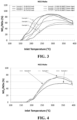
- Outlet NO 2 /NO x results as a function of temperature for Examples 1-3 before and after 800°C hydrothermal aging are provided in Fig. 3 .
- Outlet NO 2 /NOX results as a function of temperature for Examples 2, 4 and 5 after 800°C hydrothermal aging are provided in Fig. 4 .
- CO and HC light-off results and NO 2 /NO X results at 200°C for Examples 2, 4 and 5 after 800°C hydrothermal aging are provided in Fig. 5 .
- Hydrocarbon conversion results as a function of temperature for Examples 2, 4 and 5 after 800°C hydrothermal aging are provided in Fig. 6 .
- NO 2 /NO X results at 200°C for Examples 6-18 after either 650 or 800°C hydrothermal aging are provided in Table 4.
- NO oxidation performance expressed as the ratio of NO 2 generated to inlet NO x concentration was highest for Example 1 with a rear zone Pt concentration of 5.8%. This was true for both the fresh and 800°C steam aged catalysts. Moreover, the change in performance from fresh to aged was least for Example 1. While Example 3 with a rear zone Pt concentration of 0.7% had the lowest fresh performance, performance after aging was basically the same for Examples 2 and 3. Overall, significantly improved NO oxidation performance was realized when Mn-alumina support was combined with Pt at high concentration in the rear zone.
- the carbon monoxide T50 light-off temperature was reduced by about 5°C for Examples 4 and 5 comprising about 20% MnO 2 -ZrO 2 in the rear zone relative to Example 2 comprising about 5% MnO 2 -Al 2 O 3 in the rear zone.
- HC T80 was reduced by about 10°C.
- the ratio of NO 2 generated to inlet total NOx concentration was highest for Examples 4 and 5.
- Significantly improved carbon monoxide, hydrocarbon, and NO oxidation performance was realized when a Mn-zirconia support was used in Examples 4 and 5 to support Pt or Pt-Pd relative to a Mn-alumina material support as in Example 2.
- Claims or descriptions that include “or” or “and/or” between at least one members of a group are considered satisfied if one, more than one, or all of the group members are present in, employed in, or otherwise relevant to a given product or process unless indicated to the contrary or otherwise evident from the context.
- the disclosure includes embodiments in which exactly one member of the group is present in, employed in, or otherwise relevant to a given product or process.
- the disclosure includes embodiments in which more than one, or all the group members are present in, employed in, or otherwise relevant to a given product or process.
- the disclosure encompasses all variations, combinations, and permutations in which at least one limitation, element, clause, and descriptive term from at least one of the listed claims is introduced into another claim.
- any claim that is dependent on another claim can be modified to include at least one limitation found in any other claim that is dependent on the same base claim.
- elements are presented as lists, such as, e.g., in Markush group format, each subgroup of the elements is also disclosed, and any element(s) can be removed from the group. It should be understood that, in general, where the disclosure, or aspects of the disclosure, is/are referred to as comprising particular elements and/or features, embodiments of the disclosure or aspects of the disclosure consist, or consist essentially of, such elements and/or features.
Landscapes
- Chemical & Material Sciences (AREA)
- Engineering & Computer Science (AREA)
- Chemical Kinetics & Catalysis (AREA)
- Materials Engineering (AREA)
- Organic Chemistry (AREA)
- Combustion & Propulsion (AREA)
- Analytical Chemistry (AREA)
- Oil, Petroleum & Natural Gas (AREA)
- General Chemical & Material Sciences (AREA)
- Health & Medical Sciences (AREA)
- Biomedical Technology (AREA)
- Environmental & Geological Engineering (AREA)
- Crystallography & Structural Chemistry (AREA)
- Thermal Sciences (AREA)
- Physics & Mathematics (AREA)
- Catalysts (AREA)
- Exhaust Gas After Treatment (AREA)
- Processes For Solid Components From Exhaust (AREA)
- Exhaust Gas Treatment By Means Of Catalyst (AREA)
Priority Applications (7)
| Application Number | Priority Date | Filing Date | Title |
|---|---|---|---|
| EP21217681.2A EP4201517A1 (fr) | 2021-12-24 | 2021-12-24 | Articles catalytiques contenant du manganèse, systèmes de traitement de gaz d'échappement, et procédés |
| PCT/US2022/080613 WO2023122414A1 (fr) | 2021-12-24 | 2022-11-30 | Articles catalytiques contenant du manganèse, systèmes de traitement de gaz d'échappement et procédés |
| EP22839965.5A EP4452481A1 (fr) | 2021-12-24 | 2022-11-30 | Articles catalytiques contenant du manganèse, systèmes de traitement de gaz d'échappement et procédés |
| KR1020247024418A KR20240149390A (ko) | 2021-12-24 | 2022-11-30 | 망간 함유 촉매 물품, 배기 가스 처리 시스템 및 방법 |
| US18/721,775 US20250032983A1 (en) | 2021-12-24 | 2022-11-30 | Manganese-containing catalytic articles, exhaust gas treatment systems, and methods |
| CN202280077762.4A CN118302245A (zh) | 2021-12-24 | 2022-11-30 | 含锰催化制品、废气处理系统和方法 |
| JP2024531156A JP2025503378A (ja) | 2021-12-24 | 2022-11-30 | マンガン含有触媒物品、排気ガス処理システム、および方法 |
Applications Claiming Priority (1)
| Application Number | Priority Date | Filing Date | Title |
|---|---|---|---|
| EP21217681.2A EP4201517A1 (fr) | 2021-12-24 | 2021-12-24 | Articles catalytiques contenant du manganèse, systèmes de traitement de gaz d'échappement, et procédés |
Publications (1)
| Publication Number | Publication Date |
|---|---|
| EP4201517A1 true EP4201517A1 (fr) | 2023-06-28 |
Family
ID=80050911
Family Applications (2)
| Application Number | Title | Priority Date | Filing Date |
|---|---|---|---|
| EP21217681.2A Withdrawn EP4201517A1 (fr) | 2021-12-24 | 2021-12-24 | Articles catalytiques contenant du manganèse, systèmes de traitement de gaz d'échappement, et procédés |
| EP22839965.5A Pending EP4452481A1 (fr) | 2021-12-24 | 2022-11-30 | Articles catalytiques contenant du manganèse, systèmes de traitement de gaz d'échappement et procédés |
Family Applications After (1)
| Application Number | Title | Priority Date | Filing Date |
|---|---|---|---|
| EP22839965.5A Pending EP4452481A1 (fr) | 2021-12-24 | 2022-11-30 | Articles catalytiques contenant du manganèse, systèmes de traitement de gaz d'échappement et procédés |
Country Status (6)
| Country | Link |
|---|---|
| US (1) | US20250032983A1 (fr) |
| EP (2) | EP4201517A1 (fr) |
| JP (1) | JP2025503378A (fr) |
| KR (1) | KR20240149390A (fr) |
| CN (1) | CN118302245A (fr) |
| WO (1) | WO2023122414A1 (fr) |
Cited By (1)
| Publication number | Priority date | Publication date | Assignee | Title |
|---|---|---|---|---|
| EP4570360A1 (fr) * | 2023-12-14 | 2025-06-18 | Johnson Matthey Public Limited Company | Catalyseur d'oxydation diesel chargé à faible teneur en pgm pour la génération d'exothermie |
Citations (4)
| Publication number | Priority date | Publication date | Assignee | Title |
|---|---|---|---|---|
| WO2011051526A1 (fr) | 2009-10-27 | 2011-05-05 | Avialsa T-35,S.L. | Système aérien de transmission de vidéo et d'images par satellite en temps réel |
| US20150165422A1 (en) * | 2013-12-16 | 2015-06-18 | Basf Corporation | Manganese-Containing Diesel Oxidation Catalyst |
| US20150273452A1 (en) * | 2014-04-01 | 2015-10-01 | Johnson Matthey Public Limited Company | DIESEL OXIDATION CATALYST WITH NOx ADSORBER ACTIVITY |
| US20190015781A1 (en) * | 2016-01-06 | 2019-01-17 | Basf Corporation | Diesel oxidation catalyst comprising platinum group metal nanoparticles |
-
2021
- 2021-12-24 EP EP21217681.2A patent/EP4201517A1/fr not_active Withdrawn
-
2022
- 2022-11-30 EP EP22839965.5A patent/EP4452481A1/fr active Pending
- 2022-11-30 CN CN202280077762.4A patent/CN118302245A/zh active Pending
- 2022-11-30 US US18/721,775 patent/US20250032983A1/en active Pending
- 2022-11-30 KR KR1020247024418A patent/KR20240149390A/ko active Pending
- 2022-11-30 WO PCT/US2022/080613 patent/WO2023122414A1/fr not_active Ceased
- 2022-11-30 JP JP2024531156A patent/JP2025503378A/ja active Pending
Patent Citations (4)
| Publication number | Priority date | Publication date | Assignee | Title |
|---|---|---|---|---|
| WO2011051526A1 (fr) | 2009-10-27 | 2011-05-05 | Avialsa T-35,S.L. | Système aérien de transmission de vidéo et d'images par satellite en temps réel |
| US20150165422A1 (en) * | 2013-12-16 | 2015-06-18 | Basf Corporation | Manganese-Containing Diesel Oxidation Catalyst |
| US20150273452A1 (en) * | 2014-04-01 | 2015-10-01 | Johnson Matthey Public Limited Company | DIESEL OXIDATION CATALYST WITH NOx ADSORBER ACTIVITY |
| US20190015781A1 (en) * | 2016-01-06 | 2019-01-17 | Basf Corporation | Diesel oxidation catalyst comprising platinum group metal nanoparticles |
Non-Patent Citations (2)
| Title |
|---|
| "Atlas of Zeolite Framework Types", 2001, ELSEVIER |
| HECK, RONALDFARRAUTO, ROBERT: "Catalytic Air Pollution Control", 2002, WILEY-INTERSCIENCE, pages: 18 - 19 |
Cited By (2)
| Publication number | Priority date | Publication date | Assignee | Title |
|---|---|---|---|---|
| EP4570360A1 (fr) * | 2023-12-14 | 2025-06-18 | Johnson Matthey Public Limited Company | Catalyseur d'oxydation diesel chargé à faible teneur en pgm pour la génération d'exothermie |
| WO2025125832A1 (fr) * | 2023-12-14 | 2025-06-19 | Johnson Matthey Public Limited Company | Catalyseur d'oxydation diesel à charge pgm faible pour la génération d'exotherme |
Also Published As
| Publication number | Publication date |
|---|---|
| CN118302245A (zh) | 2024-07-05 |
| KR20240149390A (ko) | 2024-10-14 |
| JP2025503378A (ja) | 2025-02-04 |
| WO2023122414A1 (fr) | 2023-06-29 |
| US20250032983A1 (en) | 2025-01-30 |
| EP4452481A1 (fr) | 2024-10-30 |
Similar Documents
| Publication | Publication Date | Title |
|---|---|---|
| EP3579970B1 (fr) | Article catalytique | |
| JP7603737B2 (ja) | 選択的触媒還元物品およびシステム | |
| US10724411B2 (en) | Pt/Pd doc with enhanced CO oxidation, hydrocarbon oxidation and NO oxidation and improved sulfation/desulfation behavior | |
| KR102924716B1 (ko) | 저온 co 산화 촉매 | |
| KR102786077B1 (ko) | 초저 NOx 제어용 디젤 산화 촉매 | |
| US20190358615A1 (en) | Catalyst compositions | |
| KR20210153645A (ko) | 열수 안정성이 향상된 저온 NOx 흡착제 | |
| US20200078768A1 (en) | Diesel oxidation catalyst | |
| US20230129815A1 (en) | A selective catalytic reduction catalyst and a process for preparing a selective catalytic reduction catalyst | |
| JP2023512983A (ja) | イットリウムドープ触媒担体 | |
| KR102935004B1 (ko) | 디젤 산화 촉매 및 저온 nox 흡착제를 포함하는 조정된 배출물 제어 시스템 | |
| KR20210153644A (ko) | 탄산구리를 포함하는 선택적 촉매 환원 촉매 | |
| US20250032983A1 (en) | Manganese-containing catalytic articles, exhaust gas treatment systems, and methods | |
| JP7818510B2 (ja) | 向上した再生効率を有する低温NOx吸着剤 | |
| CN112969535A (zh) | 用于消除NOx的添加了氧化铝的催化洗涂层 |
Legal Events
| Date | Code | Title | Description |
|---|---|---|---|
| PUAI | Public reference made under article 153(3) epc to a published international application that has entered the european phase |
Free format text: ORIGINAL CODE: 0009012 |
|
| STAA | Information on the status of an ep patent application or granted ep patent |
Free format text: STATUS: THE APPLICATION HAS BEEN PUBLISHED |
|
| AK | Designated contracting states |
Kind code of ref document: A1 Designated state(s): AL AT BE BG CH CY CZ DE DK EE ES FI FR GB GR HR HU IE IS IT LI LT LU LV MC MK MT NL NO PL PT RO RS SE SI SK SM TR |
|
| STAA | Information on the status of an ep patent application or granted ep patent |
Free format text: STATUS: REQUEST FOR EXAMINATION WAS MADE |
|
| 17P | Request for examination filed |
Effective date: 20231123 |
|
| RBV | Designated contracting states (corrected) |
Designated state(s): AL AT BE BG CH CY CZ DE DK EE ES FI FR GB GR HR HU IE IS IT LI LT LU LV MC MK MT NL NO PL PT RO RS SE SI SK SM TR |
|
| STAA | Information on the status of an ep patent application or granted ep patent |
Free format text: STATUS: EXAMINATION IS IN PROGRESS |
|
| 17Q | First examination report despatched |
Effective date: 20241122 |
|
| STAA | Information on the status of an ep patent application or granted ep patent |
Free format text: STATUS: THE APPLICATION IS DEEMED TO BE WITHDRAWN |
|
| 18D | Application deemed to be withdrawn |
Effective date: 20250325 |