EP4201662B1 - Alimentation en poudre pour une presse à comprimés - Google Patents
Alimentation en poudre pour une presse à comprimés Download PDFInfo
- Publication number
- EP4201662B1 EP4201662B1 EP22214417.2A EP22214417A EP4201662B1 EP 4201662 B1 EP4201662 B1 EP 4201662B1 EP 22214417 A EP22214417 A EP 22214417A EP 4201662 B1 EP4201662 B1 EP 4201662B1
- Authority
- EP
- European Patent Office
- Prior art keywords
- powder
- filling channel
- unit
- movement
- advancing
- Prior art date
- Legal status (The legal status is an assumption and is not a legal conclusion. Google has not performed a legal analysis and makes no representation as to the accuracy of the status listed.)
- Active
Links
Images




Classifications
-
- B—PERFORMING OPERATIONS; TRANSPORTING
- B30—PRESSES
- B30B—PRESSES IN GENERAL
- B30B15/00—Details of, or accessories for, presses; Auxiliary measures in connection with pressing
- B30B15/30—Feeding material to presses
- B30B15/302—Feeding material in particulate or plastic state to moulding presses
- B30B15/304—Feeding material in particulate or plastic state to moulding presses by using feed frames or shoes with relative movement with regard to the mould or moulds
-
- B—PERFORMING OPERATIONS; TRANSPORTING
- B30—PRESSES
- B30B—PRESSES IN GENERAL
- B30B15/00—Details of, or accessories for, presses; Auxiliary measures in connection with pressing
- B30B15/30—Feeding material to presses
-
- B—PERFORMING OPERATIONS; TRANSPORTING
- B65—CONVEYING; PACKING; STORING; HANDLING THIN OR FILAMENTARY MATERIAL
- B65G—TRANSPORT OR STORAGE DEVICES, e.g. CONVEYORS FOR LOADING OR TIPPING, SHOP CONVEYOR SYSTEMS OR PNEUMATIC TUBE CONVEYORS
- B65G65/00—Loading or unloading
- B65G65/30—Methods or devices for filling or emptying bunkers, hoppers, tanks, or like containers, of interest apart from their use in particular chemical or physical processes or their application in particular machines, e.g. not covered by a single other subclass
- B65G65/34—Emptying devices
- B65G65/40—Devices for emptying otherwise than from the top
- B65G65/44—Devices for emptying otherwise than from the top using reciprocating conveyors, e.g. jigging conveyors
-
- B—PERFORMING OPERATIONS; TRANSPORTING
- B65—CONVEYING; PACKING; STORING; HANDLING THIN OR FILAMENTARY MATERIAL
- B65G—TRANSPORT OR STORAGE DEVICES, e.g. CONVEYORS FOR LOADING OR TIPPING, SHOP CONVEYOR SYSTEMS OR PNEUMATIC TUBE CONVEYORS
- B65G65/00—Loading or unloading
- B65G65/30—Methods or devices for filling or emptying bunkers, hoppers, tanks, or like containers, of interest apart from their use in particular chemical or physical processes or their application in particular machines, e.g. not covered by a single other subclass
- B65G65/34—Emptying devices
- B65G65/40—Devices for emptying otherwise than from the top
- B65G65/48—Devices for emptying otherwise than from the top using other rotating means, e.g. rotating pressure sluices in pneumatic systems
- B65G65/4809—Devices for emptying otherwise than from the top using other rotating means, e.g. rotating pressure sluices in pneumatic systems rotating about a substantially vertical axis
- B65G65/4836—Devices for emptying otherwise than from the top using other rotating means, e.g. rotating pressure sluices in pneumatic systems rotating about a substantially vertical axis and moving material over a stationary surface, e.g. sweep arms or wheels
-
- B—PERFORMING OPERATIONS; TRANSPORTING
- B30—PRESSES
- B30B—PRESSES IN GENERAL
- B30B11/00—Presses specially adapted for forming shaped articles from material in particulate or plastic state, e.g. briquetting presses, tabletting presses
- B30B11/02—Presses specially adapted for forming shaped articles from material in particulate or plastic state, e.g. briquetting presses, tabletting presses using a ram exerting pressure on the material in a moulding space
- B30B11/08—Presses specially adapted for forming shaped articles from material in particulate or plastic state, e.g. briquetting presses, tabletting presses using a ram exerting pressure on the material in a moulding space co-operating with moulds carried by a turntable
Definitions
- the present invention relates to a powder feeding device according to the independent device claim as well as an associated tablet press and a method for operating a powder feeding device according to the independent method claim.
- the present invention is based on the object of providing a spatially compact powder feed device which can ensure a consistently reliable, constant and as gentle as possible feed of a desired amount of powder into the respective tablet matrix mold for a wide range of powders with different flow properties, in particular for relatively sticky, for example resinous powder material.
- a filling channel movement unit arranged at least partially in the filling channel which is designed to move powder in the filling channel, promotes, i.e. favors, the reliability of a gravity-driven flow of powder from the powder storage container through the filling channel to a die rotating unit over a wide range of different powders, especially with powder types or powder mixtures that tend to stick together.
- the filling channel movement unit is designed to move powder through continuous start-stop movements.
- the powder movement device further comprises a rotating powder movement unit which is arranged above the filling channel and is designed to move powder towards the filling channel by means of a rotary movement, in particular by means of continuous start-stop rotary movements.
- the rotating powder movement unit can be arranged at the bottom of the powder storage container. This increases the reliability of the supply and mobilization of powder that tends to stick together in the critical bottom area, where the greatest weight of the powder bed prevails, whereby the rotating powder movement unit mobilizes powder only in the bottom region of the powder storage container, in which movement is necessary for the desired flow, and thus the risk of formation of undesirable clumps in the upper areas of the powder storage container is reduced. At the same time, the powder is mixed at the bottom.
- the drive of the rotating powder movement unit can be arranged on the bottom side outside the powder storage container.
- the rotating powder movement unit has a multi-blade impeller, wherein the blades, during a rotary movement, brush at least over a partial length, in particular over the entire length or almost the entire length, of the filling channel open towards the powder storage container, and/or the inner outer diameter of the impeller reaches up to the area of the filling channel.
- a strip of the wings over a partial length of the open filling channel increases the reliability of the powder feed, especially with powder materials that tend to stick together. This applies in particular to an optional strip of the wings over the entire length of the open filling channel. This means that the entire length of the filling channel can be used to transport the powder to the filling channel movement unit and the die rotation unit below it, which means that undesirable powder bridging in the area of the filling channel or in parts of the filling channel has less of a detrimental effect.
- An optional design of the inner outer diameter of the impeller up to the area of the filling channel further increases the reliability of the powder feed even with sticky powder mixtures, since powder flowing in from above can be directed into the area of the filling channel radially outer to the impeller.
- a powder rest zone can be provided in the powder storage container radially outside the range of movement of the rotating powder movement unit.
- Such a powder rest zone intentionally provides the powder with an area into which the movement range of the rotating powder movement unit does not extend. It has surprisingly been shown that the provision of such a powder rest zone allows the formation of clumps in the powder as well as undesirable heat development in the powder to be reduced, since the powder can escape into this zone when the pressure increases.
- a vertical powder column covers more than 1/2, in particular more than 2/3, especially more than 3/4, of the movement field occupied by the rotating powder movement unit when the powder storage container is filled, and/or a vertical powder column covers more than 1/2, in particular more than 2/3, especially more than 3/4, of the filling channel length open towards the powder storage container when the powder storage container is filled.
- Such high coverage levels of the rotating powder movement unit and/or the exposed length of the filling channel by the vertical powder column in the powder storage container increase the reliability of the powder feed to the die rotation unit and at the same time avoid the need for additional conveyors on the way from the powder storage container to the die rotation unit, which benefits a compact design. With the optionally increasing coverage levels mentioned above, this positive effect increases further.
- Optional combinations of the aforementioned high powder column coverage levels of the rotating powder movement unit and the aforementioned powder column coverage levels of the length of the filling channel increase the reliability of the powder feed to the die rotation unit while at the same time avoiding the need for additional conveyors to a particular degree.
- the filling channel movement unit is designed to move back and forth along a movement path in the filling channel, in particular the filling channel movement unit has powder movement enhancers, in particular protrusions, on its side facing the powder storage container.
- the filling channel movement unit follows the elongated extension of the filling channel with its main extension axis and/or its movement path, and/or the filling channel is designed in the shape of a circular arc.
- An equally optional following of the movement path of the extension of the filling channel also helps to keep the powder moving over a defined length of the filling channel.
- An optional circular arc-shaped design of the filling channel allows a longer section of the filling channel to be accommodated in one sector of the powder container base, thus concentrating the movement or mobilization of the powder on a smaller area.
- a circular arc-shaped design allows a die rotating unit to easily follow the filling channel with its die shapes exposed towards the filling channel via a simple rotational movement.
- an end section of the filling channel is arranged in an area shielded vertically to the powder storage container.
- the rotating powder movement unit and/or the filling channel movement unit with their movement fields protrude into the shielded area.
- powder can also be moved at the shielded end section of the filling channel, thus promoting the gravity-driven flow of powder in this area as well.
- the powder is moved particularly advantageously in this area if both movement units optionally extend into the shielded area.
- the powder movement device has a shielded movement unit which is arranged in the shielded area and is designed to move powder in the shielded area, in particular to move it towards the filling channel end section.
- Such a shielded movement unit allows powder to be moved in a way that is specifically adapted to the conditions in the shielded area in order to promote gravity-driven flow of powder through the end section of the filling channel and thus a defined final filling of a die mold underneath. At the same time, the powder experiences little or no pressure forces from the shielded movement unit, which can further reduce powder wear at the connection point to the die rotating unit.
- the shielded movement unit is designed to move powder towards the filling channel end section. This particularly supports the flow of powder towards the filling channel end section.
- the shielded movement unit only moves or mobilizes powder to promote gravity-driven flow of the powder towards a die rotating unit.
- the shielded movement unit is designed to move powder by continuous start-stop movements.
- the movement path of the shielded movement unit is arranged perpendicular to the movement path of the filling channel movement unit and/or perpendicular to the rotation plane of the rotating powder movement unit and/or the movement path of the filling channel movement unit is arranged perpendicular to the rotation plane of the rotating powder movement unit.
- the powder feed device is configured such that the filling channel movement unit and/or the shielded movement unit move when the rotating powder movement unit is stationary, and/or the powder feed device is configured such that the shielded movement unit moves towards the filling channel end section while the filling channel movement unit moves away from the filling channel end section.
- Such combinations of controlled movement sequences allow the powder to rest for short periods in certain areas of the powder feed device, which reduces the risk of clumping.
- such combinations of controlled movement sequences prevent powder from being accidentally compressed between movement units, which reduces the risk of clumping, especially with powders that tend to stick together.
- the present invention further relates to a tablet press comprising a powder feed device according to one or more of the embodiments mentioned above.
- a particularly advantageous embodiment relates to a station-by-station rotating tablet press, comprising a powder feed device according to one or more of the embodiments mentioned above.
- a tablet press has a station-by-station rotating die rotating unit, wherein the tablet press is designed to move the powder moving device in a cycle coordinated with the cycle of the die rotating unit.
- Moving the powder moving device and thus moving the said moving units of the powder moving device in a cycle coordinated with the cycle of the die turning unit allows a coordinated gravity-driven conveying of powder from the powder storage container into the die turning unit without this having to be done on the Powder builds up and clumps in an undesirable way during the conveying process. This also helps to reduce powder wear at the connection point to the die turning unit.
- the initially mentioned problem is further solved by a method according to the independent method claim.
- the method can also be implemented with a compact powder feed device.
- Fig. 1 shows a powder feeding device 1 according to an embodiment of the present invention.
- the powder feed device 1 has a powder storage container 2, which comprises parts of a base structure 3 as well as a side wall 4, here cylindrical, and a corresponding lid 5.
- the cylindrical side wall 4 is shown transparent here for the sake of clarity.
- the plate-like floor construction 3 here is designed in several parts in this embodiment and has a groove-like filling channel 6, which extends as a circular arc-shaped through hole with a constant opening width in the floor construction 3 from a starting section 7 of the filling channel 6 to an end section 8 of the filling channel 6.
- the powder feed device 1 is designed so that a die rotating unit 10 located in a tablet press 9 below the filling channel can be filled with its exposed die molds 11 through the filling channel 6, wherein during operation of the tablet press 9 a die mold 11 of the rotating die rotating unit 10, see also Fig. 8 , first located below the initial section 7 of the filling channel 6 and subsequently below the end section 8 of the filling channel 6.
- the opening width of the filling channel 6 is matched to the opening width of the die shapes 11 and corresponds to this.
- the filling channel 6 is open over its entire extension length in the powder storage container 2 towards the powder storage container 2 and is open downwards to the environment, so that during operation powder is gravity-driven from the powder storage container 2 through the filling channel 6 to a die rotating unit 10 (in Fig. 1 and 2 not shown).
- the powder feed device 1 comprises a powder movement device 12 for moving or mobilizing powder in the region of the filling channel 6 in order to effect and support a gravity-driven flow of powder from the powder storage container 2 through the filling channel 6 into a die rotating unit 10 located underneath in a tablet press 9.
- the powder moving device 12 comprises, in addition to a filling channel moving unit 13, a rotating powder moving unit 14 and a shielded moving unit 15.
- the plate-like floor construction 3 in the embodiment shown in the figures extends in the installed state of the powder feed device 1 primarily along the horizontal and projects horizontally beyond the side wall 4 of the powder storage container 2, and can thus be used directly as a fastening point for two mounting pillars 16 located opposite each other on opposite sides of the floor construction 3, which support a large part of the weight of the powder feed device 1 and can be attached to a tablet press 9 together with two further base mounting feet 17, see also example Fig. 8 .
- the base construction 3 due to its horizontal projection, also serves as a direct assembly or connection point for other components of the powder feed device 1, such as for the rotating powder movement unit 14, for the filling channel movement unit 13 and for the shielded movement unit 15 as well as for their drives 18, 19, 20.
- the rotating powder movement unit 14 is embodied by an impeller 21 arranged on the bottom 3 of the powder storage container.
- Other embodiments of the powder movement unit 14, which move the powder by a rotary movement towards the filling channel, are also conceivable.
- the rotation axis A of the rotating powder movement unit 14 is in this embodiment the rotation axis of the impeller 21, extends parallel to the main axis B of the powder storage container 2, and is parallel to the vertical in the installed state of the powder feed device 1.
- the inner outer diameter a of the impeller 21 is selected such that it reaches up to the area of the filling channel 6, from where powder mobilized by movement can flow into and through the filling channel 6.
- the number of blades is preferably matched to the circular sector that a blade 22 travels per start-stop rotary movement, such that a blade 22 can move over the entire or almost the entire length of the filling channel 6 that is open towards the powder storage container 2.
- the angular rotary movement of the impeller 21 is matched to the angular rotary movement of the die rotary unit 10. A number of five blades 22 evenly distributed on the impeller 21 has proven particularly useful in practice.
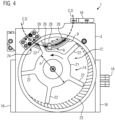
- the powder storage container 2 has a powder rest zone 23 radially outside the range of movement of the rotating powder movement unit 14, here the impeller 21, which in plan view in this embodiment is crescent-shaped (hatched in Fig. 4 ), into which the rotating blades 22 do not reach.
- This is explained in this This embodiment is achieved by an eccentric arrangement of the rotation axis A of the powder movement unit in comparison to the main extension axis B of the powder storage container 2.
- the tips of the wings 22 protrude into a shielded area 24 explained in more detail below.
- the drive 19 associated with the rotating powder movement unit 14 is arranged in this embodiment on the bottom side outside the powder storage container 2, as Fig. 2 can be removed.
- the drive has a linear actuator, preferably pneumatic, and a gear with freewheel.
- the impeller 21 moves powder towards the filling channel with continuous start-stop rotational movements, i.e. here by means of an intermittent rotation. At the same time, the powder is mixed and loosened by the movements.
- the filling channel movement unit 13 in this embodiment is arranged completely in the filling channel 6.
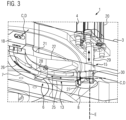
- the filling channel movement unit 13 is designed as a rod 25 that can move along a movement path D and has powder movement enhancement structures on its upper side, as well as on its lower side, here in the form of fin-like S-shaped projections 26.
- a curved sliding shield 27 is attached to the open end of the rod 25 in the region of the end section 8.
- the drive 20 of the shielded movement unit 15 is arranged outside the powder storage container 2 vertically above the floor construction 3, and in this embodiment is designed as a linear actuator, preferably pneumatically operated.
- the movement paths D, E of the filling channel movement unit 13 and the shielded movement unit 15 are arranged perpendicular to each other in the vertical and horizontal directions.
- the movement path E of the shielded movement unit is also arranged perpendicular to the rotation plane F of the impeller 21 and the horizontal rotation plane F of the impeller 21 is parallel to and above the movement path D of the filling channel movement unit 13.
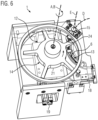
- the movement path D of the shielded movement unit 15 here with the tuning fork-like structure 30 extends into the filling channel 6, as do the movement fields of the filling channel movement unit 13 and the rotating powder movement unit 14, see the position of the shield 27 and the tip of the wing 22 in the Figures 4 and 7 .
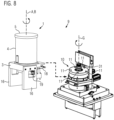
- Fig. 8 shows an exemplary embodiment of a tablet press 9 according to the present invention.
- the powder feed device 1 is shown here separated from the rest of the tablet press 9 for easier understanding, with a dashed arrow illustrating its affiliation with the rest of the tablet press.
- the tablet press 9 has the die rotation unit 10 with five die molds 11 that are open at the top, wherein the die molds completely filled with powder are pressed into tablets in a pressing station 31 downstream in the direction of rotation.
- the die rotating unit 10 rotates intermittently about its axis of rotation G in a predefined direction, here clockwise.
- the powder feed device 1 is attached to the rest of the tablet press in such a way that the rotating die rotating unit 10 with its rotating cavities or die molds 11 intermittently passes the underside of the filling channel 6.
- the filling channel 6 and the positions of the die molds 11 are coordinated with one another in such a way that in a stop phase of the die rotating unit 10, one die mold is below the starting section 7 and an adjacent die mold 11 is below the end section 8 of the filling channel 6.
- the powder storage container 2 is filled with powder until at least the impeller 21 and thus the bottom 3 of the powder storage container 2 are covered with powder.
- the powder movement device 12 i.e. the filling channel movement unit 13, the rotating powder movement unit 14 and the shielded movement unit 15, is then operated in a previously defined cycle.
- This cycle is preferably coordinated with the rotation cycle of the die rotation unit 10 or all movement sequences of the tablet press 9, including the powder feed device 1, are coordinated with one another.
- the intermittently rotating blades 22 of the impeller 21 rotate at the same rate as the die rotating unit 10, i.e. synchronously here.
- powder is mobilized at the bottom 3 of the powder storage container 2, including the area of the filling channel 6, and conveyed from more distant sections of the powder storage container 2 to the filling channel 6.
- the stop or rest phases of the impeller 21 and the rest zone 23 reduce clumping of the powder and excessive heating.
- a new, still unfilled die mold 11 is located below the initial section 7 of the filling channel and a die mold 11 that is at least partially filled depending on the flow properties of the powder is located below the end section 8 of the filling channel.
- the filling channel movement unit 13 moves back and forth in the filling channel along its movement path D, so that a gravity-driven flow of powder into the die mold waiting under the initial section 7 and the die mold waiting under the end section 8 is promoted.
- the fin-like projections 26 of the filling channel movement unit 13 increase the mobilization and thus the flow of the powder through the filling channel 6.
- the shield 27 of the filling channel movement unit 13 simultaneously pushes powder into the end section 8 of the filling channel 6 with each movement towards the end section 8.
- the shielded movement unit 15 moves back and forth along its movement path E and continues to mobilize powder in the shielded area 24 and, with the tuning fork-like structure 30, simultaneously destroys any powder bridges in the area of the end section 8 of the filling channel 6 and simultaneously moves powder into it, but without significantly pressing it.
- the filling channel moving unit 13 moves towards the end section 8 when the shielded moving unit 15 moves away from the end section 8, and vice versa.
- the die mold 11 under the end section 8 of the filling channel can be decoupled from the weight column of the powder stored in the storage container 2 and can be filled with powder up to the upper edge of the die mold 11 under almost ideal flow conditions until the now completely filled die rotates away from the powder feed device 1 towards the pressing station 31, where the tablet is pressed by a punch.
- the powder feed device 1 according to the invention and the method according to the invention allow a reliable supply of powder even with powders that tend to stick together, while at the same time being spatially compact and allowing the powder to flow gently, driven by gravity and with little powder wear, towards the die rotating unit 10.
- the inventive designs protect the powder material particularly well, as it hardly clumps together and heats up very little, which makes the present invention particularly suitable for processing powders with sensitive ingredients, such as natural substances.
- the invention and the embodiments described above are particularly suitable for processing powders containing natural substances, which are often sticky, moist and/or heat-sensitive, as they are used in the field of food supplements and/or in the field of naturopathy.
- the invention and the embodiments described above are also particularly suitable for the powder supply for slow-running, station-based tablet presses which produce tablets in quantities of up to approximately 5,000 tablets per hour.
Landscapes
- Engineering & Computer Science (AREA)
- Mechanical Engineering (AREA)
- Basic Packing Technique (AREA)
Claims (14)
- Dispositif d'alimentation de poudre (1) pour une presse à comprimés (9), comprenant :un réservoir de stockage de poudre (2),un canal de remplissage (6) agencé dans le fond du réservoir de stockage de poudre (2) et permettant de remplir de poudre, par gravité, une unité de rotation de matrice (10) pouvant être positionnée en dessous, etun dispositif de déplacement de poudre (12) permettant de déplacer la poudre dans la région du canal de remplissage (6) afin de favoriser un écoulement par gravité de la poudre depuis le réservoir de stockage de poudre (2) jusque dans une unité de rotation de matrice (10) pouvant être positionnée en dessous, en passant par le canal de remplissage (6), dans lequelle dispositif de déplacement de poudre (12) présente une unité de déplacement de canal de remplissage (13) agencée au moins partiellement, en particulier complètement, dans le canal de remplissage (6) et conçue pour déplacer la poudre dans le canal de remplissage (6), caractérisé en ce quel'unité de déplacement de canal de remplissage (13) est conçue pour déplacer la poudre grâce à de continuels mouvements de marche-arrêt.
- Dispositif d'alimentation de poudre (1) selon l'une quelconque des revendications précédentes, caractérisé en ce quele dispositif de déplacement de poudre (12) présente en outre une unité rotative de déplacement de poudre (14) qui est agencée au-dessus du canal de remplissage (6) et qui est conçue pour déplacer la poudre vers le canal de remplissage (6) grâce à un mouvement rotatif, en particulier grâce à de continuels mouvements rotatifs de marche-arrêt, dans lequel en particulierl'unité rotative de déplacement de poudre (14) est agencée au fond du réservoir de stockage de poudre (2) et/ou l'entraînement (19) de l'unité rotative de déplacement de poudre est agencé du côté du fond à l'extérieur du réservoir de stockage de poudre (2).
- Dispositif d'alimentation de poudre (1) selon la revendication 2, caractérisé en ce que l'unité rotative de déplacement de poudre (14) présente une roue à ailettes (21) à plusieurs ailettes, dans lequel les ailettes (22), lors d'un mouvement de rotation, s'étendent au moins sur une longueur partielle, en particulier sur toute la longueur ou sur presque toute la longueur, du canal de remplissage (6) ouvert vers le réservoir de stockage de poudre (2), et/ou le diamètre extérieur interne (a) de la roue à ailettes (21) atteint la région du canal de remplissage (6).
- Dispositif d'alimentation de poudre (1) selon l'une quelconque des revendications 2 à 3, caractérisé en ce qu'une région de repos de poudre (23) est prévue dans le réservoir de stockage de poudre (2) radialement à l'extérieur de la région de déplacement de l'unité rotative de déplacement de poudre (14).
- Dispositif d'alimentation de poudre (1) selon l'une quelconque des revendications 2 à 4, caractérisé en ce qu'une colonne de poudre verticale couvre plus de 1/2, en particulier plus de 2/3, en particulier plus de 3/4, du champ de mouvement occupé par l'unité rotative de déplacement de poudre (14) lorsque le réservoir de stockage de poudre (2) est rempli et/ou une colonne de poudre verticale couvre plus de 1/2, en particulier plus de 2/3, en particulier plus de 3/4 de la longueur du canal de remplissage ouvert vers le réservoir de stockage de poudre (2) lorsque le réservoir de stockage de poudre (2) est rempli.
- Dispositif d'alimentation de poudre (1) selon l'une quelconque des revendications précédentes, caractérisé en ce que l'unité de déplacement de canal de remplissage (13) est conçue pour se déplacer d'avant en arrière au sein du canal de remplissage (6) le long d'une trajectoire de déplacement (D), en particulier l'unité de déplacement de canal de remplissage (13) présente des amplificateurs de déplacement de poudre (26), en particulier des saillies, sur son côté tourné vers le réservoir de stockage de poudre (2), et/ou l'axe d'extension principal (C) et/ou la trajectoire de déplacement (D) de l'unité de déplacement de canal de remplissage (13) sui(ven)t l'extension longitudinale du canal de remplissage (6), et/ou le canal de remplissage (6) est réalisé en forme d'arc de cercle.
- Dispositif d'alimentation de poudre (1) selon l'une quelconque des revendications précédentes, caractérisé en ce qu'une section d'extrémité (8) du canal de remplissage est agencée dans une région protégée (24) verticale par rapport au réservoir de stockage de poudre (2), en particulier les champs de mouvement de l'unité rotative de déplacement de poudre (14) et/ou de l'unité de déplacement de canal de remplissage (13) font saillie dans la région protégée (24).
- Dispositif d'alimentation de poudre (1) selon la revendication 7, caractérisé en ce que le dispositif de déplacement de poudre (12) présente une unité de déplacement protégée (15) qui est agencée dans la région protégée (24) et est conçue pour déplacer la poudre dans la région protégée (24), en particulier pour la déplacer vers la section d'extrémité de canal de remplissage (8), l'unité de déplacement protégée (15) étant en particulier conçue pour déplacer la poudre grâce à de continuels mouvements de marche-arrêt.
- Dispositif d'alimentation de poudre (1) selon la revendication 8, caractérisé en ce que l'unité de déplacement protégée (15) est conçue pour se déplacer d'avant en arrière le long d'une trajectoire de déplacement (E), la trajectoire de déplacement (E) empiétant en particulier depuis l'extérieur dans le canal de remplissage (6).
- Dispositif d'alimentation de poudre (1) selon l'une quelconque des revendications précédentes, caractérisé en ce que la trajectoire de déplacement (E) de l'unité de déplacement protégée (15) est agencée perpendiculairement à la trajectoire de déplacement (D) de l'unité de déplacement de canal de remplissage (13) et/ou est agencée perpendiculairement au plan de rotation (F) de l'unité rotative de déplacement de poudre (14) et/ou la trajectoire de déplacement (D) de l'unité de déplacement de canal de remplissage (13) est agencée perpendiculairement au plan de rotation (F) de l'unité rotative de déplacement de poudre (14).
- Dispositif d'alimentation de poudre (1) selon l'une quelconque des revendications précédentes, caractérisé en ce que le dispositif d'alimentation de poudre (1) est conçu de sorte que l'unité de déplacement de canal de remplissage (13) et/ou l'unité de déplacement protégée (15) se déplacent lorsque l'unité rotative de déplacement de poudre (14) est à l'arrêt, et/ou est conçu de sorte que l'unité de déplacement protégée (24) se déplace vers la section d'extrémité de canal de remplissage (8) pendant que l'unité de déplacement de canal de remplissage (13) s'éloigne de la section d'extrémité de canal de remplissage (8).
- Presse à comprimés (9), en particulier presse à comprimés rotative stationnaire (9), comprenant un dispositif d'alimentation de poudre (1) selon l'une quelconque des revendications précédentes.
- Presse à comprimés (9) selon la revendication 12, comprenant une unité de rotation de matrice (10) tournant de manière stationnaire, caractérisée en ce que la presse à comprimés (9) est conçue pour déplacer le dispositif de déplacement de poudre (12) selon une cadence adaptée à la cadence de l'unité de rotation de matrice (10).
- Procédé de fonctionnement d'un dispositif d'alimentation de poudre (1) pour une presse à comprimés (9), en particulier de fonctionnement d'un dispositif d'alimentation de poudre (1) ou d'une presse à comprimés (9) selon l'une quelconque des revendications 1 à 13, caractérisé en ce que
la poudre est déplacée dans le canal de remplissage (6) d'un fond de réservoir de stockage de poudre grâce à une séquence de continuels mouvements de marche-arrêt au moyen d'une unité de déplacement de canal de remplissage (13) au moins partiellement agencée dans le canal de remplissage (6).
Applications Claiming Priority (1)
| Application Number | Priority Date | Filing Date | Title |
|---|---|---|---|
| DE102021134197.3A DE102021134197A1 (de) | 2021-12-22 | 2021-12-22 | Pulverzuführung für eine Tablettenpresse |
Publications (3)
| Publication Number | Publication Date |
|---|---|
| EP4201662A1 EP4201662A1 (fr) | 2023-06-28 |
| EP4201662B1 true EP4201662B1 (fr) | 2024-10-23 |
| EP4201662C0 EP4201662C0 (fr) | 2024-10-23 |
Family
ID=84537922
Family Applications (1)
| Application Number | Title | Priority Date | Filing Date |
|---|---|---|---|
| EP22214417.2A Active EP4201662B1 (fr) | 2021-12-22 | 2022-12-19 | Alimentation en poudre pour une presse à comprimés |
Country Status (2)
| Country | Link |
|---|---|
| EP (1) | EP4201662B1 (fr) |
| DE (1) | DE102021134197A1 (fr) |
Family Cites Families (10)
| Publication number | Priority date | Publication date | Assignee | Title |
|---|---|---|---|---|
| AT234911B (de) | 1961-09-26 | 1964-07-27 | Wilhelm Fette Praez Swerkzeug | Fülleinrichtung zum Zuführen des Preßgutes an Tablettiermaschinen |
| JPS57185499U (fr) | 1981-05-19 | 1982-11-25 | ||
| JPS6117299U (ja) | 1984-07-03 | 1986-01-31 | 住友化学工業株式会社 | 圧縮成型機用粉粒体供給装置 |
| AT380800B (de) * | 1984-08-03 | 1986-07-10 | Leinweber Johann Ing Anstalt F | Ruehrwerk fuer ein pulverfoermiges gut fuer eine pulverkompaktierpresse |
| DE102007057789B3 (de) * | 2007-11-30 | 2009-08-06 | Fette Gmbh | Füllvorrichtung für eine Rundlauf-Tablettenpresse |
| CN203305543U (zh) | 2013-06-13 | 2013-11-27 | 南通市常海食品添加剂有限公司 | 一种压片机 |
| DE102013211305A1 (de) | 2013-06-17 | 2014-12-18 | Horst Zerhoch | Tablettenpresse und Verfahren zum Herstellen einer Tablette |
| DE102016110556B4 (de) * | 2016-06-08 | 2018-09-20 | Fette Compacting Gmbh | Fülleinrichtung für eine Rundläuferpresse |
| CN111452421A (zh) * | 2020-04-28 | 2020-07-28 | 北京新龙立科技有限公司 | 一种压片机加料器及其震荡组件的安装方法 |
| CN112440501B (zh) | 2020-10-22 | 2021-06-22 | 广东德鑫制药有限公司 | 一种制备妇血安片的压片机 |
-
2021
- 2021-12-22 DE DE102021134197.3A patent/DE102021134197A1/de active Pending
-
2022
- 2022-12-19 EP EP22214417.2A patent/EP4201662B1/fr active Active
Also Published As
| Publication number | Publication date |
|---|---|
| DE102021134197A1 (de) | 2023-06-22 |
| EP4201662A1 (fr) | 2023-06-28 |
| EP4201662C0 (fr) | 2024-10-23 |
Similar Documents
| Publication | Publication Date | Title |
|---|---|---|
| DE1604331C2 (de) | Vorrichtung zum Zuteilen und kontrollierten Absetzen genau dosierter Mengen eines plastifizierten Kunststoffes | |
| EP3049329B1 (fr) | Appareil du dosage | |
| EP0196291B1 (fr) | Dispositif de mélange | |
| DE2425727C3 (de) | Vorrichtung zum Behandeln von Stoffen, insbesondere zum Mischen von körnigen, pulverförmigen, pastenförmigen und/oder flüssigen Massen | |
| DE102007057789B3 (de) | Füllvorrichtung für eine Rundlauf-Tablettenpresse | |
| DE1953838A1 (de) | Pulververdichtungspresse | |
| EP3525957B1 (fr) | Appareil de fabrication d'un objet par méthode additive à base de poudre disposée selon une ligne | |
| DE19915259A1 (de) | Vorrichtung zum Dosieren und Abfüllen von pulverförmigem Füllgut in Behälter | |
| DE2504246B2 (de) | Verfahren zum Gießen eines Fonnkörpers und Füllvorrichtung zu dessen Durchführung | |
| DE69500178T2 (de) | Knetmaschine für Nahrungsmittel | |
| DE3121428A1 (de) | Vorrichtung zum spritzen plastischer, elastomerer oder anderer analoger materialien | |
| WO2019020317A1 (fr) | Installation pour la fabrication additive sur lit de poudre d'une pièce, comprenant plusieurs dispositifs de dosage pour différents types de poudre, et procédé pour faire fonctionner ladite installation | |
| EP4201662B1 (fr) | Alimentation en poudre pour une presse à comprimés | |
| DE3616894C2 (fr) | ||
| BE1021676B1 (nl) | Baustein-fertigungsanlage mit rührmitteln, die sich in bewegungsrichtung eines ladetroges ertreckende rotationsachsen aufweisen | |
| DE2731728C2 (fr) | ||
| DE1902486A1 (de) | Anlage zur Giessharzverarbeitung | |
| DE2400547C3 (de) | Bunker mit Austragvorrichtung | |
| EP0436786A2 (fr) | Procédé et dispositif pour la fabrication de boulettes extrudées | |
| EP0207303A1 (fr) | Dispositif pour le dosage et la décharge des matières en vrac coulantes | |
| DE4217585C2 (de) | Verfahren zum Füllen einer Form mit einem Steinmaterialgemisch zur Herstellung einer Platte aus diesem Material und Vorrichtung zur Durchführung des Verfahrens | |
| DE2328699B1 (de) | Einrichtung zum Füllen von Pulverpreßformen | |
| DE1966542A1 (de) | Anlage zur giessharzverarbeitung | |
| DE2453057C2 (de) | Vorrichtung zur Verteilung von Gemenge auf der Oberfläche eines Glasschmelzofens | |
| DE817688C (de) | Fuelleinrichtung fuer Tablettiermaschinen |
Legal Events
| Date | Code | Title | Description |
|---|---|---|---|
| PUAI | Public reference made under article 153(3) epc to a published international application that has entered the european phase |
Free format text: ORIGINAL CODE: 0009012 |
|
| STAA | Information on the status of an ep patent application or granted ep patent |
Free format text: STATUS: THE APPLICATION HAS BEEN PUBLISHED |
|
| AK | Designated contracting states |
Kind code of ref document: A1 Designated state(s): AL AT BE BG CH CY CZ DE DK EE ES FI FR GB GR HR HU IE IS IT LI LT LU LV MC ME MK MT NL NO PL PT RO RS SE SI SK SM TR |
|
| STAA | Information on the status of an ep patent application or granted ep patent |
Free format text: STATUS: REQUEST FOR EXAMINATION WAS MADE |
|
| 17P | Request for examination filed |
Effective date: 20231220 |
|
| RBV | Designated contracting states (corrected) |
Designated state(s): AL AT BE BG CH CY CZ DE DK EE ES FI FR GB GR HR HU IE IS IT LI LT LU LV MC ME MK MT NL NO PL PT RO RS SE SI SK SM TR |
|
| RIC1 | Information provided on ipc code assigned before grant |
Ipc: B65G 65/48 20060101ALI20240429BHEP Ipc: B65G 65/44 20060101ALI20240429BHEP Ipc: B30B 15/30 20060101ALI20240429BHEP Ipc: B30B 11/10 20060101ALI20240429BHEP Ipc: B30B 11/08 20060101AFI20240429BHEP |
|
| GRAP | Despatch of communication of intention to grant a patent |
Free format text: ORIGINAL CODE: EPIDOSNIGR1 |
|
| GRAP | Despatch of communication of intention to grant a patent |
Free format text: ORIGINAL CODE: EPIDOSNIGR1 |
|
| STAA | Information on the status of an ep patent application or granted ep patent |
Free format text: STATUS: GRANT OF PATENT IS INTENDED |
|
| INTG | Intention to grant announced |
Effective date: 20240614 |
|
| GRAS | Grant fee paid |
Free format text: ORIGINAL CODE: EPIDOSNIGR3 |
|
| GRAA | (expected) grant |
Free format text: ORIGINAL CODE: 0009210 |
|
| STAA | Information on the status of an ep patent application or granted ep patent |
Free format text: STATUS: THE PATENT HAS BEEN GRANTED |
|
| AK | Designated contracting states |
Kind code of ref document: B1 Designated state(s): AL AT BE BG CH CY CZ DE DK EE ES FI FR GB GR HR HU IE IS IT LI LT LU LV MC ME MK MT NL NO PL PT RO RS SE SI SK SM TR |
|
| REG | Reference to a national code |
Ref country code: GB Ref legal event code: FG4D Free format text: NOT ENGLISH |
|
| REG | Reference to a national code |
Ref country code: CH Ref legal event code: EP |
|
| REG | Reference to a national code |
Ref country code: DE Ref legal event code: R096 Ref document number: 502022001961 Country of ref document: DE |
|
| REG | Reference to a national code |
Ref country code: IE Ref legal event code: FG4D Free format text: LANGUAGE OF EP DOCUMENT: GERMAN |
|
| U01 | Request for unitary effect filed |
Effective date: 20241113 |
|
| U07 | Unitary effect registered |
Designated state(s): AT BE BG DE DK EE FI FR IT LT LU LV MT NL PT RO SE SI Effective date: 20241120 |
|
| U20 | Renewal fee for the european patent with unitary effect paid |
Year of fee payment: 3 Effective date: 20241218 |
|
| PG25 | Lapsed in a contracting state [announced via postgrant information from national office to epo] |
Ref country code: IS Free format text: LAPSE BECAUSE OF FAILURE TO SUBMIT A TRANSLATION OF THE DESCRIPTION OR TO PAY THE FEE WITHIN THE PRESCRIBED TIME-LIMIT Effective date: 20250223 Ref country code: HR Free format text: LAPSE BECAUSE OF FAILURE TO SUBMIT A TRANSLATION OF THE DESCRIPTION OR TO PAY THE FEE WITHIN THE PRESCRIBED TIME-LIMIT Effective date: 20241023 |
|
| PG25 | Lapsed in a contracting state [announced via postgrant information from national office to epo] |
Ref country code: ES Free format text: LAPSE BECAUSE OF FAILURE TO SUBMIT A TRANSLATION OF THE DESCRIPTION OR TO PAY THE FEE WITHIN THE PRESCRIBED TIME-LIMIT Effective date: 20241023 |
|
| PG25 | Lapsed in a contracting state [announced via postgrant information from national office to epo] |
Ref country code: NO Free format text: LAPSE BECAUSE OF FAILURE TO SUBMIT A TRANSLATION OF THE DESCRIPTION OR TO PAY THE FEE WITHIN THE PRESCRIBED TIME-LIMIT Effective date: 20250123 |
|
| PG25 | Lapsed in a contracting state [announced via postgrant information from national office to epo] |
Ref country code: GR Free format text: LAPSE BECAUSE OF FAILURE TO SUBMIT A TRANSLATION OF THE DESCRIPTION OR TO PAY THE FEE WITHIN THE PRESCRIBED TIME-LIMIT Effective date: 20250124 |
|
| PG25 | Lapsed in a contracting state [announced via postgrant information from national office to epo] |
Ref country code: PL Free format text: LAPSE BECAUSE OF FAILURE TO SUBMIT A TRANSLATION OF THE DESCRIPTION OR TO PAY THE FEE WITHIN THE PRESCRIBED TIME-LIMIT Effective date: 20241023 |
|
| PG25 | Lapsed in a contracting state [announced via postgrant information from national office to epo] |
Ref country code: RS Free format text: LAPSE BECAUSE OF FAILURE TO SUBMIT A TRANSLATION OF THE DESCRIPTION OR TO PAY THE FEE WITHIN THE PRESCRIBED TIME-LIMIT Effective date: 20250123 |
|
| PG25 | Lapsed in a contracting state [announced via postgrant information from national office to epo] |
Ref country code: SM Free format text: LAPSE BECAUSE OF FAILURE TO SUBMIT A TRANSLATION OF THE DESCRIPTION OR TO PAY THE FEE WITHIN THE PRESCRIBED TIME-LIMIT Effective date: 20241023 |
|
| PG25 | Lapsed in a contracting state [announced via postgrant information from national office to epo] |
Ref country code: MC Free format text: LAPSE BECAUSE OF FAILURE TO SUBMIT A TRANSLATION OF THE DESCRIPTION OR TO PAY THE FEE WITHIN THE PRESCRIBED TIME-LIMIT Effective date: 20241023 |
|
| PG25 | Lapsed in a contracting state [announced via postgrant information from national office to epo] |
Ref country code: SK Free format text: LAPSE BECAUSE OF FAILURE TO SUBMIT A TRANSLATION OF THE DESCRIPTION OR TO PAY THE FEE WITHIN THE PRESCRIBED TIME-LIMIT Effective date: 20241023 |
|
| PG25 | Lapsed in a contracting state [announced via postgrant information from national office to epo] |
Ref country code: CZ Free format text: LAPSE BECAUSE OF FAILURE TO SUBMIT A TRANSLATION OF THE DESCRIPTION OR TO PAY THE FEE WITHIN THE PRESCRIBED TIME-LIMIT Effective date: 20241023 |
|
| PLBE | No opposition filed within time limit |
Free format text: ORIGINAL CODE: 0009261 |
|
| STAA | Information on the status of an ep patent application or granted ep patent |
Free format text: STATUS: NO OPPOSITION FILED WITHIN TIME LIMIT |
|
| 26N | No opposition filed |
Effective date: 20250724 |
|
| PG25 | Lapsed in a contracting state [announced via postgrant information from national office to epo] |
Ref country code: IE Free format text: LAPSE BECAUSE OF NON-PAYMENT OF DUE FEES Effective date: 20241219 |
|
| U20 | Renewal fee for the european patent with unitary effect paid |
Year of fee payment: 4 Effective date: 20251222 |