EP4201696A1 - Procédé de création d'une couche texturée sur un panneau décoratif - Google Patents
Procédé de création d'une couche texturée sur un panneau décoratif Download PDFInfo
- Publication number
- EP4201696A1 EP4201696A1 EP21217135.9A EP21217135A EP4201696A1 EP 4201696 A1 EP4201696 A1 EP 4201696A1 EP 21217135 A EP21217135 A EP 21217135A EP 4201696 A1 EP4201696 A1 EP 4201696A1
- Authority
- EP
- European Patent Office
- Prior art keywords
- film
- decor
- curable substance
- onto
- textured
- Prior art date
- Legal status (The legal status is an assumption and is not a legal conclusion. Google has not performed a legal analysis and makes no representation as to the accuracy of the status listed.)
- Pending
Links
Images

Classifications
-
- B—PERFORMING OPERATIONS; TRANSPORTING
- B44—DECORATIVE ARTS
- B44C—PRODUCING DECORATIVE EFFECTS; MOSAICS; TARSIA WORK; PAPERHANGING
- B44C3/00—Processes, not specifically provided for elsewhere, for producing ornamental structures
- B44C3/02—Superimposing layers
- B44C3/025—Superimposing layers to produce ornamental relief structures
-
- B—PERFORMING OPERATIONS; TRANSPORTING
- B41—PRINTING; LINING MACHINES; TYPEWRITERS; STAMPS
- B41M—PRINTING, DUPLICATING, MARKING, OR COPYING PROCESSES; COLOUR PRINTING
- B41M3/00—Printing processes to produce particular kinds of printed work, e.g. patterns
- B41M3/06—Veined printings; Fluorescent printings; Stereoscopic images; Imitated patterns, e.g. tissues, textiles
-
- B—PERFORMING OPERATIONS; TRANSPORTING
- B44—DECORATIVE ARTS
- B44C—PRODUCING DECORATIVE EFFECTS; MOSAICS; TARSIA WORK; PAPERHANGING
- B44C5/00—Processes for producing special ornamental bodies
- B44C5/04—Ornamental plaques, e.g. decorative panels, decorative veneers
Definitions
- the present invention relates to a method of creating a textured layer on a decorative panel, for example floor, wall, ceiling or furniture panel.
- Known methods for creating a textured layer on a decorative panel comprise the steps of applying a curable substance onto a surface of a panel, applying discrete quantities of a texturing fluid onto the curable substance through digital printing, subsequently curing at least a part of the curable substance.
- the known method provides for a digital printing decor to be performed directly on the panel, preferably immediately before the step of applying the curable substance.
- An object of the invention is to provide an improved method of creating a textured layer on a panel.
- the invention relates to a method for manufacturing a textured film, wherein said film is adapted to be used in decorative panels, wherein the method comprises a step of providing a film and a step of applying a curable substance onto the film.
- the method of the invention has the characteristic that the film can be according to one or more of the solutions described below.
- a decor is provided onto the film.
- An advantage of the invention is that it provides the opportunity to manufacture a textured film including the decor as an integral intermediate product, which can be attached to a substrate so as to form a panel.
- the decor provided film can be manufactured with cheaper technologies compared to direct printing onto the panel and it is possible to reduce the risk of occurring of printing defects during manufacturing of the panel.
- the resulting textured layer may have depressions and elevations which correspond to the haptic of the decor.
- Printing in register with the decor may be performed by applying image processing on the basis of the exposed decor or by using alignment marks which may have been provided on the fil. Said alignment mark can be provided on the surface of the film having the decor, for example hidden into the decor, or on the opposite surface.
- the curable substance after curing is translucent such that a decorative pattern at a side opposite to the side where the textured layer is located is visible.
- the curable substance can form a protective coating, preferably a wear protective coating, on top of said film to protect said decor.
- the textured layer and/or the decor may imitate natural materials, for example imitating a wood, a stone or a cement material.
- the curable substance may preferably a transparent or translucent substance.
- the curable substance may be applied by means of inkjet printing screen printing, roller printing, spraying, curtain coating or the like.
- the curable substance is applied by means of coating techniques, preferably roller coating, in order to apply the curable substance relatively quickly.
- the curable substance may be a liquid or pasty substance.
- the film and/or the curable substance may comprise a plastic composition, for example an acrylate-based plastic composition such as a polyurethane-modified acrylate plastic composition.
- the plastic composition may include a dipropylene glycol diacrylate and a reaction product of pentaerythritol, epichlorohydrin and acrylic acid. Additionally it may comprise a catalyst, for example a tertiary ammonium salt, such as a tertiary ammonium salt selected from the group consisting of tetrabutly-ammonium bromide, methyltrioctylammonium chloride, benzyltriethylammonium chloride, hexadecyltrimethylammonium bromide and mixtures thereof.
- the catalyst may be tetrabutlyammonium bromide.
- the plastic composite may comprise a photoinitiator, for example a phosphine oxide, such as an aromatic phosphine oxide, e.g. phenylbis(2,4,6-trimethylbenzoyl)-phosphine oxide.
- film and the curable substance may have the same plastic composition such that after the step of curing they comprise substantially the same material.
- the film is in form of a flexible sheet.
- the film can be made of a thermoplastic material, for example PVC, PP, PET, PE.
- the decor is provide onto one side of the film and the curable substance is applied onto the decor provided side thereof.
- the decor may be provided onto the film by means of digital or analog printing.
- digital printing provides great flexibility as to selecting a decorative pattern, whereas analog printing can be performed at relatively low cost.
- the decor can be formed by pigment containing ink since pigments provides for higher lightfastness than other colorants like for example dyes.
- Said inks forming the decor base can be UV-cured ink, water-based inks, solvent-based inks or oil-based inks.
- the texturing fluid may comprise a repellent material which repels the curable substance or a placeholder or mask which prevents the curable substance from being cured by means of radiation, whereas the step of curing is performed by means of radiation.
- the texturing fluid may comprise solid particles or a liquid or pasty substance, for example droplets.
- the liquid or the pasty substance may be solidified afterwards, for example via curing, preferably together with curing the curable substance. It is noted that if the texturing fluid is removed after the step of curing it does not need to have anti-wear properties.
- the step of curing may be performed by means of UV radiation in order to polymerize the curable substance, more specifically via free radical polymerization.
- alternative electromagnetic radiation is conceivable in order to initiate a chemical reaction such as polymerization or crosslinking.
- the curable substance may contain photo initiators for initiating free radical polymerization.
- mercury-free UV LEDs appear to be appropriate because of their advantageous penetration characteristics into the curable substance. In case of using electron beam radiation photo initiators are not required.
- any non-cured substance of the curable substance may be removed.
- the film is a wear resistant film.
- a wear resistant film is also called a protective film and may be attached to a substrate in order to protect a surface of the substrate. This is particularly relevant if the substrate including the wear resistant film forms a floor panel. Attaching a wear resistant film to a substrate is advantageous with respect to applying a curable layer of the same thickness and curing the curable layer, since the wear layer can be manufactured at relatively low costs, whereas attaching the wear resistant film to the substrate requires relatively little manufacturing effort.
- the curable substance which is applied onto the wear resistant film is intended to create a textured layer and may be relative thin with respect to the wear resistant film.
- the wear resistant film may be flexible and comprise protective properties such as stability, scratch resistance, heat resistance, water resistance and the like.
- the textured layer may comprise protective properties such as stability, scratch resistance, heat resistance, water resistance and the like.
- the wear resistant film has a refractive index that is the same of the refractive index of the curable substance.
- the wear resistant film can be made of a thermoplastic material, for example PVC, PP, PET, PE.
- the wear resistant film and/or the curable substance may be provided with particles of a hard material in order to obtain an appropriate abrasion-resistance, for example titanium nitride, titanium carbide, silicon nitride, silicon carbide, boron carbide, tungsten carbide, tantalum carbide, aluminum oxide (corundum), zirconium oxide, zirconium nitride or mixtures thereof.
- abrasion-resistance for example titanium nitride, titanium carbide, silicon nitride, silicon carbide, boron carbide, tungsten carbide, tantalum carbide, aluminum oxide (corundum), zirconium oxide, zirconium nitride or mixtures thereof.
- the film is attached to a decor provided sheet or foil.
- Said decor provided sheet or foil preferably has one or more feature in common with the decor provided film of the first solution.
- an adhesion promoter substance can be provided between the wear resistant film and the decor provided film.
- the invention is also related to a method of manufacturing a panel, which comprises the method of creating a textured layer on a film as described hereinbefore, wherein a thus formed textured film is attached to a substrate, hence forming the panel.
- the textured film may be laminated to the substrate, preferably heat laminated or glued.
- the film including the decor is attached to a substrate before the step of applying a curable substance onto the film.
- the film including the decor may be laminated to the substrate.
- the invention is also related to a method of manufacturing a panel, which comprises the method of creating a textured layer on a film as described hereinbefore, wherein the decor is provided onto the film by attaching a substrate including the decor on an upper surface thereof to the film, wherein the decor is printed onto the substrate by means of digital or analog printing or wherein a decorative film which is attached to the substrate comprises the decor.
- the decorative film may be manufactured by applying the decor onto a base film.
- the decor may be printed onto the base film by means of digital or analog printing.
- the base film may be made of paper layer, polyethylene, polypropylene or polyvinyl chloride.
- the resulting panel may be suitable for a floor, wall or ceiling covering or alternative coverings. It may also be a panel that is suitable for furniture, or the like.
- the substrate may be rigid or flexible such that the resulting panel is rigid or flexible, respectively.
- the substrate may be made of a wood-based material like MDF or HDF, or thermoplastic, preferably vinyl, for example WPC, SPC or LVT, metal, glass, stone, ceramic, textile, non-woven fabric, polymeric composite, mineral-based material like MgO, or the like.
- the decor is printed by means of a digital printing process it may be printed by using water-based inks, solvent based inks, oil based inks or UV curable inks.
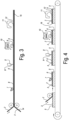
- Fig. 1 illustrates successive steps of an embodiment of a method of manufacturing a panel 1 according to the invention.
- a flexible film 2 is laminated onto a substrate 5.
- the film 2 is a smooth, non-textured film provided with a printed decor 3 on its upper surface.
- Said decor 3 is formed using pigment containing inks and can be analog or digitally printed.
- the substrate 5 may be made of a wood-based material, a plastic-based material or mineral-based material, preferably it is made of PVC, for example SPC.
- Fig. 1 further illustrates that a curable substance 6 is applied onto the film 2 by means of a roller 7.
- the curable substance 6 has anti-wear properties.
- discrete quantities of a texturing fluid in the form of a mask 8 is printed by means of a digital mask printer 9.
- the mask 8 prevents the curable substance 6 from being cured by means of UV radiation.
- the mask 8 is printed in register with the decor 3. This may be facilitated by an image processing system (not shown) which digitalizes the decor 3 before the step of printing the mask 8, or that identifies aligning marks onto the film 2.
- the curable substance 6 including the mask 8 is exposed to a UV radiator 10. Consequently, the curable substance 6 outside the locations where the mask 8 is printed is cured. Subsequently the non-cured portion of the curable substance below the mask 8 and the mask 8 are removed by a mechanical device 11, for example a brushing device, hence forming the panel 1 including depressions 12 in register with the decor 3, as shown in the lower right corner of Fig. 1 .
- the cured curable substance 6 forms a textured layer on the film 2.
- the cured curable substance 6 is transparent such that the decor 3 is visible through the textured layer and in this embodiment the curable substance forms a wear coating on top of the decor 3.
- the invention is also related to a method of creating a textured layer on a film such that a textured film 13 is created as an intermediate product.
- Fig. 2 shows successive steps of an embodiment of this method. Similar to the embodiment as illustrated in Fig. 1 , at the upper left corner of Fig. 2 the flexible, smooth, non-textured film 2, which is has a decor 3 on its upper surface is provided with the curable substance 6 upon the decor 3 itself by means of the roller 7.
- the mask 8 is printed on top of the curable substance 6 in register with the decor 3 by means of the digital mask printer 9. After the step of curing the non-cured portion of the curable substance below the mask 8 and the mask 8 are removed by the mechanical device 11, hence forming the textured film 13 including depressions 12 in register with the decor 3.
- the textured film 3 can be rolled up in a roller and stored. In a different manufacturing process the textured film 13 may be attached to a substrate (not shown) in order to create a panel, for example by means of a laminating process.
- Fig. 3 illustrates successive steps of an alternative embodiment.
- a flexible wear resistant film 2 and a decorative film 14 are supplied.
- the decorative film 14 comprises a base film onto which the decor 3 is printed by means of digital printing in a different manufacturing process (not shown).
- the wear resistant film 2 and the decorative film 14 are attached to each other, for example by means of glue, or preferably heat lamination.
- Fig. 3 shows that they are attached to each other such that the decor 3 is sandwiched between the wear resistant film 2 and the decorative film 14.
- Subsequent steps of applying the curable substance 6 and the mask 8, curing and removing non-cured substance and the mask 8 are similar to the embodiments as described hereinbefore.
- a textured wear resistant film 15 is formed, as shown in the lower right corner of Fig. 3 .
- the decorative film 14 can be laminated onto a substrate 5 before being laminated to the film 2.
- Fig. 4 illustrates successive steps of an alternative embodiment of the method of manufacturing a panel 16.
- the substrate 5 is supplied.
- the decor 3 is directly printed onto the substrate 5 by means of the digital decor printer 4, after which the flexible, smooth, non-textured wear resistant film 2 is attached to the substrate 5 including the decor 3.
- Subsequent steps of applying the curable substance 6 and the mask 8, curing and removing non-cured substance and the mask 8 are similar to the embodiments as described hereinbefore.
- the panel 16 including depressions 12 in register with the decor 3 is obtained, as shown in the lower right corner of Fig. 4 .
- a decorative film including the decor 3 may be attached to the substrate 5 instead of directly printing the decor 3 onto the substrate 5 by means of the digital decor printer 4.
- the invention is further disclosed by the following item list.
Landscapes
- Health & Medical Sciences (AREA)
- Engineering & Computer Science (AREA)
- General Health & Medical Sciences (AREA)
- Textile Engineering (AREA)
- Vascular Medicine (AREA)
- Laminated Bodies (AREA)
Priority Applications (4)
| Application Number | Priority Date | Filing Date | Title |
|---|---|---|---|
| EP21217135.9A EP4201696A1 (fr) | 2021-12-22 | 2021-12-22 | Procédé de création d'une couche texturée sur un panneau décoratif |
| PCT/IB2022/062363 WO2023119089A1 (fr) | 2021-12-22 | 2022-12-16 | Procédé de création d'une couche texturée sur un panneau décoratif |
| EP22826226.7A EP4452662A1 (fr) | 2021-12-22 | 2022-12-16 | Procédé de création d'une couche texturée sur un panneau décoratif |
| US18/723,097 US20250058582A1 (en) | 2021-12-22 | 2022-12-16 | A method of creating a textured layer on a decorative panel |
Applications Claiming Priority (1)
| Application Number | Priority Date | Filing Date | Title |
|---|---|---|---|
| EP21217135.9A EP4201696A1 (fr) | 2021-12-22 | 2021-12-22 | Procédé de création d'une couche texturée sur un panneau décoratif |
Publications (1)
| Publication Number | Publication Date |
|---|---|
| EP4201696A1 true EP4201696A1 (fr) | 2023-06-28 |
Family
ID=79024611
Family Applications (2)
| Application Number | Title | Priority Date | Filing Date |
|---|---|---|---|
| EP21217135.9A Pending EP4201696A1 (fr) | 2021-12-22 | 2021-12-22 | Procédé de création d'une couche texturée sur un panneau décoratif |
| EP22826226.7A Pending EP4452662A1 (fr) | 2021-12-22 | 2022-12-16 | Procédé de création d'une couche texturée sur un panneau décoratif |
Family Applications After (1)
| Application Number | Title | Priority Date | Filing Date |
|---|---|---|---|
| EP22826226.7A Pending EP4452662A1 (fr) | 2021-12-22 | 2022-12-16 | Procédé de création d'une couche texturée sur un panneau décoratif |
Country Status (3)
| Country | Link |
|---|---|
| US (1) | US20250058582A1 (fr) |
| EP (2) | EP4201696A1 (fr) |
| WO (1) | WO2023119089A1 (fr) |
Families Citing this family (1)
| Publication number | Priority date | Publication date | Assignee | Title |
|---|---|---|---|---|
| US20250223815A1 (en) * | 2024-01-10 | 2025-07-10 | Välinge Innovation AB | Method to produce a board element and a panel |
Citations (8)
| Publication number | Priority date | Publication date | Assignee | Title |
|---|---|---|---|---|
| WO2010070485A2 (fr) * | 2008-12-19 | 2010-06-24 | Flooring Industries Limited, Sarl | Procédés de fabrication de panneaux et panneau ainsi obtenu |
| US20100330336A1 (en) * | 2007-07-11 | 2010-12-30 | Guillot William R | Printer-compatible, pre-embossed films |
| DE102012111809A1 (de) * | 2012-12-05 | 2014-06-05 | SÜDDEKOR GmbH | Dekoratives Oberflächenmaterial für Fußböden und Möbel sowie Verfahren zu dessen Herstellung |
| EP3206881B1 (fr) * | 2014-10-17 | 2019-12-25 | Sun Chemical Corporation | Procédé d'impression décorative |
| US20200016627A1 (en) * | 2017-06-13 | 2020-01-16 | Hymmen GmbH Maschinen- und Anlagenbau | Method and apparatus for producing a decorative workpiece and workpiece |
| WO2020039361A1 (fr) * | 2018-08-22 | 2020-02-27 | Giorgio Macor | Procédé et appareil de génération d'une structure de surface |
| US20200346395A1 (en) * | 2019-05-03 | 2020-11-05 | Hymmen GmbH Maschinen- und Anlagenbau | Method and device for producing a decorative surface |
| US20210053335A1 (en) * | 2018-01-04 | 2021-02-25 | Unilin, Bv | Methods for manufacturing panels |
-
2021
- 2021-12-22 EP EP21217135.9A patent/EP4201696A1/fr active Pending
-
2022
- 2022-12-16 EP EP22826226.7A patent/EP4452662A1/fr active Pending
- 2022-12-16 WO PCT/IB2022/062363 patent/WO2023119089A1/fr not_active Ceased
- 2022-12-16 US US18/723,097 patent/US20250058582A1/en active Pending
Patent Citations (8)
| Publication number | Priority date | Publication date | Assignee | Title |
|---|---|---|---|---|
| US20100330336A1 (en) * | 2007-07-11 | 2010-12-30 | Guillot William R | Printer-compatible, pre-embossed films |
| WO2010070485A2 (fr) * | 2008-12-19 | 2010-06-24 | Flooring Industries Limited, Sarl | Procédés de fabrication de panneaux et panneau ainsi obtenu |
| DE102012111809A1 (de) * | 2012-12-05 | 2014-06-05 | SÜDDEKOR GmbH | Dekoratives Oberflächenmaterial für Fußböden und Möbel sowie Verfahren zu dessen Herstellung |
| EP3206881B1 (fr) * | 2014-10-17 | 2019-12-25 | Sun Chemical Corporation | Procédé d'impression décorative |
| US20200016627A1 (en) * | 2017-06-13 | 2020-01-16 | Hymmen GmbH Maschinen- und Anlagenbau | Method and apparatus for producing a decorative workpiece and workpiece |
| US20210053335A1 (en) * | 2018-01-04 | 2021-02-25 | Unilin, Bv | Methods for manufacturing panels |
| WO2020039361A1 (fr) * | 2018-08-22 | 2020-02-27 | Giorgio Macor | Procédé et appareil de génération d'une structure de surface |
| US20200346395A1 (en) * | 2019-05-03 | 2020-11-05 | Hymmen GmbH Maschinen- und Anlagenbau | Method and device for producing a decorative surface |
Also Published As
| Publication number | Publication date |
|---|---|
| EP4452662A1 (fr) | 2024-10-30 |
| WO2023119089A1 (fr) | 2023-06-29 |
| US20250058582A1 (en) | 2025-02-20 |
Similar Documents
| Publication | Publication Date | Title |
|---|---|---|
| US11821216B2 (en) | Decorative panel, panel covering, and method of producing such a decorative panel | |
| EP4153823B1 (fr) | Panneau décoratif et procédé pour la procuction d'un panneau décoratif | |
| EP1556561B1 (fr) | Panneau de couverture de surface presentant un motif imprime | |
| EP4087989B1 (fr) | Élément décoratif de revêtement de surface, revêtement à l'aide d'un tel élément et méthode de fabrication d'un tel élément décoratif de revêtement de surface | |
| RU2636516C2 (ru) | Способ нанесения покрытия на строительную панель методом цифровой печати или цифрового покрытия | |
| US11643822B2 (en) | Decorative surface covering element, surface covering element covering, and method of producing such a decorative surface covering element | |
| JP2019059087A (ja) | 装飾フィルム | |
| US20250058582A1 (en) | A method of creating a textured layer on a decorative panel | |
| JP7840322B2 (ja) | 屋外用uv保護フィルム | |
| AU2022406975A1 (en) | A decorative sheet and method for manufacturing | |
| LU102233B1 (en) | Digital Embossing of decorative surface coverings | |
| WO2024189468A1 (fr) | Panneau décoré et son procédé de fabrication | |
| JP2001199028A (ja) | 化粧材 | |
| LU504655B1 (en) | Decorative surface coverings digitally embossed | |
| RU2830022C1 (ru) | Цифровое тиснение декоративных поверхностных покрытий | |
| US12629960B2 (en) | Digital embossing of decorative surface coverings | |
| JPH0557865A (ja) | 化粧材及び化粧材の製造方法 |
Legal Events
| Date | Code | Title | Description |
|---|---|---|---|
| PUAI | Public reference made under article 153(3) epc to a published international application that has entered the european phase |
Free format text: ORIGINAL CODE: 0009012 |
|
| STAA | Information on the status of an ep patent application or granted ep patent |
Free format text: STATUS: THE APPLICATION HAS BEEN PUBLISHED |
|
| AK | Designated contracting states |
Kind code of ref document: A1 Designated state(s): AL AT BE BG CH CY CZ DE DK EE ES FI FR GB GR HR HU IE IS IT LI LT LU LV MC MK MT NL NO PL PT RO RS SE SI SK SM TR |
|
| STAA | Information on the status of an ep patent application or granted ep patent |
Free format text: STATUS: REQUEST FOR EXAMINATION WAS MADE |
|
| 17P | Request for examination filed |
Effective date: 20231207 |
|
| RBV | Designated contracting states (corrected) |
Designated state(s): AL AT BE BG CH CY CZ DE DK EE ES FI FR GB GR HR HU IE IS IT LI LT LU LV MC MK MT NL NO PL PT RO RS SE SI SK SM TR |
|
| RAP1 | Party data changed (applicant data changed or rights of an application transferred) |
Owner name: UNILIN, BV |
|
| TPAC | Observations filed by third parties |
Free format text: ORIGINAL CODE: EPIDOSNTIPA |
|
| STAA | Information on the status of an ep patent application or granted ep patent |
Free format text: STATUS: EXAMINATION IS IN PROGRESS |
|
| 17Q | First examination report despatched |
Effective date: 20251205 |