EP4201859A1 - Système de communication pour ascenseurs - Google Patents
Système de communication pour ascenseurs Download PDFInfo
- Publication number
- EP4201859A1 EP4201859A1 EP21217351.2A EP21217351A EP4201859A1 EP 4201859 A1 EP4201859 A1 EP 4201859A1 EP 21217351 A EP21217351 A EP 21217351A EP 4201859 A1 EP4201859 A1 EP 4201859A1
- Authority
- EP
- European Patent Office
- Prior art keywords
- bus
- bus nodes
- nodes
- group
- controller
- Prior art date
- Legal status (The legal status is an assumption and is not a legal conclusion. Google has not performed a legal analysis and makes no representation as to the accuracy of the status listed.)
- Pending
Links
Images

Classifications
-
- B—PERFORMING OPERATIONS; TRANSPORTING
- B66—HOISTING; LIFTING; HAULING
- B66B—ELEVATORS; ESCALATORS OR MOVING WALKWAYS
- B66B1/00—Control systems of elevators in general
- B66B1/02—Control systems without regulation, i.e. without retroactive action
- B66B1/06—Control systems without regulation, i.e. without retroactive action electric
-
- B—PERFORMING OPERATIONS; TRANSPORTING
- B66—HOISTING; LIFTING; HAULING
- B66B—ELEVATORS; ESCALATORS OR MOVING WALKWAYS
- B66B1/00—Control systems of elevators in general
- B66B1/34—Details, e.g. call counting devices, data transmission from car to control system, devices giving information to the control system
- B66B1/3415—Control system configuration and the data transmission or communication within the control system
- B66B1/3446—Data transmission or communication within the control system
- B66B1/3453—Procedure or protocol for the data transmission or communication
-
- G—PHYSICS
- G06—COMPUTING OR CALCULATING; COUNTING
- G06F—ELECTRIC DIGITAL DATA PROCESSING
- G06F13/00—Interconnection of, or transfer of information or other signals between, memories, input/output devices or central processing units
- G06F13/14—Handling requests for interconnection or transfer
- G06F13/36—Handling requests for interconnection or transfer for access to common bus or bus system
- G06F13/362—Handling requests for interconnection or transfer for access to common bus or bus system with centralised access control
-
- B—PERFORMING OPERATIONS; TRANSPORTING
- B66—HOISTING; LIFTING; HAULING
- B66B—ELEVATORS; ESCALATORS OR MOVING WALKWAYS
- B66B1/00—Control systems of elevators in general
- B66B1/34—Details, e.g. call counting devices, data transmission from car to control system, devices giving information to the control system
- B66B1/3415—Control system configuration and the data transmission or communication within the control system
- B66B1/3423—Control system configuration, i.e. lay-out
-
- B—PERFORMING OPERATIONS; TRANSPORTING
- B66—HOISTING; LIFTING; HAULING
- B66B—ELEVATORS; ESCALATORS OR MOVING WALKWAYS
- B66B1/00—Control systems of elevators in general
- B66B1/34—Details, e.g. call counting devices, data transmission from car to control system, devices giving information to the control system
- B66B1/3415—Control system configuration and the data transmission or communication within the control system
- B66B1/3446—Data transmission or communication within the control system
-
- B—PERFORMING OPERATIONS; TRANSPORTING
- B66—HOISTING; LIFTING; HAULING
- B66B—ELEVATORS; ESCALATORS OR MOVING WALKWAYS
- B66B5/00—Applications of checking, fault-correcting, or safety devices in elevators
- B66B5/0006—Monitoring devices or performance analysers
- B66B5/0018—Devices monitoring the operating condition of the elevator system
- B66B5/0031—Devices monitoring the operating condition of the elevator system for safety reasons
Definitions
- the invention relates to a communication system for elevators.
- the communication system according to the invention for an elevator has a bus controller and a number of bus nodes.
- the bus controller periodically sends queries to all bus nodes and receives the responses from the bus nodes.
- the bus nodes receive requests from the bus controller and send responses to the bus node.
- the bus controller is designed to select a group of bus nodes in each case for its queries and to wait for the responses of these bus nodes between two queries.
- Group is part of the bus nodes, so there is at least one other group of bus nodes.
- the bus controller can be a separate device from the lift controller, with or without its own housing.
- the bus controller can be integrated into the elevator control.
- the bus controller is preferably designed to select different groups of bus nodes for its queries, up to all bus nodes once or have been selected at least once and carry out this procedure repeatedly.
- the bus controller is preferably designed to select different groups of bus nodes at time intervals of different lengths.
- the bus node selects at least one specific group at a different time interval than other groups.
- the at least one different time interval is in each case an integer multiple of the shortest time interval.
- at least one specific group of bus nodes is selected at intervals that are half as long as other groups of bus nodes.
- the bus nodes are preferably designed such that different groups of bus nodes correspond to different types of groups of bus nodes and/or that different types of groups of bus nodes correspond to different types of sensors of the sensors associated with the bus nodes and/or that the different types of groups of bus nodes correspond to different types of safety classes or urgency classes of the sensors belonging to the bus nodes.
- Types of sensors can be: car door sensors, landing door sensors, car position sensors, emergency stop switches, operating mode switches, inspection trip switches, service door sensors, motor status sensors, brake status sensors.
- Different security classes or urgency classes mean that the affected sensors and their affected bus nodes need to be queried and answered with different frequency.
- a higher security class or Priority class of sensors and assigned bus accounts is more time-critical and has to be queried more often and has to transmit the data more often than a lower security class or priority class of sensors and bus nodes.
- the sensor with the highest security class or urgency class connected to a bus node defines the security class or urgency class of the bus node.
- sensors of the same safety class or urgency class are connected to a bus node.
- the car door sensors and landing door sensors correspond to a lower security class or priority class than the other sensors. These door sensors are typically less time sensitive. Therefore, the door sensors are queried less often than the other sensors.
- the interrogation period of the door sensors is longer than the interrogation time of the other sensors.
- the polling period of the other sensors is shorter than the polling period of the door sensors.
- the door sensors are far more numerous than the other sensors. Therefore, the other sensors can be queried at shorter intervals than if all sensors were queried at equal intervals.
- the bus nodes are preferably designed to only send a response to the request from the bus controller to the bus controller if the bus node is included in the group of selected bus nodes.
- the bus nodes are preferably designed to only send a response to the request from the bus controller to the bus controller if the bus node is included in the group of selected bus nodes and after the request in a specific order to the bus nodes also included in the group of selected bus nodes send its responses to the bus controller.
- the elevator according to the invention is an elevator with a communication system as described above.
- the bus controller according to the invention is a bus controller according to the communication system described above.
- 1 shows a timing diagram of the bus communication with the request from the bus controller and the responses from a group of bus nodes.
- the bus consists of a bus controller that is connected to bus nodes via a bus connection.
- the bus nodes are each connected to several sensors, receive their sensor data and can forward this sensor data to the bus controller via the bus connection.
- the bus controller is connected to the elevator control and can forward the sensor data to the elevator control.
- bus nodes are distributed in the elevator.
- the bus nodes have different addresses.
- Each bus node is connected to 8 sensors.
- 10 bus nodes are arranged on the cabin, in the pit and/or in the vicinity of the elevator control and are connected there to their associated sensors. At least some of the data from these 80 sensors is particularly relevant to safety or particularly urgent and must be specially evaluated. These 10 bus nodes are therefore priority bus nodes. These bus nodes form a group of consecutive addresses.
- 40 bus nodes are arranged in the elevator shaft, where they are primarily connected to door sensors. The data from these 320 sensors is less safety-related or urgent and therefore needs to be sent to the elevator controller less often. These 40 bus nodes are therefore subordinate bus nodes. The 40 bus nodes form 4 groups of 10 bus nodes, each with consecutive addresses.
- the bus controller sends queries 10 to all bus nodes via the bus connection and thereby communicates the addresses of a specific group, i.e. it addresses a specific group.
- the bus nodes recognize whether they belong to the group of addresses communicated by this request.
- Immediately after the request only the bus nodes of the affected group send a response 20 with the sensor data of the sensors connected to them.
- the bus nodes of the associated group send their responses 200 in the time sequence 30 one after the other in the order of their addresses 201, . . . 209 via the bus connection to the bus controller.
- the bus controller can identify the bus nodes via the order of the answers if they do not transmit their address and thus assign the sensor data.
- FIG. 2 shows a timing diagram of the bus communication according to figure 1 with 3 groups of bus nodes.
- the bus controller sends the requests 10 periodically at intervals of the request intervals 31.
- the bus controller addresses a group of priority bus nodes 21 for its queries at every 2nd polling interval.
- the bus nodes of this priority group send their responses 21 immediately after the query within the polling interval.
- the responses of these priority bus nodes 21 are therefore given at a time interval of a period of two polling intervals.
- the bus controller alternately addresses a second and a third group of subordinate bus nodes for its queries. These send their responses immediately after the query that affects them within the polling interval, so that the responses of these two subordinate groups 22a, 22b alternate and each occur at a time interval of a period of four polling intervals.
- Two repetition intervals 32 are shown in the figure.
- all groups of bus nodes i.e. all bus nodes and thus all sensors, are queried at least once.
- the execution according to figure 2 a group of priority bus nodes and 2 groups of subordinate bus nodes.
- the priority bus nodes are queried twice as often and deliver the sensor data from their assigned sensors to the bus controller and thus to the elevator control twice as often as the subordinate bus nodes.
- the possible polling frequency of the priority bus nodes is faster compared to an identical polling frequency for all bus nodes.
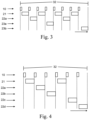
- FIG. 3 shows a timing diagram of the bus communication according to figure 1 with 4 groups of bus nodes.
- a repeat interval 32 is shown.
- the bus controller sends the requests 10 periodically at the time interval of the request intervals.
- the bus controller addresses a group of priority bus nodes 21 for its queries at every 2nd query interval.
- the bus nodes of this priority group send their responses 21 immediately after the query within the query interval.
- the responses of these priority bus nodes 21 are therefore given at a time interval of a period of two polling intervals.
- the bus controller addresses a second, third and fourth group of bus nodes in its queries.
- the bus controller addresses the bus nodes of the second group 22a in its queries at intervals twice as long as the addressing of the bus nodes of the priority group, ie in every 4th query interval. These each send their responses immediately after the query that affects them within the polling interval, so that the responses of this group 22a are each given at a time interval of a period of four polling intervals.
- the bus controller addresses the third and fourth group 23a, 23b of bus nodes alternately in its inquiries and thus in each 8th interrogation interval. These send their responses immediately after the query that affects them within the polling interval, so that the responses of these two lower-ranking groups 23a, 23b take place alternately and at intervals of a period of eight polling intervals.
- the execution according to figure 3 a group of priority bus nodes, a group of subordinate bus nodes and two groups of particularly subordinate bus nodes.
- the possible polling frequency of the priority bus nodes is faster compared to an identical polling frequency for all bus nodes.
- this version enables 3 different urgent bus node types to be queried with varying frequency, i.e. 3 different urgent sensor types.
- FIG. 4 shows a timing diagram of the bus communication according to figure 1 with 5 groups of bus nodes.
- a repeat interval 32 is shown.
- the bus controller sends the requests 10 periodically at the time interval of the request intervals.
- the bus controller addresses a group of priority bus nodes 21 for its queries at every 3rd polling interval.
- the bus nodes of this priority group send their responses 21 immediately after the query within the polling interval.
- the responses 21 of these priority bus nodes are therefore given at a time interval of a period of three polling intervals.
- the bus controller addresses a second, third, fourth and fifth group of subordinate bus nodes in its queries.
- the addressing of these groups of bus nodes takes place one after the other.
- the responses of each of these groups 22a, 22b, 22c, 22d each occur at a time interval of a period of six query intervals.
- the execution according to figure 4 a group of priority bus nodes and four groups of subordinate bus nodes.
- the priority bus nodes send the data from their assigned sensors twice as often as the subordinate bus nodes.
- the group of priority bus nodes consists of 10 bus nodes which are arranged in the cabin, in the pit and/or near the elevator control. Eight sensors are assigned to each of these priority bus nodes. These 80 sensors in total can be particularly safety-relevant sensors.
- the 4 groups of subordinate bus nodes each consist of 10 bus nodes. These 40 bus nodes are arranged in the elevator shaft. Eight sensors are assigned to each of these 40 priority bus nodes. These 320 sensors are generally door sensors or other sensors in the elevator which are less relevant to safety.
Landscapes
- Engineering & Computer Science (AREA)
- Automation & Control Theory (AREA)
- Computer Networks & Wireless Communication (AREA)
- Theoretical Computer Science (AREA)
- Physics & Mathematics (AREA)
- General Engineering & Computer Science (AREA)
- General Physics & Mathematics (AREA)
- Small-Scale Networks (AREA)
Priority Applications (3)
| Application Number | Priority Date | Filing Date | Title |
|---|---|---|---|
| EP21217351.2A EP4201859A1 (fr) | 2021-12-23 | 2021-12-23 | Système de communication pour ascenseurs |
| US18/067,986 US12204477B2 (en) | 2021-12-23 | 2022-12-19 | Communication system for elevators |
| CN202211633118.9A CN116354195A (zh) | 2021-12-23 | 2022-12-19 | 用于电梯的通信系统 |
Applications Claiming Priority (1)
| Application Number | Priority Date | Filing Date | Title |
|---|---|---|---|
| EP21217351.2A EP4201859A1 (fr) | 2021-12-23 | 2021-12-23 | Système de communication pour ascenseurs |
Publications (1)
| Publication Number | Publication Date |
|---|---|
| EP4201859A1 true EP4201859A1 (fr) | 2023-06-28 |
Family
ID=79024969
Family Applications (1)
| Application Number | Title | Priority Date | Filing Date |
|---|---|---|---|
| EP21217351.2A Pending EP4201859A1 (fr) | 2021-12-23 | 2021-12-23 | Système de communication pour ascenseurs |
Country Status (3)
| Country | Link |
|---|---|
| US (1) | US12204477B2 (fr) |
| EP (1) | EP4201859A1 (fr) |
| CN (1) | CN116354195A (fr) |
Citations (2)
| Publication number | Priority date | Publication date | Assignee | Title |
|---|---|---|---|---|
| CN1198754C (zh) * | 2000-01-28 | 2005-04-27 | 三菱电机株式会社 | 电梯的局部设备网络及其发送控制方法 |
| US10554443B2 (en) * | 2016-06-09 | 2020-02-04 | Inventio Ag | Passenger transport system with central control unit and multiple field devices which communicate with data telegrams prioritized by waiting periods |
Family Cites Families (22)
| Publication number | Priority date | Publication date | Assignee | Title |
|---|---|---|---|---|
| FR2379694A1 (fr) * | 1977-02-03 | 1978-09-01 | Schlumberger Prospection | Systeme de transmission de donnees pour puits de forage |
| US4503336A (en) * | 1982-06-14 | 1985-03-05 | Itek Corporation | Beam former having variable delays between LED output signals |
| US4747097A (en) * | 1985-03-12 | 1988-05-24 | Oki Electric Industry Co., Ltd. | Multiplex transmission system |
| US4831523A (en) * | 1986-10-31 | 1989-05-16 | Bull Hn Information Systems Inc. | Multiple DMA controller chip sequencer |
| US4792019A (en) * | 1988-02-12 | 1988-12-20 | Otis Elevator Company | Contiguous floor channeling with up hall call elevator dispatching |
| US5183981A (en) * | 1988-06-21 | 1993-02-02 | Otis Elevator Company | "Up-peak" elevator channeling system with optimized preferential service to high intensity traffic floors |
| US5035302A (en) * | 1989-03-03 | 1991-07-30 | Otis Elevator Company | "Artificial Intelligence" based learning system predicting "Peak-Period" times for elevator dispatching |
| JP2633681B2 (ja) * | 1989-04-12 | 1997-07-23 | 株式会社東芝 | エレベータの群管理制御装置 |
| US5317114A (en) * | 1991-11-27 | 1994-05-31 | Otis Elevator Company | Elevator system having dynamic sector assignments |
| US5159163A (en) * | 1991-11-27 | 1992-10-27 | Otis Elevator Company | Elevator management system time based security |
| US5387769A (en) * | 1993-06-01 | 1995-02-07 | Otis Elevator Company | Local area network between an elevator system building controller, group controller and car controller, using redundant communication links |
| JP3483947B2 (ja) * | 1993-10-14 | 2004-01-06 | 株式会社東芝 | 磁気共鳴イメージング装置 |
| US5675830A (en) * | 1994-02-28 | 1997-10-07 | Eaton Corporation | Addressing scheme for control network having remote address request device |
| KR20020058331A (ko) * | 2000-12-29 | 2002-07-12 | 엘지전자 주식회사 | 메시지 전송 시스템에서의 폭주 제어 방법 |
| ATE541377T1 (de) * | 2002-08-01 | 2012-01-15 | Nokia Corp | Übertragung von verschachtelten mehrfachen datenströmen |
| US8086747B2 (en) * | 2003-09-22 | 2011-12-27 | Anilkumar Dominic | Group-to-group communication over a single connection |
| CN201258206Y (zh) * | 2008-08-08 | 2009-06-17 | 天津莱茵克拉电梯有限公司 | 电梯主控制器 |
| FI122063B (fi) * | 2010-01-07 | 2011-08-15 | Kone Corp | Menetelmä ja järjestelmä palvelupyyntöjen antamiseksi kuljetusjärjestelmälle |
| US8601185B2 (en) * | 2010-07-16 | 2013-12-03 | St. Jude Medical, Atrial Fibrillation Divison, Inc. | System and methods for avoiding data collisions over a data bus |
| FI123506B (fi) * | 2012-05-31 | 2013-06-14 | Kone Corp | Hissin käyttölaite sekä hissin turvajärjestely |
| US10496927B2 (en) * | 2014-05-23 | 2019-12-03 | DataRobot, Inc. | Systems for time-series predictive data analytics, and related methods and apparatus |
| US11880835B2 (en) * | 2020-04-24 | 2024-01-23 | Salesforce, Inc. | Prevention of duplicate transactions across multiple transaction entities in database systems |
-
2021
- 2021-12-23 EP EP21217351.2A patent/EP4201859A1/fr active Pending
-
2022
- 2022-12-19 CN CN202211633118.9A patent/CN116354195A/zh active Pending
- 2022-12-19 US US18/067,986 patent/US12204477B2/en active Active
Patent Citations (2)
| Publication number | Priority date | Publication date | Assignee | Title |
|---|---|---|---|---|
| CN1198754C (zh) * | 2000-01-28 | 2005-04-27 | 三菱电机株式会社 | 电梯的局部设备网络及其发送控制方法 |
| US10554443B2 (en) * | 2016-06-09 | 2020-02-04 | Inventio Ag | Passenger transport system with central control unit and multiple field devices which communicate with data telegrams prioritized by waiting periods |
Also Published As
| Publication number | Publication date |
|---|---|
| US20230205716A1 (en) | 2023-06-29 |
| CN116354195A (zh) | 2023-06-30 |
| US12204477B2 (en) | 2025-01-21 |
Similar Documents
| Publication | Publication Date | Title |
|---|---|---|
| DE3424866C2 (de) | Verfahren und Anordnung zur Übertragung von Daten, insbesondere in einem Flugzeug | |
| EP0440967B1 (fr) | Commande de groupes pour ascenseurs avec distribution directe d'appels d'une entrée d'appels située sur l'étage | |
| EP0489346B1 (fr) | Procédé pour le rangement automatique des adresses des détecteurs dans un système d'alarme | |
| WO2011012262A1 (fr) | Dispositif et procédé pour l'adressage d'une unité esclave | |
| EP3131270B1 (fr) | Configuration de reseau et procede de transmission d'adresses reseau a des ventilateurs dans un reseau | |
| EP0597561B1 (fr) | Système de transfert pour l'échange de données | |
| EP2142460B1 (fr) | Procédé de réglage d'une pluralité d'unités de commande d'un système d'ascenseur desservant une pluralité d'étages | |
| DE2659662B2 (de) | Prioritätsstufengesteuerte Unterbrechungseinrichtung | |
| EP3669527B1 (fr) | Procédé de fonctionnement d'un agencement de capteurs dans un véhicule automobile sur la base d'un protocole dsi | |
| DE2411824C2 (de) | Verfahren zum Betreiben einer Aufzugsanlage | |
| DE202018006079U1 (de) | Busknoten der zur Ausführung eines Verfahrens zur Vergabe von logischen Busknotenadressen geeignet ist, das für beliebige Datenbus-Topologien geeignet ist | |
| DE2812009C2 (de) | Nachrichtenübertragungssystem | |
| WO2007082872A1 (fr) | Procédé et dispositif d'attribution d'adresses dans un système comportant plusieurs unités de générateur disposées de façon parallèle | |
| DE10148331B4 (de) | Steuervorrichtung zur Steuerung eines Datenbuszugangs eines Datenpakets | |
| DE4213792A1 (de) | Verfahren zum Betreiben eines Datenübertragungssystems | |
| DE19703721C2 (de) | Verfahren zur Adreßvergabe an gleichartige Module eines Kommunikationssystems | |
| DE3325791C2 (de) | Schaltungsanordnung für mit einer zentralen Steuereinrichtung zusammenarbeitende periphere Einheiten | |
| DE102021004815B3 (de) | Verfahren zum Betreiben einer technischen Anlage und technische Anlage | |
| EP0413005B1 (fr) | Procede permettant de reduire la longueur d'une file d'attente repartie | |
| DE10216332A1 (de) | Messeinrichtung für die Prozesstechnik und Betriebsverfahren für eine Messeinrichtung | |
| EP4685030A1 (fr) | Dispositif de signalisation et procédé de traitement de signaux d'une installation de signalisation de l'occupation des voies | |
| DE69608331T2 (de) | Verfahren zur Steuerung der Übertragung von Nachrichten im Übertragungsnetzwerk eines elektronischen Bordsystems eines Automobils | |
| EP2875438B1 (fr) | Procédé d'enregistrement et dispositif de communication par bus | |
| DE102017117225B3 (de) | Kommunikationssystem mit Bus und Codierleitung | |
| DE4113966C2 (fr) |
Legal Events
| Date | Code | Title | Description |
|---|---|---|---|
| PUAI | Public reference made under article 153(3) epc to a published international application that has entered the european phase |
Free format text: ORIGINAL CODE: 0009012 |
|
| STAA | Information on the status of an ep patent application or granted ep patent |
Free format text: STATUS: REQUEST FOR EXAMINATION WAS MADE |
|
| 17P | Request for examination filed |
Effective date: 20230131 |
|
| AK | Designated contracting states |
Kind code of ref document: A1 Designated state(s): AL AT BE BG CH CY CZ DE DK EE ES FI FR GB GR HR HU IE IS IT LI LT LU LV MC MK MT NL NO PL PT RO RS SE SI SK SM TR |
|
| STAA | Information on the status of an ep patent application or granted ep patent |
Free format text: STATUS: EXAMINATION IS IN PROGRESS |
|
| 17Q | First examination report despatched |
Effective date: 20240417 |