EP4201909A1 - Méthode à haute capacité de rétention de solides pour la production de fibrociment, utilisation et procédé de production à haute capacité de rétention de solides et article de fibrociment - Google Patents
Méthode à haute capacité de rétention de solides pour la production de fibrociment, utilisation et procédé de production à haute capacité de rétention de solides et article de fibrociment Download PDFInfo
- Publication number
- EP4201909A1 EP4201909A1 EP21857065.3A EP21857065A EP4201909A1 EP 4201909 A1 EP4201909 A1 EP 4201909A1 EP 21857065 A EP21857065 A EP 21857065A EP 4201909 A1 EP4201909 A1 EP 4201909A1
- Authority
- EP
- European Patent Office
- Prior art keywords
- fiber
- production
- fiber cement
- retention capacity
- high solids
- Prior art date
- Legal status (The legal status is an assumption and is not a legal conclusion. Google has not performed a legal analysis and makes no representation as to the accuracy of the status listed.)
- Withdrawn
Links
Images


Classifications
-
- C—CHEMISTRY; METALLURGY
- C04—CEMENTS; CONCRETE; ARTIFICIAL STONE; CERAMICS; REFRACTORIES
- C04B—LIME, MAGNESIA; SLAG; CEMENTS; COMPOSITIONS THEREOF, e.g. MORTARS, CONCRETE OR LIKE BUILDING MATERIALS; ARTIFICIAL STONE; CERAMICS; REFRACTORIES; TREATMENT OF NATURAL STONE
- C04B14/00—Use of inorganic materials as fillers, e.g. pigments, for mortars, concrete or artificial stone; Treatment of inorganic materials specially adapted to enhance their filling properties in mortars, concrete or artificial stone
-
- C—CHEMISTRY; METALLURGY
- C04—CEMENTS; CONCRETE; ARTIFICIAL STONE; CERAMICS; REFRACTORIES
- C04B—LIME, MAGNESIA; SLAG; CEMENTS; COMPOSITIONS THEREOF, e.g. MORTARS, CONCRETE OR LIKE BUILDING MATERIALS; ARTIFICIAL STONE; CERAMICS; REFRACTORIES; TREATMENT OF NATURAL STONE
- C04B28/00—Compositions of mortars, concrete or artificial stone, containing inorganic binders or the reaction product of an inorganic and an organic binder, e.g. polycarboxylate cements
- C04B28/02—Compositions of mortars, concrete or artificial stone, containing inorganic binders or the reaction product of an inorganic and an organic binder, e.g. polycarboxylate cements containing hydraulic cements other than calcium sulfates
- C04B28/04—Portland cements
-
- C—CHEMISTRY; METALLURGY
- C04—CEMENTS; CONCRETE; ARTIFICIAL STONE; CERAMICS; REFRACTORIES
- C04B—LIME, MAGNESIA; SLAG; CEMENTS; COMPOSITIONS THEREOF, e.g. MORTARS, CONCRETE OR LIKE BUILDING MATERIALS; ARTIFICIAL STONE; CERAMICS; REFRACTORIES; TREATMENT OF NATURAL STONE
- C04B7/00—Hydraulic cements
- C04B7/02—Portland cement
-
- C—CHEMISTRY; METALLURGY
- C04—CEMENTS; CONCRETE; ARTIFICIAL STONE; CERAMICS; REFRACTORIES
- C04B—LIME, MAGNESIA; SLAG; CEMENTS; COMPOSITIONS THEREOF, e.g. MORTARS, CONCRETE OR LIKE BUILDING MATERIALS; ARTIFICIAL STONE; CERAMICS; REFRACTORIES; TREATMENT OF NATURAL STONE
- C04B28/00—Compositions of mortars, concrete or artificial stone, containing inorganic binders or the reaction product of an inorganic and an organic binder, e.g. polycarboxylate cements
- C04B28/02—Compositions of mortars, concrete or artificial stone, containing inorganic binders or the reaction product of an inorganic and an organic binder, e.g. polycarboxylate cements containing hydraulic cements other than calcium sulfates
-
- C—CHEMISTRY; METALLURGY
- C08—ORGANIC MACROMOLECULAR COMPOUNDS; THEIR PREPARATION OR CHEMICAL WORKING-UP; COMPOSITIONS BASED THEREON
- C08L—COMPOSITIONS OF MACROMOLECULAR COMPOUNDS
- C08L1/00—Compositions of cellulose, modified cellulose or cellulose derivatives
- C08L1/02—Cellulose; Modified cellulose
-
- B—PERFORMING OPERATIONS; TRANSPORTING
- B01—PHYSICAL OR CHEMICAL PROCESSES OR APPARATUS IN GENERAL
- B01D—SEPARATION
- B01D21/00—Separation of suspended solid particles from liquids by sedimentation
- B01D21/01—Separation of suspended solid particles from liquids by sedimentation using flocculating agents
-
- B—PERFORMING OPERATIONS; TRANSPORTING
- B03—SEPARATION OF SOLID MATERIALS USING LIQUIDS OR USING PNEUMATIC TABLES OR JIGS; MAGNETIC OR ELECTROSTATIC SEPARATION OF SOLID MATERIALS FROM SOLID MATERIALS OR FLUIDS; SEPARATION BY HIGH-VOLTAGE ELECTRIC FIELDS
- B03D—FLOTATION; DIFFERENTIAL SEDIMENTATION
- B03D3/00—Differential sedimentation
- B03D3/06—Flocculation
-
- C—CHEMISTRY; METALLURGY
- C04—CEMENTS; CONCRETE; ARTIFICIAL STONE; CERAMICS; REFRACTORIES
- C04B—LIME, MAGNESIA; SLAG; CEMENTS; COMPOSITIONS THEREOF, e.g. MORTARS, CONCRETE OR LIKE BUILDING MATERIALS; ARTIFICIAL STONE; CERAMICS; REFRACTORIES; TREATMENT OF NATURAL STONE
- C04B20/00—Use of materials as fillers for mortars, concrete or artificial stone according to more than one of groups C04B14/00 - C04B18/00 and characterised by shape or grain distribution; Treatment of materials according to more than one of the groups C04B14/00 - C04B18/00 specially adapted to enhance their filling properties in mortars, concrete or artificial stone; Expanding or defibrillating materials
- C04B20/10—Coating or impregnating
-
- C—CHEMISTRY; METALLURGY
- C04—CEMENTS; CONCRETE; ARTIFICIAL STONE; CERAMICS; REFRACTORIES
- C04B—LIME, MAGNESIA; SLAG; CEMENTS; COMPOSITIONS THEREOF, e.g. MORTARS, CONCRETE OR LIKE BUILDING MATERIALS; ARTIFICIAL STONE; CERAMICS; REFRACTORIES; TREATMENT OF NATURAL STONE
- C04B2103/00—Function or property of ingredients for mortars, concrete or artificial stone
- C04B2103/60—Agents for protection against chemical, physical or biological attack
- C04B2103/65—Water proofers or repellants
-
- C—CHEMISTRY; METALLURGY
- C04—CEMENTS; CONCRETE; ARTIFICIAL STONE; CERAMICS; REFRACTORIES
- C04B—LIME, MAGNESIA; SLAG; CEMENTS; COMPOSITIONS THEREOF, e.g. MORTARS, CONCRETE OR LIKE BUILDING MATERIALS; ARTIFICIAL STONE; CERAMICS; REFRACTORIES; TREATMENT OF NATURAL STONE
- C04B2111/00—Mortars, concrete or artificial stone or mixtures to prepare them, characterised by specific function, property or use
- C04B2111/00241—Physical properties of the materials not provided for elsewhere in C04B2111/00
- C04B2111/0037—Materials containing oriented fillers or elements
- C04B2111/00379—Materials containing oriented fillers or elements the oriented elements being fibres
-
- Y—GENERAL TAGGING OF NEW TECHNOLOGICAL DEVELOPMENTS; GENERAL TAGGING OF CROSS-SECTIONAL TECHNOLOGIES SPANNING OVER SEVERAL SECTIONS OF THE IPC; TECHNICAL SUBJECTS COVERED BY FORMER USPC CROSS-REFERENCE ART COLLECTIONS [XRACs] AND DIGESTS
- Y02—TECHNOLOGIES OR APPLICATIONS FOR MITIGATION OR ADAPTATION AGAINST CLIMATE CHANGE
- Y02P—CLIMATE CHANGE MITIGATION TECHNOLOGIES IN THE PRODUCTION OR PROCESSING OF GOODS
- Y02P40/00—Technologies relating to the processing of minerals
- Y02P40/10—Production of cement, e.g. improving or optimising the production methods; Cement grinding
-
- Y—GENERAL TAGGING OF NEW TECHNOLOGICAL DEVELOPMENTS; GENERAL TAGGING OF CROSS-SECTIONAL TECHNOLOGIES SPANNING OVER SEVERAL SECTIONS OF THE IPC; TECHNICAL SUBJECTS COVERED BY FORMER USPC CROSS-REFERENCE ART COLLECTIONS [XRACs] AND DIGESTS
- Y02—TECHNOLOGIES OR APPLICATIONS FOR MITIGATION OR ADAPTATION AGAINST CLIMATE CHANGE
- Y02W—CLIMATE CHANGE MITIGATION TECHNOLOGIES RELATED TO WASTEWATER TREATMENT OR WASTE MANAGEMENT
- Y02W30/00—Technologies for solid waste management
- Y02W30/50—Reuse, recycling or recovery technologies
- Y02W30/91—Use of waste materials as fillers for mortars or concrete
Definitions
- the present disclosure relates to the field of building materials.
- the present disclosure relates to fiber cement production methods and processes that exhibit high solid retention capacity in the dewatering step, providing increased productivity and potentially other process gains related to the lower concentration of solids and additives in the process water.
- Fiber cements are generally known in the art.
- the production of the fiber cement comprises a dewatering step that causes the increase of the solids concentration of the suspension, with deposition of layers of this concentrated suspension on felt for forming the fiber cement products with subsequent curing (air, thermal or with the aid of forced carbonation) to promote stiffening and development of mechanical strength typically associated with hydraulic cementitious materials.
- the solids not retained in the fiber cement blanket recirculate in the production system without being discarded and, in addition to impairing the efficiency of the production process, can still generate other problems such as: (a) the cement recirculating in the system hydrates and loses its binding capacity and, therefore, when incorporated into the fiber cement acts only as an inert load of high cost and high environmental impact; (b) the accumulation of some polymeric materials (flocculants, defoamers, lignin) in the system greatly affects the quality of the final product; (c) when the production system is very contaminated or loaded with solids, there is a need for treatment of the process water in the decantation tank and, in this case, costs of operation and handling of the decanted sludge are involved, as well as investments in assets to carry out the decantation step.
- the present invention provides a method with high solid retention capacity for the production of fiber cement comprising adding and mixing dispersion water to at least one of powder material, reinforcing fiber material, cellulose filament, and cellulose fiber, so as to form a fiber cement suspension; and dewatering the fiber cement suspension, so as to obtain a fiber cement.
- the present invention relates to fibrocement production methods and processes that have a high solid retention capacity in the dewatering step, providing increased productivity and potentially other process gains related to the lower concentration of solids and additives in the process water.
- fiber cement refers to cementitious material that contains fibrous material and that can take any desired shape.
- fiber cement suspension refer generally to slurries that at least include water, fibers and cement.
- fiber cement is obtained after rinsing the diluted suspension of particles (reactive and/or inert), organic and/or synthetic fibers or minerals (such as asbestos) and chemical additives, which can (prior to curing) be shaped into whatever form is desired for the production of the component, followed by curing for development of mechanical strength and other properties relevant to the performance of the fiber cement component.
- the present invention is embodied through methods with high solid retention capacity for the production of fiber cement comprising adding and mixing dispersing water to at least one of powder material, reinforcing fiber material, cellulose filament and cellulose fiber so as to form a fiber cement suspension; and dewatering the fiber cement suspension so as to obtain a fiber cement.
- the present invention also discloses a use of method with high solids retention capacity for the production of fibre cement for the manufacture of a fibre cement article, as well as a production process with high solid retention capacity for the production of fiber cement comprising: a) preparing a fiber cement suspension by the addition and mixing of a1) dispersion water and a2) powdery material, reinforcing fiber material, cellulose filament and cellulose fiber so as to form a fiber cement suspension, b) dewatering the fiber cement suspension, obtaining a fiber cement with a predetermined thickness.
- cementitious material preferably refers to a material comprising a cementitious material.
- cementitious material includes hydraulic substances that harden in the presence of water, such as Portland cement, silicate-based cements, aluminate-based cements such as calcium aluminate, pozzolanic cements, composite cements, geopolymer-based cements activated by alkaline solutions, magnesian cements, blast furnace slag cements, for example.
- the water is present in a ratio of 0.4 to 10 times by weight of the powdery material in the composition of the fiber cement suspension.
- the present invention comprises a reinforcing fiber material, characteristic of the fibrocement composition.
- the reinforcing fiber material of the present invention may comprise at least one fiber selected from process fibers, plant natural fibers, mineral natural organic fibers, synthetic fibers, which may be asbestos fibers, polymeric fibers, Poly(vinyl acetate) (PVA) fibers, poly acrylonitrile (PAN), polypropylene (PP), polyethylene terephthalate (PET), polyethylene (PE) fibers, etc.), inorganic synthetic fibers, glass fibers or synthetic rock wool fiber, wool fiber), metallic synthetic fiber, steel fiber and the like, their alloys, other diverse alloys, preferably, the reinforcing fiber material is a Poly(vinyl acetate) (PVA) and polypropylene (PP) fiber, or mixtures thereof.
- the reinforcing fiber material comprises reinforcing fibers having a length between 0.5 and 20 mm.
- the reinforcing fiber material of the present invention may be present in a proportion of 0.1% to 3% by weight of the pulverulent material.
- cellulose fiber as used herein includes cellulosic fibers preferably refined to a degree between 45 and 70 Schopper Riegler.
- the individual cellulose fibers are typically 0.6 to 4 mm in length.
- the cellulose fiber may be from softwood and hardwood cellulosic pulps, bleached, unbleached, recycled fibers, cellulose-based products (paper), or combinations thereof.
- the cellulose fiber is present in a proportion of 1-10% by weight of the pulverulent material, preferably between 2-6% by weight of the pulverulent material.
- the present invention comprises a cellulose filament.
- the inventors have found that the addition of cellulose filament provides solids retention in the fiber cement during the dewatering step of the fiber cement suspension and assists in water retention, improving the hydration of the cement.
- the cellulose filament is obtained by a defibrillation process, which may occur by a method of shearing the cellulose fibrils that promotes their separation.
- defibrillation processes include high-pressure homogenization, microfluidization, colloidal milling, mechanical refining, among others.
- the cellulose filament may be in a pre-dispersed form. Pre-dispersion is by mixing the cellulose filament with an aqueous medium so as to be subsequently used in the methods and processes disclosed herein.
- the cellulose filament according to the present invention may be present in a proportion of 0.1% to 3% by weight of the powdery material, preferably 0.4 to 1.5% by weight of the powdery material.
- the cellulose filament may have a diameter between 20 nm and 700 nm, preferably from 80nm to 600 nm and more preferably from 300 nm to 500 nm. Furthermore, the cellulose filament may have a length greater than 1 ⁇ m and preferably greater than 10 micrometers.
- the cellulose filament can be a microfibrillated cellulose, a nanofibrillated cellulose, or a cellulose filament.
- microfibrillated cellulose includes cellulose-based fibrillary components, but not limited to this composition exclusively, which may contain traces of hemicelluloses, and may be originated from a thermo-chemical-mechanical process, comprising kraft, soda, sulfite, CTMP, among others.
- the present invention optionally comprises one or more mineral additions (i) fillers (ii) rheological modifiers, such as particles with rheological behavior modifying action of the fiber cement suspension, or (iii) mineral additions with cementitious action, which may originally come in the cement or be added in the fiber cement production step.
- mineral additions i) fillers (ii) rheological modifiers, such as particles with rheological behavior modifying action of the fiber cement suspension, or (iii) mineral additions with cementitious action, which may originally come in the cement or be added in the fiber cement production step.
- the used filler is as a replacement material, that is, it has physical properties similar to cement and is basically used to replace a reactive material with a predominantly inert one in the formulation, aiming reducing costs and environmental impact, associated CO 2 reduction.
- Suitable examples of fillers are calcium carbonate, magnesium carbonate, calcium and magnesium carbonate, silica, alumina, phyllites, iron oxides, iron hydroxides, magnesium oxide, magnesium hydroxide, calcium hydroxide, mining residues and other industries containing the cited materials, and mixtures thereof.
- the methods of the present invention may further comprise at least one flocculant.
- the present method with high solids retention capacity for fibre cement production and production process may further comprise a flocculant.
- Flocculants are water-soluble polymers that can be cationic, anionic, non-ionic (without charges or with slightly negative charges), amphoteric (positive and negative charges), hydrophobic or hydrophilic, usually with a molar mass ranging from low (for example ⁇ 103 g/mol) to high (for example > 106 g/mol) and may present linear or branched molecular structure, or mixtures thereof.
- flocculants examples include polyacrylamides (PAM).
- Anionic polyacrylamides (PAM) are most effective for fiber cement and commonly use copolymers of acrylamide and acrylic acid.
- Alternative found in the literature is the double dosage system employing phenol-formaldehyde resin (PFR) and poly (ethylene oxide) (PEO), or mixtures thereof.
- the present method comprises a step of dewatering the fibre cement suspension, from which the fibre cement blanket is obtained, prior to a possible curing step.
- the dewatering step is carried out by means of suction, via a water-permeable conveyor belt.
- the dewatering may be performed in ways known to the art and results in a fibre cement.
- the water returns to the closed water circuit of the process.
- the present invention is embodied through a method with high solids retention capacity for the production of fibre cement comprising:
- step a) of the present method can be achieved in several ways.
- step a) of adding and mixing the water may take place by adding the powdery material to the water, forming a mixture of water and powdery material, with the following addition of the remaining reinforcing fiber material, cellulose filament and cellulose fiber, forming a fiber cement suspension.
- step a) may take place by adding the reinforcing fiber material to the water, forming a mixture of water and reinforcing fiber material, with the following addition of the remaining powdery material, cellulose filament and cellulose fiber, forming a fiber cement suspension.
- step a) step can take place by adding the cellulose filament to the water, forming a mixture of water and cellulose filament, with the following addition of the others: powdery material, reinforcing fiber material and cellulose fiber, forming a fiber cement suspension.
- step a) of addition and mixing can take place by adding the cellulose fiber to the water, forming a mixture of water and cellulose fiber, with the following addition of the remaining powdery material, reinforcing fiber material and cellulose filament, forming a fiber cement suspension.
- the water of the method having high solids retention capacity for fibre cement production may be added in a ratio of 0.4 to 10 times by weight of the powdery material.
- the reinforcing fiber material may be added in the proportion of 0.1% to 3% by weight of the powdery material;
- the cellulose fiber may be added in the proportion of 1-10% by weight of the powdery material, preferably between 2 to 6% by weight of the powdery material;
- the cellulose filament of the method having high solids retention capacity for the production of fibre cement may be added in the proportion of 0.1 % to 3% by weight of the powdery material, preferably 0.4 to 1.5% by weight of the powdery material.
- the cellulose filament may be in a pre-dispersed form.
- the cellulose filament added in the method with high solid retention capacity for fibre cement production may be a pre-dispersed microfibrillated cellulose.
- the dispersion water of the method having high solid retention capacity for fibre cement production may be added in a mass ratio of between 0.4 and 10 times the mass of the powdery material.
- water may be added at once, or interspersed with the addition of each one of powdery material, reinforcing fiber material, cellulose filament, and cellulose fiber to form a fiber cement suspension, concomitantly, or in any other manner, an amount of water of up to 10 times the mass of the powdery material, providing a fiber cement dispersion well fluid enough to provide a suspension having solids content, e.g., pulverulent material, reinforcing fiber material, cellulose filament, cellulose fiber, and inert (or reactive) solid particles of between 50 g/L and 500 g/L.
- solids content e.g., pulverulent material, reinforcing fiber material, cellulose filament, cellulose fiber, and inert (or reactive) solid particles of between 50 g/L and 500 g/L.
- At least part of the water is removed from the fiber cement suspension in at least one dewatering step, to provide a fiber cement.
- at least part of the water is removed by mechanical means, such as by filtration through a screen, optionally with the aid of vacuum boxes.
- the dewatering step of the present invention can be carried out initially by fixing the fibre cement layer in tamises, followed by vacuum (sub-pressure) along the conveyor belts and finally by pressing into forming cylinders.
- the step of dewatering the fiber cement suspension may further be carried out by suctioning through a water-permeable conveyor belt.
- the fiber cement preferably in the form of a obtained fiber cement blanket may be subjected to a curing process to promote the hydration (and optionally carbonation) reactions of the cementitious materials present in the fiber cement responsible for stiffening, development of mechanical strength and other relevant properties of the fiber cement component.
- the manufacture of fiber cement components can be performed according to any known procedure.
- a fiber cement component is obtained by the Hatschek/Mazza process obtained by stacking blades while they are still wet, to obtain a laminate of desired thickness.
- the accumulation of the layered laminate is achieved by continuous winding of the blades in a cylinder (mandrel).
- This cylindrical product may be held in the form of a tube or may be cut to form a flat blade or a plate of some certain shape (e.g., a corrugated blade), with further shaping of the fresh flat blade, with the strength and flexibility required for such shaping.
- the final stage of production is the curing, which can be carried out at room temperature or by heat treatment.
- the Hatschek production process is the most common for the manufacture of plates and its modification, Mazza process is applied in the manufacture of pressure pipes.
- the present invention also provides a higher amount of water in the fiber cement after the dewatering step, the amount of solids in terms of fiber cement mass may vary significantly, being able to produce a fiber cement with a higher volume than the suspensions of the art.
- the present invention provides a water level in the fiber cement ranging from 10 to 40 percent by mass of the fiber cement after the dewatering step.
- a curing step of the obtained fiber cement component can be used in the present methods and processes, which can be done by treating the fiber cement component at room temperature in a tunnel with moisture conditions kept under control or by steam curing at higher temperature to accelerate the hardening process and development of mechanical strength. Autoclave curing can also be used, as well as CO 2 gas-rich chamber curing to promote carbonation reactions.
- the process and method of the present invention may provide a fiber cement article, typically applied in the construction industry.
- a fiber cement article typically applied in the construction industry.
- a fibre cement component may be obtained by a method or process having high solids retention capacity of the present invention. Such production of a fibre cement component may take place by applying a curing step to the fibre cement component or without the curing step.
- the present invention provides the use of method with high solids retention capacity for the production of fiber cement for the manufacture of a fiber cement article, typically applied in the construction industry.
- the use is given to the manufacture of plates.
- the use can be given to provide an external surface to the wall, both internal and external to a building or construction, such as facade plates, tiles, siding, etc.
- the use of a method with high solids retention capacity for the production of fiber cement is by applying a curing step of the article obtained by producing a fiber cement article according to the present invention.
- the use of method with high solids retention capacity for the production of fiber cement may be for the manufacture of sheet metal.
- the formation of the blades occurs with the operation of dewatering the slurry.
- a fiber cement suspension layer is deposited on its surface, which transforms into a coherent layer as water is filtered to the dry side of the screen cylinder.
- the properties of the laminate depend on the filtration rate.
- step (3) of the production process with high solids retention capacity for the production of fiber cement takes place by dewatering the fiber cement suspension, which can be achieved by at least one of: conveyor belt, sieve cylinder, or both.
- the fiber cement suspension may be dewatered by suction.
- a water-permeable conveyor belt can be used to promote dewatering.
- a water-permeable sieve cylinder may be used.
- the dewatering of the fiber-cement suspension takes place by suction through a water-permeable conveyor belt.
- US patents 3,974,024 and US 4,194,946 reveal processes for the continuous preparation of reinforced cement products.
- the fiber material and the cement suspension are deposited on the filter belt by means of separate devices and in separate process steps.
- the cement slurry and fiber material, deposited on the belt are treated with the so-called "beating" device in order to mix the fiber material into the slurry and obtain at least some degree of homogeneous dispersion of the fiber material in the cementitious matrix.
- the present invention is not particular only to the Hatschek process.
- the dewatering step is normally carried out only by means of mechanical force, such as by means of a belt press or a pressure plate.
- the step of feeding the fiber cement suspension may be performed continuously or not continuously. If continuously, a fiber cement suspension stream is produced using one or more delivery devices. Such feed devices have at least one outlet, allowing the fiber cement suspension to flow continuously. Further, the feed devices may comprise one or more inlets, which are directly or indirectly operatively connected to a fiber cement suspension source.
- the fiber cement suspension sources may be, for example, but are not limited to one or more continuous feed systems or one or more continuous mixing devices constructed so as to form a fiber cement suspension and means for indirectly or directly feeding the slurry to one or more delivery devices.
- the one or more feeding devices may comprise at least a portion with continuously moving walls, which may be internally partitioned by walls, one or more agitated devices, such as bristle brush shaped devices, one or more spraying systems, which continuously and randomly spray (droplets of) fiber cement suspension, provided by the one or more fiber cement suspension sources, onto the conveyor belt of any suitable combination of the one or more feeding systems.
- one or more agitated devices such as bristle brush shaped devices
- one or more spraying systems which continuously and randomly spray (droplets of) fiber cement suspension, provided by the one or more fiber cement suspension sources, onto the conveyor belt of any suitable combination of the one or more feeding systems.
- the step of dewatering the fiber cement suspension is performed by applying mechanical force by one or more mechanical presses, such as, without limitation, a mechanical belt press, which may optionally be installed adjacent to the belt.
- mechanical presses such as, without limitation, a mechanical belt press, which may optionally be installed adjacent to the belt.
- the water in the production process of the present invention is present in a ratio of 0.4 to 10 times by weight of the amount of powdery material in the composition of the fiber cement suspension.
- the present invention provides a method of retaining solids in a production process with high fibre cement solids retention capacity by the dry-based formulation comprising:
- the base formulation of the method of solids retention in production process having high fibre cement solids retention capacity may further comprise one or more mineral additions, fillers, rheological modifiers; and mineral additions having cementitious action.
- the present invention provides a fiber cement obtained by a method having high solids retention capacity for the production of fiber cement.
- the raw materials used were: cement, limestone filler, cellulose fibers and PVA fibers, cellulose filament CF1 and CF2, flocculant and water.
- the cellulose and PVA fibers have a density of 0.89 and 1.49 g/cm 3 , respectively.
- the flocculant used is based on polyacrylamide (Praestol) with solids content of 30%.
- the cement used was a product of the Brazilian market of the CPV type of high initial strength in accordance with Standard ABNT NBR 16697.
- the chemical composition of the cement was determined by X-ray fluorescence spectrometry using the Axios Advanced equipment, brand PANalytical. The results are expressed in Table 2, with these data the mineral phases were estimated using the Bogue method ( NEVILLE, Adam M. et al. Properties of concrete. London: Longman, 1995 ).
- the results estimated by the Bogue method demonstrate that the cement has high contents of Alite and Belite, and contents of aluminates, ferrite and calcite within the expected for a cement of initial high strength (CPV ARI).
- the CF was evaluated for its morphology and texture through transmission electron microscopy (TEM).
- TEM transmission electron microscopy
- FIGS. 1 and 2 show the morphology of CF with two levels of defibrillation, showing a "web" shape where the cellulose fibers are arranged randomly.
- the fibre cement base formulation used in this step is described in Table 4. This formulation has been referred to as reference REF.
- the dispersion of PVA fibers was performed in a device in which a jet of compressed air is injected at a pressure of 100 kgf/cm 2 for 30 + 10 s. At the top of the compartment there is a screen with an opening of 75 ⁇ m that retains the fibers.
- a planetary bench mortar (EMIC) was used for this mixing step.
- the preparation of the fiber cement suspension was carried out by the steps:
- the filtration process was carried out without vacuum with a 0.4 mm mesh tamis (the same tamis used in the production of Hatschek fiber cement for the manufacture of flat or corrugated plates). Below the tamis the box has a hole through which the filtered suspension flows straight to a becher, which in turn is on a precision scale to record the evolution of the mass of suspension passing through the tamis. As illustrated in Figure 3 .
- This step was performed with the purpose of measuring the amount of fines and water of the suspension filtered in the previous step (gravity filtration).
- the equipment ( Figure 4 ) was used to measure water retention in mortars (ABNT NBR 13277:2005).
- This equipment consists of a vacuum pump coupled to a mercury pressure gauge. Over the funnel, there is a plate where a filter paper is accommodated.
- the vacuum filtration procedure was carried out as follows: the suspension filtered in the previous step was poured at once into the equipment plate, which was covered with 80g/m 2 basic weight filter paper, and then the material was under the action of for 2 minutes.
- the cake retained on the plate was removed from the filter paper and placed in a container and the water content was determined through drying using two distinct procedures: (i) in a microwave (1500W - Brastemp) in three cycles of 5 min until the mass became constant; and (ii) in an oven for 48 h at 100°C. It was adopted that the liquid passing into the glass vial consisted only of water.
- the gravity filtration step shows the influence of the use of CFs in the fiber cement filtration process.
- the assay was repeated six times.
- the results (average of the 6 replicates) of the gravity filtration assays are presented in Figure 5 (complete assay up to 30min) and Figure 6 (visualization up to 2min). In the first 2 min of the test, interval with the greatest variations in filtration kinetics with the use of CF's and flocculant in relation to the reference.
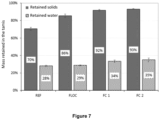
- Figure 7 shows the percentages of mass of solids and water retained in the tamis after gravity filtration for the four analyzed formulations.
- the reference composition presented the lowest retention of solids and water as expected.
- the composition with CF presented the highest retention of solids among all formulations, even without the addition of flocculant.
- the formulations with addition of CF were also able to slightly increase water retention in the tamis when compared to the other formulations. This result may still be beneficial in the next steps of the fiber cement process.
- a slightly higher water retention may result in a greater plasticity of the material, which may prevent the increase of tensions and formation of defects in the compression step of the fiber cement for forming the parts.
- Greater fibre cement plasticity can also reduce the energy expended in the compression process.
- the tests demonstrate a significant increase in the retention of solids (powder and fibers) in the tamis due to the incorporation of CF, even without the use of flocculant.
- the compositions with OF were also able to retain more water in the fiber cement, especially in the processed batch (with greater refinement).
Landscapes
- Chemical & Material Sciences (AREA)
- Engineering & Computer Science (AREA)
- Ceramic Engineering (AREA)
- Organic Chemistry (AREA)
- Materials Engineering (AREA)
- Structural Engineering (AREA)
- Chemical Kinetics & Catalysis (AREA)
- Inorganic Chemistry (AREA)
- Civil Engineering (AREA)
- Health & Medical Sciences (AREA)
- Medicinal Chemistry (AREA)
- Polymers & Plastics (AREA)
- Curing Cements, Concrete, And Artificial Stone (AREA)
- Artificial Filaments (AREA)
- Inorganic Fibers (AREA)
- Producing Shaped Articles From Materials (AREA)
- Press-Shaping Or Shaping Using Conveyers (AREA)
- Chemical Or Physical Treatment Of Fibers (AREA)
Applications Claiming Priority (2)
| Application Number | Priority Date | Filing Date | Title |
|---|---|---|---|
| BR102020016777A BR102020016777A2 (pt) | 2020-08-17 | 2020-08-17 | Método com alta capacidade de retenção de sólidos para produção de fibrocimento, uso e processo produtivo com alta capacidade de retenção de sólidos e artigo de fibrocimento |
| PCT/BR2021/050348 WO2022036429A1 (fr) | 2020-08-17 | 2021-08-17 | Méthode à haute capacité de rétention de solides pour la production de fibrociment, utilisation et procédé de production à haute capacité de rétention de solides et article de fibrociment |
Publications (2)
| Publication Number | Publication Date |
|---|---|
| EP4201909A1 true EP4201909A1 (fr) | 2023-06-28 |
| EP4201909A4 EP4201909A4 (fr) | 2024-09-25 |
Family
ID=80322306
Family Applications (1)
| Application Number | Title | Priority Date | Filing Date |
|---|---|---|---|
| EP21857065.3A Withdrawn EP4201909A4 (fr) | 2020-08-17 | 2021-08-17 | Méthode à haute capacité de rétention de solides pour la production de fibrociment, utilisation et procédé de production à haute capacité de rétention de solides et article de fibrociment |
Country Status (13)
| Country | Link |
|---|---|
| US (1) | US20230303437A1 (fr) |
| EP (1) | EP4201909A4 (fr) |
| JP (1) | JP2023538092A (fr) |
| CN (1) | CN116323513A (fr) |
| AR (1) | AR123262A1 (fr) |
| AU (1) | AU2021327091A1 (fr) |
| BR (1) | BR102020016777A2 (fr) |
| CA (1) | CA3192010A1 (fr) |
| CL (1) | CL2023000483A1 (fr) |
| MX (1) | MX2023002014A (fr) |
| PY (1) | PY2169130A (fr) |
| UY (1) | UY39387A (fr) |
| WO (1) | WO2022036429A1 (fr) |
Family Cites Families (18)
| Publication number | Priority date | Publication date | Assignee | Title |
|---|---|---|---|---|
| US3974024A (en) | 1973-03-23 | 1976-08-10 | Onoda Cement Company, Ltd. | Process for producing board of cement-like material reinforced by glass fiber |
| JPS5354219A (en) | 1976-10-28 | 1978-05-17 | Asahi Glass Co Ltd | Continuous process for production of f r c and apparatus therefor |
| DK572986D0 (da) * | 1986-11-28 | 1986-11-28 | Eternit Fab Dansk As | Fremgangsmaade til fremstilling af fiberforstaerkede formgenstande |
| ES2034551T3 (es) * | 1988-10-13 | 1993-04-01 | Polyfibre Sa | Material de construccion ligado hidraulicamente, reforzado con fibra. |
| GB9902632D0 (en) * | 1999-02-05 | 1999-03-31 | Unilever Plc | Hair treatment compositions |
| EP1044939B1 (fr) * | 1999-04-13 | 2011-08-17 | Redco S.A. | Produits façonnés en fibres-ciment et fibres de renforcement pour de tels produits et procédé de traitement de telles fibres |
| FR2812868B1 (fr) * | 2000-08-09 | 2003-03-07 | Rhodianyl | Materiau de construction comprenant un renfort fibreux ou filamentaire |
| JP5155512B2 (ja) * | 2000-10-04 | 2013-03-06 | ジェイムズ ハーディー テクノロジー リミテッド | 無機および/または有機物質が充填処理されたセルロース繊維を使用した繊維セメント複合材料 |
| BR0102548A (pt) * | 2001-03-27 | 2003-01-21 | Paulo Sergio Baptista De Souza | Nova composição (nc2) de fibras e materiais para utilização na fabricação de telhas onduladas de fibrocimento para coberturas residencial e industrial, composta de fibras vegetais e artificias/sintéticas: fibras celulósicas (com tratamento alcalino ar) + fibra de vidro (também com tratamento alcalino ar), com ou sem a fibra plástica de acetato de polivinila (pva), aglutinadas com cimento tipo portland, à composição pode-se acrescentar também cargas minerais, como o calcário, a argila e/ou caulim, as quais têm a finalidade de dar maior estabilidade à formulação, melhorando a performance do composto |
| BR0201204B1 (pt) * | 2002-04-02 | 2012-12-11 | processo de obtenção de telha de fibrocimento com reforço à base de polpa celulósica, por meio de sucção de água e prensagem, e produtos assim obtidos. | |
| BRPI0601990A (pt) * | 2006-05-10 | 2008-01-08 | Univ Sao Paulo | aperfeiçoamento introduzido em método para produzir mantas de fibrocimento com gradação funcional empregadas na fabricação de telhas e artigos congêneres, telhas e artigos congêneres produzidos com mantas de fibrocimento com gradação funcional e equipamento aperfeiçoado para produzir mantas de fibrocimento com gradação funcional empregadas na fabricação de telhas e artigos congêneres |
| US8273174B2 (en) * | 2008-12-31 | 2012-09-25 | Wyerhaeuser NR Company | Method of making a fiber cement board with improved properties and the product |
| WO2011157516A1 (fr) * | 2010-06-15 | 2011-12-22 | Redco S.A. | Fibres cellulosiques pour produits de ciment renforcés par fibres |
| WO2016015128A1 (fr) * | 2014-07-29 | 2016-02-04 | 161508 Canada Inc. | Système et procédé de moulage de pièces en fibres de ciment |
| US20160083808A1 (en) | 2014-09-22 | 2016-03-24 | The Research Foundation For The State University Of New York | Controlled flocculation of lignocellulosic hydrolyzates |
| CN107531910B (zh) * | 2015-05-01 | 2021-08-17 | Fp创新研究中心 | 干混可再分散纤维素长丝/载体产品及其制备方法 |
| EP3442484B1 (fr) * | 2016-04-11 | 2023-08-23 | The Regents of The University of Michigan | Endoprothèse lacrymale dotée d'une ouverture |
| WO2018209444A1 (fr) * | 2017-05-19 | 2018-11-22 | Fpinnovations | Panneau composite de ciment renforcé par des filaments de cellulose et son procédé de production |
-
2020
- 2020-08-17 BR BR102020016777A patent/BR102020016777A2/pt not_active Application Discontinuation
-
2021
- 2021-08-17 CA CA3192010A patent/CA3192010A1/fr active Pending
- 2021-08-17 AR ARP210102300A patent/AR123262A1/es unknown
- 2021-08-17 JP JP2023512204A patent/JP2023538092A/ja active Pending
- 2021-08-17 MX MX2023002014A patent/MX2023002014A/es unknown
- 2021-08-17 WO PCT/BR2021/050348 patent/WO2022036429A1/fr not_active Ceased
- 2021-08-17 CN CN202180050918.5A patent/CN116323513A/zh active Pending
- 2021-08-17 EP EP21857065.3A patent/EP4201909A4/fr not_active Withdrawn
- 2021-08-17 AU AU2021327091A patent/AU2021327091A1/en not_active Abandoned
- 2021-08-17 US US18/021,587 patent/US20230303437A1/en not_active Abandoned
- 2021-08-17 PY PY202102169130A patent/PY2169130A/es unknown
- 2021-08-17 UY UY0001039387A patent/UY39387A/es not_active Application Discontinuation
-
2023
- 2023-02-16 CL CL2023000483A patent/CL2023000483A1/es unknown
Also Published As
| Publication number | Publication date |
|---|---|
| CN116323513A (zh) | 2023-06-23 |
| AR123262A1 (es) | 2022-11-16 |
| CA3192010A1 (fr) | 2022-02-24 |
| PY2169130A (es) | 2022-05-04 |
| WO2022036429A1 (fr) | 2022-02-24 |
| JP2023538092A (ja) | 2023-09-06 |
| MX2023002014A (es) | 2023-04-28 |
| EP4201909A4 (fr) | 2024-09-25 |
| US20230303437A1 (en) | 2023-09-28 |
| BR102020016777A2 (pt) | 2021-10-05 |
| CL2023000483A1 (es) | 2024-04-05 |
| AU2021327091A1 (en) | 2023-05-04 |
| UY39387A (es) | 2022-02-25 |
Similar Documents
| Publication | Publication Date | Title |
|---|---|---|
| AU611933B2 (en) | Fibre composite materials | |
| CA2502147C (fr) | Procede de fabrication d'une plaque de platre legere | |
| FI69623B (fi) | Foerfarande foer framstaellning av en fiberfoerstaerkt asbestfri cementsammansaettning | |
| EP1992597B1 (fr) | Composition de fabrication d'un panneau de construction renforcé avec des fibres, et panneau ainsi obtenu | |
| SE449991B (sv) | Sett att framstella ett fiberforsterkt hydrauliskt hardnande material med ingen eller lag halt av asbest | |
| EP3523263B2 (fr) | Procédés de fabrication de produits en fibrociment séché à l'air | |
| JPWO2018003612A1 (ja) | 繊維補強炭酸化セメント成形物およびその製造方法 | |
| EP3523262B1 (fr) | Procédés de production de produits en fibrociment à partir de débris de fibrociment | |
| EP0047158B1 (fr) | Procédé pour la préparation d'articles façonnés qui sont renforcés par des fibres | |
| CN102617114A (zh) | 利用造纸白泥生产蒸压灰砂砖的方法 | |
| US20230303437A1 (en) | Method with high solid retention capacity for fiber cement production, use and production method with high solid retention capacity and fiber cement article | |
| JP5350060B2 (ja) | 木質セメント板及びその製造方法 | |
| JP7577246B1 (ja) | 水硬性組成物の硬化体 | |
| EP2540686A1 (fr) | Fibre pour ciment fibreux et produit résultant | |
| CA3064115A1 (fr) | Panneau composite de ciment renforce par des filaments de cellulose et son procede de production | |
| JP5350061B2 (ja) | 木質セメント板及びその製造方法 | |
| Farrag et al. | Black liquor waste produced from bagasse kraft pulping as an admixture in concrete | |
| CN115196934B (zh) | 一种钛石膏免烧砖及其制备工艺 | |
| Cordoba et al. | Optimizing the production and performance of MgO-based fiber cement using flocculant and recycled fibers | |
| CN110194637B (zh) | 纤维增强板材及其制备方法 | |
| WO2018065520A1 (fr) | Procédés de production de feuilles de fibrociment durcies à l'air | |
| JPH0459670A (ja) | 表面性状を改質した軽量成形体 | |
| JP2000006119A (ja) | 無機質板の製造方法 |
Legal Events
| Date | Code | Title | Description |
|---|---|---|---|
| STAA | Information on the status of an ep patent application or granted ep patent |
Free format text: STATUS: THE INTERNATIONAL PUBLICATION HAS BEEN MADE |
|
| PUAI | Public reference made under article 153(3) epc to a published international application that has entered the european phase |
Free format text: ORIGINAL CODE: 0009012 |
|
| STAA | Information on the status of an ep patent application or granted ep patent |
Free format text: STATUS: REQUEST FOR EXAMINATION WAS MADE |
|
| 17P | Request for examination filed |
Effective date: 20230313 |
|
| AK | Designated contracting states |
Kind code of ref document: A1 Designated state(s): AL AT BE BG CH CY CZ DE DK EE ES FI FR GB GR HR HU IE IS IT LI LT LU LV MC MK MT NL NO PL PT RO RS SE SI SK SM TR |
|
| DAV | Request for validation of the european patent (deleted) | ||
| DAX | Request for extension of the european patent (deleted) | ||
| REG | Reference to a national code |
Ref country code: DE Ref legal event code: R079 Free format text: PREVIOUS MAIN CLASS: C04B0016060000 Ipc: C04B0028020000 |
|
| A4 | Supplementary search report drawn up and despatched |
Effective date: 20240827 |
|
| RIC1 | Information provided on ipc code assigned before grant |
Ipc: B01D 21/00 20060101ALI20240821BHEP Ipc: C04B 28/04 20060101ALI20240821BHEP Ipc: C04B 28/02 20060101AFI20240821BHEP |
|
| STAA | Information on the status of an ep patent application or granted ep patent |
Free format text: STATUS: THE APPLICATION IS DEEMED TO BE WITHDRAWN |
|
| 18D | Application deemed to be withdrawn |
Effective date: 20260303 |