EP4203111A2 - Kathodensuspensionszusammensetzung für lithiumsekundärbatterie, kathode damit und lithiumsekundärbatterie - Google Patents
Kathodensuspensionszusammensetzung für lithiumsekundärbatterie, kathode damit und lithiumsekundärbatterie Download PDFInfo
- Publication number
- EP4203111A2 EP4203111A2 EP22838024.2A EP22838024A EP4203111A2 EP 4203111 A2 EP4203111 A2 EP 4203111A2 EP 22838024 A EP22838024 A EP 22838024A EP 4203111 A2 EP4203111 A2 EP 4203111A2
- Authority
- EP
- European Patent Office
- Prior art keywords
- positive electrode
- slurry composition
- secondary battery
- lithium secondary
- active material
- Prior art date
- Legal status (The legal status is an assumption and is not a legal conclusion. Google has not performed a legal analysis and makes no representation as to the accuracy of the status listed.)
- Pending
Links
Images

Classifications
-
- H—ELECTRICITY
- H01—ELECTRIC ELEMENTS
- H01M—PROCESSES OR MEANS, e.g. BATTERIES, FOR THE DIRECT CONVERSION OF CHEMICAL ENERGY INTO ELECTRICAL ENERGY
- H01M4/00—Electrodes
- H01M4/02—Electrodes composed of, or comprising, active material
- H01M4/62—Selection of inactive substances as ingredients for active masses, e.g. binders, fillers
- H01M4/624—Electric conductive fillers
-
- H—ELECTRICITY
- H01—ELECTRIC ELEMENTS
- H01M—PROCESSES OR MEANS, e.g. BATTERIES, FOR THE DIRECT CONVERSION OF CHEMICAL ENERGY INTO ELECTRICAL ENERGY
- H01M4/00—Electrodes
- H01M4/02—Electrodes composed of, or comprising, active material
- H01M4/62—Selection of inactive substances as ingredients for active masses, e.g. binders, fillers
-
- H—ELECTRICITY
- H01—ELECTRIC ELEMENTS
- H01M—PROCESSES OR MEANS, e.g. BATTERIES, FOR THE DIRECT CONVERSION OF CHEMICAL ENERGY INTO ELECTRICAL ENERGY
- H01M10/00—Secondary cells; Manufacture thereof
- H01M10/05—Accumulators with non-aqueous electrolyte
- H01M10/052—Li-accumulators
-
- H—ELECTRICITY
- H01—ELECTRIC ELEMENTS
- H01M—PROCESSES OR MEANS, e.g. BATTERIES, FOR THE DIRECT CONVERSION OF CHEMICAL ENERGY INTO ELECTRICAL ENERGY
- H01M4/00—Electrodes
- H01M4/02—Electrodes composed of, or comprising, active material
- H01M4/04—Processes of manufacture in general
-
- H—ELECTRICITY
- H01—ELECTRIC ELEMENTS
- H01M—PROCESSES OR MEANS, e.g. BATTERIES, FOR THE DIRECT CONVERSION OF CHEMICAL ENERGY INTO ELECTRICAL ENERGY
- H01M4/00—Electrodes
- H01M4/02—Electrodes composed of, or comprising, active material
- H01M4/04—Processes of manufacture in general
- H01M4/0402—Methods of deposition of the material
- H01M4/0404—Methods of deposition of the material by coating on electrode collectors
-
- H—ELECTRICITY
- H01—ELECTRIC ELEMENTS
- H01M—PROCESSES OR MEANS, e.g. BATTERIES, FOR THE DIRECT CONVERSION OF CHEMICAL ENERGY INTO ELECTRICAL ENERGY
- H01M4/00—Electrodes
- H01M4/02—Electrodes composed of, or comprising, active material
- H01M4/04—Processes of manufacture in general
- H01M4/043—Processes of manufacture in general involving compressing or compaction
- H01M4/0435—Rolling or calendering
-
- H—ELECTRICITY
- H01—ELECTRIC ELEMENTS
- H01M—PROCESSES OR MEANS, e.g. BATTERIES, FOR THE DIRECT CONVERSION OF CHEMICAL ENERGY INTO ELECTRICAL ENERGY
- H01M4/00—Electrodes
- H01M4/02—Electrodes composed of, or comprising, active material
- H01M4/13—Electrodes for accumulators with non-aqueous electrolyte, e.g. for lithium-accumulators; Processes of manufacture thereof
-
- H—ELECTRICITY
- H01—ELECTRIC ELEMENTS
- H01M—PROCESSES OR MEANS, e.g. BATTERIES, FOR THE DIRECT CONVERSION OF CHEMICAL ENERGY INTO ELECTRICAL ENERGY
- H01M4/00—Electrodes
- H01M4/02—Electrodes composed of, or comprising, active material
- H01M4/13—Electrodes for accumulators with non-aqueous electrolyte, e.g. for lithium-accumulators; Processes of manufacture thereof
- H01M4/136—Electrodes based on inorganic compounds other than oxides or hydroxides, e.g. sulfides, selenides, tellurides, halogenides or LiCoFy
-
- H—ELECTRICITY
- H01—ELECTRIC ELEMENTS
- H01M—PROCESSES OR MEANS, e.g. BATTERIES, FOR THE DIRECT CONVERSION OF CHEMICAL ENERGY INTO ELECTRICAL ENERGY
- H01M4/00—Electrodes
- H01M4/02—Electrodes composed of, or comprising, active material
- H01M4/13—Electrodes for accumulators with non-aqueous electrolyte, e.g. for lithium-accumulators; Processes of manufacture thereof
- H01M4/139—Processes of manufacture
-
- H—ELECTRICITY
- H01—ELECTRIC ELEMENTS
- H01M—PROCESSES OR MEANS, e.g. BATTERIES, FOR THE DIRECT CONVERSION OF CHEMICAL ENERGY INTO ELECTRICAL ENERGY
- H01M4/00—Electrodes
- H01M4/02—Electrodes composed of, or comprising, active material
- H01M4/13—Electrodes for accumulators with non-aqueous electrolyte, e.g. for lithium-accumulators; Processes of manufacture thereof
- H01M4/139—Processes of manufacture
- H01M4/1397—Processes of manufacture of electrodes based on inorganic compounds other than oxides or hydroxides, e.g. sulfides, selenides, tellurides, halogenides or LiCoFy
-
- H—ELECTRICITY
- H01—ELECTRIC ELEMENTS
- H01M—PROCESSES OR MEANS, e.g. BATTERIES, FOR THE DIRECT CONVERSION OF CHEMICAL ENERGY INTO ELECTRICAL ENERGY
- H01M4/00—Electrodes
- H01M4/02—Electrodes composed of, or comprising, active material
- H01M4/36—Selection of substances as active materials, active masses, active liquids
-
- H—ELECTRICITY
- H01—ELECTRIC ELEMENTS
- H01M—PROCESSES OR MEANS, e.g. BATTERIES, FOR THE DIRECT CONVERSION OF CHEMICAL ENERGY INTO ELECTRICAL ENERGY
- H01M4/00—Electrodes
- H01M4/02—Electrodes composed of, or comprising, active material
- H01M4/36—Selection of substances as active materials, active masses, active liquids
- H01M4/38—Selection of substances as active materials, active masses, active liquids of elements or alloys
-
- H—ELECTRICITY
- H01—ELECTRIC ELEMENTS
- H01M—PROCESSES OR MEANS, e.g. BATTERIES, FOR THE DIRECT CONVERSION OF CHEMICAL ENERGY INTO ELECTRICAL ENERGY
- H01M4/00—Electrodes
- H01M4/02—Electrodes composed of, or comprising, active material
- H01M4/36—Selection of substances as active materials, active masses, active liquids
- H01M4/38—Selection of substances as active materials, active masses, active liquids of elements or alloys
- H01M4/381—Alkaline or alkaline earth metals elements
- H01M4/382—Lithium
-
- H—ELECTRICITY
- H01—ELECTRIC ELEMENTS
- H01M—PROCESSES OR MEANS, e.g. BATTERIES, FOR THE DIRECT CONVERSION OF CHEMICAL ENERGY INTO ELECTRICAL ENERGY
- H01M4/00—Electrodes
- H01M4/02—Electrodes composed of, or comprising, active material
- H01M4/36—Selection of substances as active materials, active masses, active liquids
- H01M4/58—Selection of substances as active materials, active masses, active liquids of inorganic compounds other than oxides or hydroxides, e.g. sulfides, selenides, tellurides, halogenides or LiCoFy; of polyanionic structures, e.g. phosphates, silicates or borates
- H01M4/581—Chalcogenides or intercalation compounds thereof
- H01M4/5815—Sulfides
-
- H—ELECTRICITY
- H01—ELECTRIC ELEMENTS
- H01M—PROCESSES OR MEANS, e.g. BATTERIES, FOR THE DIRECT CONVERSION OF CHEMICAL ENERGY INTO ELECTRICAL ENERGY
- H01M4/00—Electrodes
- H01M4/02—Electrodes composed of, or comprising, active material
- H01M4/62—Selection of inactive substances as ingredients for active masses, e.g. binders, fillers
- H01M4/621—Binders
- H01M4/622—Binders being polymers
-
- H—ELECTRICITY
- H01—ELECTRIC ELEMENTS
- H01M—PROCESSES OR MEANS, e.g. BATTERIES, FOR THE DIRECT CONVERSION OF CHEMICAL ENERGY INTO ELECTRICAL ENERGY
- H01M4/00—Electrodes
- H01M4/02—Electrodes composed of, or comprising, active material
- H01M4/62—Selection of inactive substances as ingredients for active masses, e.g. binders, fillers
- H01M4/624—Electric conductive fillers
- H01M4/625—Carbon or graphite
-
- H—ELECTRICITY
- H01—ELECTRIC ELEMENTS
- H01M—PROCESSES OR MEANS, e.g. BATTERIES, FOR THE DIRECT CONVERSION OF CHEMICAL ENERGY INTO ELECTRICAL ENERGY
- H01M4/00—Electrodes
- H01M4/02—Electrodes composed of, or comprising, active material
- H01M2004/026—Electrodes composed of, or comprising, active material characterised by the polarity
- H01M2004/028—Positive electrodes
-
- Y—GENERAL TAGGING OF NEW TECHNOLOGICAL DEVELOPMENTS; GENERAL TAGGING OF CROSS-SECTIONAL TECHNOLOGIES SPANNING OVER SEVERAL SECTIONS OF THE IPC; TECHNICAL SUBJECTS COVERED BY FORMER USPC CROSS-REFERENCE ART COLLECTIONS [XRACs] AND DIGESTS
- Y02—TECHNOLOGIES OR APPLICATIONS FOR MITIGATION OR ADAPTATION AGAINST CLIMATE CHANGE
- Y02E—REDUCTION OF GREENHOUSE GAS [GHG] EMISSIONS, RELATED TO ENERGY GENERATION, TRANSMISSION OR DISTRIBUTION
- Y02E60/00—Enabling technologies; Technologies with a potential or indirect contribution to GHG emissions mitigation
- Y02E60/10—Energy storage using batteries
Definitions
- the present disclosure relates to a slurry composition for a positive electrode for a lithium secondary battery, and a positive electrode and a lithium secondary battery comprising the same.
- the lithium-sulfur secondary battery is a secondary battery which uses a sulfur-based compound having a sulfur-sulfur bond as a positive electrode active material and uses alkali metals such as lithium, or carbon-based materials where intercalation and deintercalation of metal ions such as lithium ions occur, or silicon or tin forming alloy with lithium, as a negative electrode active material.
- the lithium-sulfur secondary battery stores and generates electrical energy by using the oxidation-reduction reaction in which during the discharging which is a reduction reaction, the oxidation number of sulfur is reduced while sulfur-sulfur bonds are broken, and during the charging which is an oxidation reaction, the sulfur-sulfur bond is formed again while the oxidation number of sulfur is increased.
- the lithium-sulfur secondary battery is a battery capable of expressing high power and high energy density.
- sulfur since sulfur has the advantages of low cost, rich reserves, easy supply, and environmental friendliness, sulfur is attracting attention as an energy source for medium and large devices such as electric vehicles as well as portable electronic devices.
- sulfur Since sulfur has an electrical conductivity of 5 ⁇ 10 -30 S/cm, which is a nonconductor without electrical conductivity, there is a problem that the movement of electrons generated by the electrochemical reaction is difficult. Accordingly, sulfur is compounded with an electrically conductive material such as carbon that can provide an electrochemical reaction site, and the sulfur-carbon composite produced thereby is used.
- a method of manufacturing a positive electrode through a slurry process of preparing a slurry using the sulfur-carbon composite, an electrically conductive material, a binder, and a thickener, and then, applying the slurry to a current collector is generally used.
- carboxymethyl cellulose is contained as a binder in the preparation of the composition for the positive electrode, in order to provide an aqueous composition for a positive electrode to impart stable and flexible electrode plate characteristics.
- CMC carboxymethyl cellulose
- the slurry having low thixotropy does not spread properly when the coating rate is changed in the slurry coating process, so there is a problem that the positive electrode active material layer cannot be uniformly formed.
- Lei Qui et al. discloses a composition for a positive electrode for a lithium secondary battery comprising lithiated carboxymethyl cellulose (LiCMC) as a binder.
- LiCMC lithiated carboxymethyl cellulose
- thixotropy is also weak in the preparation of the slurry for the positive electrode, there is a problem that when the coating rate changes in the positive electrode active material layer coating process, since it cannot properly correspond to the composition for the positive electrode, the positive electrode active material layer cannot be uniformly formed.
- the inventors of the present disclosure have conducted various studies to solve the above problems, and as a result, have confirmed that if the slurry composition for a positive electrode for a lithium secondary battery is mixed with lithiated carboxymethyl cellulose (LiCMC), which is a thickener, and a succinimide-based compound, which is an additive, since the flowability of the slurry composition for the positive electrode is improved, a positive electrode active material layer having good quality can be formed even if the coating rate is changed in the coating process of the slurry composition for the positive electrode during the production of the positive electrode.
- LiCMC lithiated carboxymethyl cellulose
- a slurry composition for a positive electrode for a lithium secondary battery which has excellent flowability and can flexibly respond to variable process conditions when coating the slurry.
- the present disclosure provides a slurry composition for a positive electrode for a lithium secondary battery, the slurry composition comprising a positive electrode active material, an electrically conductive material, a binder, a thickener, an additive, and a solvent, wherein the thickener comprises lithiated carboxymethyl cellulose (LiCMC), and the additive comprises a succinimide-based compound.
- the thickener comprises lithiated carboxymethyl cellulose (LiCMC)
- the additive comprises a succinimide-based compound.
- the present disclosure also provides a positive electrode for a lithium secondary battery, the positive electrode comprising a positive electrode current collector, and a positive electrode active material layer formed on one surface of the positive electrode current collector, wherein the positive electrode active material layer is formed by the slurry composition for the positive electrode.
- the present disclosure also provides a method of manufacturing the positive electrode for the lithium secondary battery, comprising the steps of (S1) coating the slurry composition for the positive electrode on one surface of the positive electrode current collector to form a coating layer; (S2) drying the coating layer formed in step (S1); and (S3) rolling the coating layer to form a positive electrode active material layer.
- the present disclosure also provides a lithium secondary battery comprising the positive electrode described above, a negative electrode, a separator and an electrolyte.
- a positive electrode having a uniform positive electrode active material layer formed on the positive electrode current collector can be prepared by using the slurry composition for the positive electrode.
- the lithium secondary battery including the positive electrode prepared using the slurry composition for the positive electrode having good flowability exhibits improved charging/discharging performance.
- thixotropy refers to a property in which viscosity increases when no shear stress is applied to a material, and decreases when a shear stress is applied to the material.
- solid content refers to the positive electrode active material, the electrically conductive material, the binder, the thickener, and the additive collectively excluding the solvent in the slurry composition for the positive electrode for the lithium secondary battery.
- the present disclosure relates to a slurry composition for a positive electrode having flowability enough to flexibly respond to a coating rate changing in a coating process for forming a positive electrode active material layer when manufacturing a positive electrode for a lithium secondary battery.
- the term "response" means that when the coating rate is increased, since the shear stress applied to the slurry composition for the positive electrode between the current collector on which the coating material is coated and the coating bar is increased, the viscosity of the slurry composition for the positive electrode is reduced, so that it is uniformly coated according to the fast coating rate; and when the coating rate is reduced, since the shear stress applied to the slurry composition for the positive electrode between the current collector and the coating bar is reduced, the viscosity of the slurry composition for the positive electrode is increased, so that it is uniformly coated according to the slow coating rate.
- the slurry composition for the positive electrode for the lithium secondary battery comprises a positive electrode active material, an electrically conductive material, a binder, a thickener, an additive, and a solvent, wherein the thickener comprises lithiated carboxymethyl cellulose (LiCMC), and the additive comprises a succinimide-based compound.
- the thickener comprises lithiated carboxymethyl cellulose (LiCMC)
- the additive comprises a succinimide-based compound.
- the slurry composition for the positive electrode for the lithium secondary battery contains a succinimide-based compound as an additive, it exhibits improved thixotropy and improved storage properties.
- the slurry having the increased thixotropy the ability to maintain viscosity even during storage without shear stress is increased, so that there is little change in the composition of the upper and lower portions in the slurry over time, thereby improving storage properties. If there is a change in the composition of the upper and lower parts of the slurry, the internal composition of the slurry is different during coating of the slurry, and thus a coating layer having a non-uniform composition may be formed.
- the positive electrode active material may comprise one or more selected from the group consisting of elemental sulfur (S 8 ), Li 2 S n (n ⁇ 1, n is an integer), organic sulfur compound and carbon-sulfur polymer [(C 2 S x ) n , 2.5 ⁇ x ⁇ 50, n ⁇ 2, x and n are integers].
- the positive electrode active material may comprise elemental sulfur.
- the positive electrode active material may be a sulfur/carbon composite, and the sulfur/carbon composite may be a S/CNT composite obtained using sulfur (S) and carbon nanotube (CNT).
- the positive electrode active material may be contained in an amount of 60% by weight to 97% by weight based on the total weight of the solid content of the slurry composition for the positive electrode.
- the content of the positive electrode active material may be 60% by weight or more, 70% by weight or more, or 80% by weight or more, and 91% by weight or less, 93% by weight or less, or 97% by weight or less. If the content of the positive electrode active material is less than 60% by weight, the battery capacity of the entire cell may be reduced.
- the content of the positive electrode active material exceeds 97% by weight, the content of one or more of the electrically conductive materials, the binder, the thickener, and the additive excluding the positive electrode active material is relatively lowered, so that flowability, conductivity, or physical properties of the slurry composition for the positive electrode may be reduced.
- the electrically conductive material is for improving electrical conductivity, and is not particularly limited as long as it is an electrically conductive material that does not cause chemical change in a lithium secondary battery.
- the electrically conductive material may comprise one or more selected from the group consisting of carbon black, graphite, carbon fiber, carbon nanotube, metal powders, electrically conductive metal oxides, and organic electrically-conductive materials.
- the carbon black may comprise one or more selected from the group consisting of ketjen black, super P, denka black, acetylene black, and furnace black.
- the electrically conductive material may be contained in an amount of 0.01 to 30% by weight based on the total weight of the solid content of the slurry composition for the positive electrode. Specifically, the content of the electrically conductive material may be 0.01% by weight or more, 2% by weight or more, or 4% by weight or more, and 10% by weight or less, 20% by weight or less, or 30% by weight or less. If the content of the electrically conductive material is less than 0.01% by weight, the conductivity of the positive electrode may be reduced. If the content of the electrically conductive material exceeds 30% by weight, the flexibility of the positive electrode may be reduced.
- the binder maintains the positive electrode active material in the positive electrode current collector, and organically connects between the positive electrode active materials to increase the bonding force between them, and any binder known in the art may be used.
- the binder may be fluororesin-based binders comprising polyvinylidene fluoride (PVdF) and/or polytetrafluoroethylene (PTFE); rubber-based binders comprising one or more of styrene butadiene rubber (SBR), acrylonitrile-butadiene rubber, and styrene-isoprene rubber; cellulose-based binders comprising one or more of carboxymethylcellulose (CMC), starch, hydroxypropylcellulose, and regenerated cellulose; polyalcohol-based binders; polyolefin-based binders comprising one or more of polyethylene and polypropylene; polyimide-based binders; polyester-based binders; acrylic binders comprising an acrylic monomers; and silane-based binders, or mixtures or copolymers of two or more thereof.
- the binder may preferably be a combination of a rubber-based binder.
- the binder may be an emulsion type binder.
- the form of the binder for the positive electrode may be used in the form of a linear polymer as long as it can bind the components in the positive electrode, and is not particularly limited.
- the emulsion-type binder is used, the components for the positive electrode can be most effectively combined in the form of dots and dots, and the adhesive strength is also good.
- the emulsion-type binder is used, there is an effect of increasing the solid content in the slurry compared to the binder in the form of a linear polymer.
- the binder may be contained in an amount of 0.01 to 30% by weight based on the total weight of the solid content of the slurry composition for the positive electrode.
- the content of the binder may be 0.01% by weight or more, 1% by weight or more, or 2% by weight or more, and 10% by weight or less, 20% by weight or less, or 30% by weight or less. If the content of the binder is less than 0.01% by weight, the physical properties such as adhesive strength of the positive electrode may be degraded and thus the positive electrode active material and conductive material may be eliminated. If the content of the binder exceeds 30% by weight, the ratio of the positive electrode active material and the electrically conductive material is relatively reduced and thus the capacity of the battery can be reduced.
- the thickener can secure the stability of the slurry composition for the positive electrode by imparting appropriate viscosity to the slurry composition for the positive electrode and can improve the surface defect by alleviating the re-aggregation phenomenon between solid contents when the slurry composition for the positive electrode is coated on the positive electrode current collector.
- the thickener may comprise lithiated carboxymethyl cellulose (LiCMC).
- LiCMC lithiated carboxymethyl cellulose
- the LiCMC may be represented by the following Formula 1: wherein R is H or CH 2 COOH, and n is 25 to 2000.
- the LiCMC is obtained by substituting Li for metal ions of the conventional CMC.
- Metal ions comprised in the conventional CMC may act as impurities inside the cell, thereby degrading the cell's performance, whereas LiCMC excludes impurities inside the cell and contains lithium ions, so that degradation of cell's performance due to impurities may be minimized.
- the LiCMC is used together with a succinimide-based compound, it is possible to change the internal interaction (hydrogen bonding) of the slurry and thus improve the thixotropy corresponding to the shear stress.
- the thixotropy of the slurry may increase due to the interaction by hydrogen bonding between the functional group of LiCMC (-OCH 2 COO- or -OR) and the internal functional group of the succinimide-based compound (N-hydroxyl & carbonyl group), thereby improving the storability of the slurry.
- the thickener may be contained in an amount of 0.5% by weight to 5% by weight based on the total weight of the solid content of the slurry composition for the positive electrode.
- the content of the thickener may be 0.5% by weight or more, 0.8% by weight or more, or 1% by weight or more, and 2% by weight or less, 3% by weight or less, or 5% by weight or less. If the content of the thickener is less than 0.5 % by weight, since the viscosity of the slurry composition for the positive electrode is low and flows down like water, it is impossible to coat the slurry composition for the positive electrode on the positive electrode current collector. If the content of the thickener exceeds 5% by weight, it may be difficult to form a uniform coating layer because it has high viscosity and is stiff.
- the viscosity of the slurry composition for the positive electrode is not particularly limited, and the viscosity may vary depending on the content of the thickener, but considering the phase stability of the slurry composition for the positive electrode and the ease of the coating process, the viscosity may be at least 1000 cP or at least 4500 cP at 25°C.
- the additive may allow to have thixotropy to cope with variable coating rates in the coating process of coating the slurry composition for the positive electrode on the positive electrode current collector during the production of the positive electrode.
- the additive comprises a succinimide-based compound
- the succinimide-based compound may comprise one or more selected from the group consisting of N-hydroxylsuccinimide (NHS), N-(2-hydroxyethyl)succinimide, N-succinimidyl acetate, N-succinimidyl methacrylate, N-succinimidyl acrylate, succinimide and ethosuximide.
- the solid content in the slurry is increased, so that it may be easy to control thixotropy.
- the succinimide-based compound is used as an additive in addition to the existing components to prepare the slurry, the effect of increasing the solid content is good, so it may be easy to control the thixotropy of the slurry.
- the additive may be contained in an amount of 0.01% by weight to 5% by weight based on the total weight of the solid content of the slurry composition for the positive electrode.
- the content of the additive may be 0.01% by weight or more, 0.1% by weight or more, or 0.3% by weight or more, and 1.5% by weight or less, 3% by weight or less, or 5% by weight or less. If the content of the additive is less than 0.01% by weight, the slurry composition for the positive electrode has poor thixotropy, so it may be difficult to form a coating layer having a uniform thickness when the coating rate is changed during the coating process. If the content of the additive exceeds 5% by weight, the content of the LiCMC thickener is relatively reduced, and the slurry composition for the positive electrode has poor stability, which may cause cracks after the formation of the coating layer.
- the solvent may be used without particular limitation as long as it can be mixed with the positive electrode active material, the electrically conductive material, the binder, the thickener and the additive as described above to form the slurry composition for the positive electrode.
- the solvent may comprise an organic solvent and/or an aqueous solvent.
- the organic solvent may comprise one or more selected from the group consisting of N-methyl-2-pyrrolidone (NMP), methoxy propyl acetate, butyl acetate, glycol acid, butyl ester, butyl glycol, methyl alkyl polysiloxane, alkylbenzene, propylene glycol, xylene, monophenyl glycol, aralkyl modified methyl alkyl polysiloxane, polyether modified dimethyl polysiloxane copolymer, polyether-modified dimethyl polysiloxane copolymer, polyacrylate, alkylbenzene, diisobutylketone, organically modified polysiloxane, butanol, isobutanol, modified polyacrylate, modified polyurethane, and polysiloxane modified polymer.
- the aqueous solvent may comprise water.
- the solvent may be 55 to 70% by weight based on the total weight of the slurry composition for the positive electrode.
- the content of the solvent may be 55% by weight or more or 57% by weight or more, and 65% by weight or less, 67% by weight or less, or 70% by weight or less. If the content of the solvent is less than 55% by weight, since the concentration of the slurry composition for the positive electrode becomes excessively high and stiff, it may be difficult to uniformly coat the slurry composition for the positive electrode on the positive electrode current collector.
- the content of the solvent exceeds 70% by weight, since the concentration of the slurry composition for the positive electrode is excessively low and flows down, it may be difficult to control the slurry composition for the positive electrode in the coating process, and it may take a long time to dry after forming the coating layer.
- the slurry composition for the positive electrode has thixotropy, which is a property of increasing viscosity when shear stress is not applied and decreasing viscosity when shear stress is applied.
- thixotropy was defined using the viscosity of the slurry composition for the positive electrode at a rotation speed of 10 rpm versus the viscosity of the slurry composition for the positive electrode at a rotation speed of 1 rpm, as shown in Equation 1 above.
- the rotation speed is 1 rpm
- the shear rate is 0.29/s
- the shear rate is 2.9/s.
- the thixotropic index (T) is less than 0.1, since the viscosity at high rotation speed compared to low rotation speed is very low, when the coating rate is changed in the process of coating the slurry composition for the positive electrode on the positive electrode current collector, the effective coating rate is limited. If the thixotropic index (T) exceeds 0.4, even if the coating rate is changed, the viscosity change is not large, so it may be difficult to respond to the slurry.
- the thixotropic index (T) may be 0.1 or more, 1.5 or more, or 2.0 or more, and 3.0 or less, 3.5 or less, or 4.0 or less.
- the present disclosure also relates to a method for preparing a slurry composition for a positive electrode for a lithium secondary battery.
- the types and weights of materials used in the preparation of the slurry composition for the positive electrode are as described above.
- the slurry composition for the positive electrode may be prepared by adding the positive electrode active material, the electrically conductive material, the binder, the thickener, and the additive as described above to the solvent and mixing them.
- the mixing may be carried out by milling, but is not particularly limited as long as it is a mixing method used for forming a slurry in the art.
- the milling may be bead milling, roll milling, ball milling, attrition milling, planetary milling, jet milling, or screw mixing milling.
- the bead milling can be applied in consideration of the uniform mixing and dispersibility of the components comprised in the slurry composition for the positive electrode.
- the present disclosure also provides a positive electrode for a lithium secondary battery, the positive electrode comprising a positive electrode current collector, and a positive electrode active material layer formed on one surface of the positive electrode current collector, wherein the positive electrode active material layer comprises a positive electrode active material, a binder, an electrically conductive material, a thickener and an additive.
- the positive electrode current collector is not particularly limited as long as it has conductivity without causing a chemical change in the battery and can be used electrochemically and stably at the charging voltage of the positive electrode.
- the positive electrode current collector may be one or more selected from the group consisting of copper, aluminum, stainless steel, titanium, silver, palladium, nickel, alloys thereof, and combinations thereof.
- the stainless steel may be surface-treated with carbon, nickel, titanium, or silver.
- the shape of the positive electrode current collector is not particularly limited, and may be in the form of film, sheet, foil, net, porous body, foam, or nonwoven fabric. If necessary, fine irregularities may be formed on the surface of the positive electrode current collector, and the irregularities may help to improve the adhesive force with the positive electrode active material layer.
- the method of forming the irregularities on the surface of the positive electrode current collector is not particularly limited, and, for example, a known method such as a mechanical polishing method, an electrolytic polishing method, or a chemical polishing method may be applied.
- the thickness of the positive electrode current collector is not particularly limited, and may be set in an appropriate range in consideration of the mechanical strength or productivity of the positive electrode, or the capacity of the battery.
- the thickness of the positive electrode current collector may be typically 3 ⁇ m to 500 ⁇ m.
- the positive electrode active material layer is formed by the slurry composition for the positive electrode as described above, and may comprise a positive electrode active material, a binder, an electrically conductive material, a thickener, and an additive.
- a positive electrode active material may comprise a positive electrode active material, a binder, an electrically conductive material, a thickener, and an additive.
- the types and contents of the positive electrode active material, the binder, the electrically conductive material, the thickener, and the additive are as described above.
- the thickness of the positive electrode active material layer is not particularly limited, and may be set in an appropriate range in consideration of the mechanical strength of the positive electrode, the loading amount, or the capacity of the battery.
- the thickness of the positive electrode active material layer may be typically 30 ⁇ m to 300 ⁇ m.
- the present disclosure also relates to a method for manufacturing a positive electrode for a lithium secondary battery, which comprises the steps of (S1) coating the slurry composition for the positive electrode on one surface of the positive electrode current collector to form a coating layer; (S2) drying the coating layer formed in step (S1); and (S3) rolling the coating layer to form a positive electrode active material layer.
- a coating layer may be formed by coating the slurry composition for the positive electrode on one surface of the positive electrode current collector.
- the positive electrode current collector and the slurry composition for the positive electrode are the same as described above.
- a method of the coating is not particularly limited as long as it is capable of coating the slurry.
- the coating may be performed by one or more selected from the group consisting of a roll-to-roll coating method, a spin coating method, a nozzle printing method, an inkjet printing method, a slot coating method, and a dip coating method, and preferably a roll-to-roll coating method.
- the coating rate may be variable. Depending on the coating conditions, the coating rate can be varied to establish optimized drying conditions.
- the coating rate is variable because the solvent drying speed is different depending on the properties of the slurry composition for the positive electrode in the process of applying the slurry composition for the positive electrode to the current collector and drying it.
- step (S2) the coating layer formed in step (S1) may be dried.
- the solvent contained in the slurry composition for the positive electrode may evaporate to form a layer-type coating layer.
- the drying temperature may be 30 °C or more, 40 °C or more, or 45 °C or more, and 60 °C or less, 70 °C or less, or 80 °C or less so that a good-quality positive electrode active material layer can be formed.
- step (S3) the coating layer formed in step (S2) may be rolled to form a positive electrode active material layer.
- the rolling a conventional rolling process used in the art may be introduced, and the rolling may be performed using a roll press.
- the rolling using the roll press may be performed by applying pressure to the positive electrode current collector having the coating layer formed thereon with the roll, in a state where two rolls are placed on the top and bottom of the positive electrode current collector on which the coating layer is formed, and simultaneously moving the positive electrode current collector having the coating layer formed thereon in a horizontal direction.
- the present disclosure also relates to a lithium secondary battery comprising a positive electrode, a negative electrode, a separator and an electrolyte solution.
- the structure, constituent materials, and manufacturing method of the positive electrode are as described above.
- the negative electrode may comprise a negative electrode current collector and a negative electrode active material layer formed on the negative electrode current collector.
- the negative electrode active material layer e.g., lithium foil
- the negative electrode active material layer may be used alone.
- the negative electrode current collector is not particularly limited as long as it has electrical conductivity without causing a chemical change in the relevant battery.
- copper, stainless steel, aluminum, nickel, titanium, sintered carbon, copper or stainless steel surface-treated with carbon, nickel, titanium, silver or the like; aluminum-cadmium alloy or the like may be used as the negative electrode current collector.
- the shape of the negative electrode current collector can be various forms such as a film having fine irregularities on its surface, sheet, foil, net, porous body, foam, nonwoven fabric and the like.
- the negative electrode active material may comprises, but is not limited to, one or more carbon-based materials selected from the group consisting of crystalline artificial graphite, crystalline natural graphite, amorphous hard carbon, low crystalline soft carbon, carbon black, acetylene black, Ketjen black, Super-P, graphene, and fibrous carbon, Si-based material, metal composite oxides such as LixFe 2 O 3 (0 ⁇ x ⁇ 1), Li x WO 2 (0 ⁇ x ⁇ 1), Sn x Me 1-x Me' y O z (Me: Mn, Fe, Pb, Ge; Me': Al, B, P, Si, elements of groups 1, 2, and 3 of the periodic table, halogen; 0 ⁇ x ⁇ 1; 1 ⁇ y ⁇ 3; 1 ⁇ z ⁇ 8); lithium metal; lithium alloy; silicon-based alloy; tin-based alloy; metal oxide such as SnO, SnO 2 , PbO, PbO 2 , Pb 2 O 3 , Pb 3 O 4 , Sb
- the negative electrode active material may be metal composite oxides such as Sn x Me 2-x Me' y O z (Me: Mn, Fe, Pb, Ge; Me': Al, B, P, Si, elements of groups 1, 2, and 3 of the periodic table, halogen; 0 ⁇ x ⁇ 1; 1 ⁇ y ⁇ 3; 1 ⁇ z ⁇ 8); oxides such as SnO, SnO 2 , PbO, PbO 2 , Pb 2 O 3 , Pb 3 O 4 , Sb 2 O 3 , Sb 2 O 4 , Sb 2 O 5 , GeO, GeO 2 , Bi 2 O 3 , Bi 2 O 4 and Bi 2 O 3 , and carbon-based negative electrode active materials such as crystalline carbon, amorphous carbon, or carbon composite may be used alone or in combination of two or more thereof.
- metal composite oxides such as Sn x Me 2-x Me' y O z (Me: Mn, Fe, Pb, Ge; Me': Al, B, P, Si,
- any of those commonly used for manufacturing a lithium secondary battery may be used.
- Lithium salts that may be contained as electrolytes in the electrolyte solution may be used without limitation as long as they are commonly used in the electrolyte solution for a lithium secondary battery.
- the anion of the lithium salt may be any one selected from the group consisting of F - , Cl - , Br - , I - , NO 3 - , N(CN) 2 - , BF 4 - , ClO 4 - , PF 6 - , (CF 3 ) 2 PF 4 - , (CF 3 ) 3 PF 3 - , (CF 3 ) 4 PF 2 - , (CF 3 ) 5 PF - , (CF 3 ) 6 P - , CF 3 SO 3 - , CF 3 CF 2 SO 3 - , (CF 3 SO 2 ) 2 N - , (FSO 2 ) 2 N - , CF 3 CF 2 (CF 3 ) 2 CO - , (CF 3 SO 2 )
- the organic solvent comprised in the electrolyte solution may be used without limitation as long as it is commonly used in the electrolyte solution for a lithium secondary battery.
- the organic solvent may be a carbonate-based, ester-based, ether-based, ketone-based, alcohol-based or aprotic solvent.
- an ether-based solvent may be typically used.
- the carbonate-based solvent may specifically comprise dimethyl carbonate (DMC), diethyl carbonate (DEC), dipropyl carbonate (DPC), methyl propyl carbonate (MPC), ethyl propyl carbonate (EPC), methyl ethyl carbonate (MEC), ethylene carbonate (EC), propylene carbonate (PC), butylene carbonate (BC), or the like.
- DMC dimethyl carbonate
- DEC diethyl carbonate
- DPC dipropyl carbonate
- MPC methyl propyl carbonate
- EPC ethyl propyl carbonate
- MEC methyl ethyl carbonate
- EC ethylene carbonate
- PC propylene carbonate
- BC butylene carbonate
- the ester-based solvent may specifically comprise methyl acetate, ethyl acetate, n-propyl acetate, 1,1-dimethylethyl acetate, methylpropionate, ethylpropionate, ⁇ -butyrolactone, decanolide, valerolactone, mevalonolactone, carprolactone or the like.
- the ether-based solvent may specifically comprise dimethyl ether, diethyl ether, dipropyl ether, methylethyl ether, methylpropyl ether, ethylpropyl ether, dimethoxyethane, diethoxyethane, methoxyethoxyethane, diethylene glycol dimethyl ether, diethylene glycol diethyl ether, diethylene glycol methylethyl ether, triethylene glycol dimethyl ether, triethylene glycol diethyl ether, triethylene glycol methylethyl ether, tetraethylene glycol dimethyl ether, tetraethylene glycol diethyl ether, tetraethylene glycol methylethyl ether, polyethylene glycol dimethyl ether, polyethylene glycol diethyl ether, polyethylene glycol methylethyl ether, diglyme, triglyme, tetraglyme, tetrahydrofuran, 2-methyltetrahydr
- the ketone-based solvent may specifically comprise cyclohexanone or the like.
- the alcohol-based solvent may specifically comprise ethyl alcohol, isopropyl alcohol, and the like.
- the aprotic solvent may comprise nitriles such as acetonitrile, amides such as dimethylformamide, dioxolanes such as 1,3-dioxolane (DOL), or sulfolane.
- the non-aqueous organic solvent may be used alone or as a mixture of one or more solvents, and when one or more solvents are mixed and used, the mixing ratio may be appropriately adjusted according to the desired performance of the battery.
- the separator may be a conventional porous polymer film used as a separator in the art.
- the separator may be a single porous polymer film made of a polyolefin-based polymer such as polyethylene, polypropylene, ethylene/butene copolymer, ethylene/hexene copolymer, and ethylene/methacrylate copolymer, or a laminate thereof, or may be a conventional porous nonwoven fabric, for example, a nonwoven fabric made of high melting point glass fiber, polyethylene terephthalate fiber, etc., but is not limited thereto.
- the shape of the battery is not particularly limited and may be, for example, a jelly-roll type, a stack type, a stack-folding type (including a stack-Z-folding type), or a lamination-stack type, preferably a stack-folding type.
- the lithium secondary battery is manufactured by sequentially stacking the negative electrode, the separator, and the positive electrode, injecting an electrolyte solution to prepare an electrode assembly, and then putting it in a battery case, and then sealing it with a cap plate and a gasket and assembling it.
- the lithium secondary battery can be classified into various types of batteries such as lithium-sulfur secondary battery, lithium-air battery, lithium-oxide battery, and lithium all-solid-state battery depending on the materials of positive electrode/negative electrode used, can be classified into cylindrical, rectangular, coin-shaped, pouch type depending on the type, and can be divided into bulk type and thin film type depending on the size.
- batteries such as lithium-sulfur secondary battery, lithium-air battery, lithium-oxide battery, and lithium all-solid-state battery depending on the materials of positive electrode/negative electrode used
- the lithium secondary battery can be classified into cylindrical, rectangular, coin-shaped, pouch type depending on the type, and can be divided into bulk type and thin film type depending on the size.
- the structure and preparation method of these batteries are well known in the art, and thus detailed description thereof is omitted.
- the lithium secondary battery may be a lithium-sulfur secondary battery using a positive electrode material comprising a sulfur-carbon composite as a positive electrode.
- the lithium-sulfur secondary battery may use lithium metal as a negative electrode active material.
- an oxidation reaction of lithium occurs at the negative electrode and a reduction reaction of sulfur occurs at the positive electrode.
- the reduced sulfur is combined with lithium ions moved from the negative electrode, and thus is converted into lithium polysulfide, and is finally accompanied by a reaction to form lithium sulfide.
- the present disclosure relates to a battery module comprising the lithium secondary battery, and the battery module can be used as a power source for devices requiring high capacity and high rate characteristics, etc.
- the device may comprise, but are not limited to, a power tool that is powered by a battery powered motor; electric cars including an electric vehicle (EV), a hybrid electric vehicle (HEV), a plug-in hybrid electric vehicle (PHEV), and the like; an electric motorcycle including an electric bike (E-bike) and an electric scooter (E-scooter); an electric golf cart; and a power storage system.
- a positive electrode active material, an electrically conductive material, a binder, a thickener, and an additive were mixed in a weight ratio of 92:5:2:0.7:0.3 to obtain a mixture.
- the positive electrode active material was a S/CNT composite obtained by mixing sulfur (S, manufactured by Sigma-Aldrich) with Carbon Nanotube (CNT) using a ball mill and then heat-treating at 155°C, the electrically conductive material was Denka black, the binder was styrene-butadiene rubber (SBR), the thickener was LiCMC (LiCMC1000, GLchem), and the additive was hydroxysuccinimide (NHS).
- the slurry composition for the positive electrode was coated on one surface of the positive electrode current collector of aluminum foil (Al foil) having a thickness of 12 ⁇ m, and then dried at 50°C for 2 hours and rolled to form a positive electrode with a positive electrode active material layer.
- Al foil aluminum foil
- a separator of porous polyethylene having a thickness of 20 ⁇ m and a porosity of 45% is put between the positive electrode and the lithium negative electrode, and these are placed inside the case, and then, an electrolyte was injected into the case to manufacture a lithium-sulfur secondary battery in the form of a CR-2032 coin cell.
- DOL 1,3-dioxolane
- DME 1,2-dimethoxyethane
- a slurry composition for a positive electrode, a positive electrode, and a lithium-sulfur secondary battery were prepared in the same manner as in Example 1, except that the additive is not used, and the positive electrode active material, the electrically conductive material, the binder and the thickener are mixed in a weight ratio of 92:5:2:1.
- the method for measuring the viscosity, the method for calculating the thixotropic index, and the method for measuring the rheological property are as described below.
- Thixotropic index T Viscosity of slurry composition for positive electrode at rotation speed of 10 rpm / Viscosity of slurry composition for positive electrode at rotation speed of 1 rpm , wherein the above viscosity is measured at 25°C.
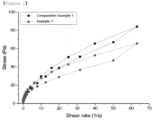
- Example 1 is the slurry composition for the positive electrode containing an appropriate amount of NHS as an additive, has a high viscosity, and has a low thixotropic index value compared to Comparative Example 1, and thus has high thixotropic property.
- Comparative Example 1 is the slurry composition for the positive electrode that does not contain an additive, and Comparative Example 1 has a viscosity required to form the slurry, but has low ability to respond to changes in shear stress.
- FIG. 1 is a graph showing the change in shear stress depending on the shear rate of the slurry composition for the positive electrode of Example 1 and Comparative Example 1.
- Example 1 has excellent thixotropic property.
- FIG. 2 is a graph showing charging/discharging characteristics of the lithium-sulfur secondary batteries of Example 1 and Comparative Example 1.
- the lithium-sulfur battery of Example 1 showed an initial discharging capacity of 1105 mAh/g, which was higher than the discharging capacity of Comparative Example 1 of 1080 mAh/g, and exhibited lifetime performance of maintaining a discharging capacity of 800 mAh/g or more for 100 cycles or more. This is the same or superior performance to the maintenance of the discharging capacity of the lithium-sulfur battery of Comparative Example 1 without the additive.
Landscapes
- Chemical & Material Sciences (AREA)
- Chemical Kinetics & Catalysis (AREA)
- Electrochemistry (AREA)
- General Chemical & Material Sciences (AREA)
- Engineering & Computer Science (AREA)
- Manufacturing & Machinery (AREA)
- Materials Engineering (AREA)
- Inorganic Chemistry (AREA)
- Battery Electrode And Active Subsutance (AREA)
- Secondary Cells (AREA)
Applications Claiming Priority (2)
| Application Number | Priority Date | Filing Date | Title |
|---|---|---|---|
| KR1020210089726A KR20230009097A (ko) | 2021-07-08 | 2021-07-08 | 리튬 이차전지용 양극 슬러리 조성물, 양극 및 이를 포함하는 리튬 이차전지 |
| PCT/KR2022/009875 WO2023282672A2 (ko) | 2021-07-08 | 2022-07-07 | 리튬 이차전지용 양극 슬러리 조성물, 이를 포함하는 양극 및 리튬 이차전지 |
Publications (2)
| Publication Number | Publication Date |
|---|---|
| EP4203111A2 true EP4203111A2 (de) | 2023-06-28 |
| EP4203111A4 EP4203111A4 (de) | 2025-02-12 |
Family
ID=84801963
Family Applications (1)
| Application Number | Title | Priority Date | Filing Date |
|---|---|---|---|
| EP22838024.2A Pending EP4203111A4 (de) | 2021-07-08 | 2022-07-07 | Kathodensuspensionszusammensetzung für lithiumsekundärbatterie, kathode damit und lithiumsekundärbatterie |
Country Status (6)
| Country | Link |
|---|---|
| US (1) | US20230378472A1 (de) |
| EP (1) | EP4203111A4 (de) |
| JP (1) | JP7600402B2 (de) |
| KR (1) | KR20230009097A (de) |
| CN (1) | CN116325208A (de) |
| WO (1) | WO2023282672A2 (de) |
Family Cites Families (13)
| Publication number | Priority date | Publication date | Assignee | Title |
|---|---|---|---|---|
| JP4590685B2 (ja) * | 2000-05-10 | 2010-12-01 | 三菱化学株式会社 | リチウム二次電池用正極材料、リチウム二次電池用正極及びリチウム二次電池 |
| US6605385B2 (en) * | 2001-03-22 | 2003-08-12 | Wilson Greatbatch Ltd. | Electrochemical cell having an electrode with a carbonate additive in the electrode active mixture |
| US20030008209A1 (en) * | 2001-06-22 | 2003-01-09 | Marufur Rahim | Cathode coating dispersion |
| CN102044675A (zh) * | 2009-10-23 | 2011-05-04 | 深圳市比克电池有限公司 | 锂电池正极浆料添加剂、浆料、电池及制备方法 |
| KR101593314B1 (ko) * | 2013-07-26 | 2016-02-11 | 주식회사 엘지화학 | 이차전지용 전극 바인더 및 이를 포함하는 이차전지용 전극 |
| CN105637683A (zh) * | 2013-10-28 | 2016-06-01 | 日本瑞翁株式会社 | 锂离子二次电池负极用浆料组合物、锂离子二次电池用负极、以及锂离子二次电池 |
| KR102311509B1 (ko) | 2014-12-12 | 2021-10-08 | 삼성에스디아이 주식회사 | 리튬 이차 전지용 양극 조성물, 그리고 이를 포함하는 리튬 이차 전지용 양극 및 리튬 이차 전지 |
| TWI629819B (zh) * | 2016-01-22 | 2018-07-11 | 旭化成股份有限公司 | Non-aqueous lithium storage element |
| KR20190106638A (ko) * | 2018-03-09 | 2019-09-18 | 주식회사 엘지화학 | 리튬 이차전지 |
| KR102590174B1 (ko) * | 2018-05-23 | 2023-10-16 | 주식회사 엘지에너지솔루션 | 리튬-황 이차전지용 바인더 및 이를 포함하는 리튬-황 이차전지 |
| WO2020100926A1 (ja) | 2018-11-13 | 2020-05-22 | 大日本印刷株式会社 | 光学フィルム、偏光板、画像表示装置用の表面板及び画像表示装置 |
| CN109346671A (zh) * | 2018-11-20 | 2019-02-15 | 桑顿新能源科技有限公司 | 一种锂离子电池阳极浆料及其制备方法与应用 |
| KR102884157B1 (ko) * | 2019-01-11 | 2025-11-14 | 주식회사 쿠라레 | 비수 전해질 전지 전극 바인더, 비수 전해질 전지 전극 바인더 용액, 비수 전해질 전지 전극 슬러리, 비수 전해질 전지 전극 및 비수 전해질 전지 |
-
2021
- 2021-07-08 KR KR1020210089726A patent/KR20230009097A/ko active Pending
-
2022
- 2022-07-07 WO PCT/KR2022/009875 patent/WO2023282672A2/ko not_active Ceased
- 2022-07-07 US US18/030,244 patent/US20230378472A1/en active Pending
- 2022-07-07 JP JP2023532823A patent/JP7600402B2/ja active Active
- 2022-07-07 CN CN202280006656.7A patent/CN116325208A/zh active Pending
- 2022-07-07 EP EP22838024.2A patent/EP4203111A4/de active Pending
Also Published As
| Publication number | Publication date |
|---|---|
| US20230378472A1 (en) | 2023-11-23 |
| CN116325208A (zh) | 2023-06-23 |
| WO2023282672A3 (ko) | 2023-03-02 |
| JP7600402B2 (ja) | 2024-12-16 |
| EP4203111A4 (de) | 2025-02-12 |
| JP2023551700A (ja) | 2023-12-12 |
| KR20230009097A (ko) | 2023-01-17 |
| WO2023282672A2 (ko) | 2023-01-12 |
Similar Documents
| Publication | Publication Date | Title |
|---|---|---|
| EP3457483B1 (de) | Kathodenaktivmaterial für lithium-schwefel-batterie mit metallsulfidnanopartikeln und verfahren zur herstellung davon | |
| EP3291338B1 (de) | Kathode für lithium-schwefel-batterie, herstellungsverfahren dafür und lithium-schwefel-batterie damit | |
| EP3002807B1 (de) | Negatives aktives verbundmaterial und verfahren zur herstellung davon, negative elektrode mit dem negativen aktiven verbundmaterial und lithiumsekundärbatterie mit einer negativen elektrode | |
| JP5196118B2 (ja) | 非水電解質二次電池及びその製造方法 | |
| EP3490038B1 (de) | Verfahren zur herstellung von eisenhydroxid (feooh) und kathode einer lithium-schwefel-batterie mit eisenhydroxid | |
| EP4068432B1 (de) | Kathodenaufschlämmungszusammensetzung für lithiumsekundärbatterie, kathode sowie lithiumsekundärbatterie damit | |
| JP6304746B2 (ja) | リチウムイオン二次電池 | |
| EP1995817A1 (de) | Wiederaufladbare lithiumbatterie mit ionischer flüssigkeit | |
| EP3806207B1 (de) | Verfahren zur herstellung von eisensulfid | |
| CN107851846A (zh) | 电解液及锂离子二次电池 | |
| KR102229456B1 (ko) | 옥시수산화질산철을 포함하는 리튬 이차전지용 양극 및 이를 구비한 리튬 이차전지 | |
| US11349113B2 (en) | Method of producing iron phosphide, positive electrode for lithium secondary battery comprising iron phosphide, and lithium secondary battery comprising same | |
| EP4203110B1 (de) | Slurry-zusammensetzung und verfahren zur herstellung einer positiven elektrode | |
| EP4372832A2 (de) | Lithiumsekundärbatterie | |
| EP4203111A2 (de) | Kathodensuspensionszusammensetzung für lithiumsekundärbatterie, kathode damit und lithiumsekundärbatterie | |
| KR102962587B1 (ko) | 리튬 이차전지용 양극 슬러리 조성물, 양극 및 이를 포함하는 리튬 이차전지 | |
| US20240113334A1 (en) | Lithium Secondary Battery Having Enhanced High-Temperature Safety | |
| EP3716367A1 (de) | Kathode einer lithiumsekundärbatterie mit eisenoxid und lithiumsekundärbatterie damit | |
| KR20190061689A (ko) | 리튬-황 전지용 양극 및 이의 제조방법 |
Legal Events
| Date | Code | Title | Description |
|---|---|---|---|
| STAA | Information on the status of an ep patent application or granted ep patent |
Free format text: STATUS: THE INTERNATIONAL PUBLICATION HAS BEEN MADE |
|
| PUAI | Public reference made under article 153(3) epc to a published international application that has entered the european phase |
Free format text: ORIGINAL CODE: 0009012 |
|
| STAA | Information on the status of an ep patent application or granted ep patent |
Free format text: STATUS: REQUEST FOR EXAMINATION WAS MADE |
|
| 17P | Request for examination filed |
Effective date: 20230324 |
|
| AK | Designated contracting states |
Kind code of ref document: A2 Designated state(s): AL AT BE BG CH CY CZ DE DK EE ES FI FR GB GR HR HU IE IS IT LI LT LU LV MC MK MT NL NO PL PT RO RS SE SI SK SM TR |
|
| DAV | Request for validation of the european patent (deleted) | ||
| DAX | Request for extension of the european patent (deleted) | ||
| A4 | Supplementary search report drawn up and despatched |
Effective date: 20250115 |
|
| RIC1 | Information provided on ipc code assigned before grant |
Ipc: H01M 4/02 20060101ALN20250109BHEP Ipc: H01M 4/58 20100101ALI20250109BHEP Ipc: H01M 4/36 20060101ALI20250109BHEP Ipc: H01M 4/1397 20100101ALI20250109BHEP Ipc: H01M 4/136 20100101ALI20250109BHEP Ipc: H01M 4/04 20060101ALI20250109BHEP Ipc: H01M 10/052 20100101ALI20250109BHEP Ipc: H01M 4/38 20060101ALI20250109BHEP Ipc: H01M 4/13 20100101ALI20250109BHEP Ipc: H01M 4/139 20100101ALI20250109BHEP Ipc: H01M 4/62 20060101AFI20250109BHEP |
|
| STAA | Information on the status of an ep patent application or granted ep patent |
Free format text: STATUS: EXAMINATION IS IN PROGRESS |
|
| 17Q | First examination report despatched |
Effective date: 20250523 |