EP4203157A2 - Batteriemodul mit verbesserter brandverhütungsfähigkeit - Google Patents
Batteriemodul mit verbesserter brandverhütungsfähigkeit Download PDFInfo
- Publication number
- EP4203157A2 EP4203157A2 EP22746207.4A EP22746207A EP4203157A2 EP 4203157 A2 EP4203157 A2 EP 4203157A2 EP 22746207 A EP22746207 A EP 22746207A EP 4203157 A2 EP4203157 A2 EP 4203157A2
- Authority
- EP
- European Patent Office
- Prior art keywords
- blocking member
- bus bar
- slot
- battery module
- battery
- Prior art date
- Legal status (The legal status is an assumption and is not a legal conclusion. Google has not performed a legal analysis and makes no representation as to the accuracy of the status listed.)
- Pending
Links
Images


Classifications
-
- H—ELECTRICITY
- H01—ELECTRIC ELEMENTS
- H01M—PROCESSES OR MEANS, e.g. BATTERIES, FOR THE DIRECT CONVERSION OF CHEMICAL ENERGY INTO ELECTRICAL ENERGY
- H01M50/00—Constructional details or processes of manufacture of the non-active parts of electrochemical cells other than fuel cells, e.g. hybrid cells
- H01M50/20—Mountings; Secondary casings or frames; Racks, modules or packs; Suspension devices; Shock absorbers; Transport or carrying devices; Holders
- H01M50/233—Mountings; Secondary casings or frames; Racks, modules or packs; Suspension devices; Shock absorbers; Transport or carrying devices; Holders characterised by physical properties of casings or racks, e.g. dimensions
- H01M50/24—Mountings; Secondary casings or frames; Racks, modules or packs; Suspension devices; Shock absorbers; Transport or carrying devices; Holders characterised by physical properties of casings or racks, e.g. dimensions adapted for protecting batteries from their environment, e.g. from corrosion
-
- H—ELECTRICITY
- H01—ELECTRIC ELEMENTS
- H01M—PROCESSES OR MEANS, e.g. BATTERIES, FOR THE DIRECT CONVERSION OF CHEMICAL ENERGY INTO ELECTRICAL ENERGY
- H01M50/00—Constructional details or processes of manufacture of the non-active parts of electrochemical cells other than fuel cells, e.g. hybrid cells
- H01M50/30—Arrangements for facilitating escape of gases
- H01M50/383—Flame arresting or ignition-preventing means
-
- A—HUMAN NECESSITIES
- A62—LIFE-SAVING; FIRE-FIGHTING
- A62C—FIRE-FIGHTING
- A62C2/00—Fire prevention or containment
- A62C2/06—Physical fire-barriers
- A62C2/065—Physical fire-barriers having as the main closure device materials, whose characteristics undergo an irreversible change under high temperatures, e.g. intumescent
-
- A—HUMAN NECESSITIES
- A62—LIFE-SAVING; FIRE-FIGHTING
- A62C—FIRE-FIGHTING
- A62C3/00—Fire prevention, containment or extinguishing specially adapted for particular objects or places
- A62C3/16—Fire prevention, containment or extinguishing specially adapted for particular objects or places in electrical installations, e.g. cableways
-
- H—ELECTRICITY
- H01—ELECTRIC ELEMENTS
- H01M—PROCESSES OR MEANS, e.g. BATTERIES, FOR THE DIRECT CONVERSION OF CHEMICAL ENERGY INTO ELECTRICAL ENERGY
- H01M50/00—Constructional details or processes of manufacture of the non-active parts of electrochemical cells other than fuel cells, e.g. hybrid cells
- H01M50/20—Mountings; Secondary casings or frames; Racks, modules or packs; Suspension devices; Shock absorbers; Transport or carrying devices; Holders
-
- H—ELECTRICITY
- H01—ELECTRIC ELEMENTS
- H01M—PROCESSES OR MEANS, e.g. BATTERIES, FOR THE DIRECT CONVERSION OF CHEMICAL ENERGY INTO ELECTRICAL ENERGY
- H01M50/00—Constructional details or processes of manufacture of the non-active parts of electrochemical cells other than fuel cells, e.g. hybrid cells
- H01M50/20—Mountings; Secondary casings or frames; Racks, modules or packs; Suspension devices; Shock absorbers; Transport or carrying devices; Holders
- H01M50/204—Racks, modules or packs for multiple batteries or multiple cells
-
- H—ELECTRICITY
- H01—ELECTRIC ELEMENTS
- H01M—PROCESSES OR MEANS, e.g. BATTERIES, FOR THE DIRECT CONVERSION OF CHEMICAL ENERGY INTO ELECTRICAL ENERGY
- H01M50/00—Constructional details or processes of manufacture of the non-active parts of electrochemical cells other than fuel cells, e.g. hybrid cells
- H01M50/20—Mountings; Secondary casings or frames; Racks, modules or packs; Suspension devices; Shock absorbers; Transport or carrying devices; Holders
- H01M50/204—Racks, modules or packs for multiple batteries or multiple cells
- H01M50/207—Racks, modules or packs for multiple batteries or multiple cells characterised by their shape
- H01M50/211—Racks, modules or packs for multiple batteries or multiple cells characterised by their shape adapted for pouch cells
-
- H—ELECTRICITY
- H01—ELECTRIC ELEMENTS
- H01M—PROCESSES OR MEANS, e.g. BATTERIES, FOR THE DIRECT CONVERSION OF CHEMICAL ENERGY INTO ELECTRICAL ENERGY
- H01M50/00—Constructional details or processes of manufacture of the non-active parts of electrochemical cells other than fuel cells, e.g. hybrid cells
- H01M50/20—Mountings; Secondary casings or frames; Racks, modules or packs; Suspension devices; Shock absorbers; Transport or carrying devices; Holders
- H01M50/251—Mountings; Secondary casings or frames; Racks, modules or packs; Suspension devices; Shock absorbers; Transport or carrying devices; Holders specially adapted for stationary devices, e.g. power plant buffering or backup power supplies
-
- H—ELECTRICITY
- H01—ELECTRIC ELEMENTS
- H01M—PROCESSES OR MEANS, e.g. BATTERIES, FOR THE DIRECT CONVERSION OF CHEMICAL ENERGY INTO ELECTRICAL ENERGY
- H01M50/00—Constructional details or processes of manufacture of the non-active parts of electrochemical cells other than fuel cells, e.g. hybrid cells
- H01M50/50—Current conducting connections for cells or batteries
- H01M50/502—Interconnectors for connecting terminals of adjacent batteries; Interconnectors for connecting cells outside a battery casing
- H01M50/505—Interconnectors for connecting terminals of adjacent batteries; Interconnectors for connecting cells outside a battery casing comprising a single busbar
-
- H—ELECTRICITY
- H01—ELECTRIC ELEMENTS
- H01M—PROCESSES OR MEANS, e.g. BATTERIES, FOR THE DIRECT CONVERSION OF CHEMICAL ENERGY INTO ELECTRICAL ENERGY
- H01M50/00—Constructional details or processes of manufacture of the non-active parts of electrochemical cells other than fuel cells, e.g. hybrid cells
- H01M50/50—Current conducting connections for cells or batteries
- H01M50/502—Interconnectors for connecting terminals of adjacent batteries; Interconnectors for connecting cells outside a battery casing
- H01M50/507—Interconnectors for connecting terminals of adjacent batteries; Interconnectors for connecting cells outside a battery casing comprising an arrangement of two or more busbars within a container structure, e.g. busbar modules
-
- H—ELECTRICITY
- H01—ELECTRIC ELEMENTS
- H01M—PROCESSES OR MEANS, e.g. BATTERIES, FOR THE DIRECT CONVERSION OF CHEMICAL ENERGY INTO ELECTRICAL ENERGY
- H01M50/00—Constructional details or processes of manufacture of the non-active parts of electrochemical cells other than fuel cells, e.g. hybrid cells
- H01M50/50—Current conducting connections for cells or batteries
- H01M50/572—Means for preventing undesired use or discharge
-
- H—ELECTRICITY
- H01—ELECTRIC ELEMENTS
- H01M—PROCESSES OR MEANS, e.g. BATTERIES, FOR THE DIRECT CONVERSION OF CHEMICAL ENERGY INTO ELECTRICAL ENERGY
- H01M2200/00—Safety devices for primary or secondary batteries
- H01M2200/10—Temperature sensitive devices
-
- H—ELECTRICITY
- H01—ELECTRIC ELEMENTS
- H01M—PROCESSES OR MEANS, e.g. BATTERIES, FOR THE DIRECT CONVERSION OF CHEMICAL ENERGY INTO ELECTRICAL ENERGY
- H01M2220/00—Batteries for particular applications
- H01M2220/10—Batteries in stationary systems, e.g. emergency power source in plant
-
- Y—GENERAL TAGGING OF NEW TECHNOLOGICAL DEVELOPMENTS; GENERAL TAGGING OF CROSS-SECTIONAL TECHNOLOGIES SPANNING OVER SEVERAL SECTIONS OF THE IPC; TECHNICAL SUBJECTS COVERED BY FORMER USPC CROSS-REFERENCE ART COLLECTIONS [XRACs] AND DIGESTS
- Y02—TECHNOLOGIES OR APPLICATIONS FOR MITIGATION OR ADAPTATION AGAINST CLIMATE CHANGE
- Y02E—REDUCTION OF GREENHOUSE GAS [GHG] EMISSIONS, RELATED TO ENERGY GENERATION, TRANSMISSION OR DISTRIBUTION
- Y02E60/00—Enabling technologies; Technologies with a potential or indirect contribution to GHG emissions mitigation
- Y02E60/10—Energy storage using batteries
Definitions
- the present disclosure relates to a battery, and more particularly, to a battery module capable of effectively preventing the occurrence or spread of fire, and a battery pack and an energy storage system including the same.
- the lithium secondary battery has almost no memory effect to ensure free charge and discharge, compared to the nickel-based secondary battery, and the lithium secondary battery is spotlighted due to a very low discharge rate and a high energy density.
- the secondary battery may be used alone, but in general, a plurality of secondary batteries are electrically connected to each other in series and/or in parallel in many cases.
- the plurality of secondary batteries may be electrically connected to each other and accommodated in one module case, thereby configuring one battery module.
- the battery module may be used alone, or two or more battery modules may be electrically connected to each other in series and/or in parallel to configure a higher-level device such as a battery pack.
- an energy storage system for storing the generated power is receiving more attention.
- ESS energy storage system
- the battery pack used in an energy storage system may require a very large capacity, compared to a small-sized or medium-sized battery pack. Accordingly, the battery pack may typically include a large number of battery modules. In addition, in order to increase the energy density, the plurality of battery modules are often configured to be densely packed in a very narrow space.
- the plurality of battery modules may be vulnerable to fire.
- a thermal propagation situation may occur in one battery module, so that high-temperature gas is discharged from at least one battery cell.
- high-temperature sparks may be ejected when the gas is discharged, and the sparks may include active materials or molten aluminum particles that are separated from the electrodes inside the battery cell. If these high-temperature sparks and high-temperature gas meet oxygen, it may generate a fire in the battery pack.
- the present disclosure is designed to solve the problems of the related art, and therefore the present disclosure is directed to providing a battery module configured to effectively suppress a fire even when high-temperature gas or sparks are generated therein due to thermal propagation, and a battery pack and an energy storage system including the same.
- a battery module comprising: a cell assembly configured such that secondary batteries having electrode leads are stacked in at least one direction; a module case configured to accommodate the cell assembly in an inner space thereof; a bus bar assembly located on at least one side of the module case and including a module bus bar made of an electrically conductive material and electrically connected to the electrode leads of the cell assembly and a bus bar housing configured so that the module bus bar is placed thereon and having a slot through which the electrode lead passes; and a blocking member located at the slot of the bus bar housing and configured to close at least a portion of the slot by transforming a shape thereof when heat is applied thereto.
- the blocking member may be configured to expand in volume to close the empty space of the slot when heat is applied thereto.
- the blocking member may be located at an inner side of the bus bar housing.
- the blocking member may be located at both sides based on the electrode lead.
- the blocking member may be configured in a sheet form.
- bus bar housing may be configured to have an inclined portion formed at the slot, and the blocking member may be located on the inclined portion.
- the blocking member may be provided in plural so that the plurality of blocking members are arranged from an inner side to an outer side.
- the blocking members may be set such that at least two blocking members arranged from an inner side to an outer side have different thermal expansion coefficients.
- the blocking member may be configured to press the electrode lead when the shape thereof is transformed since heat is applied thereto.
- a battery pack comprising the battery module according to the present disclosure.
- an energy storage system comprising the battery module according to the present disclosure.
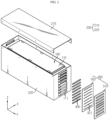
- FIG. 1 is a perspective view schematically showing a configuration of a battery module according to an embodiment of the present disclosure
- FIG. 2 is an exploded perspective view showing some components of FIG. 1 .
- the battery module includes a cell assembly 100, a module case 200, a bus bar assembly 300, and a blocking member 400.
- the cell assembly 100 may include a plurality of secondary batteries 110 (battery cells).
- the secondary battery 110 may include an electrode assembly, an electrolyte and a battery case.
- the secondary battery 110 may be a pouch-type secondary battery.
- other types of secondary batteries 110 such as a cylindrical battery or a prismatic battery, may also be adopted as the cell assembly 100.
- the plurality of secondary batteries 110 may be stacked in at least one direction to form the cell assembly 100.
- the plurality of secondary batteries 110 may be pouch-type batteries that are stacked up and down in a laid-down form.
- Each pouch-type secondary battery 110 may include electrode leads 111, which may be located at both ends or at one end of each secondary battery 110.
- a secondary battery 110 in which the electrode leads 111 protrude in both directions is called a bidirectional cell, and a secondary battery in which the electrode leads 111 protrude in one direction is called a unidirectional cell.
- the secondary battery 110 shown in FIGS. 1 and 2 is a bidirectional cell, and it may be regarded that the electrode leads 111 are positioned at both ends in the Y-axis direction.
- the secondary battery 110 of the battery module according to the present disclosure may also have a form in which the electrode leads 111 are positioned only at one end in the Y-axis direction, for example, the end in the +Y-axis direction.
- the present disclosure is not limited by any specific type or form of the secondary battery 110, and various types of secondary batteries 110 known at the time of filing of this application may be employed in the cell assembly 100 of the present disclosure. In this specification, a case where the secondary battery 110 is a bidirectional cell will be mainly described.
- the module case 200 may have an empty space formed therein and be configured to accommodate the cell assembly 100.
- the module case 200 may include an upper case 210 and a lower case 220, as shown in the drawings.
- the lower case 220 may include a lower plate and a side plate.
- the lower case 220 may further include a front plate and a rear plate.
- the lower case 220 may be formed by coupling the plates by fastening such as bolting or welding, but may also be manufactured in an integrated form.
- the upper case 210 and the lower case 220 may be coupled with each other to define an inner space.
- the cell assembly 100 may be accommodated in the inner space.
- the module case 200 may be configured such that at least one side is opened.
- the module case 200 may be configured such that the electrode leads 111 of the cell assembly 100 are positioned in the open portion.
- the cell assembly 100 may be configured such that the electrode leads 111 are positioned at both ends in the Y-axis direction and both ends of the module case 200 in the Y-axis direction are opened correspondingly.
- the bus bar assembly 300 may be coupled to the open portion. If the electrode leads 111 of the cell assembly 100 are positioned to protrude only in one side of the battery module, for example in the +Y-axis direction, the module case 200 may be configured to be opened only in the +Y-axis direction.
- the module case 200 may be configured to be closed except for the open portion to which the bus bar assembly 300 is coupled. Accordingly, when gas is generated inside the module case 200, the generated gas may be discharged only to the side where the bus bar assembly 300 is located.
- the bus bar assembly 300 may be configured to be positioned on at least one side of the module case 200, for example at both front and rear ends of the module case 200 (both ends in the Y-axis direction in FIG. 2 ).
- the bus bar assembly 300 may include a module bus bar 310 and a bus bar housing 320.
- the module bus bar 310 may be made of an electrically conductive material, for example a metal material such as copper or nickel.
- the module bus bar 310 may be configured to be electrically connected to the electrode leads 111 of the cell assembly 100.
- the module bus bar 310 may be welded or bolted in direct contact with the electrode leads 111.
- the module bus bar 310 may electrically connect the electrode leads 111 to each other or transmit voltage information sensed from the electrode leads 111 to an external control unit, for example a BMS (Battery Management System).
- BMS Battery Management System
- the bus bar housing 320 may be configured so that the module bus bar 310 may be placed thereon.
- the bus bar housing 320 may have a portion with a shape corresponding to the surface of the module bus bar 310, for example a planar shape, as a placing portion so that the module bus bar 310 is placed thereon.
- the bus bar housing 320 may support the module bus bar 310 so that the placed module bus bar 310 may stably maintain its position.
- the bus bar housing 320 may allow the module bus bar 310 to be coupled and fixed using various fastening methods such as bolting, riveting, fusion, and insertion.
- the bus bar housing 320 may be made of an electrically insulating material, such as plastic (polymer), such that it is not electrically connected to the module bus bar 310.
- the bus bar housing 320 may have a slot 321 through which the electrode lead 111 passes.
- the module bus bar 310 may be placed on the outer surface of the bus bar housing 320, and the electrode lead 111 may pass through the slot 321 at the inner side of the bus bar housing 320 and then come into contact with the module bus bar 310 located at an outer side.
- the inner side may mean an inner direction of the module case 200 in which the cell assembly 100 exists
- the outer side may mean an outer direction of the module case 200.
- the slot 321 may be formed in a shape corresponding to the shape of the electrode lead 111 so that the electrode lead 111 may easily pass therethrough.
- the slot 321 may be formed to be elongated in the left and right direction (X-axis direction in the drawing).
- a plurality of slots 321 may be formed in the bus bar housing 320.
- the pouch-type secondary batteries 110 are stacked in the vertical direction (the Z-axis direction in the drawing)
- a plurality of electrode leads 111 may exist in the vertical direction.
- the plurality of slots 321 may also be arranged to be spaced apart from each other by a predetermined distance in the vertical direction.
- the slot 321 may serve to penetrate the electrode lead 111 and support the electrode lead 111, and may additionally serve to discharge a vent gas.
- the slot 321 may have an empty gap around the electrode lead 111 in a state where the electrode lead 111 passes therethrough.
- the other part of the module case 200 may be configured in an almost sealed form. In this case, if a vent gas is generated due to a thermal propagation situation or the like in at least one of the secondary batteries 110 included in the cell assembly 100, the gas may increase the pressure inside the battery module.
- the slot 321 since the slot 321 has an empty gap formed around the electrode lead 111, the gas inside the battery module may be discharged to the outside through the slot 321. This will be described in more detail with reference to FIG. 3 .
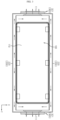
- FIG. 3 is a diagram schematically showing a discharge direction of an internal gas in the configuration of the battery module according to an embodiment of the present disclosure.
- FIG. 3 may be regarded as a diagram showing the internal configuration of the battery module of FIG. 2 , viewed from the above.
- the generated gas when gas is generated from at least one secondary battery 110 located inside the module, the generated gas may be discharged through the slot 321 formed in the bus bar assembly 300.
- the gas discharged from the vented portion may flow along the surface of the module case 200, for example the side plate of the lower case 220, move toward the bus bar assembly 300, and be discharged to the outside of the module through the slot 321, as indicated by the arrow in the drawing.
- the blocking member 400 may be located at the slot 321 of the bus bar housing 320.
- the configuration of the blocking member 400 will be described in more detail with reference to FIGS. 4 and 5 .
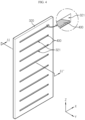
- FIG. 4 is a perspective view showing the bus bar housing 320 and the blocking member 400 according to an embodiment of the present disclosure, viewed from the outside of the battery module.
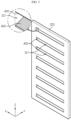
- FIG. 5 is a perspective view showing the configuration of FIG. 4 , viewed from the inside of the battery module.
- the plurality of slots 321 may be formed in the bus bar housing 320 to be arranged in the vertical direction, and the blocking member 400 may be located at each of the plurality of slots 321.
- the blocking member 400 may be provided to each slot 321.
- the blocking member 400 may be configured to transform its shape when heat is applied thereto. Also, the blocking member 400 may be configured to block at least a portion of the slot 321 due to the shape transformation. This will be described in more detail with reference to FIGS. 6 and 7 .
- FIGS. 6 and 7 are cross-sectional views schematically showing a shape-transformed configuration of the blocking member 400 according to an embodiment of the present disclosure.
- FIGS. 6 and 7 are cross-sectional views, taken along the line A1-A1' of FIG. 4 , and are illustrated based on one slot 321, wherein the module bus bar 310 and the electrode lead 111 are additionally depicted.
- FIG. 6 is a diagram showing the blocking member 400 before shape transformation
- FIG. 7 is a diagram showing the blocking member 400 after shape transformation.
- the blocking member 400 may be attached to the inner surface of the slot 321 formed in the bus bar housing 320.
- the blocking member 400 may be attached to the upper inner surface and the lower inner surface of the slot 321.
- the blocking member 400 may be configured to form an empty space between the electrode lead 111 and blocking member 400, as indicated by A2 and A2', in a normal state in which heat of a certain level or more is not applied.
- the blocking member 400 may be configured not to contact the electrode lead 111 in a normal state.
- a fluid, particularly a gas may flow in and out between the inside of the battery module (the left part of FIG.
- the venting gas may be discharged to the outside through the slot 321 as indicated by arrows in FIG. 6 .
- the shape of the blocking member 400 may be transformed as shown in FIG. 7 .
- the shape transformation of the blocking member 400 may be configured to block at least a portion of the slot 321.
- the empty space between the blocking member 400 and the electrode lead 111 indicated by A2 and A2' in FIG. 6 may be blocked by the blocking member 400 as indicated by A3 in FIG. 7 .
- the venting gas may be smoothly discharged to the outside of the battery module through the slot 321. Therefore, it is possible to prevent an explosion caused by an increase in the internal pressure of the battery module.
- the slot 321 may be blocked, so that the inflow of oxygen into the battery module through the slot 321 may be effectively blocked after the venting gas is discharged (see the dotted arrow in FIG. 7 ). Therefore, according to this configuration, it is possible to prevent a fire from occurring inside the battery module.
- a heat source such as a spark or a combustible material such as a gas or a component of the secondary battery 110 may exist inside the battery module.
- a heat source such as a spark or a combustible material such as a gas or a component of the secondary battery 110 may exist inside the battery module.
- one of three elements of combustion does not exist inside the battery module, so that combustion may be prevented inside the battery module.
- even when a small flame or fire occurs inside the battery module since the inflow of additional oxygen is blocked, it is possible to prevent the fire from spreading.
- the blocking member 400 may be configured to expand in volume when heat is applied.
- the blocking member 400 may be configured to block the empty space of the slot 321 due to the volume expansion.
- the blocking member 400 may gradually expand in volume to fill the empty space inside the slot 321 as shown in FIG. 7 . Accordingly, it is possible to prevent external oxygen from flowing into the battery module.
- the blocking member 400 may have various thermal expansion materials known at the time of filing of this application.
- the blocking member 400 may be configured to be thermally expandable by having various polymer materials such as PDMS (Poly-Di-Methyl-Siloxane), polyvinyl acetate, polystyrene, butyl (meth)acrylate, hexyl (meth)acrylate, n-octyl (meth)acrylate, isooctyl (meth)acrylate, 2-ethylhexyl (meth)acrylate, isononyl (meth)acrylate, and a urethane-based polymer.
- the blocking member 400 may further include a heat-resistant material.
- the blocking member 400 may be configured such that the outer surface is coated with a heat-resistant material such as ceramic, so that the blocking member 400 is not damaged while its volume is expanded by the heat of the venting gas.
- Thermal expansion of the blocking member 400 may be suitably set according to a type or a thermal expansion coefficient of the thermal expansion material included in the blocking member 400.
- the degree of thermal expansion of the blocking member 400 may be suitably set by a user according to various conditions, such as the size or shape of the blocking member 400 or the slot 321, and the type of the secondary batteries 110.
- the blocking member 400 may be configured to be more easily closed. That is, in configuring the blocking member 400 using a thermal expansion material, the configuration of blocking the slot 321 due to the application of heat may be more easily implemented.
- the venting gas may be discharged more smoothly. That is, when the blocking member 400 is expanded while the venting gas is discharged, the discharge space of the venting gas may be further reduced during the expansion process of the blocking member 400. Therefore, even if the amount of the venting gas present inside the battery module is not large, the discharge flow rate of the venting gas may not be significantly reduced since the size of the discharge hole is reduced. Accordingly, it is possible to allow the venting gas to be more reliably discharged, and it is also possible to more reliably block the inflow of external oxygen through the slot 321 due to the discharge pressure of the venting gas.
- the blocking member 400 may be configured to be positioned inside the bus bar housing 320.
- the module bus bar 310 may be located on the outer side of the bus bar housing 320 (+Y-axis direction in FIG. 2 ).
- the blocking member 400 may be located at the inner side of the bus bar housing 320 (-Y-axis direction in FIG. 2 ). That is, the blocking member 400 may be located on a part other than the outer surface of the bus bar housing.
- the blocking member 400 may be located in the inner space of the slot 321 in the bus bar housing 320. That is, the blocking member 400 may be configured to be positioned on a passage through which gas moves when the gas moves from the outside to the inside of the bus bar housing 320.
- the inflow of external oxygen may be more easily blocked by the blocking member 400.
- the blocking member 400 may be closed by the module bus bar 310 without interference.
- the blocking member 400 may be configured to be positioned at both sides based on the electrode lead 111.
- the electrode lead 111 may be formed in the form of a plate having two large surfaces, and the blocking member 400 may be positioned at both sides to face the two large surfaces, respectively.
- the blocking member 400 may be provided on both the upper side and the lower side of the electrode lead 111.
- the inflow of oxygen may be blocked more reliably by the blocking member 400.
- the blocking member 400 since oxygen may flow in at both sides of the electrode lead 111, if the blocking member 400 is positioned on both sides of the electrode lead 111 as in this embodiment, the sealing force around the electrode lead 111 may be secured to block the inflow of oxygen more effectively.
- the blocking member 400 may be configured to have a greater width than the electrode lead 111. This will be described in more detail with reference to FIG. 8 .
- FIG. 8 is a diagram schematically showing a width between the blocking member 400 and the electrode lead 111 in the battery module according to an embodiment of the present disclosure.
- FIG. 8 may be regarded as a diagram, viewed from the above based on one slot 321.
- the width of the blocking member 400 is indicated by W 1
- the width of the electrode lead 111 is indicated by W2.
- W1 may be formed to have a larger size than W2. That is, the blocking member 400 may be formed to have a greater width than the electrode lead 111.
- the blocking member 400 may be configured to protrude in both side directions of the electrode lead 111 (X-axis direction of FIG. 8 ).
- this configuration of the present disclosure since all of the periphery of the electrode lead 111, particularly the left and right sides of the electrode lead 111, is surrounded, it is possible to prevent a gap from being created around the electrode lead 111. That is, it is possible that not only the upper or lower portions of the electrode lead 111 but also the left and right sides of the electrode lead 111 are covered by the blocking member 400. In particular, this configuration may be obtained after the blocking member 400 is transformed due to heat. Therefore, in this case, it is possible to effectively block the inflow of oxygen by securing the sealing force around the electrode lead 111.
- the blocking member 400 includes an upper blocking member 410 and a lower blocking member 420, and the upper blocking member 410 and the lower blocking member 420 may be positioned at both sides (upper and lower sides) with respect to one electrode lead 111.
- the upper blocking member 410 and the lower blocking member 420 may be configured to expand due to heat and contact each other.
- the upper blocking member 410 and the lower blocking member 420 may be configured such that, due to thermal expansion, their portions protruding in the left and right directions further to the electrode lead 111 contact each other, as indicated by A4 and A4' in FIG. 8 .
- the blocking member 400 may be configured such that its width after thermal expansion is equal to the width of the slot 321 of the bus bar housing 320. That is, both the width of the blocking member 400 in the thermally expanded state and the width of the slot 321 may be the same as W1. In this case, the sealing property of the entire slot 321 may be stably secured. Moreover, the width of the blocking member 400 may also be obtained before thermal expansion. That is, the blocking member 400 may be configured to have the same width as the width of the slot 321 even before thermal expansion.
- the blocking member 400 may be configured in the form of a sheet, as shown in various drawings.
- the blocking member 400 may be configured in the form of a sheet made of a thermally expandable material, namely a thermally expandable sheet.
- one surface of the blocking member 400 may be attached to the inner surface of the bus bar housing 320, for example the inner surface of the slot 321, and the other surface of the blocking member 400 may be disposed to face the electrode lead 111.
- the blocking member 400 maybe included inside the slot 321 more easily. That is, since the blocking member 400 is formed in the form of a sheet, the blocking member 400 is formed to have a small thickness, and thus the blocking member 400 may be easily inserted into the inner space of the slot 321. Also, even if the size of the slot 321 is not great, the blocking member 400 may be positioned inside the slot 321. In addition, the blocking member 400 and the bus bar housing 320 may be easily coupled using an adhesive or the like. In addition, according to this configuration, when the electrode lead 111 is inserted into the slot 321, it is possible to minimize the deterioration of process efficiency caused by the blocking member 400.
- the bus bar housing 320 may be configured to have an inclined portion formed in the slot 321.
- the blocking member 400 may be configured to be positioned on the inclined portion of the slot 321.
- the inclined portion may be configured to be positioned at both sides based on the electrode lead 111.
- the bus bar housing 320 may be configured such that the inner surface of the slot 321 is inclined, as indicated by S1 and S 1' in FIG. 6 .
- the bus bar housing 320 may be configured so that both the upper surface of the slot 321 as indicated by S 1 and the lower surface of the slot 321 as indicated by S1' are inclined.
- the blocking member 400 may be configured to be provided on both the inclined portions, namely the upper inclined portion S1 and the lower inclined portion S1'.
- the process of inserting the electrode lead 111 from the inner side of the slot 321 to the outer side may be performed more smoothly.
- the slot 321 of the bus bar housing 320 may be formed to be gradually narrower as it goes from the inner side to the outer side. Therefore, when gas is vented, the discharge pressure is set high at the outer outlet of the slot 321, so that the inflow of oxygen into the slot 321 may be more reliably blocked.
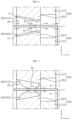
- FIGS. 9 and 10 are cross-sectional views schematically showing a blocking member 400 according to another embodiment of the present disclosure.
- FIG. 9 shows a configuration before transformation of the blocking member 400
- FIG. 10 shows a configuration after transformation of the blocking member 400.
- a plurality of blocking members 400 may be arranged from the inside to the outside. That is, the blocking member 400 may include an upper blocking member 410 and a lower blocking member 420, and the upper blocking member 410 and the lower blocking member 420 may include a plurality of unit blocking members, respectively. Moreover, in FIG. 9 , the upper blocking member 410 and the lower blocking member 420 may include three unit blocking members, respectively. More specifically, the upper blocking member 410 and the lower blocking member 420 may include an outer blocking member 411, 421, a central blocking member 412, 422, and an inner blocking member 413, 423, respectively.
- the configuration for improving the oxygen inflow blocking effect by the blocking member 400 may be designed more diversely.
- the blocking member 400 may be set such that at least two blocking members 400 arranged from the inside to the outside have different thermal expansion coefficients.
- the three unit blocking members included in the upper blocking member 410 namely the outer blocking member 411, the central blocking member 412 and the inner blocking member 413, may be made of materials having different thermal expansion coefficients.
- the unit blocking members may be configured to have a greater thermal expansion coefficient as being positioned inside.
- the thermal expansion coefficient of the outer blocking member 411 may be lowest
- the thermal expansion coefficient of the inner blocking member 413 may be highest
- the thermal expansion of the central blocking member 412 may be middle.
- the three unit blocking members included in the lower blocking member 420 may also be designed in this way.
- the sealing force may be further improved. That is, according to this embodiment, as shown in FIG. 10 , if heat is applied to the upper blocking member 410, the degree of expansion may gradually increase from the outer blocking member 411 to the inner blocking member 413. Also, if heat is applied to the lower blocking member 420, the degree of expansion may gradually increase from the outer blocking member 421 to the inner blocking member 423. The inner space of the slot 321 may gradually increase from the outside to the inside. In this configuration, the degree of expansion of the unit blocking member located at the inner side is increased, the blocking member 400 may expand in a shape corresponding to the shape of the inner space of the slot 321. Therefore, in this case, the inner space of the slot 321 may be more reliably blocked.
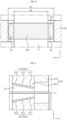
- FIG. 11 is a cross-sectional view schematically showing a blocking member 400 according to still another embodiment of the present disclosure.
- FIG. 11 may be regarded as a configuration before transformation of the blocking member 400.
- features different from the former embodiments will also be described in detail.
- the blocking member 400 includes a plurality of unit blocking members arranged from the inside to the outside, but at least two unit blocking members among them have different thicknesses.
- the three unit blocking members provided in the upper blocking member 410 namely the outer blocking member 411, the central blocking member 412, and the inner blocking member 413, may be configured to have different thicknesses.
- the three unit blocking members may be configured to have a greater thickness from the outside to the inside.
- the thickness of the outer blocking member 411 may be smallest, the thickness of the inner blocking member 413 may be greatest, and the thickness of the central blocking member 412 may be middle.
- the three unit blocking members 421, 422, 423 included in the lower blocking member 420 may also be configured in this way.
- the sealing force may be further improved.
- the blocking member 400 may be configured to press the electrode lead 111 when heat is applied thereto to transform the shape.
- the upper blocking member 410 when the upper blocking member 410 is expanded, the upper blocking member 410 may be configured not only to contact the upper surface of the electrode lead 111 at the portion indicated by A3 but also to press the upper surface of the electrode lead 111 in the lower direction.
- the lower blocking member 420 when expanded, may be configured not only to contact the lower surface of the electrode lead 111 at the portion indicated by A3 but also to press the lower surface of the electrode lead 111 in the upper direction.
- the sealing force between the blocking member 400 and the electrode lead 111 may be further improved. Moreover, when the venting gas is discharged to the outside of the battery module, a negative pressure may be formed inside the battery module, so that the external gas containing oxygen may try to flow into the slot 321 with a considerable force. However, according to this embodiment, since the blocking member 400 and the electrode lead 111 may be sealed with a strong force, it is possible to more reliably block the inflow of oxygen.
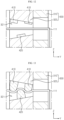
- FIGS. 12 and 13 are cross-sectional views schematically showing a blocking member 400 according to still another embodiment of the present disclosure.
- FIG. 12 shows a configuration before transformation of the blocking member 400
- FIG. 13 shows a configuration after transformation of the blocking member 400.
- features different from the former embodiments will also be described in detail.
- the blocking member 400 includes an upper blocking member 410 and a lower blocking member 420, and the upper blocking member 410 and the lower blocking member 420 may be alternately arranged from the inside to the outside.
- the center of the two upper blocking members 410 may be formed at a different position from the center of one lower blocking member 420.
- the oxygen inflow blocking effect by the blocking member 400 may be further improved.
- the electrode lead 111 may be bent, as shown in FIG. 13 . That is, the upper blocking member 410 may press the electrode lead 111 in the lower direction, and the lower blocking member 420 may press the electrode lead 111 in the upper direction.
- the electrode lead 111 may have a shape bent up and down, as shown in FIG. 13 . In this case, the adhesion between the blocking member 400 and the electrode lead 111 may be further increased.
- the space between the electrode lead 111 and the blocking member 400 is not formed in a straight line but is formed in a curve, a path for the inflow of oxygen may become long and complicated. Therefore, according to this embodiment, the effect of blocking oxygen that may flow in along the surface of the electrode lead 111 may be further improved.
- a battery pack according to the present disclosure may include a plurality of battery modules according to the present disclosure described above.
- the battery pack according to the present disclosure may further include various other components other than the battery module, for example components of the battery pack known at the time of filing of this application, such as a BMS, a bus bar, a pack case, a relay, a current sensor, and the like.
- An energy storage system may include at least one battery module according to the present disclosure.
- the energy storage system may include a plurality of battery modules according to the present disclosure in the form of being electrically connected to each other in order to have a large energy capacity.
- a plurality of battery modules according to the present disclosure may configure one batter pack, and the energy storage system may be configured to include a plurality of battery packs.
- the energy storage system according to the present disclosure may further include other various components of the energy storage system known at the time of filing of this application.
- the energy storage system may be used in various places or devices, such as a smart grid system or an electric charging station.
Landscapes
- Chemical & Material Sciences (AREA)
- Chemical Kinetics & Catalysis (AREA)
- Electrochemistry (AREA)
- General Chemical & Material Sciences (AREA)
- Health & Medical Sciences (AREA)
- Public Health (AREA)
- Business, Economics & Management (AREA)
- Emergency Management (AREA)
- Battery Mounting, Suspending (AREA)
- Connection Of Batteries Or Terminals (AREA)
- Secondary Cells (AREA)
Applications Claiming Priority (2)
| Application Number | Priority Date | Filing Date | Title |
|---|---|---|---|
| KR1020210012619A KR102960996B1 (ko) | 2021-01-28 | 화재 방지 성능이 향상된 배터리 모듈 | |
| PCT/KR2022/001329 WO2022164180A2 (ko) | 2021-01-28 | 2022-01-25 | 화재 방지 성능이 향상된 배터리 모듈 |
Publications (2)
| Publication Number | Publication Date |
|---|---|
| EP4203157A2 true EP4203157A2 (de) | 2023-06-28 |
| EP4203157A4 EP4203157A4 (de) | 2024-10-16 |
Family
ID=82654766
Family Applications (1)
| Application Number | Title | Priority Date | Filing Date |
|---|---|---|---|
| EP22746207.4A Pending EP4203157A4 (de) | 2021-01-28 | 2022-01-25 | Batteriemodul mit verbesserter brandverhütungsfähigkeit |
Country Status (5)
| Country | Link |
|---|---|
| US (1) | US20230201640A1 (de) |
| EP (1) | EP4203157A4 (de) |
| JP (1) | JP7417766B2 (de) |
| CN (1) | CN115668607A (de) |
| WO (1) | WO2022164180A2 (de) |
Families Citing this family (2)
| Publication number | Priority date | Publication date | Assignee | Title |
|---|---|---|---|---|
| KR20240019925A (ko) * | 2022-08-05 | 2024-02-14 | 주식회사 엘지에너지솔루션 | 배터리 팩 |
| WO2025129855A1 (zh) * | 2023-12-21 | 2025-06-26 | 台达电子工业股份有限公司 | 电池模块灭火结构 |
Family Cites Families (15)
| Publication number | Priority date | Publication date | Assignee | Title |
|---|---|---|---|---|
| US8035986B2 (en) | 2008-06-30 | 2011-10-11 | Lg Chem, Ltd. | Battery cell interconnect and voltage sensing assembly and method for coupling battery cell assemblies thereto |
| JP2011181409A (ja) * | 2010-03-02 | 2011-09-15 | Honda Motor Co Ltd | 電池および電池モジュール |
| JP5993209B2 (ja) * | 2012-05-24 | 2016-09-14 | タイガースポリマー株式会社 | 電池冷却構造 |
| JP5933344B2 (ja) | 2012-05-31 | 2016-06-08 | 三洋電機株式会社 | 電源装置 |
| JP6107091B2 (ja) | 2012-12-04 | 2017-04-05 | 日産自動車株式会社 | 組電池および組電池の製造方法 |
| KR102034208B1 (ko) * | 2016-03-03 | 2019-10-18 | 주식회사 엘지화학 | 배터리 모듈, 이러한 배터리 모듈을 포함하는 배터리 팩 및 이러한 배터리 팩을 포함하는 자동차 |
| KR102144945B1 (ko) * | 2017-07-14 | 2020-08-14 | 주식회사 엘지화학 | 배터리 모듈 |
| JP6996272B2 (ja) * | 2017-12-13 | 2022-01-17 | 日産自動車株式会社 | バッテリパック |
| JP2019114389A (ja) * | 2017-12-22 | 2019-07-11 | ダイムラー・アクチェンゲゼルシャフトDaimler AG | バッテリモジュール |
| KR102514123B1 (ko) | 2018-04-19 | 2023-03-23 | 주식회사 엘지에너지솔루션 | 용접을 용이하게 할 수 있는 버스바 프레임 구조를 구비하는 단위 모듈 및 이를 포함하는 배터리 모듈 |
| KR102395228B1 (ko) * | 2018-10-10 | 2022-05-04 | 주식회사 엘지에너지솔루션 | 버스바 프레임 조립 방법 |
| JP7235485B2 (ja) | 2018-11-27 | 2023-03-08 | 株式会社エンビジョンAescジャパン | 電池ケースおよびこれを備える車両並びに定置型蓄電装置 |
| KR102392767B1 (ko) * | 2018-12-26 | 2022-04-28 | 주식회사 엘지에너지솔루션 | 내측 커버를 포함하는 배터리 모듈 |
| KR102791885B1 (ko) * | 2019-07-08 | 2025-04-04 | 주식회사 엘지에너지솔루션 | 열 폭주 현상 발생 시 냉각수가 내부로 투입될 수 있는 구조를 갖는 배터리 모듈, 이를 포함하는 배터리 팩 및 에너지저장장치 |
| KR102246942B1 (ko) | 2019-07-26 | 2021-04-29 | 홍진태 | 단조용 절단기구 |
-
2022
- 2022-01-25 CN CN202280004338.7A patent/CN115668607A/zh active Pending
- 2022-01-25 EP EP22746207.4A patent/EP4203157A4/de active Pending
- 2022-01-25 US US17/926,779 patent/US20230201640A1/en active Pending
- 2022-01-25 WO PCT/KR2022/001329 patent/WO2022164180A2/ko not_active Ceased
- 2022-01-25 JP JP2022572781A patent/JP7417766B2/ja active Active
Also Published As
| Publication number | Publication date |
|---|---|
| US20230201640A1 (en) | 2023-06-29 |
| WO2022164180A3 (ko) | 2022-09-22 |
| JP2023528789A (ja) | 2023-07-06 |
| WO2022164180A2 (ko) | 2022-08-04 |
| CN115668607A (zh) | 2023-01-31 |
| JP7417766B2 (ja) | 2024-01-18 |
| KR20220109220A (ko) | 2022-08-04 |
| EP4203157A4 (de) | 2024-10-16 |
Similar Documents
| Publication | Publication Date | Title |
|---|---|---|
| EP4228083B1 (de) | Batteriepack mit verbesserter sicherheit | |
| JP7652510B2 (ja) | 電池モジュールおよびこれを含む電池パック | |
| JP7546983B2 (ja) | 電池モジュールおよびこれを含む電池パック | |
| US20230361405A1 (en) | Battery module with improved fire protection performance | |
| US20230275315A1 (en) | Battery pack with improved fire protection performance | |
| EP4152503B1 (de) | Batteriepack und fahrzeug damit | |
| EP3557651B1 (de) | Batteriemodul mit kartusche | |
| EP4358265A1 (de) | Batteriemodul, batteriepack und fahrzeug damit | |
| EP4203157A2 (de) | Batteriemodul mit verbesserter brandverhütungsfähigkeit | |
| EP4407774B1 (de) | Batteriezelleneinheit und batteriepack sowie fahrzeug damit | |
| EP4207465A1 (de) | Batteriemodul mit verbesserter brandverhütungsleistung | |
| JP7708497B2 (ja) | 電池パックおよびこれを含むデバイス | |
| KR102960996B1 (ko) | 화재 방지 성능이 향상된 배터리 모듈 | |
| EP4576379A1 (de) | Batteriemodul | |
| KR102957151B1 (ko) | 화재 방지 성능이 향상된 배터리 모듈 | |
| EP4629423A1 (de) | Batteriepack | |
| EP4597684A1 (de) | Batteriepack mit verbesserter feuerschutzleistung | |
| EP4254626A1 (de) | Batteriepack und vorrichtung damit | |
| EP4576384A1 (de) | Batteriepack | |
| EP4199230A1 (de) | Flammenableiter und batteriepack damit | |
| KR20260057017A (ko) | 화재 방지 성능이 향상된 배터리 모듈 | |
| JP2025538405A (ja) | 電池パックおよびこれを含むデバイス | |
| KR20220119988A (ko) | 화재 방지 성능이 향상된 배터리 모듈 |
Legal Events
| Date | Code | Title | Description |
|---|---|---|---|
| STAA | Information on the status of an ep patent application or granted ep patent |
Free format text: STATUS: THE INTERNATIONAL PUBLICATION HAS BEEN MADE |
|
| PUAI | Public reference made under article 153(3) epc to a published international application that has entered the european phase |
Free format text: ORIGINAL CODE: 0009012 |
|
| STAA | Information on the status of an ep patent application or granted ep patent |
Free format text: STATUS: REQUEST FOR EXAMINATION WAS MADE |
|
| 17P | Request for examination filed |
Effective date: 20230320 |
|
| AK | Designated contracting states |
Kind code of ref document: A2 Designated state(s): AL AT BE BG CH CY CZ DE DK EE ES FI FR GB GR HR HU IE IS IT LI LT LU LV MC MK MT NL NO PL PT RO RS SE SI SK SM TR |
|
| DAV | Request for validation of the european patent (deleted) | ||
| DAX | Request for extension of the european patent (deleted) | ||
| A4 | Supplementary search report drawn up and despatched |
Effective date: 20240918 |
|
| RIC1 | Information provided on ipc code assigned before grant |
Ipc: A62C 3/16 20060101ALI20240912BHEP Ipc: A62C 2/06 20060101ALI20240912BHEP Ipc: H01M 50/572 20210101ALI20240912BHEP Ipc: H01M 50/507 20210101ALI20240912BHEP Ipc: H01M 50/251 20210101ALI20240912BHEP Ipc: H01M 50/211 20210101ALI20240912BHEP Ipc: H01M 50/204 20210101ALI20240912BHEP Ipc: H01M 50/24 20210101AFI20240912BHEP |
|
| STAA | Information on the status of an ep patent application or granted ep patent |
Free format text: STATUS: EXAMINATION IS IN PROGRESS |
|
| 17Q | First examination report despatched |
Effective date: 20260302 |