EP4205253B1 - Procédé de réglage d'une classe de puissance d'un onduleur et onduleur - Google Patents
Procédé de réglage d'une classe de puissance d'un onduleur et onduleur Download PDFInfo
- Publication number
- EP4205253B1 EP4205253B1 EP21769985.9A EP21769985A EP4205253B1 EP 4205253 B1 EP4205253 B1 EP 4205253B1 EP 21769985 A EP21769985 A EP 21769985A EP 4205253 B1 EP4205253 B1 EP 4205253B1
- Authority
- EP
- European Patent Office
- Prior art keywords
- inverter
- class
- power class
- information
- power
- Prior art date
- Legal status (The legal status is an assumption and is not a legal conclusion. Google has not performed a legal analysis and makes no representation as to the accuracy of the status listed.)
- Active
Links
Images


Classifications
-
- H—ELECTRICITY
- H02—GENERATION; CONVERSION OR DISTRIBUTION OF ELECTRIC POWER
- H02J—ELECTRIC POWER NETWORKS; CIRCUIT ARRANGEMENTS OR SYSTEMS FOR SUPPLYING OR DISTRIBUTING ELECTRIC POWER; SYSTEMS FOR STORING ELECTRIC ENERGY
- H02J3/00—Circuit arrangements for AC mains or AC distribution networks
- H02J3/38—Arrangements for feeding a single network from two or more generators or sources in parallel; Arrangements for feeding already energised networks from additional generators or sources in parallel
-
- H—ELECTRICITY
- H02—GENERATION; CONVERSION OR DISTRIBUTION OF ELECTRIC POWER
- H02J—ELECTRIC POWER NETWORKS; CIRCUIT ARRANGEMENTS OR SYSTEMS FOR SUPPLYING OR DISTRIBUTING ELECTRIC POWER; SYSTEMS FOR STORING ELECTRIC ENERGY
- H02J13/00—Circuit arrangements for providing remote monitoring or remote control of equipment in a power distribution network
-
- G—PHYSICS
- G06—COMPUTING OR CALCULATING; COUNTING
- G06V—IMAGE OR VIDEO RECOGNITION OR UNDERSTANDING
- G06V10/00—Arrangements for image or video recognition or understanding
- G06V10/94—Hardware or software architectures specially adapted for image or video understanding
- G06V10/95—Hardware or software architectures specially adapted for image or video understanding structured as a network, e.g. client-server architectures
-
- G—PHYSICS
- G06—COMPUTING OR CALCULATING; COUNTING
- G06V—IMAGE OR VIDEO RECOGNITION OR UNDERSTANDING
- G06V40/00—Recognition of biometric, human-related or animal-related patterns in image or video data
- G06V40/10—Human or animal bodies, e.g. vehicle occupants or pedestrians; Body parts, e.g. hands
-
- H—ELECTRICITY
- H04—ELECTRIC COMMUNICATION TECHNIQUE
- H04L—TRANSMISSION OF DIGITAL INFORMATION, e.g. TELEGRAPHIC COMMUNICATION
- H04L9/00—Cryptographic mechanisms or cryptographic arrangements for secret or secure communications; Network security protocols
- H04L9/32—Cryptographic mechanisms or cryptographic arrangements for secret or secure communications; Network security protocols including means for verifying the identity or authority of a user of the system or for message authentication, e.g. authorization, entity authentication, data integrity or data verification, non-repudiation, key authentication or verification of credentials
-
- H—ELECTRICITY
- H02—GENERATION; CONVERSION OR DISTRIBUTION OF ELECTRIC POWER
- H02M—APPARATUS FOR CONVERSION BETWEEN AC AND AC, BETWEEN AC AND DC, OR BETWEEN DC AND DC, AND FOR USE WITH MAINS OR SIMILAR POWER SUPPLY SYSTEMS; CONVERSION OF DC OR AC INPUT POWER INTO SURGE OUTPUT POWER; CONTROL OR REGULATION THEREOF
- H02M1/00—Details of apparatus for conversion
- H02M1/0003—Details of control, feedback or regulation circuits
- H02M1/0025—Arrangements for modifying reference values, feedback values or error values in the control loop of a converter
-
- Y—GENERAL TAGGING OF NEW TECHNOLOGICAL DEVELOPMENTS; GENERAL TAGGING OF CROSS-SECTIONAL TECHNOLOGIES SPANNING OVER SEVERAL SECTIONS OF THE IPC; TECHNICAL SUBJECTS COVERED BY FORMER USPC CROSS-REFERENCE ART COLLECTIONS [XRACs] AND DIGESTS
- Y02—TECHNOLOGIES OR APPLICATIONS FOR MITIGATION OR ADAPTATION AGAINST CLIMATE CHANGE
- Y02E—REDUCTION OF GREENHOUSE GAS [GHG] EMISSIONS, RELATED TO ENERGY GENERATION, TRANSMISSION OR DISTRIBUTION
- Y02E10/00—Energy generation through renewable energy sources
- Y02E10/50—Photovoltaic [PV] energy
- Y02E10/56—Power conversion systems, e.g. maximum power point trackers
Definitions
- the invention relates to a method for setting a power class of an inverter and to an inverter.
- Inverters are power electronic devices that are designed to convert direct current into alternating current and vice versa. Inverters of a certain type are usually available in different power classes. Inverters of different power classes are designed for different power levels. This makes it easier to select an inverter with the right power for a specific application.
- Inverters can, for example, convert the direct current from solar modules into alternating current for feeding into an energy supply network.
- the inverter also known as a PV inverter, is therefore part of a photovoltaic system (PV system).
- PV system can have several PV generators. By making different power classes available, a customer's request for an inverter with the right power for different PV systems and/or PV generators can be fulfilled.
- the smallest possible number of different versions of inverters of a certain type may be desired.
- the customer's desire for the largest possible selection of power classes and effective device production can therefore be in conflict.
- This problem can be solved, for example, by determining the device's power as late as possible in production or, if necessary, later during installation or commissioning.
- the inverters of one type can be largely or completely identical in technical terms and can differ in terms of the power setting, e.g. using software, and the type plate corresponding to the set power. Setting the power and attaching the type plate can be carried out at the end of production, so that most production steps can be identical for all power classes.
- the devices can still exist in different performance classes.
- the advantages of the technical equality of the performance classes are therefore mainly realized in production.
- the reason for this is that the device performance is determined at the end of production. Postponing the performance setting until the time of installation would mean further simplification of logistics for the wholesaler, the installer and the manufacturer.
- Safety standards for PV inverters require that a nameplate indicates the power and dependent variables such as the maximum grid current.
- the power of the device is essential for the design of the cables and fuses in the system and is also the basis for the grid operator's permission to feed power into the grid. It must therefore be ensured that even if the power is determined at the time of installation, the power specification on the nameplate matches the actual power of the device. Protection against misuse is also required here.
- a disadvantage of this method is the technical complexity of the RFID reader integrated in the inverter.
- the use of this technology limits the choice of housing material.
- RFID is based on radio and the housing must not have a shielding effect on the RFID communication frequency.
- the document also shows DE 10 2014 226 620 A1 an electro-hydraulic drive in which an attached type identifier is read out via smartphone and a parameter set that is clearly assigned to the type identifier is transmitted to the drive for operation.
- the aim is to prevent incorrect transmission of parameters and the damage caused by this.
- the invention is based on the task of efficiently handling the setting of the power class of inverters.
- An inverter has a device nameplate that contains device-specific information about the inverter that is independent of the selected power class.
- the inverter also has a class plate that is selected from a number of class-specific class plates, each assigned to a power class of a number of power classes.
- the class plate contains information about the power class assigned to the inverter.
- the assigned power class is the power class to which the inverter should be set.
- the image capture of the device type plate and the class plate is carried out together, i.e. with an optical recording.
- the image capture can be carried out, for example, using a camera on a mobile device, e.g. a smartphone.
- the inverter has a controller that controls power electronic switches via which the input-side direct voltage can be converted into alternating voltage or vice versa.
- the controller is preferably set up to set the power class of the inverter after receiving the setting sequence, for example by software configuration of the program code that can be executed on the controller's computing device.
- the setting sequence can be transmitted to the inverter acoustically, mechanically, optically, directly electrically or by other means, particularly wirelessly. Examples of possible transmission methods are: RFID, camera in the inverter, barcode scanner in the inverter, microphone, shock sensor, photodiode, Bluetooth, WLAN, Ethernet, RS485, USB stick, memory card, etc.
- the setting sequence is preferably transmitted to the inverter after checking whether a combination of the device-specific information and the information about the assigned power class is a permissible combination.
- the invention makes it possible to set the power class of an inverter, selected from a plurality of power classes in which the inverter can be operated, during installation in such a way, in particular to set it permanently in such a way that it is ensured that the set power class corresponds to the clear information on the labeling attached to the inverter in accordance with the standards.
- This is done using a two-part plate for the inverter.
- the two-part plate comprises a device type plate as one part and a class plate as the other part.
- the device type plate is preferably permanently attached during production. It contains all non-power variable information about the inverter, preferably also in a human-readable form, e.g. plain text.
- the device type plate contains a code that can be read visually, preferably a code that can be read visually by a computer, e.g. QR code or barcode, which identifies the device.
- the identification of the device can include, for example, the serial number and/or the type designation.
- the class plate contains variable performance information about the inverter and is preferably included with the inverter in several versions.
- the information on the class plate can be read visually, e.g. in the form of a QR code, and contains information about the inverter's performance class.
- the variable performance information on the class plate is preferably also available in a human-readable form, e.g. in plain text.
- the class plate is preferably attached to the inverter during installation.
- the class plate can be selected from the plurality of class plates and attached, in particular permanently attached, to the inverter before the image is read out. These steps of selection and attachment can be carried out, for example, by the installer during installation of the inverter and before it is put into operation.
- the class plate can be attached, for example, by sticking the class plate on. Permanent attachment means that the plate cannot be removed again without causing damage.
- the procedure makes it possible to ensure that the inverter with a label that has a class plate indicating a certain power actually meets that power.
- the proposed solution is safer than setting it by the installer because it better ensures that the power on the rating plate matches the actual power.
- the situation in which the installer applies the wrong sticker and thereby inadvertently produces a device that is not approved by the standards is avoided.
- the information read out visually is authenticated before the power class of the inverter is set.
- Authentication in this context means that the correct origin and/or the correctness of the content is checked. Authentication can be checked, for example, by cryptographic methods, e.g. by the app, by checking a signature of the information read out visually. For example, the setting sequence can only be generated after authentication.
- Authentication can optionally include querying a database via a remote data connection, where the information captured visually can be checked, e.g. by means of a database query.
- the database can in particular have a list of permissible combinations of device-specific information and information about the assigned power class, so that it can be ensured that an impermissible combination of type plate and class plate is recognized, in which case no setting sequence is generated.
- the setting sequence preferably has additional security features that cannot be determined from the device type plate and the class plate, or cannot be determined directly.
- the inverter can preferably check these security features.
- the security features can be used for authentication, for example, and can include encryption and/or a signature. This further increases security.
- the setting sequence with an authentication section, an inverter identification section and a power class section can then be transmitted to the inverter, with the inverter checking the authentication section and the inverter identification section before a power class contained in the power class section is set, in particular permanently set.
- the authentication section can in particular contain a signature that is checked by the inverter.
- the setting sequence is generated from the device-specific information and the information about the assigned power class before being transmitted to the inverter.
- the generation can, for example, take place on the same device as the image capture of the device type plate and the class plate.
- the generation of the setting sequence can take place in a central office that is in communication with the device used for the image capture via a remote data connection, e.g. via the Internet and/or mobile communications.
- a central office can, for example, be a data center that is operated by the manufacturer of the inverter and preferably has a database and is located in the cloud, for example.
- the mobile device e.g.
- an encrypted and/or signed device-specific setting sequence can be created based on the knowledge of a non- public secret.
- access to the head office facilities is only possible after previously established identity and authorization.
- the encrypted and/or signed setting sequence can be generated directly on the mobile device.
- the inverter has structures to prevent tampering with the attached class plate. This can be done, for example, by mechanically attaching the class plate to the inverter in such a way that removing it would cause visible damage. This makes tampering detectable. Such mechanical attachment can be done, for example, using non-detachable locking hooks. It can also be done if information on all power classes is already on the device type plate and the irrelevant information is removed, e.g. by breaking it off at predetermined breaking points. It can also be done if information on all power classes is already on the device type plate and the irrelevant information is covered, e.g. using cover plates with non-detachable locking hooks.
- the installer scans the codes of the device type plate and the class plate with the app using the camera on their smartphone.
- the app checks that both parts of the type plate are present and in the correct position in relation to each other.
- the app can then use the information about the inverter type on the device type plate and the information about the power class on the class plate to create the encrypted, secure setting sequence for power activation for the inverter, which can be checked for validity by the inverter, and sends this to the inverter.
- the inverter checks this setting sequence and, if the check is successful, sets the corresponding power.
- the power is set permanently, which means that it can only be changed by the manufacturer and not by the user or system operator. This ensures that the power on the plate corresponds to the actual power of the inverter.
- the inverter reports the successful setting of the power back to the sender of the setting sequence. It can also report back that a power was not set successfully, and if necessary, the reason for the failure can also be communicated.
- the image capture and transmission of the setting sequence takes place with the same device, in particular the mobile device, preferably a smartphone. This ensures easy handling.
- One embodiment may include checking the state of the structures to prevent manipulation in the captured image.
- the structures to prevent manipulation of the attached class plate on the inverter may be recognized on the mobile device.
- the app may be designed to recognize an incorrectly attached class plate that was protected against manipulation, for example, by the above-mentioned mechanical measures on the inverter.
- the setting sequence may not be generated if checking the state of the structures in the captured image reveals that manipulation has been carried out.
- authenticating may include capturing and checking information about the person performing the image capture. For example, information about the person performing the image capture may be captured and it may be checked whether the person is authorized. Information about the person performing the image capture may be, for example, a picture capture of the person or, for example, the reading of an authorization card. For example, the generation of the setting sequence may be linked to this and only take place if the person has been identified as an authorized person.
- authentication can include checking whether the conditions for setting the inverter's power class are met.
- the setting sequence would advantageously only be generated after validation of a contractual relationship. Such validation could be carried out by querying a remote database and could include, for example: payment has been made, there is a valid framework agreement, authorization for activation is available, etc. For validation, this information could be linked to information about the requester, e.g. the identity of the PV system, the role of the requester and/or his identity or similar. In particular, it can also be checked whether the power class to be set corresponds to the one ordered and thus paid for. When generating the setting sequence in the central office with a database, a check can be made to see whether the set power has been paid for.
- the price for an inverter depends on the power and the payment for the set power, this can be checked before it is released and before the setting code is generated.
- a further Code can be used, which is transmitted from the control center to the inverter, e.g. via remote data transmission. All of this can be checked as part of the admissibility check of the combination of device-specific information and information about the assigned performance class.
- a payment process can also be triggered automatically when the setting sequence is generated, with the price corresponding to the performance class contained in the setting sequence.
- the inverter does not output any electrical power without the power class being set.
- the setting sequence can be transmitted via a transmission path that is independent of a device used for image capture, e.g. from the control center via remote data communication to the inverter.
- the setting sequence is encrypted before being transmitted to the inverter to ensure confidentiality and/or signed to ensure authenticity.
- the inverter thereby authenticates the transmitted setting sequence. This ensures that the setting sequence is only accepted by the intended inverter for setting a power class.
- An inverter with an adjustable power class has a device type plate that contains device-specific information of the inverter that is independent of the power class.
- the inverter also has a class plate that is selected from a plurality of power class-specific class plates, each assigned to a power class of the plurality of power classes, and that contains information about the assigned power class.
- the device type plate and the class plate are preferably arranged on the inverter in such a way that they can be read out together as an image.
- the inverter also has a receiver that is set up to receive an encrypted and/or signed setting sequence that contains the information about the assigned power class.
- a controller of the inverter is set up to decrypt the encrypted setting sequence and/or to authenticate and set the power class of the inverter using the setting sequence.
- Fig. 1 shows schematically steps of a method for setting a power class of an inverter.
- step S1 a class plate 14 ( Fig. 2 ) from a plurality of class plates 14.1, 14.2, 14.3, 14.4 ( Fig. 2 ) and connected to an inverter 10 ( Fig. 2 ) is attached.
- step S2 a device type plate 12 attached to the inverter 10 ( Fig. 2 ) and the class plate 14 ( Fig. 2 ) is captured visually and device-specific information and information about the assigned performance class is read from the captured data, i.e. the captured image or images.
- step S3 the information read out is authenticated.
- Authentication preferably includes checking whether the requirements for setting the power class of the inverter 10 are met. This check can, for example, include querying a database 24 located remotely from the inverter via remote data transmission 26. For example, the database query can be used to determine whether the power class specified on the class plate 14 has actually been paid for.
- step S4 a setting sequence is transmitted to the inverter 10, wherein the setting sequence contains the information about the power class assigned to the inverter 10 that is to be set.
- step S5 the power class of the inverter 10 is set using the setting sequence.
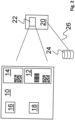
- FIG. 2 An inverter 10 with adjustable power class is shown schematically.
- the inverter 10 has a device type plate 12 which contains device-specific information of the inverter 10 which are independent of the power class.
- the inverter 10 also has a class plate 14 which consists of a plurality of power class-specific class plates 14.1, 14.2, 14.3, 14.4 ( Fig. 3 ) is selected and which contains information about the assigned power class.
- the device type plate 12 and the class plate 14 of the inverter 10 can be read visually.
- the information on the device type plate is preferably provided on the plates 12, 14 in the form of machine-readable image codes, such as barcodes or QR codes. Alternatively or additionally, the same information can be provided on the plates in a human-readable form.
- the device type plate 12 and the class plate 14 are arranged on the inverter 10 in such a way that they can be read out together as an image.
- the inverter 10 has a receiver 16 that is set up to receive an encrypted and/or signed setting sequence that contains information about the assigned power class.
- the inverter 10 has a controller 18 that is set up to decrypt the encrypted setting sequence and/or authenticate the signed setting sequence and set the power class of the inverter 10 based on the setting sequence.
- a mobile device 20 has a camera 22 that is set up to capture images of the device type plate 12 and the class plate 14, preferably together. Codes such as barcodes and/or QR codes can be read for this purpose. Alternatively or additionally, human-readable information can be captured and recorded by a programmed circuit, e.g. using an app, of the mobile device 20. An example of this is OCR (Optical Character Recognition) for text recognition.
- OCR Optical Character Recognition
- the mobile device is connected to a database 24 via a remote data connection 26, e.g. mobile communications and/or the Internet.
- a remote data connection 26 e.g. mobile communications and/or the Internet.
- the image-captured information can be authenticated and thus verified via the database, for example.
- a device type plate 12 and a class plate 14 are shown schematically, as they can be arranged on an inverter 10, for example. If they are arranged in the manner shown, they can be read out together visually, which speeds up the process and further increases the safety of the process.
- the device type plate 12 contains device-specific information of the inverter 10, which is independent of the power class.
- the class plate 14 is selected from a plurality of class plates 14.1, 14.2, 14.3, 14.4. Each of the class plates 14.1, 14.2, 14.3, 14.4 is power class specific, ie it is assigned to a power class to which the inverter 10 can be set.
- the Inverter 10 has an associated class plate 14.1, 14.2, 14.3, 14.4 for each power class to which it can be set.
- the majority of class plates 14.1, 14.2, 14.3, 14.4 are included in the scope of delivery of the inverter so that during installation, the one that corresponds to the power class to be set can be selected and attached to inverter 10.
Landscapes
- Engineering & Computer Science (AREA)
- Theoretical Computer Science (AREA)
- General Physics & Mathematics (AREA)
- Computer Security & Cryptography (AREA)
- Multimedia (AREA)
- Physics & Mathematics (AREA)
- Power Engineering (AREA)
- Human Computer Interaction (AREA)
- Computer Networks & Wireless Communication (AREA)
- Signal Processing (AREA)
- Software Systems (AREA)
- Management, Administration, Business Operations System, And Electronic Commerce (AREA)
- Inverter Devices (AREA)
- Power Sources (AREA)
- Remote Monitoring And Control Of Power-Distribution Networks (AREA)
Claims (14)
- Procédé de réglage d'une classe de puissance d'un onduleur (10), dans lequel l'onduleur (10) comprend une plaque de type d'appareil (12) contenant des informations spécifiques à l'appareil de l'onduleur (10), ces informations étant indépendantes de la classe de puissance sélectionnée, et dans lequel l'onduleur (10) comprend une plaque de classe (14) sélectionnée parmi une pluralité de plaques de classe spécifiques à une classe de puissance (14.1, 14.2, 14.3, 14.4), chacune étant affectée à une classe de puissance parmi une pluralité de classes de puissance et contenant des informations sur la classe de puissance affectée, dans lequel le procédé comprend les étapes suivantes :- capturer sous forme d'image la plaque de type d'appareil (12) et la plaque de classe (14) et lire les informations spécifiques à l'appareil et les informations sur la classe de puissance attribuée à partir des données capturées sous forme d'image,- communiquer une séquence de réglage à l'onduleur (10), la séquence de réglage comprenant les informations relatives à la classe de puissance attribuée,- réglage de la classe de puissance de l'onduleur (10) sur la base de la séquence de réglage après authentification des informations lues,la séquence de réglage, avant d'être communiquée à l'onduleur (10), est générée à partir des informations spécifiques à l'appareil et des informations relatives à la classe de puissance attribuée.
- Procédé selon la revendication 1, dans lequel la lecture sous forme d'image est précédée de la sélection de la plaque de classe (14) parmi la pluralité de plaques de classe (14.1, 14.2, 14.3, 14.4) et de la fixation, en particulier de la fixation permanente, de la plaque de classe (14) à l'onduleur (10).
- Procédé selon la revendication 1 ou 2, dans lequel l'onduleur (10) comprend des structures destinées à empêcher la manipulation de la plaque de classe (14) fixée.
- Procédé selon l'une des revendications précédentes, comprenant en outre l'authentification de la séquence de réglage communiquée avant le réglage de la classe de puissance de l'onduleur (10).
- Procédé selon la revendication 5, dans lequel l'authentification comprend la capture et la vérification d'informations sur la personne effectuant la capture sous forme d'image.
- Procédé selon la revendication 5 ou 6, dans lequel l'authentification consiste à vérifier s'il existe des conditions préalables au réglage de la classe de puissance de l'onduleur (10).
- Procédé selon la revendication 7, dans lequel l'authentification consiste à vérifier l'état des structures dans l'image capturée.
- Procédé selon l'une des revendications 5 à 8, dans lequel l'authentification comprend l'interrogation d'une base de données (24) par l'intermédiaire d'une connexion de données à distance (26).
- Procédé selon l'une des revendications 5 à 9, dans lequel, en cas d'authentification réussie, la séquence de réglage est transmise avec une section d'authentification, une section d'identification de l'onduleur et une section de classe de puissance à l'onduleur (10), dans lequel l'onduleur (10) vérifie la section d'authentification et la section d'identification de l'onduleur avant qu'une classe de puissance contenue dans la section de classe de puissance ne soit réglée, en particulier réglée de manière permanente.
- Procédé selon la revendication 10, dans lequel la capture sous forme d'image et la transmission de la séquence de réglage sont effectuées par un seul et même appareil (20), en particulier un smartphone.
- Procédé selon la revendication 10, dans lequel la séquence de réglage est transmise par un moyen de transmission indépendant du dispositif (20) utilisé pour la capture sous forme d'image.
- Procédé selon l'une des revendications précédentes, caractérisé en ce que la séquence de réglage est cryptée et/ou signée avant d'être communiquée à l'onduleur.
- Procédé selon l'une des revendications précédentes, dans lequel la communication de la séquence de réglage est effectuée après avoir vérifié si une combinaison des informations spécifiques à l'appareil et des informations relatives à la classe de puissance attribuée est une combinaison autorisée.
- Onduleur (10) avec une classe de puissance réglable, dans lequel l'onduleur comprend une plaque de type d'appareil (12) contenant des informations spécifiques à l'appareil de l'onduleur (10), ces informations étant indépendantes de la classe de puissance, et dans lequel l'onduleur (10) comprend une plaque de classe (14) sélectionnée parmi une pluralité de plaques de classe spécifiques à une classe de puissance (14.1, 14.2, 14.3, 14. 4), chacune affectée à une classe de puissance parmi la pluralité de classes de puissance et contenant des informations sur la classe de puissance affectée, dans laquelle la plaque de type d'appareil (12) et la plaque de classe (14) sont lisibles sous forme d'image et dans laquelle l'onduleur (10) comprend un récepteur (16) configuré pour recevoir une séquence de réglage cryptée et/ou signée sur la base des informations spécifiques à l'appareil et des informations sur la classe de puissance affectée, et dans lequel l'onduleur (10) comprend un contrôleur (18) configuré pour décrypter la séquence de réglage cryptée et/ou pour authentifier la séquence de réglage signée et pour régler la classe de puissance de l'onduleur (10) sur la base de la séquence de réglage.
Applications Claiming Priority (2)
| Application Number | Priority Date | Filing Date | Title |
|---|---|---|---|
| DE102020122705.1A DE102020122705A1 (de) | 2020-08-31 | 2020-08-31 | Verfahren zum einstellen einer leistungsklasse eines wechselrichters und wechselrichter |
| PCT/EP2021/074017 WO2022043582A1 (fr) | 2020-08-31 | 2021-08-31 | Procédé de réglage d'une classe de puissance d'un onduleur et onduleur |
Publications (3)
| Publication Number | Publication Date |
|---|---|
| EP4205253A1 EP4205253A1 (fr) | 2023-07-05 |
| EP4205253B1 true EP4205253B1 (fr) | 2025-02-12 |
| EP4205253C0 EP4205253C0 (fr) | 2025-02-12 |
Family
ID=77750285
Family Applications (1)
| Application Number | Title | Priority Date | Filing Date |
|---|---|---|---|
| EP21769985.9A Active EP4205253B1 (fr) | 2020-08-31 | 2021-08-31 | Procédé de réglage d'une classe de puissance d'un onduleur et onduleur |
Country Status (6)
| Country | Link |
|---|---|
| US (1) | US12562588B2 (fr) |
| EP (1) | EP4205253B1 (fr) |
| JP (1) | JP7767398B2 (fr) |
| CN (1) | CN116076009A (fr) |
| DE (1) | DE102020122705A1 (fr) |
| WO (1) | WO2022043582A1 (fr) |
Families Citing this family (2)
| Publication number | Priority date | Publication date | Assignee | Title |
|---|---|---|---|---|
| DE102022133551A1 (de) * | 2022-12-15 | 2024-06-20 | Sma Solar Technology Ag | Verfahren zum betrieb einer leistungselektronischen vorrichtung und leistungselektronische vorrichtung |
| CN117134486B (zh) * | 2023-07-17 | 2024-06-07 | 恩沃新能源科技(上海)有限公司 | 一种改变微型逆变器功率的方法及系统 |
Family Cites Families (15)
| Publication number | Priority date | Publication date | Assignee | Title |
|---|---|---|---|---|
| US4755850A (en) * | 1981-01-13 | 1988-07-05 | Canon Kabushiki Kaisha | Electrostatic recording apparatus including a controlled developer device |
| US5946210A (en) * | 1996-04-19 | 1999-08-31 | Vlt Corporation | Configuring power converters |
| US6256732B1 (en) * | 1998-06-25 | 2001-07-03 | International Business Machines Corporation | Computer system having automatic registration for in-box configuration |
| US8477045B2 (en) * | 2009-10-29 | 2013-07-02 | Hewlett-Packard Development Company, L.P. | Configuration information provided to configurable electronic device residing in a shipping box |
| US8762704B2 (en) * | 2011-09-29 | 2014-06-24 | Apple Inc. | Customized content for electronic devices |
| US20130342458A1 (en) * | 2012-06-23 | 2013-12-26 | VillageTech Solutions | Methods and systems for input to an interactive audiovisual device |
| US11388799B2 (en) * | 2012-11-08 | 2022-07-12 | Applied Biophotonics Ltd. | Distributed photobiomodulation therapy system and method |
| DE102015101684A1 (de) | 2014-02-28 | 2015-09-03 | Sma Solar Technology Ag | Verfahren zum Betrieb einer elektronischen Komponente einer Energieerzeugungsanlage sowie RFID-Transponder und elektronische Komponente mit einem RFID-Transponder |
| US20150256355A1 (en) * | 2014-03-07 | 2015-09-10 | Robert J. Pera | Wall-mounted interactive sensing and audio-visual node devices for networked living and work spaces |
| JP6317182B2 (ja) * | 2014-05-30 | 2018-04-25 | 東芝シュネデール・インバータ株式会社 | インバータ装置 |
| JP6223289B2 (ja) * | 2014-06-24 | 2017-11-01 | 京セラ株式会社 | 電力管理装置の設定方法、電力管理システム及びプログラム |
| JP2016107445A (ja) * | 2014-12-03 | 2016-06-20 | セイコーエプソン株式会社 | 液体吐出装置、ヘッドユニット、容量性負荷駆動用集積回路装置、容量性負荷駆動回路及び液体吐出装置の製造方法 |
| DE102014226620A1 (de) | 2014-12-19 | 2016-06-23 | Robert Bosch Gmbh | Verfahren und Vorrichtung zur Parametrierung zumindest einer Komponente einer elektrohydraulischen Antriebseinheit |
| JP6892981B2 (ja) * | 2016-10-11 | 2021-06-23 | 株式会社 Global Data Systems | トレーサビリティサポートシステムおよびトレーサビリティサポート装置 |
| US11086279B2 (en) | 2017-07-31 | 2021-08-10 | Solaredge Technologies Ltd. | Method to prepare a power converter or other apparatus for configuration |
-
2020
- 2020-08-31 DE DE102020122705.1A patent/DE102020122705A1/de active Pending
-
2021
- 2021-08-31 WO PCT/EP2021/074017 patent/WO2022043582A1/fr not_active Ceased
- 2021-08-31 CN CN202180053721.7A patent/CN116076009A/zh active Pending
- 2021-08-31 EP EP21769985.9A patent/EP4205253B1/fr active Active
- 2021-08-31 JP JP2023512169A patent/JP7767398B2/ja active Active
-
2023
- 2023-02-13 US US18/108,840 patent/US12562588B2/en active Active
Also Published As
| Publication number | Publication date |
|---|---|
| US12562588B2 (en) | 2026-02-24 |
| EP4205253A1 (fr) | 2023-07-05 |
| JP2023539823A (ja) | 2023-09-20 |
| CN116076009A (zh) | 2023-05-05 |
| WO2022043582A1 (fr) | 2022-03-03 |
| JP7767398B2 (ja) | 2025-11-11 |
| DE102020122705A1 (de) | 2022-03-03 |
| US20230187967A1 (en) | 2023-06-15 |
| EP4205253C0 (fr) | 2025-02-12 |
Similar Documents
| Publication | Publication Date | Title |
|---|---|---|
| EP2572323B1 (fr) | Procédé et dispositif d'intégration d'un appareil dans un réseau | |
| EP2705410B1 (fr) | Procédé et système pour fournir des données d'exploitant, spécifiques d'un appareil, pour un appareil d'automatisation d'une installation d'automatisation | |
| DE102011004978B4 (de) | Verfahren, Steuerungseinrichtung und System zum Nachweis von Verletzungen der Authentzität von Anlagenkomponenten | |
| DE112007001635T5 (de) | Authentifizierung von Komponenten bei Computersystemen | |
| RU2523927C2 (ru) | Проверка изменения конфигурации (ied) | |
| DE102015005232B4 (de) | Steuern einer Freischaltberechtigung eines Kraftfahrzeugs | |
| EP4205253A1 (fr) | Procédé de réglage d'une classe de puissance d'un onduleur et onduleur | |
| EP3422628B1 (fr) | Procédé, dispositif de sécurité et système de sécurité | |
| DE102012008519A1 (de) | Sicherung eines Energiemengenzählers gegen unbefugten Zugriff | |
| EP2389644B1 (fr) | Procédé de déverrouillage d'une fonction de carte à puce, et lecteur de carte | |
| EP2996299B1 (fr) | Procédé et système d'autorisation d'une action sur un système auto-commandé | |
| DE102018132979A1 (de) | Abgesichertes und intelligentes Betreiben einer Ladeinfrastruktur | |
| EP3657750B1 (fr) | Procédé d'authentification des lunettes intelligentes dans un réseau de données | |
| WO2011072952A1 (fr) | Dispositif et procédé pour accorder des droits d'accès à une fonctionnalité de maintenance | |
| EP3289509A1 (fr) | Procédé pour produire une signature électronique | |
| DE102022125109B4 (de) | Verfahren zum Authentifizieren eines Zugangs eines Kraftfahrzeugs zu einem zugangsbeschränkten Bereich | |
| WO2024126006A1 (fr) | Configuration par logiciel de la classe de puissance et fonctions supplémentaires d'un onduleur | |
| EP1652131B1 (fr) | Procede d'emission d'un support de donnees portable. | |
| DE102007061825A1 (de) | Elektronisches Etikett zur Produktsicherung | |
| DE102022103943B3 (de) | Verfahren zum Überprüfen einer Zugangsberechtigung zu einem Fahrzeug, Fahrzeugentriegelungsvorrichtung und Fahrzeug | |
| EP3441945A1 (fr) | Procédé de fonctionnement d'un système de contrôle d'accès comprenant un serveur, au moins un dispositif de contrôle d'accès et au moins un appareil de point de ventes de droits d'accès pour la zone contrôlée par le système de contrôle d'accès | |
| EP3797036B2 (fr) | Système de marquage pour marquer un objet de repérage | |
| WO2026032733A1 (fr) | Procédé et dispositif de commande de charge pour autoriser automatiquement un véhicule à utiliser une station de charge | |
| EP4567757A1 (fr) | Procédé et dispositif pour déterminer si une information a été conforme à un compartiment d'un compartiment de stockage | |
| EP4488774A1 (fr) | Procédé et dispositif d'accès sécurisé à un composant d'automatisation industrielle |
Legal Events
| Date | Code | Title | Description |
|---|---|---|---|
| STAA | Information on the status of an ep patent application or granted ep patent |
Free format text: STATUS: UNKNOWN |
|
| STAA | Information on the status of an ep patent application or granted ep patent |
Free format text: STATUS: THE INTERNATIONAL PUBLICATION HAS BEEN MADE |
|
| PUAI | Public reference made under article 153(3) epc to a published international application that has entered the european phase |
Free format text: ORIGINAL CODE: 0009012 |
|
| STAA | Information on the status of an ep patent application or granted ep patent |
Free format text: STATUS: REQUEST FOR EXAMINATION WAS MADE |
|
| 17P | Request for examination filed |
Effective date: 20230223 |
|
| AK | Designated contracting states |
Kind code of ref document: A1 Designated state(s): AL AT BE BG CH CY CZ DE DK EE ES FI FR GB GR HR HU IE IS IT LI LT LU LV MC MK MT NL NO PL PT RO RS SE SI SK SM TR |
|
| DAV | Request for validation of the european patent (deleted) | ||
| DAX | Request for extension of the european patent (deleted) | ||
| GRAP | Despatch of communication of intention to grant a patent |
Free format text: ORIGINAL CODE: EPIDOSNIGR1 |
|
| STAA | Information on the status of an ep patent application or granted ep patent |
Free format text: STATUS: GRANT OF PATENT IS INTENDED |
|
| INTG | Intention to grant announced |
Effective date: 20241008 |
|
| GRAS | Grant fee paid |
Free format text: ORIGINAL CODE: EPIDOSNIGR3 |
|
| GRAA | (expected) grant |
Free format text: ORIGINAL CODE: 0009210 |
|
| STAA | Information on the status of an ep patent application or granted ep patent |
Free format text: STATUS: THE PATENT HAS BEEN GRANTED |
|
| AK | Designated contracting states |
Kind code of ref document: B1 Designated state(s): AL AT BE BG CH CY CZ DE DK EE ES FI FR GB GR HR HU IE IS IT LI LT LU LV MC MK MT NL NO PL PT RO RS SE SI SK SM TR |
|
| REG | Reference to a national code |
Ref country code: GB Ref legal event code: FG4D Free format text: NOT ENGLISH |
|
| REG | Reference to a national code |
Ref country code: CH Ref legal event code: EP |
|
| REG | Reference to a national code |
Ref country code: DE Ref legal event code: R096 Ref document number: 502021006639 Country of ref document: DE |
|
| REG | Reference to a national code |
Ref country code: IE Ref legal event code: FG4D Free format text: LANGUAGE OF EP DOCUMENT: GERMAN |
|
| U01 | Request for unitary effect filed |
Effective date: 20250213 |
|
| U07 | Unitary effect registered |
Designated state(s): AT BE BG DE DK EE FI FR IT LT LU LV MT NL PT RO SE SI Effective date: 20250220 |
|
| PG25 | Lapsed in a contracting state [announced via postgrant information from national office to epo] |
Ref country code: RS Free format text: LAPSE BECAUSE OF FAILURE TO SUBMIT A TRANSLATION OF THE DESCRIPTION OR TO PAY THE FEE WITHIN THE PRESCRIBED TIME-LIMIT Effective date: 20250512 |
|
| PG25 | Lapsed in a contracting state [announced via postgrant information from national office to epo] |
Ref country code: PL Free format text: LAPSE BECAUSE OF FAILURE TO SUBMIT A TRANSLATION OF THE DESCRIPTION OR TO PAY THE FEE WITHIN THE PRESCRIBED TIME-LIMIT Effective date: 20250212 |
|
| PG25 | Lapsed in a contracting state [announced via postgrant information from national office to epo] |
Ref country code: ES Free format text: LAPSE BECAUSE OF FAILURE TO SUBMIT A TRANSLATION OF THE DESCRIPTION OR TO PAY THE FEE WITHIN THE PRESCRIBED TIME-LIMIT Effective date: 20250212 |
|
| PG25 | Lapsed in a contracting state [announced via postgrant information from national office to epo] |
Ref country code: IS Free format text: LAPSE BECAUSE OF FAILURE TO SUBMIT A TRANSLATION OF THE DESCRIPTION OR TO PAY THE FEE WITHIN THE PRESCRIBED TIME-LIMIT Effective date: 20250612 Ref country code: NO Free format text: LAPSE BECAUSE OF FAILURE TO SUBMIT A TRANSLATION OF THE DESCRIPTION OR TO PAY THE FEE WITHIN THE PRESCRIBED TIME-LIMIT Effective date: 20250512 |
|
| PG25 | Lapsed in a contracting state [announced via postgrant information from national office to epo] |
Ref country code: HR Free format text: LAPSE BECAUSE OF FAILURE TO SUBMIT A TRANSLATION OF THE DESCRIPTION OR TO PAY THE FEE WITHIN THE PRESCRIBED TIME-LIMIT Effective date: 20250212 |
|
| PG25 | Lapsed in a contracting state [announced via postgrant information from national office to epo] |
Ref country code: GR Free format text: LAPSE BECAUSE OF FAILURE TO SUBMIT A TRANSLATION OF THE DESCRIPTION OR TO PAY THE FEE WITHIN THE PRESCRIBED TIME-LIMIT Effective date: 20250513 |
|
| U20 | Renewal fee for the european patent with unitary effect paid |
Year of fee payment: 5 Effective date: 20250826 |
|
| PG25 | Lapsed in a contracting state [announced via postgrant information from national office to epo] |
Ref country code: SM Free format text: LAPSE BECAUSE OF FAILURE TO SUBMIT A TRANSLATION OF THE DESCRIPTION OR TO PAY THE FEE WITHIN THE PRESCRIBED TIME-LIMIT Effective date: 20250212 |
|
| PGFP | Annual fee paid to national office [announced via postgrant information from national office to epo] |
Ref country code: GB Payment date: 20250822 Year of fee payment: 5 |
|
| PG25 | Lapsed in a contracting state [announced via postgrant information from national office to epo] |
Ref country code: CZ Free format text: LAPSE BECAUSE OF FAILURE TO SUBMIT A TRANSLATION OF THE DESCRIPTION OR TO PAY THE FEE WITHIN THE PRESCRIBED TIME-LIMIT Effective date: 20250212 |
|
| PG25 | Lapsed in a contracting state [announced via postgrant information from national office to epo] |
Ref country code: SK Free format text: LAPSE BECAUSE OF FAILURE TO SUBMIT A TRANSLATION OF THE DESCRIPTION OR TO PAY THE FEE WITHIN THE PRESCRIBED TIME-LIMIT Effective date: 20250212 |
|
| PLBE | No opposition filed within time limit |
Free format text: ORIGINAL CODE: 0009261 |
|
| STAA | Information on the status of an ep patent application or granted ep patent |
Free format text: STATUS: NO OPPOSITION FILED WITHIN TIME LIMIT |
|
| REG | Reference to a national code |
Ref country code: CH Ref legal event code: L10 Free format text: ST27 STATUS EVENT CODE: U-0-0-L10-L00 (AS PROVIDED BY THE NATIONAL OFFICE) Effective date: 20251224 |
|
| 26N | No opposition filed |
Effective date: 20251113 |
|
| REG | Reference to a national code |
Ref country code: CH Ref legal event code: H13 Free format text: ST27 STATUS EVENT CODE: U-0-0-H10-H13 (AS PROVIDED BY THE NATIONAL OFFICE) Effective date: 20260324 |
|
| PG25 | Lapsed in a contracting state [announced via postgrant information from national office to epo] |
Ref country code: MC Free format text: LAPSE BECAUSE OF FAILURE TO SUBMIT A TRANSLATION OF THE DESCRIPTION OR TO PAY THE FEE WITHIN THE PRESCRIBED TIME-LIMIT Effective date: 20250212 |
|
| PG25 | Lapsed in a contracting state [announced via postgrant information from national office to epo] |
Ref country code: CH Free format text: LAPSE BECAUSE OF NON-PAYMENT OF DUE FEES Effective date: 20250831 |