EP4206162A1 - Verfahren zur herstellung eines oxidpulvers von aktiniden aus einer kolloidalen sol-gel-lösung - Google Patents
Verfahren zur herstellung eines oxidpulvers von aktiniden aus einer kolloidalen sol-gel-lösung Download PDFInfo
- Publication number
- EP4206162A1 EP4206162A1 EP22215699.4A EP22215699A EP4206162A1 EP 4206162 A1 EP4206162 A1 EP 4206162A1 EP 22215699 A EP22215699 A EP 22215699A EP 4206162 A1 EP4206162 A1 EP 4206162A1
- Authority
- EP
- European Patent Office
- Prior art keywords
- aca
- actinide
- nitrate
- thorium
- molar ratio
- Prior art date
- Legal status (The legal status is an assumption and is not a legal conclusion. Google has not performed a legal analysis and makes no representation as to the accuracy of the status listed.)
- Granted
Links
Images




Classifications
-
- C—CHEMISTRY; METALLURGY
- C04—CEMENTS; CONCRETE; ARTIFICIAL STONE; CERAMICS; REFRACTORIES
- C04B—LIME, MAGNESIA; SLAG; CEMENTS; COMPOSITIONS THEREOF, e.g. MORTARS, CONCRETE OR LIKE BUILDING MATERIALS; ARTIFICIAL STONE; CERAMICS; REFRACTORIES; TREATMENT OF NATURAL STONE
- C04B35/00—Shaped ceramic products characterised by their composition; Ceramics compositions; Processing powders of inorganic compounds preparatory to the manufacturing of ceramic products
- C04B35/51—Shaped ceramic products characterised by their composition; Ceramics compositions; Processing powders of inorganic compounds preparatory to the manufacturing of ceramic products based on compounds of actinides
-
- C—CHEMISTRY; METALLURGY
- C01—INORGANIC CHEMISTRY
- C01F—COMPOUNDS OF THE METALS BERYLLIUM, MAGNESIUM, ALUMINIUM, CALCIUM, STRONTIUM, BARIUM, RADIUM, THORIUM, OR OF THE RARE-EARTH METALS
- C01F15/00—Compounds of thorium
-
- C—CHEMISTRY; METALLURGY
- C04—CEMENTS; CONCRETE; ARTIFICIAL STONE; CERAMICS; REFRACTORIES
- C04B—LIME, MAGNESIA; SLAG; CEMENTS; COMPOSITIONS THEREOF, e.g. MORTARS, CONCRETE OR LIKE BUILDING MATERIALS; ARTIFICIAL STONE; CERAMICS; REFRACTORIES; TREATMENT OF NATURAL STONE
- C04B35/00—Shaped ceramic products characterised by their composition; Ceramics compositions; Processing powders of inorganic compounds preparatory to the manufacturing of ceramic products
- C04B35/622—Forming processes; Processing powders of inorganic compounds preparatory to the manufacturing of ceramic products
- C04B35/624—Sol-gel processing
-
- C—CHEMISTRY; METALLURGY
- C04—CEMENTS; CONCRETE; ARTIFICIAL STONE; CERAMICS; REFRACTORIES
- C04B—LIME, MAGNESIA; SLAG; CEMENTS; COMPOSITIONS THEREOF, e.g. MORTARS, CONCRETE OR LIKE BUILDING MATERIALS; ARTIFICIAL STONE; CERAMICS; REFRACTORIES; TREATMENT OF NATURAL STONE
- C04B35/00—Shaped ceramic products characterised by their composition; Ceramics compositions; Processing powders of inorganic compounds preparatory to the manufacturing of ceramic products
- C04B35/622—Forming processes; Processing powders of inorganic compounds preparatory to the manufacturing of ceramic products
- C04B35/626—Preparing or treating the powders individually or as batches ; preparing or treating macroscopic reinforcing agents for ceramic products, e.g. fibres; mechanical aspects section B
- C04B35/62605—Treating the starting powders individually or as mixtures
- C04B35/62645—Thermal treatment of powders or mixtures thereof other than sintering
- C04B35/62655—Drying, e.g. freeze-drying, spray-drying, microwave or supercritical drying
-
- C—CHEMISTRY; METALLURGY
- C04—CEMENTS; CONCRETE; ARTIFICIAL STONE; CERAMICS; REFRACTORIES
- C04B—LIME, MAGNESIA; SLAG; CEMENTS; COMPOSITIONS THEREOF, e.g. MORTARS, CONCRETE OR LIKE BUILDING MATERIALS; ARTIFICIAL STONE; CERAMICS; REFRACTORIES; TREATMENT OF NATURAL STONE
- C04B2235/00—Aspects relating to ceramic starting mixtures or sintered ceramic products
- C04B2235/02—Composition of constituents of the starting material or of secondary phases of the final product
- C04B2235/30—Constituents and secondary phases not being of a fibrous nature
- C04B2235/44—Metal salt constituents or additives chosen for the nature of the anions, e.g. hydrides or acetylacetonate
- C04B2235/443—Nitrates or nitrites
Definitions
- the invention relates to a process for the preparation of a powder of actinide(s) oxide(s) from a stable colloidal sol-gel solution comprising colloids of controlled sizes resulting from the partial polycondensation of nitrate (s) of actinide(s), said powder being able to be characterized by a uniformly distributed, percolating microporosity, with micropores of controlled and interconnected sizes and being also able to be characterized by a macroporosity allowing better accessibility of the microporosity for any physical process or chemical requiring to be carried out on the surface of the material and thus a better specific surface.
- the powders obtained by the process of the invention have the properties inherent in an oxide ceramic, namely the refractory character, the thermal or chemical stability in a wide range of backgrounds.
- the invention can thus find application in the field of porous ceramics, catalysis or even the field of nuclear fuels.
- the powders of the invention are obtained from a colloidal solution-gel, which therefore results from a sol-gel process.
- the sol-gel process falls into the category of processes for producing inorganic or hybrid materials using a wet process and at low temperatures (generally below 100° C. before heat treatment).
- the sol-gel process involves the use of metal precursors (generally in the form of alkoxides or in the form of salts), which are first dissolved in at least one solvent (aqueous or organic) then undergo, in a second step, a sol-gel transition resulting from the triggering of hydrolysis reactions then condensation to form the formation of hydroxos (M-OH-M) or oxos (MOM) bridges ) between the metal atoms M and the concomitant formation of a three-dimensional network swollen with solvent, which can be described as a gel.
- metal precursors generally in the form of alkoxides or in the form of salts
- solvent aqueous or organic
- the gel can then be subjected to drying, to eliminate the liquid phase, possibly shaping (depending on the nature of the material that one wishes to obtain, for example, a powder, a film, a monolithic material) and a treatment thermal end (for example, calcination, sintering) depending on the nature of the material sought.
- sol-gel processes Two types of sol-gel processes exist: the polymeric sol-gel process and the colloidal sol-gel process, which differ in the nature of the precursor used, on the one hand (an alkoxide precursor for the polymeric sol-gel process and a salt precursor for the colloidal sol-gel process) and which differ, on the other hand, by the physico-chemical nature of the sol relative to the inorganic polymerization conditions.
- sol-gel transition takes place by the formation of polymer chains which intertwine to form a three-dimensional network that can be described as a “polymer gel”.
- the process is based on the formation of a sol, that is to say a dispersion of dense particles by nucleation, said particles generally having a nanometric size (for example, a few nanometers to a few tens of nanometers), the dispersion being caused to be destabilized in a controlled manner until it forms a three-dimensional network formed of soil particles linked together by oxo and hydroxos bonds without precipitation, this network being able to be qualified as a colloidal gel.
- a sol that is to say a dispersion of dense particles by nucleation, said particles generally having a nanometric size (for example, a few nanometers to a few tens of nanometers)
- the dispersion being caused to be destabilized in a controlled manner until it forms a three-dimensional network formed of soil particles linked together by oxo and hydroxos bonds without precipitation, this network being able to be qualified as a colloidal gel.
- the inventors have set themselves the objective of developing a process for manufacturing a powder of actinide(s) oxide(s) advantageously in the form of a stack of nanoparticles and advantageously having a uniformly distributed, percolating microporosity, with micropores of controlled and interconnected sizes and characterized, advantageously , by a macroporosity allowing a better accessibility of the microporosity for any physical or chemical process requiring to be carried out on the surface of the material and thus a better specific surface.
- the process of the invention of the invention is a process of simple implementation, involving few ingredients and allowing the obtaining, initially, of a stable sol-gel solution, that is to say say a solution whose state does not change for a long period of time, for example, for more than a year, without the appearance of sedimentation, sineresis and/or flocculation phenomena and, secondly, after lyophilization and heat treatment, a powder composed, advantageously, of a stack of nanoparticles of actinide(s) oxide(s).
- the said chemical element(s) capable of entering into the composition of the powder are actinide elements, and, in particular, it may be thorium, in which case the powder of actinide(s) oxide(s) prepared in accordance with the method of the invention is a powder of thorium oxide ThOz.
- the process of the invention comprises, in the first place, a step of preparing a sol-gel solution comprising colloids based on actinide(s) by bringing into contact with at least one nitrate of actinide (for example, thorium nitrate) with at least one amino acid, the bringing into contact taking place at a pH ranging from 3 to 6.
- a nitrate of actinide for example, thorium nitrate
- the preparation step may involve a single actinide nitrate, which may be thorium nitrate.
- the thorium nitrate may be thorium nitrate pentahydrate (Th(NO 3 ) 4 .5H 2 O).
- the amino acid(s) used in the implementation of step a) correspond, conventionally, to a carboxylic acid also comprising an amine group and, more particularly, a primary amine group.
- amino acid(s) can be linear amino acids comprising, for example, from 2 to 6 carbon atoms, a preferred amino acid falling into this category being 6-aminocaproic acid (also called acid 6-aminohexanoic acid) of the following formula:
- the amino acid(s) can be used in the form of a solution comprising it or them with, for example, the concentration of the amino acid(s) in the solution being fixed according to the molar ratio (actinide/amino acid ) wish.
- the actinide nitrate(s) is thorium nitrate and the amino acid is 6-aminocaproic acid
- the molar ratio between thorium and the 6-aminocaproic acid can range from 0.25 to 2 and can more particularly be equal to 0.25; 0.5; 1 or 2.
- the bringing into contact is carried out at a pH ranging from 3 to 6, this pH being able to be obtained by adding a base, such as ammonia (NH 4 OH), this addition being able to be carried out drop by drop until to obtain the desired pH in the aforementioned range and this addition can be carried out with stirring.
- a base such as ammonia (NH 4 OH)
- the contacting is carried out with stirring, so as to obtain an intimate mixture between the actinide nitrate(s) and the amino acid(s).
- the formation of the colloidal sol-gel solution takes place by hydrolysis and condensation reactions, which reactions can lead to the formation of complexes of hexamers or nanoparticles of the sol then bonds between them or they.
- the colloidal sol-gel solution obtained at the end of step a) comprises colloids of controlled sizes (for example, from 1.5 to 3, 5 nm) on the basis of a control of the reactions of hydrolysis and condensation of the polynuclear species of thorium existing in aqueous medium and this by the simultaneous control of the pH and the complexation of the species.
- the colloidal sol-gel solutions obtained at the end of step a) are stable solutions for more than one year, namely that they do not undergo sedimentation, sineresis and flocculation and can therefore be stored under liquid form without risk of radioactive contamination as may be the case with powder systems.
- the step of preparing the colloidal sol-gel solution is subjected to a freeze-drying step, this step conventionally comprising an operation of freezing the colloidal sol-gel solution followed by an operation of sublimation of the frozen water, this freeze-drying step being able to be carried out at a temperature ranging from -80°C to -110°C, for example, -110°C, and at a pressure ranging from 0.001 mTorr to 10 mTorr, for example, 1, 15 mTorr.
- This freeze-drying step results in a product in the form of a paste, which will be subjected to a heat treatment step to form the actinide oxide(s).
- This heat treatment step consists, conventionally, in heating the paste to an effective temperature to eliminate the organic part, namely, in this case, the amino acid(s) used in step a), this heat treatment step also being implementation, advantageously, under air so as to form the oxide(s) of actinide(s).
- the heat treatment step may consist of heating the paste to a temperature of 230°C for 5 hours, this temperature of 230°C being able to be reached by a ramp of 2, 5 or 10°C/min.
- the actinide(s) oxide(s) powder in particular when the actinide(s) nitrate is a thorium nitrate and the amino acid is 6-aminocaproic acid , can be in the form of a stack of actinide(s) oxide nanoparticles, for example, oxide of thorium ThOz, presenting a controlled, percolating and homogeneously distributed microporosity with micropores interconnected between them and also presenting a macroporosity and an important specific surface which allows a better accessibility for any physical or chemical process requiring to be carried out on the surface of the material, catalysis for example and, more specifically, heterogeneous catalysis (the large specific surface making it possible to create a large quantity of reactive groups) or impregnation with a solution of actinides to prepare a mixed nuclear fuel.
- a stack of actinide(s) oxide nanoparticles for example, oxide of thorium ThOz
- the elimination of the amino acid(s) makes it possible, on the one hand, to form a material corresponding to a stack of nanoparticles of actinide oxide(s) generating microporosity controlled, percolating and distributed in a homogeneous way and, on the other hand, the thermal explosion occurring during the heat treatment making it possible to form the macroporosity.
- the first phase constitutes the preparation of stable colloidal solutions based on thorium (IV).
- thorium nitrate pentahydrate (Th(NO 3 ) 4.5H 2 O) is added to a solution of 2.5 mL of 6-aminocaproic acid (called ACA below), the resulting concentration of Th (IV) being 0.35M, the concentration of ACA in the solution being variable depending on the desired molar ratio (Th/ACA).
- ACA 6-aminocaproic acid
- the pH is then adjusted by adding a 3M ammonia solution (NH 4 OH) with stirring, the amount of ammonia solution added depending on the desired pH.
- colloidal solutions with respective molar ratios (0.25; 0.5; 1 and 2) and respective pHs (3; 4; 5 and 6) are prepared.
- the structure and organization of the colloidal solutions obtained and, more specifically, the size of the objects present in the colloidal solutions and their interactions were determined by the technique of Small Angle X-rays Scattering (known as SAFX) as discussed below.
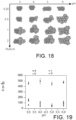
- the size distributions of these objects obtained by simulation of the X-ray scattering curves are represented on the figure 6 , which is a graph having the diameter D (in nm) as the abscissa and the Th/ACA molar ratio as the ordinate, while the figure 7 illustrates a diagram of the objects (complexes of hexamers, nanoparticles and aggregates) present in the colloidal solutions according to the conditions of pH and Th/ACA molar ratio according to the methods of representation of the objects already illustrated on the figure 5 mentioned above.
- the colloidal solutions obtained in Example 1 above are subjected to a freeze-drying treatment at -110° C. and 1.15 nmTorr for 24 hours so as to eliminate the water molecules located in the core of the complexes or nanoparticles and those physisorbed, this elimination resulting in a rimpedement of the polynuclear/colloid species or even a self-assembly of these species or an organization of these. Freeze-drying also allows preservation of the surface state (complexation and charge) of the hexamers and nanoparticles.
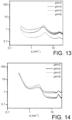
- SAXS the ordinate representing the intensity in cm -1 and the abscissa q representing the scattering vector in nm -1
- the pastes obtained at the end of the freeze-drying are then heat-treated in air at 230° C. for 5 hours using a temperature rise ramp of 10° C./min to eliminate the ACA.
- the characteristic distance d (d 2 ⁇ /q) corresponding to the maximum intensity of the peak at 3 nm -1 and relative to an average distance between the pores, increases with the molar ratio (Th/ACA) from 1.5 nm to 2.5 nm as evidenced by the table below. Moreover, when the molar ratio (Th/ACA) increases and/or the pH decreases, this same peak becomes broader and less intense. indicating loss of pore structure. This phenomenon comes from the formation of crystallites having a size larger than the size of the nanoparticles.
- the porosity present within these materials is accessible as shown by the maps of Th and Hf obtained by scanning electron microscopy coupled with EDS after impregnation of the powder with a solution of HfCl 4 .
Landscapes
- Chemical & Material Sciences (AREA)
- Engineering & Computer Science (AREA)
- Ceramic Engineering (AREA)
- Manufacturing & Machinery (AREA)
- Organic Chemistry (AREA)
- Inorganic Chemistry (AREA)
- Materials Engineering (AREA)
- Structural Engineering (AREA)
- Physics & Mathematics (AREA)
- Thermal Sciences (AREA)
- Life Sciences & Earth Sciences (AREA)
- Geology (AREA)
- Dispersion Chemistry (AREA)
- Plasma & Fusion (AREA)
- Colloid Chemistry (AREA)
- Inorganic Compounds Of Heavy Metals (AREA)
Applications Claiming Priority (1)
| Application Number | Priority Date | Filing Date | Title |
|---|---|---|---|
| FR2114694A FR3131583B1 (fr) | 2021-12-30 | 2021-12-30 | Procédé de préparation d’une poudre d’oxyde(s) d’actinide(s) à partir d’une solution sol-gel colloïdale |
Publications (3)
| Publication Number | Publication Date |
|---|---|
| EP4206162A1 true EP4206162A1 (de) | 2023-07-05 |
| EP4206162B1 EP4206162B1 (de) | 2024-08-07 |
| EP4206162C0 EP4206162C0 (de) | 2024-08-07 |
Family
ID=81749040
Family Applications (1)
| Application Number | Title | Priority Date | Filing Date |
|---|---|---|---|
| EP22215699.4A Active EP4206162B1 (de) | 2021-12-30 | 2022-12-21 | Verfahren zur herstellung eines oxidpulvers von aktiniden aus einer kolloidalen sol-gel-lösung |
Country Status (2)
| Country | Link |
|---|---|
| EP (1) | EP4206162B1 (de) |
| FR (1) | FR3131583B1 (de) |
Citations (2)
| Publication number | Priority date | Publication date | Assignee | Title |
|---|---|---|---|---|
| US3280011A (en) * | 1958-06-19 | 1966-10-18 | Diamond Alkali Co | Preparation of thoria sols by electrodialysis |
| FR3070278A1 (fr) * | 2017-08-23 | 2019-03-01 | Commissariat A L'energie Atomique Et Aux Energies Alternatives | Procede de preparation d'une poudre comprenant de l'oxyde d'uranium uo2, eventuellement de l'oxyde de plutonium puo2 et eventuellement de l'oxyde d'americium amo2 et/ou un oxyde d'un autre actinide mineur |
-
2021
- 2021-12-30 FR FR2114694A patent/FR3131583B1/fr active Active
-
2022
- 2022-12-21 EP EP22215699.4A patent/EP4206162B1/de active Active
Patent Citations (2)
| Publication number | Priority date | Publication date | Assignee | Title |
|---|---|---|---|---|
| US3280011A (en) * | 1958-06-19 | 1966-10-18 | Diamond Alkali Co | Preparation of thoria sols by electrodialysis |
| FR3070278A1 (fr) * | 2017-08-23 | 2019-03-01 | Commissariat A L'energie Atomique Et Aux Energies Alternatives | Procede de preparation d'une poudre comprenant de l'oxyde d'uranium uo2, eventuellement de l'oxyde de plutonium puo2 et eventuellement de l'oxyde d'americium amo2 et/ou un oxyde d'un autre actinide mineur |
Non-Patent Citations (2)
| Title |
|---|
| ANNIE D ET AL: "Freeze drying vs microwave drying-methods for synthesis of sinteractive thoria powders", vol. 484, 18 November 2016 (2016-11-18), pages 51 - 58, XP029885143, ISSN: 0022-3115, Retrieved from the Internet <URL:https://www.sciencedirect.com/science/article/pii/S0022311516307036?via%3Dihub> [retrieved on 20220913], DOI: 10.1016/J.JNUCMAT.2016.11.019 * |
| HENNIG CHRISTOPH ET AL: "Structure and stability range of a hexanuclear Th(iv)-glycine complex", vol. 41, no. 41, 2012, Cambridge, pages 12818, XP055959771, ISSN: 1477-9226, Retrieved from the Internet <URL:https://pubs.rsc.org/en/content/articlepdf/2012/dt/c2dt31367g> [retrieved on 20220913], DOI: 10.1039/c2dt31367g * |
Also Published As
| Publication number | Publication date |
|---|---|
| FR3131583B1 (fr) | 2024-01-19 |
| FR3131583A1 (fr) | 2023-07-07 |
| EP4206162B1 (de) | 2024-08-07 |
| EP4206162C0 (de) | 2024-08-07 |
Similar Documents
| Publication | Publication Date | Title |
|---|---|---|
| CA1229530A (fr) | Procede de fabrication d'un element de microfiltration, d'ultrafiltration ou d'osmose inverse | |
| WO2019243602A1 (en) | Nanoreactors for the synthesis of porous crystalline materials | |
| US20250197296A1 (en) | Performance of technical ceramics | |
| EP2072462A1 (de) | Verfahren zur herstellung einer dispersion von feinen metallverbindungsteilchen und dispersion | |
| EP4245793A1 (de) | Verfahren zur herstellung von hochdispergierbaren radikalfänger-metalloxid-ionomer-nanokompositen unter verwendung eines selbstassemblierungsverfahrens und damit hergestellte nanokomposite enthaltende brennstoffzelle | |
| EP2155388A2 (de) | Texturierter partikelfilter zur verwendung in katalysatoren | |
| EP4206162B1 (de) | Verfahren zur herstellung eines oxidpulvers von aktiniden aus einer kolloidalen sol-gel-lösung | |
| JP5767620B2 (ja) | 酸化ジルコニウムナノ粒子とそのヒドロゾルおよび酸化ジルコニウムナノ粒子を製造するための組成物と方法 | |
| Shi et al. | Synthesis and purification of oxide nanoparticle dispersions by modified emulsion precipitation | |
| EP1427673B1 (de) | Kolloidale dispersion von partikeln eines seltenerden-vanadats oder -phosphovanadats | |
| JP3020241B2 (ja) | チタンセラミック膜の製造方法 | |
| US7713902B2 (en) | Method of preparing a platinum catalyst for use in fuel cell electrode | |
| FR3131654A1 (fr) | Procédé de fabrication d’un combustible nucléaire sous forme compactée à base d’au moins un élément actinide et d’un autre élément | |
| KR101516151B1 (ko) | 태양 광전지 커버 유리용 매크로 기공성 반사방지 조성물과 이를 사용한 태양광전지 | |
| US20120244056A1 (en) | Method of synthesizing metal composite oxide and metal composite oxide obtained by same | |
| FR2681851A1 (fr) | Procede de preparation de zircon sous forme de couche ultra-mince supportee et membrane d'ultrafiltration comportant une telle couche ultra-mince poreuse. | |
| EP1242173A1 (de) | Wässrige, basische, kolloidale dispersion, die mindestens ein metall und ein komplex enthält; ihr herstellungsverfahren sowie verwendung | |
| EP1644300B1 (de) | Verfahren zur herstellung von schichten von yttriumoxid dotiertes zirkonoxid | |
| FR3131296A1 (fr) | Matériau inorganique, particulaire et poreux, à base d’un vanadate ou phosphovanadate de plomb, utile pour la capture d’iode gazeux, son procédé de préparation et ses utilisations | |
| EP1888811A2 (de) | Monolayerfilme aus dispergierten nanopartikeln | |
| FR2978448A1 (fr) | Nouveaux materiaux luminescents | |
| FR3134586A1 (fr) | Électrode comprenant un revêtement composite et procédé de fabrication associé | |
| WO2016202869A1 (fr) | Materiaux monolithiques inorganiques alveolaires echangeurs cationiques, leur procede de preparation, et procede de separation les mettant en œuvre | |
| WO2002038682A1 (fr) | Dispersion aqueuse de dioxyde de titane, substrat obtenu a partir de cette dispersion et procede d'autonettoyage dudit substrat | |
| EP3034483B1 (de) | Herstellungsverfahren eines substrats aus oxid-keramik, bei dem ein ionentauscherharz zum einsatz kommt |
Legal Events
| Date | Code | Title | Description |
|---|---|---|---|
| PUAI | Public reference made under article 153(3) epc to a published international application that has entered the european phase |
Free format text: ORIGINAL CODE: 0009012 |
|
| STAA | Information on the status of an ep patent application or granted ep patent |
Free format text: STATUS: REQUEST FOR EXAMINATION WAS MADE |
|
| 17P | Request for examination filed |
Effective date: 20221221 |
|
| AK | Designated contracting states |
Kind code of ref document: A1 Designated state(s): AL AT BE BG CH CY CZ DE DK EE ES FI FR GB GR HR HU IE IS IT LI LT LU LV MC ME MK MT NL NO PL PT RO RS SE SI SK SM TR |
|
| GRAP | Despatch of communication of intention to grant a patent |
Free format text: ORIGINAL CODE: EPIDOSNIGR1 |
|
| STAA | Information on the status of an ep patent application or granted ep patent |
Free format text: STATUS: GRANT OF PATENT IS INTENDED |
|
| INTG | Intention to grant announced |
Effective date: 20240314 |
|
| GRAS | Grant fee paid |
Free format text: ORIGINAL CODE: EPIDOSNIGR3 |
|
| GRAA | (expected) grant |
Free format text: ORIGINAL CODE: 0009210 |
|
| STAA | Information on the status of an ep patent application or granted ep patent |
Free format text: STATUS: THE PATENT HAS BEEN GRANTED |
|
| AK | Designated contracting states |
Kind code of ref document: B1 Designated state(s): AL AT BE BG CH CY CZ DE DK EE ES FI FR GB GR HR HU IE IS IT LI LT LU LV MC ME MK MT NL NO PL PT RO RS SE SI SK SM TR |
|
| REG | Reference to a national code |
Ref country code: GB Ref legal event code: FG4D Free format text: NOT ENGLISH |
|
| REG | Reference to a national code |
Ref country code: CH Ref legal event code: EP |
|
| REG | Reference to a national code |
Ref country code: DE Ref legal event code: R096 Ref document number: 602022005171 Country of ref document: DE |
|
| REG | Reference to a national code |
Ref country code: IE Ref legal event code: FG4D Free format text: LANGUAGE OF EP DOCUMENT: FRENCH |
|
| U01 | Request for unitary effect filed |
Effective date: 20240903 |
|
| U07 | Unitary effect registered |
Designated state(s): AT BE BG DE DK EE FI FR IT LT LU LV MT NL PT RO SE SI Effective date: 20240916 |
|
| RAP4 | Party data changed (patent owner data changed or rights of a patent transferred) |
Owner name: COMMISSARIAT A L'ENERGIE ATOMIQUE ET AUX ENERGIESALTERNATIVES |
|
| U1H | Name or address of the proprietor changed after the registration of the unitary effect |
Owner name: COMMISSARIAT A L'ENERGIE ATOMIQUE ET AUX ENERGIESALTERNATIVES; FR |
|
| PG25 | Lapsed in a contracting state [announced via postgrant information from national office to epo] |
Ref country code: NO Free format text: LAPSE BECAUSE OF FAILURE TO SUBMIT A TRANSLATION OF THE DESCRIPTION OR TO PAY THE FEE WITHIN THE PRESCRIBED TIME-LIMIT Effective date: 20241107 |
|
| PG25 | Lapsed in a contracting state [announced via postgrant information from national office to epo] |
Ref country code: GR Free format text: LAPSE BECAUSE OF FAILURE TO SUBMIT A TRANSLATION OF THE DESCRIPTION OR TO PAY THE FEE WITHIN THE PRESCRIBED TIME-LIMIT Effective date: 20241108 Ref country code: PL Free format text: LAPSE BECAUSE OF FAILURE TO SUBMIT A TRANSLATION OF THE DESCRIPTION OR TO PAY THE FEE WITHIN THE PRESCRIBED TIME-LIMIT Effective date: 20240807 |
|
| U20 | Renewal fee for the european patent with unitary effect paid |
Year of fee payment: 3 Effective date: 20241218 |
|
| PG25 | Lapsed in a contracting state [announced via postgrant information from national office to epo] |
Ref country code: IS Free format text: LAPSE BECAUSE OF FAILURE TO SUBMIT A TRANSLATION OF THE DESCRIPTION OR TO PAY THE FEE WITHIN THE PRESCRIBED TIME-LIMIT Effective date: 20241207 |
|
| PG25 | Lapsed in a contracting state [announced via postgrant information from national office to epo] |
Ref country code: HR Free format text: LAPSE BECAUSE OF FAILURE TO SUBMIT A TRANSLATION OF THE DESCRIPTION OR TO PAY THE FEE WITHIN THE PRESCRIBED TIME-LIMIT Effective date: 20240807 |
|
| PG25 | Lapsed in a contracting state [announced via postgrant information from national office to epo] |
Ref country code: RS Free format text: LAPSE BECAUSE OF FAILURE TO SUBMIT A TRANSLATION OF THE DESCRIPTION OR TO PAY THE FEE WITHIN THE PRESCRIBED TIME-LIMIT Effective date: 20241107 Ref country code: ES Free format text: LAPSE BECAUSE OF FAILURE TO SUBMIT A TRANSLATION OF THE DESCRIPTION OR TO PAY THE FEE WITHIN THE PRESCRIBED TIME-LIMIT Effective date: 20240807 |
|
| PG25 | Lapsed in a contracting state [announced via postgrant information from national office to epo] |
Ref country code: RS Free format text: LAPSE BECAUSE OF FAILURE TO SUBMIT A TRANSLATION OF THE DESCRIPTION OR TO PAY THE FEE WITHIN THE PRESCRIBED TIME-LIMIT Effective date: 20241107 Ref country code: PL Free format text: LAPSE BECAUSE OF FAILURE TO SUBMIT A TRANSLATION OF THE DESCRIPTION OR TO PAY THE FEE WITHIN THE PRESCRIBED TIME-LIMIT Effective date: 20240807 Ref country code: NO Free format text: LAPSE BECAUSE OF FAILURE TO SUBMIT A TRANSLATION OF THE DESCRIPTION OR TO PAY THE FEE WITHIN THE PRESCRIBED TIME-LIMIT Effective date: 20241107 Ref country code: IS Free format text: LAPSE BECAUSE OF FAILURE TO SUBMIT A TRANSLATION OF THE DESCRIPTION OR TO PAY THE FEE WITHIN THE PRESCRIBED TIME-LIMIT Effective date: 20241207 Ref country code: HR Free format text: LAPSE BECAUSE OF FAILURE TO SUBMIT A TRANSLATION OF THE DESCRIPTION OR TO PAY THE FEE WITHIN THE PRESCRIBED TIME-LIMIT Effective date: 20240807 Ref country code: GR Free format text: LAPSE BECAUSE OF FAILURE TO SUBMIT A TRANSLATION OF THE DESCRIPTION OR TO PAY THE FEE WITHIN THE PRESCRIBED TIME-LIMIT Effective date: 20241108 Ref country code: ES Free format text: LAPSE BECAUSE OF FAILURE TO SUBMIT A TRANSLATION OF THE DESCRIPTION OR TO PAY THE FEE WITHIN THE PRESCRIBED TIME-LIMIT Effective date: 20240807 |
|
| PG25 | Lapsed in a contracting state [announced via postgrant information from national office to epo] |
Ref country code: SM Free format text: LAPSE BECAUSE OF FAILURE TO SUBMIT A TRANSLATION OF THE DESCRIPTION OR TO PAY THE FEE WITHIN THE PRESCRIBED TIME-LIMIT Effective date: 20240807 |
|
| PG25 | Lapsed in a contracting state [announced via postgrant information from national office to epo] |
Ref country code: CZ Free format text: LAPSE BECAUSE OF FAILURE TO SUBMIT A TRANSLATION OF THE DESCRIPTION OR TO PAY THE FEE WITHIN THE PRESCRIBED TIME-LIMIT Effective date: 20240807 |
|
| PG25 | Lapsed in a contracting state [announced via postgrant information from national office to epo] |
Ref country code: SK Free format text: LAPSE BECAUSE OF FAILURE TO SUBMIT A TRANSLATION OF THE DESCRIPTION OR TO PAY THE FEE WITHIN THE PRESCRIBED TIME-LIMIT Effective date: 20240807 |
|
| PLBE | No opposition filed within time limit |
Free format text: ORIGINAL CODE: 0009261 |
|
| STAA | Information on the status of an ep patent application or granted ep patent |
Free format text: STATUS: NO OPPOSITION FILED WITHIN TIME LIMIT |
|
| PG25 | Lapsed in a contracting state [announced via postgrant information from national office to epo] |
Ref country code: MC Free format text: LAPSE BECAUSE OF FAILURE TO SUBMIT A TRANSLATION OF THE DESCRIPTION OR TO PAY THE FEE WITHIN THE PRESCRIBED TIME-LIMIT Effective date: 20240807 |
|
| 26N | No opposition filed |
Effective date: 20250508 |
|
| PG25 | Lapsed in a contracting state [announced via postgrant information from national office to epo] |
Ref country code: IE Free format text: LAPSE BECAUSE OF NON-PAYMENT OF DUE FEES Effective date: 20241221 |
|
| U1N | Appointed representative for the unitary patent procedure changed after the registration of the unitary effect |
Representative=s name: SANTARELLI; FR |
|
| U20 | Renewal fee for the european patent with unitary effect paid |
Year of fee payment: 4 Effective date: 20251217 |