EP4207889A1 - Verfahren zur validierung der positionierung eines benutzerendgeräts in einem 5g-zellnetzwerk - Google Patents
Verfahren zur validierung der positionierung eines benutzerendgeräts in einem 5g-zellnetzwerk Download PDFInfo
- Publication number
- EP4207889A1 EP4207889A1 EP22215163.1A EP22215163A EP4207889A1 EP 4207889 A1 EP4207889 A1 EP 4207889A1 EP 22215163 A EP22215163 A EP 22215163A EP 4207889 A1 EP4207889 A1 EP 4207889A1
- Authority
- EP
- European Patent Office
- Prior art keywords
- user terminal
- positioning data
- satellite
- network
- positioning
- Prior art date
- Legal status (The legal status is an assumption and is not a legal conclusion. Google has not performed a legal analysis and makes no representation as to the accuracy of the status listed.)
- Pending
Links
- 238000000034 method Methods 0.000 title claims description 58
- 238000004891 communication Methods 0.000 claims abstract description 43
- 230000001413 cellular effect Effects 0.000 claims abstract description 16
- 238000005259 measurement Methods 0.000 claims description 70
- 238000010200 validation analysis Methods 0.000 claims description 28
- 230000005540 biological transmission Effects 0.000 claims description 25
- 238000004590 computer program Methods 0.000 claims description 6
- 238000003672 processing method Methods 0.000 claims description 5
- 230000008569 process Effects 0.000 claims description 4
- 238000012545 processing Methods 0.000 claims description 3
- 210000004027 cell Anatomy 0.000 description 49
- 230000004048 modification Effects 0.000 description 27
- 238000012986 modification Methods 0.000 description 27
- 230000004044 response Effects 0.000 description 27
- 238000011002 quantification Methods 0.000 description 11
- 230000008520 organization Effects 0.000 description 9
- 230000000977 initiatory effect Effects 0.000 description 8
- 230000007246 mechanism Effects 0.000 description 6
- 230000004913 activation Effects 0.000 description 4
- 239000000969 carrier Substances 0.000 description 4
- 238000005516 engineering process Methods 0.000 description 4
- 238000012795 verification Methods 0.000 description 4
- 241000287107 Passer Species 0.000 description 3
- 101150080038 Sur-8 gene Proteins 0.000 description 2
- 239000013256 coordination polymer Substances 0.000 description 2
- 230000000737 periodic effect Effects 0.000 description 2
- 238000013139 quantization Methods 0.000 description 2
- 101150114085 soc-2 gene Proteins 0.000 description 2
- 230000009471 action Effects 0.000 description 1
- 230000008859 change Effects 0.000 description 1
- 125000004122 cyclic group Chemical group 0.000 description 1
- 238000005562 fading Methods 0.000 description 1
- 229910052741 iridium Inorganic materials 0.000 description 1
- GKOZUEZYRPOHIO-UHFFFAOYSA-N iridium atom Chemical compound [Ir] GKOZUEZYRPOHIO-UHFFFAOYSA-N 0.000 description 1
- 230000004807 localization Effects 0.000 description 1
- 239000013307 optical fiber Substances 0.000 description 1
- 230000001172 regenerating effect Effects 0.000 description 1
- 210000001057 smooth muscle myoblast Anatomy 0.000 description 1
Images











Classifications
-
- H—ELECTRICITY
- H04—ELECTRIC COMMUNICATION TECHNIQUE
- H04W—WIRELESS COMMUNICATION NETWORKS
- H04W64/00—Locating users or terminals or network equipment for network management purposes, e.g. mobility management
-
- G—PHYSICS
- G01—MEASURING; TESTING
- G01S—RADIO DIRECTION-FINDING; RADIO NAVIGATION; DETERMINING DISTANCE OR VELOCITY BY USE OF RADIO WAVES; LOCATING OR PRESENCE-DETECTING BY USE OF THE REFLECTION OR RERADIATION OF RADIO WAVES; ANALOGOUS ARRANGEMENTS USING OTHER WAVES
- G01S5/00—Position-fixing by co-ordinating two or more direction or position line determinations; Position-fixing by co-ordinating two or more distance determinations
- G01S5/02—Position-fixing by co-ordinating two or more direction or position line determinations; Position-fixing by co-ordinating two or more distance determinations using radio waves
- G01S5/0205—Details
- G01S5/0244—Accuracy or reliability of position solution or of measurements contributing thereto
Definitions
- the present invention relates to the implementation of 5G communications between a terminal (called User Equipment in English or UE) using and a central network (called 5G Core in English or 5GC) via at least one communication satellite.
- a terminal called User Equipment in English or UE
- 5G Core in English or 5GC
- Satellite systems for user terminals are currently proprietary and little or not interoperable either between the various satellite systems or with the land mobile networks.
- User terminals and existing network equipment are expensive and specific. This limits them to niche markets and does not allow them to create a solution for the mainstream market.
- a communication system for 5G communication comprises a core network and at least one base station belonging to a 5G cell.
- the communication system also includes at least one gateway disposed between the satellite and the core network. The communication system thus enables 5G communication between user terminals and said central network.
- the user terminal in communication with the core network is present in a cell of the 5G cell network.
- certain functionalities such as, for example, billing functionalities
- GNSS coordinates for Geolocation and Navigation by a Satellite System.
- GNSS means any system or combination of satellite navigation systems such as, for example, GPS, GALILEO, BEIDOU, GLONASS, EGNOS, NavIC, QZSS (or Michibiki), etc.
- the user terminal thus sends its GNSS coordinates back to the central network.
- the user terminal also uses its GNSS coordinates/information to synchronize with the 5G NTN satellite network (known as Non-Terrestrial Networks or NTN), for example to perform Doppler pre-compensation and/or a Timing Advance procedure.
- NTN Non-Terrestrial Networks
- the user terminal can easily mislead its geographical position, i.e. the measurement performed or the GNSS measurement report sent to the core network. Therefore, a 5G network cannot consider the GNSS position transmitted to it by the user terminal as completely reliable.
- This 5G network must therefore have a verification/validation mechanism by the network.
- This verification mechanism is necessary to know the position of the user terminal in order to apply the correct routing policy and the correct tariff.
- This mechanism is also necessary to allow legal interception in order to be able to intercept the user terminal by a competent authority of the country in which said user terminal is located.
- a verification mechanism makes it possible to refuse access by satellite, e.g. in countries which are not served by the satellite operator.
- the user terminal pre-compensates the Timing Advance and the Doppler in UpLink and this before and after the first transmission and/or the initial access to the satellite.
- GNSS information and ephemeral communication satellites are used.
- it is not possible to use conventional localization methods except to require a power level received by several 5G NR (known as “New Radio” in English) satellites, if several of these satellites cover the same area.
- LPP and NRPPa protocols are also described in TS 37.355 and TS 38.455.
- the present invention aims to at least partially remedy this need.
- the invention aims to improve the determination of the position of a user terminal in a network of 5G cells.
- a first object of the invention relates to a method for validating a positioning of a 5G compatible user terminal in a network of 5G cells.
- the user terminal is suitable for exchanging service frames with a satellite.
- the satellite is adapted to exchange feeder link frames with a gateway.
- the gateway is connected to a 5G core network, each 5G cell of the 5G network comprising at least one base station, each base station being able to communicate with the 5G core network.
- the user terminal is able to communicate at a given time with several base stations of 5G cells, called proximity base stations.
- the validation method comprises a step of determining first positioning data of the user terminal, said first positioning data being a GNSS position of the user terminal, said first positioning data being sent by the user terminal to the central 5G network via the satellite.
- the validation method comprises a step of sending by the user terminal second positioning data from the user terminal to the 5G central network, said second positioning data being based on all or part of propagation channel measurements carried out by the user terminal on the proximity base stations, said sending step being carried out via the satellite.
- the validation method comprises a step of sending by the proximity base stations third positioning data of the user terminal to the 5G central network, said third positioning data being based on measurements of propagation channels carried out by the stations of proximity base on the user terminal, said sending step being carried out without going through the satellite.
- the method comprises a step of comparing, in the 5G central network, the second positioning data with the third positioning data, the first positioning data of the user terminal being validated if the second positioning data are compatible with the third data of positioning.
- the 5G core network thus compares the second positioning data with the third positioning data and decides whether the user terminal can be accepted into the 5G network or not.
- the second positioning data are measurements of the propagation channels carried out by the user terminal on the transmissions of one or more proximity base stations.
- the second positioning data are particular secret keys of the user terminal, said particular secret keys being calculated from the propagation channels by the user terminal on the transmissions of the nearby base stations.
- the second positioning data is a global secret key calculated from the particular secret keys.
- the global secret key corresponds to an electromagnetic fingerprint.
- the third positioning data are the measurements of the propagation channels by the proximity base stations on the transmissions from the user terminal.
- the third positioning data are specific secret keys of the proximity base stations, said secret keys being calculated from the channel measurements of said proximity stations on transmissions from the user terminal.
- the third positioning data is a base station global secret key calculated from the particular secret keys.
- the secret keys are added on LPP/NRPPa protocols in their transmission to the 5G core network.
- the method initially comprises a step of authenticating the user terminal in the central 5G network.
- Another object of the invention relates to a 5G-compatible user terminal, said user terminal being able to implement the steps of a method for exchanging first positioning data and second positioning data according to the invention for validation positioning said user terminal in a 5G cell network.
- Another object of the invention relates to a computer program comprising program instructions that can be used by a 5G compatible user terminal according to the invention, which when they are executed or interpreted by said user terminal trigger the implementation of a method for exchanging first positioning data and second positioning data according to the invention for validating positioning of said user terminal in a 5G cell network.
- Another object of the invention relates to a base station able to implement the steps of a method for exchanging third positioning data according to the invention for validating a positioning of a user terminal in a network of 5G cells.
- Another object of the invention relates to a computer program comprising program instructions usable by a base station according to the invention, which when they are executed or interpreted by said base station trigger the implementation of a method for exchanging third positioning data according to the invention for validating a positioning of a user terminal in a 5G cell network.
- Another object of the invention relates to a 5G central network capable of implementing the steps of a positioning data processing method according to the invention for validating a positioning of a user terminal in a network of cells 5G.
- Another object of the invention relates to a computer program comprising program instructions usable by a 5G access network according to the invention, which when they are executed or interpreted by said 5G access network trigger the setting implementation of a positioning data processing method according to the invention for validating a positioning of a user terminal in a 5G cell network.
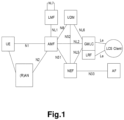
- FIG. 4 illustrates a 5G communication system 1 for 5G communication with a user terminal UE.
- the 5G cell network includes a plurality of 5G cells defining coverage areas where connection with the user terminal UE is possible.
- Each 5G cell comprises at least one base station suitable for transmitting and receiving data on said 5G cell.
- the user terminal UE moves in the 5G cell network, it is in connection, at a given instant, with a plurality of base stations of different 5G cells called proximity base stations gNB1,..., gNBi, . .., gNBn.
- the user terminal UE is compatible with 5G and more particularly compatible with version n°17 of the 3GPP standard so that this terminal has an NTN functionality (for “Non-Terrestrial Network” in English).
- the communication system 1 also includes the satellite Sat.
- This satellite Sat is suitable for exchanging service frames T S with the user terminal UE.
- the satellite Sat is also suitable for exchanging feeder link frames T LF with the gateway GW.
- the Sat satellite is, for example, a satellite traveling in a non-geostationary orbit called an NGSO satellite (for “Non-Geostationary Orbit” in English), such as a LEO satellite (for “Low-Earth Orbit” in English), vLEO (for "very Low-Earth Orbit” in English) or MEO (for "Medium-Earth Orbit” in English).
- the reference point of this satellite moves with respect to the nearby base stations gNB1,..., gNBi,..., gNBn and this delay is highly variable, for example it can be between 2 and 5 ms with a rate of variation that can reach up to 25ppm in the case where the satellite is in an orbit at 600 km (LEO@600km).
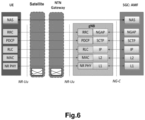
- There figure 6 illustrates a control plane (“Control Plane” in English or CP) and an architecture of the Sat satellite according to Release-17 5G NR. This architecture is compatible with version TR 38.821 disclosing a CP 5G NR NTN protocol stack for a non-regenerative satellite (repeater satellite, with relaying at the RF level, “RF Repeater” or “Bend-pipe” satellite).
- the gateway GW enables communication between a wired environment and the radio environment associated with the satellite SAT to be made possible.
- the gateway GW is adapted to communicate with the core network 5GC.
- the GW gateway communicates with the 5G core network via the gNB satcom base station.
- the central network 5GC here comprises an NGC module (for “Next Generation Core” in English) and which is connected with a public data network public data network (PDN).
- NGC module for “Next Generation Core” in English
- PDN public data network public data network
- the user terminal UE is suitable for determining first positioning data Pos1 via communication with one or more satellites Sat. These first positioning data Pos1 correspond to a GNSS position of the user terminal UE.
- the first Pos1 positioning data is transmitted to the 5G core network via the Sat satellite.
- the user terminal UE is also suitable for determining second positioning data Pos2. These second positioning data Pos2 are based on all or part of channel measurements made by the proximity base stations gNB1,..., gNBi,..., gNBn.
- the user terminal UE is thus capable of communicating with the different base stations by different radio channels i.
- the information CHi coming from a radio channel i can be the impulse response of channel i or the values of this response for certain multipaths only, the frequency response of channel i or the values of this response for certain sub-carriers only.
- the information transmitted can be periodic, aperiodic, event-driven, etc.
- Each radio channel impulse response or frequency response can be evaluated on a given band configuration related to GSM,CDMA, HSDPA, HSUPA, LTE, WiMax, WiFi, 802.11 or other technology (not just 5G NR) in case of connection with the 5G Core.
- Each impulse response or frequency response of the radio channel can be evaluated on one subcarrier, on several subcarriers, on a group of subcarriers (usually a multiple of 12 subcarriers ).
- the size of a subcarrier (eg 7.5 kHz, 15 kHz, 30 kHz, 60 kHz, 120 kHz, 240 kHz or 480 kHz) can change with numerology or depending on the technology used.
- the value of the CHi channel can be expressed by a simple amplitude, which can be quantified on, for example, 8 bits, 16 bits, 32 bits, 64 bits, 128 bit or 256 bit.
- the concept of subcarrier and variation of the signal received on a subcarrier is related to the OFDM waveform.
- This waveform results from orthogonal frequency division multiplexing.
- Cyclic Prefix OFDM (CP-OFDM) technology has become the preferred choice for 5G NR.
- numbering refers to symbol duration and physical layer subcarrier spacing.
- 3GPP has established a flexible numerology that adjusts the spacing between orthogonal subcarriers and starts with LTE's 15 kHz spacing.
- FIG. 7 illustrates a first example of an organization of SKG information with quantification on 8 bits per sub/carrier.
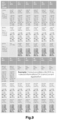
- FIG 8 illustrates a second example of an organization of SKG information with quantification on 4 bits per sub/carrier (16 values/sub-carrier).
- FIG. 9 illustrates a third example of an organization of SKG information with an 8-bit quantification per sub/carrier with an estimate on a multiple of 12 sub-carriers SP/Resource Blocks RBs (fixed value) or possibly a multiple of 2 sub-carriers carriers out of 12.
- FIG 10 illustrates a fourth example of an organization of SKG information with a quantization on 16 bits/subcarrier with an estimation on a multiple of 2 subcarriers out of 12 (1RB).
- an "IE security key” (IE corresponds to "Information Element” in English, information element for the security key) on NG-AP is defined on 256 bits.
- the user terminal UE From its channel measurements on the transmissions of the proximity base stations gNB1,..., gNBi,..., gNBn, the user terminal UE can determine particular secret keys SKG i associated respectively with the proximity base stations gNB1,..., gNBi, ..., gNBn. These different secret keys are sent to the central network 5GC via the Sat satellite.
- the user terminal UE is capable of determining a global secret key SKG calculated from the various particular secret keys SKG i .
- This global secret key SKG is, for example, a summation or a concatenation of the various particular secret keys SKG i.
- the central network 5GC is able to reconstitute a global secret key SKG from said different specific keys SKG i .
- the proximity base stations gNB1,..., gNBi,..., gNBn are suitable for transmitting third position data Pos3 to the network central 5GC, and more particularly towards the NGC module.
- This transmission of third Pos3 positioning data is done without going through the Sat satellite.
- the third Pos3 positioning data is transmitted to the 5G core network via an optical fiber.
- the third positioning data is based on channel measurements made by the proximity base stations gNB1,..., gNBi,..., gNBn on the transmissions of the user terminal UE.
- each proximity base station gNB1,..., gNBi,..., gNBn is adapted to calculate a particular secret key SKG' i which it sends to the central network 5GC.
- a proximity base station can collect all of the channel measurements made by the proximity base stations and calculate a global secret key SKG' corresponding, for example, to a summation or a concatenation of the particular secret keys SKG ' i .
- This global secret key SKG' is then transmitted to the central network 5GC.
- the central network 5GC is adapted to compare these data. He can thus check the compatibility. For example, it can compare the particular secret keys SKG i , SKG' i . Alternatively, the core network 5GC compares the general secret keys SKG, SKG'. If the Pos2 and Pos3 positioning data are compatible, the 5GC core network validates the first Pos1 positioning data of the user terminal UE and the terminal can continue to use the 5G network.
- FIG. 5 illustrates the steps of a method for validating a positioning of a user terminal.
- an entity LMF for “Location Management Function” sends to the user terminal UE a message indicating a number of sources to be measured.
- the user terminal UE makes a selection of the most powerful sources, that is to say the proximity base stations closest to the user terminal UE.
- the user terminal UE determines the second positioning data Pos2 from measurements made at the level of the PHY layer (L1). This user terminal UE can therefore obtain the different particular secret keys SKG i of the different proximity base stations and transmit them. As a variant, he can perform an operation on these particular secret keys SKG i , such as a summation, to deduce therefrom a general secret key SKG.
- the user terminal UE transmits the second positioning data Pos2 via an LPP layer (for “LTE Positioning Protocol”).
- the second positioning data Pos2 are transmitted to the central network 5GC with the positioning data Pos1.
- a fifth step E5 one of the proximity base stations gNBi sends the third positioning data Pos3.
- these third positioning data can be measurements of channels by the proximity base station gNBi on the transmissions of the user terminal UE or a particular secret key SKG′ i produced from these measurements.
- the LMF module can validate the GNSS position of the user terminal UE in a step E6. In the case where there is no validation, the 5G network rejects the user terminal UE in a step E7.
- the 5GC LCS entity can optionally send an information request or SKG secret key request to the AMF, or quite simply the 5GC LCS entity can request the activation of the method based on the concept of the SKG secret key for validation of the positioning of the user terminal.
- This request can be encapsulated in a field of the message “1a. Location Service Request ([Optional] SKG Info Request)”. Following this message, the AMF can perform step “1b. Location Service Request” and will send a "2.
- Location Service Request message to LMF to specify to the LMF in specific fields that the AMF needs to know the secret keys SKG i for the user terminal (with the stations of proximity base) and the secret keys SKG'i for NG-RAN or one or more proximity base stations (with the user terminal) for eg validating the positioning UE. These requests can be encapsulated in specific fields of the “2. Location Service Request” message.
- the LMF can carry out the reconciliation of keys SKG i and SKG' i (Alt1) and can send in a first alternative (Alt1) the message "4.
- Location Service Response” with a specific field which contains the result(s) for the reconciliation of secret keys SKG i and SKG' i with the UE.
- Alt1 the message “4.
- Location Service Response presents a specific field which contains the result(s) for the reconciliation of secret keys SKG i and SKG' i with the UE.
- Location Service Response presents a field or several specific fields with the (complete) results of secret keys SKG i and SKG' i with the UE, and this can be in the form of a report ("Report” in English) or an update ("Update” in English). Following the transmission of the message "4.
- the AMF can carry out in a second alternative (Alt2) the reconciliation of secret keys SKG i and SKG' i or quite simply take one or more decisions (Alt1 and Alt2) with what needs to be done next (eg validating the position of the user terminal UE, rejecting the user terminal UE from the satellite network, restricting the user terminal UE in the network eg in terms of services, selecting or re-selecting a new AMF ("AMF selection” or "AMF reselection" for MFA selection/re-selection - as a decision or as a message eg from MFA NTN to new MFA or from MFA NTN to UE NTN to indicate that AMF or PLMN re-selection is needed, or from LMF to new AMF/old AMF or directly to UE NTN to indicate that AMF or PLMN re-selection is needed), invalidate the position of the user terminal UE, or just continue the communication), including whether to enable security/encrypt
- the AMF can transmit a message “5a. Location Services Response” to the 5GC LCS entities with the information concerning the SKG secret keys or simply the response with the activation of the SKG procedure.
- the old AMF in the selection/re-selection message, in message 4, or in the response sent to the UE, to the new AMF, to 5G LCS or to another network entity, can indicate the code the country where the UE NTN is located (eg “Country of UE location”, “Country code”, etc.).
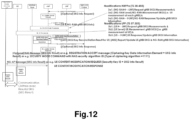
- FIG 12 illustrates another embodiment showing the different steps for a Decision/Reconciliation with a reconciled SKG activation for the communication.
- FIG 12 also illustrates the activation of an encrypted communication between the user terminal UE and the gNB Satcom, using a reconciliation result of secret keys SKG, a global key SKG, a particular secret key, or a general secret key.
- the SKG secret key can be transmitted by the AMF to the gNB Satcom using an NG-AP protocol.
- NG-RAN can select or re-select a new AMF ("AMF selection” or “AMF reselection” for MFA selection/re-selection - as a decision or as message eg from NG-RAN NTN or TN, or from LMF to new AMF or old AMF).
- AMF selection or “AMF reselection” for MFA selection/re-selection - as a decision or as message eg from NG-RAN NTN or TN, or from LMF to new AMF or old AMF).
- NG-RAN can indicate the code of the country where the UE NTN is located (eg “Country of UE location”, “Country code”, etc.).
- the decision for key reconciliation can be taken in the NG-RAN, AMF, LMF.
- FIG 15 illustrates a third example of changes to the E-CID procedure under NRPPa TS 38.455.
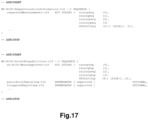
- FIG 17 illustrates a first example of modification procedure if a measurement on NR E-CID is carried out, according to LPP TS 37.355.
- FIG. 18 illustrates a second example of procedure modification if a measurement on NR E-CID is carried out, according to LPP TS 37.355;
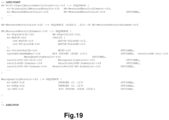
- FIG. 19 illustrates a third example of procedure modification if a measurement on NR E-CID is carried out, according to LPP TS 37.355;
- FIG. 20 illustrates a first example of modification procedure if a measurement on LTE E-CID is carried out, according to LPP TS 37.355;
- FIG. 21 illustrates a second example of modification procedure if a measurement on LTE E-CID is carried out, according to LPP TS 37.355.
- the SKG exchange can be periodic or aperiodic.
- SKG size configurations may vary.
- the invention is applicable in TDD if the uplink and the downlink use the same carrier frequency (reciprocal channel UE->gNBi in UpLink or gNBi ->UE in DownLink for the determination CHi, to ensure a channel estimation of reciprocal propagation at the gNBi level and at the UE level and similar key generations) but also potentially in FDD.
- the invention may involve the use of a g-SMLC (next-generation Serving Mobile Location Centre) and/or e-SMLC and/or GMLC (Gateway Mobile Location Centre), and/or SLP (SUPL Location Platform , potentially using a Subscriber LCS privacy Profile, for a user-plane based solution) and using a SUPL (Secure User Plane Location), and/or LBS (location-based service) and/or LCS (Location Service), and/or LPP (LTE Positioning Protocol) & NRPPa (NR Positioning Protocol A) protocols, which are specific entities/services/protocols at the core network level.
- the invention can also use one of these entities/functions: Access and Mobility Management Function (AMF), LMF (Location Management Function), etc.
- AMF Access and Mobility Management Function
- LMF Location Management Function
- the proximity base station can be for example a macro cell, a small cell, a pico cell, a wide area BS or any other type of BS (Base Station), or an IAB (Integrated Access Backhaul), a Remote Radio Head (RRH), a Transmission Point (TP), an Access Point or a trusted WiFi/WLAN Access Point (AP).
- BS Base Station
- IAB Integrated Access Backhaul
- RRH Remote Radio Head
- TP Transmission Point
- AP trusted WiFi/WLAN Access Point
- the UE can use another means of transmission, see for example the RRC protocol (for "Radio Resource Control" in English) to transmit the key(s) to the gNB Satcom, and then the gNB Satcom can use an NRPPa type protocol for the transmission of SKG data to the 5GC and/or to LMF/5G LCS.
- RRC protocol for "Radio Resource Control” in English
- the initial SKG usage message can be generated for example by the 5GC, 5GC LCS entities, AMF, LMF, gNB etc. ; the reconciliation of keys (Pos2, Pos3) can be carried out for example at the LMF, AMF, etc. level. ; the decision concerning the action performed by the 5GC can be for example at the AMF, LMF, etc. level. ; the result of the decision can be, for example, a UE rejection message (e.g. UE Rejection Message to e.g. UE and/or PCF for the "Policy and Charging Function"), UE restriction message (UE Restriction Message to e.g. NG-RAN and /or PCF), an invalid position message (e.g.
- UE rejection message e.g. UE Rejection Message to e.g. UE and/or PCF for the "Policy and Charging Function
- UE restriction message UE Restriction Message to e.g. NG-RAN and /or PCF
- Invalid Position Message to e.g. LMF or 5GC LCS or other 5GC entity(ies), a valid position message (e.g. to LMF or 5GC LCS entities), a decision to continue the communication and without any message transmitted to the various 5GC/NG-RAN/UE entities.
- a valid position message e.g. to LMF or 5GC LCS entities
- NAS message see TS 24.501
- SKG secret key or the result of key reconciliation (eg a global SKG secret key) between the AMF and the UE or eg a REGISTRATION ACCEPT message with SKG information, or possibly a SECURITY MODE COMMAND which informs the UE that the encryption algorithm will be based on SKG (1 bit of information added in the type of encryption algorithm).
- the AMF can also communicate the SKG secret key to the NG-RAN Satcom (or gNB Satcom) in an NG-AP type message (see TS 38.413) with the result of the key reconciliation (eg a global SKG secret key) or eg a UE CONTEXT MODIFICATION REQUEST message with the "Security Key IE" field equal to eg the global SKG key/secret key.
- the invention can implement the securing/encryption of the link between the UE and the 5G NR satellite access network with the secret key SKG.
- Link encryption/securing can be one-way or two-way communication.
- the 5G and especially 5GC implementation can be done using a Software Defined Network implementation and/or concepts in English or SDN.
- the invention can use the following drivers (non-restrictive examples): Demodulation Reference Signals (DM-RS), Sounding Reference Signals (SRS), Channel State Information Reference Signals (CSI-RS), Positioning Reference Signals (PRS), Tracking Reference Signals (TRS), PSS/SSS (Primary/Secondary Synchronization Signals) and potentially others such as PRACH preambles or other type of signal emitted by the UE or the gNB.
- DM-RS Demodulation Reference Signals
- SRS Sounding Reference Signals
- CSI-RS Channel State Information Reference Signals
- PRS Positioning Reference Signals
- TRS Tracking Reference Signals
- PSS/SSS Primary/Secondary Synchronization Signals
- the user terminal UE and the proximity base stations can determine the positioning data (Pos2, respectively Pos3) from measurements made at the level of the PHY layer (L1), after the FFT/DFT processing (FFT if direct Fourier transform rapid or “Fast Fourier Transform” in English, DFT if discrete Fourier transform or “Discrete Fourier Transform” in English) in reception, and preferably before the equalization of the radio channel.
- FFT direct Fourier transform rapid or “Fast Fourier Transform” in English
- DFT discrete Fourier transform or “Discrete Fourier Transform” in English
Landscapes
- Engineering & Computer Science (AREA)
- Physics & Mathematics (AREA)
- General Physics & Mathematics (AREA)
- Radar, Positioning & Navigation (AREA)
- Remote Sensing (AREA)
- Computer Networks & Wireless Communication (AREA)
- Signal Processing (AREA)
- Mobile Radio Communication Systems (AREA)
- Radio Relay Systems (AREA)
Applications Claiming Priority (1)
| Application Number | Priority Date | Filing Date | Title |
|---|---|---|---|
| FR2114621A FR3131499B1 (fr) | 2021-12-29 | 2021-12-29 | Procédé de validation d'un positionnement d'un terminal utilisateur dans un réseau de cellules 5 G |
Publications (1)
| Publication Number | Publication Date |
|---|---|
| EP4207889A1 true EP4207889A1 (de) | 2023-07-05 |
Family
ID=82019181
Family Applications (1)
| Application Number | Title | Priority Date | Filing Date |
|---|---|---|---|
| EP22215163.1A Pending EP4207889A1 (de) | 2021-12-29 | 2022-12-20 | Verfahren zur validierung der positionierung eines benutzerendgeräts in einem 5g-zellnetzwerk |
Country Status (2)
| Country | Link |
|---|---|
| EP (1) | EP4207889A1 (de) |
| FR (1) | FR3131499B1 (de) |
Cited By (1)
| Publication number | Priority date | Publication date | Assignee | Title |
|---|---|---|---|---|
| WO2025092907A1 (zh) * | 2023-11-03 | 2025-05-08 | 华为技术有限公司 | 一种通信方法及装置 |
Citations (3)
| Publication number | Priority date | Publication date | Assignee | Title |
|---|---|---|---|---|
| WO2005004528A1 (en) * | 2003-06-27 | 2005-01-13 | Qualcomm, Incorporated | Method and apparatus for wireless network hybrid positioning |
| WO2020064219A1 (en) * | 2018-09-24 | 2020-04-02 | Sony Corporation | Telecommunications apparatus and methods |
| US20210400734A1 (en) * | 2020-06-23 | 2021-12-23 | Qualcomm Incorporated | Methods and apparatus for supporting positioning in idle or inactive mode |
-
2021
- 2021-12-29 FR FR2114621A patent/FR3131499B1/fr active Active
-
2022
- 2022-12-20 EP EP22215163.1A patent/EP4207889A1/de active Pending
Patent Citations (3)
| Publication number | Priority date | Publication date | Assignee | Title |
|---|---|---|---|---|
| WO2005004528A1 (en) * | 2003-06-27 | 2005-01-13 | Qualcomm, Incorporated | Method and apparatus for wireless network hybrid positioning |
| WO2020064219A1 (en) * | 2018-09-24 | 2020-04-02 | Sony Corporation | Telecommunications apparatus and methods |
| US20210400734A1 (en) * | 2020-06-23 | 2021-12-23 | Qualcomm Incorporated | Methods and apparatus for supporting positioning in idle or inactive mode |
Non-Patent Citations (6)
| Title |
|---|
| 3GPP TR 38.855, March 2019 (2019-03-01) |
| 3GPP TR 38.856, December 2019 (2019-12-01) |
| 3GPP TS 23.271, December 2019 (2019-12-01) |
| 3GPP TS 23.273, December 2019 (2019-12-01) |
| 3GPP TS 38.305, December 2019 (2019-12-01) |
| 3GPP TS 38.455, January 2019 (2019-01-01) |
Cited By (1)
| Publication number | Priority date | Publication date | Assignee | Title |
|---|---|---|---|---|
| WO2025092907A1 (zh) * | 2023-11-03 | 2025-05-08 | 华为技术有限公司 | 一种通信方法及装置 |
Also Published As
| Publication number | Publication date |
|---|---|
| FR3131499B1 (fr) | 2025-03-21 |
| FR3131499A1 (fr) | 2023-06-30 |
Similar Documents
| Publication | Publication Date | Title |
|---|---|---|
| EP3026961B1 (de) | Verfahren und system zur steuerung der dopplerverschiebung während einem zellenwechsel in einem kommunikationssystem | |
| BE1020891A5 (fr) | Reglage de couverture dans des reseaux e-utra. | |
| CN113574941B (zh) | 用于在无线网络中支持安全基站数据库数据的系统和方法 | |
| FR2943882A1 (fr) | Procede d'emission pour un reseau sans fil et procede de reception correspondant | |
| KR20240140067A (ko) | 사용자 장비(ue) 기반 사이드링크 인식 무선 주파수 핑거프린팅(rffp) 포지셔닝 | |
| KR20250003609A (ko) | 다운링크 포지셔닝 기준 신호들을 이용한 사용자 장비(ue)-기반 무선 주파수 핑거프린트(rffp) 포지셔닝 | |
| KR20230116780A (ko) | 추정된 전리층을 이용하는 글로벌 내비게이션 위성 시스템 정밀 포지셔닝 엔진 | |
| CN117044132A (zh) | 用于定位的测量时段制定的方法和装置 | |
| EP2394474B1 (de) | Übertragungsverfahren für ein drahtloses netzwerk und entsprechendes empfangsverfahren | |
| CN119072939A (zh) | 用于基于机器学习的定位测量的报告框架 | |
| EP3110203B1 (de) | Doppler effekt berücksichtigendes leistungsmessverfahren und -vorrichtung | |
| KR20240136986A (ko) | 포지셔닝을 위한 재구성가능한 지능형 표면 보조 무선 주파수 핑거프린팅 | |
| KR20250027641A (ko) | 주파수 도메인 윈도우잉을 사용한 ue 포지셔닝 | |
| EP2926617B1 (de) | Direktmoduskommunikation in einem breitbandigen funkkommunikationssystem | |
| EP4207889A1 (de) | Verfahren zur validierung der positionierung eines benutzerendgeräts in einem 5g-zellnetzwerk | |
| TW202412547A (zh) | 定位模型編碼點配置 | |
| WO2005114873A1 (fr) | Determination par un terminal de communication du temps de propagation d'un signal de reference provenant d'un equipement de gestion de communications | |
| EP4206719A1 (de) | Verfahren zur validierung einer positionierung eines benutzerendgeräts in einem 4g-mobilfunknetz | |
| US20250028043A1 (en) | Artificial intelligence/machine learning (ai/ml)-based positioning measurement prediction | |
| TW202450347A (zh) | 基於上行鏈路的人工智慧/機器學習(ai/ml)定位功能和模型識別 | |
| CN120937457A (zh) | 侧链路定位锚分类和选择 | |
| KR20240128674A (ko) | Prs(positioning reference signal)를 보안하기 위한 기법들 | |
| CN119631346A (zh) | 用于侧链路定位参考信号(sl-prs)的辅助的自动增益控制(agc) | |
| WO2009053402A1 (fr) | Dispositif et procede permettant d'intercepter des communications dans un reseau | |
| US12585029B2 (en) | Enhanced positioning for location services |
Legal Events
| Date | Code | Title | Description |
|---|---|---|---|
| PUAI | Public reference made under article 153(3) epc to a published international application that has entered the european phase |
Free format text: ORIGINAL CODE: 0009012 |
|
| STAA | Information on the status of an ep patent application or granted ep patent |
Free format text: STATUS: THE APPLICATION HAS BEEN PUBLISHED |
|
| AK | Designated contracting states |
Kind code of ref document: A1 Designated state(s): AL AT BE BG CH CY CZ DE DK EE ES FI FR GB GR HR HU IE IS IT LI LT LU LV MC ME MK MT NL NO PL PT RO RS SE SI SK SM TR |
|
| XX | Miscellaneous (additional remarks) |
Free format text: IF DETAILS ARE NOT FULLY DISCERNIBLE, THAT IS DUE TO THE QUALITY OF THE DRAWINGS FILED BY THE APPLICANT. |
|
| STAA | Information on the status of an ep patent application or granted ep patent |
Free format text: STATUS: REQUEST FOR EXAMINATION WAS MADE |
|
| 17P | Request for examination filed |
Effective date: 20231208 |
|
| RBV | Designated contracting states (corrected) |
Designated state(s): AL AT BE BG CH CY CZ DE DK EE ES FI FR GB GR HR HU IE IS IT LI LT LU LV MC ME MK MT NL NO PL PT RO RS SE SI SK SM TR |
|
| STAA | Information on the status of an ep patent application or granted ep patent |
Free format text: STATUS: EXAMINATION IS IN PROGRESS |
|
| 17Q | First examination report despatched |
Effective date: 20241018 |