EP4207922A1 - Drahtloskommunikationsverfahren, endgerätevorrichtung und netzwerkvorrichtung - Google Patents
Drahtloskommunikationsverfahren, endgerätevorrichtung und netzwerkvorrichtung Download PDFInfo
- Publication number
- EP4207922A1 EP4207922A1 EP20955558.0A EP20955558A EP4207922A1 EP 4207922 A1 EP4207922 A1 EP 4207922A1 EP 20955558 A EP20955558 A EP 20955558A EP 4207922 A1 EP4207922 A1 EP 4207922A1
- Authority
- EP
- European Patent Office
- Prior art keywords
- terminal
- type
- reference signal
- signal measurement
- capability
- Prior art date
- Legal status (The legal status is an assumption and is not a legal conclusion. Google has not performed a legal analysis and makes no representation as to the accuracy of the status listed.)
- Pending
Links
Images


Classifications
-
- H—ELECTRICITY
- H04—ELECTRIC COMMUNICATION TECHNIQUE
- H04W—WIRELESS COMMUNICATION NETWORKS
- H04W48/00—Access restriction; Network selection; Access point selection
- H04W48/08—Access restriction or access information delivery, e.g. discovery data delivery
- H04W48/12—Access restriction or access information delivery, e.g. discovery data delivery using downlink control channel
-
- H—ELECTRICITY
- H04—ELECTRIC COMMUNICATION TECHNIQUE
- H04W—WIRELESS COMMUNICATION NETWORKS
- H04W72/00—Local resource management
- H04W72/50—Allocation or scheduling criteria for wireless resources
- H04W72/51—Allocation or scheduling criteria for wireless resources based on terminal or device properties
-
- H—ELECTRICITY
- H04—ELECTRIC COMMUNICATION TECHNIQUE
- H04W—WIRELESS COMMUNICATION NETWORKS
- H04W72/00—Local resource management
- H04W72/20—Control channels or signalling for resource management
- H04W72/23—Control channels or signalling for resource management in the downlink direction of a wireless link, i.e. towards a terminal
- H04W72/231—Control channels or signalling for resource management in the downlink direction of a wireless link, i.e. towards a terminal the control data signalling from the layers above the physical layer, e.g. RRC or MAC-CE signalling
-
- H—ELECTRICITY
- H04—ELECTRIC COMMUNICATION TECHNIQUE
- H04B—TRANSMISSION
- H04B17/00—Monitoring; Testing
- H04B17/30—Monitoring; Testing of propagation channels
- H04B17/309—Measuring or estimating channel quality parameters
- H04B17/318—Received signal strength
- H04B17/328—Reference signal received power [RSRP]; Reference signal received quality [RSRQ]
-
- H—ELECTRICITY
- H04—ELECTRIC COMMUNICATION TECHNIQUE
- H04L—TRANSMISSION OF DIGITAL INFORMATION, e.g. TELEGRAPHIC COMMUNICATION
- H04L5/00—Arrangements affording multiple use of the transmission path
- H04L5/003—Arrangements for allocating sub-channels of the transmission path
- H04L5/0048—Allocation of pilot signals, i.e. of signals known to the receiver
-
- H—ELECTRICITY
- H04—ELECTRIC COMMUNICATION TECHNIQUE
- H04W—WIRELESS COMMUNICATION NETWORKS
- H04W24/00—Supervisory, monitoring or testing arrangements
- H04W24/08—Testing, supervising or monitoring using real traffic
-
- H—ELECTRICITY
- H04—ELECTRIC COMMUNICATION TECHNIQUE
- H04W—WIRELESS COMMUNICATION NETWORKS
- H04W28/00—Network traffic management; Network resource management
- H04W28/02—Traffic management, e.g. flow control or congestion control
- H04W28/0215—Traffic management, e.g. flow control or congestion control based on user or device properties, e.g. MTC-capable devices
-
- H—ELECTRICITY
- H04—ELECTRIC COMMUNICATION TECHNIQUE
- H04W—WIRELESS COMMUNICATION NETWORKS
- H04W72/00—Local resource management
- H04W72/50—Allocation or scheduling criteria for wireless resources
- H04W72/54—Allocation or scheduling criteria for wireless resources based on quality criteria
- H04W72/542—Allocation or scheduling criteria for wireless resources based on quality criteria using measured or perceived quality
-
- H—ELECTRICITY
- H04—ELECTRIC COMMUNICATION TECHNIQUE
- H04W—WIRELESS COMMUNICATION NETWORKS
- H04W74/00—Wireless channel access
- H04W74/002—Transmission of channel access control information
- H04W74/004—Transmission of channel access control information in the uplink, i.e. towards network
-
- H—ELECTRICITY
- H04—ELECTRIC COMMUNICATION TECHNIQUE
- H04W—WIRELESS COMMUNICATION NETWORKS
- H04W88/00—Devices specially adapted for wireless communication networks, e.g. terminals, base stations or access point devices
- H04W88/02—Terminal devices
-
- H—ELECTRICITY
- H04—ELECTRIC COMMUNICATION TECHNIQUE
- H04L—TRANSMISSION OF DIGITAL INFORMATION, e.g. TELEGRAPHIC COMMUNICATION
- H04L5/00—Arrangements affording multiple use of the transmission path
-
- H—ELECTRICITY
- H04—ELECTRIC COMMUNICATION TECHNIQUE
- H04W—WIRELESS COMMUNICATION NETWORKS
- H04W8/00—Network data management
- H04W8/22—Processing or transfer of terminal data, e.g. status or physical capabilities
Definitions
- Embodiments of the present application relate to the field of wireless communication, and more particularly, to a method for wireless communication, a terminal device, and a network device.
- a network device sends random access related parameters to a terminal device through system information, wherein in a Random Access Channel-Configuration Common Information Element (RACH-ConfigCommon IE), a Reference Signal Receiving Power (RSRP) threshold (rsrp-ThresholdSSB) for a Synchronization Signal Block (SSB) is used for SSB selection by the terminal device.
- RSRP Reference Signal Receiving Power
- SSB Synchronization Signal Block
- a Reduced Capability (RedCap) terminal is introduced for a scenario with low requirements on performance such as delay, reliability, bandwidth, coverage and throughput.
- a measurement result of the SSB by the RedCap terminal is quite different from a measurement result of the SSB by a non-RedCap terminal. In that case, an urgent problem to be solved for the RedCap terminal is to select a suitable SSB for subsequent random access.
- Embodiments of the present application provide a method for wireless communication, a terminal device and a network device, which are beneficial to ensuring that a reduced capability terminal selects a suitable downlink reference signal.
- a method for wireless communication includes: according to a first reference signal measurement quantity threshold, determining, by a terminal device, a target reference signal measurement quantity threshold used by the terminal device, wherein the first reference signal measurement quantity threshold is a reference signal measurement quantity threshold corresponding to a first type of terminal, the terminal device is the first type of terminal, and the first type of terminal includes a reduced capability terminal; or, according to a reference signal measurement quantity threshold corresponding to a second type of terminal and a capability of the first type of terminal, determining, by the terminal device, a target reference signal measurement quantity threshold used by the terminal device, wherein the terminal device is the first type of terminal, the first type of terminal includes the reduced capability terminal, and the second type of terminal does not include the reduced capability terminal.
- a method for wireless communication includes sending, by a network device, first configuration information used for configuring a first reference signal measurement threshold, wherein the first reference signal measurement threshold is a reference signal measurement threshold corresponding to a first type of terminal, the terminal device is the first type of terminal, and the first type of terminal includes a reduced capability terminal.
- a terminal device configured to perform the method in the above first aspect or any possible implementation mode of the first aspect.
- the terminal device includes units for performing the method in the above first aspect or any possible implementation mode of the first aspect.
- a network device configured to perform the method in the above second aspect or any possible implementation of the second aspect.
- the network device includes units for performing the method in the above second aspect or any possible implementation mode of the second aspect.
- a terminal device which includes: a processor and a memory.
- the memory is configured to store a computer program
- the processor is configured to call and run the computer program stored in the memory to perform the method in the first aspect or in various implementations thereof.
- a network device which includes: a processor and a memory.
- the memory is configured to store a computer program
- the processor is configured to call and run the computer program stored in the memory to perform the method in the second aspect or various implementations thereof.
- a chip is provided for implementing the method according to any one of the first and second aspects or any of various implementation modes thereof.
- the chip includes a processor configured to call and run a computer program from a memory to enable a device in which the chip is installed to perform the method according to any one of the first and second aspects or any of various implementation modes thereof.
- a computer readable storage medium configured to store a computer program, which causes a computer to perform the method according to any one of the above first and second aspects or various implementations thereof.
- a computer program product which includes computer program instructions, the computer instructions enable a computer to perform the method according to any one of the first and second aspects or any of various implementation modes thereof.
- a computer program when the computer program is run on a computer, the computer program enables the computer to perform the method in any one of the first and second aspects or various implementations thereof.
- the network device can configure a special reference signal measurement threshold for the first type of terminal, or the terminal device can determine the reference signal measurement threshold corresponding to the first type of terminal according to the reference signal measurement threshold corresponding to the second type of terminal in combination with the capability of the first type of terminal. Further, when the first type of terminal selects the reference signal based on the reference signal measurement threshold, it is beneficial to ensuring that a suitable reference signal is selected, thereby ensuring subsequent data communication.
- GSM Global System of Mobile Communication
- CDMA Code Division Multiple Access
- WCDMA Wideband Code Division Multiple Access
- GPRS General Packet Radio Service
- LTE Long Term Evolution
- LTE-A Advanced Long Term Evolution
- NR New Radio
- NTN Non-Terrestrial Networks
- UMTS Universal Mobile Telecommunications System
- WLAN Wireless Local Area Networks
- WiFi Wireless Fidelity
- 5G 5th-generation
- D2D Device to Device
- M2M Machine to Machine
- MTC Machine Type Communication
- V2V Vehicle to Vehicle
- V2X Vehicle to everything
- the communication systems in the embodiments of the present application can be applied to a carrier aggregation (CA) scenario, or a dual connectivity (DC) scenario, or a standalone (SA) networking scenario.
- CA carrier aggregation
- DC dual connectivity
- SA standalone
- the communication system in an embodiment of the present application may be applied to an unlicensed spectrum, wherein the unlicensed spectrum may also be considered as a shared spectrum; or, the communication system in an embodiment of the present application may also be applied to a licensed spectrum, wherein the licensed spectrum may also be considered as a non-shared spectrum.
- the terminal device may also be referred to as a User Equipment (UE), an access terminal, a subscriber unit, a subscriber station, a mobile station, a mobile platform, a remote station, a remote terminal, a mobile device, a user terminal, a terminal, a wireless communication device, a user agent or a user apparatus, etc.
- UE User Equipment
- the terminal device may be a station (ST) in a WLAN, or may be a cellular phone, a cordless phone, a Session Initiation Protocol (SIP) phone, a Wireless Local Loop (WLL) station, a Personal Digital Assistant (PDA) device, a handheld device with a wireless communication function, a computing device, or other processing devices connected to a wireless modem, a vehicle-mounted device, a wearable device, a terminal device in a next generation communication system such as an NR network, or a terminal device in a future evolved Public Land Mobile Network (PLMN).
- ST station
- WLAN Wireless Local Loop
- PDA Personal Digital Assistant
- a terminal device may be deployed on land including indoor or outdoor, handheld, wearable or vehicle-mounted terminal device; or it may be deployed on water (such as on ships, etc.); or it may be deployed aerially (such as in airplanes, balloons and satellites, etc.).
- the terminal device may be a mobile phone, a Pad, a computer with wireless transceiving function, a virtual reality (VR) terminal device, an augmented reality (AR) terminal device, a wireless terminal device in industrial control, a wireless terminal device in self driving, a wireless terminal device in remote medicine, a wireless terminal device in smart grid, a wireless terminal device in transportation safety, a wireless terminal device in smart city, or a wireless terminal device in smart home, etc.
- VR virtual reality
- AR augmented reality
- the terminal device may be a wearable device.
- the wearable device may also be referred to as a wearable smart device, which is a general term of wearable devices developed by intelligent design on daily wear by applying wearable technology, such as glasses, gloves, a watch, clothing and shoes.
- the wearable device is a portable device that is worn directly on a body, or integrated into clothes or accessories of users.
- the wearable device not only is a hardware device, but also implements powerful functions through software support as well as data interaction or cloud interaction.
- Generalized wearable smart devices include devices which are fully functional, have large sizes, and may implement complete or partial functions without relying on smart phones, such as a smart watch or smart glasses, and devices which focus on a certain kind of application functions only and need to be used in conjunction with other devices such as smart phones, such as various smart bracelets, smart jewelries or the like for monitoring physical signs.
- a network device may be a device used for communicating with a mobile device, and may be an Access Point (AP) in the WLAN, a Base Transceiver Station (BTS) in GSM or CDMA, a NodeB (NB) in WCDMA, an evolutional Node B (eNB or eNodeB) in LTE, a relay station or an access point, a vehicle-mounted device, a wearable device, a network device (gNB) in the NR network, a network device in a future evolved PLMN network, or a network device in an NTN network, etc.
- AP Access Point
- BTS Base Transceiver Station
- NB NodeB
- eNB evolutional Node B
- gNB network device
- gNB network device in the NR network
- gNB network device in a future evolved PLMN network
- NTN network etc.
- a network device may be of mobility, for example, the network device may be a mobile device.
- the network device may be a satellite or a balloon station.
- the satellite may be a low earth orbit (LEO) satellite, a medium earth orbit (MEO) satellite, a geostationary earth orbit (GEO) satellite, a high elliptical orbit (HEO) satellite, etc.
- the network device may be a base station disposed in a position on land or a water region etc.
- a network device may provide a service for a cell, and a terminal device communicates with the network device through a transmission resource (e.g., a frequency domain resource, which is also referred to as a spectrum resource) used by the cell, wherein the cell may be a cell corresponding to the network device (e.g., a base station), and the cell may belong to a macro base station, or may belong to a base station corresponding to a Small cell.
- the Small cell herein may include a Metro cell, a Micro cell, a Pico cell, or a Femto cell, etc.
- the Small cells are characterized by a small coverage range and a low transmission power, and are suitable for providing high-speed data transmission services.
- the communication system 100 may include a network device 110.
- the network device 110 may be a device that communicates with terminal devices 120 (or referred to as communication terminals, or terminals).
- the network device 110 may provide communication coverage for a specific geographical area, and may communicate with terminal devices located within the coverage area.
- FIG. 1 illustrates one network device and two terminal devices.
- the communication system 100 may include multiple network devices, and other quantity of terminal devices may be included within the coverage area of each network device, which is not limited in the embodiments of the present application.
- the communication system 100 may also include another network entity, such as a network controller, a mobile management entity, etc., which is not limited in the embodiments of the present application.
- another network entity such as a network controller, a mobile management entity, etc., which is not limited in the embodiments of the present application.
- a device with a communication function in a network/system in the embodiments of the present application may also be referred to as a communication device.
- communication devices may include a network device 110 and terminal devices 120 which have communication functions, and the network device 110 and the terminal devices 120 may be the specific devices described above, and will not be described repeatedly herein.
- Communication devices may also include other devices in the communication system 100, for example, other network entities such as a network controller and a mobility management entity, which is not limited in the embodiments of the present application.
- indication involved in embodiments of the present application may be a direct indication, may be an indirect indication, or may represent an association relationship.
- a indicates B may mean that A indicates B directly, for example, B can be acquired through A; or it may mean that A indicates B indirectly, for example, A indicates C, and B can be acquired through C; or it may mean that there is an association between A and B.
- the term "correspond” may mean that there is a direct correspondence or an indirect correspondence between two parties, or mean that there is an association between two parties, or mean a relationship such as indicating and being indicated, configuring and being configured, etc.
- predefining may be achieved by pre-storing corresponding codes, tables or other ways that may be used to indicate relevant information in devices (e.g., including terminal devices and network devices), and the specific implementation thereof is not limited in the present application.
- predefining can refer to defining in a protocol.
- the term "protocol" may refer to a standard protocol in the communication field.
- the protocol can include an LTE protocol, an NR protocol, and related protocols applied in future communication systems, which is not limited in the present application.
- a terminal device can select Physical Random Access Channel (PRACH) resources, which can include time domain resources, frequency domain resources and code domain resources.
- PRACH Physical Random Access Channel
- a network device sends random access related parameters to a terminal device by broadcasting a System Information Block (SIB), wherein in a Random Access Channel-Configuration Common Information Element (RACH-ConfigCommon IE), a Reference Signal Receiving Power (RSRP) threshold (rsrp-ThresholdSSB) for a Synchronization Signal Block (SSB) is used for SSB selection by the terminal device.
- SIB System Information Block
- RACH-ConfigCommon IE Random Access Channel-Configuration Common Information Element
- RSRP Reference Signal Receiving Power
- SSB Synchronization Signal Block
- the terminal device compares an RSRP measurement result for each SSB with the threshold rsrp-ThresholdSSB, and selects an SSB whose measurement value is higher than a configured threshold for access.
- a RedCap terminal also known as a RedCap device
- the scenario may be, but not limited to, the following scenarios.
- Scenario 1 it is for industrial wireless sensors, wherein the industrial wireless sensors have relatively low requirements on delay and reliability, compared with Ultra-Reliable and Low Latency Communication (URLLC) terminals. Moreover, device cost and power consumption of industrial wireless sensors are lower than those of URLLC terminals and Enhance Mobile Broadband (eMBB) terminals.
- URLLC Ultra-Reliable and Low Latency Communication
- Scenario 2 it is for video surveillance, wherein a RedCap terminal can be used for video surveillance in scenarios such as smart city, and industrial process.
- the RedCap device is mainly used for data collection and processing, so as to achieve more effective monitoring and control of city resources and provide more effective services for city residents.
- Scenario 3 it is for wearables, wherein the wearables include, but are not limited to, smart watches, rings, electronic health devices, medical monitoring devices, etc. These devices are usually small in size.
- the RedCap terminal determines a selected SSB according to an RSRP threshold of the non-RedCap terminal, the RedCap terminal can not find an SSB meeting the RSRP threshold, thus failing in obtaining corresponding PRACH resources and affecting a subsequent random access process.
- FIG. 2 is a schematic flow chart of a method 200 for wireless communication according to an embodiment of the present application.
- the method 200 can be performed by the terminal device in the communication system shown in FIG. 1 .
- the method 200 may include at least part of the following content.
- a terminal device determines a target reference signal measurement threshold used by the terminal device according to a first reference signal measurement threshold, wherein the first reference signal measurement threshold is a reference signal measurement threshold corresponding to a first type of terminal, the terminal device is the first type of terminal, and the first type of terminal includes a reduced capability terminal.
- the target reference signal measurement threshold is the first reference signal measurement threshold.
- At least two types of terminals may be included, such as the first type of terminal and the second type of terminal.
- the at least two types of terminals may be divided according to capabilities of terminal devices, or may also be divided according to differences in measurement results of the reference signal by the terminal device, which is not limited in the present application.
- capabilities of terminal devices may include, for example, at least one of the quantity of the receiving antennas, a receiving antenna gain, and a coverage capability level.
- other performance indices that can affect a reception capability may also be included, which is not limited in the present application.
- the coverage capability level can be expressed as a receiving capability level of the terminal device, which is proportional to the quantity of the receiving antennas and the receiving antenna gain of the terminal device. That is, the more the quantity of the receiving antennas, the higher the coverage capability level; and the greater the receiving antenna gain, the higher the coverage capability level.
- the network device can configure reference signal measurement thresholds corresponding to different types of terminals.
- the first type of terminal is configured with a first reference signal measurement threshold
- the second type of terminal is configured with a second reference signal measurement threshold, so that different types of terminals can use corresponding reference signal measurement thresholds to select reference signals, which is beneficial to selecting a suitable reference signal.
- the first type of terminal may be any type of terminal which needs to perform differentiated reference signal measurement configuration.
- the capability of the first type of terminal differs from the capability of the second type of terminal, more specifically, the capability of the first type of terminal is lower than the capability of the second type of terminal; or, the capability of the first type of terminal is higher than the capability of the second type of terminal.
- the first type of terminal includes a reduced capability terminal, i.e. a RedCap terminal.
- the second type of terminal includes an ordinary terminal, wherein the capability of the ordinary terminal is higher than the capability of the reduced capability terminal. In other words, the capability of the first type of terminal is lower than the capability of the second type of terminal.
- the first type of terminal includes an enhanced capability terminal.
- the second type of terminal includes an ordinary terminal.
- the capability of the ordinary terminal is lower than the capability of the enhanced capability terminal. In other words, the capability of the first type of terminal is higher than the capability of the second type of terminal.
- an independent reference signal measurement threshold is configured for a terminal with a large difference in the capability of the second type of terminal, so that this type of terminal can use a corresponding reference signal measurement threshold to select a reference signal, which is beneficial to selecting appropriate reference signals.
- the reduced capability terminal may include a terminal in the above three scenarios, or the reduced capability terminal can include a terminal in a Machine Type of Communication (MTC), an evolved Machine Type of Communication (eMTC), or a Narrow Band Internet of Things (NB-IoT).
- MTC Machine Type of Communication
- eMTC evolved Machine Type of Communication
- NB-IoT Narrow Band Internet of Things Terminals in these technologies greatly reduce the hardware complexity, data throughput and processing speed of the terminals, so the terminals can also be referred to as reduced capability terminals, or the terminals can also include terminals applied to some smart homes, smart cities, intelligent plants, remote monitoring and smart transportation application scenarios with lower requirements, which is not limited in the present application.
- the reduced capability terminal in an embodiment of the present application may also be replaced by other expressions for indicating a class of terminals with lower requirements on performance such as delay, reliability, bandwidth, coverage, throughput, etc., or a class of terminals with lower capability, or a class of terminals with lower reference signal measurement results, etc., and it is the same with an enhanced capability terminal, which is not limited in the present application.
- the first type of terminal acting as a reduced capability terminal and the second type of terminal acting as an ordinary terminal are taken as an example for explanation, which is not limited in the present application.
- a measurement result of a downlink reference channel measured by the ordinary terminal is generally higher than a measurement result of the downlink reference signal measured by the reduced capability terminal because the capability of the ordinary terminal is higher than the capability of the reduced capability terminal.
- a first reference signal measurement threshold corresponding to the first type of terminal may be configured to be less than a second reference signal measurement threshold corresponding to the second type of terminal, facilitating a reduced capability terminal to select an appropriate downlink reference signal.
- the first reference signal measurement threshold may be configured through system information, such as a Random Access Channel-Configuration Common Information Element (RACH-ConfigCommon IE) that can be contained in the system information.
- RACH-ConfigCommon IE Random Access Channel-Configuration Common Information Element
- the first reference signal measurement threshold may also be configured by other signaling or message, such as Radio Resource Control (RRC) signaling or paging message configuration, etc.
- RRC Radio Resource Control
- the first type of terminal is of a plurality of sub-terminal types.
- the network device can configure a plurality of the first reference signal measurement thresholds, and each sub-terminal type in the plurality of sub-terminal types corresponds to one of the first reference signal measurement thresholds, respectively.
- Each sub-terminal type in the plurality of sub-terminal types corresponds to a specific capability, that is, a capability corresponding to each sub-terminal type can be different.
- the network device can determine, respectively, corresponding reference signal measurement thresholds for different types of reduced capability terminals, so that different types of reduced capability terminals can determine the sub-terminal types of reduced capability terminals themselves according to their own capabilities, and further determine the reference signal measurement threshold corresponding to the sub-terminal type as the target reference signal measurement threshold.
- the first reference signal measurement threshold may be used for selection of the downlink reference signal.
- the terminal device may determine a downlink reference signal satisfying the first reference signal measurement threshold as the target reference signal according to the measurement result of the downlink reference signal and the first reference signal measurement threshold.
- the Physical Random Access Channel (PRACH) resource is determined according to the target reference signal and a first association relationship, wherein, the first association relationship is an association relationship between the downlink reference signal and the PRACH resource.
- PRACH Physical Random Access Channel
- the downlink reference signal includes, but is not limited to, at least one of a Synchronization Signal Block (SSB), a Channel State Information Reference Signal (CSI-RS), a Demodulation Reference Signal (DMRS), for example.
- SSB Synchronization Signal Block
- CSI-RS Channel State Information Reference Signal
- DMRS Demodulation Reference Signal
- SSB can also be referred to as an SS block, or a Synchronization Signal/Physical Broadcast Channel block (SS/PBCH block).
- SS/PBCH block Synchronization Signal/Physical Broadcast Channel block
- the measurement result of the downlink reference signal may be, but is not limited to, at least one of a Reference Signal Receiving Power (RSRP), a Reference Signal Receiving Quality (RSRQ), a Signal to Interference plus Noise Ratio (SINR) and a Channel Quatity Indicator (CQI), for example.
- RSRP Reference Signal Receiving Power
- RSRQ Reference Signal Receiving Quality
- SINR Signal to Interference plus Noise Ratio
- CQI Channel Quatity Indicator
- the first reference signal measurement threshold may be an RSRP threshold.
- the first reference signal measurement threshold may be used for selection of the random access type.
- the terminal device when the terminal device supports both a 4-step random access type and a 2-step random access type, the terminal device determines, according to the first reference signal measurement threshold, a random access type that is used to initiate the random access.
- the 2-step random access type can be selected.
- the reduced capability terminal can select a suitable random access type based on the reference signal measurement threshold, which is beneficial to improving the probability of random access success.
- the first reference signal measurement threshold may be used for selecting a carrier used to initiate the random access.
- the first reference signal measurement threshold may also be referred to as a Supplementary Uplink (SUL) carrier selection threshold, that is, the first reference signal measurement threshold can be used by the terminal device to determine whether to initiate the random access on the SUL carrier.
- SUL Supplementary Uplink
- the terminal device can select the SUL carrier, otherwise select a Normal Uplink (NU) carrier.
- NU Normal Uplink
- the reduced capability terminal can select a suitable carrier to initiate the random access based on the reference signal measurement threshold, which is beneficial to improving the probability of random access success.
- reference signal measurement threshold is used as an example only, and the reference signal measurement threshold may also be applicable to other scenarios where subsequent operations are further performed based on the measurement result of the downlink reference signal by measuring the downlink reference signal, which is not limited in the present application.
- FIG. 3 is a schematic flow chart of another method 300 for wireless communication according to an embodiment of the present application.
- the method 300 may be performed by a terminal device in the communication system shown in FIG. 1 .
- the method 300 may include at least part of the following act S310.
- a terminal device determines a target reference signal measurement threshold used by the terminal device, wherein the terminal device is the first type of terminal, the first type of terminal includes a reduced capability terminal, and the second type of terminal does not include a reduced capability terminal.
- the network device may not configure an independent reference signal measurement threshold for the first type of terminal, and the terminal device may determine a reference signal measurement threshold suitable for the first type of terminal according to the reference signal measurement threshold corresponding to the second type of terminal.
- the network device can only configure the reference signal measurement threshold corresponding to the second type of terminal, and the reference signal measurement threshold corresponding to other types of terminals can be determined according to the reference signal measurement threshold corresponding to the second type of terminal.
- the terminal device may determine the target reference signal measurement threshold used by the terminal device based on the reference signal measurement threshold corresponding to the second type of terminal in combination with the capability of the first type of terminal.
- the terminal device can determine that the reference signal measurement threshold corresponding to the first type of terminal is lower than the reference signal measurement threshold corresponding to the second type of terminal.
- the reference signal measurement threshold corresponding to the second type of terminal plus an offset is determined as the reference signal measurement threshold corresponding to the first type of terminal, wherein the offset is a negative number.
- the terminal device can determine that the reference signal measurement threshold corresponding to the first type of terminal is higher than the reference signal measurement threshold corresponding to the second type of terminal.
- the reference signal measurement threshold corresponding to the second type of terminal plus an offset is determined as the reference signal measurement threshold corresponding to the first type of terminal, wherein the offset is a negative number.
- the terminal device can determine a first adjustment amount according to the capability of the first type of terminal and the capability of the second type of terminal, and then determine the target reference signal measurement threshold according to the reference signal measurement threshold corresponding to the second type of terminal and the first adjustment amount.
- the reference signal measurement threshold corresponding to the second type of terminal may be represented by an RSRP range (RSRP-Range).
- RSRP-Range ranges from 0 to 127
- an actual RSRP threshold is obtained by subtracting 156dBm from a value in the RSRP-Range, except the case that the value is 127, at that point the actual RSRP threshold is infinity.
- the values in the RSRP-Range correspond to a range of measured RSRPs. Table 1 is an example of the RSRP-Range.
- the first adjustment amount can be determined to be -3dBm.
- the second type of terminal obtains the actual RSRP threshold by subtracting 156dBm from the value in the RSRP range in Table 1.
- the first type of terminal can obtain the actual RSRP threshold by subtracting 156dBm and then subtracting 3dBm from the value in the RSRP range in Table 1.
- a calculated actual RSRP threshold for the second type of terminal is -146dBm.
- the corresponding RSRP range in the above table is [-146,-145) dBm.
- the calculated actual RSRP threshold is -149dBm.
- the corresponding RSRP range in the above table is [-149,-148) dBm.
- the first adjustment amount can be determined to be -6dBm.
- the second type of terminal obtains the actual RSRP threshold by subtracting 156dBm from the value in the RSRP range in Table 1.
- the first type of terminal can obtain the actual RSRP threshold by subtracting 156dBm and then subtracting 6dBm from the value in the RSRP range in Table 1.
- a calculated actual RSRP threshold for the second type of terminal is -146dBm.
- the corresponding RSRP range in the above table is [-146,-145) dBm.
- the calculated actual RSRP threshold is -152dBm.
- the corresponding RSRP range in the above table is [-152,-151) dBm.
- the manner by which the first adjustment amount is determined is only used as an example and that in other embodiments the first adjustment amount may also have other values, which is not limited in the present application.
- the manner by which the reference signal measurement threshold corresponding to the first type of terminal is determined based on the capabilities of the first type of terminal is only used as an example, and that in other embodiments the terminal device can also determine its corresponding reference signal measurement threshold according to other algorithms, for example, there may be a specific offset between the reference signal measurement threshold corresponding to the first type of terminal and the reference signal measurement threshold corresponding to the second type of terminal, and the specific offset may be predefined, e.g. 3dB, or may also be configured by the network device.
- the terminal device determines, according to the preset algorithm, the target reference signal measurement threshold used by the terminal device itself according to the reference signal measurement threshold configured by the network device, which is beneficial to reducing signaling overhead, reducing modification to the existing protocol and maintaining backward compatibility.
- the first type of terminal is of a plurality of sub-terminal types, each of which corresponds to a specific capability, i.e. the capability of each sub-terminal type is also different.
- each sub-terminal type corresponds to a corresponding adjustment amount.
- the adjustment amount corresponding to the first sub-terminal type is -3dB
- the adjustment amount corresponding to the second sub-terminal type is -6dB, wherein the capability of the first sub-terminal type is higher than the capability of the second sub-terminal type.
- a terminal device can determine the sub-terminal type of the terminal device according to the capability of the terminal device itself, and further determine the target adjustment amount in combination with the sub-terminal type of the terminal device.
- the application of the reference signal measurement threshold corresponding to the first type of terminal determined by the terminal device may refer to the related implementation in the method 200, which is not repeated here for the sake of brevity.
- the reference signal measurement threshold corresponding to the first type of terminal may be used for selection of the downlink reference signal.
- the reference signal measurement threshold corresponding to the first type of terminal may be used for selection of the random access type.
- the reference signal measurement threshold corresponding to the first type of terminal may be used to select a carrier used for initiating the random access.
- the network device can configure a special reference signal measurement threshold for the first type of terminal, or the terminal device can determine the reference signal measurement threshold corresponding to the first type of terminal according to the reference signal measurement threshold corresponding to the second type of terminal in combination with a capability of the first type of terminal. Further, when the first type of terminal selects the reference signal based on the reference signal measurement threshold, it is beneficial to ensuring that a suitable reference signal is selected, thereby ensuring subsequent data communication.
- the method for wireless communication according to the embodiments of the present application is described in detail above from a perspective of the terminal device in connection with FIGs. 2 and 3 .
- a method for wireless communication according to yet another embodiment of the present application will be described in detail from a perspective of the network device in connection with FIG. 4 .
- the description of the network device side corresponds to the description of the terminal device side, and similar description may refer to the above description, which will not be repeated herein for brevity.
- FIG. 4 is a schematic flow chart of a method 400 for wireless communication according to yet another embodiment of the present application.
- the method 400 may be implemented by the network device in the communication system shown in FIG. 1 .
- the method 400 includes the following act S410.
- a network device sends first configuration information to a terminal device, wherein the first configuration information is used for configuring a first reference signal measurement threshold, wherein, the first reference signal measurement threshold is a reference signal measurement threshold corresponding to a first type of terminal, the terminal device is the first type of terminal, and the first type of terminal includes a reduced capability terminal.
- a capability of the first type of terminal includes at least one of the quantity of the receiving antennas, a receiving antenna gain, a coverage capability level.
- the capability of the first type of terminal is different from the capability of the second type of terminal.
- that the capability of the first type of terminal is different from the capability of the second type of terminal includes at least one of following cases:
- the second type of terminal corresponds to a second reference signal measurement threshold.
- the first reference signal measurement threshold is less than the second reference signal measurement threshold.
- the first type of terminal is of a plurality of sub-terminal types, and there are a plurality of the first reference signal measurement thresholds, and each sub-terminal type in the plurality of sub-terminal types corresponds to a first reference signal measurement threshold respectively, wherein, each sub-terminal type in the plurality of sub-terminal types corresponds to a specific capability.
- the first configuration information is contained in system information and/or a Radio Resource Control (RRC) signaling.
- RRC Radio Resource Control
- the first reference signal measurement threshold includes a Reference Signal Received Power (RSRP) threshold.
- RSRP Reference Signal Received Power
- FIG. 5 shows a schematic block diagram of a terminal device 500 in accordance with an embodiment of the present application.
- a terminal device 500 includes a processing unit 510.
- the processing unit 510 is configured to determine a target reference signal measurement quantity threshold used by the terminal device according to a first reference signal measurement quantity threshold, wherein the first reference signal measurement quantity threshold is a reference signal measurement quantity threshold corresponding to a first type of terminal, the terminal device is the first type of terminal, and the first type of terminal includes a reduced capability terminal; or, determine a target reference signal measurement quantity threshold used by the terminal device according to a reference signal measurement quantity threshold corresponding to a second type of terminal and a capability of the first type of terminal, wherein the terminal device is the first type of terminal, the first type of terminal includes the reduced capability terminal, and the second type of terminal does not include the reduced capability terminal.
- the capability of the first type of terminal includes at least one of a quantity of the receiving antennas, a receiving antenna gain, a coverage capability level.
- the capability of the first type of terminal is different from the capability of the second type of terminal.
- that the capability of the first type of terminal is different from the capability of the second type of terminal includes at least one of:
- the second type of terminal corresponds to a second reference signal measurement threshold.
- the first reference signal measurement threshold is less than the second reference signal measurement threshold.
- the first type of terminal is of a plurality of sub-terminal types, and there are a plurality of the first reference signal measurement thresholds, and each sub-terminal type in the plurality of sub-terminal types corresponds to a first reference signal measurement threshold respectively, wherein, each sub-terminal type in the plurality of sub-terminal types corresponds to a specific capability.
- the first reference signal measurement threshold is configured by system information and/or a Radio Resource Control (RRC) signaling.
- RRC Radio Resource Control
- the processing module 510 is further configured to:
- the first type of terminal is of a plurality of sub-terminal types, each of which corresponds to a particular capability, and the processing unit 510 is further configured to:
- the processing module 510 is further configured to: determine a downlink reference signal satisfying the target reference signal measurement threshold as a target reference signal according to a measurement result of a downlink reference signal and the target reference signal measurement threshold.
- the processing module 510 is further configured to: determine a Physical Random Access Channel (PRACH) resource is according to the target reference signal and a first association relationship, wherein, the first association relationship is a correspondence relationship between the downlink reference signal and the PRACH resource.
- PRACH Physical Random Access Channel
- the processing module 510 is further configured to: determine the target random access type for random access according to the measurement result of the downlink reference signal and the target reference signal measurement threshold.
- the processing module 510 is further configured to: determine a target carrier used for initiating random access according to the measurement result of the downlink reference signal and the target reference signal measurement threshold.
- the downlink reference signal includes a Synchronization Signal Block (SSB).
- SSB Synchronization Signal Block
- the first reference signal measurement threshold includes a Reference Signal Received Power (RSRP) threshold.
- RSRP Reference Signal Received Power
- the communication unit may be a communication interface or a transceiver, or an input/output interface of a communication chip or a system on a chip.
- the processing unit may be one or more processors.
- terminal device 500 may correspond to the terminal device in the method embodiments of the present application, and the above-mentioned and other operations and/or functions of various units in the terminal device 500 are respectively for implementing the corresponding processes of the terminal device in the method embodiment shown in FIG. 2 or 3 , which will not be repeated here for brevity.
- FIG. 6 is a schematic block diagram of a network device according to an embodiment of the present application.
- the network device 600 in FIG. 6 includes a communication unit 610.
- the communication unit 610 is configured to send first configuration information to a terminal device, wherein the first configuration information is used for configuring a first reference signal measurement threshold, wherein the first reference signal measurement threshold is a reference signal measurement threshold corresponding to a first type of terminal, the terminal device is the first type of terminal, and the first type of terminal includes a reduced capability terminal.
- a capability of the first type of terminal includes at least one of a quantity of the receiving antennas, a receiving antenna gain, and a coverage capability level.
- the capability of the first type of terminal is different from the capability of the second type of terminal.
- that the capability of the first type of terminal is different from the capability of the second type of terminal includes at least one of following cases:
- the second type of terminal corresponds to a second reference signal measurement threshold.
- the first reference signal measurement threshold is less than the second reference signal measurement threshold.
- the first type of terminal is of a plurality of sub-terminal types, and there are a plurality of the first reference signal measurement thresholds, and each sub-terminal type in the plurality of sub-terminal types corresponds to a first reference signal measurement threshold respectively, wherein, each sub-terminal type in the plurality of sub-terminal types corresponds to a specific capability.
- the first configuration information is contained in system information and/or a Radio Resource Control (RRC) signaling.
- RRC Radio Resource Control
- the first reference signal measurement threshold includes a Reference Signal Received Power (RSRP) threshold.
- RSRP Reference Signal Received Power
- the communication unit may be a communication interface or a transceiver, or an input/output interface of a communication chip or a system on a chip.
- the processing unit may be one or more processors.
- the network device 600 in accordance with an embodiment of the present application may correspond to the network device in the method embodiment of the present application, and the above-mentioned and other operations and/or functions of various units in the network device 600 are respectively for implementing corresponding processes of the network device in the method 400 shown in FIG. 4 , and will not be repeated herein for brevity.
- FIG. 7 is a schematic structure diagram of a communication device 700 in accordance with an embodiment of the present application.
- the communication device 700 shown in FIG. 7 includes a processor 710, wherein the processor 710 may invoke and run a computer program from a memory to implement the method in the embodiments of the present application.
- the communication device 700 may further include a memory 720.
- the processor 710 may invoke and run a computer program from the memory 720 to implement the method in the embodiments of the present application.
- the memory 720 may be a separate device independent of the processor 710, or may be integrated in the processor 710.
- the communication device 700 may further include a transceiver 730, and the processor 710 may control the transceiver 730 to communicate with other devices.
- the transceiver 1530 may send information or data to other devices or receive information or data sent by other devices.
- the transceiver 730 may include a transmitter and a receiver.
- the transceiver 730 may further include antennas, a quantity of which may be one or more.
- the communication device 700 may specifically be the network device according to the embodiments of the present application, and the communication device 700 may implement corresponding processes implemented by the network device in various methods in the embodiments of the present application, which will not be repeated here for brevity.
- the communication device 700 may specifically be the mobile terminal/terminal device in accordance with an embodiment of the present application, and the communication device 700 may implement the corresponding processes implemented by the mobile terminal/terminal device in various methods in the embodiments of the present application, which will not be repeated herein for brevity.
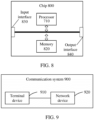
- FIG. 8 is a schematic diagram of a structure of a chip according to an embodiment of the present application.
- a chip 800 shown in FIG. 8 includes a processor 810 that may invoke a computer program from a memory and run the computer program to implement a method in an embodiment of the present application.
- the chip 800 may further include a memory 820.
- the processor 810 may invoke and run a computer program from the memory 820 to implement the method in the embodiments of the present application.
- the memory 820 may be a separate component independent of the processor 810, or may be integrated in the processor 810.
- the chip 800 may further include an input interface 830.
- the processor 810 may control the input interface 830 to communicate with another device or chip.
- the processor 1610 may acquire information or data sent by another device or chip.
- the chip 800 may further include an output interface 840.
- the processor 810 may control the output interface 840 to communicate with another device or chip.
- the processor 1610 may output information or data to another device or chip.
- the chip may be applied to the network device in the embodiments of the present application, and the chip may implement corresponding processes implemented by the network device in various methods of the embodiments of the present application, which will not be repeated here for brevity.
- the chip may be applied to the mobile terminal/terminal device in the embodiments of the present application, and the chip may implement corresponding processes implemented by the mobile terminal/terminal device in various methods of the embodiments of the present application, which will not be repeated herein for brevity.
- chip mentioned in the embodiments of the present application may also be referred to as a system-level chip, a system chip, a chip system, or a system on chip, etc.
- FIG. 9 is a schematic block diagram of a communication system 900 in accordance with an embodiment of the present application. As shown in FIG. 9 , the communication system 900 includes a terminal device 910 and a network device 920.
- the terminal device 910 may be configured to implement the corresponding functions implemented by the terminal device in the above-mentioned methods
- the network device 920 may be configured to implement the corresponding functions implemented by the network device in the above-mentioned methods, which will not be repeated herein for brevity.
- the processor in the embodiments of the present application may be an integrated circuit chip with a capability for processing signals.
- various acts of the method embodiments described above may be completed through an integrated logic circuit of hardware in a processor or instructions in a form of software.
- the above processor may be a general purpose processor, a Digital Signal Processor (DSP), an Application Specific Integrated Circuit (ASIC), a Field Programmable Gate Array (FPGA), or another programmable logic device, a discrete gate or transistor logic device, or a discrete hardware component.
- DSP Digital Signal Processor
- ASIC Application Specific Integrated Circuit
- FPGA Field Programmable Gate Array
- the processor may implement various methods, acts, and logic block diagrams disclosed in the embodiments of the present application.
- the general purpose processor may be a microprocessor or the processor may be any conventional processor.
- the acts of the methods disclosed in connection with the embodiments of the present application may be directly embodied by execution of a hardware decoding processor, or by execution of a combination of hardware and software modules in a decoding processor.
- the software modules may be located in a storage medium commonly used in the art, such as a random access memory, a flash memory, a read-only memory, a programmable read-only memory or an electrically erasable programmable memory, or a register.
- the storage medium is located in a memory, and a processor reads information in the memory and completes the acts of the above methods in combination with its hardware.
- the memory in the embodiments of the present application may be a transitory memory or a non-transitory memory, or may include both transitory and non-transitory memories.
- the non-transitory memory may be a Read-Only Memory (ROM), a Programmable ROM (PROM), an Erasable PROM (EPROM), an Electrically EPROM (EEPROM), or a flash memory.
- the transitory memory may be a Random Access Memory (RAM) which serves as an external cache.
- RAMs such as a Static RAM (SRAM), a Dynamic RAM (DRAM), a Synchronous DRAM (SDRAM), a Double Data Rate SDRAM (DDR SDRAM), an Enhanced SDRAM (ESDRAM), a Synchlink DRAM (SLDRAM), and a Direct Rambus RAM (DR RAM).
- SRAM Static RAM
- DRAM Dynamic RAM
- SDRAM Synchronous DRAM
- DDR SDRAM Double Data Rate SDRAM
- ESDRAM Enhanced SDRAM
- SLDRAM Synchlink DRAM
- DR RAM Direct Rambus RAM
- the memory in the embodiments of the present application may be a static RAM (SRAM), a dynamic RAM (DRAM), a synchronous DRAM (SDRAM), a double data rate SDRAM (DDR SDRAM), an enhanced SDRAM (ESDRAM), a synch link DRAM (SLDRAM) and a direct Rambus RAM (DR RAM), etc. That is to say, the memories in the embodiments of the present application are intended to include, but are not limited to, these and any other suitable types of memories.
- SRAM static RAM
- DRAM dynamic RAM
- SDRAM synchronous DRAM
- DDR SDRAM double data rate SDRAM
- ESDRAM enhanced SDRAM
- SLDRAM synch link DRAM
- DR RAM direct Rambus RAM
- An embodiment of the present application further provides a computer readable storage medium, configured to store a computer program.
- the computer readable storage medium may be applied to the network device in the embodiments of the present application, and the computer program causes a computer to perform the corresponding processes implemented by the network device in various methods in accordance with the embodiments of the present application, which will not be repeated herein for brevity.
- the computer readable storage medium may be applied to the mobile terminal/terminal device in the embodiments of the present application, and the computer program causes a computer to perform the corresponding processes implemented by the mobile terminal/terminal device in various methods in accordance with the embodiments of the present application, which will not be repeated herein for brevity.
- An embodiment of the present application further provides a computer program product, including computer program instructions.
- the computer program product may be applied to the network device in the embodiments of the present application, and the computer program instructions cause a computer to perform the corresponding processes implemented by the network device in various methods in accordance with the embodiments of the present application, which will not be repeated herein for brevity.
- the computer program product may be applied to the mobile terminal/terminal device in the embodiments of the present application, and the computer program instructions cause a computer to perform the corresponding processes implemented by the mobile terminal/terminal device in various methods in accordance with the embodiments of the present application, which will not be repeated herein for brevity.
- An embodiment of the present application further provides a computer program.
- the computer program may be applied to the network device in the embodiments of the present application.
- the computer program When the computer program is run on a computer, the computer is enabled to perform corresponding processes implemented by the network device in various methods according to the embodiments of the present application, which will not be repeated here for brevity.
- the computer program may be applied to the mobile terminal/terminal device in the embodiments of the present application.
- the computer program when running on a computer, causes the computer to perform the corresponding processes implemented by the mobile terminal/terminal device in various methods in accordance with the embodiments of the present application, which will not be repeated herein for brevity.
- the units described as separate components may be or may be not physically separated, and the component shown as a unit may be or may be not a physical unit, i.e., it may be located in one place or may be distributed on multiple network units. Part or all of units may be selected according to actual needs to achieve purposes of technical solutions of the embodiments.
- various functional units in various embodiments of the present application may be integrated in one processing unit, or various units may be physically present separately, or two or more units may be integrated in one unit.
- the functions, if implemented in a form of software functional units and sold or used as an independent product, may be stored in a computer readable storage medium.
- the technical solutions of the present application in essence, or parts of them which contribute to the prior art, or parts of the technical solutions, may be embodied in a form of a software product, which is stored in a storage medium, and includes several instructions for enabling a computer device (which may be a personal computer, a server, or a network device, etc.) to perform all or part of the acts of the methods of various embodiments of the present application.
- the aforementioned storage medium includes various media capable of storing program codes, such as a U disk, a mobile hard disk, a read-only memory (ROM), a random access memory (RAM), a magnetic disk, or an optical disk, etc.
Landscapes
- Engineering & Computer Science (AREA)
- Signal Processing (AREA)
- Computer Networks & Wireless Communication (AREA)
- Quality & Reliability (AREA)
- Databases & Information Systems (AREA)
- Physics & Mathematics (AREA)
- Electromagnetism (AREA)
- Computer Security & Cryptography (AREA)
- Mobile Radio Communication Systems (AREA)
Applications Claiming Priority (1)
| Application Number | Priority Date | Filing Date | Title |
|---|---|---|---|
| PCT/CN2020/118943 WO2022067532A1 (zh) | 2020-09-29 | 2020-09-29 | 无线通信的方法、终端设备和网络设备 |
Publications (2)
| Publication Number | Publication Date |
|---|---|
| EP4207922A1 true EP4207922A1 (de) | 2023-07-05 |
| EP4207922A4 EP4207922A4 (de) | 2023-10-25 |
Family
ID=80949314
Family Applications (1)
| Application Number | Title | Priority Date | Filing Date |
|---|---|---|---|
| EP20955558.0A Pending EP4207922A4 (de) | 2020-09-29 | 2020-09-29 | Drahtloskommunikationsverfahren, endgerätevorrichtung und netzwerkvorrichtung |
Country Status (5)
| Country | Link |
|---|---|
| US (1) | US20230239097A1 (de) |
| EP (1) | EP4207922A4 (de) |
| KR (1) | KR20230078724A (de) |
| CN (2) | CN116390254B (de) |
| WO (1) | WO2022067532A1 (de) |
Cited By (1)
| Publication number | Priority date | Publication date | Assignee | Title |
|---|---|---|---|---|
| EP4311294A4 (de) * | 2021-03-19 | 2024-12-25 | Beijing Xiaomi Mobile Software Co., Ltd. | Direktzugriffsverfahren, direktzugriffsvorrichtung und speichermedium |
Families Citing this family (5)
| Publication number | Priority date | Publication date | Assignee | Title |
|---|---|---|---|---|
| WO2023206234A1 (zh) * | 2022-04-28 | 2023-11-02 | Oppo广东移动通信有限公司 | 一种测量参考信号的配置方法及装置、终端设备、网络设备 |
| CN120113267A (zh) * | 2023-01-13 | 2025-06-06 | Oppo广东移动通信有限公司 | 门限确定方法、装置、设备及存储介质 |
| EP4668840A1 (de) * | 2023-02-13 | 2025-12-24 | Beijing Xiaomi Mobile Software Co., Ltd. | Verfahren und vorrichtung zur übertragung kleiner daten |
| CN119603714B (zh) * | 2023-09-11 | 2025-11-07 | 中国电信股份有限公司技术创新中心 | 一种信号的测量方法、装置和终端 |
| WO2026008140A1 (en) * | 2024-07-03 | 2026-01-08 | Nokia Technologies Oy | User equipment classification |
Family Cites Families (8)
| Publication number | Priority date | Publication date | Assignee | Title |
|---|---|---|---|---|
| AU2017305867B2 (en) * | 2016-08-05 | 2021-06-10 | Nokia Technologies Oy | Power class based coverage enhancement level selection |
| CN116249181A (zh) * | 2016-08-12 | 2023-06-09 | 中兴通讯股份有限公司 | 一种无线资源配置方法和装置 |
| US10735117B2 (en) * | 2017-03-23 | 2020-08-04 | Qualcomm Incorporated | Techniques and apparatuses for signal quality measurements for narrowband internet of things (NB-IOT) devices |
| CN107820728B (zh) * | 2017-04-01 | 2021-08-27 | 深圳前海达闼云端智能科技有限公司 | 随机接入的方法和装置 |
| CN108738141B (zh) * | 2017-04-21 | 2020-04-17 | 中国移动通信有限公司研究院 | 一种物理随机接入信道参数的配置方法、网络侧设备及终端 |
| US11234244B2 (en) * | 2018-07-05 | 2022-01-25 | Asustek Computer Inc. | Method and apparatus for performing random access resource selection in new radio access technology-unlicensed (NR-U) cells in a wireless communication system |
| CN111132314B (zh) * | 2018-10-30 | 2022-06-24 | 维沃移动通信有限公司 | 非周期信道状态信息参考信号配置方法、网络设备及终端 |
| CN110798871A (zh) * | 2019-10-31 | 2020-02-14 | RealMe重庆移动通信有限公司 | 信息处理方法、终端设备及存储介质 |
-
2020
- 2020-09-29 KR KR1020237013914A patent/KR20230078724A/ko active Pending
- 2020-09-29 EP EP20955558.0A patent/EP4207922A4/de active Pending
- 2020-09-29 CN CN202310433895.7A patent/CN116390254B/zh active Active
- 2020-09-29 WO PCT/CN2020/118943 patent/WO2022067532A1/zh not_active Ceased
- 2020-09-29 CN CN202080102016.7A patent/CN115699972A/zh active Pending
-
2023
- 2023-03-27 US US18/190,849 patent/US20230239097A1/en active Pending
Cited By (1)
| Publication number | Priority date | Publication date | Assignee | Title |
|---|---|---|---|---|
| EP4311294A4 (de) * | 2021-03-19 | 2024-12-25 | Beijing Xiaomi Mobile Software Co., Ltd. | Direktzugriffsverfahren, direktzugriffsvorrichtung und speichermedium |
Also Published As
| Publication number | Publication date |
|---|---|
| CN115699972A (zh) | 2023-02-03 |
| CN116390254B (zh) | 2025-10-31 |
| KR20230078724A (ko) | 2023-06-02 |
| EP4207922A4 (de) | 2023-10-25 |
| CN116390254A (zh) | 2023-07-04 |
| US20230239097A1 (en) | 2023-07-27 |
| WO2022067532A1 (zh) | 2022-04-07 |
Similar Documents
| Publication | Publication Date | Title |
|---|---|---|
| US20230239097A1 (en) | Wireless communication method, terminal device and network device | |
| US20230179374A1 (en) | Channel transmission method, terminal device, and network device | |
| CN115669133B (zh) | 无线通信的方法、终端设备和网络设备 | |
| US20230209526A1 (en) | Method for selecting initial bandwidth part (bwp), terminal device and network device | |
| US12207222B2 (en) | Access point assisted positioning for a user equipment (UE) | |
| US12581398B2 (en) | Wireless communication method, terminal device and network device | |
| US12587993B2 (en) | Wireless communication method, terminal device, and network device | |
| US20230308924A1 (en) | Measurement method, terminal device, and network device | |
| CN118044248A (zh) | 无线通信的方法、终端设备和网络设备 | |
| CN116762311B (zh) | 无线通信的方法、终端设备和网络设备 | |
| CN115699868B (zh) | 重选初始带宽部分bwp的方法、终端设备和网络设备 | |
| CN115428527B (zh) | 数据传输的方法和设备 | |
| US20250212026A1 (en) | Model monitoring methods, and devices | |
| CN115699858B (zh) | 测量方法、终端设备和网络设备 | |
| CN115428349B (zh) | 信号测量的方法、终端设备和网络设备 | |
| CN118435649A (zh) | 无线通信的方法、终端设备和网络设备 | |
| CN118235463A (zh) | 无线通信的方法、终端设备和网络设备 | |
| EP4626083A1 (de) | Kommunikationsverfahren, -vorrichtung und -system | |
| CN117693974A (zh) | 无线通信的方法、终端设备和网络设备 | |
| WO2022193240A1 (zh) | 网络选择的方法、终端设备和网络设备 | |
| CN120712860A (zh) | 无线通信的方法、终端设备和网络设备 | |
| EP4648331A1 (de) | Kommunikationsverfahren und -vorrichtung | |
| CN119032618A (zh) | 无线通信的方法、终端设备和网络设备 | |
| CN118176806A (zh) | 无线通信的方法、终端设备和网络设备 |
Legal Events
| Date | Code | Title | Description |
|---|---|---|---|
| STAA | Information on the status of an ep patent application or granted ep patent |
Free format text: STATUS: THE INTERNATIONAL PUBLICATION HAS BEEN MADE |
|
| PUAI | Public reference made under article 153(3) epc to a published international application that has entered the european phase |
Free format text: ORIGINAL CODE: 0009012 |
|
| STAA | Information on the status of an ep patent application or granted ep patent |
Free format text: STATUS: REQUEST FOR EXAMINATION WAS MADE |
|
| 17P | Request for examination filed |
Effective date: 20230327 |
|
| AK | Designated contracting states |
Kind code of ref document: A1 Designated state(s): AL AT BE BG CH CY CZ DE DK EE ES FI FR GB GR HR HU IE IS IT LI LT LU LV MC MK MT NL NO PL PT RO RS SE SI SK SM TR |
|
| REG | Reference to a national code |
Ref country code: DE Ref legal event code: R079 Free format text: PREVIOUS MAIN CLASS: H04W0074080000 Ipc: H04W0048120000 |
|
| A4 | Supplementary search report drawn up and despatched |
Effective date: 20230926 |
|
| RIC1 | Information provided on ipc code assigned before grant |
Ipc: H04W 72/51 20230101ALN20230920BHEP Ipc: H04L 5/00 20060101ALI20230920BHEP Ipc: H04W 8/22 20090101ALI20230920BHEP Ipc: H04W 48/12 20090101AFI20230920BHEP |
|
| DAV | Request for validation of the european patent (deleted) | ||
| DAX | Request for extension of the european patent (deleted) |