EP4209266A1 - Herstellungsverfahren für poröses spinnverbundmaterial und anwendung davon in der lithiumextraktion - Google Patents
Herstellungsverfahren für poröses spinnverbundmaterial und anwendung davon in der lithiumextraktion Download PDFInfo
- Publication number
- EP4209266A1 EP4209266A1 EP21908240.1A EP21908240A EP4209266A1 EP 4209266 A1 EP4209266 A1 EP 4209266A1 EP 21908240 A EP21908240 A EP 21908240A EP 4209266 A1 EP4209266 A1 EP 4209266A1
- Authority
- EP
- European Patent Office
- Prior art keywords
- lithium
- spinning
- porous
- composite material
- adsorption
- Prior art date
- Legal status (The legal status is an assumption and is not a legal conclusion. Google has not performed a legal analysis and makes no representation as to the accuracy of the status listed.)
- Granted
Links
Images
Classifications
-
- B—PERFORMING OPERATIONS; TRANSPORTING
- B01—PHYSICAL OR CHEMICAL PROCESSES OR APPARATUS IN GENERAL
- B01J—CHEMICAL OR PHYSICAL PROCESSES, e.g. CATALYSIS OR COLLOID CHEMISTRY; THEIR RELEVANT APPARATUS
- B01J20/00—Solid sorbent compositions or filter aid compositions; Sorbents for chromatography; Processes for preparing, regenerating or reactivating thereof
- B01J20/22—Solid sorbent compositions or filter aid compositions; Sorbents for chromatography; Processes for preparing, regenerating or reactivating thereof comprising organic material
- B01J20/26—Synthetic macromolecular compounds
- B01J20/262—Synthetic macromolecular compounds obtained otherwise than by reactions only involving carbon to carbon unsaturated bonds, e.g. obtained by polycondensation
-
- B—PERFORMING OPERATIONS; TRANSPORTING
- B01—PHYSICAL OR CHEMICAL PROCESSES OR APPARATUS IN GENERAL
- B01J—CHEMICAL OR PHYSICAL PROCESSES, e.g. CATALYSIS OR COLLOID CHEMISTRY; THEIR RELEVANT APPARATUS
- B01J20/00—Solid sorbent compositions or filter aid compositions; Sorbents for chromatography; Processes for preparing, regenerating or reactivating thereof
- B01J20/30—Processes for preparing, regenerating, or reactivating
- B01J20/3007—Moulding, shaping or extruding
-
- B—PERFORMING OPERATIONS; TRANSPORTING
- B01—PHYSICAL OR CHEMICAL PROCESSES OR APPARATUS IN GENERAL
- B01J—CHEMICAL OR PHYSICAL PROCESSES, e.g. CATALYSIS OR COLLOID CHEMISTRY; THEIR RELEVANT APPARATUS
- B01J20/00—Solid sorbent compositions or filter aid compositions; Sorbents for chromatography; Processes for preparing, regenerating or reactivating thereof
- B01J20/02—Solid sorbent compositions or filter aid compositions; Sorbents for chromatography; Processes for preparing, regenerating or reactivating thereof comprising inorganic material
- B01J20/04—Solid sorbent compositions or filter aid compositions; Sorbents for chromatography; Processes for preparing, regenerating or reactivating thereof comprising inorganic material comprising compounds of alkali metals, alkaline earth metals or magnesium
- B01J20/041—Oxides or hydroxides
-
- B—PERFORMING OPERATIONS; TRANSPORTING
- B01—PHYSICAL OR CHEMICAL PROCESSES OR APPARATUS IN GENERAL
- B01J—CHEMICAL OR PHYSICAL PROCESSES, e.g. CATALYSIS OR COLLOID CHEMISTRY; THEIR RELEVANT APPARATUS
- B01J20/00—Solid sorbent compositions or filter aid compositions; Sorbents for chromatography; Processes for preparing, regenerating or reactivating thereof
- B01J20/02—Solid sorbent compositions or filter aid compositions; Sorbents for chromatography; Processes for preparing, regenerating or reactivating thereof comprising inorganic material
- B01J20/06—Solid sorbent compositions or filter aid compositions; Sorbents for chromatography; Processes for preparing, regenerating or reactivating thereof comprising inorganic material comprising oxides or hydroxides of metals not provided for in group B01J20/04
-
- B—PERFORMING OPERATIONS; TRANSPORTING
- B01—PHYSICAL OR CHEMICAL PROCESSES OR APPARATUS IN GENERAL
- B01J—CHEMICAL OR PHYSICAL PROCESSES, e.g. CATALYSIS OR COLLOID CHEMISTRY; THEIR RELEVANT APPARATUS
- B01J20/00—Solid sorbent compositions or filter aid compositions; Sorbents for chromatography; Processes for preparing, regenerating or reactivating thereof
- B01J20/22—Solid sorbent compositions or filter aid compositions; Sorbents for chromatography; Processes for preparing, regenerating or reactivating thereof comprising organic material
- B01J20/26—Synthetic macromolecular compounds
- B01J20/261—Synthetic macromolecular compounds obtained by reactions only involving carbon to carbon unsaturated bonds
-
- B—PERFORMING OPERATIONS; TRANSPORTING
- B01—PHYSICAL OR CHEMICAL PROCESSES OR APPARATUS IN GENERAL
- B01J—CHEMICAL OR PHYSICAL PROCESSES, e.g. CATALYSIS OR COLLOID CHEMISTRY; THEIR RELEVANT APPARATUS
- B01J20/00—Solid sorbent compositions or filter aid compositions; Sorbents for chromatography; Processes for preparing, regenerating or reactivating thereof
- B01J20/28—Solid sorbent compositions or filter aid compositions; Sorbents for chromatography; Processes for preparing, regenerating or reactivating thereof characterised by their form or physical properties
- B01J20/28014—Solid sorbent compositions or filter aid compositions; Sorbents for chromatography; Processes for preparing, regenerating or reactivating thereof characterised by their form or physical properties characterised by their form
- B01J20/28023—Fibres or filaments
-
- B—PERFORMING OPERATIONS; TRANSPORTING
- B01—PHYSICAL OR CHEMICAL PROCESSES OR APPARATUS IN GENERAL
- B01J—CHEMICAL OR PHYSICAL PROCESSES, e.g. CATALYSIS OR COLLOID CHEMISTRY; THEIR RELEVANT APPARATUS
- B01J20/00—Solid sorbent compositions or filter aid compositions; Sorbents for chromatography; Processes for preparing, regenerating or reactivating thereof
- B01J20/28—Solid sorbent compositions or filter aid compositions; Sorbents for chromatography; Processes for preparing, regenerating or reactivating thereof characterised by their form or physical properties
- B01J20/28014—Solid sorbent compositions or filter aid compositions; Sorbents for chromatography; Processes for preparing, regenerating or reactivating thereof characterised by their form or physical properties characterised by their form
- B01J20/28028—Particles immobilised within fibres or filaments
-
- B—PERFORMING OPERATIONS; TRANSPORTING
- B01—PHYSICAL OR CHEMICAL PROCESSES OR APPARATUS IN GENERAL
- B01J—CHEMICAL OR PHYSICAL PROCESSES, e.g. CATALYSIS OR COLLOID CHEMISTRY; THEIR RELEVANT APPARATUS
- B01J20/00—Solid sorbent compositions or filter aid compositions; Sorbents for chromatography; Processes for preparing, regenerating or reactivating thereof
- B01J20/30—Processes for preparing, regenerating, or reactivating
-
- B—PERFORMING OPERATIONS; TRANSPORTING
- B01—PHYSICAL OR CHEMICAL PROCESSES OR APPARATUS IN GENERAL
- B01J—CHEMICAL OR PHYSICAL PROCESSES, e.g. CATALYSIS OR COLLOID CHEMISTRY; THEIR RELEVANT APPARATUS
- B01J20/00—Solid sorbent compositions or filter aid compositions; Sorbents for chromatography; Processes for preparing, regenerating or reactivating thereof
- B01J20/30—Processes for preparing, regenerating, or reactivating
- B01J20/305—Addition of material, later completely removed, e.g. as result of heat treatment, leaching or washing, e.g. for forming pores
- B01J20/3064—Addition of pore forming agents, e.g. pore inducing or porogenic agents
-
- B—PERFORMING OPERATIONS; TRANSPORTING
- B01—PHYSICAL OR CHEMICAL PROCESSES OR APPARATUS IN GENERAL
- B01J—CHEMICAL OR PHYSICAL PROCESSES, e.g. CATALYSIS OR COLLOID CHEMISTRY; THEIR RELEVANT APPARATUS
- B01J20/00—Solid sorbent compositions or filter aid compositions; Sorbents for chromatography; Processes for preparing, regenerating or reactivating thereof
- B01J20/30—Processes for preparing, regenerating, or reactivating
- B01J20/3071—Washing or leaching
-
- B—PERFORMING OPERATIONS; TRANSPORTING
- B01—PHYSICAL OR CHEMICAL PROCESSES OR APPARATUS IN GENERAL
- B01J—CHEMICAL OR PHYSICAL PROCESSES, e.g. CATALYSIS OR COLLOID CHEMISTRY; THEIR RELEVANT APPARATUS
- B01J20/00—Solid sorbent compositions or filter aid compositions; Sorbents for chromatography; Processes for preparing, regenerating or reactivating thereof
- B01J20/30—Processes for preparing, regenerating, or reactivating
- B01J20/3078—Thermal treatment, e.g. calcining or pyrolizing
-
- B—PERFORMING OPERATIONS; TRANSPORTING
- B01—PHYSICAL OR CHEMICAL PROCESSES OR APPARATUS IN GENERAL
- B01J—CHEMICAL OR PHYSICAL PROCESSES, e.g. CATALYSIS OR COLLOID CHEMISTRY; THEIR RELEVANT APPARATUS
- B01J20/00—Solid sorbent compositions or filter aid compositions; Sorbents for chromatography; Processes for preparing, regenerating or reactivating thereof
- B01J20/30—Processes for preparing, regenerating, or reactivating
- B01J20/3085—Chemical treatments not covered by groups B01J20/3007 - B01J20/3078
-
- B—PERFORMING OPERATIONS; TRANSPORTING
- B01—PHYSICAL OR CHEMICAL PROCESSES OR APPARATUS IN GENERAL
- B01J—CHEMICAL OR PHYSICAL PROCESSES, e.g. CATALYSIS OR COLLOID CHEMISTRY; THEIR RELEVANT APPARATUS
- B01J20/00—Solid sorbent compositions or filter aid compositions; Sorbents for chromatography; Processes for preparing, regenerating or reactivating thereof
- B01J20/30—Processes for preparing, regenerating, or reactivating
- B01J20/32—Impregnating or coating ; Solid sorbent compositions obtained from processes involving impregnating or coating
- B01J20/3202—Impregnating or coating ; Solid sorbent compositions obtained from processes involving impregnating or coating characterised by the carrier, support or substrate used for impregnation or coating
- B01J20/3206—Organic carriers, supports or substrates
- B01J20/3208—Polymeric carriers, supports or substrates
- B01J20/321—Polymeric carriers, supports or substrates consisting of a polymer obtained by reactions involving only carbon to carbon unsaturated bonds
-
- B—PERFORMING OPERATIONS; TRANSPORTING
- B01—PHYSICAL OR CHEMICAL PROCESSES OR APPARATUS IN GENERAL
- B01J—CHEMICAL OR PHYSICAL PROCESSES, e.g. CATALYSIS OR COLLOID CHEMISTRY; THEIR RELEVANT APPARATUS
- B01J20/00—Solid sorbent compositions or filter aid compositions; Sorbents for chromatography; Processes for preparing, regenerating or reactivating thereof
- B01J20/30—Processes for preparing, regenerating, or reactivating
- B01J20/32—Impregnating or coating ; Solid sorbent compositions obtained from processes involving impregnating or coating
- B01J20/3202—Impregnating or coating ; Solid sorbent compositions obtained from processes involving impregnating or coating characterised by the carrier, support or substrate used for impregnation or coating
- B01J20/3206—Organic carriers, supports or substrates
- B01J20/3208—Polymeric carriers, supports or substrates
- B01J20/3212—Polymeric carriers, supports or substrates consisting of a polymer obtained by reactions otherwise than involving only carbon to carbon unsaturated bonds
-
- B—PERFORMING OPERATIONS; TRANSPORTING
- B01—PHYSICAL OR CHEMICAL PROCESSES OR APPARATUS IN GENERAL
- B01J—CHEMICAL OR PHYSICAL PROCESSES, e.g. CATALYSIS OR COLLOID CHEMISTRY; THEIR RELEVANT APPARATUS
- B01J20/00—Solid sorbent compositions or filter aid compositions; Sorbents for chromatography; Processes for preparing, regenerating or reactivating thereof
- B01J20/30—Processes for preparing, regenerating, or reactivating
- B01J20/32—Impregnating or coating ; Solid sorbent compositions obtained from processes involving impregnating or coating
- B01J20/3231—Impregnating or coating ; Solid sorbent compositions obtained from processes involving impregnating or coating characterised by the coating or impregnating layer
- B01J20/3234—Inorganic material layers
- B01J20/3236—Inorganic material layers containing metal, other than zeolites, e.g. oxides, hydroxides, sulphides or salts
-
- C—CHEMISTRY; METALLURGY
- C22—METALLURGY; FERROUS OR NON-FERROUS ALLOYS; TREATMENT OF ALLOYS OR NON-FERROUS METALS
- C22B—PRODUCTION AND REFINING OF METALS; PRETREATMENT OF RAW MATERIALS
- C22B26/00—Obtaining alkali, alkaline earth metals or magnesium
- C22B26/10—Obtaining alkali metals
- C22B26/12—Obtaining lithium
-
- C—CHEMISTRY; METALLURGY
- C22—METALLURGY; FERROUS OR NON-FERROUS ALLOYS; TREATMENT OF ALLOYS OR NON-FERROUS METALS
- C22B—PRODUCTION AND REFINING OF METALS; PRETREATMENT OF RAW MATERIALS
- C22B3/00—Extraction of metal compounds from ores or concentrates by wet processes
- C22B3/20—Treatment or purification of solutions, e.g. obtained by leaching
- C22B3/22—Treatment or purification of solutions, e.g. obtained by leaching by physical processes, e.g. by filtration, by magnetic means, or by thermal decomposition
- C22B3/24—Treatment or purification of solutions, e.g. obtained by leaching by physical processes, e.g. by filtration, by magnetic means, or by thermal decomposition by adsorption on solid substances, e.g. by extraction with solid resins
-
- Y—GENERAL TAGGING OF NEW TECHNOLOGICAL DEVELOPMENTS; GENERAL TAGGING OF CROSS-SECTIONAL TECHNOLOGIES SPANNING OVER SEVERAL SECTIONS OF THE IPC; TECHNICAL SUBJECTS COVERED BY FORMER USPC CROSS-REFERENCE ART COLLECTIONS [XRACs] AND DIGESTS
- Y02—TECHNOLOGIES OR APPLICATIONS FOR MITIGATION OR ADAPTATION AGAINST CLIMATE CHANGE
- Y02P—CLIMATE CHANGE MITIGATION TECHNOLOGIES IN THE PRODUCTION OR PROCESSING OF GOODS
- Y02P10/00—Technologies related to metal processing
- Y02P10/20—Recycling
Definitions
- the present invention belongs to the field of material chemical engineering and relates to lithium-ion adsorption materials, particularly to a method for a porous spinning composite material.
- Lithium serving as the lightest metal is widely applied to the fields of aerospace, lithium-ion batteries, the nuclear industry, ceramics and electronic devices and is praised as a "strategic energy metal" in the 21st century. With the continuous development of modern high technology, lithium demands are increasing.
- the sources of lithium are mainly divided into two categories: solid lithium ore resources that mainly include lepidolite, spodumene and petalite, and liquid lithium ore resources that mainly include salt lake brine, concentrated seawater, geothermal water and underground brine.
- solid lithium ore resources that mainly include lepidolite, spodumene and petalite
- liquid lithium ore resources that mainly include salt lake brine, concentrated seawater, geothermal water and underground brine.
- the methods for extracting lithium from the liquid lithium ore mainly include a precipitation method, an electrochemical method, an extraction method and an adsorption method.
- the adsorption method has the advantages of being low in cost, simple in process, green and efficient, and gradually becoming a lithium extraction method with the most excellent application prospects.
- the key to the technology is to prepare a lithium adsorbent with excellent adsorption properties. Because of higher adsorption capacity and lithium-ion selectivity, lithium-ion sieve-type oxides gradually become the research focus. However, most lithium-ion sieve-type oxides exist in the form of superfine powder; applications of the oxides in the industry are greatly limited by lower fluidity and cycling stability.
- the key to solving the problem is to prepare a composite lithium-ion sieve adsorbent having high adsorption capacity, high adsorption rate, excellent cycling stability and low cost.
- lithium ore in geothermal water generally has a low mineralization degree of 1-10 g/L only and low lithium concentration (5-30 mg/L), green and efficient extraction of the lithium ore is difficult. Further, for the salt lake surface brine having a low mineralization degree, due to dissolution loss of the manganic lithium-ion sieve, contamination is easily caused, and the cycling stability is poor.
- the adsorption materials mentioned in the above patents are inapplicable to the extraction of lithium from the geothermal water and the salt lake surface brine having a low mineralization degree.
- porous spinning composite adsorbent that is simple in the preparation process, stable in performance, high in adsorption efficiency and easy for industrial operation needs to be developed.
- the purpose of the present invention is to provide a fibrous spinning composite adsorption material that is simple in preparation procedure, high in adsorption capacity, high in adsorption rate, and easy for large-scale preparation and industrial operation, thereby realizing efficient lithium separation and recovery in liquid lithium ore resources with low lithium concentration (5-30 mg/L) and low mineralization degree and laying a foundation for industrialized application of the porous spinning composite adsorption material.
- a preparation method for the porous spinning composite material includes the following steps:
- the high-molecular polymer is one or a mixture of more than one of polyethylene, polypropylene, polyvinyl chloride, polyvinylidene fluoride, polytetrafluoroethylene, polystyrene, polyacrylonitrile, polyamide, polysulfone, sulfonated polysulfone, polyarylsulfone and polyether sulfone.
- the organic solvent is one or a mixture of more than one of dimethyl formamide, dimethyl acetamide, dimethyl sulfoxide, N-methyl pyrrolidone, tetrahydrofuran, dichloromethane and tetrachloromethane.
- the lithium-ion sieve powder is LiTi 2 O 4 , Li 2 TiO 3 , Li 4 Ti 5 O 12 , or one or a mixture of more than one of H products of LiTi 2 O 4 , Li 2 TiO 3 and Li 4 Ti 5 O 12 after acid pickling.
- the water-soluble pore-forming agent is a mixture of more than one of LiCl, KCl, NaHCO 3 , (NH 4 ) 2 CO 3 , NH 4 HCO 3 , polyethylene glycol-200/400/600/800/1000 and polyvinyl pyrrolidone.
- the additional amount of the pore-forming agent is 2-10% of the total mass of the mixed solution; under the condition the porosity of the composite fibers may be greatly increased and leakage of the lithium-ion sieve powder material is avoided.
- the mass ratio of the high-molecular polymer to the lithium-ion sieve is 1 :4-4: 1.
- the spinning jet of the wet spinning equipment has 20-60 holes; each spinneret hole has a diameter of 0.05-0.5 mm; a spinning speed is 2-20 m/min; and a winding machine has a speed of 2-30 m/min.
- the coagulating bath is a mixed aqueous solution containing organic solvents such as one or more than one of dimethyl formamide, dimethyl acetamide, dimethyl sulfoxide, N-methyl pyrrolidone, tetrahydrofuran and dichloromethane, and has a mass fraction of 5-25%. Under this condition, the porous composite lithium-ion sieve spinning fibers are rapidly molded.
- the present invention further discloses an application of the porous spinning composite material in the extraction of lithium from liquid lithium ore.
- the liquid lithium ore is geothermal water and has a mineralization degree TDS of 1-10 g/L and a lithium concentration of 5-30 mg/L, and a pH value of the porous spinning composite material is controlled at 7-13 during extraction of lithium from the geothermal water.
- the liquid lithium ore is salt lake surface brine having a low mineralization degree, and the pH value of the porous spinning composite material is controlled at 7-13 during extraction of lithium from the salt lake surface brine having a low mineralization degree.
- the liquid lithium ore for porous spinning further includes salt lake brine, underground brine, well mine brine, geothermal water, seawater and seabed hydrothermal ore.
- Methods for the composite material used during extraction of lithium from the liquid lithium ore include adsorption column, adsorption bed and adsorption tower type operations.
- Embodiment 1 Preparation of polysulfone-H 2 TiO 3 porous spinning composite material and lithium extraction from geothermal water thereof
- H 2 TiO 3 powder and 8 g of a water-soluble pore-forming agent PEG-400 were weighed in the above polysulfone mixed solution and fully mixed and uniformly stirred so that H-type lithium-ion sieve powder H 2 TiO 3 was uniformly dispersed in the polysulfone mixed solution.
- a polysulfone/H 2 TiO 3 composite spinning stock solution was added into a raw material tank of wet spinning equipment; the number of holes of a spinning jet was adjusted to 40, wherein each spinneret hole had a diameter of 0.07 mm, a spinning speed was 13 m/min, and a drafting and winding speed was 16 m/min; and the stock solution was spun into a coagulating bath via the spinning jet and subjected to phase inversion molding and draft washing, thereby obtaining the polysulfone-H 2 TiO 3 porous spinning composite material.
- the composite spinning material obtained under the condition has morphology integrity, uniform thickness and excellent adsorption property. Compared with composite spinning material obtained by the spinneret hole diameter of 0.1 mm under the same condition, the adsorption capacity is increased by 13.69%, and the adsorption rate is increased by 30%.
- the prepared polysulfone-H 2 TiO 3 porous spinning composite material is applied to the extraction of lithium from geothermal water having an initial lithium-ion concentration of 26.5895 mg ⁇ L -1 ; a pH value of the geothermal water is regulated as 12.1, and 1 g of the polysulfone-H 2 TiO 3 porous spinning composite material is added into 1 L of geothermal water for adsorption.
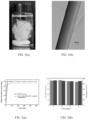
- FIGs. 1(a) and 1(b) A real product picture and a polarizing microscope magnified drawing of the prepared material are shown in Figs. 1(a) and 1(b) ; and a comparison of adsorption capacity for lithium adsorption with the powder H 2 TiO 3 under the same condition and cycling stability are shown in Figs. 2(a) and 2(b) .
- the spinning fiber coated/molded lithium-ion sieve powder may still maintain higher adsorption capacity and rate, and the adsorption capacity and rate are not significantly decreased compared with the powder material.
- the adsorption rate and adsorption capacity of the fibrous spinning composite adsorption material prepared in the present embodiment are greatly increased.
- adsorption equilibrium achievement time is respectively 120 hours and 8 hours at normal temperature.
- the polysulfone-H 2 TiO 3 porous spinning composite material in the present embodiment can achieve adsorption equilibrium within 1 hour only at the normal temperature.
- the adsorption capacity is lower and is up to 7 mg ⁇ g -1 only.
- the adsorption capacity of the porous polysulfone-H 2 TiO 3 spinning composite material prepared in the present embodiment may be up to 23.39 mg ⁇ g -1 .
- the adsorption equilibrium time is only 40 minutes; and various adsorption properties are significantly increased.
- Embodiment 2 Preparation of polyacrylonitrile-H 4 Ti 5 O 12 spinning composite material and lithium extraction from geothermal water thereof
- a polyacrylonitrile/H 4 Ti 5 O 12 composite spinning stock solution was added into a raw material tank of wet spinning equipment; the number of holes of a spinning jet was adjusted to 50, wherein each spinneret hole had a diameter of 0.05 mm, a spinning speed was 10 m/min, and a drafting and winding speed was 110 m/min; and the stock solution was spun into a coagulating bath via the spinning jet and subjected to phase inversion molding and draft washing, thereby obtaining the polyacrylonitrile-H 4 Ti 5 O 12 spinning composite material.
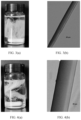
- a real product picture and a polarizing microscope magnified drawing of the prepared material are shown in Figs. 3(a) and 3(b) .
- the prepared polyacrylonitrile-H 4 Ti 5 O 12 spinning composite material is applied to the extraction of lithium from geothermal water; a pH value of the geothermal water is regulated as 11.8; 1 g of the polysulfone-H 2 TiO 3 porous spinning composite material is added into 1.5 L of geothermal water for adsorption; adsorption capacity may be up to 20.07 mg/g; and adsorption equilibrium was achieved within 50 minutes.
- Embodiment 3 Preparation of polyacrylonitrile-Li 2 TiO 3 spinning composite material and lithium extraction from geothermal water thereof
- Li 2 TiO 3 powder 10 g was weighed in the above polyacrylonitrile mixed solution and fully mixed and uniformly stirred so that lithium-ion sieve powder was uniformly dispersed in the polyacrylonitrile mixed solution.
- a polyacrylonitrile/Li 2 TiO 3 composite spinning stock solution was added into a raw material tank of wet spinning equipment; the number of holes of a spinning jet was adjusted to 40, wherein each spinneret hole had a diameter of 0.07 mm, a spinning speed was 10 m/min, and a drafting and winding speed was 10 m/min; and the stock solution was spun into a coagulating bath via the spinning jet and subjected to phase inversion molding and draft washing to obtain a polyacrylonitrile-Li 2 TiO 3 spinning composite material; and the polyacrylonitrile-Li 2 TiO 3 spinning composite material was subjected to further acid pickling, thereby obtaining the polyacrylonitrile-H 2 TiO 3 spinning composite material.
- adsorption was conducted in the above geothermal water; an adsorption pH value was controlled as 12; an adsorption column had a radius of 5 cm and a column height of 50 cm; and a flow rate was 20 ml ⁇ min -1 .
- a real product picture and a polarizing microscope magnified drawing of the prepared material are shown in Figs. 4(a) and 4(b) .
- the adsorption rate of the polyacrylonitrile- Li 2 TiO 3 spinning composite material prepared in the present embodiment is significantly increased.
- a polyacrylonitrile-Li 2 TiO 3 electrostatic spinning nanofiber membrane reported in the literature " Journal of Industrial and Engineering Chemistry, 2019, 70, 124-135 " achieves adsorption equilibrium within 12 hours at normal temperature in a lithium chloride solution having an initial lithium-ion concentration of 70 mg ⁇ L -1 ; and adsorption equilibrium capacity is up to 28 mg ⁇ g -1 .
- column-bed dynamic adsorption capacity is up to 29.8 mg ⁇ g -1 under the same adsorption condition; adsorption equilibrium time is only 1 hour, and efficiency is increased by 12 times.
- the spinning composite material is easy to process, high in strength and easy for engineering application.
Landscapes
- Chemical & Material Sciences (AREA)
- Organic Chemistry (AREA)
- Chemical Kinetics & Catalysis (AREA)
- Analytical Chemistry (AREA)
- Engineering & Computer Science (AREA)
- Materials Engineering (AREA)
- Environmental & Geological Engineering (AREA)
- Manufacturing & Machinery (AREA)
- Mechanical Engineering (AREA)
- Metallurgy (AREA)
- Geology (AREA)
- General Life Sciences & Earth Sciences (AREA)
- Life Sciences & Earth Sciences (AREA)
- Inorganic Chemistry (AREA)
- Geochemistry & Mineralogy (AREA)
- Physics & Mathematics (AREA)
- Thermal Sciences (AREA)
- Solid-Sorbent Or Filter-Aiding Compositions (AREA)
- Water Treatment By Sorption (AREA)
Applications Claiming Priority (2)
| Application Number | Priority Date | Filing Date | Title |
|---|---|---|---|
| CN202011524295.4A CN112619621B (zh) | 2020-12-22 | 2020-12-22 | 一种多孔纺丝复合材料的制备方法及其提锂应用 |
| PCT/CN2021/070555 WO2022134221A1 (zh) | 2020-12-22 | 2021-01-07 | 一种多孔纺丝复合材料的制备方法及其提锂应用 |
Publications (4)
| Publication Number | Publication Date |
|---|---|
| EP4209266A1 true EP4209266A1 (de) | 2023-07-12 |
| EP4209266A4 EP4209266A4 (de) | 2024-01-17 |
| EP4209266B1 EP4209266B1 (de) | 2025-04-09 |
| EP4209266C0 EP4209266C0 (de) | 2025-04-09 |
Family
ID=75320609
Family Applications (1)
| Application Number | Title | Priority Date | Filing Date |
|---|---|---|---|
| EP21908240.1A Active EP4209266B1 (de) | 2020-12-22 | 2021-01-07 | Herstellungsverfahren für poröses spinnverbundmaterial |
Country Status (3)
| Country | Link |
|---|---|
| EP (1) | EP4209266B1 (de) |
| CN (1) | CN112619621B (de) |
| WO (1) | WO2022134221A1 (de) |
Cited By (2)
| Publication number | Priority date | Publication date | Assignee | Title |
|---|---|---|---|---|
| CN117299098A (zh) * | 2023-11-28 | 2023-12-29 | 万华化学集团股份有限公司 | 一种高性能的钛系锂吸附剂及其制备方法和应用 |
| WO2024126603A1 (en) * | 2022-12-14 | 2024-06-20 | Watercycle Technologies Limited | Material |
Families Citing this family (22)
| Publication number | Priority date | Publication date | Assignee | Title |
|---|---|---|---|---|
| CN115445587B (zh) * | 2022-09-23 | 2023-08-11 | 江苏久吾高科技股份有限公司 | 一种中空复合多级孔结构的高吸附容量吸附剂及其制备方法 |
| CN115369510A (zh) * | 2022-10-24 | 2022-11-22 | 北京地之光企业管理有限公司 | 一种用于吸附锂离子的含冠醚载体纳米纤维材料及其制备方法 |
| CN115463646B (zh) * | 2022-10-28 | 2023-02-03 | 北京地之光企业管理有限公司 | 一种盐湖卤水提锂吸附材料及其制备方法和应用 |
| CN115701807B (zh) * | 2022-11-08 | 2024-11-15 | 北京碧水源膜科技有限公司 | 一种锂离子筛H2TiO3吸附帘式膜的制备方法及应用所述帘式膜的盐湖提锂系统 |
| CN115845825B (zh) * | 2022-11-29 | 2023-09-19 | 北京碧水源膜科技有限公司 | 一种锂吸附剂的制备方法及实现所述方法的设备 |
| CN116272891A (zh) * | 2022-12-02 | 2023-06-23 | 厦门紫金矿冶技术有限公司 | 一种盐湖提锂吸附材料的制备方法及应用 |
| CN116116370B (zh) * | 2022-12-14 | 2025-04-25 | 北京碧水源膜科技有限公司 | 具有高吸附容量和高吸附速率的钛系锂吸附剂的制备方法 |
| CN116159531A (zh) * | 2022-12-20 | 2023-05-26 | 浙江工业大学 | 一种中空纤维膜锂离子吸附剂的制备方法 |
| CN116371384B (zh) * | 2022-12-28 | 2024-04-16 | 北京碧水源膜科技有限公司 | 钛基锂离子筛粉体的成型方法 |
| CN115970659B (zh) * | 2022-12-30 | 2025-06-10 | 北京华特源科技有限公司 | 一种锂离子吸附材料及其制备方法、提锂系统和提锂方法 |
| CN115970661B (zh) * | 2023-01-30 | 2024-09-20 | 江苏海普功能材料有限公司 | 一种高吸附量的锂离子印迹纳米复合颗粒的制备方法 |
| GB202302144D0 (en) * | 2023-02-15 | 2023-03-29 | Watercycle Tech Ltd | Method |
| CN116272851B (zh) * | 2023-02-16 | 2025-01-28 | 西安金藏膜环保科技有限公司 | 一种用于锂离子提取的沸石负载型复合材料的制备方法 |
| CN116212830B (zh) * | 2023-02-17 | 2025-04-22 | 北京碧水源膜科技有限公司 | 一种锂离子吸附材料及其制备方法和应用 |
| CN116351380B (zh) * | 2023-03-21 | 2024-04-12 | 郑州大学 | 一种低成本层状锂离子筛及其制备方法和应用 |
| CN119186513B (zh) * | 2023-06-27 | 2025-10-14 | 中国石油化工股份有限公司 | 锂吸附材料及其制备方法和应用 |
| CN119320492A (zh) * | 2023-07-17 | 2025-01-17 | 中国石油化工股份有限公司 | 含锂离子筛的聚酰胺材料和分离膜及它们的制备方法 |
| CN116966866B (zh) * | 2023-07-31 | 2025-11-14 | 上海科技大学 | 一种具有光热辅助提锂功能的非织造材料、制备方法及应用 |
| WO2025129574A1 (zh) * | 2023-12-21 | 2025-06-26 | 广东邦普循环科技有限公司 | 一种双层锂离子筛纤维材料及其制备方法和应用 |
| CN117886340B (zh) * | 2024-01-17 | 2024-11-26 | 中国地质科学院矿产资源研究所 | 一种吸附耦合盐梯度太阳池提取碳酸盐型盐湖中锂的方法 |
| CN118719025A (zh) * | 2024-06-07 | 2024-10-01 | 西藏自治区地质矿产勘查开发局中心实验室 | 一种高亲水性3d网状复合吸附材料的制备及液态资源中提锂应用 |
| CN118892809A (zh) * | 2024-06-28 | 2024-11-05 | 山东大学 | 一种二维碳材料修饰的锂离子筛复合膜及其制备方法 |
Family Cites Families (12)
| Publication number | Priority date | Publication date | Assignee | Title |
|---|---|---|---|---|
| CN101898113A (zh) | 2010-08-11 | 2010-12-01 | 华东理工大学 | 球形二氧化锰型锂离子筛 |
| CN102211012A (zh) | 2010-09-10 | 2011-10-12 | 中国海洋大学 | 一种锂离子筛膜及其制备方法 |
| JP6692530B2 (ja) * | 2016-03-31 | 2020-05-13 | 国立大学法人信州大学 | チタン酸系リチウム吸着剤の製造方法 |
| CN106622170A (zh) * | 2016-12-21 | 2017-05-10 | 江苏大学 | 一种锂钛型离子筛复合膜的制备方法及其用途 |
| CN106902781B (zh) | 2017-03-08 | 2019-06-28 | 江苏大学 | 改性介孔空心硅球吸附剂的制备方法及其应用 |
| WO2019173716A1 (en) * | 2018-03-08 | 2019-09-12 | Ut-Battelle, Llc | Lithium extraction composite for recovery of lithium from brines, and process of using said composition |
| KR102146063B1 (ko) * | 2018-08-22 | 2020-08-20 | 명지대학교 산학협력단 | H2TiO3가 함침된 복합나노시트를 포함하는 리튬흡착제 및 그 제조방법 |
| CN109225121A (zh) * | 2018-08-27 | 2019-01-18 | 石河子大学 | 复合吸附剂的制备方法和卤水提锂方法 |
| CN109537106B (zh) * | 2018-11-09 | 2021-05-18 | 中国科学院山西煤炭化学研究所 | 高速干喷纺丝制备异形截面碳纤维前驱体纤维、预氧化纤维或碳纤维的方法 |
| CN109289754A (zh) * | 2018-11-14 | 2019-02-01 | 天津科技大学 | 一种磷钼酸铵复合凝胶吸附材料的制备方法 |
| CN110090614B (zh) * | 2019-05-28 | 2021-08-27 | 湖南大学 | 一种锂离子筛吸附剂的制备方法及其产品与应用 |
| CN110975795A (zh) * | 2019-12-20 | 2020-04-10 | 南京工业大学 | 一种提锂吸附剂的合成方法 |
-
2020
- 2020-12-22 CN CN202011524295.4A patent/CN112619621B/zh active Active
-
2021
- 2021-01-07 EP EP21908240.1A patent/EP4209266B1/de active Active
- 2021-01-07 WO PCT/CN2021/070555 patent/WO2022134221A1/zh not_active Ceased
Cited By (3)
| Publication number | Priority date | Publication date | Assignee | Title |
|---|---|---|---|---|
| WO2024126603A1 (en) * | 2022-12-14 | 2024-06-20 | Watercycle Technologies Limited | Material |
| CN117299098A (zh) * | 2023-11-28 | 2023-12-29 | 万华化学集团股份有限公司 | 一种高性能的钛系锂吸附剂及其制备方法和应用 |
| CN117299098B (zh) * | 2023-11-28 | 2024-02-27 | 万华化学集团股份有限公司 | 一种高性能的钛系锂吸附剂及其制备方法和应用 |
Also Published As
| Publication number | Publication date |
|---|---|
| CN112619621B (zh) | 2023-02-24 |
| EP4209266A4 (de) | 2024-01-17 |
| WO2022134221A1 (zh) | 2022-06-30 |
| EP4209266B1 (de) | 2025-04-09 |
| EP4209266C0 (de) | 2025-04-09 |
| CN112619621A (zh) | 2021-04-09 |
Similar Documents
| Publication | Publication Date | Title |
|---|---|---|
| EP4209266B1 (de) | Herstellungsverfahren für poröses spinnverbundmaterial | |
| KR20240112270A (ko) | 고흡착 용량의 입상 티타늄 기반 리튬 이온 체 흡착제의 제조 방법 | |
| CN106987922B (zh) | 中空多孔结构的纤维素纳米纤维静电纺丝制备方法 | |
| CN115970659B (zh) | 一种锂离子吸附材料及其制备方法、提锂系统和提锂方法 | |
| CN113278819A (zh) | 一种高选择性提锂电极及其制备方法 | |
| CN108114693B (zh) | 一种玻璃纤维为基体的锂离子筛吸附膜及其制备方法 | |
| CN109304088A (zh) | 一种耐强酸强碱的海水淡化膜及其制备方法与应用 | |
| CN115701807B (zh) | 一种锂离子筛H2TiO3吸附帘式膜的制备方法及应用所述帘式膜的盐湖提锂系统 | |
| CN112726028B (zh) | 具有粗糙结构的超亲水复合纳米纤维膜及其制备和应用 | |
| Bao et al. | Enhancement of lithium extraction from low grade brines by highly hydrophilic blend membranes using MnO2 ion sieve as adsorbents | |
| CN117280488B (zh) | 一种多孔贫锂态电极及其制备方法和应用 | |
| CN109134944A (zh) | 一种具有不同化学官能团的多孔小球及其应用 | |
| CN102784563B (zh) | 高强度聚氯乙烯中空纤维超滤膜及其制备方法 | |
| CN115573096A (zh) | 聚氨酯纳米纤维膜的制备方法 | |
| CN109589803B (zh) | 微生物载体杂化MBfR膜及其制备方法 | |
| CN116371384B (zh) | 钛基锂离子筛粉体的成型方法 | |
| CN117258744A (zh) | 一种颗粒状锂吸附剂及其制备方法和应用 | |
| CN119951483A (zh) | 一种球形吸附剂的制备方法 | |
| CN102512987A (zh) | 一种高通量的聚偏氟乙烯中空纤维膜的制备方法 | |
| CN117942954A (zh) | 一种凝胶态锂离子吸附剂及其制备方法与脱锂方法 | |
| CN117797767A (zh) | 用于盐湖卤水提锂的吸附剂制备方法 | |
| CN105088417A (zh) | 一种金属氧化物宏观纤维及其制备方法 | |
| CN106532090B (zh) | 一种液流电池用宣纸增强非氟离子膜及其制备方法 | |
| CN115946416A (zh) | 一种超疏水纳米纤维膜材料的制备方法 | |
| CN204625733U (zh) | 锂离子吸附柱 |
Legal Events
| Date | Code | Title | Description |
|---|---|---|---|
| STAA | Information on the status of an ep patent application or granted ep patent |
Free format text: STATUS: THE INTERNATIONAL PUBLICATION HAS BEEN MADE |
|
| PUAI | Public reference made under article 153(3) epc to a published international application that has entered the european phase |
Free format text: ORIGINAL CODE: 0009012 |
|
| STAA | Information on the status of an ep patent application or granted ep patent |
Free format text: STATUS: REQUEST FOR EXAMINATION WAS MADE |
|
| 17P | Request for examination filed |
Effective date: 20230331 |
|
| AK | Designated contracting states |
Kind code of ref document: A1 Designated state(s): AL AT BE BG CH CY CZ DE DK EE ES FI FR GB GR HR HU IE IS IT LI LT LU LV MC MK MT NL NO PL PT RO RS SE SI SK SM TR |
|
| A4 | Supplementary search report drawn up and despatched |
Effective date: 20231215 |
|
| RIC1 | Information provided on ipc code assigned before grant |
Ipc: C22B 3/24 20060101ALI20231211BHEP Ipc: C22B 26/12 20060101ALI20231211BHEP Ipc: B01J 20/30 20060101ALI20231211BHEP Ipc: B01J 20/28 20060101ALI20231211BHEP Ipc: B01J 20/26 20060101AFI20231211BHEP |
|
| DAV | Request for validation of the european patent (deleted) | ||
| DAX | Request for extension of the european patent (deleted) | ||
| STAA | Information on the status of an ep patent application or granted ep patent |
Free format text: STATUS: EXAMINATION IS IN PROGRESS |
|
| 17Q | First examination report despatched |
Effective date: 20240903 |
|
| GRAP | Despatch of communication of intention to grant a patent |
Free format text: ORIGINAL CODE: EPIDOSNIGR1 |
|
| STAA | Information on the status of an ep patent application or granted ep patent |
Free format text: STATUS: GRANT OF PATENT IS INTENDED |
|
| GRAS | Grant fee paid |
Free format text: ORIGINAL CODE: EPIDOSNIGR3 |
|
| GRAA | (expected) grant |
Free format text: ORIGINAL CODE: 0009210 |
|
| STAA | Information on the status of an ep patent application or granted ep patent |
Free format text: STATUS: THE PATENT HAS BEEN GRANTED |
|
| INTG | Intention to grant announced |
Effective date: 20250211 |
|
| AK | Designated contracting states |
Kind code of ref document: B1 Designated state(s): AL AT BE BG CH CY CZ DE DK EE ES FI FR GB GR HR HU IE IS IT LI LT LU LV MC MK MT NL NO PL PT RO RS SE SI SK SM TR |
|
| REG | Reference to a national code |
Ref country code: GB Ref legal event code: FG4D |
|
| REG | Reference to a national code |
Ref country code: CH Ref legal event code: EP |
|
| REG | Reference to a national code |
Ref country code: DE Ref legal event code: R096 Ref document number: 602021029075 Country of ref document: DE |
|
| REG | Reference to a national code |
Ref country code: IE Ref legal event code: FG4D |
|
| U01 | Request for unitary effect filed |
Effective date: 20250509 |
|
| U07 | Unitary effect registered |
Designated state(s): AT BE BG DE DK EE FI FR IT LT LU LV MT NL PT RO SE SI Effective date: 20250515 |
|
| PG25 | Lapsed in a contracting state [announced via postgrant information from national office to epo] |
Ref country code: ES Free format text: LAPSE BECAUSE OF FAILURE TO SUBMIT A TRANSLATION OF THE DESCRIPTION OR TO PAY THE FEE WITHIN THE PRESCRIBED TIME-LIMIT Effective date: 20250409 |
|
| PG25 | Lapsed in a contracting state [announced via postgrant information from national office to epo] |
Ref country code: NO Free format text: LAPSE BECAUSE OF FAILURE TO SUBMIT A TRANSLATION OF THE DESCRIPTION OR TO PAY THE FEE WITHIN THE PRESCRIBED TIME-LIMIT Effective date: 20250709 Ref country code: GR Free format text: LAPSE BECAUSE OF FAILURE TO SUBMIT A TRANSLATION OF THE DESCRIPTION OR TO PAY THE FEE WITHIN THE PRESCRIBED TIME-LIMIT Effective date: 20250710 |
|
| PG25 | Lapsed in a contracting state [announced via postgrant information from national office to epo] |
Ref country code: PL Free format text: LAPSE BECAUSE OF FAILURE TO SUBMIT A TRANSLATION OF THE DESCRIPTION OR TO PAY THE FEE WITHIN THE PRESCRIBED TIME-LIMIT Effective date: 20250409 |
|
| PG25 | Lapsed in a contracting state [announced via postgrant information from national office to epo] |
Ref country code: HR Free format text: LAPSE BECAUSE OF FAILURE TO SUBMIT A TRANSLATION OF THE DESCRIPTION OR TO PAY THE FEE WITHIN THE PRESCRIBED TIME-LIMIT Effective date: 20250409 |
|
| PG25 | Lapsed in a contracting state [announced via postgrant information from national office to epo] |
Ref country code: RS Free format text: LAPSE BECAUSE OF FAILURE TO SUBMIT A TRANSLATION OF THE DESCRIPTION OR TO PAY THE FEE WITHIN THE PRESCRIBED TIME-LIMIT Effective date: 20250709 |
|
| PG25 | Lapsed in a contracting state [announced via postgrant information from national office to epo] |
Ref country code: IS Free format text: LAPSE BECAUSE OF FAILURE TO SUBMIT A TRANSLATION OF THE DESCRIPTION OR TO PAY THE FEE WITHIN THE PRESCRIBED TIME-LIMIT Effective date: 20250809 |
|
| U20 | Renewal fee for the european patent with unitary effect paid |
Year of fee payment: 6 Effective date: 20251203 |
|
| PG25 | Lapsed in a contracting state [announced via postgrant information from national office to epo] |
Ref country code: SM Free format text: LAPSE BECAUSE OF FAILURE TO SUBMIT A TRANSLATION OF THE DESCRIPTION OR TO PAY THE FEE WITHIN THE PRESCRIBED TIME-LIMIT Effective date: 20250409 |
|
| PG25 | Lapsed in a contracting state [announced via postgrant information from national office to epo] |
Ref country code: CZ Free format text: LAPSE BECAUSE OF FAILURE TO SUBMIT A TRANSLATION OF THE DESCRIPTION OR TO PAY THE FEE WITHIN THE PRESCRIBED TIME-LIMIT Effective date: 20250409 |
|
| PG25 | Lapsed in a contracting state [announced via postgrant information from national office to epo] |
Ref country code: SK Free format text: LAPSE BECAUSE OF FAILURE TO SUBMIT A TRANSLATION OF THE DESCRIPTION OR TO PAY THE FEE WITHIN THE PRESCRIBED TIME-LIMIT Effective date: 20250409 |
|
| PLBE | No opposition filed within time limit |
Free format text: ORIGINAL CODE: 0009261 |
|
| STAA | Information on the status of an ep patent application or granted ep patent |
Free format text: STATUS: NO OPPOSITION FILED WITHIN TIME LIMIT |
|
| REG | Reference to a national code |
Ref country code: CH Ref legal event code: L10 Free format text: ST27 STATUS EVENT CODE: U-0-0-L10-L00 (AS PROVIDED BY THE NATIONAL OFFICE) Effective date: 20260218 |
|
| 26N | No opposition filed |
Effective date: 20260112 |
|
| PGFP | Annual fee paid to national office [announced via postgrant information from national office to epo] |
Ref country code: TR Payment date: 20260106 Year of fee payment: 6 |