EP4209331A1 - Films de polyethylene a orientation biaxiale pour thermoformage, procede de fabrication, utilisation, procede de thermoformage et produits associes - Google Patents
Films de polyethylene a orientation biaxiale pour thermoformage, procede de fabrication, utilisation, procede de thermoformage et produits associes Download PDFInfo
- Publication number
- EP4209331A1 EP4209331A1 EP22195415.9A EP22195415A EP4209331A1 EP 4209331 A1 EP4209331 A1 EP 4209331A1 EP 22195415 A EP22195415 A EP 22195415A EP 4209331 A1 EP4209331 A1 EP 4209331A1
- Authority
- EP
- European Patent Office
- Prior art keywords
- film
- polyethylene
- stress
- thermoforming
- films
- Prior art date
- Legal status (The legal status is an assumption and is not a legal conclusion. Google has not performed a legal analysis and makes no representation as to the accuracy of the status listed.)
- Granted
Links
Images

Classifications
-
- C—CHEMISTRY; METALLURGY
- C08—ORGANIC MACROMOLECULAR COMPOUNDS; THEIR PREPARATION OR CHEMICAL WORKING-UP; COMPOSITIONS BASED THEREON
- C08J—WORKING-UP; GENERAL PROCESSES OF COMPOUNDING; AFTER-TREATMENT NOT COVERED BY SUBCLASSES C08B, C08C, C08F, C08G or C08H
- C08J5/00—Manufacture of articles or shaped materials containing macromolecular substances
- C08J5/18—Manufacture of films or sheets
-
- C—CHEMISTRY; METALLURGY
- C08—ORGANIC MACROMOLECULAR COMPOUNDS; THEIR PREPARATION OR CHEMICAL WORKING-UP; COMPOSITIONS BASED THEREON
- C08F—MACROMOLECULAR COMPOUNDS OBTAINED BY REACTIONS ONLY INVOLVING CARBON-TO-CARBON UNSATURATED BONDS
- C08F110/00—Homopolymers of unsaturated aliphatic hydrocarbons having only one carbon-to-carbon double bond
- C08F110/02—Ethene
-
- B—PERFORMING OPERATIONS; TRANSPORTING
- B29—WORKING OF PLASTICS; WORKING OF SUBSTANCES IN A PLASTIC STATE IN GENERAL
- B29C—SHAPING OR JOINING OF PLASTICS; SHAPING OF MATERIAL IN A PLASTIC STATE, NOT OTHERWISE PROVIDED FOR; AFTER-TREATMENT OF THE SHAPED PRODUCTS, e.g. REPAIRING
- B29C48/00—Extrusion moulding, i.e. expressing the moulding material through a die or nozzle which imparts the desired form; Apparatus therefor
- B29C48/001—Combinations of extrusion moulding with other shaping operations
- B29C48/0017—Combinations of extrusion moulding with other shaping operations combined with blow-moulding or thermoforming
-
- B—PERFORMING OPERATIONS; TRANSPORTING
- B29—WORKING OF PLASTICS; WORKING OF SUBSTANCES IN A PLASTIC STATE IN GENERAL
- B29C—SHAPING OR JOINING OF PLASTICS; SHAPING OF MATERIAL IN A PLASTIC STATE, NOT OTHERWISE PROVIDED FOR; AFTER-TREATMENT OF THE SHAPED PRODUCTS, e.g. REPAIRING
- B29C48/00—Extrusion moulding, i.e. expressing the moulding material through a die or nozzle which imparts the desired form; Apparatus therefor
- B29C48/001—Combinations of extrusion moulding with other shaping operations
- B29C48/0018—Combinations of extrusion moulding with other shaping operations combined with shaping by orienting, stretching or shrinking, e.g. film blowing
-
- B—PERFORMING OPERATIONS; TRANSPORTING
- B29—WORKING OF PLASTICS; WORKING OF SUBSTANCES IN A PLASTIC STATE IN GENERAL
- B29C—SHAPING OR JOINING OF PLASTICS; SHAPING OF MATERIAL IN A PLASTIC STATE, NOT OTHERWISE PROVIDED FOR; AFTER-TREATMENT OF THE SHAPED PRODUCTS, e.g. REPAIRING
- B29C48/00—Extrusion moulding, i.e. expressing the moulding material through a die or nozzle which imparts the desired form; Apparatus therefor
- B29C48/03—Extrusion moulding, i.e. expressing the moulding material through a die or nozzle which imparts the desired form; Apparatus therefor characterised by the shape of the extruded material at extrusion
- B29C48/07—Flat, e.g. panels
- B29C48/08—Flat, e.g. panels flexible, e.g. films
-
- B—PERFORMING OPERATIONS; TRANSPORTING
- B29—WORKING OF PLASTICS; WORKING OF SUBSTANCES IN A PLASTIC STATE IN GENERAL
- B29C—SHAPING OR JOINING OF PLASTICS; SHAPING OF MATERIAL IN A PLASTIC STATE, NOT OTHERWISE PROVIDED FOR; AFTER-TREATMENT OF THE SHAPED PRODUCTS, e.g. REPAIRING
- B29C48/00—Extrusion moulding, i.e. expressing the moulding material through a die or nozzle which imparts the desired form; Apparatus therefor
- B29C48/16—Articles comprising two or more components, e.g. co-extruded layers
- B29C48/18—Articles comprising two or more components, e.g. co-extruded layers the components being layers
- B29C48/21—Articles comprising two or more components, e.g. co-extruded layers the components being layers the layers being joined at their surfaces
-
- B—PERFORMING OPERATIONS; TRANSPORTING
- B29—WORKING OF PLASTICS; WORKING OF SUBSTANCES IN A PLASTIC STATE IN GENERAL
- B29C—SHAPING OR JOINING OF PLASTICS; SHAPING OF MATERIAL IN A PLASTIC STATE, NOT OTHERWISE PROVIDED FOR; AFTER-TREATMENT OF THE SHAPED PRODUCTS, e.g. REPAIRING
- B29C48/00—Extrusion moulding, i.e. expressing the moulding material through a die or nozzle which imparts the desired form; Apparatus therefor
- B29C48/25—Component parts, details or accessories; Auxiliary operations
- B29C48/36—Means for plasticising or homogenising the moulding material or forcing it through the nozzle or die
- B29C48/395—Means for plasticising or homogenising the moulding material or forcing it through the nozzle or die using screws surrounded by a cooperating barrel, e.g. single screw extruders
- B29C48/40—Means for plasticising or homogenising the moulding material or forcing it through the nozzle or die using screws surrounded by a cooperating barrel, e.g. single screw extruders using two or more parallel screws or at least two parallel non-intermeshing screws, e.g. twin screw extruders
- B29C48/435—Sub-screws
- B29C48/44—Planetary screws
-
- B—PERFORMING OPERATIONS; TRANSPORTING
- B29—WORKING OF PLASTICS; WORKING OF SUBSTANCES IN A PLASTIC STATE IN GENERAL
- B29C—SHAPING OR JOINING OF PLASTICS; SHAPING OF MATERIAL IN A PLASTIC STATE, NOT OTHERWISE PROVIDED FOR; AFTER-TREATMENT OF THE SHAPED PRODUCTS, e.g. REPAIRING
- B29C48/00—Extrusion moulding, i.e. expressing the moulding material through a die or nozzle which imparts the desired form; Apparatus therefor
- B29C48/25—Component parts, details or accessories; Auxiliary operations
- B29C48/88—Thermal treatment of the stream of extruded material, e.g. cooling
- B29C48/911—Cooling
- B29C48/9135—Cooling of flat articles, e.g. using specially adapted supporting means
- B29C48/914—Cooling drums
-
- B—PERFORMING OPERATIONS; TRANSPORTING
- B29—WORKING OF PLASTICS; WORKING OF SUBSTANCES IN A PLASTIC STATE IN GENERAL
- B29C—SHAPING OR JOINING OF PLASTICS; SHAPING OF MATERIAL IN A PLASTIC STATE, NOT OTHERWISE PROVIDED FOR; AFTER-TREATMENT OF THE SHAPED PRODUCTS, e.g. REPAIRING
- B29C48/00—Extrusion moulding, i.e. expressing the moulding material through a die or nozzle which imparts the desired form; Apparatus therefor
- B29C48/25—Component parts, details or accessories; Auxiliary operations
- B29C48/92—Measuring, controlling or regulating
-
- B—PERFORMING OPERATIONS; TRANSPORTING
- B29—WORKING OF PLASTICS; WORKING OF SUBSTANCES IN A PLASTIC STATE IN GENERAL
- B29C—SHAPING OR JOINING OF PLASTICS; SHAPING OF MATERIAL IN A PLASTIC STATE, NOT OTHERWISE PROVIDED FOR; AFTER-TREATMENT OF THE SHAPED PRODUCTS, e.g. REPAIRING
- B29C55/00—Shaping by stretching, e.g. drawing through a die; Apparatus therefor
- B29C55/005—Shaping by stretching, e.g. drawing through a die; Apparatus therefor characterised by the choice of materials
-
- B—PERFORMING OPERATIONS; TRANSPORTING
- B29—WORKING OF PLASTICS; WORKING OF SUBSTANCES IN A PLASTIC STATE IN GENERAL
- B29C—SHAPING OR JOINING OF PLASTICS; SHAPING OF MATERIAL IN A PLASTIC STATE, NOT OTHERWISE PROVIDED FOR; AFTER-TREATMENT OF THE SHAPED PRODUCTS, e.g. REPAIRING
- B29C55/00—Shaping by stretching, e.g. drawing through a die; Apparatus therefor
- B29C55/02—Shaping by stretching, e.g. drawing through a die; Apparatus therefor of plates or sheets
- B29C55/10—Shaping by stretching, e.g. drawing through a die; Apparatus therefor of plates or sheets multiaxial
- B29C55/12—Shaping by stretching, e.g. drawing through a die; Apparatus therefor of plates or sheets multiaxial biaxial
-
- B—PERFORMING OPERATIONS; TRANSPORTING
- B29—WORKING OF PLASTICS; WORKING OF SUBSTANCES IN A PLASTIC STATE IN GENERAL
- B29C—SHAPING OR JOINING OF PLASTICS; SHAPING OF MATERIAL IN A PLASTIC STATE, NOT OTHERWISE PROVIDED FOR; AFTER-TREATMENT OF THE SHAPED PRODUCTS, e.g. REPAIRING
- B29C2948/00—Indexing scheme relating to extrusion moulding
- B29C2948/92—Measuring, controlling or regulating
- B29C2948/92504—Controlled parameter
- B29C2948/92704—Temperature
-
- B—PERFORMING OPERATIONS; TRANSPORTING
- B29—WORKING OF PLASTICS; WORKING OF SUBSTANCES IN A PLASTIC STATE IN GENERAL
- B29C—SHAPING OR JOINING OF PLASTICS; SHAPING OF MATERIAL IN A PLASTIC STATE, NOT OTHERWISE PROVIDED FOR; AFTER-TREATMENT OF THE SHAPED PRODUCTS, e.g. REPAIRING
- B29C48/00—Extrusion moulding, i.e. expressing the moulding material through a die or nozzle which imparts the desired form; Apparatus therefor
- B29C48/25—Component parts, details or accessories; Auxiliary operations
- B29C48/30—Extrusion nozzles or dies
- B29C48/305—Extrusion nozzles or dies having a wide opening, e.g. for forming sheets
-
- B—PERFORMING OPERATIONS; TRANSPORTING
- B29—WORKING OF PLASTICS; WORKING OF SUBSTANCES IN A PLASTIC STATE IN GENERAL
- B29C—SHAPING OR JOINING OF PLASTICS; SHAPING OF MATERIAL IN A PLASTIC STATE, NOT OTHERWISE PROVIDED FOR; AFTER-TREATMENT OF THE SHAPED PRODUCTS, e.g. REPAIRING
- B29C48/00—Extrusion moulding, i.e. expressing the moulding material through a die or nozzle which imparts the desired form; Apparatus therefor
- B29C48/25—Component parts, details or accessories; Auxiliary operations
- B29C48/36—Means for plasticising or homogenising the moulding material or forcing it through the nozzle or die
- B29C48/375—Plasticisers, homogenisers or feeders comprising two or more stages
- B29C48/385—Plasticisers, homogenisers or feeders comprising two or more stages using two or more serially arranged screws in separate barrels
-
- B—PERFORMING OPERATIONS; TRANSPORTING
- B29—WORKING OF PLASTICS; WORKING OF SUBSTANCES IN A PLASTIC STATE IN GENERAL
- B29C—SHAPING OR JOINING OF PLASTICS; SHAPING OF MATERIAL IN A PLASTIC STATE, NOT OTHERWISE PROVIDED FOR; AFTER-TREATMENT OF THE SHAPED PRODUCTS, e.g. REPAIRING
- B29C48/00—Extrusion moulding, i.e. expressing the moulding material through a die or nozzle which imparts the desired form; Apparatus therefor
- B29C48/25—Component parts, details or accessories; Auxiliary operations
- B29C48/36—Means for plasticising or homogenising the moulding material or forcing it through the nozzle or die
- B29C48/395—Means for plasticising or homogenising the moulding material or forcing it through the nozzle or die using screws surrounded by a cooperating barrel, e.g. single screw extruders
- B29C48/40—Means for plasticising or homogenising the moulding material or forcing it through the nozzle or die using screws surrounded by a cooperating barrel, e.g. single screw extruders using two or more parallel screws or at least two parallel non-intermeshing screws, e.g. twin screw extruders
-
- B—PERFORMING OPERATIONS; TRANSPORTING
- B29—WORKING OF PLASTICS; WORKING OF SUBSTANCES IN A PLASTIC STATE IN GENERAL
- B29C—SHAPING OR JOINING OF PLASTICS; SHAPING OF MATERIAL IN A PLASTIC STATE, NOT OTHERWISE PROVIDED FOR; AFTER-TREATMENT OF THE SHAPED PRODUCTS, e.g. REPAIRING
- B29C48/00—Extrusion moulding, i.e. expressing the moulding material through a die or nozzle which imparts the desired form; Apparatus therefor
- B29C48/25—Component parts, details or accessories; Auxiliary operations
- B29C48/36—Means for plasticising or homogenising the moulding material or forcing it through the nozzle or die
- B29C48/49—Means for plasticising or homogenising the moulding material or forcing it through the nozzle or die using two or more extruders to feed one die or nozzle
-
- B—PERFORMING OPERATIONS; TRANSPORTING
- B29—WORKING OF PLASTICS; WORKING OF SUBSTANCES IN A PLASTIC STATE IN GENERAL
- B29C—SHAPING OR JOINING OF PLASTICS; SHAPING OF MATERIAL IN A PLASTIC STATE, NOT OTHERWISE PROVIDED FOR; AFTER-TREATMENT OF THE SHAPED PRODUCTS, e.g. REPAIRING
- B29C51/00—Shaping by thermoforming, i.e. shaping sheets or sheet like preforms after heating, e.g. shaping sheets in matched moulds or by deep-drawing; Apparatus therefor
- B29C51/002—Shaping by thermoforming, i.e. shaping sheets or sheet like preforms after heating, e.g. shaping sheets in matched moulds or by deep-drawing; Apparatus therefor characterised by the choice of material
-
- B—PERFORMING OPERATIONS; TRANSPORTING
- B29—WORKING OF PLASTICS; WORKING OF SUBSTANCES IN A PLASTIC STATE IN GENERAL
- B29K—INDEXING SCHEME ASSOCIATED WITH SUBCLASSES B29B, B29C OR B29D, RELATING TO MOULDING MATERIALS OR TO MATERIALS FOR MOULDS, REINFORCEMENTS, FILLERS OR PREFORMED PARTS, e.g. INSERTS
- B29K2023/00—Use of polyalkenes or derivatives thereof as moulding material
- B29K2023/04—Polymers of ethylene
- B29K2023/06—PE, i.e. polyethylene
-
- B—PERFORMING OPERATIONS; TRANSPORTING
- B29—WORKING OF PLASTICS; WORKING OF SUBSTANCES IN A PLASTIC STATE IN GENERAL
- B29L—INDEXING SCHEME ASSOCIATED WITH SUBCLASS B29C, RELATING TO PARTICULAR ARTICLES
- B29L2031/00—Other particular articles
- B29L2031/712—Containers; Packaging elements or accessories, Packages
- B29L2031/7132—Bowls, Cups, Glasses
-
- C—CHEMISTRY; METALLURGY
- C08—ORGANIC MACROMOLECULAR COMPOUNDS; THEIR PREPARATION OR CHEMICAL WORKING-UP; COMPOSITIONS BASED THEREON
- C08F—MACROMOLECULAR COMPOUNDS OBTAINED BY REACTIONS ONLY INVOLVING CARBON-TO-CARBON UNSATURATED BONDS
- C08F2500/00—Characteristics or properties of obtained polyolefins; Use thereof
- C08F2500/07—High density, i.e. > 0.95 g/cm3
-
- C—CHEMISTRY; METALLURGY
- C08—ORGANIC MACROMOLECULAR COMPOUNDS; THEIR PREPARATION OR CHEMICAL WORKING-UP; COMPOSITIONS BASED THEREON
- C08J—WORKING-UP; GENERAL PROCESSES OF COMPOUNDING; AFTER-TREATMENT NOT COVERED BY SUBCLASSES C08B, C08C, C08F, C08G or C08H
- C08J2323/00—Characterised by the use of homopolymers or copolymers of unsaturated aliphatic hydrocarbons having only one carbon-to-carbon double bond; Derivatives of such polymers
- C08J2323/02—Characterised by the use of homopolymers or copolymers of unsaturated aliphatic hydrocarbons having only one carbon-to-carbon double bond; Derivatives of such polymers not modified by chemical after treatment
- C08J2323/04—Homopolymers or copolymers of ethene
- C08J2323/06—Polyethene
Definitions
- the disclosure document DE 10 2005 041 134 A1 discloses a three-layer film comprising a printable film, an adhesive layer, and a thermoforming film (usable for thermoforming).
- the thin film can be biaxially oriented. It can also contain HDPE.
- the thermoforming film can also contain polyethylene. However, it is not disclosed that the thermoforming film can be biaxially oriented.
- thermoformable film which is as homogeneous as possible and is therefore suitable for recycling.
- the film should also be able to be produced as inexpensively as possible and preferably be cheaper than conventional films for thermoforming.
- the moldings produced from the film according to the invention by means of the method according to the invention have a higher puncture resistance.
- the biaxial stretching also leads to more homogeneous properties in the longitudinal and transverse direction of the film and thus also to more homogeneous properties in the moldings that are produced from them. This also applies in particular in comparison to a monoaxially stretched film.
- the thickness distribution is also significantly better than with non-oriented or monoaxially oriented films. The same effect also leads to better processability of the films.
- the optical properties of the film are improved. Transparency and gloss increase as a result of stretching, and haze decreases.
- the film according to the invention is therefore particularly well suited for packaging and the like, where the content should be clearly visible.
- the barrier properties against oxygen and air are improved by stretching.
- the use of the films according to the invention for thermoforming offers the possibility of reducing the weight of the products. For example, a more weight-efficient package results because the same amount of film material provides a larger film area for the package after stretching.
- the film of the invention also leads to more energy-efficient production, since significantly better properties are obtained by stretching with only little energy input.
- a further advantage of the film according to the invention is that it does not tend to sag in the film as a result of the stretching of the film during heating in the thermoforming process.
- polyethylene includes both homopolymers and copolymers which, in addition to ethylene, can contain up to 6 percent by weight and preferably no more than 5 percent by weight of other olefins as comonomers. Most preferably, the other olefins are present in the copolymers in an amount of up to 3 percent by weight, and most preferably in an amount ranging from 0.1 to 3 percent by weight. These quantities are in each case based on the total mass of the copolymer. These olefins are preferably C3 to C20 olefins. Alpha-olefins are also preferred. Particularly preferred are C3 to C20 alpha olefins.
- Such olefins can be selected from the group consisting of dienes, aromatic olefins, olefins containing carboxylic acid groups, olefins containing ester groups and olefins containing cyanide groups.
- Butadiene could be mentioned as a diene, for example.
- An example of a suitable aromatic olefin is styrene.
- Examples of olefins containing carboxylic acid groups and olefins containing ester groups are acrylic acid and its esters, methacrylic acid and its esters and maleic acid, the latter being preferred.
- monomers containing heteroatoms other than oxygen atoms are not preferred.
- the copolymers of polyethylene described herein are fully attributed to the polyethylene fraction.
- a polyethylene film containing 75% by weight of a polyethylene copolymer and no other polymers containing ethylene monomers is considered for purposes of this application to be a polyethylene film containing 75% by weight polyethylene.
- mixtures containing several different polyethylene homopolymers or mixtures of several different polyethylene copolymers It is also possible to use mixtures containing several different polyethylene homopolymers or mixtures of several different polyethylene copolymers. Furthermore, blends of one or more polyethylene homopolymers with one or more polyethylene copolymers can be used.
- polyolefins which are used in addition to polyethylene in the films of the process according to the invention, can be present in mixtures (blends) with the polyethylene or the polyethylenes or can be used separately, for example in other layers. For example, they can be used as a separate layer in the polyethylene film.
- the film material is also stretched here, but irregularly and not in the plane of the film surface. Some parts of the film are strongly deformed (stretched) and others only slightly or not at all. However, the ability of polyethylenes to be stretched (oriented) is limited. It is a material property that can be taken from the stress-strain diagram of the respective polyethylene as the elongation at break. So that the films according to the invention do not tear at the heavily stretched areas of the films during thermoforming, they should therefore have a high elongation at break. Since both the orientation and the thermoforming are carried out just below the melting point of the polyethylenes, the elongation at break at such a temperature is relevant.
- a film according to the invention is characterized in that the polyethylene has an elongation at break of at least 7 in the stress-strain diagram, the stress-strain diagram being measured at a temperature 10°C below the melting point of the polyethylene and the melting point determined by differential scanning calorimetry at a heating rate of 10°C per minute.
- the elongation at break is particularly preferably at least 8 and very particularly preferably at least 9.
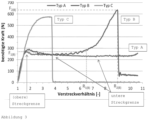
- the elongation at break is stated here as a multiple of the original length of the sample. This is illustrated with Figure 3 . This shows the stress-strain diagrams of 3 different polyethylenes. As can be seen, the Type C polyethylene breaks at a draw ratio of about 3.7. This film therefore does not correspond to this characteristic. Polyethylenes A and B break at a draw ratio of about 10.7 and about 9. Thus, these two polyethylenes have an elongation at break of 9 or more.
- a film according to the invention is therefore preferred which is characterized in that the stress-strain diagram of the polyethylene has an upper yield point and the yield stress is the highest stress in the stress-strain diagram, the stress-strain diagram being measured as indicated above .
- Yield stress is the stress at yield point. This is also based on the Figure 3 illustrated.
- Type C has no yield point.
- Type A and Type B have a yield point. However, at higher elongations, type B exhibits stresses that are above the yield stress. However, this is not the case with type A and this type is particularly suitable because its stress-strain curve does not show any stress in excess of the yield stress.
- the stress in the stress-strain diagram of the polyethylene does not increase or increases only slightly at elongation values that are greater than the elongation at yield (elongation at the yield point). If the stress increases at any point after the yield point, the curve forms an inflection point, the lower yield point, as in Figure 3 indicated for type A and type B polyethylenes. Such an increase is called strain hardening.
- a film according to the invention is preferred, which is characterized in that the stress-strain diagram of the polyethylene also has a lower yield point and all stress values at higher elongation values than the elongation at the lower yield point are lower than the mean value of the yield stress and the Stress at the lower yield point.
- a film according to the invention which is characterized in that the stress-strain diagram of the polyethylene shows no strain hardening at all. Such stress-strain diagrams have an upper yield point but no lower yield point. There is therefore no increase in stress at higher elongations than the yield elongation.
- films according to the invention which are characterized in that their modulus of elasticity is 800 MPa. Especially preferred the modulus of elasticity is at least 1000 MPa and very particularly preferably at least 1100 MPa. A high modulus of elasticity is advantageous for most thermoforming applications. Films with a high modulus of elasticity give the molded part produced not only high strength and rigidity but also high dimensional stability, which is important for producing and maintaining the desired shape of the molded body.
- the films according to the invention preferably have a thickness in the range from 25 ⁇ m to 2000 ⁇ m. Films according to the invention with a thickness in the range from 100 to 2000 ⁇ m are particularly preferred. Films according to the invention with a thickness in the range from 100 to 1000 ⁇ m are very particularly preferred. and most preferred are films ranging in thickness from 150 to 500 ⁇ m. These are the film thicknesses as determined according to DIN 53370. Thicker films can also be obtained by laminating thinner biaxially oriented films. After thermoforming, foils with such thicknesses result in molded articles with thicknesses suitable for most industrial purposes. Furthermore, preference is given to a film according to the invention which has a 2 sigma value for the distribution of the film thickness of 15% or less.
- the width of the films according to the invention is preferably in the range from 10 to 50 cm and particularly preferably in the range from 20 to 30 cm.
- Another preferred object of the present invention is a biaxially oriented sheet for thermoforming, characterized in that the sheet comprises at least 80% by weight polyethylene and at least 95% by weight Polyolefins, based on the total mass of the film, wherein the polyethylene has an elongation at break of at least 8 in the stress-strain diagram, wherein either (1) the stress-strain diagram of the polyethylene has an upper and a lower yield point and all stress values at elongation values higher than the elongation at the yield point are less than the average of the yield stress and the stress at the yield point or (2) the stress-strain diagram of the polyethylene has an upper yield point and shows no strain hardening and wherein the film has a thickness in the range of 25 ⁇ m to 1000 ⁇ m, has a 2sigma value of the thickness distribution of 7% or less, has a longitudinal and transverse shrinkage of at most 3% and wherein the stretch ratio in the longitudinal and transverse directions is in the range of 1, 2 to 5.0 where the stress-strain curve is measured
- Another preferred subject of the present invention is a biaxially oriented film for thermoforming, characterized in that the film contains at least 80 percent by weight polyethylene and at least 95 percent by weight polyolefins, based on the total mass of the film, the polyethylene having an elongation at break of at least 9 in the stress-strain diagram, wherein either (1) the stress-strain diagram of the polyethylene has an upper and a lower yield point and all stress values at higher strain values than the elongation at the lower yield point are less than the average of the yield stress and of stress at the yield point or (2) the stress-strain diagram of the polyethylene has an upper yield point and shows no strain hardening and wherein the film has a thickness in the range of 150 ⁇ m to 500 ⁇ m, a 2sigma value of the thickness distribution of 5% or less, has a longitudinal and transverse shrinkage of at most 2% and wherein the stretch ratio in the longitudinal and transverse directions is in the range of 1.2 to 3, the stress-strain -graph is measured at a temperature 10
- the films of the invention can have one or more layers and are therefore monolayer films or multilayer films. They preferably have up to 9 layers.
- the polymers contained in the films according to the invention are preferably of the same type, type or type according to DIN EN ISO 11469.
- the polymers can be selected from the group consisting of virgin high density polyethylene (HDPE), linear low density polyethylene (LLDPE) and blends thereof.
- films according to the invention which exclusively comprise high-density polyethylene (HDPE) or exclusively linear low-density polyethylene (LLDPE). Films that only contain polymers that are of the same type or type can be recycled particularly well.
- the films according to the invention can contain auxiliaries.
- the auxiliaries can be selected from the group consisting of nucleating agents, in particular alpha-nucleating agents, antiblocking agents, adhesion promoters, dispersing agents, stabilizing agents, lubricants, antistatic agents, solid Plasticizing agents, activating agents, promoters, anti-aging agents, anti-scorch agents, binders, heat-resistant agents, initiator agents, polymerization catalysts, emulsifiers, plasticizers, heat stabilizers, light stabilizers, flame retardants, mold release agents, modifiers, clarifiers and anti-fog agents.
- Dispersing agents allow films with a high filler content (e.g. antiblocking agents) to be stretched and result in a smooth surface.
- the films according to the invention can also contain dyes. This allows customization of the slides for certain Applications and their adaptation to specific needs.
- it can be white foil, which has the advantage that primer for printing can be saved.
- the foils can also have different print zones. This also saves ink when printing the foils.
- such foils are usually better recyclable than corresponding printed foils.
- Exemplary structures include a single layer film made of polyethylene containing a color masterbatch.
- a three-layer film in which the three layers contain HDPE or LLDPE (preferably HDPE) and one or both outer layers contain a masterbatch. The preferred color is white.
- inventive films in which at least one layer is cavitated.
- Such films are ideal for Form Fill Seal (FFS) machines because of their soft texture.
- These films according to the invention also have a high gloss, low water permeability, reduced weight, can be printed directly and can be produced with a smaller amount of polyethylene.
- the cavities can be created by adding particles ("cavitating agents").
- these particles may contain materials selected from the group consisting of calcium carbonate, polybutylene terephthalate, polymethyl methacrylate, polyamide-6, and mixtures of such materials.
- the particles preferably consist of such materials.
- This layer preferably contains calcium carbonate particles.
- the particles can be contained in the films according to the invention in an amount of up to 5% by weight, based on the total mass of the film.
- a suitable embodiment for this is a 5-layer structure with a base layer which is HDPE and cavities contains.
- a base layer which is HDPE and cavities contains.
- On each of the two surfaces of the base layer is a layer that contains a blend of LLDPE and HDPE and a dye.
- On the outer surface of each of these layers is an outer layer of LLDPE, which can also contain a dye.
- the layers containing the blend of HDPE and LLDPE serve as adhesion promoters between the outer layer, which contains LLDPE, and the base layer, which contains HDPE.
- the dye is preferably white in all layers. Because of the outer layers of LLDPE, such a film can be sealed without further modifications having to be made to it.
- Such films are ideal for Form Fill Seal (FFS) machines.
- the films have a reduced weight with the same dimensions compared to films without cavities. This leads to material savings and thus to lower costs.
- An exemplary structure for such a film consists of a base layer made of HDPE, which contains cavities and, depending on the desired density of the film, contains 5 to 25 percent by weight of particles ("cavitating agents"), based on the total mass of the base layer, in this embodiment the particles not be included in the total mass of the film. Materials can be selected from the list above.
- a layer of HDPE can be applied to both sides of this base layer.
- Such films have low water permeability and can be printed directly.
- Such a film is a 7-layer film with a base layer made of HDPE, on one side of which is applied a layer containing an adhesion promoter, to which in turn is applied a layer containing ethyl-vinyl alcohol copolymers, polyamides or mixtures thereof. Another layer is applied to this layer, which contains an adhesion promoter, on which finally an outer layer of the film, which contains LLDPE, is applied. On the other side of the base layer is applied a layer containing a blend of HDPE and LLDPE, on which in turn is applied an outer layer of the film containing LLDPE.
- These films have a base layer that is at least 70 percent by weight of the total mass of the film, preferably at least 80 percent, and most preferably at least 85 percent.
- This base layer contains HDPE, preferably at least 80 percent by weight HDPE, more preferably at least 90 percent by weight and most preferably at least 95 percent by weight. Most preferably this base layer consists of HDPE.
- a layer made of a blend containing HDPE and LLDPE is applied to at least one side of this base layer. on this layer an outer layer of the film containing LLDPE is applied.
- Such a film thus contains at least 3 layers.
- the outer layer ensures that the film is heat sealable.
- the layer containing the blend described above serves as an adhesion promoter between the base layer and the outer layer.
- the layer containing the blend and the outer layer containing LLDPE can also be applied to both sides of the base layer. Then the foil contains 5 layers.
- Such films have the advantage that they can be sealed without further changes and can be machined on Form Fill Seal (FFS) machines. Compared to films that only have one HDPE layer, there is no need to carry out a lamination step to make the films heat-sealable. The films can also be produced easily and in one process step by co-extrusion.
- FFS Form Fill Seal
- Films that contain a proportion of polyolefins are still recognized as sorted in many recycling systems.
- polyolefins other than polyethylene increase thermal stability or can impart other properties to the films.
- Such foils can have the following structure, for example.
- a layer containing a blend of polyethylene and a copolymer of at least two different olefins is applied to one side of a base layer made of polyethylene.
- An outer layer of the film, which contains a copolymer of at least two different olefins, is applied to this layer containing the blend. It is preferably the same copolymer that was used in the layer containing the blend. Any polymer that imparts the desired properties to the film can be used as the copolymer.
- the other side of the base layer can either represent the outside of the film or the same layer structure can be applied to both sides.
- a layer containing a blend of HDPE and LLDPE is preferably applied to the other side of the base layer, to which in turn an outer layer of LLDPE is applied.
- Such a film is additionally heat-sealable, which is ideal for packaging purposes.
- Both HDPE and LLDPE are particularly preferred for use in the films of the present invention. Using them together in a film allows adjusting various properties of the film by changing the amounts of HDPE and LLDPE. A higher proportion of HDPE leads to improved mechanical properties such as modulus of elasticity and shrinkage. A higher LLDPE content leads to better properties such as optics, puncture resistance and tear resistance. At the same time, the adhesion of HDPE and LLDPE to each other can be improved through the use of blends, which leads to better composite adhesion between the layers when HDPE layers and LLDPE layers are used in a film.
- These films have a base layer that contains HDPE.
- a layer made of a blend containing HDPE and LLDPE is applied to at least one side of this base layer.
- An outer layer of the film containing LLDPE is applied to this layer.
- Such a film thus contains at least 3 layers.
- the LLDPE outer layer can be heat sealable.
- the layer containing the blend described above serves as an adhesion promoter between the base layer and the outer layer.
- the layer containing the blend and the outer layer containing LLDPE can also be applied to both sides of the base layer. Then it is preferably a 5-layer film. This is particularly preferred.
- the coating can be applied during the production process of the film after extrusion and melt cooling, or it can be applied to the finished film in a separate process.
- the coating can be applied, for example, by top coating or inline coating. Such coatings usually require very little material and can be very thin. The coated foils are therefore generally still suitable for recycling.
- the coating can be used to give the film various properties, for example the barrier properties to water and oxygen can be significantly improved. This results in the possibility of producing a recyclable film that has good barrier properties.
- the material of the coating is usually not polyolefins. It can be, for example, polyurethanes.
- An example of a suitable structure of the film is a film that has a base layer that contains HDPE, to which an adhesion promoter (for example Admer from Mitsui) is applied on at least one side, on which in turn the coating (Coating) is upset. Both surfaces of the base layer are preferably also covered by a further layer which contains HDPE. The adhesion promoter and the coating are then applied to at least one surface of these layers.
- AdPE Admer from Mitsui
- Both surfaces of the base layer are preferably also covered by a further layer which contains HDPE.
- the adhesion promoter and the coating are then applied to at least one surface of these layers.
- This 5-layer film is preferred.
- adhesion promoter and coating can also be applied to the surfaces of both HDPE layers that are applied to the base layer.
- These laminates can also contain 5% by weight of materials that are not polyolefins and especially not polyethylenes. Such materials can be used in particular to obtain a film that can be easily deep-drawable.
- These materials can be polymers act selected from the group consisting of polyamides, ethylene vinyl alcohol copolymer (EVOH), polypropylene (PP), polyvinyl chloride (PVC), polystyrene (PS) and acrylonitrile butadiene styrene copolymer (ABS).
- EVOH ethylene vinyl alcohol copolymer
- PP polypropylene
- PVC polyvinyl chloride
- PS polystyrene
- ABS acrylonitrile butadiene styrene copolymer
- Such polymers can be used, for example, to modify the barrier properties or the surface properties of the films of the invention.
- the laminates of this invention must contain at least 75 weight percent polymers that are biaxially oriented. This favors thermoforming.
- Such a film can be, for example, a biaxially oriented HDPE base layer to which a (non-oriented) LLDPE blown film has been laminated. With such a film, a hermetic seal can be achieved after thermoforming.
- the films according to the invention and in particular the films according to the invention mentioned under points (i) to (vii) can also be laminated to one another. This makes it possible to combine different properties that cannot be imparted to a film through an extrusion process.
- Such a film can, for example, be a base layer consisting of biaxially oriented HDPE, onto which a likewise biaxially oriented LLDPE film has been laminated.
- a hermetic seal after thermoforming can also be achieved with such a film.
- HDPE film “LLDPE film”, “HDPE layer”, “LLDPE layer” and the like each describe films or layers which contain or consist of the polymers mentioned.
- a layer contains a specific polymer (e.g. HDPE, LLDPE, EVOH, PA, etc.)
- the case in which the layer consists of this polymer is also included, unless otherwise stated. Unless otherwise stated, this is also the preferred embodiment for all films according to the invention.
- the raw material used to make the films of this invention can either be provided as such, or it can be prepared by mixing multiple ingredients during manufacture of the film in an extruder or mixer.
- a plastic granulate is preferably used as the raw material. If the film has multiple layers, a separate raw material can be provided for each layer. Depending on the desired thickness of each layer, the raw material is dosed separately for each layer.
- a method according to the invention is preferred which is characterized in that the polyethylene used has a density in the range from 0.89 to 0.98 g/cm 3 .
- a density in the range from 0.91 to 0.97 is particularly preferred.
- the polyethylene used in the process according to the invention also preferably has an MFI (190° C./2.16 kg) in the range from 0.3 to 8 g/10 min, particularly preferably in the range from 0.7 to 5 g/10 min and very particularly preferably in the range of 0.7 to 3 g/10 min.
- MFI 190° C./2.16 kg
- the thickness of the cast film in the process according to the invention is preferably 300 to 5000 ⁇ m, particularly preferably 500 to 3000 ⁇ m.
- the raw material or raw materials or the ingredients thereto are fed into an extruder. They are mixed and melted in the extruder. If the film has only one layer, only one extruder is needed. If the film has several layers, a separate extruder is usually used for each layer. However, it is also possible to produce several layers from the same plastic granulate if two or more layers have the same composition. Then the material for two or more of these layers can be extruded from the same extruder. Furthermore, all layers can be extruded from one extruder if all layers have the same composition. Any type of extruder can be used.
- the extruder or extruders are preferably selected from the group consisting of single-screw extruders, cascade extruders and twin-screw extruders. Other mixing and processing units, such. B. a bus kneader or a planetary roller extruder can be used.
- the Extruders are preferably operated at a temperature in the range from 180 to 280°C, more preferably at a temperature in the range from 200 to 260°C and most preferably at a temperature in the range from 230 to 250°C.
- the melt is discharged through a slot die and deposited on a chill roll. If the film has several layers, a multi-layer die is preferably used.
- a device for positioning the film on the chill roll (pinning system) is preferably used in order to improve the positioning of the film on the chill roll.
- a preferred device is an air knife, which is a directed flow of air that exerts a force on the film toward the chill roll.
- a pinning system results in more even contact between the film and the chill roll, resulting in a smooth and even cast film.
- the temperature of the chill roll is preferably in the range of 20 to 100°C. If the layer applied to the chill roll contains a high proportion of HDPE, the temperature of the film should preferably be set to higher temperatures in this range. If the layer applied to the chill roll contains more than 60 percent by weight HDPE, the temperature of the chill roll is preferably in a range from 60 to 100 °C, more preferably in a range from 70 to 100 °C and most preferably in a range of 75 up to 90 °C. If the layer applied to the chill roll can be more easily applied to the chill roll than layers containing HDPE (e.g. LLDPE), the temperature of the chill roll can be lower.
- HDPE e.g. LLDPE
- the film can also be passed through a cooling bath.
- the cooling bath is preferably installed in the area of the cooling roll.
- the cooling bath is preferably a water bath. If a water bath is also used for cooling, the chill roll can be rotatably mounted in a water bath, more than half of the chill roll usually being immersed in the water bath.
- a corresponding chill roll is, for example, from DE 197 05 796 C2 known.
- the chill roll can also be cooled from the inside.
- the biaxial orientation or stretching can be done both sequentially and simultaneously.
- Methods for sequentially and simultaneously biaxially orienting or stretching are known to those skilled in the art.
- a procedure is described in the disclosure document DE 10 2019 119293 A1 described, particularly in paragraphs [0045] to [0055].
- the method described here is preferably also used correspondingly for the present invention.
- the sequential stretching is preferably carried out as follows.
- the cast film produced as described above is fed to a longitudinal stretcher and, after being sufficiently heated, stretched in the machine direction.
- the machine direction stretch can have a draw ratio of from 1.2 to 9.
- the film is usually rolled between pairs of rollers rotating at different speeds stretched.
- the temperature of the film in the longitudinal stretching machine is preferably in the range from 30 to 140.degree. C., particularly preferably in the range from 80 to 120.degree.
- the speed of the film when stretched in the longitudinal direction is up to 600 m/min.
- the stretching in the transverse direction is preferably carried out after the stretching in the longitudinal direction.
- the film is fed to a transverse stretching device.
- the film is stretched at a stretch ratio of 1.2 to 9 in the transverse direction.
- the film is first preheated.
- the temperature during the transverse stretching is preferably in a range from 50 to 180°C, particularly preferably in the range from 100 to 150°C.
- the films according to the invention can also be stretched in a simultaneous stretching process.
- the simultaneous stretching can be performed by a method selected from the group consisting of pantograph method, spindle method, LI-SIM method and MESIM method.
- the temperature in the case of simultaneous stretching is preferably in the range from 50 to 180°C, particularly preferably in the range from 80 to 150°C.
- the film speed here is preferably 600 m/min or less.
Landscapes
- Engineering & Computer Science (AREA)
- Mechanical Engineering (AREA)
- Chemical & Material Sciences (AREA)
- Chemical Kinetics & Catalysis (AREA)
- Organic Chemistry (AREA)
- Polymers & Plastics (AREA)
- Medicinal Chemistry (AREA)
- Health & Medical Sciences (AREA)
- Manufacturing & Machinery (AREA)
- Materials Engineering (AREA)
- Physics & Mathematics (AREA)
- Thermal Sciences (AREA)
- Manufacture Of Macromolecular Shaped Articles (AREA)
- Laminated Bodies (AREA)
- Shaping By String And By Release Of Stress In Plastics And The Like (AREA)
- Extrusion Moulding Of Plastics Or The Like (AREA)
Applications Claiming Priority (1)
| Application Number | Priority Date | Filing Date | Title |
|---|---|---|---|
| DE102021124259.2A DE102021124259A1 (de) | 2021-09-20 | 2021-09-20 | Biaxial-orientierte Polyethylenfolien für das Thermoformen, Verfahren zu ihrer Herstellung, ihre Verwendung, ein Verfahren zum Thermoformen und dessen Produkte |
Publications (3)
| Publication Number | Publication Date |
|---|---|
| EP4209331A1 true EP4209331A1 (fr) | 2023-07-12 |
| EP4209331C0 EP4209331C0 (fr) | 2025-03-12 |
| EP4209331B1 EP4209331B1 (fr) | 2025-03-12 |
Family
ID=83318827
Family Applications (1)
| Application Number | Title | Priority Date | Filing Date |
|---|---|---|---|
| EP22195415.9A Active EP4209331B1 (fr) | 2021-09-20 | 2022-09-13 | Films de polyéthylène biaxialement orientés pour le thermoformage, leur procédé de fabrication, leur utilisation, un procédé de thermoformage et ses produits |
Country Status (6)
| Country | Link |
|---|---|
| US (1) | US12030964B2 (fr) |
| EP (1) | EP4209331B1 (fr) |
| JP (1) | JP2023044724A (fr) |
| KR (1) | KR20230042432A (fr) |
| CN (1) | CN115838487A (fr) |
| DE (1) | DE102021124259A1 (fr) |
Families Citing this family (2)
| Publication number | Priority date | Publication date | Assignee | Title |
|---|---|---|---|---|
| CN121100060A (zh) * | 2023-04-28 | 2025-12-09 | 库恩设备制造有限公司 | 用于制造单层或多层薄膜的方法,单层或多层挤出同时双轴向拉伸和热定型的薄膜以及相应用途 |
| KR102648996B1 (ko) * | 2023-06-09 | 2024-03-19 | 제이케이머티리얼즈(주) | 내열성 및 투명성이 개선된 이축연신 고밀도 폴리에틸렌 필름 및 이의 제조방법 |
Citations (10)
| Publication number | Priority date | Publication date | Assignee | Title |
|---|---|---|---|---|
| DE19705796C2 (de) | 1996-02-16 | 2002-08-08 | Ishikawajima Harima Heavy Ind | Walzenkühlstruktur für Doppelwalzen-Stranggießmaschinen |
| DE102005041134A1 (de) | 2005-08-30 | 2007-03-01 | Wipak Walsrode Gmbh & Co. Kg | Bedruckte bahnförmige Mehrschicht-Verpackungsfolie für rapportgerechtes Tiefziehen und Verfahren zu ihrer Herstellung |
| EP1876010A1 (fr) | 2006-07-06 | 2008-01-09 | Alcan Technology & Management Ltd. | Procédé pour thermoformage d'un film de matière plastique étirer biaxialement |
| EP1395415B1 (fr) | 2001-04-30 | 2010-12-22 | Treofan Germany GmbH & Co.KG | Procede pour produire des emballages biodegradables a partir de films a etirement biaxial et de tels emballages |
| US7985804B2 (en) * | 2006-11-06 | 2011-07-26 | Exxonmobil Chemical Patents Inc. | Rubber toughened compositions, articles, films, and methods of making the same |
| US20140228517A1 (en) * | 2008-06-30 | 2014-08-14 | Fina Technology Inc. | Articles Including a Compatibilized Polypropylene and Polylactic Acid Blend |
| US20160020030A1 (en) | 2014-07-16 | 2016-01-21 | Tdk Corporation | Thin film capacitor |
| EP3152128B1 (fr) | 2014-06-06 | 2019-04-03 | Bemis Company, Inc | Composants d'emballage-coque |
| US10752740B2 (en) * | 2012-10-31 | 2020-08-25 | Exxonmobil Chemical Patents Inc. | Articles comprising broad molecular weight distribution polypropylene resins |
| DE102019119293A1 (de) | 2019-07-16 | 2021-01-21 | Brückner Maschinenbau GmbH & Co. KG | Biaxial-orientierte Polyesterfolie als Substrat für Hochbarriere-Folie mit abziehbarer Opferschicht |
Family Cites Families (13)
| Publication number | Priority date | Publication date | Assignee | Title |
|---|---|---|---|---|
| GB8914703D0 (en) | 1989-06-27 | 1989-08-16 | Dow Europ Sa | Bioriented film |
| EP0876250A4 (fr) | 1995-12-18 | 2000-05-03 | Exxon Chemical Patents Inc | Films de polyethylene a orientation biaxiale |
| US20030039826A1 (en) | 2000-03-20 | 2003-02-27 | Sun Edward I. | Conformable and die-cuttable biaxially oriented films and labelstocks |
| US20090068453A1 (en) | 2006-10-11 | 2009-03-12 | Sengshiu Chung | Impact-resistant lightweight polymeric laminates |
| US9388306B2 (en) | 2008-03-04 | 2016-07-12 | Exxonmobil Chemical Patents Inc. | Polyethylene stretch film |
| WO2013029223A1 (fr) | 2011-08-26 | 2013-03-07 | Dow Global Technologies Llc | Film polyéthylène bi-orienté |
| US9266977B2 (en) | 2012-12-21 | 2016-02-23 | Exxonmobil Chemical Patents Inc. | Bridged metallocene compounds, catalyst systems and processes for polymerization therewith |
| BR112017023792B1 (pt) | 2015-05-07 | 2022-08-09 | Fina Technology, Inc | Método para obtenção de polietileno com desempenho superior de termoformação para extrusão de chapa |
| SG11202110508UA (en) | 2019-04-04 | 2021-10-28 | Amcor Flexibles North America Inc | Recyclable film for thermoforming |
| DE102019112089A1 (de) | 2019-05-09 | 2020-11-12 | Brückner Maschinenbau GmbH & Co. KG | Folie mit wenigstens zwei Schichten und Verfahren zu ihrer Herstellung |
| WO2021043678A1 (fr) | 2019-09-03 | 2021-03-11 | Sabic Global Technologies B.V. | Emballage comprenant un film de polyéthylène à orientation bidirectionnelle |
| CA3152938A1 (fr) | 2019-10-23 | 2021-04-29 | Nova Chemicals Corporation | Film mdpe a orientation biaxiale |
| CN114787249A (zh) | 2019-12-09 | 2022-07-22 | 埃克森美孚化学专利公司 | 双轴取向的聚乙烯膜 |
-
2021
- 2021-09-20 DE DE102021124259.2A patent/DE102021124259A1/de active Pending
-
2022
- 2022-09-13 KR KR1020220115117A patent/KR20230042432A/ko active Pending
- 2022-09-13 EP EP22195415.9A patent/EP4209331B1/fr active Active
- 2022-09-16 JP JP2022147505A patent/JP2023044724A/ja active Pending
- 2022-09-19 US US17/947,727 patent/US12030964B2/en active Active
- 2022-09-20 CN CN202211148806.6A patent/CN115838487A/zh active Pending
Patent Citations (10)
| Publication number | Priority date | Publication date | Assignee | Title |
|---|---|---|---|---|
| DE19705796C2 (de) | 1996-02-16 | 2002-08-08 | Ishikawajima Harima Heavy Ind | Walzenkühlstruktur für Doppelwalzen-Stranggießmaschinen |
| EP1395415B1 (fr) | 2001-04-30 | 2010-12-22 | Treofan Germany GmbH & Co.KG | Procede pour produire des emballages biodegradables a partir de films a etirement biaxial et de tels emballages |
| DE102005041134A1 (de) | 2005-08-30 | 2007-03-01 | Wipak Walsrode Gmbh & Co. Kg | Bedruckte bahnförmige Mehrschicht-Verpackungsfolie für rapportgerechtes Tiefziehen und Verfahren zu ihrer Herstellung |
| EP1876010A1 (fr) | 2006-07-06 | 2008-01-09 | Alcan Technology & Management Ltd. | Procédé pour thermoformage d'un film de matière plastique étirer biaxialement |
| US7985804B2 (en) * | 2006-11-06 | 2011-07-26 | Exxonmobil Chemical Patents Inc. | Rubber toughened compositions, articles, films, and methods of making the same |
| US20140228517A1 (en) * | 2008-06-30 | 2014-08-14 | Fina Technology Inc. | Articles Including a Compatibilized Polypropylene and Polylactic Acid Blend |
| US10752740B2 (en) * | 2012-10-31 | 2020-08-25 | Exxonmobil Chemical Patents Inc. | Articles comprising broad molecular weight distribution polypropylene resins |
| EP3152128B1 (fr) | 2014-06-06 | 2019-04-03 | Bemis Company, Inc | Composants d'emballage-coque |
| US20160020030A1 (en) | 2014-07-16 | 2016-01-21 | Tdk Corporation | Thin film capacitor |
| DE102019119293A1 (de) | 2019-07-16 | 2021-01-21 | Brückner Maschinenbau GmbH & Co. KG | Biaxial-orientierte Polyesterfolie als Substrat für Hochbarriere-Folie mit abziehbarer Opferschicht |
Also Published As
| Publication number | Publication date |
|---|---|
| DE102021124259A1 (de) | 2023-03-23 |
| US12030964B2 (en) | 2024-07-09 |
| KR20230042432A (ko) | 2023-03-28 |
| US20230087287A1 (en) | 2023-03-23 |
| EP4209331C0 (fr) | 2025-03-12 |
| EP4209331B1 (fr) | 2025-03-12 |
| JP2023044724A (ja) | 2023-03-31 |
| CN115838487A (zh) | 2023-03-24 |
Similar Documents
| Publication | Publication Date | Title |
|---|---|---|
| DE69909521T2 (de) | Extrusionsbeschichtungsverfahren zum herstellen von mit hoher durchsichtigkeit schutz- und dekorbeschichtungen | |
| DE68928274T2 (de) | Mehrschichtiges Material | |
| DE68918159T2 (de) | Schichtstoffplatte aus Polyolefinschaum und ihre beidseitige Vakuumformung. | |
| EP0616885B1 (fr) | Feuille en polypropylène étirée biaxialement et à surface mate, et son procédé de fabrication | |
| EP2170605B1 (fr) | Feuille à étiquettes pour procédé d'emboutissage | |
| EP0564846B1 (fr) | Feuille matte en polypropylène, étirée biaxialement et son procédé de fabrication | |
| EP1855947B1 (fr) | Materiau d'emballage thermoformable presentant des proprietes de retrecissement | |
| EP2061652A2 (fr) | Matériau d'emballage thermoformable présentant des propriétés de rétrécissement | |
| DE202010018574U1 (de) | In Maschinenrichtung orientierte Folie für Etiketten | |
| EP2205435B1 (fr) | Feuille pour étiquettes enveloppantes | |
| EP4209331B1 (fr) | Films de polyéthylène biaxialement orientés pour le thermoformage, leur procédé de fabrication, leur utilisation, un procédé de thermoformage et ses produits | |
| DE69706201T2 (de) | Polyestermehrschichtfolie | |
| CN111231470A (zh) | 一种多层共挤聚乙烯热收缩膜及其制备方法 | |
| DE10120502A1 (de) | Laminierte Folie und dieselbe umfassende Struktur | |
| EP2387493B1 (fr) | Utilisation d'une feuille d'étiquettes pour procédé par emboutissage profond | |
| DE10010533A1 (de) | Laminierte Folie aus Acrylharz und laminierter Gegenstand | |
| EP1238796B1 (fr) | Feuille multicouche emboutie | |
| EP1876010B1 (fr) | Procédé pour thermoformage d'un film de matière plastique étirer biaxialement | |
| EP1862299A1 (fr) | Feuille de liaison de couvercle, son procédé de fabrication et utilisation pour une unité d'emballage | |
| EP2062726A1 (fr) | Feuille de polyester pour scellement à basse temperature pour des substrates polaires | |
| DE60007908T3 (de) | Bedruckbare Polyolefin-Mehrschichtfolie | |
| EP2420373A2 (fr) | Procédé de fabrication d'une pièce de formage opaque | |
| WO2006053886A2 (fr) | Films multicouches thermoformables | |
| DE102005017937A1 (de) | Thermoformbares Verpackungsmaterial mit Schrumpfeigenschaften | |
| DE10308535A1 (de) | Bahn, warmgeformter Artikel und Laminatstruktur |
Legal Events
| Date | Code | Title | Description |
|---|---|---|---|
| PUAI | Public reference made under article 153(3) epc to a published international application that has entered the european phase |
Free format text: ORIGINAL CODE: 0009012 |
|
| STAA | Information on the status of an ep patent application or granted ep patent |
Free format text: STATUS: THE APPLICATION HAS BEEN PUBLISHED |
|
| AK | Designated contracting states |
Kind code of ref document: A1 Designated state(s): AL AT BE BG CH CY CZ DE DK EE ES FI FR GB GR HR HU IE IS IT LI LT LU LV MC MK MT NL NO PL PT RO RS SE SI SK SM TR |
|
| STAA | Information on the status of an ep patent application or granted ep patent |
Free format text: STATUS: REQUEST FOR EXAMINATION WAS MADE |
|
| 17P | Request for examination filed |
Effective date: 20240110 |
|
| RBV | Designated contracting states (corrected) |
Designated state(s): AL AT BE BG CH CY CZ DE DK EE ES FI FR GB GR HR HU IE IS IT LI LT LU LV MC MK MT NL NO PL PT RO RS SE SI SK SM TR |
|
| GRAP | Despatch of communication of intention to grant a patent |
Free format text: ORIGINAL CODE: EPIDOSNIGR1 |
|
| STAA | Information on the status of an ep patent application or granted ep patent |
Free format text: STATUS: GRANT OF PATENT IS INTENDED |
|
| RIC1 | Information provided on ipc code assigned before grant |
Ipc: C08J 5/18 20060101ALI20240912BHEP Ipc: B29C 51/00 20060101ALI20240912BHEP Ipc: B29C 48/08 20190101ALI20240912BHEP Ipc: B29C 55/12 20060101AFI20240912BHEP |
|
| INTG | Intention to grant announced |
Effective date: 20240930 |
|
| GRAS | Grant fee paid |
Free format text: ORIGINAL CODE: EPIDOSNIGR3 |
|
| GRAA | (expected) grant |
Free format text: ORIGINAL CODE: 0009210 |
|
| STAA | Information on the status of an ep patent application or granted ep patent |
Free format text: STATUS: THE PATENT HAS BEEN GRANTED |
|
| AK | Designated contracting states |
Kind code of ref document: B1 Designated state(s): AL AT BE BG CH CY CZ DE DK EE ES FI FR GB GR HR HU IE IS IT LI LT LU LV MC MK MT NL NO PL PT RO RS SE SI SK SM TR |
|
| REG | Reference to a national code |
Ref country code: GB Ref legal event code: FG4D Free format text: NOT ENGLISH |
|
| REG | Reference to a national code |
Ref country code: CH Ref legal event code: EP |
|
| REG | Reference to a national code |
Ref country code: DE Ref legal event code: R096 Ref document number: 502022003154 Country of ref document: DE |
|
| REG | Reference to a national code |
Ref country code: IE Ref legal event code: FG4D Free format text: LANGUAGE OF EP DOCUMENT: GERMAN |
|
| U01 | Request for unitary effect filed |
Effective date: 20250402 |
|
| U07 | Unitary effect registered |
Designated state(s): AT BE BG DE DK EE FI FR IT LT LU LV MT NL PT RO SE SI Effective date: 20250409 |
|
| PG25 | Lapsed in a contracting state [announced via postgrant information from national office to epo] |
Ref country code: RS Free format text: LAPSE BECAUSE OF FAILURE TO SUBMIT A TRANSLATION OF THE DESCRIPTION OR TO PAY THE FEE WITHIN THE PRESCRIBED TIME-LIMIT Effective date: 20250612 |
|
| PG25 | Lapsed in a contracting state [announced via postgrant information from national office to epo] |
Ref country code: ES Free format text: LAPSE BECAUSE OF FAILURE TO SUBMIT A TRANSLATION OF THE DESCRIPTION OR TO PAY THE FEE WITHIN THE PRESCRIBED TIME-LIMIT Effective date: 20250312 |
|
| PG25 | Lapsed in a contracting state [announced via postgrant information from national office to epo] |
Ref country code: NO Free format text: LAPSE BECAUSE OF FAILURE TO SUBMIT A TRANSLATION OF THE DESCRIPTION OR TO PAY THE FEE WITHIN THE PRESCRIBED TIME-LIMIT Effective date: 20250612 |
|
| PG25 | Lapsed in a contracting state [announced via postgrant information from national office to epo] |
Ref country code: HR Free format text: LAPSE BECAUSE OF FAILURE TO SUBMIT A TRANSLATION OF THE DESCRIPTION OR TO PAY THE FEE WITHIN THE PRESCRIBED TIME-LIMIT Effective date: 20250312 |
|
| PG25 | Lapsed in a contracting state [announced via postgrant information from national office to epo] |
Ref country code: GR Free format text: LAPSE BECAUSE OF FAILURE TO SUBMIT A TRANSLATION OF THE DESCRIPTION OR TO PAY THE FEE WITHIN THE PRESCRIBED TIME-LIMIT Effective date: 20250613 |
|
| PG25 | Lapsed in a contracting state [announced via postgrant information from national office to epo] |
Ref country code: SM Free format text: LAPSE BECAUSE OF FAILURE TO SUBMIT A TRANSLATION OF THE DESCRIPTION OR TO PAY THE FEE WITHIN THE PRESCRIBED TIME-LIMIT Effective date: 20250312 |
|
| PG25 | Lapsed in a contracting state [announced via postgrant information from national office to epo] |
Ref country code: PL Free format text: LAPSE BECAUSE OF FAILURE TO SUBMIT A TRANSLATION OF THE DESCRIPTION OR TO PAY THE FEE WITHIN THE PRESCRIBED TIME-LIMIT Effective date: 20250312 |
|
| PG25 | Lapsed in a contracting state [announced via postgrant information from national office to epo] |
Ref country code: CZ Free format text: LAPSE BECAUSE OF FAILURE TO SUBMIT A TRANSLATION OF THE DESCRIPTION OR TO PAY THE FEE WITHIN THE PRESCRIBED TIME-LIMIT Effective date: 20250312 |
|
| PG25 | Lapsed in a contracting state [announced via postgrant information from national office to epo] |
Ref country code: SK Free format text: LAPSE BECAUSE OF FAILURE TO SUBMIT A TRANSLATION OF THE DESCRIPTION OR TO PAY THE FEE WITHIN THE PRESCRIBED TIME-LIMIT Effective date: 20250312 |
|
| PG25 | Lapsed in a contracting state [announced via postgrant information from national office to epo] |
Ref country code: IS Free format text: LAPSE BECAUSE OF FAILURE TO SUBMIT A TRANSLATION OF THE DESCRIPTION OR TO PAY THE FEE WITHIN THE PRESCRIBED TIME-LIMIT Effective date: 20250712 |
|
| U20 | Renewal fee for the european patent with unitary effect paid |
Year of fee payment: 4 Effective date: 20250922 |
|
| PLBI | Opposition filed |
Free format text: ORIGINAL CODE: 0009260 |
|
| PLBI | Opposition filed |
Free format text: ORIGINAL CODE: 0009260 |
|
| PLAX | Notice of opposition and request to file observation + time limit sent |
Free format text: ORIGINAL CODE: EPIDOSNOBS2 |
|
| 26 | Opposition filed |
Opponent name: SABIC GLOBAL TECHNOLOGIES B.V. /SABIC PETROCHEMICALS B.V. Effective date: 20251210 |
|
| 26 | Opposition filed |
Opponent name: JFE INNOVATION CENTER SRL Effective date: 20251212 |
|
| PLBP | Opposition withdrawn |
Free format text: ORIGINAL CODE: 0009264 |