EP4209362A1 - Reifen - Google Patents
Reifen Download PDFInfo
- Publication number
- EP4209362A1 EP4209362A1 EP21864344.3A EP21864344A EP4209362A1 EP 4209362 A1 EP4209362 A1 EP 4209362A1 EP 21864344 A EP21864344 A EP 21864344A EP 4209362 A1 EP4209362 A1 EP 4209362A1
- Authority
- EP
- European Patent Office
- Prior art keywords
- sipe
- tire
- piece
- sipe piece
- closed
- Prior art date
- Legal status (The legal status is an assumption and is not a legal conclusion. Google has not performed a legal analysis and makes no representation as to the accuracy of the status listed.)
- Granted
Links
Images







Classifications
-
- B—PERFORMING OPERATIONS; TRANSPORTING
- B60—VEHICLES IN GENERAL
- B60C—VEHICLE TYRES; TYRE INFLATION; TYRE CHANGING; CONNECTING VALVES TO INFLATABLE ELASTIC BODIES IN GENERAL; DEVICES OR ARRANGEMENTS RELATED TO TYRES
- B60C11/00—Tyre tread bands; Tread patterns; Anti-skid inserts
- B60C11/03—Tread patterns
- B60C11/12—Tread patterns characterised by the use of narrow slits or incisions, e.g. sipes
- B60C11/1236—Tread patterns characterised by the use of narrow slits or incisions, e.g. sipes with special arrangements in the tread pattern
-
- B—PERFORMING OPERATIONS; TRANSPORTING
- B60—VEHICLES IN GENERAL
- B60C—VEHICLE TYRES; TYRE INFLATION; TYRE CHANGING; CONNECTING VALVES TO INFLATABLE ELASTIC BODIES IN GENERAL; DEVICES OR ARRANGEMENTS RELATED TO TYRES
- B60C11/00—Tyre tread bands; Tread patterns; Anti-skid inserts
- B60C11/03—Tread patterns
- B60C11/12—Tread patterns characterised by the use of narrow slits or incisions, e.g. sipes
- B60C11/1204—Tread patterns characterised by the use of narrow slits or incisions, e.g. sipes with special shape of the sipe
- B60C11/1218—Three-dimensional shape with regard to depth and extending direction
-
- B—PERFORMING OPERATIONS; TRANSPORTING
- B60—VEHICLES IN GENERAL
- B60C—VEHICLE TYRES; TYRE INFLATION; TYRE CHANGING; CONNECTING VALVES TO INFLATABLE ELASTIC BODIES IN GENERAL; DEVICES OR ARRANGEMENTS RELATED TO TYRES
- B60C11/00—Tyre tread bands; Tread patterns; Anti-skid inserts
- B60C11/03—Tread patterns
- B60C11/12—Tread patterns characterised by the use of narrow slits or incisions, e.g. sipes
- B60C11/1259—Depth of the sipe
- B60C11/1263—Depth of the sipe different within the same sipe
-
- B—PERFORMING OPERATIONS; TRANSPORTING
- B60—VEHICLES IN GENERAL
- B60C—VEHICLE TYRES; TYRE INFLATION; TYRE CHANGING; CONNECTING VALVES TO INFLATABLE ELASTIC BODIES IN GENERAL; DEVICES OR ARRANGEMENTS RELATED TO TYRES
- B60C11/00—Tyre tread bands; Tread patterns; Anti-skid inserts
- B60C11/03—Tread patterns
- B60C11/12—Tread patterns characterised by the use of narrow slits or incisions, e.g. sipes
- B60C11/1204—Tread patterns characterised by the use of narrow slits or incisions, e.g. sipes with special shape of the sipe
- B60C2011/1213—Tread patterns characterised by the use of narrow slits or incisions, e.g. sipes with special shape of the sipe sinusoidal or zigzag at the tread surface
-
- B—PERFORMING OPERATIONS; TRANSPORTING
- B60—VEHICLES IN GENERAL
- B60C—VEHICLE TYRES; TYRE INFLATION; TYRE CHANGING; CONNECTING VALVES TO INFLATABLE ELASTIC BODIES IN GENERAL; DEVICES OR ARRANGEMENTS RELATED TO TYRES
- B60C11/00—Tyre tread bands; Tread patterns; Anti-skid inserts
- B60C11/03—Tread patterns
- B60C11/12—Tread patterns characterised by the use of narrow slits or incisions, e.g. sipes
- B60C11/1236—Tread patterns characterised by the use of narrow slits or incisions, e.g. sipes with special arrangements in the tread pattern
- B60C2011/1254—Tread patterns characterised by the use of narrow slits or incisions, e.g. sipes with special arrangements in the tread pattern with closed sipe, i.e. not extending to a groove
Definitions
- the present disclosure relates to a tire.
- Patent Document 1 Japanese Patent Application Publication No. 2003-025812
- the land portions of the tread portion are provided with a plurality of sipes extending in the tire axial direction and arranged in the tire circumferential direction.
- sipes including a component extending in the tire circumferential direction are arranged.
- the number of the sipes which can be arranged per unit length in the tire circumferential direction of the land portion tends to decrease. Therefore, there is a possibility that the braking/driving performance on ice will be impaired.
- a main problem is to provide a tire improved in braking/driving performance and turning performance on ice.
- the present disclosure is a tire including a tread portion, wherein
- FIG. 1 shows a cross-sectional view of a tread portion 2 of a tire 1 of the present embodiment.
- FIG. 1 is a meridian cross sectional view including the tire rotation axis, of the tire 1 under a normal state.
- the tire 1 of the present embodiment is suitably used as, for example, a pneumatic tire for passenger cars. However, it is not limited to such an embodiment, and the tire 1 of the present disclosure may be used for heavy loads, for example.
- the "normal state” is a state in which the tire mounted on a regular rim is inflated to a regular internal pressure but loaded with no load.
- the normal state means a standard usage state corresponding to the purpose of use of the tire and a no-load state.
- dimensions and the like of various parts of the tire are the values measured under the normal state. ⁇ ach of the configurations described in this specification shall allow for normal errors involved in rubber molded products.
- the "regular rim” is a rim defined for each tire by a standard in a standard system including the standard on which the tire is based, for example, "standard Rim” in JATMA, "Design Rim” in TRA, and “Measuring Rim” in ETRTO,
- the "regular internal pressure” is air pressure defined for each tire by a standard in a standard system including the standard on which the tire is based, for example, “MAXIMUM AIR PRESSURE” in JATMA, the maximum value listed in the table “TIRE LOAD LIMITS AT VARIOUS COLD INFLATION PRESSURES" in TRA, "INFLATION PRESSURE” in ETRTO.
- the tread portion 2 is provided with, for example, a plurality of main grooves 3 continuously extending in the tire circumferential direction, and a plurality of land portions 4 divided thereby.
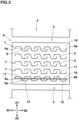
- FIG. 2 shows an enlarged plan view of the land portion 4.
- the land portion 4 of the present embodiment is configured, for example, as a row of blocks including a plurality of blocks 6 in the tire circumferential direction.
- the blocks 6 are defined between a plurality of lateral grooves 5 crossing the land portion 4 in the tire axial direction.
- the land portion 4 of the present disclosure is not limited to such an example, and may be a rib continuously extending in the tire circumferential direction, for example.
- a plurality of closed sipes 8 are arranged in the tire axial direction.
- a plurality of sipe groups 7 each made up of a plurality of closed sipes 8 is disposed in one block 6.
- one sipe group 7 is made up of 3 to 7 closed sipes 8.
- the "sipe” is a slit having a minute width, and refers to that having a width of 1.5 mm or less between two sipe walls facing each other.
- the above-said width of the closed sipe 8 of the present embodiment is 1.0 mm or less.
- the term "closed sipe” refers to a sipe whose both ends are terminated within the land portion 4.
- the sipe group 7 provided in the block 6 of the present embodiment consists of the closed sipes 8 only. In other words, none of the sipes are connected to the edges of the block 6.
- the present invention is however, not limited to such a mode, and the sipe arranged near the edge of the block 6 may be a non-closed sipe having one end opened at the edge.
- each closed sipe 8 comprises a first end 8a and a second end 8b, and a first sipe piece 11, a second sipe piece 12 and a third sipe piece 13.
- the first end 8a is the end of the closed sipe 8 on the first side B1 in the tire axial direction.
- the second end 8b is the end of the closed sipe 8 on the second side B2 in the tire axial direction.
- the first sipe piece 11 extends in the tire axial direction on the first end 8a side of the third sipe piece 13.
- the second sipe piece 12 extends in the tire axial direction on the second end 8b side of the third sipe piece 13.
- the third sipe piece 13 is inclined with respect to the tire axial direction.
- the first sipe piece 11 is positioned on the first side A1 in the tire circumferential direction and on the first side B1 in the tire axial direction of the second sipe piece 12.
- the first sipe piece 11 continues to the third sipe piece 13 om the first side A1 in the tire circumferential direction.
- the second sipe piece 12 continues to the third sipe piece 13 on the second side A2 in the tire circumferential direction.
- the closed sipes 8 arranged in the tire axial direction overlap each other in the tire axial direction and the tire circumferential direction.
- the expression “the closed sipes 8 overlap each other in the tire axial direction” means such a mode that a virtual region obtained by extending one closed sipe 8 parallel to the tire circumferential direction overlaps with the closed sipe 8 adjacent thereto.
- the expression “the closed sipes 8 overlap each other in the tire circumferential direction” means such a mode that a virtual region obtained by extending one closed sipe 8 in parallel with the tire axial direction overlaps the closed sipe 8 adjacent thereto.
- the sipe group 7 of the present disclosure includes a plurality of closed sipes 8 arranged in the tire axial direction. Since the closed sipes 8 are difficult to open during braking and driving, they are less likely to be clogged with snow or ice inside, and the edge effect can be stably exhibited over a long period of time. Thus, the anti-snow clogging performance when running on snow is improved. In addition, the closed sipes 8 increase the pattern rigidity of the land portion 4 and enhance the steering stability on dry road surfaces.
- the third sipe piece 13 is inclined with respect to the tire axial direction, it exerts a frictional force in the tire axial direction on ice, thereby capable of improving turning performance on ice. Furthermore, since the second sipe piece 12 of the closed sipe 8 overlaps the first sipe piece 11 of the closed sipe 8 adjacent in the tire axial direction and the tire circumferential direction, it is possible to provide many closed sipes 8 in the land portion 4, and excellent braking/driving performance can be exhibited on ice.
- the present disclosure is however, not limited to such a mode.
- the sipe group 7 of the present embodiment extends along the tire axial direction, but may extend with a certain degree of inclination with respect to the tire axial direction.
- an virtual straight line 18 (indicated by a two-dot chain line), which connecting between a first end 8a of the closed sipe 8 provided at the end on the first side B1 in the tire axial direction, and a first end 8b of the closed sipe 8 provided at the end on the second side B2 in the tire axial direction, is, for example, 45 degrees or less, preferably 15 degrees or less, and more preferably 5 degrees or less with respect to the tire axial direction.
- the sipe group 7 is however, not limited to such a mode, and can be changed according to the shape of the land portion, and as described later, for example, the virtual straight line 18 may extend obliquely.
- the first end 8a of each closed sipe 8 is placed in the same imaginary zone 15 (colored in FIG. 2 ) extending parallel to the tire axial direction with a minute width.
- the width of the imaginary zone 15 is, for example, 3.0 mm or less.
- the first ends 8a of the respective closed sipes 8 are placed on a same virtual straight line extending parallel to the tire axial direction.
- the second end 8b of each closed sipe 8 is placed in the same imaginary zone (not shown) extending parallel to the tire axial direction with a minute width.
- the width of the imaginary zone is, for example, 3.0 mm or less.
- the second ends 8b of the respective closed sipes 8 are placed on a same virtual straight line extending parallel to the tire axial direction.
- the overlapping length L2 of two closed sipes 8 adjacent to each other in the tire axial direction is 10% to 40% of the maximum length L1 in the tire axial direction of the closed sipe 8.
- excellent braking/driving performance is exhibited while maintaining the wear resistance of the land portion 4.
- the overlapping length L2 is less than 10% of the length L1, the edge component in the tire axial direction disposed on the land portion 4 is reduced, and the braking/driving performance on ice may deteriorate.
- the overlapping length L2 exceeds 40% of the length L1, the clearance between two closed sipes 8 adjacent to each other becomes narrow, which may cause uneven wear of the land portion.
- ⁇ ach length of the sipe is measured at the widthwise center line of the sipe.
- the distance L3 in the tire circumferential direction between the second end 8b of one closed sipe 8 and the first end 8a of the closed sipe 8 adjacent thereto is, for example, not more than 10%, preferably not more than 5% of the length L6 in the tire circumferential direction the third sipe piece 13.
- the second end 8b is positioned on the first side A1 in the tire circumferential direction than the first end 8a.
- the first end 8a and the second end 8b are located on the second side A2 in the tire circumferential direction of the first sipe piece 11, and on the first side A1 in the tire circumferential direction of the second sipe piece 12.
- the first end 8a and the second end 8b are located within a region (not shown) formed by extending the third sipe piece 13 toward both sides in the tire axial direction in parallel with the tire axial direction.
- the closed sipe 8 of the present embodiment includes a first outer sipe piece 16 and a second outer sipe piece 17.
- the first outer sipe piece 16 extends from the first end 8a to the first sipe piece 11.
- the second outer sipe piece 17 extends from the second end 8b to the second sipe piece 12.
- Such closed sipe 8 provides a large frictional force in the tire axial direction by means of the first outer sipe piece 16 and the second outer sipe piece 17, thereby enhancing turning performance on ice.
- the angle between the first sipe piece 11 and the first outer sipe piece 16 and the angle between the second sipe piece 12 and the second outer sipe piece are each, for example, not less than 80 degrees, preferably not less than 90 degrees. In the present embodiment, the above two angles are 100 to 120 degrees.
- each of the sipe pieces of the closed sipe 8 extends linearly.
- each of the sipe pieces may extend in a curved manner.
- each of the axial length L4 of the first sipe piece 11 and the axial length L5 of the second sipe piece 12 is greater than the axial length of the third sipe piece 13.
- Each of the length L4 of the first sipe piece 11 and the length L5 of the second sipe piece 12 is 35% to 45% of the axial length L1 of the closed sipe 8.
- the angle of the first sipe piece 11 with respect to the tire axial direction and the angle of the second sipe piece 12 with respect to the tire axial direction are, for example, in a range of +/-20 degrees, preferably in a range of +/-10 degrees. ⁇ ach of the first sipe piece 11 and the second sipe piece 12 of the present embodiment extends parallel to the tire axial direction. Such first sipe piece 11 and second sipe piece 12 help to effectively enhance the braking/driving performance on ice.
- the first sipe pieces 11 of the closed sipes 8 are arranged in a same imaginary zone (not shown) extending parallel to the tire axial direction with a minute width.
- the width of the imaginary zone is, for example, 3.0 mm or less.
- the first sipe pieces 11 of the closed sipes 8 are arranged on a same virtual straight line extending parallel to the tire axial direction. Thereby, the braking/driving performance is improved while maintaining the uneven wear resistance performance.
- the second sipe pieces 12 of the closed sipes 8 are arranged in a same imaginary zone (not shown) extending parallel to the tire axial direction with a minute width.
- the width of the imaginary zone is, for example, 3.0 mm or less.
- the second sipe pieces 12 of the closed sipes 8 are arranged on a same virtual straight line extending parallel to the tire axial direction.
- the length L6 in the tire circumferential direction of the third sipe piece 13 is, for example, smaller than the length L1 in the tire axial direction of the closed sipe 8.
- the length L6 of the third sipe piece 13 is smaller than the length L4 in the tire axial direction of the first sipe piece 11 and the length L5 in the tire axial direction of the second sipe piece 12.
- the length L6 of the third sipe piece 13 is 25% to 40% of the length L1 of the closed sipe 8.
- Such third sipe piece 13 enhances turning performance on ice while maintaining uneven wear resistance performance.
- the third sipe piece 13 for example, is inclined to the second side A2 in the tire circumferential direction from the first sipe piece 11 toward the second side B2 in the tire axial direction.
- the third sipe piece 13 is arranged at a larger angle with respect to the tire axial direction than the first sipe piece 11 and the second sipe piece 12.
- the third sipe piece 13 may, for example, extend parallel to the tire circumferential direction.
- the angle of the third sipe piece 13 of the present embodiment with respect to the tire axial direction is, for example, not less than 45 degrees, preferably 60 to 80 degrees. Such third sipe piece 13 improves turning performance on ice, while providing frictional force in the tire circumferential direction too.
- the closed sipes 8 of the present embodiment are arranged so that the third sipe pieces 13 become parallel to each other. Thereby, the uneven wear resistance of the land portion 4 and the steering stability on dry road surfaces are improved.
- the length L7 in the tire circumferential direction of the first outer sipe piece 16 and the length L8 in the tire circumferential direction of the second outer sipe piece 17 are, for example, smaller than the length in the tire circumferential direction of the third sipe piece 13.
- the length L7 of the first outer sipe piece 16 and the length L8 of the second outer sipe piece 17 are preferably not more than 60%, more preferably 45% to 55% of the length L6 of the third sipe piece 13. This ensures a sufficient clearance between two closed sipes 8 adjacent to each other. Therefore, uneven wear resistance is maintained, and demoldability during vulcanization molding is ensured.
- the first outer sipe piece 16 and the second outer sipe piece 17 are each inclined in a direction opposite to the third sipe piece 13.
- the angle of the first outer sipe piece 16 with respect to the tire circumferential direction and the angle of the second outer sipe piece 17 with respect to the tire circumferential direction are each, for example, not more than 45 degrees, preferably 10 to 30 degrees.
- the angle of the first outer sipe piece 16 and the angle of the second outer sipe piece 17 are the same as the angle of the third sipe piece 13 with respect to the tire circumferential direction.
- the first outer sipe piece 16 and the second outer sipe piece 17 may extend parallel to the tire circumferential direction, for example.
- the second sipe piece 12 of the closed sipe 8 on one side overlaps in the tire axial direction with the first sipe piece 11 of the closed sipe 8 on the other side.
- the second outer sipe piece 17 of the closed sipe 8 on one side extends from the second sipe piece 12 toward the first side A1 in the tire circumferential direction.
- the first outer sipe piece 16 of the closed sipe 8 on the other side extends from the first sipe piece 11 toward the second side A2 in the tire circumferential direction.
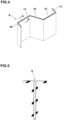
- FIG. 4 shows a see-through perspective view showing an example of the interior portion of the closed sipe 8
- FIG. 5 shows a cross-sectional view taken along line A-A of FIG. 4 .
- the edges of the closed sipe 8 at the tread surface is indicated by a solid line
- the shape of the interior portion of the closed sipe 8 is indicated by a broken line.
- the entire closed sipe 8 extends linearly in the tire radial direction in its sipe cross-section.
- the rigidity of the land portion 4 is maintained by the closed sipe 8 whose both ends are terminated within the land portion 4, therefore, sufficient steering stability and resistance to uneven wear are exhibited.
- the closed sipe 8 having such sipe cross section helps to improve demoldability during vulcanization molding, reduce the defect rate during tire production, and reduce manufacturing and maintenance costs for the vulcanization mold.
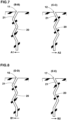
- FIG. 6 shows a see-through perspective view showing another example of the interior portion of the closed sipe 8.
- FIG. 7 shows a B-B line cross-sectional view and a C-C line cross-sectional view of FIG. 6 .
- the first sipe piece 11 and the second sipe piece 12 are each configured as a bent portion 20 extending zigzag in the tire radial direction in the sipe cross section.
- Such closed sipe 8 increases the rigidity of the land portion 4 in the tire circumferential direction, and can exhibit excellent braking/driving performance on ice.
- the bent portion 20 includes an outer inclined portion 21 which continues to the edge of the closed sipe 8 and extends while inclining to one direction with respect to the tire radial direction.
- the outer inclined portion 21 belonging to the first sipe piece 11 is inclined to the first side A1 in the tire circumferential direction toward the inside in the tire radial direction.
- the outer inclined portion 21 belonging to the second sipe piece 12 is inclined to the second side A2 in the tire circumferential direction toward the inside in the tire radial direction.
- FIG. 8 shows a D-D line cross-sectional view and a E-E line cross-sectional view of FIG. 6 .
- each of the first outer sipe piece 16 and the second outer sipe piece 17 is configured as a bent portion 20 extending zigzag in the tire radial direction in the sipe cross-section.
- Such closed sipe 8 increases the rigidity of the land portion 4 in the tire axial direction, and can exhibit excellent turning performance on ice.
- the outer inclined portion 21 belonging to the first outer sipe piece 16 is inclined to the first side B1 in the tire axial direction toward the inside in the tire radial direction.
- the outer inclined portion 21 belonging to the second outer sipe piece 17 is inclined to the second side B2 in the tire axial direction toward the inside in the tire radial direction.
- the configuration of the bent portion 20 can be varied depending on the purpose of the tire.
- Such closed sipe 8 can exhibit excellent braking/driving performance on ice while improving demoldability during vulcanization molding.
- first outer sipe piece 16 and the second outer sipe piece 17 have the cross-sectional shapes shown in FIG. 8 , and other portions extend parallel to the tire radial direction, for example.
- Such closed sipe 8 can exhibit excellent turning performance on ice while improving demoldability during vulcanization molding.
- Fig. 9 shows a see-through perspective view showing the interior portion of yet another closed sipe 8.
- each sipe piece of the closed sipe 8 is configured as a bent portion 20 extending in a zigzag shape in the tire radial direction.
- Such closed sipe 8 when closed can further increase the rigidity of the land portion 4, and can exhibit excellent uneven wear resistance performance.
- the outer inclined portions 21 have the following configuration. That is, in the present embodiment, the outer inclined portion 21 belonging to the first sipe piece 11 and the outer inclined portion 21 belonging to the second sipe piece 12 are each inclined to the first side A1 in the tire circumferential direction toward the inside in the tire radial direction. In addition, the outer inclined portion 21 belonging to the first outer sipe piece 16 and the outer inclined portion 21 belonging to the second outer sipe piece 17 are each inclined to the first side B1 in the tire axial direction toward the inside in the tire radial direction.
- each sipe piece 13 is configured as the bent portion 20, and the above effects can be exhibited.
- the closed sipe 8 having the planar shape shown in FIGS. 2 and 3 may have any of the cross-sectional shapes shown in FIGS. 4 to 10 .
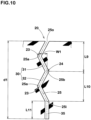
- the bent portion 20 includes two or more first convex portions 23 which are convex toward one side as shown in FIG. 10 .
- the bent portion 20 of the present embodiment is constructed by two first convex portions 23, and one second convex portion 24 which is convex toward the other side between the two first convex portions 23.
- the center line 25 in the width direction of the bent portion 20 comprises a first vertex 25a bent at the first convex portion 23 and a second vertex 25b bent at the second convex portion 24. Moreover, it is preferable that a virtual straight line (not shown) connecting between both ends of the center line 25 of the bent portion 20 is parallel to the tire radial direction. Moreover, it is preferable that the second vertex 25b is positioned on the virtual straight line.
- the center line 25 of the bent portion 20 includes an outer end 25o on the outer side in the tire radial direction, and an inner end 25i on the inner side in the tire radial direction.
- the bent portion 20 comprises two bent elements 30.
- the bent element 30 of the present embodiment is composed of a first bent element 31 from the outer end 25o to the second vertex 25b, and a second bent element 32 from the second vertex 25b to the inner end 25i.
- Such bent portion 20 can uniformly improve traction performance and braking performance on ice.
- the bending width w1 of the bent portion 20 (the distance in the width direction of the sipe from the first vertex 25a to the second vertex 25b) is, for example, 0.1 to 1.0 mm.
- the closed sipe 8 comprises a vertical portion 35 which continues to the inner side in the tire radial direction of the bent portion 20 and extends parallel to the tire radial direction.
- the length L11 in the tire radial direction of the vertical portion 35 is, for example, 10% to 30% of the maximum depth d1 of the closed sipe 8.
- FIG. 11 shows a see-through perspective view showing another example of the interior portion of the closed sipe 8.
- the closed sipe 8 of the present embodiment includes a connecting portion 26 in which sipe walls facing each other are partially connected with each other and which protrudes outward in the tire radial direction.
- the closed sipe 8 shown in Fig. 11 can suppress the above-described deformation by the connecting portion 26, it is possible to improve steering stability and braking performance even on ice.
- suppressing the deformation described above is highly effective in suppressing uneven wear (heel-and-toe wear). Therefore, the closed sipe 8 having the connecting portion 26 suppresses uneven wear, thereby reducing changes in tire performance due to wear, and thus it becomes possible to provide a tire capable of maintaining high safety over a long period of time.
- the connecting portion 26 is provided on at least one of the first sipe piece 11 and the second sipe piece 12, for example. In the present embodiment, as a more preferable mode, the connecting portion 26 is provided on each of the first sipe piece 11 and the second sipe piece 12.
- the height in the tire radial direction of the connecting portion 26 provided in the first sipe piece 11 is, for example, 80% to 120% of the height in the tire radial direction of the connecting portion 26 provided in the second sipe piece 12. Preferably, they are the same. Thereby, the rigidity around the closed sipe 8 is uniformly increased by the two connecting portions 26, and the above-described effects can be further improved.
- the connecting portion 26 extends in the tire radial direction with a constant width, for example.
- the width w2 of the connecting portion 26 provided in the first sipe piece 11 (the width along the length of the closed sipe 8) is preferably 10% to 50%, more preferably 20% to 30% of the length L4 (shown in FIG. 3 ) of the first sipe piece 11.
- the width of the connecting portion 26 provided on the second sipe piece 12 is set in the same range in relation to the length L5 (shown in FIG. 3 ) of the second sipe piece 12.
- the height h1 in the tire radial direction of the connecting portion 26 is, for example, 10% to 90% of the maximum depth d1 (shown in Fig. 10 ) of the closed sipe 8.
- the height h1 is appropriately determined according to the purpose of the tire. This is because, as shown in FIG. 12 , when the land portion 4 provided with the closed sipe 8 having the connecting portion 26 is worn, the connecting portion 26 is exposed and the edge component of the closed sipe 8 is reduced.
- the height h1 is 20% to 40% of the maximum depth d1 of the closed sipe 8.
- the height h1 is 50% to 70% of the depth d1.
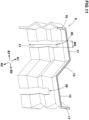
- Fig. 13 there is shown a see-through perspective view showing still another example of the interior portion of the closed sipe 8.
- the closed sipe 8 is provided with connecting portions 26 in the first sipe piece 11 and the second sipe piece 12 as in the embodiment shown in FIG. 11
- the third sipe piece 13 is also provided with a connecting portion 26.
- deformation of the closed sipe 8 in the tire axial direction is further suppressed. Therefore, further improvements in steering stability and turning performance on ice can be expected.
- the connecting portion 26 provided in the first sipe piece 11 may be referred to as a first connecting portion 26a, the connecting portion 26 provided in the second sipe piece 12 as a second connecting portion 26b, and the connecting portion 26 provided in the third sipe piece 13 as a third connecting portion 26c.
- first connecting portion 26a and the second connecting portion 26b shown in Fig. 13 the configurations of the connecting portions 26 shown in Fig. 11 can be applied, and the descriptions thereof will be omitted here. Further, in a preferred mode, the first connecting portion 26a and the second connecting portion 26b have substantially the same configuration. Thereby, progress of wear becomes uniform around the first sipe piece 11 and around the second sipe piece 12, and uneven wear is suppressed.
- the height h2 of the third connecting portion 26c is, for example, 10% to 90% of the maximum depth d1 (shown in Fig. 10 ) of the closed sipe 8.
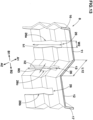
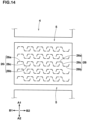
- the height h2 is appropriately determined according to the purpose of the tire. This is because, as shown in FIG. 14 , when the land portion 4 provided with the closed sipe 8 having the connecting portion 26 is worn, the first connecting portion 26a, the second connecting portion 26b, and the third connecting portion 26c are exposed, and the edge component of the closed sipe 8 is reduced.
- the height h2 is 20% to 40% of the maximum depth d1 of the closed sipe 8.
- the height h2 is 50% to 70% of the depth d1.
- the height h2 of the third connecting portion 26c is, for example, 40% to 100% of the height h1 of the first connecting portion 26a or the second connecting portion 26b.
- the height h1 is the same as the height h2. Thereby, uneven wear is further suppressed.
- the width w3 of the third connecting portion 26c (the width along the length direction of the closed sipe 8) is, for example, 10% to 50%, preferably 20% to 30% of the length L12 of the third sipe piece 13 (the length along the length direction of the closed sipe 8).
- the widths w2 of the first connecting portion 26a and the second connecting portion 26b and the width w3 of the third connecting portion 26c are the same. Thereby, it is possible to further suppress uneven wear around the closed sipe 8.
- FIGS. 15 and 16 there are shown enlarged plan views of land portions of other embodiments of the present disclosure.
- the same reference numerals are assigned to the configurations described above, and descriptions thereof are omitted here.
- a sipe which is adjacent to a longitudinal edge 6e extending in the tire circumferential direction of the block 6, is configured as a non-closed sipe 9 communicating with the longitudinal edge 6e.
- the non-closed sipe 9 of the present embodiment has, for example, such a shape that the closed sipe 8 communicates with the longitudinal edge 6e at the first sipe piece 11 or the second sipe piece 12.
- Such sipe configuration helps to further improve the braking/driving performance on ice.
- the block 6 of the embodiment shown in Fig. 16 is provided with a sipe group 7 of closed sipes 8 arranged obliquely with respect to the tire axial direction.
- a virtual straight line 18 (indicated by a two-dot chain line), which connects between a first end 8a of the closed sipe 8 provided at the end on the first side B1 in the tire axial direction and a second end 8b of the closed sipe 8 provided at the end on the second side B2 in the tire axial direction, is, for example, 10 to 45 degrees with respect to the tire axial direction.
- turning performance on ice is improved.
- the closed sipes 8 of the present disclosure are provided in at least shoulder blocks.
- the shoulder block is a block included in a shoulder land portion located on the outermost side in the tire axial direction of the tread portion 2 .
- the closed sipes 8 of the present disclosure can be expected to increase block stiffness compared to conventional sipes. Therefore, by providing the closed sipes 8 of the present disclosure in the shoulder blocks, the braking performance on dry road surfaces can be effectively improved.
- the closed sipe 8 including the connecting portions 26 shown in FIG. 11 or 13 can reliably increase the rigidity of the block and further improve the braking performance on dry road surfaces.
- Pneumatic tires of size 195/65R15 having the above-described sipe group were experimentally manufactured based on the specifications in Table 1.
- a tire in which a block a was provided with a plurality of sipes b extending in a zigzag pattern as shown in FIG. 17 was experimentally manufactured.
- the sipe b of the comparative example extends linearly in the tire radial direction as a whole.
- Each test tire had substantially the same configuration, except for the shape of the sipe.
- Each test tire was tested for traction performance on ice, braking performance on ice, and turning performance on ice. Common specifications to the test tires and test methods are as follows.
- the braking performance was evaluated by the driver's senses.
- the results are grades based on the braking performance of the comparative example being 100, and a higher value indicates better braking performance on ice.
- the turning performance was evaluated by the driver's senses.
- the results are grades based on the turning performance of the comparative example being 100, and a higher value indicates better turning performance on ice.
- each example tire had improved braking/driving performance and turning performance on ice as compared to the comparative example.
- the present disclosure includes the following modes.
- a tire including a tread portion, wherein the tread portion includes a land portion,
- each of the first sipe piece and the second sipe piece extends at an angle of +/-10 degrees with respect to the tire axial direction.
- the closed sipe includes a bent portion extending in the tire radial direction in a zigzag manner in a sipe cross section.
- the bent portion includes at least two bent elements which are convex toward the same direction.
- the closed sipe includes a vertical portion which continues to an inside in the tire radial direction of the bent portion and extends parallel to the tire radial direction.
- the closed sipe includes a connecting portion in which sipe walls facing each other are connected to each other and which protrudes outward in the tire radial direction.
- the connecting portion is provided in each of the first sipe piece and the second sipe piece, and the height in the tire radial direction of the connecting portion provided in the first sipe piece is the same as the height in the tire radial direction of the connecting portion provided in the second sipe piece.
- tread portion includes a shoulder land portion positioned on the outermost side in the tire axial direction
Landscapes
- Engineering & Computer Science (AREA)
- Mechanical Engineering (AREA)
- Tires In General (AREA)
Applications Claiming Priority (3)
| Application Number | Priority Date | Filing Date | Title |
|---|---|---|---|
| JP2020148450 | 2020-09-03 | ||
| JP2020217478 | 2020-12-25 | ||
| PCT/JP2021/032048 WO2022050287A1 (ja) | 2020-09-03 | 2021-09-01 | タイヤ |
Publications (3)
| Publication Number | Publication Date |
|---|---|
| EP4209362A1 true EP4209362A1 (de) | 2023-07-12 |
| EP4209362A4 EP4209362A4 (de) | 2024-02-28 |
| EP4209362B1 EP4209362B1 (de) | 2024-12-11 |
Family
ID=80492263
Family Applications (1)
| Application Number | Title | Priority Date | Filing Date |
|---|---|---|---|
| EP21864344.3A Active EP4209362B1 (de) | 2020-09-03 | 2021-09-01 | Reifen |
Country Status (4)
| Country | Link |
|---|---|
| US (1) | US12515479B2 (de) |
| EP (1) | EP4209362B1 (de) |
| JP (1) | JP7757969B2 (de) |
| WO (1) | WO2022050287A1 (de) |
Families Citing this family (7)
| Publication number | Priority date | Publication date | Assignee | Title |
|---|---|---|---|---|
| JP7831975B2 (ja) * | 2021-10-28 | 2026-03-17 | 株式会社ブリヂストン | タイヤ |
| JP2024019953A (ja) * | 2022-08-01 | 2024-02-14 | 住友ゴム工業株式会社 | タイヤ |
| JP2024051377A (ja) * | 2022-09-30 | 2024-04-11 | 住友ゴム工業株式会社 | タイヤ |
| JP2024076123A (ja) * | 2022-11-24 | 2024-06-05 | 住友ゴム工業株式会社 | タイヤ |
| JP2024087558A (ja) * | 2022-12-19 | 2024-07-01 | 住友ゴム工業株式会社 | タイヤ |
| JP2024093504A (ja) * | 2022-12-27 | 2024-07-09 | 住友ゴム工業株式会社 | タイヤ |
| JP2024098861A (ja) | 2023-01-11 | 2024-07-24 | 住友ゴム工業株式会社 | タイヤ |
Family Cites Families (19)
| Publication number | Priority date | Publication date | Assignee | Title |
|---|---|---|---|---|
| DE2253717A1 (de) * | 1972-11-02 | 1974-05-09 | Uniroyal Ag | Fahrzeugluftreifen |
| DE3130574A1 (de) * | 1981-08-01 | 1983-02-17 | Bayer Ag, 5090 Leverkusen | Reifen mit asymmetrischem laufflaechenprofil |
| JPS6250206A (ja) * | 1985-08-30 | 1987-03-04 | Bridgestone Corp | サイプを有する空気入りタイヤ |
| JPH04310407A (ja) * | 1991-04-05 | 1992-11-02 | Yokohama Rubber Co Ltd:The | スタッドレスタイヤ |
| US5824169A (en) * | 1995-01-20 | 1998-10-20 | The Goodyear Tire & Rubber Company | Pneumatic tire having improved wear properties |
| JP2000255219A (ja) * | 1999-03-05 | 2000-09-19 | Bridgestone Corp | 空気入りタイヤ |
| JP3912468B2 (ja) * | 1999-04-12 | 2007-05-09 | 横浜ゴム株式会社 | 空気入りタイヤ |
| FI115833B (fi) * | 2000-05-23 | 2005-07-29 | Nokian Renkaat Oyj | Kuviopalat ajoneuvon renkaan kulutuspinnassa |
| JP3648179B2 (ja) | 2001-07-18 | 2005-05-18 | 住友ゴム工業株式会社 | 空気入りタイヤ及びその加硫金型 |
| JP4056304B2 (ja) * | 2002-06-24 | 2008-03-05 | 横浜ゴム株式会社 | 氷雪路用空気入りタイヤ |
| JP4274355B2 (ja) * | 2003-04-09 | 2009-06-03 | 東洋ゴム工業株式会社 | 空気入りタイヤ |
| US7143799B2 (en) * | 2003-11-20 | 2006-12-05 | The Goodyear Tire & Rubber Company | Three-dimensional sipes for treads |
| JP4330455B2 (ja) * | 2004-01-09 | 2009-09-16 | 住友ゴム工業株式会社 | 空気入りタイヤ |
| FR2888163B1 (fr) * | 2005-07-05 | 2007-09-14 | Michelin Soc Tech | Bande de roulement comportant une sculpture avec des incisions. |
| JP5518473B2 (ja) | 2007-05-29 | 2014-06-11 | 株式会社ブリヂストン | 空気入りタイヤ |
| JP5388118B2 (ja) * | 2009-07-27 | 2014-01-15 | 株式会社ブリヂストン | タイヤ |
| JP5425707B2 (ja) * | 2010-05-26 | 2014-02-26 | 東洋ゴム工業株式会社 | 空気入りタイヤ |
| DE102013111471A1 (de) * | 2013-10-17 | 2015-04-23 | Continental Reifen Deutschland Gmbh | Fahrzeugluftreifen |
| EP3351408B1 (de) * | 2018-01-05 | 2020-09-09 | Nokian Renkaat Oyj | Laufflächenblockanordnung mit einer lamelle |
-
2021
- 2021-09-01 EP EP21864344.3A patent/EP4209362B1/de active Active
- 2021-09-01 US US18/024,466 patent/US12515479B2/en active Active
- 2021-09-01 WO PCT/JP2021/032048 patent/WO2022050287A1/ja not_active Ceased
- 2021-09-01 JP JP2022546934A patent/JP7757969B2/ja active Active
Also Published As
| Publication number | Publication date |
|---|---|
| US20230322028A1 (en) | 2023-10-12 |
| WO2022050287A1 (ja) | 2022-03-10 |
| EP4209362B1 (de) | 2024-12-11 |
| US12515479B2 (en) | 2026-01-06 |
| EP4209362A4 (de) | 2024-02-28 |
| JPWO2022050287A1 (de) | 2022-03-10 |
| JP7757969B2 (ja) | 2025-10-22 |
Similar Documents
| Publication | Publication Date | Title |
|---|---|---|
| EP4209362B1 (de) | Reifen | |
| EP3326840B1 (de) | Reifen | |
| EP3219513B1 (de) | Luftreifen | |
| EP3260308B1 (de) | Reifen | |
| EP3178668B1 (de) | Luftreifen | |
| EP3023267B1 (de) | Luftreifen | |
| EP3098089B1 (de) | Winterreifen | |
| US9090134B2 (en) | Pneumatic tire | |
| EP3012119B1 (de) | Luftreifen | |
| EP2213483B1 (de) | Luftreifen | |
| EP3098090B1 (de) | Winterreifen | |
| EP3549791B1 (de) | Reifen | |
| US9004125B2 (en) | Pneumatic tire | |
| EP3498498A1 (de) | Luftreifen | |
| EP2881266B1 (de) | Luftreifen | |
| EP2602127B1 (de) | Reifen | |
| EP3575110B1 (de) | Reifen | |
| EP3988336B1 (de) | Reifen | |
| EP4079540B1 (de) | Reifen | |
| EP4105040B1 (de) | Reifen | |
| EP3842262B1 (de) | Reifen | |
| EP4316871B1 (de) | Reifen | |
| US20020011292A1 (en) | Pneumatic tires | |
| EP4105041A1 (de) | Reifen |
Legal Events
| Date | Code | Title | Description |
|---|---|---|---|
| STAA | Information on the status of an ep patent application or granted ep patent |
Free format text: STATUS: THE INTERNATIONAL PUBLICATION HAS BEEN MADE |
|
| PUAI | Public reference made under article 153(3) epc to a published international application that has entered the european phase |
Free format text: ORIGINAL CODE: 0009012 |
|
| STAA | Information on the status of an ep patent application or granted ep patent |
Free format text: STATUS: REQUEST FOR EXAMINATION WAS MADE |
|
| 17P | Request for examination filed |
Effective date: 20230223 |
|
| AK | Designated contracting states |
Kind code of ref document: A1 Designated state(s): AL AT BE BG CH CY CZ DE DK EE ES FI FR GB GR HR HU IE IS IT LI LT LU LV MC MK MT NL NO PL PT RO RS SE SI SK SM TR |
|
| DAV | Request for validation of the european patent (deleted) | ||
| DAX | Request for extension of the european patent (deleted) | ||
| A4 | Supplementary search report drawn up and despatched |
Effective date: 20240130 |
|
| RIC1 | Information provided on ipc code assigned before grant |
Ipc: B60C 11/12 20060101AFI20240124BHEP |
|
| P01 | Opt-out of the competence of the unified patent court (upc) registered |
Effective date: 20240327 |
|
| GRAP | Despatch of communication of intention to grant a patent |
Free format text: ORIGINAL CODE: EPIDOSNIGR1 |
|
| STAA | Information on the status of an ep patent application or granted ep patent |
Free format text: STATUS: GRANT OF PATENT IS INTENDED |
|
| INTG | Intention to grant announced |
Effective date: 20240923 |
|
| GRAS | Grant fee paid |
Free format text: ORIGINAL CODE: EPIDOSNIGR3 |
|
| GRAA | (expected) grant |
Free format text: ORIGINAL CODE: 0009210 |
|
| STAA | Information on the status of an ep patent application or granted ep patent |
Free format text: STATUS: THE PATENT HAS BEEN GRANTED |
|
| AK | Designated contracting states |
Kind code of ref document: B1 Designated state(s): AL AT BE BG CH CY CZ DE DK EE ES FI FR GB GR HR HU IE IS IT LI LT LU LV MC MK MT NL NO PL PT RO RS SE SI SK SM TR |
|
| REG | Reference to a national code |
Ref country code: GB Ref legal event code: FG4D |
|
| REG | Reference to a national code |
Ref country code: CH Ref legal event code: EP |
|
| REG | Reference to a national code |
Ref country code: IE Ref legal event code: FG4D |
|
| REG | Reference to a national code |
Ref country code: DE Ref legal event code: R096 Ref document number: 602021023392 Country of ref document: DE |
|
| REG | Reference to a national code |
Ref country code: LT Ref legal event code: MG9D |
|
| PG25 | Lapsed in a contracting state [announced via postgrant information from national office to epo] |
Ref country code: HR Free format text: LAPSE BECAUSE OF FAILURE TO SUBMIT A TRANSLATION OF THE DESCRIPTION OR TO PAY THE FEE WITHIN THE PRESCRIBED TIME-LIMIT Effective date: 20241211 |
|
| PG25 | Lapsed in a contracting state [announced via postgrant information from national office to epo] |
Ref country code: FI Free format text: LAPSE BECAUSE OF FAILURE TO SUBMIT A TRANSLATION OF THE DESCRIPTION OR TO PAY THE FEE WITHIN THE PRESCRIBED TIME-LIMIT Effective date: 20241211 |
|
| PG25 | Lapsed in a contracting state [announced via postgrant information from national office to epo] |
Ref country code: BG Free format text: LAPSE BECAUSE OF FAILURE TO SUBMIT A TRANSLATION OF THE DESCRIPTION OR TO PAY THE FEE WITHIN THE PRESCRIBED TIME-LIMIT Effective date: 20241211 |
|
| REG | Reference to a national code |
Ref country code: NL Ref legal event code: MP Effective date: 20241211 |
|
| PG25 | Lapsed in a contracting state [announced via postgrant information from national office to epo] |
Ref country code: ES Free format text: LAPSE BECAUSE OF FAILURE TO SUBMIT A TRANSLATION OF THE DESCRIPTION OR TO PAY THE FEE WITHIN THE PRESCRIBED TIME-LIMIT Effective date: 20241211 |
|
| PG25 | Lapsed in a contracting state [announced via postgrant information from national office to epo] |
Ref country code: NO Free format text: LAPSE BECAUSE OF FAILURE TO SUBMIT A TRANSLATION OF THE DESCRIPTION OR TO PAY THE FEE WITHIN THE PRESCRIBED TIME-LIMIT Effective date: 20250311 |
|
| PG25 | Lapsed in a contracting state [announced via postgrant information from national office to epo] |
Ref country code: LV Free format text: LAPSE BECAUSE OF FAILURE TO SUBMIT A TRANSLATION OF THE DESCRIPTION OR TO PAY THE FEE WITHIN THE PRESCRIBED TIME-LIMIT Effective date: 20241211 Ref country code: GR Free format text: LAPSE BECAUSE OF FAILURE TO SUBMIT A TRANSLATION OF THE DESCRIPTION OR TO PAY THE FEE WITHIN THE PRESCRIBED TIME-LIMIT Effective date: 20250312 |
|
| PG25 | Lapsed in a contracting state [announced via postgrant information from national office to epo] |
Ref country code: RS Free format text: LAPSE BECAUSE OF FAILURE TO SUBMIT A TRANSLATION OF THE DESCRIPTION OR TO PAY THE FEE WITHIN THE PRESCRIBED TIME-LIMIT Effective date: 20250311 |
|
| PG25 | Lapsed in a contracting state [announced via postgrant information from national office to epo] |
Ref country code: NL Free format text: LAPSE BECAUSE OF FAILURE TO SUBMIT A TRANSLATION OF THE DESCRIPTION OR TO PAY THE FEE WITHIN THE PRESCRIBED TIME-LIMIT Effective date: 20241211 |
|
| REG | Reference to a national code |
Ref country code: AT Ref legal event code: MK05 Ref document number: 1750130 Country of ref document: AT Kind code of ref document: T Effective date: 20241211 |
|
| PG25 | Lapsed in a contracting state [announced via postgrant information from national office to epo] |
Ref country code: SM Free format text: LAPSE BECAUSE OF FAILURE TO SUBMIT A TRANSLATION OF THE DESCRIPTION OR TO PAY THE FEE WITHIN THE PRESCRIBED TIME-LIMIT Effective date: 20241211 |
|
| PG25 | Lapsed in a contracting state [announced via postgrant information from national office to epo] |
Ref country code: PL Free format text: LAPSE BECAUSE OF FAILURE TO SUBMIT A TRANSLATION OF THE DESCRIPTION OR TO PAY THE FEE WITHIN THE PRESCRIBED TIME-LIMIT Effective date: 20241211 |
|
| PG25 | Lapsed in a contracting state [announced via postgrant information from national office to epo] |
Ref country code: IS Free format text: LAPSE BECAUSE OF FAILURE TO SUBMIT A TRANSLATION OF THE DESCRIPTION OR TO PAY THE FEE WITHIN THE PRESCRIBED TIME-LIMIT Effective date: 20250411 |
|
| PG25 | Lapsed in a contracting state [announced via postgrant information from national office to epo] |
Ref country code: PT Free format text: LAPSE BECAUSE OF FAILURE TO SUBMIT A TRANSLATION OF THE DESCRIPTION OR TO PAY THE FEE WITHIN THE PRESCRIBED TIME-LIMIT Effective date: 20250411 |
|
| PG25 | Lapsed in a contracting state [announced via postgrant information from national office to epo] |
Ref country code: EE Free format text: LAPSE BECAUSE OF FAILURE TO SUBMIT A TRANSLATION OF THE DESCRIPTION OR TO PAY THE FEE WITHIN THE PRESCRIBED TIME-LIMIT Effective date: 20241211 |
|
| PG25 | Lapsed in a contracting state [announced via postgrant information from national office to epo] |
Ref country code: RO Free format text: LAPSE BECAUSE OF FAILURE TO SUBMIT A TRANSLATION OF THE DESCRIPTION OR TO PAY THE FEE WITHIN THE PRESCRIBED TIME-LIMIT Effective date: 20241211 Ref country code: AT Free format text: LAPSE BECAUSE OF FAILURE TO SUBMIT A TRANSLATION OF THE DESCRIPTION OR TO PAY THE FEE WITHIN THE PRESCRIBED TIME-LIMIT Effective date: 20241211 |
|
| PG25 | Lapsed in a contracting state [announced via postgrant information from national office to epo] |
Ref country code: SK Free format text: LAPSE BECAUSE OF FAILURE TO SUBMIT A TRANSLATION OF THE DESCRIPTION OR TO PAY THE FEE WITHIN THE PRESCRIBED TIME-LIMIT Effective date: 20241211 |
|
| PG25 | Lapsed in a contracting state [announced via postgrant information from national office to epo] |
Ref country code: CZ Free format text: LAPSE BECAUSE OF FAILURE TO SUBMIT A TRANSLATION OF THE DESCRIPTION OR TO PAY THE FEE WITHIN THE PRESCRIBED TIME-LIMIT Effective date: 20241211 |
|
| PG25 | Lapsed in a contracting state [announced via postgrant information from national office to epo] |
Ref country code: IT Free format text: LAPSE BECAUSE OF FAILURE TO SUBMIT A TRANSLATION OF THE DESCRIPTION OR TO PAY THE FEE WITHIN THE PRESCRIBED TIME-LIMIT Effective date: 20241211 |
|
| PG25 | Lapsed in a contracting state [announced via postgrant information from national office to epo] |
Ref country code: SE Free format text: LAPSE BECAUSE OF FAILURE TO SUBMIT A TRANSLATION OF THE DESCRIPTION OR TO PAY THE FEE WITHIN THE PRESCRIBED TIME-LIMIT Effective date: 20241211 |
|
| REG | Reference to a national code |
Ref country code: DE Ref legal event code: R097 Ref document number: 602021023392 Country of ref document: DE |
|
| PG25 | Lapsed in a contracting state [announced via postgrant information from national office to epo] |
Ref country code: DK Free format text: LAPSE BECAUSE OF FAILURE TO SUBMIT A TRANSLATION OF THE DESCRIPTION OR TO PAY THE FEE WITHIN THE PRESCRIBED TIME-LIMIT Effective date: 20241211 |
|
| PGFP | Annual fee paid to national office [announced via postgrant information from national office to epo] |
Ref country code: DE Payment date: 20250730 Year of fee payment: 5 |
|
| PLBE | No opposition filed within time limit |
Free format text: ORIGINAL CODE: 0009261 |
|
| STAA | Information on the status of an ep patent application or granted ep patent |
Free format text: STATUS: NO OPPOSITION FILED WITHIN TIME LIMIT |
|
| PGFP | Annual fee paid to national office [announced via postgrant information from national office to epo] |
Ref country code: FR Payment date: 20250808 Year of fee payment: 5 |
|
| 26N | No opposition filed |
Effective date: 20250912 |