EP4209794A1 - Informationsverarbeitungsvorrichtung, informationsverarbeitungsverfahren, informationsverarbeitungssystem und programm - Google Patents
Informationsverarbeitungsvorrichtung, informationsverarbeitungsverfahren, informationsverarbeitungssystem und programm Download PDFInfo
- Publication number
- EP4209794A1 EP4209794A1 EP20950482.8A EP20950482A EP4209794A1 EP 4209794 A1 EP4209794 A1 EP 4209794A1 EP 20950482 A EP20950482 A EP 20950482A EP 4209794 A1 EP4209794 A1 EP 4209794A1
- Authority
- EP
- European Patent Office
- Prior art keywords
- soh
- battery
- maximum
- battery unit
- minimum voltage
- Prior art date
- Legal status (The legal status is an assumption and is not a legal conclusion. Google has not performed a legal analysis and makes no representation as to the accuracy of the status listed.)
- Pending
Links
Images





Classifications
-
- G—PHYSICS
- G01—MEASURING; TESTING
- G01R—MEASURING ELECTRIC VARIABLES; MEASURING MAGNETIC VARIABLES
- G01R31/00—Arrangements for testing electric properties; Arrangements for locating electric faults; Arrangements for electrical testing characterised by what is being tested not provided for elsewhere
- G01R31/36—Arrangements for testing, measuring or monitoring the electrical condition of accumulators or electric batteries, e.g. capacity or state of charge [SoC]
- G01R31/392—Determining battery ageing or deterioration, e.g. state of health
-
- G—PHYSICS
- G01—MEASURING; TESTING
- G01R—MEASURING ELECTRIC VARIABLES; MEASURING MAGNETIC VARIABLES
- G01R31/00—Arrangements for testing electric properties; Arrangements for locating electric faults; Arrangements for electrical testing characterised by what is being tested not provided for elsewhere
- G01R31/36—Arrangements for testing, measuring or monitoring the electrical condition of accumulators or electric batteries, e.g. capacity or state of charge [SoC]
- G01R31/382—Arrangements for monitoring battery or accumulator variables, e.g. SoC
- G01R31/3835—Arrangements for monitoring battery or accumulator variables, e.g. SoC involving only voltage measurements
-
- G—PHYSICS
- G01—MEASURING; TESTING
- G01R—MEASURING ELECTRIC VARIABLES; MEASURING MAGNETIC VARIABLES
- G01R31/00—Arrangements for testing electric properties; Arrangements for locating electric faults; Arrangements for electrical testing characterised by what is being tested not provided for elsewhere
- G01R31/36—Arrangements for testing, measuring or monitoring the electrical condition of accumulators or electric batteries, e.g. capacity or state of charge [SoC]
- G01R31/396—Acquisition or processing of data for testing or for monitoring individual cells or groups of cells within a battery
-
- H—ELECTRICITY
- H02—GENERATION; CONVERSION OR DISTRIBUTION OF ELECTRIC POWER
- H02J—ELECTRIC POWER NETWORKS; CIRCUIT ARRANGEMENTS OR SYSTEMS FOR SUPPLYING OR DISTRIBUTING ELECTRIC POWER; SYSTEMS FOR STORING ELECTRIC ENERGY
- H02J7/00—Circuit arrangements for charging or discharging batteries or for supplying loads from batteries
- H02J7/40—Circuit arrangements for charging or discharging batteries or for supplying loads from batteries characterised by the exchange of charge or discharge related data
-
- H—ELECTRICITY
- H02—GENERATION; CONVERSION OR DISTRIBUTION OF ELECTRIC POWER
- H02J—ELECTRIC POWER NETWORKS; CIRCUIT ARRANGEMENTS OR SYSTEMS FOR SUPPLYING OR DISTRIBUTING ELECTRIC POWER; SYSTEMS FOR STORING ELECTRIC ENERGY
- H02J7/00—Circuit arrangements for charging or discharging batteries or for supplying loads from batteries
- H02J7/50—Circuit arrangements for charging or discharging batteries or for supplying loads from batteries acting upon multiple batteries simultaneously or sequentially
-
- H—ELECTRICITY
- H02—GENERATION; CONVERSION OR DISTRIBUTION OF ELECTRIC POWER
- H02J—ELECTRIC POWER NETWORKS; CIRCUIT ARRANGEMENTS OR SYSTEMS FOR SUPPLYING OR DISTRIBUTING ELECTRIC POWER; SYSTEMS FOR STORING ELECTRIC ENERGY
- H02J7/00—Circuit arrangements for charging or discharging batteries or for supplying loads from batteries
- H02J7/80—Circuit arrangements for charging or discharging batteries or for supplying loads from batteries including monitoring or indicating arrangements
- H02J7/84—Control of state of health [SOH]
-
- H—ELECTRICITY
- H02—GENERATION; CONVERSION OR DISTRIBUTION OF ELECTRIC POWER
- H02J—ELECTRIC POWER NETWORKS; CIRCUIT ARRANGEMENTS OR SYSTEMS FOR SUPPLYING OR DISTRIBUTING ELECTRIC POWER; SYSTEMS FOR STORING ELECTRIC ENERGY
- H02J7/00—Circuit arrangements for charging or discharging batteries or for supplying loads from batteries
- H02J7/80—Circuit arrangements for charging or discharging batteries or for supplying loads from batteries including monitoring or indicating arrangements
-
- Y—GENERAL TAGGING OF NEW TECHNOLOGICAL DEVELOPMENTS; GENERAL TAGGING OF CROSS-SECTIONAL TECHNOLOGIES SPANNING OVER SEVERAL SECTIONS OF THE IPC; TECHNICAL SUBJECTS COVERED BY FORMER USPC CROSS-REFERENCE ART COLLECTIONS [XRACs] AND DIGESTS
- Y02—TECHNOLOGIES OR APPLICATIONS FOR MITIGATION OR ADAPTATION AGAINST CLIMATE CHANGE
- Y02E—REDUCTION OF GREENHOUSE GAS [GHG] EMISSIONS, RELATED TO ENERGY GENERATION, TRANSMISSION OR DISTRIBUTION
- Y02E60/00—Enabling technologies; Technologies with a potential or indirect contribution to GHG emissions mitigation
- Y02E60/10—Energy storage using batteries
Definitions
- Embodiments of the present invention relate to an information processing apparatus, an information processing method, an information processing system, and a program.
- SoH State of Health
- a voltage standard deviation method which aims at identifying the SoH by statistically processing a relationship between a State of Charge (SoC) and a voltage on the basis of operation data of the battery.
- SoC State of Charge
- Non-Patent Document 1 " Method to Evaluate State of Health of Lithium-Ion Batteries Used in In-Service BESS for Electric Power System", Toshiba Review vol. 73, No. 6, November in 2018, Toshiba Corp .
- Embodiments of the present invention provide an information processing apparatus to generate deterioration sign information of a battery system with high accuracy.
- an information processing apparatus includes: an SoH calculator to calculate an SoH (State of Health) for each of a plurality battery units on the basis of measurement data related to an electric power applied to each of the plurality of battery units in a rechargeable battery; a maximum/minimum voltage SoH calculator to calculate a maximum/minimum voltage SoH which is an SoH based on a maximum voltage and a minimum voltage in voltages applied to a plurality of cells or a plurality of battery subunits in the battery unit for each of the plurality of battery units on the basis of the measurement data; and an SoH ratio calculator to calculate an SoH ratio which is a ratio of the maximum/minimum voltage SoH to the SoH for each of the plurality of battery units on the basis of the calculated SoH and the calculated maximum/minimum voltage SoH.
- SoH State of Health
- FIG. 1 is a block diagram illustrating an information processing apparatus 1 according to the embodiment of the invention.
- the information processing apparatus 1 includes a storage 11, a data acquirer 12, a calculator 13, a detector 14, and an input-and-output circuit 15.
- the calculator 13 includes an SoH calculator 131, a maximum/minimum voltage SoH calculator 132, and an SoH ratio calculator 133.
- the information processing apparatus 1 is an apparatus to generate information that is, in other words, an index of a deteriorating acceleration of a rechargeable battery.
- the deteriorating acceleration of the rechargeable battery is detected based on the index information and may also be detected by the information processing apparatus 1 or by an external apparatus.
- a cloud server it is also considered for a cloud server to collect the items of battery information via a communication network and detect the deteriorating acceleration.
- the information processing apparatus 1 including the detector 14 is thus configured to detect the deteriorating acceleration for the sake of explaining the detection of the deteriorating acceleration.
- the rechargeable battery as a detection target of the deteriorating acceleration is a rechargeable battery capable of accumulating electricity (charging) and discharging the electric energy.
- the rechargeable battery includes a plurality of unit batteries (cells each) separated into a plurality of battery units, and the plurality of battery units are exemplified by a battery module and a battery board as in a battery energy storage system (BESS).
- BESS battery energy storage system
- a deterioration of the battery unit is detected, and the deterioration of the rechargeable battery is detected based on the detection of the battery unit.
- FIG. 2 is a diagram illustrating a first example of a configuration of the rechargeable battery as the detection target of the deteriorating acceleration.
- a rechargeable battery 2 is configured by a plurality of battery modules 22 each including a plurality of cells 21 connected in series. The plurality of battery modules 22 are connected in parallel.
- the battery module 22 corresponds to the battery unit described above.
- FIG. 3 is a diagram illustrating a second example of the configuration of the rechargeable battery as the detection target of the deteriorating acceleration.
- the rechargeable battery 2 is configured by a plurality of battery boards 23 each including the plurality of battery modules 22 connected in series. The plurality of battery boards 23 are connected in parallel. Each of the plurality of battery modules 22 includes one or more cells.
- the battery board 23 corresponds to the battery unit described above. Note that a different battery unit is contained in the battery unit as in the battery modules 22 contained in the battery board 23, in which case the different battery unit in the battery unit is referred to as a battery subunit. Note that a configuration of each of the cells included in the plurality of battery modules 22 may not be the configuration as in the example of FIG. 2 .
- each battery unit may be the same and may also be different.
- the battery subunits in each battery unit are arrayed such that voltages applied in a same deteriorating state are substantially same.
- each battery unit includes none of the battery subunits, in which case the respective cells in each battery unit are arrayed such that the voltages applied to the cells in the same deteriorating state are substantially same.
- Parameters of a voltage, a current, a temperature and other parameters of each battery unit are measurable and transmitted as measurement data to the information processing apparatus 1.
- a BMU Battery Management Unit
- CMU Cell Monitoring Unit
- the measurement data may be transmitted by the rechargeable battery 2 directly to the information processing apparatus 1 and may also be transmitted via a device or its equivalent to collect the items of information of the rechargeable battery 2. The measurement data of the rechargeable battery 2 being in operation are thus obtained, thereby enabling the deteriorating acceleration of the battery unit to be monitored even in the operating status of the rechargeable battery 2.
- short-cycle charging/discharging is performed for 24 hours 365 days in the BESS, and however, the present embodiment enables soundness evaluation of the BESS to be carried out without stopping the BESS.
- the deteriorating acceleration at the past time point may be estimated based on the measurement data in the past, and the rechargeable battery being in non-operation may also be evaluated.
- the measurement data about each battery unit contain at least data necessary for calculating the SoH of the rechargeable battery 2.
- the SoH is an index that indicates the state of deterioration of the rechargeable battery 2. Note that it may be properly set how a deteriorating state of a rechargeable device is indicated. For instance, the deteriorating state may be defined by using a full-charge capacity decreasing due to the deterioration and an internal resistance increasing due to the deterioration.
- the SoH is set as a ratio of the full-charge capacity at an evaluation time point to a full-charge capacity prescribed in specifications of the battery unit (Ratio of Full-Charge Capacity at Evaluation Time/Full-Charge Capacity Prescribed in Specifications).
- the evaluation time point may be an arbitrary time point.
- the measurement data are saved on a daily basis often as a CSV file containing measurement results for one day in the BESS described above. An electric power energy handled on the day can be calculated from the measurement data for one day, and hence a time point when saving the measurement data may also be set as the evaluation time point.
- an SoH transition run chart with an axis of abscissa indicating the electric power energy and an axis of ordinate indicating the SoH may be generated based on the measurement results.
- the SoH with respect to an cumulative equivalent cycle number up to an arbitrary evaluation time point may also be calculated.
- the SoH may further be set as a ratio of the full-charge capacity at a second time point to the full-charge capacity at a first time point (Full-Charge Capacity at Second Time point/Full-Charge Capacity at First Time point).
- the first time point and the second time point are arbitrary time points, in which the second time point is posterior to the first time point, and the deterioration of the battery unit progresses at the second time point farther than at the first time point.
- the first time point may also be a not-yet-used time point, in which case the full-charge capacity at the first time point is generally set larger than the full-charge capacity prescribed in the specifications.
- a method of calculating the SoH of the battery unit may involve using conventional methods.
- the measurement data contain the voltages of the battery units, and a standard deviation or a variance of a distribution of voltage values is calculated based on time-series data of the voltages.
- a known SoH calculating method is that reference data representing a general relationship between the SoH and the standard deviation or the variance of the distribution of the voltage values are generated from the rechargeable batteries rendered deteriorating in a variety of states beforehand, and the SoH is calculated from the calculated standard deviation or variance on the basis of the reference data.
- the SoH may be calculated by use of the method described as such.
- the measurement data further contain data representing whether the battery unit is in charging or discharging in order to calculate a maximum/minimum voltage SoH. For instance, a direction of current to charge and discharge the rechargeable battery is indicated by positive or negative of the current, in which case the measurement data contain the charging/discharging current for the rechargeable battery.
- the measurement data still further contain maximum and minimum values of the voltage values of the battery subunit included in the battery unit to calculate the maximum/minimum voltage SoH.
- the battery unit does not include the battery subunit, in which case the measurement data contain the maximum and minimum values of the voltage values of the respective cells in the battery unit.
- the measurement data may contain parameter values not used for calculating the SoH.
- FIG. 1 An internal configuration of the information processing apparatus 1 will be described. Note that components illustrated in FIG. 1 serve to detect the deteriorating acceleration, whereas other components are omitted.
- the respective components may be divided and may also be integrated.
- the storage 11 may be divided corresponding to files to be saved.
- the components other than the storage 11 may also be deemed as arithmetic units.
- a processing result of each component may be transmitted to the component that executes a next process and may also be stored in the storage 11; and the component, which executes the next process, may acquire the processing result from the storage 11 by accessing the storage 11.
- the storage 11 stores the data used for the processing of the information processing apparatus 1.
- the data given as such are exemplified by the measurement data acquired from the rechargeable battery 2, the reference data for calculating the SoH and data for outputting an alert.
- the data to be stored in the storage 11 are not limited, but, for instance, the processing results of the respective components of the information processing apparatus 1 may also be stored.
- the data acquirer 12 acquires the measurement data from the rechargeable battery 2 and stores the acquired data in the storage 11.
- the stored measurement data are used as a history. For example, the transitions of the voltage applied to the respective battery units can be checked from the stored measurement data.
- the measurement data are acquired in real time from the rechargeable battery 2 and may be stored in the storage 11 by collecting the measurement data per unit time exemplified by one day into one file.
- the rechargeable battery 2 collects the measurement data per unit time into one file and may store the file in the storage 11 by transmitting the file thereto.
- the unit time and a saving format may be properly determined.
- the calculator 13 generates information for detecting the deteriorating acceleration on the basis of the stored measurement data.
- the calculator 13 is divided into the SoH calculator 131, the maximum/minimum voltage SoH calculator 132 and the SoH ratio calculator 133, corresponding to processing contents.
- the SoH calculator 131 calculates, based on the stored measurement data, the SoH per battery unit of the rechargeable battery 2. For example, as stated above, the SoH calculator 131 calculates the standard deviation or the variance of the distribution of the voltage values of the battery unit per unit period exemplified by one day. Subsequently, the SoH calculator 131 calculates the SoH of the battery unit from the calculated standard deviation or variance on the basis of the reference data.
- the maximum/minimum voltage SoH calculator 132 calculates, based on the stored measurement data, the maximum/minimum voltage SoH for every battery unit of the rechargeable battery 2.
- the maximum/minimum voltage SoH is the SoH based on the maximum voltage and the minimum voltage of the respective voltages applied to the battery subunits in the battery unit.
- the battery unit does not include the battery subunit, in which case the maximum/minimum voltage SoH is the SoH based on the maximum voltage and the minimum voltage of the respective voltages applied to the cells in the battery unit.
- the cells or the battery subunits included in the battery unit have differences caused due to the deteriorations between values of internal resistances thereof. Therefore, the voltages of the cells or the battery subunits also come to differ, respectively.
- the maximum/minimum voltage SoH calculator 132 regards, as the voltage of the battery unit, the maximum voltage of the voltages applied to the cells or the battery subunits at charging time, and regards, as the voltage of the battery unit, the minimum voltage of the voltages applied to the cells or the battery subunits at discharging time. Similarly to the SoH calculator 131, the maximum/minimum voltage SoH calculator 132 calculates the SoH of the battery unit.
- the maximum/minimum voltage SoH calculator 132 calculates the SoH of the battery unit from maximum/minimum voltage data synthesized by using the maximum voltage of the internal cells or the battery subunits instead of the voltage of the battery unit at the charging time of the battery unit, and the minimum voltage of the internal cells or the battery subunits instead of the voltage of the battery unit at the discharging time of the battery unit, and sets the calculated SoH as the maximum/minimum voltage SoH.
- the cell or the battery subunit exhibiting the maximum voltage at the charging time of the battery unit do not necessarily coincide with the cell or the battery subunit exhibiting the minimum voltage at the discharging time of the battery unit, in which these cells or the battery subunits are tentatively given as those exhibiting a maximum deterioration state in the cells or the battery subunits in the battery unit.
- the maximum/minimum voltage SoH exhibits a possibility of a most progressing state of the deterioration in the battery unit, and therefore becomes a value smaller than the SoH.
- a voltage standard deviation method capable of evaluating the SoH without stopping the rechargeable battery being in charging/discharging.
- the voltage standard deviation method involves using a plot locus chart with an X-coordinate indicating an SoC (State of Charge) of the cell being in charging/discharging and a Y-coordinate indicating a terminal voltage of the cell concerned. It is known with respect to the plots that a distribution along the Y-axis, in other words, a dispersion of the terminal voltage spreads corresponding to a decrease in the SoH even when the charging/discharging electric energy is the same.
- the SoH is estimated based on the distribution described above.
- the locus chart has illustrations of the plot of the maximum voltage along the Y-coordinate and the plot of the minimum voltage along the Y-coordinate. Hence, the distribution along the Y-coordinate becomes extremely extensive. It is recognized from what is just described above that the maximum/minimum voltage SoH takes a value smaller than the SoH.
- the SoH ratio calculator 133 calculates an SoH ratio for each battery unit.
- the SoH ratio represents a ratio of the maximum/minimum voltage SoH of the battery unit concerned to the SoH of the battery unit (Maximum/Minimum Voltage SoH/SoH).
- the maximum/minimum voltage SoH depends on the most progressing state of the deterioration in the battery unit.
- the SoH depends on all of the cells or the battery subunits in the battery unit.
- the SoH ratio takes a value approximate to "1" when the most progressing state of the deterioration is substantially the same as those of other cells or battery subunits, but takes a value smaller than "1" when the most progressing state of the deterioration is larger than those of other cells or battery subunits.
- the SoH ratio represents how much the most progressing state of the deterioration in the battery unit progresses in deterioration as compared with other states.
- the SoH ratio is used as the index, thereby enabling such recognition that the deterioration progresses in a part of the internal cells or cell subs farther than other cells or battery subunits even when the whole battery unit appears to keep the soundness.
- the detector 14 detects, based on the SoH ratios of the respective battery units, an alert target battery unit. In other words, a search for whether there exists the battery unit including an existence of the cell or battery subunit progressing in deterioration farther than other cells or battery subunits, is made based on the SoH ratio, and the detected (searched) battery unit is set as the alert target. Note that alert contents may properly be determined. For example, the battery unit being set as the alert target may be deemed to be deteriorated or broke down, and may also be deemed to have an apprehension of the sudden deterioration or breakdown hereafter. When detecting the alert target battery unit, the detector 14 may set the rechargeable battery 2 as the alert target in the same way with this battery unit.
- the rechargeable battery 2 may also be deemed to get deteriorated or broke down, and may further be deemed to have the apprehension of the sudden deterioration or breakdown hereafter.
- the battery unit may be detected as the alert target, corresponding to a degree of how much the SoH ratio is far from the value "1", and the alert contents may also be varied.
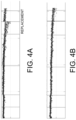
- FIG. 4 is a chart illustrating transitions of the SoH.
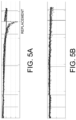
- FIG. 5 is a chart illustrating transitions of the maximum/minimum voltage SoH.
- the axes of abscissas in FIGS. 4 and 5 indicate charging/discharging equivalent cyclenumber, and FIGS. 4 and 5 illustrate plots with respect to, e.g., one battery board on the daily basis.
- the equivalent cycle number is a numerical value obtained by dividing an stored charging/discharging electric power energy by electric power energy given in the specifications of the battery board, and represents how many times the electric power energy applied to the battery board so far corresponds to the full-charge capacity of the battery board.
- FIG. 4A and FIG. 5A each illustrate the maximum/minimum SoH of the battery board
- FIG. 4B and FIG. 5B each illustrate the SoH of the battery board.
- FIG. 4 depicts a case in which the deteriorations of the units configuring the battery board are relatively uniform
- FIG. 5 depicts a case in which the deteriorations of the units configuring the battery board are different in terms of progress.
- Straight lines depicted in FIGS. 4 and 5 represent approximate curves formed by all of the plots.
- the plots gradually get away from the approximate curves in FIGS. 4A and 5A . Accordingly, replacement is carried out at a time point of getting away to some extent from the approximate curve. It is thus feasible to detect the deterioration by comparing with the approximate curve, i.e., comparing the respective battery units with each other in a case where the deterioration of the battery unit is different from those of other battery units.
- the plots don't get away from the approximate curve in a case where the battery unit is deteriorated in the same way as other battery units are deteriorated. In other words, it is unfeasible to detect the deterioration even by comparing the respective battery units with each other.
- the deterioration is undetectable relatively, and hence the deterioration needs to be detected relatively by providing specific threshold values or threshold functions corresponding to the equivalent cycle number .
- FIG. 6 is a chart illustrating transitions of the SoH ratio.
- FIG. 6 illustrates the plots for all of the battery boards (several tens of battery boards in the illustrative example).
- the maximum/minimum voltage SoH takes substantially the same value as the value of the SoH in each battery unit. Consequently, as illustrated in FIG. 6 , the SoH ratio becomes substantially "1" at the initial stage with the small cycle frequency.
- the electric power applied thereto at the charging/discharging time comes to have a dispersion. Accordingly, a difference is caused between the maximum/minimum voltage SoH and the SoH. Consequently, the SoH ratio deviates from "1". It may be detected based on a degree of this deviation that the deterioration of a part of units is accelerated.
- the SoH ratio is not derived from the comparisons with other battery boards, and hence the deterioration is detectable even when each battery unit gets deteriorated in the same way as other battery units.
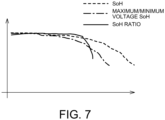
- FIG. 7 is a graphic chart illustrating comparisons between the SoH, the maximum/minimum voltage SoH and the SoH ratio.
- a graph of solid line represents a transition of the SoH ratio.
- a graph of one-dotted broken line represents a transition of the maximum/minimum voltage SoH.
- a graph of broken line represents a transition of the SoH.
- the SoH ratio drops down more sharply than the transitions of the SoH and the maximum/minimum voltage SoH. It is therefore feasible to enhance the accuracy of detecting the deteriorating acceleration of each battery unit to a greater degree than when using the SoH and the maximum/minimum voltage SoH.
- the deterioration is detected based on how far the SoH ratio deviates from "1", and however, the threshold value for this detection may be previously stored in the storage 11.
- a deterioration estimator may calculate the threshold value. For instance, a standard deviation ⁇ of the SoH ratio in a fixed period is calculated, and the threshold value may also be calculated based on the standard deviation ⁇ .
- the standard deviation ⁇ of the SoH ratio which is calculated in the fixed period, is set as a reference dispersion, and standard deviation multiples 3 ⁇ ,4 ⁇ ,4.5 ⁇ ,6 ⁇ may also be set as the threshold values.
- the period for obtaining the standard deviation may be an initial period for which the SoH is assumed to be substantially "1" and may also be a period with its central point being the time point when detecting the deteriorating acceleration.
- the detector may detect the deteriorated battery unit from the plurality of battery units on the basis of the calculated SoH or maximum/minimum voltage SoH.
- the detector 14 may select one of a plurality of categories related to the deterioration on the basis of at least any one of the SoH, the maximum/minimum voltage SoH and the SoH ratio. Predetermined are, e.g., the categories exemplified by "normal”, "a part of battery unit has a tendency of the deteriorating acceleration” and "the whole battery unit has the tendency of the deteriorating acceleration", and "value ranges corresponding to these categories". It is then detected that any one of the SoH, the maximum/minimum voltage SoH and the SoH ratio corresponds to which category.
- the detection about which category the SoH, the maximum/minimum voltage SoH or the SoH ratio corresponds to may be made based on at least two combinations of the SoH, the maximum/minimum voltage SoH and the SoH ratio.
- the SoH is equal to or larger than a predetermined threshold value
- the SoH ratio is smaller than the predetermined threshold value, in which case the category for prompting a user to be cautious may also be selected.
- the battery unit when conforming with a plurality of conditions, may be detected as the alert target.
- the value ranges may be properly determined, and the values of the ranges may also be set as values based on the standard deviation described above.
- the input-and-output circuit 15 outputs the processing results of the respective components.
- the input-and-output circuit 15 may output, e.g., the calculated SoH, the calculated maximum/minimum voltage SoH and the calculated SoH ratio.
- the input-and-output circuit 15 may also output a result of detecting the deteriorating acceleration.
- the input-and-output circuit 15 may further output information indicating the alert, in other words, "Alert" in order to notify the user that the battery unit deemed as the alert target is detected.
- the input-and-output circuit 15 may also output an identification number exemplified by ID of the battery unit deemed as the alert target. When no battery unit deemed as the alert target exists, the input-and-output circuit 15 may output information indicating "normal" to the user.
- the input-and-output circuit 15 may further output data exemplified by the measurement data stored in the storage 11.
- the output contents may be varied corresponding to the categories about the alert targets.
- the input-and-output circuit 15 outputs the alert about the battery unit when detecting the deteriorated battery unit on the basis of the SoH or the maximum/minimum voltage SoH, and may also output the alert about the cell or the battery subunit in order to indicate that the cell or the battery subunit in the battery unit has a trouble when detecting the deteriorated battery unit on the basis of the SoH ratio.
- Output formats of the input-and-output circuit 15 are not particularly limited, but, e.g., images and sounds/voices may be available.
- the output formats may be varied corresponding to the detection results of the deteriorating acceleration. For instance, at least one of a plurality alert images and sounds/voices stored beforehand in the storage 11 may be outputted corresponding to the assumed category.
- FIG. 8 is an outline flowchart of whole processes of the information processing apparatus 1 according to the embodiment.
- the data acquirer acquires the measurement data related to the battery unit and stores the acquired data in the storage 11 (S101).
- the SoH calculator 131 calculates the SoH, based on the measurement data stored in the storage 11 (S102). As described above, specifically, the standard deviation or the equivalent of the distribution of the voltage values is calculated from the time-series data of voltages in the measurement data, and the corresponding SoH may be acquired from the reference data.
- the maximum/minimum voltage SoH calculator 132 calculates the maximum/minimum voltage SoH, based on the measurement data stored in the storage 11.
- the maximum/minimum voltage SoH may be calculated by using the voltage when calculating the SoH, i.e., the maximum voltage at the charging time and the minimum voltage at the discharging time, as described above (S103).
- the SoH ratio calculator 133 calculates the SoH ratio on the basis of the calculated SoH and maximum/minimum voltage SoH (S104).
- the detector 14 makes a search for whether the battery unit satisfying a condition about outputting the alert exist or not, based on the calculated SoH ratio or the equivalent (S105).
- the condition may be properly determined, and may also be a condition about, e.g., the SoH ratio, and may further be a condition about the SoH.
- the condition may be exemplified by whether the SoH ratio or the equivalent decreases under the predetermined threshold value or not, and whether the SoH ratio or the equivalent falls within a predetermined range or not.
- the processing loops back to the process in S101. Then, the data acquirer again acquires the measurement data, and the SoH ratio is calculated.
- the input-and-output circuit 15 outputs the alert-related images or sounds/voices (S107). Subsequently, the input-and-output circuit 15 accepts stop signals outputted from the user, other apparatuses and other components (S108) and thus stops outputting, thereby finishing the processing flow.
- FIG. 9 is an outline flowchart illustrating the specific examples of the detection and the output. This processing flow illustrates the processes in S105 to S107 depicted in FIG. 8 by way of more practical processes.
- the detector 14 checks the values of the SoH and the SoH ratio of each battery unit, which are calculated by the calculator 13 (S201).
- the input-and-output circuit 15 outputs the alert against the battery unit with the SoH being under the threshold value.
- the input-and-output circuit 15 may specify which battery unit is under the threshold value by indicating the identification number or the equivalent of the battery unit.
- the input-and-output circuit 15 outputs the alert against the cell or the battery subunit in the battery unit with the SoH ratio being under the threshold value (S205). In other words, this indicates that any one of the cell and the battery subunit in the battery unit has the trouble. Not the indication that the whole battery unit has the trouble but the indication that the internal cell or battery subunit has the trouble, may thus be made.
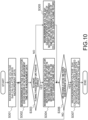
- FIG. 10 is an outline flowchart illustrating processes of calculating the maximum/minimum voltage SoH. This processing flow represents details of S103 illustrated in FIG. 8 .
- the maximum/minimum voltage SoH calculator is a main unit handling the present processing flow.
- the maximum/minimum voltage SoH calculator reads the measurement data (S301). In the measurement data, values of measurement items exemplified by the voltage and the current at the respective measuring time points are herein given in rows (records). The maximum/minimum voltage SoH calculator checks the record at the next measuring time point (S302). The record at the first measuring time point is checked in a first process of S302.
- the processing loops back to the process in S302, and the record at the next measuring time point is checked.
- the process in S304 or S305 is thus executed for all of the records in the measurement data.
- the maximum/minimum voltage SoH calculator calculates the SoH on the basis of the modified measurement data, and sets the calculated SoH as the maximum/minimum voltage SoH (S307).
- the voltage of the battery unit is replaced by the maximum voltage or the minimum voltage of the cells or the battery subunits, corresponding to the charge/discharge of the battery unit, thereby calculating the maximum/minimum voltage SoH.
- FIGS. 8 to 11 are one example, in which the flowcharts are not limited to those given above. Sequences or the equivalents of the processes are not limited, but a part of the processes may be omitted.
- the external apparatus detects the deteriorating acceleration, in which case it may be sufficient that the input-and-output circuit 15 outputs the SoH ratio or the equivalent.
- the processes in S102 and S103 may be executed in parallel. When not accepting the signal for stopping the output, the processing may again loop back to the process in S101 without stopping the output.
- the SoH and the SoH ratio are used in the processing flow of FIG. 9 , and however, the alert against the maximum/minimum voltage SoH may be outputted after checking the maximum/minimum voltage SoH.
- the use of the SoH ratio enables the battery unit progressing in its deterioration farther than other battery units to be detected from the plurality of battery units included in the rechargeable battery 2. It is thereby feasible to detect the battery unit having a high risk of the failure earlier than by the conventional methods even when exhibiting a small bias in the deteriorations of the plurality of battery units. There is no necessity for comparing the SoH ratio with those of other battery units, and therefore a dispersion of initial performance due to Lot of the battery units does not need being taken into consideration.
- At least a part of the embodiment described above may be attained by dedicated electronic circuits (i.e., hardware) exemplified by ICs (Integrated Circuits) on which processors, memories and the equivalents are mounted. At least a part of the embodiment described above may also be attained by running software (programs). For instance, a general-purpose computer apparatus is employed as basic hardware, and a processor exemplified by a CPU mounted on the computer apparatus runs the program, thereby enabling the processes in the embodiment to be attained.
- the information processing apparatus 1 may be configured by, e.g., one or a plurality of computers.
- the computer reads the dedicated software stored in a non-transitory computer readable storage medium, thereby enabling the computer to be used as the apparatus according to the embodiment. Categories of the storage mediums are not particularly limited.
- the dedicated software downloaded via a communication network is installed into the computer, thereby enabling the computer to be used as the apparatus according to the embodiment.
- the software-based information processing is thus tangibly implemented by use of the hardware resources.
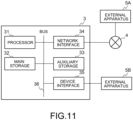
- FIG. 11 is a block diagram illustrating one example of a hardware configuration in one embodiment of the present invention.
- the information processing apparatus 1 includes a processor 31, a main storage 32, an auxiliary storage 33, a network interface 34, and a device interface 35, and may be attained as a computer apparatus 3 by interconnecting these components via a bus 36.
- the storage 11 may be attained by the main storage 32 or the auxiliary storage 33, and other components may be attained by the processor 31.
- FIG. 11 includes the respective components by ones and may include a plurality of same components.
- FIG. 11 illustrates one computer apparatus 3, and however, a plurality of computer apparatuses may respectively execute a different part of processes of software by installing the software into the plurality of computer apparatuses.
- the processor 31 is an electronic circuit including a controller and an arithmetic device of the computer.
- the processor 31 executes an arithmetic process based on the program and the data inputted from the respective devices of the internal configuration of the computer apparatus 3, and outputs an arithmetic result and a control signal to the respective devices.
- the processor 31 executes OS (Operating System) and applications of the computer apparatus 3, thus controlling the respective devices configuring the computer apparatus 3.
- the processor 31 is not particularly limited on condition that the processor 31 is capable of executing the processes described above.
- the main storage 32 is a storage that stores instructions and various items of data to be executed by the processor 31, and the processor 31 directly reads the information stored in the main storage 32.
- the auxiliary storage 33 is a storage other than the main storage 32. Note that these storage devices are what means arbitrary electronic components capable of storing the electronic information, and may be memories and storages. The memories are classified into volatile and nonvolatile memories, and both of the memories may be available.
- the network interface 34 is an interface for establishing wireless or wired connections to the communication network 4. Interfaces conforming with the existing telecommunications standard may be usable as the network interface 34. Through the network interface 34, the information may be received from and transmitted to an external apparatus 5A being communication-connected via the communication network 4.
- the device interface 35 is an interface exemplified by a USB that directly connects to an external apparatus 5B.
- the external apparatus 5B may be an external storage medium and may also be a storage device exemplified by a database.
- Each of the external apparatuses 5A and 5B may be a simulator 107, may also be an output apparatus and may further be an input apparatus.
- the output apparatus may be, e.g., a display apparatus for displaying the images and may also be an apparatus for outputting the sounds/voices.
- the input and output apparatuses are exemplified by LCD (Liquid Crystal Display), CRT (Cathode Ray Tube), PDP (Plasma Display Panel) and a loudspeaker but are not limited to these apparatuses.
- the input apparatus includes devices exemplified by a keyboard, a mouse and a touch panel, and gives pieces of information inputted by these devices to the computer apparatus 3. Signals coming from the input apparatus are outputted to the processor 31.
Landscapes
- Physics & Mathematics (AREA)
- General Physics & Mathematics (AREA)
- Engineering & Computer Science (AREA)
- Power Engineering (AREA)
- Secondary Cells (AREA)
- Tests Of Electric Status Of Batteries (AREA)
- Charge And Discharge Circuits For Batteries Or The Like (AREA)
- Health & Medical Sciences (AREA)
- General Health & Medical Sciences (AREA)
- Medical Informatics (AREA)
Applications Claiming Priority (1)
| Application Number | Priority Date | Filing Date | Title |
|---|---|---|---|
| PCT/JP2020/033695 WO2022049745A1 (ja) | 2020-09-04 | 2020-09-04 | 情報処理装置、情報処理方法、情報処理システム、およびプログラム |
Publications (2)
| Publication Number | Publication Date |
|---|---|
| EP4209794A1 true EP4209794A1 (de) | 2023-07-12 |
| EP4209794A4 EP4209794A4 (de) | 2024-06-19 |
Family
ID=80490740
Family Applications (1)
| Application Number | Title | Priority Date | Filing Date |
|---|---|---|---|
| EP20950482.8A Pending EP4209794A4 (de) | 2020-09-04 | 2020-09-04 | Informationsverarbeitungsvorrichtung, informationsverarbeitungsverfahren, informationsverarbeitungssystem und programm |
Country Status (4)
| Country | Link |
|---|---|
| US (1) | US20220260646A1 (de) |
| EP (1) | EP4209794A4 (de) |
| JP (1) | JP7193678B2 (de) |
| WO (1) | WO2022049745A1 (de) |
Families Citing this family (4)
| Publication number | Priority date | Publication date | Assignee | Title |
|---|---|---|---|---|
| US12500436B2 (en) * | 2021-10-20 | 2025-12-16 | China Energy Investment Corporation Limited | Controller, system, and method for managing discharge or charge of heterogeneous battery packs |
| JP7765369B2 (ja) | 2022-09-16 | 2025-11-06 | 株式会社東芝 | 情報処理装置、情報処理方法、コンピュータプログラム及び情報処理システム |
| JPWO2024189850A1 (de) * | 2023-03-15 | 2024-09-19 | ||
| AU2024434583A1 (en) | 2024-03-18 | 2026-03-12 | Kabushiki Kaisha Toshiba | Information processing device, information processing method, computer program, and information processing system |
Family Cites Families (17)
| Publication number | Priority date | Publication date | Assignee | Title |
|---|---|---|---|---|
| JPS54119446A (en) * | 1978-03-10 | 1979-09-17 | Mitsubishi Chem Ind Ltd | Preparation of estrone |
| JPH0745308A (ja) * | 1993-07-28 | 1995-02-14 | Shin Kobe Electric Mach Co Ltd | 密閉形蓄電池の劣化状態推定方法 |
| JP5386443B2 (ja) | 2010-06-30 | 2014-01-15 | 株式会社日立製作所 | 電源装置,鉄道車両 |
| FR2975238B1 (fr) * | 2011-05-09 | 2016-06-10 | Commissariat Energie Atomique | Procede de gestion et diagnostic d'une batterie |
| US20130158912A1 (en) * | 2011-12-15 | 2013-06-20 | Chung-Shan Institute of Science and Technology, Armaments, Bureau, Ministry of National Defence | Apparatus for Measuring the State of Health of a Cell Pack |
| US9411019B2 (en) * | 2013-12-16 | 2016-08-09 | Automotive Research & Testing Center | Method and system for estimating state of health of battery set |
| US10459034B2 (en) * | 2014-12-26 | 2019-10-29 | Samsung Electronics Co., Ltd. | Method and apparatus for estimating state of health (SOH) of battery |
| KR102534623B1 (ko) | 2015-06-01 | 2023-05-22 | 한국전자통신연구원 | 에너지 저장 장치의 건강 상태에 기반한 건물 에너지 관리 장치 및 방법 |
| CN106796267B (zh) | 2015-07-31 | 2020-06-23 | 株式会社东芝 | 蓄电池评价装置、蓄电系统及蓄电池评价方法 |
| CN107179505B (zh) * | 2016-03-09 | 2020-07-07 | 华为技术有限公司 | 电池健康状态检测装置及方法 |
| KR101776507B1 (ko) | 2016-06-09 | 2017-09-08 | 현대자동차주식회사 | 배터리 충전 방법 및 시스템 |
| KR101866073B1 (ko) | 2016-10-19 | 2018-06-08 | 현대자동차주식회사 | 배터리 soh 추정 방법 |
| KR102695516B1 (ko) * | 2016-11-18 | 2024-08-14 | 삼성전자주식회사 | 배터리 충전 방법, 배터리 충전 정보 생성 방법 및 배터리 충전 장치 |
| US10312699B2 (en) * | 2017-07-31 | 2019-06-04 | Robert Bosch Gmbh | Method and system for estimating battery open cell voltage, state of charge, and state of health during operation of the battery |
| JP7265364B2 (ja) | 2019-01-22 | 2023-04-26 | 株式会社東芝 | 情報処理装置、情報処理方法及び情報処理システム |
| KR102594315B1 (ko) * | 2019-03-05 | 2023-10-27 | 현대자동차주식회사 | 차량 및 그 제어 방법 |
| KR102752376B1 (ko) * | 2019-08-01 | 2025-01-10 | 현대자동차주식회사 | 친환경 차량 및 그 충전 제어 방법 |
-
2020
- 2020-09-04 EP EP20950482.8A patent/EP4209794A4/de active Pending
- 2020-09-04 JP JP2022513409A patent/JP7193678B2/ja active Active
- 2020-09-04 WO PCT/JP2020/033695 patent/WO2022049745A1/ja not_active Ceased
-
2022
- 2022-03-14 US US17/693,865 patent/US20220260646A1/en active Pending
Also Published As
| Publication number | Publication date |
|---|---|
| WO2022049745A1 (ja) | 2022-03-10 |
| US20220260646A1 (en) | 2022-08-18 |
| EP4209794A4 (de) | 2024-06-19 |
| JP7193678B2 (ja) | 2022-12-20 |
| JPWO2022049745A1 (de) | 2022-03-10 |
Similar Documents
| Publication | Publication Date | Title |
|---|---|---|
| US20220260646A1 (en) | Information processing apparatus, information processing method, information processing system, and non-transitory computer readable medium | |
| US10989762B2 (en) | Apparatus and method for detecting battery state of health | |
| US11300625B2 (en) | Evaluation device, evaluation method and evaluation system for energy storage device | |
| EP3719515A1 (de) | Bewertungsvorrichtung, stromspeichersystem, bewertungsverfahren und computerprogramm | |
| US20190120908A1 (en) | Apparatus and methods for identifying anomaly(ies) in re-chargeable battery of equipment and connected component(s) | |
| EP3559689B1 (de) | Verfahren und elektronische einrichtung zur erkennung eines inneren kurzschlusses in einer batterie | |
| WO2024113182A1 (zh) | 电池风险等级确定方法、装置、存储介质及电池管理系统 | |
| US20190242950A1 (en) | Information processing apparatus, control method, and program | |
| CN114148216A (zh) | 电池自放电率异常检测方法、系统、设备及存储介质 | |
| US9235463B2 (en) | Device and method for fault management of smart device | |
| US11733304B2 (en) | Determination apparatus | |
| JP6532374B2 (ja) | 蓄電池状態分析システム、蓄電池状態分析方法および蓄電池状態分析プログラム | |
| CN116430110A (zh) | 一种电流同步采集方法、系统、终端设备及存储介质 | |
| EP3588395A1 (de) | Verwaltungsvorrichtung, verwaltungsverfahren und programm | |
| WO2022174698A1 (zh) | 新能源设备的健康状况测评方法、装置、介质及提示终端 | |
| EP4068466B1 (de) | Verarbeitungssystem, überwachungsvorrichtung, verarbeitungsverfahren, überwachungsverfahren und programm | |
| CN120670768B (zh) | 一种电网变量监控系统及方法 | |
| JP2026031394A (ja) | 電池整合性の早期警報方法、装置、機器及び媒体 | |
| US20240426929A1 (en) | Battery pack management system and battery pack management method | |
| EP4589317A1 (de) | Informationsverarbeitungsvorrichtung, informationsverarbeitungsverfahren, computerprogramm und informationsverarbeitungssystem | |
| EP4682560A1 (de) | Informationsverarbeitungsvorrichtung, informationsverarbeitungsverfahren, programm und informationsverarbeitungssystem | |
| CN115327391B (zh) | 一种基于梯次利用电池的检测方法及装置 | |
| CN118938047A (zh) | 电池组的故障诊断方法 | |
| EP4287451A1 (de) | Informationsverarbeitungsvorrichtung, informationsverarbeitungsverfahren, informationsverarbeitungssystem und computerprogramm | |
| CN116521568A (zh) | 测试数据分析处理方法、装置、电子设备及存储介质 |
Legal Events
| Date | Code | Title | Description |
|---|---|---|---|
| STAA | Information on the status of an ep patent application or granted ep patent |
Free format text: STATUS: UNKNOWN |
|
| STAA | Information on the status of an ep patent application or granted ep patent |
Free format text: STATUS: THE INTERNATIONAL PUBLICATION HAS BEEN MADE |
|
| PUAI | Public reference made under article 153(3) epc to a published international application that has entered the european phase |
Free format text: ORIGINAL CODE: 0009012 |
|
| STAA | Information on the status of an ep patent application or granted ep patent |
Free format text: STATUS: REQUEST FOR EXAMINATION WAS MADE |
|
| 17P | Request for examination filed |
Effective date: 20220228 |
|
| AK | Designated contracting states |
Kind code of ref document: A1 Designated state(s): AL AT BE BG CH CY CZ DE DK EE ES FI FR GB GR HR HU IE IS IT LI LT LU LV MC MK MT NL NO PL PT RO RS SE SI SK SM TR |
|
| DAV | Request for validation of the european patent (deleted) | ||
| DAX | Request for extension of the european patent (deleted) | ||
| A4 | Supplementary search report drawn up and despatched |
Effective date: 20240521 |
|
| RIC1 | Information provided on ipc code assigned before grant |
Ipc: H02J 7/00 20060101ALI20240514BHEP Ipc: G01R 31/3835 20190101ALI20240514BHEP Ipc: G01R 31/396 20190101ALI20240514BHEP Ipc: G01R 31/392 20190101AFI20240514BHEP |