EP4209902A1 - Procédé d'attribution de mémoire, dispositif associé, et support de stockage lisible par ordinateur - Google Patents
Procédé d'attribution de mémoire, dispositif associé, et support de stockage lisible par ordinateur Download PDFInfo
- Publication number
- EP4209902A1 EP4209902A1 EP21874324.3A EP21874324A EP4209902A1 EP 4209902 A1 EP4209902 A1 EP 4209902A1 EP 21874324 A EP21874324 A EP 21874324A EP 4209902 A1 EP4209902 A1 EP 4209902A1
- Authority
- EP
- European Patent Office
- Prior art keywords
- tensor data
- memory space
- pieces
- node
- piece
- Prior art date
- Legal status (The legal status is an assumption and is not a legal conclusion. Google has not performed a legal analysis and makes no representation as to the accuracy of the status listed.)
- Pending
Links
Images





Classifications
-
- G—PHYSICS
- G06—COMPUTING OR CALCULATING; COUNTING
- G06F—ELECTRIC DIGITAL DATA PROCESSING
- G06F9/00—Arrangements for program control, e.g. control units
- G06F9/06—Arrangements for program control, e.g. control units using stored programs, i.e. using an internal store of processing equipment to receive or retain programs
- G06F9/46—Multiprogramming arrangements
- G06F9/50—Allocation of resources, e.g. of the central processing unit [CPU]
- G06F9/5005—Allocation of resources, e.g. of the central processing unit [CPU] to service a request
- G06F9/5011—Allocation of resources, e.g. of the central processing unit [CPU] to service a request the resources being hardware resources other than CPUs, Servers and Terminals
- G06F9/5016—Allocation of resources, e.g. of the central processing unit [CPU] to service a request the resources being hardware resources other than CPUs, Servers and Terminals the resource being the memory
-
- G—PHYSICS
- G06—COMPUTING OR CALCULATING; COUNTING
- G06F—ELECTRIC DIGITAL DATA PROCESSING
- G06F9/00—Arrangements for program control, e.g. control units
- G06F9/06—Arrangements for program control, e.g. control units using stored programs, i.e. using an internal store of processing equipment to receive or retain programs
- G06F9/46—Multiprogramming arrangements
- G06F9/50—Allocation of resources, e.g. of the central processing unit [CPU]
- G06F9/5005—Allocation of resources, e.g. of the central processing unit [CPU] to service a request
- G06F9/5027—Allocation of resources, e.g. of the central processing unit [CPU] to service a request the resource being a machine, e.g. CPUs, Servers, Terminals
- G06F9/5033—Allocation of resources, e.g. of the central processing unit [CPU] to service a request the resource being a machine, e.g. CPUs, Servers, Terminals considering data affinity
-
- G—PHYSICS
- G06—COMPUTING OR CALCULATING; COUNTING
- G06N—COMPUTING ARRANGEMENTS BASED ON SPECIFIC COMPUTATIONAL MODELS
- G06N3/00—Computing arrangements based on biological models
- G06N3/02—Neural networks
- G06N3/04—Architecture, e.g. interconnection topology
-
- G—PHYSICS
- G06—COMPUTING OR CALCULATING; COUNTING
- G06N—COMPUTING ARRANGEMENTS BASED ON SPECIFIC COMPUTATIONAL MODELS
- G06N3/00—Computing arrangements based on biological models
- G06N3/02—Neural networks
- G06N3/04—Architecture, e.g. interconnection topology
- G06N3/045—Combinations of networks
-
- G—PHYSICS
- G06—COMPUTING OR CALCULATING; COUNTING
- G06N—COMPUTING ARRANGEMENTS BASED ON SPECIFIC COMPUTATIONAL MODELS
- G06N3/00—Computing arrangements based on biological models
- G06N3/02—Neural networks
- G06N3/04—Architecture, e.g. interconnection topology
- G06N3/0464—Convolutional networks [CNN, ConvNet]
-
- G—PHYSICS
- G06—COMPUTING OR CALCULATING; COUNTING
- G06N—COMPUTING ARRANGEMENTS BASED ON SPECIFIC COMPUTATIONAL MODELS
- G06N3/00—Computing arrangements based on biological models
- G06N3/02—Neural networks
- G06N3/06—Physical realisation, i.e. hardware implementation of neural networks, neurons or parts of neurons
- G06N3/063—Physical realisation, i.e. hardware implementation of neural networks, neurons or parts of neurons using electronic means
-
- G—PHYSICS
- G06—COMPUTING OR CALCULATING; COUNTING
- G06F—ELECTRIC DIGITAL DATA PROCESSING
- G06F2209/00—Indexing scheme relating to G06F9/00
- G06F2209/50—Indexing scheme relating to G06F9/50
- G06F2209/509—Offload
Definitions
- This application relates to the field of artificial intelligence technologies, and in particular, to a memory allocation method, a related device, and a computer-readable storage medium.
- An entire neural network is run, and then memory is allocated to the entire neural network based on a sequence of running of the entire neural network. For example, in a running process, the neural network needs to sequentially occupy 100 M memory space, 10 M memory space, and 50 M memory space.
- 100 M memory space may be allocated to the neural network.
- 10 M memory space it is determined whether the allocated 10 M memory space can be reused; and if the allocated 10 M memory space can be reused, no new memory space is allocated to the applied 10 M memory space, and the foregoing 100 M memory space is reused.
- the neural network applies for 50 M memory space, it is first determined whether allocated 100 M memory space can be reused for the 50 M memory space; and if the allocated 100 M memory space can be reused, no new memory space is allocated to the applied 50 M memory space.
- This application provides a memory allocation method, a related device, and a computer-readable storage medium, to avoid improper memory allocation.
- the improper memory allocation may be reflected in that memory occupied by an entire neural network is large.
- a memory allocation method may include the following steps: first obtaining a computation graph corresponding to a neural network, where the computation graph includes N nodes and a directed edge that connects different nodes, the node is used to indicate computation logic in the neural network, and the directed edge is used to indicate a direction of tensor data in the computation logic; and a directed edge of the computation graph carries tensor data, the computation graph includes M pieces of tensor data, and M is an integer greater than 1; and then sequentially allocating memory space to the M pieces of tensor data based on a sorting result of the M pieces of tensor data, where if at least a part of the allocated memory space can be reused for one of the M pieces of tensor data, the at least the part of the memory space that can be reused for the tensor data is allocated to the tensor data, where the allocated memory space is memory space that has been allocated to the M pieces of tensor data before the
- the M pieces of tensor data are used as a whole, and the memory space that has been allocated to the whole is described. Some tensor data in the whole may not be allocated to the memory space.
- a node to which tensor data flows is the consumption node
- a node from which tensor data flows is the production node
- one piece of tensor data may be carried on different directed edges, or one piece of tensor data may be carried on one directed edge.
- the method may further include the following step: if the allocated memory space cannot be reused for the tensor data, allocating other memory space to the tensor data, where the other memory space is different from the allocated memory space.
- the constraint relationship indicates at least one of the following relationships: a relationship between available memory space of one piece of tensor data and available memory space of another piece of tensor data is reusable, a relationship between available memory space of one piece of tensor data and available memory space of another piece of tensor data is non-reusable, and a relationship between available memory space of one piece of tensor data and available memory space of another piece of tensor data is non-reusable and continuous.
- the constraint relationship has different priorities. To be specific, when a relationship between available memory space of two tensors is non-reusable and continuous, the relationship is also definitely non-reusable. In this case, the relationship between the available memory space of the two tensors is indicated as non-reusable and continuous in the constraint relationship. That is, it may be understood that a non-reusable and continuous priority is higher than a non-reusable priority.
- the constraint relationship is carried in a constraint relationship table, the constraint relationship table includes identifiers of the M data tensors, and in the constraint relationship table, a first value is used to indicate that the relationship between the available memory space of the one piece of tensor data and the available memory space of the another piece of tensor data is reusable, a second value is used to indicate that the relationship between the available memory space of the one piece of tensor data and the available memory space of the another piece of tensor data is non-reusable, and a third value is used to indicate that the relationship between the available memory space of the one piece of tensor data and the available memory space of the another piece of tensor data is non-reusable and continuous.
- the first value, the second value, and the third value may be values that can be distinguished from each other.
- the first value may be "0”
- the second value may be "1”
- the third value may be "2”.
- the relationship in the constraint relationship table is marked only as “2” instead of "1" and "2”.
- memory space of a corresponding size is sequentially allocated to the tensor data based on the sorting result, a phenomenon of improper memory can be avoided.
- memory space allocated to the second tensor data can be reused for the first tensor data; or when all the consumption nodes of the first tensor data are not the upstream nodes of the production node of the second tensor data, or when all the consumption nodes of the second tensor data are not the downstream nodes of the production node of the first tensor data, the memory space allocated to the second tensor data cannot be reused for the first tensor data, where the first tensor data and the second tensor data are any two of the M pieces of tensor data, the consumption node is a node to which tensor data flows, and the production node is a node from which tensor data
- a node A is an upstream node of a node B means that in the computation graph, the node A and the node B may be connected through one or more directed edges, that is, the node A and the node B may be connected through a directed edge from the node A to the node B, or may be connected through a plurality of directed edges and nodes included in these directed edges.
- the constraint relationship corresponding to each piece of tensor data may be determined, to provide a basis for subsequently obtaining the sorting result of the M pieces of tensor data.
- the computation graph includes a plurality of computing subtasks
- the computing subtask indicates a computing function by using a group of nodes and an edge related to the group of nodes, and an execution relationship between the plurality of computing subtasks is parallel.
- the method may further include the following steps: in one computing subtask, if there is no directed edge between two adjacent nodes, adding a directed edge between the two adjacent nodes, to update the computing graph, where each added directed edge carries corresponding tensor data, and the two adjacent nodes are two nodes that are adjacent in an execution sequence in the computing subtask; and herein, the execution sequence is a sequence having a time sequence relationship; and obtaining the information about each piece of tensor data based on the updated computation graph.
- the computation graph further includes a first computing subtask and a second computing subtask that are in a serial execution relationship, and the first computing subtask is before the second computing subtask in an execution sequence.
- An implementation process of updating the computation graph may further include the following step: if there is no directed edge between a last node in the first computing subtask and a first node in the second computing subtask, adding a directed edge between the last node in the first computing subtask and the first node in the second computing subtask.
- the execution relationship between the computing subtasks includes serial and parallel
- the computation graph may be updated in this implementation, to provide a basis for subsequently analyzing an ancestor relationship of each node based on the computation graph and determining a constraint relationship corresponding to each node.
- an execution relationship between a computing subtask 1 and a computing subtask is serial means that a processor executes the computing subtask 2 only after completing execution of the computing subtask.
- an execution relationship between a computing subtask 1 and a computing subtask 2 is serial, and an execution relationship between the computing subtask 2 and a computing subtask 3 is parallel means that the computing subtask 1 and the computing subtask 2 may be considered as a whole, the computing subtask 1 and the computing subtask 2 are run by using a processor core 1, and the computing subtask 3 is run by using a processor core 2. Time periods required by the processor core 1 and the processor core 2 to execute the foregoing computing subtasks overlap at a same time reference.
- an identifier of a production node of tensor data is less than an identifier of a consumption node of the tensor data, and the production node of the tensor data and the consumption node of the tensor data are two adjacent nodes.
- an identifier corresponding to each node may be determined, to provide a basis for subsequently analyzing an ancestor relationship of each node based on the identifier corresponding to each node and determining a constraint relationship corresponding to each node.
- an identifier of each node in the computation graph is used to determine the information about each of the M pieces of tensor data.
- the information about each piece of tensor data indicates a constraint relationship corresponding to each piece of tensor data.
- An ancestor relationship of each node may be analyzed based on an identifier of each node (which nodes are production nodes and which nodes are consumption nodes may be reflected in the ancestor relationship), and then the constraint relationship corresponding to each piece of tensor data is obtained based on the ancestor relationship.
- the information about each piece of tensor data indicates the constraint relationship corresponding to each piece of tensor data.
- the method may further include the following steps: obtaining, based on the constraint relationship corresponding to each piece of tensor data, constraint quantities respectively corresponding to the M pieces of tensor data, where the constraint quantity is an amount of tensor data that is in other tensor data and for which same memory space cannot be reused with the tensor data; and sorting the M pieces of tensor data based on the constraint quantities respectively corresponding to the M pieces of tensor data, to obtain the sorting result of the M pieces of tensor data.
- the information about each piece of tensor data indicates a quantity of nodes to which each piece of tensor data flows.
- the method further includes: sorting the M pieces of tensor data based on quantities of consumption nodes that respectively correspond to the M pieces of tensor data, to obtain the sorting result of the M pieces of tensor data.
- the M pieces of tensor data may be further sorted in descending order based on at least two of the information about each piece of tensor data, to obtain the sorting result of the M pieces of tensor data.
- the M pieces of tensor data are sorted in descending order based on the constraint quantities respectively corresponding to the M pieces of tensor data and a size of memory space corresponding to each piece of tensor data, to obtain the sorting result of the M pieces of tensor data.
- the M pieces of tensor data are sorted in descending order based on the constraint quantities respectively corresponding to the M pieces of tensor data and the quantities of consumption nodes that respectively correspond to all the pieces of tensor data, to obtain the sorting result of the M pieces of tensor data.
- the method may further include the following step: sorting the M pieces of tensor data based on the information about each piece of tensor data by using a heuristic algorithm, to obtain the sorting result of the M pieces of tensor data within a preset time period.
- the sorting result is a sorting result obtained after optimization, and a size of maximum memory that needs to be occupied by the neural network and that corresponds to the sorting result obtained after optimization is less than a size of maximum memory that needs to be occupied by the neural network and that is determined based on a sorting result existing before optimization.
- memory space can be saved because the size of the maximum memory that needs to be occupied by the neural network and that is determined based on the sorting result obtained after optimization is less than the size of the maximum memory that needs to be occupied by the neural network and that is determined based on the sorting result.
- an embodiment of this application further provides a memory allocation method.
- the method may include the following steps: first obtaining a computation graph corresponding to a neural network, where the computation graph includes N nodes and a directed edge that connects different nodes, the node is used to indicate computation logic in the neural network, and the directed edge is used to indicate a direction of tensor data in the computation logic; and a directed edge of the computation graph carries tensor data, the computation graph includes M pieces of tensor data, and M is an integer greater than 1; and then sequentially allocating memory space to the M pieces of tensor data based on a constraint relationship corresponding to each piece of tensor data and an execution sequence of the M pieces of tensor data in the neural network, where if at least a part of the allocated memory space can be reused for one of the M pieces of tensor data, the at least the part of the memory space that can be reused for the tensor data is allocated to the tensor data,
- a terminal device may sequentially allocate the memory space to the M pieces of tensor data based on the constraint relationship corresponding to each piece of tensor data and the execution sequence of the M pieces of tensor data. This can avoid a case in which in a parallel scenario, an operator operation result is incorrect because operators reuse same memory space in different execution flows, and can ensure accuracy of a calculation result of the neural network.
- the method may further include the following step: if the allocated memory space cannot be reused for the tensor data, allocating other memory space to the tensor data, where the other memory space is different from the allocated memory space.
- the method provided in this application can resolve a problem of improper memory allocation, for example, improper memory allocation may be reflected in that excessively large memory is allocated to the neural network, and in a parallel scenario, an operator operation result is incorrect because operators reuse same memory space in different execution flows, and can ensure accuracy of a calculation result of the neural network.
- an embodiment of this application provides a memory allocation apparatus.
- the apparatus may include: a computation graph obtaining unit, configured to obtain a computation graph corresponding to a neural network, where the computation graph includes N nodes and a directed edge that connects different nodes, a directed edge of the computation graph carries tensor data, the computation graph includes M pieces of tensor data, and M is an integer greater than 1; and an allocation unit, configured to sequentially allocate memory space to the M pieces of tensor data based on a sorting result of the M pieces of tensor data, where if at least a part of the allocated memory space can be reused for one of the M pieces of tensor data, the at least the part of the memory space that can be reused for the tensor data is allocated to the tensor data, where the allocated memory space is memory space that has been allocated to the M pieces of tensor data before the tensor data, the sorting result indicates a sequence of allocating memory space to the M pieces of
- the allocation unit is further configured to: if the allocated memory space cannot be reused for the tensor data, allocate other memory space to the tensor data, where the other memory space is different from the allocated memory space.
- the constraint relationship indicates at least one of the following relationships: a relationship between available memory space of one piece of tensor data and available memory space of another piece of tensor data is reusable, a relationship between available memory space of one piece of tensor data and available memory space of another piece of tensor data is non-reusable, and a relationship between available memory space of one piece of tensor data and available memory space of another piece of tensor data is non-reusable and continuous.
- the constraint relationship is carried in a constraint relationship table, the constraint relationship table includes identifiers of the M data tensors, and in the constraint relationship table, a first value is used to indicate that the relationship between the available memory space of the one piece of tensor data and the available memory space of the another piece of tensor data is reusable, a second value is used to indicate that the relationship between the available memory space of the one piece of tensor data and the available memory space of the another piece of tensor data is non-reusable, and a third value is used to indicate that the relationship between the available memory space of the one piece of tensor data and the available memory space of the another piece of tensor data is non-reusable and continuous.
- memory space allocated to the second tensor data can be reused for the first tensor data; or when all the consumption nodes of the first tensor data are not the upstream nodes of the production node of the second tensor data, or when all the consumption nodes of the second tensor data are not the downstream nodes of the production node of the first tensor data, the memory space allocated to the second tensor data cannot be reused for the first tensor data, where the first tensor data and the second tensor data are any two of the M pieces of tensor data, the consumption node is a node to which tensor data flows, and the production node is a node from which tensor data
- the computation graph includes a plurality of computing subtasks
- the computing subtask indicates a computing function by using a group of nodes and an edge related to the group of nodes, and an execution relationship between the plurality of computing subtasks is parallel.
- the apparatus further includes: a computation graph updating unit, configured to: in one computing subtask, if there is no directed edge between two adjacent nodes, add a directed edge between the two adjacent nodes, to update the computing graph, where each added directed edge carries corresponding tensor data, and the two adjacent nodes are two nodes that are adjacent in an execution sequence in the computing subtask; and an information obtaining unit, configured to obtain information about each piece of tensor data based on the updated computed graph.
- the computation graph further includes a first computing subtask and a second computing subtask that are in a serial execution relationship, and the first computing subtask is before the second computing subtask in an execution sequence.
- the computation graph updating unit is further configured to: if there is no directed edge between a last node in the first computing subtask and a first node in the second computing subtask, add a directed edge between the last node in the first computing subtask and the first node in the second computing subtask.
- an identifier of a production node of tensor data is less than an identifier of a consumption node of the tensor data, and the production node of the tensor data and the consumption node of the tensor data are two adjacent nodes.
- an identifier of each node in the computation graph is used to determine the information about each of the M pieces of tensor data.
- the information about each piece of tensor data indicates the constraint relationship corresponding to each piece of tensor data.
- the apparatus further includes a first sorting unit, configured to: obtain, based on the constraint relationship corresponding to each piece of tensor data, constraint quantities respectively corresponding to the M pieces of tensor data, where the constraint quantity is an amount of tensor data that is in other tensor data and for which same memory space cannot be reused with the tensor data; and sort the M pieces of tensor data based on the constraint quantities respectively corresponding to the M pieces of tensor data, to obtain the sorting result of the M pieces of tensor data.
- the information about each piece of tensor data indicates a quantity of nodes to which each piece of tensor data flows.
- the apparatus further includes a second sorting unit, configured to sort the M pieces of tensor data based on quantities of consumption nodes that respectively correspond to the M pieces of tensor data, to obtain the sorting result of the M pieces of tensor data.
- the apparatus further includes: a third sorting unit, configured to sort the M pieces of tensor data based on the information about each piece of tensor data by using a heuristic algorithm, to obtain the sorting result of the M pieces of tensor data within a preset time period.
- a third sorting unit configured to sort the M pieces of tensor data based on the information about each piece of tensor data by using a heuristic algorithm, to obtain the sorting result of the M pieces of tensor data within a preset time period.
- the sorting result is a sorting result obtained after optimization, and a size of maximum memory that needs to be occupied by the neural network and that corresponds to the sorting result obtained after optimization is less than a size of maximum memory that needs to be occupied by the neural network and that is determined based on a sorting result existing before optimization.
- an embodiment of this application further provides a memory allocation apparatus.
- the apparatus may include: a computation graph obtaining unit, configured to obtain a computation graph corresponding to a neural network, where the computation graph includes N nodes and a directed edge that connects different nodes, a directed edge of the computation graph carries tensor data, the computation graph includes M pieces of tensor data, and M is an integer greater than 1; and an allocation unit, configured to sequentially allocate memory space to the M pieces of tensor data based on a constraint relationship corresponding to each piece of tensor data and an execution sequence of the M pieces of tensor data in the neural network, where if at least a part of the allocated memory space can be reused for one of the M pieces of tensor data, the at least the part of the memory space that can be reused for the tensor data is allocated to the tensor data, where the allocated memory space is memory space that has been allocated to the M pieces of tensor data before the tensor
- the allocation unit is further configured to: if the allocated memory space cannot be reused for the tensor data, allocate other memory space to the tensor data, where the other memory space is different from the allocated memory space.
- an embodiment of this application further provides a memory allocation device.
- the memory allocation device may include a memory and a processor.
- the memory is configured to store a computer program that supports the memory allocation device in performing the foregoing method, the computer program includes program instructions, and the processor is configured to invoke the program instructions to perform the memory allocation method according to any implementation of the first aspect or any implementation of the second aspect.
- an embodiment of this application further provides a computer readable storage medium.
- the computer storage medium stores a computer program, the computer program includes program instructions, and when the program instructions are executed by a processor, the processor is enabled to perform the memory allocation method according to any implementation of the first aspect or any implementation of the second aspect.
- an embodiment of this application further provides a computer program.
- the computer program includes computer software instructions, and when the computer software instructions are executed by a computer, the computer is enabled to perform the memory allocation method according to any implementation of the first aspect or any implementation of the second aspect
- the terms “first”, “second”, and the like are intended to distinguish between different objects or distinguish between different processing of a same object, but do not indicate a particular order of the objects.
- the terms “including”, “having”, or any other variant thereof in descriptions of this application are intended to cover a non-exclusive inclusion.
- a process, a method, a system, a product, or a device that includes a series of steps or units is not limited to the listed steps or units, but optionally further includes other unlisted steps or units, or optionally further includes other inherent steps or units of the process, the method, the product, or the device.
- the neural network may include a neuron.
- activation function activation function
- the output signal of the activation function may be used as an input of a next convolution layer.
- the activation function may be a sigmoid function.
- the neural network is a network formed by connecting many single neurons together. To be specific, an output of a neuron may be an input of another neuron. An input of each neuron may be connected to a local receptive field of a previous layer to extract a feature of the local receptive field.
- the local receptive field may be a region including several neurons.
- the deep neural network (deep neural network, DNN) is also referred to as a multi-layer neural network, and may be understood as a neural network having a plurality of hidden layers. There is no special metric for "a plurality of" herein.
- the DNN is divided based on locations of different layers, and a neural network in the DNN may be divided into three types: an input layer, a hidden layer, and an output layer. Generally, a first layer is the input layer, a last layer is the output layer, and a middle layer is the hidden layer.
- the layers may be fully connected or may not be fully connected. When the layers are fully connected, any neuron at an i th layer is definitely connected to any neuron at an (i+1) th layer.
- a linear coefficient from a fourth neuron at a second layer to a second neuron at a third layer is defined as w 24 3 .
- the superscript 3 represents a layer at which the coefficient W is located, and the subscript corresponds to an output third-layer index 2 and an input second-layer index 4.
- a coefficient from a k th neuron at an (L-1) th layer to a j th neuron at an L th layer is defined as w jk L .
- the input layer does not have the parameter w .
- more hidden layers make the network more capable of describing a complex case in the real world.
- a model with more parameters has higher complexity and a larger "capacity”. It indicates that the model can complete a more complex learning task.
- Training the deep neural network is a process of learning a weight matrix, and a final objective of the training is to obtain a weight matrix of all layers of the trained deep neural network (a weight matrix formed by vectors w at many layers).
- the computation graph is a manner of describing a computation process of a neural network by using a graph structure. If computation is significantly modular and there are temporal and logical dependency relationships between modules definitely, a directed graph structure may be usually used for description.
- the graph structure includes two basic elements, which are respectively a node and a directed edge.
- a neural network model may be abstracted as a directed graph structure including tensor data and operators.
- the node is also referred to as an operator
- the directed edge is an edge with a direction, describes a pointing direction between operators, and is used to represent a dependency relationship between the operators.
- the node is used as an example for description.
- a computation graph includes eight operators and nine pieces of tensor data.
- the eight operators are respectively an operator a, an operator b, an operator c, an operator d, an operator e, an operator f, an operator g, and an operator h
- the nine pieces of tensor data are respectively tensor data t0, tensor data t1, tensor data t2, tensor data t3, tensor data t4, tensor data t5, tensor data t6, tensor data t7, and tensor data t8.
- the operator a, the operator b, and the operator c are used as an example.
- a directed edge between the operator a and the operator b there is a directed edge between the operator a and the operator b, a pointing direction of the directed edge is that the operator a points to the operator b, and the directed edge indicates that the tensor data t0 generated by the operator a is an input of the operator b.
- a directed edge between the operator a and the operator c a pointing direction of the directed edge is that the operator a points to the operator c, and the directed edge indicates that the tensor data t0 generated by the operator a is an input of the operator b.
- a neural network model is described by using a computation graph, to help grasp computing tasks in an entire neural network as a whole.
- an expression manner of the computation graph is also convenient for scheduling and parallel execution of the computing tasks.
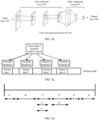
- operators in the computation graph may be allocated to a plurality of computing subtasks, and different computing subtasks may be parallel or serial. Operators in a same computing subtask run in serial. For example, as shown in FIG. 1b , an operator a and an operator c are allocated to a computing subtask 0, an operator b, an operator d, an operator e, and an operator f are allocated to a computing subtask 1, and an operator g and an operator h are allocated to a computing subtask 2.
- a computing task in a neural network may be split to obtain a plurality of computing subtasks, so that a plurality of computing subgraphs can be obtained, where one computing subgraph is one computing subtask.
- an execution sequence of operators in different computing subtasks depends on a direction of a directed edge between the operators.
- an execution sequence of the operators is: the operator a -> the operator c
- an execution sequence of the operators is: the operator b -> the operator d/the operator e -> the operator f
- an execution sequence of the operators is: the operator g -> the operator h.
- the operator c and the operator g are executed in parallel in the two computing subtasks.
- an execution sequence of the operator e and the operator g is not limited. Specifically, an execution sequence of operators in the computation graph may be shown in FIG. 1c . It should be noted that, in FIG. 1c , an execution sequence of an operator d and an operator e is not limited. Based on this, the execution sequence is represented as the operator d/the operator e.
- an execution sequence of operators in different computing subtasks depends on a direction of a directed edge between the operators.
- an execution sequence of the operators is: the operator a -> the operator c; in the computing subtask 1, an execution sequence of the operators is: the operator b -> the operator d/the operator e -> the operator f; and in the computing subtask 2, an execution sequence of the operators is: the operator g -> the operator h.
- the operator g in the computing subtask 2 is run only after running of the operator f in the computing subtask 1 ends.
- an execution sequence of operators in the computation graph may be shown in FIG. 1d .
- an operator A depends on an operator B, indicating that the operator A needs to wait until execution of a kernel function corresponding to the operator B is completed before the a computing task of the operator A starts.
- the tensor is merely feature description of stored data, and the tensor records information such as a shape and a type of the data.
- the tensor needs to be understood as tensor data, and may include input tensor data and output tensor data in a neural network model, or may include feature tensor data, or the like.
- An artificial intelligence deep learning framework TensorFlow is used as an example.
- a tensor dimension is usually described by using a rank (rank), a shape (shape), and a dimension number (dimension number).
- rank rank
- shape shape
- dimension number dimension number
- a relationship between the rank, the shape, and the dimension number may be shown in the following table.
- Rank Shape Dimension number Example 0 [] 0-D 4 1 [D1] 1-D [2] 2 [D1, D2] 2-D [6, 2] 3 [D1, D2, D3] 3-D [7, 3, 2] ... ... ... n [D1, D2, D3, ..., Dn] n-D
- the tensor A represents a two-dimensional matrix. Specifically, the matrix is a matrix with six rows and two columns.
- the allocated set is a set of allocated memory space information in a process of storing tensor data in a neural network.
- the allocated set may also be referred to as a shared memory queue. This is not specifically limited in this application.
- a first policy is referred to as an In-Place policy.
- the policy means that an input and an output of each node in the neural network share one piece of memory space.
- a second policy is referred to as a Co-share policy.
- the policy means that memory space can be used by a plurality of nodes in the neural network. When execution of all the nodes is completed, a lifecycle of the memory space ends. In this case, the memory space can be used by another node in the neural network. For example, a lifecycle of memory space A may be preset to (1, 2, 3), indicating that the memory space A can be used by a node 1, a node 2, and a node 3. When execution of the node 1, the node 2, and the node 3 is completed, the lifecycle of the memory space A ends. In this case, the memory space A may be placed in a free linked list for use by another node in the neural network.
- the neural network needs to sequentially occupy 100 M memory space, 10 M memory space, and 50 M memory space.
- 100 M memory space may be allocated to the neural network.
- 10 M memory space it is determined whether the allocated 10 M memory space can be reused; and if the allocated 10 M memory space can be reused, no new memory space is allocated to the applied 10 M memory space, and the foregoing 100 M memory space is reused.
- the neural network applies for 50 M memory space, it is first determined whether allocated 100 M memory space can be reused for the 50 M memory space; and if the allocated 100 M memory space can be reused, no new memory space is allocated to the applied 50 M memory space.
- the allocated 100 M memory space can be reused for both the applied 10 M memory space and the applied 50 M memory space, the allocated 100 M memory space is reused for the applied 10 M memory space, and additional 50 M memory space is allocated to the neural network. Therefore, the entire neural network needs to occupy 150 M memory space. As a result, memory occupied by the entire neural network is large, and memory allocation is improper.
- a main principle of the method is: obtaining a sorting result of a plurality of pieces of tensor data in an entire neural network based on information about each piece of tensor data, where the information about each piece of tensor data may include at least one of a size of memory space that needs to be occupied by each piece of tensor data, a constraint relationship corresponding to each piece of tensor data, and a consumption operator, and each piece of tensor data includes a corresponding identifier; and then sequentially allocating memory space to the tensor data based on the sorting result.
- improper memory planning space in the conventional technology can be avoided, so that memory that needs to be occupied in the entire neural network can be saved, and memory allocation of the neural network is optimized.
- the method can further resolve a problem that in a parallel scenario, an operator operation result is incorrect because operators reuse same memory space in different computing subtasks.
- an entire neural network includes eight nodes, and indexes are respectively a to h in a running sequence. It can be learned through pre-analysis that when the neural network shown in FIG. 1a runs, five pieces of memory space need to be occupied successively in an execution sequence ⁇ a, b, c, d, e, f, g, h ⁇ of operators, which are respectively first memory space, second memory space, third memory space, fourth memory space, and fifth memory space, and each piece of memory space is used for tensor data.
- FIG. 2b an implementation process of pre-allocating memory to the tensor data may be shown in FIG. 2b .
- the first memory space is allocated to tensor data t0, and the second memory space is allocated to tensor data t1.
- the third memory space is allocated to tensor data t2, and the fourth memory space is allocated to tensor data t3.
- the fifth memory space is allocated to tensor data t4.
- the first memory space is released, and the first memory space can be reused for subsequent tensor data.
- the first memory space that can be reused is allocated to tensor data t5.
- the third memory space is released, and the third memory space can be reused for subsequent tensor data.
- the third memory space that can be reused is allocated to tensor data t6.
- the fourth memory space is released, and the fourth memory space can be reused for subsequent tensor data.
- the fourth memory space that can be reused is allocated to tensor data t7.
- the first memory space and the third memory space are released, and the first memory space and the third memory space can be reused for subsequent tensor data.
- the first memory space that can be reused is allocated to tensor data t8.
- the fifth memory space is released.
- the second memory space, the fourth memory space, and the first memory space are released.
- an operation result of the neural network is stored in specified memory space.
- a size of memory planning space determined for an entire neural network is a sum of sizes of the foregoing five pieces of memory space.
- the computation graph shown in FIG. 1b the computation graph includes three computing subtasks, and the three computing subtasks respectively represent different neural network computing subtasks.
- a relationship between the three computing subtasks may be serial or parallel.
- an execution sequence of operators is serial. As shown in FIG.
- this application provides another memory allocation method.
- a main principle of the method is as follows: In a parallel scenario, a constraint relationship corresponding to each piece of tensor data in a computation graph is determined, and then memory space is allocated to tensor data based on the constraint relationship corresponding to each piece of tensor data.
- improper memory planning space in the conventional technology can be avoided, a case in which an operator operation result is incorrect because operators reuse same memory space in different computing subtasks can be avoided, and accuracy of a calculation result of the neural network can be ensured.
- the method described in this application may be applied to neural network online training/inference, or may be applied to neural network offline training/inference.
- a processor CPU communicates with an artificial intelligence processor through an I/O bus, to allocate memory to a neural network in a running state.
- a general-purpose processor obtains a neural network offline file stored in a hard disk, and allocates memory to the neural network offline file when invoking the neural network offline file.
- the memory allocation device may be specifically a server or a terminal device.
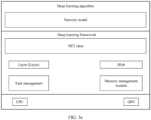
- a server side or a terminal device side may include a deep learning algorithm, a deep learning framework, a computing resource, a memory resource, and the like.
- the deep learning algorithm may invoke a computing resource and a memory resource by using a deep learning framework.
- a convolutional architecture for fast feature embedding (Convolutional Architecture For Fast Feature embedding, Caffe) is used as an example.
- Caffe may support a plurality of types of deep learning frameworks, image-oriented classification, and image-oriented segmentation, and may further support a convolutional neural network (Convolutional Neural Network, CNN), a convolutional neural network (Region-CNN, RCNN) used for target detection, a long short-term memory (Long Short-Term Memory, LSTM) neural network, and a fully connected neural network.
- CNN convolutional Neural Network
- Regular-CNN convolutional neural network
- RCNN convolutional neural network
- LSTM Long Short-Term Memory
- a deep learning algorithm may include a network model, and a deep learning framework may include a NET class, a layer, a blob, a task management module, and a memory management module (syncmem), where a MemModel module may be disposed in the memory management module.
- Memory optimization can be implemented based on original logic of the blob and the memory management module.
- the network model may be specifically a network model of a neural network.
- the NET class may store a directed acyclic graph (Directed acyclic graph, DAG) corresponding to a neural network.
- DAG directed acyclic graph
- FIG. 3d an example of a DAG is provided.
- FIG. 3d an example of a DAG is provided.
- a neural network includes five nodes A, B, C, E, F, and G, where an output parameter (for example, tensor data) of the node A is used as an input parameter of the node B, an output parameter of the node B is used as an input parameter of the node C and the node F, an output parameter of the node C is used as an input parameter of the node E, and output parameters of the node E and the node F are used as an input parameter of the node G.
- the layer is configured to store information about a node included in the neural network.
- the node may also be referred to as a layer.
- the blob is configured to store information about memory space occupied by an input parameter, an output parameter, and an intermediate parameter that correspond to each node during operation of the node in the neural network.
- the memory management module is configured to: manage and allocate information about memory space occupied by the neural network.
- FIG. 4a is a schematic flowchart of a neural network memory allocation method according to an embodiment of this application.
- the method may be performed by a server on which a neural network is run, or may be performed by a terminal device on which a neural network is run.
- a terminal device on which a neural network is run For ease of description, an example in which an execution body is a terminal device on which a neural network is run is used for description.
- FIG. 4a it may be specified that a plurality of pieces of memory space are required when the entire neural network is run.
- the method may include but is not limited to the following steps.
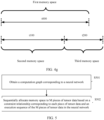
- Step S401 Obtain a computation graph corresponding to a neural network, where the computation graph includes N nodes and a directed edge that connects different nodes, a directed edge of the computation graph carries tensor data, the computation graph includes M pieces of tensor data, and M is an integer greater than 1.
- the node is configured to indicate computation logic in the neural network, that is, a function for implementing a specific function.
- an OP may be used to represent a node
- a tensor may be used to represent tensor data.
- the neural network is a convolutional neural network.
- a specific structure of the convolutional neural network may be shown in FIG. 4b .
- the convolutional neural network (CNN) 400 may include an input layer 410, a convolutional layer/pooling layer 420 (where the pooling layer is optional), a fully connected layer 430, and an output layer 440.
- the fully connected layer 430 refers to a fully connected network structure.
- a hidden layer 1 is used as an example.
- a product of input data of the hidden layer 1 and a weight tensor corresponding to the hidden layer 1 may be used to represent a fully connected feature.
- the fully connected feature may be quantized as ⁇ x , where ⁇ represents the weight tensor corresponding to the hidden layer 1, and x represents the input data of the hidden layer 1.
- the convolutional layer 420 is configured to extract a feature of input data. For example, when the input data is an image, the convolution layer 420 is configured to extract a feature of the input image, to reduce a quantity of parameters brought by the input image.
- the fully connected layer 430 is configured to integrate class-differentiated local information in the convolutional layer 420 (or the pooling layer). For example, the fully connected layer 430 may connect a feature extracted by the convolutional layer 420.
- an excitation function of each neuron at the fully connected layer 430 is usually a ReLU function.
- An output value of the last fully connected layer 430 is transferred to an output.
- classification may be performed through softmax logistic regression (softmax regression), so that a processing result can be obtained.
- the processing result may be a recognition probability of an image, so that the processing result can be output through the output layer 440.
- a terminal device may obtain a computation graph corresponding to the convolutional neural network.
- the computation graph includes a convolution node, a fully connected (FC) node, an activation (Relu) node, a pooling (Pooling) node, a classifier (softmax) node, and the like.
- a directed edge may be used to represent a connection relationship between nodes, the directed edge carries tensor data, and a direction of the directed edge is used to reflect a direction of the tensor data.
- Step S402 Sequentially allocate memory space to the M pieces of tensor data based on a sorting result of the M pieces of tensor data, where if at least a part of the allocated memory space can be reused for one of the M pieces of tensor data, at least the part of the memory space that can be reused for the tensor data is allocated to the tensor data, where the allocated memory space is memory space that has been allocated to the M pieces of tensor data before the tensor data.
- the sorting result of the M pieces of tensor data indicates an execution sequence of allocating memory space to the M pieces of tensor data
- the sorting result is related to information about each of the M pieces of tensor data
- the information about each piece of tensor data indicates at least one of the following information: a constraint relationship corresponding to each piece of tensor data and a quantity of nodes to which each piece of tensor data flows.
- the tensor data may include input tensor data, output tensor data, and intermediate tensor data.
- the consumption node is a node that consumes tensor data in the computation graph, that is, a node to which tensor data flows.
- Consption refers to use and consumption of a substance (for example, tensor data) in a node operation process.
- the production node is a node that generates tensor data in the computation graph, that is, a node from which tensor data flows.
- “Production” is a reverse process of "consumption", indicating an output in a node operation process.
- a node A is an upstream node of a node B means that there may be at least one path from the node A to the node B in the computation graph.
- the node B may be used as a start point, and the upstream node corresponding to the node B is obtained through reverse traversal (that is, in an opposite direction of the directed edge).
- the constraint relationship may be carried in a constraint relationship table.
- a first value may be used to indicate that same memory space can be reused for each piece of tensor data with another piece of tensor data
- a second value may be used to indicate that same memory space cannot be reused for each piece of tensor data with another piece of tensor data
- a third value may be used to indicate that each piece of tensor data and another piece of tensor data may be continuously stored in same memory space.
- the first value, the second value, and the third value may be values that can be distinguished from each other.
- the first value may be "0”
- the second value may be "1”
- the third value may be "2”.
- the constraint relationship has different priorities.
- the relationship between available memory space of two tensors is non-reusable and continuous, the relationship is also definitely non-reusable.
- the relationship between the available memory space of the two tensors is indicated as non-reusable and continuous in the constraint relationship. That is, it may be understood that a non-reusable and continuous priority is higher than a non-reusable priority.
- the constraint relationship may alternatively be not limited to a representation form of the constraint relationship table, or may be presented in another data structure.
- an implementation process of determining a constraint relationship corresponding to each piece of tensor data in the computation graph may include: determining whether all consumption nodes of first tensor data are upstream nodes of a production node of second tensor data; and if all the consumption nodes of the first tensor data are the upstream nodes of the production node of the second tensor data, determining that memory space allocated to the second tensor data can be reused for the first tensor data, or if all the consumption nodes of the first tensor data are not the upstream nodes of the production node of the second tensor data, determining that memory space allocated to the second tensor data cannot be reused for the first tensor data.
- an implementation process of determining a constraint relationship corresponding to each piece of tensor data in the computation graph may include: determining whether all consumption nodes of second tensor data are downstream nodes of a production node of first tensor data; and if all the consumption nodes of the second tensor data are the downstream nodes of the production node of the first tensor data, determining that memory space allocated to the second tensor data can be reused for the first tensor data, or if all the consumption nodes of the second tensor data are not the downstream nodes of the production node of the first tensor data, determining that memory space allocated to the second tensor data cannot be reused for the first tensor data.
- that at least a part of memory space allocated to tensor data B can be reused for tensor data A means that the memory space allocated to the tensor data B can be completely reused for the tensor data A, or the part of the memory space allocated to the tensor data B can be reused for the tensor data A.
- a node A is an upstream node of a node B means that there may be at least one path from the node A to the node B in the computation graph.
- the node B may be used as a start point, and the upstream node corresponding to the node B is obtained through reverse traversal (that is, in an opposite direction of the directed edge).
- an implementation process of determining a size of memory space that needs to be occupied by each piece of tensor data in the computation graph may include: A terminal device runs a neural network, and records the size of the memory space that needs to be occupied by each piece of tensor data in the neural network, so that the size of the memory space that needs to be occupied by each piece of tensor data when the neural network is in a running state is determined based on the recorded size of the memory space that needs to be occupied by each piece of tensor data, to provide a basis for subsequently allocating corresponding memory space to the tensor data.
- the entire neural network includes a node 1 and a node 2.
- the terminal device runs the neural network by using an artificial intelligence processor, and may record, in a running process of the neural network, a size 1000 KB of memory space that needs to be occupied by tensor data 1, and a size 500 KB of memory space that needs to be occupied by tensor data 2, so that the size of the memory space that needs to be occupied by each piece of tensor data when the neural network is in the running state can be determined based on the recorded size of the memory space that needs to be occupied by each piece of tensor data.
- each piece of tensor data has an identifier corresponding to the tensor data.
- the computation graph shown in FIG. 1b is used as an example.
- the computation graph includes eight operators and nine piece of tensor data.
- the nine piece of tensor data may be represented as tensor data t0, tensor data t1, tensor data t2, tensor data t3, tensor data t4, tensor data t5, tensor data t6, tensor data t7, and tensor data t8. It may be understood that an identifier corresponding to each piece of tensor data is unique.
- the identifier may be a series of sequential numbers, so that a sequence of tensor data can be determined based on the identifier corresponding to each piece of tensor data.
- constraint quantities respectively corresponding to the M pieces of tensor data may be obtained based on the constraint relationship corresponding to each piece of tensor data, where the constraint quantity is an amount of tensor data that is in other tensor data and for which same memory space cannot be reused with the tensor data; and then the M pieces of tensor data are sorted in descending order based on the constraint quantities respectively corresponding to the M pieces of tensor data, to obtain the sorting result of the M pieces of tensor data.
- the M pieces of tensor data may be sorted in descending order based on a quantity of consumption nodes that respectively correspond to the M pieces of tensor data, to obtain the sorting result of the M pieces of tensor data.
- the M pieces of tensor data may be further sorted in descending order based on at least two of the information about each piece of tensor data, to obtain the sorting result of the M pieces of tensor data.
- the information about each piece of tensor data includes a size of memory space that needs to be occupied by each piece of tensor data and a constraint relationship corresponding to each piece of tensor data.
- the computation graph includes two pieces of tensor data: tensor data 1 and tensor data 2.
- a size of memory space that needs to be occupied by the tensor data 1 is 1000 KB
- a constraint relationship between the tensor data 1 and the tensor data 2 is that same memory space cannot be reused for the tensor 1 with the tensor data 2
- a constraint quantity of the tensor data 1 is 1.
- a size of memory space that needs to be occupied by the tensor data 1 is 500 KB
- a constraint relationship between the tensor data 2 and the tensor data 1 is that same memory space cannot be reused for the tensor data 2 with the tensor data 1
- a constraint quantity of the tensor data 2 is 1.
- the M pieces of tensor data may be sorted by using a heuristic algorithm, to obtain the sorting result of the M pieces of tensor data within a preset time period.
- the heuristic algorithm is an algorithm constructed based on intuitive or empirical, and provides a feasible solution of each instance of a to-be-resolved combination optimization problem at acceptable costs (computing time and space). Generally, a degree of deviation between the feasible solution and the optimal solution cannot be predicted.
- the information about each piece of tensor data may further include one or more of the following: a size of memory space that needs to be occupied by each piece of tensor data, a constraint relationship corresponding to each piece of tensor data, and a quantity of consumption nodes to which each piece of tensor data flows.
- the terminal device needs to consider a sequence of information included in each piece of tensor data, and then uses the sequence as an independent individual for sorting.
- each piece of tensor data includes the identifier corresponding to each piece of tensor data, the size of the memory space that needs to be occupied by each piece of tensor data, the constraint relationship corresponding to each piece of tensor data, and the quantity of consumption nodes to which each piece of tensor data flows.
- the computation graph includes four pieces of tensor data: tensor data 1, tensor data 2, tensor data 3, tensor data 4, and tensor data 5.
- the terminal device sorts the five pieces of tensor data by using the foregoing heuristic algorithm, and learns that a sorting sequence (for example, the sorting sequence is the tensor data 2, the tensor data 3, the tensor data 4, the tensor data 1, and the tensor data 5) determined by using the heuristic algorithm within a preset time period is a sorting result of the five pieces of tensor data. Therefore, the terminal device may allocate memory space to the tensor data based on the determined sorting result.
- the memory allocation apparatus may invoke a heuristic algorithm (for example, the heuristic algorithm includes a deterministic algorithm and a random algorithm) by using a constraint programming solver CPsolver (Constraint Programming solver) to sort the M pieces of tensor data.
- a heuristic algorithm for example, the heuristic algorithm includes a deterministic algorithm and a random algorithm
- CPsolver Constraint Programming solver
- the sorting result may be a sorting result that needs to be optimized, or may be a sorting result that does not need to be optimized.
- the sorting result is a sorting result obtained after optimization, and a size of maximum memory that needs to be occupied by the neural network and that corresponds to the sorting result obtained after optimization is less than a size of maximum memory that needs to be occupied by the neural network and that is determined based on a sorting result existing before optimization.
- the computation graph includes four pieces of tensor data: tensor data 1, tensor data 2, tensor data 3, tensor data 4, and tensor data 5.
- An arrangement sequence of the tensor data 1, the tensor data 2, the tensor data 3, and the tensor data 4 is sequentially as follows: the tensor data 1, the tensor data 2, the tensor data 3, and the tensor data 4.
- the sorting result as shown in FIG.
- the tensor data 5 has four possible locations (a possible location 1, a possible location 2, a possible location 3, and a possible location 4), where the possible location 1 is a location between the tensor data 1 and the tensor data 2, the possible location 2 is a location between the tensor data 2 and the tensor data 3, the possible location 3 is a location between the tensor data 3 and the tensor data 4, and the possible location 4 is a location after the tensor data 4.
- the foregoing four potential possible locations respectively correspond to different memory space.
- the memory allocation apparatus determines a location of the tensor data 5 based on different determining conditions, where the determining condition may include but is not limited to: for a piece of tensor data, an initial address corresponding to memory space allocated to the tensor data is the smallest or the largest; and for a piece of tensor data, it is determined that a difference between a size of memory space corresponding to a potential possible location and a size of memory space that needs to be occupied by the tensor data meets a threshold.
- the threshold may be 0 or another value.
- the terminal device allocates memory space to the tensor data based on the sorting result. For example, the terminal device determines, by using the allocated memory space, that a size of maximum memory required for running the entire neural network is 4500 KB.
- the terminal device allocates memory space to the tensor data based on the sorting result.
- the terminal device determines, by using the allocated memory space, that a size of maximum memory required for running the entire neural network is 3500 KB.
- the terminal device allocates memory space to the tensor data based on the sorting result.
- the terminal device determines, by using the allocated memory space, that a size of maximum memory required for running the entire neural network is 5000 KB.
- the terminal device allocates memory space to the tensor data based on the sorting result. For example, the terminal device determines, by using the allocated memory space, that a size of maximum memory required for running the entire neural network is 4000 KB.
- the computing subtask 0 includes a node a and a node c, and an execution sequence of the node a and the node c is: the node a -> the node c.
- the computing subtask 1 includes a node b, a node d, a node e, and a node f, and an execution sequence of the node b, the node d, the node e, and the node f is: the node b -> the node d/e -> the node f.
- the computing subtask 2 includes a node g and a node h, and an execution sequence of the node g and the node h is: the node g -> the node h.
- An execution relationship between the computing subtask 0, the computing subtask 1, and the computing subtask 2 is parallel.
- an upstream node corresponding to each node, output tensor data corresponding to each node, and input tensor data corresponding to each node are determined.
- the upstream node corresponding to each node, the output tensor data corresponding to each node, and the input tensor data corresponding to each node may be shown in Table 1.
- the node a is used as an example.
- the node a is a start node and has no corresponding upstream node.
- output tensor data t0 and output tensor data t1 may be obtained.
- the node b is used as an example.
- the node a is an upstream node of the node b. This indicates that there is a path from the node a to the node b in the computation graph.
- input tensor data of the node b is t0, and output tensor data t2 and output tensor data t3 may be obtained.
- output tensor data t2 and output tensor data t3 may be obtained.
- a constraint relationship corresponding to each piece of tensor data is determined. For example, it may be determined whether all consumption nodes of first tensor data are upstream nodes of a production node of second tensor data; and if all the consumption nodes of the first tensor data are the upstream nodes of the production node of the second tensor data, it is determined that memory space allocated to the second tensor data can be reused for the first tensor data, or if all the consumption nodes of the first tensor data are not the upstream nodes of the production node of the second tensor data, it is determined that memory space allocated to the second tensor data cannot be reused for the first tensor data.
- the constraint relationship may be carried in a constraint relationship table.
- a first value may be used to indicate that same memory space can be reused for each piece of tensor data with another piece of tensor data
- a second value may be used to indicate that same memory space cannot be reused for each piece of tensor data with another piece of tensor data
- a third value may be used to indicate that each piece of tensor data and another piece of tensor data may be continuously stored in same memory space.
- a first value "0" is used to indicate that same memory space can be reused for tensor data with tensor data other than the tensor data
- a second value "1” is used to indicate that same memory space cannot be reused for tensor data with tensor data other than the tensor data
- a third value "2" is used to indicate that tensor data and tensor data other than the tensor data may be continuously stored in same memory space.
- constraint relationships between every two pieces of tensor data are symmetric, and the symmetry is reflected in a relationship that is exactly the same as an inverse relationship of the constraint relationship.
- Table 2 for example, a constraint relationship between the tensor data t2 and the tensor data t8 is determined.
- a production node of the tensor data t7 is f
- a consumption node of the tensor data t2 is d.
- the node b is a control selection node, and the node has two branches. One branch is: the node b -> the node d -> the node f. The other branch is: the node b -> the node e -> the node f. In one operation of the neural network, only one branch is valid.
- a constraint relationship between the tensor data t2 and the tensor data t3 is that the tensor data t2 and the tensor data t3 do not require two pieces of independent memory space, that is, same memory space can be reused.
- a constraint relationship between the tensor data t5 and the tensor data t6 is that the tensor data t5 and the tensor data t6 do not require two pieces of independent memory space, that is, same memory space can be reused.
- the information about each piece of tensor data includes a size of memory space that needs to be occupied by each piece of tensor data and a constraint relationship corresponding to each piece of tensor data.
- the M pieces of tensor data are sorted in descending order based on the size of the memory space that needs to be occupied by each piece of tensor data and a constraint quantity corresponding to each piece of tensor data, to obtain the sorting result of the M pieces of tensor data.
- a plurality of pieces of tensor data that are continuously stored in same memory space in a constraint relationship may be sorted as an independent whole.
- a constraint quantity corresponding to each piece of tensor data may be obtained.
- same memory space cannot be reused for the tensor data t0 with other tensor data (t1, t2, t3, t4, t5, t6, t7, t8), and a constraint quantity of the tensor data t0 is 8.
- tensor data t1 same memory space cannot be reused for the tensor data t1 with other tensor data (t0, t2, t3, t4, t5, t6, t7, t8), and a constraint quantity of the tensor data t1 is 8.
- tensor data t2 same memory space cannot be reused for the tensor data t2 with tensor data (t0, t1, t3, t4, t5, t8), and a constraint quantity of the tensor data t2 is 6.
- tensor data t3 same memory space cannot be reused for the tensor data t3 with tensor data (t0, t1, t4, t6, t8), and a constraint quantity of the tensor data t3 is 5.
- tensor data t4 same memory space cannot be reused for the tensor data t4 with tensor data (t0, t1, t2, t3, t5, t6, t7, t8), and a constraint quantity of the tensor data t4 is 8.
- tensor data t7 same memory space cannot be reused for the tensor data t7 with tensor data (t0, t1, t4, t5, t6), and a constraint quantity of the tensor data t7 is 5.
- tensor data t8 same memory space cannot be reused for the tensor data t8 with tensor data (t0, t2, t3, t4, t5, t6, t7), and a constraint quantity of the tensor data t8 is 7.
- a size of memory space that needs to be occupied by the tensor data t0 is 500 KB
- a size of memory space occupied by the tensor data t1 is 500 KB
- a size of memory space that needs to be occupied by the tensor data t2 is 500 KB
- a size of memory space occupied by the tensor data t3 is 500 KB
- a size of memory space that needs to be occupied by the tensor data t4 is 500 KB
- a size of memory space that needs to be occupied by the tensor data t5 is 1000 KB
- a size of memory space that needs to be occupied by the tensor data t6 is 1000 KB
- a size of memory space that needs to be occupied by the tensor data t7 is 1000 KB
- a size of memory space that needs to be occupied by the tensor data t8 is 1000 KB.
- the foregoing nine pieces of tensor data may be sorted in descending order.
- the sorting result may be shown in Table 3.
- each piece of tensor data may also be ranked as an independent whole.
- first memory space is first allocated to the tensor data t1, t7, and t8.
- the allocated memory space includes the first memory space.
- the first memory space includes memory space a, second memory space b, and third memory space c.
- the memory space a, the memory space b, and the memory space c are continuous memory space.
- the memory space a is used to store the tensor data t1 (that is, a size of the memory space a is equal to a size of the tensor data t1)
- the memory space b is used to store the tensor data t7 (that is, a size of the memory space b is equal to a size of the tensor data t7)
- the memory space c is used to store the tensor data t8 (that is, a size of the memory space c is equal to a size of the tensor data t8). Then, memory space is allocated to the tensor data t5.
- the implementation process may include: determining, based on a constraint relationship between the tensor data t5 and other tensor data in Table 2, whether the allocated memory space (the first memory space) can be reused for the tensor data t5. Because the allocated first memory space cannot be reused for the tensor data t5, second memory space of a corresponding size is allocated to the tensor data t5 based on a size of memory space required by the tensor data t5. In this case, the allocated memory space includes the first memory space and the second memory space. Then, memory space is allocated to the tensor data t6.
- the implementation process may include: determining, based on a constraint relationship between the tensor data t6 and other tensor data in Table 2, whether the allocated memory space (the first memory space and the second memory space) can be reused for the tensor data t6. Because the second memory space can be reused for the tensor data t6, the second memory space is allocated to the tensor data t6. Then, memory space is allocated to the tensor data t0.
- the implementation process may include: determining, based on a constraint relationship between the tensor data t0 and other tensor data in Table 2, whether the allocated memory space (the first memory space and the second memory space) can be reused for the tensor data t0.
- third memory space of a corresponding size is allocated to the tensor data t0 based on a size of memory space that needs to be occupied by the tensor data t0.
- the allocated memory space includes the first memory space, the second memory space, and the third memory space.
- memory space is allocated to the tensor data t4.
- the implementation process may include: determining, based on a constraint relationship between the tensor data t4 and other tensor data in Table 2, whether the allocated memory space (the first memory space, the second memory space, and the third memory space) can be reused for the tensor data t4.
- fourth memory space of a corresponding size is allocated to the tensor data t4 based on a size of memory space that needs to be occupied by the tensor data t4.
- the allocated memory space includes the first memory space, the second memory space, the third memory space, and the fourth memory space.
- memory space is allocated to the tensor data t2.
- the implementation process may include: determining, based on a constraint relationship between the tensor data t2 and other tensor data in Table 1, whether the allocated memory space (the first memory space, the second memory space, the third memory space, and the fourth memory space) can be reused for the tensor data t2.
- the first memory space can be reused for the tensor data t2
- the first memory space is allocated to the tensor data t2 (for example, the memory space c in the first memory space may be allocated to the tensor data t2).
- memory space is allocated to the tensor data t3.
- the implementation process may include: determining, based on a constraint relationship between the tensor data t3 and other tensor data in Table 2, whether the allocated memory space (the first memory space, the second memory space, the third memory space, and the fourth memory space) can be reused for the tensor data.
- the first memory space is allocated to the tensor data t3 (for example, the memory space c in the first memory space may be allocated to the tensor data t3).
- the allocation process may be shown in FIG. 4d . It may be understood that, in this implementation, independent memory space is allocated to each piece of tensor data, and a relationship between tensor data and memory space is in a one-to-one correspondence, that is, an amount of tensor data is the same as an amount of memory space.
- each piece of memory space includes a corresponding initial address and a corresponding size of storage space.
- the memory space allocated to each piece of tensor data may be shown in Table 4.
- Table 4 Identifier Size of tensor data Initial address Size of storage space Sorting result
- [3500, 4000[ indicates that 3500 to 3999 are included, 4000 is not included, and a size of storage space is 500.
- a size of maximum memory that needs to be occupied by the entire neural network may be determined by using the allocated memory space. For example, based on the allocation process in FIG. 4d , it may be determined that the size of the maximum memory that needs to be occupied by the neural network shown in FIG. 1b is 4500 KB. In this implementation, the size of the maximum memory required by a computer device to run the entire neural network may be determined, to avoid a case in which the allocated memory cannot support normal running of the neural network.
- corresponding memory space is allocated to each piece of tensor data
- it is verified, based on a constraint relationship corresponding to each piece of tensor data, whether the allocated memory space is correct, and if the allocated memory space is incorrect, memory space is re-allocated to the M pieces of tensor data. For example, for the tensor data t8, in the first memory space, it is determined whether memory space corresponding to the tensor data t8 is on the right of memory space corresponding to the tensor data t1.
- the memory space corresponding to the tensor data t1 is [0, 500[
- the memory space corresponding to the tensor data t8 is [500, 1500[. It may be determined, based on the memory space corresponding to the tensor data t1 and the memory space corresponding to the tensor data t8, that the memory space corresponding to the tensor data t8 is on the right of the memory space corresponding to the tensor data t1. This means that the allocation is correct.
- memory space respectively corresponding to the tensor data t1, the tensor data t8, and the tensor data t7 is continuous memory space.
- memory space respectively corresponding to the tensor data t1, the tensor data t8, and the tensor data t7 is continuous memory space.
- the first memory space is [0, 500[
- the second memory space is [500, 1500[
- the third memory space is [1500, 2500[.
- the computing subtask 0 includes a node a and a node c, and an execution sequence of the node a and the node c is: the node a -> the node c.
- the computing subtask 1 includes a node b, a node d, a node e, and a node f, and an execution sequence of the node b, the node d, the node e, and the node f is: the node b -> the node d/e -> the node f.
- the computing subtask 2 includes a node g and a node h, and an execution sequence of the node g and the node h is: the node g -> the node h.
- An execution relationship between the computing subtask 0 and the computing subtask 1 is parallel, and an execution relationship between the computing subtask 1 and the computing subtask 2 is serial.
- an upstream node corresponding to each node, output tensor data corresponding to each node, and input tensor data corresponding to each node are determined.
- the upstream node corresponding to each node, the output tensor data corresponding to each node, and the input tensor data corresponding to each node may be shown in Table 5.
- the node f is used as an example.
- the input tensor data of the node f includes the tensor data t5, the tensor data t6, and the tensor data t4, and the output tensor data of the node f includes the tensor data t7 and the tensor data t dep .
- Implementation processes of determining an upstream node, output tensor data, and input tensor data that correspond to another node are not described herein again.
- a constraint relationship corresponding to each piece of tensor data is determined. For example, it may be determined whether all consumption nodes of first tensor data are upstream nodes of a production node of second tensor data; and if all the consumption nodes of the first tensor data are the upstream nodes of the production node of the second tensor data, it is determined that memory space allocated to the second tensor data can be reused for the first tensor data, or if all the consumption nodes of the first tensor data are not the upstream nodes of the production node of the second tensor data, it is determined that memory space allocated to the second tensor data cannot be reused for the first tensor data.
- the constraint relationship may be carried in a constraint relationship table.
- a first value may be used to indicate that same memory space can be reused for each piece of tensor data with another piece of tensor data
- a second value may be used to indicate that same memory space cannot be reused for each piece of tensor data with another piece of tensor data
- a third value may be used to indicate that each piece of tensor data and another piece of tensor data may be continuously stored in same memory space.
- a first value "0" is used to indicate that same memory space can be reused for tensor data with tensor data other than the tensor data
- a second value "1” is used to indicate that same memory space cannot be reused for tensor data with tensor data other than the tensor data
- a third value "2" is used to indicate that tensor data and tensor data other than the tensor data may be continuously stored in same memory space.
- constraint relationships between every two pieces of tensor data are symmetric, and the symmetry is reflected in a relationship that is exactly the same as an inverse relationship of the constraint relationship.
- Table 2 for example, a constraint relationship between the tensor data t2 and the tensor data t8 is determined.
- a production node of the tensor data t7 is f
- a consumption node of the tensor data t2 is d.
- the node b is a control selection node, and the node has two branches. One branch is: the node b -> the node d -> the node f. The other branch is: the node b -> the node e -> the node f. In one operation of the neural network, only one branch is valid.
- a constraint relationship between the tensor data t2 and the tensor data t3 is that the tensor data t2 and the tensor data t3 do not require two pieces of independent memory space, that is, same memory space can be reused.
- a constraint relationship between the tensor data t5 and the tensor data t6 is that the tensor data t5 and the tensor data t6 do not require two pieces of independent memory space, that is, same memory space can be reused.
- the information about each piece of tensor data includes a size of memory space that needs to be occupied by each piece of tensor data and a constraint relationship corresponding to each piece of tensor data.
- the M pieces of tensor data are sorted in descending order based on the size of the memory space that needs to be occupied by each piece of tensor data and a constraint quantity corresponding to each piece of tensor data, to obtain the sorting result of the M pieces of tensor data.
- a plurality of pieces of tensor data that are continuously stored in same memory space in a constraint relationship may be sorted as an independent whole.
- a constraint quantity corresponding to each piece of tensor data may be obtained.
- same memory space cannot be reused for the tensor data t0 with other tensor data (t1, t2, t3, t4, t5, t6, t7), and a constraint quantity of the tensor data t0 is 7.
- same memory space cannot be reused for the tensor data t1 with other tensor data (t0, t2, t3, t4, t5, t6, t7, t8), and a constraint quantity of the tensor data t1 is 8.
- tensor data t2 same memory space cannot be reused for the tensor data t2 with tensor data (t0, t1, t4, t5), and a constraint quantity of the tensor data t2 is 4.
- tensor data t3 same memory space cannot be reused for the tensor data t3 with tensor data (t0, t1, t4, t6), and a constraint quantity of the tensor data t3 is 4.
- tensor data t4 same memory space cannot be reused for the tensor data t4 with tensor data (t0, t1, t2, t3, t5, t6, t7, t8), and a constraint quantity of the tensor data t4 is 8.
- tensor data t5 same memory space cannot be reused for the tensor data t5 with tensor data (t0, t1, t2, t4, t7), and a constraint quantity of the tensor data t5 is 5.
- tensor data t6 same memory space cannot be reused for the tensor data t6 with tensor data (t0, t1, t3, t4, t7), and a constraint quantity of the tensor data t6 is 5.
- tensor data t7 same memory space cannot be reused for the tensor data t7 with tensor data (t0, t1, t4, t5, t6), and a constraint quantity of the tensor data t7 is 5.
- tensor data t8 same memory space cannot be reused for the tensor data t8 with tensor data t4, t8), and a constraint quantity of the tensor data t8 is 2.
- a size of memory space that needs to be occupied by the tensor data t0 is 500 KB
- a size of memory space occupied by the tensor data t1 is 500 KB
- a size of memory space that needs to be occupied by the tensor data t2 is 500 KB
- a size of memory space occupied by the tensor data t3 is 500 KB
- a size of memory space that needs to be occupied by the tensor data t4 is 500 KB
- a size of memory space that needs to be occupied by the tensor data t5 is 1000 KB
- a size of memory space that needs to be occupied by the tensor data t6 is 1000 KB
- a size of memory space that needs to be occupied by the tensor data t7 is 1000 KB
- a size of memory space that needs to be occupied by the tensor data t8 is 1000 KB.
- the foregoing nine pieces of tensor data may be sorted in descending order.
- the sorting result may be shown in Table 7.
- each piece of tensor data may also be ranked as an independent whole.
- first memory space is first allocated to the tensor data t1, t7, and t8.
- the allocated memory space includes the first memory space.
- the first memory space includes memory space a, memory space b, and memory space c.
- the memory space a, the memory space b, and the memory space c are continuous memory space.
- the memory space a is used to store the tensor data t1 (that is, a size of the memory space a is equal to a size of the tensor data t1)
- the memory space b is used to store the tensor data t8 (that is, a size of the memory space b is equal to a size of the tensor data t8)
- the memory space c is used to store the tensor data t7 (that is, a size of the memory space c is equal to a size of the tensor data t7). Then, memory space is allocated to the tensor data t5.
- the implementation process may include: determining, based on a constraint relationship between the tensor data t5 and other tensor data in Table 7, whether the allocated memory space (the first memory space) can be reused for the tensor data t5. Because the first memory space can be reused for the tensor data t5, second memory space is allocated to the tensor data t5 (for example, the memory space b in the first memory space may be allocated to the tensor data 5). Then, memory space is allocated to the tensor data t6.
- the implementation process may include: determining, based on a constraint relationship between the tensor data t6 and other tensor data in Table 7, whether the allocated memory space (the first memory space) can be reused for the tensor data t6. Because the first memory space can be reused for the tensor data t6, the first memory space is allocated to the tensor data t6 (for example, the memory space b in the first memory space may be allocated to the tensor data t6). Then, memory space is allocated to the tensor data t0.
- the implementation process may include: determining, based on a constraint relationship between the tensor data t0 and other tensor data in Table 7, whether the allocated memory space (the first memory space) can be reused for the tensor data t0. Because the allocated memory space cannot be reused for the tensor data t0, second memory space of a corresponding size is allocated to the tensor data t0 based on a size of memory space that needs to be occupied by the tensor data t0. In this case, the allocated memory space includes the first memory space and the second memory space. Then, memory space is allocated to the tensor data t4.
- the implementation process may include: determining, based on a constraint relationship between the tensor data t4 and other tensor data in Table 7, whether the allocated memory space (the first memory space and the second memory space) can be reused for the tensor data t4. Because the allocated memory space cannot be reused for the tensor data t4, third memory space of a corresponding size is allocated to the tensor data t4 based on a size of memory space that needs to be occupied by the tensor data t4. In this case, the allocated memory space includes the first memory space, the second memory space, and the third memory space. Then, memory space is allocated to the tensor data t2.
- the implementation process may include: determining, based on a constraint relationship between the tensor data t2 and other tensor data in Table 7, whether the allocated memory space (the first memory space, the second memory space, and the third memory space) can be reused for the tensor data t2. Because the first memory space can be reused for the tensor data t2, the first memory space is allocated to the tensor data t2 (for example, the third memory space in the first memory space may be allocated to the tensor data t2). Then, memory space is allocated to the tensor data t3.
- the implementation process may include: determining, based on a constraint relationship between the tensor data t3 and other tensor data in Table 7, whether the allocated memory space (the first memory space, the second memory space, and the third memory space) can be reused for the tensor data. Because the first memory space can be reused for the tensor data, the first memory space is allocated to the tensor data t3 (for example, the third memory space in the first memory space may be allocated to the tensor data t3). Specifically, the allocation process may be shown in FIG. 4f .
- independent memory space is allocated to each piece of tensor data, and a relationship between tensor data and memory space is in a one-to-one correspondence, that is, an amount of tensor data is the same as an amount of memory space.
- each piece of memory space includes a corresponding initial address and a corresponding size of storage space.
- memory space allocated to each piece of tensor data may be shown in Table 8.
- Table 8 Identifier Size of tensor data
- Initial address Size of storage space Sorting result t0 500 2500 [2500, 3000[ 6 t1 500 0 [0, 500[ 1 t2 500 1500 [1500, 2000[ 8 t3 500 1500 [1500, 2000[ 9 t4 500 3000 [3000, 3500[ 7 t5 1000 500 [500, 1500[ 4 t6 1000 500 [500, 1000[ 5 t7 1000 1500 [1500, 2500[ 3 t8 1000 500 [500, 1000[ 2
- a size of maximum memory that needs to be occupied by the entire neural network may be determined by using the allocated memory space. For example, a size of maximum memory that needs to be occupied by the neural network shown in FIG. 4e is 3500 KB. In this implementation, the size of the maximum memory required by a computer device to run the entire neural network may be determined, to avoid a case in which the allocated memory cannot support normal running of the neural network.
- corresponding memory space is allocated to each piece of tensor data
- it is verified, based on a constraint relationship corresponding to each piece of tensor data, whether the allocated memory space is correct, and if the allocated memory space is incorrect, memory space is re-allocated to the M pieces of tensor data. For example, for the tensor data t8, in the first memory space, it is determined whether memory space corresponding to the tensor data t8 is on the right of memory space corresponding to the tensor data t1.
- the memory space corresponding to the tensor data t1 is [0, 500[
- the memory space corresponding to the tensor data t8 is [500, 1000[. It may be determined, based on the memory space corresponding to the tensor data t1 and the memory space corresponding to the tensor data t8, that the memory space corresponding to the tensor data t8 is on the right of the memory space corresponding to the tensor data t1. This means that the allocation is correct. In this implementation, improper memory allocation can be avoided. For example, the improper memory allocation may be reflected in that an allocation result mutually exclusive with the constraint relationship occurs in the allocated memory space.
- the computing subtask 0 includes a node a and a node c, and an execution sequence of the node a and the node c is: the node a -> the node c.
- the computing subtask 1 includes a node b, a node d, a node e, and a node f, and an execution sequence of the node b, the node d, the node e, and the node f is: the node b -> the node d/e -> the node f.
- the computing subtask 2 includes a node g and a node h, and an execution sequence of the node g and the node h is: the node g -> the node h.
- An execution relationship between the computing subtask 0, the computing subtask 1, and the computing subtask 2 is parallel.
- an execution sequence of the nodes is obtained, and then same nodes are sequentially encoded based on the execution sequence of the nodes, to obtain an identifier (for example, a sequence number) corresponding to each node.
- an identifier corresponding to a current node is less than an identifier corresponding to a next node.
- End ID is greater than Start ID, it indicates that a node corresponding to End ID is an upstream node of a node corresponding to Start ID. Then, a constraint relationship corresponding to each piece of tensor data is determined. For specific implementations of how to sort the M pieces of tensor data based on the information about each piece of tensor data and how to allocate memory space to the tensor data, refer to the foregoing descriptions. Details are not described herein again.
- the computing subtask 0 includes a node a and a node c, and an execution sequence of the node a and the node c is: the node a -> the node c.
- the computing subtask 1 includes a node b, a node d, a node e, and a node f, and an execution sequence of the node b, the node d, the node e, and the node f is: the node b -> the node d/e -> the node f.
- the computing subtask 2 includes a node g and a node h, and an execution sequence of the node g and the node h is: the node g -> the node h.
- An execution relationship between the computing subtask 0 and the computing subtask 1 is parallel, and an execution relationship between the computing subtask 1 and the computing subtask 2 is serial.
- an execution sequence of the nodes is obtained, and then same nodes are sequentially encoded based on the execution sequence of the nodes, to obtain an identifier (for example, a sequence number) corresponding to each node.
- an execution sequence of nodes in the at least two computing subtasks is obtained, and the nodes in the at least two computing subtasks are sequentially encoded based on the execution sequence of the nodes, to obtain an identifier corresponding to each node.
- an identifier corresponding to a current node is less than an identifier corresponding to a next node.
- the computing subtask 2 in FIG. 1b is used as an example.
- An identifier of each node in the computing subtask 2 may be shown in Table 10.
- Table 10 Node Identifier Output tensor data Input tensor data g Start ID2-00g t7: 00g-00h t4: 00c-00g h End ID2-00h - t1: 00a-00h t7: 00g-00h t8: 00f-00h
- End ID is greater than Start ID, it indicates that a node corresponding to End ID is an upstream node of a node corresponding to Start ID. Then, a constraint relationship corresponding to each piece of tensor data is determined. For specific implementations of how to sort the M pieces of tensor data based on the information about each piece of tensor data and how to allocate memory space to the tensor data, refer to the foregoing descriptions. Details are not described herein again.
- the computation graph corresponding to the neural network includes three pieces of tensor data, which may be respectively represented as tensor data t000, tensor data t100, and tensor data t200.
- a size of memory space that needs to be occupied by the tensor data t000 is 1000 KB
- a size of memory space that needs to be occupied by the tensor data t100 is 600 KB
- a size of memory space that needs to be occupied by the tensor data t200 is 450 KB.
- a first value "0" is used to indicate that same memory space can be reused for tensor data with data other than the tensor data
- a second value "1" is used to indicate that same memory space cannot be reused for tensor data with tensor data other than the tensor data.
- same memory space can be reused for the tensor data t000 with the tensor data t100, and same memory space can be reused for the tensor data t000 with the tensor data t200.
- same memory space can be reused for the tensor data t100 with the tensor data t000, but same memory space cannot be reused for the tensor data t100 with the tensor data t200.
- same memory space can be reused for the tensor data t200 with the tensor data t000, but same memory space cannot be reused for the tensor data t200 with the tensor data t100.
- the foregoing three pieces of tensor data are sorted in descending order based on a size of memory space that needs to be occupied by each piece of tensor data, to obtain a sorting result.
- the sorting result may be shown in Table 12.
- the memory allocation apparatus when allocating memory space to the three pieces of tensor data, the memory allocation apparatus first creates first memory space, where the first memory space is used to store the tensor data t000.
- first memory space For example, an initial address of the created first memory space is a, and a size of storage space is a size of memory space that needs to be occupied by the tensor data t000.
- second memory space For example, the memory allocation apparatus creates second memory space, where the second memory space is used to store the tensor data t100.
- an initial address of the created second memory space is a (that is, is the same as the initial address of the first memory space), and a size of storage space is memory space that needs to be occupied by the tensor data t100.
- the size of the memory space that needs to be occupied by the tensor data t000 is 1000 KB
- the size of the memory space that needs to be occupied by the tensor data t100 is 600 KB. This means that a part [a, 600[ of the first memory space is reused for the tensor data t100.
- the memory allocation apparatus creates third memory space, where the third memory space is used to store the tensor data t200. Because the memory space [a, 1000[ allocated to the tensor data t000 can be reused for the tensor data t200, but the memory space [a, 600[ allocated to the tensor data t100 cannot be reused for the tensor data t200, an initial address of the third memory space is 600, and a size of storage space is a size of memory space that needs to be occupied by the tensor data t200. This means that a part [600, 1000[ of the first memory space is reused for the tensor data t200. Specifically, the allocation process may be shown in FIG. 4g .
- the foregoing constraint relationship may be further reflected in that memory space allocated to tensor data and memory space allocated to tensor data other than the tensor data are discontinuous memory space (for example, memory space 1 is allocated to tensor data, and memory space 2 is allocated to tensor data 2, where there is a space gap between the memory space 1 and the memory space 2), and whether the tensor data and the tensor data other than the tensor data meet a spatial co-location constraint, where the spatial co-location constraint is reflected in that same memory space cannot be reused for an i th piece of tensor data with a j th piece of tensor data, and same memory space can be reused for the i th piece of tensor data with a k th piece of tensor data.
- same memory space cannot be reused for the i th piece of tensor data with an l th piece of tensor data, where the l th piece of tensor data is tensor data that overlaps between the j th piece of tensor data and the k th piece of tensor data, or the like.
- FIG. 5 is a schematic flowchart of a neural network memory allocation method according to an embodiment of this application.
- the method may be performed by a server on which a neural network is run, or may be performed by a terminal device on which a neural network is run.
- a terminal device on which a neural network is run For ease of description, an example in which an execution body is a terminal device on which a neural network is run is used for description.
- FIG. 5 it may be specified that a plurality of pieces of memory space are required when the entire neural network is run.
- the method may include but is not limited to the following steps.
- Step S501 Obtain a computation graph corresponding to a neural network, where the computation graph includes N nodes and a directed edge that connects different nodes, a directed edge of the computation graph carries tensor data, the computation graph includes M pieces of tensor data, and M is an integer greater than 1.
- step S501 For a specific implementation of step S501, refer to the foregoing descriptions. Details are not described herein again.
- Step S502 Sequentially allocate memory space to the M pieces of tensor data based on a constraint relationship corresponding to each piece of tensor data and an execution sequence of the M pieces of tensor data in the neural network.
- an implementation process of determining a constraint relationship corresponding to each piece of tensor data in the computation graph may include: determining whether all consumption nodes of first tensor data are upstream nodes of a production node of second tensor data; and if all the consumption nodes of the first tensor data are the upstream nodes of the production node of the second tensor data, determining that memory space allocated to the second tensor data can be reused for the first tensor data, or if all the consumption nodes of the first tensor data are not the upstream nodes of the production node of the second tensor data, determining that memory space allocated to the second tensor data cannot be reused for the first tensor data; and for another example, determining whether all consumption nodes of second tensor data are downstream nodes of a production node of first tensor data; and if all the consumption nodes of the second tensor data are the downstream nodes of
- the foregoing method may be applied to a scenario in which a plurality of computing subtasks are parallel (for example, execution relationships between the plurality of computing subtasks are all parallel; for another example, execution relationships between the plurality of computing subtasks include serial and parallel).
- the terminal device obtains a constraint relationship corresponding to each piece of tensor data, and then sequentially allocates memory to the tensor data based on an execution sequence of the tensor data in the neural network and the constraint relationship corresponding to each piece of tensor data, to avoid a case in which in a parallel scenario, an operator operation result is incorrect because operators reuse same memory space in different computing subtasks, and ensure accuracy of a calculation result of the neural network.
- FIG. 1a to FIG. 5 describe in detail the memory allocation method in embodiments of this application.
- the following describes apparatuses in embodiments of this application with reference to accompanying drawings.
- FIG. 6 is a schematic diagram of a structure of a memory allocation apparatus 60 according to an embodiment of this application.
- the memory allocation apparatus 60 shown in FIG. 6 may include: a computation graph obtaining unit 600, configured to obtain a computation graph corresponding to a neural network, where the computation graph includes N nodes and a directed edge that connects different nodes, a directed edge of the computation graph carries tensor data, the computation graph includes M pieces of tensor data, and M is an integer greater than 1; and an allocation unit 602, configured to sequentially allocate memory space to the M pieces of tensor data based on a sorting result of the M pieces of tensor data, where if at least a part of the allocated memory space can be reused for one of the M pieces of tensor data, the at least the part of the memory space that can be reused for the tensor data is allocated to the tensor data, where the allocated memory space is memory space that has been allocated to the M pieces of tensor data before the tens
- the constraint relationship indicates at least one of the following relationships: a relationship between available memory space of one piece of tensor data and available memory space of another piece of tensor data is reusable, a relationship between available memory space of one piece of tensor data and available memory space of another piece of tensor data is non-reusable, and a relationship between available memory space of one piece of tensor data and available memory space of another piece of tensor data is non-reusable and continuous.
- the constraint relationship is carried in a constraint relationship table, the constraint relationship table includes identifiers of the M data tensors, and in the constraint relationship table, a first value is used to indicate that the relationship between the available memory space of the one piece of tensor data and the available memory space of the another piece of tensor data is reusable, a second value is used to indicate that the relationship between the available memory space of the one piece of tensor data and the available memory space of the another piece of tensor data is non-reusable, and a third value is used to indicate that the relationship between the available memory space of the one piece of tensor data and the available memory space of the another piece of tensor data is non-reusable and continuous.
- memory space allocated to the second tensor data can be reused for the first tensor data; or when all the consumption nodes of the first tensor data are not the upstream nodes of the production node of the second tensor data, or when all the consumption nodes of the second tensor data are not the downstream nodes of the production node of the first tensor data, the memory space allocated to the second tensor data cannot be reused for the first tensor data, where the first tensor data and the second tensor data are any two of the M pieces of tensor data, the consumption node is a node to which tensor data flows, and the production node is a node from which tensor data
- the computation graph includes a plurality of computing subtasks, the computing subtask indicates a computing function by using a group of nodes and an edge related to the group of nodes, and an execution relationship between the plurality of computing subtasks is parallel; and the apparatus further includes:
- the computation graph further includes a first computing subtask and a second computing subtask that are in a serial execution relationship, and the first computing subtask is before the second computing subtask in an execution sequence; and the computation graph updating unit 604 is further configured to: if there is no directed edge between a last node in the first computing subtask and a first node in the second computing subtask, add a directed edge between the last node in the first computing subtask and the first node in the second computing subtask.
- an identifier of a production node of tensor data is less than an identifier of a consumption node of the tensor data, and the production node of the tensor data and the consumption node of the tensor data are two adjacent nodes.
- an identifier of each node in the computation graph is used to determine the information about each of the M pieces of tensor data.
- the information about each piece of tensor data indicates the constraint relationship corresponding to each piece of tensor data
- the apparatus further includes: a first sorting unit 608, configured to: obtain, based on the constraint relationship corresponding to each piece of tensor data, constraint quantities respectively corresponding to the M pieces of tensor data, wherein the constraint quantity is an amount of tensor data that is in other tensor data and for which same memory space cannot be reused with the tensor data; and sort the M pieces of tensor data based on the constraint quantities respectively corresponding to the M pieces of tensor data, to obtain the sorting result of the M pieces of tensor data.
- the information about each piece of tensor data indicates a quantity of nodes to which each piece of tensor data flows
- the apparatus further includes: a second sorting unit 6010, configured to sort the M pieces of tensor data based on quantities of consumption nodes that respectively correspond to the M pieces of tensor data, to obtain the sorting result of the M pieces of tensor data.
- the apparatus further includes: a third sorting unit 6012, configured to sort the M pieces of tensor data based on the information about each piece of tensor data by using a heuristic algorithm, to obtain the sorting result of the M pieces of tensor data within a preset time period.
- a third sorting unit 6012 configured to sort the M pieces of tensor data based on the information about each piece of tensor data by using a heuristic algorithm, to obtain the sorting result of the M pieces of tensor data within a preset time period.
- the sorting result is a sorting result obtained after optimization, and a size of maximum memory that needs to be occupied by the neural network and that corresponds to the sorting result obtained after optimization is less than a size of maximum memory that needs to be occupied by the neural network and that is determined based on a sorting result existing before optimization.
- the memory allocation apparatus obtains the sorting result of the M pieces of tensor data based on the information about each piece of tensor data, to allocate memory space of a corresponding size to each piece of tensor data based on the sorting result, so that a phenomenon of improper memory allocation can be avoided, thereby saving memory that needs to be occupied by the entire neural network, and optimizing memory allocation of the neural network.
- an embodiment of this application provides a memory allocation apparatus 70.
- the memory allocation apparatus 70 may be specifically a terminal device or a server.
- the memory allocation apparatus 70 may be specifically a central control module in the server, or a function of the memory allocation apparatus 70 is implemented by a central control module in the server.
- the memory allocation apparatus 70 may be specifically a central control module in the terminal device, or a function of the memory allocation apparatus 70 is implemented by a central control module in the terminal device.
- the memory allocation apparatus may include a processor 701, a memory 702, a communications bus 703, and a communications interface 704, and the processor 701 is connected to the memory 702 and the communications interface 703 through the communications bus.
- the processor 701 may be a general-purpose central processing unit (Central Processing Unit, CPU), a microprocessor, an application-specific integrated circuit (Application-Specific Integrated Circuit, ASIC), a graphics processing unit (Graphics Processing Unit, GPU), a neural-network processing unit (Network Processing Unit, NPU), or one or more integrated circuits, and is configured to execute a related program, to perform the memory allocation method described in the method embodiments of this application.
- CPU Central Processing Unit
- ASIC Application-Specific Integrated Circuit
- GPU Graphics Processing Unit
- NPU neural-network processing unit
- the processor 701 may alternatively be an integrated circuit chip and has a signal processing capability. In an implementation process, steps of the memory allocation method in this application may be completed by using an integrated logic circuit of hardware in the processor 701 or an instruction in a form of software.
- the processor 701 may alternatively be a general-purpose processor, a digital signal processor (Digital Signal Processing, DSP), an application-specific integrated circuit (ASIC), a field programmable gate array (Field Programmable Gate Array, FPGA) or another programmable logic device, a discrete gate or transistor logic device, or a discrete hardware component.
- DSP Digital Signal Processing
- ASIC application-specific integrated circuit
- FPGA Field Programmable Gate Array
- the processor may implement or perform the methods, steps, and logical block diagrams that are disclosed in embodiments of this application.
- the general-purpose processor may be a microprocessor, or the processor may be any conventional processor or the like.
- the steps in the methods disclosed with reference to embodiments of this application may be directly performed and completed by a hardware decoding processor, or may be performed and completed by using a combination of hardware in the decoding processor and a software module.
- the software module may be located in a mature storage medium in the art, such as a random access memory, a flash memory, a read-only memory, a programmable read-only memory, an electrically erasable programmable memory, or a register.
- the storage medium is located in the memory 701, and the processor 701 reads information in the memory 702, and performs the memory allocation method in the method embodiments of this application in combination with hardware of the processor 701.
- the memory 702 may be a read-only memory (Read-Only Memory, ROM), a static storage device, a dynamic storage device, or a random access memory (Random Access Memory, RAM).
- the memory 702 may store a program and data, for example, a program of the memory allocation method in embodiments of this application.
- the processor 701 and the communications interface 704 are configured to perform steps of the memory allocation method in embodiments of this application.
- a program is used to implement the memory allocation method in embodiments of this application.
- the communications interface 704 is but not limited to a transceiver apparatus such as a transceiver, to implement communication between the memory allocation apparatus 700 and another device or a communications network.
- a trained neural network may be obtained through the communications interface 704, to implement information exchange with an execution device, a client device, user equipment, a terminal device, or the like.
- the memory allocation apparatus may further include an artificial intelligence processor 705, and the artificial intelligence processor 705 may be any processor suitable for large-scale OR operation processing such as a neural-network processing unit (Network Processing Unit, NPU), a tensor processing unit (Tensor Processing Unit, TPU), or a graphics processing unit (Graphics Processing Unit, GPU).
- the artificial intelligence processor 705 may be mounted on a host CPU (Host CPU) as a coprocessor, and the host CPU assigns a task to the artificial intelligence processor 705.
- the artificial intelligence processor 705 may implement one or more operations in the foregoing memory allocation method.
- An NPU is used as an example.
- a core part of the NPU is an operation circuit, and an operation circuit is controlled by using a controller to extract matrix data in the memory 702 and perform multiplication and addition operations.
- the processor 701 is configured to invoke data and program code in the memory, to perform the following steps:
- the processor 701 is further configured to: if the allocated memory space cannot be reused for the tensor data, allocate other memory space to the tensor data, wherein the other memory space is different from the allocated memory space.
- the constraint relationship indicates at least one of the following relationships: a relationship between available memory space of one piece of tensor data and available memory space of another piece of tensor data is reusable, a relationship between available memory space of one piece of tensor data and available memory space of another piece of tensor data is non-reusable, and a relationship between available memory space of one piece of tensor data and available memory space of another piece of tensor data is non-reusable and continuous.
- the constraint relationship is carried in a constraint relationship table, the constraint relationship table includes identifiers of the M data tensors, and in the constraint relationship table, a first value is used to indicate that the relationship between the available memory space of the one piece of tensor data and the available memory space of the another piece of tensor data is reusable, a second value is used to indicate that the relationship between the available memory space of the one piece of tensor data and the available memory space of the another piece of tensor data is non-reusable, and a third value is used to indicate that the relationship between the available memory space of the one piece of tensor data and the available memory space of the another piece of tensor data is non-reusable and continuous.
- the computation graph includes a plurality of computing subtasks, the computing subtask indicates a computing function by using a group of nodes and an edge related to the group of nodes, and an execution relationship between the plurality of computing subtasks is parallel; and the processor 701 is further configured to:
- the computation graph further includes a first computing subtask and a second computing subtask that are in a serial execution relationship, and the first computing subtask is before the second computing subtask in an execution sequence, and that the processor 701 updates the computation graph further includes: if there is no directed edge between a last node in the first computing subtask and a first node in the second computing subtask, adding a directed edge between the last node in the first computing subtask and the first node in the second computing subtask.
- an identifier of a production node of tensor data is less than an identifier of a consumption node of the tensor data, and the production node of the tensor data and the consumption node of the tensor data are two adjacent nodes.
- An identifier of each node in the computation graph is used to determine the information about each of the M pieces of tensor data.
- the information about each piece of tensor data indicates the constraint relationship corresponding to each piece of tensor data, and the processor 701 is further configured to:
- the information about each piece of tensor data indicates a quantity of nodes to which each piece of tensor data flows, and the processor 701 is further configured to: sort the M pieces of tensor data based on quantities of consumption nodes that respectively correspond to the M pieces of tensor data, to obtain the sorting result of the M pieces of tensor data.
- the processor 701 is further configured to: sort the M pieces of tensor data based on the information about each piece of tensor data by using a heuristic algorithm, to obtain the sorting result of the M pieces of tensor data within a preset time period.
- the sorting result is a sorting result obtained after optimization, and a size of maximum memory that needs to be occupied by the neural network and that corresponds to the sorting result obtained after optimization is less than a size of maximum memory that needs to be occupied by the neural network and that is determined based on a sorting result existing before optimization.
- An embodiment of this application further provides a computer storage medium.
- the computer-readable storage medium stores instructions, and when the instructions are run on a computer or a processor, the computer or the processor is enabled to perform one or more steps in the method in any one of the foregoing embodiments.
- the component modules of the apparatus may be stored in the computer-readable storage medium.
- the computer-readable storage medium may be an internal storage unit of the device in the foregoing embodiment, for example, a hard disk or memory.
- the computer-readable storage medium may be an external storage device of the device, for example, an equipped plug-in hard disk, a smart media card (Smart Media Card, SMC), a secure digital (Secure Digital, SD) card, or a flash card (Flash Card).
- the computer-readable storage medium may alternatively include both the internal storage unit of the device and the external storage device.
- the computer-readable storage medium is configured to store the computer program and other programs and data that are required by the device.
- the computer-readable storage medium may be further configured to temporarily store data that has been output or is to be output.
- the computer program may be stored in a computer-readable storage medium. When the program runs, the procedures of the methods in embodiments may be performed.
- the foregoing storage medium includes any medium that can store program code, such as a ROM, a RAM, a magnetic disk, or an optical disc.
- a sequence of the steps of the method in embodiments of this application may be adjusted, combined, or removed based on an actual requirement.
- the modules in the apparatus in embodiments of this application may be combined, divided, and deleted based on an actual requirement.
- the computer-readable medium may include a computer-readable storage medium corresponding to a tangible medium, such as a data storage medium, or any communication medium that facilitates transmission of a computer program from one place to another (for example, according to a communication protocol).
- the computer-readable medium may generally correspond to: (1) a non-transitory tangible computer-readable storage medium, or (2) a communication medium, for example, a signal or a carrier.
- the data storage medium may be any usable medium that can be accessed by one or more computers or one or more processors to retrieve instructions, code, and/or data structures for implementing the technologies described in this application.
- a computer program product may include a computer-readable medium.
- the disclosed system, apparatus, and method may be implemented in another manner.
- the described apparatus embodiment is merely an example.
- division into the units is merely logical function division and may be other division in actual implementation.
- a plurality of units or components may be combined or integrated into another system, or some features may be ignored or not performed.
- the displayed or discussed mutual couplings or direct couplings or communication connections may be implemented through some interfaces.
- the indirect couplings or communication connections between the apparatuses or units may be implemented in electrical, mechanical, or another form.
- the units described as separate parts may or may not be physically separate, and parts displayed as units may or may not be physical units, and may be located in one position, or may be distributed on a plurality of network units. Some or all of the units may be selected based on actual requirements to achieve the objectives of the solutions of embodiments.
- the functions When the functions are implemented in a form of a software functional unit and sold or used as an independent product, the functions may be stored in a computer-readable storage medium. Based on such an understanding, the technical solutions of this application essentially, or the part contributing to the conventional technology, or some of the technical solutions may be implemented in a form of a software product.
- the computer software product is stored in a storage medium, and includes several instructions for instructing a computer device (which may be a personal computer, a server, a network device, or the like) to perform all or some of the steps of the methods in embodiments of this application.
- the foregoing storage medium includes any medium that can store program code, such as a USB flash drive, a removable hard disk, a read-only memory (Read-Only Memory, ROM), a random access memory (Random Access Memory, RAM), a magnetic disk, or an optical disc.
- program code such as a USB flash drive, a removable hard disk, a read-only memory (Read-Only Memory, ROM), a random access memory (Random Access Memory, RAM), a magnetic disk, or an optical disc.
Landscapes
- Engineering & Computer Science (AREA)
- Theoretical Computer Science (AREA)
- Physics & Mathematics (AREA)
- Software Systems (AREA)
- General Physics & Mathematics (AREA)
- General Engineering & Computer Science (AREA)
- Health & Medical Sciences (AREA)
- Life Sciences & Earth Sciences (AREA)
- Biomedical Technology (AREA)
- Biophysics (AREA)
- General Health & Medical Sciences (AREA)
- Molecular Biology (AREA)
- Computing Systems (AREA)
- Evolutionary Computation (AREA)
- Data Mining & Analysis (AREA)
- Mathematical Physics (AREA)
- Computational Linguistics (AREA)
- Artificial Intelligence (AREA)
- Neurology (AREA)
- Information Retrieval, Db Structures And Fs Structures Therefor (AREA)
Applications Claiming Priority (2)
| Application Number | Priority Date | Filing Date | Title |
|---|---|---|---|
| CN202011057095.2A CN114327844B (zh) | 2020-09-29 | 2020-09-29 | 内存分配方法、相关设备及计算机可读存储介质 |
| PCT/CN2021/119829 WO2022068663A1 (fr) | 2020-09-29 | 2021-09-23 | Procédé d'attribution de mémoire, dispositif associé, et support de stockage lisible par ordinateur |
Publications (2)
| Publication Number | Publication Date |
|---|---|
| EP4209902A1 true EP4209902A1 (fr) | 2023-07-12 |
| EP4209902A4 EP4209902A4 (fr) | 2024-01-10 |
Family
ID=80949565
Family Applications (1)
| Application Number | Title | Priority Date | Filing Date |
|---|---|---|---|
| EP21874324.3A Pending EP4209902A4 (fr) | 2020-09-29 | 2021-09-23 | Procédé d'attribution de mémoire, dispositif associé, et support de stockage lisible par ordinateur |
Country Status (4)
| Country | Link |
|---|---|
| US (1) | US20230236888A1 (fr) |
| EP (1) | EP4209902A4 (fr) |
| CN (1) | CN114327844B (fr) |
| WO (1) | WO2022068663A1 (fr) |
Families Citing this family (23)
| Publication number | Priority date | Publication date | Assignee | Title |
|---|---|---|---|---|
| CN114780237B (zh) * | 2022-04-19 | 2025-04-25 | 北京清微智能信息技术有限公司 | 可重构处理器的内存分配及回收方法、装置及存储介质 |
| CN114819084B (zh) * | 2022-04-26 | 2024-03-01 | 北京百度网讯科技有限公司 | 模型推理方法、装置、设备及存储介质 |
| CN117149398A (zh) * | 2022-05-20 | 2023-12-01 | 北京希姆计算科技有限公司 | 一种内存分配的方法和装置 |
| CN115018064B (zh) * | 2022-06-27 | 2024-11-08 | 中国科学技术大学 | 一种计算节点的空间分配方法及装置 |
| CN115080240B (zh) * | 2022-06-29 | 2023-10-10 | 美的集团(上海)有限公司 | 语音处理模型的部署方法、电子设备及存储介质 |
| CN115269179B (zh) * | 2022-07-15 | 2025-09-05 | 浙江大华技术股份有限公司 | 一种静态内存分配方法、装置、设备及介质 |
| CN115374232A (zh) * | 2022-09-01 | 2022-11-22 | 安谋科技(中国)有限公司 | 张量分配方法、介质、电子设备和程序产品 |
| CN115455245B (zh) * | 2022-09-19 | 2026-03-17 | 上海壁仞科技股份有限公司 | 数据处理方法及装置、电子设备和存储介质 |
| CN115268936B (zh) * | 2022-09-27 | 2022-12-27 | 之江实验室 | 一种用于计算图编译的优化方法及装置 |
| CN117815652B (zh) * | 2022-09-27 | 2025-05-30 | 腾讯科技(深圳)有限公司 | 虚拟物体的渲染方法、装置、设备及存储介质 |
| CN118132245A (zh) * | 2022-12-01 | 2024-06-04 | 马上消费金融股份有限公司 | 资源分配方法、装置及电子设备 |
| CN115981839A (zh) * | 2022-12-05 | 2023-04-18 | 昆仑芯(北京)科技有限公司 | 内存分配方法及装置、设备和介质 |
| WO2024211755A1 (fr) * | 2023-04-05 | 2024-10-10 | Nvidia Corporation | Techniques de classement de dimensions de tenseurs |
| WO2025001349A1 (fr) * | 2023-06-29 | 2025-01-02 | 华为技术有限公司 | Procédé de traitement d'opérateurs et appareil associé |
| EP4488820B1 (fr) * | 2023-07-05 | 2025-09-10 | aiMotive Kft. | Procédés, dispositifs et systèmes de traitement de tenseurs |
| CN117032954B (zh) * | 2023-07-17 | 2024-04-26 | 北京泛睿科技合伙企业(有限合伙) | 针对终端训练模型的内存优化方法、系统、设备及介质 |
| CN116700996B (zh) * | 2023-08-04 | 2023-11-07 | 北京燧原智能科技有限公司 | 一种神经网络的内存分配方法、装置、设备及介质 |
| CN116893904B (zh) * | 2023-09-11 | 2023-12-26 | 腾讯科技(深圳)有限公司 | 神经网络模型的内存管理方法、装置、设备、介质及产品 |
| CN119831007A (zh) * | 2023-10-13 | 2025-04-15 | 华为技术有限公司 | 数据处理方法及装置 |
| US20250217192A1 (en) * | 2023-12-29 | 2025-07-03 | Qualcomm Incorporated | Graph aware memory allocation |
| CN118656215B (zh) * | 2024-07-10 | 2026-02-06 | 深圳市大数据研究院 | 一种应用于有向无环图的调度方法及相关设备 |
| CN121144065B (zh) * | 2025-11-18 | 2026-03-24 | 上海壁仞科技股份有限公司 | 人工智能芯片、用于同步矩阵乘法指令的方法、计算装置、介质和程序产品 |
| CN121478673B (zh) * | 2026-01-08 | 2026-04-17 | 上海东方算芯科技有限公司 | 内存分配方法、装置、电子设备、存储介质及芯片 |
Family Cites Families (13)
| Publication number | Priority date | Publication date | Assignee | Title |
|---|---|---|---|---|
| EP0918281A1 (fr) * | 1997-03-29 | 1999-05-26 | IMEC vzw | Méthode et appareil pour optimisation de grandeur des unités de stockage |
| US10936569B1 (en) * | 2012-05-18 | 2021-03-02 | Reservoir Labs, Inc. | Efficient and scalable computations with sparse tensors |
| US11907760B2 (en) * | 2016-09-23 | 2024-02-20 | Apple Inc. | Systems and methods of memory allocation for neural networks |
| CN108829610B (zh) * | 2018-04-02 | 2020-08-04 | 浙江大华技术股份有限公司 | 一种神经网络前向计算过程中的内存管理方法及设备 |
| CN110597616B (zh) * | 2018-06-13 | 2022-07-29 | 华为技术有限公司 | 一种神经网络的内存分配方法及装置 |
| US11769065B2 (en) * | 2019-03-14 | 2023-09-26 | Julius Technologies Llc | Distributed system generating rule compiler engine by determining a best matching rule based on concrete parameterization with declarative rules syntax |
| CN111832738B (zh) * | 2019-04-18 | 2024-01-09 | 中科寒武纪科技股份有限公司 | 一种数据处理方法及相关产品 |
| US10931588B1 (en) * | 2019-05-10 | 2021-02-23 | Innovium, Inc. | Network switch with integrated compute subsystem for distributed artificial intelligence and other applications |
| CN110490313B (zh) * | 2019-08-14 | 2022-03-18 | 中科寒武纪科技股份有限公司 | 一种内存复用方法及其相关产品 |
| US12026604B2 (en) * | 2019-11-11 | 2024-07-02 | NextVPU (Shanghai) Co., Ltd. | Memory pre-allocation for forward calculation in a neural network |
| US11669443B2 (en) * | 2020-01-17 | 2023-06-06 | Alibaba Group Holding Limited | Data layout optimization on processing in memory architecture for executing neural network model |
| US12423007B1 (en) * | 2020-03-31 | 2025-09-23 | Nvidia Corporation | Techniques for tensor memory allocation |
| CN111488221B (zh) * | 2020-06-29 | 2020-10-09 | 北京一流科技有限公司 | 静态网络中的内存空间预配系统及其方法 |
-
2020
- 2020-09-29 CN CN202011057095.2A patent/CN114327844B/zh active Active
-
2021
- 2021-09-23 WO PCT/CN2021/119829 patent/WO2022068663A1/fr not_active Ceased
- 2021-09-23 EP EP21874324.3A patent/EP4209902A4/fr active Pending
-
2023
- 2023-03-28 US US18/127,300 patent/US20230236888A1/en active Pending
Also Published As
| Publication number | Publication date |
|---|---|
| US20230236888A1 (en) | 2023-07-27 |
| CN114327844B (zh) | 2025-09-05 |
| EP4209902A4 (fr) | 2024-01-10 |
| CN114327844A (zh) | 2022-04-12 |
| WO2022068663A1 (fr) | 2022-04-07 |
Similar Documents
| Publication | Publication Date | Title |
|---|---|---|
| US20230236888A1 (en) | Memory allocation method, related device, and computer-readable storage medium | |
| CN115543639B (zh) | 分布式执行深度学习任务的优化方法和分布式系统 | |
| CN104036451B (zh) | 基于多图形处理器的模型并行处理方法及装置 | |
| Villa | Advanced models for manufacturing systems management | |
| Mishra et al. | Artificial intelligence and hardware accelerators | |
| CN114492782A (zh) | 基于强化学习的神经网络的片上核心编译映射方法及装置 | |
| US12093811B2 (en) | Fractal calculating device and method, integrated circuit and board card | |
| US20190130268A1 (en) | Tensor radix point calculation in a neural network | |
| CN113449859A (zh) | 一种数据处理方法及其装置 | |
| CN110889497B (zh) | 一种人工智能处理器的学习任务编译方法及相关产品 | |
| US11763131B1 (en) | Systems and methods for reducing power consumption of convolution operations for artificial neural networks | |
| CN115860081A (zh) | 一种芯粒算法调度方法、系统、电子设备及存储介质 | |
| CN116070682B (zh) | 神经元计算机操作系统的snn模型动态映射方法及装置 | |
| CN110333946A (zh) | 一种基于人工智能cpu数据处理系统及方法 | |
| Zhang et al. | Enabling highly efficient capsule networks processing through a PIM-based architecture design | |
| Ouyang et al. | Hardware/software partitioning for heterogenous mpsoc considering communication overhead | |
| DE102021201597A1 (de) | Verwenden von hardware-beschleunigten befehlen | |
| KR102372869B1 (ko) | 인공 신경망을 위한 행렬 연산기 및 행렬 연산 방법 | |
| CN115033391A (zh) | 一种用于神经网络计算的数据流动方法和装置 | |
| US20190130276A1 (en) | Tensor manipulation within a neural network | |
| CN117829299A (zh) | 一种量子电路模拟方法、装置、介质及电子装置 | |
| CN110766146A (zh) | 一种人工智能处理器的学习任务编译方法及相关产品 | |
| CN120540820A (zh) | 多智能体协同方法、装置、电子设备及存储介质 | |
| WO2019089553A1 (fr) | Calcul de séparation fractionnaire de tenseur dans un réseau neuronal | |
| Zhang et al. | Enabling highly efficient capsule networks processing through software-hardware co-design |
Legal Events
| Date | Code | Title | Description |
|---|---|---|---|
| STAA | Information on the status of an ep patent application or granted ep patent |
Free format text: STATUS: THE INTERNATIONAL PUBLICATION HAS BEEN MADE |
|
| PUAI | Public reference made under article 153(3) epc to a published international application that has entered the european phase |
Free format text: ORIGINAL CODE: 0009012 |
|
| STAA | Information on the status of an ep patent application or granted ep patent |
Free format text: STATUS: REQUEST FOR EXAMINATION WAS MADE |
|
| 17P | Request for examination filed |
Effective date: 20230405 |
|
| AK | Designated contracting states |
Kind code of ref document: A1 Designated state(s): AL AT BE BG CH CY CZ DE DK EE ES FI FR GB GR HR HU IE IS IT LI LT LU LV MC MK MT NL NO PL PT RO RS SE SI SK SM TR |
|
| DAV | Request for validation of the european patent (deleted) | ||
| DAX | Request for extension of the european patent (deleted) | ||
| A4 | Supplementary search report drawn up and despatched |
Effective date: 20231212 |
|
| RIC1 | Information provided on ipc code assigned before grant |
Ipc: G06N 3/063 20230101ALN20231206BHEP Ipc: G06N 3/045 20230101ALN20231206BHEP Ipc: G06N 3/04 20230101ALN20231206BHEP Ipc: G06F 9/50 20060101AFI20231206BHEP |