EP4210041A1 - Remodelage de signaux pour signaux à plage dynamique élevée - Google Patents
Remodelage de signaux pour signaux à plage dynamique élevée Download PDFInfo
- Publication number
- EP4210041A1 EP4210041A1 EP23158881.5A EP23158881A EP4210041A1 EP 4210041 A1 EP4210041 A1 EP 4210041A1 EP 23158881 A EP23158881 A EP 23158881A EP 4210041 A1 EP4210041 A1 EP 4210041A1
- Authority
- EP
- European Patent Office
- Prior art keywords
- color space
- color
- image
- lms
- hue
- Prior art date
- Legal status (The legal status is an assumption and is not a legal conclusion. Google has not performed a legal analysis and makes no representation as to the accuracy of the status listed.)
- Withdrawn
Links
Images




Classifications
-
- H—ELECTRICITY
- H04—ELECTRIC COMMUNICATION TECHNIQUE
- H04N—PICTORIAL COMMUNICATION, e.g. TELEVISION
- H04N19/00—Methods or arrangements for coding, decoding, compressing or decompressing digital video signals
- H04N19/46—Embedding additional information in the video signal during the compression process
-
- H—ELECTRICITY
- H04—ELECTRIC COMMUNICATION TECHNIQUE
- H04N—PICTORIAL COMMUNICATION, e.g. TELEVISION
- H04N19/00—Methods or arrangements for coding, decoding, compressing or decompressing digital video signals
- H04N19/85—Methods or arrangements for coding, decoding, compressing or decompressing digital video signals using pre-processing or post-processing specially adapted for video compression
- H04N19/87—Methods or arrangements for coding, decoding, compressing or decompressing digital video signals using pre-processing or post-processing specially adapted for video compression involving scene cut or scene change detection in combination with video compression
-
- H—ELECTRICITY
- H04—ELECTRIC COMMUNICATION TECHNIQUE
- H04N—PICTORIAL COMMUNICATION, e.g. TELEVISION
- H04N19/00—Methods or arrangements for coding, decoding, compressing or decompressing digital video signals
- H04N19/85—Methods or arrangements for coding, decoding, compressing or decompressing digital video signals using pre-processing or post-processing specially adapted for video compression
-
- H—ELECTRICITY
- H04—ELECTRIC COMMUNICATION TECHNIQUE
- H04N—PICTORIAL COMMUNICATION, e.g. TELEVISION
- H04N19/00—Methods or arrangements for coding, decoding, compressing or decompressing digital video signals
- H04N19/90—Methods or arrangements for coding, decoding, compressing or decompressing digital video signals using coding techniques not provided for in groups H04N19/10-H04N19/85, e.g. fractals
- H04N19/98—Adaptive-dynamic-range coding [ADRC]
-
- G—PHYSICS
- G09—EDUCATION; CRYPTOGRAPHY; DISPLAY; ADVERTISING; SEALS
- G09G—ARRANGEMENTS OR CIRCUITS FOR CONTROL OF INDICATING DEVICES USING STATIC MEANS TO PRESENT VARIABLE INFORMATION
- G09G5/00—Control arrangements or circuits for visual indicators common to cathode-ray tube indicators and other visual indicators
- G09G5/02—Control arrangements or circuits for visual indicators common to cathode-ray tube indicators and other visual indicators characterised by the way in which colour is displayed
-
- H—ELECTRICITY
- H04—ELECTRIC COMMUNICATION TECHNIQUE
- H04N—PICTORIAL COMMUNICATION, e.g. TELEVISION
- H04N1/00—Scanning, transmission or reproduction of documents or the like, e.g. facsimile transmission; Details thereof
- H04N1/46—Colour picture communication systems
- H04N1/56—Processing of colour picture signals
- H04N1/60—Colour correction or control
- H04N1/6058—Reduction of colour to a range of reproducible colours, e.g. to ink- reproducible colour gamut
-
- H—ELECTRICITY
- H04—ELECTRIC COMMUNICATION TECHNIQUE
- H04N—PICTORIAL COMMUNICATION, e.g. TELEVISION
- H04N21/00—Selective content distribution, e.g. interactive television or video on demand [VOD]
- H04N21/20—Servers specifically adapted for the distribution of content, e.g. VOD servers; Operations thereof
- H04N21/23—Processing of content or additional data; Elementary server operations; Server middleware
- H04N21/234—Processing of video elementary streams, e.g. splicing of video streams or manipulating encoded video stream scene graphs
- H04N21/2343—Processing of video elementary streams, e.g. splicing of video streams or manipulating encoded video stream scene graphs involving reformatting operations of video signals for distribution or compliance with end-user requests or end-user device requirements
-
- H—ELECTRICITY
- H04—ELECTRIC COMMUNICATION TECHNIQUE
- H04N—PICTORIAL COMMUNICATION, e.g. TELEVISION
- H04N9/00—Details of colour television systems
- H04N9/64—Circuits for processing colour signals
- H04N9/643—Hue control means, e.g. flesh tone control
-
- H—ELECTRICITY
- H04—ELECTRIC COMMUNICATION TECHNIQUE
- H04N—PICTORIAL COMMUNICATION, e.g. TELEVISION
- H04N9/00—Details of colour television systems
- H04N9/64—Circuits for processing colour signals
- H04N9/67—Circuits for processing colour signals for matrixing
-
- H—ELECTRICITY
- H04—ELECTRIC COMMUNICATION TECHNIQUE
- H04N—PICTORIAL COMMUNICATION, e.g. TELEVISION
- H04N9/00—Details of colour television systems
- H04N9/64—Circuits for processing colour signals
- H04N9/68—Circuits for processing colour signals for controlling the amplitude of colour signals, e.g. automatic chroma control circuits
-
- H—ELECTRICITY
- H04—ELECTRIC COMMUNICATION TECHNIQUE
- H04N—PICTORIAL COMMUNICATION, e.g. TELEVISION
- H04N9/00—Details of colour television systems
- H04N9/77—Circuits for processing the brightness signal and the chrominance signal relative to each other, e.g. adjusting the phase of the brightness signal relative to the colour signal, correcting differential gain or differential phase
-
- G—PHYSICS
- G09—EDUCATION; CRYPTOGRAPHY; DISPLAY; ADVERTISING; SEALS
- G09G—ARRANGEMENTS OR CIRCUITS FOR CONTROL OF INDICATING DEVICES USING STATIC MEANS TO PRESENT VARIABLE INFORMATION
- G09G2320/00—Control of display operating conditions
- G09G2320/02—Improving the quality of display appearance
- G09G2320/0271—Adjustment of the gradation levels within the range of the gradation scale, e.g. by redistribution or clipping
- G09G2320/0276—Adjustment of the gradation levels within the range of the gradation scale, e.g. by redistribution or clipping for the purpose of adaptation to the characteristics of a display device, i.e. gamma correction
-
- G—PHYSICS
- G09—EDUCATION; CRYPTOGRAPHY; DISPLAY; ADVERTISING; SEALS
- G09G—ARRANGEMENTS OR CIRCUITS FOR CONTROL OF INDICATING DEVICES USING STATIC MEANS TO PRESENT VARIABLE INFORMATION
- G09G2320/00—Control of display operating conditions
- G09G2320/06—Adjustment of display parameters
-
- G—PHYSICS
- G09—EDUCATION; CRYPTOGRAPHY; DISPLAY; ADVERTISING; SEALS
- G09G—ARRANGEMENTS OR CIRCUITS FOR CONTROL OF INDICATING DEVICES USING STATIC MEANS TO PRESENT VARIABLE INFORMATION
- G09G2340/00—Aspects of display data processing
- G09G2340/06—Colour space transformation
Definitions
- the present invention relates generally to images. More particularly, an embodiment of the present invention relates to signal reshaping of images with high dynamic range to improve backwards compatibility
- the term 'dynamic range' may relate to a capability of the human visual system (HVS) to perceive a range of intensity (e.g., luminance, luma) in an image, e.g., from darkest darks (blacks) to brightest whites (i.e., highlights).
- HVS human visual system
- DR relates to a 'scene-referred' intensity.
- DR may also relate to the ability of a display device to adequately or approximately render an intensity range of a particular breadth. In this sense, DR relates to a 'display-referred' intensity.
- the term may be used in either sense, e.g. interchangeably.
- high dynamic range relates to a DR breadth that spans the some 14-15 orders of magnitude of the human visual system (HVS).
- HVS human visual system
- EDR enhanced dynamic range
- VDR visual dynamic range
- EDR may individually or interchangeably relate to the DR that is perceivable within a scene or image by a human visual system (HVS) that includes eye movements, allowing for some light adaptation changes across the scene or image.
- EDR may relate to a DR that spans 5 to 6 orders of magnitude.
- HDR high dynamic range
- n ⁇ 8 e.g., color 24-bit JPEG images
- images where n > 8 may be considered images of enhanced dynamic range.
- EDR and HDR images may also be stored and distributed using high-precision (e.g., 16-bit) floating-point formats, such as the OpenEXR file format developed by Industrial Light and Magic.
- Metadata relates to any auxiliary information that is transmitted as part of the coded bitstream and assists a decoder to render a decoded image.
- metadata may include, but are not limited to, color space or gamut information, reference display parameters, and auxiliary signal parameters, as those described herein.
- HDR lower dynamic range
- SDR standard dynamic range
- HDR content may be color graded and displayed on HDR displays that support higher dynamic ranges (e.g., from 1,000 nits to 5,000 nits or more).
- the methods of the present disclosure relate to any dynamic range higher than SDR. As appreciated by the inventors here, improved techniques for the coding of high-dynamic range images are desired.
- HDR high dynamic range
- Example embodiments described herein relate to the reshaping and coding of high-dynamic range images.
- a processor accesses an image database and
- the first color space is a gamma-based YCbCr color space and the second color space is a PQ-based IPT color space.
- the color-rotation matrix is used to generate a reshaped color space based on the preferred color space. Images are coded using the reshaped color space, and information about the color rotation matrix is signaled from the encoder to a decoder.
- the decoder in a method to reconstruct an input image coded in a reshaped color space, the decoder:
- a processor in an encoder, a processor:
- a processor in a decoder, a processor:
- FIG. 1 depicts an example process of a conventional video delivery pipeline (100) showing various stages from video capture to video content display.
- a sequence of video frames (102) is captured or generated using image generation block (105).
- Video frames (102) may be digitally captured (e.g. by a digital camera) or generated by a computer (e.g. using computer animation) to provide video data (107).
- video frames (102) may be captured on film by a film camera. The film is converted to a digital format to provide video data (107).
- a production phase (110) video data (107) is edited to provide a video production stream (112).
- the video data of production stream (112) is then provided to a processor at block (115) for post-production editing.
- Post-production editing (115) may include adjusting or modifying colors or brightness in particular areas of an image to enhance the image quality or achieve a particular appearance for the image in accordance with the video creator's creative intent. This is sometimes called "color timing" or "color grading.”
- Other editing e.g. scene selection and sequencing, image cropping, addition of computer-generated visual special effects, etc.
- video images are viewed on a reference display (125).
- video data of final production (117) may be delivered to encoding block (120) for delivering downstream to decoding and playback devices such as television sets, set-top boxes, movie theaters, and the like.
- coding block (120) may include audio and video encoders, such as those defined by ATSC, DVB, DVD, Blu-Ray, and other delivery formats, to generate coded bit stream (122).
- the coded bit stream (122) is decoded by decoding unit (130) to generate a decoded signal (132) representing an identical or close approximation of signal (117).
- the receiver may be attached to a target display (140) which may have completely different characteristics than the reference display (125).
- a display management block (135) may be used to map the dynamic range of decoded signal (132) to the characteristics of the target display (140) by generating display-mapped signal (137).
- part of the processing pipeline for example, coding (120), decoding (130), and display management (135) may be performed in what will be referred to as the IPT-PQ color space.
- IPT-PQ color space An example use of the IPT-PQ color space for display management application can be found in "Display Management for High Dynamic Range Video,” WIPO Publication WO 2014/130343, by R. Atkins et al. , which is incorporated by reference in its entirety.
- the IPT color space as described in " Development and testing of a color space (ipt) with improved hue uniformity", by F. Ebner and M.D. Fairchild, in Proc. 6th Color Imaging Conference: Color Science, Systems, and Applications, IS&T, Scottsdale, Arizona, Nov.
- IPT is a normalized space to some reference luminance. In an embodiment, the normalization is based on the maximum luminance of a target display (e.g., 5,000 nits).
- PQ perceptual quantization
- the human visual system responds to increasing light levels in a very non-linear way. A human's ability to see a stimulus is affected by the luminance of that stimulus, the size of the stimulus, the spatial frequency(ies) making up the stimulus, and the luminance level that the eyes have adapted to at the particular moment one is viewing the stimulus.
- a perceptual quantizer function maps linear input gray levels to output gray levels that better match the contrast sensitivity thresholds in the human visual system. Examples of PQ mapping functions are described in U.S. Patent Ser. No. 9,077,994 (to be referred as the ⁇ 994 Patent)," by J. S. Miller et al.
- a PQ curve as determined by the ⁇ 994 Patent, imitates the true visual response of the human visual system using a relatively simple functional model.
- FIG. 2 depicts in more detail an example process (200) for the color conversion into the IPT-PQ color space according to an embodiment.
- the color space transformation in the perceptually-corrected IPT color space may comprise the following steps:
- FIG. 3 depicts an example process for signal reshaping and coding according to an embodiment.
- the forward color reshaping block (305) applies, as needed, color transformation and or reshaping functions to generate a signal (307) in a preferred color space (e.g., IPT-PQ-r).
- Reshaping-related metadata (309) may also be generated and communicated to subsequent blocks of the coding pipeline, such as the encoder (310), the decoder (315), and backward color reshaping (320).
- a decoder after receiving coded signal (315) will apply decoding (315) (such as HEVC decoding) to generate decoded signal (317).
- decoding such as HEVC decoding
- a decoder aware of the preferred HDR-WCG coding color space e.g., IPT-PQ-r
- signal (322) may be transformed to YCbCr or RGB for additional post-processing, storage, or display.
- a legacy decoder which is not aware of the preferred HDR-WCG coding space, may treat the HDR-WCG space as a legacy color space (e.g., gamma-coded YCbCr); however, due to the forward color reshaping (305), output (317) may still have a reasonable picture quality, despite the fact that no backward reshaping or other color transformation is applied to output (317) of the decoder.
- a legacy color space e.g., gamma-coded YCbCr
- a linear reshaping matrix (e.g., a 3 x 3 matrix) is generated to perceptually match the skin tones in an IPT-PQ signal with the skin-tones in a YCbCr-gamma signal.
- a color transformation has no effect on the performance of most image processing applications in the IPT color space, yet greatly improves color reproduction by a legacy device.
- similar transformation matrices may also be generated to match other important colors, such as foliage, sky, etc.
- the reshaping matrix may be computed as follows:
- a' the value of angle "a"
- fminunc(fun, x0) the value of angle "a"
- fun Cost H
- x0 0.1.
- the hue-cost and saturation-cost functions may be combined into a single hue/saturation cost function and solved for both a ' and b ' simultaneously.
- the proposed rotation matrix R may improve the color reproduction; however, the decoded image (317) may still be perceived to have low contrast due to the difference in the non-linear EOTF encoding functions (e.g., ST 2084 versus BT 1866).
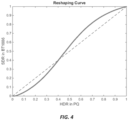
- the contrast may be improved by applying a 1-D tone-mapping curve to the luminance channel (e.g., I'). This step may include the following sub-steps:
- FIG. 4 An example of such mapping between ST 2084 (PQ) and BT 1866 is shown in FIG. 4 .
- the curve has higher mid-tone contrast, lower blacks, and brighter (with less contrast) highlights. This aligns the tone scale more closely with standard SDR, so that when the input is decoded by a legacy device the image is still viewable.
- input and output values are normalized to (0, 1).
- Reshaping information may be signaled from an encoder to the rest of the pipeline as metadata.
- the reshaping parameters may be determined at a variety of time instances, such as on a per frame basis, on a per scene basis, or on a per sequence basis, to yield the best possible performance for a given video sequence.
- a Rec. 2020 bitstream may be adjusted using signal reshaping techniques as described herein to provide better hue and saturation output when decoded using a legacy Rec. 709 decoder.
- FIG. 6 depicts an example process flow for generating a color-rotation and scaling matrix according to an embodiment.
- step (610) computes hue and saturation values for the images in the database in a first (legacy) color space (e.g. YCbCr-gamma).
- step (615) computes hue for the images in the database in a second (preferred) color space (e.g. IPT-PQ).
- step (620) solves for an optimum rotation angle a' according to a minimization cost criterion (such as mean square error (MSE)) which minimizes the distance between hues computed in the legacy color space and hues computed in a rotated preferred color space.
- a minimization cost criterion such as mean square error (MSE)
- MSE mean square error
- An optional saturation scaler may also be computed. Given a saturation cost function (e.g., equation 8), step (630), optionally, solves for an optimum scaler b ' according to a minimization cost criterion, such as the MSE between the saturation of signals in the first color space and the saturation of scaled signals in a color-rotated preferred color space (640, 645).
- a saturation cost function e.g., equation 8
- step (630) optionally, solves for an optimum scaler b ' according to a minimization cost criterion, such as the MSE between the saturation of signals in the first color space and the saturation of scaled signals in a color-rotated preferred color space (640, 645).
- step (635) the rotation angle and the scaler are combined to generate a color-rotation and scaling matrix (e.g., equation (11)).
- the encoder will apply the color-rotation and scaling matrix to the input data in the preferred color space to generate data in a reshaped color space.
- Data will be encoded (compressed) and transmitted to a decoder together with information related to the color-rotation and scaling matrix.
- a legacy decoder will decode the data assuming it is coded in the legacy color space. Despite using the wrong color space information, images will still be viewable at adequate quality, albite in a lower dynamic range.
- a newer, fully-enabled, decoder may take advantage of the received metadata information on the color-rotation and scaling matrix to decode the image data in the preferred color space, thus providing to a viewer the full high-dynamic range of the data.
- the rotation (R) matrix and scaling vector ( S ) may be absorbed by the L'M'S' to I'P'T' conversion matrix in (230).
- the tone reshaping curve may be part of the forward color reshaping (305).
- the adaptive reshaping information (that is, the matrix and the tone-mapping curve) may be transmitted by the encoder to the decoder using the syntax proposed in U.S. Provisional Application Ser. No. 62/193,390, filed on July 16, 2015 , also filed as PCT Application with Ser. No. PCT/US2016/02861 on April 19, 2016 , which is incorporated herein by reference in its entirety.
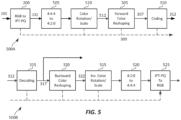
- a new color rotation and scale block (510) may be added in an encoder (500A). This block may be added after the color transformation (200) (e.g., RGB to IPT-PQ) but preferably before the forward reshaping (305).
- a decoder (500B) a corresponding inverse color rotation and scaling block (515) may be added after the backward reshaping box (320).
- optional color format conversion boxes e.g., 4:4:4 to 4:2:0 (505) or 4:2:0 to 4:4:4 (520) may be added in the encoding and/or decoding pipeline as needed.
- Table 1 provides an example of SEI messaging to communicate a color rotation and scaling matrix; however, signaling is not limited in SEI message; it can be inserted in any high level syntax, like SPS, PPS, etc.
- colour_rotation_scale_matrix_present_flag 1 indicates that the syntax elements colour_rotation_scale_coeffs [ c ][ i ], for c and i in the range of 0 to 1, inclusive, are present.
- colour_rotation_scale_matrix_present_flag 0 indicates that the syntax elements colour_rotation_scale_coeffs [ c ][ i ], for c and i in the range of 0 to 1, inclusive, are not present.
- colour_rotation_scale_coeffs [ c ][ i ] specifies the value of the two-by-two colour rotation and scale matrix coefficients.
- the value of colour_rotation_scale_coeffs [ c ][ i ] shall be in the range of -2 ⁇ 15 to 2 ⁇ 15 - 1, inclusive.
- colour_rotation_scale_coeffs [ c ][ i ] is not present, the default colour rotation and scale matrix matrix is used.
- both the encoder and the decoder may be aware of the color-rotation and scaling matrix (e.g., through the mutual definition of a new color space), hence it may not be needed to signal the color-rotation matrix from an encoder to the decoder.
- the color-rotation and scaling matrix can be referenced in VUI (Video Usability Information) together with IPT-PQ.
- N hues e.g., skin tones, sky, greens, and the like.
- a set of optimal (rotation angle, saturation scale) values e.g., ⁇ ( a 1 , bi), ( a 2 , b 2 ),..., ( a N , b N ) ⁇ .
- pixel p a p f H h p
- Functions f H ( h ( p )) and f S ( h ( p )) may be represented and stored in a variety of ways known in the art, for example, as look-up tables or piece-wise linear or non-linear polynomials, and can be signaled from an encoder to a decoder as metadata.
- the encoder may signal to the decoder the inverse of the f S ( h ( p )) (e.g., 1/ b ( p ) values).
- trigonometric operations may be performed using look-up tables.
- T p s p sin h ′ p ⁇ a p .
- FIG. 7A depicts an example backward reshaping function to convert hue from reshaped IPT-PQ-r (which appears as YCbCr to a legacy device) back to IPT-PQ when the legacy color space is YCbCr-gamma.
- FIG. 7B depicts the corresponding backward reshaping function to adjust the saturation.
- FIG. 8 depicts how the preferred color space IPT-PQ (820) may be adjusted to match the characteristics of the legacy YCbCr color space (810).
- Rays (830) depict the rotation and scaling.
- the v () and w () functions, as before, can been communicated from the encoder to the decoder using metadata or they can be part of an established coding protocol or standard known by both the encoder and the decoder.
- IC T C P also to be referred to as ICtCp (or IPT)
- IPT ITP-PQ
- I Intensity
- C T Tritan Axis
- C P Protan Axis
- the term "isoluminance” refers to a measure of how well luminance (say, I of ICtCp or Y' of Y'Cb'Cr') correspond to luminance Y . Indirectly, it measures how well a color space separates luma from chroma. Experiments performed by the inventors indicate that I of ICtCp corresponds much closer to luma than Y' of Y'Cb'Cr'.
- the EOTF ST 2084 ⁇ 1 function may be replaced by another non-linear quantization function such as the Hybrid Log-Gamma (HLG) function.
- HLG Hybrid Log-Gamma
- the corresponding L'M'S' to RGB and IC T C P to L'M'S' matrices are given by:
- R G B 3.436606694333078 ⁇ 2.5064521118656270 0.069845424323191 ⁇ 0.791329555598929 1.983600451792291 ⁇ 0.192270896193362 ⁇ 0.025949899690593 ⁇ 0.098913714711726 1.12486314402319
- L ′ M ′ S ′ L ′ M ′ S ′ 1.0 0.008609037037933 0.1110296250030260 1.0 ⁇ 0.008609037037933 ⁇ 0.111029625003026 1.0 0.560031335710679 ⁇ 0.320627174987319 I C T C P
- High dynamic range content may be viewed on displays that have less dynamic range than the reference display used to master the content.
- display mapping should be performed. This can take the form of an EETF (electrical-electrical transfer function) in the display, which is typically applied before applying the EOTF for the display. This function provides a toe and shoulder to gracefully roll off the highlights and shadows providing a balance between preserving the artistic intent and maintaining details.
- FIG. 9 is an example EETF mapping from the full 0-10,000 nits dynamic range to a target display capable of 0. 1-1,000 nits.
- the EETF may be introduced into the PQ signal; the plots show the effect of the mapping, i.e. they illustrate how the intended light is changed into the actual displayed light.
- the EETF may be applied in the non-linear domain to either the luma channel in IC T C P or Y'C' B C' R or to RGB channels individually.
- the central region of the tone mapping curve is defined as a one-to-one mapping from source to target.
- An additional toe and shoulder roll off are calculated using a Hermite spline to reduce the dynamic range to the capabilities of the target display.
- the turning points (Toe Start (TS) and Shoulder Start (SS)) for the spline are defined first. These are the points where the roll offs begin.
- the output E 2 is computed as follows.
- the resulting EETF curve can be applied to either the intensity I channel of IC T C P or the luma Y channel of Y'C' B C' R .
- I channel of IC T C P or the luma Y channel of Y'C' B C' R .
- Embodiments of the present invention may be implemented with a computer system, systems configured in electronic circuitry and components, an integrated circuit (IC) device such as a microcontroller, a field programmable gate array (FPGA), or another configurable or programmable logic device (PLD), a discrete time or digital signal processor (DSP), an application specific IC (ASIC), and/or apparatus that includes one or more of such systems, devices or components.
- IC integrated circuit
- FPGA field programmable gate array
- PLD configurable or programmable logic device
- DSP discrete time or digital signal processor
- ASIC application specific IC
- the computer and/or IC may perform, control, or execute instructions relating to signal reshaping and coding of images with enhanced dynamic range, such as those described herein.
- the computer and/or IC may compute any of a variety of parameters or values that relate to the signal reshaping and coding processes described herein.
- the image and video embodiments may be implemented in hardware, software, firmware and various combinations
- Certain implementations of the invention comprise computer processors which execute software instructions which cause the processors to perform a method of the invention.
- processors in a display, an encoder, a set top box, a transcoder or the like may implement methods related to signal reshaping and coding of HDR images as described above by executing software instructions in a program memory accessible to the processors.
- the invention may also be provided in the form of a program product.
- the program product may comprise any non-transitory medium which carries a set of computer-readable signals comprising instructions which, when executed by a data processor, cause the data processor to execute a method of the invention.
- Program products according to the invention may be in any of a wide variety of forms.
- the program product may comprise, for example, physical media such as magnetic data storage media including floppy diskettes, hard disk drives, optical data storage media including CD ROMs, DVDs, electronic data storage media including ROMs, flash RAM, or the like.
- the computer-readable signals on the program product may optionally be compressed or encrypted.
- a component e.g. a software module, processor, assembly, device, circuit, etc.
- reference to that component should be interpreted as including as equivalents of that component any component which performs the function of the described component (e.g., that is functionally equivalent), including components which are not structurally equivalent to the disclosed structure which performs the function in the illustrated example embodiments of the invention.
Landscapes
- Engineering & Computer Science (AREA)
- Multimedia (AREA)
- Signal Processing (AREA)
- Physics & Mathematics (AREA)
- Computer Hardware Design (AREA)
- General Physics & Mathematics (AREA)
- Theoretical Computer Science (AREA)
- Image Processing (AREA)
- Processing Of Color Television Signals (AREA)
- Compression Or Coding Systems Of Tv Signals (AREA)
- Facsimile Image Signal Circuits (AREA)
- Color Image Communication Systems (AREA)
Applications Claiming Priority (7)
| Application Number | Priority Date | Filing Date | Title |
|---|---|---|---|
| US201562200797P | 2015-08-04 | 2015-08-04 | |
| US201562202980P | 2015-08-10 | 2015-08-10 | |
| US201662278362P | 2016-01-13 | 2016-01-13 | |
| US201662300012P | 2016-02-25 | 2016-02-25 | |
| US201662302073P | 2016-03-01 | 2016-03-01 | |
| PCT/US2016/045362 WO2017024042A2 (fr) | 2015-08-04 | 2016-08-03 | Remodelage de signal pour signaux à plage dynamique élevée |
| EP16757757.6A EP3332550B1 (fr) | 2015-08-04 | 2016-08-03 | Remodelage de signal pour signaux à plage dynamique élevée |
Related Parent Applications (2)
| Application Number | Title | Priority Date | Filing Date |
|---|---|---|---|
| EP16757757.6A Division EP3332550B1 (fr) | 2015-08-04 | 2016-08-03 | Remodelage de signal pour signaux à plage dynamique élevée |
| EP16757757.6A Division-Into EP3332550B1 (fr) | 2015-08-04 | 2016-08-03 | Remodelage de signal pour signaux à plage dynamique élevée |
Publications (1)
| Publication Number | Publication Date |
|---|---|
| EP4210041A1 true EP4210041A1 (fr) | 2023-07-12 |
Family
ID=56802666
Family Applications (3)
| Application Number | Title | Priority Date | Filing Date |
|---|---|---|---|
| EP16757757.6A Active EP3332550B1 (fr) | 2015-08-04 | 2016-08-03 | Remodelage de signal pour signaux à plage dynamique élevée |
| EP23158888.0A Withdrawn EP4207178A1 (fr) | 2015-08-04 | 2016-08-03 | Remodelage de signaux pour signaux à plage dynamique élevée |
| EP23158881.5A Withdrawn EP4210041A1 (fr) | 2015-08-04 | 2016-08-03 | Remodelage de signaux pour signaux à plage dynamique élevée |
Family Applications Before (2)
| Application Number | Title | Priority Date | Filing Date |
|---|---|---|---|
| EP16757757.6A Active EP3332550B1 (fr) | 2015-08-04 | 2016-08-03 | Remodelage de signal pour signaux à plage dynamique élevée |
| EP23158888.0A Withdrawn EP4207178A1 (fr) | 2015-08-04 | 2016-08-03 | Remodelage de signaux pour signaux à plage dynamique élevée |
Country Status (10)
| Country | Link |
|---|---|
| US (15) | US10432977B2 (fr) |
| EP (3) | EP3332550B1 (fr) |
| JP (2) | JP6320440B2 (fr) |
| KR (3) | KR20180026517A (fr) |
| CN (2) | CN110267046B (fr) |
| BR (2) | BR122022023327B1 (fr) |
| CA (2) | CA3086441C (fr) |
| RU (3) | RU2693687C1 (fr) |
| TW (3) | TWI735036B (fr) |
| WO (1) | WO2017024042A2 (fr) |
Families Citing this family (36)
| Publication number | Priority date | Publication date | Assignee | Title |
|---|---|---|---|---|
| EP3338243B1 (fr) | 2015-09-23 | 2022-04-20 | ARRIS Enterprises LLC | Opérations d'adaptation de plage dynamique élevée au niveau d'un décodeur vidéo |
| CN106937121B (zh) * | 2015-12-31 | 2021-12-10 | 中兴通讯股份有限公司 | 图像解码和编码方法、解码和编码装置、解码器及编码器 |
| EP3367659A1 (fr) * | 2017-02-28 | 2018-08-29 | Thomson Licensing | Mappage de gamme de couleurs de changement de teinte |
| CN110447051B (zh) | 2017-03-20 | 2023-10-31 | 杜比实验室特许公司 | 在感知上保持参考场景的对比度和色度 |
| CN110770787B (zh) * | 2017-06-16 | 2023-04-07 | 杜比实验室特许公司 | 高效端到端单层逆向显示管理编码 |
| US10769817B2 (en) * | 2017-08-07 | 2020-09-08 | Samsung Display Co., Ltd. | Measures for image testing |
| TWI650998B (zh) | 2017-12-15 | 2019-02-11 | Mstar Semiconductor, Inc. | 應用在機上盒的格式轉換電路及相關的方法 |
| MA51865A (fr) * | 2018-02-14 | 2020-12-23 | Dolby Laboratories Licensing Corp | Redéfinition d'images dans un codage vidéo à l'aide d'une optimisation de distorsion du taux de codage |
| JP7189230B2 (ja) * | 2018-04-09 | 2022-12-13 | ドルビー ラボラトリーズ ライセンシング コーポレイション | ニューラルネットワークマッピングを用いるhdr画像表現 |
| US10917583B2 (en) * | 2018-04-27 | 2021-02-09 | Apple Inc. | Standard and high dynamic range display systems and methods for high dynamic range displays |
| WO2019234606A1 (fr) | 2018-06-05 | 2019-12-12 | Beijing Bytedance Network Technology Co., Ltd. | Interaction entre ibc et atmvp |
| CN110691277B (zh) * | 2018-07-05 | 2024-03-05 | 华为技术有限公司 | 视频信号的处理方法及装置 |
| KR102784625B1 (ko) * | 2018-11-01 | 2025-03-19 | 세종대학교산학협력단 | 칼라 좌표축 변환을 이용한 영상 부호화/복호화 방법 및 장치 |
| CN116886926A (zh) | 2018-11-10 | 2023-10-13 | 北京字节跳动网络技术有限公司 | 成对平均候选计算中的取整 |
| CN109685859B (zh) * | 2018-12-24 | 2021-06-08 | 哈尔滨工业大学(深圳) | 基于3d查找表的三维颜色自动调整方法 |
| US12022080B2 (en) | 2019-03-01 | 2024-06-25 | Lg Electronics Inc. | Image coding method based on LMCS, and device therefor |
| US11924431B2 (en) | 2019-03-01 | 2024-03-05 | Lg Electronics Inc. | LMCS-based image coding method and device therefor |
| TWI753377B (zh) * | 2019-03-12 | 2022-01-21 | 弗勞恩霍夫爾協會 | 用於影像及視訊寫碼之選擇性成分間變換(ict)技術 |
| CN110189687B (zh) * | 2019-06-04 | 2020-10-09 | 深圳市摩西尔电子有限公司 | 一种对led模组图像进行图像变换的方法和装置 |
| US11895416B2 (en) * | 2019-07-30 | 2024-02-06 | Dolby Laboratories Licensing Corporation | Electro-optical transfer function conversion and signal legalization |
| CN115052137B (zh) | 2019-10-18 | 2023-09-26 | 华为技术有限公司 | 一种饱和度调整的方法及装置 |
| US11838531B2 (en) | 2019-12-06 | 2023-12-05 | Dolby Laboratories Licensing Corporation | Cascade prediction |
| JP7309081B2 (ja) * | 2020-04-03 | 2023-07-14 | ドルビー ラボラトリーズ ライセンシング コーポレイション | Hdrイメージングにおけるブラインド局所再整形 |
| US11837140B2 (en) * | 2020-04-17 | 2023-12-05 | Dolby Laboratories Licensing Corporation | Chromatic ambient light correction |
| CN115699734B (zh) * | 2020-04-21 | 2025-07-11 | 杜比实验室特许公司 | 用于生成整形函数的方法、装置、介质和计算机程序产品 |
| CN115699077B (zh) * | 2020-04-22 | 2026-04-03 | 杜比实验室特许公司 | 单层hdr图像编解码器中整形函数的迭代优化 |
| US11412174B2 (en) * | 2020-09-22 | 2022-08-09 | Microsoft Technology Licensing, Llc | Efficient electro-optical transfer function (EOTF) curve for standard dynamic range (SDR) content |
| WO2022072884A1 (fr) | 2020-10-02 | 2022-04-07 | Dolby Laboratories Licensing Corporation | Remodelage local adaptatif pour conversion sdr à hdr |
| EP4229869A1 (fr) | 2020-10-14 | 2023-08-23 | Dolby Laboratories Licensing Corporation | Transformation de couleur pour vidéo hdr avec une contrainte de rendement de codage |
| EP4349012A1 (fr) | 2021-06-01 | 2024-04-10 | Dolby Laboratories Licensing Corporation | Codage vidéo à plage dynamique élevée activé par rotation |
| US12143593B2 (en) | 2021-06-08 | 2024-11-12 | Dolby Laboratories Licensing Corporation | Chained reshaping function optimization |
| EP4494340A1 (fr) | 2022-03-18 | 2025-01-22 | Dolby Laboratories Licensing Corporation | Optimisation d'image dans des applications de capture et d'édition mobiles |
| CN115147308B (zh) * | 2022-07-05 | 2025-06-24 | 浙江大学 | 一种改善hdr图像全局阶调映射处理中细节保留性能的方法 |
| EP4339901A1 (fr) * | 2022-09-19 | 2024-03-20 | Tata Consultancy Services Limited | Système et procédé de génération de vision artificielle hyperspectrale pour machines |
| US12587353B2 (en) | 2023-04-13 | 2026-03-24 | Western Carolina University | Signal sampling and reconstruction below the nyquist rate |
| WO2025006041A1 (fr) * | 2023-06-30 | 2025-01-02 | Purdue Research Foundation | Procédé de développement de nuancier spécifique d'un tissu |
Citations (5)
| Publication number | Priority date | Publication date | Assignee | Title |
|---|---|---|---|---|
| JP2008040305A (ja) * | 2006-08-09 | 2008-02-21 | Nanao Corp | 表示装置および表示システム並びにrgb信号処理方法 |
| US8593480B1 (en) | 2011-03-15 | 2013-11-26 | Dolby Laboratories Licensing Corporation | Method and apparatus for image data transformation |
| WO2014130343A2 (fr) | 2013-02-21 | 2014-08-28 | Dolby Laboratories Licensing Corporation | Gestion d'affichage d'une vidéo à plage dynamique étendue |
| WO2014160705A1 (fr) | 2013-03-26 | 2014-10-02 | Dolby Laboratories Licensing Corporation | Encodage de contenu de vidéo quantifié perceptivement dans un codage vdr à couches multiples |
| US9077994B2 (en) | 2011-12-06 | 2015-07-07 | Dolby Laboratories Licensing Corporation | Device and method of improving the perceptual luminance nonlinearity-based image data exchange across different display capabilities |
Family Cites Families (67)
| Publication number | Priority date | Publication date | Assignee | Title |
|---|---|---|---|---|
| JPS5141557B2 (fr) | 1972-09-04 | 1976-11-10 | ||
| JPS5141557Y2 (fr) | 1973-06-05 | 1976-10-08 | ||
| JPS5141557U (fr) | 1974-09-24 | 1976-03-27 | ||
| JP3414800B2 (ja) * | 1992-09-02 | 2003-06-09 | 松下電器産業株式会社 | 画像信号処理装置 |
| EP0586204B1 (fr) * | 1992-09-02 | 1997-11-19 | Matsushita Electric Industrial Co., Ltd. | Dispositif de traitement d'un signal d'image |
| DE4306797C1 (de) * | 1993-03-04 | 1994-05-05 | Schneider Rundfunkwerke Ag | Fernsehprojektionssystem |
| JPH11313219A (ja) * | 1998-01-20 | 1999-11-09 | Fujitsu Ltd | カラーデータ変換方法 |
| US6335983B1 (en) | 1998-09-28 | 2002-01-01 | Eastman Kodak Company | Representing an extended color gamut digital image in a limited color gamut color space |
| US6766263B1 (en) * | 2000-04-26 | 2004-07-20 | Microsoft Corporation | Method of color capture calibration for digital capture devices |
| JP4197858B2 (ja) * | 2001-08-27 | 2008-12-17 | 富士通株式会社 | 画像処理プログラム |
| JP2004040448A (ja) | 2002-07-03 | 2004-02-05 | Panasonic Communications Co Ltd | 画像処理方法及び画像処理装置 |
| US7142723B2 (en) * | 2003-07-18 | 2006-11-28 | Microsoft Corporation | System and process for generating high dynamic range images from multiple exposures of a moving scene |
| JP4617644B2 (ja) | 2003-07-18 | 2011-01-26 | ソニー株式会社 | 符号化装置及び方法 |
| JP2005079834A (ja) | 2003-08-29 | 2005-03-24 | Pentax Corp | 色変換マトリクス算出方法および画像信号処理装置 |
| JP2005184601A (ja) * | 2003-12-22 | 2005-07-07 | Fuji Xerox Co Ltd | 画像処理装置、画像処理方法および画像処理プログラム |
| MX2007000369A (es) * | 2004-07-29 | 2007-03-12 | Microsoft Corp | Procesamiento de imagen utilizando valores ligeros y otras mejoras de procesamiento de imagen. |
| US20060244983A1 (en) * | 2005-04-29 | 2006-11-02 | Huanzhao Zeng | Fast color mapping using primary adjustment with gamut adaptation |
| JP2007259124A (ja) * | 2006-03-23 | 2007-10-04 | Konica Minolta Business Technologies Inc | 色変換テーブルの作成方法、情報作成装置、記録媒体及び画像処理装置 |
| US20070285434A1 (en) * | 2006-06-12 | 2007-12-13 | Hung-Shih Lin | Hue adjustor and method for adjusting hues for specific colors in an image |
| TW200808072A (en) * | 2006-07-17 | 2008-02-01 | Marketech Int Corp | Hue adjusting device |
| WO2008050761A1 (fr) | 2006-10-23 | 2008-05-02 | Nikon Corporation | procÉdÉ de traitement d'image, programme de traitement d'image, dispositif de traitement d'image et appareil photo |
| UA26453U (en) | 2007-04-18 | 2007-09-25 | Zoia Rudolfivna Ulberh | Method for treating inflammations and functional impairments of locomotor and hepatobiliary systems |
| KR101166388B1 (ko) * | 2007-08-28 | 2012-07-23 | 삼성전자주식회사 | 색 변환장치 및 그 제어방법 |
| CN101521001B (zh) | 2008-02-26 | 2011-04-27 | 瑞昱半导体股份有限公司 | 显示装置的色彩校正方法及装置 |
| US20090220151A1 (en) * | 2008-02-29 | 2009-09-03 | Himax Technologies Limited | Device for adjusting image color difference value and adjusting method thereof |
| US20090285434A1 (en) | 2008-05-13 | 2009-11-19 | Jason Martin Williams | Earhook and earbud headset |
| US8477247B2 (en) * | 2008-09-30 | 2013-07-02 | Intel Corporation | Joint enhancement of lightness, color and contrast of images and video |
| US8831343B2 (en) * | 2009-01-19 | 2014-09-09 | Dolby Laboratories Licensing Corporation | Image processing and displaying methods for devices that implement color appearance models |
| JP5430218B2 (ja) * | 2009-05-07 | 2014-02-26 | キヤノン株式会社 | 画像処理装置および画像処理方法 |
| CN101909215B (zh) * | 2009-06-05 | 2012-04-18 | 华映视讯(吴江)有限公司 | 色彩转换方法以及其相对应的色彩显示方法 |
| KR101295881B1 (ko) * | 2009-07-10 | 2013-08-12 | 엘지디스플레이 주식회사 | 선호색 보정방법과 이를 이용한 표시장치 |
| KR101482542B1 (ko) * | 2010-07-22 | 2015-01-14 | 돌비 레버러토리즈 라이쎈싱 코오포레이션 | 이미지 데이터와 디스플레이의 비디오 범위들 사이의 맵핑을 위한 시스템, 장치 및 방법들 |
| JP5663284B2 (ja) * | 2010-12-06 | 2015-02-04 | 東芝テック株式会社 | アンテナ切替システム |
| JP5648496B2 (ja) * | 2011-01-26 | 2015-01-07 | 村田機械株式会社 | 原稿読取装置 |
| US8743291B2 (en) | 2011-04-12 | 2014-06-03 | Dolby Laboratories Licensing Corporation | Quality assessment for images that have extended dynamic ranges or wide color gamuts |
| CN103493489B (zh) | 2011-04-14 | 2016-10-19 | 杜比实验室特许公司 | 基于原色分级模型的图像预测 |
| JP5791643B2 (ja) * | 2013-01-29 | 2015-10-07 | 京セラドキュメントソリューションズ株式会社 | 画像処理装置および画像形成装置 |
| JP6251489B2 (ja) * | 2013-03-28 | 2017-12-20 | 株式会社 資生堂 | 画像解析装置、画像解析方法、及び画像解析プログラム |
| JP6038360B2 (ja) * | 2013-06-17 | 2016-12-07 | ドルビー ラボラトリーズ ライセンシング コーポレイション | エンハンストダイナミックレンジ信号の階層符号化のための適応的再構成 |
| EP3094096B1 (fr) | 2014-01-06 | 2018-09-26 | LG Electronics Inc. | Procédé et dispositif d'émission et de réception d'un signal de diffusion sur la base d'un rééchantillonnage de gamme de couleurs |
| TW201531089A (zh) * | 2014-01-10 | 2015-08-01 | Thomson Licensing | 將影像資料編碼之方法及裝置,以及將影像資料解碼之方法及裝置 |
| US9277196B2 (en) * | 2014-02-19 | 2016-03-01 | DDD IP Ventures, Ltd. | Systems and methods for backward compatible high dynamic range/wide color gamut video coding and rendering |
| US10194035B2 (en) * | 2014-04-29 | 2019-01-29 | Hewlett-Packard Development Company, L.P. | Imager calibration via modeled responses to importance-weighted color sample data |
| EP2961168A1 (fr) * | 2014-06-27 | 2015-12-30 | Thomson Licensing | Procédé et appareil permettant de prédire des données d'image pour le codage ou le décodage |
| US9936199B2 (en) | 2014-09-26 | 2018-04-03 | Dolby Laboratories Licensing Corporation | Encoding and decoding perceptually-quantized video content |
| US9736335B2 (en) * | 2015-04-15 | 2017-08-15 | Apple Inc. | Techniques for advanced chroma processing |
| US10484684B2 (en) * | 2015-04-22 | 2019-11-19 | Dolby Laboratories Licensing Corporation | Signal reshaping and coding in the IPT-PQ color space |
| WO2016186547A1 (fr) * | 2015-05-21 | 2016-11-24 | Telefonaktiebolaget Lm Ericsson (Publ) | Prétraitement et codage de pixels |
| CN107852513B (zh) * | 2015-06-05 | 2021-01-08 | 瑞典爱立信有限公司 | 对输入视频序列的像素进行编码 |
| EP3110124A1 (fr) * | 2015-06-25 | 2016-12-28 | Thomson Licensing | Mappage de gamme de couleurs de changement de teinte |
| US10560695B2 (en) * | 2015-06-26 | 2020-02-11 | Telefonaktiebolaget Lm Ericsson (Publ) | Encoding and decoding of pictures in a video |
| GB2539917B (en) * | 2015-06-30 | 2021-04-07 | British Broadcasting Corp | Method and apparatus for conversion of HDR signals |
| US10602109B2 (en) * | 2015-07-10 | 2020-03-24 | Telefonaktiebolaget Lm Ericsson (Publ) | Method and arrangements for HDR encoding |
| JP2018525905A (ja) * | 2015-07-22 | 2018-09-06 | アリス エンタープライジズ エルエルシーArris Enterprises Llc | 高ダイナミックレンジおよび広色域シーケンスを符号化するシステム |
| EP3329679A1 (fr) * | 2015-07-28 | 2018-06-06 | VID SCALE, Inc. | Architectures de codage vidéo de plage dynamique élevée ayant de multiples modes de fonctionnement |
| WO2017032646A1 (fr) * | 2015-08-24 | 2017-03-02 | Thomson Licensing | Procédé de codage et de décodage et dispositifs correspondants |
| WO2017053432A1 (fr) * | 2015-09-21 | 2017-03-30 | Vid Scale, Inc. | Reconfiguration inverse pour codage vidéo à plage dynamique élevée |
| EP3338243B1 (fr) * | 2015-09-23 | 2022-04-20 | ARRIS Enterprises LLC | Opérations d'adaptation de plage dynamique élevée au niveau d'un décodeur vidéo |
| WO2017083784A1 (fr) * | 2015-11-11 | 2017-05-18 | Apple Inc. | Techniques de sous-échantillonage adaptatif de la couleur et de conversion d'espace colorimétrique |
| PT3394850T (pt) * | 2015-12-21 | 2020-08-14 | Koninklijke Philips Nv | Otimização de imagens de alta gama dinâmica para monitores específicos |
| US20190068939A1 (en) * | 2016-01-22 | 2019-02-28 | Electronics And Telecommunications Research Institute | Image signal conversion method and apparatus for reducing image quality deterioration |
| US10397586B2 (en) * | 2016-03-30 | 2019-08-27 | Dolby Laboratories Licensing Corporation | Chroma reshaping |
| US10542296B2 (en) * | 2016-05-10 | 2020-01-21 | Dolby Laboratories Licensing Corporation | Chroma reshaping of HDR video signals |
| EP3340165A1 (fr) * | 2016-12-20 | 2018-06-27 | Thomson Licensing | Procédé de mise en correspondance de gamme de couleurs d'entrée de couleurs d'un contenu ldr d'entrée dans les couleurs de sortie formant un contenu hdr de sortie |
| CN110383802B (zh) * | 2017-03-03 | 2021-05-25 | 杜比实验室特许公司 | 利用逼近函数的彩色图像修改方法 |
| WO2018175337A1 (fr) * | 2017-03-20 | 2018-09-27 | Dolby Laboratories Licensing Corporation | Préservation perceptive de contrastes et de chromaticités de scène |
| GB2561395A (en) * | 2017-04-13 | 2018-10-17 | Sony Corp | Colour conversion |
-
2016
- 2016-03-17 JP JP2016054344A patent/JP6320440B2/ja active Active
- 2016-08-03 RU RU2018104936A patent/RU2693687C1/ru active
- 2016-08-03 KR KR1020187003386A patent/KR20180026517A/ko not_active Ceased
- 2016-08-03 WO PCT/US2016/045362 patent/WO2017024042A2/fr not_active Ceased
- 2016-08-03 JP JP2018503569A patent/JP6531218B2/ja active Active
- 2016-08-03 CN CN201910669133.0A patent/CN110267046B/zh active Active
- 2016-08-03 CA CA3086441A patent/CA3086441C/fr active Active
- 2016-08-03 KR KR1020197020423A patent/KR102141193B1/ko active Active
- 2016-08-03 BR BR122022023327-9A patent/BR122022023327B1/pt active IP Right Grant
- 2016-08-03 EP EP16757757.6A patent/EP3332550B1/fr active Active
- 2016-08-03 EP EP23158888.0A patent/EP4207178A1/fr not_active Withdrawn
- 2016-08-03 BR BR112018001465-6A patent/BR112018001465B1/pt active IP Right Grant
- 2016-08-03 CN CN201680045443.XA patent/CN107925770B/zh active Active
- 2016-08-03 CA CA2994282A patent/CA2994282C/fr active Active
- 2016-08-03 US US15/749,231 patent/US10432977B2/en active Active
- 2016-08-03 KR KR1020207022148A patent/KR102188460B1/ko active Active
- 2016-08-03 RU RU2019118419A patent/RU2736103C2/ru active
- 2016-08-03 EP EP23158881.5A patent/EP4210041A1/fr not_active Withdrawn
- 2016-08-04 TW TW108131544A patent/TWI735036B/zh active
- 2016-08-04 TW TW110122989A patent/TWI756146B/zh active
- 2016-08-04 TW TW105124794A patent/TWI684166B/zh active
-
2019
- 2019-08-06 US US16/532,924 patent/US11025961B2/en active Active
-
2020
- 2020-10-14 RU RU2020133656A patent/RU2762384C1/ru active
-
2021
- 2021-04-20 US US17/234,815 patent/US11582490B2/en active Active
- 2021-04-20 US US17/234,816 patent/US11570480B2/en active Active
-
2022
- 2022-11-22 US US17/992,616 patent/US11979615B1/en active Active
- 2022-11-22 US US17/992,603 patent/US11785263B2/en active Active
-
2023
- 2023-06-27 US US18/215,129 patent/US11924477B2/en active Active
- 2023-10-31 US US18/385,724 patent/US11910025B1/en active Active
-
2024
- 2024-01-05 US US18/405,874 patent/US12028555B2/en active Active
- 2024-03-26 US US18/616,959 patent/US12041275B1/en active Active
- 2024-04-09 US US18/630,786 patent/US12120357B2/en active Active
- 2024-05-30 US US18/678,794 patent/US12120358B2/en active Active
- 2024-07-22 US US18/780,325 patent/US12167048B2/en active Active
- 2024-09-27 US US18/899,400 patent/US12200271B1/en active Active
- 2024-11-26 US US18/961,211 patent/US12621501B2/en active Active
Patent Citations (5)
| Publication number | Priority date | Publication date | Assignee | Title |
|---|---|---|---|---|
| JP2008040305A (ja) * | 2006-08-09 | 2008-02-21 | Nanao Corp | 表示装置および表示システム並びにrgb信号処理方法 |
| US8593480B1 (en) | 2011-03-15 | 2013-11-26 | Dolby Laboratories Licensing Corporation | Method and apparatus for image data transformation |
| US9077994B2 (en) | 2011-12-06 | 2015-07-07 | Dolby Laboratories Licensing Corporation | Device and method of improving the perceptual luminance nonlinearity-based image data exchange across different display capabilities |
| WO2014130343A2 (fr) | 2013-02-21 | 2014-08-28 | Dolby Laboratories Licensing Corporation | Gestion d'affichage d'une vidéo à plage dynamique étendue |
| WO2014160705A1 (fr) | 2013-03-26 | 2014-10-02 | Dolby Laboratories Licensing Corporation | Encodage de contenu de vidéo quantifié perceptivement dans un codage vdr à couches multiples |
Non-Patent Citations (4)
| Title |
|---|
| "High Dynamic Range Electro-optical Transfer Function of Mastering Reference Displays", SMPTE ST 2084:2014 SPECIFICATION, 16 August 2014 (2014-08-16) |
| F. EBNERM.D. FAIRCHILD: "Proc. 6th Color Imaging Conference: Color Science, Systems, and Applications", November 1998, IS&T, article "Development and testing of a color space (ipt) with improved hue uniformity", pages: 8 - 13 |
| ITU-R WP 6C VIA SC 29 SECRETARIAT: "Liaison Statement from ITU-R WP 6C", no. m37788, 12 February 2016 (2016-02-12), XP030268348, Retrieved from the Internet <URL:http://phenix.int-evry.fr/mpeg/doc_end_user/documents/114_San%20Diego/wg11/m37788-v1-m37788.zip 29n156263.doc> [retrieved on 20160212] * |
| TAORAN LU ET AL: "ITP Colour Space and Its Compression Performance for High Dynamic Range and Wide Colour Gamut Video Distribution", 5 February 2016 (2016-02-05), XP055282146, Retrieved from the Internet <URL:http://wwwen.zte.com.cn/endata/magazine/ztecommunications/2016/1/articles/201603/P020160311294995790791.pdf> [retrieved on 20160620] * |
Also Published As
Similar Documents
| Publication | Publication Date | Title |
|---|---|---|
| US12621501B2 (en) | Signal reshaping for high dynamic range signals | |
| HK40088762A (en) | Signal reshaping for high dynamic range signals | |
| HK40010357A (en) | Signal reshaping for high dynamic range signals | |
| HK40010357B (zh) | 用於高动态范围信号的信号整形 |
Legal Events
| Date | Code | Title | Description |
|---|---|---|---|
| PUAI | Public reference made under article 153(3) epc to a published international application that has entered the european phase |
Free format text: ORIGINAL CODE: 0009012 |
|
| STAA | Information on the status of an ep patent application or granted ep patent |
Free format text: STATUS: THE APPLICATION HAS BEEN PUBLISHED |
|
| AC | Divisional application: reference to earlier application |
Ref document number: 3332550 Country of ref document: EP Kind code of ref document: P |
|
| AK | Designated contracting states |
Kind code of ref document: A1 Designated state(s): AL AT BE BG CH CY CZ DE DK EE ES FI FR GB GR HR HU IE IS IT LI LT LU LV MC MK MT NL NO PL PT RO RS SE SI SK SM TR |
|
| REG | Reference to a national code |
Ref country code: HK Ref legal event code: DE Ref document number: 40088762 Country of ref document: HK |
|
| STAA | Information on the status of an ep patent application or granted ep patent |
Free format text: STATUS: THE APPLICATION HAS BEEN WITHDRAWN |
|
| 18W | Application withdrawn |
Effective date: 20240108 |