EP4210311B1 - Procédé et appareil pour empêcher le refus d'un transfert d'appel - Google Patents
Procédé et appareil pour empêcher le refus d'un transfert d'appel Download PDFInfo
- Publication number
- EP4210311B1 EP4210311B1 EP22150532.4A EP22150532A EP4210311B1 EP 4210311 B1 EP4210311 B1 EP 4210311B1 EP 22150532 A EP22150532 A EP 22150532A EP 4210311 B1 EP4210311 B1 EP 4210311B1
- Authority
- EP
- European Patent Office
- Prior art keywords
- access attempt
- call
- access
- pull
- mobile
- Prior art date
- Legal status (The legal status is an assumption and is not a legal conclusion. Google has not performed a legal analysis and makes no representation as to the accuracy of the status listed.)
- Active
Links
Images


Classifications
-
- H—ELECTRICITY
- H04—ELECTRIC COMMUNICATION TECHNIQUE
- H04M—TELEPHONIC COMMUNICATION
- H04M3/00—Automatic or semi-automatic exchanges
- H04M3/42—Systems providing special services or facilities to subscribers
- H04M3/58—Arrangements for transferring received calls from one subscriber to another; Arrangements affording interim conversations between either the calling or the called party and a third party
-
- H—ELECTRICITY
- H04—ELECTRIC COMMUNICATION TECHNIQUE
- H04M—TELEPHONIC COMMUNICATION
- H04M3/00—Automatic or semi-automatic exchanges
- H04M3/42—Systems providing special services or facilities to subscribers
- H04M3/54—Arrangements for diverting calls for one subscriber to another predetermined subscriber
- H04M3/543—Call deflection
-
- H—ELECTRICITY
- H04—ELECTRIC COMMUNICATION TECHNIQUE
- H04L—TRANSMISSION OF DIGITAL INFORMATION, e.g. TELEGRAPHIC COMMUNICATION
- H04L65/00—Network arrangements, protocols or services for supporting real-time applications in data packet communication
- H04L65/1066—Session management
- H04L65/1083—In-session procedures
- H04L65/1094—Inter-user-equipment sessions transfer or sharing
-
- H—ELECTRICITY
- H04—ELECTRIC COMMUNICATION TECHNIQUE
- H04L—TRANSMISSION OF DIGITAL INFORMATION, e.g. TELEGRAPHIC COMMUNICATION
- H04L65/00—Network arrangements, protocols or services for supporting real-time applications in data packet communication
- H04L65/1066—Session management
- H04L65/1096—Supplementary features, e.g. call forwarding or call holding
-
- H—ELECTRICITY
- H04—ELECTRIC COMMUNICATION TECHNIQUE
- H04L—TRANSMISSION OF DIGITAL INFORMATION, e.g. TELEGRAPHIC COMMUNICATION
- H04L65/00—Network arrangements, protocols or services for supporting real-time applications in data packet communication
- H04L65/80—Responding to QoS
-
- H—ELECTRICITY
- H04—ELECTRIC COMMUNICATION TECHNIQUE
- H04W—WIRELESS COMMUNICATION NETWORKS
- H04W4/00—Services specially adapted for wireless communication networks; Facilities therefor
- H04W4/16—Communication-related supplementary services, e.g. call-transfer or call-hold
-
- H—ELECTRICITY
- H04—ELECTRIC COMMUNICATION TECHNIQUE
- H04M—TELEPHONIC COMMUNICATION
- H04M2207/00—Type of exchange or network, i.e. telephonic medium, in which the telephonic communication takes place
- H04M2207/18—Type of exchange or network, i.e. telephonic medium, in which the telephonic communication takes place wireless networks
-
- H—ELECTRICITY
- H04—ELECTRIC COMMUNICATION TECHNIQUE
- H04M—TELEPHONIC COMMUNICATION
- H04M7/00—Arrangements for interconnection between switching centres
- H04M7/006—Networks other than PSTN/ISDN providing telephone service, e.g. Voice over Internet Protocol (VoIP), including next generation networks with a packet-switched transport layer
Definitions
- Various example embodiments described herein generally relate to wireless communication systems and more particularly, to wireless communication systems allowing to prevent denial of call transfer. Yet more particularly, some example embodiments provide methods and apparatuses for preventing denial of call transfer.
- Wireless telecommunication systems are under constant development. There is a constant need for higher data rates and high quality of service. Reliability requirements are constantly rising and ways and means to ensure reliable connections and data traffic while keeping transmission delays minimal are constantly under development.
- MUD multi-device
- MuDE multi-identity enhancements
- call transfer between devices shall include both call push mechanisms, where a call is pushed from the device in a call to another device, and call pull mechanisms, where a call is pulled from the device to the other device.
- KHATRI SHRAWAN KUMAR et al.: "A SIP Response Code (497) for Call Transfer Failure" relates to the definition of the Call Transfer Failure SIP response code, allowing Call Pull and Call Push parties to indicate that the operation was rejected. Also, optional warning codes are defined to carry granular information. SIP entities may use this information to adjust how subsequent calls can be handled intelligently.
- a method to be performed by an apparatus in a terminal device or by the terminal device comprises: indicating, in the apparatus, that a call pull is initiated; categorizing, in the apparatus, an access attempt occurred for the call pull as a mobile-terminated access attempt; and making, in the apparatus, the access attempt to a network by transmitting a message to enable a process for the call pull.
- the message includes a cause value set according to the categorization of the access attempt.
- the method may allow to prevent denial of call transfer (e.g., due to barring).
- the method further comprises: indicating that the call pull is initiated in response to determining, in the apparatus, that the call pull is initiated to pull, to the first user equipment (UE), a call from a second user equipment (UE).
- the method further comprises: causing, in the apparatus, the access attempt to be considered not barred based on that the access attempt is categorized as the mobile-terminated access attempt.
- the cause value is set to an access category representing the mobile-terminated access attempt.
- the access category may, for example, comprise access category 0 if the first UE is in an NG-RAN cell.
- the message further includes a call type.
- the cause value may comprise an RRC establishment cause value indicating the mobile-terminated access attempt and/or the call type may comprise a call type indicating terminating calls, if the first UE is in an E-UTRAN cell.
- indicating that a call pull is initiated comprises indicating, from an upper layer of the apparatus to lower layers of the apparatus that the call pull is initiated.
- categorizing the access attempt comprises categorizing, at the lower layers, the access attempt and making the access attempt comprises making, at the lower layers, the access attempt.
- the lower layers comprise a first lower layer at which to categorize the access attempt and a second lower layer at which to make the access attempt, and wherein the method further comprises providing, from the first lower layer to the second lower layer, the access attempt categorized as the mobile-terminated access attempt.
- the upper layer comprises an application layer with an IP Multimedia Subsystem (IMS) client
- the first lower layer comprises a Non-Access Stratum (NAS) layer
- the second lower layer comprises an Access Stratum (AS) layer.
- IMS IP Multimedia Subsystem
- the apparatus is included in the first UE.
- a method to be performed by a network device in a network comprises: receiving, at a network from a user equipment, a message to enable a process for a call pull; and performing an access control based on the message.
- the message may include a cause value set according to categorization of an access attempt, wherein the performing an access control is based on the cause value.
- the message may indicate an access attempt and the access control may be performed based on the indicated access attempt.
- the access attempt is for a call pull.
- the user equipment categorizes the access attempt as a mobile-terminated access attempt.
- the cause value is set to an access category representing the mobile-terminated access attempt.
- the access category may comprise access category 0 if the first UE is in an NG-RAN cell.
- the message further comprises a call type.
- the cause value may comprise an RRC establishment cause value indicating the mobile-terminated access attempt and/or the call type may comprise a call type indicating terminating calls, if the first UE is in an E-UTRAN cell.
- an apparatus in a user equipment comprises: at least one processor; and at least one memory including computer program code.
- the computer program code causes the apparatus, when executed with the at least one processor, to at least: indicate that a call pull is initiated; categorize an access attempt occurred for the call pull as a mobile-terminated access attempt; and make the access attempt to a network by transmitting a message to enable a process for the call pull.
- the message includes a cause value set according to the categorization of the access attempt.
- the apparatus may allow to prevent denial of call transfer (e.g., due to barring).
- the computer program code further causes the apparatus, when executed with the at least one processor, to at least: indicate that the call pull is initiated in response to determining that the call pull is initiated to pull, to the UE, a call from another user equipment (UE).
- UE user equipment
- the computer program code further causes the apparatus, when executed with the at least one processor, to at least: cause the access attempt to be considered not barred based on that the access attempt is categorized as the mobile-terminated access attempt.
- the cause value is set to an access category representing the mobile-terminated access attempt.
- the access category may, for example, comprise access category 0 if the first UE is in an NG-RAN cell.
- the message further includes a call type.
- the cause value may comprise an RRC establishment cause value indicating the mobile-terminated access attempt and/or the call type may comprise a call type indicating terminating calls, if the first UE is in an E-UTRAN cell.
- the computer program code causes the apparatus, when executed with the at least one processor, to at least: indicate, from an upper layer of the apparatus to lower layers of the apparatus that the call pull is initiated.
- the computer program code causes the apparatus, when executed with the at least one processor, to at least: categorize, at the lower layers, the access attempt and make, at the lower layers, the access attempt.
- the lower layers comprise a first lower layer at which to categorize the access attempt and a second lower layer at which to make the access attempt.
- the computer program code further causes the apparatus, when executed with the at least one processor, to at least: provide, from the first lower layer to the second lower layer, the access attempt categorized as the mobile-terminated access attempt.
- the upper layer comprises an application layer with an IP Multimedia Subsystem (IMS) client
- the first lower layer comprises a Non-Access Stratum (NAS) layer
- the second lower layer comprises an Access Stratum (AS) layer.
- IMS IP Multimedia Subsystem
- an apparatus in a network comprises: at least one processor; and at least one memory including computer program code.
- the computer program code causes the apparatus, when executed with the at least one processor, to at least: receive, from a user equipment, a message to enable a process for the call pull; and perform an access control based on the message.
- the message may include a cause value set according to categorization of an access attempt, wherein the performing an access control is based on the cause value.
- the message may indicate an access attempt and the access control may be performed based on the indicated access attempt.
- the access attempt is for a call pull.
- the user equipment categorizes the access attempt as a mobile-terminated access attempt.
- the cause value is set to an access category representing the mobile-terminated access attempt.
- the access category may comprise access category 0 if the first UE is in an NG-RAN cell.
- the method further includes a call type.
- the cause value may comprise an RRC establishment cause value indicating the mobile-terminated access attempt and/or the call type may comprise a call type indicating terminating calls, if the first UE is in an E-UTRAN cell.
- a computer program product comprises program instructions stored on a computer readable medium to execute steps according to any one of the example embodiments of the methods outlined above when said program is executed on a computer.
- the above-noted aspects and features may be implemented in systems, apparatuses, methods, articles and/or non-transitory computer-readable media depending on the configuration.
- the subject disclosure may be implemented in and/or used with a number of different types of devices, including but not limited to cellular phones, tablet computers, wearable computing devices, portable media players, and any of various other computing devices.
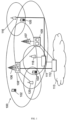
- a wireless communication system 100 such as that shown in FIG. 1
- mobile communication devices or user equipment (UE) 102, 104, 105 are provided wireless access via at least one base station (e.g., next generation NB, gNB) or similar wireless transmitting and/or receiving node or point.
- Base stations may be controlled or assisted by at least one appropriate controller apparatus, so as to enable operation thereof and management of mobile communication devices in communication with the base stations.
- the controller apparatus may be located in a radio access network (e.g., wireless communication system 100) or in a core network (CN) (not shown) and may be implemented as one central apparatus or its functionality may be distributed over several apparatuses.
- CN core network
- the controller apparatus may be part of the base station and/or provided by a separate entity such as a Radio Network Controller (RNC).
- RNC Radio Network Controller
- control apparatus 108 and 109 are shown to control the respective macro level base stations 106 and 107.
- the control apparatus of a base station can be interconnected with other control entities.
- the control apparatus is typically provided with memory capacity and at least one data processor.
- the control apparatus and functions may be distributed between a plurality of control units. In some systems, the control apparatus may additionally or alternatively be provided in a radio network controller.
- base stations 106 and 107 are shown as connected to a wider communications network 113 via gateway 112.
- a further gateway function may be provided to connect to another network.
- the term "base station” has the full breadth of its ordinary meaning, and at least includes a wireless communication station installed at a fixed location and used to communicate as part of a wireless telephone system or radio system.
- the communication area (or coverage area) of the base stations may be referred to as a "cell.”
- the base stations and the UEs may be configured to communicate over the transmission medium using any of various radio access technologies (RATs), also referred to as wireless communication technologies, or telecommunication standards described hereinbelow.
- RATs radio access technologies
- each UE may also be capable of receiving signals from (and possibly within communication range of) one or more other cells (which might be provided by the base stations and/or any other base stations), which may be referred to as “neighboring cells”.
- the smaller base stations 116, 118 and 120 may also be connected to the network 113, for example by a separate gateway function and/or via the controllers of the macro level stations.
- the base stations 116, 118 and 120 may be pico or femto level base stations or the like. In the example, stations 116 and 118 are connected via a gateway 111 whilst station 120 connects via the controller apparatus 108. In some example embodiments, the smaller stations may not be provided. Smaller base stations 116, 118 and 120 may be part of a second network, for example WLAN and may be WLAN APs.
- the communication devices 102, 104, 105 may access the communication system based on various access techniques, such as code division multiple access (CDMA), or wideband CDMA (WCDMA).
- CDMA code division multiple access
- WCDMA wideband CDMA
- TDMA time division multiple access
- FDMA frequency division multiple access
- IFDMA interleaved frequency division multiple access
- SC-FDMA single carrier frequency division multiple access
- OFDMA orthogonal frequency division multiple access
- SDMA space division multiple access
- LTE Long-term evolution
- UMTS Universal Mobile Telecommunications System
- releases The various development stages of the 3GPP specifications are referred to as releases. More recent developments of the LTE are often referred to as LTE Advanced (LTE-A).
- LTE-A employs a radio mobile architecture referred to as the Evolved Universal Terrestrial Radio Access Network (E-UTRAN) and a core network known as the Evolved Packet Core (EPC).
- E-UTRAN Evolved Universal Terrestrial Radio Access Network
- EPC Evolved Packet Core
- Base stations of such systems are referred to as evolved or enhanced Node Bs (eNBs) and provide E-UTRAN features such as user plane Packet Data Convergence/Radio Link Control/Medium Access Control/Physical layer protocol (PDCP/RLC/MAC/PHY) and control plane Radio Resource Control (RRC) protocol terminations towards the communication devices.
- E-UTRAN features such as user plane Packet Data Convergence/Radio Link Control/Medium Access Control/Physical layer protocol (PDCP/RLC/MAC/PHY) and control plane Radio Resource Control (RRC) protocol terminations towards the communication devices.
- RRC Radio Resource Control
- Other examples of radio access system comprise those provided by base stations of systems that are based on technologies such as wireless local area network (WLAN) and/or WiMax (Worldwide Interoperability for Microwave Access).
- WLAN wireless local area network
- WiMax Worldwide Interoperability for Microwave Access
- a base station can provide coverage for an entire cell or similar radio service area.
- Core network elements include Mobility Management Entity
- Network architecture in NR may be compared to that of LTE Advanced.
- Base stations of NR systems may be referred to as next generation Node Bs (gNBs).
- Changes to the network architecture may depend on the need to support various radio technologies and finer QoS support, and some on-demand requirements for e.g. QoS levels to support QoE of user point of view.
- network aware services and applications, and service and application aware networks may bring changes to the architecture. Those are related to Information Centric Network (ICN) and User-Centric Content Delivery Network (UC-CDN) approaches.
- ICN Information Centric Network
- UC-CDN User-Centric Content Delivery Network
- NR may use multiple input-multiple output (MIMO) antennas, many more base stations or nodes than the LTE (a so-called small cell concept), including macro sites operating in co-operation with smaller stations and perhaps also employing a variety of radio technologies for better coverage and enhanced data rates.
- MIMO multiple input-multiple output
- Networks may utilize network functions virtualization (NFV) which is a network architecture concept that virtualize network node functions into "building blocks" or entities that may be operationally connected or linked together to provide services.
- a virtualized network function (VNF) may comprise one or more virtual machines running computer program codes using servers. Cloud computing or data storage may also be utilized.
- radio communications this may mean node operations to be carried out, at least partly, in a server, host or node operationally coupled to a remote radio head. It is also possible that node operations may be distributed among a plurality of servers, nodes or hosts. It should also be understood that the distribution of labor between core network operations and base station operations may differ from that of the LTE or even be non-existent.
- An example 5G core network comprises functional entities.
- the CN is connected to a UE via the radio access network (RAN).
- An UPF User Plane Function
- PSA PDU Session Anchor
- DN data network
- PSA PDU Session Anchor
- the UPF is controlled by an SMF (Session Management Function) that receives policies from a PCF (Policy Control Function).
- SMF Session Management Function
- PCF Policy Control Function
- the CN may also include an AMF (Access & Mobility Function).
- a possible mobile communication device will now be described in more detail with reference to FIG. 2 showing a schematic, partially sectioned view of a communication device 200.
- a communication device is often referred to as user equipment (UE) or terminal device.
- a mobile communication device may be implemented by any device capable of sending and receiving radio signals.
- Non-limiting examples comprise a mobile station (MS) or mobile device, such as a mobile phone or what is referred to as a smart phone, a computer provided with a wireless interface card or other wireless interface facility (e.g., USB dongle), personal data assistant (PDA) or a tablet provided with wireless communication capabilities, or any combinations of these or the like.
- MS mobile station
- PDA personal data assistant
- a mobile communication device may provide, for example, communication of data for carrying communications such as voice, electronic mail (e-mail), text message, multimedia and so on. Users may thus be offered and provided numerous services via their communication devices. Non-limiting examples of these services comprise two-way or multi-way calls, data communication or multimedia services or simply an access to a data communications network system, such as the Internet. Users may also be provided broadcast or multicast data. Non-limiting examples of the content comprise downloads, television and radio programs, videos, advertisements, various alerts and other information.
- a communication device may be a modem integrated into an industrial actuator (e.g., a robot arm) and/or a modem acting as an Ethernet-hub that will act as a connection point for one or several connected Ethernet devices (which connection may be wired or unwired).
- an industrial actuator e.g., a robot arm
- a modem acting as an Ethernet-hub that will act as a connection point for one or several connected Ethernet devices (which connection may be wired or unwired).
- a mobile device is typically provided with at least one data processing entity 201, at least one memory 202 and other possible components 203 for use in software and hardware aided execution of tasks it is designed to perform, including control of access to and communications with access systems and other communication devices.
- the data processing, storage and other relevant control apparatus can be provided on an appropriate circuit board and/or in chip-sets. This feature is denoted by reference 204.
- the user may control the operation of the mobile device by means of a suitable user interface such as keypad 205, voice commands, touch sensitive screen or pad, combinations thereof or the like.
- a display 208, a speaker and a microphone can be also provided.
- a mobile communication device may comprise appropriate connectors (either wired or wireless) to other devices and/or for connecting external accessories, for example hands-free equipment, thereto.
- the communication device 200 may receive signals over an air or radio interface 207 via appropriate apparatus for receiving and may transmit signals via appropriate apparatus for transmitting radio signals.
- transceiver apparatus is designated schematically by block 206.
- the transceiver apparatus 206 may be provided, for example, by means of a radio part and associated antenna arrangement.
- the antenna arrangement may be arranged internally or externally to the mobile device.
- the communication device 200 may additionally or alternatively be configured to communicate using one or more global navigational satellite systems (GNSS, e.g., GPS or GLONASS), one or more mobile television broadcasting standards (e.g., ATSC-M/H or DVB-H), and/or any other wireless communication protocol, if configured.
- GNSS global navigational satellite systems
- mobile television broadcasting standards e.g., ATSC-M/H or DVB-H
- any other wireless communication protocol if configured.
- Other combinations of wireless communication standards including more than two wireless communication standards are also possible.
- the communication device 200 illustrated in FIG. 2 includes a set of components configured to perform core functions.
- this set of components may be implemented as a system on chip (SOC), which may include portions for various purposes.
- SOC system on chip
- this set of components may be implemented as separate components or groups of components for the various purposes.
- the set of components may be coupled (e.g., communicatively; directly or indirectly) to various other circuits of the communication device 200.
- the communication device 200 may include at least one antenna in communication with a transmitter and a receiver (e.g., the transceiver apparatus 206). Alternatively, transmit and receive antennas may be separate.
- the communication device 200 may also include a processor (e.g., the at least one data processing entity 201) configured to provide signals to and receive signals from the transmitter and receiver, respectively, and to control the functioning of the communication device 200.
- the processor may be configured to control the functioning of the transmitter and receiver by effecting control signaling via electrical leads to the transmitter and receiver.
- the processor may be configured to control other elements of the communication device 200 by effecting control signaling via electrical leads connecting processor to the other elements, such as a display (e.g., display 208) or a memory (e.g., the at least one memory 202).
- the processor may, for example, be implemented in a variety of ways including circuitry, at least one processing core, one or more microprocessors with accompanying digital signal processor(s), one or more processor(s) without an accompanying digital signal processor, one or more coprocessors, one or more multi-core processors, one or more controllers, processing circuitry, one or more computers, various other processing elements including integrated circuits (for example, an application specific integrated circuit (ASIC), a field programmable gate array (FPGA), and/or the like), or some combination thereof. Accordingly, in some examples, the processor may comprise a plurality of processors or processing cores.
- ASIC application specific integrated circuit
- FPGA field programmable gate array
- the communication device 200 and/or a cellular modem therein may be capable of operating in accordance with various first generation (1G) communication protocols, second generation (2G or 2.5G) communication protocols, third-generation (3G) communication protocols, fourth-generation (4G) communication protocols, fifth-generation (5G) communication protocols, Internet Protocol Multimedia Subsystem (IMS) communication protocols (for example, session initiation protocol (SIP) and/or the like).
- the communication device 200 may be capable of operating in accordance with 2G wireless communication protocols IS-136, Time Division Multiple Access TDMA, Global System for Mobile communications, GSM, IS-95, Code Division Multiple Access, CDMA, and/or the like.
- the communication device 200 may be capable of operating in accordance with 2.5G wireless communication protocols General Packet Radio Service (GPRS), Enhanced Data GSM Environment (EDGE), and/or the like. Further, for example, the communication device 200 may be capable of operating in accordance with 3G wireless communication protocols, such as Universal Mobile Telecommunications System (UMTS), Code Division Multiple Access 2000 (CDMA2000), Wideband Code Division Multiple Access (WCDMA), Time Division-Synchronous Code Division Multiple Access (TD-SCDMA), and/or the like. The communication device 200 may be additionally capable of operating in accordance with 3.9G wireless communication protocols, such as Long-Term Evolution (LTE), Evolved Universal Terrestrial Radio Access Network (E-UTRAN), and/or the like. Additionally, for example, the communication device 200 may be capable of operating in accordance with 4G wireless communication protocols, such as LTE Advanced, 5G, and/or the like as well as similar wireless communication protocols that may be subsequently developed.
- GPRS General Packet Radio Service
- EDGE Enhanced Data GSM Environment
- the processor may include circuitry for implementing audio/video and logic functions of the communication device 200.
- the processor may comprise a digital signal processor device, a microprocessor device, an analog-to-digital converter, a digital-to-analog converter, and/or the like. Control and signal processing functions of the communication device 200 may be allocated between these devices according to their respective capabilities.
- the processor may additionally comprise an internal voice coder (VC), an internal data modem (DM), and/or the like.
- the processor may include functionality to operate one or more software programs, which may be stored in memory.
- the processor and stored software instructions may be configured to cause the communication device 200 to perform actions.
- the processor may be capable of operating a connectivity program, such as a web browser.
- the connectivity program may allow the communication device 200 to transmit and receive web content, such as location-based content, according to a protocol, such as wireless application protocol (WAP), hypertext transfer protocol (HTTP), and/or the like.
- WAP wireless application protocol
- HTTP hypertext transfer protocol
- the communication device 200 may also comprise a user interface including, for example, an earphone or speaker, a ringer, a microphone, a display, a user input interface, and/or the like, which may be operationally coupled to the processor.
- the display may, as noted above, include a touch sensitive display, where a user may touch and/or gesture to make selections, enter values, and/or the like.
- the processor may also include user interface circuitry configured to control at least some functions of one or more elements of the user interface, such as the speaker, the ringer, the microphone, the display, and/or the like.
- the processor and/or user interface circuitry comprising the processor may be configured to control one or more functions of one or more elements of the user interface through computer program instructions, for example, software and/or firmware, stored on a memory accessible to the processor, for example, volatile memory, non-volatile memory, and/or the like.
- the communication device 200 may include a battery for powering various circuits related to the mobile terminal, for example, a circuit to provide mechanical vibration as a detectable output.
- the user input interface may comprise devices allowing the communication device 200 to receive data, such as a keypad (e.g., keypad 205) and/or other input devices.
- the keypad can also be a virtual keyboard presented on display or an externally coupled keyboard.
- the communication device 200 may also include one or more mechanisms for sharing and/or obtaining data.
- the communication device 200 may include a short-range radio frequency (RF) transceiver and/or interrogator, so data may be shared with and/or obtained from electronic devices in accordance with RF techniques.
- RF radio frequency
- the communication device 200 may include other short-range transceivers, such as an infrared (IR) transceiver, a Bluetooth TM (BT) transceiver operating using Bluetooth TM wireless technology, a wireless universal serial bus (USB) transceiver, a Bluetooth TM Low Energy transceiver, a ZigBee transceiver, an ANT transceiver, a cellular device-to-device transceiver, a wireless local area link transceiver, and/or any other short-range radio technology.
- the communication device 200 and, in particular, the short-range transceiver may be capable of transmitting data to and/or receiving data from electronic devices within the proximity of the apparatus, such as within 10 meters, for example.
- the communication device 200 including the Wi-Fi or wireless local area networking modem may also be capable of transmitting and/or receiving data from electronic devices according to various wireless networking techniques, including 6LoWpan, Wi-Fi, Wi-Fi low power, WLAN techniques such as IEEE 802.11 techniques, IEEE 802.15 techniques, IEEE 802.16 techniques, and/or the like.
- various wireless networking techniques including 6LoWpan, Wi-Fi, Wi-Fi low power, WLAN techniques such as IEEE 802.11 techniques, IEEE 802.15 techniques, IEEE 802.16 techniques, and/or the like.
- the communication device 200 may comprise memory, such as one or more Subscriber Identity Modules (SIM), one or more Universal Subscriber Identity Modules (USIM), one or more removable User Identity Modules (R-UIM), one or more eUICC, one or more UICC, and/or the like, which may store information elements related to a mobile subscriber.
- SIM Subscriber Identity Modules
- USIM Universal Subscriber Identity Modules
- R-UIM removable User Identity Modules
- eUICC embedded UICC
- UICC universal Subscriber Identity Module
- UICC universal Subscriber Identity Module
- the communication device 200 may include volatile memory and/or non-volatile memory.
- the volatile memory may include Random Access Memory (RAM) including dynamic and/or static RAM, on-chip or off-chip cache memory, and/or the like.
- RAM Random Access Memory
- the non-volatile memory which may be embedded and/or removable, may include, for example, read-only memory, flash memory, magnetic storage devices, for example, hard disks, floppy disk drives, magnetic tape, optical disc drives and/or media, non-volatile random-access memory (NVRAM), and/or the like.
- the non-volatile memory may include a cache area for temporary storage of data. At least part of the volatile and/or non-volatile memory may be embedded in the processor.
- the memories may store one or more software programs, instructions, pieces of information, data, and/or the like which may be used by the apparatus for performing operations disclosed herein.
- the memories may comprise an identifier, such as an International Mobile Equipment Identification (IMEI) code, capable of uniquely identifying the communication device 200.
- the memories may comprise an identifier, such as an international mobile equipment identification (IMEI) code, capable of uniquely identifying the communication device 200.
- the processor may be configured using computer code stored at memory to cause the processor to perform operations disclosed herein.
- a "computer-readable medium" may be any non-transitory media that can contain, store, communicate, propagate or transport the instructions for use by or in connection with an instruction execution system, apparatus, or device, such as a computer or data processor circuitry, with examples depicted at FIG. 2
- computer-readable medium may comprise a non-transitory computer-readable storage medium that may be any media that can contain or store the instructions for use by or in connection with an instruction execution system, apparatus, or device, such as a computer.
- the communication device 200 i.e., a user equipment (UE) in a network
- the processor e.g., the at least one data processing entity 201
- the memory e.g., the at least one memory 202
- the memory includes computer program code causing the communication device 200 to perform processing according to one or more of the methods described below with reference to FIGS. 5 and 6 .
- FIG. 3 shows an example embodiment of a control apparatus for a communication system, for example to be coupled to and/or for controlling a station of an access system, such as a RAN node, e.g., a base station, eNB or gNB, a relay node or a core network node such as an MME or S-GW or P-GW, or a core network function such as AMF/SMF, or a server or host.
- the method may be implanted in a single control apparatus or across more than one control apparatus.
- the control apparatus may be integrated with or external to a node or module of a core network or RAN.
- base stations comprise a separate control apparatus unit or module.
- control apparatus can be another network element, such as a radio network controller or a spectrum controller.
- each base station may have such a control apparatus as well as a control apparatus being provided in a radio network controller.
- the control apparatus 300 can be arranged to provide control on communications in the service area of the system.
- the control apparatus 300 comprises at least one memory 301, at least one data processing unit 302, 303 and an input/output interface 304. Via the interface, the control apparatus can be coupled to a receiver and a transmitter of the base station.
- the receiver and/or the transmitter may be implemented as a radio front end or a remote radio head.
- the control apparatus 300 has an antenna, which transmits and receives radio signals.
- a radio frequency (RF) transceiver module coupled with the antenna, receives RF signals from antenna, converts them to baseband signals and sends them to processor (e.g., the at least one data processing unit 302, 303).
- RF transceiver also converts received baseband signals from processor, converts them to RF signals, and sends out to antenna.
- Processor processes the received baseband signals and invokes different functional modules to perform features in control apparatus 300.
- Memory e.g., the at least one memory 301 stores program instructions and data to control the operations of the control apparatus 300.
- the control apparatus 300 also includes protocol stack and a set of control functional modules and circuit.
- PDU session handling circuit handles PDU session establishment and modification procedures.
- Policy control module that configures policy rules for UE.
- Configuration and control circuit provides different parameters to configure and control UE of related functionalities including mobility management and session management.
- Suitable processors include, by way of example, a special purpose processor, a digital signal processor (DSP), a plurality of micro-processors, one or more micro-processor associated with a DSP core, a controller, a microcontroller, application specific integrated circuits (ASICs), file programmable gate array (FPGA) circuits, and other type of integrated circuits (ICs), and/or state machines.
- DSP digital signal processor
- ASICs application specific integrated circuits
- FPGA file programmable gate array
- control apparatus 300 i.e., the base station or the wireless transmitting and/or receiving point equipment
- the processor e.g., the at least one data processing unit 302, 303
- the memory e.g., the at least one memory 301.
- the memory includes computer program code causing the control apparatus 300 to perform processing according to the method described below with reference to FIG. 7 .
- call transfer between devices shall include both call push mechanisms, where a call is pushed from the device in a call to another device, and call pull mechanisms, where a call is pulled from the device to the other device.
- a call (or more generally, a session) is initiated (e.g., user initiated, machine initiated, and so forth) between a user equipment (referred to as a second user equipment UE 2) to another user equipment (referred to as another user equipment UE X) via one or more networks (referred to as the network(s)).
- the call is ongoing, for example, it is decided (e.g., by a user of UE 2) at step 2 to transfer the call from UE 2 to yet another user equipment (referred to as the first user equipment UE 1) by pulling the call from UE 2.
- UE 1 sends an access attempt to the network(s) at step 3.
- the network(s) receiving the access attempt coordinates the transfer of the call by performing corresponding signaling to the UEs (i.e., UE 2 and UE X) participating the call and also UE 1 at step 4.
- the signaling results in that the call is transferred from UE 2 to UE 1 and continued between UE 1 and UE X via the network(s) at step 5.
- UE 2 may perform a barring check before making the access attempt to the network(s) in step 3.
- the barring check may result in that to pull the call is "not barred” (i.e., to pull the call is allowed) and thus can be done in accordance with the procedure of FIG. 4 , i.e., the access attempt is made to the network(s).
- the result of the barring check is "barred" (i.e., to pull the call is not allowed)
- UE 1 is prohibited from making the access attempt toward the network(s). That is, UE 1 is not allowed to make the access attempt to toward the network(s).
- the call pull fails and the call will continue between UE 2 and UE X.
- the subject disclosure provides a method to prevent denial of transfer of the call.
- FIG. 5 illustrates a flow chart of a method to prevent denial of call transfer according to some example embodiments.
- the method 500 is performed by a user equipment (UE) or by an apparatus in the UE.
- the UE may be represented by any one of the mobile communication devices 102, 104, 105 of the wireless communication system 100 as described above with reference to FIG. 1 , or the communication device 200 as described above with reference to FIG. 2 .
- the method starts at block 520 with indicating that the call pull is initiated. That is, the apparatus in the first UE (i.e., UE 1) performs processing related to the initiation of the call pull.
- the processing involves that the initiation of the call pull is to be handled by the apparatus, for example, in accordance with a layered architecture of the apparatus. In some examples, as will be described in more detail hereinbelow, the initiation of the call pull is indicated from upper layers to lower layers of the layered architecture of the apparatus.
- the indication at block 520 may, in some examples, be performed in response to determining at optional block 510 that the call pull for pulling the call from the second UE (i.e., UE 2) to the first UE is initiated.
- the determination may be based on the decision (e.g., user decision, machine decision, and so forth) to pull the call using the second UE.
- the user may provide an instruction for the call pull to the first UE, possibly together with the selection of the second UE (e.g., selection of one UE among federated UEs of the user).
- federated UEs concerns a group of UEs which are configured to use the same public user identity.
- the instruction may have the form of pushing a button of the first UE, touching on a given region on a touch-sensitive display of the first UE, providing a voice command via a microphone of the first UE, a result of an automated logic-based decision, or the like. That is, the apparatus in the first UE determines that the instruction for the call pull using the second UE was given (or entered).
- the apparatus categorized an access attempt occurred for the call pull as a mobile-terminated access attempt. That is, in response to receiving the indication that the call pull is initiated, the access attempt (i.e., the access attempt related to the call pull) is prepared in a way such that the access attempt is considered to be occurred due to a request that is to be terminated on or delivered to the first UE (i.e., the request terminated at the first UE).
- the access attempt categorized to be mobile-terminated causes the apparatus to consider that the access attempt occurred due to mobile-terminated request and therefore as not barred.
- the apparatus may categorize the access attempt using a mapping.
- the apparatus then makes the access attempt to the network, at block 540.
- the apparatus makes the access attempt by transmitting a message to the network.
- the message may indicate the access attempt or the message may include a cause value set according to the categorization of the access attempt.
- the access attempt for the call pull may be mapped to an access category representing the mobile-terminated access attempt.
- the cause value may be set to the access category representing the mobile-terminated access attempt. For example, in case the first UE is registered in an NG-RAN cell, the access category corresponds to access category 0 in accordance with 3GPP TS 24.501.
- the access attempt for the call pull may be mapped to a cause value and/or a call type.
- the message to be transmitted to the network may further comprise the call type.
- the cause value corresponds to an RRC establishment cause value indicating the mobile-terminated access attempt and/or the call type corresponds to a call type indicating terminating calls in accordance with 3GPP TS 24.501.
- categorizing the access attempt occurred for the call pull as the mobile-terminated access attempt causes the apparatus and thus the first UE to consider that the access attempt occurred due to mobile-terminated request.
- This prevents a denial of call transfer, for example, as a barring check for the access attempt (not mapped to mobile-terminated) may result in that the access attempt is barred, resulting in that the call pull fails.
- FIG. 6 illustrates a flow chart of the method to prevent denial of call transfer according to some example embodiments. Again, the method is performed by a user equipment (UE) or by an apparatus in the UE.
- UE user equipment
- the layered architecture of the apparatus comprises at least an upper layer, such as an application layer and lower layers.
- the upper layer may include an IP Multimedia Subsystem (IMS) client (the upper layer is referred to as IMS client hereinbelow). That is, the apparatus comprises the IMS client at the application layer.
- the lower layers may include a first lower layer, such as a Non-Access Stratum (NAS) layer (the first lower layer is referred to as NAS layer hereinbelow), and a second lower layer, such as an Access Stratum (AS) layer (the second lower layer is referred to as AS layer hereinbelow).
- NAS Non-Access Stratum
- AS Access Stratum
- the IMS client When the call pull is initiated with the first UE as described above with reference to block 510 shown in FIG. 5 , the IMS client indicates to lower layers that a call pull is initiated (started). More specifically, in response to the decision (e.g., user decision, machine-based decision, and so forth) to pull the call at step 1, the IMS client provides, at step 2, an indication that the call pull is initiated to the NAS layer. At step 3, the lower layers or more specifically the NAS layer maps an access attempt occurred for the call pull to indicate the access attempt to be mobile-terminated (i.e., the NAS layer categorizes that access attempt as the mobile-terminated access attempt).
- the decision e.g., user decision, machine-based decision, and so forth
- the NAS layer may map the access attempt to an access category representing that the access attempt is for mobile-terminated access (e.g., Access Category 0 which represents that the access attempt is for mobile-terminated access, if the first UE is registered in an NG-RAN cell).
- the NAS layer may map the access attempt to a cause value and/or a call type (e.g., an RRC establishment cause value indicating mobile-terminated access and/or a call type indicating terminating calls, if the first UE is registered in an E-UTRAN cell).
- the NAS layer may, in some examples, provide the access attempt mapped to indicate mobile-terminated to the AS layer.
- the NAS layer may provide ⁇ Access Category 0 ⁇ or ⁇ RRC establishment cause "MT access", call type "terminating calls” ⁇ to the AS layer.
- the AS layer receiving the access attempt considers that the access attempt occurred due to mobile-terminated request, avoiding that the access attempt is barred and thus preventing denial of call transfer.
- the UE e.g., the AS layer
- the message may include the access attempt. More specifically, the message may include a cause value set according to the categorization of the access attempt.
- the cause value may comprise, set to, or represent, an access category representing the mobile-terminated access attempt. In other examples, the cause value comprises a cause value and/or a call type.
- the access attempt for call pull may be mapped to an access category or RRC establishment cause value / call type already defined in 3GPP TS 24.501.
- the access attempt for call pull may also be mapped to a new access category or RRC establishment cause value / call type specifically relating to call pull.
- the new access category or RRC establishment cause value / call type exempt from access control may also be used.
- the Access Category 0 is used in case of a call pull and thus is of the
- the mapping table according to 3GPP TS 24.501 to be used by the NAS layer in case the first UE is registered in an E-UTRAN may include the following definition relating to RRC establishment cause value and/or call type: NAS procedure RRC establishment cause (according 3GPP TS 36.331) Call type Tracking Area Update If the UE does not have a PDN connection established for emergency bearer services and is not initiating a PDN CONNECTIVITY REQUEST that has request type set to "emergency" or "handover of emergency bearer services", and a TRACKING AREA UPDATE REQUEST is triggered upon receiving a call-pull-initiated indication from the upper layers (see 3GPP TS 24.174), the RRC establishment cause shall be set to MT access.
- terminal calls Service Request If a SERVICE REQUEST is triggered upon receiving a call-pull-initiated indication from the upper layers (see 3GPP TS 24.174), the RRC establishment cause shall be set to MT access. "terminating calls” In other words, the RRC establishment cause set to mobile-terminated (MT) access and the call type set to "terminating calls” are to be used in case of a call pull.
- MT mobile-terminated
- the network may initiate signaling for call transfer to UEs involved, e.g., the first UE, the second UE and optionally also the other UE with which the call is ongoing (i.e., UE X) (step 4 in FIG. 4 ).
- the first UE may signal (e.g., send an INVITE message) to the second UE (step 4 in FIG. 4 ).
- the second UE may reply (step 4 in FIG.
- the call is transferred (step 5 in FIG. 5 ) and will be proceed further between the first UE and the other UE via the network(s).
- signaling e.g., "200 OK" response if successful.
- FIG. 7 illustrates a flow chart of a method prevent denial of call transfer according to some example embodiments.
- the method 700 is performed by the network. More specifically, the method may be performed by a base station, such as the base station represented by the control apparatus 300 as described above with reference to FIG. 3 or by an apparatus in the base station.
- the base station may be a serving base station, or a gNB or a transmission/reception point (TRP) in a 5GS.
- TRP transmission/reception point
- the method may be performed at a core network function such as AMF.
- a call is initiated (e.g., user initiated, machine initiated, and so forth) between the second UE (UE 2) to another user equipment (UE X) via the network(s).
- the user may, for example, decide to transfer the call from the second UE to the first UE.
- the transfer of the call is to be done by pulling the call from the second UE to the first UE.
- the steps performed by the first UE in response to the user deciding to pull the call are described with reference to FIGS. 5 and 6 .
- the first UE sends a message or an access attempt to the network(s) (step 3 in FIG. 4 ) according to some example embodiments.
- the network receives the access attempt or the message from the first UE (UE 1).
- the message may indicate the access attempt or the message may include a cause value set according to categorization of the access attempt.
- the access attempt is a call pull to pull a call from the second UE (UE 2) to the first UE.
- the access attempt is categorized, by the first UE, as mobile-terminated access attempt. As described above in more detailed, the access attempt may be categorized by mapping the access attempt to mobile-terminated.
- the access attempt for the call pull may be mapped to an access category representing the mobile-terminated access attempt.
- the cause value in the message is set to the access category representing the mobile-terminated access attempt.
- the access category may comprise access category 0 if UE 1 is in an NG-RAN cell. Using the access category and one or more access identities, the first UE can determine an RRC establishment cause.
- the access attempt for the call pull may be mapped to a cause value and/or a call type.
- the message may further comprise the call type.
- the cause value may comprise an RRC establishment cause value indicating the mobile-terminated access attempt and/or the call type may comprise a call type indicating terminating calls, if the first UE is in an E-UTRAN cell.
- the network performs an access control based on the message at block 720. More specifically, the network may perform the access control based on the access attempt indicated in the message or based on the cause value set according to the categorization of the access attempt.
- the network may further perform signaling for call transfer to the first UE, the second UE and optionally also the other UE (UE X).
- the UEs may perform processing for transferring the call in accordance with signaling, and the UEs may also acknowledge call transfer. As a result, the call is transferred (i.e., pull) from the second UE to the first UE and will be continued at block 730 between the first UE and the other UE via the network(s).
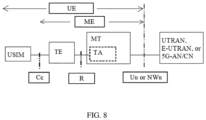
- FIG. 8 illustrates a PLMN Access Reference Configuration in accordance with 3GPP TS 24.002.
- the method to prevent denial of call transfer concerns the interaction between the Mobile Termination (shown as MT in FIG. 8 ) and the Terminal Equipment (shown as TE in FIG. 8 ).
- the subject disclosure may relate to the R interface between the MT and the TE.
- the UE i.e., the first UE
- may pull a session e.g., a call
- another federated UE i.e., the second UE
- apparatuses may comprise or be coupled to other units or modules etc., such as radio parts or radio heads, used in or for transmission and/or reception.
- apparatuses have been described as one entity, different modules and memory may be implemented in one or more physical or logical entities.
- the various example embodiments may be implemented in hardware or special purpose circuits, software, logic or any combination thereof.
- Some aspects of the subject disclosure may be implemented in hardware, while other aspects may be implemented in firmware or software which may be executed by a controller, microprocessor or other computing device, although the subject disclosure is not limited thereto. While various aspects of the subject disclosure may be illustrated and described as block diagrams, flow charts, or using some other pictorial representation, it is well understood that these blocks, apparatus, systems, techniques or methods described herein may be implemented in, as non-limiting examples, hardware, software, firmware, special purpose circuits or logic, general purpose hardware or controller or other computing devices, or some combination thereof.
- Example embodiments of the subject disclosure may be implemented by computer software executable by a data processor of the mobile device, such as in the processor entity, or by hardware, or by a combination of software and hardware.
- Computer software or program also called program product, including software routines, applets and/or macros, may be stored in any apparatus-readable data storage medium and they comprise program instructions to perform particular tasks.
- a computer program product may comprise one or more computer- executable components which, when the program is run, are configured to carry out example embodiments.
- the one or more computer-executable components may be at least one software code or portions of it.
- any blocks of the logic flow as in the figures may represent program steps, or interconnected logic circuits, blocks and functions, or a combination of program steps and logic circuits, blocks and functions.
- the software may be stored on such physical media as memory chips, or memory blocks implemented within the processor, magnetic media such as hard disk or floppy disks, and optical media such as for example DVD and the data variants thereof, CD.
- the physical media is a non-transitory media.
- the memory may be of any type suitable to the local technical environment and may be implemented using any suitable data storage technology, such as semiconductor-based memory devices, magnetic memory devices and systems, optical memory devices and systems, fixed memory and removable memory.
- the data processors may be of any type suitable to the local technical environment, and may comprise one or more of general-purpose computers, special purpose computers, microprocessors, digital signal processors (DSPs), application specific integrated circuits (ASICs), FPGA, gate level circuits and processors based on multi-core processor architecture, as non-limiting examples.
- Example embodiments of the subject disclosure may be practiced in various components such as integrated circuit modules.
- the design of integrated circuits is by and large a highly automated process.
- Complex and powerful software tools are available for converting a logic level design into a semiconductor circuit design ready to be etched and formed on a semiconductor substrate.
Landscapes
- Engineering & Computer Science (AREA)
- Signal Processing (AREA)
- Computer Networks & Wireless Communication (AREA)
- Multimedia (AREA)
- Business, Economics & Management (AREA)
- General Business, Economics & Management (AREA)
- Mobile Radio Communication Systems (AREA)
Claims (15)
- Procédé (500), comprenant:indiquer, au moyen d'un appareil d'un équipement utilisateur, UE, apte à fonctionner dans un système 5G, qu'une extraction d'appel est initié (520) ;catégoriser, au moyen de l'appareil, une tentative d'accès survenue pour l'extraction d'appel en tant que tentative d'accès à destination d'un mobile (530) ; eteffectuer, au moyen de l'appareil, la tentative d'accès à un réseau en transmettant un message pour permettre un processus pour l'extraction d'appel, dans lequel le message comprend une valeur de cause définie en fonction de la catégorisation de la tentative d'accès (540).
- Procédé selon la revendication 1, comprenant en outre :
indiquer que l'extraction d'appel est initié (520) en réponse à la détermination, au moyen de l'appareil, que l'extraction d'appel est initié pour extraire, vers l'UE, un appel provenant d'un autre équipement utilisateur, UE (510). - Procédé selon la revendication 1 ou 2, comprenant en outre:
amener, au moyen de l'appareil, la tentative d'accès à être considérée comme non interdite sur la base du fait que la tentative d'accès est catégorisée comme étant la tentative d'accès à destination d'un mobile. - Procédé de l'une quelconque des revendications 1 à 3, dans lequel la valeur de cause est définie sur une catégorie d'accès représentant la tentative d'accès à destination d'un mobile.
- Procédé selon la revendication 4, dans lequel la catégorie d'accès comprend la catégorie d'accès 0 si l'UE se trouve dans une cellule NG-RAN.
- Procédé de l'une quelconque des revendications 1 à 5, dans lequel le message comporte en outre un type d'appel.
- Procédé selon la revendication 6, dans lequel la valeur de cause comprend une valeur de cause d'établissement RRC indiquant la tentative d'accès à destination d'un mobile et/ou le type d'appel comprend un type d'appel indiquant des appels d'arrivée, si l'UE se trouve dans une cellule E-UTRAN.
- Procédé de l'une quelconque des revendications 1 à 7, dans lequel indiquer qu'une extraction d'appel est initiée (520) comprend l'indication, depuis une couche supérieure de l'appareil à des couches inférieures de l'appareil, que l'extraction d'appel est initiée.
- Procédé selon la revendication 8, dans lequel catégoriser la tentative d'accès (530) comprend la catégorisation, au niveau des couches inférieures, de la tentative d'accès, et effectuer la tentative d'accès comprend la réalisation, au niveau des couches inférieures, de la tentative d'accès.
- Procédé selon la revendication 9, dans lequel les couches inférieures comprennent une première couche inférieure au niveau de laquelle doit être catégorisée la tentative d'accès, et une deuxième couche inférieure au niveau de laquelle doit être effectuée la tentative d'accès, et dans lequel le procédé comprend en outre la fourniture, de la première couche inférieure à la deuxième couche inférieure, de la tentative d'accès catégorisée comme étant la tentative d'accès à destination d'un mobile.
- Procédé selon la revendication 10, dans lequel la couche supérieure comprend une couche d'application avec un client de sous-système multimédia IP, IMS, la première couche inférieure comprend une couche de strate de non-accès, NAS, et/ou la deuxième couche inférieure comprend une couche de strate d'accès, AS.
- Procédé (700), comprenant :recevoir, sur un réseau, en provenance d'un équipement utilisateur apte à fonctionner dans un système 5G, un message comprenant une valeur de cause définie en fonction de la catégorisation d'une tentative d'accès (710) ; eteffectuer un contrôle d'accès sur la base de la valeur de cause (720),dans lequel :la tentative d'accès est destinée à une extraction d'appel ; etl'équipement utilisateur catégorise la tentative d'accès comme étant une tentative d'accès à destination d'un mobile.
- Appareil (200) pour un équipement utilisateur, UE, apte à fonctionner dans un système 5G, comprenant :au moins un processeur (201) ; etau moins une mémoire (202) comprenant un code de programme informatique, dans lequel le code de programme informatique amène l'appareil, lorsqu'il est exécuté par l'au moins un processeur (201), à au moins :indiquer qu'une extraction d'appel est initié ;catégoriser une tentative d'accès survenue pour l'extraction d'appel comme étant une tentative d'accès à destination d'un mobile ; eteffectuer la tentative d'accès à un réseau en transmettant un message pour permettre un processus pour l'extraction d'appel, dans lequel le message comporte une valeur de cause définie en fonction de la catégorisation de la tentative d'accès.
- Appareil (300) pour un dispositif de réseau en mesure de fonctionner dans un système 5G, comprenant :au moins un processeur (302) ; etau moins une mémoire (301) comprenant un code de programme informatique, dans lequel le code de programme informatique amène l'appareil, lorsqu'il est exécuté par l'au moins un processeur (302), à au moins :recevoir, en provenance d'un équipement utilisateur, un message comprenant une valeur de cause définie en fonction de la catégorisation d'une tentative d'accès ; eteffectuer un contrôle d'accès sur la base de la valeur de cause,dans lequel :la tentative d'accès est destinée à une extraction d'appel ; etl'équipement utilisateur catégorise la tentative d'accès comme étant une tentative d'accès à destination d'un mobile.
- Produit de programme informatique comprenant des instructions de programme stockées sur un support lisible par ordinateur pour exécuter le procédé selon l'une quelconque des revendications 1 à 12 lorsque ledit programme est exécuté sur un ordinateur.
Priority Applications (7)
| Application Number | Priority Date | Filing Date | Title |
|---|---|---|---|
| EP22150532.4A EP4210311B1 (fr) | 2022-01-07 | 2022-01-07 | Procédé et appareil pour empêcher le refus d'un transfert d'appel |
| PCT/EP2022/086073 WO2023131494A1 (fr) | 2022-01-07 | 2022-12-15 | Procédé et appareil pour empêcher le refus de transfert d'appel |
| CN202280086279.2A CN118451698A (zh) | 2022-01-07 | 2022-12-15 | 用于防止拒绝呼叫转移的方法和装置 |
| MX2024008482A MX2024008482A (es) | 2022-01-07 | 2022-12-15 | Metodo y aparato para prevenir la denegacion de transferencia de llamada. |
| TW112100228A TWI868555B (zh) | 2022-01-07 | 2023-01-04 | 防止拒絕通話轉移之方法及設備 |
| US18/094,692 US20230224409A1 (en) | 2022-01-07 | 2023-01-09 | Method and apparatus to prevent denial of call transfer |
| ZA2024/05913A ZA202405913B (en) | 2022-01-07 | 2024-07-31 | Method and apparatus to prevent denial of call transfer |
Applications Claiming Priority (1)
| Application Number | Priority Date | Filing Date | Title |
|---|---|---|---|
| EP22150532.4A EP4210311B1 (fr) | 2022-01-07 | 2022-01-07 | Procédé et appareil pour empêcher le refus d'un transfert d'appel |
Publications (3)
| Publication Number | Publication Date |
|---|---|
| EP4210311A1 EP4210311A1 (fr) | 2023-07-12 |
| EP4210311C0 EP4210311C0 (fr) | 2025-01-29 |
| EP4210311B1 true EP4210311B1 (fr) | 2025-01-29 |
Family
ID=79927084
Family Applications (1)
| Application Number | Title | Priority Date | Filing Date |
|---|---|---|---|
| EP22150532.4A Active EP4210311B1 (fr) | 2022-01-07 | 2022-01-07 | Procédé et appareil pour empêcher le refus d'un transfert d'appel |
Country Status (7)
| Country | Link |
|---|---|
| US (1) | US20230224409A1 (fr) |
| EP (1) | EP4210311B1 (fr) |
| CN (1) | CN118451698A (fr) |
| MX (1) | MX2024008482A (fr) |
| TW (1) | TWI868555B (fr) |
| WO (1) | WO2023131494A1 (fr) |
| ZA (1) | ZA202405913B (fr) |
Family Cites Families (5)
| Publication number | Priority date | Publication date | Assignee | Title |
|---|---|---|---|---|
| EP3619955B1 (fr) * | 2017-05-05 | 2024-01-24 | Apple Inc. | Mécanisme de contrôle d'accès |
| JP7092191B2 (ja) * | 2017-11-16 | 2022-06-28 | 富士通株式会社 | アクセス制御方法、装置及び通信システム |
| CN113056937B (zh) * | 2018-11-29 | 2024-01-23 | 谷歌有限责任公司 | 向上层通知对多个接入类别的限制减轻 |
| US11405814B2 (en) * | 2019-10-02 | 2022-08-02 | Lg Electronics Inc. | Method and apparatus for informing relaxed measurement upon early measurement reporting in a wireless communication system |
| CN117204045A (zh) * | 2021-03-12 | 2023-12-08 | 欧芬诺有限责任公司 | 小数据传输 |
-
2022
- 2022-01-07 EP EP22150532.4A patent/EP4210311B1/fr active Active
- 2022-12-15 WO PCT/EP2022/086073 patent/WO2023131494A1/fr not_active Ceased
- 2022-12-15 CN CN202280086279.2A patent/CN118451698A/zh active Pending
- 2022-12-15 MX MX2024008482A patent/MX2024008482A/es unknown
-
2023
- 2023-01-04 TW TW112100228A patent/TWI868555B/zh active
- 2023-01-09 US US18/094,692 patent/US20230224409A1/en active Pending
-
2024
- 2024-07-31 ZA ZA2024/05913A patent/ZA202405913B/en unknown
Also Published As
| Publication number | Publication date |
|---|---|
| ZA202405913B (en) | 2026-01-28 |
| EP4210311C0 (fr) | 2025-01-29 |
| CN118451698A (zh) | 2024-08-06 |
| WO2023131494A1 (fr) | 2023-07-13 |
| TW202345569A (zh) | 2023-11-16 |
| MX2024008482A (es) | 2024-07-15 |
| EP4210311A1 (fr) | 2023-07-12 |
| TWI868555B (zh) | 2025-01-01 |
| US20230224409A1 (en) | 2023-07-13 |
Similar Documents
| Publication | Publication Date | Title |
|---|---|---|
| US20250142432A1 (en) | Configuration enhancements for l1/l2 mobility | |
| US20250274996A1 (en) | Method and apparatus for controlling a user device | |
| US20250088956A1 (en) | Method and apparatus for controlling a user device in a network | |
| US20240129710A1 (en) | Methods and apparatus for subscription authorization enhancement | |
| EP3756333B1 (fr) | Procédé, appareil et programme informatique | |
| WO2023131553A1 (fr) | Procédé et appareil pour attribuer une tranche de réseau pour une session associée à un système patrimonial | |
| EP4210311B1 (fr) | Procédé et appareil pour empêcher le refus d'un transfert d'appel | |
| US20240236942A9 (en) | Methods and apparatuses for controlling multi-usim behaviour of user equipment | |
| US20240205813A1 (en) | Method and apparatus to access core networks via gateway functions | |
| EP3777447B1 (fr) | Appareil, procédé et programme informatique | |
| EP4322581A1 (fr) | Procédé et appareil pour contrôler des tranches de réseau demandées par un équipement utilisateur | |
| US20250220637A1 (en) | Method and apparatus for paging | |
| US20250324335A1 (en) | Methods and apparatus of operating user equipment and network devices | |
| HK40106706A (en) | Method and apparatus to access core networks via gateway functions | |
| HK40112236A (en) | Method and apparatus for controlling a user device in a network | |
| WO2024166063A2 (fr) | Mobilité à travers une zone de service de tranche limitée pendant des transferts intra-gnb et inter-gnb |
Legal Events
| Date | Code | Title | Description |
|---|---|---|---|
| PUAI | Public reference made under article 153(3) epc to a published international application that has entered the european phase |
Free format text: ORIGINAL CODE: 0009012 |
|
| STAA | Information on the status of an ep patent application or granted ep patent |
Free format text: STATUS: THE APPLICATION HAS BEEN PUBLISHED |
|
| AK | Designated contracting states |
Kind code of ref document: A1 Designated state(s): AL AT BE BG CH CY CZ DE DK EE ES FI FR GB GR HR HU IE IS IT LI LT LU LV MC MK MT NL NO PL PT RO RS SE SI SK SM TR |
|
| STAA | Information on the status of an ep patent application or granted ep patent |
Free format text: STATUS: REQUEST FOR EXAMINATION WAS MADE |
|
| 17P | Request for examination filed |
Effective date: 20231115 |
|
| RBV | Designated contracting states (corrected) |
Designated state(s): AL AT BE BG CH CY CZ DE DK EE ES FI FR GB GR HR HU IE IS IT LI LT LU LV MC MK MT NL NO PL PT RO RS SE SI SK SM TR |
|
| GRAP | Despatch of communication of intention to grant a patent |
Free format text: ORIGINAL CODE: EPIDOSNIGR1 |
|
| STAA | Information on the status of an ep patent application or granted ep patent |
Free format text: STATUS: GRANT OF PATENT IS INTENDED |
|
| RIC1 | Information provided on ipc code assigned before grant |
Ipc: H04M 7/00 20060101ALI20240423BHEP Ipc: H04L 65/80 20220101ALI20240423BHEP Ipc: H04W 4/16 20090101ALI20240423BHEP Ipc: H04L 65/1094 20220101ALI20240423BHEP Ipc: H04L 65/1096 20220101ALI20240423BHEP Ipc: H04M 3/58 20060101AFI20240423BHEP |
|
| INTG | Intention to grant announced |
Effective date: 20240510 |
|
| GRAS | Grant fee paid |
Free format text: ORIGINAL CODE: EPIDOSNIGR3 |
|
| GRAJ | Information related to disapproval of communication of intention to grant by the applicant or resumption of examination proceedings by the epo deleted |
Free format text: ORIGINAL CODE: EPIDOSDIGR1 |
|
| GRAL | Information related to payment of fee for publishing/printing deleted |
Free format text: ORIGINAL CODE: EPIDOSDIGR3 |
|
| STAA | Information on the status of an ep patent application or granted ep patent |
Free format text: STATUS: REQUEST FOR EXAMINATION WAS MADE |
|
| GRAP | Despatch of communication of intention to grant a patent |
Free format text: ORIGINAL CODE: EPIDOSNIGR1 |
|
| STAA | Information on the status of an ep patent application or granted ep patent |
Free format text: STATUS: GRANT OF PATENT IS INTENDED |
|
| INTG | Intention to grant announced |
Effective date: 20240910 |
|
| GRAA | (expected) grant |
Free format text: ORIGINAL CODE: 0009210 |
|
| STAA | Information on the status of an ep patent application or granted ep patent |
Free format text: STATUS: THE PATENT HAS BEEN GRANTED |
|
| AK | Designated contracting states |
Kind code of ref document: B1 Designated state(s): AL AT BE BG CH CY CZ DE DK EE ES FI FR GB GR HR HU IE IS IT LI LT LU LV MC MK MT NL NO PL PT RO RS SE SI SK SM TR |
|
| REG | Reference to a national code |
Ref country code: GB Ref legal event code: FG4D |
|
| REG | Reference to a national code |
Ref country code: CH Ref legal event code: EP |
|
| REG | Reference to a national code |
Ref country code: DE Ref legal event code: R096 Ref document number: 602022009885 Country of ref document: DE |
|
| REG | Reference to a national code |
Ref country code: IE Ref legal event code: FG4D |
|
| U01 | Request for unitary effect filed |
Effective date: 20250205 |
|
| U07 | Unitary effect registered |
Designated state(s): AT BE BG DE DK EE FI FR IT LT LU LV MT NL PT RO SE SI Effective date: 20250211 |
|
| PG25 | Lapsed in a contracting state [announced via postgrant information from national office to epo] |
Ref country code: RS Free format text: LAPSE BECAUSE OF FAILURE TO SUBMIT A TRANSLATION OF THE DESCRIPTION OR TO PAY THE FEE WITHIN THE PRESCRIBED TIME-LIMIT Effective date: 20250429 |
|
| PG25 | Lapsed in a contracting state [announced via postgrant information from national office to epo] |
Ref country code: PL Free format text: LAPSE BECAUSE OF FAILURE TO SUBMIT A TRANSLATION OF THE DESCRIPTION OR TO PAY THE FEE WITHIN THE PRESCRIBED TIME-LIMIT Effective date: 20250129 |
|
| PG25 | Lapsed in a contracting state [announced via postgrant information from national office to epo] |
Ref country code: ES Free format text: LAPSE BECAUSE OF FAILURE TO SUBMIT A TRANSLATION OF THE DESCRIPTION OR TO PAY THE FEE WITHIN THE PRESCRIBED TIME-LIMIT Effective date: 20250129 |
|
| PG25 | Lapsed in a contracting state [announced via postgrant information from national office to epo] |
Ref country code: IS Free format text: LAPSE BECAUSE OF FAILURE TO SUBMIT A TRANSLATION OF THE DESCRIPTION OR TO PAY THE FEE WITHIN THE PRESCRIBED TIME-LIMIT Effective date: 20250529 Ref country code: NO Free format text: LAPSE BECAUSE OF FAILURE TO SUBMIT A TRANSLATION OF THE DESCRIPTION OR TO PAY THE FEE WITHIN THE PRESCRIBED TIME-LIMIT Effective date: 20250429 |
|
| PG25 | Lapsed in a contracting state [announced via postgrant information from national office to epo] |
Ref country code: HR Free format text: LAPSE BECAUSE OF FAILURE TO SUBMIT A TRANSLATION OF THE DESCRIPTION OR TO PAY THE FEE WITHIN THE PRESCRIBED TIME-LIMIT Effective date: 20250129 |
|
| PG25 | Lapsed in a contracting state [announced via postgrant information from national office to epo] |
Ref country code: GR Free format text: LAPSE BECAUSE OF FAILURE TO SUBMIT A TRANSLATION OF THE DESCRIPTION OR TO PAY THE FEE WITHIN THE PRESCRIBED TIME-LIMIT Effective date: 20250430 |
|
| PG25 | Lapsed in a contracting state [announced via postgrant information from national office to epo] |
Ref country code: SM Free format text: LAPSE BECAUSE OF FAILURE TO SUBMIT A TRANSLATION OF THE DESCRIPTION OR TO PAY THE FEE WITHIN THE PRESCRIBED TIME-LIMIT Effective date: 20250129 |
|
| PG25 | Lapsed in a contracting state [announced via postgrant information from national office to epo] |
Ref country code: CZ Free format text: LAPSE BECAUSE OF FAILURE TO SUBMIT A TRANSLATION OF THE DESCRIPTION OR TO PAY THE FEE WITHIN THE PRESCRIBED TIME-LIMIT Effective date: 20250129 |
|
| PG25 | Lapsed in a contracting state [announced via postgrant information from national office to epo] |
Ref country code: SK Free format text: LAPSE BECAUSE OF FAILURE TO SUBMIT A TRANSLATION OF THE DESCRIPTION OR TO PAY THE FEE WITHIN THE PRESCRIBED TIME-LIMIT Effective date: 20250129 |
|
| PLBE | No opposition filed within time limit |
Free format text: ORIGINAL CODE: 0009261 |
|
| STAA | Information on the status of an ep patent application or granted ep patent |
Free format text: STATUS: NO OPPOSITION FILED WITHIN TIME LIMIT |
|
| 26N | No opposition filed |
Effective date: 20251030 |
|
| PGFP | Annual fee paid to national office [announced via postgrant information from national office to epo] |
Ref country code: GB Payment date: 20251204 Year of fee payment: 5 |
|
| U20 | Renewal fee for the european patent with unitary effect paid |
Year of fee payment: 5 Effective date: 20251205 |