EP4210364A1 - Elektronische vorrichtung und betriebsverfahren dafür - Google Patents
Elektronische vorrichtung und betriebsverfahren dafür Download PDFInfo
- Publication number
- EP4210364A1 EP4210364A1 EP21877992.4A EP21877992A EP4210364A1 EP 4210364 A1 EP4210364 A1 EP 4210364A1 EP 21877992 A EP21877992 A EP 21877992A EP 4210364 A1 EP4210364 A1 EP 4210364A1
- Authority
- EP
- European Patent Office
- Prior art keywords
- external device
- signal strength
- wireless
- electronic apparatus
- signal
- Prior art date
- Legal status (The legal status is an assumption and is not a legal conclusion. Google has not performed a legal analysis and makes no representation as to the accuracy of the status listed.)
- Granted
Links
Images









Classifications
-
- H—ELECTRICITY
- H04—ELECTRIC COMMUNICATION TECHNIQUE
- H04N—PICTORIAL COMMUNICATION, e.g. TELEVISION
- H04N21/00—Selective content distribution, e.g. interactive television or video on demand [VOD]
- H04N21/40—Client devices specifically adapted for the reception of or interaction with content, e.g. set-top-box [STB]; Operations thereof
- H04N21/43—Processing of content or additional data, e.g. demultiplexing additional data from a digital video stream; Elementary client operations, e.g. monitoring of home network or synchronising decoder's clock; Client middleware
- H04N21/442—Monitoring of processes or resources, e.g. detecting the failure of a recording device, monitoring the downstream bandwidth, the number of times a movie has been viewed, the storage space available from the internal hard disk
- H04N21/44227—Monitoring of local network, e.g. connection or bandwidth variations; Detecting new devices in the local network
-
- H—ELECTRICITY
- H04—ELECTRIC COMMUNICATION TECHNIQUE
- H04W—WIRELESS COMMUNICATION NETWORKS
- H04W4/00—Services specially adapted for wireless communication networks; Facilities therefor
- H04W4/80—Services using short range communication, e.g. near-field communication [NFC], radio-frequency identification [RFID] or low energy communication
-
- H—ELECTRICITY
- H04—ELECTRIC COMMUNICATION TECHNIQUE
- H04B—TRANSMISSION
- H04B17/00—Monitoring; Testing
- H04B17/30—Monitoring; Testing of propagation channels
- H04B17/309—Measuring or estimating channel quality parameters
- H04B17/318—Received signal strength
-
- G—PHYSICS
- G01—MEASURING; TESTING
- G01S—RADIO DIRECTION-FINDING; RADIO NAVIGATION; DETERMINING DISTANCE OR VELOCITY BY USE OF RADIO WAVES; LOCATING OR PRESENCE-DETECTING BY USE OF THE REFLECTION OR RERADIATION OF RADIO WAVES; ANALOGOUS ARRANGEMENTS USING OTHER WAVES
- G01S5/00—Position-fixing by co-ordinating two or more direction or position line determinations; Position-fixing by co-ordinating two or more distance determinations
- G01S5/02—Position-fixing by co-ordinating two or more direction or position line determinations; Position-fixing by co-ordinating two or more distance determinations using radio waves
- G01S5/0252—Radio frequency fingerprinting
-
- G—PHYSICS
- G06—COMPUTING OR CALCULATING; COUNTING
- G06K—GRAPHICAL DATA READING; PRESENTATION OF DATA; RECORD CARRIERS; HANDLING RECORD CARRIERS
- G06K7/00—Methods or arrangements for sensing record carriers, e.g. for reading patterns
- G06K7/10—Methods or arrangements for sensing record carriers, e.g. for reading patterns by electromagnetic radiation, e.g. optical sensing; by corpuscular radiation
- G06K7/10009—Methods or arrangements for sensing record carriers, e.g. for reading patterns by electromagnetic radiation, e.g. optical sensing; by corpuscular radiation sensing by radiation using wavelengths larger than 0.1 mm, e.g. radio-waves or microwaves
- G06K7/10297—Methods or arrangements for sensing record carriers, e.g. for reading patterns by electromagnetic radiation, e.g. optical sensing; by corpuscular radiation sensing by radiation using wavelengths larger than 0.1 mm, e.g. radio-waves or microwaves arrangements for handling protocols designed for non-contact record carriers such as RFIDs NFCs, e.g. ISO/IEC 14443 and 18092
-
- G—PHYSICS
- G08—SIGNALLING
- G08C—TRANSMISSION SYSTEMS FOR MEASURED VALUES, CONTROL OR SIMILAR SIGNALS
- G08C17/00—Arrangements for transmitting signals characterised by the use of a wireless electrical link
- G08C17/02—Arrangements for transmitting signals characterised by the use of a wireless electrical link using a radio link
-
- H—ELECTRICITY
- H04—ELECTRIC COMMUNICATION TECHNIQUE
- H04B—TRANSMISSION
- H04B17/00—Monitoring; Testing
- H04B17/30—Monitoring; Testing of propagation channels
- H04B17/382—Monitoring; Testing of propagation channels for resource allocation, admission control or handover
-
- H—ELECTRICITY
- H04—ELECTRIC COMMUNICATION TECHNIQUE
- H04M—TELEPHONIC COMMUNICATION
- H04M1/00—Substation equipment, e.g. for use by subscribers
- H04M1/72—Mobile telephones; Cordless telephones, i.e. devices for establishing wireless links to base stations without route selection
- H04M1/724—User interfaces specially adapted for cordless or mobile telephones
- H04M1/72403—User interfaces specially adapted for cordless or mobile telephones with means for local support of applications that increase the functionality
- H04M1/72409—User interfaces specially adapted for cordless or mobile telephones with means for local support of applications that increase the functionality by interfacing with external accessories
- H04M1/72415—User interfaces specially adapted for cordless or mobile telephones with means for local support of applications that increase the functionality by interfacing with external accessories for remote control of appliances
-
- H—ELECTRICITY
- H04—ELECTRIC COMMUNICATION TECHNIQUE
- H04N—PICTORIAL COMMUNICATION, e.g. TELEVISION
- H04N21/00—Selective content distribution, e.g. interactive television or video on demand [VOD]
- H04N21/40—Client devices specifically adapted for the reception of or interaction with content, e.g. set-top-box [STB]; Operations thereof
- H04N21/41—Structure of client; Structure of client peripherals
- H04N21/4104—Peripherals receiving signals from specially adapted client devices
- H04N21/4108—Peripherals receiving signals from specially adapted client devices characterised by an identification number or address, e.g. local network address
-
- H—ELECTRICITY
- H04—ELECTRIC COMMUNICATION TECHNIQUE
- H04N—PICTORIAL COMMUNICATION, e.g. TELEVISION
- H04N21/00—Selective content distribution, e.g. interactive television or video on demand [VOD]
- H04N21/40—Client devices specifically adapted for the reception of or interaction with content, e.g. set-top-box [STB]; Operations thereof
- H04N21/41—Structure of client; Structure of client peripherals
- H04N21/4104—Peripherals receiving signals from specially adapted client devices
- H04N21/4126—The peripheral being portable, e.g. PDAs or mobile phones
- H04N21/41265—The peripheral being portable, e.g. PDAs or mobile phones having a remote control device for bidirectional communication between the remote control device and client device
-
- H—ELECTRICITY
- H04—ELECTRIC COMMUNICATION TECHNIQUE
- H04N—PICTORIAL COMMUNICATION, e.g. TELEVISION
- H04N21/00—Selective content distribution, e.g. interactive television or video on demand [VOD]
- H04N21/40—Client devices specifically adapted for the reception of or interaction with content, e.g. set-top-box [STB]; Operations thereof
- H04N21/43—Processing of content or additional data, e.g. demultiplexing additional data from a digital video stream; Elementary client operations, e.g. monitoring of home network or synchronising decoder's clock; Client middleware
- H04N21/436—Interfacing a local distribution network, e.g. communicating with another STB or one or more peripheral devices inside the home
- H04N21/4363—Adapting the video stream to a specific local network, e.g. a Bluetooth® network
- H04N21/43637—Adapting the video stream to a specific local network, e.g. a Bluetooth® network involving a wireless protocol, e.g. Bluetooth®, RF or wireless LAN [IEEE 802.11]
-
- H—ELECTRICITY
- H04—ELECTRIC COMMUNICATION TECHNIQUE
- H04N—PICTORIAL COMMUNICATION, e.g. TELEVISION
- H04N21/00—Selective content distribution, e.g. interactive television or video on demand [VOD]
- H04N21/40—Client devices specifically adapted for the reception of or interaction with content, e.g. set-top-box [STB]; Operations thereof
- H04N21/43—Processing of content or additional data, e.g. demultiplexing additional data from a digital video stream; Elementary client operations, e.g. monitoring of home network or synchronising decoder's clock; Client middleware
- H04N21/443—OS processes, e.g. booting an STB, implementing a Java virtual machine in an STB or power management in an STB
- H04N21/4436—Power management, e.g. shutting down unused components of the receiver
-
- H—ELECTRICITY
- H04—ELECTRIC COMMUNICATION TECHNIQUE
- H04N—PICTORIAL COMMUNICATION, e.g. TELEVISION
- H04N21/00—Selective content distribution, e.g. interactive television or video on demand [VOD]
- H04N21/40—Client devices specifically adapted for the reception of or interaction with content, e.g. set-top-box [STB]; Operations thereof
- H04N21/47—End-user applications
- H04N21/485—End-user interface for client configuration
-
- H—ELECTRICITY
- H04—ELECTRIC COMMUNICATION TECHNIQUE
- H04W—WIRELESS COMMUNICATION NETWORKS
- H04W4/00—Services specially adapted for wireless communication networks; Facilities therefor
- H04W4/02—Services making use of location information
- H04W4/023—Services making use of location information using mutual or relative location information between multiple location based services [LBS] targets or of distance thresholds
-
- H—ELECTRICITY
- H04—ELECTRIC COMMUNICATION TECHNIQUE
- H04W—WIRELESS COMMUNICATION NETWORKS
- H04W88/00—Devices specially adapted for wireless communication networks, e.g. terminals, base stations or access point devices
- H04W88/02—Terminal devices
-
- G—PHYSICS
- G08—SIGNALLING
- G08C—TRANSMISSION SYSTEMS FOR MEASURED VALUES, CONTROL OR SIMILAR SIGNALS
- G08C2201/00—Transmission systems of control signals via wireless link
- G08C2201/90—Additional features
- G08C2201/91—Remote control based on location and proximity
-
- H—ELECTRICITY
- H04—ELECTRIC COMMUNICATION TECHNIQUE
- H04M—TELEPHONIC COMMUNICATION
- H04M1/00—Substation equipment, e.g. for use by subscribers
- H04M1/72—Mobile telephones; Cordless telephones, i.e. devices for establishing wireless links to base stations without route selection
- H04M1/724—User interfaces specially adapted for cordless or mobile telephones
- H04M1/72403—User interfaces specially adapted for cordless or mobile telephones with means for local support of applications that increase the functionality
- H04M1/72409—User interfaces specially adapted for cordless or mobile telephones with means for local support of applications that increase the functionality by interfacing with external accessories
- H04M1/72412—User interfaces specially adapted for cordless or mobile telephones with means for local support of applications that increase the functionality by interfacing with external accessories using two-way short-range wireless interfaces
-
- H—ELECTRICITY
- H04—ELECTRIC COMMUNICATION TECHNIQUE
- H04M—TELEPHONIC COMMUNICATION
- H04M1/00—Substation equipment, e.g. for use by subscribers
- H04M1/72—Mobile telephones; Cordless telephones, i.e. devices for establishing wireless links to base stations without route selection
- H04M1/724—User interfaces specially adapted for cordless or mobile telephones
- H04M1/72448—User interfaces specially adapted for cordless or mobile telephones with means for adapting the functionality of the device according to specific conditions
- H04M1/72454—User interfaces specially adapted for cordless or mobile telephones with means for adapting the functionality of the device according to specific conditions according to context-related or environment-related conditions
Definitions
- Various embodiments relate to an electronic apparatus and an operating method thereof, and more particularly, to an electronic apparatus capable of effectively performing a wireless tag function, and an operating method thereof.
- NFC near field communication
- RFID radio frequency identification
- Wireless tagging is a technology for generating a tag event by determining proximity between devices through wireless communication without a specific tag device, and providing a service based on the generation of the tag event.
- proximity between two devices is determined using a wireless signal according to various wireless communication technologies, e.g., a Wi-Fi signal or a Bluetooth signal, a tag event occurs based on the determination of the proximity, and a service is provided when the tag event occurs.
- the proximity between the two devices is determined using a strength of the wireless signal, and the wireless signal strength varies depending on various factors. Therefore, it may not be easy to provide reliable and satisfactory services to users simply by using the wireless tagging technology based on the wireless signal strength. Therefore, a wireless tagging technology for providing more reliable and effective services to users is required.
- Various embodiments provide an electronic apparatus for creating and storing customized wireless tag information optimized for each external device, and performing a wireless tag operation suitable for the external device, by using the customized wireless tag information, and an operating method thereof.
- an electronic apparatus includes a wireless communication module, a memory storing one or more instructions, and a processor configured to execute the one or more instructions stored in the memory to receive a wireless signal from an external device through the wireless communication module, obtain identification information of the external device and a signal strength of the wireless signal from the wireless signal, identify whether the obtained signal strength corresponds to a signal strength pattern stored in correspondence to the identification information of the external device, and perform an operation corresponding to the identification information of the external device, based on the obtained signal strength being identified to correspond to the stored signal strength pattern.
- the signal strength pattern may be defined by a signal strength at a first timing, and a signal strength at a second timing prior to the first timing by a predefined time.
- the processor may be further configured to execute the one or more instructions to identify that the obtained signal strength corresponds to the stored signal strength pattern, based on the signal strength of the wireless signal at the first timing being greater than or equal to a first threshold value and the signal strength of the wireless signal at the second timing being less than or equal to a second threshold value.
- the operation corresponding to the identification information of the external device may include at least one of an audio visual content reproduction operation or an audio content reproduction operation.
- the processor may be further configured to execute the one or more instructions to obtain a sensing value of the external device from the wireless signal, identify whether the obtained sensing value corresponds to a sensing value pattern stored in correspondence to the identification information of the external device, and perform the operation corresponding to the identification information of the external device, based on the obtained signal strength being identified to correspond to the stored signal strength pattern, and also the obtained sensing value being identified to correspond to the stored sensing value pattern.
- the processor may be further configured to execute the one or more instructions to pre-store, in the memory, the signal strength pattern corresponding to the identification information of the external device.
- the processor may be further configured to execute the one or more instructions to receive a training wireless signal from the external device, determine the signal strength pattern, based on the received training wireless signal, and store the determined signal strength pattern in association with the identification information of the external device.
- the processor may be further configured to execute the one or more instructions to receive, using a user input, operation information indicating an operation to be performed based on the strength of the wireless signal received from the external device being identified to correspond to the determined signal strength pattern, and store the operation information in association with the identification information of the external device.
- the processor may be further configured to execute the one or more instructions to receive, using a user input, signal sensitivity information used to determine the signal strength pattern based on the training wireless signal, and determine the signal strength pattern with reference to the received signal sensitivity information.
- the processor may be further configured to execute the one or more instructions to control the signal strength pattern corresponding to the identification information of the external device, to be stored in the wireless communication module.
- the wireless communication module may be configured to receive a wireless signal from the external device, and transmit an interrupt signal to a microcomputer or the processor to trigger performance of an operation stored in correspondence to the identification information of the external device, based on a signal strength obtained from the received wireless signal being identified to correspond to the signal strength pattern stored in correspondence to the identification information of the external device.
- an operating method of an electronic apparatus includes receiving a wireless signal from an external device through a wireless communication module, obtaining identification information of the external device and a signal strength of the wireless signal from the wireless signal, identifying whether the obtained signal strength corresponds to a signal strength pattern stored in correspondence to the identification information of the external device, and performing an operation corresponding to the identification information of the external device, based on the obtained signal strength being identified to correspond to the stored signal strength pattern.
- a computer-readable recording medium has recorded thereon one or more programs to be executed by a processor of an electronic apparatus to implement an operating method of the electronic apparatus, the operating method including receiving a wireless signal from an external device through a wireless communication module, obtaining identification information of the external device and a signal strength of the wireless signal from the wireless signal, identifying whether the obtained signal strength corresponds to a signal strength pattern stored in correspondence to the identification information of the external device, and performing an operation corresponding to the identification information of the external device, based on the obtained signal strength being identified to correspond to the stored signal strength pattern.
- a wireless tag operation may be performed suitably for a wireless signal strength of the external device and a desired service may be registered for each device.
- the term “unit” or “module” denotes an entity for performing at least one function or operation, and may be implemented as hardware, software, or a combination of hardware and software.
- the term "user” refers to a person who controls functions or operations of a computing apparatus or an electronic apparatus by using a controller, and may include a viewer, an administrator, or an installer.
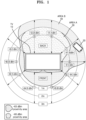
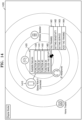
- FIG. 1 is a reference view showing a difference in wireless signal strength depending on a distance, according to an example.
- a strength of the wireless signal varies depending on a location of the mobile device 20.
- a strength of the wireless signal of the mobile device detected by the TV 10 varies depending on a combination of devices, i.e., a combination of the TV 10 and the mobile device 20.
- the wireless signal exhibits a difference depending on a manufacturer and a model of the mobile device.
- BT Bluetooth
- Wi-Fi Wireless Fidelity
- an area with a signal strength of -60 dBm or less is indicated as area A 30 and an area with a signal strength of -63 dBm or less is indicated as area B 40.
- a high signal strength is exhibited at the back of the TV 10 because an antenna of a BT module is located behind the TV 10, and signal strengths at the left and right sides of the TV 10 are not uniform.
- the wireless tag operation performed using the mobile device right behind the TV may be recognized by the TV, but the wireless tag operation performed in front of the TV or about 2 m to 3 m behind the TV may not be recognized by the TV 10.
- a wireless signal strength varies depending on devices or a measurement environment and thus, when a tag event is detected simply based on the wireless signal strength, frequent errors are unavoidable due to tagging sensitivity issues.
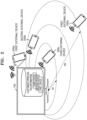
- FIG. 2 is a reference view for describing a concept in which an electronic apparatus performs a wireless tag operation by creating customized wireless tag information per device through a wireless tag training operation per device, according to various embodiments.
- an electronic apparatus 100 and one or more external devices e.g., a first external device 200a, a second external device 200b, and a third external device 200c, are illustrated according to an example.
- each of the one or more external devices may be referred to as an external device 200.
- the electronic apparatus 100 may create wireless tag information customized for the external device 200 by using a wireless signal received from the external device 200 for wireless tag training, and store the customized wireless tag information in a database.
- the "wireless tag training" may mean an operation, performed by the electronic apparatus 100, of receiving a wireless signal based on a wireless tag operation to create wireless tag information customized for the external device 200, and creating customized wireless tag information.
- the "wireless tag operation” may mean an operation of moving the external device 200 in the vicinity of the electronic apparatus 100, e.g., near or at a distance from the electronic apparatus 100, to generate a wireless signal with respect to the electronic apparatus 100.
- the wireless tag operation may include an operation of bringing the external device 200 close to and then away from the electronic apparatus 100 near the electronic apparatus 100.
- the wireless tag operation may include an operation of moving the external device 200 by a certain angle toward the electronic apparatus 100 by a user at a distance from the electronic apparatus 100, e.g., by a user sitting on a sofa.
- the "wireless tag operation” may mean both of a wireless tag operation for generating a wireless signal for wireless tag training to first create customized wireless tag information of the external device 200, and a wireless tag operation performed for generation of a wireless tag event to actually receive a service after the customized wireless tag information is created.
- the wireless signal received from the external device 200 may include a wireless signal according to various wireless communication technologies, e.g., a Bluetooth signal according to Bluetooth communication technology or a Wi-Fi signal according to Wi-Fi communication technology.
- the electronic apparatus 100 may obtain identification information of the external device 200 and strength information of the wireless signal from the wireless signal received from the external device 200 for wireless tag training, and determine a signal strength pattern suitable for detecting a wireless signal of the external device 200, based on the obtained wireless signal strength.
- the identification information of the external device may include, for example, a media access control (MAC) address of the external device.
- the strength information of the wireless signal may include at least one of transmit power information and a received signal strength indicator (RSSI).
- the signal strength pattern may include one or more signal strength threshold values of the wireless signal and threshold values of one or more durations. For example, the signal strength pattern may include two signal strength threshold values of the wireless signal and threshold values of two durations.
- the signal strength pattern may include a signal strength threshold value at a first timing, a signal strength threshold value at a second timing, a threshold value of a duration corresponding to the first timing, and a threshold value of a duration corresponding to the second timing in the wireless signal.
- the electronic apparatus 100 may store the customized wireless tag information by storing the determined signal strength pattern in association with the identification information of the external device 200.
- the identification information of the external device 200 is unique information for distinguishing the external device 200 from other external devices and may include, for example, a Bluetooth MAC address or a Wi-Fi MAC address.
- the electronic apparatus 100 may determine whether a wireless tag event occurs, with reference to ⁇ external device identification information-signal strength pattern> mapping information.
- the electronic apparatus 100 may store the customized wireless tag information by storing service information indicating a service to be provided based on generation of a wireless tag event, in association with the identification information of the external device 200.
- the service information indicating the service to be provided when the wireless tag event occurs based on a wireless tag operation of the external device 200 may be received using a user input.
- the service information indicating the service to be provided when the wireless tag event occurs may be determined in various manners.
- the service to be provided based on the generation of the wireless tag event may include a content reproduction operation such as screen mirroring, sound mirroring, or connection of a content providing application.
- the electronic apparatus 100 may store service information corresponding to each external device, e.g., screen mirroring as the service to be provided when the wireless tag event occurs with respect to the first external device 200a, and sound mirroring as the service to be provided when the wireless tag event occurs with respect to the second external device 200b.
- service information corresponding to each external device e.g., screen mirroring as the service to be provided when the wireless tag event occurs with respect to the first external device 200a, and sound mirroring as the service to be provided when the wireless tag event occurs with respect to the second external device 200b.
- the electronic apparatus 100 may store, in the database, customized wireless tag information suitable for each external device.
- the electronic apparatus 100 may include, in the database, customized wireless tag information corresponding to the first external device 200a, customized wireless tag information corresponding to the second external device 200b, and customized wireless tag information corresponding to the third external device 200c.
- the customized wireless tag information corresponding to the first external device 200a may include identification information of the first external device 200a, a signal strength pattern used to detect a wireless tag operation of the first external device 200a, and service information indicating a service to be performed when a wireless tag event of the first external device 200a occurs.
- the customized wireless tag information corresponding to the second external device 200b may include identification information of the second external device 200b, a signal strength pattern used to detect a wireless tag operation of the second external device 200b, and service information indicating a service to be performed when a wireless tag event of the second external device 200b occurs.
- the electronic apparatus 100 may store the wireless tag information customized for the third external device 200c.
- the electronic apparatus 100 may store a plurality of pieces of customized wireless tag information with respect to the same external device. For example, the electronic apparatus 100 receives a different wireless signal depending on a location of the first external device 200a, i.e., a location where a user performs a wireless tag operation with the first external device 200a in the vicinity of the electronic apparatus 100. For example, referring to FIG. 2 , the electronic apparatus 100 may detect a strength of a wireless signal based on a wireless tag operation performed at a radius R1 by the first external device 200a, differently from a strength of a wireless signal based on a wireless tag operation performed at a radius R2 by the first external device 200a.
- the electronic apparatus 100 may store a plurality of pieces of customized wireless tag information with respect to one external device by storing a wireless signal strength pattern based on each wireless tag operation by using the difference in strength of the wireless signals based on the wireless tag operations performed at different locations with respect to the same external device.
- the electronic apparatus 100 may store the plurality of pieces of customized wireless tag information in association with different services. That is, referring to FIG. 2 , the electronic apparatus 100 may store first customized wireless tag information created using the wireless signal strength based on the wireless tag operation performed at the radius R1 by the first external device 200a, and second customized wireless tag information created using the wireless signal strength based on the wireless tag operation performed at the radius R2 by the first external device 200a.
- the electronic apparatus 100 may provide a service according to the first customized wireless tag information, or when a wireless signal is received later from the first external device 200a performing a wireless tag operation at the radius R2, the electronic apparatus 100 may provide a service according to the second customized wireless tag information.
- the electronic apparatus 100 may store the customized wireless tag information in further association with a sensing value pattern of the external device received from the external device.
- a sensing value pattern of the external device received from the external device For example, when the first external device 200a performs a wireless tag operation at the radius R2, a strength of a wireless signal received by the electronic apparatus 100 is inevitably low. Therefore, when the strength of the wireless signal is low, the electronic apparatus 100 may not easily determine a strength pattern of the wireless signal or identify whether the strength of the received wireless signal corresponds to the stored signal strength pattern.
- the electronic apparatus 100 may detect a wireless tag operation by using not only the strength of the wireless signal of the external device 200 but also a sensing value of the external device 200 provided by the external device 200.
- the external device includes a gyro sensor and provides, to the electronic apparatus 100, a wireless signal strength and a gyro sensing value based on a wireless tag operation for wireless tag training
- the electronic apparatus 100 may determine a signal strength pattern by using the received wireless signal strength, determine a sensing value pattern by using the received sensing value, and store the signal strength pattern and the sensing value pattern together with the customized wireless tag information corresponding to the external device.
- the electronic apparatus 100 may determine whether a wireless tag event occurs, with reference to the signal strength pattern and the sensing value pattern stored in correspondence to the external device 200. As described above, considering not only the strength of the wireless signal based on a wireless tag operation of the external device but also the sensing value of the external device, even when the external device is far from the electronic apparatus 100 and thus the signal strength is low, the electronic apparatus 100 may more reliably determine whether a wireless tag event occurs.
- the electronic apparatus 100 may provide a graphical user interface for inducing a wireless tag training operation to store customized wireless tag information, and store the customized wireless tag information corresponding to the external device, when a wireless signal based on a wireless tag operation of the external device is received in response to the graphical user interface.
- the electronic apparatus 100 may receive, using a user input, service information indicating a service to be performed in correspondence to generation of a wireless tag event of the external device, and store the service information in association with the identification information of the external device.
- the electronic apparatus 100 may receive, using a user input, sensitivity information of the signal strength pattern used to determine whether a wireless tag event occurs, and determine the signal strength pattern by using the received sensitivity information.
- the electronic apparatus 100 may obtain identification information the external device and a wireless signal strength from the received wireless signal, searches for the identification information the external device in the database storing the customized wireless tag information, and determine whether a wireless tag event occurs, by using the customized wireless tag information corresponding to the identification information of the external device, when the identification information the external device is found in the database.
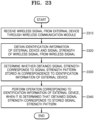
- the electronic apparatus 100 may determine whether the received wireless signal strength corresponds to a stored signal strength pattern, by using the signal strength pattern stored in association with the identification information of the external device, and provide a service mapped to the identification information of the external device, when the received wireless signal strength corresponds to the stored signal strength pattern.
- the electronic apparatus 100 may not perform any operation in correspondence to the reception of the wireless signal from the external device.
- the electronic apparatus 100 may determine whether a wireless tag event occurs, by determining whether the received wireless signal strength corresponds to a signal strength pattern stored by default.
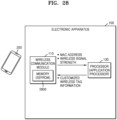
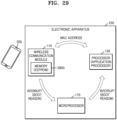
- the electronic apparatus 100 may store the customized wireless tag information not only in a memory referred by an application processor but also in a memory of a wireless communication module which operates even in a sleep mode (or a standby mode or a low power mode) of the electronic apparatus 100, and update the customized wireless tag information.
- the electronic apparatus 100 may determine whether a wireless tag event occurs, by comparing the received wireless signal to a signal strength pattern stored in the customized wireless tag information.
- the electronic apparatus 100 may wake up an application processor and transition to a normal mode (or a power on mode) to provide a service based on the generated wireless tag event.
- FIG. 3 shows an example of a system including an electronic apparatus and an external device, according to an embodiment.
- the system may include the electronic apparatus 100, the external device 200, and a wireless communication network 300.
- the external device 200 may transmit a wireless signal based on a wireless tag operation to the electronic apparatus 100 through the wireless communication network 300, and the electronic apparatus 100 may generate a wireless tag event based on the wireless signal received through the wireless communication network 300, and perform an operation related to a service corresponding to the wireless tag event.
- the electronic apparatus 100 may include a wireless communication module 110, a memory 120, and a processor 130.
- the electronic apparatus 100 may be implemented by more elements than the illustrated elements, and is not limited to the above-described example.
- the wireless communication module 110 may communicate with the external device 200 through the wireless communication network 300.
- the wireless communication module 110 may include at least one of a Wi-Fi communication module or a Bluetooth communication module.
- the wireless communication module 110 may receive a wireless signal from the external device 200 through the wireless communication network 300, obtain identification information of the external device and strength information of the wireless signal from the received wireless signal, and transmit the obtained identification information of the external device and the strength information of the wireless signal to the processor 130.
- the identification information of the external device may include, for example, a MAC address of the external device.
- the strength information of the wireless signal may include at least one of transmit power information and a RSSI.
- the memory 120 may store programs for processing and control by the processor 130, and also store data input to or to be output from the electronic apparatus 100.
- the memory 120 may include at least one type of storage medium from among flash memory, a hard disk, a multimedia card micro, a memory card (e.g., a secure digital (SD) or extreme digital (XD) memory card), random access memory (RAM), static random access memory (SRAM), read-only memory (ROM), electrically erasable programmable read-only memory (EEPROM), programmable read-only memory (PROM), magnetic memory, a magnetic disk, or an optical disc.
- a memory card e.g., a secure digital (SD) or extreme digital (XD) memory card
- RAM random access memory
- SRAM static random access memory
- ROM read-only memory
- EEPROM electrically erasable programmable read-only memory
- PROM programmable read-only memory
- magnetic memory a magnetic disk, or an optical disc.
- the processor 130 controls overall operation of the electronic apparatus 100.
- the processor 130 may execute one or more instructions stored in the memory 120 to perform functions of the electronic apparatus 100 disclosed herein.
- the processor 130 may execute the one or more instructions stored in the memory 120 to control the above-described operations to be performed.
- the memory 120 may store one or more instructions executable by the processor 130.
- the processor 130 may store one or more instructions in an internal memory, and execute the one or more instructions stored in the internal memory to control the above-described operations to be performed. That is, the processor 130 may execute at least one instruction or program stored in the memory 120 or the internal memory of the processor 130 to perform a certain operation.
- FIG. 3 illustrates one processor 130, a plurality of processors may be provided. In this case, each of operations performed in the electronic apparatus according to an embodiment of the disclosure may be performed by at least one of the plurality of processors.
- the processor 130 may execute the one or more instructions stored in the memory 120 to determine a signal strength pattern based on a training wireless signal used for wireless tag training, when the training wireless signal is received from the external device 200, and store the determined signal strength pattern in association with the identification information of the external device.
- the processor 130 may execute the one or more instructions stored in the memory 120 to store, in association with the identification information of the external device, service operation information indicating a service operation to be performed based on a strength of the wireless signal received from the external device being identified to correspond to the determined signal strength pattern.
- the processor 130 may execute the one or more instructions stored in the memory 120 to receive, using a user input, signal sensitivity information used to determine the signal strength pattern based on the training wireless signal, and determine the signal strength pattern with reference to the received signal sensitivity information.
- the processor 130 may execute the one or more instructions stored in the memory 120 to receive a wireless signal from the external device through the wireless communication module, obtain identification information of the external device and a signal strength of the wireless signal from the wireless signal, identify whether the obtained signal strength corresponds to a signal strength pattern (or requirement) stored in correspondence to the identification information of the external device, and perform an operation corresponding to the identification information of the external device based on the obtained signal strength being identified to correspond to the stored signal strength pattern, that is, based on the obtained signal strength being identified to satisfy the signal strength requirement.
- the signal strength pattern may be defined by a signal strength at a first timing, and a signal strength at a second timing prior to the first timing by a predefined time.
- the processor 130 may execute the one or more instructions stored in the memory 120 to identify that the obtained signal strength corresponds to the stored signal strength pattern, based on the signal strength of the wireless signal at the first timing being greater than or equal to a first threshold value and the signal strength of the wireless signal at the second timing being less than or equal to a second threshold value.
- the operation corresponding to the identification information of the external device may include at least one of an audio visual content reproduction operation or an audio content reproduction operation.
- the processor 130 may execute the one or more instructions stored in the memory 120 to obtain a sensing value of the external device from the wireless signal, identify whether the obtained sensing value corresponds to a sensing value pattern stored in correspondence to the identification information of the external device, and perform the operation corresponding to the identification information of the external device, based on the obtained signal strength being identified to correspond to the stored signal strength pattern, and also the obtained sensing value being identified to correspond to the stored sensing value pattern.
- the processor 130 may execute the one or more instructions stored in the memory 120 to pre-store, in the memory, the signal strength pattern corresponding to the identification information of the external device.
- the processor 130 may execute the one or more instructions stored in the memory 120 to control the signal strength pattern corresponding to the identification information of the external device, to be stored in the wireless communication module 110.
- the wireless communication module 110 may receive a wireless signal from the external device, and transmit an interrupt signal to the processor 130 to trigger performance of an operation stored in correspondence to identification information of the external device, based on a signal strength obtained from the received wireless signal being identified to correspond to a signal strength pattern stored in correspondence to the identification information of the external device.
- the electronic apparatus 100 may be any type of apparatus including a processor and a memory to perform functions.
- the electronic apparatus 100 may be a stationary or mobile apparatus.
- the electronic apparatus 100 may include various electronic apparatuses, e.g., computers such as desktops, laptops, and tablets, televisions, set-top boxes, smartphones, cellular phones, game consoles, music players, video players, medical devices, and home appliances.
- the electronic apparatus 100 may also be referred to as a display apparatus, a computing apparatus, or a media apparatus.
- the external device 200 may include a wireless communication module 210, a memory 220, and a processor 230. However, the external device 200 may be implemented by more elements than the illustrated elements, and is not limited to the above-described example.
- the wireless communication module 210 may communicate with the electronic apparatus 100 through the wireless communication network 300.
- the wireless communication module 210 may include at least one of a Wi-Fi communication module or a Bluetooth communication module.
- the wireless communication module 210 may transmit or receive a wireless signal to or from the electronic apparatus 100 through the wireless communication network 300.
- the wireless signal may include at least one of a Wi-Fi signal or a Bluetooth signal.
- the wireless signal may include identification information of the external device 200 and strength information of the wireless signal.
- the identification information of the external device may include, for example, a MAC address of the external device.
- the strength information of the wireless signal may include at least one of transmit power information and a RSSI.
- the wireless signal may include the identification information of the external device 200, the strength information of the wireless signal, and a sensing value obtained by the external device 200.
- the wireless communication module 210 may transmit a wireless signal including information about content reproduced by the external device 200, based on a request of the electronic apparatus 100.
- the memory 220 may store programs for processing and control by the processor 230, and also store data input to or to be output from the external device 200.
- the memory 220 may include at least one type of storage medium from among flash memory, a hard disk, a multimedia card micro, a memory card (e.g., a SD or XD memory card), RAM, SRAM, ROM, EEPROM, PROM, magnetic memory, a magnetic disk, or an optical disc.
- a memory card e.g., a SD or XD memory card
- the processor 230 controls overall operation of the external device 200.
- the processor 230 may execute one or more instructions stored in the memory 220 to perform functions of the external device 200 disclosed herein.
- the processor 230 may execute the one or more instructions stored in the memory 220 to control the above-described operations to be performed.
- the memory 220 may store one or more instructions executable by the processor 230.
- the processor 230 may store one or more instructions in an internal memory, and execute the one or more instructions stored in the internal memory to control the above-described operations to be performed. That is, the processor 230 may execute at least one instruction or program stored in the memory 220 or the internal memory of the processor 230 to perform a certain operation.
- FIG. 3 illustrates one processor 230, a plurality of processors may be provided. In this case, each of operations performed in the external device according to an embodiment of the disclosure may be performed by at least one of the plurality of processors.
- FIG. 4 is a detailed block diagram of an electronic apparatus according to an embodiment.
- FIGS. 3 and 4 like elements are denoted by like reference numerals. Therefore, the description provided above in relation to FIG. 3 will not be repeated herein to describe the electronic apparatus 100.
- the electronic apparatus 100 may further include a display 140, an audio outputter 150, a microcomputer (micom) 170, a power control module 185, a sensing module 190, and an input/output module 160.
- the processor 130 may control each element of the electronic apparatus 100 to perform an operation.
- the wireless communication module 110 may include one or more modules capable of enabling wireless communication between the electronic apparatus 100 and a wireless communication system or between the electronic apparatus 100 and a network where another electronic apparatus is located.
- the wireless communication module 110 may include a broadcast receiver module 111, a mobile communication module 112, a wireless Internet module 113, and a short-range wireless communication module 114.
- the wireless communication module 110 may be called a transceiver.
- the broadcast receiver module 111 receives broadcast signals and/or broadcast information from an external broadcast management server through broadcast channels.
- the broadcast signals may not only include TV broadcast signals, radio broadcast signals, and data broadcast signals but also include broadcast signals in which TV or radio broadcast signals are combined with data broadcast signals.
- the mobile communication module 112 transmits or receives wireless signals to or from at least one of a base station, an external terminal, or a server on a mobile communication network.
- the wireless signals may include various types of data based on transmission and reception of voice call signals, video call signals, or text/multimedia messages.
- the wireless Internet module 113 refers to a module for wireless Internet access, and may be included in or provided outside a device.
- wireless Internet technology for example, wireless local area network (WLAN) (or Wi-Fi), wireless broadband (Wibro), worldwide interoperability for microwave access (Wimax), or high-speed downlink packet access (HSDPA) may be used.
- the device may be Wi-Fi peer-to-peer (P2P)-connected to another device through the wireless Internet module 113.
- the wireless Internet module 113 may include a Wi-Fi module performing Wi-Fi communication, and a wireless signal based on a wireless tag operation may be received from the external device 200 through the Wi-Fi module.
- the short-range wireless communication module 114 refers to a module for short-range wireless communication.
- short-range wireless communication technology for example, Bluetooth, Bluetooth low energy (BLE), radio frequency identification (RFID), Infrared Data Association (IrDA), ultra-wideband (UWB), or ZigBee may be used.
- the short-range wireless communication module 114 may include a Bluetooth module performing Bluetooth communication, and a wireless signal based on a wireless tag operation may be received from the external device 200 through the Bluetooth module.
- Wi-Fi and Bluetooth modules may be configured as separate chips, or configured as one chip, e.g., a Wi-Fi/Bluetooth combo module.
- the display 140 may display an image on a screen under the control of the processor 130.
- the image displayed on the screen may be received from the wireless communication module 100, the input/output module 160, or the memory 120.
- a video processor 145 may process image data to be displayed by the display 130, and perform various image processing operations, e.g., decoding, rendering, scaling, noise filtering, frame rate conversion, and resolution conversion, on the image data.
- the audio outputter 150 may output audio included in a received broadcast signal, audio input through the wireless communication module 110 or the input/output module 160, or audio stored in the memory 120, under the control of the processor 130.
- the audio outputter 150 may include at least one of a speaker, a headphone output port, or a Sony/Philips Digital Interface (S/PDIF) output port.
- S/PDIF Sony/Philips Digital Interface
- An audio processor 155 processes audio data.
- the audio processor 155 may perform various processing operations, e.g., decoding, amplification, and noise filtering, on the audio data.
- the input/output module 160 receives, for example, video data (e.g., moving images), audio data (e.g., voice or music), and additional information (e.g., an electronic program guide (EPG)) from the outside of the electronic apparatus 100 under the control of the processor 130.
- the input/output module 160 may include one of a high-definition multimedia interface (HDMI) port 161, a component jack 162, a personal computer (PC) port 163, and a universal serial bus (USB) port 164.
- the input/output module 160 may include a combination of the HDMI port 161, the component jack 162, the PC port 163, and the USB port 164.
- the micom 170 is a processor which always receives power supply even in a standby mode to wake up an application processor, and serves to wake up the processor 130 when, for example, a control signal is received from a remote controller.
- a user inputter 180 refers to means by which a user inputs data for controlling the electronic apparatus 100.
- the user inputter 180 may include a keypad, a dome switch, a touchpad, a jog wheel, or a jog switch, but is not limited thereto.
- the sensing module 190 may detect voice of a user, a video of the user, or an interaction of the user, and include a microphone 191, a camera 192, and an optical receiver 193.
- the microphone 191 may receive voice uttered by the user, convert the received voice into an electrical signal, and output the electrical signal to the processor 130.
- the camera 192 may receive a video (e.g., consecutive frames) corresponding to motion of the user which includes a gesture within a camera recognition range.
- the optical receiver 193 receives an optical signal (including a control signal) from the remote controller.
- the optical receiver 193 may receive, from the remote controller, an optical signal corresponding to a user input (e.g., touch, press, touch gesture, voice, or motion).
- a control signal may be extracted from the received optical signal under the control of the processor 130.
- An illumination sensor 194 may detect a brightness signal. According to an embodiment, the brightness signal value from the illumination sensor 194 may be used to determine a wireless tag operation of the external device together with a wireless signal value received from the external device.
- the memory 110 may store programs for processing and control by the processor 120, and also store data input to or to be output from the electronic apparatus 100.
- the memory 110 may store data required for operation of the electronic apparatus 100.
- the programs stored in the memory 110 may be classified into a plurality of modules depending on functions thereof.
- the memory 120 may include a wireless tag management module 121 and a customized wireless tag information 122.
- the wireless tag management module 121 may include one or more instructions for determining a signal strength pattern suitable for a training wireless signal when the training wireless signal is received from the external device 200, creating customized wireless tag information corresponding to the external device 200, and storing the created customized wireless tag information in a database.
- the wireless tag management module 121 may include one or more instructions for extracting customized wireless tag information of the external device 200 from the database when a wireless tag signal for generation of a wireless tag event is received from the external device 200, identifying whether a received wireless signal corresponds to the stored signal strength pattern, by using a signal strength pattern of the extracted wireless tag information, and performing a service operation stored to be mapped to the external device 200, based on the received wireless signal being identified to correspond to the stored signal strength pattern.
- the customized wireless tag information 122 may include information used to perform a wireless tag operation in correspondence to each external device.
- the customized wireless tag information 122 may include a signal strength pattern serving as a criterion for determining whether a wireless signal corresponds to a signal capable of generating a wireless tag event when the wireless signal and identification information of the external device are received, and service information indicating a service to be performed when it is determined that a wireless tag event occurs based on the received wireless signal.
- the customized wireless tag information 122 may further include a sensing pattern of the external device.
- the sensing pattern may be a factor serving as a criterion for determining whether a wireless tag event occurs, considering not only a signal strength value of the received wireless signal but also a sensing value transmitted from the external device.
- the wireless tag management module 121 is implemented as software stored in the memory 120 in FIG. 4 , the wireless tag management module 121 is not limited thereto and may be implemented as a combination of suitable software, logic, circuit, interface, and/or code which may operate to perform a wireless tag function disclosed herein.
- the processor 130 controls overall operation of the electronic apparatus 100 and the flow of signals between internal elements of the electronic apparatus 100, and processes data.
- the processor 130 may execute an operating system (OS) and various applications stored in the memory 120, when an input of the user is received or a preset and stored condition is satisfied.
- OS operating system
- the processor 130 may include an internal memory. In this case, at least one of data, programs, and instructions to be stored in the memory 120 may be stored in the internal memory (not shown) of the processor 130.
- FIGS. 3 and 4 are block diagrams for an embodiment. Elements of the block diagram may be integrated, added, or omitted depending on specifications of the electronic apparatus 100 which is actually realized. For example, when necessary, two or more elements may be combined into one element, or one element may be divided into two or more elements.
- the functions performed by the blocks are to describe embodiments, and specific operations or devices thereof do not limit the scope of the disclosure.
- FIG. 5 is a detailed block diagram of an external device according to an embodiment.
- FIGS. 3 and 5 like elements are denoted by like reference numerals. Therefore, the description provided above in relation to FIG. 3 will not be repeated herein to describe the external device 200.
- the external device 200 may further include a display 240, a video processor 245, an audio outputter 250, an audio processor 255, a sensing module 260, an input/output module 270, and a user inputter 280.
- the wireless communication module 210 may include one or more modules capable of enabling wireless communication between the external device 200 and a wireless communication system or between the external device 200 and a network where another electronic apparatus is located.
- the wireless communication module 210 may include a broadcast receiver module 211, a mobile communication module 212, a wireless Internet module 213, and a short-range wireless communication module 214.
- the wireless communication module 210 may be called a transceiver.
- the wireless Internet module 213 refers to a module for wireless Internet access, and may be included in or provided outside a device.
- wireless Internet technology for example, WLAN (or Wi-Fi), Wibro, Wimax, or HSDPA may be used.
- the device may be Wi-Fi P2P-connected to another device through the wireless Internet module 213.
- the wireless Internet module 213 may include a Wi-Fi module performing Wi-Fi communication, and a wireless signal based on a wireless tag operation may be transmitted to or received from the electronic apparatus 100 through the Wi-Fi module.
- the short-range wireless communication module 214 refers to a module for short-range wireless communication.
- short-range wireless communication technology for example, Bluetooth, BLE, RFID, IrDA, UWB, or ZigBee may be used.
- the short-range wireless communication module 214 may include a Bluetooth module performing Bluetooth communication, and a wireless signal based on a wireless tag operation may be transmitted to or received from the electronic apparatus 100 through the Bluetooth module.
- Wi-Fi and Bluetooth modules may be configured as separate chips, or configured as one chip, e.g., a Wi-Fi/Bluetooth combo module.
- the display 240 may display an image on a screen under the control of the processor 230.
- the image displayed on the screen may be received from the wireless communication module 210, the input/output module 270, or the memory 220.
- the video processor 245 may process image data to be displayed by the display 240, and perform various image processing operations, e.g., decoding, rendering, scaling, noise filtering, frame rate conversion, and resolution conversion, on the image data.
- image processing operations e.g., decoding, rendering, scaling, noise filtering, frame rate conversion, and resolution conversion
- the audio outputter 250 may output audio included in a received broadcast signal, audio input through the wireless communication module 210 or the input/output module 270, or audio stored in the memory 220, under the control of the processor 230.
- the audio outputter 250 may include at least one of a speaker, a headphone output port, or a S/PDIF output port.
- the audio processor 255 processes audio data.
- the audio processor 255 may perform various processing operations, e.g., decoding, amplification, and noise filtering, on the audio data.
- the sensing module 260 may detect voice of a user, a video of the user, or an interaction of the user, and include a microphone 261, a camera 262, and an optical receiver 263.
- the microphone 261, the camera 262, and the optical receiver 263 are the same as the microphone 191, the camera 192, and the optical receiver 193 described above in relation to FIG. 4 .
- a gyro sensor 264 may include a sensor for detecting motion of an object by using a gyroscope, an inertial sensor, and an acceleration sensor.
- a sensing value representing motion of the external device 200, which is detected by the gyro sensor 264, may be transmitted to the electronic apparatus 100 through the wireless communication module under the control of the processor 230.
- the sensing value measured by the gyro sensor 264 may be transmitted as a Bluetooth signal or a Wi-Fi signal.
- the input/output module 270 receives, for example, video data (e.g., moving images), audio data (e.g., voice or music), and additional information (e.g., an EPG) from the outside of the external device 200 under the control of the processor 230.
- the input/output module 270 may include one of a HDMI port, a component jack, a PC port, and a USB port.
- the user inputter 280 refers to means by which a user inputs data for controlling the external device 200.
- the user inputter 280 may include a keypad, a dome switch, a touchpad, a jog wheel, or a jog switch, but is not limited thereto.
- the memory 220 may store programs for processing and control by the processor 230, and also store data input to or to be output from the external device 200. In addition, the memory 220 may store data required for operation of the external device 200.
- the programs stored in the memory 220 may be classified into a plurality of modules depending on functions thereof.
- the processor 230 controls overall operation of the external device 200 and the flow of signals between internal elements of the external device 200, and processes data.
- the processor 230 may execute an OS and various applications stored in the memory 220, when an input of the user is received or a preset and stored condition is satisfied.
- the processor 230 may include an internal memory. In this case, at least one of data, programs, and instructions to be stored in the memory 220 may be stored in the internal memory (not shown) of the processor 230.
- the processor 230 may control a wireless signal to be transmitted through the wireless communication module 210.
- the user holds the external device 200 and performs a wireless tag operation, that is, the user holds the external device 200 and performs an operation of bringing the external device 200 close to and then away from the electronic apparatus 100, and a strength given to the wireless signal by the external device 200 may vary depending on such an operation.
- the processor 230 may control the wireless communication module 210 to transmit information based on the request to the electronic apparatus 100. For example, when the service corresponding to the generation of the wireless tag event is screen mirroring or sound mirroring, the processor 230 may provide, to the electronic apparatus 100, information about audio visual content or audio content being reproduced on the external device 200.
- FIGS. 3 and 5 are block diagrams for an embodiment. Elements of the block diagram may be integrated, added, or omitted depending on specifications of the external device 200 which is actually realized. For example, when necessary, two or more elements may be combined into one element, or one element may be divided into two or more elements.
- the functions performed by the blocks are to describe embodiments, and specific operations or devices thereof do not limit the scope of the disclosure.
- FIG. 6 is a flowchart for describing an overall operation for executing a wireless tag function, according to an embodiment.
- the electronic apparatus 100 may store customized wireless tag information through wireless tag training per external device, and provide a service by determining a wireless signal based on an actual wireless tag operation by using the customized wireless tag information when the wireless signal is received.
- the electronic apparatus 100 may receive a training wireless signal from an external device through a wireless communication module.
- the electronic apparatus 100 may create a customized wireless tag information based on the received training wireless signal.
- the electronic apparatus 100 may store the created customized wireless tag information in a database.
- the electronic apparatus 100 may receive a wireless signal from the external device through the wireless communication module.
- the electronic apparatus 100 may generate a wireless tag event by using the customized wireless tag information.
- the electronic apparatus 100 may perform a service operation corresponding to the wireless tag event.
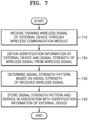
- FIG. 7 is a flowchart of an operation, performed by the electronic apparatus 100, of storing customized wireless tag information through wireless tag training, according to an embodiment.
- the electronic apparatus 100 may receive a training wireless signal of an external device through a wireless communication module.
- the training wireless signal may be a Bluetooth signal based on Bluetooth communication, or a Wi-Fi signal based on Wi-Fi communication.
- the electronic apparatus 100 may obtain identification information of the external device and a signal strength of the wireless signal from the received training wireless signal.
- the electronic apparatus 100 may determine a signal strength pattern based on the signal strength of the received training wireless signal.
- the electronic apparatus 100 may determine that a wireless tag event occurs.
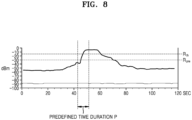
- FIG. 8 is a reference view for describing a method of determining a signal strength pattern serving as a criterion for generating a wireless tag event, according to an embodiment.
- duration 1 represents a duration in which the external device approaches the electronic apparatus 100 and thus the strength of the wireless signal increases
- duration 2 represents a duration in which the external device is located closest to the electronic apparatus 100 and thus the strength of the wireless signal the highest
- durations 3 and 4 represent durations in which the external device moves away from the electronic apparatus 100 and thus the strength of the wireless signal decreases.
- the signal strength pattern exhibited due to the wireless tag operation may be used to determine a signal strength pattern serving as a criterion for detecting a wireless tag event.
- the electronic apparatus 100 may determine two parameters Rth and Rpre as parameters for defining a signal strength pattern.
- Rth is a first threshold parameter that the strength of the received wireless signal is required to exceed
- Rpre is a second threshold parameter that the strength of the wireless signal is required not to reach.
- Rpre denotes a second threshold parameter that the wireless signal strength is required not to reach at a timing which is prior to a timing when the strength of the wireless signal exceeds the first threshold parameter Rth, by a predefined time duration P.
- the electronic apparatus 100 may check a timing when the strength of the received wireless signal is greater than Rth, and determine that a wireless tag event occurs with respect to the wireless signal, when the strength of the wireless signal at a timing prior to the above-mentioned timing by the predefined time duration P is less than Rpre. In this case, the electronic apparatus 100 may determine the parameters serving as criteria for generating a wireless tag event, i.e., the first threshold parameter Rth and the second threshold parameter Rpre, on the basis of a received training wireless signal.
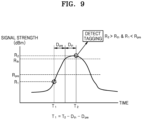
- FIG. 9 is a reference view for describing a method of determining a signal strength pattern serving as a criterion for generating a wireless tag event, according to another embodiment.
- the electronic apparatus 100 may detect two or more durations to detect an increase in signal strength and a maintenance in signal strength to detect a wireless tag event. Because a wireless signal frequently exhibits an increase and a decrease in signal strength due to its characteristics, a stable wireless tag event may be detected by setting increasing and maintenance (threshold) durations. Therefore, according to an embodiment, the electronic apparatus 100 may determine two signal strengths R th and R pre and two durations D th and D pre as parameters serving as criteria for generating a wireless tag event.
- R th is a threshold RSSI value for determining whether an external device is in proximity.
- D th is a duration in which the threshold value R th needs to be maintained when it is determined that the external device is in proximity.
- R pre is a threshold value for checking a previous RSSI when the threshold R th /duration is detected.
- D pre is a duration to be checked to determine whether a value less than the previous RSSI exists.
- the electronic apparatus 100 may detect a wireless tag event. (R 2 >R th & R 1 ⁇ R pre )
- the electronic apparatus 100 may initially determine whether the strength of the received wireless signal exceeding the upper threshold parameter value R th is maintained for the duration D th , determine whether a wireless signal strength value less than the lower threshold parameter value R pre exists in the duration D pre prior to the duration D th , when it is determined that the strength exceeding the upper threshold parameter value R th is maintained for the duration D th , and determine that a wireless tag event occurs, when the wireless signal strength value less than the lower threshold parameter value R pre exists.
- the electronic apparatus 100 may determine that a wireless tag event occurs, considering not only a high strength of a received wireless signal but also a low strength of the wireless signal at a timing prior to the timing when the strength of the wireless signal is high, thereby more reliably detecting generation of a wireless tag. Therefore, to detect generation of a wireless tag event, the electronic apparatus 100 may determine the above-described four parameter values, i.e., R th , D th , R pre , and R th , based on a training wireless signal received from the external device 200, and use the determined parameter values as a signal strength pattern serving as a criterion for generating a wireless tag event.
- the electronic apparatus 100 may determine the above-described four parameter values, i.e., R th , D th , R pre , and R th , based on a training wireless signal received from the external device 200, and use the determined parameter values as a signal strength pattern serving as a criterion for generating a wireless tag event.
- a signal strength serving as a criterion for detecting a wireless tag between devices varies depending on a device type such as a cover material of a device, a device installation location/method such as installation of TV wall mounts, or a mobile device holding method for a tagging operation.
- a wireless signal sensing duration may be determined differently depending on a signal scan cycle.
- the number of sample durations to be used for sensing according to the wireless signal sensing cycle may also vary depending on system circumstances. In an embodiment of the disclosure, to consider the signal deviation, sensing cycle, user tagging operation, etc.
- the electronic apparatus 100 may determine a signal strength pattern serving as a criterion for generating a wireless tag event, which is suitable for each external device, when a training wireless signal is received from the external device, thereby obtaining wireless tag information better customized for the external device.
- the electronic apparatus 100 may store customized wireless tag information by determining the signal strength pattern and a service in association with the identification information of the external device. According to an embodiment, the electronic apparatus 100 may store customized wireless tag information shown in FIG. 10 .
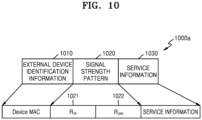
- FIG. 10 shows an example of customized wireless tag information according to an embodiment.
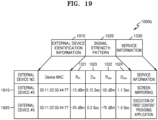
- customized wireless tag information 1000a may include external device identification information 1010, a signal strength pattern 1020, and service information 1030.
- the external device identification information 1010 is information for identifying an external device and may include, for example, a device MAC address.
- the external device identification information 1010 may include a Bluetooth MAC address for Bluetooth communication, or a Wi-Fi MAC address for Wi-Fi communication.
- the MAC address may be carried in a wireless signal received from the external device, and the electronic apparatus 100 may obtain the MAC address from the received wireless signal.
- the signal strength pattern 1020 is a signal strength pattern serving as a criterion used by the electronic apparatus 100 to determine whether a wireless tag operation as generation of a wireless tag event and may include, for example, the signal strength pattern determined in operation 730.
- the signal strength pattern 1020 may include two parameters R th (1021) and R pre (1022).
- the service information 1030 represents service information indicating a service to be performed when the wireless signal detected by the electronic apparatus 100 is determined as generation of a wireless tag event.
- the service information may include various types of content reproduction operations.
- the various types of content reproduction operations may include screen mirroring, sound mirroring, and execution of various content reproduction applications.
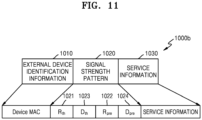
- FIG. 11 shows another example of customized wireless tag information according to an embodiment.
- the customized wireless tag information 1000b may include external device identification information 1010, a signal strength pattern 1020, and service information 1030.
- the customized wireless tag information 1000b shown in FIG. 11 is substantially similar to the customized wireless tag information 1000a shown in FIG. 10 , but differs in the signal strength pattern 1020.
- the signal strength pattern 1020 shown in FIG. 10 includes two parameters R th (1021) and R pre (1022), the signal strength pattern 1020 shown in FIG. 11 may further include D th (1023) and D pre (1024) in addition to the two parameters R th (1021) and R pre (1022).
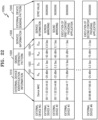
- FIG. 12 shows a specific example of the customized wireless tag information shown in FIG. 11 , according to an example.
- the customized wireless tag information 1000b may include the external device identification information 1010, the signal strength pattern 1020, and the service information 1030.
- the customized wireless tag information 1000b shown in FIG. 12 includes customized wireless tag information of N external devices from external device #1 to external device #N.
- the external device identification information 1010 corresponding to the external device #1 is ⁇ 00:11:22:33:44:55>
- the parameters R th (1021), D th (1023), R pre (1022), and D pre (1024) included in the signal strength pattern 1020 are -20 dBm, 0.1 sec., -50 dBm, and 0.9 sec., respectively.
- the electronic apparatus 100 may determine whether a wireless signal strength less than -50 dBm exists in the duration D pre (1024), i.e., the duration of 0.9 sec. prior to the duration of 0.1 sec. When it is determined that such a wireless signal strength exists, the electronic apparatus 100 may determine that a wireless tag event occurs.
- the service information indicating a service to be performed by the electronic apparatus 100 indicates screen mirroring. That is, when it is determined that a wireless signal from the external device #1 corresponds to generation of a wireless tag event, the electronic apparatus 100 may receive, from the external device #1, information about content to be screen-mirrored, and perform screen mirroring, based on the received information about the content.
- the service information indicating a service to be performed by the electronic apparatus 100 indicates sound mirroring. That is, when it is determined that a wireless signal from the external device #2 corresponds to generation of a wireless tag event, the electronic apparatus 100 may receive, from the external device #2, information about content to be sound-mirrored, and perform sound mirroring, based on the received information about the content.
- the service information indicating a service to be performed by the electronic apparatus 100 indicates connection of a first content providing application. That is, when it is determined that a wireless signal from the external device #3 corresponds to generation of a wireless tag event, the electronic apparatus 100 may execute the first content providing application.
- FIG. 13 shows an example of a flowchart of an operation, performed by the electronic apparatus 100, of performing wireless tag setup, according to an embodiment.
- the electronic apparatus 100 may execute a wireless tag operation-related application capable of enabling setup or adjustment related to a wireless tag operation including wireless tag training.
- the wireless tag operation-related application may include, for example, the Digital Butler application provided by the applicant.
- the electronic apparatus 100 may receive a user input for selecting the wireless tag operation-related application from among applications installed in the electronic apparatus 100, and execute the selected wireless tag operation-related application.
- the electronic apparatus 100 may select a wireless tag training menu. For example, the electronic apparatus 100 may receive a user input for selecting the wireless tag training menu, and execute the wireless tag training menu selected based on the user input.
- the electronic apparatus 100 may receive a training wireless signal for wireless tag training from the external device 200.
- the electronic apparatus 100 may receive a wireless signal from the external device 200, and the wireless signal received by the electronic apparatus 100 may include identification information of the external device 200 and a wireless signal strength that varies depending on a specific operation of the external device 200.
- the electronic apparatus 100 may obtain the wireless signal strength and the external device identification information from the wireless signal received from the external device 200.
- the electronic apparatus 100 may determine a signal strength pattern serving as a criterion for generating a wireless tag event, based on the obtained signal strength of the wireless signal.
- the electronic apparatus 100 may select a service operation to be performed in correspondence to generation of a wireless tag event with respect to the external device identification information.
- the service operation to be performed in correspondence to generation of a wireless tag event may be received using a user input from the user.
- the service operation to be performed in correspondence to generation of a wireless tag event may be selected as a default value by the electronic apparatus 100.
- the electronic apparatus 100 may store the signal strength pattern created in correspondence to the external device identification information, and the selected service operation, as customized wireless tag information.
- a user interface for wireless tag setup will now be described with reference to FIGS. 14 to 19 .
- FIG. 14 shows an example of a user interface provided by the electronic apparatus 100 for wireless tag setup, according to an embodiment.
- the electronic apparatus 100 may discover wireless devices or home appliances in the vicinity of the electronic apparatus 100, and provide a peripheral device management application capable of showing and managing available features related to the discovered wireless devices or home appliances.
- the user interface shown in FIG. 14 shows an example of a graphical user interface providable by the peripheral device management application.
- a graphical user interface 1400 provided by the peripheral device management application may display one or more peripheral devices discovered by the electronic apparatus 100, e.g., a smartphone, a home theatre, BT headphones, and a wireless speaker.
- features available for each peripheral device may be displayed with respect to the device. For example, as available features 1420 corresponding to a smartphone 1410, one or more functions such as function #1 1430, function #2 1440, function #3 1450, and function #4 1460 may be displayed. A wireless tag setup function may be added as one of the functions.
- a tag training item 1461 When a wireless tag setup 1460 corresponding to the function #4 is selected, a tag training item 1461, a setting sensitivity item 1462, a setting service item 1463, and an add tag training item 1464 may be displayed as submenus.
- the tag training item 1461 is a menu for creating customized wireless tag information per device by receiving a wireless signal based on a wireless tag operation and determining a signal strength pattern for initial wireless tag setup.
- the setting sensitivity item 1462 is a menu for adjusting one or more parameter values included in a wireless signal strength pattern by setting or adjusting sensitivity of a strength of a wireless signal to create customized wireless tag information in correspondence to an external device.
- the setting service item 1463 is a menu for setting a service operation to be performed when it is determined that a wireless tag event occurs in correspondence to an external device.
- the add tag training item 1464 is a menu for creating a plurality of pieces of customized wireless tag information with respect to the same external device.
- the add tag training item 1464 is a menu for separately creating customized wireless tag information corresponding to a wireless tag operation performed using the external device by a user near the electronic apparatus 100, and customized wireless tag information corresponding to a wireless tag operation performed using the same external device by the user at a location far from the electronic apparatus 100, e.g., the user sitting on a sofa.
- FIG. 15 shows an example of a graphical user interface provided in response to selection of the tag training item 1461, according to an embodiment.
- the electronic apparatus 100 may output a graphical user interface 1500 including a message for inducing a tag action to be made.
- the graphical user interface 1500 shown in FIG. 15 may provide a message 1510 saying ⁇ You can train a tag operation to be used for a wireless tag event. Make a tag action!>.
- An example of a tag action may be viewed under the message 1510 as a guide for the tag action to be made by the user.
- the electronic apparatus 100 may receive a wireless signal from the external device 200.
- the electronic apparatus 100 may obtain identification information of the external device 200 and a strength of the wireless signal from the wireless signal, determine a signal strength pattern serving as a criterion for determining generation of a wireless tag event in correspondence to the external device 200, by using the identification information of the external device 200 and the strength of the wireless signal, and create customized wireless tag information corresponding to the external device 200.
- FIG. 16 shows an example of a graphical user interface provided in response to selection of the setting sensitivity item 1462, according to an embodiment.
- the electronic apparatus 100 may output a graphical user interface 1600 used to set parameter values of a wireless signal strength pattern.
- the graphical user interface 1600 may include a message 1610 saying ⁇ You can set signal strength parameters to be used for a wireless tag. Move bars to set!>, together with one or more adjustable bars 1620 used to adjust one or more parameters included in the signal strength pattern.
- the adjustable bar 1620 corresponding to each parameter may be adjusted from 1 to 10 based on a user input.
- the user may determine whether to sensitively or insensitively detect a wireless signal for each external device. For example, when the user desires to generate a wireless tag event only when a very accurate tagging operation is performed as a wireless tag operation, the user may set the sensitivity of the wireless signal to be high and, when the user desires to generate a wireless tag event even when a negligent and rough tagging operation is performed as a wireless tag operation, the user may set the sensitivity of the wireless signal to be low.
- the user may increase a difference between a signal strength upper threshold value and a signal strength lower threshold value by setting a signal strength upper threshold parameter Rth to a high value and setting a signal strength lower threshold parameter Rpre to a low value, and thus control a tag event to be generated when an accurate tagging operation is performed.
- the user may reduce the difference between the signal strength upper threshold value and the signal strength lower threshold value by setting the signal strength upper threshold parameter Rth to a relatively low value and setting the signal strength lower threshold parameter Rpre to a relatively high value, and thus control a tag event to be generated even when an inaccurate tagging operation is performed.
- the menu used to set the sensitivity of the strength of the wireless signal may be determined in various manners. For example, when the electronic apparatus 100 requests the user to separately set the parameter values used for the signal strength pattern, it may place a burden on the user in setting the sensitivity. Therefore, the electronic apparatus 100 may provide only one bar instead of the menu for separately setting the parameter values, to allow the user to merely select a high or low sensitivity of the strength of the wireless signal, and autonomously determine the parameter values used for the signal strength pattern based on the selection of the user.
- FIG. 17 shows an example of a graphical user interface provided in response to selection of the setting service item 1463, according to an embodiment.
- the electronic apparatus 100 may output a graphical user interface 1700 used to set services.
- the graphical user interface 1700 may output a message 1710 saying ⁇ You can set a service to be performed based on a wireless tag event. Select one of the following services!>, together with a menu 1720 used to select one of various service items.
- the menu 1720 may include an item used to select screen mirroring which allows audio visual content reproduced on the external device, to be equally reproduced on the electronic apparatus 100, an item used to select sound mirroring which allows audio content reproduced on the external device, to be equally reproduced on the electronic apparatus 100, an item used to select execution of a first content providing application, an item used to select execution of a second content providing application, or an item used to manually input a desired service.
- the service items displayed on the menu 1720 shown in FIG. 17 are examples, and more or less items may be displayed.
- the user may set a different desired service for the external device.
- the external device is a smartphone
- the user may set a sound mirroring service to be performed when a wireless tag event occurs in correspondence to the smartphone
- the external device is a tablet PC
- the user may set a screen mirroring service to be performed when a wireless tag event occurs in correspondence to the tablet PC.
- FIG. 18 shows an example of a graphical user interface provided in response to selection of the add tag training item 1464, according to an embodiment.
- the electronic apparatus 100 may output a graphical user interface 1800 used to add tag training.
- the add tag training item 1464 may be used when, for example, the user desires different services to be provided based on different wireless tag operations with respect to one external device. For example, using the same smartphone, a first service may be provided based on generation of a wireless tag event near the electronic apparatus 100, and a second service may be provided based on generation of a wireless tag event at a location far from the electronic apparatus 100, e.g., at a sofa. Because a strength of a wireless signal received from a location close to the electronic apparatus 100 differs from a strength of a wireless signal received from a location far from the electronic apparatus 100, a signal strength pattern serving as a criterion for generating a wireless tag event needs to be determined differently. Therefore, the electronic apparatus 100 may provide the graphical user interface 1800 used to add tag training.
- the graphical user interface 1800 may output a message 1810 saying ⁇ Additional wireless tag event setup is available. You can train a tag operation to be used for an additional wireless tag event. Make a tag action!>, together with a menu 1820 used to select one of various service items.
- the electronic apparatus 100 may determine a signal strength pattern based on the received training wireless signal.
- the electronic apparatus 100 may store a service corresponding to identification information of the external device, as additional customized wireless tag information, based on a user input for selecting one item on the menu 1820.
- FIG. 19 shows an example in which a plurality of pieces of customized wireless tag information are created with respect to one external device by adding tag training, according to an embodiment.
- two pieces of customized wireless tag information 1910 and 1920 may be created with respect to the same the external device #3.
- a value Rth of the customized wireless tag information 1910 corresponding to the external device #3 is set to be -15 dBm which is greater than the value Rth of the customized wireless tag information 1920, i.e., -25 dBm.
- the electronic apparatus 100 may create the customized wireless tag information 1910 which has a higher parameter value included in a wireless signal strength pattern, by receiving a wireless signal of the external device based on a wireless tag operation performed at a location closer to the electronic apparatus 100, and create the customized wireless tag information 1920 which has a lower parameter value included in a wireless signal strength pattern, by receiving a wireless signal of the external device based on a wireless tag operation performed at a location farther away from the electronic apparatus 100.
- Different pieces of service information are mapped to the two pieces of customized wireless tag information 1910 and 1920.
- the electronic apparatus 100 may determine whether a wireless signal strength of the received wireless signal corresponds to the signal strength pattern of the customized wireless tag information 1910 or the signal strength pattern of the customized wireless tag information 1920, and perform a service operation mapped to the customized wireless tag information corresponding to the determined signal strength pattern. For example, when the electronic apparatus 100 receives a wireless signal of the external device #3 and when the received wireless signal corresponds to the signal strength pattern of the customized wireless tag information 1910, the electronic apparatus 100 may perform screen mirroring based on generation of a wireless tag event. For example, when the electronic apparatus 100 receives a wireless signal of the external device #3 and when the received wireless signal corresponds to the signal strength pattern of the customized wireless tag information 1920, the electronic apparatus 100 may execute a first content providing application based on generation of a wireless tag event.
- a user may set different services to be provided with respect to one external device, based on locations where wireless tag operations are performed using the external device.
- the electronic apparatus 100 may use not only a strength of a wireless signal from an external device but also a sensor value measured by the external device, to determine whether a wireless tag event occurs.
- a strength of a wireless signal from an external device but also a sensor value measured by the external device is used to determine whether a wireless tag event occurs.
- FIG. 20 shows an example of a scenario in which a user generates a wireless tag event at a location relatively far from the electronic apparatus 100, according to an embodiment.
- a strength of a wireless signal received by the electronic apparatus 100 inevitably decreases.
- a user sitting on a sofa and reproducing content on a smartphone may desire to use screen mirroring to reproduce the content being reproduced on the smartphone, on the electronic apparatus 100 having a larger screen.
- having the user get up from the sofa and approach the electronic apparatus 100 to perform a wireless tag operation for screen mirroring may be very cumbersome to the user.
- a wireless tag operation of the external device may not be reliably detected due to a low strength of a wireless signal of the external device and thus the electronic apparatus 100 may not easily determine whether to generate a wireless tag event.
- a sensor value measured by the external device 200 may be further used to determine whether a wireless tag event occurs.
- FIG. 21 shows an example of a flowchart of an operation, performed by the electronic apparatus 100, of performing wireless tag setup by further using a sensing value of an external device, according to an embodiment.
- the electronic apparatus 100 may execute a wireless tag operation-related application capable of enabling setup or adjustment related to a wireless tag operation including wireless tag training.
- the wireless tag operation-related application may include, for example, the Digital Butler application provided by the applicant.
- the electronic apparatus 100 may receive a user input for selecting the wireless tag operation-related application from among applications installed in the electronic apparatus 100, and execute the selected wireless tag operation-related application.
- the electronic apparatus 100 may select a wireless tag training menu. For example, the electronic apparatus 100 may receive a user input for selecting the wireless tag training menu, and execute the wireless tag training menu selected based on the user input.
- the electronic apparatus 100 may receive a training wireless signal for wireless tag training from the external device 200.
- the electronic apparatus 100 may receive a wireless signal from the external device 200, and the wireless signal received by the electronic apparatus 100 may include identification information of the external device 200 and a wireless signal strength that varies depending on a specific operation of the external device 200, and further include a sensor measurement value that varies depending on a specific operation of the external device 200.
- one or more sensors included in the external device 200 may measure a location value based on the motion of the external device 200. For example, the location value measured by the external device 200 varies depending on a trajectory of the external device 200. Therefore, a pattern of the sensing value of the external device 200 may be used to determine the wireless tag operation of the external device 200.
- the external device 200 may include various sensors for measuring the motion of the external device 200.
- the external device 200 may sense the motion of the external device 200 by using a gyroscope accelerometer and a gyro sensor.
- the accelerometer measures an acceleration
- the gyro sensor measures a rotational force.
- Both the accelerometer and the gyro sensor use 3-axis sensors, and the 3-axis sensor refers to a sensor capable of measuring an acceleration in x-axis, y-axis, and z-axis directions of a 3-dimensional (3D) space, and may measure a location and motion relative to the gravity.
- the external device 200 transmits a wireless signal based on a wireless tag operation to the electronic apparatus 100, the sensing value measured by the sensors of the external device 200 may be included in the wireless signal.
- the electronic apparatus 100 may obtain the wireless signal strength, the sensing value, and the external device identification information from the wireless signal received from the external device 200.
- the electronic apparatus 100 may determine a signal strength pattern serving as a criterion for generating a wireless tag event, based on the obtained signal strength of the wireless signal, and determine a sensing pattern serving as a criterion for generating a wireless tag event, based on the obtained sensing value. For example, when the gyro sensor value and the acceleration sensor value are received as the sensing value, the electronic apparatus 100 may determine a threshold sensor value to be determined as generation of a wireless tag event, based on the received gyro sensor value and acceleration sensor value, and determine the threshold sensor value as the sensing pattern.
- the electronic apparatus 100 may select a service operation to be performed in correspondence to generation of a wireless tag event with respect to the external device identification information.
- the service operation to be performed in correspondence to generation of a wireless tag event may be received using a user input from the user.
- the service operation to be performed in correspondence to generation of a wireless tag event may be selected as a default value by the electronic apparatus 100.
- the electronic apparatus 100 may store the signal strength pattern and sensing pattern created in correspondence to the external device identification information, and the selected service operation, as customized wireless tag information.
- FIG. 22 shows an example of customized wireless tag information 1000c further including a sensing pattern of an external device, according to an embodiment.
- the customized wireless tag information 1000c may further include an external device sensing pattern 1040 compared to the customized wireless tag information 1000b shown in FIG. 12 .
- the external device sensing pattern 1040 may include a sensing pattern value serving as a criterion for determining whether a wireless tag event occurs, based on a sensing value of the external device 200 received from the external device 200.
- FIG. 23 shows an example of a flowchart of a method of operating the electronic apparatus 100 by using a wireless tag operation, according to an embodiment.
- the electronic apparatus 100 may receive a wireless signal from an external device through a wireless communication module.
- the electronic apparatus 100 may receive a Wi-Fi signal from the external device through a Wi-Fi communication module, or receive a Bluetooth signal from the external device through a Bluetooth communication module.
- the electronic apparatus 100 may obtain identification information of the external device and a signal strength of the wireless signal from the received wireless signal.
- the wireless signal may further include a sensing value of the external device in addition to the identification information of the external device and the signal strength of the wireless signal and, in that case, the electronic apparatus 100 may further obtain the sensing value of the external device from the wireless signal.
- the electronic apparatus 100 may identify whether the obtained signal strength corresponds to a signal strength pattern stored in correspondence to the identification information of the external device.
- the electronic apparatus 100 may find a signal strength pattern stored in correspondence to the identification information of the external device, from the customized wireless tag information 1000a shown in FIG. 10 , the customized wireless tag information 1000b shown in FIG. 11 , the customized wireless tag information shown in FIG. 19 , the customized wireless tag information 1000c shown in FIG. 22 , or the like, and identify whether the obtained signal strength corresponds to the found signal strength pattern.
- the electronic apparatus 100 may identify whether the obtained signal strength and sensing value respectively correspond to the signal strength pattern and sensing pattern stored in correspondence to the identification information of the external device.
- the electronic apparatus 100 may perform a service operation mapped to the identification information of the external device.
- the electronic apparatus 100 may perform a service operation stored in correspondence to the identification information of the external device.
- FIG. 24 shows an example of a flowchart of a method of operating the electronic apparatus 100 by using a wireless tag operation through Bluetooth communication, according to an embodiment.
- the electronic apparatus 100 may perform BLE scan through a Bluetooth communication module.
- the electronic apparatus 100 may obtain a signal strength from a Bluetooth signal received through BLE scan, and determine whether the signal strength RSSI is greater than a signal strength upper threshold parameter value Rth. When the obtained signal strength RSSI is less than the signal strength upper threshold parameter value Rth, the electronic apparatus 100 proceeds to operation 2410 to continue BLE scan or, when the obtained signal strength RSSI is greater than the signal strength upper threshold parameter value Rth, the electronic apparatus 100 proceeds to operation 2430.
- the electronic apparatus 100 may search a database for identification information of an external device, e.g. a MAC address, which is obtained from the Bluetooth signal. When the identification information of the external device is found, the electronic apparatus 100 may proceed to operation 2440 or, when the identification information of the external device is not found, the electronic apparatus 100 may proceed to operation 2450.
- an external device e.g. a MAC address
- the electronic apparatus 100 may obtain a signal strength pattern stored in correspondence to the identification information of the external device.
- the signal strength pattern may include a signal strength upper threshold parameter value Rth and a signal strength lower threshold parameter value Rpre which are stored in correspondence to the external device identification information.
- the electronic apparatus 100 may obtain a default signal strength pattern.
- the default signal strength pattern may also include a signal strength upper threshold parameter value Rth and a signal strength lower threshold parameter value Rpre.
- the electronic apparatus 100 may determine whether the highest signal strength R2 is greater than the signal strength upper threshold parameter value Rth and whether a signal strength R1 at a timing prior to the timing of R2 by a predefined time is less than the signal strength lower threshold parameter value Rpre, based on the obtained wireless signal strength. When the above conditions are satisfied, the electronic apparatus 100 may determine that a wireless tag event occurs or, when the above conditions are not satisfied, the electronic apparatus 100 may determine that a wireless tag event is not generated.
- FIG. 25 shows an example of a flowchart of a method of operating the electronic apparatus 100 by using a wireless tag operation, according to an embodiment.
- the electronic apparatus 100 may receive a wireless signal from an external device through a wireless communication module.
- the electronic apparatus 100 may receive a Wi-Fi signal from the external device through a Wi-Fi communication module, or receive a Bluetooth signal from the external device through a Bluetooth communication module.
- the electronic apparatus 100 may obtain identification information of the external device and a signal strength of the wireless signal from the received wireless signal.
- the electronic apparatus 100 may determine whether the obtained signal strength corresponds to a signal strength pattern stored in correspondence to the identification information of the external device. When the obtained signal strength does not correspond to the signal strength pattern stored in correspondence to the identification information of the external device, the method may be immediately terminated.
- the electronic apparatus 100 may find a signal strength pattern stored in correspondence to the identification information of the external device, from the customized wireless tag information 1000a shown in FIG. 10 , the customized wireless tag information 1000b shown in FIG. 11 , the customized wireless tag information shown in FIG. 19 , the customized wireless tag information 1000c shown in FIG. 22 , or the like, and identify whether the obtained signal strength corresponds to the found signal strength pattern.
- the electronic apparatus 100 may check a service operation mapped to the identification information of the external device.
- the electronic apparatus 100 may obtain and check a service operation stored in correspondence to the identification information of the external device.
- the electronic apparatus 100 may check that the obtained service is a service of reproducing content in association with the external device.
- the electronic apparatus 100 may request content or content information from the external device 200, based on a service type. For example, when the service is screen mirroring or sound mirroring, the electronic apparatus 100 may request at least one of identification information of content to be reproduced, access information, or the content itself.
- the electronic apparatus 100 may receive the requested content or content information from the external device 200.
- the electronic apparatus 100 may reproduce the content by using the received content or content information.
- FIG. 26 shows an example of a flowchart of a method of operating the electronic apparatus 100 by using a wireless tag operation, according to an embodiment.
- the electronic apparatus 100 may receive a wireless signal from an external device through a wireless communication module.
- the electronic apparatus 100 may receive a Wi-Fi signal from the external device through a Wi-Fi communication module, or receive a Bluetooth signal from the external device through a Bluetooth communication module.
- the electronic apparatus 100 may obtain identification information of the external device, a signal strength of the wireless signal, and a sensing value of the external device from the received wireless signal.
- the electronic apparatus 100 may identify whether the obtained signal strength corresponds to a signal strength pattern stored in correspondence to the identification information of the external device, and whether the obtained sensing value corresponds to a sensing pattern stored in correspondence to the identification information of the external device.
- the electronic apparatus 100 may find a signal strength pattern and sensing pattern stored in correspondence to the identification information of the external device, from the customized wireless tag information 1000c shown in FIG. 22 , or the like, and identify whether the obtained signal strength corresponds to the found signal strength pattern, and whether the obtained sensing value corresponds to the stored sensing pattern. When the obtained signal strength and sensing value do not correspond to the signal strength pattern/sensing pattern stored in correspondence to the identification information of the external device, the method may be immediately terminated.
- the electronic apparatus 100 may check a service operation mapped to the identification information of the external device.
- the electronic apparatus 100 may check that the obtained service is a service of reproducing content in association with the external device.
- the electronic apparatus 100 may request content or content information from the external device 200, based on a service type. For example, when the service is screen mirroring or sound mirroring, the electronic apparatus 100 may request at least one of identification information of content to be reproduced, access information, or the content itself.
- the electronic apparatus 100 may receive the requested content or content information from the external device 200.
- the electronic apparatus 100 may reproduce the content by using the received content or content information.
- FIG. 27 shows an example of a flowchart of a method of operating the electronic apparatus 100 by using a wireless tag operation, according to an embodiment.
- the electronic apparatus 100 may receive a wireless signal from an external device through a wireless communication module.
- the electronic apparatus 100 may receive a Wi-Fi signal from the external device through a Wi-Fi communication module, or receive a Bluetooth signal from the external device through a Bluetooth communication module.
- the electronic apparatus 100 may obtain identification information of the external device, a signal strength of the wireless signal, and a sensing value of the external device from the received wireless signal.
- the electronic apparatus 100 may identify whether the obtained signal strength corresponds to a signal strength pattern stored in correspondence to the identification information of the external device.
- the electronic apparatus 100 may find a signal strength pattern stored in correspondence to the identification information of the external device, from the customized wireless tag information 1000c shown in FIG. 22 , or the like, and identify whether the obtained signal strength corresponds to the found signal strength pattern. When the obtained signal strength does not correspond to the signal strength pattern stored in correspondence to the identification information of the external device, the method may be immediately terminated.
- the electronic apparatus 100 may request a sensing value from the external device. That is, because always including the sensing value in the wireless signal may place a burden on the external device, the electronic apparatus 100 may request the sensing value when the signal strength matches to a certain extent.
- the electronic apparatus 100 may receive the sensing value from the external device in response to the request.
- the electronic apparatus 100 may identify whether the received sensing value corresponds to a stored sensing pattern. When the received sensing value does not correspond to the stored sensing pattern, the method may be immediately terminated.
- the electronic apparatus 100 may check a service operation mapped to the identification information of the external device.
- the electronic apparatus 100 may check that the obtained service is a service of reproducing content in association with the external device.
- the electronic apparatus 100 may request content or content information from the external device 200, based on a service type. For example, when the service is screen mirroring or sound mirroring, the electronic apparatus 100 may request at least one of identification information of content to be reproduced, access information, or the content itself.
- the electronic apparatus 100 may receive the requested content or content information from the external device 200.
- the electronic apparatus 100 may reproduce the content by using the received content or content information.
- an operation related to determination of generation of a wireless tag event may be performed by an application processor.
- a standby mode or a low power mode or a sleep mode
- the operation related to determination of generation of a wireless tag event may be performed by a wireless communication module.
- FIG. 28 is a reference view for describing an entity for performing an operation related to determination of generation of a wireless tag event, in a normal mode of an electronic apparatus, according to an embodiment.
- the wireless communication module 110 of the electronic apparatus 100 may extract external device identification information, e.g., a MAC address, and a wireless signal strength from the received wireless signal, and transmit the extracted external device identification information and wireless signal strength to the processor 130.
- the processor 130 may be called an application processor.
- the processor 130 may perform a wireless tag-related operation by using the received external device identification information and wireless signal strength.
- the processor 130 may create customized wireless tag information corresponding to the external device, by using the received external device identification information and wireless signal strength.
- the processor 130 may extract a signal strength pattern stored in correspondence to the external device, determine whether the received wireless signal is determined as generation of a wireless tag event, and perform a service operation stored in correspondence to the external device, when the received wireless signal is determined as generation of a wireless tag event.
- the processor 130 may transmit the created customized wireless tag information to the wireless communication module 110 such that the created customized wireless tag information may be stored in a memory 2800 of the wireless communication module 110, e.g., EEPROM.
- the stored customized wireless tag information may be used by the wireless communication module 110 to determine generation of a wireless tag event, in a standby mode of the electronic apparatus 100.
- the operation of transmitting the customized wireless tag information from the processor 130 to the wireless communication module 110 and recording the same in the wireless communication module 110 may be performed immediately after the customized wireless tag information is created, or before the electronic apparatus 100 enters a standby mode.
- FIG. 29 is a reference view for describing an entity for performing an operation related to determination of generation of a wireless tag event, in a standby mode of an electronic apparatus, according to an embodiment.
- the wireless communication module 110 of the electronic apparatus 100 may extract external device identification information, e.g., a MAC address, and a wireless signal strength from the received wireless signal, find the external device identification information from customized wireless tag information stored in the memory 2800, and identify whether the strength of the received wireless signal corresponds to a signal strength pattern stored in correspondence to the found external device identification information. Based on the strength of the received wireless signal being identified to correspond to the stored signal strength pattern, the wireless communication module 110 may determine that a wireless tag event occurs.
- external device identification information e.g., a MAC address
- a wireless signal strength e.g., a wireless signal strength
- the wireless communication module 110 may transmit an interrupt signal to the microprocessor 170 together with a ⁇ boot reason>.
- the ⁇ boot reason> may include information about a service operation to be performed when a wireless tag event occurs in correspondence to the identification information of the external device. As described above, by including the information about a service operation to be performed by the processor 130, directly in the ⁇ boot reason>, an operation required to be first performed when power is supplied to the processor 130 may be defined.
- the microprocessor 170 having received the interrupt signal together with the ⁇ boot reason> may transmit the received interrupt signal including the ⁇ boot reason>, to the processor 130 to wake up the processor 130 and, at the same time, notify the operation to be first performed when the processor 130 is woken up.
- the processor 130 having received the interrupt signal together with the ⁇ boot reason> may be woken up by supply of power and check the operation to be first performed by the processor 130, from the ⁇ boot reason> included in the interrupt signal. For example, when a content reproduction operation such as screen mirroring or sound mirroring is checked from the ⁇ boot reason>, the application processor 130 may request external device information from the wireless communication module 110 to identify the external device, and the wireless communication module 110 may provide identification information of the external device, e.g., a MAC address, to the processor 130. The application processor 130 having received the identification information of the external device may perform the content reproduction operation recorded in the ⁇ boot reason>, by starting communication with the external device by using the identification information of the external device, i.e., the MAC address.
- the application processor 130 having received the identification information of the external device may perform the content reproduction operation recorded in the ⁇ boot reason>, by starting communication with the external device by using the identification information of the external device, i.e., the MAC address.
- An embodiment may be implemented in the form of a recording medium including instructions executable by a computer, e.g., a program module executable by the computer.
- the computer-readable medium may be an arbitrary available medium accessible by the computer, and examples thereof include all of volatile and non-volatile media, and removable and non-removable media.
- the computer-readable medium may include a computer storage medium. Examples of the computer storage medium include all of volatile and non-volatile, and removable and non-removable media implemented using an arbitrary method or technology for storing information such as computer-readable instructions, data structures, program modules, or other data.
- the computer is a device capable of fetching instructions stored in a storage medium, and operating according to the afore-described embodiments based on the fetched instructions, and may include an electronic apparatus according to the afore-described embodiments.
- the computer-readable storage medium may be provided in the form of a non-transitory storage medium.
- the storage medium is 'non-transitory', it means that the storage medium does not include signals and is tangible, and it does not limit that data is semi-permanently or temporarily stored in the storage medium.
- a control method may be included and provided in a computer program product.
- the computer program product may be traded between a seller and a purchaser as a commercial product.
- the computer program product may include a software program, and a computer-readable storage medium having the software program stored therein.
- the computer program product may include a commercial product that is electronically distributed in the form of a software program (e.g., a downloadable application) via a device manufacturer or an electronic market (e.g., Google Play or App Store).
- a software program e.g., a downloadable application
- an electronic market e.g., Google Play or App Store
- the storage medium may be a storage medium of a server of the manufacturer, a server of the electronic market, or a relay server that temporarily stores the software program.
- the computer program product may include a storage medium of a server or a storage medium of a device in a system including the server and the device.
- a third device e.g., a smartphone
- the computer program product may include a storage medium of the third device.
- the computer program product may include a software program itself that is transmitted from the server to the device or the third device, or from the third device to the device.
- one of the server, the device, and the third device may execute the computer program product to perform the method according to the afore-described embodiments.
- two or more of the server, the device, and the third device may execute the computer program product to perform the method according to the afore-described embodiments in a distributed fashion.
- the server e.g., a cloud server or an artificial intelligence (Al) server
- the server may execute the computer program product stored therein, to control the device, which is communicatively connected to the server, to perform the method according to the afore-described embodiments.
- Al artificial intelligence
- the third device may execute the computer program product to control the device, which is communicatively connected to the third device, to perform the method according to the afore-described embodiments.
- the third device may download the computer program product from the server and execute the downloaded computer program product.
- the third device may execute the computer program product, which is provided in a preloaded state, to perform the method according to the afore-described embodiments.
- unit may indicate a hardware component such as a processor or a circuit, and/or a software component executable by the hardware component such as the processor.
Landscapes
- Engineering & Computer Science (AREA)
- Signal Processing (AREA)
- Computer Networks & Wireless Communication (AREA)
- Physics & Mathematics (AREA)
- Multimedia (AREA)
- Electromagnetism (AREA)
- General Physics & Mathematics (AREA)
- Health & Medical Sciences (AREA)
- Toxicology (AREA)
- General Engineering & Computer Science (AREA)
- Human Computer Interaction (AREA)
- Computer Security & Cryptography (AREA)
- Theoretical Computer Science (AREA)
- Radar, Positioning & Navigation (AREA)
- Remote Sensing (AREA)
- Computer Vision & Pattern Recognition (AREA)
- Artificial Intelligence (AREA)
- General Health & Medical Sciences (AREA)
- Quality & Reliability (AREA)
- Software Systems (AREA)
- Databases & Information Systems (AREA)
- Telephone Function (AREA)
- Mobile Radio Communication Systems (AREA)
Applications Claiming Priority (2)
| Application Number | Priority Date | Filing Date | Title |
|---|---|---|---|
| KR1020200129463A KR102877085B1 (ko) | 2020-10-07 | 2020-10-07 | 전자 장치 및 그 동작 방법 |
| PCT/KR2021/013694 WO2022075741A1 (ko) | 2020-10-07 | 2021-10-06 | 전자 장치 및 그 동작 방법 |
Publications (4)
| Publication Number | Publication Date |
|---|---|
| EP4210364A1 true EP4210364A1 (de) | 2023-07-12 |
| EP4210364A4 EP4210364A4 (de) | 2024-01-24 |
| EP4210364B1 EP4210364B1 (de) | 2026-02-11 |
| EP4210364C0 EP4210364C0 (de) | 2026-02-11 |
Family
ID=81126990
Family Applications (1)
| Application Number | Title | Priority Date | Filing Date |
|---|---|---|---|
| EP21877992.4A Active EP4210364B1 (de) | 2020-10-07 | 2021-10-06 | Elektronische vorrichtung und betriebsverfahren dafür |
Country Status (5)
| Country | Link |
|---|---|
| US (1) | US12549266B2 (de) |
| EP (1) | EP4210364B1 (de) |
| KR (1) | KR102877085B1 (de) |
| CN (1) | CN116325813A (de) |
| WO (1) | WO2022075741A1 (de) |
Families Citing this family (2)
| Publication number | Priority date | Publication date | Assignee | Title |
|---|---|---|---|---|
| JP7833301B2 (ja) * | 2022-02-14 | 2026-03-19 | 東芝テック株式会社 | 探索装置及び情報処理プログラム |
| CN119107791A (zh) * | 2024-09-09 | 2024-12-10 | 深圳市华宝新能源股份有限公司 | 电器设备的控制方法和装置 |
Family Cites Families (37)
| Publication number | Priority date | Publication date | Assignee | Title |
|---|---|---|---|---|
| JP4850548B2 (ja) | 2006-03-20 | 2012-01-11 | 富士通株式会社 | タグアクセス制御システム、タグアクセス制御方法およびタグアクセス制御プログラム |
| KR100769688B1 (ko) | 2006-05-25 | 2007-10-23 | 고려대학교 산학협력단 | 다중 임계값을 이용하는 태그 리드 방법, 그 기록 매체 및그 장치 |
| KR100924831B1 (ko) | 2007-12-06 | 2009-11-03 | 한국전자통신연구원 | Rfid 리더 자동 제어 장치 및 방법 |
| TWI427573B (zh) * | 2007-12-31 | 2014-02-21 | Ind Tech Res Inst | 肢體互動式學習方法與裝置 |
| US20090232481A1 (en) * | 2008-03-11 | 2009-09-17 | Aaron Baalbergen | Systems and methods for handling content playback |
| KR101048518B1 (ko) | 2009-03-17 | 2011-07-12 | 성균관대학교산학협력단 | Id 태그를 이용한 사용자 인증 방법 및 시스템 |
| EP2422291B1 (de) * | 2009-04-22 | 2018-09-26 | Franwell. Inc. | Tragbares rfid-system |
| US8325019B2 (en) | 2010-09-13 | 2012-12-04 | Ricoh Company, Ltd. | Motion tracking techniques for RFID tags |
| KR101514045B1 (ko) | 2012-04-25 | 2015-04-21 | 주식회사 케이티 | 서비스 제공 방법 및 시스템 |
| JP5991039B2 (ja) * | 2012-06-18 | 2016-09-14 | 株式会社リコー | 情報処理装置および会議システム |
| KR101761224B1 (ko) | 2012-08-20 | 2017-08-07 | (주) 네톰 | 알에프아이디 태그 탐색 시스템 및 그 방법 |
| KR20140026843A (ko) * | 2012-08-23 | 2014-03-06 | 삼성전자주식회사 | 통신 링크 형성 방법 및 이를 위한 디스플레이 장치 |
| WO2014097348A1 (ja) * | 2012-12-18 | 2014-06-26 | 富士通株式会社 | 情報処理装置の制御方法、制御プログラム、情報処理装置 |
| US20140279508A1 (en) * | 2013-03-14 | 2014-09-18 | TollShare, Inc. | Selective operation of executable procedures based on detected gesture and context |
| KR102148645B1 (ko) * | 2013-03-15 | 2020-08-28 | 엘지전자 주식회사 | 이동단말기 및 그 제어방법 |
| KR102000159B1 (ko) * | 2013-12-18 | 2019-07-16 | 한국전자통신연구원 | 불법 위장 단말 식별 장치 및 방법 |
| US9445032B2 (en) | 2014-03-24 | 2016-09-13 | Broadcom Corporation | Auto-pairing control device |
| US10681490B2 (en) * | 2014-09-03 | 2020-06-09 | CloudLeaf, Inc. | Events based asset location and management system |
| FR3026876B1 (fr) | 2014-10-03 | 2017-12-08 | Tagsys | Procede de discrimination de tags rfid en mouvement de tags rfid statiques |
| US20160151672A1 (en) * | 2014-11-30 | 2016-06-02 | WiseWear Corporation | Recommending an exercise activity for a user |
| JP6515705B2 (ja) | 2015-06-30 | 2019-05-22 | 株式会社リコー | 情報処理装置、情報処理システム、情報処理方法及びプログラム |
| US10332096B2 (en) * | 2015-07-27 | 2019-06-25 | Paypal, Inc. | Wireless communication beacon and gesture detection system |
| US10154367B2 (en) * | 2016-05-16 | 2018-12-11 | Google Llc | Adaptive threshold for proximity based wireless communications features |
| JP6474370B2 (ja) | 2016-09-09 | 2019-02-27 | ホクショー株式会社 | タグid識別システム |
| US10382986B2 (en) * | 2017-03-17 | 2019-08-13 | At&T Mobility Ii Llc | Facilitating mobile device self-optimizing technology selection thresholds in a wireless communication system |
| US10123297B1 (en) | 2017-08-10 | 2018-11-06 | Lokatur, Inc. | System, method and devices for performing wireless tracking |
| US10136293B1 (en) * | 2017-09-28 | 2018-11-20 | Thales Avionics, Inc. | Inflight entertainment system that selects among passenger electronic devices for connection based on power measurements |
| KR102096619B1 (ko) | 2017-09-29 | 2020-05-27 | 엘지전자 주식회사 | 상품의 정보를 스캐닝하는 장치 및 스캐닝한 정보를 관리하는 장치 |
| KR102483328B1 (ko) | 2017-11-13 | 2022-12-30 | 삼성전자주식회사 | 복수개의 전자 장치들 간의 거리 측정 방법 및 그에 따른 전자 장치 |
| US10417845B1 (en) * | 2018-02-26 | 2019-09-17 | International Business Machines Corporation | Detecting unauthorized physical access via wireless electronic device identifiers |
| KR102478031B1 (ko) * | 2018-03-08 | 2022-12-16 | 삼성전자주식회사 | 외부 장치와의 연결을 위한 전자 장치 및 방법 |
| US10380813B1 (en) * | 2018-07-19 | 2019-08-13 | Capital One Services, Llc | Systems and methods for using motion pattern of a user for authentication |
| KR102466837B1 (ko) | 2018-08-03 | 2022-11-16 | 삼성전자주식회사 | 전자 장치 및 이의 제어 방법 |
| KR102634351B1 (ko) | 2018-10-23 | 2024-02-07 | 현대자동차주식회사 | 저전력 블루투스 통신 기반 차량 제어 장치, 그를 포함한 시스템 및 그 방법 |
| KR102137194B1 (ko) | 2018-10-31 | 2020-07-24 | 엘지전자 주식회사 | 이동 단말기 |
| KR102613846B1 (ko) | 2018-11-29 | 2023-12-15 | 삼성전자주식회사 | 전자 장치 및 그 제어 방법 |
| KR102719971B1 (ko) | 2018-12-17 | 2024-10-22 | 삼성전자주식회사 | 전자 장치 및 전자 장치의 제어 방법 |
-
2020
- 2020-10-07 KR KR1020200129463A patent/KR102877085B1/ko active Active
-
2021
- 2021-10-06 EP EP21877992.4A patent/EP4210364B1/de active Active
- 2021-10-06 CN CN202180068652.7A patent/CN116325813A/zh active Pending
- 2021-10-06 WO PCT/KR2021/013694 patent/WO2022075741A1/ko not_active Ceased
-
2023
- 2023-04-06 US US18/296,580 patent/US12549266B2/en active Active
Also Published As
| Publication number | Publication date |
|---|---|
| US20230246722A1 (en) | 2023-08-03 |
| WO2022075741A1 (ko) | 2022-04-14 |
| EP4210364B1 (de) | 2026-02-11 |
| EP4210364A4 (de) | 2024-01-24 |
| US12549266B2 (en) | 2026-02-10 |
| CN116325813A (zh) | 2023-06-23 |
| KR102877085B1 (ko) | 2025-10-24 |
| EP4210364C0 (de) | 2026-02-11 |
| KR20220046260A (ko) | 2022-04-14 |
Similar Documents
| Publication | Publication Date | Title |
|---|---|---|
| US11523341B2 (en) | Display device and control method thereof | |
| US11019299B2 (en) | Portable device, display apparatus, display system, and method for controlling power of display apparatus thereof | |
| KR102275033B1 (ko) | 데이터 처리 방법 및 그 전자 장치 | |
| US9992544B2 (en) | Method and system for reproducing contents, and computer-readable recording medium thereof | |
| EP3016377B1 (de) | Anzeigevorrichtung, steuerungsverfahren und anzeigesystem | |
| KR20170016760A (ko) | 외부장치의 음량을 조정하는 전자장치 및 방법 | |
| JP7436532B2 (ja) | ディスプレイ装置及びその制御方法 | |
| KR20190098602A (ko) | 전자파 신호를 기반으로 외부 전자 장치를 제어하기 위한 방법 및 전자 장치 | |
| US12549266B2 (en) | Electronic device and operation method thereof | |
| KR20150091839A (ko) | 전자 장치 및 이의 정보 제공 방법 | |
| US20170083280A1 (en) | Display apparatus and method for controlling display apparatus thereof | |
| KR102872659B1 (ko) | 시각적 인식을 사용하여 디바이스들을 페어링하기 위한 시스템들 및 방법들 | |
| KR20170009651A (ko) | 영상 표시 장치 및 그 동작방법 | |
| KR102606041B1 (ko) | 상태 정보에 기반하여 식별 정보를 변경하는 전자 장치 및 상기 식별 정보를 확인할 수 있는 다른 전자 장치 | |
| US12254758B2 (en) | Mobile terminal and display device for searching for location of remote control device by using Bluetooth pairing | |
| KR20190101817A (ko) | 블루투스 통신을 사용하는 전자 장치와 이의 동작 방법 | |
| US20240129157A1 (en) | Device and method for controlling indoor appliances | |
| KR20150059282A (ko) | 데이터 처리 방법 및 그 전자 장치 | |
| KR102755046B1 (ko) | 외부 장치와 관련된 신호 제어 방법 및 장치 | |
| EP4191283B1 (de) | Elektronische vorrichtung und steuerungsverfahren dafür | |
| KR102404364B1 (ko) | 외부 전자 장치와 페어링되는 전자 장치 및 그 전자 장치의 제어 방법 | |
| US20130300632A1 (en) | Display system, display method and portable electronic device | |
| KR102640422B1 (ko) | 컨텐츠 캐스팅 방법 및 이를 위한 전자 장치 | |
| KR101859959B1 (ko) | 휴대 단말기 및 그 동작방법 | |
| KR102077563B1 (ko) | 홈 어플라이언스 및 그 동작방법 |
Legal Events
| Date | Code | Title | Description |
|---|---|---|---|
| STAA | Information on the status of an ep patent application or granted ep patent |
Free format text: STATUS: THE INTERNATIONAL PUBLICATION HAS BEEN MADE |
|
| PUAI | Public reference made under article 153(3) epc to a published international application that has entered the european phase |
Free format text: ORIGINAL CODE: 0009012 |
|
| STAA | Information on the status of an ep patent application or granted ep patent |
Free format text: STATUS: REQUEST FOR EXAMINATION WAS MADE |
|
| 17P | Request for examination filed |
Effective date: 20230405 |
|
| AK | Designated contracting states |
Kind code of ref document: A1 Designated state(s): AL AT BE BG CH CY CZ DE DK EE ES FI FR GB GR HR HU IE IS IT LI LT LU LV MC MK MT NL NO PL PT RO RS SE SI SK SM TR |
|
| DAV | Request for validation of the european patent (deleted) | ||
| DAX | Request for extension of the european patent (deleted) | ||
| A4 | Supplementary search report drawn up and despatched |
Effective date: 20240103 |
|
| RIC1 | Information provided on ipc code assigned before grant |
Ipc: H04N 21/485 20110101ALI20231220BHEP Ipc: H04N 21/443 20110101ALI20231220BHEP Ipc: H04N 21/442 20110101ALI20231220BHEP Ipc: H04N 21/4363 20110101ALI20231220BHEP Ipc: H04N 21/41 20110101ALI20231220BHEP Ipc: H04M 1/72415 20210101ALI20231220BHEP Ipc: G08C 17/02 20060101ALI20231220BHEP Ipc: G06K 7/10 20060101ALI20231220BHEP Ipc: H04W 88/02 20090101ALI20231220BHEP Ipc: G01S 5/02 20100101ALI20231220BHEP Ipc: H04W 4/02 20180101ALI20231220BHEP Ipc: H04W 4/80 20180101AFI20231220BHEP |
|
| STAA | Information on the status of an ep patent application or granted ep patent |
Free format text: STATUS: EXAMINATION IS IN PROGRESS |
|
| 17Q | First examination report despatched |
Effective date: 20240705 |
|
| GRAP | Despatch of communication of intention to grant a patent |
Free format text: ORIGINAL CODE: EPIDOSNIGR1 |
|
| STAA | Information on the status of an ep patent application or granted ep patent |
Free format text: STATUS: GRANT OF PATENT IS INTENDED |
|
| INTG | Intention to grant announced |
Effective date: 20251006 |
|
| GRAS | Grant fee paid |
Free format text: ORIGINAL CODE: EPIDOSNIGR3 |
|
| GRAA | (expected) grant |
Free format text: ORIGINAL CODE: 0009210 |
|
| STAA | Information on the status of an ep patent application or granted ep patent |
Free format text: STATUS: THE PATENT HAS BEEN GRANTED |
|
| AK | Designated contracting states |
Kind code of ref document: B1 Designated state(s): AL AT BE BG CH CY CZ DE DK EE ES FI FR GB GR HR HU IE IS IT LI LT LU LV MC MK MT NL NO PL PT RO RS SE SI SK SM TR |
|
| REG | Reference to a national code |
Ref country code: CH Ref legal event code: F10 Free format text: ST27 STATUS EVENT CODE: U-0-0-F10-F00 (AS PROVIDED BY THE NATIONAL OFFICE) Effective date: 20260211 Ref country code: GB Ref legal event code: FG4D |
|
| REG | Reference to a national code |
Ref country code: DE Ref legal event code: R096 Ref document number: 602021047917 Country of ref document: DE |
|
| REG | Reference to a national code |
Ref country code: IE Ref legal event code: FG4D |
|
| U01 | Request for unitary effect filed |
Effective date: 20260302 |
|
| U07 | Unitary effect registered |
Designated state(s): AT BE BG DE DK EE FI FR IT LT LU LV MT NL PT RO SE SI Effective date: 20260325 |