EP4212447A2 - Système de transport pour marchandises commerciales - Google Patents
Système de transport pour marchandises commerciales Download PDFInfo
- Publication number
- EP4212447A2 EP4212447A2 EP22214151.7A EP22214151A EP4212447A2 EP 4212447 A2 EP4212447 A2 EP 4212447A2 EP 22214151 A EP22214151 A EP 22214151A EP 4212447 A2 EP4212447 A2 EP 4212447A2
- Authority
- EP
- European Patent Office
- Prior art keywords
- type
- boxes
- crate
- box
- transport system
- Prior art date
- Legal status (The legal status is an assumption and is not a legal conclusion. Google has not performed a legal analysis and makes no representation as to the accuracy of the status listed.)
- Withdrawn
Links
Images


Classifications
-
- B—PERFORMING OPERATIONS; TRANSPORTING
- B65—CONVEYING; PACKING; STORING; HANDLING THIN OR FILAMENTARY MATERIAL
- B65D—CONTAINERS FOR STORAGE OR TRANSPORT OF ARTICLES OR MATERIALS, e.g. BAGS, BARRELS, BOTTLES, BOXES, CANS, CARTONS, CRATES, DRUMS, JARS, TANKS, HOPPERS, FORWARDING CONTAINERS; ACCESSORIES, CLOSURES, OR FITTINGS THEREFOR; PACKAGING ELEMENTS; PACKAGES
- B65D11/00—Containers having bodies formed by interconnecting or uniting two or more rigid, or substantially rigid, components made wholly or mainly of plastics material
- B65D11/18—Containers having bodies formed by interconnecting or uniting two or more rigid, or substantially rigid, components made wholly or mainly of plastics material collapsible, i.e. with walls hinged together or detachably connected
- B65D11/182—Containers having bodies formed by interconnecting or uniting two or more rigid, or substantially rigid, components made wholly or mainly of plastics material collapsible, i.e. with walls hinged together or detachably connected comprising two side walls hinged along the sides of a base panel and to an upper frame and two other side walls being hinged only to the upper frame
- B65D11/1826—Containers having bodies formed by interconnecting or uniting two or more rigid, or substantially rigid, components made wholly or mainly of plastics material collapsible, i.e. with walls hinged together or detachably connected comprising two side walls hinged along the sides of a base panel and to an upper frame and two other side walls being hinged only to the upper frame and one or more side walls being foldable along a median line
-
- B—PERFORMING OPERATIONS; TRANSPORTING
- B65—CONVEYING; PACKING; STORING; HANDLING THIN OR FILAMENTARY MATERIAL
- B65D—CONTAINERS FOR STORAGE OR TRANSPORT OF ARTICLES OR MATERIALS, e.g. BAGS, BARRELS, BOTTLES, BOXES, CANS, CARTONS, CRATES, DRUMS, JARS, TANKS, HOPPERS, FORWARDING CONTAINERS; ACCESSORIES, CLOSURES, OR FITTINGS THEREFOR; PACKAGING ELEMENTS; PACKAGES
- B65D77/00—Packages formed by enclosing articles or materials in preformed containers, e.g. boxes, cartons, sacks or bags
- B65D77/04—Articles or materials enclosed in two or more containers disposed one within another
- B65D77/0446—Articles or materials enclosed in two or more containers disposed one within another the inner and outer containers being rigid or semi-rigid and the outer container being of polygonal cross-section not formed by folding or erecting one or more blanks
- B65D77/0453—Articles or materials enclosed in two or more containers disposed one within another the inner and outer containers being rigid or semi-rigid and the outer container being of polygonal cross-section not formed by folding or erecting one or more blanks the inner container having a polygonal cross-section
-
- G—PHYSICS
- G06—COMPUTING OR CALCULATING; COUNTING
- G06Q—INFORMATION AND COMMUNICATION TECHNOLOGY [ICT] SPECIALLY ADAPTED FOR ADMINISTRATIVE, COMMERCIAL, FINANCIAL, MANAGERIAL OR SUPERVISORY PURPOSES; SYSTEMS OR METHODS SPECIALLY ADAPTED FOR ADMINISTRATIVE, COMMERCIAL, FINANCIAL, MANAGERIAL OR SUPERVISORY PURPOSES, NOT OTHERWISE PROVIDED FOR
- G06Q10/00—Administration; Management
- G06Q10/08—Logistics, e.g. warehousing, loading or distribution; Inventory or stock management
- G06Q10/083—Shipping
- G06Q10/0833—Tracking
-
- B—PERFORMING OPERATIONS; TRANSPORTING
- B65—CONVEYING; PACKING; STORING; HANDLING THIN OR FILAMENTARY MATERIAL
- B65D—CONTAINERS FOR STORAGE OR TRANSPORT OF ARTICLES OR MATERIALS, e.g. BAGS, BARRELS, BOTTLES, BOXES, CANS, CARTONS, CRATES, DRUMS, JARS, TANKS, HOPPERS, FORWARDING CONTAINERS; ACCESSORIES, CLOSURES, OR FITTINGS THEREFOR; PACKAGING ELEMENTS; PACKAGES
- B65D2203/00—Decoration means, markings, information elements, contents indicators
- B65D2203/06—Arrangements on packages concerning bar-codes
Definitions
- the invention relates to a transport system for merchandise and goods to be delivered according to claim 1.
- Merchandise within the meaning of the invention is any goods that can be bought, for example, by end users in retail stores, e.g. in supermarkets, discounters, department stores, petrol stations, etc.
- the commercial goods e.g. groceries
- the goods manufacturing plant e.g. groceries
- the packaging is usually disposed of.
- Delivery goods within the meaning of the invention include, for example, meals delivered from a restaurant to a private household, for which purpose disposable or, in particular, reusable crockery can be used.
- the object of the invention is to provide a generic transport system which provides closed circuits for packaging and transport containers, which is acceptable due to its comfort and which is designed to be environmentally friendly.
- the principle of the invention consists in providing a transport system for merchandise and goods to be delivered, which has a large number of boxes.
- the boxes are made of plastic and are designed to be recyclable. They are therefore available for multiple use.
- the crates are foldable and can thus be converted from a compressed non-use state, in which they take up only a small amount of space, into a use state, in which they have a cuboid shape.
- the collapsible boxes include rigid walls.
- Such foldable boxes are known per se and can be used per se in a transport system according to the invention.
- the boxes may have closed walls, or walls provided with openings so that a kind of ribbed structure is provided.
- the walls are designed to be sufficiently rigid in order to be able to safely receive, store and transport the merchandise and delivery goods to be transported with the crates.
- foldable boxes with rigid walls are understood to mean any type of collapsible, collapsible or folding boxes or boxes, boxes or crates with walls that can be partially or fully folded, pivoted, hinged or folded, in particular boxes in which four side walls can be folded relative to the Bottom wall between a substantially upright working position and a compressed, preferably aligned parallel or substantially parallel to the bottom wall non-use position are displaceable.
- the side walls or only some of the side walls can be subdivided into a plurality of sections or segments that can also be displaced relative to one another.
- the transport system according to the invention comprises crates of different types, namely crates of the first type, crates of the second type, and crates of the third type.
- the crates differ in their sizes.
- All boxes have rectangular bases. Dimensions can be assigned to the rectangular base area. The dimensions of a crate's footprint are provided by the length of the crate and the width of the crate.
- a first special feature of the transport system according to the invention is that a crate of the first type, in particular the largest crate in the system, has dimensions (that is, a length and a width) that are less than the dimensions of the base area of a quarter pallet.
- the box of the first type thus has a length that is less than the length of a quarter pallet (ie less than 60 cm) and a width that is less than the width of a quarter pallet (ie less than 40 cm).
- a quarter pallet is known as a technical term in the field of retail and delivery logistics and describes the quarter size of a standard Euro 15 pallet (80 cm x 120 cm).
- a crate of the first type with the base area described offers the possibility of making the crate of the first type sufficiently large so that storage space that is large enough for the intended purposes is available.
- the dimensions are chosen in such a way that the boxes are easy to grasp, portable and transportable. This also in a filled state. Finally, a box of the first kind fits well in a conventional shopping cart.
- the transport system according to the invention also includes a crate of the second type.
- the crate of the second type has a rectangular base area with second dimensions. The second dimensions are chosen so that they are smaller than the first dimensions.
- the transport system also includes crates of the third type.
- the crates of the third type also each have a rectangular base area that has third dimensions.
- the third dimensions are smaller than the second dimensions.
- the third type box has a length that is less than the length of the second type box.
- the second type box has a length that is less than the length of the first type box.
- the third type box has a width that is smaller than the width of the second type box.
- the second type box has a width that is smaller than the width of the first type box.
- the transport system according to the invention also provides that the dimensions of the crates are chosen such that two crates of the third type fit transversely into a crate of the first type.
- the dimensions are chosen in such a way that a box of the third type fits into a box of the second type long ago.
- the dimensions are chosen so that a box of the second type fits lengthwise in a box of the first type.
- the transport system according to the invention thus offers boxes of three different types that can be used one inside the other.
- the box of the third type in particular can be used, for example, within the transport system as primary packaging for commercial or delivery goods. It can therefore be assembled, for example, in the factory of the manufacturer of the goods or in the factory of a filler. There the crate of the third type is filled with trade or delivery goods.
- Such a crate can be taken from the filling station or from the manufacturer or packaging company to a retail store. There the crate of the third type with the goods contained therein can be ready for a sale.
- boxes of the second type and boxes of the third type are also provided in the retail store. These can be filled by customers in the supermarket with the goods offered in the supermarket.
- they also serve to accommodate the crates of the third type. This means that during a purchase in one A second type crate or a third type crate can be used in a retail store to hold both a first type crate with merchandise placed inside, so that the third type crate acts as the primary packaging, but at the same time there are other merchandise in the supermarket or retail store can be bought, can be picked up from the boxes of the second type or can be picked up from the boxes of the third type.
- boxes of different types for the transport of goods to be delivered, in particular food can be kept in stock and filled with, for example, reusable crockery.
- the transport system is used here for the transport of goods and in particular also reusable crockery to a customer and for the return transport of e.g. soiled reusable crockery from the customer.
- All crates i.e. both the crate of the third type (the primary packaging) and the crates of the second and first types are designed to be fit for circulation, i.e. they can be part of a deposit return system. It should be noted that boxes of the second and first type can also be used as primary packaging. This means that a closed, easy-to-handle transport system can be provided for the entire transport chain, including the manufacturers, supermarkets and end customers, which includes a return of the crates.
- boxes of different types along different orientation and number can be used in boxes of other types in the manner described in the claim, allows a selectable composition of boxes to handling units, making the handling is flexible and easier: For example, an end user in one Supermarket buy or borrow a box of the first type, arrange one or more boxes of the third type in it, which e.g. include primary packaging with commercial or delivery goods, and also accommodate further commercial or delivery goods in the box of the first type, which are in the retail shop or the Issuers are provided loose. This allows the user to put together, combine and transport the crate of the first type--or the crate of the second type--in a modular manner and according to their respective shopping and transport needs.
- the foldability can be used particularly advantageously when the end user z.
- several folded boxes of the second type and/or third type, possibly also of the first type, can be accommodated in larger boxes and transported comfortably.
- the transport system according to the invention is therefore of modular design, the modular character resulting in flexibility and a large number of handling advantages.
- the invention also offers a possibility of use in the context of Click & Collect and also for delivery services.
- the crates of different types can be stacked on top of one another when they are not in use and/or when they are in use. This embodiment offers the advantage that handling is made easier.
- a stackability of crates in the use state allows in particular a transport of crates filled with commercial and delivery goods in a space-saving manner from and to the retail outlets or transport companies.
- the heights of the crates are advantageously chosen so that a stack of at least two crates of the third type has a lower height than a crate of the first type. Stackability of crates when not in use enables space-saving accommodation and space-saving transport.
- the stackability can be provided, for example, with the help of a stacking edge, in particular an upper and a lower stacking edge.
- a stacking edge in particular an upper and a lower stacking edge.
- non-slip relative positioning of two stacked crates can be ensured.
- the boxes have an identifier. This refinement of the invention enables the boxes to be distinguished from one another, either according to their type or by distinguishing individual boxes. This also enables particularly good handling.
- the identifier designates the type of crate, different identifiers being assigned to different types of crates.
- This refinement of the invention enables different types of crates to be distinguished, preferably also in an automated manner. This opens up the possibility of automatic sorting, for example. Different deposit notes can also be taken into account automatically.
- the identifier designates an individual crate, the identifier being in the form of a serial number which identifies the individual crates distinguishable from each other.
- the embodiment of the invention allows individual management of individual boxes. For example, information can be assigned to a crate by a computer using a reading or writing device that a specific crate is or was filled with specific commercial or delivery goods.
- Transport routes can also be traced. Furthermore, circulation cycles, e.g. frequency of use of certain boxes, or their dwell times at different stations can be recorded. For example, it can be automatically recognized at a station in the transport system how many times the individual crate has already been used, for example in order to initiate a check as to whether the crate needs to be replaced.
- circulation cycles e.g. frequency of use of certain boxes, or their dwell times at different stations. For example, it can be automatically recognized at a station in the transport system how many times the individual crate has already been used, for example in order to initiate a check as to whether the crate needs to be replaced.
- the identifier is designed to be readable by a machine or with the aid of a machine, and is designed to be readable, for example, optically and/or electronically, e.g. is designed as an alphanumeric code or as a barcode or as an RFID tag. This enables particularly convenient handling and the use of automatic reading devices.
- the identifier is in the form of an alphanumeric code and is visually recognizable.
- This embodiment enables the identifier to be read out by an end user, for example.
- the identifier can be entered, for example, via a browser on a website. Information related to the crate can be retrieved via this.
- the transport system includes a computer that manages the identifiers of the boxes. This enabled an automated, comfortable, simplified administration and management of the transport system.
- information about a commercial or delivery item and/or information about a point in time and/or about a period of time and/or information about a cleaning process and/or information about a number of uses of the box can be assigned.
- It can also be determined, for example, when a specific prescribed maximum number of times a box has been used has been reached or exceeded. In this way, for example, a manual or visual inspection of an individual box for damage and functionality can be initiated.
- a crate has handles and/or handle openings on its narrow sides. This enables particularly convenient handling.
- boxes of different types are designed to be similar to one another in the geometric sense or to scale with one another. This allows different types of boxes to be associated with one another in a particularly simple manner.
- a box of the first type has a width of between 34 cm and 39.5 cm, a length of between 53 cm and 59.5 cm and a height of between 27 cm and 33 cm when in use. This enables particularly convenient handling.
- a crate of the second type has a width of between 24 cm and 34 cm, a length of between 30 cm and 45 cm and, when in use, a height of between 17 cm and 25 cm. This enables particularly convenient handling.
- a box of the third type has a width of between 18 cm and 24 cm, a length of between 25 cm and 34 cm and, when in use, a height of between 8 cm and 16 cm. This enables particularly convenient handling.
- a device is provided with which the identifier can be read out. This enables convenient automated handling. A deposit return system can also be set up conveniently.
- the device is assigned to a deposit return machine.
- a deposit return machine assigns the new transport system according to the invention to be integrated into existing reusable systems for reusable containers, such as beverage bottles or bottle crates.
- reusable containers in the form of glasses or bottles can also be identified with the device. This enables a particularly convenient construction of such a device.
- a writable memory is assigned to the identifier, in particular arranged on the boxes. This allows information to be associated with a specific crate, with the information being secured in particular on the crate.
- the transport system comprises a writing device with which information can be written into the memory. This enables, for example, an automated assignment of information to a specific box.
- a box of the third type provides primary packaging for merchandise or supplies. This makes it possible to provide a reusable primary packaging that can be used across different levels of trade to the end consumer and back.
- a washing station and/or a cleaning station and/or a disinfection station is provided for the crates. This allows multiple reuse.
- a storage area or a staging area is provided for a plurality of empty crates in a retail store or delivery company, the staging area preparing crates for use.
- This allows empty boxes to be provided, for example, near areas in retail stores or delivery companies where other loose goods are provided, so that the empty boxes can be filled directly with these loose goods, and other transport containers for transporting the goods can be dispensed with.
- the invention is also based on the object of specifying a method with which a transport system can be operated with a plurality of boxes for receiving and transporting merchandise and goods to be delivered.
- the invention solves this problem with the features of the independent method claim.
- the special feature is that foldable boxes made of plastic, which are designed to be operable and have rigid walls, are provided and transported to a company or plant that manufactures or fills merchandise or goods to be delivered. There the crate can be filled or assembled. The crate is then transported to a retail store or delivery service in a state filled with merchandise or goods to be delivered. There it is made available for sale and for transport.
- a note e.g. a deposit note
- an electronic deposit note is generated, or a deposit is withheld.
- a note when the merchandise or delivery goods are sold, a note is generated together with the box containing them can include a variety of variants:
- a note e.g. a deposit note
- such a note e.g. the latter can e.g. B.
- the retail store or delivery service in particular the cash register system of the retail store or delivery service, the identity of the customer is known.
- Notes can also be assigned to a specific customer using customer cards or bonus systems.
- the note can also be designed in such a way that it is noted on the crate itself, e.g. with a code, a sticker, a receipt, an inscription or the like that the corresponding crate left the trade shop in an orderly manner.
- a note can be attached to the crate, or made via a serial number of the crate in the cash register system and thus noted, for example, in a network of the transport system.
- the endorsement makes it possible to associate the endorsement with a specific buyer or a specific end seller or a specific buying company. For example, a corresponding note can be assigned to the holder of such a card, especially if corresponding payments for the merchandise or goods to be purchased are made via Payback or other reimbursement systems or bonus systems or customer cards.
- a network and/or a computer associated with the network can manage individualized notices, or notices assigned to buyers or consumers, and process the corresponding information.
- the network or a computer belonging to the network determines, for example, that a certain person has accumulated a large number of boxes, e.g. more than five or ten boxes, or - possibly also in combination with a number of boxes - corresponding threshold residence times are reached or exceeded, automatic or individualized notifications can be generated and sent to the customer, e.g. combined with a request to return the boxes.
- the consumer can be offered incentives for a return or an early return, e.g. increased deposit refunds.
- a computer in the network can, for example, in certain embodiments of the invention, also allow notes relating to end customers to be managed and this data to be processed.
- the crate can then be taken to a place of consumption or a place of use for the merchandise or goods to be delivered.
- the emptied crate which is free of the merchandise or delivery goods, can then be transported back.
- the return transport takes place either directly to the retail store or delivery service or to another store or to a take-back facility.
- the return facility can also be a deposit machine, for example.
- the emptied box is taken back according to the inventive method.
- the deposit can be repaid or the previously generated note can be taken into account, e.g. by generating a receipt or a credit note.
- the box can then be cleaned and/or disinfected and/or washed.
- the box cleaned or disinfected in this way can subsequently be made available for the method to be carried out again.
- the method according to the invention thus enables a transport system to be operated exclusively with reusable containers.
- One-way containers such as one-way primary packaging or one-way transport packaging, can be dispensed with.
- the transport system is particularly suitable for the transport of reusable containers for taking away food, as is required under the legislation on reusable alternatives for disposable plastic food packaging (including the corresponding beverage cups).
- the method includes the transport of the cleaned transport boxes to the issuer, for example the food retail trade or a restaurant. After the reusable packaging has been used and returned by an end consumer, the issuer collects the used and possibly soiled reusable packaging in the transport boxes. The transport boxes filled with the soiled packaging are picked up by a provider, cleaned (packaging and transport box) and returned to the cycle described.
- a transport box can also be used for both applications. It can be provided that the end customer orders from Click & Collect, receives the transport box and returns it to the issuer after use. In turn, the issuer uses the box to collect dirty reusable packaging and transport it to a provider for cleaning, as described above.
- At least one box of another type is advantageously provided in the retail store or delivery service.
- This additional box is used to fill merchandise or delivery goods that can be purchased in particular in the retail business or delivery service. It can in particular also be provided that the other type of box can accommodate the previously provided box.
- a deposit machine as used in the transport system of the present invention in one embodiment includes a receiving opening. Boxes of the type described above, in particular boxes of the different types described above, can be used in these.
- the crates are designed to be foldable and are used to transport and store merchandise or goods to be delivered. In particular, the crates are used empty in the deposit machine.
- the boxes are made of plastic and have rigid walls. They are trained to be fit for circulation.
- the deposit machine includes a detection device. With this, the boxes used in the receiving opening can be identified. In particular, the deposit machine can initiate or cause a deposit payment, if necessary the printing of a receipt.
- the invention also includes when a note, in particular a deposit note, is taken into account, e.g. B. data is processed or processed.
- the deposit can also be recorded independently of receipts or money refunds, e.g. B. done electronically, e.g. by transfer to a mobile phone or a mobile device, this embodiment being included in the invention.
- the deposit machine can recognize the crates when they are in the use state and/or the deposit machine can recognize the crates when they are in the non-use state.
- the identifier is therefore in particular designed and/or arranged on the respective crate in such a way that it can be easily recognized and read both when the crate is in the non-use state and when the crate is in the use position.
- the crate has several identifiers. It can be provided in particular that a first type of identifier can be easily read when the crate is in the non-use position and a second type of identifier can be easily read when the crate is in the use position.
- the detection device is designed to distinguish between different types of crates. Furthermore, the detection device can be designed to detect identifiers of crates different ways to read. Different notes can be generated or taken into account for crates of different types, or different deposit payments can be arranged or initiated.
- the detection device is designed to read out identifiers of crates, but also identifiers of returnable bottles or returnable glasses or other reusable containers.
- a deposit machine which can recognize commercially usual reusable containers subject to a deposit, crates of a transport system according to the invention can also be recognized.
- the transport system according to the invention includes a closed movement path.
- the transport system advantageously has a large number of closed movement paths.
- a transport route of the boxes or a path of movement of the boxes that can be seen in a flow chart, for example, is regarded as a movement path. This is closed so that after a circuit, possibly taking into account branches and inner or outer loops, a box returns to the same place or to the same station or to a station with the same function or to a place with the same function.
- a return station In the transport system of the type according to the invention, a return station, but also a large number of return stations can be provided.
- the closed system in the sense of the invention only requires that a crate reaches one of the plurality of return stations.
- one or numerous delivery stations can be provided.
- one or numerous consumption stations can be provided.
- One or numerous return stations can be provided according to the invention and one or numerous washing and/or cleaning and/or disinfecting stations can be provided according to the invention. This ensures a closed circuit.
- the exemplary embodiment of a transport system according to the invention is denoted in its entirety in the figures with the reference numeral 10 and, for example, in 14 shown schematically, in the form of a block diagram.
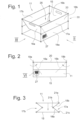
- a box 11 is in the Figures 1 to 3 shown and explained below.
- the transport system 10 according to the invention includes boxes of different types 14 the transport system according to the invention has crates 12 of the first type, crates 13 of the second type and crates 14 of the third type.
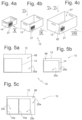
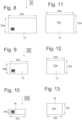
- the boxes 12, 13, 14 are different, such as comparing the Figures 4a, 4b, 4c and a comparison of Figures 8 to 13 becomes clear by their size.
- the embodiment of 1 shows an example of such a crate 11. It can be a crate 12 of the first type, for example.
- Boxes of one type are identical to each other. Boxes of different types are designed similar to each other. All boxes are cuboid when in use educated. In particular, the boxes of different types can also be to scale with respect to one another.
- the boxes 11 are designed as folding boxes and between a state of use 30, the z. Am 1 is shown, and a collapsed or compressed non-use state 31, e.g. Am 18 is indicated, foldable.
- a crate 11 comprises a bottom wall 15 which provides a rectangular base area 32 . From the bottom wall 32 four walls 16a, 16b, 17a, 17b extend upwards.
- the narrow side walls 16a, 16b can be pivoted along indicated geometric pivot axes 19a, 19b. 1 indicates that the front narrow side wall 16a is partially pivoted inwards, while the rear narrow side wall 16b is still in its upright working position.
- both narrow side walls 16a, 16b are already partially pivoted inwards. After continuous pivoting, the narrow side walls 16a, 16b - which in 2 not shown - a position such that they are aligned parallel to the bottom wall 15.
- the longitudinal side walls 17a, 17b each comprise foldable wall sections 18a, 18b. How based on the 3 opens up to the viewer, for example, the foldable wall section 18a is connected in an articulated manner via pivot axes 21c and 21b and the wall section 18b is connected in an articulated manner via the pivot axes 21a and 21b.
- two foldable wall sections 18a, 18b are connected to one another via a geometric pivot axis 21b.
- one area of the wall sections 18a, 18b which is arranged remotely from the pivot axis 21b is articulated to an upper frame structure 20. It is therefore a matter of conventional collapsible boxes or collapsible boxes which are known per se in terms of their functional principle.
- the Figures 8 to 13 illustrate the different dimensions of the crates 12 of the first type, the crates 13 of the second type and the crates 14 of the third type.
- the crate 12 of the first type has a height 24a, a length 22a and a width 23a.
- the box 13 of the second type has a height 24b, a length 22b and a width 23b.
- the third type box 14 has a height 24c, a length 22c and a width 23c.
- the base of the crate 12 of the first type is denoted by 32a
- the base 13 of the second type is denoted by 32b
- the base of the crate 14 of the third type is denoted by 32c.
- the dimensions are advantageously chosen such that z. e.g Figure 5a it follows that a crate 13 of the second type can be inserted lengthwise into a crate 12 of the first type.
- Figure 5b shows that a crate 14 of the third type can be inserted lengthwise into a crate 13 of the second type.
- Figure 5c shows that two crates 14a, 14b of the third type can be inserted transversely into a crate 12 of the first type.
- a crate 14a, 14b of the third type can also be inserted longitudinally into a crate 12 of the first type.
- a residual space 66 remains in the respective larger box when the smaller box is inserted.
- a large residual space 66 which results if analogous to the representation according to FIG Figure 5c only one crate 14 of the third type is placed in a crate 12 of the first type.
- the respective residual space 66 is used to hold other goods.
- FIG. 7 shows a box 14 of the third type, which is filled with merchandise 26a, 26b, 26c.
- the respective interior space 25 of such a box 14 can be completely filled with merchandise 26a, 26b, 26c or free spaces can remain.
- the embodiment of 7 shows a filled crate 36, in contrast to an empty crate 67 according to FIG Figure 4c .
- FIG. 1 also shows primary packaging 63 for commercial goods, as is provided, for example, as a result of being filled with goods at a filling location to be explained later.
- the boxes 12 of the first type, boxes 13 of the second type and boxes 14 of the third type can each be designed in the region of their bottom wall 15 such that a type of liquid-tight trough is formed. This can advantageously prevent liquids from leaking out.
- Each of the boxes 11, 12, 13, 14 has an identifier 27 on. This is an example in 6 shown.
- the embodiment of 6 shows an identifier 27 which includes a barcode 28 and an alphanumeric code 29 .
- the crate 11, 12, 13, 14 has only one barcode 28 or only one alphanumeric code 29 or only one other type or several types of identifiers.
- the identifier 27 includes information about the type of box. The information can be hidden in the barcode, but can be recognized by manual or automatic reading. This offers the possibility of reliably recognizing crates 12, 13, 14 of different types. In this way, for example, a crate can be sorted automatically by a crate sorting system, so that sorting by size can take place.
- Crates of different types can also be assigned different notes, e.g. different deposit amounts, or different, possibly also automated, processing processes, such as cleaning, disinfection or washing processes with crates of different types, can be carried out.
- the invention also includes when the identifier 27 includes information about a single, individual crate 11 , 12 , 13 , 14 .
- the identifier 27 can thus include a type of serial number, for example. This allows the individual boxes to be customized. For example, information can be attributed to a specific crate as to when the crate was processed, e.g. B. when a box 11, 12, 13, 14 was filled with certain merchandise 26a, 26b, 26c, or should still be filled. Information about the crate 11, 12, 13, 14 or information about the merchandise 26a, 26b, 26c or information about the processing of the crates, e.g. 8. A disinfection of a specific box 11, 12, 13, 14, this specific box 11, 12, 13, 14, are assigned. The assignment of the information to the box can, for example, be done electronically, e.g., with the aid of an external computer and a network, which will be described later.
- the invention also includes when the identifier 27 is assigned a memory 62 .
- the store is only exemplary in the embodiment of the first type of box 12 in FIG Fig.4c implied.
- a memory 62 can be associated with the identifier 27 .
- it can also be connected to a computer 50 of the network 49 .
- the memory can be wireless, electronic, writable and readable, for example, and can be written to and/or only read out using radio technologies such as Bluetooth, WLAN, NFC or other radio protocols as part of a data exchange.
- FIG. 14 describes an exemplary embodiment of a transport system 10 according to the invention, which uses the previously described crates 12 of the first type, 13 of the second type, 14 of the third type.
- ID 14 a filling station 34a is indicated in the upper left edge of the image. It is therefore a station within the transport system 10 in which the boxes 10 are filled with merchandise 26.
- the filling station 34a is indicated as a factory.
- z. B. Merchandise 26a, 26b, 26c (cf. 7 ) are produced, e.g. B. in the form of buns. Equally, other foods come into consideration, or life science products or other commercial goods.
- the filling station 34a has been supplied with empty crates 67a, 67b, 67c along a section 37a of a movement path 33.
- buns are baked, and the baked buns are filled in the boxes 67a, 67b, 67c as commodities 26a, 26b, 26c, so that there are filled boxes 36a, 36b, 36c according to FIG 14 within factory 35 are indicated.
- the filled boxes 36a, 36b, 36c are boxes 14a, 14b, 14c of the third type.
- a crate 14d is transported along the section 37b of the movement path 33 to a trading store 38 - shown only by way of example.
- a commercial transaction 38 is only intended to represent a general example of a delivery station 38 of a transport system 10 .
- the trading transaction 38 can, for example, as in 14 indicated to be a supermarket.
- the supermarket includes an entrance 68 for customers and an exit 69 for customers.
- the supermarket 38 includes a goods receipt 70 through which the box 14d reaches the retail store 38.
- the boxes filled with merchandise of the third type, reference numbers 14e and 14f are positioned in a delivery station 39.
- Customers who enter the retail store 38 through the entrance 68 can remove a box 14e, 14f of the third type filled with merchandise from the delivery station 39 and the merchandise in the box 14a, 14f of the third type, in particular with retention of a deposit for the box 14e , 14f, buy. To do this, you can go along section 37e of movement path 33 to a cash register 42 of retail store 38, buy the goods in box 14e and take them home with the box, or to any point of consumption for the goods or to any point of consumption 43 for move the goods. The crate 14i, 14g, 14j is thus transported along the section 37i of the movement path 33.
- the boxes 12, 13, 14 of different types of the transport system 10 according to the invention can be releasably attached to vehicles, for example a bicycle or a walker or a trolley for disabled people, with the aid of adapter elements, not shown, for example clickable or clip-on adapter elements become.
- Place of consumption 43 takes place a consumption or a use of the merchandise 26a, 26b, 26c.
- the box 14h is emptied after the merchandise 26a, 26b, 26c has been removed.
- An emptied crate 67a can now be returned along portion 37g of path of travel 33.
- This crate 67a can, for example, have a return station 44 which, for. 8. is designed as a deposit machine 45, are returned and are subsequently fed along the section 37h of the movement path 33 to a cleaning station, a washing station or a disinfection station 46.
- the crate 67a can be reused by the customer, illustrated by the portion 37f of the movement path 33, for a subsequent purchase.
- the user can therefore take the empty box 67a with him the next time he makes a purchase, insert it through the entrance 68 when entering the retail store 38 and then independently fill this box 14x again with merchandise.
- 14 shows in the trading business 38 a delivery location 41 for non-crate-bound merchandise, ie for z. B. loosely arranged merchandise.
- the box 14x can be used again by the user as transport packaging for the goods.
- a crate washed, cleaned or disinfected in a station 46 can subsequently be fed to a store 47 .
- the box can be stored there until further use. It can then be fed in turn from the store 47 to the filling station 34a along the section 37a of the movement path 33, if necessary using intermediate stores (not shown). In this way, the movement path 33 is closed along the sections 37a, 37b, 37e, 37i, 37g, 37h.
- a washed and cleaned crate e.g. 8. from a warehouse 47, along the section 37j of the movement path 33 directly to the commercial store 38.
- a supply station 40 for empty crates can also be provided in the retail store 38 .
- the 14 indicates such a staging area 40 for empty crates 14k, 13, 12b and 12a.
- a visitor or customer of retail store 38 can therefore, if he does not have any transport containers with him, remove such transport containers from the supply station 40, fill them with merchandise that can be purchased in retail store 38, the merchandise together with the box by paying a deposit at one Transport point of consumption 43, and then use it several times or return it to a return station 44.
- a filling station 34b Immediately before the loose merchandise, which in 14 are denoted by 41, there is a filling station 34b in which boxes 12, 13, 14 of different types can be filled with loose goods 41.
- there is a closed movement path 33b that includes the sections 37x, 37i, 37g, 37h and 37j.
- the transport system 10 according to the invention thus provides closed movement paths 33, 33b.
- the boxes 11, 12, 13, 14 can be used as primary packaging and can be returned along the different stations, such as the filling station 34, factory 45, supply station in the retail store 38 and consumption station 43, in particular using a deposit or labeling or numbering system .
- the boxes 11, 12, 13, 14 are all foldable and can be folded up when not in use, compressed and thus accommodated in a space-saving manner.
- Accommodation in the compressed state can, for example, take place at a filling station 34a, in the area of a factory 35, but also at a filling station 34b or in a staging area 40.
- the boxes can also be accommodated in a space-saving manner at the point of use 33 or in the area of storage 47 .
- FIG. 12 also shows a network 49.
- This includes a first computer 50 and a second computer 51 connected to it.
- the network 49 can also include other computers or computing units that are not shown.
- the intelligence of this network 49 can be organized centrally or decentrally.
- the network 49 is part of the transport system 10.
- the network 49 includes a large number of reading and/or writing stations 52a, 52b, 52c, 52d, 52e, 52f, 52g.
- the individual reading or writing stations 52a, 52b, 52c, 52d, 52e, 52f, 52g have different tasks and functions.
- a read or write device 52a can be arranged in the area of the filling station 34a. With this, for example, the boxes 14d of the third type filled with merchandise can be scanned. In the course of this scanning process, the identifier 27 can be read out via a suitable detection. At the same time can for example automatically, the read identifier 27, in particular a type of serial number, is assigned information that these boxes were filled with a specific type of goods and/or with a specific number of goods and/or with a specific weight of goods. Other information about the filling of this crate 14d with goods can also be assigned to the identifier and thus to the crate.
- the information generated can either be stored in a memory 62 of the box 14d, or it can be transmitted to the computer 50 via a signal line section 64a, via which the read/write device 52a is connected to the computer 50.
- the network 49 therefore knows that a specific box 14d of the third type is filled with specific commercial goods 26a, 26b, 26c or knows other information about the goods.
- the identifier can be read out or the information relating to the identifier 27 can be written in with the aid of a radio link 72, which is only indicated.
- radio links are provided in many places, some in 14 shown but not labeled everywhere.
- the signal path 72 or radio path 72 may include electromagnetic waves or acoustic waves or other types of signal transmission.
- the radio link 72 should indicate that an identifier 27 of the corresponding crate 11, 12, 13, 14 can be read by the reading device 52 or information can be written into a memory of the crate or information about the goods in relation to the crate can be set.
- Each read/write device 52a, 52b, 52c, 52d is connected directly or indirectly to the network 49 via a signal line section 64a, 64b, 64c, 64d.
- the crate 14d can be supplied to a trading store 38 via a goods receipt 70 .
- the figures do not show that a further read/write device is provided in the area of goods receipt 70 of retail store 38, but of course a further read/write device can be provided there.
- a box filled with merchandise indicated by way of example, the box 14e of the third type in 14 leaving the retail store 38, it is also scanned or read in the checkout area 42.
- a reading device 52b is provided for this purpose. This can be connected directly to the cash register 42, possibly also cooperate with the cash register 42 in terms of data technology, or be arranged separately from the cash register 42.
- the reader 52b can read the identifier 27 of the box 14i and z. B. generate a deposit note or other note and this z. B. tell the checkout. A deposit can thus also be calculated in the course of the calculation and the sale of the goods contained in the box 14i. Irrespective of this, information can also be transmitted to the network 49 from the reading device 52b that the crate 14i of the third type has left the retail store 38 after the goods have been sold.
- a further reading device 52d can be provided in the area of the return station 44, e.g. in the area of a deposit machine 45. This can also check or scan a crate 67a brought into the return station 44 and read in its identifier.
- the automatic deposit machine 45 can, for example, in turn take into account an in particular electronic note, with the reading of the identifier for example resulting in a deposit being credited or a deposit being paid out. Of course, such a deposit credit can also be made electronically.
- the reading device 52d can also be connected to the network 49 via a signal line section 64f and communicate to the network 49 that a specific box 14a has been returned to the system and—possibly after cleaning—is available for further use.
- a reading device 52c can document that a specific crate has been subjected to a specific washing or cleaning process, or a specific disinfection process. As a result of this documentation, it can be ensured, for example, that certain cleaning or disinfection steps have been carried out for certain merchandise to be placed in certain boxes. For example, it can be ensured that the crates for certain goods were treated with special chemicals, or it can be ruled out that certain commodities to be contained in the crates were cleaned or disinfected with certain chemicals.
- the information about an individual crate can be transmitted to the network 49 and z. B. to the computer 50 are transmitted.
- the computer 50 or the network 49 can have a memory, not shown, which stores the information or assignments mentioned so that they can be called up.
- a reader 52g may determine which and how many crates are in the warehouse 47 at any given time.
- the computer 50 can thus z. B. also manage storage locations, so that the circulation of the boxes 11, 12, 13, 14 is optimized, in particular needs-based control.
- the computer 50 or in another computer connected to the network 49, which in 14 is not shown, can be recorded in relation to an individual specific crate 11, 12, 13, 14 which stations or which processing this crate has gone through in the course of the life of this crate.
- the type, frequency of use of the crate, the number of washing or disinfection processes can be recorded, as well as the time spent outside of a retail store or within a filling station 34 and information about the goods received.
- an automated check can be carried out to determine whether a single box has already exceeded a large number of uses, for example a threshold use value for a specific number of uses, for example 30 uses. If such a threshold value is exceeded, an automated or visual or manual inspection can be carried out with regard to a specific box in order to check the functionality of the box. The fact that a corresponding inspection has been carried out in relation to a specific crate can also be recorded with the aid of a read/write device and by storing the corresponding information. Such a transport system can thus be operated safely.
- a reading device 52c can also be provided in the area of the point of consumption 43 of the goods, which is connected to the network 49 via a signal connection section 64c.
- a reading device 52 can be provided by an Internet browser, for example.
- a buyer of the crate 14h filled with merchandise can, for example, by entering the alphanumeric code of a specific crate on a website, explicitly obtain specific information about where this crate has already been, which goods have been transported with this crate, when the crate has left the retail store has, etc., to provide insight into such a transport system and to increase acceptance.
- the invention also encompasses a check of the dwell time of the crate outside of the retail store 38 in the area of the return station 44 . So e.g. B. to encourage and to create an incentive to quickly supply corresponding boxes again for re-use, if they are returned after a short period of time, a higher one Deposit be paid out than after return after a longer stay outside of the commercial transaction 38. This enables the transport system to be operated with only a smaller number of boxes 11, 12, 13, 14 required.
- the transport system 14 provides that crates of the third type fit transversely into crates 12 of the first type. For example, shows 14 a box 14j of the third type within a box 12c of the first type between the commercial establishment 38 and the place of consumption 43.
- a user borrows a crate 12 of the first type when shopping in a supermarket or another commercial establishment 38, he can accommodate a crate 14e of the third type designed as primary packaging in this crate 12 and additionally accommodate further merchandise 41 that is not bound to a crate, for which more Transport space or residual space 66 is made available within the box 12 of the first type, even if a primary packaging 14 is already arranged therein.
- This provides the shopping customer with great convenience and a comfortable means of transport.
- a customer can therefore use transport containers 11, 12, 13, 14, which are offered in a reusable system, in a retail store 38 even for unplanned purchases, without having to bring his own transport containers with him.
- a user When a user enters a retail store 38 through an entrance area 68, he can, by scanning his empty crate with a read/write device 52f, inform a commercial store's computer system, for example, that this crate is deposit-free or that a corresponding deposit has already been paid by a user. A deposit credit, in particular temporary, can also take place or be generated.
- A, in 14 not shown, may be provided internally of the commercial store 38 arranged smaller network that transmits the appropriate information.
- the cash register 42 is preferably connected to this smaller internal network.
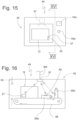
- a return station 44 of a transport system according to the invention is based on an example of a deposit machine 45 based on the Figures 15 and 16 explained schematically.
- 15 shows a deposit machine 45 in a front view, with a receiving opening 53, which is dimensioned so that even the largest boxes 12 of the transport system 10 according to the invention, in this case boxes 12 of the first type, fit.
- 16 makes it clear that the box 12a of the first type can be placed on a conveyor belt 56.
- the deposit machine 45 has a detection device 57 which, for example, corresponds to the read/write device 52d of the exemplary embodiment of FIG 14 can match.
- the detection device 57 is able to read out the identifier 27 and to recognize the type of crate 12 and, if necessary, additionally also be designed to recognize a serial number of the crate 12 .
- the detection device 57 is advantageously also designed to read out identifiers 65 on other reusable containers, e.g. on bottles 55a, 55b. In this way, a deposit machine 45 can be used both for taking back reusable containers of a conventional type and for taking back crates 11, 12, 13, 14 of a transport system 10 according to the invention.
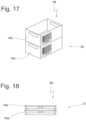
- FIG. 17 shows schematically a stack 58 of boxes 14a of the third type and in use 18 shows a stack 58 of boxes 14a of the third type that are in the non-use position.
- the boxes advantageously have a stacking edge (not shown) in order to achieve a defined and non-slip positioning of stacked boxes 14a, 14d.
- the invention also includes when a first box 14a according to 17 is closed by a second box 14b placed thereon.
- the upper crate 14b resting on the lower crate 14a - unlike in 17 - are in a non-use condition and form a lid for the lower box 14a.
- the invention also encompasses handling units comprising a first box 14a of the first, second or third type and at least one second box 14b of the same type arranged thereon, the second box 14b forming a lid for closing the first box 14a when not in use .
- the handling unit formed in this way can also be used to transport or store higher-value or high-value products.
- Lid 14b and box 14a closed by this lid 14b can e.g. B. by some kind of seal or security linked and locked so that unauthorized access to the goods in the box 14a is prevented during shipping or storage.
- Such handling units can also be dispatched via transport companies, for example.
- a use of the crates 11, 12 of the first type, the crates 13 of the second type, and the crates 14 of the third type can be used as part of a transport system 10 according to the invention, for. B. using parcel services, online ordering systems, click & collect systems, in retail stores as part of on-site rental and as part of primary packaging.
- Each box 11, 12, 13, 14 preferably has a handle 60 or a handle opening 61 on each of the narrow side walls 16a, 16b.
Landscapes
- Engineering & Computer Science (AREA)
- Business, Economics & Management (AREA)
- Economics (AREA)
- Mechanical Engineering (AREA)
- Operations Research (AREA)
- Tourism & Hospitality (AREA)
- Human Resources & Organizations (AREA)
- Marketing (AREA)
- Development Economics (AREA)
- Quality & Reliability (AREA)
- Strategic Management (AREA)
- Entrepreneurship & Innovation (AREA)
- Physics & Mathematics (AREA)
- General Business, Economics & Management (AREA)
- General Physics & Mathematics (AREA)
- Theoretical Computer Science (AREA)
- Control Of Vending Devices And Auxiliary Devices For Vending Devices (AREA)
- Details Of Rigid Or Semi-Rigid Containers (AREA)
Applications Claiming Priority (1)
| Application Number | Priority Date | Filing Date | Title |
|---|---|---|---|
| DE102021134024 | 2021-12-21 |
Publications (2)
| Publication Number | Publication Date |
|---|---|
| EP4212447A2 true EP4212447A2 (fr) | 2023-07-19 |
| EP4212447A3 EP4212447A3 (fr) | 2023-08-02 |
Family
ID=86733565
Family Applications (1)
| Application Number | Title | Priority Date | Filing Date |
|---|---|---|---|
| EP22214151.7A Withdrawn EP4212447A3 (fr) | 2021-12-21 | 2022-12-16 | Système de transport pour marchandises commerciales |
Country Status (1)
| Country | Link |
|---|---|
| EP (1) | EP4212447A3 (fr) |
Cited By (3)
| Publication number | Priority date | Publication date | Assignee | Title |
|---|---|---|---|---|
| WO2025036599A1 (fr) * | 2023-08-16 | 2025-02-20 | Schoeller Ventures Gmbh | Récipient de présentation réutilisable |
| WO2025036613A1 (fr) * | 2023-08-16 | 2025-02-20 | Schoeller Ventures Gmbh | Contenants de transport réutilisables, découpe pour la production d'un contenant de transport réutilisable, système et procédé permettant la réutilisation de contenants de transport réutilisables |
| WO2026003506A1 (fr) * | 2024-06-24 | 2026-01-02 | Fuelsell Limited | Système d'achat de bûches, caisses améliorées et sacs à bûches pliables améliorés |
Family Cites Families (5)
| Publication number | Priority date | Publication date | Assignee | Title |
|---|---|---|---|---|
| GB2461722B (en) * | 2008-07-10 | 2012-10-17 | Christopher Douglas Blair | Integrated goods transport sytem and method |
| TR200901510A2 (tr) * | 2009-02-27 | 2009-05-21 | Ay Kasa Pol�Mer Ambalaj Ve Ta�Ima S� | Kasa içinde mini kasa |
| DE202010007099U1 (de) * | 2010-05-21 | 2010-08-26 | Surplus Systems Ug | Kiste |
| US9382035B2 (en) * | 2013-10-28 | 2016-07-05 | Linda Fritz | Market basket system |
| DE102016104371A1 (de) * | 2016-03-10 | 2017-09-14 | Surplussystems Gmbh | Verfahren zur Nutzung von Miniboxen für Obst und Gemüse sowie eine Minibox mit Haltemitteln |
-
2022
- 2022-12-16 EP EP22214151.7A patent/EP4212447A3/fr not_active Withdrawn
Cited By (3)
| Publication number | Priority date | Publication date | Assignee | Title |
|---|---|---|---|---|
| WO2025036599A1 (fr) * | 2023-08-16 | 2025-02-20 | Schoeller Ventures Gmbh | Récipient de présentation réutilisable |
| WO2025036613A1 (fr) * | 2023-08-16 | 2025-02-20 | Schoeller Ventures Gmbh | Contenants de transport réutilisables, découpe pour la production d'un contenant de transport réutilisable, système et procédé permettant la réutilisation de contenants de transport réutilisables |
| WO2026003506A1 (fr) * | 2024-06-24 | 2026-01-02 | Fuelsell Limited | Système d'achat de bûches, caisses améliorées et sacs à bûches pliables améliorés |
Also Published As
| Publication number | Publication date |
|---|---|
| EP4212447A3 (fr) | 2023-08-02 |
Similar Documents
| Publication | Publication Date | Title |
|---|---|---|
| EP4212447A2 (fr) | Système de transport pour marchandises commerciales | |
| DE69419236T2 (de) | Registrierkassensystem mit Strichkode-Drucker | |
| DE602005004930T2 (de) | System zur hochfrequenzidentifikation (rfid) für herstellung, verteilung und verkauf von schlüsseln | |
| DE69133396T2 (de) | Warenauszahlsystem | |
| EP2740109B1 (fr) | Appareil automatique pour marchandises | |
| CN107220795A (zh) | 一种不同门店间关联下单方法及装置 | |
| EP3914761B1 (fr) | Sac réutilisable | |
| Alizadeh et al. | A modified (S− 1, S) inventory system for deteriorating items with Poisson demand and non-zero lead time | |
| DE102005024217A1 (de) | RF-Tag-Recycling-System und RF-Tag-Sammelvorrichtung | |
| DE102014225118A1 (de) | Systeme und verfahren zum erleichtern der leistungen bei der bestandsverwaltung und -steuerung | |
| Cooper et al. | How buyers and operations personnel evaluate service | |
| EP1585068A1 (fr) | Méthode et dispositif pour la vente d'articles et la livraison des articles achetés | |
| DE19511649A1 (de) | Elektronisches System-Kaufhaus | |
| Poler et al. | Inventory theory | |
| EP2827290B1 (fr) | Procédé de manipulation et/ou de vente de marchandises à l'aide d'un dépôt de marchandises, ainsi que dépôt de marchandises | |
| DE69118485T2 (de) | Flexibles Warenauszahl- und Inventarverwaltungssystem | |
| DE102019130519B4 (de) | System und Verfahren zur Automatisierung von auswahlbezogenen Warenströmen | |
| DE10040752A1 (de) | Warenhaus mit einer zentralen Warenausgabe | |
| AU2021376443A1 (en) | System and method for the supply of reusable products | |
| DE102013000587A1 (de) | Abrechnungssystem | |
| US20080249655A1 (en) | Recycle station layout and system | |
| AT524800B1 (de) | Bereitstellen und Beziehen eines Pfandguts mit einem Identifizierer | |
| EP3570232B1 (fr) | Système à plusieurs voies doté de conteneurs de transport démontables | |
| Klongsungsorn | Reverse Logistics Warehouse Process Optimization | |
| DE19706637C2 (de) | Verfahren zum Verkauf und/oder zur Ausgabe von Waren |
Legal Events
| Date | Code | Title | Description |
|---|---|---|---|
| PUAI | Public reference made under article 153(3) epc to a published international application that has entered the european phase |
Free format text: ORIGINAL CODE: 0009012 |
|
| STAA | Information on the status of an ep patent application or granted ep patent |
Free format text: STATUS: THE APPLICATION HAS BEEN PUBLISHED |
|
| PUAL | Search report despatched |
Free format text: ORIGINAL CODE: 0009013 |
|
| AK | Designated contracting states |
Kind code of ref document: A2 Designated state(s): AL AT BE BG CH CY CZ DE DK EE ES FI FR GB GR HR HU IE IS IT LI LT LU LV MC ME MK MT NL NO PL PT RO RS SE SI SK SM TR |
|
| AK | Designated contracting states |
Kind code of ref document: A3 Designated state(s): AL AT BE BG CH CY CZ DE DK EE ES FI FR GB GR HR HU IE IS IT LI LT LU LV MC ME MK MT NL NO PL PT RO RS SE SI SK SM TR |
|
| RIC1 | Information provided on ipc code assigned before grant |
Ipc: G06Q 10/0833 20230101ALI20230629BHEP Ipc: B65D 77/04 20060101ALI20230629BHEP Ipc: B65D 6/18 20060101AFI20230629BHEP |
|
| STAA | Information on the status of an ep patent application or granted ep patent |
Free format text: STATUS: THE APPLICATION IS DEEMED TO BE WITHDRAWN |
|
| 18D | Application deemed to be withdrawn |
Effective date: 20240203 |