EP4212593A1 - Wasserlösliche pi-konjugierte fluoreszierende polymere auf 1,1'-binaphthyl-basis mit abstimmbarer absorption - Google Patents
Wasserlösliche pi-konjugierte fluoreszierende polymere auf 1,1'-binaphthyl-basis mit abstimmbarer absorption Download PDFInfo
- Publication number
- EP4212593A1 EP4212593A1 EP23151645.1A EP23151645A EP4212593A1 EP 4212593 A1 EP4212593 A1 EP 4212593A1 EP 23151645 A EP23151645 A EP 23151645A EP 4212593 A1 EP4212593 A1 EP 4212593A1
- Authority
- EP
- European Patent Office
- Prior art keywords
- sub
- conjugate
- polymer
- antigen recognizing
- conjugate according
- Prior art date
- Legal status (The legal status is an assumption and is not a legal conclusion. Google has not performed a legal analysis and makes no representation as to the accuracy of the status listed.)
- Pending
Links
Images



Classifications
-
- C—CHEMISTRY; METALLURGY
- C09—DYES; PAINTS; POLISHES; NATURAL RESINS; ADHESIVES; COMPOSITIONS NOT OTHERWISE PROVIDED FOR; APPLICATIONS OF MATERIALS NOT OTHERWISE PROVIDED FOR
- C09B—ORGANIC DYES OR CLOSELY-RELATED COMPOUNDS FOR PRODUCING DYES, e.g. PIGMENTS; MORDANTS; LAKES
- C09B69/00—Dyes not provided for by a single group of this subclass
- C09B69/10—Polymeric dyes; Reaction products of dyes with monomers or with macromolecular compounds
-
- C—CHEMISTRY; METALLURGY
- C08—ORGANIC MACROMOLECULAR COMPOUNDS; THEIR PREPARATION OR CHEMICAL WORKING-UP; COMPOSITIONS BASED THEREON
- C08G—MACROMOLECULAR COMPOUNDS OBTAINED OTHERWISE THAN BY REACTIONS ONLY INVOLVING UNSATURATED CARBON-TO-CARBON BONDS
- C08G65/00—Macromolecular compounds obtained by reactions forming an ether link in the main chain of the macromolecule
- C08G65/02—Macromolecular compounds obtained by reactions forming an ether link in the main chain of the macromolecule from cyclic ethers by opening of the heterocyclic ring
- C08G65/32—Polymers modified by chemical after-treatment
- C08G65/329—Polymers modified by chemical after-treatment with organic compounds
- C08G65/337—Polymers modified by chemical after-treatment with organic compounds containing other elements
-
- G—PHYSICS
- G01—MEASURING; TESTING
- G01N—INVESTIGATING OR ANALYSING MATERIALS BY DETERMINING THEIR CHEMICAL OR PHYSICAL PROPERTIES
- G01N33/00—Investigating or analysing materials by specific methods not covered by groups G01N1/00 - G01N31/00
- G01N33/48—Biological material, e.g. blood, urine; Haemocytometers
- G01N33/50—Chemical analysis of biological material, e.g. blood, urine; Testing involving biospecific ligand binding methods; Immunological testing
- G01N33/53—Immunoassay; Biospecific binding assay; Materials therefor
- G01N33/531—Production of immunochemical test materials
- G01N33/532—Production of labelled immunochemicals
- G01N33/533—Production of labelled immunochemicals with fluorescent label
-
- C—CHEMISTRY; METALLURGY
- C08—ORGANIC MACROMOLECULAR COMPOUNDS; THEIR PREPARATION OR CHEMICAL WORKING-UP; COMPOSITIONS BASED THEREON
- C08G—MACROMOLECULAR COMPOUNDS OBTAINED OTHERWISE THAN BY REACTIONS ONLY INVOLVING UNSATURATED CARBON-TO-CARBON BONDS
- C08G61/00—Macromolecular compounds obtained by reactions forming a carbon-to-carbon link in the main chain of the macromolecule
- C08G61/12—Macromolecular compounds containing atoms other than carbon in the main chain of the macromolecule
- C08G61/121—Macromolecular compounds containing atoms other than carbon in the main chain of the macromolecule derived from organic halides
-
- C—CHEMISTRY; METALLURGY
- C08—ORGANIC MACROMOLECULAR COMPOUNDS; THEIR PREPARATION OR CHEMICAL WORKING-UP; COMPOSITIONS BASED THEREON
- C08G—MACROMOLECULAR COMPOUNDS OBTAINED OTHERWISE THAN BY REACTIONS ONLY INVOLVING UNSATURATED CARBON-TO-CARBON BONDS
- C08G65/00—Macromolecular compounds obtained by reactions forming an ether link in the main chain of the macromolecule
- C08G65/02—Macromolecular compounds obtained by reactions forming an ether link in the main chain of the macromolecule from cyclic ethers by opening of the heterocyclic ring
- C08G65/32—Polymers modified by chemical after-treatment
- C08G65/329—Polymers modified by chemical after-treatment with organic compounds
- C08G65/333—Polymers modified by chemical after-treatment with organic compounds containing nitrogen
- C08G65/33344—Polymers modified by chemical after-treatment with organic compounds containing nitrogen containing carbamate group
-
- C—CHEMISTRY; METALLURGY
- C08—ORGANIC MACROMOLECULAR COMPOUNDS; THEIR PREPARATION OR CHEMICAL WORKING-UP; COMPOSITIONS BASED THEREON
- C08G—MACROMOLECULAR COMPOUNDS OBTAINED OTHERWISE THAN BY REACTIONS ONLY INVOLVING UNSATURATED CARBON-TO-CARBON BONDS
- C08G65/00—Macromolecular compounds obtained by reactions forming an ether link in the main chain of the macromolecule
- C08G65/02—Macromolecular compounds obtained by reactions forming an ether link in the main chain of the macromolecule from cyclic ethers by opening of the heterocyclic ring
- C08G65/32—Polymers modified by chemical after-treatment
- C08G65/329—Polymers modified by chemical after-treatment with organic compounds
- C08G65/334—Polymers modified by chemical after-treatment with organic compounds containing sulfur
-
- C—CHEMISTRY; METALLURGY
- C09—DYES; PAINTS; POLISHES; NATURAL RESINS; ADHESIVES; COMPOSITIONS NOT OTHERWISE PROVIDED FOR; APPLICATIONS OF MATERIALS NOT OTHERWISE PROVIDED FOR
- C09B—ORGANIC DYES OR CLOSELY-RELATED COMPOUNDS FOR PRODUCING DYES, e.g. PIGMENTS; MORDANTS; LAKES
- C09B69/00—Dyes not provided for by a single group of this subclass
- C09B69/10—Polymeric dyes; Reaction products of dyes with monomers or with macromolecular compounds
- C09B69/109—Polymeric dyes; Reaction products of dyes with monomers or with macromolecular compounds containing other specific dyes
-
- C—CHEMISTRY; METALLURGY
- C09—DYES; PAINTS; POLISHES; NATURAL RESINS; ADHESIVES; COMPOSITIONS NOT OTHERWISE PROVIDED FOR; APPLICATIONS OF MATERIALS NOT OTHERWISE PROVIDED FOR
- C09K—MATERIALS FOR MISCELLANEOUS APPLICATIONS, NOT PROVIDED FOR ELSEWHERE
- C09K11/00—Luminescent materials, e.g. electroluminescent or chemiluminescent
- C09K11/06—Luminescent materials, e.g. electroluminescent or chemiluminescent containing organic luminescent materials
-
- G—PHYSICS
- G01—MEASURING; TESTING
- G01N—INVESTIGATING OR ANALYSING MATERIALS BY DETERMINING THEIR CHEMICAL OR PHYSICAL PROPERTIES
- G01N15/00—Investigating characteristics of particles; Investigating permeability, pore-volume or surface-area of porous materials
- G01N15/10—Investigating individual particles
- G01N15/14—Optical investigation techniques, e.g. flow cytometry
-
- G—PHYSICS
- G01—MEASURING; TESTING
- G01N—INVESTIGATING OR ANALYSING MATERIALS BY DETERMINING THEIR CHEMICAL OR PHYSICAL PROPERTIES
- G01N21/00—Investigating or analysing materials by the use of optical means, i.e. using sub-millimetre waves, infrared, visible or ultraviolet light
- G01N21/62—Systems in which the material investigated is excited whereby it emits light or causes a change in wavelength of the incident light
- G01N21/63—Systems in which the material investigated is excited whereby it emits light or causes a change in wavelength of the incident light optically excited
- G01N21/64—Fluorescence; Phosphorescence
-
- G—PHYSICS
- G01—MEASURING; TESTING
- G01N—INVESTIGATING OR ANALYSING MATERIALS BY DETERMINING THEIR CHEMICAL OR PHYSICAL PROPERTIES
- G01N33/00—Investigating or analysing materials by specific methods not covered by groups G01N1/00 - G01N31/00
- G01N33/48—Biological material, e.g. blood, urine; Haemocytometers
- G01N33/50—Chemical analysis of biological material, e.g. blood, urine; Testing involving biospecific ligand binding methods; Immunological testing
- G01N33/52—Use of compounds or compositions for colorimetric, spectrophotometric or fluorometric investigation, e.g. use of reagent paper and including single- and multilayer analytical elements
-
- G—PHYSICS
- G01—MEASURING; TESTING
- G01N—INVESTIGATING OR ANALYSING MATERIALS BY DETERMINING THEIR CHEMICAL OR PHYSICAL PROPERTIES
- G01N33/00—Investigating or analysing materials by specific methods not covered by groups G01N1/00 - G01N31/00
- G01N33/48—Biological material, e.g. blood, urine; Haemocytometers
- G01N33/50—Chemical analysis of biological material, e.g. blood, urine; Testing involving biospecific ligand binding methods; Immunological testing
- G01N33/58—Chemical analysis of biological material, e.g. blood, urine; Testing involving biospecific ligand binding methods; Immunological testing involving labelled substances
- G01N33/582—Chemical analysis of biological material, e.g. blood, urine; Testing involving biospecific ligand binding methods; Immunological testing involving labelled substances with fluorescent label
-
- G—PHYSICS
- G01—MEASURING; TESTING
- G01N—INVESTIGATING OR ANALYSING MATERIALS BY DETERMINING THEIR CHEMICAL OR PHYSICAL PROPERTIES
- G01N33/00—Investigating or analysing materials by specific methods not covered by groups G01N1/00 - G01N31/00
- G01N33/48—Biological material, e.g. blood, urine; Haemocytometers
- G01N33/50—Chemical analysis of biological material, e.g. blood, urine; Testing involving biospecific ligand binding methods; Immunological testing
- G01N33/58—Chemical analysis of biological material, e.g. blood, urine; Testing involving biospecific ligand binding methods; Immunological testing involving labelled substances
- G01N33/583—Chemical analysis of biological material, e.g. blood, urine; Testing involving biospecific ligand binding methods; Immunological testing involving labelled substances with non-fluorescent dye label
-
- C—CHEMISTRY; METALLURGY
- C08—ORGANIC MACROMOLECULAR COMPOUNDS; THEIR PREPARATION OR CHEMICAL WORKING-UP; COMPOSITIONS BASED THEREON
- C08G—MACROMOLECULAR COMPOUNDS OBTAINED OTHERWISE THAN BY REACTIONS ONLY INVOLVING UNSATURATED CARBON-TO-CARBON BONDS
- C08G2261/00—Macromolecular compounds obtained by reactions forming a carbon-to-carbon link in the main chain of the macromolecule
- C08G2261/10—Definition of the polymer structure
- C08G2261/14—Side-groups
- C08G2261/142—Side-chains containing oxygen
- C08G2261/1424—Side-chains containing oxygen containing ether groups, including alkoxy
-
- C—CHEMISTRY; METALLURGY
- C08—ORGANIC MACROMOLECULAR COMPOUNDS; THEIR PREPARATION OR CHEMICAL WORKING-UP; COMPOSITIONS BASED THEREON
- C08G—MACROMOLECULAR COMPOUNDS OBTAINED OTHERWISE THAN BY REACTIONS ONLY INVOLVING UNSATURATED CARBON-TO-CARBON BONDS
- C08G2261/00—Macromolecular compounds obtained by reactions forming a carbon-to-carbon link in the main chain of the macromolecule
- C08G2261/10—Definition of the polymer structure
- C08G2261/14—Side-groups
- C08G2261/142—Side-chains containing oxygen
- C08G2261/1426—Side-chains containing oxygen containing carboxy groups (COOH) and/or -C(=O)O-moieties
-
- C—CHEMISTRY; METALLURGY
- C08—ORGANIC MACROMOLECULAR COMPOUNDS; THEIR PREPARATION OR CHEMICAL WORKING-UP; COMPOSITIONS BASED THEREON
- C08G—MACROMOLECULAR COMPOUNDS OBTAINED OTHERWISE THAN BY REACTIONS ONLY INVOLVING UNSATURATED CARBON-TO-CARBON BONDS
- C08G2261/00—Macromolecular compounds obtained by reactions forming a carbon-to-carbon link in the main chain of the macromolecule
- C08G2261/10—Definition of the polymer structure
- C08G2261/14—Side-groups
- C08G2261/143—Side-chains containing nitrogen
-
- C—CHEMISTRY; METALLURGY
- C08—ORGANIC MACROMOLECULAR COMPOUNDS; THEIR PREPARATION OR CHEMICAL WORKING-UP; COMPOSITIONS BASED THEREON
- C08G—MACROMOLECULAR COMPOUNDS OBTAINED OTHERWISE THAN BY REACTIONS ONLY INVOLVING UNSATURATED CARBON-TO-CARBON BONDS
- C08G2261/00—Macromolecular compounds obtained by reactions forming a carbon-to-carbon link in the main chain of the macromolecule
- C08G2261/10—Definition of the polymer structure
- C08G2261/14—Side-groups
- C08G2261/146—Side-chains containing halogens
-
- C—CHEMISTRY; METALLURGY
- C08—ORGANIC MACROMOLECULAR COMPOUNDS; THEIR PREPARATION OR CHEMICAL WORKING-UP; COMPOSITIONS BASED THEREON
- C08G—MACROMOLECULAR COMPOUNDS OBTAINED OTHERWISE THAN BY REACTIONS ONLY INVOLVING UNSATURATED CARBON-TO-CARBON BONDS
- C08G2261/00—Macromolecular compounds obtained by reactions forming a carbon-to-carbon link in the main chain of the macromolecule
- C08G2261/10—Definition of the polymer structure
- C08G2261/14—Side-groups
- C08G2261/148—Side-chains having aromatic units
-
- C—CHEMISTRY; METALLURGY
- C08—ORGANIC MACROMOLECULAR COMPOUNDS; THEIR PREPARATION OR CHEMICAL WORKING-UP; COMPOSITIONS BASED THEREON
- C08G—MACROMOLECULAR COMPOUNDS OBTAINED OTHERWISE THAN BY REACTIONS ONLY INVOLVING UNSATURATED CARBON-TO-CARBON BONDS
- C08G2261/00—Macromolecular compounds obtained by reactions forming a carbon-to-carbon link in the main chain of the macromolecule
- C08G2261/10—Definition of the polymer structure
- C08G2261/21—Stereochemical aspects
- C08G2261/214—Chirality
-
- C—CHEMISTRY; METALLURGY
- C09—DYES; PAINTS; POLISHES; NATURAL RESINS; ADHESIVES; COMPOSITIONS NOT OTHERWISE PROVIDED FOR; APPLICATIONS OF MATERIALS NOT OTHERWISE PROVIDED FOR
- C09K—MATERIALS FOR MISCELLANEOUS APPLICATIONS, NOT PROVIDED FOR ELSEWHERE
- C09K2211/00—Chemical nature of organic luminescent or tenebrescent compounds
- C09K2211/14—Macromolecular compounds
-
- G—PHYSICS
- G01—MEASURING; TESTING
- G01N—INVESTIGATING OR ANALYSING MATERIALS BY DETERMINING THEIR CHEMICAL OR PHYSICAL PROPERTIES
- G01N2458/00—Labels used in chemical analysis of biological material
- G01N2458/30—Electrochemically active labels
Definitions
- the present invention is to water-soluble fluorescent polymer dyes and their use in conjugates with antibodies for cell detection and analysis.
- Immunofluorescent labeling is important for the detailed analysis and specific isolation of target cells from a biological specimen in both, research and clinical applications.
- the sensitivity of the analysis mainly depends on the brightness of the fluorophores.
- Water-soluble ⁇ -conjugated polymers have been used as fluorophores with remarkable brightness and applied in biological applications.
- Such water-soluble ⁇ -conjugated polymers are for example described in " Synthesis of Binaphthyl-Oligothiophene Copolymers with Emissions of Different Colors: Systematically Tuning the Photoluminescence of Conjugated Polymers" by K. Y. Musick, Q.-S. Hu, L. Pu, Macromolecules 1998, 31, 2933-2942 .
- US20180009990A1 and US10604657B2 mention 4,4'-polymerized binaphthyl substituted with PEGs in the 2,2'positions.
- PPE polyparaethyniline
- the binaphthyl-based polymers disclosed in this invention are bound directly to neighboring co-monomers without ethyniline bonding, resulting in sp 2 hybridized bonding and fully-aromatic conjugated systems. Water solvated polymeric dyes and polymeric tandem dyes are provided.
- the polymeric dyes include a water solvated light harvesting multichromophore having a conjugated segment of aryl or heteroaryl co-monomers linked via covalent bonds, vinylene groups or ethynylene groups.
- the polymeric tandem dyes further include a signaling chromophore covalently linked to the multichromophore in energy-receiving proximity therewith.
- polymer dyes are expensive to manufacture and in particular the synthesis of 4,4'-functionalized binaphthyl monomers is laborious and expensive. Furthermore, special comonomers are required to use these polymer dyes with ultraviolet excitation light and and the resulting polymer dyes are highly complex. It is therefore an object of the invention to provide simple systems which give more flexibility in tuning the absorption and emission characteristics towards the UV region of the spectrum and which are also easier and cheaper to produce.
- pi-Conjugated polymers based on binaphthyl monomers allow tuning the absorption wavelength over an extremely wide range.
- the energy of the system is strikingly high because of to the unique structure of the binaphthyl monomers which consist of two twisted naphthyl units.
- this structural feature allows the design of polymers with absorption in the deep UV region.
- the energy of the system can be precisely controlled by copolymerization of the binaphthyl monomers with suitable comonomers. Strategic choice of comonomers gives the ability to tune the polymer absorption band edge from the deep UV into the visible range of the spectrum.
- the absorption band of a useful polymer needs to match the wavelength of the light source, e.g. lasers with 355 nm, 405 nm, 488 nm, 561 nm or 640 nm wavelength.
- Current polymers are limited in their light absorption band to narrow regions of the violet, which in turn limits their usefulness.
- Novel pi-conjugated polymers with tuneable absorption band would allow the expansion of the arsenal of water-soluble polymeric dyes for biological applications, including the detection of analytes.
- an object of the invention is a conjugate having the general formula (I)
- Fig. 5 shows possible substitution patterns.
- the residues used for substitution may be same or different in each position (for example position 2 and 2' may be provided with the same or a different residue.
- two residues at the remaining positions may form a common cycloalkyl- or heterocycloalkyl ring system.
- the conjugates of the invention are preferable water-soluble.
- AR is connected in the polymer chain via the 2,2' or 3,3' or 5,5' or 6,6' or 7,7' or 8,8' positions
- 2,2' or 3,3' or 5,5' or 6,6' or 7,7' or 8,8' positions refers to C-C bonds between the respective C atoms of the positions of AR with a C-atom of another AR unit, a G1 unit or an L unit.
- Yet another object of the invention is the use of the method in fluorescence microscopy, flow cytometry, fluorescence spectroscopy, cell separation, pathology or histology.
- MU is a bandgap modifying unit which causes a shift of the absorption band of the conjugate.
- MU comprises an aromatic system with at least one benzene or thiophene ring providing an conjugated pi system, optionally substituted with an electron withdrawing residue, an electron donating residue, sterically hindering groups, and/or residues enhancing water solubility.
- MU comprises an aromatic system with at least two fused, annulated or conjugated benzene or thiophene rings providing an conjugated pi system, optionally substituted with an electron withdrawing residue, an electron donating residue, sterically hindering groups, and/or residues enhancing water solubility.
- an electron withdrawing residue an electron donating residue, sterically hindering groups, and/or residues enhancing water solubility one or more residues like alkyl or ether (glycol) residues or halogen atoms or halogenated alkyl groups can be used.
- MU repeating units may evenly or randomly distributed in the conjugate of the invention.
- MU has not only the function as band gap modifying unit, but also as polymer modifying unit.
- Preferred residues for MU are as follows:
- Terminal groups G1 and G2 Terminal groups G1 and G2
- G1 and G2 are both independently chosen from the group of hydrogen, halogen or an antigen recognizing moiety.
- the antigen recognizing moiety could be selected from an antibody, an fragmented antibody, an fragmented antibody derivative, peptide/MHC-complexes, receptors for cell adhesion or costimulatory molecules, receptor ligands, antigens, hapten binders, avidin, streptavidin, aptamers, primers and ligase substrates, peptide/MHC complexes targeting TCR molecules, cell adhesion receptor molecules, receptors for costimulatory molecules or artificial engineered binding molecules.
- the MU unit located on the end of the conjugate is bond via a linker group L as shown in the following formula (III) Wherein G1, AR, MU, G2, a, b and c have the same meaning as in formula (I) and wherein L represents a molecule comprising alkyl, aryl or heteroaryl groups connecting the polymer to G2.
- L is an aryl or a heteroaryl group located at the ends of the polymer main chain and may be substituted with one or more pendant chains terminated with: i) a functional group selected from amine, carbamate, carboxylic acid, carboxylate, maleimide, activated ester, N-hydroxysuccinimidyl, hydrazine, hydrazide, hydrazine, azide, alkyne, aldehyde, thiol, and protected groups thereof for conjugation to a molecule or biomolecule; or ii) an attached organic fluorescent dye as energy acceptor of an energy transfer system, or iii) a biomolecule.
- a functional group selected from amine, carbamate, carboxylic acid, carboxylate, maleimide, activated ester, N-hydroxysuccinimidyl, hydrazine, hydrazide, hydrazine, azide, alkyne, aldehyde, thiol, and protected groups thereof for conjug
- L is selected from one or more of the following residues:
- antigen recognizing moiety refers to any kind of antibody, fragmented antibody or fragmented antibody derivatives, directed against the target moietiesexpressed on the biological specimens, like antigens expressed intracellular or extracellular on cells.
- the term relates to fully intact antibodies, fragmented antibody or fragmented antibody derivatives, e. g., Fab, Fab', F(ab')2, sdAb, scFv, di-scFv, nanobodies.
- fragmented antibody derivatives may be synthesized by recombinant procedures including covalent and non - covalent conjugates containing these kinds of molecules.
- antigen recognizing moieties are peptide/MHC-complexes targeting TCR molecules, cell adhesion receptor molecules, receptors for costimulatory molecules, artificial engineered binding molecules, e.g., peptides or aptamers which target, e.g., cell surface molecules.
- the conjugate used in the method of the invention may comprise up to 100, preferable 1-20 antigen recognizing moieties Y.
- the interaction of the antigen recognizing moiety with the target antigen can be of high or low affinity. Binding interactions of a single low - affinity antigen recognizing moiety is too low to provide a stable bond with the antigen.
- Low-affinity antigen recognizing moieties can be multimerized by conjugation to the enzymatically degradable spacer to furnish high avidity. When the spacer is enzymatically cleaved, the low-affinity antigen recognizing moieties will be monomerized which results in a complete removal of the fluorescent marker.
- Antigen recognizing moiety refers to an antibody directed against antigen expressed by the biological specimens (target cells) intracellular, like IL2, FoxP3, CD154, or extracellular, like CD19, CD3, CD14, CD4, CD, CD25, CD34, CD56, and CD133.
- the antigen recognizing moieties G1, G2, especially antibodies, can be coupled to CP through side chain amino or sulfhydryl groups. In some cases, the glycosidic side chain of the antibody can be oxidized by periodate resulting in aldehyde functional groups.
- the antigen recognizing moiety can be covalently or non-covalently coupled.
- Methods for covalent or non-covalent conjugation are known by persons skilled in the art and the same as mentioned for conjugation of the fluorescent marker.
- the method of the invention is especially useful for detection and/or isolation of specific cell types from complex mixtures and may comprise more than one sequential sequences of the steps a) - c).
- the method may use a variety of combinations of conjugates.
- a conjugate may comprise antibodies specific for two different epitopes, like two different anti-CD34 antibodies.
- Different antigens may be addressed with different conjugates comprising different antibodies, for example, anti-CD4 and anti-CD8 for differentiation between two distinct T-cell-populations or anti-CD4 and anti-CD25 for determination of different cell subpopulations like regulatory T-cells.
- Targets labelled with the conjugate are detected by exciting either the fluorescent moiety FL or the backbone CP and analysing the resulting fluorescence signal.
- the wavelength of the excitation is usually selected according to the absorption maximum of the fluorescent moiety FL or CP and provided by LASER or LED sources as known in the art. If several different detection moieties FL are used for multiple colour/parameter detection, care should be taken to select fluorescent moieties having not overlapping absorption spectra, at least not overlapping absorption maxima.
- the targets may be detected, e.g., under a fluorescence microscope, in a flow cytometer, a spectrofluorometer, or a fluorescence scanner. Light emitted by chemiluminescence can be detected by similar instrumentation omitting the excitation.
- target moiety to be detected with the method of the invention can be on any biological specimen, like tissues slices, cell aggregates, suspension cells, or adherent cells.
- the cells may be living or dead.
- target moieties are antigens expressed intracellular or extracellular on biological specimen like whole animals, organs, tissues slices, cell aggregates, or single cells of invertebrates, (e.g., Caenorhabditis elegans, Drosophila melanogaster), vertebrates (e.g., Danio rerio, Xenopus laevis) and mammalians (e.g., Mus musculus, Homo Sapiens).
- invertebrates e.g., Caenorhabditis elegans, Drosophila melanogaster
- vertebrates e.g., Danio rerio, Xenopus laevis
- mammalians e.g., Mus musculus, Homo Sapiens
- the method of the invention can be used for various applications in research, diagnostics and cell therapy, like in fluorescence microscopy, flow cytometer, fluorescence spectroscopy, cell separation, pathology or histology.
- biological specimens like cells are detected for counting purposes i.e. to establish the amount of cells from a sample having a certain set of antigens recognized by the antigen recognizing moieties of the conjugate.
- the biological specimens detected by the conjugate in step c) are separated from the sample by optical means, electrostatic forces, piezoelectric forces, mechanical separation or acoustic means.
- the location of the target moieties like antigens on the biological specimens recognized by the antigen recognizing moieties of the conjugate is determined.
- Such techniques are known as "Multi Epitope Ligand Cartography", “Chip-based Cytometry” or “Multiomyx” and are described, for example, in EP0810428 , EP1181525 , EP 1136822 or EP1224472 .
- cells are immobilized and contacted with antibodies coupled to fluorescent moiety.
- the antibodies are recognized by the respective antigens on the biological specimen (for example on a cell surface) and after removing the unbound marker and exciting the fluorescent moieties, the location of the antigen is detected by the fluorescence emission of the fluorescent moieties.
- antibodies coupled to fluorescent moieties instead of antibodies coupled to fluorescent moieties, antibodies coupled to moieties detectable for MALDI-Imaging or CyTOF can be used.
- the person skilled in the art is aware how to modify the technique based on fluorescent moiety to work with these detection moieties.
- the location of the target moieties is achieved by a digital imaging device with a sufficient resolution and sensitivity in for the wavelength of the fluorescence radiation, the digital imaging device may be used with or without optical enlargement for example with a fluorescence microscope.
- the resulting images are stored on an appropriate storing device like a hard drive, for example in RAW, TIF, JPEG, or HDF5 format.
- antibody-conjugates having the same or different fluorescent moiety or antigen recognizing moiety can be provided. Since the parallel detection of fluorescence emission with different wavelengths is limited, the antibody-fluorochrome conjugates are utilized sequentially individually or in small groups (2-10) after the other.
- the biological specimens especially suspension cells of the sample are immobilized by trapping in microcavities or by adherence.
- the method of the invention can be performed in several variants.
- the conjugate not recognized by a target moiety can be removed by washing for example with buffer before the target moiety labelled with the conjugate is detected.
- At least two conjugates are provided simultaneously or in subsequent staining sequences, wherein each antigen recognizing moiety recognizes different antigens.
- at least two conjugates can be provided to the sample simultaneously or in subsequent staining sequences, .
- the labelled target moieties can be detected simultaneously or sequentially.
- water-soluble binaphthyl based polymers 1-3 were synthesized and provided in position G1 with an antigen recognizing moiety
- the obtained crude material was diluted with water (20 mL) and extracted with ethyl acetate (3 x 30 mL). The combined organic phases were washed with brine (20 mL), dried over Na 2 SO 4 , filtered and concentrated under reduced pressure.
- the obtained crude residue was purified by silica column chromatography eluting with methanol/dichloromethane (5:95) giving a pale-yellow liquid.
- This compound was further purified by reverse phase chromatography, using eluting with acetonitrile/water (50:50). The compound was freeze dried to give pure compound M1 (1.7 g, 17.6 %) as a pale-yellow liquid.
- the solvents were removed under reduced pressure and saturated sodium hydrogencarbonate solution (50 mL) was added.
- the suspension was filtered and the residue was dried under reduced pressure to obtain 2.4 g of the crude product as an off white solid.
- the solid was washed with ethanol and dried under reduced pressure to yield the NHS ester as a white solid (1.24 g).
- the NHS-ester (2.00 g, 5.89 mmol) was dissolved with N -Boc-ethylenediamine hydrochloride (2.06 g, 6.48 mmol) in a mixture of tetrahydrofuran (40 mL) and water (20 mL) at 0 °C and sodium hydrogencarbonate (2.47 g, 29.5 mmol) was added.
- reaction temperature was slowly raised to room temperature and the mixture was stirred for 7 h.
- the reaction mixture was concentrated under reduced pressure to remove the tetrahydrofuran, then water (100 mL) was added and the suspension was stirred for 15 min.
- the resulting solid was filtered off and dried under reduced pressure to give the product (2.0 g) as an off white solid.
- the solid was recrystallized from isopropyl alcohol (24 mL) giving compound M2 as white solid (1.15 g, 38 %).
- the polymer was purified by size exclusion purification and subsequently freeze dried.
- the polymer was dissolved in a mixture of dichloromethane (32 mL) and piperidine (8 mL). After evaporation of the solvent, the polymer was dissolved in 20 vol-% aq. ethanol and desalted via size exclusion purification to give the pure product (282 mg, 94.4 %).
- the antibody was reduced using dithiothreitol (50 mM) in MES buffer (pH 6) for 30 min at an antibody concentration of 5 mg/mL.
- the reduced antibody was purified by gel filtration oven a Sephadex G-25 column (Cytiva Europe GmbH, Germany).
- the antibody containing fractions were identified by Coomassie stain and the antibody concentration of the pooled fractions was determined by measuring absorption at 280 nm.
- the amino-functionalized polymer was coupled to the reduced antibody using succinimidyl 4-(N-maleimidomethyl)cyclohexane-1-carboxylate (SMCC) as heterobifunctional crosslinker.
- SMCC succinimidyl 4-(N-maleimidomethyl)cyclohexane-1-carboxylate
- the crosscoupling was carried out using a commercial SMCC-crosscoupling kit (Thermo Fisher Scientific Inc., USA). The coupling was carried out following the kit user instructions.
- the antibody-polymer conjugates were purified by size exclusion chromatography.
- Stained cells were analyzed by flow cytometry using a LSR Fortessa (Becton, Dickinson & Company Inc, USA) with five laser excitation sources (355 nm, 405 nm, 488 nm, 561 nm, 640 nm) in combination with a 379/28 nm bandpass filter.
- Flow cytometry data analysis was performed using FlowJo (Becton, Dickinson & Company Inc, USA) flow cytometry analysis software.
- Figure 1 shows the absorption and emission spectra of polybinaphthyl homopolymer 1.
- the absorption and emission maxima are 315 nm and 408 nm, respectively (Table 1).
- copolymerization of the binaphthyl monomer with phenylene monomer resulted in a bathochromic shift of the absorption maximum by 15 nm compared to homopolymer 1 .
- the emission maxima of homopolymer 1 and phenylene copolymer 2 are very close (408 nm and 406 nm, respectively, see Table 1).
- Fl. QY describes the fluorescence quantum yield of the synthesized polymer, which is a unit measurement of the efficiency of fluorescence conversion by the polymer in which a value of 1.00 represents 100% conversion efficiency of absorbed light photons into emitted fluorescence photons, and 0.00 represents 0% conversion.
- Mn (kDa) refers to the number averaged molecular weight
- Mw (kDa) refers to the mass average molecular weight.
- Compound 1, 2 and 3 demonstrate that the absorption wavelength of water-soluble binaphthyl based polymers can be tuned by copolymerization with different comonomers.
- This invention can be used to shift the absorption band to match the wavelength of commonly used excitation laser.
- polymer 1 pure binaphthyl polymer
- polymer 2 Phenylene comonomer
- polymer 3 bisthiophene comonomer
- binaphthyl phenylene copolymer 2 was conjugated to a human anti-CD4 and human anti-CD19monoclonal antibody.
- the conjugate had the structure shown in Fig. 6 .
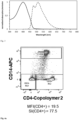
- Anti-CD4 and anti-CD19 antibody conjugates of copolymer 2 were used in flow cytometric analysis of human peripheral blood mononuclear cells (PBMCs) using an UV laser (355 nm) as excitation source.
- Fig. 4 shows the performance of phenylene copolymer 2 antibody conjugates in flow cytometric analysis using a UV laser.
- the absorption wavelength can be tuned depending on the choice of the comonomer.
- bithiophene copolymer 3 can be used for applications with the violet laser (405 nm).
Landscapes
- Health & Medical Sciences (AREA)
- Chemical & Material Sciences (AREA)
- Life Sciences & Earth Sciences (AREA)
- Immunology (AREA)
- Engineering & Computer Science (AREA)
- Hematology (AREA)
- Urology & Nephrology (AREA)
- Molecular Biology (AREA)
- Medicinal Chemistry (AREA)
- Biomedical Technology (AREA)
- Organic Chemistry (AREA)
- General Health & Medical Sciences (AREA)
- Pathology (AREA)
- Biochemistry (AREA)
- Physics & Mathematics (AREA)
- General Physics & Mathematics (AREA)
- Analytical Chemistry (AREA)
- Chemical Kinetics & Catalysis (AREA)
- Food Science & Technology (AREA)
- Biotechnology (AREA)
- Cell Biology (AREA)
- Polymers & Plastics (AREA)
- Microbiology (AREA)
- General Chemical & Material Sciences (AREA)
- Nuclear Medicine, Radiotherapy & Molecular Imaging (AREA)
- Dispersion Chemistry (AREA)
- Materials Engineering (AREA)
- Peptides Or Proteins (AREA)
- Investigating, Analyzing Materials By Fluorescence Or Luminescence (AREA)
- Polyoxymethylene Polymers And Polymers With Carbon-To-Carbon Bonds (AREA)
- Measuring Or Testing Involving Enzymes Or Micro-Organisms (AREA)
Applications Claiming Priority (1)
| Application Number | Priority Date | Filing Date | Title |
|---|---|---|---|
| EP22151720 | 2022-01-17 |
Publications (1)
| Publication Number | Publication Date |
|---|---|
| EP4212593A1 true EP4212593A1 (de) | 2023-07-19 |
Family
ID=79686915
Family Applications (1)
| Application Number | Title | Priority Date | Filing Date |
|---|---|---|---|
| EP23151645.1A Pending EP4212593A1 (de) | 2022-01-17 | 2023-01-16 | Wasserlösliche pi-konjugierte fluoreszierende polymere auf 1,1'-binaphthyl-basis mit abstimmbarer absorption |
Country Status (4)
| Country | Link |
|---|---|
| US (1) | US20230228745A1 (de) |
| EP (1) | EP4212593A1 (de) |
| JP (1) | JP2023104905A (de) |
| CN (1) | CN116444784A (de) |
Citations (7)
| Publication number | Priority date | Publication date | Assignee | Title |
|---|---|---|---|---|
| EP0810428A2 (de) | 1996-05-29 | 1997-12-03 | Walter Dr. Schubert | Automatisierte Vorrichtung und Verfahren zum Messen und Bestimmen von Molekülen oder Teilen davon |
| EP1136822A2 (de) | 2000-03-24 | 2001-09-26 | Walter Dr. Schubert | Verfahren zur Identifizierung von zellspezifischen Zielstrukturen |
| EP1181525A2 (de) | 1999-11-04 | 2002-02-27 | Meltec Multi-Epitope-Ligand-Technologies GmbH | Verfahren zur automatischen analyse von mikroskopaufnahmen |
| EP1224472A1 (de) | 2000-09-04 | 2002-07-24 | Meltec Multi-Epitope-Ligand-Technologies GmbH | Verfahren zur identifizierung von zellspezifischen proteinen |
| WO2018009581A1 (en) * | 2016-07-07 | 2018-01-11 | Becton, Dickinson And Company | Fluorescent water-solvated conjugated polymers |
| US20210372999A1 (en) * | 2020-05-27 | 2021-12-02 | Miltenyi Biotec B.V. & Co. KG | Method for detection of cells by repetitive staining and destaining |
| WO2022013198A1 (en) * | 2020-07-16 | 2022-01-20 | Miltenyi Biotec Gmbh | Fluorescent dyes comprising π-conjugated 1,1´-binaphthyl-based polymers |
-
2023
- 2023-01-15 US US18/097,243 patent/US20230228745A1/en active Pending
- 2023-01-16 EP EP23151645.1A patent/EP4212593A1/de active Pending
- 2023-01-16 CN CN202310075540.5A patent/CN116444784A/zh active Pending
- 2023-01-16 JP JP2023004317A patent/JP2023104905A/ja active Pending
Patent Citations (9)
| Publication number | Priority date | Publication date | Assignee | Title |
|---|---|---|---|---|
| EP0810428A2 (de) | 1996-05-29 | 1997-12-03 | Walter Dr. Schubert | Automatisierte Vorrichtung und Verfahren zum Messen und Bestimmen von Molekülen oder Teilen davon |
| EP1181525A2 (de) | 1999-11-04 | 2002-02-27 | Meltec Multi-Epitope-Ligand-Technologies GmbH | Verfahren zur automatischen analyse von mikroskopaufnahmen |
| EP1136822A2 (de) | 2000-03-24 | 2001-09-26 | Walter Dr. Schubert | Verfahren zur Identifizierung von zellspezifischen Zielstrukturen |
| EP1224472A1 (de) | 2000-09-04 | 2002-07-24 | Meltec Multi-Epitope-Ligand-Technologies GmbH | Verfahren zur identifizierung von zellspezifischen proteinen |
| WO2018009581A1 (en) * | 2016-07-07 | 2018-01-11 | Becton, Dickinson And Company | Fluorescent water-solvated conjugated polymers |
| US20180009990A1 (en) | 2016-07-07 | 2018-01-11 | Becton, Dickinson And Company | Fluorescent water-solvated conjugated polymers |
| US10604657B2 (en) | 2016-07-07 | 2020-03-31 | Becton, Dickinson And Company | Fluorescent water-solvated conjugated polymers |
| US20210372999A1 (en) * | 2020-05-27 | 2021-12-02 | Miltenyi Biotec B.V. & Co. KG | Method for detection of cells by repetitive staining and destaining |
| WO2022013198A1 (en) * | 2020-07-16 | 2022-01-20 | Miltenyi Biotec Gmbh | Fluorescent dyes comprising π-conjugated 1,1´-binaphthyl-based polymers |
Non-Patent Citations (5)
| Title |
|---|
| HUANG X ET AL: "A highly selective and sensitive fluorescence chemosensor based on optically active polybinaphthyls for Hg^2^+", POLYMER, ELSEVIER, AMSTERDAM, NL, vol. 50, no. 25, 27 November 2009 (2009-11-27), pages 5996 - 6000, XP026771125, ISSN: 0032-3861, [retrieved on 20091023], DOI: 10.1016/J.POLYMER.2009.10.039 * |
| K. Y. MUSICKQ.-S. HUL. PU: "Synthesis of Binaphthyl-Oligothiophene Copolymers with Emissions of Different Colors: Systematically Tuning the Photoluminescence of Conjugated Polymers", MACROMOLECULES, vol. 31, 1998, pages 2933 - 2942, XP002308656, DOI: 10.1021/ma9711710 |
| LIU YAN ET AL: "Fluorescent Chemosensory Conjugated Polymers Based on Optically Active Polybinaphthyls and 2,2'-Bipyridyl Units", MACROMOLECULES, 40, 15 June 2007 (2007-06-15), pages 4839 - 4847, XP055933924, Retrieved from the Internet <URL:https://pubs.acs.org/doi/pdf/10.1021/ma0701437> [retrieved on 20220621], DOI: 10.1021/ma0701437 * |
| LIU-ZHU GONG ET AL: "Optically Active Dendrimers with a Binaphthyl Core and Phenylene Dendrons: Light Harvesting and Enantioselective Fluorescent Sensing", THE JOURNAL OF ORGANIC CHEMISTRY, AMERICAN CHEMICAL SOCIETY, vol. 66, 1 January 2001 (2001-01-01), pages 2358 - 2367, XP007914317, ISSN: 0022-3263, [retrieved on 20010303], DOI: 10.1021/JO001565G * |
| ODAKA TOMOKI ET AL: "Visualization of Chiral Binaphthyl Recognition by Atroposelective Antibodies with Thermoresponsive Polymers", CHEMISTRY LETTERS,46, 30 May 2017 (2017-05-30), pages 1173 - 1175, XP055933898, Retrieved from the Internet <URL:https://www.journal.csj.jp/doi/pdf/10.1246/cl.170296> [retrieved on 20220621], DOI: 10.1246/cl.170296 * |
Also Published As
| Publication number | Publication date |
|---|---|
| JP2023104905A (ja) | 2023-07-28 |
| CN116444784A (zh) | 2023-07-18 |
| US20230228745A1 (en) | 2023-07-20 |
Similar Documents
| Publication | Publication Date | Title |
|---|---|---|
| Kompa et al. | Exchangeable HaloTag ligands for super-resolution fluorescence microscopy | |
| AU2017375751B2 (en) | Water-soluble polymeric dyes | |
| US20230287170A1 (en) | Fluorescent dyes comprising m-conjugated 1,1 -binaphthyl-based polymers | |
| US8835000B2 (en) | High-density fluorescent dye clusters | |
| JP2026048733A (ja) | ペンダントクロモフォアを有する水溶性ポリマー色素 | |
| ES2911298T3 (es) | Colorantes poliméricos en tándem fluorescentes fotoestables que incluyen complejos de metales luminiscentes | |
| CN119286279A (zh) | 深紫外线可激发的水溶剂化聚合物染料 | |
| US20250085225A1 (en) | Method for detection of cells by repetitive staining and destaining | |
| CN111032823A (zh) | 共轭聚合物及其使用方法 | |
| US20230228745A1 (en) | Water-soluble ii-conjugated fluorescent 1,1 -binaphthyl-based polymers with tuneable absorption | |
| Reiber et al. | Fluorophore multimerization as an efficient approach towards bright protein labels | |
| EP4212594A1 (de) | Wasserlösliche konjugierte fluoreszierende 1,1'-binaphthyl-basierte tandempolymere | |
| JP2019095451A (ja) | 染色された細胞を光褪色させる方法 | |
| CN119156541A (zh) | 单域抗体/聚合物串联荧光染料缀合物及其制备和使用方法 | |
| US20050037402A1 (en) | Device and process for direct quantitative in vitro determination of a substance that is contained in a sample | |
| CN113677995A (zh) | 使用具有用于增加荧光亮度的接头和酶促可释放荧光部分的缀合物的可逆细胞检测 | |
| Zheng et al. | Two-dimensional two-photon absorbing chromophores and solvent effects on their cross-sections | |
| CN117741125A (zh) | 在生物组织上具有光产生的酸性或碱性可释放检测部分的生物缀合物 | |
| CN121420033A (zh) | 聚肌氨酸增溶的染料及其使用方法 | |
| CN118946640A (zh) | 紫色可激发串联染料及其制备和使用方法 | |
| HK1188592B (zh) | 發色聚合物點 |
Legal Events
| Date | Code | Title | Description |
|---|---|---|---|
| PUAI | Public reference made under article 153(3) epc to a published international application that has entered the european phase |
Free format text: ORIGINAL CODE: 0009012 |
|
| STAA | Information on the status of an ep patent application or granted ep patent |
Free format text: STATUS: THE APPLICATION HAS BEEN PUBLISHED |
|
| AK | Designated contracting states |
Kind code of ref document: A1 Designated state(s): AL AT BE BG CH CY CZ DE DK EE ES FI FR GB GR HR HU IE IS IT LI LT LU LV MC ME MK MT NL NO PL PT RO RS SE SI SK SM TR |
|
| STAA | Information on the status of an ep patent application or granted ep patent |
Free format text: STATUS: REQUEST FOR EXAMINATION WAS MADE |
|
| 17P | Request for examination filed |
Effective date: 20240109 |
|
| RBV | Designated contracting states (corrected) |
Designated state(s): AL AT BE BG CH CY CZ DE DK EE ES FI FR GB GR HR HU IE IS IT LI LT LU LV MC ME MK MT NL NO PL PT RO RS SE SI SK SM TR |
|
| STAA | Information on the status of an ep patent application or granted ep patent |
Free format text: STATUS: EXAMINATION IS IN PROGRESS |
|
| 17Q | First examination report despatched |
Effective date: 20260204 |