EP4212875A1 - Biochip, verfahren zu dessen herstellung und dessen verwendung - Google Patents
Biochip, verfahren zu dessen herstellung und dessen verwendung Download PDFInfo
- Publication number
- EP4212875A1 EP4212875A1 EP21864469.8A EP21864469A EP4212875A1 EP 4212875 A1 EP4212875 A1 EP 4212875A1 EP 21864469 A EP21864469 A EP 21864469A EP 4212875 A1 EP4212875 A1 EP 4212875A1
- Authority
- EP
- European Patent Office
- Prior art keywords
- biochip
- substrate
- complex
- immobilized
- group
- Prior art date
- Legal status (The legal status is an assumption and is not a legal conclusion. Google has not performed a legal analysis and makes no representation as to the accuracy of the status listed.)
- Pending
Links
Images




Classifications
-
- G—PHYSICS
- G01—MEASURING; TESTING
- G01N—INVESTIGATING OR ANALYSING MATERIALS BY DETERMINING THEIR CHEMICAL OR PHYSICAL PROPERTIES
- G01N33/00—Investigating or analysing materials by specific methods not covered by groups G01N1/00 - G01N31/00
- G01N33/48—Biological material, e.g. blood, urine; Haemocytometers
- G01N33/50—Chemical analysis of biological material, e.g. blood, urine; Testing involving biospecific ligand binding methods; Immunological testing
- G01N33/53—Immunoassay; Biospecific binding assay; Materials therefor
- G01N33/543—Immunoassay; Biospecific binding assay; Materials therefor with an insoluble carrier for immobilising immunochemicals
- G01N33/54393—Improving reaction conditions or stability, e.g. by coating or irradiation of surface, by reduction of non-specific binding, by promotion of specific binding
-
- B—PERFORMING OPERATIONS; TRANSPORTING
- B01—PHYSICAL OR CHEMICAL PROCESSES OR APPARATUS IN GENERAL
- B01L—CHEMICAL OR PHYSICAL LABORATORY APPARATUS FOR GENERAL USE
- B01L3/00—Containers or dishes for laboratory use, e.g. laboratory glassware; Droppers
- B01L3/50—Containers for the purpose of retaining a material to be analysed, e.g. test tubes
- B01L3/502—Containers for the purpose of retaining a material to be analysed, e.g. test tubes with fluid transport, e.g. in multi-compartment structures
- B01L3/5027—Containers for the purpose of retaining a material to be analysed, e.g. test tubes with fluid transport, e.g. in multi-compartment structures by integrated microfluidic structures, i.e. dimensions of channels and chambers are such that surface tension forces are important, e.g. lab-on-a-chip
-
- B—PERFORMING OPERATIONS; TRANSPORTING
- B01—PHYSICAL OR CHEMICAL PROCESSES OR APPARATUS IN GENERAL
- B01L—CHEMICAL OR PHYSICAL LABORATORY APPARATUS FOR GENERAL USE
- B01L3/00—Containers or dishes for laboratory use, e.g. laboratory glassware; Droppers
- B01L3/50—Containers for the purpose of retaining a material to be analysed, e.g. test tubes
- B01L3/502—Containers for the purpose of retaining a material to be analysed, e.g. test tubes with fluid transport, e.g. in multi-compartment structures
- B01L3/5027—Containers for the purpose of retaining a material to be analysed, e.g. test tubes with fluid transport, e.g. in multi-compartment structures by integrated microfluidic structures, i.e. dimensions of channels and chambers are such that surface tension forces are important, e.g. lab-on-a-chip
- B01L3/502707—Containers for the purpose of retaining a material to be analysed, e.g. test tubes with fluid transport, e.g. in multi-compartment structures by integrated microfluidic structures, i.e. dimensions of channels and chambers are such that surface tension forces are important, e.g. lab-on-a-chip characterised by the manufacture of the container or its components
-
- G—PHYSICS
- G01—MEASURING; TESTING
- G01N—INVESTIGATING OR ANALYSING MATERIALS BY DETERMINING THEIR CHEMICAL OR PHYSICAL PROPERTIES
- G01N33/00—Investigating or analysing materials by specific methods not covered by groups G01N1/00 - G01N31/00
- G01N33/48—Biological material, e.g. blood, urine; Haemocytometers
- G01N33/50—Chemical analysis of biological material, e.g. blood, urine; Testing involving biospecific ligand binding methods; Immunological testing
- G01N33/53—Immunoassay; Biospecific binding assay; Materials therefor
- G01N33/543—Immunoassay; Biospecific binding assay; Materials therefor with an insoluble carrier for immobilising immunochemicals
-
- G—PHYSICS
- G01—MEASURING; TESTING
- G01N—INVESTIGATING OR ANALYSING MATERIALS BY DETERMINING THEIR CHEMICAL OR PHYSICAL PROPERTIES
- G01N33/00—Investigating or analysing materials by specific methods not covered by groups G01N1/00 - G01N31/00
- G01N33/48—Biological material, e.g. blood, urine; Haemocytometers
- G01N33/50—Chemical analysis of biological material, e.g. blood, urine; Testing involving biospecific ligand binding methods; Immunological testing
- G01N33/53—Immunoassay; Biospecific binding assay; Materials therefor
- G01N33/543—Immunoassay; Biospecific binding assay; Materials therefor with an insoluble carrier for immobilising immunochemicals
- G01N33/54313—Immunoassay; Biospecific binding assay; Materials therefor with an insoluble carrier for immobilising immunochemicals the carrier being characterised by its particulate form
-
- G—PHYSICS
- G01—MEASURING; TESTING
- G01N—INVESTIGATING OR ANALYSING MATERIALS BY DETERMINING THEIR CHEMICAL OR PHYSICAL PROPERTIES
- G01N33/00—Investigating or analysing materials by specific methods not covered by groups G01N1/00 - G01N31/00
- G01N33/48—Biological material, e.g. blood, urine; Haemocytometers
- G01N33/50—Chemical analysis of biological material, e.g. blood, urine; Testing involving biospecific ligand binding methods; Immunological testing
- G01N33/53—Immunoassay; Biospecific binding assay; Materials therefor
- G01N33/563—Immunoassay; Biospecific binding assay; Materials therefor involving antibody fragments
-
- B—PERFORMING OPERATIONS; TRANSPORTING
- B01—PHYSICAL OR CHEMICAL PROCESSES OR APPARATUS IN GENERAL
- B01L—CHEMICAL OR PHYSICAL LABORATORY APPARATUS FOR GENERAL USE
- B01L2200/00—Solutions for specific problems relating to chemical or physical laboratory apparatus
- B01L2200/16—Reagents, handling or storing thereof
-
- B—PERFORMING OPERATIONS; TRANSPORTING
- B01—PHYSICAL OR CHEMICAL PROCESSES OR APPARATUS IN GENERAL
- B01L—CHEMICAL OR PHYSICAL LABORATORY APPARATUS FOR GENERAL USE
- B01L2300/00—Additional constructional details
- B01L2300/06—Auxiliary integrated devices, integrated components
- B01L2300/0627—Sensor or part of a sensor is integrated
- B01L2300/0636—Integrated biosensor, microarrays
-
- B—PERFORMING OPERATIONS; TRANSPORTING
- B01—PHYSICAL OR CHEMICAL PROCESSES OR APPARATUS IN GENERAL
- B01L—CHEMICAL OR PHYSICAL LABORATORY APPARATUS FOR GENERAL USE
- B01L2300/00—Additional constructional details
- B01L2300/08—Geometry, shape and general structure
- B01L2300/0809—Geometry, shape and general structure rectangular shaped
- B01L2300/0819—Microarrays; Biochips
-
- G—PHYSICS
- G01—MEASURING; TESTING
- G01N—INVESTIGATING OR ANALYSING MATERIALS BY DETERMINING THEIR CHEMICAL OR PHYSICAL PROPERTIES
- G01N2474/00—Immunochemical assays or immunoassays characterised by detection mode or means of detection
Definitions
- the spot is typically a roughly circular region, and the diameter thereof may be fluctuated depending on the size of a biochip, the number of spots, etc.
- the diameter of a spot may be set to be, for example, 400 ⁇ m to 800 ⁇ m, and preferably 500 ⁇ m to 700 ⁇ m.
- the number of spots in a single biochip may be fluctuated depending on the size of a biochip, the size of a spot, etc.
- the number of spots is preferably 3 or more, more preferably 12 or more, and particularly preferably 18 or more.
- the number of spots is preferably 168 or less, and more preferably 144 or less.
- the range of the number of spots may be, for example, 1 to 200, 3 to 168, 18 to 144, or the like.
- the hydrophilization treatment is not particularly limited, but examples of the hydrophilization treatment may include: the coating of the surface with inorganic materials having hydrophilicity, such as silica, or surfactants; chemical hydrophilization treatments such as a plasma treatment, a UV-ozone treatment, a corona treatment, or a flame treatment; and the imparting of hydrophilicity by physically forming a fine nanostructure ( WO2011/024947 ).
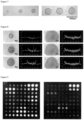
- Figure 5(b) is a cross-sectional view showing a cross-sectional structure obtained by cutting Biochip (D) 13 with the line A-A' (see Figure 4(a) ).
- the range of the height of Boundary 102 from Coating Layer 104 is the same as the range of the height of Boundary 102 from Upper Surface 101A of Substrate 101 in Biochip (C).
- the width and material of Boundary 102, the thickness of Coating Layer 104, and Spots 105 are the same as those of Biochip (C).
- the material to be immobilized modified with a group reacting with the reactive group via a spacer can be produced by any given known method.
- the peptide is allowed to react with a biotin derivative having, at one end of a spacer, a group reacting with a functional group comprised in the peptide (i.e. a primary amine (-NH 2 ), a sulfhydryl group (-SH), or a carboxyl group (-COOH), etc.), so that the peptide can be biotinylated.
- a functional group comprised in the peptide i.e. a primary amine (-NH 2 ), a sulfhydryl group (-SH), or a carboxyl group (-COOH), etc.
- a non-contact dispenser having a nozzle whose diameter is about 20 to 400 ⁇ m, preferably 30 to 200 ⁇ m, more preferably 40 to 140 ⁇ m, and particularly preferably 100 ⁇ m, can be used.
- azide groups are preferable because when the azide groups are irradiated with light, nitrogen molecules are dissociated and nitrogen radicals are generated, and these nitrogen radicals can bind not only to functional groups such as amino groups or carboxyl groups, but can also bind to carbon atoms constituting an organic compound, and can form covalent bonds with almost all organic matters.
- the photocrosslinking agent having such azide groups may be, for example, diazidostilbene.
- the photocrosslinking agent is preferably a water-soluble agent.
- the "water solubility" of the photocrosslinking agent means that an aqueous solution comprising the photocrosslinking agent in a concentration of 0.5 mM or more, and preferably 2 mM or more, can be given.
- the viscosity of the stamp solution at 25°C may be 0.6 mPa ⁇ s to 10 mPa ⁇ s, 0.8 mPa ⁇ s to 4 mPa ⁇ s, 1.0 mPa ⁇ s to 2 mPa ⁇ s, 1.12 mPa ⁇ s to 2 mPa ⁇ s, 1.13 mPa ⁇ s to 2 mPa ⁇ s, 1.14 mPa ⁇ s to 2 mPa ⁇ s, 1.15 mPa ⁇ s to 2 mPa ⁇ s, 1.16 mPa ⁇ s to 2 mPa ⁇ s, 1.17 mPa ⁇ s to 2 mPa ⁇ s, 1.18 mPa ⁇ s to 2 mPa ⁇ s, 1.19 mPa ⁇ s to 2 mPa ⁇ s, 1.2 mPa ⁇ s to 2 mPa ⁇ s, or the like.
- Detection of the target substance may be different depending on the detection reagent used.
- the target substance when a labeled substance that binds to the target substance is used as a detection reagent, the target substance can be detected by detecting the label that binds to the target substance.
- the label can be detected by various types of known methods that depend on the label. For example, when the label is an enzyme, a luminescent material or a coloring material that reacts with the enzyme is allowed to act on the enzyme, and luminescence intensity or absorbance is then measured, so that the label can be detected. Such detection may be carried out, either qualitatively or quantitatively.
- an HRP-labeled monoclonal antibody specific to the target substance can be used as a detection reagent.
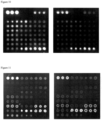
- the biochip was washed with a TBS-T solution (137 mM sodium chloride, 2.68 mM potassium chloride, 25 mM tris-hydroxymethylaminomethane, pH 7.4, 0.1% by weight of Tween 20) three times.
- a TBS-T solution 137 mM sodium chloride, 2.68 mM potassium chloride, 25 mM tris-hydroxymethylaminomethane, pH 7.4, 0.1% by weight of Tween 20
- 8-fold diluted serum was added to the reaction area to which an ALP-labeled antibody was to be added, and 30-fold diluted serum was added to the reaction area to which an HRP-labeled antibody was to be added.
- Biochips A to F were obtained in the same manner as that of Example 3, with the exceptions that Biochip Substrates A to F produced in Example 5 were used as biochip substrates, that a non-contact dispenser (manufactured by BioDot, Non-Contact Microdispensing System AD1520) was used as a spotting method, and that Stamp Solution 2 was used as a stamp solution.
- a non-contact dispenser manufactured by BioDot, Non-Contact Microdispensing System AD1520
- Stamp Solution 2 was used as a stamp solution.
Landscapes
- Health & Medical Sciences (AREA)
- Immunology (AREA)
- Life Sciences & Earth Sciences (AREA)
- Chemical & Material Sciences (AREA)
- Engineering & Computer Science (AREA)
- Hematology (AREA)
- Urology & Nephrology (AREA)
- Molecular Biology (AREA)
- Biomedical Technology (AREA)
- General Health & Medical Sciences (AREA)
- Analytical Chemistry (AREA)
- Physics & Mathematics (AREA)
- Food Science & Technology (AREA)
- Medicinal Chemistry (AREA)
- Biotechnology (AREA)
- Microbiology (AREA)
- Biochemistry (AREA)
- Cell Biology (AREA)
- General Physics & Mathematics (AREA)
- Pathology (AREA)
- Chemical Kinetics & Catalysis (AREA)
- Dispersion Chemistry (AREA)
- Clinical Laboratory Science (AREA)
- Apparatus Associated With Microorganisms And Enzymes (AREA)
Applications Claiming Priority (2)
| Application Number | Priority Date | Filing Date | Title |
|---|---|---|---|
| JP2020150138 | 2020-09-07 | ||
| PCT/JP2021/032732 WO2022050418A1 (ja) | 2020-09-07 | 2021-09-06 | バイオチップ、その製造方法及びその使用 |
Publications (2)
| Publication Number | Publication Date |
|---|---|
| EP4212875A1 true EP4212875A1 (de) | 2023-07-19 |
| EP4212875A4 EP4212875A4 (de) | 2024-03-13 |
Family
ID=80492004
Family Applications (1)
| Application Number | Title | Priority Date | Filing Date |
|---|---|---|---|
| EP21864469.8A Pending EP4212875A4 (de) | 2020-09-07 | 2021-09-06 | Biochip, verfahren zu dessen herstellung und dessen verwendung |
Country Status (5)
| Country | Link |
|---|---|
| US (1) | US20230241601A1 (de) |
| EP (1) | EP4212875A4 (de) |
| JP (1) | JPWO2022050418A1 (de) |
| CN (1) | CN115989411A (de) |
| WO (1) | WO2022050418A1 (de) |
Families Citing this family (2)
| Publication number | Priority date | Publication date | Assignee | Title |
|---|---|---|---|---|
| US20240052301A1 (en) * | 2021-02-03 | 2024-02-15 | Sekisui Chemical Co., Ltd. | Microcarrier for cell culture and cell culture method |
| CN115541895B (zh) * | 2022-11-29 | 2023-05-19 | 天津德祥生物技术股份有限公司 | 一种提高微流控反定检测卡灵敏度的配方液及应用 |
Family Cites Families (13)
| Publication number | Priority date | Publication date | Assignee | Title |
|---|---|---|---|---|
| WO1998020019A1 (en) * | 1996-11-06 | 1998-05-14 | Sequenom, Inc. | Compositions and methods for immobilizing nucleic acids to solid supports |
| EP1397679B1 (de) * | 2000-11-27 | 2010-01-20 | Intelligent Medical Devices LLC | Klinische intelligente diagnostische vorrichtungen und verfahren |
| JP3945192B2 (ja) * | 2001-06-27 | 2007-07-18 | 富士通株式会社 | 割引の組み合わせ方法および組み合わせプログラム |
| US20030044801A1 (en) * | 2001-09-05 | 2003-03-06 | Harvey Thomas B. | Array using microspheres |
| JP2008231013A (ja) * | 2007-03-20 | 2008-10-02 | Kaneka Corp | 固定化糖鎖体 |
| JP4972008B2 (ja) * | 2008-02-12 | 2012-07-11 | 株式会社セルフリーサイエンス | 磁性粒子アレイの作製装置および磁性粒子アレイの作製方法 |
| JP5559465B2 (ja) | 2008-06-17 | 2014-07-23 | 株式会社日立製作所 | アビジン類結合担体、その製造方法及びその使用方法 |
| JP2011053334A (ja) | 2009-08-31 | 2011-03-17 | Housetec Inc | 成形構造体 |
| JP5686408B2 (ja) * | 2011-01-31 | 2015-03-18 | 独立行政法人産業技術総合研究所 | 微粒子のアレイ化法および装置 |
| JP7130919B2 (ja) * | 2016-03-11 | 2022-09-06 | 三菱瓦斯化学株式会社 | 生体物質固定化方法 |
| JP7700430B2 (ja) | 2017-09-07 | 2025-07-01 | 三菱瓦斯化学株式会社 | バイオチップ用基体、バイオチップ、バイオチップの製造方法およびその保存方法 |
| US12379376B2 (en) * | 2018-12-03 | 2025-08-05 | University Of Notre Dame Du Lac | Biosensor and method for detection of analytes |
| JP7346855B2 (ja) | 2019-03-13 | 2023-09-20 | 富士電機株式会社 | 半導体装置 |
-
2021
- 2021-09-06 JP JP2022547003A patent/JPWO2022050418A1/ja active Pending
- 2021-09-06 WO PCT/JP2021/032732 patent/WO2022050418A1/ja not_active Ceased
- 2021-09-06 CN CN202180052075.2A patent/CN115989411A/zh active Pending
- 2021-09-06 US US18/043,368 patent/US20230241601A1/en active Pending
- 2021-09-06 EP EP21864469.8A patent/EP4212875A4/de active Pending
Also Published As
| Publication number | Publication date |
|---|---|
| CN115989411A (zh) | 2023-04-18 |
| WO2022050418A1 (ja) | 2022-03-10 |
| US20230241601A1 (en) | 2023-08-03 |
| JPWO2022050418A1 (de) | 2022-03-10 |
| EP4212875A4 (de) | 2024-03-13 |
Similar Documents
| Publication | Publication Date | Title |
|---|---|---|
| EP3680663B1 (de) | Substrat für biochip, biochip, verfahren zur herstellung eines biochips und verfahren zur konservierung eines biochips | |
| US9476876B2 (en) | Sol composition for sol-gel biochip to immobilize probe on substrate without surface treatment and method for screening thereof | |
| JP2001247580A (ja) | 活性化固相物質への分子の共有結合及び該物質を用いた装置 | |
| JPH07503063A (ja) | 生体分子検定施行法及び当該方法に使用する固相担体 | |
| Ito | Photoimmobilization for microarrays | |
| EP4212875A1 (de) | Biochip, verfahren zu dessen herstellung und dessen verwendung | |
| JP7130919B2 (ja) | 生体物質固定化方法 | |
| AU2011241208A1 (en) | Microarrays | |
| JP4879067B2 (ja) | 免疫測定用検体前処理液、免疫測定用試薬キット及び免疫測定方法 | |
| CN103026230B (zh) | 共偶联以控制免疫测定中试剂的反应性 | |
| US20210088510A1 (en) | Modified particle, method for manufacturing modified particle, and detection apparatus | |
| JPH09508199A (ja) | 標識付け | |
| JP4197279B2 (ja) | 生体由来物検出用基板及びその製造方法 | |
| JP2006322709A (ja) | 物質固定化基板 | |
| JP5461910B2 (ja) | 微粒子の凝集抑制方法及び保存液 | |
| JP5344438B2 (ja) | 物質固定用基板、物質固定化基板および分析方法 | |
| JP2007155691A (ja) | 物質の測定方法ならびに測定用組成物 | |
| US12385910B2 (en) | Solid phase carrier and kit | |
| JP2014206460A (ja) | タンパク質固定ゲルマイクロアレイ | |
| JP4831352B2 (ja) | プローブ結合粒子およびその製造方法ならびにブロッキング剤 | |
| CN115144375A (zh) | 基于一步式夹心法检测待测物的纳米等离子共振芯片及其制备方法和应用 | |
| JP4288591B2 (ja) | ペプチドチップの作製方法 | |
| WO2017130829A1 (ja) | マイクロアレイ、マイクロアレイの製造方法、検査方法、及び検査キット | |
| US20230194511A1 (en) | Compound Fixing Method, Detection Method, Screening Method, Substrate Used in Same, Compound Fixing Agent, and Fixing Kit | |
| KR20120127035A (ko) | 우혈청알부민-디아지린, 이의 제조 방법 및 이를 이용한 바이오 물질의 선택적 고정 방법 |
Legal Events
| Date | Code | Title | Description |
|---|---|---|---|
| STAA | Information on the status of an ep patent application or granted ep patent |
Free format text: STATUS: THE INTERNATIONAL PUBLICATION HAS BEEN MADE |
|
| PUAI | Public reference made under article 153(3) epc to a published international application that has entered the european phase |
Free format text: ORIGINAL CODE: 0009012 |
|
| STAA | Information on the status of an ep patent application or granted ep patent |
Free format text: STATUS: REQUEST FOR EXAMINATION WAS MADE |
|
| 17P | Request for examination filed |
Effective date: 20230302 |
|
| AK | Designated contracting states |
Kind code of ref document: A1 Designated state(s): AL AT BE BG CH CY CZ DE DK EE ES FI FR GB GR HR HU IE IS IT LI LT LU LV MC MK MT NL NO PL PT RO RS SE SI SK SM TR |
|
| DAV | Request for validation of the european patent (deleted) | ||
| DAX | Request for extension of the european patent (deleted) | ||
| A4 | Supplementary search report drawn up and despatched |
Effective date: 20240209 |
|
| RIC1 | Information provided on ipc code assigned before grant |
Ipc: B01L 3/00 20060101ALI20240205BHEP Ipc: G01N 33/543 20060101ALI20240205BHEP Ipc: G01N 33/53 20060101AFI20240205BHEP |
|
| STAA | Information on the status of an ep patent application or granted ep patent |
Free format text: STATUS: EXAMINATION IS IN PROGRESS |
|
| 17Q | First examination report despatched |
Effective date: 20250708 |