EP4213078A1 - Événements dépendants de la proximité - Google Patents
Événements dépendants de la proximité Download PDFInfo
- Publication number
- EP4213078A1 EP4213078A1 EP22211291.4A EP22211291A EP4213078A1 EP 4213078 A1 EP4213078 A1 EP 4213078A1 EP 22211291 A EP22211291 A EP 22211291A EP 4213078 A1 EP4213078 A1 EP 4213078A1
- Authority
- EP
- European Patent Office
- Prior art keywords
- portable electronic
- electronic device
- proximity
- dependent event
- time
- Prior art date
- Legal status (The legal status is an assumption and is not a legal conclusion. Google has not performed a legal analysis and makes no representation as to the accuracy of the status listed.)
- Pending
Links
Images


Classifications
-
- G—PHYSICS
- G06—COMPUTING OR CALCULATING; COUNTING
- G06Q—INFORMATION AND COMMUNICATION TECHNOLOGY [ICT] SPECIALLY ADAPTED FOR ADMINISTRATIVE, COMMERCIAL, FINANCIAL, MANAGERIAL OR SUPERVISORY PURPOSES; SYSTEMS OR METHODS SPECIALLY ADAPTED FOR ADMINISTRATIVE, COMMERCIAL, FINANCIAL, MANAGERIAL OR SUPERVISORY PURPOSES, NOT OTHERWISE PROVIDED FOR
- G06Q10/00—Administration; Management
- G06Q10/10—Office automation; Time management
- G06Q10/109—Time management, e.g. calendars, reminders, meetings or time accounting
-
- H—ELECTRICITY
- H04—ELECTRIC COMMUNICATION TECHNIQUE
- H04W—WIRELESS COMMUNICATION NETWORKS
- H04W4/00—Services specially adapted for wireless communication networks; Facilities therefor
- H04W4/02—Services making use of location information
- H04W4/023—Services making use of location information using mutual or relative location information between multiple location based services [LBS] targets or of distance thresholds
Definitions
- the present disclosure relates generally to proximity-dependent events, in particular, proximity-dependent reminders for wireless devices.
- Many electronic devices such as desktop computers or mobile stations including simple cellular telephones, smart telephones, wireless personal digital assistants (PDAs), and laptop computers with wireless 802.11 or Bluetooth TM capabilities, include calendar or date-book applications for scheduling and reviewing time-dependent events such as appointments and meetings in a graphical user interface.
- time-dependent events such as time, place and duration is saved as a time-dependent event and is viewable in the graphical user interface in various layouts such as a day view, a week view or a month view.
- Such applications are useful for maintaining a list of time-dependent events for a user, and audible or visible alerts are commonly employed for notifying or reminding the user of any or all of the events.
- time-dependent events can be created and saved using the calendar application of the portable electronic device.
- Time-dependent events can also be created and saved on another electronic device such as a desktop or laptop computer, using a calendar service application on the desktop computer.
- These time-dependent events can be synchronized or transferred to the portable electronic device by wired or wireless connection.
- the time-dependent events are stored at both the desktop computer and at the portable electronic device such that the time-dependent events at the electronic device mirror those at the desktop computer. This permits convenient viewing of the events using the calendar application at either the device or the desktop computer.
- Mobile devices having Bluetooth capabilities have introduced the possibility of having both time-dependent events and proximity-dependent events. It would be advantageous to display time-dependent events and proximity dependent events in a single calendar application on a portable electronic device.
- a calendar application for use with a first portable electronic device, the calendar application including:
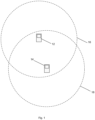
- a first portable electronic device 12 and a second portable electronic device 14 are generally shown.
- the portable electronic devices 12, 14 shown are exemplary devices that are based on the computing environment and functionality of a hand-held wireless communication device. It will be understood, however, that the portable electronic devices 12, 14 are not limited to a hand-held wireless communication device. Other portable electronic devices are possible, such as cellular telephones, smart telephones, and laptop computers, for example.
- the portable electronic devices 12, 14 include Bluetooth TM technology for short range radio frequency (RF) voice and data communications.
- Coverage areas 16 and 18 for short range RF communications of first portable electronic device 12 and second portable electronic device 14, respectively, are indicated as circles centered on the devices 12, 14.
- Overlap area 20 indicates that the first portable electronic device 12 and the second portable electronic device 14 may communicate with one another.
- either device 12, 14 may communicate with any other Bluetooth TM -enabled device that is located within its coverage area 16, 18.
- the portable electronic devices 12, 14 are not limited to using Bluetooth TM technology.
- Other short-range radio frequency (RF) technologies such as induction wireless, infrared wireless, or ultra wideband, for example, may alternatively be used. If infrared wireless is used, line-of-sight communication is required between the portable electronic devices 12, 14.
- RF radio frequency
- the portable electronic devices 12 and 14 are further operable to effect communications over a radio communications channel and communicate with a base station (not shown) while located within a coverage area that is defined by the base station.
- the base station is part of a wireless network that is in communication with the Internet 20.
- Data is delivered to the portable electronic devices 12, 14 via wireless transmission from the base station.
- data is sent from the portable electronic devices 12, 14 via wireless transmission to the base station.
- a server 22 handles wireless client requests from the portable electronic devices 12, 14 and a firewall, or proxy server, 24, is provided between the server 22 and the Internet 26.
- wireless networks include GSM/GPRS, CDPD, TDMA, iDEN Mobitex, DataTAC networks, EDGE or UMTS and broadband networks including variants of 802.11.
- FIG. 3 a block diagram of certain components within the first portable electronic device 12 is shown. It will be appreciated that the second portable electronic device 14 includes similar components and therefore will not be described separately.
- the first portable electronic device 12 is based on a microcomputer including a processor 28 connected to a persistent storage 30 and a random access memory unit (RAM) 32.
- the persistent storage 30 is flash memory that contains a plurality of applications executable by the processor 28 that enables each portable electronic device 12 to perform certain functions including, for example, PIN message functions, SMS message functions and cellular telephone functions.
- the processor 28 receives input from various input devices including a keypad 34.
- the processor 28 outputs to various output devices including an LCD display 36.
- a microphone 38 and phone speaker 40 are connected to the processor 28 for cellular telephone functions.
- the processor 28 is also connected to a modem and radio device 42.
- the modem and radio device 42 is used to connect to wireless networks and transmit and receive voice and data communications through an antenna 44.
- a content store 46 which is generally a file storage system for the portable electronic device 12, is also provided.
- the portable electronic devices 12, 14 include a Calendar application that is used for displaying and storing calendared events such as appointments, lectures, exams, movies, meetings, performances, dinners, ceremonies, etc., when executed by the processor 28.
- calendared events such as appointments, lectures, exams, movies, meetings, performances, dinners, ceremonies, etc., when executed by the processor 28.
- Each calendared event includes a variety of information including a date and time of the event.
- This information can be selectively manipulated by and displayed to the user in various formats including monthly, weekly or daily schedules.
- Figures 4 and 5 show exemplary screen shots of monthly and weekly schedules, respectively.
- there are three events including: an "Upcoming Projects" event from 9:00 a.m. until 10:00 a.m., a "Performance Review” from 11:00 a.m. until 12:00 p.m. and an "Interview" from 3:00 p.m. until 4:00 p.m.
- Time-dependent appointments such as those shown in Figure 5 are created manually by the user or automatically in response to a meeting request from another party.
- a new appointment screen for composition of a new event for addition to the calendar display is shown in Figure 6 .
- the new appointment screen includes the event subject, the location, an indication as to whether or not the meeting is an all-day event, the start time, the end time, the duration, the time zone, a reminder setting, an indication of whether or not this is a recurring event and a field for entering notes relating to the event.
- the subject is "Status Review" and the location is "Room B".
- the start time of the meeting is Wednesday, April 10, 2002 at 9:00 a.m. and the end time is Wednesday, April 10, 2006 at 10:00 a.m.
- the meeting duration is 1 hour.
- a reminder is set to remind the user of the meeting 15 minutes prior to the meeting.
- Meeting requests appear as messages in a messaging application of the portable electronic device 12, 14. New appointments based on meeting requests are created by selecting an 'accept' option associated with the meeting request message. Once the meeting has been accepted, the device calendar and the desktop calendar are updated over the wireless network and a response message, which is sent to the meeting organizer, replaces the original meeting request message. Meeting details may be viewed by opening the response message or by opening the newly created calendar event in the calendar application.
- a calendar application for use with both time-dependent events and proximity-dependent events. Unlike time-dependent events, reminders for proximity-dependent events are generated based on proximity to another user. Such reminders will be generated when the other user is within short RF communication range.
- the proximity event includes a person field, a device ID field, fields relating to meeting details and a notes field.
- the device ID is the unique signature that is associated with the device.
- the first portable electronic device 12 includes a proximity-dependent event for which the specified device ID corresponds to the second portable electronic device 14.
- the second portable electronic device 14 When the second portable electronic device 14 is in a normal operating condition, its unique signature is broadcast continuously.
- the broadcast signal is received by the antenna 46 of the first portable electronic device 12 when it is broadcast range of the second portable electronic device 14.
- the first portable electronic device 12 Upon receipt of the broadcast signal, the first portable electronic device 12 notifies the user with an auditory or vibratory reminder.
- a screen shot showing a list of proximity dependent events that are stored in the calendar application is provided in Figure 8 .
- the list of proximity-dependent events is a view similar other views of the calendar application including month, week and day calendar formats.
- the list provides the user of the first portable electronic device 12 with a summary of all of the reminders that are waiting to be triggered.
- the user may view a pending proximity-dependent event by selecting the line and then selecting an open option.
- a method for generating time dependent events based on proximity-dependent events within the calendar application will now be described with reference to Figure 9 .
- the user of the first device 12 is alerted by the proximity-dependent event reminder, as indicated at steps 50 and 52.
- the user of the first portable electronic device 12 may then meet with the user of the specified device and discuss the subject of the reminder, which is the "XYZ conference" in the example of Figure 7 .
- the user of the first portable electronic device 12 determines whether or not the proximity-dependent event will be followed up with a meeting or an appointment, as indicated at step 54.
- the user of the first portable electronic device 12 selects a meeting option or an appointment option from a menu of the proximity-dependent event within the calendar application.
- the user of the first portable electronic device 12 has concluded discussions regarding the subject with the user of the second portable electronic device, the user selects a "no follow up" option and the proximity-dependent event is deleted from the calendar, as indicated at step 56.
- the "no follow up" option would be selected, for example, if John Smith was not attending the XYZ conference.
- the proximity-dependent event is converted into a meeting, as indicated at step 58.
- the meeting option would be selected if the users of the devices 12, 14 had decided to meet at a later time/date to discuss travel arrangements.
- the calendar application converts the proximity-dependent event of Figure 7 into a meeting request.
- the meeting request is populated with information from the proximity-dependent event.
- the user identified in the proximity-dependent event would be identified as a meeting attendee and the subject and the notes would be copied from the proximity-dependent event.
- the user of the first portable electronic device 12 would have to provide some information at the time the proximity-dependent event is being converted in order to populate fields that are not provided in the proximity-dependent event. For example, the time/date and location of the meeting. Also, if other attendees were to be invited, they would be added to the meeting request.
- the meeting request is then sent to the second portable electronic device 14, as indicated at step 60. It will be appreciated that once the proximity-dependent event has been converted into a meeting request, the meeting request behaves like any other meeting request. Thus, once the meeting request has been accepted by the user of the second portable electronic device 14, as indicated at step 62, an appointment is automatically entered into the calendar of the second portable electronic device 14, as indicated at step 64. Sending and accepting meeting requests using calendar applications is well known in the art and therefore will not be discussed further here.
- the proximity-dependent event is converted into an appointment, as indicated at step 66.
- the appointment option would be selected if, for example, the user of the first portable electronic device 12 requires a reminder for a later time/date to book a seat on the confirmed flight of the user of the second portable electronic device 14. In this case there is no need to meet with the user of the second portable electronic device 14 again; however, the proximity-dependent event should be followed up with an appointment.
- the appointment is populated with information from the proximity-dependent event where possible. Any additional information, such as the time of the appointment, is entered into the appointment by the user of the first portable electronic device 12 at the time of conversion. Once the appointment is populated with all of the desired information, the appointment is saved in the calendar application, as indicated at step 68.
- a proximity-dependent event is provided in the calendar application of the first portable electronic device 12.
- the user is prompted to select a type of time-dependent event that the proximity-dependent event is to be converted into. As previously described, the user may select meeting or appointment.
- a new time-dependent event of the type selected by the user is opened. Information from the proximity-dependent event is then copied into the time-dependent event, as indicated at step 76. Once the information has been successfully copied, the proximity-dependent event is deleted, as indicated at step 78.
- the proximity-dependent event alerts the user of the proximity of the specified device ID
- the user is able to view the calendar of the user of the specified device.
- the user would be able to determine if the user of the specified device is busy and, if so, for how long. As such, the user would not interrupt the specified user unnecessarily. It will be appreciated that in order for this embodiment to be employed, the user of the specified device would have to enable the public calendar on his/her device.
- Device ID's for various users are stored in an address book application of the portable electronic device 12.
- the Device IDs may be manually entered into an appropriate field of an address book record or, alternatively, the portable electronic device 12 can scan for Bluetooth TM -enabled devices in the vicinity and store the device IDs that correspond to contacts in their address book.
- the proximity of devices 12, 14 is determined by using Global Positioning System information that is collected and monitored by a central server.
- the central server tracks the location of various portable electronic devices and stores proximity driven reminders that are generated by each portable electronic device.
- the central server searches for reminders that have been previously saved in relation to either of the portable electronic devices 12, 14. If a reminder that was generated by the first device 12 relating to the second device 14 and was previously saved at the central server, the reminder will be forwarded to the first device 12 when the distance between the devices 12, 14 is less than or equal to the set distance. It will be appreciated that in this embodiment, the set distance is unlimited. As long as the devices 12, 14 are in contact with the central server, the central server is able to determine the distance between the devices 12, 14 and forward reminders thereto.
- proximity-dependent reminders are not integrated into a calendar application.
- the proximity-dependent reminders may be generated on a device that does not include a calendar application or alternatively, the proximity-dependent reminders may operate independently of a device calendar application.
- portable electronic devices 12 and 14 are described as being similar, it will be appreciated by a person skilled in the art that the devices could be dissimilar. Any device having short range RF communication or GPS capability would be suitable such as a Palm Treo TM or Nokia TM cell phone, for example.
- Any device having short range RF communication or GPS capability would be suitable such as a Palm Treo TM or Nokia TM cell phone, for example.
- a specific embodiment has been shown and described herein. However, modifications and variations may occur to those skilled in the art. All such modifications and variations are believed to be within the sphere and scope of the present embodiment.
- the application further comprises the following aspects:
Landscapes
- Engineering & Computer Science (AREA)
- Business, Economics & Management (AREA)
- Human Resources & Organizations (AREA)
- Entrepreneurship & Innovation (AREA)
- Strategic Management (AREA)
- Economics (AREA)
- Data Mining & Analysis (AREA)
- Signal Processing (AREA)
- Computer Networks & Wireless Communication (AREA)
- Marketing (AREA)
- Operations Research (AREA)
- Quality & Reliability (AREA)
- Tourism & Hospitality (AREA)
- Physics & Mathematics (AREA)
- General Business, Economics & Management (AREA)
- General Physics & Mathematics (AREA)
- Theoretical Computer Science (AREA)
- Management, Administration, Business Operations System, And Electronic Commerce (AREA)
Priority Applications (1)
| Application Number | Priority Date | Filing Date | Title |
|---|---|---|---|
| EP22211291.4A EP4213078A1 (fr) | 2007-06-01 | 2007-06-01 | Événements dépendants de la proximité |
Applications Claiming Priority (2)
| Application Number | Priority Date | Filing Date | Title |
|---|---|---|---|
| EP07109405A EP2000961A1 (fr) | 2007-06-01 | 2007-06-01 | Événements dépendants de la proximité |
| EP22211291.4A EP4213078A1 (fr) | 2007-06-01 | 2007-06-01 | Événements dépendants de la proximité |
Related Parent Applications (1)
| Application Number | Title | Priority Date | Filing Date |
|---|---|---|---|
| EP07109405A Division EP2000961A1 (fr) | 2007-06-01 | 2007-06-01 | Événements dépendants de la proximité |
Publications (1)
| Publication Number | Publication Date |
|---|---|
| EP4213078A1 true EP4213078A1 (fr) | 2023-07-19 |
Family
ID=38535598
Family Applications (2)
| Application Number | Title | Priority Date | Filing Date |
|---|---|---|---|
| EP22211291.4A Pending EP4213078A1 (fr) | 2007-06-01 | 2007-06-01 | Événements dépendants de la proximité |
| EP07109405A Ceased EP2000961A1 (fr) | 2007-06-01 | 2007-06-01 | Événements dépendants de la proximité |
Family Applications After (1)
| Application Number | Title | Priority Date | Filing Date |
|---|---|---|---|
| EP07109405A Ceased EP2000961A1 (fr) | 2007-06-01 | 2007-06-01 | Événements dépendants de la proximité |
Country Status (2)
| Country | Link |
|---|---|
| EP (2) | EP4213078A1 (fr) |
| CA (1) | CA2632514C (fr) |
Families Citing this family (2)
| Publication number | Priority date | Publication date | Assignee | Title |
|---|---|---|---|---|
| US9894633B2 (en) | 2013-12-06 | 2018-02-13 | Google Llc | Reminders based on device proximity using bluetooth LE |
| EP3669237B1 (fr) * | 2017-08-18 | 2025-10-01 | Honeywell International Inc. | Procédé permettant de rappeler à un premier utilisateur de terminer une tâche sur la base d'une position par rapport à un second utilisateur |
Citations (2)
| Publication number | Priority date | Publication date | Assignee | Title |
|---|---|---|---|---|
| US20030046304A1 (en) * | 2001-09-05 | 2003-03-06 | Peskin Christopher A. | Event-based appointment scheduling adaptive to real-time information |
| US20050101335A1 (en) * | 2003-11-06 | 2005-05-12 | International Business Machines Corporation | System, method and program product for scheduling meetings |
Family Cites Families (3)
| Publication number | Priority date | Publication date | Assignee | Title |
|---|---|---|---|---|
| US20050273493A1 (en) * | 2004-06-04 | 2005-12-08 | John Buford | Proximity reminder system using instant messaging and presence |
| US7487456B2 (en) | 2005-04-06 | 2009-02-03 | Microsoft Corporation | System and method for automatically populating appointment fields |
| DE202006021197U1 (de) | 2005-09-26 | 2013-08-08 | Research In Motion Limited | Planen von Terminen aus elektronischen Nachrichten |
-
2007
- 2007-06-01 EP EP22211291.4A patent/EP4213078A1/fr active Pending
- 2007-06-01 EP EP07109405A patent/EP2000961A1/fr not_active Ceased
-
2008
- 2008-05-29 CA CA2632514A patent/CA2632514C/fr active Active
Patent Citations (2)
| Publication number | Priority date | Publication date | Assignee | Title |
|---|---|---|---|---|
| US20030046304A1 (en) * | 2001-09-05 | 2003-03-06 | Peskin Christopher A. | Event-based appointment scheduling adaptive to real-time information |
| US20050101335A1 (en) * | 2003-11-06 | 2005-05-12 | International Business Machines Corporation | System, method and program product for scheduling meetings |
Also Published As
| Publication number | Publication date |
|---|---|
| CA2632514A1 (fr) | 2008-12-01 |
| EP2000961A1 (fr) | 2008-12-10 |
| CA2632514C (fr) | 2015-08-18 |
Similar Documents
| Publication | Publication Date | Title |
|---|---|---|
| US8285206B2 (en) | Proximity-dependent events | |
| US9047592B2 (en) | Handheld electronic device including appointment and meeting conflict notification, and associated method | |
| US8090780B2 (en) | Device, time, and location based notification content transfer and presentment system and method | |
| JP5335904B2 (ja) | モバイルデバイスからのメッセージの送信のスケジュールを設定するための方法及び装置 | |
| US9516464B2 (en) | Notification to users of events | |
| US8595316B2 (en) | Method and apparatus for managing shared data at a portable electronic device of a first entity | |
| US20080270211A1 (en) | method and system for modifying a meeting attendee list of an email calendar application | |
| US20110078267A1 (en) | Conditional communication | |
| US8060539B2 (en) | Method of notifying an invitee to an event of changes to the event in an electronic calendar system | |
| US20080195619A1 (en) | Electronic device and method of sharing calendar-event information | |
| US8000683B2 (en) | System and method for communication record logging | |
| US20080191896A1 (en) | Electronic device and method of adding parties to a calendar event | |
| CA2632514C (fr) | Evenements lies a la proximite | |
| EP1816437B1 (fr) | Procédé et dispositif de représentation visuelle d'un emplacement et d'une condition d'un appareil électronique portable | |
| EP1956531A1 (fr) | Dispositif électronique et procédé pour ajouter des parties à un évènement de calendrier | |
| EP1986142A1 (fr) | Procédé et système pour modifier une liste de participants à une réunion d'une application de calendrier de messagerie électronique | |
| EP1956532A1 (fr) | Dispositif électronique et procédé pour partager des informations d'évènement de calendrier | |
| US20060154599A1 (en) | Systems, methods, and media for providing wireless electronic messaging | |
| JP2006048438A (ja) | 通信端末器 | |
| EP1998519A2 (fr) | Appareil et procédé pour fournir des informations pour des services de messagerie multimédia dans un terminal portable | |
| KR100594688B1 (ko) | 이동통신 단말기의 일정관리 및 통보 방법 | |
| EP2634979B1 (fr) | Procédé et système pour prévenir de la présence d'articles non ouverts dans des communications | |
| EP1696374A1 (fr) | Procédé pour la notification d'un invité à un événement de modifications à cet événement dans un système de calendrier électronique | |
| GB2445003A (en) | Communication device and method for arranging a meeting. | |
| CA2771955C (fr) | Methode et dispositif de synchronisation et de gestion de dossiers |
Legal Events
| Date | Code | Title | Description |
|---|---|---|---|
| PUAI | Public reference made under article 153(3) epc to a published international application that has entered the european phase |
Free format text: ORIGINAL CODE: 0009012 |
|
| STAA | Information on the status of an ep patent application or granted ep patent |
Free format text: STATUS: THE APPLICATION HAS BEEN PUBLISHED |
|
| AC | Divisional application: reference to earlier application |
Ref document number: 2000961 Country of ref document: EP Kind code of ref document: P |
|
| AK | Designated contracting states |
Kind code of ref document: A1 Designated state(s): AT BE BG CH CY CZ DE DK EE ES FI FR GB GR HU IE IS IT LI LT LU LV MC MT NL PL PT RO SE SI SK TR |
|
| STAA | Information on the status of an ep patent application or granted ep patent |
Free format text: STATUS: REQUEST FOR EXAMINATION WAS MADE |
|
| 17P | Request for examination filed |
Effective date: 20240116 |
|
| RBV | Designated contracting states (corrected) |
Designated state(s): AT BE BG CH CY CZ DE DK EE ES FI FR GB GR HU IE IS IT LI LT LU LV MC MT NL PL PT RO SE SI SK TR |
|
| STAA | Information on the status of an ep patent application or granted ep patent |
Free format text: STATUS: EXAMINATION IS IN PROGRESS |
|
| 17Q | First examination report despatched |
Effective date: 20260220 |