EP4215225A1 - Abdeckungsanordnung mit koagulationskammer und verwendungen davon in einem blutüberwachungs-/-managementsystem - Google Patents
Abdeckungsanordnung mit koagulationskammer und verwendungen davon in einem blutüberwachungs-/-managementsystem Download PDFInfo
- Publication number
- EP4215225A1 EP4215225A1 EP23158031.7A EP23158031A EP4215225A1 EP 4215225 A1 EP4215225 A1 EP 4215225A1 EP 23158031 A EP23158031 A EP 23158031A EP 4215225 A1 EP4215225 A1 EP 4215225A1
- Authority
- EP
- European Patent Office
- Prior art keywords
- red blood
- compartment
- covering
- container
- blood cell
- Prior art date
- Legal status (The legal status is an assumption and is not a legal conclusion. Google has not performed a legal analysis and makes no representation as to the accuracy of the status listed.)
- Pending
Links
Images




Classifications
-
- A—HUMAN NECESSITIES
- A61—MEDICAL OR VETERINARY SCIENCE; HYGIENE
- A61J—CONTAINERS SPECIALLY ADAPTED FOR MEDICAL OR PHARMACEUTICAL PURPOSES; DEVICES OR METHODS SPECIALLY ADAPTED FOR BRINGING PHARMACEUTICAL PRODUCTS INTO PARTICULAR PHYSICAL OR ADMINISTERING FORMS; DEVICES FOR ADMINISTERING FOOD OR MEDICINES ORALLY; BABY COMFORTERS; DEVICES FOR RECEIVING SPITTLE
- A61J1/00—Containers specially adapted for medical or pharmaceutical purposes
- A61J1/14—Details; Accessories therefor
- A61J1/20—Arrangements for transferring or mixing fluids, e.g. from vial to syringe
- A61J1/2003—Accessories used in combination with means for transfer or mixing of fluids, e.g. for activating fluid flow, separating fluids, filtering fluid or venting
- A61J1/202—Separating means
- A61J1/2027—Separating means having frangible parts
-
- A—HUMAN NECESSITIES
- A61—MEDICAL OR VETERINARY SCIENCE; HYGIENE
- A61M—DEVICES FOR INTRODUCING MEDIA INTO, OR ONTO, THE BODY; DEVICES FOR TRANSDUCING BODY MEDIA OR FOR TAKING MEDIA FROM THE BODY; DEVICES FOR PRODUCING OR ENDING SLEEP OR STUPOR
- A61M1/00—Suction or pumping devices for medical purposes; Devices for carrying-off, for treatment of, or for carrying-over, body-liquids; Drainage systems
- A61M1/60—Containers for suction drainage, adapted to be used with an external suction source
-
- A—HUMAN NECESSITIES
- A61—MEDICAL OR VETERINARY SCIENCE; HYGIENE
- A61M—DEVICES FOR INTRODUCING MEDIA INTO, OR ONTO, THE BODY; DEVICES FOR TRANSDUCING BODY MEDIA OR FOR TAKING MEDIA FROM THE BODY; DEVICES FOR PRODUCING OR ENDING SLEEP OR STUPOR
- A61M1/00—Suction or pumping devices for medical purposes; Devices for carrying-off, for treatment of, or for carrying-over, body-liquids; Drainage systems
- A61M1/88—Draining devices having means for processing the drained fluid, e.g. an absorber
-
- A—HUMAN NECESSITIES
- A61—MEDICAL OR VETERINARY SCIENCE; HYGIENE
- A61M—DEVICES FOR INTRODUCING MEDIA INTO, OR ONTO, THE BODY; DEVICES FOR TRANSDUCING BODY MEDIA OR FOR TAKING MEDIA FROM THE BODY; DEVICES FOR PRODUCING OR ENDING SLEEP OR STUPOR
- A61M1/00—Suction or pumping devices for medical purposes; Devices for carrying-off, for treatment of, or for carrying-over, body-liquids; Drainage systems
- A61M1/88—Draining devices having means for processing the drained fluid, e.g. an absorber
- A61M1/882—Draining devices provided with means for releasing antimicrobial or gelation agents in the drained fluid
-
- B—PERFORMING OPERATIONS; TRANSPORTING
- B65—CONVEYING; PACKING; STORING; HANDLING THIN OR FILAMENTARY MATERIAL
- B65D—CONTAINERS FOR STORAGE OR TRANSPORT OF ARTICLES OR MATERIALS, e.g. BAGS, BARRELS, BOTTLES, BOXES, CANS, CARTONS, CRATES, DRUMS, JARS, TANKS, HOPPERS, FORWARDING CONTAINERS; ACCESSORIES, CLOSURES, OR FITTINGS THEREFOR; PACKAGING ELEMENTS; PACKAGES
- B65D51/00—Closures not otherwise provided for
- B65D51/24—Closures not otherwise provided for combined or co-operating with auxiliary devices for non-closing purposes
- B65D51/28—Closures not otherwise provided for combined or co-operating with auxiliary devices for non-closing purposes with auxiliary containers for additional articles or materials
- B65D51/2807—Closures not otherwise provided for combined or co-operating with auxiliary devices for non-closing purposes with auxiliary containers for additional articles or materials the closure presenting means for placing the additional articles or materials in contact with the main contents by acting on a part of the closure without removing the closure, e.g. by pushing down, pulling up, rotating or turning a part of the closure, or upon initial opening of the container
- B65D51/2814—Closures not otherwise provided for combined or co-operating with auxiliary devices for non-closing purposes with auxiliary containers for additional articles or materials the closure presenting means for placing the additional articles or materials in contact with the main contents by acting on a part of the closure without removing the closure, e.g. by pushing down, pulling up, rotating or turning a part of the closure, or upon initial opening of the container the additional article or materials being released by piercing, cutting or tearing an element enclosing it
- B65D51/2828—Closures not otherwise provided for combined or co-operating with auxiliary devices for non-closing purposes with auxiliary containers for additional articles or materials the closure presenting means for placing the additional articles or materials in contact with the main contents by acting on a part of the closure without removing the closure, e.g. by pushing down, pulling up, rotating or turning a part of the closure, or upon initial opening of the container the additional article or materials being released by piercing, cutting or tearing an element enclosing it said element being a film or a foil
-
- A—HUMAN NECESSITIES
- A61—MEDICAL OR VETERINARY SCIENCE; HYGIENE
- A61J—CONTAINERS SPECIALLY ADAPTED FOR MEDICAL OR PHARMACEUTICAL PURPOSES; DEVICES OR METHODS SPECIALLY ADAPTED FOR BRINGING PHARMACEUTICAL PRODUCTS INTO PARTICULAR PHYSICAL OR ADMINISTERING FORMS; DEVICES FOR ADMINISTERING FOOD OR MEDICINES ORALLY; BABY COMFORTERS; DEVICES FOR RECEIVING SPITTLE
- A61J1/00—Containers specially adapted for medical or pharmaceutical purposes
- A61J1/14—Details; Accessories therefor
- A61J1/1412—Containers with closing means, e.g. caps
-
- A—HUMAN NECESSITIES
- A61—MEDICAL OR VETERINARY SCIENCE; HYGIENE
- A61J—CONTAINERS SPECIALLY ADAPTED FOR MEDICAL OR PHARMACEUTICAL PURPOSES; DEVICES OR METHODS SPECIALLY ADAPTED FOR BRINGING PHARMACEUTICAL PRODUCTS INTO PARTICULAR PHYSICAL OR ADMINISTERING FORMS; DEVICES FOR ADMINISTERING FOOD OR MEDICINES ORALLY; BABY COMFORTERS; DEVICES FOR RECEIVING SPITTLE
- A61J2200/00—General characteristics or adaptations
-
- A—HUMAN NECESSITIES
- A61—MEDICAL OR VETERINARY SCIENCE; HYGIENE
- A61L—METHODS OR APPARATUS FOR STERILISING MATERIALS OR OBJECTS IN GENERAL; DISINFECTION, STERILISATION OR DEODORISATION OF AIR; CHEMICAL ASPECTS OF BANDAGES, DRESSINGS, ABSORBENT PADS OR SURGICAL ARTICLES; MATERIALS FOR BANDAGES, DRESSINGS, ABSORBENT PADS OR SURGICAL ARTICLES
- A61L11/00—Methods specially adapted for refuse
Definitions
- the present invention is related to the field of lids and/or coverings for a container.
- Containers for collecting biologically hazardous materials may include a lid that includes a port that must be manually opened by a user, and manually emptied by the user, in order to dispose of the liquid waste contents.
- This procedure creates risk of contaminating the user performing the disposal activity, risk of contaminating others within the immediate area where the contents are being disposed of, and risk of contaminating the area in general where the procedure is being performed.
- Safer disposal methods for handling and discarding liquid or semi-liquid waste materials are needed, especially in the medical arts, to guard against these potential and significant health safety risks and/or other hazards.
- the liquidity of a collected material is associated, at least in part, with the liquid state in which any blood in the material remains for several hours under standard room temperature and collection conditions. Any blood present may remain in a liquid state for much longer time periods, depending on what other materials are present. Techniques for quickly and easily reducing the liquidity of collected material, particularly biohazardous materials, remain largely underdeveloped to meet current needs.
- Blister packaging sub-assemblies or "blister packs” have been used for convenient packaging of a variety of consumer products, such as chewing gum, throat lozenges, certain medications, and the like.
- a "blister pack” is understood to relate to a preformed plastic and/or foil packaging used for small consumer product goods, foods and pharmaceuticals (chewing gum, etc.).
- the blister pack typically will provide a cavity or pocket created with a formable web or an aluminum foil or plastic on one side, and a paperboard or other less conformable back wall or seal on the other side.
- the product may be easily expelled and retrieved by a user by exerting force on the back wall to expel the product through the aluminum foil or plastic compartment, and into a users' hand, for example.
- the content of a blister pack "chamber" compartment will be released upon a user applying direct force against the back wall of the "pack", with the back wall remaining intact.
- the weakest part of the front wall or encasing layer of the blister "pack” assembly will be thrust out of the compartment, as the front wall material is perforated by the product contained in the "pack” compartment.
- the backing seal ruptures, and the contents of the blister are ejected through the tear in the backing seal.
- German patent application DE10343668A1 which relates to a leak-tight blister pack for medication.
- German patent application DE202007003050U1 relates to a blister pack for a liquid substance that is released into the external environment by diffusion.
- the present disclosure provides a solution to these and other problems existing in the art.
- the present invention provides materials, devices, and systems for safely managing and disposing of potentially health hazardous materials that may include a fluid component, such as those materials collected during or following a laboratory, medical or other procedure.
- a fluid component such as those materials collected during or following a laboratory, medical or other procedure.
- devices and methods for processing and disposal of materials collected during a surgical procedure, that are at risk of containing blood or blood products are presented.
- the disclosed devices and methods include a covering assembly, such as a lid, cover, and/or cap, that provides a tool which permits an enhanced safety, contact-free disposal solution for potentially biohazardous materials.
- a waste collection and biohazard disposable system is provided.
- the device in one embodiment, comprises a covering and/or lid assembly comprising a first compartment containing a coagulant material capable of coagulating a blood component (red blood cells), the first compartment having a top side and a bottom side, wherein the top side comprises a compressible button or dimple.
- the compressible button or dimple will be preferably situated above a frangible layer located on the bottom side of the first compartment, wherein the frangible layer, upon rupture, will release the coagulant material and function to coagulate and/or gelatinize blood components in a material, such as red blood cells.
- the coagulant material is selectively released from the compartment upon rupture of the frangible layer/covering, and into a container or other receptacle.
- the coagulant in particular a blood coagulant, will be selectively released. Any blood component in the container and/or compartment will thereafter quickly form a coagulated semi-solid, gel-like state, thus permitting an essentially spill-free, more easily disposable material solid and/or semi-solid mass.
- the comprises a covering and/or lid assembly comprising a second compartment containing a red blood cell flocculent material, capable of flocculating a blood component (red blood cells), the second compartment having a top side and a bottom side, wherein the top side comprises a compressible button or dimple.
- the compressible button or dimple will be preferably situated above a frangible layer located on the bottom side of the compartment, wherein the frangible layer, upon rupture, will release the red blood cell flocculent material and function to flocculate red blood cells by associating with the surface of the red blood cells, thereby inhibiting blood coagulation.
- Table 1 presents examples of human red blood cell (RBC) flocculants.
- Table I Chemicals Descriptions Dextran 80 + CaCl 2 Literature indicates that Dextran 80 plus a divalent cation like Ca 2+ , and Ba 2+ will increase aggregation of RBCs
- Polyethylenimine (PEI) with different molecular weight PEI is a polymer composed of large number of positively charged amine groups, which is expected to attract RBCs to cause RBC settlement.
- Polyacrylamide (PAM) with different molecular weight PAM is widely used as a flocculants for water treatment. It can be configured to either positive or negative charge. Positively charged PAM is toxic to aquatic wildlife.
- Polydiallyldimethylammonium chloride (PolyDADMAC) with different molecular weight PolyDADMAC is a positively charged water-soluble polymer
- RBCs present in a fluid containing blood become bound to each other in the presence of an RBC flocculent, and in this manner form heavier particles that settle within the container/bottle/tube/collapsible bag or other vessel within which a sample/material is collected.
- the flocculated settled RBCs may be easily re-dispersed, and do not coagulate and/or do not form a solid mass that may be easily and safely disposed of. Therefore, these may be coagulated by providing one or more appropriate coagulants to the flocculated settled or dispersed red blood cells.
- the flocculent comprises poly diallyl-dimethyl-ammonium chloride (PolyDADMAC).
- PolyDADMAC poly diallyl-dimethyl-ammonium chloride
- RBC flocculants include polymeric RBC flocculants and non-polymeric RBC flocculants.
- Non-polymeric RBC flocculants may include acids, such as HCl or other acid molecule.
- an appropriate solidifying, jelling (or blood coagulant) requires that the agent be capable of forming a solid, jell-like or semi-solid mass from a liquid comprising red blood cells that have been flocculated.
- Kits are provided wherein a blood solidifying, jelling agent is packaged as part of a lid/cap/cover assembly, and configured to securely attach (screw, snap, etc.) to a collection vessel opening, such as to the top opening of a collection vessel or device.
- the cap/lid/cover lid assembly will be configured to include a blister pack as described above, and will contain the blood solidifying/jelling agent within the blister pack as part of a lid assembly.
- the lid assembly in some embodiments, will be configured so as to attach securely to an opening of a collection vessel.
- the blister pack may comprises two films which in turn may be made up of several layers of different or identical materials.
- the films may be made of plastics and/or metal, e.g. aluminum, while other materials such as paper or the like may theoretically also be used, or used in addition.
- the two films are, in particular, a base layer or base film (support) and a cover layer or cover film (cover).
- the base film or support there may be one or more wells or depressions for holding the liquid, into which the liquid, particularly a pharmaceutical formulation, is introduced.
- the cover film or the cover is then placed on the base film or support and fixed or attached thereto, and this is done, for example, at the edges or in a connecting region, particularly in flatly abutting surface regions, preferably by adhesion, heat-sealing, welding or the like.
- the blister pack may be sealed by an inert compound that minimally interferes with analysis of the blood, blood components, or other chemicals to be introduced into a collection canister.
- an inert compound that minimally interferes with analysis of the blood, blood components, or other chemicals to be introduced into a collection canister.
- a frangible seal is often provided around at least part of a perimeter of the blister cavity. Such frangible seal technologies allow relatively simple and controlled release of reagents, whilst eliminating the need for complex fluid handling systems or external piercing means.
- the sealing material for the blister pack may be a plastic film made from a material comprising, for example, polyethylene, polypropylene, polybutylene, polyvinyl chloride, or a combination thereof.
- the sealing material for the blister pack may also be aluminum foil.
- the blister cavity or pocket may be made from a formable web, usually a thermoformed plastic such as PVC, PVDC, Polychlorotrifluoroethylene (PCTFE), or cyclic olefin copolymers (COC) or polymers (COP). These aforementioned materials may be combined with polypropylene (PP), polyethylene (PE), or glycol-modified polyethylene terephthalate (PETg) to add more protection.
- a formable web usually a thermoformed plastic such as PVC, PVDC, Polychlorotrifluoroethylene (PCTFE), or cyclic olefin copolymers (COC) or polymers (COP).
- PCTFE Polychlorotrifluoroethylene
- COC cyclic olefin copolymers
- COP polymers
- Blood Solidifying/Jelling Agents may be used with embodiments of the present invention. These may include cellulosic materials, salts thereof, salts of inorganic compounds such as Cu (II), Ag (I), Fe (II), Fe (III), Ti (IV), and Ni (II).
- the solidifying/jelling agent may be aerosolized, and/or applied in a powder form, of a cellulose rich compound.
- Liqui-Loc ® , PolySorb TM , a calcium sodium salt of microdispersed oxidized cellulose (QUICKSTOP! ® ) or similar agent may be employed to solidify a composition for disposal.
- An effective solidifier/jelling agent may comprise a solution containing any of the following compounds: methanol; poly-aluminum chloride; silver nitrate; copper (II) sulfate, copper (II) bromide; ferric sulfate; ferric sub-sulfate; ferric chloride; aluminum sulfate; or zinc sulfate.
- the flocculated red blood cell solidification and/or jelling agent may be provided in the form of a powder, a tablet, or a liquid as part of the present devices and methods employing the devices. Table II provides examples of the flocculated red blood cell solidifying and/or jelling agents.
- a powder form of the cellulosic material may be provided in a compartment of the lid assembly, and easily released into the container/canister, without risk of exposure of the container contents to the operator/technician.
- Collection devices including canisters, collection bags and containers suitable for the collection and visual estimation of blood loss may be used with the covering and/or lid assemblies provided herein.
- the lid/covering assembly may include one or more than one frangible compartments.
- One of the frangible compartments will comprise a coagulant that will effectively coagulate flocculated red blood cells in a fluid.
- the lid/covering assembly will comprise a first frangible compartment comprising a cellulosic solidifier/jelling agent that will effectively solidify and/or remove liquid components of a preparation of suspended flocculated red blood cells in a fluid, and a second frangible compartment comprising a red blood cell flocculent.
- a first frangible compartment comprising a cellulosic solidifier/jelling agent that will effectively solidify and/or remove liquid components of a preparation of suspended flocculated red blood cells in a fluid
- a second frangible compartment comprising a red blood cell flocculent.
- This embodiment of the lid/covering assembly is envisioned for use with a collection canister or other container that has an interior that has not been treated to include a red blood cell flocculent, such as a coating of a red blood cell flocculent (e.g., PolyDADMAC).
- the lid having these two frangible compartments will be employed together with a collection device that has not been previously treated to include an interior surface comprising a coating of a red blood cell flocculent.
- a collection device that has not been previously treated to include an interior surface comprising a coating of a red blood cell flocculent.
- the red blood cell flocculent in the second frangible compartment will be released into the interior of the collection container.
- the presence of the red blood cell flocculent will allow any red blood cells in the collected material /fluid to settle in the container, and form a discernable settled red blood cell level.
- the settled flocculated red blood cells may be readily dispersed if the contents of the container are disturbed, and there is no solid coagulation.
- the flocculated red blood cell solidifying and/or jelling material contained in the second frangible compartment of the lid assembly may be securely and simply released into the interior of the container, without opening the container or removing the lid/covering assembly.
- a safe, secure, contact-free assembly and device is provided for both assessing settled red blood cell levels (and calculating blood volume therefrom) in a material, and disposing of the collected material having or suspected to contain blood and/or red blood cells, in a single assembly, without exposing the contents to the environment or the user.
- the lid assembly in either embodiment may be configured to have a circumference that permits the lid assembly to securely and snugly fit over the top or opening of a collection device, such as a biological fluid collection device.
- the biological fluid collection device may take the form of such devices as those described in U.S. Patent 10,401,347 and U.S. Patent Application Numbers 16/363,674 , 16/257,876 , and 16/257,673 , and corresponding patents and patent applications outside of the United States, that include as a component a red blood cell flocculent provided on a surface of the collection container, such as a surface coating of a red blood cell flocculent on the inside surface of a container.
- the container may be in the shape of a canister, an envelope or bag, or other configuration onto which a coating of a red blood cell flocculent material may be provided.
- the present covering and/or lid assembly may be used together with a collection device, such as a canister or collection bag or sleeve, that is preferably sufficiently transparent or at least opaque so as to permit the visual detection of a level of material, such as a level of sediment, flocculated red blood cells (settled RBCs, not coagulated blood) within the collection device.
- the collection device can be of a solid or flexible material, such as a hard plastic or glass, or a flexible material, such as a plastic or other non-rigid material suitable for containing a liquid and/or semi-liquid state material comprising or suspected to comprise blood.
- Such liquid and/or semi-liquid material comprising blood or suspected to comprise blood includes a liquid medical waste material comprising blood.
- flocculent is intended to mean a molecule that has a cationic charge that is capable of facilitating the coalescence of RBCs in a fluid at room temperature, and form a settled RBC mass with less than 30 minutes at room temperature without centrifugation.
- a flocculent as defined herein does not provide for coagulation , solidification or jelling of a liquid comprising blood or a blood component (e.g., red blood cells).
- patient or “subject” means an individual having symptoms of, or at risk for, cancer or other malignancy.
- a patient may be human or non-human and may include, for example, animal such a horse, dog, cow, pig or other animal.
- a patient or subject may include a human patient including adults or juveniles (e.g., children).
- a patient or subject may mean any living organism, preferably a mammal (e.g., human or non-human) from whom a blood volume is desired to be determined and/or monitored from the administration of compositions contemplated herein.
- waste means a mixture that incudes blood or a blood component, such as red blood cells. Bio-waste from hospital/clinical sources are examples.
- blood solidifying and/or jelling enhancing substance or “blood coagulating material” means a substance that may provide a solid semi-solid of gelatinous mass from a liquid or semi-liquid material comprising blood or a blood component, such as red blood cells.
- ⁇ means within a statistically meaningful range of a value or values such as a stated concentration, length, molecular weight, pH, sequence identity, timeframe, temperature or volume. Such a value or range can be within an order of magnitude, typically within 20%, more typically within 10%, and even more typically within 5% of a given value or range. The allowable variation encompassed by “about” will depend upon the particular system under study, and can be readily appreciated by one of skill in the art.
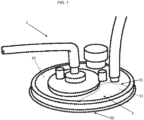
- the present example presents a description of one embodiment of the covering assembly/lid 1.
- the covering assembly/lid is illustrated in Figures 1 , 3 , and 4 .
- the covering assembly/lid 1 includes a top portion 10 and a bottom portion 20 , and further includes a frangible compartment 5 situated on a first surface 25 of the covering assembly bottom portion 20.
- Covering assembly/lid 1 may comprise a transparent plastic material, such as a polyethylene or a polypropylene.
- the frangible compartment 5 contains a blood coagulation enhancing substance 50 that is selectively releasable from the frangible compartment 5.
- the blood coagulation enhancing substance 50 may be powder, as illustrated in Figure 4 .
- the blood solidifying and/or jelling enhancing substance and/or biological waste solidifier 50 may be in the form of a powder, a tablet, or a liquid, and may be selected from any of the aforementioned blood solidifying and/or jellifying compounds previously listed.
- the blood solidifying and/or jellifying enhancing substance and/or biological waste solidifier 50 may be enclosed in a frangible compartment 5.
- the frangible compartment may be provided as a blister pack, the blister pack comprising a release side comprising a frangible material, such as an aluminum, tin, or other foil, aplastic, or other frangible material.
- the blood solidifying and/or jellifying enhancing substance 50 may be contained within the blister pack.
- the blood solidifying and/or jellifying enhancing substance and/or solidifier may be packaged in a box, a bottle, a tray, a cartridge, or a card.
- Covering assembly/lid 1 may also include a coupling adapter 8 along a perimeter 12 of the covering assembly 1.
- the coupling adapter 8 with a threaded connection that is suitable for attaching the covering assembly 1 onto a canister 30 to provide a fluid-tight seal.
- Coupling adapter 8 may comprise, for example, a threaded connection, or a screw connection, or a locking connection.
- the covering assembly/lid 1 may include a compressible button or dimple 11, that is comprised of a non-frangible material, on a first surface 15 of the covering assembly top portion 10.
- the compressible button or dimple 11 in some embodiments is situated above the frangible compartment 5, and when a compressive force (such as pushing the dimple/button "in"), is applied by a user to the compressible button or dimple 11, the blood coagulation enhancing substance 50 is released from the delivery compartment 55, as the frangible layer of the compartment opens/breaks, for example, by the force exerted by a substance contained within the frangible compartment against the frangible layer and/or the pressure exerted upon pressing the button or dimple 11.
- a compressive force such as pushing the dimple/button "in”
- a first frangible compartment 55 comprises a non-frangible top layer 57 and a bottom frangible layer 59.
- Application of pressure to the non-frangible layer 57 results in force being applied to bottom frangible layer 59, causing the frangible layer to break or tear.
- the break and/or tear of the frangible layer in turn results in the release of the blood coagulation enhancing substance 50, and into an enclosed collection device.
- the compressible button and/or dimple 11 located on the non-frangible top layer 57 may be comprised of one or more plastic materials that are pliable and able to be bent by an applied pressure.
- the bottom frangible layer 59 may comprise a layer of aluminum film or other material that will be broken/tom by an applied pressure to the button and/or dimple.
- the applied pressure may originate from, for example, a user pressing the button and/or dimple in or down, thus creating air pressure to be applied against the interior of the frangible compartment and through the bottom frangible layer 59.
- the present example presents the collection system 100 of the present invention.
- the system is illustrated in Figure 2 .
- the collection system 100 includes a collection vessel that may connect to a covering and/or lid assembly 1.
- the covering and/or lid assembly 1 includes a top portion 10 and a bottom portion 20, and further includes a frangible chamber 5 situated on a first surface 25 of the covering assembly bottom portion 20.
- Frangible chamber 5 contains a blood solidifying/jelling agent and/or blood coagulation enhancing substance 50 that is selectively releasable from the frangible chamber 5.
- the blood solidifying and/or jollification enhancing substance 50 may be enclosed in a compartment 55, which may be a blister pack.
- the blister pack is made up on one surface a frangible material, such as a surface comprising plastic and/or an aluminum foil material.
- the covering and/or lid assembly 1 has a coupling adapter 8 along a perimeter 12 of the covering assembly 1, and the coupling adapter 8 with a threaded configuration that is suitable for attaching the covering assembly 1 onto the top opening of a canister 30 to provide a secure, fluid-tight closing.
- Covering assembly 1 may include a compressible button or dimple 11 on a first surface 15 of the covering assembly top portion 10.
- the compressible button or dimple 11 may be situated above the detachable chamber 5.
- the button or dimple 11 pushes air that engages the frangible compartment 55, which causes the blood solidification and/or jollification enhancing substance 50 within the delivery compartment 55 to be released into the adjacent canister 30.
- Canister 30 a fluid sample 60 including fluids such as settled RBCs and other media to be disposed.
- the solidifying/jelling agent will comprise a composition comprising a highly absorbent cellulosic material as cellulose. Such a cellulosic material may comprise sodium; 2,3,4,5,6-pentahydroxyhexanal; acetate. A powdered form of this or other appropriate agent may be included in a compartment of the lid/cap assembly.
- Waste is collected in collection system 100 a single time and then the entire system and waste contents are discarded.
- Collection system 100 is self-contained, does not require cleanup for disposal of the contents therein, and thereby prevents creation of a biohazard. No additional solution or other cleaning is required for disposal of the contents in collection system 100.
- Collection system 100 may be propped up or set up on a stand, such as a tower for IV drip containers. Each time a medical procedure is completed and fluids are collected in the collection system 100, the enclosed system and the contents therein are disposed. A new collection system is then substituted in place of the used collection system, and the new system is used to process additional waste.
- the canister 30 may be, for example, a flocculated container, having flocculent 35. Examples of flocculated containers are described in U.S. Patent Application Numbers 16/363,674 , 16/257,876 , 16/257,673 , and 15/868,983 , which are hereby incorporated by reference.
- Collection system 100 also provides for estimation of blood volume in the contents within collection vessel 30.
- the present example presents a contact-free system for collecting and disposing of biologically hazardous materials that minimizes user handling.
- the system provides for collection and processing of a fluid suspected to include or including a biological material, such as blood, into a collection canister, assessing a volume of blood that is present in the collected material, and transforming the content of the container into a readily disposable solid and/or semi-solid mass in the container, without removal of the covering/lid assembly.
- a biological material such as blood
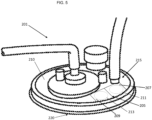
- Covering assembly 201 includes a top portion 210 and a bottom portion 220.
- a first chamber includes a frangible material layer 205 situated on a first surface 225 of the covering assembly bottom portion 220.
- the covering assembly and/or lid 201 may comprise a plastic material, e.g., polyethylene or polypropylene.
- the frangible material layer 205 will be positioned at a bottom side of a first compartment 207.
- the first compartment may contain a red blood cell flocculent material or a blood coagulant material 250.
- a first button/dimple 211 will be located directly above the frangible chamber, and upon pressing the button and/or dimple, the material in the compartment will apply a force against the frangible material surface that breaks the surface, thus expelling the material into an interior chamber of a collection container. Thus, as the surface of the first frangible chamber is breached from the application of the force, the material is released into the container where it will mix and contact with the fluid contents.
- a second compartment 209 may also be provided, this compartment comprising a preferred material, such as a red blood cell flocculent or blood coagulant (capable of transforming flocculated red blood cells into a solid and/or semi-solid mass or gel).
- a preferred material such as a red blood cell flocculent or blood coagulant (capable of transforming flocculated red blood cells into a solid and/or semi-solid mass or gel).
- This solid and/or semi-solid mass may then be easily disposed of, without risk of splashing or spilling onto another person, technical personnel, or on/in the surrounding area.
- a second button/dimple 213 defining one side (the top side) of the second compartment will be located directly above a second frangible layer, and upon pressing the second button and/or dimple, the material within the second compartment (such as a red blood cell flocculent or a flocculated red blood cell coagulant material) will be forced through the frangible layer of the compartment and into a collection device interior.
- the material within the second compartment such as a red blood cell flocculent or a flocculated red blood cell coagulant material
- the first button/dimple 211 and the second button/dimple 213 may each be substantially level with first surface 215 of the covering assembly top portion 210 to improve the compactness of covering assembly 201, and allow for stackable storage for more than one covering assembly 201. This may also ensure that the first button/dimple 211 and the second button/dimple 213 do not become exposed to force that would press upon them upon packaging and shipping of the covering assembly 201.
- the flocculated red blood cell solidifying/jelling and/or coagulant substance may be a powder, or other form, such as a tablet, or a liquid.
- the flocculated red blood cell solidifying/jelling and/or blood coagulant, red blood cell flocculent, or both may be enclosed in a blister pack within the first compartment or the second compartment, for example, within a pack made of a plastic and/or aluminum foil.
- the flocculated red blood cell solidifying/jelling and/or red blood cell coagulant, or red blood cell flocculent may alternatively be packaged in another material such as, for example, a box, a bottle, a tray, a cartridge, or a card, within the first compartment or second compartment, or both compartments.
- Covering assembly 201 also includes a coupling adapter 208 along a perimeter 212 of the covering assembly 201, and the coupling adapter 208 with a threaded connection that is suitable for attaching the covering assembly 201 onto a canister 230 to provide a fluid-tight seal.
- Coupling adapter 208 may comprise a threaded connection, or a screw connection, or a locking connection.
- Covering assembly 201 may be interchangeably used with the collection system 100.
- a high molecular weight flocculent is Poly (diallyldimethylammonium chloride).
- the high molecular weight form of PolyDADMAC material has an average molecular weight of 400,000-500,000. Lower molecular weight forms of PolyDADMAC may also be used.
- This flocculent in a powder, tablet, liquid or other form may be included in a compartment of the lid and/or cap of the present device, and then selectively released into a canister on which the lid/cap is fitted.
- V b is equal to the calculated volume of blood in a material
- V m is equal to the observed sedimentation level of red blood cells in a container having a flocculent
- ⁇ is equal to the packing ratio determined for the container/container
- Hct is equal to the hematocrit of the animal/human from whom the liquid material was collected.
- the present example illustrates the use of the present canister covering assembly including a blood coagulant/blood component solidifying and/or jelling agent in a compartment for processing flocculated red blood cells from a volume of human blood (no anti-coagulant).
- the human blood employed in the following studies did not contain an anti-coagulant.
- the solidifying/coagulating agent examined was a super absorbent cellulosic material of high molecular weight cellulose-containing material (by way of example, Liqui-Loc Plus TM Solidifier). At the end of the 30 minute sedimentation period, 1 oz. (about 100 ml.) of the cellulosic solidifier (Liqui-Loc Plus TM ) was added to the Test 4 canister.
- the settled RBCs and other material in the container were not in a solid and/or gel-like condition at the 30 minute time period prior to adding the solidifier/jelling agent.
- the solidifier and/or jelling agent was released into the canister.
- the material in the canister, including the flocculated RBCs began to solidify/jell within about 1 minute the entire contents of the canister had formed a solid, gel-like mass (a "plug"). This is ready to dispose of safely as a biohazard material that handling contains exposure.
- a coagulant and/or solidifying/jelling agent may be released into the canister from the compartment on the lid by compressing the dimple located above the compartment, to easily and quickly solidify/jellify the contents for easy and safe disposal of biohazard waste, in compliance with conventional hazardous waste handling practice at hospital/facility and/or medical waste collecting facilities.
- Test 1 Human Adult Male; Hct.
- Example 6 Solidifying and/or Coagulating Polymeric Materials suitable for Solidifying Biological Waste Products with Flocculated Human RBCs
- Blood components such as red blood cells, sedimented from blood that had not been processed to include an anti-coagulant, will upon contact with a flocculent, yield red blood cells that are flocculated and that will form a uniform, observable sedimentation level.
- Human red blood cells exposed to a high molecular weight flocculent in a container e.g., high mw PolyDADMAC
- liquid or semi-liquid hazardous bio-waste should be treated such as to provide a solid, semi-solid, and/or jellified composition that will not splash, spill, or otherwise expose technicians and others to the canister contents, for safe disposal.
- the canister covering assembly may include a compartment that includes a flocculated red blood cell solidifier.
- the solidifier (RBC coagulant, jelling agent) may comprise a super absorbent cellulose composition.
- Compositions employed in the health care industry (hospitals) for solidifying/jelling biological waste include several compositions that include cellulose (e.g., Liqui-Loc Plus, StatSorb, Isosorb, Medi Vac Solid Plus), and other highly absorbent formula components as part of an appropriate solidifying/jelling formulation.
Landscapes
- Health & Medical Sciences (AREA)
- Heart & Thoracic Surgery (AREA)
- Life Sciences & Earth Sciences (AREA)
- Veterinary Medicine (AREA)
- Public Health (AREA)
- General Health & Medical Sciences (AREA)
- Animal Behavior & Ethology (AREA)
- Engineering & Computer Science (AREA)
- Anesthesiology (AREA)
- Hematology (AREA)
- Biomedical Technology (AREA)
- Vascular Medicine (AREA)
- Pharmacology & Pharmacy (AREA)
- Physics & Mathematics (AREA)
- Fluid Mechanics (AREA)
- Mechanical Engineering (AREA)
- Investigating Or Analysing Biological Materials (AREA)
- External Artificial Organs (AREA)
- Accommodation For Nursing Or Treatment Tables (AREA)
- Medical Preparation Storing Or Oral Administration Devices (AREA)
Applications Claiming Priority (4)
| Application Number | Priority Date | Filing Date | Title |
|---|---|---|---|
| US202063055577P | 2020-07-23 | 2020-07-23 | |
| US17/026,106 US11559466B2 (en) | 2020-07-23 | 2020-09-18 | Covering assembly with coagulant compartment and uses thereof in a blood monitoring/management system |
| PCT/US2021/043041 WO2022020761A1 (en) | 2020-07-23 | 2021-07-23 | Covering assembly with coagulant compartment and uses thereof in a blood monitoring/management system |
| EP21847010.2A EP4185345B1 (de) | 2020-07-23 | 2021-07-23 | Abdeckungsanordnung mit koagulationskammer und verwendungen davon in einem blutüberwachungs-/-managementsystem |
Related Parent Applications (2)
| Application Number | Title | Priority Date | Filing Date |
|---|---|---|---|
| EP21847010.2A Division-Into EP4185345B1 (de) | 2020-07-23 | 2021-07-23 | Abdeckungsanordnung mit koagulationskammer und verwendungen davon in einem blutüberwachungs-/-managementsystem |
| EP21847010.2A Division EP4185345B1 (de) | 2020-07-23 | 2021-07-23 | Abdeckungsanordnung mit koagulationskammer und verwendungen davon in einem blutüberwachungs-/-managementsystem |
Publications (1)
| Publication Number | Publication Date |
|---|---|
| EP4215225A1 true EP4215225A1 (de) | 2023-07-26 |
Family
ID=79687352
Family Applications (2)
| Application Number | Title | Priority Date | Filing Date |
|---|---|---|---|
| EP23158031.7A Pending EP4215225A1 (de) | 2020-07-23 | 2021-07-23 | Abdeckungsanordnung mit koagulationskammer und verwendungen davon in einem blutüberwachungs-/-managementsystem |
| EP21847010.2A Active EP4185345B1 (de) | 2020-07-23 | 2021-07-23 | Abdeckungsanordnung mit koagulationskammer und verwendungen davon in einem blutüberwachungs-/-managementsystem |
Family Applications After (1)
| Application Number | Title | Priority Date | Filing Date |
|---|---|---|---|
| EP21847010.2A Active EP4185345B1 (de) | 2020-07-23 | 2021-07-23 | Abdeckungsanordnung mit koagulationskammer und verwendungen davon in einem blutüberwachungs-/-managementsystem |
Country Status (8)
| Country | Link |
|---|---|
| US (2) | US11559466B2 (de) |
| EP (2) | EP4215225A1 (de) |
| JP (1) | JP2023535716A (de) |
| CN (1) | CN116472074A (de) |
| AU (1) | AU2021311831A1 (de) |
| CA (1) | CA3189807A1 (de) |
| ES (1) | ES3062602T3 (de) |
| WO (1) | WO2022020761A1 (de) |
Citations (6)
| Publication number | Priority date | Publication date | Assignee | Title |
|---|---|---|---|---|
| US5185007A (en) * | 1989-03-30 | 1993-02-09 | Abbott Laboratories | Suction drainage infection control system |
| DE10343668A1 (de) | 2003-09-18 | 2005-04-14 | Boehringer Ingelheim Pharma Gmbh & Co. Kg | Arzneimittelblister |
| DE202007003050U1 (de) | 2007-02-28 | 2007-05-10 | Swif Gmbh South West International Fragrance | Wirkstoffbehälter |
| US20110163091A1 (en) * | 2008-07-15 | 2011-07-07 | Medela Holding Ag | Fluid-collecting container |
| US20180196031A1 (en) * | 2017-01-11 | 2018-07-12 | Hemodus Medical, Llc | Method of estimating blood volume |
| WO2021054297A1 (ja) * | 2019-09-20 | 2021-03-25 | 大研医器株式会社 | 廃液収容容器、及びこれを備えた廃液貯留器並びに廃液吸引システム |
Family Cites Families (28)
| Publication number | Priority date | Publication date | Assignee | Title |
|---|---|---|---|---|
| GB1216534A (en) * | 1967-03-03 | 1970-12-23 | Braun Internat G M B H B | Improvements in or relating to containers for storing and dispensing medicinal liquids |
| US4540413A (en) * | 1983-06-17 | 1985-09-10 | Russo Ronald D | Cardiopulmonary drainage collector with blood transfer adapter |
| US5391351A (en) * | 1987-10-07 | 1995-02-21 | Kaufman; Jack W. | Body waste fluids solidification system |
| US5238582A (en) * | 1988-12-06 | 1993-08-24 | Daiken Iki Co., Ltd. | Method of treating waste liquid |
| DE68902818D1 (de) * | 1988-12-19 | 1992-10-15 | Duphar Int Res | Wasserreinigungsgeraet mit chemikalienbehaelter. |
| WO1991001638A1 (en) * | 1989-07-27 | 1991-02-21 | Jost Leonora I | Biological support system container and process for preserving living mammalian matter, ex vivo |
| DK119490D0 (da) * | 1990-05-14 | 1990-05-14 | Unes As | Apparat til fremstilling af et koncentrat af koagulationsfaktorer, saasom fibrinogen, fra en blodportion |
| IE69360B1 (en) * | 1993-07-01 | 1996-09-04 | Abbott Lab | Gelling treatment for suction drainage system |
| JPH07167716A (ja) | 1993-12-14 | 1995-07-04 | Nichiyu Giken Kogyo Kk | 感熱インジケータ付き検体容器蓋 |
| EP0819437A1 (de) * | 1996-02-01 | 1998-01-21 | Daiken Iki Co. Ltd. | Verfahren zur beseitigung von abfallflüssigkeiten, einschliesslich körperflüssigkeiten, und vorrichtung dafür |
| US5686074A (en) * | 1996-08-07 | 1997-11-11 | Stewart; Ulvert H. | Poison ivy treatment composition and method of use |
| US7387623B2 (en) * | 2002-08-21 | 2008-06-17 | Pfizer Inc. | Injectable pharmaceutical suspension in a two-chamber vial |
| WO2007127390A2 (en) | 2006-04-28 | 2007-11-08 | Biolife, L.L.C. | Materials and methods for wound treatment |
| US20080293156A1 (en) * | 2007-05-22 | 2008-11-27 | 3M Innovative Properties Company | Devices and methods for dispensing reagents into samples |
| CN201070460Y (zh) | 2007-07-17 | 2008-06-11 | 遵义医学院附属医院 | 一种用于自体血回收的贮血装置 |
| EP2214824A4 (de) * | 2007-11-28 | 2015-08-19 | Smart Tube Inc | Vorrichtungen, systeme und verfahren zur entnahme, stimulation, stabilisierung und analyse einer biologischen probe |
| US20100326151A1 (en) * | 2009-06-24 | 2010-12-30 | Feeco International, Inc. | Enhanced Fertilizer Granule |
| KR20110072512A (ko) * | 2009-12-23 | 2011-06-29 | 김영재 | 액상의 의료폐기물 수거장치 |
| US8206368B2 (en) * | 2010-01-18 | 2012-06-26 | Rourke M. Yeakley | Multi-chamber mixture dispensing system |
| US8895918B2 (en) * | 2011-06-03 | 2014-11-25 | Purdue Research Foundation | Ion generation using modified wetted porous materials |
| US9075039B2 (en) * | 2011-11-08 | 2015-07-07 | Becton, Dickinson And Company | Container and cap for a biological specimen |
| EP3047862A1 (de) | 2015-01-20 | 2016-07-27 | Medela Holding AG | Gelierprodukt für Fluidsammelbehälter |
| CN204661493U (zh) * | 2015-03-29 | 2015-09-23 | 武汉兴天宇环境工程有限公司 | 一种景观生态型污水处理系统 |
| WO2016183290A1 (en) * | 2015-05-13 | 2016-11-17 | Dornoch Medical Systems, Inc. | Fluid collection and disposal system |
| KR101767103B1 (ko) * | 2015-07-03 | 2017-08-23 | 김기종 | 의료용 이물질 흡입장치 |
| US10814047B2 (en) * | 2016-04-25 | 2020-10-27 | Allegiance Corporation | Fluid collection systems and methods of use |
| WO2018174072A1 (en) * | 2017-03-23 | 2018-09-27 | Terumo Kabushiki Kaisha | Cassette for a blood component collection system and manufacturing method thereof |
| US10518260B1 (en) * | 2019-05-01 | 2019-12-31 | Nano Discovery, Inc. | Device for separation of plasma or serum from blood cells and methods of using the device |
-
2020
- 2020-09-18 US US17/026,106 patent/US11559466B2/en active Active
-
2021
- 2021-07-23 ES ES21847010T patent/ES3062602T3/es active Active
- 2021-07-23 EP EP23158031.7A patent/EP4215225A1/de active Pending
- 2021-07-23 CA CA3189807A patent/CA3189807A1/en active Pending
- 2021-07-23 AU AU2021311831A patent/AU2021311831A1/en active Pending
- 2021-07-23 CN CN202180064985.2A patent/CN116472074A/zh active Pending
- 2021-07-23 WO PCT/US2021/043041 patent/WO2022020761A1/en not_active Ceased
- 2021-07-23 EP EP21847010.2A patent/EP4185345B1/de active Active
- 2021-07-23 JP JP2023504490A patent/JP2023535716A/ja active Pending
-
2022
- 2022-12-15 US US18/082,545 patent/US20230117068A1/en active Pending
Patent Citations (7)
| Publication number | Priority date | Publication date | Assignee | Title |
|---|---|---|---|---|
| US5185007A (en) * | 1989-03-30 | 1993-02-09 | Abbott Laboratories | Suction drainage infection control system |
| DE10343668A1 (de) | 2003-09-18 | 2005-04-14 | Boehringer Ingelheim Pharma Gmbh & Co. Kg | Arzneimittelblister |
| DE202007003050U1 (de) | 2007-02-28 | 2007-05-10 | Swif Gmbh South West International Fragrance | Wirkstoffbehälter |
| US20110163091A1 (en) * | 2008-07-15 | 2011-07-07 | Medela Holding Ag | Fluid-collecting container |
| US20180196031A1 (en) * | 2017-01-11 | 2018-07-12 | Hemodus Medical, Llc | Method of estimating blood volume |
| US10401347B2 (en) | 2017-01-11 | 2019-09-03 | Cypher Medical, Llc | Method of estimating blood volume |
| WO2021054297A1 (ja) * | 2019-09-20 | 2021-03-25 | 大研医器株式会社 | 廃液収容容器、及びこれを備えた廃液貯留器並びに廃液吸引システム |
Non-Patent Citations (2)
| Title |
|---|
| NOURI, S. ET AL.: "Efficacy and Safety of Aluminum Chloride in Controlling External Hemorrhage: An Animal Model Study", IRAN RED CRESCENT MEDICAL JOURNAL, vol. 17, no. 3, March 2015 (2015-03-01) |
| RATERMANN, A. ET AL., JOURNAL OF AGRICULTURAL FOOD CHEMISTRY, vol. 28, no. 2, 1980, pages 438 - 44 |
Also Published As
| Publication number | Publication date |
|---|---|
| CA3189807A1 (en) | 2022-01-27 |
| ES3062602T3 (en) | 2026-04-13 |
| EP4185345B1 (de) | 2025-12-17 |
| US20230117068A1 (en) | 2023-04-20 |
| JP2023535716A (ja) | 2023-08-21 |
| WO2022020761A1 (en) | 2022-01-27 |
| EP4185345A1 (de) | 2023-05-31 |
| AU2021311831A1 (en) | 2023-02-23 |
| US20220023147A1 (en) | 2022-01-27 |
| US11559466B2 (en) | 2023-01-24 |
| CN116472074A (zh) | 2023-07-21 |
| EP4185345A4 (de) | 2023-07-26 |
Similar Documents
| Publication | Publication Date | Title |
|---|---|---|
| TW303297B (de) | ||
| US8561653B2 (en) | Material(s)/content(s) management method and apparatus | |
| AU2003216425B2 (en) | Dialysis connector and cap having an integral disinfectant | |
| KR101036696B1 (ko) | 지혈 키트, 지혈제의 제조 방법 및 지혈을 촉진하는 방법 | |
| EP0845970A1 (de) | Beutel für eine sterile medizinische lösung und verfahren zum mischen solcher lösung | |
| US5238582A (en) | Method of treating waste liquid | |
| GB2319507A (en) | Packaged catheter with lubricant-activating liquid | |
| US5156823A (en) | Device for and method of treating waste liquid | |
| JP2002500917A (ja) | 二重パッケージ | |
| EP4185345B1 (de) | Abdeckungsanordnung mit koagulationskammer und verwendungen davon in einem blutüberwachungs-/-managementsystem | |
| US5584825A (en) | Closure delivery system | |
| HK40097232A (zh) | 带有凝结剂隔间的覆盖物组装件及其在血液监测/管理系统中的用途 | |
| EP2857492A1 (de) | Zellinhaltsbehälter und behälter mit bereits enthaltendem zellinhalt | |
| US20050218032A1 (en) | Sterile cleaning kit | |
| AU2004316287A1 (en) | Needle guide | |
| CN202314359U (zh) | 一种新的包装氨基酸葡萄糖注射液的双室输液袋 | |
| JP2818520B2 (ja) | 血性廃液の処理方法 | |
| CN111924359A (zh) | 一种医疗废物分类存放的方法 | |
| JP3519425B2 (ja) | 液状廃棄物の吸引処理方法及びその処理装置 | |
| EP2454171A1 (de) | Chirurgische reinigungslösungen | |
| DE19934491A1 (de) | Geschlossenes System zur Aufbereitung von Blutstammzellen | |
| JPS6137983A (ja) | 容器入水処理剤 | |
| JP2026502243A (ja) | 密封オーバーポーチを有する透析濃縮物用のためのフレキシブルバッグ | |
| TWM241042U (en) | Structure for collecting and solidifying waste liquid |
Legal Events
| Date | Code | Title | Description |
|---|---|---|---|
| PUAI | Public reference made under article 153(3) epc to a published international application that has entered the european phase |
Free format text: ORIGINAL CODE: 0009012 |
|
| STAA | Information on the status of an ep patent application or granted ep patent |
Free format text: STATUS: THE APPLICATION HAS BEEN PUBLISHED |
|
| AC | Divisional application: reference to earlier application |
Ref document number: 4185345 Country of ref document: EP Kind code of ref document: P |
|
| AK | Designated contracting states |
Kind code of ref document: A1 Designated state(s): AL AT BE BG CH CY CZ DE DK EE ES FI FR GB GR HR HU IE IS IT LI LT LU LV MC MK MT NL NO PL PT RO RS SE SI SK SM TR |
|
| STAA | Information on the status of an ep patent application or granted ep patent |
Free format text: STATUS: REQUEST FOR EXAMINATION WAS MADE |
|
| 17P | Request for examination filed |
Effective date: 20240126 |
|
| RBV | Designated contracting states (corrected) |
Designated state(s): AL AT BE BG CH CY CZ DE DK EE ES FI FR GB GR HR HU IE IS IT LI LT LU LV MC MK MT NL NO PL PT RO RS SE SI SK SM TR |
|
| STAA | Information on the status of an ep patent application or granted ep patent |
Free format text: STATUS: EXAMINATION IS IN PROGRESS |
|
| 17Q | First examination report despatched |
Effective date: 20250729 |
|
| RAP1 | Party data changed (applicant data changed or rights of an application transferred) |
Owner name: CYPHER MEDICAL, LLC |
|
| RIN1 | Information on inventor provided before grant (corrected) |
Inventor name: CAREW, CHRISTOPHER A. |