EP4215539B1 - Procédé de purification d'ester de sucralose-6-éthyle - Google Patents
Procédé de purification d'ester de sucralose-6-éthyle Download PDFInfo
- Publication number
- EP4215539B1 EP4215539B1 EP20962907.0A EP20962907A EP4215539B1 EP 4215539 B1 EP4215539 B1 EP 4215539B1 EP 20962907 A EP20962907 A EP 20962907A EP 4215539 B1 EP4215539 B1 EP 4215539B1
- Authority
- EP
- European Patent Office
- Prior art keywords
- acetate
- sucralose
- crystallization
- low
- ethyl acetate
- Prior art date
- Legal status (The legal status is an assumption and is not a legal conclusion. Google has not performed a legal analysis and makes no representation as to the accuracy of the status listed.)
- Active
Links
Images

Classifications
-
- C—CHEMISTRY; METALLURGY
- C07—ORGANIC CHEMISTRY
- C07H—SUGARS; DERIVATIVES THEREOF; NUCLEOSIDES; NUCLEOTIDES; NUCLEIC ACIDS
- C07H1/00—Processes for the preparation of sugar derivatives
- C07H1/06—Separation; Purification
-
- C—CHEMISTRY; METALLURGY
- C07—ORGANIC CHEMISTRY
- C07H—SUGARS; DERIVATIVES THEREOF; NUCLEOSIDES; NUCLEOTIDES; NUCLEIC ACIDS
- C07H13/00—Compounds containing saccharide radicals esterified by carbonic acid or derivatives thereof, or by organic acids, e.g. phosphonic acids
- C07H13/02—Compounds containing saccharide radicals esterified by carbonic acid or derivatives thereof, or by organic acids, e.g. phosphonic acids by carboxylic acids
- C07H13/04—Compounds containing saccharide radicals esterified by carbonic acid or derivatives thereof, or by organic acids, e.g. phosphonic acids by carboxylic acids having the esterifying carboxyl radicals attached to acyclic carbon atoms
-
- C—CHEMISTRY; METALLURGY
- C07—ORGANIC CHEMISTRY
- C07B—GENERAL METHODS OF ORGANIC CHEMISTRY; APPARATUS THEREFOR
- C07B2200/00—Indexing scheme relating to specific properties of organic compounds
- C07B2200/13—Crystalline forms, e.g. polymorphs
-
- Y—GENERAL TAGGING OF NEW TECHNOLOGICAL DEVELOPMENTS; GENERAL TAGGING OF CROSS-SECTIONAL TECHNOLOGIES SPANNING OVER SEVERAL SECTIONS OF THE IPC; TECHNICAL SUBJECTS COVERED BY FORMER USPC CROSS-REFERENCE ART COLLECTIONS [XRACs] AND DIGESTS
- Y02—TECHNOLOGIES OR APPLICATIONS FOR MITIGATION OR ADAPTATION AGAINST CLIMATE CHANGE
- Y02P—CLIMATE CHANGE MITIGATION TECHNOLOGIES IN THE PRODUCTION OR PROCESSING OF GOODS
- Y02P20/00—Technologies relating to chemical industry
- Y02P20/10—Process efficiency
Definitions
- the present disclosure relates to the technical field of chemical purification, and in particular to a method for purifying sucralose-6-acetate.
- Sucralose-6-acetate is one of the important intermediates for producing sucralose, and the purity of sucralose-6-acetate is one of the keys affecting the yield of sucralose. It is found that, when the purity of sucralose-6-acetate is 80%, the yield of sucralose after deacylation is 45%; but when the purity of sucralose-6-acetate is increased to 90%, the yield of sucralose is accordingly increased to 67%. Therefore, the improvement of the purity of sucralose-6-acetate makes it possible to effectively improve the yield of sucralose. At present, ethyl acetate, butyl acetate and water are widely used industrially for the purification of sucralose-6-acetate, and the purification of sucralose-6-acetate is generally achieved by multiple recrystallization.
- Chinese patent CN101709069 discloses a method for purifying sucralose-6-acetate, including: first preparing a sucralose-6-acetate crude product into an aqueous solution, and then subjecting the aqueous solution to extraction with ethyl acetate or butyl acetate, concentration, and multiple recrystallization by the above solvent, to obtain a sucralose-6-acetate crystal.
- the above method has the disadvantages of large organic solvent consumption, low product purity, and poor purification and separation effect.
- Chinese patent CN109956983A discloses a method for extracting sucralose-6-ethyl ester, which comprises: after a chlorination stage for preparing sucralose-6-ethyl ester, neutralizing an obtained acid material with alkali, adding a non-polar or a low-polar solvent, and leaving the mixture to stand after stirring such that the sucralose-6-ethyl ester forms a solid; subjecting a resulting system to solid-liquid separation to obtain a crude product of sucralose-6-ethyl ester solid; and optionally, recycling a liquid part after rectification separation, and recrystallizing the crude product of sucralose-6-ethyl ester solid.
- Chinese patent CN1271077C discloses a method for preparing sucralose-6-ethyl ester, which comprises: (1) adding sucrose-6-ethyl ester into a solvent containing N-formyl groups, cooling to below 30 °C, and adding thionyl chloride dropwise to react with N-formyl groups in the solvent; and heating a resulting mixture up to 70-85 °C for 0.5-2 hours, and then heating up to 90-105 °C for 0.5-2 hours, finally heating up to 105-125 °C for 2-5 hours, the whole heating process and reaction are protected by chlorine gas; (2) cooling a resulting system to room temperature, adjusting the system to neutral by alkali, extracting the system with ethyl acetate, and concentrating a resulting extract to obtain a sucralose-6-ethyl ester solution; and adding a small amount of ether solvent or water to the sucralose-6-ethyl ester solution to obtain sucralose-6-ethyl ester crystals
- Chinese patent CN102807594A discloses a method for refining sucralose-6-ethyl ester, which comprises: refining a sucralose-6-ethyl ester crude product obtained by concentration for the first time by using an alcohol-ether mixed solvent to remove most impurities; and refining the crude product for the second time by using an ester-alkane mixed solvent to remove trace impurities so as to obtain a high-purity sucralose-6-ethyl ester fine product.
- sucralose-6-acetate is obtained through chlorination of sucrose-6-acetate, and by-products produced during the chlorination mainly include monochlorosucrose-6-acetate, dichlorosucrose-6-acetate, tetrachlorosucrose-6-acetate, or the like, where monochlorinated and dichlorinated by-products are common.
- Ethyl acetate which is commonly used in industry, has excellent polarity and includes an ester group. According to the principle of similar compatibility, ethyl acetate has a high solubility for the four products.
- the present disclosure provides a method for purifying sucralose-6-acetate in order to overcome the above problems.
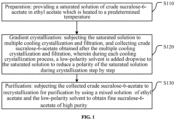
- a method for purifying sucralose-6-acetate including:
- the predetermined temperature of the saturated solution of crude sucralose-6-acetate in ethyl acetate is in a range of 60°C to 70°C.
- the low-polarity solvent is one or more selected from the group consisting of n-pentane, cyclopentane, n-hexane, cyclohexane, n-heptane, and cycloheptane.
- the saturated solution in the gradient crystallization, is subjected to the cooling crystallization for three or more times.
- the crude sucralose-6-acetate is dissolved at a temperature of 50°C to 70°C for recrystallization; the mixed solution of ethyl acetate and the low-polarity solvent is stirred at a rate of 60 r/min to 100 r/min; a volume ratio of ethyl acetate to the low-polarity solvent is in a range of 1:(0.5-1); and the recrystallization is conducted at a temperature of -10°C to 0°C for 0.5 hours to 3 hours.
- the purification further includes: drying a sucralose-6-acetate solid obtained by filtration with a dryer to obtain the fine sucralose-6-acetate of high purity.
- the method further includes: recovery: collecting a first mother liquor obtained by filtration after the third cooling crystallization in the gradient crystallization and a second mother liquor obtained by filtration after the recrystallization for purification, and recovering ethyl acetate and the low-polarity solvent from the first mother liquor and the second mother liquor.
- the low-polarity solvent includes one selected from the group consisting of n-pentane, cyclopentane, and n-hexane
- the low-polarity solvent is first recovered from the first mother liquor and the second mother liquor, and then ethyl acetate is recovered
- the low-polarity solvent includes one selected from the group consisting of cyclohexane, n-heptane, and cycloheptane
- ethyl acetate is first recovered from the first mother liquor and the second mother liquor, and then the low-polarity solvent is recovered.
- the present disclosure has the following beneficial effects:
- ethyl acetate is used as an initial solvent for cooling crystallization of sucralose-6-acetate, and a low-polarity solvent is added step by step with the decrease of temperature to make the polarity of the mixed solvent show a trend of gradient reduction during the crystallization, such that impurities could be effectively separated due to polarity changes, which enables high single-pass crystallization yield and efficiency of sucralose-6-acetate, ensures the purity of a crystallization product, and reduces the number of crystallization times and the consumption of the organic solvent, thereby leading to high product yield, purity, and quality.
- the by-products produced during the preparation of sucralose-6-acetate are mostly monochlorinated and dichlorinated by-products.
- each chlorinated product has a specified polarity, and the polarity gradually increases with the increase of the number of chlorine groups, that is, the four products rank as follows in terms of polarity: tetrachlorosucrose-6-acetate > sucralose-6-acetate > dichlorosucrose-6-acetate > monochlorosucrose-6-acetate.
- ethyl acetate used in industry has excellent polarity and exhibits high solubility for the four chlorinated products, the recrystallization for purification using a single solvent inevitably fails to effectively separate a variety of by-products.
- the technical concept of the present disclosure is as follows: An ethyl acetate saturated solution is used for cooling crystallization of sucralose-6-acetate, and a low-polarity solvent is added step by step with the decrease in temperature to reduce the polarity of the solution in stages, such that impurities could be effectively separated and a crystalline purity of sucralose-6-acetate could be improved at each stage, thereby reducing the number of crystallization times and the organic solvent consumption, and making it possible to ensure a high single-pass crystallization yield and the purity of a crystallization product.
- the method of the present disclosure has strong operability and makes it possible to obtain product with high yield, high purity, and good quality.
- FIG. 1 is a flowchart showing a method for purifying sucralose-6-acetate according to an embodiment of the present disclosure. As shown in FIG. 1 , the method includes:
- the temperature of the saturated solution of crude sucralose-6-acetate in ethyl acetate is in a range of 60°C to 70°C.
- Ethyl acetate has excellent polarity and includes ester groups. According to the principle of similar compatibility, ethyl acetate exhibits high solubility for the four chlorinated products, which could effectively ensure the product yield.
- ethyl acetate with excellent polarity is first used alone, and with the progress of cooling crystallization, a low-polarity solvent is gradually added to reduce the overall polarity of the solvent in the solution system, such that monochlorinated product and dichlorinated product of low polarity are effectively separated due to the gradient changes of the polarity of the solvent, which promotes the precipitation of the target product sucralose-6-acetate and realizes the efficient and high-purity purification of sucralose-6-acetate.
- the low-polarity solvent is one or more selected from the group consisting of n-pentane, cyclopentane, n-hexane, cyclohexane, n-heptane, and cycloheptane.
- the low-polarity solvent available in the present disclosure is not limited to the above solvents, and any low-polarity solvent that can be mixed with ethyl acetate to produce a mixed solvent with reduced polarity, does not react with the target product in the solution, and is easy to separate may be used in the present disclosure.
- the saturated solution in the gradient crystallization, is subjected to the cooling crystallization for three or more times.
- an excellent purification effect could be achieved by gradually reducing the polarity of the solvent and conducting cooling crystallization for 3 times.
- increased cooling crystallization times could bring an improved purification effect, but would also increase the cost. Therefore, the actual number of cooling crystallization times could be determined according to the production needs.
- the saturated solution of crude sucralose-6-acetate in ethyl acetate is subjected to the cooling crystallization for three times, where a first cooling crystallization is conducted at a temperature of 40°C to 50°C, a second cooling crystallization is conducted at a temperature of 20°C to 30°C, and a third cooling crystallization is conducted at a temperature of -10°C to 0°C.
- the low-polarity solvent is added dropwise for 5 minutes to 30 minutes in an amount of 5% to 15% of a volume of the saturated solution during each cooling crystallization process.
- the cooling crystallization is conducted for three times, where a first cooling crystallization is conducted for 0.5 hours to 1 hour, a second cooling crystallization is conducted for 0.5 hours to 1.5 hours, and a third cooling crystallization is conducted for 0.5 hours to 2 hours; and the resulting solution is stirred at a rate of 10 r/min to 30 r/min during each cooling crystallization process.
- the crude sucralose-6-acetate is dissolved at a temperature of 50°C to 70°C for recrystallization; the mixed solution of ethyl acetate and the low-polarity solvent is stirred at a rate of 60 r/min to 100 r/min; a volume ratio of ethyl acetate to the low-polarity solvent is in a range of 1 :(0.5-1); and the recrystallization is conducted at a temperature of -10°C to 0°C for 0.5 hours to 3 hours.
- the above method is not much different from the existing method for purifying sucralose-6-acetate by ethyl acetate recrystallization, and is mainly intended to further purify and unify the purities of sucralose-6-acetate products at different concentrations produced at different stages.
- the purification further includes: drying a sucralose-6-acetate solid obtained by filtration with a dryer to obtain the fine sucralose-6-acetate of high purity.
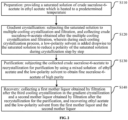
- FIG. 2 is a flowchart showing the method for purifying sucralose-6-acetate according to another embodiment of the present disclosure.
- the method further includes: S140: Recovery: A first mother liquor obtained by filtration after the third cooling crystallization in the gradient crystallization and a second mother liquor obtained by filtration after the recrystallization for purification are collected, and ethyl acetate and the low-polarity solvent are recovered from the first mother liquor and the second mother liquor.
- S140 Recovery: A first mother liquor obtained by filtration after the third cooling crystallization in the gradient crystallization and a second mother liquor obtained by filtration after the recrystallization for purification are collected, and ethyl acetate and the low-polarity solvent are recovered from the first mother liquor and the second mother liquor.
- ethyl acetate and the low-polarity solvent could be recovered and recycled, which makes it possible to reduce the process cost.
- the low-polarity solvent includes one selected from the group consisting of n-pentane, cyclopentane, and n-hexane
- the low-polarity solvent is first recovered from the first mother liquor and the second liquor, and then ethyl acetate is recovered
- the low-polarity solvent includes one selected from the group consisting of cyclohexane, n-heptane, and cycloheptane
- ethyl acetate is first recovered from the first mother liquor and the second mother liquor, and then the low-polarity solvent is recovered.
- a recovery order may be adjusted according to properties such as the boiling points of the low-polarity solvents and ethyl acetate.
- FIG. 3 is a process flowchart showing the method for purifying sucralose-6-acetate according to an embodiment of the present disclosure.
- the purification of crude sucralose-6-acetate is achieved by conducting cooling crystallization for three times during the gradient crystallization. The following examples are illustrated with reference to the process flowchart shown in FIG. 3 .
- a resulting mixture was subjected to a first solid-liquid separation (SLS) in a first solid-liquid separator H-1.
- a resulting mother liquor was transported to a second crystallization reactor E-2, cooled to 30°C, and stirred at a rate of 10 r/min. Then 100 L of n-pentane was added dropwise for 10 minutes, and a resulting system was further stirred for 0.5 hours to allow a continued crystallization.
- a resulting mixture was subjected to a second SLS in a second solid-liquid separator H-2.
- a resulting mother liquor was transported to a third crystallization reactor E-3, cooled to 0°C, and stirred at a rate of 30 r/min. Then 50 L of n-pentane was added dropwise for 10 minutes, and a resulting system was further stirred for 0.5 hours to allow a further crystallization. After the crystallization was completed, a resulting mixture was subjected to a third SLS in a third solid-liquid separator H-3, and a resulting mother liquor was transported to recovery towers E-5 and E-6 for solvent recovery. The gradient crystallization was completed.
- a resulting sucralose-6-acetate solid was dried by a dryer H-5 to obtain a fine sucralose-6-acetate of high purity, and a resulting mother liquor was combined with the mother liquor obtained from the third solid-liquid separator H-3 and transported to recovery towers E-5 and E-6 for recovering ethyl acetate and the low-polarity solvent.
- the low-polarity solvent was n-pentane with a lower boiling point than that of ethyl acetate.
- the solvent recovery tower E-5 was a low-polarity solvent recovery tower, which was configured to recover n-pentane and was connected to a low-polarity solvent storage tank V-1.
- the solvent recovery tower E-6 was an ethyl acetate recovery tower, which was connected to an ethyl acetate storage tank V-2.
- a solvent recovery order of the solvent recovery towers E-5 and E-6 was determined according to the boiling points of the low-polarity solvent and ethyl acetate, and the principle was the same, which would not be repeated.
- a purity of sucralose-6-acetate at each stage and a total yield of sucralose-6-acetate were shown in Table 1.
- a resulting mixture was subjected to a first SLS in a first solid-liquid separator H-1.
- a resulting mother liquor was transported to a second crystallization reactor E-2, cooled to 20°C, and stirred at a rate of 15 r/min.
- 150 L of cyclopentane was added dropwise for 15 minutes, and a resulting system was further stirred for 1 hour to allow a continued crystallization.
- a resulting mixture was subjected to a second SLS in a second solid-liquid separator H-2.
- a resulting mother liquor was transported to a third crystallization reactor E-3, cooled to -5°C, and stirred at a rate of 15 r/min.
- n-pentane purity: greater than 99%, commercially available
- a resulting sucralose-6-acetate solid was dried by a dryer H-5 to obtain a fine sucralose-6-acetate of high purity, and a resulting mother liquor was combined with the mother liquor obtained from the third solid-liquid separator H-3 and transported to solvent recovery towers for recovering ethyl acetate and the low-polarity solvent.
- a purity of sucralose-6-acetate at each stage and a total yield of sucralose-6-acetate were shown in Table 2.
- Table 2 Purity of sucralose-6-acetate at each stage and total yield of sucralose-6-acetate Item Raw material Gradient 1 Gradient 2 Gradient 3 Gradient 4 Purity/% 36.98 87.69 90.85 93.57 97.46 Total yield/% 87.66
- a resulting mixture was subjected to a first SLS in a first solid-liquid separator H-1.
- a resulting mother liquor was transported to a second crystallization reactor E-2, cooled to 25°C, and stirred at a rate of 20 r/min.
- 80 L of n-pentane was added dropwise for 10 minutes, and a resulting system was further stirred for 1 hour to allow a continued crystallization.
- a resulting mixture was subjected to a second SLS in a second solid-liquid separator H-2.
- a resulting mother liquor was transported to a third crystallization reactor E-3, cooled to 0°C, and stirred at a rate of 30 r/min.
- a resulting sucralose-6-acetate solid was dried by a dryer H-5 to obtain a fine sucralose-6-acetate of high purity, and a resulting mother liquor was combined with the mother liquor obtained from the third solid-liquid separator H-3 and transported to solvent recovery towers for recovering ethyl acetate and the low-polarity solvent.
- a purity of sucralose-6-acetate at each stage and a total yield of sucralose-6-acetate were shown in Table 3.
- Table 3 Purity of sucralose-6-acetate at each stage and total yield of sucralose-6-acetate Item Raw material Gradient 1 Gradient 2 Gradient 3 Gradient 4 Purity/% 30.21 82.47 88.24 93.01 99.01 Total yield/% 88.75
- a resulting mixture was subjected to a first SLS in a first solid-liquid separator H-1.
- a resulting mother liquor was transported to a second crystallization reactor E-2, cooled to 30°C, and stirred at a rate of 15 r/min.
- 160 L of n-pentane (purity: greater than 99%, commercially available) was added dropwise for 15 minutes, and a resulting system was further stirred for 1 hour to allow a continued crystallization.
- n-pentane purity: greater than 99%, commercially available
- a resulting mother liquor was transported to a third crystallization reactor E-3, cooled to 0°C, and stirred at a rate of 15 r/min. Then 150 L of n-pentane was added dropwise for 15 minutes, and a resulting system was further stirred for 1.5 hours to allow a further crystallization. After the crystallization was completed, a resulting mixture was subjected to a third SLS in a third solid-liquid separator H-3, and a resulting mother liquor was transported to solvent recovery towers for solvent recovery.
- a resulting sucralose-6-acetate solid was dried by a dryer H-5 to obtain a fine sucralose-6-acetate of high purity, and a resulting mother liquor was combined with the mother liquor obtained from the third solid-liquid separator H-3 and transported to solvent recovery towers for recovering ethyl acetate and the low-polarity solvent.
- a purity of sucralose-6-acetate at each stage and a total yield of sucralose-6-acetate were shown in Table 4.
- Table 4 Purity of sucralose-6-acetate at each stage and total yield of sucralose-6-acetate Item Raw material Gradient 1 Gradient 2 Gradient 3 Gradient 4 Purity/% 35.14 85.66 89.18 91.62 97.24 Total yield/% 88.25
- a resulting mixture was subjected to a first SLS in a first solid-liquid separator H-1.
- a resulting mother liquor was transported to a second crystallization reactor E-2, cooled to 20°C, and stirred at a rate of 10 r/min.
- 100 L of n-pentane was added dropwise for 10 minutes, and a resulting system was further stirred for 0.5 hours to allow a continued crystallization.
- a resulting mixture was subjected to a second SLS in a second solid-liquid separator H-2.
- a resulting mother liquor was transported to a third crystallization reactor E-3, cooled to -6°C, and stirred at a rate of 10 r/min.
- a resulting sucralose-6-acetate solid was dried by a dryer H-5 to obtain a fine sucralose-6-acetate of high purity, and a resulting mother liquor was combined with the mother liquor obtained from the third solid-liquid separator H-3 and transported to solvent recovery towers for recovering ethyl acetate and the low-polarity solvent.
- a purity of sucralose-6-acetate at each stage and a total yield of sucralose-6-acetate were shown in Table 5.
- a resulting mixture was subjected to a first SLS in a first solid-liquid separator H-1.
- a resulting mother liquor was transported to a second crystallization reactor E-2, cooled to 20°C, and stirred at a rate of 15 r/min.
- 180 L of n-pentane was added dropwise for 15 minutes, and a resulting system was further stirred for 1.5 hours to allow a continued crystallization.
- a resulting mixture was subjected to a second SLS in a second solid-liquid separator H-2.
- a resulting mother liquor was transported to a third crystallization reactor E-3, cooled to -3°C, and stirred at a rate of 15 r/min.
- a resulting sucralose-6-acetate solid was dried by a dryer H-5 to obtain a fine sucralose-6-acetate of high purity, and a resulting mother liquor was combined with the mother liquor obtained from the third solid-liquid separator H-3 and transported to solvent recovery towers for recovering ethyl acetate and the low-polarity solvent.
- a purity of sucralose-6-acetate at each stage and a total yield of sucralose-6-acetate were shown in Table 6.
- Table 6 Purity of sucralose-6-acetate at each stage and total yield of sucralose-6-acetate Item Raw material Gradient 1 Gradient 2 Gradient 3 Gradient 4 Purity/% 36.55 89.52 93.11 96.00 98.43 Total yield/% 89.27
- a resulting mixture was subjected to a first SLS in a first solid-liquid separator H-1.
- a resulting mother liquor was transported to a second crystallization reactor E-2, cooled to 30°C, and stirred at a rate of 20 r/min.
- 200 L of n-pentane was added dropwise for 20 minutes, and a resulting system was further stirred for 1.5 hours to allow a continued crystallization.
- a resulting mixture was subjected to a second SLS in a second solid-liquid separator H-2.
- a resulting mother liquor was transported to a third crystallization reactor E-3, cooled to -1°C, and stirred at a rate of 10 r/min.
- a resulting sucralose-6-acetate solid was dried by a dryer H-5 to obtain a fine sucralose-6-acetate of high purity, and a resulting mother liquor was combined with the mother liquor obtained from the third solid-liquid separator H-3 and transported to solvent recovery towers for recovering ethyl acetate and the low-polarity solvent.
- a purity of sucralose-6-acetate at each stage and a total yield of sucralose-6-acetate were shown in Table 7.
- Table 7 Purity of sucralose-6-acetate at each stage and total yield of sucralose-6-acetate Item Raw material Gradient 1 Gradient 2 Gradient 3 Gradient 4 Purity/% 36.89 88.16 91.25 95.56 98.58 Total yield/% 86.13
- a resulting mixture was subjected to a first SLS in a first solid-liquid separator H-1.
- a resulting mother liquor was transported to a second crystallization reactor E-2, cooled to 20°C, and stirred at a rate of 30 r/min.
- 350 L of n-pentane was added dropwise for 30 minutes, and a resulting system was further stirred for 1.5 hours to allow a continued crystallization.
- a resulting mixture was subjected to a second SLS in a second solid-liquid separator H-2.
- a resulting mother liquor was transported to a third crystallization reactor E-3, cooled to -4°C, and stirred at a rate of 10 r/min.
- a resulting sucralose-6-acetate solid was dried by a dryer H-5 to obtain a fine sucralose-6-acetate of high purity, and a resulting mother liquor was combined with the mother liquor obtained from the third solid-liquid separator H-3 and transported to solvent recovery towers for recovering ethyl acetate and the low-polarity solvent.
- a purity of sucralose-6-acetate at each stage and a total yield of sucralose-6-acetate were shown in Table 8.
- Table 8 Purity of sucralose-6-acetate at each stage and total yield of sucralose-6-acetate Item Raw material Gradient 1 Gradient 2 Gradient 3 Gradient 4 Purity/% 32.71 85.23 90.99 93.77 99.05 Total yield/% 87.65
- a resulting mixture was subjected to a first SLS in a first solid-liquid separator H-1.
- a resulting mother liquor was transported to a second crystallization reactor E-2, cooled to 25°C, and stirred at a rate of 15 r/min.
- 200 L of n-pentane was added dropwise for 20 minutes, and a resulting system was further stirred for 1.5 hours to allow a continued crystallization.
- a resulting mixture was subjected to a second SLS in a second solid-liquid separator H-2.
- a resulting mother liquor was transported to a third crystallization reactor E-3, cooled to -1°C, and stirred at a rate of 10 r/min.
- n-pentane n-pentane was added dropwise for 10 minutes, and a resulting system was further stirred for 1.5 hours to allow a further crystallization. After the crystallization was completed, a resulting mixture was subjected to a third SLS in a third solid-liquid separator H-3, and a resulting mother liquor was transported to solvent recovery towers for solvent recovery.
- a resulting sucralose-6-acetate solid was dried by a dryer H-5 to obtain a fine sucralose-6-acetate of high purity, and a resulting mother liquor was combined with the mother liquor obtained from the third solid-liquid separator H-3 and transported to solvent recovery towers for recovering ethyl acetate and the low-polarity solvent.
- a purity of sucralose-6-acetate at each stage and a total yield of sucralose-6-acetate were shown in Table 9.
- Table 9 Purity of sucralose-6-acetate at each stage and total yield of sucralose-6-acetate Item Raw material Gradient 1 Gradient 2 Gradient 3 Gradient 4 Purity/% 37.34 87.68 91.39 94.17 98.81 Total yield/% 89.73
- ethyl acetate is used as an initial solvent for cooling crystallization of sucralose-6-acetate, and a low-polarity solvent is added step by step with the decrease of temperature to make the polarity of the mixed solvent show a trend of gradient reduction during the crystallization, such that impurities could be effectively separated at different gradient stages, which enables high single-pass crystallization yield and efficiency, ensures the purity of a crystallization product, and reduces the number of crystallization times and the consumption of the organic solvent, thereby leading to high product yield, purity, and quality.
Landscapes
- Chemical & Material Sciences (AREA)
- Organic Chemistry (AREA)
- Health & Medical Sciences (AREA)
- Life Sciences & Earth Sciences (AREA)
- Engineering & Computer Science (AREA)
- Biochemistry (AREA)
- Biotechnology (AREA)
- General Health & Medical Sciences (AREA)
- Genetics & Genomics (AREA)
- Molecular Biology (AREA)
- Organic Low-Molecular-Weight Compounds And Preparation Thereof (AREA)
Claims (9)
- Procédé de purification du sucralose-6-acétate, comprenant :la préparation : fourniture d'une solution saturée de sucralose-6-acétate brut dans de l'acétate d'éthyle qui est chauffée à une température prédéterminée ;la cristallisation à gradient : soumission de la solution saturée à de multiples cristallisations par refroidissement et filtrations, et collecte du sucralose-6-acétate brut obtenu après les multiples cristallisations par refroidissement et filtrations, dans lequel, pendant chaque processus de cristallisation par refroidissement, un solvant à faible polarité est ajouté goutte à goutte à la solution saturée pour réduire une polarité de la solution saturée pendant la cristallisation étape par étape ; etla purification : soumission du sucralose-6-acétate brut collecté à une recristallisation pour purification à l'aide d'une solution mixte d'acétate d'éthyle et du solvant à faible polarité pour obtenir du sucralose-6-acétate fin de grande pureté ;dans lequel dans la cristallisation à gradient, la solution saturée est soumise à la cristallisation par refroidissement trois fois, dans lequel une première cristallisation par refroidissement est réalisée à une température de 40 °C à 50 °C, une deuxième cristallisation par refroidissement est réalisée à une température de 20 °C à 30 °C, et une troisième cristallisation par refroidissement est réalisée à une température de -10 °C à 0 °C.
- Procédé de purification du sucralose-6-acétate selon la revendication 1, dans lequel la température prédéterminée de la solution saturée de sucralose-6-acétate brut dans de l'acétate d'éthyle est dans la plage de 60 °C à 70 °C.
- Procédé de purification du sucralose-6-acétate selon la revendication 1, dans lequel le solvant à faible polarité est un ou plusieurs choisis dans le groupe constitué par le n-pentane, le cyclopentane, le n-hexane, le cyclohexane, le n-heptane et le cycloheptane.
- Procédé de purification du sucralose-6-acétate selon la revendication 1, dans lequel dans la cristallisation à gradient, la solution saturée est soumise à la cristallisation par refroidissement trois fois ou plus.
- Procédé de purification du sucralose-6-acétate selon la revendication 1, dans lequel dans la cristallisation à gradient, le solvant à faible polarité est ajouté goutte à goutte pendant 5 minutes à 30 minutes en une quantité de 5 % à 15 % d'un volume de la solution saturée pendant chaque processus de cristallisation par refroidissement ;la première cristallisation par refroidissement est réalisée pendant 0,5 heure à 1 heure, la deuxième cristallisation par refroidissement est réalisée pendant 0,5 heure à 1,5 heure, et la troisième cristallisation par refroidissement est réalisée pendant 0,5 heure à 2 heures ; etpendant de chaque processus de cristallisation par refroidissement, une solution résultante est agitée à une vitesse de 10 r/min à 30 r/min.
- Procédé de purification du sucralose-6-acétate selon la revendication 1, dans lequel dans la purification, le sucralose-6-acétate brut est dissous à une température de 50 °C à 70 °C pour recristallisation ; la solution mixte d'acétate d'éthyle et du solvant à faible polarité est agitée à une vitesse de 60 r/min à 100 r/min ; un rapport volumique d'acétate d'éthyle au solvant à faible polarité est dans la plage de 1:(0,5 à 1) ; et la recristallisation est réalisée à une température de -10 °C à 0 °C pendant 0,5 heure à 3 heures.
- Procédé de purification du sucralose-6-acétate selon la revendication 1, dans lequel la purification comprend en outre : séchage d'un solide de sucralose-6-acétate obtenu par filtration avec un séchoir pour obtenir le sucralose-6-acétate fin de grande pureté.
- Procédé de purification du sucralose-6-acétate selon la revendication 1, comprenant en outre :
la récupération : collecte d'une première liqueur mère obtenue par filtration après la troisième cristallisation par refroidissement dans la cristallisation à gradient et d'une seconde liqueur mère obtenue par filtration après la recristallisation pour la purification, et récupération de l'acétate d'éthyle et du solvant à faible polarité de la première liqueur mère et de la seconde liqueur mère. - Procédé de purification du sucralose-6-acétate selon la revendication 8, dans lequel dans la récupération, à condition que le solvant à faible polarité comprenne un choisi dans le groupe constitué par le n-pentane, le cyclopentane et le n-hexane, le solvant à faible polarité est d'abord récupéré de la première liqueur mère et de la seconde liqueur mère, puis l'acétate d'éthyle est récupéré ; et
à condition que le solvant à faible polarité comprenne un choisi dans le groupe constitué par le cyclohexane, le n-heptane et le cycloheptane, l'acétate d'éthyle est d'abord récupéré de la première liqueur mère et de la seconde liqueur mère, puis le solvant à faible polarité est récupéré.
Applications Claiming Priority (1)
| Application Number | Priority Date | Filing Date | Title |
|---|---|---|---|
| PCT/CN2020/132262 WO2022110017A1 (fr) | 2020-11-27 | 2020-11-27 | Procédé de purification d'ester de sucralose-6-éthyle |
Publications (4)
| Publication Number | Publication Date |
|---|---|
| EP4215539A1 EP4215539A1 (fr) | 2023-07-26 |
| EP4215539A4 EP4215539A4 (fr) | 2024-01-17 |
| EP4215539B1 true EP4215539B1 (fr) | 2024-11-27 |
| EP4215539C0 EP4215539C0 (fr) | 2024-11-27 |
Family
ID=75291169
Family Applications (1)
| Application Number | Title | Priority Date | Filing Date |
|---|---|---|---|
| EP20962907.0A Active EP4215539B1 (fr) | 2020-11-27 | 2020-11-27 | Procédé de purification d'ester de sucralose-6-éthyle |
Country Status (5)
| Country | Link |
|---|---|
| US (1) | US12606586B2 (fr) |
| EP (1) | EP4215539B1 (fr) |
| CN (1) | CN112638924B (fr) |
| MX (1) | MX2023005917A (fr) |
| WO (1) | WO2022110017A1 (fr) |
Families Citing this family (3)
| Publication number | Priority date | Publication date | Assignee | Title |
|---|---|---|---|---|
| WO2022233040A1 (fr) * | 2021-05-07 | 2022-11-10 | 安徽金禾实业股份有限公司 | Procédé de purification d'ester de sucralose-6-éthyle |
| CN116354814A (zh) * | 2022-12-15 | 2023-06-30 | 贵州天豪民族药业有限公司 | 一种提高对溴甲基苯基丙酸纯度的加工工艺 |
| CN117186163B (zh) * | 2023-09-09 | 2025-11-25 | 福州大学 | 一种三氯蔗糖-6-乙酸酯提纯工艺 |
Family Cites Families (11)
| Publication number | Priority date | Publication date | Assignee | Title |
|---|---|---|---|---|
| US5530106A (en) * | 1993-03-12 | 1996-06-25 | Mcneil-Ppc, Inc. | Recovery of sucralose intermediates |
| US6998480B2 (en) * | 2002-03-08 | 2006-02-14 | Tate & Lyle Public Limited Company | Process for improving sucralose purity and yield |
| CN1271077C (zh) * | 2003-10-01 | 2006-08-23 | 常州市牛塘化工厂 | 三氯蔗糖-6-乙酯的制备方法 |
| CN101328195B (zh) | 2007-06-18 | 2011-01-05 | 盐城捷康三氯蔗糖制造有限公司 | 一种分离三氯蔗糖-6-酯的方法 |
| US20100022765A1 (en) * | 2008-07-23 | 2010-01-28 | David Losan Ho | Methods for extracting and purifying sucralose intermediate |
| CN101709069B (zh) | 2009-08-06 | 2011-11-23 | 浙江工业大学 | 一种分离纯化三氯蔗糖-6-乙酯的新方法 |
| CN102807594B (zh) * | 2012-07-25 | 2015-05-13 | 湖北省宏源药业有限公司 | 一种三氯蔗糖-6-乙酯的精制方法 |
| CN109956983B (zh) * | 2017-12-25 | 2022-11-01 | 盐城捷康三氯蔗糖制造有限公司 | 三氯蔗糖-6-乙酯的提取方法 |
| CN108250255A (zh) * | 2018-01-24 | 2018-07-06 | 山东康宝生化科技有限公司 | 一种提高三氯蔗糖-6-乙酯结晶收率的方法 |
| CN109734755A (zh) * | 2018-12-28 | 2019-05-10 | 山东三和维信生物科技有限公司 | 一种三氯蔗糖结晶工艺 |
| CN111000803A (zh) * | 2019-12-03 | 2020-04-14 | 珠海亿邦制药有限责任公司 | 一种注射用克林霉素磷酸酯药物组合物的制备工艺 |
-
2020
- 2020-11-27 EP EP20962907.0A patent/EP4215539B1/fr active Active
- 2020-11-27 CN CN202080003566.3A patent/CN112638924B/zh active Active
- 2020-11-27 US US18/250,957 patent/US12606586B2/en active Active
- 2020-11-27 WO PCT/CN2020/132262 patent/WO2022110017A1/fr not_active Ceased
- 2020-11-27 MX MX2023005917A patent/MX2023005917A/es unknown
Also Published As
| Publication number | Publication date |
|---|---|
| CN112638924A (zh) | 2021-04-09 |
| EP4215539A4 (fr) | 2024-01-17 |
| US12606586B2 (en) | 2026-04-21 |
| EP4215539A1 (fr) | 2023-07-26 |
| US20240327445A1 (en) | 2024-10-03 |
| WO2022110017A1 (fr) | 2022-06-02 |
| EP4215539C0 (fr) | 2024-11-27 |
| MX2023005917A (es) | 2023-05-24 |
| CN112638924B (zh) | 2022-12-20 |
Similar Documents
| Publication | Publication Date | Title |
|---|---|---|
| EP4215539B1 (fr) | Procédé de purification d'ester de sucralose-6-éthyle | |
| CN106674293B (zh) | 一种利用水解方式处理三氯蔗糖-6-乙酸酯废弃母液的方法 | |
| CN113717237B (zh) | 一种从三氯蔗糖-6-乙酸酯中和液中制备三氯蔗糖的方法 | |
| CN110563780B (zh) | 一种三氯蔗糖氯化液的后处理方法及其在三氯蔗糖制备中的应用 | |
| CN113939524A (zh) | 三氯蔗糖-6-酯的提纯方法 | |
| DE69026281T2 (de) | Verfahren zur Reinigung und Isolierung von optisch aktivem Atenolol mit hoher Ausbeute | |
| CN109956982B (zh) | 一种三氯蔗糖的制备方法 | |
| CN113767109A (zh) | 三氯蔗糖的制备方法 | |
| US8252922B2 (en) | Method for crystallizing sucralose | |
| JP3110459B2 (ja) | p−アミノフェノール組成物の精製及びN−アセチル−p−アミノフェノールへの直接転化 | |
| WO2024082177A1 (fr) | Procédé de préparation de produit brut de sucralose à l'aide d'un système d'hydrolyse | |
| WO2024082157A1 (fr) | Procédé de préparation de sucralose brut à l'aide d'un système d'hydrolyse alcaline alcool-eau amélioré | |
| CN1362415A (zh) | 高纯度乙酰甲胺磷原粉的制备方法(2) | |
| CN117186163B (zh) | 一种三氯蔗糖-6-乙酸酯提纯工艺 | |
| CN116425811B (zh) | 一种三氯蔗糖溶析结晶工艺 | |
| CN110642736A (zh) | 一种乙酰氨基-3-氯丙氨酸甲酯的合成方法 | |
| US4348334A (en) | Process for producing the magnesium salt of 3-nitro-naphthalene-1,5-disulfonic acid (nitro-Armstrong's acid) | |
| CN109593107A (zh) | 一种蔗糖-6-乙酸酯的提纯方法 | |
| CN112457361B (zh) | 一种泼尼松龙磷酸钠母液回收方法 | |
| CN113173959B (zh) | 一种去除酶法合成蔗糖-6-乙酸酯体系中杂质的方法 | |
| US3174999A (en) | Method of separating nitro-substitutedchloro-benzoic acids | |
| CN114437146A (zh) | 一种三氯蔗糖-6-乙酸酯生产工艺 | |
| WO2024082175A1 (fr) | Procédé de préparation de produit raffiné de sucralose | |
| CN1277201A (zh) | 从乙酰甲胺磷原油中提取高纯度乙酰甲胺磷原粉的方法(2) | |
| WO2024082156A1 (fr) | Procédé de préparation de produit brut de sucralose à l'aide d'un système d'hydrolyse alcaline alcool-eau |
Legal Events
| Date | Code | Title | Description |
|---|---|---|---|
| STAA | Information on the status of an ep patent application or granted ep patent |
Free format text: STATUS: THE INTERNATIONAL PUBLICATION HAS BEEN MADE |
|
| PUAI | Public reference made under article 153(3) epc to a published international application that has entered the european phase |
Free format text: ORIGINAL CODE: 0009012 |
|
| STAA | Information on the status of an ep patent application or granted ep patent |
Free format text: STATUS: REQUEST FOR EXAMINATION WAS MADE |
|
| 17P | Request for examination filed |
Effective date: 20230420 |
|
| AK | Designated contracting states |
Kind code of ref document: A1 Designated state(s): AL AT BE BG CH CY CZ DE DK EE ES FI FR GB GR HR HU IE IS IT LI LT LU LV MC MK MT NL NO PL PT RO RS SE SI SK SM TR |
|
| RIC1 | Information provided on ipc code assigned before grant |
Ipc: C07H 5/02 20060101ALI20230905BHEP Ipc: C07H 13/04 20060101ALI20230905BHEP Ipc: C07H 1/06 20060101AFI20230905BHEP |
|
| A4 | Supplementary search report drawn up and despatched |
Effective date: 20231107 |
|
| DA4 | Supplementary search report drawn up and despatched (deleted) | ||
| RIC1 | Information provided on ipc code assigned before grant |
Ipc: C07H 5/02 20060101ALI20231205BHEP Ipc: C07H 13/04 20060101ALI20231205BHEP Ipc: C07H 1/06 20060101AFI20231205BHEP |
|
| RA4 | Supplementary search report drawn up and despatched (corrected) |
Effective date: 20231107 |
|
| RIC1 | Information provided on ipc code assigned before grant |
Ipc: C07H 5/02 20060101ALI20231214BHEP Ipc: C07H 13/04 20060101ALI20231214BHEP Ipc: C07H 1/06 20060101AFI20231214BHEP |
|
| DAV | Request for validation of the european patent (deleted) | ||
| DAX | Request for extension of the european patent (deleted) | ||
| GRAP | Despatch of communication of intention to grant a patent |
Free format text: ORIGINAL CODE: EPIDOSNIGR1 |
|
| STAA | Information on the status of an ep patent application or granted ep patent |
Free format text: STATUS: GRANT OF PATENT IS INTENDED |
|
| INTG | Intention to grant announced |
Effective date: 20240722 |
|
| GRAS | Grant fee paid |
Free format text: ORIGINAL CODE: EPIDOSNIGR3 |
|
| GRAA | (expected) grant |
Free format text: ORIGINAL CODE: 0009210 |
|
| STAA | Information on the status of an ep patent application or granted ep patent |
Free format text: STATUS: THE PATENT HAS BEEN GRANTED |
|
| AK | Designated contracting states |
Kind code of ref document: B1 Designated state(s): AL AT BE BG CH CY CZ DE DK EE ES FI FR GB GR HR HU IE IS IT LI LT LU LV MC MK MT NL NO PL PT RO RS SE SI SK SM TR |
|
| REG | Reference to a national code |
Ref country code: GB Ref legal event code: FG4D |
|
| REG | Reference to a national code |
Ref country code: CH Ref legal event code: EP |
|
| REG | Reference to a national code |
Ref country code: DE Ref legal event code: R096 Ref document number: 602020042324 Country of ref document: DE |
|
| REG | Reference to a national code |
Ref country code: IE Ref legal event code: FG4D |
|
| U01 | Request for unitary effect filed |
Effective date: 20241127 |
|
| U07 | Unitary effect registered |
Designated state(s): AT BE BG DE DK EE FI FR IT LT LU LV MT NL PT RO SE SI Effective date: 20241204 |
|
| U20 | Renewal fee for the european patent with unitary effect paid |
Year of fee payment: 5 Effective date: 20241202 |
|
| PG25 | Lapsed in a contracting state [announced via postgrant information from national office to epo] |
Ref country code: IS Free format text: LAPSE BECAUSE OF FAILURE TO SUBMIT A TRANSLATION OF THE DESCRIPTION OR TO PAY THE FEE WITHIN THE PRESCRIBED TIME-LIMIT Effective date: 20250327 Ref country code: HR Free format text: LAPSE BECAUSE OF FAILURE TO SUBMIT A TRANSLATION OF THE DESCRIPTION OR TO PAY THE FEE WITHIN THE PRESCRIBED TIME-LIMIT Effective date: 20241127 |
|
| PG25 | Lapsed in a contracting state [announced via postgrant information from national office to epo] |
Ref country code: ES Free format text: LAPSE BECAUSE OF FAILURE TO SUBMIT A TRANSLATION OF THE DESCRIPTION OR TO PAY THE FEE WITHIN THE PRESCRIBED TIME-LIMIT Effective date: 20241127 |
|
| PG25 | Lapsed in a contracting state [announced via postgrant information from national office to epo] |
Ref country code: NO Free format text: LAPSE BECAUSE OF FAILURE TO SUBMIT A TRANSLATION OF THE DESCRIPTION OR TO PAY THE FEE WITHIN THE PRESCRIBED TIME-LIMIT Effective date: 20250227 |
|
| PG25 | Lapsed in a contracting state [announced via postgrant information from national office to epo] |
Ref country code: GR Free format text: LAPSE BECAUSE OF FAILURE TO SUBMIT A TRANSLATION OF THE DESCRIPTION OR TO PAY THE FEE WITHIN THE PRESCRIBED TIME-LIMIT Effective date: 20250228 |
|
| PG25 | Lapsed in a contracting state [announced via postgrant information from national office to epo] |
Ref country code: PL Free format text: LAPSE BECAUSE OF FAILURE TO SUBMIT A TRANSLATION OF THE DESCRIPTION OR TO PAY THE FEE WITHIN THE PRESCRIBED TIME-LIMIT Effective date: 20241127 |
|
| PG25 | Lapsed in a contracting state [announced via postgrant information from national office to epo] |
Ref country code: RS Free format text: LAPSE BECAUSE OF FAILURE TO SUBMIT A TRANSLATION OF THE DESCRIPTION OR TO PAY THE FEE WITHIN THE PRESCRIBED TIME-LIMIT Effective date: 20250227 |
|
| REG | Reference to a national code |
Ref country code: CH Ref legal event code: PL |
|
| PG25 | Lapsed in a contracting state [announced via postgrant information from national office to epo] |
Ref country code: SM Free format text: LAPSE BECAUSE OF FAILURE TO SUBMIT A TRANSLATION OF THE DESCRIPTION OR TO PAY THE FEE WITHIN THE PRESCRIBED TIME-LIMIT Effective date: 20241127 |
|
| REG | Reference to a national code |
Ref country code: CH Ref legal event code: PL |
|
| PG25 | Lapsed in a contracting state [announced via postgrant information from national office to epo] |
Ref country code: CH Free format text: LAPSE BECAUSE OF NON-PAYMENT OF DUE FEES Effective date: 20241130 |
|
| PG25 | Lapsed in a contracting state [announced via postgrant information from national office to epo] |
Ref country code: SK Free format text: LAPSE BECAUSE OF FAILURE TO SUBMIT A TRANSLATION OF THE DESCRIPTION OR TO PAY THE FEE WITHIN THE PRESCRIBED TIME-LIMIT Effective date: 20241127 |
|
| PG25 | Lapsed in a contracting state [announced via postgrant information from national office to epo] |
Ref country code: CZ Free format text: LAPSE BECAUSE OF FAILURE TO SUBMIT A TRANSLATION OF THE DESCRIPTION OR TO PAY THE FEE WITHIN THE PRESCRIBED TIME-LIMIT Effective date: 20241127 |
|
| PG25 | Lapsed in a contracting state [announced via postgrant information from national office to epo] |
Ref country code: MC Free format text: LAPSE BECAUSE OF FAILURE TO SUBMIT A TRANSLATION OF THE DESCRIPTION OR TO PAY THE FEE WITHIN THE PRESCRIBED TIME-LIMIT Effective date: 20241127 |
|
| PLBE | No opposition filed within time limit |
Free format text: ORIGINAL CODE: 0009261 |
|
| STAA | Information on the status of an ep patent application or granted ep patent |
Free format text: STATUS: NO OPPOSITION FILED WITHIN TIME LIMIT |
|
| PG25 | Lapsed in a contracting state [announced via postgrant information from national office to epo] |
Ref country code: IE Free format text: LAPSE BECAUSE OF NON-PAYMENT OF DUE FEES Effective date: 20241127 |
|
| 26N | No opposition filed |
Effective date: 20250828 |
|
| U20 | Renewal fee for the european patent with unitary effect paid |
Year of fee payment: 6 Effective date: 20251110 |
|
| PGFP | Annual fee paid to national office [announced via postgrant information from national office to epo] |
Ref country code: GB Payment date: 20251111 Year of fee payment: 6 |
|
| PG25 | Lapsed in a contracting state [announced via postgrant information from national office to epo] |
Ref country code: HU Free format text: LAPSE BECAUSE OF FAILURE TO SUBMIT A TRANSLATION OF THE DESCRIPTION OR TO PAY THE FEE WITHIN THE PRESCRIBED TIME-LIMIT; INVALID AB INITIO Effective date: 20201127 |
|
| PG25 | Lapsed in a contracting state [announced via postgrant information from national office to epo] |
Ref country code: CY Free format text: LAPSE BECAUSE OF FAILURE TO SUBMIT A TRANSLATION OF THE DESCRIPTION OR TO PAY THE FEE WITHIN THE PRESCRIBED TIME-LIMIT; INVALID AB INITIO Effective date: 20201127 |