EP4216263A1 - Speichervorrichtung und verfahren zur herstellung davon - Google Patents
Speichervorrichtung und verfahren zur herstellung davon Download PDFInfo
- Publication number
- EP4216263A1 EP4216263A1 EP22859776.1A EP22859776A EP4216263A1 EP 4216263 A1 EP4216263 A1 EP 4216263A1 EP 22859776 A EP22859776 A EP 22859776A EP 4216263 A1 EP4216263 A1 EP 4216263A1
- Authority
- EP
- European Patent Office
- Prior art keywords
- trench
- forming
- layer
- semiconductor substrate
- dielectric layer
- Prior art date
- Legal status (The legal status is an assumption and is not a legal conclusion. Google has not performed a legal analysis and makes no representation as to the accuracy of the status listed.)
- Pending
Links
Images





Classifications
-
- H—ELECTRICITY
- H10—SEMICONDUCTOR DEVICES; ELECTRIC SOLID-STATE DEVICES NOT OTHERWISE PROVIDED FOR
- H10B—ELECTRONIC MEMORY DEVICES
- H10B12/00—Dynamic random access memory [DRAM] devices
- H10B12/01—Manufacture or treatment
- H10B12/02—Manufacture or treatment for one transistor one-capacitor [1T-1C] memory cells
- H10B12/03—Making the capacitor or connections thereto
- H10B12/033—Making the capacitor or connections thereto the capacitor extending over the transistor
- H10B12/0335—Making a connection between the transistor and the capacitor, e.g. plug
-
- H—ELECTRICITY
- H10—SEMICONDUCTOR DEVICES; ELECTRIC SOLID-STATE DEVICES NOT OTHERWISE PROVIDED FOR
- H10B—ELECTRONIC MEMORY DEVICES
- H10B12/00—Dynamic random access memory [DRAM] devices
- H10B12/01—Manufacture or treatment
- H10B12/02—Manufacture or treatment for one transistor one-capacitor [1T-1C] memory cells
- H10B12/03—Making the capacitor or connections thereto
- H10B12/033—Making the capacitor or connections thereto the capacitor extending over the transistor
-
- H—ELECTRICITY
- H10—SEMICONDUCTOR DEVICES; ELECTRIC SOLID-STATE DEVICES NOT OTHERWISE PROVIDED FOR
- H10B—ELECTRONIC MEMORY DEVICES
- H10B12/00—Dynamic random access memory [DRAM] devices
- H10B12/01—Manufacture or treatment
- H10B12/02—Manufacture or treatment for one transistor one-capacitor [1T-1C] memory cells
- H10B12/05—Making the transistor
-
- H—ELECTRICITY
- H10—SEMICONDUCTOR DEVICES; ELECTRIC SOLID-STATE DEVICES NOT OTHERWISE PROVIDED FOR
- H10B—ELECTRONIC MEMORY DEVICES
- H10B12/00—Dynamic random access memory [DRAM] devices
- H10B12/01—Manufacture or treatment
- H10B12/02—Manufacture or treatment for one transistor one-capacitor [1T-1C] memory cells
- H10B12/05—Making the transistor
- H10B12/053—Making the transistor the transistor being at least partially in a trench in the substrate
-
- H—ELECTRICITY
- H10—SEMICONDUCTOR DEVICES; ELECTRIC SOLID-STATE DEVICES NOT OTHERWISE PROVIDED FOR
- H10B—ELECTRONIC MEMORY DEVICES
- H10B12/00—Dynamic random access memory [DRAM] devices
- H10B12/30—DRAM devices comprising one-transistor - one-capacitor [1T-1C] memory cells
- H10B12/48—Data lines or contacts therefor
- H10B12/482—Bit lines
-
- H—ELECTRICITY
- H10—SEMICONDUCTOR DEVICES; ELECTRIC SOLID-STATE DEVICES NOT OTHERWISE PROVIDED FOR
- H10D—INORGANIC ELECTRIC SEMICONDUCTOR DEVICES
- H10D30/00—Field-effect transistors [FET]
- H10D30/01—Manufacture or treatment
- H10D30/021—Manufacture or treatment of FETs having insulated gates [IGFET]
- H10D30/031—Manufacture or treatment of FETs having insulated gates [IGFET] of thin-film transistors [TFT]
-
- H—ELECTRICITY
- H10—SEMICONDUCTOR DEVICES; ELECTRIC SOLID-STATE DEVICES NOT OTHERWISE PROVIDED FOR
- H10D—INORGANIC ELECTRIC SEMICONDUCTOR DEVICES
- H10D30/00—Field-effect transistors [FET]
- H10D30/60—Insulated-gate field-effect transistors [IGFET]
- H10D30/67—Thin-film transistors [TFT]
- H10D30/6728—Vertical TFTs
-
- H—ELECTRICITY
- H10—SEMICONDUCTOR DEVICES; ELECTRIC SOLID-STATE DEVICES NOT OTHERWISE PROVIDED FOR
- H10D—INORGANIC ELECTRIC SEMICONDUCTOR DEVICES
- H10D30/00—Field-effect transistors [FET]
- H10D30/60—Insulated-gate field-effect transistors [IGFET]
- H10D30/67—Thin-film transistors [TFT]
- H10D30/6757—Thin-film transistors [TFT] characterised by the structure of the channel, e.g. transverse or longitudinal shape or doping profile
-
- H—ELECTRICITY
- H10—SEMICONDUCTOR DEVICES; ELECTRIC SOLID-STATE DEVICES NOT OTHERWISE PROVIDED FOR
- H10D—INORGANIC ELECTRIC SEMICONDUCTOR DEVICES
- H10D64/00—Electrodes of devices having potential barriers
- H10D64/20—Electrodes characterised by their shapes, relative sizes or dispositions
- H10D64/27—Electrodes not carrying the current to be rectified, amplified, oscillated or switched, e.g. gates
- H10D64/311—Gate electrodes for field-effect devices
- H10D64/411—Gate electrodes for field-effect devices for FETs
- H10D64/511—Gate electrodes for field-effect devices for FETs for IGFETs
- H10D64/512—Disposition of the gate electrodes, e.g. buried gates
- H10D64/513—Disposition of the gate electrodes, e.g. buried gates within recesses in the substrate, e.g. trench gates, groove gates or buried gates
-
- H—ELECTRICITY
- H10—SEMICONDUCTOR DEVICES; ELECTRIC SOLID-STATE DEVICES NOT OTHERWISE PROVIDED FOR
- H10D—INORGANIC ELECTRIC SEMICONDUCTOR DEVICES
- H10D84/00—Integrated devices formed in or on semiconductor substrates that comprise only semiconducting layers, e.g. on Si wafers or on GaAs-on-Si wafers
- H10D84/01—Manufacture or treatment
- H10D84/0123—Integrating together multiple components covered by H10D12/00 or H10D30/00, e.g. integrating multiple IGBTs
- H10D84/0126—Integrating together multiple components covered by H10D12/00 or H10D30/00, e.g. integrating multiple IGBTs the components including insulated gates, e.g. IGFETs
- H10D84/0128—Manufacturing their channels
-
- H—ELECTRICITY
- H10—SEMICONDUCTOR DEVICES; ELECTRIC SOLID-STATE DEVICES NOT OTHERWISE PROVIDED FOR
- H10D—INORGANIC ELECTRIC SEMICONDUCTOR DEVICES
- H10D84/00—Integrated devices formed in or on semiconductor substrates that comprise only semiconducting layers, e.g. on Si wafers or on GaAs-on-Si wafers
- H10D84/01—Manufacture or treatment
- H10D84/0123—Integrating together multiple components covered by H10D12/00 or H10D30/00, e.g. integrating multiple IGBTs
- H10D84/0126—Integrating together multiple components covered by H10D12/00 or H10D30/00, e.g. integrating multiple IGBTs the components including insulated gates, e.g. IGFETs
- H10D84/013—Manufacturing their source or drain regions, e.g. silicided source or drain regions
-
- H—ELECTRICITY
- H10—SEMICONDUCTOR DEVICES; ELECTRIC SOLID-STATE DEVICES NOT OTHERWISE PROVIDED FOR
- H10D—INORGANIC ELECTRIC SEMICONDUCTOR DEVICES
- H10D84/00—Integrated devices formed in or on semiconductor substrates that comprise only semiconducting layers, e.g. on Si wafers or on GaAs-on-Si wafers
- H10D84/01—Manufacture or treatment
- H10D84/02—Manufacture or treatment characterised by using material-based technologies
- H10D84/03—Manufacture or treatment characterised by using material-based technologies using Group IV technology, e.g. silicon technology or silicon-carbide [SiC] technology
- H10D84/038—Manufacture or treatment characterised by using material-based technologies using Group IV technology, e.g. silicon technology or silicon-carbide [SiC] technology using silicon technology, e.g. SiGe
-
- H—ELECTRICITY
- H10—SEMICONDUCTOR DEVICES; ELECTRIC SOLID-STATE DEVICES NOT OTHERWISE PROVIDED FOR
- H10B—ELECTRONIC MEMORY DEVICES
- H10B12/00—Dynamic random access memory [DRAM] devices
- H10B12/30—DRAM devices comprising one-transistor - one-capacitor [1T-1C] memory cells
- H10B12/31—DRAM devices comprising one-transistor - one-capacitor [1T-1C] memory cells having a storage electrode stacked over the transistor
- H10B12/315—DRAM devices comprising one-transistor - one-capacitor [1T-1C] memory cells having a storage electrode stacked over the transistor with the capacitor higher than a bit line
-
- H—ELECTRICITY
- H10—SEMICONDUCTOR DEVICES; ELECTRIC SOLID-STATE DEVICES NOT OTHERWISE PROVIDED FOR
- H10B—ELECTRONIC MEMORY DEVICES
- H10B12/00—Dynamic random access memory [DRAM] devices
- H10B12/30—DRAM devices comprising one-transistor - one-capacitor [1T-1C] memory cells
- H10B12/34—DRAM devices comprising one-transistor - one-capacitor [1T-1C] memory cells the transistor being at least partially in a trench in the substrate
-
- H—ELECTRICITY
- H10—SEMICONDUCTOR DEVICES; ELECTRIC SOLID-STATE DEVICES NOT OTHERWISE PROVIDED FOR
- H10B—ELECTRONIC MEMORY DEVICES
- H10B12/00—Dynamic random access memory [DRAM] devices
- H10B12/30—DRAM devices comprising one-transistor - one-capacitor [1T-1C] memory cells
- H10B12/48—Data lines or contacts therefor
- H10B12/485—Bit line contacts
Definitions
- the present application relates to the field of memories, and in particular, to a memory device and a forming method thereof.
- a dynamic random access memory is composed of many repeated memory cells.
- Each memory cell usually includes a capacitor and a transistor.
- a gate is connected to a word line (WL)
- a drain is connected to a bit line (BL)
- a source is connected to the capacitor.
- a voltage signal on the WL can control the transistor to turn on or off, and then data information stored in the capacitor is read through the BL, or data information is written into the capacitor through the BL for storage.
- the transistor in the existing DRAM usually uses a trench-type transistor structure.
- a line width of a transistor structure of the existing trench-type has been minimized and a storage capacity of the DRAM cannot be further improved. Therefore, how to further improve the storage capacity and storage density of the DRAM is an urgent problem to be resolved by those skilled in the art.
- the present application provides a novel memory device and a forming method thereof, which can further improve a storage capacity and storage density of the memory device.
- some embodiments of the present application provide a method of forming a memory device, including: providing a semiconductor substrate, wherein multiple active regions are formed in the semiconductor substrate, the multiple active regions are separated by multiple first trenches extending along a first direction and multiple second trenches extending along a second direction, and the first trench communicates with the corresponding second trench; forming, in the semiconductor substrate at a bottom of the first trench, a third trench extending along the first direction, wherein a width of the third trench is less than a width of the bottom of the first trench; forming a bit line doped region in the semiconductor substrate on two sides of the third trench and at the bottom of the first trench through an ion implantation process; forming a gate dielectric layer on a sidewall surface and a bottom surface of the first trench and a sidewall surface and a bottom surface of the second trench; forming a first dielectric layer that fills the third trench; forming a metal gate in the second trench and the first trench on the first dielectric layer, wherein a top surface
- the multiple active regions are arranged in rows and columns.
- a formation process of the multiple active regions includes: forming, on the semiconductor substrate, multiple first mask patterns extending along the first direction and parallel to each other, with a first opening formed between adjacent first mask patterns; forming, on the first mask patterns, multiple second mask patterns extending along the second direction and parallel to each other, with a second opening formed between adjacent second mask patterns; etching the first mask pattern along the second opening by using the second mask pattern as a mask, and segmenting the first mask pattern along the second direction, and forming multiple discrete block mask patterns; and etching the semiconductor substrate by using each of the block mask patterns as a mask, and forming, in the semiconductor substrate, the first trench corresponding to the first opening and the second trench corresponding to the second opening, wherein the retained semiconductor substrate between the first trench and the second trench is the multiple active regions.
- the first mask pattern and the second mask pattern are formed by using a self-aligned double patterning process.
- a formation process of the first mask pattern includes: forming a first hard mask layer on the semiconductor substrate; forming, on the first hard mask layer, multiple first strip structures extending along the first direction and arranged parallel to each other; forming a first sacrificial sidewall layer on a sidewall and a top surface of the first strip structure and on the first hard mask layer between the first strip structures; filling each portion between the first strip structures with a first filling layer; removing the first sacrificial sidewall layer on the sidewall surface of the first strip structure, and forming a third opening between the first strip structure and the first filling layer; and etching the first hard mask layer along the third opening, and forming the first opening in the first hard mask layer, and using the retained portion of the first hard mask layer as the first mask pattern.
- a formation process of the second mask pattern includes: forming a second hard mask layer on the semiconductor substrate and the first mask pattern; forming, on the second hard mask layer, multiple second strip structures arranged in parallel along the second direction; forming a second sacrificial sidewall layer on a sidewall and a top surface of the second strip structure and on a surface of the second hard mask layer between the second strip structures; filling each portion between the second strip structures with a second filling layer; removing the second sacrificial sidewall layer on the sidewall surface of the second strip structure, and forming a fourth opening between the second strip structure and a second filling layer; and etching the second hard mask layer along the fourth opening, and forming the second opening in the second hard mask layer, and using the retained portion of the second hard mask layer as the second mask pattern.
- the width of the third trench is 1/4 to 3/4 of the width of the bottom of the first trench.
- a formation process of the third trench includes: forming a third mask layer in the first trench, with a sixth opening formed in the third mask layer, extending along the first direction, and exposing a surface of a portion of the semiconductor substrate at the bottom of the first trench; and etching the semiconductor substrate along the sixth opening, and forming the third trench.
- the process of forming a bit line doped region in the semiconductor substrate on two sides of the third trench and at the bottom of the first trench through an ion implantation process includes: forming a fourth mask layer in the third trench and on the top surface of the active region, with a seventh opening formed in the fourth mask layer, extending along the first direction, and exposing the semiconductor substrate on the two sides of the third trench; and performing first ion implantation on the semiconductor substrate at the bottom of the seventh opening along the seventh opening, and forming the bit line doped regions in the semiconductor substrate on the two sides of the third trench and at the bottom of the first trench.
- impurity ions implanted through the first ion implantation are N-type impurity ions or P-type impurity ions, and the first ion implantation has energy of 20 kev to 100 kev, a dose of 1E13 to 1E22 atom/cm 2 , and an angle of 0 to 20 degrees.
- the source region is formed through second ion implantation, and a type of impurity ions implanted in the source region is the same as a type of impurity ions implanted in the bit line doped region.
- the process of forming, on a surface of the semiconductor substrate, a capacitor connected to the source region includes: forming a third dielectric layer on the active region and the second dielectric layer; forming, in the third dielectric layer, a through hole exposing a surface of the source region; forming a contact plug in the through hole; forming a fourth dielectric layer on the third dielectric layer; forming, in the fourth dielectric layer, a capacitor hole exposing the contact plug; and forming the capacitor in the capacitor hole.
- doping is performed in a well region on the semiconductor substrate, and a type of impurity ions doped in the well region is opposite to a type of impurity ions doped in the source region and a type of impurity ions doped in the bit line doped region.
- Some other embodiments of the present invention further provide a memory device, including: a semiconductor substrate, wherein multiple active regions are formed in the semiconductor substrate, the multiple active regions are separated by multiple first trenches extending along a first direction and multiple second trenches extending along a second direction, and the first trench communicates with the corresponding second trench; a third trench, extending along the first direction and located in the semiconductor substrate at a bottom of the first trench, wherein a width of the third trench is less than a width of the bottom of the first trench; a bit line doped region, located in the semiconductor substrate on two sides of the third trench and at the bottom of the first trench; a gate dielectric layer, located on a sidewall surface of the first trench and the second trench; a first dielectric layer that fills the third trench; a metal gate, located in the second trench and the first trench on the first dielectric layer, wherein a top surface of the metal gate is lower than a top surface of the active region, and the metal gate in the second trench is segmented along the second direction;
- the multiple active regions are arranged in rows and columns.
- the width of the third trench is 1/4 to 3/4 of the width of the bottom of the first trench.
- impurity ions doped in the bit line doped region are N-type impurity ions or P-type impurity ions.
- a type of impurity ions doped in the source region is the same as a type of the impurity ions doped in the bit line doped region.
- the memory device further includes: a third dielectric layer, located on the active region and the second dielectric layer, wherein a contact plug connected to the source region is formed in the third dielectric layer; and a fourth dielectric layer located on the third dielectric layer, wherein a capacitor hole exposing the contact plug is formed in the fourth dielectric layer, and the capacitor is located in the capacitor hole.
- a material of the metal gate is one or more of W, Al, Cu, Ag, Au, Pt, Ni, Ti, TiN, TaN, Ta, TaC, TaSiN, WN, and Wsi.
- multiple active regions are formed in the semiconductor substrate, and after the multiple active regions are separated by multiple first trenches extending along a first direction and multiple second trenches extending along a second direction, a third trench extending along the first direction is formed in a portion of the semiconductor substrate at the bottom of each of the first trenches, where a width of the third trench is less than a width of the bottom of the first trench; bit line doped regions are formed in portions of the semiconductor substrate on two sides of the third trench and at the bottom of the first trench through an ion implantation process; a gate dielectric layer is formed on sidewall surfaces and a bottom surface of each of the first trench and the second trench; a first dielectric layer that fills the third trench is formed; a metal gate is formed in each of the first trench on the first dielectric layer and the second trench, where a top surface of the metal gate is lower than a top surface of the active region; a portion of each of the first trench
- each vertical transistor includes a corresponding active region, a gate dielectric layer located on a sidewall surface of the active region, bit line doped regions located in portions of a semiconductor substrate at the bottom of a first trench and on two sides of a third trench, a source region located on a top surface of the active region, and a metal gate located in each of the first trench and a second trench and surrounding the active region.
- a source region and a drain region are located on an upper side and a lower side of the active region, and a formed channel region is located on a sidewall of the active region, such that an area of the semiconductor substrate occupied by the vertical transistor is relatively small, a quantity of vertical transistors formed per unit area can be increased, and correspondingly, a quantity of capacitors connected to the source region of each transistor and subsequently formed per unit area can also be increased, thereby improving a storage capacity and storage density of a memory.
- use of the vertical transistor of such a specific structure can reduce a body effect, reduce a leakage current generated by a subsequently formed capacitor into the substrate, and improve electrical properties of the memory device.
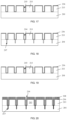
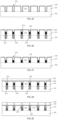
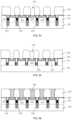
- FIG. 1 to FIG. 39 are each a schematic structural diagram of a formation process of a memory device according to an embodiment of the present application.
- a trench-type transistor usually includes at least one buried word line located in a semiconductor substrate and one drain region and at least one source region located in portions of the semiconductor substrate on two sides of the buried word line.
- Such a trench-type transistor occupies a relatively large area of the semiconductor substrate, which is not conducive to improvement of integration of the DRAM, thus limiting the storage capacity and storage density of the DRAM.
- the present application provides a novel memory device and a forming method thereof, which can further improve a storage capacity and storage density of the memory device.
- FIG. 13 is a schematic structural diagram of a cross section of FIG. 15 along a direction of a cutting line AB
- FIG. 14 is a schematic structural diagram of a cross section of FIG. 15 along a direction of a cutting line CD
- a semiconductor substrate 201 is provided.
- Multiple active regions 213 are formed in the semiconductor substrate 201, and the multiple active regions 213 are separated by multiple first trenches 214 extending along a first direction and multiple second trenches 215 extending along a second direction.
- the first trench 214 communicates with the corresponding second trench 215.
- a material of the semiconductor substrate 201 may be silicon (Si), germanium (Ge), silicon-germanium (GeSi), or silicon carbide (SiC); or may be silicon on insulator (SOI) or germanium on insulator (GOI); or may be another material such as gallium arsenide or other III-V compounds.
- the material of the semiconductor substrate 201 is silicon.
- the semiconductor substrate 201 needs to be doped with some impurity ions according to a type of a subsequently formed vertical transistor. For example, doping may be performed in a well region on the semiconductor substrate.
- the impurity ions may be N-type impurity ions or P-type impurity ions.
- the P-type impurity ions are one or more of boron ions, gallium ions, or indium ions.
- the N-type impurity ions are one or more of phosphorus ions, arsenic ions, or antimony ions.
- the active region 213 is subsequently used to form a channel region of the vertical transistor.
- the multiple active regions 213 are discrete, and adjacent active regions 213 separated by cross-distributed first trenches 214 and second trenches 215.
- the formed active regions 213 are arranged in rows and columns (referring to FIG. 15 ). In other embodiments, the active regions may be arranged in another manner.
- first direction and the second direction are perpendicular to each other and have an angle of 90 degrees. In other embodiments, the first direction and the second direction may not be perpendicular to each other. For example, an angle between the first direction and the second direction may be an acute angle.
- the semiconductor substrate 201 may be first etched to form multiple first trenches 214, and then the semiconductor substrate 201 is etched to form multiple second trenches 215, thereby forming multiple discrete active regions 213.
- the first trench 214 and the second trench 215 may be formed simultaneously by etching the semiconductor substrate 201.
- the multiple active regions 213 are formed by using a self-aligned double patterning mask process.
- a formation process of the active region 213 is described in detail below with reference to FIG. 1 to FIG. 15 .
- a first hard mask layer 202 is formed on the semiconductor substrate 201; and a first material layer 203 is formed on the first hard mask layer 202.
- the first hard mask layer 202 is subsequently used to form a first mask pattern.
- the first hard mask layer 202 may be of a single-layer structure or a multi-layer stacked structure.
- a material of the first hard mask layer 202 may be one or more of polycrystalline silicon, amorphous silicon, amorphous carbon, silicon nitride, silicon oxynitride, silicon oxide, silicon nitride bonded silicon carbide, silicon oxycarbide, silicon carbide, and silicon-germanium.
- a process of forming the first hard mask layer 202 may be atmospheric or low pressure chemical vapor deposition (CVD), plasma enhanced chemical vapor deposition (PECVD), thermal chemical vapor deposition (Thermal CVD), physical vapor deposition (PVD), atomic layer deposition (ALD), sputtering, metallization, electroplating, spin coating, other suitable methods, and/or a combination thereof.
- CVD chemical vapor deposition
- PECVD plasma enhanced chemical vapor deposition
- Thermal CVD thermal chemical vapor deposition
- PVD physical vapor deposition
- ALD atomic layer deposition
- sputtering metallization
- electroplating electroplating
- spin coating other suitable methods, and/or a combination thereof.
- the material of the first hard mask layer 202 is polycrystalline silicon.
- a first etching stop layer may further be formed between the first hard mask layer 202 and the semiconductor substrate 201.
- the first etching stop layer is used to protect an underlying material layer from being over-etched during patterning of the first hard mask layer.
- a material of the first etching stop layer is different from that of the first hard mask layer.
- the material of the first etching stop layer is one or more of silicon nitride, silicon oxynitride, silicon oxide, silicon nitride bonded silicon carbide, and silicon oxycarbide. In this embodiment, the material of the first etching stop layer is silicon oxide.
- the first material layer 203 is subsequently used to form a first strip structure.
- the first material layer 203 may be of a single-layer structure or a multi-layer stacked structure.
- a material of the first material layer 203 may be one or more of polycrystalline silicon, amorphous silicon, amorphous carbon, silicon nitride, silicon oxynitride, silicon oxide, silicon nitride bonded silicon carbide, silicon oxycarbide, silicon carbide, and silicon-germanium.
- the material of the first material layer 203 is amorphous carbon.
- a second etching stop layer may further be formed between the first material layer 203 and the first hard mask layer 202.
- the second etching stop layer is used to protect an underlying material layer from being over-etched during patterning of the first material layer 203.
- a material of the second etching stop layer is different from that of the first material layer 203.
- the material of the second etching stop layer is one or more of silicon nitride, silicon oxynitride, silicon oxide, silicon nitride bonded silicon carbide, and silicon oxycarbide. In this embodiment, the material of the second etching stop layer is silicon oxynitride.
- FIG. 2 is a schematic structural diagram of a cross section of FIG. 3 along a direction of a cutting line AB.
- the first material layer 203 (referring to FIG. 1 ) is patterned.
- Multiple first strip structures 204 extending along the first direction and arranged parallel to each other are formed on the first hard mask layer.
- the first strip structure 204 is elongated.
- the multiple first strip structures 204 are discrete and parallel to each other.
- a fourth opening 205 is formed between adjacent first strip structures 204.
- the first material layer 203 is patterned by using an anisotropic dry etching process, and specifically, an anisotropic plasma etching process may be used.
- a patterned photoresist layer (not shown in the figure) may further be formed on the first material layer 203, and the first material layer 203 is etched by using the patterned photoresist layer as a mask to form a first strip structure 204; and the patterned photoresist layer is removed.
- FIG. 4 is performed on the basis of FIG. 2 , and a first sacrificial sidewall layer 206 is formed on sidewall and top surfaces of the first strip structure 204 and on a portion of the first hard mask layer 202 between first strip structures 204.
- a material of the first sacrificial sidewall layer 206 is different from that of the first strip structure.
- the material of the first sacrificial sidewall layer 206 may be one or more of polycrystalline silicon, amorphous silicon, amorphous carbon, silicon nitride, silicon oxynitride, silicon oxide, silicon nitride bonded silicon carbide, silicon oxycarbide, silicon carbide, and silicon-germanium.
- the first sacrificial sidewall layer 206 is formed by using a deposition process.
- the deposition process includes an atomic layer deposition process.
- each portion between the first strip structures 204 is filled with a first filling layer 207, and the first filling layer 207 fills the remaining portion of the fourth opening.
- a third opening is formed between the first strip structure 204 and the first filling layer 207 by removing portions of the first sacrificial sidewall layer on the sidewall surfaces of the first strip structure 204.
- a material of the first filling layer 207 is different from that of the first sacrificial sidewall layer 206.
- the material of the first filling layer 207 may be one or more of polycrystalline silicon, amorphous silicon, amorphous carbon, silicon nitride, silicon oxynitride, silicon oxide, silicon nitride bonded silicon carbide, silicon oxycarbide, silicon carbide, silicon-germanium, and an organic material.
- a process of forming the first filling layer 207 may be atmospheric or low pressure CVD, PECVD, thermal CVD, PVD, ALD, sputtering, metallization, electroplating, spin coating, other suitable methods, and/or a combination thereof.
- a surface of the formed first filling layer 207 may be flush with the first sacrificial sidewall layer 206 on the top surface of the first strip structure 204. Specifically, after a first filling material layer covering the first sacrificial sidewall layer 206 and filling the remaining portion of the fourth opening is formed, a portion of the first filling layer above the first sacrificial sidewall layer 206 on the top surface of the first strip structure 204 is removed by using a chemical-mechanical mask process. The remaining portion of the first filling material layer in the fourth opening is used as the first filling layer 207.
- a surface of the formed first filling layer may be flush with the top surface of the first strip structure 204.
- a portion of the first sacrificial sidewall layer 206 and the first filling material layer above the top surface of the first strip structure 204 are removed by using a chemical-mechanical mask process, to expose the top surface of the first strip structure 204, and the remaining portion of the first filling material layer in the fourth opening is used as the first filling layer. Therefore, a top surface of the formed first filling layer is flush with the top surface of the first strip structure.
- an etching load effect caused by a height difference between the filling layer and the first strip structure can be alleviated, accuracy of positions and sizes of the formed first mask patterns can be improved, and a favorable sidewall shape can be maintained, such that positions and sizes of block mask patterns formed after the first mask patterns are segmented have relatively high accuracy and a favorable sidewall shape is maintained, and finally, positions and sizes of active regions formed by etching the semiconductor substrate by using each of the block mask patterns as a mask have relatively high accuracy and a favorable sidewall shape is maintained.
- portions of the first sacrificial sidewall layer on the sidewall surfaces of the first strip structure 204 are removed, to form a third opening 208 between the first strip structure 204 and the first filling layer 207.
- the portions of the first sacrificial sidewall layer on the sidewall surfaces of the first strip structure 204 are removed by using an anisotropic dry etching process, including an anisotropic plasma etching process.
- the portion of the first sacrificial sidewall layer on the top surface of the first strip structure 204 is also removed.
- FIG. 7 is performed on the basis of FIG. 6
- FIG. 7 is a schematic structural diagram of a cross section of FIG. 9 along a direction of a cutting line AB
- FIG. 8 is a schematic structural diagram of a cross section of FIG. 9 along a direction of a cutting line CD.
- the first hard mask layer 202 (referring to FIG. 6 ) is etched along the third opening 208 (referring to FIG. 6 ), to form the first opening 210 in the first hard mask layer, and the retained portion of the first hard mask layer is used as the first mask pattern 209.
- the first hard mask layer 202 is etched by using an anisotropic dry etching process, including an anisotropic plasma etching process.
- the formed multiple first mask patterns 209 are discrete. Specifically, the formed first mask patterns 209 extend along the first direction and are parallel to each other, and a first opening 210 is formed between adjacent first mask patterns 209.
- the foregoing first mask pattern 209 is formed by using the foregoing self-aligned double patterning process, and subsequently, during the formation of the active region, a width of the first trench between active regions can be made relatively small, thereby allowing an area of the active region to be relatively large.
- FIG. 10 is a schematic structural diagram of a cross section of FIG. 12 along a direction of a cutting line AB
- FIG. 11 is a schematic structural diagram of a cross section of FIG. 12 along a direction of a cutting line CD.
- the first mask patterns 209 (referring to FIG. 7 to FIG. 9 ) are segmented along the second direction to form multiple discrete block mask patterns 211.
- the first mask patterns 209 are segmented along the second direction by using an anisotropic dry etching process.
- multiple second mask patterns extending along the second direction and parallel to each other are formed on the first mask pattern 209 and are each used as a mask for etching the first mask patterns 209, and a second opening is formed between adjacent second mask patterns; the first mask patterns 209 are etched along the second opening by using each of the second mask patterns as a mask, to segment the first mask patterns along the second direction to form multiple discrete block mask patterns 211; and the second mask patterns are removed.
- the second mask pattern may be formed by using a self-aligned double patterning process.
- a specific process includes: A formation process of the second mask pattern includes: forming a second hard mask layer on the semiconductor substrate and the first mask pattern; forming, on the second hard mask layer, multiple second strip structures arranged in parallel along the second direction; form a second sacrificial sidewall layer on a sidewall and top surfaces of the second strip structure and on a surface of a portion of the second hard mask layer between second strip structures; filling each portion between the second strip structures with a second filling layer; removing portions of the second sacrificial sidewall layer on the sidewall surfaces of the second strip structure, to form a fourth opening between the second strip structure and a second filling layer; and etching the second hard mask layer along the fourth opening, to form the second opening in the second hard mask layer, and using the retained portion of the second hard mask layer as the second mask pattern.
- a material of the second hard mask layer may be one or more of polycrystalline silicon, amorphous silicon, amorphous carbon, silicon nitride, silicon oxynitride, silicon oxide, silicon nitride bonded silicon carbide, silicon oxycarbide, silicon carbide, and silicon-germanium.
- a process of forming the second hard mask layer may be atmospheric or low pressure CVD, PECVD, thermal CVD, PVD, ALD, sputtering, metallization, electroplating, spin coating, other suitable methods, and/or a combination thereof.
- a fourth etching stop layer may further be formed between the second hard mask layer and the first mask pattern 209.
- a material of the fourth etching stop layer is different from that of the second hard mask layer.
- the material of the fourth etching stop layer is one or more of silicon nitride, silicon oxynitride, silicon oxide, silicon nitride bonded silicon carbide, and silicon oxycarbide.
- a material of the second strip structure may be one or more of polycrystalline silicon, amorphous silicon, amorphous carbon, silicon nitride, silicon oxynitride, silicon oxide, silicon nitride bonded silicon carbide, silicon oxycarbide, silicon carbide, and silicon-germanium.
- the second strip structure may be formed by etching a second material layer located on the second hard mask layer.
- a fifth etching stop layer may be further formed between the second material layer and the second hard mask layer.
- a material of the fifth etching stop layer is different from that of the second material layer.
- the material of the fifth etching stop layer is one or more of silicon nitride, silicon oxynitride, silicon oxide, silicon nitride bonded silicon carbide, and silicon oxycarbide.
- a material of the second sacrificial sidewall layer is different from that of the second strip structure.
- the material of the second sacrificial sidewall layer may be one or more of polycrystalline silicon, amorphous silicon, amorphous carbon, silicon nitride, silicon oxynitride, silicon oxide, silicon nitride bonded silicon carbide, silicon oxycarbide, silicon carbide, and silicon-germanium.
- the second sacrificial sidewall layer is formed by using a deposition process.
- the deposition process includes an atomic layer deposition process.
- a material of the second filling layer is different from that of the second sacrificial sidewall layer.
- the material of the second filling layer may be one or more of polycrystalline silicon, amorphous silicon, amorphous carbon, silicon nitride, silicon oxynitride, silicon oxide, silicon nitride bonded silicon carbide, silicon oxycarbide, silicon carbide, silicon-germanium, and an organic material.
- a process of forming the second filling layer may be atmospheric or low pressure CVD, PECVD, thermal CVD, PVD, ALD, sputtering, metallization, electroplating, spin coating, other suitable methods, and/or a combination thereof.
- a surface of the formed second filling layer may be flush with the second sacrificial sidewall layer on the top surface of the second strip structure.
- a portion of the second filling layer above the surface of the second sacrificial sidewall layer on the top surface of the second strip structure is removed by using a chemical-mechanical mask process. The remaining portion of the second filling material layer between the second strip structures is used as the second filling layer.
- a surface of the formed second filling layer may be flush with the top surface of the second strip structure.
- a portion of the second sacrificial sidewall layer and the second filling material layer above the top surface of the second strip structure are removed by using a chemical-mechanical mask process, to expose the top surface of the second strip structure, and the remaining portion of the second filling material layer in the space between the second strip structures is used as the second filling layer. Therefore, a top surface of the formed second filling layer is flush with the top surface of the second strip structure.
- an etching load effect caused by a height difference between the filling layer and the second strip structure can be alleviated, accuracy of positions and sizes of the formed second mask patterns can be improved, and a favorable sidewall shape can be maintained, such that positions and sizes of block mask patterns formed after the first mask patterns are segmented have relatively high accuracy and a favorable sidewall shape is maintained, and finally, positions and sizes of active regions formed by etching the semiconductor substrate by using each of the block mask patterns as a mask have relatively high accuracy and a favorable sidewall shape is maintained.
- the portions of the first sacrificial sidewall layer on the sidewall surfaces of the second strip structure are removed by using an anisotropic dry etching process, including an anisotropic plasma etching process.
- FIG. 13 is a schematic structural diagram of a cross section of FIG. 15 along a direction of a cutting line AB
- FIG. 14 is a schematic structural diagram of a cross section of FIG. 15 along a direction of a cutting line CD.
- the semiconductor substrate 201 is etched by using each of the block mask patterns (referring to FIG. 11 ) as a mask, to form, in the semiconductor substrate 201, first trenches 214 corresponding to the first openings and second trenches 215 corresponding to the second openings. Multiple first trenches 214 extend along the first direction and are parallel to each other. Multiple second trenches 215 extend along the second direction and are parallel to each other. Each first trench 214 communicates with a corresponding second trench 215.
- the retained portions of the semiconductor substrate between the first trenches 214 and the second trenches 215 are multiple active regions 213.
- FIG. 16 is performed on the basis of FIG. 13
- FIG. 17 is performed on the basis of FIG. 14
- a protective layer 236 is formed on each of a surface of the active region 213 and sidewall and bottom surfaces of the first trench and the second trench.
- the protective layer 236 protects the active region 213 during a subsequent process (etching, implantation, or other processes).
- a material of the protective layer 236 may be one or more of silicon oxide, silicon nitride, silicon oxynitride, and silicon nitride bonded silicon carbide.
- the material of the protective layer 236 may be silicon oxide, and the protective layer 236 may be formed by using a furnace tube oxidation process, a thermal oxidation process, or a deposition process.
- a third trench 217 extending along the first direction is formed in a portion of the semiconductor substrate 201 at the bottom of the first trench 214.
- a width of the third trench 217 is less than a width of the bottom of the first trench 214.
- the third trench 217 is formed for the purpose of separating adjacent active regions 213 that are arranged along the second direction, and defining positions of bit line doped regions (specifically, portions of the semiconductor substrate on two sides of the third trench are used as bit line doped regions of corresponding transistors).
- Each portion of the semiconductor substrate 201 at the bottom of the first trench 214 has a corresponding third trench 217.
- a width of the first trench 214 is less than the width of the bottom of the first trench 214. In some embodiments, the width of the first trench 214 is 1/4 to 3/4 of the width of the bottom of the first trench 214.
- the portion of the semiconductor substrate 201 at the bottom of the first trench 214 is etched to form the third trench 217 extending along the first direction.
- a third mask layer is formed in the first trench 214 and on the semiconductor substrate 201, and a sixth opening extending along the first direction and exposing a surface of a portion of the semiconductor substrate 201 at the bottom of the first trench 214 is formed in the third mask layer.
- the semiconductor substrate 201 is etched along the sixth opening to form the third trench 217.
- the etching is anisotropic dry etching, and may anisotropic plasma etching.
- the third mask layer is removed.
- bit line doped regions 217 are formed in portions of the semiconductor substrate 201 on two sides of the third trench 217 and at the bottom of the first trench 214 through an ion implantation process.
- the bit line doped region 217 is subsequently used as a bit line of a memory, a portion of the bit line doped region in contact with each active region 213 may be used as a drain region of a subsequently formed vertical transistor in each active region, and after the vertical transistor is subsequently formed, the bit line may be used to perform a read or write operation on a row of memories arranged along the first direction.
- the bit line doped region 217 is formed through ion implantation.
- a type of impurity ions implanted in the bit line doped region 217 is different from a type of impurity ions implanted in the active region 213.
- P-type impurity ions are implanted in the active region 213, N-type impurity ions are implanted in the bit line doped region 217, or when N-type impurity ions are implanted in the active region 213, P-type impurity ions are implanted in the bit line doped region 217.
- the impurity ions implanted in the bit line doped region 217 are N-type impurity ions or P-type impurity ions.
- the P-type impurity ions are one or more of boron ions, gallium ions, or indium ions.
- the N-type impurity ions are one or more of phosphorus ions, arsenic ions, or antimony ions.
- a fourth mask layer 238 is formed in the third trench 217 and on the top surface of the active region 213, and a seventh opening extending along the first direction and exposing the portions of the semiconductor substrate 201 on the two sides of the third trench 217 is formed in the fourth mask layer 238.
- first ion implantation is formed on a portion of the semiconductor substrate 201 at the bottom of the seventh opening along the seventh opening, and the bit line doped regions 218 are formed in the portions of the semiconductor substrate 201 on the two sides of the third trench 217 and at the bottom of the first trench 214.
- bit line doped regions 218, the fourth mask layer 238 is removed.
- the bit line doped regions 218 are distributed in the portions of the semiconductor substrate 201 on two sides of the active region 213, such that a control capability of the bit line can be improved and electrical properties of the memory can be improved.
- the first ion implantation has energy of 20 kev to 100 kev, a dose of 1E13 to 1E22 atom/cm 2 , and an angle of 0 degrees to 20 degrees.
- a gate dielectric layer 216 is formed on sidewall surfaces and a bottom surface of each of the first trench 214 and the second trench 215.
- a material of the gate dielectric layer 216 may be silicon oxide or a high-K (dielectric constant) dielectric material.
- the high-K dielectric material is one or more of HfO 2 , TiO 2 , HfZrO, HfSiNO, Ta 2 O 5 , ZrO 2 , ZrSiO 2 , Al 2 O 3 , SrTiO 3 , or BaSrTiO.
- the gate dielectric layer 216 may be formed by using an oxidation process or a deposition process.
- the gate dielectric layer 216 may be formed after the removal of the protective layer 236. In another embodiment, a gate dielectric layer may be formed directly on the protective layer 236 without removing the protective layer 236.
- the gate dielectric layer 216 may alternatively be formed on sidewall and bottom surfaces of the third trench or directly fill the third trench.
- a first dielectric layer 219 that fills the third trench is formed.
- the formed first dielectric layer 219 is used for electrical isolation between adjacent word line doped regions 218.
- a material of the first dielectric layer 219 is silicon oxide, silicon nitride, silicon oxynitride, fluorine-doped silica glass (FSG), a low dielectric constant (where K is less than 2.8) material, other suitable materials, and/or a combination thereof.
- a formation process of the first dielectric layer 219 includes: forming a first dielectric material layer on a surface of the active region 213 and in the first trench 214, the second trench 215, and the third trench by using a deposition process; and etching back to remove a portion of the first dielectric material layer, to form the first dielectric layer 219 that fills the third trench.
- the formed first dielectric layer 219 fills the third trench, and a surface of the first dielectric layer 219 may be higher than an opening of the third trench and partially located in the first trench 214.
- a metal gate 220 is formed in each of the first trench 214 on the first dielectric layer 219 and the second trench 215.
- a top surface of the metal gate 220 is lower than a top surface of the active region 213.
- the formed metal gate 220 is located in the second trench 215 and the first trench 214, that is, the formed metal gate 220 surrounds sidewalls of each active region, such that a capability of the metal gate 220 to control the formation of a trench in the sidewall of the active region can be improved, and performance of forming a vertical transistor can be improved.
- a material of the metal gate 220 may be one or more of W, Al, Cu, Ag, Au, Pt, Ni, Ti, TiN, TaN, Ta, TaC, TaSiN, WN, and Wsi.
- a formation process the metal gate 220 is: forming a metal layer in the first trench and the second trench and on a surface of the active region; and etching back to remove a portion of the metal layer, and using the remaining metal layer in the first trench and the second trench as the metal gate 220, where a surface of the metal gate 220 is lower than the top surface of the active region 213.
- each of the second trench and the first trench above the metal gate 220 is filled with a second dielectric layer 221; and a portion of the metal gate 220 in the second trench 215 is etched to segment the metal gate 220 in the second trench along the second direction.
- the metal gate 220 is segmented along the second direction, such that multiple sub-metal gates extending along the second direction and parallel to each other can be formed, and each sub-metal gate can correspondingly control multiple vertical transistors formed in multiple active regions in a row along the second direction.
- a portion of the metal gate 220 in the second trench is segmented along the second direction, to form a fifth mask layer 222 on a surface of the second dielectric layer 221 and a top surface of the active region 213, and an eighth opening extending along the second direction and exposing a surface of a portion of the second dielectric layer 221 in the second trench is formed in the fifth mask layer 222; and portions of the second dielectric layer 221 and the metal gate 220 in the second trench are etched along the eighth opening to segment the metal gate in the second trench.
- a material of the second dielectric layer 221 is silicon oxide, silicon nitride, silicon oxynitride, FSG, a low dielectric constant (where K is less than 2.8) material, other suitable materials, and/or a combination thereof.
- the second mask layer 222 (referring to FIG. 28 and FIG. 29 ) is removed; gaps of the segmented metal gate 220 and the second trench are filled with a dielectric material, and the filled dielectric material is used as a portion of the second dielectric layer 221; and a source region 223 is formed on the top surface of the active region 213.
- a type of impurity ions doped in the source region 223 is the same as a type of impurity ions doped in the bit line doped region 218, and is different from the type of the impurity ions doped in the foregoing well region.
- the source region 223 is formed by using a second ion implantation process.
- the impurity ions implanted (doped) in the bit line doped region 217 are N-type impurity ions or P-type impurity ions.
- the P-type impurity ions are one or more of boron ions, gallium ions, or indium ions.
- the N-type impurity ions are one or more of phosphorus ions, arsenic ions, or antimony ions.
- each vertical transistor includes a corresponding active region 213, a gate dielectric layer 216 located on a sidewall surface of the active region 213, bit line doped regions 218 located in portions of a semiconductor substrate at the bottom of a first trench and on two sides of a third trench, a source region 223 located on a top surface of the active region 213, and a metal gate 220 located in each of the first trench and a second trench and surrounding the active region 213.
- a source region and a drain region are located on an upper side and a lower side of the active region, and a formed channel region is located on a sidewall of the active region, such that an area of the semiconductor substrate occupied by the vertical transistor is relatively small, a quantity of vertical transistors formed per unit area can be increased, and correspondingly, a quantity of capacitors connected to the source region of each transistor and subsequently formed per unit area can also be increased, thereby improving a storage capacity and storage density of a memory.
- use of the vertical transistor of such a specific structure can reduce a body effect, reduce a leakage current generated by a subsequently formed capacitor into the substrate, and improve electrical properties of the memory device.
- the following is further included: forming, on a surface of the semiconductor substrate 201, a capacitor connected to the source region 223.
- the process of forming, on a surface of the semiconductor substrate 201, a capacitor connected to the source region 223 includes: referring to FIG. 32 and FIG. 33 , forming a third dielectric layer 224 on the active region 213 and the second dielectric layer 221; and forming, in the third dielectric layer 224, a through hole 225 exposing a surface of the source region 223.
- the following step may further be included: widening an opening of the through hole 225 to facilitate subsequent formation of a contact plug, and to increase a contact area between a top surface of the formed contact plug and the subsequently formed capacitor. Referring to FIG. 36 and FIG.
- a contact plug 226 is formed in the through hole, and a material of the contact plug 226 is metal.
- a fourth dielectric layer 227 is formed on the third dielectric layer 224; a capacitor hole 229 exposing the contact plug is formed in the fourth dielectric layer 227; and a capacitor 228 is formed in the capacitor hole 229.
- the capacitor 228 includes a bottom electrode layer, a dielectric layer located on the bottom electrode layer, and a top electrode layer located on the dielectric layer.
- a material of the dielectric layer may be a high-K dielectric material, so as to increase a capacitance value of the capacitor per unit area.
- the high-K dielectric material includes one of HfO 2 , TiO 2 , HfZrO, HfSiNO, Ta 2 O 5 , ZrO 2 , ZrSiO 2 , Al 2 O 3 , SrTiOa, or BaSrTiO, or a stacked layer formed by at least two of groups including the foregoing materials.
- a material of each of the top electrode layer and the bottom electrode layer may be one of tungsten, titanium, nickel, aluminum, platinum, titanium nitride, N-type polycrystalline silicon, and P-type polycrystalline silicon, or a stacked layer formed by at least two of groups including the foregoing materials, or may include a compound formed by one or two of metal nitride and metal silicide, such as titanium nitride, titanium silicide, nickel silicide, or silicon titanium nitride (TiSixNy).
- the capacitor may alternatively be formed by using an existing double-sided capacitor formation process.
- the memory device includes:
- the multiple active regions 213 are arranged in rows and columns.
- the width of the third trench 217 is 3/4 to 1/4 of the width of the bottom of the first trench 214.
- impurity ions doped in the bit line doped region 218 are N-type impurity ions or P-type impurity ions.
- a type of impurity ions doped in the source region 223 is the same as a type of the impurity ions doped in the bit line doped region 218 and different from a type of impurity ions in a well region formed in the active region.
- the memory device further includes: a third dielectric layer 224, located on the active region 213 and the second dielectric layer 221, where a contact plug 226 connected to the source region 223 is formed in the third dielectric layer 224; and a fourth dielectric layer 227 located on the third dielectric layer 224, where a capacitor hole exposing the contact plug 226 is formed in the fourth dielectric layer 227, and the capacitor 228 is located in the capacitor hole.
- a material of the metal gate is one or more of W, Al, Cu, Ag, Au, Pt, Ni, Ti, TiN, TaN, Ta, TaC, TaSiN, WN, and Wsi.
Landscapes
- Engineering & Computer Science (AREA)
- Manufacturing & Machinery (AREA)
- Semiconductor Memories (AREA)
Applications Claiming Priority (2)
| Application Number | Priority Date | Filing Date | Title |
|---|---|---|---|
| CN202110966709.7A CN116133375B (zh) | 2021-08-23 | 2021-08-23 | 存储器件及其形成方法 |
| PCT/CN2022/071630 WO2023024415A1 (zh) | 2021-08-23 | 2022-01-12 | 存储器件及其形成方法 |
Publications (2)
| Publication Number | Publication Date |
|---|---|
| EP4216263A1 true EP4216263A1 (de) | 2023-07-26 |
| EP4216263A4 EP4216263A4 (de) | 2024-09-25 |
Family
ID=85227716
Family Applications (1)
| Application Number | Title | Priority Date | Filing Date |
|---|---|---|---|
| EP22859776.1A Pending EP4216263A4 (de) | 2021-08-23 | 2022-01-12 | Speichervorrichtung und verfahren zur herstellung davon |
Country Status (2)
| Country | Link |
|---|---|
| US (1) | US11626408B2 (de) |
| EP (1) | EP4216263A4 (de) |
Families Citing this family (2)
| Publication number | Priority date | Publication date | Assignee | Title |
|---|---|---|---|---|
| US12394714B2 (en) * | 2022-04-18 | 2025-08-19 | Fujian Jinhua Integrated Circuit Co., Ltd. | Semiconductor device including dielectric insert structure directly under buried word line and method for forming the same |
| CN121865646A (zh) * | 2024-10-10 | 2026-04-14 | 无锡华润微电子有限公司 | 一种半导体器件及其制造方法、电子装置 |
Family Cites Families (13)
| Publication number | Priority date | Publication date | Assignee | Title |
|---|---|---|---|---|
| DE10143650A1 (de) | 2001-09-05 | 2003-03-13 | Infineon Technologies Ag | Halbleiterspeicher mit einen vertikalen Auswahltransistor umfassenden Speicherzellen sowie Verfahren zu seiner Herstellung |
| US7326611B2 (en) | 2005-02-03 | 2008-02-05 | Micron Technology, Inc. | DRAM arrays, vertical transistor structures and methods of forming transistor structures and DRAM arrays |
| KR101094371B1 (ko) * | 2009-07-03 | 2011-12-15 | 주식회사 하이닉스반도체 | 수직트랜지스터를 구비한 반도체장치 제조 방법 |
| US8143121B2 (en) | 2009-10-01 | 2012-03-27 | Nanya Technology Corp. | DRAM cell with double-gate fin-FET, DRAM cell array and fabrication method thereof |
| KR101116360B1 (ko) * | 2010-06-04 | 2012-03-09 | 주식회사 하이닉스반도체 | 매립비트라인을 구비한 반도체장치 및 그 제조 방법 |
| KR101699442B1 (ko) | 2010-10-13 | 2017-01-25 | 삼성전자 주식회사 | 수직 채널 트랜지스터를 구비한 반도체 소자의 제조 방법 |
| US8361856B2 (en) | 2010-11-01 | 2013-01-29 | Micron Technology, Inc. | Memory cells, arrays of memory cells, and methods of forming memory cells |
| KR101154006B1 (ko) | 2010-11-08 | 2012-06-07 | 에스케이하이닉스 주식회사 | 매몰 정션을 포함하는 수직형 트랜지스터 및 형성 방법 |
| JP2013098295A (ja) | 2011-10-31 | 2013-05-20 | Elpida Memory Inc | 半導体装置及びその製造方法、並びにデータ処理システム |
| KR20130103942A (ko) | 2012-03-12 | 2013-09-25 | 에스케이하이닉스 주식회사 | 무접합 수직 게이트 트랜지스터를 갖는 반도체 소자 및 그 제조 방법 |
| TWI560886B (en) * | 2014-09-25 | 2016-12-01 | Inotera Memories Inc | Non-floating vertical transistor structure and method for forming the same |
| CN109285836B (zh) * | 2018-08-28 | 2023-10-10 | 中国科学院微电子研究所 | 半导体存储设备及其制造方法及包括存储设备的电子设备 |
| CN209045570U (zh) | 2018-11-21 | 2019-06-28 | 长鑫存储技术有限公司 | 半导体器件 |
-
2022
- 2022-01-12 EP EP22859776.1A patent/EP4216263A4/de active Pending
- 2022-06-14 US US17/806,793 patent/US11626408B2/en active Active
Also Published As
| Publication number | Publication date |
|---|---|
| US11626408B2 (en) | 2023-04-11 |
| EP4216263A4 (de) | 2024-09-25 |
| US20230055933A1 (en) | 2023-02-23 |
Similar Documents
| Publication | Publication Date | Title |
|---|---|---|
| CN116133375B (zh) | 存储器件及其形成方法 | |
| CN116133395B (zh) | 存储器件及其形成方法 | |
| US11217593B2 (en) | Memory structure and its formation method | |
| US20230389261A1 (en) | Semiconductor structure and method for forming semiconductor structure | |
| JP2008072106A (ja) | メモリセルアレイおよびその形成方法 | |
| CN114725106A (zh) | 半导体结构及半导体结构的制备方法、存储器 | |
| CN115188708A (zh) | 半导体器件及其形成方法 | |
| US12446207B2 (en) | Semiconductor device having bottom bit line and narrow channel, and forming method thereof | |
| US11626408B2 (en) | Memory device and forming method thereof | |
| US20240023324A1 (en) | Three-dimensional semiconductor structure and method for forming same | |
| WO2024109158A1 (zh) | 三维半导体结构及其形成方法 | |
| WO2024109157A1 (zh) | 半导体结构及其形成方法 | |
| US20230411412A1 (en) | Semiconductor structure and forming method thereof | |
| US11189624B2 (en) | Memory structure and its formation method | |
| US20230084851A1 (en) | Storage device and method for forming storage device | |
| CN218998732U (zh) | 存储器件 | |
| CN115188666A (zh) | 三维半导体结构及其制备方法 | |
| US12096619B2 (en) | Semiconductor structure and manufacturing method thereof | |
| CN119300341B (zh) | 半导体结构及其制备方法 | |
| US12575087B2 (en) | Semiconductor structure and manufacturing method thereof | |
| US20260025987A1 (en) | Access line partition outside array for three dimensional (3d) memory | |
| US20250365919A1 (en) | Substrate isolation in a three dimensional (3d) memory array | |
| WO2024016753A1 (zh) | 三维半导体结构及其形成方法 | |
| CN117915661A (zh) | 半导体结构及半导体结构的制造方法 | |
| CN117835691A (zh) | 半导体结构及其制备方法 |
Legal Events
| Date | Code | Title | Description |
|---|---|---|---|
| STAA | Information on the status of an ep patent application or granted ep patent |
Free format text: STATUS: THE INTERNATIONAL PUBLICATION HAS BEEN MADE |
|
| PUAI | Public reference made under article 153(3) epc to a published international application that has entered the european phase |
Free format text: ORIGINAL CODE: 0009012 |
|
| STAA | Information on the status of an ep patent application or granted ep patent |
Free format text: STATUS: REQUEST FOR EXAMINATION WAS MADE |
|
| 17P | Request for examination filed |
Effective date: 20230420 |
|
| AK | Designated contracting states |
Kind code of ref document: A1 Designated state(s): AL AT BE BG CH CY CZ DE DK EE ES FI FR GB GR HR HU IE IS IT LI LT LU LV MC MK MT NL NO PL PT RO RS SE SI SK SM TR |
|
| REG | Reference to a national code |
Ref country code: DE Ref legal event code: R079 Free format text: PREVIOUS MAIN CLASS: H01L0021824800 Ipc: H10B0012000000 |
|
| A4 | Supplementary search report drawn up and despatched |
Effective date: 20240822 |
|
| RIC1 | Information provided on ipc code assigned before grant |
Ipc: H10B 12/00 20230101AFI20240817BHEP |
|
| DAV | Request for validation of the european patent (deleted) | ||
| DAX | Request for extension of the european patent (deleted) | ||
| STAA | Information on the status of an ep patent application or granted ep patent |
Free format text: STATUS: EXAMINATION IS IN PROGRESS |
|
| 17Q | First examination report despatched |
Effective date: 20250521 |
|
| GRAP | Despatch of communication of intention to grant a patent |
Free format text: ORIGINAL CODE: EPIDOSNIGR1 |
|
| STAA | Information on the status of an ep patent application or granted ep patent |
Free format text: STATUS: GRANT OF PATENT IS INTENDED |
|
| INTG | Intention to grant announced |
Effective date: 20260309 |
|
| GRAS | Grant fee paid |
Free format text: ORIGINAL CODE: EPIDOSNIGR3 |
|
| GRAA | (expected) grant |
Free format text: ORIGINAL CODE: 0009210 |
|
| STAA | Information on the status of an ep patent application or granted ep patent |
Free format text: STATUS: THE PATENT HAS BEEN GRANTED |