EP4216489A1 - Procédé de modification d'une clé d'accès réelle dans un appareil de terrain de la technique d'automatisation - Google Patents
Procédé de modification d'une clé d'accès réelle dans un appareil de terrain de la technique d'automatisation Download PDFInfo
- Publication number
- EP4216489A1 EP4216489A1 EP23152486.9A EP23152486A EP4216489A1 EP 4216489 A1 EP4216489 A1 EP 4216489A1 EP 23152486 A EP23152486 A EP 23152486A EP 4216489 A1 EP4216489 A1 EP 4216489A1
- Authority
- EP
- European Patent Office
- Prior art keywords
- key
- cur
- field device
- actual access
- access key
- Prior art date
- Legal status (The legal status is an assumption and is not a legal conclusion. Google has not performed a legal analysis and makes no representation as to the accuracy of the status listed.)
- Pending
Links
Images




Classifications
-
- H—ELECTRICITY
- H04—ELECTRIC COMMUNICATION TECHNIQUE
- H04L—TRANSMISSION OF DIGITAL INFORMATION, e.g. TELEGRAPHIC COMMUNICATION
- H04L9/00—Cryptographic mechanisms or cryptographic arrangements for secret or secure communications; Network security protocols
- H04L9/08—Key distribution or management, e.g. generation, sharing or updating, of cryptographic keys or passwords
- H04L9/0891—Revocation or update of secret information, e.g. encryption key update or rekeying
-
- H—ELECTRICITY
- H04—ELECTRIC COMMUNICATION TECHNIQUE
- H04L—TRANSMISSION OF DIGITAL INFORMATION, e.g. TELEGRAPHIC COMMUNICATION
- H04L9/00—Cryptographic mechanisms or cryptographic arrangements for secret or secure communications; Network security protocols
- H04L9/08—Key distribution or management, e.g. generation, sharing or updating, of cryptographic keys or passwords
- H04L9/0861—Generation of secret information including derivation or calculation of cryptographic keys or passwords
- H04L9/0863—Generation of secret information including derivation or calculation of cryptographic keys or passwords involving passwords or one-time passwords
-
- H—ELECTRICITY
- H04—ELECTRIC COMMUNICATION TECHNIQUE
- H04L—TRANSMISSION OF DIGITAL INFORMATION, e.g. TELEGRAPHIC COMMUNICATION
- H04L63/00—Network architectures or network communication protocols for network security
- H04L63/06—Network architectures or network communication protocols for network security for supporting key management in a packet data network
- H04L63/062—Network architectures or network communication protocols for network security for supporting key management in a packet data network for key distribution, e.g. centrally by trusted party
-
- H—ELECTRICITY
- H04—ELECTRIC COMMUNICATION TECHNIQUE
- H04L—TRANSMISSION OF DIGITAL INFORMATION, e.g. TELEGRAPHIC COMMUNICATION
- H04L67/00—Network arrangements or protocols for supporting network services or applications
- H04L67/01—Protocols
- H04L67/12—Protocols specially adapted for proprietary or special-purpose networking environments, e.g. medical networks, sensor networks, networks in vehicles or remote metering networks
-
- H—ELECTRICITY
- H04—ELECTRIC COMMUNICATION TECHNIQUE
- H04L—TRANSMISSION OF DIGITAL INFORMATION, e.g. TELEGRAPHIC COMMUNICATION
- H04L9/00—Cryptographic mechanisms or cryptographic arrangements for secret or secure communications; Network security protocols
- H04L9/08—Key distribution or management, e.g. generation, sharing or updating, of cryptographic keys or passwords
- H04L9/0816—Key establishment, i.e. cryptographic processes or cryptographic protocols whereby a shared secret becomes available to two or more parties, for subsequent use
- H04L9/0819—Key transport or distribution, i.e. key establishment techniques where one party creates or otherwise obtains a secret value, and securely transfers it to the other(s)
- H04L9/0825—Key transport or distribution, i.e. key establishment techniques where one party creates or otherwise obtains a secret value, and securely transfers it to the other(s) using asymmetric-key encryption or public key infrastructure [PKI], e.g. key signature or public key certificates
-
- H—ELECTRICITY
- H04—ELECTRIC COMMUNICATION TECHNIQUE
- H04L—TRANSMISSION OF DIGITAL INFORMATION, e.g. TELEGRAPHIC COMMUNICATION
- H04L9/00—Cryptographic mechanisms or cryptographic arrangements for secret or secure communications; Network security protocols
- H04L9/08—Key distribution or management, e.g. generation, sharing or updating, of cryptographic keys or passwords
- H04L9/0861—Generation of secret information including derivation or calculation of cryptographic keys or passwords
- H04L9/0869—Generation of secret information including derivation or calculation of cryptographic keys or passwords involving random numbers or seeds
-
- H—ELECTRICITY
- H04—ELECTRIC COMMUNICATION TECHNIQUE
- H04L—TRANSMISSION OF DIGITAL INFORMATION, e.g. TELEGRAPHIC COMMUNICATION
- H04L9/00—Cryptographic mechanisms or cryptographic arrangements for secret or secure communications; Network security protocols
- H04L9/08—Key distribution or management, e.g. generation, sharing or updating, of cryptographic keys or passwords
- H04L9/088—Usage controlling of secret information, e.g. techniques for restricting cryptographic keys to pre-authorized uses, different access levels, validity of crypto-period, different key- or password length, or different strong and weak cryptographic algorithms
-
- H—ELECTRICITY
- H04—ELECTRIC COMMUNICATION TECHNIQUE
- H04L—TRANSMISSION OF DIGITAL INFORMATION, e.g. TELEGRAPHIC COMMUNICATION
- H04L9/00—Cryptographic mechanisms or cryptographic arrangements for secret or secure communications; Network security protocols
- H04L9/08—Key distribution or management, e.g. generation, sharing or updating, of cryptographic keys or passwords
- H04L9/0894—Escrow, recovery or storing of secret information, e.g. secret key escrow or cryptographic key storage
-
- H—ELECTRICITY
- H04—ELECTRIC COMMUNICATION TECHNIQUE
- H04L—TRANSMISSION OF DIGITAL INFORMATION, e.g. TELEGRAPHIC COMMUNICATION
- H04L9/00—Cryptographic mechanisms or cryptographic arrangements for secret or secure communications; Network security protocols
- H04L9/32—Cryptographic mechanisms or cryptographic arrangements for secret or secure communications; Network security protocols including means for verifying the identity or authority of a user of the system or for message authentication, e.g. authorization, entity authentication, data integrity or data verification, non-repudiation, key authentication or verification of credentials
- H04L9/3226—Cryptographic mechanisms or cryptographic arrangements for secret or secure communications; Network security protocols including means for verifying the identity or authority of a user of the system or for message authentication, e.g. authorization, entity authentication, data integrity or data verification, non-repudiation, key authentication or verification of credentials using a predetermined code, e.g. password, passphrase or PIN
- H04L9/3228—One-time or temporary data, i.e. information which is sent for every authentication or authorization, e.g. one-time-password, one-time-token or one-time-key
Definitions
- the invention relates to a method for changing an actual access key in a field device for automation technology, with a field device identifier and the actual access key being stored in the field device, with an operating device being able to be connected to the field device via a communication link, with an operating device identifier and the actual access key being stored in the operating device, with the field device checking the access authorization of the operating device by at least indirect evaluation of its actual access key and the actual access key of the operating device and with before If the access authorization is based, the operating device agrees a new access key with the field device, which new access key the field device stores as the new actual access key.
- Field devices in automation technology are measuring devices or actuators that are connected to a physical process, such as an industrial process plant, and deliver measurement data of corresponding process variables (e.g. flow rates, fill levels, temperatures, pressures, pH values) or also affect the process, for example by controlling valves, motors or heating elements.
- process variables e.g. flow rates, fill levels, temperatures, pressures, pH values
- a large number of field devices are generally used in a technical process, often several tens or even several hundred field devices.
- the field devices are usually at least partially connected to one another via a serial fieldbus and can be addressed via corresponding fieldbus messages or can also send information themselves via fieldbus messages.
- the respective field device is connected to an operator control device via a communication connection.
- This communication connection is often different from the fieldbus interface of the field device, it can be designed proprietary, but it is often based on established standards (e.g. USB, Bluetooth, Ethernet).
- a connected operating device must first identify itself with the field device. This is done here in that the field device checks the access authorization of the operating device by at least indirectly evaluating its actual access key and the actual access key of the operating device.
- PACE Password Authenticated Connection Establishment
- the operating device - in the case of an existing access authorization - agrees with the field device on a new access key, which the field device then stores as the new actual access key, ie stores it in terms of data; the agreed new access key is also ultimately stored in the operating device as the new actual access key.
- the new access key is agreed between the field device and the operating device in such a way that the new access key is first defined on the operating device (for example by user input) and is transmitted from here to the field device. Setting up a new actual access key can have different motivations.
- the actual access key can be changed, for example, in order to re-establish a defined security status, for example if there are uncertainties as to whether the old actual access key may have been unintentionally disseminated.
- the actual access key can be expired as part of an established security protocol a certain number of times the communications link is established, or simply at random.
- the actual access code can also be renewed by spontaneous user intervention, for example by entering a new actual access code into the operating device. In any case, the question arises as to how the new actual access key is managed as cleverly as possible so that, for example, users and/or operating devices who also have access authorization and who have access to the field device but only have the old actual access key are not excluded from access to the field device.
- the object of the present invention is therefore to design and develop the method described at the outset for changing an actual access key in a field device in such a way that the actual access key can be changed as cleverly as possible and with little effort, even when several authorized users and/or operating devices are used.
- a key database is provided on a database server and the key database for a plurality of field devices comprises at least the field device identifier of the respective field device, the actual access key of the respective field device and the identifier of at least one user with access authorization and/or at least one operator device with access authorization for the respective field device.
- the access authorization can, for example, be linked to a person, the user with access authorization, or also to a technical device, ie the operating device with access authorization.
- a user with access authorization could, for example, turn any operating device into an operating device with access authorization by identifying the user with access authorization as authorized to use the operating device.
- the field device identifier is a piece of information technology data that is unique to the field device. It can be the factory serial number of the field device, but it can also be unique information that has been subsequently assigned to the field device, for example when setting up the system in which the field device is installed.
- the database server can be technically implemented in many ways, for example it can be implemented as a service of an already existing control room, as a database server implemented separately in terms of hardware, which can be contacted locally in the environment of the plant in which the field devices are installed, it can also be implemented as an outsourced cloud service on the World Wide Web, if this is compatible with the specified data security requirements.
- the situation is similar with the establishment of a connection between the operating device and database server and the data exchange between the devices.
- Various options are also conceivable here, which depend on the implementation of the database server mentioned above. However, the precise implementation of the database server and the information technology contacting of the database server by operating devices is not important in detail.
- the method also provides for the key data record to be transferred to the user's control device or to the control device with access authorization, so that the control device of the user with access authorization or the control device with access authorization has the actual access keys of the field devices for which access authorization is available.
- the measures described make it possible overall to centrally manage actual access keys for a field device or for a number of field devices and to provide authorized users or authorized operating devices with a key data set individually derived from the key database. Of course, this is also possible and particularly advantageous when access information, ie actual access key, changes or has changed.
- the key data set before it is transmitted to the operating device of the person authorized to access user or on the access-authorized operating device is encrypted and the encrypted key data record is decrypted on the operating device before use.
- Encryption and decryption can be implemented with different complexity. In a simple variant, it is possible to work with symmetrical keys that are stored on the database server and on the user or operator device with access authorization.
- asymmetric keys are used, with the public key being stored on the database server for each authorized user or for each authorized operating device, and accordingly the authorized user or the authorized operating device has the corresponding private key, so that the key data record encrypted with the public key can then be decrypted with the corresponding private key on the authorized operating device.
- a further preferred development of the method is characterized in that the original entry time of the actual access key is also noted in the key database and in the key data set generated from the key database for the actual access keys. This creates the possibility of recognizing which of a number of actual access keys is the more recent one. It is important that only the time of the original generation of the actual access key is noted and not the time of transmission and note on each device to which the actual access key is transferred and noted. However, this is possible without further ado, since it can be clearly decided at any time as part of the procedure whether an actual access key or a new access key is newly created or whether a known, already created actual access key is only passed on.
- a further development of the method provides that in a synchronization step the key database and the key data record of at least one operating device are compared with regard to the entry times of corresponding actual access keys, and if the entry times differ, the newest actual access key is added with its entry time where only the older actual access key is available, so that the key database and the key data record of the operating device have matching actual access keys for the respective field device.
- the synchronization step is preferably carried out automatically as soon as an operating device connects to the key database.
- the latest actual access code that is added later does not replace the older actual access code, rather the latest actual access code that is added later is noted in addition to the older actual access code, so that the previously valid actual access code is also still available.
- even older actual access keys are deleted so that only the last two most recent versions of the actual access key are available.
- the development of the method described below deals with the case in which a new actual access key is specified directly in a field device or is specified in the field device via an operating device connected to the field device.
- the procedure is then preferably such that the field device is given a new access key by the operating device connected to the field device via the communication link and the new access key is stored by the field device as the new actual access key, with the operating device storing the new access key as the new actual access key in its key data record.
- the operating device establishes a connection to the key database and the synchronization step is initiated, or the operating device requests the user of the operating device to establish a connection to the key database in order to be able to carry out the synchronization step.
- the following exemplary embodiment of the method deals with the application in which a new access key for a field device is initially specified in the key database.
- the new access key is stored by the key database for the field device as the new actual access key and at least the last valid actual access key for the field device remains as the old actual access key in the Key database saved.
- the key data record is generated, the new actual access key and at least the last valid actual access key for the field device are included in the key data record.
- the latest actual access code is added, at least the previously valid, older actual access code is retained.
- the new access key here is first specified on the database server or in the key database of the database server.
- the new access key it proves to be advantageous if not only the new access key is stored as the new actual access key, but at least the last valid actual access key is also stored before the new access key is recorded as the new actual access key.
- a preferred development of the aforementioned method is characterized in that the operating device is connected to the field device to which it has access authorization, that the operating device has a key data record with the actual access key and the previously valid actual access key for the field device, that the operating device uses the previously applicable actual access key to obtain access authorization to the field device and, if the access authorization is present, transmits the actual access key to the field device as a new access key.
- An alternative embodiment of the aforementioned exemplary embodiment of the method provides that the operating device is connected to the field device to which it has access authorization, that the operating device has a key data record with the actual access key and the previously applicable actual access key for the field device, that the operating device first uses the actual access key to obtain access authorization to the field device and, if the access authorization is denied, uses the previously applicable actual access key.
- This example makes it clear that storing the previously applicable actual access key after a new access key has been announced as a new actual access key is advantageous, namely when the field device does not (yet) know anything about the new access key that has been noted in the key database but has not yet been announced to the field device.
- a further development of the method in which the new access key has first been specified in the key database is characterized in that the new access key, which is stored in the key database for the field device as a new actual access key, is provided with a synchronization flag, the synchronization flag indicating whether the new actual access key is stored on the field device or not on the field device, and that the synchronization flag indicates at the beginning that the actual access key is not stored on the field device .
- the synchronization flag is included in the key data set.
- the synchronization flag is adjusted, but the synchronization flag is only changed from "actual access code not stored on the field device" to "actual access code stored on the field device".
- the operating device is connected to the field device and the operating device evaluates the synchronization flag of the actual access key. In the event that the synchronization flag indicates "actual access key not stored on the field device", the operating device uses the previously valid actual access key to obtain access authorization to the field device and otherwise it uses the actual access key.
- the operating device is connected to the field device to which it has access authorization, and after the new actual access key has been transmitted to the field device, the operating device changes the synchronization flag of the transmitted new actual access key in its key data record to "actual access key stored on the field device".
- the operating device agrees a new access key with the field device by the operating device requesting the field device to provide a new access key, i.e. to transmit a new access key to the operating device.
- the field device can generate the new access key, for example, using a random number generator, in particular using a non-deterministic random number generator.
- the new access key generated by the field device can be stored immediately on the field device as the new actual access key However, it may also be necessary for the new access key to first have to be retransmitted as such from the operating device to the field device in order to complete the setup of the new access key.
- a method 1 for changing an actual access key F1 CUR in a field device F1 of automation technology is shown in whole or in part. It goes without saying that in the automation or process engineering systems that occur in practice, a large number of field devices are used, which are usually connected to one another via a field bus. For the sake of clarity, only one field device F1 is shown here, but this does not limit the generality of the illustration.
- the exemplary embodiment shown shows a method 1 known from the prior art, with which the actual access key F1_CUR in the field device F1 is changed.
- the field device F1 has a field device identifier F1_ID, which can be used to uniquely identify it.
- the actual access key F1_CUR is also stored on the field device F1.
- An operating device B can be connected to the field device F1 via a communication connection 2 and it is in 1 also connected to the field device F1.
- the operating device B can be, for example, a mobile phone, a handheld computer, a tablet, a laptop computer, etc.; in the illustration it is a mobile phone with a corresponding app.
- an operating device identifier B_ID and an actual access key B_F1_CUR are stored. If the operating device B is connected to the field device F1, the field device F1 tries to find out to what extent the operating device B has access authorization to the field device F1. As a result of a data exchange serving this purpose, the precise course of which is not of interest here in detail, the field device F1 in the exemplary embodiment shown learns the actual access key B F1 CUR, which is stored on the operating device B for the field device F1. The field device F1 checks the access authorization of the operating device B for the field device F1 by directly evaluating 3 its own actual access key F1_CUR and the actual access key B_F1_CUR of the operating device B.
- the actual access key F1_CUR, B_F1_CUR can also be evaluated indirectly (not shown) by using the respective actual access key F1_CUR, B_F1 _CUR on the operating device B and the field device F1 test values are derived, which are then subjected to a comparison. If the access authorization of the operating device B to the field device F1 is present, the operating device B transmits 4 the field device F1 a new access key B_F1_NEW, which new access key B_F1_NEW the field device F1 stores as the new actual access key F1_CUR 5.
- the new access key B_F1_NEW can have been stored in the operating device B, it can have been entered by the user of the operating device, it can also have been generated in the operating device via a random number generator; In the exemplary embodiment shown, it has been entered by the user of the operating device B via an input interface of the operating device B.
- the field device F1 is requested by the operating device B to provide a new access key, which can be accomplished, for example, by a random number generator on the field device.
- the following figures show configurations of the method 1 with which the new access key in the field device F1 or a new access key intended for the field device F1 can be managed in a simple manner.
- the key database includes at least the field device identifier F1_ID, F2_ID of the respective field device F1, F2, the actual access key D_F1_CUR, D_F2_CUR of the respective field device F1, F2 and the identifier U1_ID, U2_ID, U3_ID of at least one authorized user U1, U2, U3.
- the key database could also include at least the identifier of an operating device B with access authorization to the respective field device F1, F2. In the exemplary embodiment, however, access authorization is tied to users U1, U2, U3.
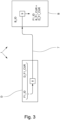
- the database server DS for an authorized user U1 from the key database generates a key data record D(U1) 6, the key data record D for the field device F1 in this case, to which the authorized user U1 has access authorization, the field device identifier F1_ID and the actual access key D_F1_CUR of the respective field device F1.
- Method 1 thus enables central key management and individual key distribution to authorized users and/or authorized operating devices, which is an essential technical basis for the desired key organization and key distribution.
- the encryption is implemented using an asymmetric pair of keys.
- the key data record is encrypted with the public key of the asymmetric key pair and decrypted on the operating device B of the authorized user U1 with the corresponding private key of the asymmetric key pair.
- FIG 5 shows method 1 to which a synchronization step 10 has been added.
- the key database of the database server DS and the key data record D of the operating device B are compared with regard to the entry times D_T_F1, B_T_F1 corresponding actual access key D_F1_CUR, B_F1_CUR of the field device F1.
- the entry times D_T_F1, B_T_F1 are added accordingly.
- the synchronization step 10 is carried out automatically in the exemplary embodiment shown as soon as the operating device B connects to the key database of the database server DS.
- the synchronization step 10 is in accordance with the embodiment figure 5 also implemented in such a way that the later, newer actual access code does not replace the older actual access code, i.e.
- the operating device B has a new access key B_F1_NEW for the field device F1, which has been given to the operating device here by the user U1.
- the new access key B_F1_NEW is specified for the field device F1 by the operating device B connected to the field device F1 via the communication link 2, and the new access key B_F1_NEW is stored by the field device F1 as the new actual access key F1_CUR 5.
- the operating device B stores the new access key B_F1_NEW as the new actual access key B_F1_CUR in its key data record.
- the operating device B then establishes a connection to the key database of the database server DS and initiates the synchronization step 10 .
- the synchronization step 10 is then carried out with a time interval when a connection to the database server DS can be established.
- the method 1 is described, with the specification 11 of a new access key D_F1_NEW taking place via the database server DS.
- the key database of the database server DS is given a new access key D_F1_NEW for the field device F1 11.
- the new access key D F1 NEW is stored in the key database of the database server DS for the field device F1 as the new actual access key D_F1_CUR, and the last valid actual access key D_F1 CUR for the field device F1 remains stored as the old actual access key D_F1_OLD in the key database.
- the entry time D_T_F1_OLD of the old actual access key is also saved here.
- the entry time D_T_F1 is recorded (get_time()).
- the key data record D is generated from the key database
- the actual access key D_F1_CUR and at least the last valid actual access key D_F1_OLD for the field device F1 are included in the key data record D.
- the method 1 is shown schematically for the case of a transfer of a new access key from the operating device B to the field device F1, the new access key being the actual access key B_F1_CUR of the operating device B.
- the operating device B is connected to the field device F1, to which it has access authorization.
- the operating device B has the key data record with the actual access key B_F1_CUR and the previously applicable actual access key B_F1_OLD for the field device F1.
- the operating device B uses the previously valid actual access key B_F1_OLD, and if the access authorization is present, the operating device B transmits the actual access key B_F1_CUR to the field device F1 as a new access key.
- the operating device B transmits the actual access key B_F1_CUR to check 3 the access authorization, so that the case is also covered that the actual access key in the field device F1 has already been replaced by the new access key, for example by another operating device.
- Method 1 it is provided in Method 1 that the operating device B is connected to the field device F1, to which it has access authorization, that the operating device B has a key data record with the actual access key B_F1_CUR and the previously applicable actual access key B_F1_OLD for the field device F1, that the operating device B first has the actual access key B_F1_CUR to obtain access authorization for the field device F1 used and if the access authorization is denied, the previously applicable actual access key B_F1_OLD is used.
- the test sequence is reversed when checking 3 the access authorization.
- Method 8 proposes a further development of the method 1, which has a secure indicator for displaying a new actual access key that has been successfully stored on the field device F1.
- Method 1 is characterized in that the new access key D_F1_NEW, which is specified 11 and stored in the key database of the database server DS for the field device F1 as the new actual access key D_F1_CUR (similar to 6 ), is provided with a synchronization flag S, the synchronization flag S indicating whether the new actual access code D_F1_CUR is stored on the field device F1 (S_YES) or is not stored on the field device (S_NO).
- the synchronization flag for the actual access key D_F1_CUR before a new actual access key D_F1_NEW is specified indicates that the actual access key D_F1_CUR has been stored on the field device F1 S_YES (upper block in 8 ).
- the synchronization flag S indicates that the actual access key D_F1_CUR is not stored on the field device F1 S_NO.
- the key data record (not shown) is generated, the synchronization flag is also included in the key data record.
- the synchronization flag S is also compared, ie also transmitted to the operating device with the key data record.
- the synchronization flag is changed from "actual access key not stored on the field device" (S_NO) to "actual access key stored on the field device” (S_YES) on the operator panel.
- the synchronization flag for the actual access key for the field device F1 in the key database of the database server DS is then changed from S_NO ("actual access key not stored on the field device") to S_YES ("actual access key stored on the field device").
- method 1 using the synchronization flag S provides that the operating device B is connected to the field device F1, that the operating device B evaluates the synchronization flag S of the actual access key BF1_CUR and, in the event that the synchronization flag S "actual access key is not stored on the field device" S_NO, the operating device to obtain access authorization to the field device F1 uses the previously applicable actual access key B _F1_OLD is used and otherwise uses the actual access key B_F1_CUR.
- Method 1 also makes it possible to identify on the database server DS whether and when the planned password change has been implemented.
Landscapes
- Engineering & Computer Science (AREA)
- Computer Security & Cryptography (AREA)
- Computer Networks & Wireless Communication (AREA)
- Signal Processing (AREA)
- Computing Systems (AREA)
- General Engineering & Computer Science (AREA)
- Computer Hardware Design (AREA)
- Health & Medical Sciences (AREA)
- General Health & Medical Sciences (AREA)
- Medical Informatics (AREA)
- Information Retrieval, Db Structures And Fs Structures Therefor (AREA)
- Storage Device Security (AREA)
- Lock And Its Accessories (AREA)
Applications Claiming Priority (1)
| Application Number | Priority Date | Filing Date | Title |
|---|---|---|---|
| DE102022101689.7A DE102022101689A1 (de) | 2022-01-25 | 2022-01-25 | Verfahren zur Änderung eines Ist-Zugangsschlüssels in einem Feldgerät der Automatisierungstechnik |
Publications (1)
| Publication Number | Publication Date |
|---|---|
| EP4216489A1 true EP4216489A1 (fr) | 2023-07-26 |
Family
ID=86852295
Family Applications (1)
| Application Number | Title | Priority Date | Filing Date |
|---|---|---|---|
| EP23152486.9A Pending EP4216489A1 (fr) | 2022-01-25 | 2023-01-19 | Procédé de modification d'une clé d'accès réelle dans un appareil de terrain de la technique d'automatisation |
Country Status (4)
| Country | Link |
|---|---|
| US (1) | US12512982B2 (fr) |
| EP (1) | EP4216489A1 (fr) |
| CN (1) | CN116506114A (fr) |
| DE (1) | DE102022101689A1 (fr) |
Families Citing this family (2)
| Publication number | Priority date | Publication date | Assignee | Title |
|---|---|---|---|---|
| DE102021129693A1 (de) * | 2021-11-15 | 2023-05-17 | Bayerische Motoren Werke Aktiengesellschaft | Verfahren, Computerprogramm, Vorrichtung und Fahrzeug zur Synchronisation von Verschlüsselungsdaten |
| DE102024120252A1 (de) * | 2024-07-18 | 2026-01-22 | Endress+Hauser Process Solutions Ag | Verfahren zur Verwaltung eines Bestandsfeldgeräts und entsprechendes System |
Citations (2)
| Publication number | Priority date | Publication date | Assignee | Title |
|---|---|---|---|---|
| US20090292918A1 (en) * | 2005-12-20 | 2009-11-26 | Panasonic Corporation | Authentication system and authentication device |
| US20120170751A1 (en) * | 2010-12-29 | 2012-07-05 | Secureall Corporation | Cryptographic communication with mobile devices |
Family Cites Families (31)
| Publication number | Priority date | Publication date | Assignee | Title |
|---|---|---|---|---|
| US6947556B1 (en) * | 2000-08-21 | 2005-09-20 | International Business Machines Corporation | Secure data storage and retrieval with key management and user authentication |
| US8195940B2 (en) * | 2002-04-05 | 2012-06-05 | Qualcomm Incorporated | Key updates in a mobile wireless system |
| US20050195975A1 (en) * | 2003-01-21 | 2005-09-08 | Kevin Kawakita | Digital media distribution cryptography using media ticket smart cards |
| US20080288786A1 (en) * | 2004-12-20 | 2008-11-20 | Michael Stephen Fiske | System with access keys |
| DE102005053332A1 (de) * | 2005-11-07 | 2007-05-10 | Endress + Hauser Flowtec Ag | Verfahren zum Betreiben eines Feldgerätes der Automatisierungstechnik mit Sonderfunktionalitäten |
| US8451088B2 (en) * | 2006-12-18 | 2013-05-28 | Sentrilock, Llc | Electronic lock box with transponder based communications |
| KR100839445B1 (ko) * | 2007-02-15 | 2008-06-19 | 건국대학교 산학협력단 | 메시지 다이제스트를 이용한 모바일 데이터베이스 동기화시스템 및 그 방법 |
| JP5061166B2 (ja) * | 2009-09-04 | 2012-10-31 | Kii株式会社 | データ同期システムおよびデータ同期方法 |
| US9336291B2 (en) * | 2009-12-30 | 2016-05-10 | Sybase, Inc. | Message based synchronization for mobile business objects |
| US20120310882A1 (en) * | 2011-06-03 | 2012-12-06 | Apple Inc. | Key value data storage |
| US8639928B2 (en) * | 2011-12-05 | 2014-01-28 | Certicom Corp. | System and method for mounting encrypted data based on availability of a key on a network |
| US9698975B2 (en) * | 2012-02-15 | 2017-07-04 | Blackberry Limited | Key management on device for perimeters |
| US9049593B2 (en) * | 2012-06-28 | 2015-06-02 | Qualcomm Incorporated | Method and apparatus for restricting access to a wireless system |
| DE102012016403B4 (de) * | 2012-08-21 | 2014-10-30 | Krohne Messtechnik Gmbh | Verfahren zur Parametrierung eines Feldgeräts und entsprechendes Feldgerät und System zur Parametrierung |
| DE102013111690A1 (de) * | 2013-10-23 | 2015-05-07 | Endress + Hauser Conducta Gesellschaft für Mess- und Regeltechnik mbH + Co. KG | Verfahren zum Bereitstellen von limitierten Zugangsschlüsseln für Feldgeräte |
| US10050955B2 (en) * | 2014-10-24 | 2018-08-14 | Netflix, Inc. | Efficient start-up for secured connections and related services |
| US10057065B2 (en) * | 2016-04-28 | 2018-08-21 | Arnold G. Reinhold | System and method for securely storing and utilizing password validation data |
| US10356064B1 (en) * | 2016-05-02 | 2019-07-16 | Rockwell Collins, Inc. | Distributed on-demand key management for rangeless environments |
| DE102016117289A1 (de) * | 2016-09-14 | 2018-03-15 | Endress + Hauser Gmbh + Co. Kg | Feldgerät mit einem optoelektronischen Bedienelement sowie Verfahren zur Detektion einer Berührung an dem Bedienelement |
| HUE060007T2 (hu) | 2016-10-19 | 2023-01-28 | Grieshaber Vega Kg | Kezelõkészülék és eljárás mérõkészülék mûködtetésére |
| GB201617913D0 (en) * | 2016-10-24 | 2016-12-07 | Trustonic Limited | Multi-stakeholder key setup for lot |
| CN106878009B (zh) * | 2017-02-21 | 2021-04-09 | 蔚来(安徽)控股有限公司 | 密钥更新方法及系统 |
| DE102017111928A1 (de) * | 2017-05-31 | 2018-12-06 | Endress+Hauser Conducta Gmbh+Co. Kg | Verfahren zur autorisierten Aktualisierung eines Feldgeräts der Automatisierungstechnik |
| US10931453B2 (en) * | 2018-03-05 | 2021-02-23 | International Business Machines Corporation | Distributed encryption keys for tokens in a cloud environment |
| DE102018107928A1 (de) * | 2018-04-04 | 2019-10-10 | Krohne Messtechnik Gmbh | Verfahren zur sicheren Kommunikation mit einem Feldmessgerät der Prozessmesstechnik und ein entsprechendes Feldmessgerät der Prozessmesstechnik |
| US11032287B1 (en) * | 2018-07-02 | 2021-06-08 | Amazon Technologies, Inc. | Delegated administrator with defined permission boundaries in a permission boundary policy attachment for web services and resources |
| US11558180B2 (en) * | 2020-01-20 | 2023-01-17 | International Business Machines Corporation | Key-value store with blockchain properties |
| WO2021150789A1 (fr) * | 2020-01-22 | 2021-07-29 | Valimail Inc. | Approvisionnement et rotation de pki à gestion centrale |
| US11250157B2 (en) * | 2020-03-03 | 2022-02-15 | The Prudential Insurance Company Of America | System for improving data security through key management |
| US11194769B2 (en) * | 2020-04-27 | 2021-12-07 | Richard Banister | System and method for re-synchronizing a portion of or an entire source database and a target database |
| US11567915B2 (en) * | 2021-02-01 | 2023-01-31 | Capital One Services, Llc | Maintaining a dataset based on periodic cleansing of raw source data |
-
2022
- 2022-01-25 DE DE102022101689.7A patent/DE102022101689A1/de active Pending
-
2023
- 2023-01-19 EP EP23152486.9A patent/EP4216489A1/fr active Pending
- 2023-01-25 US US18/159,417 patent/US12512982B2/en active Active
- 2023-01-28 CN CN202310113635.1A patent/CN116506114A/zh active Pending
Patent Citations (2)
| Publication number | Priority date | Publication date | Assignee | Title |
|---|---|---|---|---|
| US20090292918A1 (en) * | 2005-12-20 | 2009-11-26 | Panasonic Corporation | Authentication system and authentication device |
| US20120170751A1 (en) * | 2010-12-29 | 2012-07-05 | Secureall Corporation | Cryptographic communication with mobile devices |
Also Published As
| Publication number | Publication date |
|---|---|
| US20240113874A1 (en) | 2024-04-04 |
| DE102022101689A1 (de) | 2023-07-27 |
| CN116506114A (zh) | 2023-07-28 |
| US12512982B2 (en) | 2025-12-30 |
Similar Documents
| Publication | Publication Date | Title |
|---|---|---|
| EP3157281B1 (fr) | Procédé de communication protégée dans un véhicule | |
| EP3287925B1 (fr) | Dispositif informatique permettant de transférer un certificat à un dispositif dans une installation | |
| DE102011081804B4 (de) | Verfahren und System zum Bereitstellen von gerätespezifischen Betreiberdaten, welche an ein Authentisierungs-Credential gebunden werden, für ein Automatisierungsgerät einer Automatisierungsanlage | |
| DE102010044517A1 (de) | Verfahren zur Zertifikats-basierten Authentisierung | |
| EP3582033B1 (fr) | Procédé de fonctionnement securisé d'un appareil de terrain | |
| DE102018102608A1 (de) | Verfahren zur Benutzerverwaltung eines Feldgeräts | |
| WO2011076491A1 (fr) | Dispositif et procédé destinés à sécuriser la remise d'au moins une clef cryptographique entre appareils | |
| EP4216489A1 (fr) | Procédé de modification d'une clé d'accès réelle dans un appareil de terrain de la technique d'automatisation | |
| EP3422628B1 (fr) | Procédé, dispositif de sécurité et système de sécurité | |
| EP2772856A1 (fr) | Procédé de réalisation de tâches sur un système informatique de production et système de traitement de données | |
| EP2304558A1 (fr) | Système et procédé de communication à distance entre un ordinateur central et une commande de machine | |
| EP4032243B1 (fr) | Système et procédé de gestion de données d'un appareil de terrain de la technique d'automatisation de manière sécurisée contre la manipulation | |
| EP3836489B1 (fr) | Attribution dynamique d'unités d'automatisation aux serveurs d'automatisation | |
| WO2019096489A1 (fr) | Procédé et dispositif de traitement d'attestations d'authenticité pour des entités, en particulier des certificats numériques liés à des personnes, liés à des services et/ou liés à des objets | |
| DE102021109253B4 (de) | Verfahren zum login eines autorisierten nutzers auf ein gerät, insbesondere auf ein gerät für eine energieerzeugungsanlage, und energieerzeugungsanlage mit gerät | |
| EP3306514B1 (fr) | Procédé et dispositif de certification d'une chaîne de fonctions critique pour la sécurité | |
| EP3358802B1 (fr) | Procédé de fourniture sécurisée d'une clé cryptographique | |
| EP3627755A1 (fr) | Procédé pour une communication sécurisée dans un réseau de communication pourvu d'une pluralité d'unités à différents niveaux de sécurité | |
| EP3796107A1 (fr) | Système de guidage et procédé de gestion des certificats | |
| DE102024120252A1 (de) | Verfahren zur Verwaltung eines Bestandsfeldgeräts und entsprechendes System | |
| EP3765345B1 (fr) | Dispositif pour effectuer de manière commandée une action liée à la sécurité dans le trafic ferroviaire | |
| EP3893065A1 (fr) | Procédé de mise en uvre basée sur le paiement d'une fonction à mettre en uvre d'un appareil de terrain, appareil de terrain correspondant et unité de service | |
| DE102021205549A1 (de) | Verfahren zur Integration einer neuen Komponente in ein Netzwerk, Registrarkomponente und Anlage | |
| EP4138435A1 (fr) | Procédé d'octroi d'un droit d'accès à une unité de commande dans un système de commande de bâtiment | |
| DE102014008654A1 (de) | Temporäre Berechtigung |
Legal Events
| Date | Code | Title | Description |
|---|---|---|---|
| PUAI | Public reference made under article 153(3) epc to a published international application that has entered the european phase |
Free format text: ORIGINAL CODE: 0009012 |
|
| STAA | Information on the status of an ep patent application or granted ep patent |
Free format text: STATUS: THE APPLICATION HAS BEEN PUBLISHED |
|
| AK | Designated contracting states |
Kind code of ref document: A1 Designated state(s): AL AT BE BG CH CY CZ DE DK EE ES FI FR GB GR HR HU IE IS IT LI LT LU LV MC ME MK MT NL NO PL PT RO RS SE SI SK SM TR |
|
| STAA | Information on the status of an ep patent application or granted ep patent |
Free format text: STATUS: REQUEST FOR EXAMINATION WAS MADE |
|
| 17P | Request for examination filed |
Effective date: 20230920 |
|
| RBV | Designated contracting states (corrected) |
Designated state(s): AL AT BE BG CH CY CZ DE DK EE ES FI FR GB GR HR HU IE IS IT LI LT LU LV MC ME MK MT NL NO PL PT RO RS SE SI SK SM TR |