EP4216653A1 - Kommunikationsverfahren und -vorrichtung - Google Patents
Kommunikationsverfahren und -vorrichtung Download PDFInfo
- Publication number
- EP4216653A1 EP4216653A1 EP21885139.2A EP21885139A EP4216653A1 EP 4216653 A1 EP4216653 A1 EP 4216653A1 EP 21885139 A EP21885139 A EP 21885139A EP 4216653 A1 EP4216653 A1 EP 4216653A1
- Authority
- EP
- European Patent Office
- Prior art keywords
- external network
- transaction
- port number
- network
- outbound packet
- Prior art date
- Legal status (The legal status is an assumption and is not a legal conclusion. Google has not performed a legal analysis and makes no representation as to the accuracy of the status listed.)
- Withdrawn
Links
- 230000006854 communication Effects 0.000 title claims abstract description 70
- 238000004891 communication Methods 0.000 title claims abstract description 68
- 238000000034 method Methods 0.000 title claims abstract description 53
- 238000013519 translation Methods 0.000 claims abstract description 41
- 238000013507 mapping Methods 0.000 claims description 46
- 238000012545 processing Methods 0.000 claims description 27
- 238000004590 computer program Methods 0.000 claims description 18
- 238000005516 engineering process Methods 0.000 abstract description 15
- 238000013461 design Methods 0.000 description 30
- 101000897488 Homo sapiens Cyclin-D1-binding protein 1 Proteins 0.000 description 26
- 101000651236 Homo sapiens NCK-interacting protein with SH3 domain Proteins 0.000 description 26
- 102100021934 Cyclin-D1-binding protein 1 Human genes 0.000 description 23
- 101000765037 Mus musculus Class E basic helix-loop-helix protein 40 Proteins 0.000 description 22
- 102100039321 HAUS augmin-like complex subunit 7 Human genes 0.000 description 18
- 101001035814 Homo sapiens HAUS augmin-like complex subunit 7 Proteins 0.000 description 18
- 230000006870 function Effects 0.000 description 16
- 238000010586 diagram Methods 0.000 description 13
- 101100149552 Arabidopsis thaliana SKP1B gene Proteins 0.000 description 7
- 101100311320 Saccharomyces cerevisiae (strain ATCC 204508 / S288c) SYN8 gene Proteins 0.000 description 7
- 230000003068 static effect Effects 0.000 description 6
- 238000012986 modification Methods 0.000 description 5
- 230000004048 modification Effects 0.000 description 5
- 230000008569 process Effects 0.000 description 5
- 230000005540 biological transmission Effects 0.000 description 4
- 238000012546 transfer Methods 0.000 description 4
- 101100262736 Saccharomyces cerevisiae (strain ATCC 204508 / S288c) UIP3 gene Proteins 0.000 description 3
- 230000001174 ascending effect Effects 0.000 description 3
- 230000000694 effects Effects 0.000 description 2
- 230000002093 peripheral effect Effects 0.000 description 2
- 230000009286 beneficial effect Effects 0.000 description 1
- 238000000802 evaporation-induced self-assembly Methods 0.000 description 1
- 230000003287 optical effect Effects 0.000 description 1
- 230000004044 response Effects 0.000 description 1
Images

Classifications
-
- H—ELECTRICITY
- H04—ELECTRIC COMMUNICATION TECHNIQUE
- H04L—TRANSMISSION OF DIGITAL INFORMATION, e.g. TELEGRAPHIC COMMUNICATION
- H04L61/00—Network arrangements, protocols or services for addressing or naming
- H04L61/09—Mapping addresses
- H04L61/25—Mapping addresses of the same type
- H04L61/2503—Translation of Internet protocol [IP] addresses
- H04L61/2514—Translation of Internet protocol [IP] addresses between local and global IP addresses
-
- H—ELECTRICITY
- H04—ELECTRIC COMMUNICATION TECHNIQUE
- H04L—TRANSMISSION OF DIGITAL INFORMATION, e.g. TELEGRAPHIC COMMUNICATION
- H04L61/00—Network arrangements, protocols or services for addressing or naming
- H04L61/09—Mapping addresses
- H04L61/25—Mapping addresses of the same type
- H04L61/2503—Translation of Internet protocol [IP] addresses
- H04L61/256—NAT traversal
-
- H—ELECTRICITY
- H04—ELECTRIC COMMUNICATION TECHNIQUE
- H04L—TRANSMISSION OF DIGITAL INFORMATION, e.g. TELEGRAPHIC COMMUNICATION
- H04L61/00—Network arrangements, protocols or services for addressing or naming
- H04L61/09—Mapping addresses
- H04L61/25—Mapping addresses of the same type
- H04L61/2503—Translation of Internet protocol [IP] addresses
- H04L61/2517—Translation of Internet protocol [IP] addresses using port numbers
-
- H—ELECTRICITY
- H04—ELECTRIC COMMUNICATION TECHNIQUE
- H04L—TRANSMISSION OF DIGITAL INFORMATION, e.g. TELEGRAPHIC COMMUNICATION
- H04L61/00—Network arrangements, protocols or services for addressing or naming
- H04L61/09—Mapping addresses
- H04L61/25—Mapping addresses of the same type
- H04L61/2503—Translation of Internet protocol [IP] addresses
- H04L61/255—Maintenance or indexing of mapping tables
-
- H—ELECTRICITY
- H04—ELECTRIC COMMUNICATION TECHNIQUE
- H04L—TRANSMISSION OF DIGITAL INFORMATION, e.g. TELEGRAPHIC COMMUNICATION
- H04L61/00—Network arrangements, protocols or services for addressing or naming
- H04L61/45—Network directories; Name-to-address mapping
- H04L61/4505—Network directories; Name-to-address mapping using standardised directories; using standardised directory access protocols
- H04L61/4511—Network directories; Name-to-address mapping using standardised directories; using standardised directory access protocols using domain name system [DNS]
-
- H—ELECTRICITY
- H04—ELECTRIC COMMUNICATION TECHNIQUE
- H04L—TRANSMISSION OF DIGITAL INFORMATION, e.g. TELEGRAPHIC COMMUNICATION
- H04L61/00—Network arrangements, protocols or services for addressing or naming
- H04L61/09—Mapping addresses
- H04L61/25—Mapping addresses of the same type
- H04L61/2596—Translation of addresses of the same type other than IP, e.g. translation from MAC to MAC addresses
Definitions
- Embodiments of this application relate to the field of communication technologies, and in particular, to a communication method and apparatus.
- a network address translation (network address translation, NAT) technology is widely used in a telecom carrier network for translation between external network addresses and internal network addresses.
- a carrier-grade NAT (carrier-grade NAT, CGN) device is deployed, so that a carrier may effectively use limited internal network internet protocol (internet protocol, IP) addresses, to provide internet (internet) access services for more users.
- IP internet protocol
- IPv4 global internet protocol version 4
- Embodiments of this application provide a communication method and apparatus, to improve a ratio of translation between an external network IP address and an internal network IP address, and improve utilization of the external network IP address.
- this application provides a communication method.
- the method includes: receiving an outbound packet sent by an internal network device to an external network, where the outbound packet carries an internal network transaction ID Transaction-ID, and the Transaction-ID marks a group including a domain name system DNS outbound packet and a corresponding inbound packet; assigning an external network IP, an external network port number, and an external network Transaction-ID to the outbound packet; and replacing a source IP, a source port number, and the internal network Transaction-ID of the outbound packet with the external network IP, the external network port number, and the external network Transaction-ID, and then sending the outbound packet.
- a network address translation technology based on a DNS application layer Transaction-ID is proposed for an application layer feature of a DNS protocol.
- network address translation processing may be performed in three dimensions of a network layer (an IP address), a transport layer (a UDP port), and an application layer (a Transaction-ID), to improve a ratio of translation between an external network IP address and an internal network IP address. In this way, utilization of the external network IP is improved.
- the assigning an external network IP, an external network port number, and an external network Transaction-ID to the outbound packet includes: assigning the external network IP, the external network port number, and the external network Transaction-ID to the outbound packet based on a configured network address translation NAT mapping table and the source IP, the source port number, and the internal network Transaction-ID that are of the outbound packet, where the NAT mapping table includes a plurality of mapping relationships between an internal network IP, an internal network port number, and an internal network Transaction-ID and an external network IP, an external network port number, and an external network Transaction-ID.
- the assigning an external network IP, an external network port number, and an external network Transaction-ID to the outbound packet includes: assigning a group including an unoccupied external network IP, an external network port number, and an external network Transaction-ID to the outbound packet in a resource set of external network IPs, external network port numbers, and external network Transaction-IDs.
- the external network Transaction-ID assigned to the outbound packet is the same as or different from the internal network Transaction-ID of the outbound packet.
- a static translation or dynamic translation manner may be used to translate the source IP (namely, the internal network IP), the source port number (namely, the internal network port number), and the internal network Transaction-ID of the outbound packet into the external network IP, the external network port number, and the external network Transaction-ID.
- This enriches implementations of network address translation, and helps satisfy different communication requirements.
- a mapping relationship between the source IP, the source port number, and the internal network Transaction-ID that are of the outbound packet and the external network IP, the external network port number, and the external network Transaction-ID that are assigned to the outbound packet is recorded into a NAT mapping table.
- the mapping relationship between the source IP address (the internal network IP), the source port number (the internal network port number), and the internal network Transaction-ID that are of the outbound packet and the external network IP, the external network port number, and the external network Transaction-ID that are assigned to the outbound packet is recorded in the NAT mapping table, to facilitate identification and determining of the internal network IP, the internal network port number, and the internal network Transaction-ID that correspond to the inbound packet sent from the external network to the internal network device. This ensures reliability of transmission of the inbound packet.
- the method further includes: receiving the inbound packet sent by the external network to the internal network device, where the inbound packet carries the external network Transaction-ID; assigning the internal network IP, the internal network port number, and the internal network Transaction-ID to the inbound packet based on the NAT mapping table and a destination IP, a destination port number, and the external network Transaction-ID that are of the inbound packet; and replacing the destination IP, the destination port number, and the external network Transaction-ID of the inbound packet with the internal network IP, the internal network port number, and the internal network Transaction-ID, and then sending the inbound packet.
- the destination IP, the destination port number, and the external network Transaction-ID of the inbound packet sent from the external network to the internal network device are translated based on the NAT mapping table. This helps ensure that the internal network device accurately receives the inbound packet, and improves reliability of transmission of the inbound packet.
- an embodiment of this application provides a communication apparatus.
- the apparatus has a function of implementing the method according to any one of the first aspect or the possible designs of the first aspect.
- the function may be implemented by hardware, or may be implemented by hardware executing corresponding software.
- the hardware or software includes one or more units (modules) corresponding to the foregoing function, for example, a communication unit and a processing unit.
- the apparatus may be a chip or an integrated circuit.
- the apparatus includes a processor and a communication interface.
- the processor is coupled to the communication interface, and is configured to implement the method according to any one of the first aspect or the possible designs of the first aspect.
- the communication interface may be a transceiver or an input/output interface.
- the apparatus may further include a memory, and the memory stores a program that may be executed by the processor to implement the method according to any one of the first aspect or the possible designs of the first aspect.
- the apparatus may be a NAT device.
- this application provides a computer-readable storage medium.
- the storage medium stores computer instructions.
- the computer instructions When executed, the method according to any one of the first aspect or the possible designs of the first aspect may be implemented.
- this application further provides a computer program product including a computer program or instructions.
- the computer program or the instructions When executed, the method according to any one of the first aspect or the possible designs of the first aspect may be implemented.
- an embodiment of this application provides a chip.
- the chip is configured to execute a computer program or instructions stored in a memory, to implement the method according to any one of the first aspect or the possible designs of the first aspect.
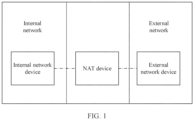
- FIG. 1 is a schematic diagram of an architecture of a possible communication system according to an embodiment of this application.
- the system includes a NAT device, an internal network device, and an external network device.
- the NAT device may divide a network into an internal network and an external network.
- the internal network may also be referred to as a private network or a private network, for example, a local area network (local area network, LAN) used by an enterprise user or a home user.
- the external network may also be referred to as a public network or a public network, for example, a wide area network (wide area network, WAN), namely, an internet (internet).
- WAN wide area network
- a device that uses the internal network for communication is referred to as the internal network device, and a device that uses the external network for communication is referred to as the external network device.
- the NAT device is located between the internal network and the external network.
- the internal network device communicates with the external network device through the NAT device. For example, after an internal network address of a packet sent by the internal network device passes through the NAT device, the internal network address is represented by an external network address translated by the NAT device in the external network.
- the external network device knows only the translated external network address, but does not know the internal network address of the packet.
- the external network address is represented by an internal network address translated by the NAT device in the internal network.
- the internal network device knows only the translated internal network address but does not know the external network address of the packet.
- NAT technology was proposed in 1994.
- some devices in the private network namely, the internal network
- local IP addresses namely, internal network IP addresses
- NAT software needs to be installed on a router that connects the internal network to the external network.
- the router on which the NAT software is installed may also be referred to as a NAT router, and the router has at least one valid external network IP address.
- an internal network IP address of the device needs to be translated into an external network IP address on the NAT router, so that the device can be connected to the external network.
- an example in which an internal network IP in the outbound packet is translated into an external network IP is shown in Table 1.
- Src IP represents a source IP
- Dst IP represents a destination IP
- the Src IP in the outbound packet carries a local IP of the internal network device, namely, the internal network IP.
- the NAT device translates the Src IP in the outbound packet from the internal network IP into the external network IP, for example, translates a UIP1 into an EIP1, and translates a UIP2 into an EIP2.
- UIP represents the internal network IP
- EIP represents the external network IP.
- Table 1 It may be shown in Table 1 that a ratio of translation between the internal network IP and external network IP is 1:1.
- Table 1 Outbound packet (internal network) Outbound packet (external network) Src IP Dst IP Src IP Dst IP UIP1 DIP1 EIP1 DIP1 UIP2 DIP1 EIP2 DIP1 UIP3 DIP1 EIP3 DIP1 UIP4 DIP1 EIP4 DIP1
- a network address and port translation (network address and port translation, NAPT) technology is an enhancement of the basic-NAT technology, and port dimension processing is added.
- the technology uses a valid external network IP, and different user datagram protocol (user datagram protocol, UDP) port numbers correspond to different internal network IPs.
- UDP user datagram protocol
- translation between ⁇ the internal network IP + an internal network port number> and ⁇ the external network IP + an external network port number> is applicable to a scenario in which an enterprise has only one external network IP, but a plurality of devices need to access the external network or are accessed by the external network.
- an outbound packet sent by the internal network device to the external network an example in which an internal network IP and an internal network port number in the outbound packet are translated into an external network IP and an external network port is shown in Table 2.
- "Port” represents a transport layer protocol
- "Src IP” represents a source IP
- "Src port” represents a source port
- "Dst IP” represents a destination IP
- "Dst port” represents a destination port.
- the NAT device translates the Src IP and the Src port in the outbound packet from the internal network IP and the internal network port number into the external network IP and the external network port number, for example, translates a UIP1 and a Uport1 into an EIP1 and an Eport1.
- UDP represents the internal network IP
- Uport represents the internal network port
- EIP represents the external network IP
- Uport represents the external network port.
- an IP has 65536 UDP ports.
- one external network IP may provide services for 65536 internal network devices. That is, each UDP port of the external network IP corresponds to a different internal network IP.
- a ratio of translation that one external network IP address provides services for 128 internal network IPs can also be reached.
- the NAT device may be a device such as a router, a gateway, or a switch that has a network address translation function, or may be a CGN device or the like.
- the NAT technology operates at a network layer (network layer) and a transport layer (transport layer), and processing on a domain name system (domain name system, DNS) feature of an application layer protocol is not performed.
- DNS domain name system
- the ratio of translation between the external network IP and the internal network IP is low.
- external network IP resources become increasingly tense. How to improve a ratio of translation between network addresses and improve utilization of external network IPs as much as possible becomes a problem to be resolved.
- a DNS protocol is widely used in the internet and is the most widely used protocol. In some carrier networks, a proportion of DNS connections is up to 48%, which is higher than that of protocols such as the hypertext transfer protocol (hypertext transfer protocol, HTTP), the hypertext transfer protocol secure (hypertext transfer protocol secure, HTTPS), and the quick UDP internet connection (quick UDP internet connection, QUIC).
- HTTP hypertext transfer protocol
- HTTPS hypertext transfer protocol secure
- QUIC quick UDP internet connection
- This application is intended to focus on a DNS protocol feature, and add DNS application layer Transaction-ID dimension processing based on dimensions of a network layer (an IP address) and a transport layer (a UDP port) used in an existing NAPT technology, to improve a ratio of translation between an external network IP address and an internal network IP address.
- At least one may be alternatively described as one or more, and more may represent two, three, four, or more. This is not limited in this application.
- "/" may represent an "or” relationship between associated objects.
- A/B may represent A or B.
- "And/or” may be used to represent that there are three relationships between associated objects.
- a and/or B may represent the following three cases: Only A exists, both A and B exist, and only B exists. A and B may be singular or plural.
- terms such as “first” and “second” may be used to distinguish between technical features with same or similar functions.
- first and second do not limit a quantity and an execution sequence, and the terms such as “first” and “second” do not indicate a definite difference.
- the term such as “example” or “for example” is used to represent an example, an illustration, or a description. Any embodiment or design scheme described with “example” or “for example” should not be explained as being more preferred or having more advantages than another embodiment or design scheme. Use of the term such as “example” or “for example” is intended to present a related concept in a specific manner for ease of understanding.
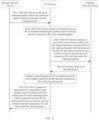
- FIG. 2 is a schematic diagram of a communication process according to an embodiment of this application. The process includes the following steps.
- a NAT device receives an outbound packet sent by an internal network device to an external network, where the outbound packet carries an internal network transaction ID (Transaction-ID), and the Transaction-ID marks a group including a DNS outbound packet and a corresponding inbound packet.
- Transaction-ID an internal network transaction ID
- a difference from an existing DNS packet that uses a DNS protocol is that an IP protocol is used only at a network layer, a UDP protocol is used at a transport layer, and only an IP and a port number are used to identify different connections.
- a Transaction-ID identifier is carried in an application layer DNS protocol header, and marks a group including a DNS outbound packet (or a request packet) and a corresponding inbound packet (or a corresponding response packet).
- a new dimension Transaction-ID is introduced to form a six-tuple based on transmission of a conventional packet by using a quintuple (namely, a source IP address, a source port, a destination IP address, a destination port, and a transport layer protocol), so that existing different connections that are identified by using only an IP or only an IP and a port number are different connections that are identified by using an IP, a port number, and a Transaction-ID.
- a quintuple namely, a source IP address, a source port, a destination IP address, a destination port, and a transport layer protocol
- Each external network IP has 65536 UDP ports (namely, 65536 port numbers), and each UDP port has 65536 Transaction-IDs.
- a NAT translation ratio of DNS service flows may be increased to 1:65536 (65536 ports of one external network IP) * 65536 (65536 Transaction-IDs of one port). That is, a Transaction-ID of any port (UDP port) of an external network IP may provide a service for an internal network IP, a ratio of translation between an external network IP and an internal network IP may be increased to 1:4294967296.
- the NAT device may perform the determining in a manner of identifying whether the outbound packet complies with a DNS protocol format specification, whether to send the outbound packet to a DNS server (for example, whether a destination IP is an IP of the DNS server), or the like.
- the NAT device may perform the determining in a manner of identifying whether the inbound packet complies with a DNS protocol format specification, whether the inbound packet is from a DNS server (for example, whether a source IP is an IP of the DNS server), or the like. Details are not described in this application.
- the outbound packet is a packet sent by the internal network device to the external network, namely, a packet sent by an internal network to the external network.
- a source IP, a source port number, and the Transaction-ID carried in the outbound packet are an internal network IP, an internal network port number, and the internal network Transaction-ID, and need to be translated into an external network IP, an external network port number, and an external network Transaction-ID when passing through the NAT device.
- the inbound packet is a packet sent from an external network device to the internal network, namely, a packet sent from the external network to the internal network.
- a destination IP, a destination port number, and the Transaction-ID carried in the inbound packet are the external network IP, the external network port number, and the external network Transaction-ID, and need to be translated into the internal network IP, the internal network port number, and the internal network Transaction-ID when passing through the NAT device.
- the NAT device assigns the external network IP, the external network port number, and the external network Transaction-ID to the outbound packet.
- the NAT device may perform NAT translation in a manner such as static translation or dynamic translation.
- the static translation means that the IP address, the port number, and the Transaction-ID are in one-to-one mapping and are fixed.
- a specific group including an internal network IP address, an internal network port number, and an internal network Transaction-ID can only be translated into (or mapped to) a specific group including an external network IP address, an external network port number, and an external network Transaction-ID.
- the dynamic translation means that when a group including an internal network IP address, an internal network port number, and an internal network Transaction-ID is translated into a group including an external network IP address, an external network port number, and an external network Transaction-ID, the external network IP address, the external network port number, and the external network Transaction-ID are not fixed and can be randomly translated into any specified valid external network IP address, external network port number, and external network Transaction-ID. This may apply to a scenario in which an enterprise has only one external network IP but a plurality of devices need to be accessed by the internet or access the internet.
- the following uses the static translation and the dynamic translation as examples for description.
- a user may configure a NAT mapping table based on an internal network IP, an internal network port number, and an internal network Transaction-ID used by each internal network device in the internal network and a resource set of external network IPs, external network port numbers, and external network Transaction-IDs that may be used by the NAT device.
- the NAT mapping table includes a plurality of mapping relationships between an internal network IP, an internal network port number, and an internal Transaction-ID and an external network IP, an external network port number, and an external network Transaction-ID.
- the NAT device After receiving the outbound packet sent by the internal network device to the external network, the NAT device searches, based on the source IP, the source port number, and the internal network Transaction-ID of the outbound packet, the NAT mapping table for a group including an external network IP, an external network port number, and an external network Transaction-ID that has a mapping relationship with the source IP, the source port number, and the internal network Transaction-ID of the outbound packet, and assigns the external network IP, the external network port number, and the external network Transaction-ID to the outbound packet.
- the resource set of external network IPs, external network port numbers, and external network Transaction-IDs that may be used by the NAT device may be determined based on one or more external network IPs of the NAT device.
- Each external network IP has 65536 UDP ports, each UDP port has 65536 Transaction-IDs, and one external network IP may correspond to 4294967296 groups including external network IPs, external network port numbers, and external network Transaction-ID resources.
- the user may further limit a port number that may be used by an IP of the NAT device and/or a Transaction-ID that may be used by each available port.
- the NAT device determines the resource set of external network IPs, external network port numbers, and external network Transaction-IDs based on the port number that may be used by the IP of the NAT device and/or the Transaction-ID that may be used by each available port.
- the resource set of external network IPs, external network port numbers, and external network Transaction-IDs of the NAT device may alternatively be directly configured by the user. This is not limited in this application.
- the NAT mapping table stored in the NAT device is shown in Table 3. Assuming that the source IP carried in the outbound packet received by the NAT device is a UIP1, the source port number is a UPortl, and the internal network Transaction-ID is 11111, the external network IP "EIP1", the external network port number "EPortl”, and the external network Transaction-ID "1" are assigned to the outbound packet. For example, according to the NAT mapping table 1, the source IP (Src IP), the source port number (Src Port), and the internal network Transaction-ID of the outbound packet, and the source IP, the source port number, and the external network Transaction-ID after replacement may be shown in Table 4.
- a group including an unoccupied external network IP, an external network port number, and an external network Transaction-ID is assigned to the outbound packet in a resource set of external network IPs, external network port numbers, and external network Transaction-IDs.
- the NAT device may assign, in a sequential assignment manner, the group including an unoccupied external network IP, an external network port number, and an external network Transaction-ID to the outbound packet in the resource set of external network IPs, external network port numbers, and external network Transaction-IDs
- the network device may assign the group including an unoccupied external network IP, an external network port number, and an external network Transaction-ID to the outbound packet in the resource set of external network IPs, external network port numbers, and external network Transaction-IDs in a manner of assigning the external network IPs in ascending order, the external network port numbers in ascending order, and the external network Transaction-IDs in ascending order.
- the NAT device may further assign, in an assignment manner such as random assignment or assignment according to a specified assignment policy, the group including an unoccupied external network IP, an external network port number, and an external network Transaction-ID to the outbound packet in the resource set of external network IPs, external network port numbers, and external network Transaction-IDs.
- the NAT device may further assign only one external network IP and one external network port number for each internal network IP of the internal network device.
- the NAT device may assign the external network IP and the external network port number (where the static assignment or the dynamic assignment may be used) to the outbound packet based on the source IP (namely, the internal network IP) to the outbound packet, and keep the external network Transaction-ID and the internal network Transaction-ID of the outbound packet unchanged.
- the source IP (Src IP), the source port number (Src Port), and the internal network Transaction-ID of the outbound packet, and the corresponding external network IP, external network port number, and external network Transaction-ID may be shown in Table 5.
- the NAT device replaces the source IP, the source port number, and the internal network Transaction-ID of the outbound packet with the external network IP, the external network port number, and the external network Transaction-ID, and then sends the outbound packet.
- the NAT device replaces the source IP, the source port number, and the internal network Transaction-ID of the outbound packet with the external network IP, the external network port number, and the internal network Transaction-ID, and records a mapping relationship between the source IP (namely, the internal network IP), the source port number (namely, the internal network port number), and the internal network Transaction-ID of the outbound packet and the external network IP, the external network port number, and the external network Transaction-ID that are assigned to the outbound packet into the NAT mapping table.
- the external network device After receiving the packet sent by the internal network device, the external network device responds to the packet sent by the internal network device.
- the NAT device may assign the internal network IP, the internal network port number, and the internal network Transaction-ID to the inbound packet based on the stored NAT mapping table and the destination IP, the destination port number, and the external network Transaction-ID of the inbound packet, replaces the destination IP, the destination port number, and the external network Transaction-ID of the inbound packet with the internal network IP, the internal network port number, and the internal network Transaction-ID, and then sends the inbound packet.
- the NAT mapping table is shown in Table 3, and assuming that the destination IP of the inbound packet is an EIP1, the destination port number is an EPort1, and the external network Transaction-ID is 5, the internal network IP UIP2, the internal network port number UPort4, and the internal network Transaction-ID 11114 are assigned to the inbound packet.
- the NAT device includes a corresponding hardware structure and/or software module (or unit) for performing each function.
- the NAT device includes a corresponding hardware structure and/or software module (or unit) for performing each function.
- this application may be implemented by hardware or a combination of hardware and computer software. Whether a function is performed by hardware or hardware driven by computer software depends on particular applications and design constraints of the technical solutions. Persons skilled in the art may use different methods to implement the described functions for each particular application, but it should not be considered that the implementation goes beyond the scope of this application.
- FIG. 3 is a schematic diagram of a possible structure of a communication apparatus according to an embodiment of this application.
- the communication apparatuses may be configured to implement functions of the NAT device in the foregoing method embodiments. Therefore, beneficial effects of the foregoing method embodiments can also be implemented.
- the communication apparatus may be the NAT device in FIG. 2 , or may be a unit (or module) or the like used in the NAT device.
- the communication apparatus 300 may include a processing unit 302 and a communication unit 303, and may further include a storage unit 301.
- the communication apparatus 300 is configured to implement a function of the NAT device in the method embodiment shown in FIG. 2 .
- the processing unit 302 is configured to implement a corresponding processing function.
- the communication unit 303 is configured to support the communication apparatus 300 in communicating with another network entity.
- the storage unit 301 is configured to store program code and/or data of the communication apparatus 300.
- the communication unit 303 may include a receiving unit and/or a sending unit, which are respectively configured to perform a receiving operation and a sending operation.
- the communication unit 303 is configured to receive an outbound packet sent by an internal network device to an external network, where the outbound packet carries an internal network Transaction-ID, and the Transaction-ID marks a group including a domain name system DNS outbound packet and a corresponding inbound packet; the processing unit 302 is configured to: assign an external network IP, an external network port number, and an external network Transaction-ID to the outbound packet; and replace a source IP, a source port number, and the internal network Transaction-ID of the outbound packet with the external network IP, the external network port number, and the external network Transaction-ID; and the communication unit 303 is further configured to send the outbound packet processed by the processing unit 302.
- the processing unit 302 when assigning the external network IP, the external network port number, and the external network Transaction-ID to the outbound packet, is specifically configured to: assign the external network IP, the external network port number, and the external network Transaction-ID to the outbound packet based on a configured network address translation NAT mapping table and the source IP, the source port number, and the internal network Transaction-ID that are of the outbound packet, where the NAT mapping table includes a plurality of mapping relationships between an internal network IP, an internal network port number, and an internal network Transaction-ID and an external network IP, an external network port number, and an external network Transaction-ID.
- the processing unit 302 when assigning the external network IP, the external network port number, and the external network Transaction-ID to the outbound packet, is specifically configured to: assign a group including an unoccupied external network IP, an external network port number, and an external network Transaction-ID to the outbound packet in a resource set of external network IPs, external network port numbers, and external network Transaction-IDs.
- the external network Transaction-ID assigned to the outbound packet is the same as or different from the internal network Transaction-ID of the outbound packet.
- the processing unit 302 is further configured to record, in a NAT mapping table, a mapping relationship between the source IP, the source port number, and the internal network Transaction-ID that are of the outbound packet and the external network IP, the external network port number, and the external network Transaction-ID that are assigned to the outbound packet.
- the communication unit 303 is further configured to receive the inbound packet sent by the external network to the internal network device, where the inbound packet carries the external network Transaction-ID; the processing unit 302 is further configured to: assign the internal network IP, the internal network port number, and the internal network Transaction-ID to the inbound packet based on the NAT mapping table and a destination IP, a destination port number, and the external network Transaction-ID that are of the inbound packet; and replace the destination IP, the destination port number, and the external network Transaction-ID of the inbound packet with the internal network IP, the internal network port number, and the internal network Transaction-ID; and the communication unit 303 is further configured to send the inbound packet processed by the processing unit 302.
- the communication apparatus 400 includes a communication interface 401, a processor 402, and a memory 403.
- the communication interface 401, the processor 402, and the memory 403 are connected to each other.
- the communication interface 401, the processor 402, and the memory 403 are connected to each other through a bus 404.
- the bus 404 may be a peripheral component interconnect (peripheral component interconnect, PCI) bus, an extended industry standard architecture (extended industry standard architecture, EISA) bus, or the like.
- PCI peripheral component interconnect
- EISA extended industry standard architecture
- the bus may be classified into an address bus, a data bus, a control bus, and the like.
- the bus is represented by using only one bold line in FIG. 4 . However, this does not indicate that there is only one bus or only one type of bus.
- the assigning an external network IP, an external network port number, and an external network Transaction-ID to the outbound packet includes: assigning the external network IP, the external network port number, and the external network Transaction-ID to the outbound packet based on a configured network address translation NAT mapping table and the source IP, the source port number, and the internal network Transaction-ID that are of the outbound packet, where the NAT mapping table includes a plurality of mapping relationships between an internal network IP, an internal network port number, and an internal network Transaction-ID and an external network IP, an external network port number, and an external network Transaction-ID.
- the assigning an external network IP, an external network port number, and an external network Transaction-ID to the outbound packet includes: assigning a group including an unoccupied external network IP, an external network port number, and an external network Transaction-ID to the outbound packet in a resource set of external network IPs, external network port numbers, and external network Transaction-IDs.
- the external network Transaction-ID assigned to the outbound packet is the same as or different from the internal network Transaction-ID of the outbound packet.
- the method further includes: recording, into a NAT mapping table, a mapping relationship between the source IP, the source port number, and the internal network Transaction-ID that are of the outbound packet and the external network IP, the external network port number, and the external network Transaction-ID that are assigned to the outbound packet.
- the method further includes: receiving, through the communication interface 401, the inbound packet sent by the external network to the internal network device, where the inbound packet carries the external network Transaction-ID; assigning the internal network IP, the internal network port number, and the internal network Transaction-ID to the inbound packet based on the NAT mapping table and a destination IP, a destination port number, and the external network Transaction-ID that are of the inbound packet; and replacing the destination IP, the destination port number, and the external network Transaction-ID of the inbound packet with the internal network IP, the internal network port number, and the internal network Transaction-ID, and then sending the inbound packet through the communication interface 401.
- a computer-readable storage medium stores instructions. When the instructions are executed, the communication method applicable to the NAT device in the foregoing method embodiments may be performed.
- a computer program product includes instructions is provided. When the instructions are executed, the communication method applicable to the NAT device in the foregoing method embodiment may be performed.
- a chip When running, the chip may perform the communication method applicable to the NAT device in the foregoing method embodiments.
- embodiments of this application may be provided as a method, a system, or a computer program product. Therefore, this application may use a form of hardware only embodiments, software only embodiments, or embodiments with a combination of software and hardware. In addition, this application may use a form of a computer program product that is implemented on one or more computer-usable storage media (including but not limited to a disk memory, a CD-ROM, an optical memory, and the like) that include computer-usable program code.
- computer-usable storage media including but not limited to a disk memory, a CD-ROM, an optical memory, and the like
- These computer program instructions may be provided for a general-purpose computer, a dedicated computer, an embedded processor, or a processor of any other programmable data processing device to generate a machine, so that the instructions executed by a computer or a processor of any other programmable data processing device generate an apparatus for implementing a specific function in one or more processes in the flowcharts and/or in one or more blocks in the block diagrams.
- These computer program instructions may alternatively be stored in a computer-readable memory that can instruct the computer or any other programmable data processing device to work in a specific manner, so that the instructions stored in the computer-readable memory generate an artifact that includes an instruction apparatus.
- the instruction apparatus implements a specific function in one or more processes in the flowcharts and/or in one or more blocks in the block diagrams.
- the computer program instructions may alternatively be loaded onto a computer or another programmable data processing device, so that a series of operations and steps are performed on the computer or the another programmable device, so that computer-implemented processing is generated. Therefore, the instructions executed on the computer or the another programmable device provide steps for implementing a specific function in one or more procedures in the flowcharts and/or in one or more blocks in the block diagrams.
Landscapes
- Engineering & Computer Science (AREA)
- Computer Networks & Wireless Communication (AREA)
- Signal Processing (AREA)
- Data Exchanges In Wide-Area Networks (AREA)
- Small-Scale Networks (AREA)
Applications Claiming Priority (2)
| Application Number | Priority Date | Filing Date | Title |
|---|---|---|---|
| CN202011193498.XA CN114531417B (zh) | 2020-10-30 | 2020-10-30 | 一种通信方法及装置 |
| PCT/CN2021/126346 WO2022089412A1 (zh) | 2020-10-30 | 2021-10-26 | 一种通信方法及装置 |
Publications (2)
| Publication Number | Publication Date |
|---|---|
| EP4216653A1 true EP4216653A1 (de) | 2023-07-26 |
| EP4216653A4 EP4216653A4 (de) | 2024-02-21 |
Family
ID=81383562
Family Applications (1)
| Application Number | Title | Priority Date | Filing Date |
|---|---|---|---|
| EP21885139.2A Withdrawn EP4216653A4 (de) | 2020-10-30 | 2021-10-26 | Kommunikationsverfahren und -vorrichtung |
Country Status (4)
| Country | Link |
|---|---|
| US (1) | US12199941B2 (de) |
| EP (1) | EP4216653A4 (de) |
| CN (1) | CN114531417B (de) |
| WO (1) | WO2022089412A1 (de) |
Cited By (1)
| Publication number | Priority date | Publication date | Assignee | Title |
|---|---|---|---|---|
| FI20235927A1 (en) * | 2023-08-18 | 2025-02-19 | Liikennevirta Oy / Virta Ltd | Method and device for managing identifiers for electric vehicle charging stations |
Families Citing this family (1)
| Publication number | Priority date | Publication date | Assignee | Title |
|---|---|---|---|---|
| CN117118746B (zh) * | 2023-10-20 | 2024-01-09 | 明阳时创(北京)科技有限公司 | 一种基于动态dnat的dns攻击防御方法、系统、介质及设备 |
Family Cites Families (25)
| Publication number | Priority date | Publication date | Assignee | Title |
|---|---|---|---|---|
| US6353614B1 (en) * | 1998-03-05 | 2002-03-05 | 3Com Corporation | Method and protocol for distributed network address translation |
| US7068655B2 (en) * | 2001-06-14 | 2006-06-27 | Nortel Networks Limited | Network address and/or port translation |
| US7333492B2 (en) * | 2004-08-31 | 2008-02-19 | Innomedia Pte Ltd | Firewall proxy system and method |
| CN1960316A (zh) * | 2005-11-04 | 2007-05-09 | 华为技术有限公司 | 分片报文的网络地址转换方法 |
| CN100586104C (zh) * | 2006-04-17 | 2010-01-27 | 中国科学院计算技术研究所 | 基于路由的会话初始化协议透明穿越网络地址转换的方法 |
| CN101159693B (zh) * | 2007-10-16 | 2011-08-10 | 中兴通讯股份有限公司 | 复用路由器接口地址的静态pat支持任意端口的方法 |
| CN101316272A (zh) * | 2008-07-09 | 2008-12-03 | 南京邮电大学 | 构建因特网协议版本4和6混合网络的多协议层翻译方法 |
| CN101729606A (zh) * | 2008-10-22 | 2010-06-09 | 华为技术有限公司 | 一种实现网络地址转换的方法及相关设备 |
| CN101567852B (zh) * | 2009-05-20 | 2011-08-24 | 中兴通讯股份有限公司 | Ip报文网络地址转换的方法及装置 |
| US8289968B1 (en) * | 2010-10-27 | 2012-10-16 | Juniper Networks, Inc. | Distributed network address translation in computer networks |
| CN105100299A (zh) * | 2010-11-25 | 2015-11-25 | 华为技术有限公司 | 报文发送方法、nat表项建立方法及nat设备 |
| CN102684972B (zh) * | 2011-03-07 | 2017-04-12 | 中兴通讯股份有限公司 | 一种兼容IPv4地址的通信方法及系统 |
| CN102232288A (zh) * | 2011-04-15 | 2011-11-02 | 华为技术有限公司 | 一种网络地址转换方法及装置 |
| CN102325197B (zh) * | 2011-05-23 | 2014-03-12 | 杭州华三通信技术有限公司 | 一种内网设备与外网设备通信的方法和网络地址转换设备 |
| CN103024089B (zh) * | 2011-09-20 | 2016-02-17 | 中国电信股份有限公司 | 网络地址转换方法和设备 |
| CN102790811B (zh) * | 2012-07-25 | 2015-10-14 | 浙江宇视科技有限公司 | 一种在监控网络中穿越nat设备的方法和装置 |
| CN104184842A (zh) * | 2013-05-24 | 2014-12-03 | 中兴通讯股份有限公司 | 一种转发报文的方法及装置 |
| US9894033B2 (en) * | 2014-08-04 | 2018-02-13 | Fortinet, Inc. | DNS-enabled communication between heterogeneous devices |
| US20160380789A1 (en) * | 2015-06-25 | 2016-12-29 | Microsoft Technology Licensing, Llc | Media Relay Server |
| US10237236B2 (en) * | 2015-06-25 | 2019-03-19 | Microsoft Technology Licensing, Llc | Media Session |
| CN107231450A (zh) * | 2016-03-25 | 2017-10-03 | 中兴通讯股份有限公司 | 一种实现网络访问的方法和装置 |
| US20180262467A1 (en) * | 2017-03-08 | 2018-09-13 | At&T Intellectual Property I, L.P. | Cloud-based ddos mitigation |
| US10826820B2 (en) * | 2017-05-09 | 2020-11-03 | Cisco Technology, Inc. | Routing network traffic based on DNS |
| CN110062056B (zh) * | 2018-01-19 | 2021-11-02 | 中兴通讯股份有限公司 | 网络地址转换方法及装置 |
| CN111417108B (zh) * | 2019-01-07 | 2023-03-28 | 中国移动通信有限公司研究院 | 一种数据传输方法、网络设备和存储介质 |
-
2020
- 2020-10-30 CN CN202011193498.XA patent/CN114531417B/zh active Active
-
2021
- 2021-10-26 EP EP21885139.2A patent/EP4216653A4/de not_active Withdrawn
- 2021-10-26 WO PCT/CN2021/126346 patent/WO2022089412A1/zh not_active Ceased
-
2023
- 2023-04-28 US US18/140,779 patent/US12199941B2/en active Active
Cited By (1)
| Publication number | Priority date | Publication date | Assignee | Title |
|---|---|---|---|---|
| FI20235927A1 (en) * | 2023-08-18 | 2025-02-19 | Liikennevirta Oy / Virta Ltd | Method and device for managing identifiers for electric vehicle charging stations |
Also Published As
| Publication number | Publication date |
|---|---|
| US20230269216A1 (en) | 2023-08-24 |
| CN114531417B (zh) | 2023-09-22 |
| US12199941B2 (en) | 2025-01-14 |
| EP4216653A4 (de) | 2024-02-21 |
| WO2022089412A1 (zh) | 2022-05-05 |
| CN114531417A (zh) | 2022-05-24 |
Similar Documents
| Publication | Publication Date | Title |
|---|---|---|
| US7283544B2 (en) | Automatic network device route management | |
| US7107360B1 (en) | Network address translation in a gateway | |
| US10320738B2 (en) | Address allocation method, CGN device, and CGN dual-active system | |
| US9602333B2 (en) | DNS server, gateways and methods for managing an identifier of a port range in the transmission of data | |
| CN101582925B (zh) | 一种网络地址转换的方法及系统 | |
| EP2779588A2 (de) | Verfahren und Vorrichtung für Hostnamen-selektives Routing in Doppelstapel-Hosts | |
| US12199941B2 (en) | Communication method and apparatus | |
| CN108040134A (zh) | 一种dns透明代理的方法及装置 | |
| US9426069B2 (en) | System and method of cross-connection traffic routing | |
| CN104969515A (zh) | 处理dns请求的方法和网关 | |
| CN113014680A (zh) | 一种宽带接入的方法、装置、设备和存储介质 | |
| CN114189492A (zh) | 一种基于网络地址转换技术的网卡压力测试方法和系统 | |
| AU2023203289A1 (en) | Systems and methods for providing a ReNAT communications environment | |
| CN102546407A (zh) | 报文发送方法及装置 | |
| CN115022281A (zh) | 一种nat穿透的方法、客户端及系统 | |
| CN111935333B (zh) | Nat类型的确定方法、设备、系统和存储介质 | |
| CN102246494B (zh) | 从一个地址领域向不同地址领域中的客户端分配网络资源的系统和方法 | |
| CN102439918A (zh) | 一种报文转发的方法、设备及系统 | |
| US20140157398A1 (en) | Systems and Methods for Providing a Multiple Secure Link Architecture | |
| US20120047271A1 (en) | Network address translation device and method of passing data packets through the network address translation device | |
| CN115442328B (zh) | 一种网络地址转换方法、装置、网关、介质和设备 | |
| KR100562390B1 (ko) | 호스트 라우팅과 IP Aliasing 기법을 이용한 네트워크 데이터 플로우 식별 방법 및 시스템 | |
| US7454525B1 (en) | Enabling communication when signaling protocol packets contain embedded addresses subject to translation | |
| CN114979065A (zh) | 一种提高源nat地址转换有效性的方法及装置 | |
| US20250371147A1 (en) | Structuring ipv6 addresses into bit fields to embed language localization and services |
Legal Events
| Date | Code | Title | Description |
|---|---|---|---|
| STAA | Information on the status of an ep patent application or granted ep patent |
Free format text: STATUS: THE INTERNATIONAL PUBLICATION HAS BEEN MADE |
|
| PUAI | Public reference made under article 153(3) epc to a published international application that has entered the european phase |
Free format text: ORIGINAL CODE: 0009012 |
|
| STAA | Information on the status of an ep patent application or granted ep patent |
Free format text: STATUS: REQUEST FOR EXAMINATION WAS MADE |
|
| 17P | Request for examination filed |
Effective date: 20230419 |
|
| AK | Designated contracting states |
Kind code of ref document: A1 Designated state(s): AL AT BE BG CH CY CZ DE DK EE ES FI FR GB GR HR HU IE IS IT LI LT LU LV MC MK MT NL NO PL PT RO RS SE SI SK SM TR |
|
| REG | Reference to a national code |
Ref country code: DE Ref legal event code: R079 Free format text: PREVIOUS MAIN CLASS: H04W0076120000 Ipc: H04L0061251700 |
|
| DAV | Request for validation of the european patent (deleted) | ||
| DAX | Request for extension of the european patent (deleted) | ||
| A4 | Supplementary search report drawn up and despatched |
Effective date: 20240124 |
|
| RIC1 | Information provided on ipc code assigned before grant |
Ipc: H04L 61/4511 20220101ALI20240118BHEP Ipc: H04L 61/2517 20220101AFI20240118BHEP |
|
| GRAP | Despatch of communication of intention to grant a patent |
Free format text: ORIGINAL CODE: EPIDOSNIGR1 |
|
| STAA | Information on the status of an ep patent application or granted ep patent |
Free format text: STATUS: GRANT OF PATENT IS INTENDED |
|
| INTG | Intention to grant announced |
Effective date: 20240628 |
|
| STAA | Information on the status of an ep patent application or granted ep patent |
Free format text: STATUS: THE APPLICATION IS DEEMED TO BE WITHDRAWN |
|
| 18D | Application deemed to be withdrawn |
Effective date: 20241029 |