EP4220246B1 - Bildgebungsinstrument - Google Patents
Bildgebungsinstrument Download PDFInfo
- Publication number
- EP4220246B1 EP4220246B1 EP22216678.7A EP22216678A EP4220246B1 EP 4220246 B1 EP4220246 B1 EP 4220246B1 EP 22216678 A EP22216678 A EP 22216678A EP 4220246 B1 EP4220246 B1 EP 4220246B1
- Authority
- EP
- European Patent Office
- Prior art keywords
- face
- optical component
- light rays
- image sensor
- instrument
- Prior art date
- Legal status (The legal status is an assumption and is not a legal conclusion. Google has not performed a legal analysis and makes no representation as to the accuracy of the status listed.)
- Active
Links
Images



Classifications
-
- G—PHYSICS
- G02—OPTICS
- G02B—OPTICAL ELEMENTS, SYSTEMS OR APPARATUS
- G02B5/00—Optical elements other than lenses
- G02B5/003—Light absorbing elements
-
- G—PHYSICS
- G02—OPTICS
- G02B—OPTICAL ELEMENTS, SYSTEMS OR APPARATUS
- G02B23/00—Telescopes, e.g. binoculars; Periscopes; Instruments for viewing the inside of hollow bodies; Viewfinders; Optical aiming or sighting devices
- G02B23/02—Telescopes, e.g. binoculars; Periscopes; Instruments for viewing the inside of hollow bodies; Viewfinders; Optical aiming or sighting devices involving prisms or mirrors
-
- G—PHYSICS
- G02—OPTICS
- G02B—OPTICAL ELEMENTS, SYSTEMS OR APPARATUS
- G02B27/00—Optical systems or apparatus not provided for by any of the groups G02B1/00 - G02B26/00, G02B30/00
- G02B27/0018—Optical systems or apparatus not provided for by any of the groups G02B1/00 - G02B26/00, G02B30/00 with means for preventing ghost images
-
- G—PHYSICS
- G02—OPTICS
- G02B—OPTICAL ELEMENTS, SYSTEMS OR APPARATUS
- G02B5/00—Optical elements other than lenses
- G02B5/005—Diaphragms
Definitions
- the present description relates to an imaging instrument designed to suppress certain stray light rays likely to reach an image sensor which is used in the instrument.
- An imaging instrument generally includes imaging optics and an image sensor that is disposed in an image plane.
- the image sensor then captures, at each reading cycle, an image which is formed by light rays transmitted by the imaging optics. For each image point, these light rays which contribute to the formation of the image are limited by a pupil of the instrument.
- This pupil limits, in a longitudinal plane which contains the optical axis of the instrument at the level of the image sensor, the angular sector of the light rays which reach the image sensor. It can be determined in various ways, for example by a peripheral edge of one of the components of the imaging optics, or by an intermediate diaphragm which is added in a pupil plane of the instrument.
- Certain imaging instruments also include an additional optical component, which is located between the imaging optics and the image sensor, and which is intended to be passed through by the light rays which form the image captured by the sensor.
- an optical component can for example be a spectral filter, or a set of spectral filters which are juxtaposed and each have a band shape.
- the faces of such an additional optical component, as well as the photosensitive surface of the image sensor each have a residual reflection power, even if these faces and/or the photosensitive surface are provided with anti-reflective treatments.
- a light ray which comes from the imaging optics to converge at an image point on the photosensitive surface of the image sensor is then partially reflected by the latter, then again partially reflected by one or other of the faces of the additional optical component, so that part of this ray can return to the image sensor, at a location which is generally different from the image point at its first impact on the photosensitive surface.
- the parts of the light ray which have thus been reflected are stray rays. These stray rays cause a reduction in the contrast and precision of the image that is captured with each reading cycle of the image sensor.
- the residual reflection power of each face of the additional optical component is not always low, so that the light intensity which is associated with the stray rays can be significant, and the resulting degradation of the captured image can be annoying.
- this additional optical component is a spectral filter, with an interference filter which is carried by one of the faces of the component. Even if its transmission value at the center of the transmission spectral window of the interference filter is very high, with a corresponding reflection value which is very low, the interference filter gives the face of the optical component on which it is located, a value reflection which is important at the limits of the transmission spectral window.
- an aim of the present invention is to reduce the quantity of parasitic rays which reach the image sensor, in an imaging instrument of the type which has just been described.
- the invention aims to eliminate at least some of the parasitic rays which undergo at least one reflection on one of the faces of the additional optical component.
- the invention aims to eliminate, among all the light rays which reach the image sensor, stray rays which are generated by a partial reflection of useful light rays on the photosensitive surface of the image sensor, followed by another reflection on one of the output and input faces of the additional optical component.
- useful light rays are designated those light rays which contribute to the image formed by the imaging optics.
- the critical ray after reflection on the face of the optical component, can be angularly oriented outside a beam such as resulting from the reflection on the photosensitive surface then on the face of the optical component of the light rays which are transmitted by the imaging optics through the optical component, and such as limited by the pupil of the imaging optics.
- the first mask edge can be superimposed in the longitudinal plane on a first limit which is generated by the pupil of the imaging optics and which is effective for the light rays which reach the first field edge.
- the second mask edge can likewise be superimposed in the longitudinal plane on a second limit which is also generated by the pupil of the imaging optics but which is effective for the light rays which reach the second field edge .
- the imaging optics can be optimized in terms of its size and its weight in relation to the mask which is added according to the invention.
- the face of the optical component which is inclined so that the critical ray is less oblique relative to the optical axis than all the light rays which are transmitted by the imaging optics, after their reflection on the face of the optical component, can be a output face of this optical component, which is turned towards the image sensor.
- the optical component can have an output face which faces the image sensor, but also an input face which faces the imaging optics. Then, the face of the optical component which is inclined so that the critical ray is less oblique relative to the optical axis than all the light rays which are transmitted by the imaging optics, after their reflection on the face of the optical component, can be the input face of this optical component.
- the critical ray and the light rays are subject to refraction each time each of them passes through the exit face of the optical component.
- the optical component can be a spectral filter, or a set of spectral filters which are each juxtaposed in the form of a band, each spectral filter being effective for selectively transmitting light rays which are contained in a spectral window of this filter.
- the spectral filter or each spectral filter may be of the absorption filter, layer filter, zone filter, etc. type.
- the face or one of the faces of the optical component which has a reflective power can comprise several elementary facets in the form of strips which are juxtaposed in a direction of juxtaposition perpendicular to a common longitudinal direction of all the elementary facets.
- planes which contain the elementary facets one by one can all be parallel and offset from each other.
- light rays transmitted by the imaging optics which pass through different elementary facets can converge towards separate parts of the photosensitive surface of the image sensor.
- an opening of the mask can be dedicated to each elementary facet separately from the other elementary facets, so as to reproduce the characteristics of the invention for all the elementary facets.
- the instrument can be combined with a scanning system adapted to move the nominal image on the photosensitive surface of the image sensor in a scanning direction which has a component parallel to the direction of juxtaposition of the elementary facets.
- the optical component may comprise N elementary facets which are juxtaposed, and all inclined at the same angle relative to the optical axis in the longitudinal plane, N being an integer greater than or equal to two and less than or equal to sixteen.
- each elementary facet of the optical component can be associated with a respective spectral filter, so that a transmission spectral window which is associated with one of the elementary facets is different from the transmission spectral window which is associated with each other elementary facet.
- the imaging optics can be of any type.
- it can be a telescope.
- a second aspect of the invention provides an imaging method which uses an imaging instrument as described above.
- the method can be of the multispectral imaging process type.
- Such an imaging instrument can in particular be used on board a satellite which is in orbit around the Earth. In this case, it is particularly suitable for the imaging optics to be a telescope.
- an imaging instrument which is generally designated by the reference 10 comprises imaging optics 1 and an image sensor 2.
- Imaging optics 1 forms an image of a scene in an image plane PI, which is perpendicular to an optical axis AA of the instrument 10.
- a beam of light rays F which comes from a point in the scene converges at an image point in the image plane PI.
- the beam F which is represented corresponds to a scene point which is located at a great distance on a line of sight of the instrument 10, so that the associated image point is located at a center O of the image plane PI .
- the imaging optics 1 can be of any type, for example a telescope with two or three mirrors.
- the beam F is limited transversely by a pupil P, which can be determined by one of the components of the imaging optics 1, for example the primary mirror in the case of a telescope, or by a diaphragm which is placed in a plane pupillary.
- the half-angle of opening of the beam F at the exit of the imaging optics 1, denoted ⁇ , is then equal to Arctan(B/L), where B is the radius of the exit pupil, L is the focal length of imaging optics 1, and Arctan() designates the reciprocal of the tangent function.
- the image which is thus formed by the imaging optics 1 in the image plane PI is called the nominal image.
- the image sensor 2 can be of any type, for example a CMOS technology sensor. It comprises at least one line of photodetectors, or several lines forming a matrix of photodetectors, inside a photosensitive surface of the image sensor which is denoted SP. The image sensor 2 is arranged so that its photosensitive surface SP is superimposed on the image plane PI.
- the plan of [ Fig. 1 ] contains the optical axis AA of the imaging instrument 10.
- Such a plane has been called longitudinal plane in the general part of the present description.
- the longitudinal plane which is used in the following to describe the invention can be chosen to be perpendicular to a direction of the lines of photodetectors of the image sensor 2, or to a direction of columns of its matrix of photodetectors.
- An additional optical component which is at least partially transparent for the light rays which are transmitted by the imaging optics 1, is arranged on the path of these light rays between this imaging optics 1 and the image sensor 2.
- This additional optical component is designated by the reference 3. It may be a spectral filter, which is intended to limit the image which is captured by the image sensor 2 to a determined spectral window. This spectral filter may in particular be of the interference filter type.
- the optical component 3 comprises a portion of a homogeneous refractive material, which has a refractive index value n, and which is limited by an entry face FE and an exit face FS. These entry faces FE and exit faces FS are assumed to be planar in a first part of the present description, the entry face FE being turned towards the imaging optics 1, and the exit face FS being turned towards the sensor of pictures 2.
- the reference RP1 designates such a stray ray which is reflected by the photosensitive surface SP of the image sensor 2, at point 11, then reflected by the output face FS of the optical component 3.
- the reference RP2 designates another parasitic ray which is reflected by the photosensitive surface SP of the image sensor 2, at point 12, then by the entry face FE of the optical component 3.
- Yet another parasitic ray which is designated by the reference RP3, results from the partial reflection of a light ray transmitted by the imaging optics 1 in the direction of the image sensor 2 , first on the photosensitive surface SP of the image sensor 2 at point I3, then on the input face FE of the optical component 3 inside this component, then on its output face FS, and again on its input face FE to then propagate to the image sensor 2.
- [ Fig. 1 ] does not show the variations in inclination of the light rays inside the optical component 3, which are caused by refraction, but such variations in inclination are present and will be taken into account in the following when necessary.
- the invention aims to eliminate at least one of the parasitic rays RP1, RP2 and RP3.
- any parasitic ray which would be reflected by the photosensitive surface SP then by one or the other of the exit face FS and the entry face FE, and which would return to the photosensitive surface SP at point O is eliminated if the beam of light rays which converges at point O to form the nominal image is limited inside the longitudinal plane between a first light ray R1 which comes from the imaging optics 1 crossing the exit face FS of the optical component 3 perpendicularly to this exit face FS, and a second light ray R2 which similarly comes from the imaging optics 1 but crossing the entry face FE of the optical component 3 perpendicular to this entry face FE.
- the input FE and output FS faces of the optical component 3 both flat, form a non-zero angle ⁇ between them in the longitudinal plane. Furthermore, the output face FS of the optical component 3 is inclined by a non-zero angle ⁇ in the longitudinal plane, relative to a direction perpendicular to the optical axis AA inside this longitudinal plane.
- the crossing of the entry face FE of the optical component 3 by the light ray R1, and the crossing of the exit face FS of the optical component 3 by the light ray R2 are governed by refraction.
- a mask 4 is then added according to the invention, between the optical component 3 and the image sensor 2, to limit the light beam which converges at point O to light rays which are angularly intermediate between the light rays R1 and R2.
- the light rays R1 and R2 correspond respectively to the first and second light rays as introduced in the general part of the present description, for the case where the photosensitive surface SP is restricted to a single photodetector in the longitudinal plane.
- the edges of the opening of the mask 4 in the longitudinal plane, denoted BM1 and BM2 correspond respectively to the limits of the light beam F which constitute the light rays R1 and R2.
- the mask 4 is preferably planar and perpendicular to the optical axis AA such that this axis is oriented between the optical component 3 and the image sensor 2.
- the mask 4 which is thus introduced by the invention can constitute a pupil of the instrument 10.
- the light beam which comes from the imaging optics 1 to form the nominal image, as limited by the opening of the mask 4 can coincide with a limitation of this beam which results from a pupil of the imaging optics 1. If the limitation by the mask 4 is more restrictive than that by the pupil of the imaging optics 1, then the transverse dimensions of the imaging optics 1, perpendicular to the optical axis AA, could be reduced.
- the mask 4 can limit the light rays which reach the point O to an angular interval which is smaller than that determined by the rays R1 and R2.
- ⁇ is equal to the angle, inside the longitudinal plane, between a direction which is perpendicular to the output face FS of the optical component 3 and the optical axis A-A of the instrument, such that this optical axis exists between the optical component 3 and the image sensor 2.
- the light ray R2 passing through the output face FS obliquely, and then being deflected due to refraction, the angle ⁇ is non-zero.
- the input faces FE and output faces FS of the optical component 3 are not parallel to each other.
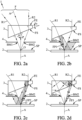
- Fig. 2b shows the effectiveness of the invention in eliminating parasitic rays of the type designated by RP1 above.
- FP1 designates a first beam of stray rays which are produced by reflection on the photosensitive surface SP of the image sensor 2 in the direction of the mask edge BM1.
- the part of this beam FP1 which is to the left of the ray R1 in the figure is directly obscured by the mask 4 at the level of the mask edge BM1, while the complementary part of this beam FP1 is reflected by the output face FS of the component optical 3, then again by the photosensitive surface SP of the image sensor 2 outside the point O to return in the direction of the mask 4 to the right of the ray R2.
- This complementary part of the beam FP1 is then obscured by the mask edge BM2.
- the angle ⁇ is greater than Arcsin[B/(2 ⁇ L)], where Arcsin() designates the reciprocal function of the sine, and B and L have the meanings given above.
- Fig. 2c shows the effectiveness of the invention in eliminating parasitic rays of the type designated by RP2 above.
- FP2 designates a second beam of stray rays which are produced by reflection on the photosensitive surface SP of the image sensor 2 in the direction of the mask edge BM2.
- the part of this beam FP2 which is to the right of the ray R2 in the figure is directly obscured by the mask 4 at the level of the mask edge BM2, while the complementary part of this beam FP2 is reflected by the input face FE of the optical component 3, then again by the photosensitive surface SP of the image sensor 2 outside the point O to return towards the mask 4 to the left of radius R1.
- This complementary part of the beam FP2 is then obscured by the mask edge BM1.
- the angle ⁇ is greater than Arcsin[B/(nL)], approximately, where n still designates the refractive index of the material of the optical component 3.
- FIG. 2d shows the effectiveness of the invention for eliminating stray rays which undergo several internal reflections in the optical component 3, of the type of stray ray which was designated above by RP3.
- the third beam of stray rays FP3 is identical to the second beam FP2 until its internal reflection on the input face FE of the optical component 3, but it then undergoes an internal reflection on the output face FS, then another internal reflection on the entry face FE.
- the beam FP3 is then deflected outside the opening of the mask 4 after having crossed the exit face FS again, regardless of the number of internal reflections that it undergoes inside the optical component 3.
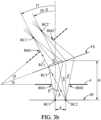
- [ Fig. 3a ] shows the generalization of the first light ray R1 which was introduced in relation to [ Fig. 2a ] in the case where the image field [BC1-BC2] has the non-zero transverse extension d.
- This radius R1 becomes the critical radius RC1 which is indicated in [ Fig. 3a ], coming from the field edge BC2, reflected by the output face FS of the optical component 3, then passing over the mask edge BM1.
- the generalization of the characteristic of the ray R1 is that the critical ray RC1, after its reflection on the exit face FS, is angularly outside a beam which converges on the photosensitive surface SP to form the nominal image, and which is reflected by this photosensitive surface SP then by the exit face FS.
- Such a beam initially converges for example at point O, at the intersection of the optical axis AA with the photosensitive surface SP. It has a half aperture angle ⁇ at point O, which can be limited by the pupil P of the imaging optics 1.
- the left limit of this beam forms an angle with the optical axis AA which is smaller than that formed by the right limit of this same beam.
- This angle of the left limit is 2 ⁇ ⁇ - ⁇ , where ⁇ still denotes the angle between the direction perpendicular to the exit face FS and the optical axis AA.
- the angle ⁇ 1 formed by the critical ray RC1 with the optical axis AA after having been reflected by the exit face FS must be less than 2 ⁇ ⁇ - ⁇ .
- the fact that this inequality is satisfied by the critical ray RC1 which comes from the field edge BC2 and passes over the mask edge BM1 ensures that this same inequality is also satisfied by all the parasitic rays which come from any point of the image field [BC1-BC2], are reflected by the exit face FS then return towards the image sensor 2 by crossing the opening of the mask 4 between the two mask edges BM1 and BM2.
- [ Fig. 3b ] correspond to [ Fig. 3a ] by showing the images of the mask 4 and the image sensor 2 which result from the reflection of the light rays on the output face FS of the optical component 3.
- BM1' and BM2' thus designate the images of the two mask edges BM1 and BM2, respectively.
- BC1' and BC2' designate the geometric images of the two field edges BC1 and BC2, respectively.
- the critical ray RC1 and the beam F as it exists after its reflection on the photosensitive surface SP are unfolded, and make it possible to more easily visualize their angles with the optical axis AA, respectively ⁇ 1 and 2 ⁇ ⁇ - ⁇ .
- ⁇ min 2 ⁇ ⁇ - ⁇ , corresponding to a minimum value which is necessary for the angle ⁇ .
- This minimum value is denoted ⁇ min , and is given by the following equation: 1 ⁇ d/H + tan ⁇ 2 ⁇ x 2 ⁇ 2 ⁇ x ⁇ tan ⁇ ⁇ d/H 2 ⁇ 2 ⁇ d/H ⁇ tan ⁇
- the unknown x is tan( ⁇ min ), tan() denoting the tangent function
- H is the distance between the photosensitive surface SP and the exit face FS, measured parallel to the optical axis AA from the edge of field BC2.
- the value which is thus obtained for ⁇ min is independent of the position of the mask edge BM1 along the critical radius RC1.
- the critical ray RC1 has been called the first critical ray in the general part of this description.
- [ Fig. 3c ] correspond to [ Fig. 3a ] by replacing the parasitic reflection on the output face FS of the optical component 3 by that on its input face FE.
- the critical ray RC2 which is represented there is a generalization of the second light ray R2 of [ Fig. 2a ] At case where the image field [BC1-BC2] has the non-zero transverse extension d.
- field edge BC1 and mask edge BM2 play the roles of field edge BC2 and mask edge BM1 for critical ray RC1, respectively.
- the critical ray RC2 thus comes from the field edge BC1, then undergoes refraction when it crosses the exit face FS, then is reflected by the entry face FE inside the optical component 3, then undergoes again refraction when it crosses the exit face FS in the opposite direction, to pass on the mask edge BM2.
- This critical ray RC2 has been called second critical ray in the general part of this description.
- the angle ⁇ 2 formed by the critical ray RC2 with the optical axis AA at the level of the mask edge BM2 is intended to be less than the smallest of the angles, relative to the optical axis AA, formed by the rays of the beam F after reflection on the photosensitive surface SP, crossing the exit face FS, reflection on the entry face FE, then crossing the exit face FS again.
- This smallest of the angles of the beam F is denoted ⁇ 2 lim in [ Fig. 3c ], and replaces for the parasitic reflection on the input face FE, the limiting angle 2 ⁇ - ⁇ for the case of the parasitic reflection on the exit face FS.
- angles ⁇ 2 and ⁇ 2 lim both have the same direction, which is opposite to that of ⁇ 1 and 2 ⁇ ⁇ - ⁇ , and the inequality ⁇ 2 ⁇ ⁇ 2 lim is to be applied to the positive values of these angles which are relative to their common meaning.
- Those skilled in the art will then know how to construct an unfolded figure for the parasitic reflection on the input face FE, equivalent to [ Fig. 3b ] which was relative to the reflection on the exit face FS.
- a minimum value ⁇ min can be determined according to the invention for the angle ⁇ considering critical radius RC2.
- This value ⁇ min is non-zero, so that the input face FE and the output face FS of the optical component 3 are not parallel. The value which is thus obtained for ⁇ min is independent of the position of the mask edge BM2 along the critical radius RC2.
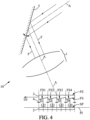
- the output face FS of the optical component 3 has a scale structure, for example with four elementary facets in the form of strips which are elongated perpendicular to the plane of the figure, and designated by the references FS1-FS4. These bands are included in respective planes which are all parallel and offset from one to the next at a constant pitch.
- DJ is the direction of juxtaposition of the facets FS1-FS4 in the output face FS.
- Each elementary facet can be covered with an interference filter whose spectral transmission window varies from one filter to another. In known manner, such interference filters each consist of a stack of thin transparent layers which are superimposed on the corresponding elementary facet.
- the image field portion CI1 is associated with the elementary facet FS1 and with the spectral band of the filter of this facet FS1
- the image field portion CI2 is associated with the elementary facet FS2 and the spectral band of the filter of this facet FS2
- the same thing with the field portion of image CI3 for the facet FS3, and also with the portion of image field CI4 for the facet FS4.
- the mask 4 is then provided with a distinct opening for each pair formed by one of the elementary facets with the portion of image field associated with it, so as to implement the invention separately for each elementary facet with the corresponding opening of the mask 4.
- O1 thus designates the opening which is associated with the facet FS1, O2 the opening associated with the facet FS2, O3 that of the facet FS3 and O4 that of the facet FS4.
- a scanning system is then advantageously added to the instrument 10, such as a rotating mirror 5 for example.
- the axis of rotation of the mirror 5 is oriented so that a progressive rotation of the mirror causes a continuous movement of the image which is formed by the imaging optics 1 on the photosensitive surface SP, parallel to the direction of juxtaposition DJ.
- the same scene element can be captured in image successively within each of the image fields CI1-CI4, to obtain a multispectral image of the complete scene by combining the image contents which are captured successively for each field image.
- Such a multispectral imaging instrument 10 can be particularly useful for space use on board a satellite, in order to collect images of the Earth's surface simultaneously in several spectral bands.
- the imaging optics 1 can be constituted by a telescope, of one of the types known to those skilled in the art.
- the spectral filters can be located on the input face and/or the output face of the optical component
- the ladder shape can be that of the input face or that of the output face.
- the entry face and the exit face can each be in the form of a ladder, provided that the elementary facets of both are consistent with a useful division of the image field on the photosensitive surface of the image sensor.
- the number of image field portions which are thus determined can be any, not necessarily equal to four, and each image field portion can contain any number of neighboring lines of photodetectors, including a single line per portion of image field.
Landscapes
- Physics & Mathematics (AREA)
- General Physics & Mathematics (AREA)
- Optics & Photonics (AREA)
- Astronomy & Astrophysics (AREA)
- Photometry And Measurement Of Optical Pulse Characteristics (AREA)
- Optical Elements Other Than Lenses (AREA)
- Studio Devices (AREA)
Claims (14)
- Bildgebungsinstrument (10), aufweisend:- eine Abbildungsoptik (1), die eingerichtet ist, um ausgehend von Lichtstrahlen, die von der Abbildungsoptik übertragen werden, ein Bild, genannt nominales Bild, in einer Bildebene (PI) zu erzeugen;- einen Bildsensor (2), der eine lichtempfindliche Oberfläche (SP) aufweist und der derart angeordnet ist, dass die lichtempfindliche Oberfläche der Bildebene (PI) überlagert ist; und- eine optische Komponente (3), die auf einem Pfad der Lichtstrahlen ortsfest zwischen der Abbildungsoptik (1) und dem Bildsensor (2) angeordnet ist, wobei die optische Komponente einen Bereich eines lichtbrechenden und für die Lichtstrahlen mindestens teilweise transparenten Materials aufweist, wobei der Bereich zwei ebene Flächen (FE, FS) hat und bei einer Verwendung des Instruments (10) zwischen den zwei Flächen von den Lichtstrahlen durchquert wird,wobei ein nutzbarer Teil der lichtempfindlichen Oberfläche (SP) in einer Längsebene, die eine optische Achse (A-A) des Instruments (10) enthält, von zwei sich gegenüberliegenden Punkten, genannt Feldränder (BC1, BC2), begrenzt wird,wobei in dem Instrument (10) die lichtempfindliche Oberfläche (SP) des Bildsensors (2) und mindestens eine der Flächen (FE, FS) der optischen Komponente (3) jeweilige Reflexionsvermögen besitzen, so dass die Lichtstrahlen, die das nominale Bild erzeugen, von der lichtempfindlichen Oberfläche, dann von der Fläche der optischen Komponente teilweise reflektiert werden und in Richtung der lichtempfindlichen Oberfläche zurückkehren,wobei das Instrument (10) dadurch gekennzeichnet ist, dass es ferner aufweist:- eine Maske (4), die auf dem Pfad der Lichtstrahlen ortsfest zwischen der optischen Komponente (3) und dem Bildsensor (2) angeordnet ist und eine Öffnung aufweist, die in der Längsebene von zwei sich gegenüberliegenden Maskenrändern (BM1, BM2) begrenzt wird, wobei bei der Verwendung des Instruments (10) die Lichtstrahlen durch die Öffnung hindurchgehen,wobei in der Längsebene ein erster der Maskenränder (BM1, BM2) und ein erster der Feldränder (BC1, BC2) auf einer gleichen ersten lateralen Seite der optischen Achse (A-A) des Instruments (10) zwischen der optischen Komponente (3) und dem Bildsensor (2) angeordnet sind, und ein zweiter der Maskenränder (BM1, BM2) und ein zweiter der Feldränder (BC1, BC2) auf einer gleichen zweiten lateralen Seite der optischen Achse (A-A), die der ersten lateralen Seite gegenüberliegt, angeordnet sind,wobei der erste Maskenrand ein Lichtbündel begrenzt, das von der Abbildungsoptik (1) übertragen wird und das zum ersten Feldrand konvergiert, und der zweite Maskenrand ein anderes Lichtbündel begrenzt, das von der Abbildungsoptik übertragen wird und das zum zweiten Feldrand konvergiert,und dadurch, dass für mindestens diejenige der Flächen (FE, FS) der optischen Komponente (3), die ein Reflexionsvermögen besitzt, ein Neigungswinkel einer zu der Fläche senkrechten Richtung bezüglich der optischen Achse (A-A) zwischen der optischen Komponente und dem Bildsensor (2) und in der Längsebene derart ist, dass ein Lichtstrahl, genannt kritischer Strahl, der von dem zweiten Feldrand herkommt, dann von der besagten Fläche der optischen Komponente reflektiert wird, um den ersten Maskenrand zu streifen, in Höhe des ersten Maskenrands einen Winkel (γ1, γ2) mit der optischen Achse bildet, der kleiner ist als ein kleinster der Winkel, die Reflexionen an der lichtempfindlichen Oberfläche (SP) des Bildsensors, dann an der besagten Fläche der optischen Komponente aller von der Abbildungsoptik (1) in Richtung des Bildsensors übertragener Lichtstrahlen mit der optischen Achse bilden.
- Instrument (10) nach Anspruch 1, in welchem die Abbildungsoptik (1) eine Pupille (P) besitzt, die für die Lichtstrahlen wirksam ist, die von der Abbildungsoptik durch die optische Komponente (3) hindurch in Richtung des Bildsensors (2) übertragen werden,
und in welchem der kritische Strahl nach Reflexion an der Fläche der optischen Komponente (3) angular außerhalb eines Bündels orientiert ist, wie ein solches aus der Reflexion an der lichtempfindlichen Oberfläche (SP), dann an der besagten Fläche der optischen Komponente der von der Abbildungsoptik (1) über die optische Komponente übertragenen und von der Pupille (P) der Abbildungsoptik begrenzten Lichtstrahlen resultiert. - Instrument (10) nach Anspruch 2, in welchemder erste Maskenrand in der Längsebene von einer ersten Grenze überlagert ist, die von der Pupille (P) der Abbildungsoptik (1) erzeugt und für die Lichtstrahlen wirksam ist, die zu dem ersten Feldrand gelangen, und/oderder zweite Maskenrand in der Längsebene von einer zweiten Grenze überlagert ist, die von der Pupille (P) der Abbildungsoptik (1) erzeugt und für die Lichtstrahlen wirksam ist, die zu dem zweiten Feldrand gelangen.
- Instrument (10) nach einem der Ansprüche 1 bis 3, in welchem diejenige Fläche der optischen Komponente (3), die geneigt ist, damit der kritische Strahl bezüglich der optischen Achse (A-A) weniger schräg als alle von der Abbildungsoptik (1) übertragenen Lichtstrahlen nach Reflexion der Lichtstrahlen an der besagten Fläche der optischen Komponente ist, eine dem Bildsensor (2) zugewandte Austrittsfläche (FS) der optischen Komponente ist.
- Instrument (10) nach einem der Ansprüche 1 bis 3,in welchem die optische Komponente (3) eine dem Bildsensor (2) zugewandte Austrittsfläche (FS) und eine der Abbildungsoptik (1) zugewandte Eintrittsfläche (FE) aufweist,und in welchem diejenige Fläche der optischen Komponente (3), die geneigt ist, damit der kritische Strahl bezüglich der optischen Achse (A-A) weniger schräg als alle von der Abbildungsoptik (1) übertragenen Lichtstrahlen nach Reflexion der Lichtstrahlen an der besagten Fläche der optischen Komponente ist, die Eintrittsfläche (FE) ist,wobei jedes Mal, wenn der kritische Strahl und die Lichtstrahlen die Austrittsfläche (FS) überqueren, der kritische Strahl und die Lichtstrahlen einer Brechung unterworfen werden.
- Instrument (10) nach einem der Ansprüche 1 bis 3,in welchem die optische Komponente (3) eine dem Bildsensor (2) zugewandte Austrittsfläche (FS) und eine der Abbildungsoptik (1) zugewandte Eintrittsfläche (FE) aufweist, wobei die Austrittsfläche und die Eintrittsfläche jeweilige Reflexionsvermögen haben, wobeidie Austrittsfläche (FS) bezüglich einer Ebene, die senkrecht zur optischen Achse (A-A) zwischen der optischen Komponente (3) und dem Bildsensor (2) ist, in einem solchen Sinne, dass eine zur Austrittsfläche senkrechte Richtung sich von dem ersten Maskenrand (BM1) in Richtung des zweiten Maskenrands (BM2) entfernt, und mit einem solchen Winkelwert geneigt ist, dass ein erster kritischer Strahl (RC1), der von dem zweiten Feldrand (BC2) herkommt, dann von der Austrittsfläche reflektiert wird, um den ersten Maskenrand (BM1) zu streifen, einen ersten Winkel (γ1) bezüglich der optischen Achse in Höhe des ersten Maskenrands bildet, der kleiner ist als der kleinste (2*Θ - β) der Winkel, die Reflexionen an der lichtempfindlichen Oberfläche (SP), dann an der Austrittsfläche aller von der Abbildungsoptik (1) in Richtung des Bildsensors übertragener Lichtstrahlen mit der optischen Achse bilden,und die Eintrittsfläche (FE) bezüglich der Austrittsfläche (FS) geneigt ist, derart, dass ein zweiter kritischer Strahl (RC2), der von dem ersten Feldrand (BC1) herkommt, die Austrittsfläche überquert, dann von der Eintrittsfläche reflektiert wird, wieder die Austrittsfläche überquert, um den zweiten Maskenrand (BM2) zu streifen, einen zweiten Winkel (γ2) bezüglich der optischen Achse in Höhe der zweiten Maske bildet, der kleiner ist als der kleinste der Winkel (γ2lim), den Reflexionen an der lichtempfindlichen Oberfläche (SP), dann an der Eintrittsfläche aller von der Abbildungsoptik (1) in Richtung des Bildsensors (2) übertragener Lichtstrahlen mit der optischen Achse bilden, wobei jedes Mal, wenn der zweite kritische Strahl und die Lichtstrahlen die Austrittsfläche der optischen Komponente überqueren, der zweite kritische Strahl und die Lichtstrahlen einer Brechung unterworfen werden,eine zur Austrittsfläche (FS) der optischen Komponente (3) senkrechte Richtung einen Winkel (Θ) von ungleich Null mit der optischen Achse (A-A), so wie diese optische Achse zwischen der optischen Komponente (3) und dem Bildsensor (2) orientiert ist, bildet, unddie Eintrittsfläche (FE) und die Austrittsfläche (FS) der optischen Komponente miteinander einen Winkel (ω) von ungleich Null bilden.
- Instrument (10) nach einem der vorstehenden Ansprüche, in welchem der nutzbare Teil der lichtempfindlichen Oberfläche (SP) des Bildsensors (2) in der Längsebene auf einen einzigen Fotodetektor begrenzt ist,und in welchem die Austrittsfläche (FS) der optischen Komponente (3) senkrecht zu einem ersten Lichtstrahl (R1) ist, der zu dem Fotodetektor gelangen würde, so, wie der erste Lichtstrahl in Höhe der Austrittsfläche orientiert wäre,und in welchem die Eintrittsfläche (FE) der optischen Komponente (3) senkrecht zu einem zweiten Lichtstrahl (R2) ist, der nach Überqueren der optischen Komponente zu dem Fotodetektor gelangen würde, so, wie der zweite Lichtstrahl in Höhe der Eintrittsfläche orientiert wäre,und in welchem die Maske (4) eingerichtet ist, um das Bündel der Lichtstrahlen, die dadurch, dass sie von der Abbildungsoptik (1) übertragen worden sind, zu dem Fotodetektor gelangen, auf einen Winkelsektor zu begrenzen, der in der Längsebene zwischen dem ersten (R1) und dem zweiten (R2) Lichtstrahl liegt.
- Instrument (10) nach einem der vorstehenden Ansprüche, in welchem die optische Komponente (3) ein Spektralfilter oder ein Satz von nebeneinander angeordneten Spektralfiltern, jedes in Form eines Bandfilters, ist, wobei jedes Spektralfilter wirksam ist, um Lichtstrahlen, die in einem Spektralfenster des Spektralfilters enthalten sind, selektiv zu übertragen.
- Instrument (10) nach einem der vorstehenden Ansprüche, in welchem die Fläche oder diejenige der Flächen der optischen Komponente (3), die ein Reflexionsvermögen besitzt, mehrere elementare Facetten (FS1-FS4) in Form von Streifen aufweist, die in einer Anordnungsrichtung (DJ), die senkrecht zu einer gemeinsamen Längsrichtung aller elementarer Facetten ist, nebeneinander angeordnet sind, wobei die elementaren Facetten eins zu eins in Ebenen enthalten sind, die alle parallel und zueinander versetzt sind,wobei von der Abbildungsoptik (1) übertragene Lichtstrahlen, die unterschiedliche elementare Facetten (FS1-FS4) überqueren, hin zu getrennten Teilen der lichtempfindlichen Oberfläche (SP) des Bildsensors (2) konvergieren,jeder elementaren Facette (FS1-FS4) separat von anderen elementaren Facetten eine jeweilige Öffnung der Maske (01-04) zugeordnet ist, um so die Merkmale des Anspruchs 1 für alle elementaren Facetten wiederzugeben,und das Instrument (10) mit einem Abtastsystem (5) kombiniert ist, das eingerichtet ist, um das nominale Bild auf der lichtempfindlichen Oberfläche (SP) des Bildsensors (2) in eine Abtastrichtung abzutasten, die eine zur Anordnungsrichtung (DJ) der elementaren Facetten (FS1-FS4) parallele Komponente besitzt.
- Instrument (10) nach Anspruch 9, in welchem die optische Komponente (3) N elementare Facetten aufweist, die in der Längsebene nebeneinander angeordnet und alle in einem gleichen Winkel bezüglich der optischen Achse (A-A) geneigt sind, wobei N eine ganze Zahl größer oder gleich zwei und kleiner oder gleich sechzehn ist.
- Instrument (10) nach Anspruch 9 oder 10, in welchem jede elementare Facette (FS1-FS4) der optischen Komponente (3) mit einem jeweiligen Spektralfilter assoziiert ist, derart, dass ein spektrales Übertragungsfenster, das mit einer der elementaren Facetten assoziiert ist, sich von dem spektralen Übertragungsfenster, das mit jeder anderen elementaren Facette assoziiert ist, unterscheidet.
- Instrument (10) nach einem der vorstehenden Ansprüche, in welchem die Abbildungsoptik (1) ein Teleskop ist.
- Bildgebungsverfahren, das ein Bildgebungsinstrument (10) nach einem der vorstehenden Ansprüche verwendet.
- Bildgebungsverfahren nach Anspruch 13 vom Typ multispektrales Bildgebungsverfahren, gemäß welchem das Bildgebungsinstrument (10) Anspruch 11 entspricht und gemäß welchem das Bildgebungsinstrument an Bord eines Satelliten in einer Erdumlaufbahn verwendet wird.
Applications Claiming Priority (1)
| Application Number | Priority Date | Filing Date | Title |
|---|---|---|---|
| FR2200652A FR3132151B1 (fr) | 2022-01-26 | 2022-01-26 | Instrument d’imagerie |
Publications (3)
| Publication Number | Publication Date |
|---|---|
| EP4220246A1 EP4220246A1 (de) | 2023-08-02 |
| EP4220246B1 true EP4220246B1 (de) | 2024-08-07 |
| EP4220246C0 EP4220246C0 (de) | 2024-08-07 |
Family
ID=81748942
Family Applications (1)
| Application Number | Title | Priority Date | Filing Date |
|---|---|---|---|
| EP22216678.7A Active EP4220246B1 (de) | 2022-01-26 | 2022-12-26 | Bildgebungsinstrument |
Country Status (2)
| Country | Link |
|---|---|
| EP (1) | EP4220246B1 (de) |
| FR (1) | FR3132151B1 (de) |
Family Cites Families (3)
| Publication number | Priority date | Publication date | Assignee | Title |
|---|---|---|---|---|
| FR2696892B1 (fr) * | 1992-10-09 | 1994-12-09 | Thomson Csf | Caméra infrarouge protégée contre les modulations parasites de flux capté. |
| US5835228A (en) * | 1996-01-19 | 1998-11-10 | Dainippon Screen Mfg. Co., Ltd. | Image pickup apparatus, density measuring optical system and scanning optical microscope |
| FR2959903B1 (fr) * | 2010-05-04 | 2012-07-27 | Astrium Sas | Procede d'imagerie polychrome |
-
2022
- 2022-01-26 FR FR2200652A patent/FR3132151B1/fr active Active
- 2022-12-26 EP EP22216678.7A patent/EP4220246B1/de active Active
Also Published As
| Publication number | Publication date |
|---|---|
| EP4220246A1 (de) | 2023-08-02 |
| FR3132151B1 (fr) | 2024-01-12 |
| EP4220246C0 (de) | 2024-08-07 |
| FR3132151A1 (fr) | 2023-07-28 |
Similar Documents
| Publication | Publication Date | Title |
|---|---|---|
| EP2220523B1 (de) | Optischer leiter und optisches system für sehkraft | |
| EP3607585B1 (de) | Vorrichtung und verfahren zur multispektralen bildgebung im infrarotbereich | |
| EP1745329B1 (de) | Projektionsmodul und dieses enthaltender projektor | |
| FR2665773A1 (fr) | Dispositif de projection d'images utilisant deux composantes orthogonales de polarisation de la lumiere. | |
| EP0572292B1 (de) | Farbstrahlteiler und Abbildungsprojektor der diesen benutzt | |
| FR2550902A1 (fr) | Camera de television en couleur | |
| EP4220246B1 (de) | Bildgebungsinstrument | |
| EP3237860A1 (de) | Weitfeld-infrarot-bildgebungssystem | |
| EP0121962A2 (de) | Vorrichtung zur optischen Kopplung zwischen Lichtwellenleitern | |
| EP0402194B1 (de) | Interferometrische Vorrichtung, insbesondere für ein sich bewegendes Spektralabbildungsgerät mit Multiplex-Fourier-Transformation und diese Vorrichtung enthaltendes Spektralabbildungsgerät | |
| EP0138646B1 (de) | Raumfeldzerlegungsanordnung zur Winkellokalisierung Strahlender Objekte | |
| FR2532765A1 (fr) | Dispositif de detection de position de mise au point | |
| EP3916462B1 (de) | Optisches instrument mit teleskopfunktion und mehreren kanälen | |
| EP3899458B1 (de) | Instrument mit mehreren optischen kanälen | |
| WO2022129770A2 (fr) | Systeme optique imageur a trois miroirs | |
| EP0130869A1 (de) | Video-Abbildungsgerät, insbesondere für sich selbst lenkende Körper | |
| EP0811173B1 (de) | Weitwinklige spektrale unterdrückungsvorrichtung und verfahren zu ihrer herstellung | |
| EP3807689B1 (de) | Anamorphotisches nachtsichtfernglas | |
| FR2653879A1 (fr) | Spectrographe a reseau de diffraction convexe. | |
| EP0872752A1 (de) | Interferometrisches Telescopsystem | |
| EP2002226B1 (de) | Spektrumbildungseinrichtung auf einem optischen sensor mit räumlicher sperrung | |
| EP1279989B1 (de) | Bildprojektionsvorrichtung mit dichroitischen Gradientenfiltern | |
| EP3525015A1 (de) | Optisches monoblockelement mit diaphragma | |
| EP4235253B1 (de) | Fünfspiegelteleskop | |
| CA3123482C (fr) | Instrument a plusieurs voies optiques |
Legal Events
| Date | Code | Title | Description |
|---|---|---|---|
| PUAI | Public reference made under article 153(3) epc to a published international application that has entered the european phase |
Free format text: ORIGINAL CODE: 0009012 |
|
| STAA | Information on the status of an ep patent application or granted ep patent |
Free format text: STATUS: THE APPLICATION HAS BEEN PUBLISHED |
|
| AK | Designated contracting states |
Kind code of ref document: A1 Designated state(s): AL AT BE BG CH CY CZ DE DK EE ES FI FR GB GR HR HU IE IS IT LI LT LU LV MC ME MK MT NL NO PL PT RO RS SE SI SK SM TR |
|
| STAA | Information on the status of an ep patent application or granted ep patent |
Free format text: STATUS: REQUEST FOR EXAMINATION WAS MADE |
|
| 17P | Request for examination filed |
Effective date: 20240108 |
|
| RBV | Designated contracting states (corrected) |
Designated state(s): AL AT BE BG CH CY CZ DE DK EE ES FI FR GB GR HR HU IE IS IT LI LT LU LV MC ME MK MT NL NO PL PT RO RS SE SI SK SM TR |
|
| GRAP | Despatch of communication of intention to grant a patent |
Free format text: ORIGINAL CODE: EPIDOSNIGR1 |
|
| STAA | Information on the status of an ep patent application or granted ep patent |
Free format text: STATUS: GRANT OF PATENT IS INTENDED |
|
| RIC1 | Information provided on ipc code assigned before grant |
Ipc: G02B 27/00 20060101ALI20240423BHEP Ipc: G02B 23/02 20060101ALI20240423BHEP Ipc: G02B 5/00 20060101AFI20240423BHEP |
|
| INTG | Intention to grant announced |
Effective date: 20240516 |
|
| GRAS | Grant fee paid |
Free format text: ORIGINAL CODE: EPIDOSNIGR3 |
|
| GRAA | (expected) grant |
Free format text: ORIGINAL CODE: 0009210 |
|
| STAA | Information on the status of an ep patent application or granted ep patent |
Free format text: STATUS: THE PATENT HAS BEEN GRANTED |
|
| AK | Designated contracting states |
Kind code of ref document: B1 Designated state(s): AL AT BE BG CH CY CZ DE DK EE ES FI FR GB GR HR HU IE IS IT LI LT LU LV MC ME MK MT NL NO PL PT RO RS SE SI SK SM TR |
|
| REG | Reference to a national code |
Ref country code: GB Ref legal event code: FG4D Free format text: NOT ENGLISH |
|
| REG | Reference to a national code |
Ref country code: CH Ref legal event code: EP |
|
| REG | Reference to a national code |
Ref country code: DE Ref legal event code: R096 Ref document number: 602022005174 Country of ref document: DE |
|
| REG | Reference to a national code |
Ref country code: IE Ref legal event code: FG4D Free format text: LANGUAGE OF EP DOCUMENT: FRENCH |
|
| U01 | Request for unitary effect filed |
Effective date: 20240807 |
|
| U07 | Unitary effect registered |
Designated state(s): AT BE BG DE DK EE FI FR IT LT LU LV MT NL PT RO SE SI Effective date: 20240902 |
|
| PG25 | Lapsed in a contracting state [announced via postgrant information from national office to epo] |
Ref country code: NO Free format text: LAPSE BECAUSE OF FAILURE TO SUBMIT A TRANSLATION OF THE DESCRIPTION OR TO PAY THE FEE WITHIN THE PRESCRIBED TIME-LIMIT Effective date: 20241107 |
|
| PG25 | Lapsed in a contracting state [announced via postgrant information from national office to epo] |
Ref country code: GR Free format text: LAPSE BECAUSE OF FAILURE TO SUBMIT A TRANSLATION OF THE DESCRIPTION OR TO PAY THE FEE WITHIN THE PRESCRIBED TIME-LIMIT Effective date: 20241108 Ref country code: PL Free format text: LAPSE BECAUSE OF FAILURE TO SUBMIT A TRANSLATION OF THE DESCRIPTION OR TO PAY THE FEE WITHIN THE PRESCRIBED TIME-LIMIT Effective date: 20240807 |
|
| PG25 | Lapsed in a contracting state [announced via postgrant information from national office to epo] |
Ref country code: IS Free format text: LAPSE BECAUSE OF FAILURE TO SUBMIT A TRANSLATION OF THE DESCRIPTION OR TO PAY THE FEE WITHIN THE PRESCRIBED TIME-LIMIT Effective date: 20241207 |
|
| PG25 | Lapsed in a contracting state [announced via postgrant information from national office to epo] |
Ref country code: HR Free format text: LAPSE BECAUSE OF FAILURE TO SUBMIT A TRANSLATION OF THE DESCRIPTION OR TO PAY THE FEE WITHIN THE PRESCRIBED TIME-LIMIT Effective date: 20240807 |
|
| PG25 | Lapsed in a contracting state [announced via postgrant information from national office to epo] |
Ref country code: RS Free format text: LAPSE BECAUSE OF FAILURE TO SUBMIT A TRANSLATION OF THE DESCRIPTION OR TO PAY THE FEE WITHIN THE PRESCRIBED TIME-LIMIT Effective date: 20241107 Ref country code: ES Free format text: LAPSE BECAUSE OF FAILURE TO SUBMIT A TRANSLATION OF THE DESCRIPTION OR TO PAY THE FEE WITHIN THE PRESCRIBED TIME-LIMIT Effective date: 20240807 |
|
| PG25 | Lapsed in a contracting state [announced via postgrant information from national office to epo] |
Ref country code: RS Free format text: LAPSE BECAUSE OF FAILURE TO SUBMIT A TRANSLATION OF THE DESCRIPTION OR TO PAY THE FEE WITHIN THE PRESCRIBED TIME-LIMIT Effective date: 20241107 Ref country code: PL Free format text: LAPSE BECAUSE OF FAILURE TO SUBMIT A TRANSLATION OF THE DESCRIPTION OR TO PAY THE FEE WITHIN THE PRESCRIBED TIME-LIMIT Effective date: 20240807 Ref country code: NO Free format text: LAPSE BECAUSE OF FAILURE TO SUBMIT A TRANSLATION OF THE DESCRIPTION OR TO PAY THE FEE WITHIN THE PRESCRIBED TIME-LIMIT Effective date: 20241107 Ref country code: IS Free format text: LAPSE BECAUSE OF FAILURE TO SUBMIT A TRANSLATION OF THE DESCRIPTION OR TO PAY THE FEE WITHIN THE PRESCRIBED TIME-LIMIT Effective date: 20241207 Ref country code: HR Free format text: LAPSE BECAUSE OF FAILURE TO SUBMIT A TRANSLATION OF THE DESCRIPTION OR TO PAY THE FEE WITHIN THE PRESCRIBED TIME-LIMIT Effective date: 20240807 Ref country code: GR Free format text: LAPSE BECAUSE OF FAILURE TO SUBMIT A TRANSLATION OF THE DESCRIPTION OR TO PAY THE FEE WITHIN THE PRESCRIBED TIME-LIMIT Effective date: 20241108 Ref country code: ES Free format text: LAPSE BECAUSE OF FAILURE TO SUBMIT A TRANSLATION OF THE DESCRIPTION OR TO PAY THE FEE WITHIN THE PRESCRIBED TIME-LIMIT Effective date: 20240807 |
|
| U20 | Renewal fee for the european patent with unitary effect paid |
Year of fee payment: 3 Effective date: 20241227 |
|
| PG25 | Lapsed in a contracting state [announced via postgrant information from national office to epo] |
Ref country code: SM Free format text: LAPSE BECAUSE OF FAILURE TO SUBMIT A TRANSLATION OF THE DESCRIPTION OR TO PAY THE FEE WITHIN THE PRESCRIBED TIME-LIMIT Effective date: 20240807 |
|
| PG25 | Lapsed in a contracting state [announced via postgrant information from national office to epo] |
Ref country code: CZ Free format text: LAPSE BECAUSE OF FAILURE TO SUBMIT A TRANSLATION OF THE DESCRIPTION OR TO PAY THE FEE WITHIN THE PRESCRIBED TIME-LIMIT Effective date: 20240807 |
|
| PG25 | Lapsed in a contracting state [announced via postgrant information from national office to epo] |
Ref country code: SK Free format text: LAPSE BECAUSE OF FAILURE TO SUBMIT A TRANSLATION OF THE DESCRIPTION OR TO PAY THE FEE WITHIN THE PRESCRIBED TIME-LIMIT Effective date: 20240807 |
|
| PLBE | No opposition filed within time limit |
Free format text: ORIGINAL CODE: 0009261 |
|
| STAA | Information on the status of an ep patent application or granted ep patent |
Free format text: STATUS: NO OPPOSITION FILED WITHIN TIME LIMIT |
|
| PG25 | Lapsed in a contracting state [announced via postgrant information from national office to epo] |
Ref country code: MC Free format text: LAPSE BECAUSE OF FAILURE TO SUBMIT A TRANSLATION OF THE DESCRIPTION OR TO PAY THE FEE WITHIN THE PRESCRIBED TIME-LIMIT Effective date: 20240807 |
|
| 26N | No opposition filed |
Effective date: 20250508 |
|
| PG25 | Lapsed in a contracting state [announced via postgrant information from national office to epo] |
Ref country code: IE Free format text: LAPSE BECAUSE OF NON-PAYMENT OF DUE FEES Effective date: 20241226 |
|
| U20 | Renewal fee for the european patent with unitary effect paid |
Year of fee payment: 4 Effective date: 20251230 |