EP4220428A1 - Erzeugung eines index für einen datenspeicher - Google Patents
Erzeugung eines index für einen datenspeicher Download PDFInfo
- Publication number
- EP4220428A1 EP4220428A1 EP22153967.9A EP22153967A EP4220428A1 EP 4220428 A1 EP4220428 A1 EP 4220428A1 EP 22153967 A EP22153967 A EP 22153967A EP 4220428 A1 EP4220428 A1 EP 4220428A1
- Authority
- EP
- European Patent Office
- Prior art keywords
- data storage
- data
- index
- index generation
- generation command
- Prior art date
- Legal status (The legal status is an assumption and is not a legal conclusion. Google has not performed a legal analysis and makes no representation as to the accuracy of the status listed.)
- Withdrawn
Links
Images

Classifications
-
- G—PHYSICS
- G06—COMPUTING OR CALCULATING; COUNTING
- G06F—ELECTRIC DIGITAL DATA PROCESSING
- G06F16/00—Information retrieval; Database structures therefor; File system structures therefor
- G06F16/20—Information retrieval; Database structures therefor; File system structures therefor of structured data, e.g. relational data
- G06F16/22—Indexing; Data structures therefor; Storage structures
-
- G—PHYSICS
- G06—COMPUTING OR CALCULATING; COUNTING
- G06F—ELECTRIC DIGITAL DATA PROCESSING
- G06F16/00—Information retrieval; Database structures therefor; File system structures therefor
- G06F16/20—Information retrieval; Database structures therefor; File system structures therefor of structured data, e.g. relational data
- G06F16/24—Querying
- G06F16/245—Query processing
- G06F16/2453—Query optimisation
- G06F16/24534—Query rewriting; Transformation
- G06F16/24549—Run-time optimisation
Definitions
- the present invention relates to a system and a computer-implemented method for generation of an index for a data storage, as well as a computer program product.
- IT systems are diverse in terms of the system types they are integrating and in terms of their deployment.
- IT systems are becoming increasingly connected to optimize business processes (e.g., logistics' life cycle tracking, digital threads, data marketplaces, IIoT, etc.)
- business processes e.g., logistics' life cycle tracking, digital threads, data marketplaces, IIoT, etc.
- applications with different data structures, data persistence technologies and programming languages being integrated together is increasing. Additionally, this results in distributed and decentralized IT systems spanning across multiple locations, deploy environments and business who govern their part of data and infrastructure.
- An index or index structure is used to allow fast queries/access to data in a data storage or database.
- an index can be used to sort large data sets according to given criteria.
- Manual optimization and indexing approaches usually are not scalable, will not result in optimal solution, and might not even be possible due to a decentralized nature of the data and the dynamic usage of data querying.
- An example of such decentralized system is an energy data marketplace, which consists of many different sub-systems and a wide variety of client applications performing different types of tasks (automatic trading, forecasting, monitoring and measuring, ...) and queries, all of which produces and consumes data with different and very often dynamic data structures.
- client systems are often updated, exchanged, which brings additional new requirements in terms of querying capabilities, all of which cannot be planned during the system design, creation and setup. This often results in slow querying and data retrieval because the system cannot be manually optimized by updating or generating new indices quick enough.
- the invention provides according to the first aspect a system for generation of an index for a data storage, comprising:
- the terms “perform”, “calculate”, “computer-aided”, “compute”, “discover”, “generate”, “configure”, “reconstruct” and the like preferably relate to actions and/or processes and/or processing steps that alter and/or produce data and/or that convert data into other data, the data being able to be presented or available as physical variables, in particular, for example as electrical impulses.
- the expression “computer” should be interpreted as broadly as possible in order to cover in particular all electronic devices having data processing properties.
- Computers can therefore be for example personal computers, servers, programmable logic controllers (PLCs), handheld computer systems, Pocket PC devices, mobile radios and other communication devices that can process data in computer-aided fashion, processors, and other electronic devices for data processing.
- PLCs programmable logic controllers
- Pocket PC devices Pocket PC devices
- mobile radios and other communication devices that can process data in computer-aided fashion, processors, and other electronic devices for data processing.
- a processor can be understood to mean for example a machine or an electronic circuit.
- a processor can be in particular a central processing unit (CPU), a microprocessor or a microcontroller, for example an application-specific integrated circuit or a digital signal processor, possibly in combination with a memory unit for storing program instructions, etc.
- a processor can, by way of example, also be an IC (integrated circuit), in particular an FPGA (field programmable gate array) or an ASIC (application-specific integrated circuit), or a DSP (digital signal processor) or a graphics processor GPU (graphics processing unit).
- a processor can also be understood to mean a virtualized processor, a virtual machine or a soft CPU.
- a programmable processor that is equipped with configuration steps for carrying out the method according to embodiments of the invention or that is configured by means of configuration steps such that the programmable processor realizes the features according to embodiments of the invention for the method, the component, the modules or other aspects and/or sub-aspects of embodiments of the invention.
- a “module” can be understood to mean for example a processor and/or a memory unit for storing program instructions.
- the processor is configured specifically to execute the program instructions such that the processor performs functions to implement or perform the method according to embodiments of the invention or a step of the method according to embodiments of the invention.
- assign in particular in regard to data and/or information, can be understood to mean for example computer-aided assignment of data and/or information.
- provision in particular in regard to data and/or information, can be understood to mean for example computer-aided provision.
- Provision is effected for example via an interface (e.g. a database interface, a network interface, an interface to a memory unit).
- This interface can be used for example to convey and/or send and/or retrieve and/or receive applicable data and/or information during the provision.
- a “data storage” can for example be a database, a blockchain, a data processing pipeline, a file storage, an object storage, etc..
- an index for, e.g., efficient data query
- multiple indices can be generated automatically.
- the system is in particular technology and/or data structure agnostic and can be run in parallel to the data storage.
- the system is easily scalable. Time and/or resources, e.g., computing resources, spent on identifying querying bottlenecks and deriving a custom solution to each data query can be drastically decreased. Therefore, power consumption can be reduced and/or slow performing queries can be eliminated.
- the generator may further be configured to generate the index generation command by means of a trained machine learning model which is trained to output an index generation command based on data queries, an operational objective and/or on the type of the data storage.
- a trained machine learning model can be an artificial intelligence (AI) algorithm, e.g., an artificial neural network, random forests, or support vector machines. It can be for example trained using data query data/data queries, an operational objective and/or type of data storage as input training data and previously assigned index generation commands. The output are observed metadata that can be compared against the input set of metadata and verified if the operational objectives were improved/satisfied. Therefore, the index generation can be AI-based. Furthermore, the machine learning model can be continuously improved using respective monitoring data or metadata.
- AI artificial intelligence
- An example can be reinforcement learning (RL) where the training agent learns to achieve a goal in an uncertain and often potential environment. Actions that were tried out when searching for optimal solution can be rewarded if the result improved or can be penalized if the result worsened. To set penalties and rewards, monitoring feedback can be taken to compare new metadata against the metadata that needed optimization. RL Actions would be in the proposed invention the different variants of index generation commands, RL observations the provided metadata, RL reward/penalty related the increase or decrease in the overall performance of the queries.
- the machine learning model may be trained based on monitoring data provided by the first, second and/or third monitoring module, respectively.
- the generator may be configured to generate the index generation command at a certain point in time or in certain time steps.
- the index generation can be triggered based on certain events, e.g., slow query performance when querying data from the data storage. Performing index generation on specified times further prevents continuous re-indexing, which could degrade the overall performance of the data storage.
- the second monitoring module may further be configured to analyse metadata of the executed data queries and wherein the generator is further configured to generate an index generation command also depending on the metadata.
- Metadata can for example be parameters of the data query, an execution speed and/or an execution plan (i.e., a sequence of steps that are executed for accessing the data that are being queried).
- the metadata can be for example used to improve the generation of the index generation command.
- system may further comprise a testing module configured to evaluate the generated index generation command, wherein
- the application module may be configured to apply the index generation command to the data storage depending on the evaluation result.
- a testing module can be for example a sandbox environment.
- the testing module preferably comprises an instance of the data storage such that the generated index generation command can be tested before applying it to the data storage.
- the data storage may be distributed and/or decentralized, and at least two index generation commands may be generated and sent to respective parts of the distributed data storage.
- the data storage can be a distributed and/or a decentralized database which is distributed across multiple host environments.
- the generator can then be configured to provide index generation commands for different nodes of the database. Then, the generated index generation commands can be shared across the distributed data storage.
- the generator may be run by the host environment of the data storage.
- the operation module may be configured to set an operation mode of the system.
- the application module may be configured to apply the index generation command to the data storage depending on the operation mode.
- An operation mode may for example be fully automatic or semi-automatic, wherein the latter may involve an additional confirmation before applying the index generation command to the data storage.
- the invention provides a computer-implemented method for index generation for a data storage, comprising the method steps:
- a computer program product non-transitory computer readable storage medium having instructions, which when executed by a processor, perform actions
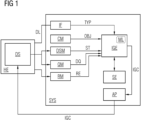
- Figure 1 shows a block diagram illustrating an embodiment of the system SYS for generation of an index or of indices for a data storage DS.
- the data storage DS is run in a host environment HE.
- the host environment HE can be for example a computing resource running the data storage.
- the system SYS is connected to the data storage DS and the host environment via a data connection DL, such that the system SYS can send and/or receive data from the data storage DS and/or the host environment HE.
- the data storage DS can be further connected to multiple devices configured to query data from the data storage DS.
- the system SYS provides index generation commands IGC, which are configured to create at least one index for the data storage enabling efficient data queries.
- the system SYS comprises an interface IF, an operation module CM, a first monitoring module DSM, a second monitoring module QM, a third monitoring module RM, a generator IGE, and an application module AP.
- the system SYS can further comprise a testing module SE.
- the modules are preferably connected to each other, such that data can be exchanged between the modules.
- system SYS comprises only one monitoring module wherein said one monitoring module has the functionality of the first, second and third monitoring module.
- the generator IGE is run by the host environment HE of the data storage DS or by another host environment.
- the interface IF is configured to connect the system SYS to the data storage DS.
- the interface is configured to determine a type TYP of data storage.
- the operation module CM is configured to set an operational objective for operating the system.
- the operational objective relates to the index generation.
- the operation module CM sends the operational objective to the generator IGE.
- the operational objective can be set to minimizing use of computational resources, minimizing RAM consumption, or maximizing query performance.
- the configuration module CM is configured to set an operation mode of the system, e.g., a full automatic or semi-automatic mode with respect to applying the generated index generation command to the data storage.
- the first monitoring module DSM is configured to monitor a data structure of data stored in the data storage DS.
- the first monitoring module monitors DSM analyses the data structure of artefacts stored in the data storage.
- the second monitoring module QM is configured to monitor at least one executed data query (or a set of data queries) querying data stored in the data storage.
- the second monitoring modules analyses all executed data queries sent to the data storage.
- metadata of the executed data queries are analysed. Metadata can for example be query parameters, an execution speed and/or an execution plan.
- the third monitoring module RM is configured to monitor a usage of resources by the host environment HE of the data storage. For example, the third monitoring module RM monitors used and available resources, e.g., processing power, storage, or temporary data storage space (RAM).
- used and available resources e.g., processing power, storage, or temporary data storage space (RAM).
- the first, second and third monitoring modules provide the respective monitored data to the generator IGE.
- the generator IGE is configured to generate at least one index generation command with regard to the operational objective OBJ and depending on the data structure ST and a type of the data storage TYP, the data query DQ and the usage of resources RE.
- the index generation command (or the index generation commands) comprises instructions for generating an index for the data storage.
- the generator IGE is further configured to generate an index generation command IGC also depending on metadata of the data queries.
- the generator IGE is further configured to generate the index generation command by means of a trained machine learning model ML.
- the trained machine learning model e.g., an artificial neural network, can be trained to output an index generation command based on given data queries, an operational objective and/or on the type of the data storage.
- the machine learning model ML can be improved using monitoring data provided by the first, second and/or third monitoring module to validate the generated index commands.
- the generator IGE is preferably configured to generate the index generation command at a certain point in time or in certain time steps.
- the generator IGE is preferably configured to generate an optimized index generation command in order to improve for example a query performance. In other words, based on the given monitoring data, the generator IGE provides an automatic index generation which improves querying data from the data storage.
- the generated index generation command IGC is transferred to the application module AP.
- the application module AP is configured to apply the index generation command IGC to the data storage DS for generating an index.
- the index can then be generated by the data storage DS executing the index generation command IGC.
- the testing module SE is configured to evaluate the generated index generation command IGC.
- the testing module SE can for example be a sandbox environment running an instance and/or a replicate of the data storage DS.
- the index generation command IGC is applied to the instance of the data storage and a test index is generated. Then, test data queries are run on the instance of the data storage using the test index, resulting in test metadata of the data query, like, e.g., query performance parameters.
- the test metadata are checked against respective metadata of the executed data query on the data storage. The check result is provided.
- the application module AP can apply the index generation command IGC depending on the check result. If the check finds that the index generation command IGC results for example in an improved query performance and/or resource consumption, the index generation command IGC can be applied to the data storage DS.
- the data storage DS can for example be a distributed and/or decentralized data storage.
- the generator can be configured to share the generated index generation command IGE, e.g., fully or sharded, across the distributed data storage.
- the generator IGE can also provide an optimization regarding addressing artefact locations discovery as a result on querying, e.g., based on distributed Hash tables. The optimization result derived from the data queries can also be used together with the indices to optimize the storage distribution of the data.
- the system SYS can automatically analyse query data, data structure and operational data in order to create, preferably during runtime, indexing commands IGC for an artefact persistence solution DS to continuously optimize the querying performance of the artefact persistence solution to current application demands.
- the system SYS therefore does not require any changes of the existing data processing pipelines and persistence engines. It can also be deployed alongside a data storage and configured with an appropriate access level. Based on the configuration mode, the system SYS can be operated in fully automatic mode or in semi-automatic mode, wherein the latter requires for example manual confirmation of executing commands.
- Figure 2 shows a flow chart illustrating an embodiment of the computer-implemented method for index generation for a data storage.
- the system for index generation is coupled to the data storage by means of an interface.
- an operational objective is set for the system, wherein the operational objective can be for example minimization of query time.
- a data structure of data stored in the data storage is monitored. Furthermore at least one executed data query querying data stored in the data storage, and a usage of resources by a host environment of the data storage is monitored. Respective monitoring data are provided.
- an index generation command with regard to the operational objective and depending on the data structure and a type of the data storage, the data query and the usage of resources is generated.
- the index generation command comprises instructions for generating an index for the data storage.
- the index generation command is applied to the data storage for generating an index. Then the index generation command can be executed by the data storage and an index (structure) can be generated.
Landscapes
- Engineering & Computer Science (AREA)
- Theoretical Computer Science (AREA)
- Data Mining & Analysis (AREA)
- Databases & Information Systems (AREA)
- Physics & Mathematics (AREA)
- General Engineering & Computer Science (AREA)
- General Physics & Mathematics (AREA)
- Software Systems (AREA)
- Computational Linguistics (AREA)
- Information Retrieval, Db Structures And Fs Structures Therefor (AREA)
Priority Applications (2)
| Application Number | Priority Date | Filing Date | Title |
|---|---|---|---|
| EP22153967.9A EP4220428A1 (de) | 2022-01-28 | 2022-01-28 | Erzeugung eines index für einen datenspeicher |
| PCT/EP2023/051509 WO2023144070A1 (en) | 2022-01-28 | 2023-01-23 | Generation of an index for a data storage |
Applications Claiming Priority (1)
| Application Number | Priority Date | Filing Date | Title |
|---|---|---|---|
| EP22153967.9A EP4220428A1 (de) | 2022-01-28 | 2022-01-28 | Erzeugung eines index für einen datenspeicher |
Publications (1)
| Publication Number | Publication Date |
|---|---|
| EP4220428A1 true EP4220428A1 (de) | 2023-08-02 |
Family
ID=80122811
Family Applications (1)
| Application Number | Title | Priority Date | Filing Date |
|---|---|---|---|
| EP22153967.9A Withdrawn EP4220428A1 (de) | 2022-01-28 | 2022-01-28 | Erzeugung eines index für einen datenspeicher |
Country Status (2)
| Country | Link |
|---|---|
| EP (1) | EP4220428A1 (de) |
| WO (1) | WO2023144070A1 (de) |
Families Citing this family (1)
| Publication number | Priority date | Publication date | Assignee | Title |
|---|---|---|---|---|
| CN117290557A (zh) * | 2023-09-22 | 2023-12-26 | 度小满科技(北京)有限公司 | 一种数据加载方法、相关装置、设备以及可读存储介质 |
Citations (2)
| Publication number | Priority date | Publication date | Assignee | Title |
|---|---|---|---|---|
| US10263908B1 (en) * | 2015-12-09 | 2019-04-16 | A9.Com, Inc. | Performance management for query processing |
| US20200042524A1 (en) * | 2018-08-06 | 2020-02-06 | Oracle International Corporation | Automated real-time index management |
-
2022
- 2022-01-28 EP EP22153967.9A patent/EP4220428A1/de not_active Withdrawn
-
2023
- 2023-01-23 WO PCT/EP2023/051509 patent/WO2023144070A1/en not_active Ceased
Patent Citations (2)
| Publication number | Priority date | Publication date | Assignee | Title |
|---|---|---|---|---|
| US10263908B1 (en) * | 2015-12-09 | 2019-04-16 | A9.Com, Inc. | Performance management for query processing |
| US20200042524A1 (en) * | 2018-08-06 | 2020-02-06 | Oracle International Corporation | Automated real-time index management |
Also Published As
| Publication number | Publication date |
|---|---|
| WO2023144070A1 (en) | 2023-08-03 |
Similar Documents
| Publication | Publication Date | Title |
|---|---|---|
| Thiede | Environmental sustainability of cyber physical production systems | |
| Leitao et al. | Smart agents in industrial cyber–physical systems | |
| Moin et al. | Supporting AI engineering on the IoT edge through model-driven TinyML | |
| CN117806931A (zh) | 一种在超算中心用于算力资源建模和评分的方法和装置 | |
| Li et al. | A cloud-terminal-based cyber-physical system architecture for energy efficient machining process optimization | |
| CN103870324A (zh) | 异构多处理器环境中人机接口应用的有效执行 | |
| Schmidt et al. | Elastic infrastructure to support computing clouds for large-scale cyber-physical systems | |
| Tchernykh et al. | Mitigating uncertainty in developing and applying scientific applications in an integrated computing environment | |
| Straesser et al. | Kubernetes-in-the-loop: Enriching microservice simulation through authentic container orchestration | |
| EP4220428A1 (de) | Erzeugung eines index für einen datenspeicher | |
| Bakhishoff et al. | DTHMM ExaLB: discrete-time hidden Markov model for load balancing in distributed exascale computing environment | |
| Khaneghah et al. | Challenges of load balancing to support distributed exascale computing environment | |
| WO2023154051A1 (en) | Determining root causes of anomalies in services | |
| US20250078005A1 (en) | Decision engine for computing system energy management | |
| Huang et al. | An efficient parallel method for batched OS-ELM training using MapReduce | |
| Huang et al. | Performance and replica consistency simulation for quorum-based NoSQL system cassandra | |
| Kumar et al. | Intelligent manufacturing | |
| Berthier et al. | Designing autonomic management systems by using reactive control techniques | |
| Ben Hafaiedh et al. | A model-based approach for formal verification and performance analysis of dynamic load-balancing protocols in cloud environment | |
| Memari et al. | A data center simulation framework based on an ontological foundation | |
| Tomarchio et al. | A hierarchical Hadoop framework to handle big data in geo-distributed computing environments | |
| Zakharchenko et al. | Orchestration of model computing assets for the development of digital twins | |
| Rościszewski | Modeling and simulation for exploring power/time trade-off of parallel deep neural network training | |
| US12314104B2 (en) | Energy management for computing systems | |
| Xu et al. | Kubeflow-based automatic data processing service for data center of state grid scenario |
Legal Events
| Date | Code | Title | Description |
|---|---|---|---|
| PUAI | Public reference made under article 153(3) epc to a published international application that has entered the european phase |
Free format text: ORIGINAL CODE: 0009012 |
|
| STAA | Information on the status of an ep patent application or granted ep patent |
Free format text: STATUS: THE APPLICATION HAS BEEN PUBLISHED |
|
| AK | Designated contracting states |
Kind code of ref document: A1 Designated state(s): AL AT BE BG CH CY CZ DE DK EE ES FI FR GB GR HR HU IE IS IT LI LT LU LV MC MK MT NL NO PL PT RO RS SE SI SK SM TR |
|
| STAA | Information on the status of an ep patent application or granted ep patent |
Free format text: STATUS: THE APPLICATION IS DEEMED TO BE WITHDRAWN |
|
| 18D | Application deemed to be withdrawn |
Effective date: 20240203 |