EP4220552A1 - Procédé et système de traitement d'image - Google Patents
Procédé et système de traitement d'image Download PDFInfo
- Publication number
- EP4220552A1 EP4220552A1 EP21960095.4A EP21960095A EP4220552A1 EP 4220552 A1 EP4220552 A1 EP 4220552A1 EP 21960095 A EP21960095 A EP 21960095A EP 4220552 A1 EP4220552 A1 EP 4220552A1
- Authority
- EP
- European Patent Office
- Prior art keywords
- image
- target object
- pixel
- enhanced
- enhanced image
- Prior art date
- Legal status (The legal status is an assumption and is not a legal conclusion. Google has not performed a legal analysis and makes no representation as to the accuracy of the status listed.)
- Pending
Links
Images





Classifications
-
- G—PHYSICS
- G06—COMPUTING OR CALCULATING; COUNTING
- G06T—IMAGE DATA PROCESSING OR GENERATION, IN GENERAL
- G06T5/00—Image enhancement or restoration
- G06T5/60—Image enhancement or restoration using machine learning, e.g. neural networks
-
- G—PHYSICS
- G06—COMPUTING OR CALCULATING; COUNTING
- G06V—IMAGE OR VIDEO RECOGNITION OR UNDERSTANDING
- G06V10/00—Arrangements for image or video recognition or understanding
- G06V10/40—Extraction of image or video features
- G06V10/44—Local feature extraction by analysis of parts of the pattern, e.g. by detecting edges, contours, loops, corners, strokes or intersections; Connectivity analysis, e.g. of connected components
-
- G—PHYSICS
- G06—COMPUTING OR CALCULATING; COUNTING
- G06N—COMPUTING ARRANGEMENTS BASED ON SPECIFIC COMPUTATIONAL MODELS
- G06N3/00—Computing arrangements based on biological models
- G06N3/02—Neural networks
- G06N3/04—Architecture, e.g. interconnection topology
- G06N3/0464—Convolutional networks [CNN, ConvNet]
-
- G—PHYSICS
- G06—COMPUTING OR CALCULATING; COUNTING
- G06N—COMPUTING ARRANGEMENTS BASED ON SPECIFIC COMPUTATIONAL MODELS
- G06N3/00—Computing arrangements based on biological models
- G06N3/02—Neural networks
- G06N3/08—Learning methods
- G06N3/09—Supervised learning
-
- G—PHYSICS
- G06—COMPUTING OR CALCULATING; COUNTING
- G06T—IMAGE DATA PROCESSING OR GENERATION, IN GENERAL
- G06T7/00—Image analysis
- G06T7/10—Segmentation; Edge detection
-
- G—PHYSICS
- G06—COMPUTING OR CALCULATING; COUNTING
- G06T—IMAGE DATA PROCESSING OR GENERATION, IN GENERAL
- G06T7/00—Image analysis
- G06T7/10—Segmentation; Edge detection
- G06T7/11—Region-based segmentation
-
- G—PHYSICS
- G06—COMPUTING OR CALCULATING; COUNTING
- G06V—IMAGE OR VIDEO RECOGNITION OR UNDERSTANDING
- G06V10/00—Arrangements for image or video recognition or understanding
- G06V10/40—Extraction of image or video features
- G06V10/44—Local feature extraction by analysis of parts of the pattern, e.g. by detecting edges, contours, loops, corners, strokes or intersections; Connectivity analysis, e.g. of connected components
- G06V10/443—Local feature extraction by analysis of parts of the pattern, e.g. by detecting edges, contours, loops, corners, strokes or intersections; Connectivity analysis, e.g. of connected components by matching or filtering
- G06V10/446—Local feature extraction by analysis of parts of the pattern, e.g. by detecting edges, contours, loops, corners, strokes or intersections; Connectivity analysis, e.g. of connected components by matching or filtering using Haar-like filters, e.g. using integral image techniques
-
- G—PHYSICS
- G06—COMPUTING OR CALCULATING; COUNTING
- G06V—IMAGE OR VIDEO RECOGNITION OR UNDERSTANDING
- G06V10/00—Arrangements for image or video recognition or understanding
- G06V10/40—Extraction of image or video features
- G06V10/44—Local feature extraction by analysis of parts of the pattern, e.g. by detecting edges, contours, loops, corners, strokes or intersections; Connectivity analysis, e.g. of connected components
- G06V10/443—Local feature extraction by analysis of parts of the pattern, e.g. by detecting edges, contours, loops, corners, strokes or intersections; Connectivity analysis, e.g. of connected components by matching or filtering
- G06V10/449—Biologically inspired filters, e.g. difference of Gaussians [DoG] or Gabor filters
- G06V10/451—Biologically inspired filters, e.g. difference of Gaussians [DoG] or Gabor filters with interaction between the filter responses, e.g. cortical complex cells
- G06V10/454—Integrating the filters into a hierarchical structure, e.g. convolutional neural networks [CNN]
-
- G—PHYSICS
- G06—COMPUTING OR CALCULATING; COUNTING
- G06V—IMAGE OR VIDEO RECOGNITION OR UNDERSTANDING
- G06V10/00—Arrangements for image or video recognition or understanding
- G06V10/70—Arrangements for image or video recognition or understanding using pattern recognition or machine learning
- G06V10/764—Arrangements for image or video recognition or understanding using pattern recognition or machine learning using classification, e.g. of video objects
-
- G—PHYSICS
- G06—COMPUTING OR CALCULATING; COUNTING
- G06V—IMAGE OR VIDEO RECOGNITION OR UNDERSTANDING
- G06V10/00—Arrangements for image or video recognition or understanding
- G06V10/70—Arrangements for image or video recognition or understanding using pattern recognition or machine learning
- G06V10/82—Arrangements for image or video recognition or understanding using pattern recognition or machine learning using neural networks
-
- G—PHYSICS
- G06—COMPUTING OR CALCULATING; COUNTING
- G06T—IMAGE DATA PROCESSING OR GENERATION, IN GENERAL
- G06T2207/00—Indexing scheme for image analysis or image enhancement
- G06T2207/20—Special algorithmic details
- G06T2207/20004—Adaptive image processing
- G06T2207/20012—Locally adaptive
-
- G—PHYSICS
- G06—COMPUTING OR CALCULATING; COUNTING
- G06T—IMAGE DATA PROCESSING OR GENERATION, IN GENERAL
- G06T2207/00—Indexing scheme for image analysis or image enhancement
- G06T2207/20—Special algorithmic details
- G06T2207/20072—Graph-based image processing
-
- G—PHYSICS
- G06—COMPUTING OR CALCULATING; COUNTING
- G06T—IMAGE DATA PROCESSING OR GENERATION, IN GENERAL
- G06T2207/00—Indexing scheme for image analysis or image enhancement
- G06T2207/20—Special algorithmic details
- G06T2207/20084—Artificial neural networks [ANN]
Definitions
- the present application relates to computer technologies, and in particular, to image processing technologies.
- Image processing with computers is widely used in various fields.
- Image processing can be used to improve the visual quality of images, extract features of specific objects in images, store and transmit images, and the like.
- To extract a feature of a specific object in an image it is desirable to identify and position the specific object.
- the present application provides an image processing method and system that can improve the accuracy of positioning and segmenting a specific target in an image.
- the present application provides an image processing method, including: determining an enhanced image of a target object of an input image based on a segmentation algorithm, where the enhanced image of the target object includes an image in which each pixel classified as the target object is displayed in an enhanced manner; and determining a positioning image of the target object by applying an integral image algorithm to the enhanced image of the target object.
- the determining an enhanced image of a target object of an input image based on a segmentation algorithm further includes: performing feature extraction on the input image to determine a pixel feature graph; performing feature extraction on the input image to determine a context feature graph; determining context relation information of each pixel based on the pixel feature graph and the context feature graph; and determining the enhanced image of the target object according to the context relation information and the input image, where a pixel of the enhanced image of the target object includes weight information, and the weight information is related to whether the pixel belongs to the target object.
- pixel-level classification information not only pixel-level classification information, but also context classification information around a target pixel are considered in the segmentation algorithm, and a final classification result of the target pixel is determined based on the relation between the target pixel and the context thereof.
- Context information is incorporated into a classification algorithm to further improve the classification accuracy of the target pixel, thereby segmenting the target object more accurately.
- a weight applied to each pixel finally classified as the target object is changed to generate the enhanced image of the target object, so that the target object is displayed in an enhanced manner, thereby providing a more accurate basis for subsequent positioning processing and further improving the positioning accuracy of the target object.
- the weight may be configured by a user.
- a change of weight setting can affect the enhancement effect of the target object in the enhanced image of the target object, so that the desired enhancement effect of the target object can be achieved through user setting.
- the determining a positioning image of the target object by applying an integral image algorithm to the enhanced image of the target object further includes: determining an integral image according to the enhanced image of the target object; and determining the positioning image of the target object by using the integral image.
- the integral image algorithm is applied to the enhanced image of the target object in which the target object is displayed in an enhanced manner, so that the positioning accuracy of the target object can be further improved.
- the determining an integral image according to the enhanced image of the target object further includes: applying a scale factor to the enhanced image of the target object.
- a volume of data to be processed can be adjusted by applying a scale factor, so that an operation process can be accelerated and/or the accuracy of the integral image can be improved according to actual needs.
- the method further includes: calculating a loss rate between the enhanced image of the target object and the input image based on a loss function; and feeding back the calculated loss rate to the segmentation algorithm.
- a loss rate between the enhanced image of the target object output by the segmentation algorithm and a labeled production line image reflects the similarity between the enhanced image of the target object output by the segmentation algorithm and the original input image.
- the loss rate is fed back to the segmentation algorithm to perform supervised learning training on the segmentation algorithm. The accuracy of the segmentation algorithm can be improved through continuous training and learning while fit regression is trained.
- the method further includes: updating the segmentation algorithm based on the loss rate or the labeled production line image or a combination of both.
- the segmentation algorithm in the present application trains the calculated loss rate or the labeled production line image or a combination of both as training data, and can continuously improve the accuracy of the segmentation algorithm in target object segmentation in a supervised learning manner.
- the training data since the training data all comes from the real production line, the training data can cover actual needs and be used and promoted in practice in the production line.
- the segmentation algorithm is implemented by a deep convolutional neural network HRNet18.
- HRNetIS maintains high-resolution features in the entire segmentation algorithm process and facilitates accurate segmentation of the target object.
- different branches of the HRN et18 network produce features of different resolutions, and these features interact to obtain information, so that high-resolution features including multi-channel information can be obtained.
- selection of the HRNet18 model avoids the risk of overfitting and at the same time can accelerate the operation speed of the entire segmentation algorithm because of the small structure of the model.
- the present application provides an image processing system, including: a segmentation module, configured to determine an enhanced image of a target object of an input image based on a segmentation algorithm, where the enhanced image of the target object includes an image in which each pixel classified as the target object is displayed in an enhanced manner; and a positioning image generation module, configured to determine a positioning image of the target object by applying an integral image algorithm to the enhanced image of the target object.
- a segmentation module configured to determine an enhanced image of a target object of an input image based on a segmentation algorithm, where the enhanced image of the target object includes an image in which each pixel classified as the target object is displayed in an enhanced manner
- a positioning image generation module configured to determine a positioning image of the target object by applying an integral image algorithm to the enhanced image of the target object.
- the segmentation module further includes: a feature extraction component, configured to perform feature extraction on the input image to determine a pixel feature graph and perform feature extraction on the input image to determine a context feature graph; a context component, configured to determine context relation information of each pixel based on the pixel feature graph and the context feature graph; and an enhanced image generation component, configured to determine the enhanced image of the target object according to the context relation information and the input image, where a pixel of the enhanced image of the target object includes weight information, and the weight information is related to whether the pixel belongs to the target object.
- a feature extraction component configured to perform feature extraction on the input image to determine a pixel feature graph and perform feature extraction on the input image to determine a context feature graph
- a context component configured to determine context relation information of each pixel based on the pixel feature graph and the context feature graph
- an enhanced image generation component configured to determine the enhanced image of the target object according to the context relation information and the input image, where a pixel of the enhanced image of the target object includes weight information, and the weight information
- pixel-level classification information not only pixel-level classification information, but also context classification information around a target pixel are considered in the segmentation algorithm, and a final classification result of the target pixel is determined based on the relation between the target pixel and the context thereof.
- Context information is incorporated into a classification algorithm to further improve the classification accuracy of the target pixel, thereby segmenting the target object more accurately.
- a weight applied to each pixel finally classified as the target object is changed to generate the enhanced image of the target object, so that the target object is displayed in an enhanced manner, thereby providing a more accurate basis for subsequent positioning processing and further improving the positioning accuracy of the target object.
- the weight may be configured by a user.
- a change of weight setting can affect the enhancement effect of the target object in the enhanced image of the target object, so that the desired enhancement effect of the target object can be achieved through user setting.
- the positioning image generation module is further configured to: determine an integral image according to the enhanced image of the target object; and determine the positioning image of the target object by using the integral image.
- the integral image algorithm is applied to the enhanced image of the target object in which the target object is displayed in an enhanced manner, so that the positioning accuracy of the target object can be further improved.
- the positioning image generation module is further configured to apply a scale factor to the enhanced image of the target object.
- a volume of data to be processed can be adjusted by applying a scale factor, so that an operation process can be accelerated and/or the accuracy of the integral image can be improved according to actual needs.
- the system further includes a loss rate module, configured to: calculate a loss rate between the enhanced image of the target object and the input image based on a loss function; and feed back the calculated loss rate to the segmentation module.
- a loss rate between the enhanced image of the target object output by the segmentation algorithm and a labeled production line image reflects the similarity between the enhanced image of the target object output by the segmentation algorithm and the original input image.
- the loss rate is fed back to the segmentation algorithm to perform supervised learning training on the segmentation algorithm. The accuracy of the segmentation algorithm can be improved through continuous training and learning while fit regression is trained.
- the segmentation module is further configured to update the segmentation module based on the loss rate or the labeled production line image or a combination of both.
- the segmentation algorithm in the present application trains the calculated loss rate or the labeled production line image or a combination of both as training data, and can continuously improve the accuracy of the segmentation algorithm in target object segmentation in a supervised learning manner.
- the training data since the training data all comes from the real production line, the training data can cover actual needs and be used and promoted in practice in the production line.
- the present application provides an image processing system, including: a memory storing computer-executable instructions; and a processor coupled to the memory, where the computer-executable instructions, when executed by the processor, cause the system to perform the following operations: determining an enhanced image of a target object of an input image based on a segmentation algorithm, where the enhanced image of the target object includes an image in which each pixel classified as the target object is displayed in an enhanced manner; and determining a positioning image of the target object by applying an integral image algorithm to the enhanced image of the target object.
- the technical terms “first”, “second”, etc. are merely used for distinguishing different objects, and are not to be construed as indicating or implying relative importance or implicitly indicating the number, particular order or primary-secondary relationship of the technical features modified thereby.
- the phrase “multiple” means two or more, unless otherwise explicitly and specifically defined.
- multiple means two or more (including two), similarly the term “multiple groups” means two or more groups (including two groups), and the term “multiple pieces” means two or more pieces (including two pieces).
- Image processing with computers is widely used in various fields.
- Image processing can be used to improve the visual quality of images, extract features of specific objects in images, store and transmit images, and the like.
- To extract a feature of a specific object in an image it is desirable to identify and position the specific object.
- the extraction of the specific object can be used for defect detection of the specific object. For example, for power lithium batteries, images of lithium batteries produced on a production line are captured and target objects such as tabs are positioned, so that it can be effectively detected whether the tabs have defects such as folding.
- Some image processing methods include: performing double-Gaussian difference on an input image, labeling the processed image, constructing a neural network and a model for training and learning, and finally performing data inference based on the model.
- the first step is generally inputting image data into the model for feature extraction. Therefore, the quality (for example, a resolution and a signal-to-noise ratio) of the input image data directly affects the accuracy of the trained model.
- the method of double-Gaussian difference cannot effectively position an extremely small target object that requires an extremely high resolution, and image background (a non-target object) has a large interference on the target object.
- the solution of the present application may include segmentation of the target object and positioning of the target object.
- a segmentation stage in the present application, an enhanced image of a target object of an input image is determined based on a segmentation algorithm, where the enhanced image of the target object includes an image in which each pixel classified as the target object is displayed in an enhanced manner;
- a positioning stage in the present application, an integral image is generated according to the enhanced image of the target object, and a positioning image of the target object is generated based on an integral image algorithm.
- the technical solutions of the embodiments of the present application are applicable to segmentation and positioning of a target object that occupies a small percentage of an image and requires a high resolution, including but not limited to: defect detection of tabs in lithium batteries, recognition and labeling of species observed in the wild, detection and interpretation of human facial micro-expressions, and the like.
- recognition of the species is generally based on labeling of specific patterns and stripes on a specific part of its face or body, and an infrared camera for observation in the wild often cannot provide a clear high-resolution image. Therefore, improved segmentation and positioning algorithms in the present application are used to improve segmentation and positioning of specific patterns and stripes, which facilitates recognition and labeling of the species.
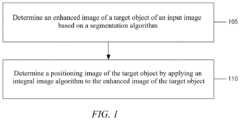
- FIG. 1 is a flowchart of an image processing method according to some embodiments of the present application.
- the present application provides an image processing method.
- the method includes: In step 105, an enhanced image of a target object of an input image is determined based on a segmentation algorithm, where the enhanced image of the target object includes an image in which each pixel classified as the target object is displayed in an enhanced manner.
- the method includes: In step 110, a positioning image of the target object is determined by applying an integral image algorithm to the enhanced image of the target object.
- the enhanced image of the target object includes an image in which each pixel belonging to the target object is displayed in an enhanced manner and each pixel not belonging to the target object is not displayed in an enhanced manner.
- the enhanced image of the target object may include an image in which a pixel belonging to the target object is displayed with enhanced brightness.
- the enhanced image of the target object may be converted into a form of a mask map.
- the determining a positioning image of the target object by applying an integral image algorithm to the enhanced image of the target object includes: calculating an integral image for the enhanced image of the target object converted into the form of a mask map.
- An integral image is a method for quickly calculating a sum of rectangular areas in an image.
- the positioning image of the target object may be in the form of a mask map and may be determined based on the integral image. For example, a value of each pixel in the positioning image of the target object may depend on whether the value of the pixel in the integral image is 0. If the value is 0, the value of the pixel in the positioning image of the target object is 0. If the value is not 0, the value of the pixel in the positioning image of the target object is 1. 1 indicates that the pixel belongs to the target object, and 0 indicates that the pixel belongs to the image background or a non-target object.
- FIG. 2 is a flowchart of a method for determining an enhanced image of a target object of an input image based on a segmentation algorithm according to some embodiments of the present application
- FIG. 3 is an effect diagram of steps of segmenting a target object according to some embodiments of the present application. Step 102 in FIG.
- step 205 performing feature extraction on the input image to determine a pixel feature graph
- step 210 performing feature extraction on the input image to determine a context feature graph
- step 215 determining context relation information of each pixel based on the pixel feature graph and the context feature graph
- step 220 determining the enhanced image of the target object according to the context relation information and the input image, where the enhanced image of the target object is generated by changing, based on whether each pixel belongs to the target object or a non-target object, a weight applied to the pixel.
- step 205 may include: inputting the input image into a deep convolutional neural network to perform pixel-level feature extraction on the input image.
- step 205 may include: inputting the input image into HRNet 18 to generate a feature graph of each pixel in the input image.
- a feature value of each pixel in the pixel feature graph may indicate initial classification of whether the pixel belongs to the target object or a non-target object.
- feature values of pixels range from 0 to 255, and it may be considered that each pixel whose feature value is higher than 128 belongs to the target object and each pixel whose feature value is lower than 128 belongs to a non-target object.
- the pixel feature graph may be a matrix representing pixel-level features (pixel representation) after the input image is calculated by a deep convolutional neural network, and an image representation thereof may be, for example, shown in a in FIG. 3 .
- step 210 may include: inputting the input image into a deep convolutional neural network to perform image block-level feature extraction on the input image.
- step 210 may include: inputting the input image into HRNet 18 to generate a feature graph in which the input image includes a pixel block including a center pixel.
- the pixel block may be determined by selecting an appropriate convolution kernel n ⁇ n, where n is an odd number. As shown in b in FIG.
- a block in the figure represents a center pixel, and pixels around the block plus the center pixel represent a pixel block.
- the feature graph of the pixel block may be a matrix representing pixel block-level features (object region representation) after the input image is calculated by a deep convolutional neural network with a selected convolution kernel.
- the feature graph of the pixel block represents feature values extracted in a unit of the pixel block including the center pixel.
- the feature value of the pixel block may indicate whether the pixel block belongs to the target object or a non-target object.
- feature values of pixel blocks range from 0 to 255, and it may be considered that each pixel block whose feature value is higher than 128 belongs to the target object and each pixel block whose feature value is lower than 128 belongs to a non-target object.
- a feature value of a pixel block may represent whether a pixel around the center pixel in the pixel block belongs to the target object or a non-target object or possibility thereof.
- the pixel block feature graph and the context feature graph can be used interchangeably to represent information about pixels and/or context around the center pixel in the pixel block.
- step 215 may include: determining context relation information of each pixel based on the pixel feature graph determined in step 205 and the context feature graph determined in step 210, where the context relation information indicates the strength of relation between each pixel and context of the pixel.
- context relation information may be obtained by performing matrix multiplication on the pixel feature graph determined in step 205 and the context feature graph determined in step 210 and applying a softmax function to obtain context relation information of each pixel (pixel region relation).
- the pixel feature graph of the center pixel indicates that the pixel belongs to the target object (a non-target object)
- the context feature graph indicates that the context of the pixel also belongs to the target object (a non-target object)
- the obtained context relation information of the pixel is strong.
- step 220 may include: determining, based on the context relation information in step 215, a final classification of whether each pixel belongs to the target object or a non-target object, and generating the enhanced image of the target object by enhancing, based on the final classification, each pixel belonging to the target object.
- matrix multiplication is performed on the context relation information (pixel region relation) obtained in step 215 and the context feature graph (object region representation) determined in step 210, to obtain a weighted pixel-level feature graph, and the weighted pixel-level feature graph is concatenated with the pixel feature graph (pixel representation) determined in step 205 to obtain a final pixel feature graph.
- the enhanced image of the target object is generated by changing, based on a feature value (which in turn reflects whether the pixel belongs to the target object or a non-target object) of the pixel in the final pixel feature graph, a weight applied to each pixel. An image representation thereof can be shown, for example, in c in FIG. 3 .
- the enhanced image of the target object may be generated by increasing a weight applied to each pixel whose feature value is higher than 128.
- pixel-level classification information not only pixel-level classification information, but also context classification information around a target pixel are considered in the segmentation algorithm, and a final classification result of the target pixel is determined based on the relation between the target pixel and the context thereof.
- Context information is incorporated into a classification algorithm to further improve the classification accuracy of the target pixel, thereby segmenting the target object more accurately.
- a weight applied to each pixel finally classified as the target object is changed to generate the enhanced image of the target object, so that the target object is displayed in an enhanced manner, thereby providing a more accurate basis for subsequent positioning processing and further improving the positioning accuracy of the target object.
- the weight may be configured by a user.
- a change of weight setting can affect the enhancement effect of the target object in the enhanced image of the target object, so that the desired enhancement effect of the target object can be achieved through user setting.
- the determining a positioning image of the target object by applying an integral image algorithm to the enhanced image of the target object further includes: determining an integral image according to the enhanced image of the target object; and determining the positioning image of the target object by using the integral image.
- an integral image is calculated for the enhanced image of the target object, as shown in a and b in FIG. 4 .
- the integral graph algorithm is applied to the final classification result obtained based on the segmentation algorithm of the present application, so that the target object can be accurately positioned.
- the integral image algorithm is applied to the enhanced image of the target object in which the target object is displayed in an enhanced manner, so that the positioning accuracy of the target object can be further improved.
- the determining an integral image according to the enhanced image of the target object further includes: applying a scale factor to the enhanced image of the target object.
- a scale factor (img_scale) is applied to the enhanced image of the target object converted into the form of a mask map.
- x _ top int max x _ left ⁇ x_extend 0 / img _ scale
- y _ top int max y ⁇ left ⁇ y _ extend 0 / img _ scale
- x _ bottom int max x_left ⁇ x_extend 0 / img _ scale
- y _ bottom int max y ⁇ left ⁇ y _ extend 0 / img _ scale .
- a volume of data to be processed can be adjusted by applying a scale factor, so that an operation process can be accelerated and/or the accuracy of the integral image can be improved according to actual needs.
- the method further includes: calculating a loss rate between the enhanced image of the target object and the input image based on a loss function; and feeding back the calculated loss rate to the segmentation algorithm.
- a cross entropy loss (cross entropy loss) function may be used to calculate a loss rate between the enhanced image of the target object generated in step 220 and the input image.
- the calculated loss rate represents the similarity between the enhanced image of the target object and the original input image.
- a loss rate between the enhanced image of the target object output by the segmentation algorithm and a labeled production line image reflects the similarity between the enhanced image of the target object output by the segmentation algorithm and the original input image.
- the loss rate is fed back to the segmentation algorithm to perform supervised learning training on the segmentation algorithm.
- the accuracy of the segmentation algorithm can be improved through continuous training and learning while fit regression is trained.
- the method further includes: updating the segmentation algorithm based on the loss rate or the labeled production line image or a combination of both.
- the segmentation algorithm in the present application trains the calculated loss rate or the labeled production line image or a combination of both as training data, and can continuously improve the accuracy of the segmentation algorithm in target object segmentation in a supervised learning manner.
- the training data since the training data all comes from the real production line, the training data can cover actual needs and be used and promoted in practice in the production line.
- FIG. 5 is an architecture diagram of a network model of a segmentation algorithm for implementing an image processing method according to some embodiments of the present application.
- the segmentation algorithm is implemented by a deep convolutional neural network HRNet18.
- HRNet is a high-resolution network that can maintain a high-resolution representation in an entire process. Starting from a high-resolution subnetwork as the first stage, subnetworks from high resolutions to low resolutions are gradually added to form more stages, and multi-resolution subnetworks are connected in parallel. In the entire process, multi-scale repeated fusion is performed by repeatedly exchanging information on parallel multi-resolution subnetworks. Keypoints are estimated based on high-resolution representations output by the network, and a network architecture is shown in FIG. 4 . In some examples, in consideration of whether the segmentation of the target object depends on very high-level semantic information and a limited volume of real training data, the smaller model HRNet18 in the HRNet series is selected to implement the segmentation algorithm of the present application.
- HRNet18 maintains high-resolution features in the entire segmentation algorithm process and facilitates accurate segmentation of the target object.
- different branches of the HRNet18 network produce features of different resolutions, and these features interact to obtain information, so that high-resolution features including multi-channel information can be obtained.
- selection of the HRNet18 model avoids the risk of overfitting and at the same time can accelerate the operation speed of the entire segmentation algorithm because of the small structure of the model.
- the present application provides an image processing method, including: performing feature extraction on the input image to determine a pixel feature graph; performing feature extraction on the input image to determine a context feature graph; determining context relation information of each pixel based on the pixel feature graph and the context feature graph; and determining the enhanced image of the tab according to the context relation information and the input image, where the enhanced image of the tab is generated by changing, based on whether each pixel belongs to the tab, a weight applied to the pixel; determining an integral image according to the enhanced image of the tab, where a scale factor is applied to the enhanced image of the tab; and using the integral image to determine the positioning image of the tab, where the segmentation algorithm is implemented by HRNet18.
- FIG. 6 is a functional block diagram of an image processing system according to some embodiments of the present application.
- the present application provides an image processing system.
- the system includes: a segmentation module 605, configured to determine an enhanced image of a target object of an input image based on a segmentation algorithm, where the enhanced image of the target object includes an image in which each pixel classified as the target object is displayed in an enhanced manner; and a positioning image generation module 610, configured to determine a positioning image of the target object by applying an integral image algorithm to the enhanced image of the target object.
- FIG. 7 is a functional block diagram of the segmentation module according to some embodiments of the present application.
- the segmentation module 605 further includes: a feature extraction component 705, configured to perform feature extraction on the input image to determine a pixel feature graph and perform feature extraction on the input image to determine a context feature graph; a context component 710, configured to determine context relation information of each pixel based on the pixel feature graph and the context feature graph; and an enhanced image generation component 715, configured to determine the enhanced image of the target object according to the context relation information and the input image, where the enhanced image of the target object is generated by changing, based on whether each pixel belongs to the target object or a non-target object, a weight applied to the pixel.
- a feature extraction component 705 configured to perform feature extraction on the input image to determine a pixel feature graph and perform feature extraction on the input image to determine a context feature graph
- a context component 710 configured to determine context relation information of each pixel based on the pixel feature graph and the context feature graph
- pixel-level classification information not only pixel-level classification information, but also context classification information around a target pixel are considered in the segmentation algorithm, and a final classification result of the target pixel is determined based on the relation between the target pixel and the context thereof.
- Context information is incorporated into a classification algorithm to further improve the classification accuracy of the target pixel, thereby segmenting the target object more accurately.
- a weight applied to each pixel finally classified as the target object is changed to generate the enhanced image of the target object, so that the target object is displayed in an enhanced manner, thereby providing a more accurate basis for subsequent positioning processing and further improving the positioning accuracy of the target object.
- the weight may be configured by a user.
- a change of weight setting can affect the enhancement effect of the target object in the enhanced image of the target object, so that the desired enhancement effect of the target object can be achieved through user setting.
- the positioning image generation module 610 is further configured to: determine an integral image according to the enhanced image of the target object; and determine the positioning image of the target object by using the integral image.
- the integral image algorithm is applied to the enhanced image of the target object in which the target object is displayed in an enhanced manner, so that the positioning accuracy of the target object can be further improved.
- the positioning image generation module 610 is further configured to apply a scale factor to the enhanced image of the target object.
- a volume of data to be processed can be adjusted by applying a scale factor, so that an operation process can be accelerated and/or the accuracy of the integral image can be improved according to actual needs.
- the system further includes a loss rate module 615, configured to: calculate a loss rate between the enhanced image of the target object and the input image based on a loss function; and feed back the calculated loss rate to the segmentation algorithm to update the segmentation module.
- a loss rate module 615 configured to: calculate a loss rate between the enhanced image of the target object and the input image based on a loss function; and feed back the calculated loss rate to the segmentation algorithm to update the segmentation module.
- a loss rate between the enhanced image of the target object output by the segmentation algorithm and a labeled production line image reflects the similarity between the enhanced image of the target object output by the segmentation algorithm and the original input image.
- the loss rate is fed back to the segmentation algorithm to perform supervised learning training on the segmentation algorithm.
- the accuracy of the segmentation algorithm can be improved through continuous training and learning while fit regression is trained.
- the segmentation module 605 is further configured to update the segmentation module based on the loss rate or the labeled production line image or a combination of both.
- the segmentation algorithm in the present application trains the calculated loss rate or the labeled production line image or a combination of both as training data, and can continuously improve the accuracy of the segmentation algorithm in target object segmentation in a supervised learning manner.
- the training data since the training data all comes from the real production line, the training data can cover actual needs and be used and promoted in practice in the production line.
- the present application provides an image processing system, including: a segmentation module 605, including:
- FIG. 8 is a structural block diagram of a computer system suitable for implementing an image processing system according to some embodiments of the present application.
- the system includes: a memory 028 storing computer-executable instructions; and a processor 016 coupled to the memory 028, where the computer-executable instructions, when executed by the processor, cause the system to perform the following operations: determining an enhanced image of a target object of an input image based on a segmentation algorithm, where the enhanced image of the target object includes an image in which each pixel classified as the target object is displayed in an enhanced manner; and determining a positioning image of the target object by applying an integral image algorithm to the enhanced image of the target object.
- FIG. 8 is a structural block diagram of a computer system 012 suitable for implementing an image processing system according to some embodiments of the present application.
- the computer system 012 shown in FIG. 8 is only an example, and should not limit the function and application scope of this embodiment of the present invention.
- the computer system 012 is represented in a form of a general-purpose computing device.
- Components of the computer system 012 may include, but are not limited to: one or more processors or processing units 016, a system memory 028, and a bus 018 connecting different system components (including the system memory 028 and the processing unit 016).
- the bus 018 represents one or more of several types of bus structures, including a memory bus or a memory controller, a peripheral bus, an accelerated graphics port, a processor, or a local bus using any one of multiple bus structures. Examples of these structures include, but are not limited to, an industry standard architecture (ISA) bus, a micro channel architecture (MAC) bus, an enhanced ISA bus, a video electronics standards association (VESA) local bus, and a peripheral component interconnect (PCI) bus.
- ISA industry standard architecture
- MAC micro channel architecture
- VESA video electronics standards association
- PCI peripheral component interconnect
- the computer system 012 typically includes multiple computer system readable mediums. These mediums can be any available medium that can be accessed by the computer system 012 and include both volatile and nonvolatile mediums, and removable and non-removable mediums.
- the system memory 028 may include a computer system readable medium in a form of a volatile memory, such as a random access memory (RAM) 030 and/or a cache memory 032.
- the computer system 012 may further include other removable/non-removable and volatile/nonvolatile computer system storage mediums.
- the storage system 034 may be configured to read from and write into non-removable and non-volatile magnetic mediums (not shown in FIG. 6 , commonly referred to as a "hard disk drive").
- each drive may be connected to the bus 018 through one or more data medium interfaces.
- the memory 028 may include at least one program product having a set (for example, at least one) of program modules configured to perform the functions of the embodiments of the present invention.
- a program/utility 040 having a set (at least one) of program modules 042 may be stored, for example, in the memory 028.
- Such program module 042 includes but is not limited to an operating system, one or more application programs, and other program modules and program data. Each or some combination of these examples may include the implementation of a network environment.
- the program module 042 generally performs the functions and/or methods of the described embodiments of the present invention.
- the computer system 012 can also communicate with one or more external devices 014 (for example, a keyboard, a pointing device, and a display 024).
- the computer system 012 communicates with external radar devices, and can further communicate with one or more devices that enable a user to interact with the computer system 012, and/or any device (for example, a network card and a modem) that enables the computer system 012 to communicate with one or more other computing devices.
- Such communication may occur through an input/output (I/O) interface 022.
- the computer system 012 can further communicate with one or more networks (for example, a local area network (LAN), a wide area network (WAN), and/or a public network such as the Internet) through a network adapter 020.
- networks for example, a local area network (LAN), a wide area network (WAN), and/or a public network such as the Internet
- the network adapter 020 communicates with other modules of the computer system 012 through the bus 018.
- other hardware and/or software modules may be used in conjunction with the computer system 012, including but not limited to: microcode, device drives, redundant processing units, external disk drive arrays, RAID systems, tape drives, data backup storage systems, and the like.
- the processing unit 016 executes various functional applications and data processing by running the programs stored in the system memory 028, such as implementing the method flow provided by the embodiments of the present invention.
- the computer program can be provided in a computer storage medium, that is, the computer storage medium is encoded with the computer program, and when the program is executed by one or more computers, the one or more computers can be enabled to execute the method flow and/or the apparatus operation provided by the embodiments of the present invention.
- the method flow provided by the embodiments of the present invention is executed by the one or more processors.
- the computer readable medium may be a computer readable signal medium or a computer readable storage medium.
- a computer readable storage medium may be, for example, but is not limited to, electrical, magnetic, optical, electromagnetic, infrared, or semiconductor systems, apparatuses, or devices, or any combination thereof. More specific examples (a non-exhaustive list) of the computer readable storage medium include: an electrical connection with one or more conductors, a portable computer disk, a hard disk, a random access memory (RAM), a read only memory (ROM), an erasable programmable read only memory (EPROM or a flash memory), an optical fiber, a portable compact disk read only memory (CD-ROM), an optical storage device, a magnetic storage device, or any suitable combination thereof.
- a computer readable storage medium may be any tangible medium that contains or stores a program that can be used by or in conjunction with an instruction execution system, apparatus, or device.
- a computer readable signal medium may include a data signal transmitted in a baseband or as a part of a carrier wave, and carries computer readable program code. Such propagated data signal may be in many forms, including but not limited to an electromagnetic signal, an optical signal, or any suitable combination thereof.
- a computer readable signal medium may also be any computer readable medium other than a computer readable storage medium, and the computer readable medium can send, propagate, or transmit a program used by or in conjunction with an instruction execution system, apparatus, or device.
- Program code contained on a computer readable medium may be transmitted through any appropriate medium, including but not limited to a wireless manner, a wireline, an optical cable, RF, or any suitable combination thereof.
- Computer program code for performing the operations of the present invention may be written in one or more programming languages or a combination thereof.
- the programming languages include object-oriented programming languages such as Java, Smalltalk, and C++, and conventional procedural programming languages such as the "C" language, or a similar programming language.
- the program code may run entirely on a user computer, run partly on a user computer, run as a standalone software package, run partly on a user computer and partly on a remote computer, or run entirely on a remote computer or server.
- the remote computer can be connected to a user computer through any network including a local area network (LAN) or a wide area network (WAN), or can be connected to an external computer (for example, connected through the Internet provided by an Internet service provider).
- LAN local area network
- WAN wide area network
- Internet service provider for example, connected through the Internet provided by an Internet service provider
Landscapes
- Engineering & Computer Science (AREA)
- Theoretical Computer Science (AREA)
- Physics & Mathematics (AREA)
- General Physics & Mathematics (AREA)
- Computer Vision & Pattern Recognition (AREA)
- Evolutionary Computation (AREA)
- Multimedia (AREA)
- General Health & Medical Sciences (AREA)
- Health & Medical Sciences (AREA)
- Artificial Intelligence (AREA)
- Computing Systems (AREA)
- Software Systems (AREA)
- Medical Informatics (AREA)
- Databases & Information Systems (AREA)
- Biomedical Technology (AREA)
- Life Sciences & Earth Sciences (AREA)
- Molecular Biology (AREA)
- Computational Linguistics (AREA)
- Biophysics (AREA)
- Mathematical Physics (AREA)
- General Engineering & Computer Science (AREA)
- Data Mining & Analysis (AREA)
- Biodiversity & Conservation Biology (AREA)
- Image Analysis (AREA)
Applications Claiming Priority (1)
| Application Number | Priority Date | Filing Date | Title |
|---|---|---|---|
| PCT/CN2021/136052 WO2023102723A1 (fr) | 2021-12-07 | 2021-12-07 | Procédé et système de traitement d'image |
Publications (2)
| Publication Number | Publication Date |
|---|---|
| EP4220552A1 true EP4220552A1 (fr) | 2023-08-02 |
| EP4220552A4 EP4220552A4 (fr) | 2023-12-27 |
Family
ID=86729503
Family Applications (1)
| Application Number | Title | Priority Date | Filing Date |
|---|---|---|---|
| EP21960095.4A Pending EP4220552A4 (fr) | 2021-12-07 | 2021-12-07 | Procédé et système de traitement d'image |
Country Status (4)
| Country | Link |
|---|---|
| US (1) | US11967125B2 (fr) |
| EP (1) | EP4220552A4 (fr) |
| CN (2) | CN120765481A (fr) |
| WO (1) | WO2023102723A1 (fr) |
Families Citing this family (4)
| Publication number | Priority date | Publication date | Assignee | Title |
|---|---|---|---|---|
| WO2024044947A1 (fr) * | 2022-08-30 | 2024-03-07 | 宁德时代新能源科技股份有限公司 | Procédé et appareil de détection de défaut, et support de stockage lisible par ordinateur |
| US20250078547A1 (en) * | 2023-09-05 | 2025-03-06 | Qualcomm Incorporated | Warping-free motion guided feature referencing for consistent video segmentation |
| CN117350993B (zh) * | 2023-11-02 | 2024-09-03 | 上海贝特威自动化科技有限公司 | 一种基于图像识别的极耳层数检测方法 |
| CN118674665B (zh) * | 2024-08-23 | 2024-11-29 | 浙江大华技术股份有限公司 | 图像增强方法、设备及存储介质 |
Family Cites Families (13)
| Publication number | Priority date | Publication date | Assignee | Title |
|---|---|---|---|---|
| US8824797B2 (en) * | 2011-10-03 | 2014-09-02 | Xerox Corporation | Graph-based segmentation integrating visible and NIR information |
| AU2013222016A1 (en) * | 2013-08-30 | 2015-03-19 | Canon Kabushiki Kaisha | Method, system and apparatus for determining a property of an image |
| US10460214B2 (en) * | 2017-10-31 | 2019-10-29 | Adobe Inc. | Deep salient content neural networks for efficient digital object segmentation |
| US10872409B2 (en) | 2018-02-07 | 2020-12-22 | Analogic Corporation | Visual augmentation of regions within images |
| IL280460B2 (en) * | 2018-07-29 | 2025-04-01 | Nano X Ai Ltd | Systems and methods for automatic recognition of visual objects in medical images |
| CN110889410B (zh) * | 2018-09-11 | 2023-10-03 | 苹果公司 | 浅景深渲染中语义分割的稳健用途 |
| EP3956711A4 (fr) * | 2019-04-18 | 2023-01-11 | The Administrators of The Tulane Educational Fund | Systèmes et procédés de positionnement d'échantillon pour faciliter la microscopie |
| CN110648334A (zh) * | 2019-09-18 | 2020-01-03 | 中国人民解放军火箭军工程大学 | 一种基于注意力机制的多特征循环卷积显著性目标检测方法 |
| CN111080615B (zh) * | 2019-12-12 | 2023-06-16 | 创新奇智(重庆)科技有限公司 | 基于卷积神经网络的pcb缺陷检测系统及检测方法 |
| CN111445493B (zh) * | 2020-03-27 | 2024-04-12 | 北京市商汤科技开发有限公司 | 图像处理方法及装置、电子设备和存储介质 |
| CN112508939B (zh) * | 2020-12-22 | 2023-01-20 | 郑州金惠计算机系统工程有限公司 | 法兰表面缺陷检测方法及系统和设备 |
| US11875510B2 (en) * | 2021-03-12 | 2024-01-16 | Adobe Inc. | Generating refined segmentations masks via meticulous object segmentation |
| CN113065467B (zh) * | 2021-04-01 | 2024-05-14 | 中科星图空间技术有限公司 | 一种基于深度学习的卫星图像低相干区域识别方法及装置 |
-
2021
- 2021-12-07 CN CN202510866036.6A patent/CN120765481A/zh active Pending
- 2021-12-07 EP EP21960095.4A patent/EP4220552A4/fr active Pending
- 2021-12-07 CN CN202180078471.2A patent/CN116802683A/zh not_active Withdrawn
- 2021-12-07 WO PCT/CN2021/136052 patent/WO2023102723A1/fr not_active Ceased
-
2023
- 2023-04-04 US US18/295,513 patent/US11967125B2/en active Active
Also Published As
| Publication number | Publication date |
|---|---|
| EP4220552A4 (fr) | 2023-12-27 |
| US11967125B2 (en) | 2024-04-23 |
| US20230237763A1 (en) | 2023-07-27 |
| CN116802683A (zh) | 2023-09-22 |
| CN120765481A (zh) | 2025-10-10 |
| WO2023102723A1 (fr) | 2023-06-15 |
Similar Documents
| Publication | Publication Date | Title |
|---|---|---|
| US11967125B2 (en) | Image processing method and system | |
| CN109858555B (zh) | 基于图像的数据处理方法、装置、设备及可读存储介质 | |
| EP4040401A1 (fr) | Procédé et appareil de traitement d'image, dispositif et support d'enregistrement | |
| CN110197146B (zh) | 基于深度学习的人脸图像分析方法、电子装置及存储介质 | |
| JP2022177232A (ja) | 画像処理方法、テキスト認識方法及び装置 | |
| US11756288B2 (en) | Image processing method and apparatus, electronic device and storage medium | |
| WO2023015922A1 (fr) | Procédé et appareil d'entraînement de modèle de reconnaissance d'image, dispositif et support de stockage | |
| CN113591566B (zh) | 图像识别模型的训练方法、装置、电子设备和存储介质 | |
| CN113205041B (zh) | 结构化信息提取方法、装置、设备和存储介质 | |
| US20230245429A1 (en) | Method and apparatus for training lane line detection model, electronic device and storage medium | |
| CN113177472A (zh) | 动态手势识别方法、装置、设备以及存储介质 | |
| CN114093006A (zh) | 活体人脸检测模型的训练方法、装置、设备以及存储介质 | |
| EP3955216A2 (fr) | Procédé et appareil de reconnaissance d'image, dispositif électronique et support d'enregistrement | |
| CN112580666B (zh) | 图像特征的提取方法、训练方法、装置、电子设备及介质 | |
| CN114299366A (zh) | 一种图像检测方法、装置、电子设备及存储介质 | |
| US20220392242A1 (en) | Method for training text positioning model and method for text positioning | |
| CN111753618B (zh) | 图像识别方法、装置、计算机设备及计算机可读存储介质 | |
| EP4156124A1 (fr) | Procédé et appareil de reconnaissance de geste dynamique, dispositif, et support de stockage | |
| CN114445682A (zh) | 训练模型的方法、装置、电子设备、存储介质及产品 | |
| CN113361572A (zh) | 图像处理模型的训练方法、装置、电子设备以及存储介质 | |
| CN114549697A (zh) | 图像处理方法、装置、设备及存储介质 | |
| CN114241411B (zh) | 基于目标检测的计数模型处理方法、装置及计算机设备 | |
| WO2026040716A1 (fr) | Procédé et appareil de traitement d'images de langue, dispositif et support de stockage | |
| CN115393488A (zh) | 虚拟人物表情的驱动方法、装置、电子设备和存储介质 | |
| CN115937993A (zh) | 活体检测模型训练方法、活体检测方法、装置和电子设备 |
Legal Events
| Date | Code | Title | Description |
|---|---|---|---|
| STAA | Information on the status of an ep patent application or granted ep patent |
Free format text: STATUS: UNKNOWN |
|
| STAA | Information on the status of an ep patent application or granted ep patent |
Free format text: STATUS: THE INTERNATIONAL PUBLICATION HAS BEEN MADE |
|
| PUAI | Public reference made under article 153(3) epc to a published international application that has entered the european phase |
Free format text: ORIGINAL CODE: 0009012 |
|
| STAA | Information on the status of an ep patent application or granted ep patent |
Free format text: STATUS: REQUEST FOR EXAMINATION WAS MADE |
|
| 17P | Request for examination filed |
Effective date: 20230427 |
|
| AK | Designated contracting states |
Kind code of ref document: A1 Designated state(s): AL AT BE BG CH CY CZ DE DK EE ES FI FR GB GR HR HU IE IS IT LI LT LU LV MC MK MT NL NO PL PT RO RS SE SI SK SM TR |
|
| A4 | Supplementary search report drawn up and despatched |
Effective date: 20231122 |
|
| RIC1 | Information provided on ipc code assigned before grant |
Ipc: G06T 7/11 20170101ALI20231117BHEP Ipc: G06T 5/00 20060101ALI20231117BHEP Ipc: G06T 7/00 20170101AFI20231117BHEP |
|
| RAP1 | Party data changed (applicant data changed or rights of an application transferred) |
Owner name: CONTEMPORARY AMPEREX TECHNOLOGY(HONG KONG) LIMITED |
|
| DAV | Request for validation of the european patent (deleted) | ||
| DAX | Request for extension of the european patent (deleted) | ||
| STAA | Information on the status of an ep patent application or granted ep patent |
Free format text: STATUS: EXAMINATION IS IN PROGRESS |
|
| 17Q | First examination report despatched |
Effective date: 20260123 |