EP4220582A1 - Verfahren und system zur automatischen annotation der sequenz von fahrbildern eines eisenbahn-rollgeräts - Google Patents
Verfahren und system zur automatischen annotation der sequenz von fahrbildern eines eisenbahn-rollgeräts Download PDFInfo
- Publication number
- EP4220582A1 EP4220582A1 EP23153295.3A EP23153295A EP4220582A1 EP 4220582 A1 EP4220582 A1 EP 4220582A1 EP 23153295 A EP23153295 A EP 23153295A EP 4220582 A1 EP4220582 A1 EP 4220582A1
- Authority
- EP
- European Patent Office
- Prior art keywords
- time
- data
- driving
- images
- stamped
- Prior art date
- Legal status (The legal status is an assumption and is not a legal conclusion. Google has not performed a legal analysis and makes no representation as to the accuracy of the status listed.)
- Pending
Links
Images
Classifications
-
- G—PHYSICS
- G06—COMPUTING OR CALCULATING; COUNTING
- G06V—IMAGE OR VIDEO RECOGNITION OR UNDERSTANDING
- G06V20/00—Scenes; Scene-specific elements
- G06V20/70—Labelling scene content, e.g. deriving syntactic or semantic representations
-
- B—PERFORMING OPERATIONS; TRANSPORTING
- B61—RAILWAYS
- B61L—GUIDING RAILWAY TRAFFIC; ENSURING THE SAFETY OF RAILWAY TRAFFIC
- B61L15/00—Indicators provided on the vehicle or train for signalling purposes
- B61L15/0072—On-board train data handling
-
- B—PERFORMING OPERATIONS; TRANSPORTING
- B61—RAILWAYS
- B61L—GUIDING RAILWAY TRAFFIC; ENSURING THE SAFETY OF RAILWAY TRAFFIC
- B61L23/00—Control, warning or like safety means along the route or between vehicles or trains
- B61L23/04—Control, warning or like safety means along the route or between vehicles or trains for monitoring the mechanical state of the route
- B61L23/041—Obstacle detection
-
- B—PERFORMING OPERATIONS; TRANSPORTING
- B61—RAILWAYS
- B61L—GUIDING RAILWAY TRAFFIC; ENSURING THE SAFETY OF RAILWAY TRAFFIC
- B61L25/00—Recording or indicating positions or identities of vehicles or trains or setting of track apparatus
- B61L25/02—Indicating or recording positions or identities of vehicles or trains
- B61L25/025—Absolute localisation, e.g. providing geodetic coordinates
-
- G—PHYSICS
- G06—COMPUTING OR CALCULATING; COUNTING
- G06Q—INFORMATION AND COMMUNICATION TECHNOLOGY [ICT] SPECIALLY ADAPTED FOR ADMINISTRATIVE, COMMERCIAL, FINANCIAL, MANAGERIAL OR SUPERVISORY PURPOSES; SYSTEMS OR METHODS SPECIALLY ADAPTED FOR ADMINISTRATIVE, COMMERCIAL, FINANCIAL, MANAGERIAL OR SUPERVISORY PURPOSES, NOT OTHERWISE PROVIDED FOR
- G06Q10/00—Administration; Management
- G06Q10/06—Resources, workflows, human or project management; Enterprise or organisation planning; Enterprise or organisation modelling
- G06Q10/063—Operations research, analysis or management
- G06Q10/0635—Risk analysis of enterprise or organisation activities
-
- G—PHYSICS
- G06—COMPUTING OR CALCULATING; COUNTING
- G06Q—INFORMATION AND COMMUNICATION TECHNOLOGY [ICT] SPECIALLY ADAPTED FOR ADMINISTRATIVE, COMMERCIAL, FINANCIAL, MANAGERIAL OR SUPERVISORY PURPOSES; SYSTEMS OR METHODS SPECIALLY ADAPTED FOR ADMINISTRATIVE, COMMERCIAL, FINANCIAL, MANAGERIAL OR SUPERVISORY PURPOSES, NOT OTHERWISE PROVIDED FOR
- G06Q10/00—Administration; Management
- G06Q10/06—Resources, workflows, human or project management; Enterprise or organisation planning; Enterprise or organisation modelling
- G06Q10/063—Operations research, analysis or management
- G06Q10/0639—Performance analysis of employees; Performance analysis of enterprise or organisation operations
-
- G—PHYSICS
- G06—COMPUTING OR CALCULATING; COUNTING
- G06Q—INFORMATION AND COMMUNICATION TECHNOLOGY [ICT] SPECIALLY ADAPTED FOR ADMINISTRATIVE, COMMERCIAL, FINANCIAL, MANAGERIAL OR SUPERVISORY PURPOSES; SYSTEMS OR METHODS SPECIALLY ADAPTED FOR ADMINISTRATIVE, COMMERCIAL, FINANCIAL, MANAGERIAL OR SUPERVISORY PURPOSES, NOT OTHERWISE PROVIDED FOR
- G06Q10/00—Administration; Management
- G06Q10/06—Resources, workflows, human or project management; Enterprise or organisation planning; Enterprise or organisation modelling
- G06Q10/067—Enterprise or organisation modelling
-
- G—PHYSICS
- G06—COMPUTING OR CALCULATING; COUNTING
- G06Q—INFORMATION AND COMMUNICATION TECHNOLOGY [ICT] SPECIALLY ADAPTED FOR ADMINISTRATIVE, COMMERCIAL, FINANCIAL, MANAGERIAL OR SUPERVISORY PURPOSES; SYSTEMS OR METHODS SPECIALLY ADAPTED FOR ADMINISTRATIVE, COMMERCIAL, FINANCIAL, MANAGERIAL OR SUPERVISORY PURPOSES, NOT OTHERWISE PROVIDED FOR
- G06Q10/00—Administration; Management
- G06Q10/10—Office automation; Time management
-
- G—PHYSICS
- G06—COMPUTING OR CALCULATING; COUNTING
- G06Q—INFORMATION AND COMMUNICATION TECHNOLOGY [ICT] SPECIALLY ADAPTED FOR ADMINISTRATIVE, COMMERCIAL, FINANCIAL, MANAGERIAL OR SUPERVISORY PURPOSES; SYSTEMS OR METHODS SPECIALLY ADAPTED FOR ADMINISTRATIVE, COMMERCIAL, FINANCIAL, MANAGERIAL OR SUPERVISORY PURPOSES, NOT OTHERWISE PROVIDED FOR
- G06Q50/00—Information and communication technology [ICT] specially adapted for implementation of business processes of specific business sectors, e.g. utilities or tourism
- G06Q50/40—Business processes related to the transportation industry
-
- G—PHYSICS
- G06—COMPUTING OR CALCULATING; COUNTING
- G06V—IMAGE OR VIDEO RECOGNITION OR UNDERSTANDING
- G06V10/00—Arrangements for image or video recognition or understanding
- G06V10/70—Arrangements for image or video recognition or understanding using pattern recognition or machine learning
- G06V10/77—Processing image or video features in feature spaces; using data integration or data reduction, e.g. principal component analysis [PCA] or independent component analysis [ICA] or self-organising maps [SOM]; Blind source separation
- G06V10/774—Generating sets of training patterns; Bootstrap methods, e.g. bagging or boosting
- G06V10/7753—Incorporation of unlabelled data, e.g. multiple instance learning [MIL]
-
- G—PHYSICS
- G06—COMPUTING OR CALCULATING; COUNTING
- G06V—IMAGE OR VIDEO RECOGNITION OR UNDERSTANDING
- G06V20/00—Scenes; Scene-specific elements
- G06V20/50—Context or environment of the image
- G06V20/56—Context or environment of the image exterior to a vehicle by using sensors mounted on the vehicle
Definitions
- the invention falls within the field of autonomous driving of vehicles, and in particular of railway rolling stock.
- the invention relates more particularly to the generation of a training database for an artificial vision system designed to detect and/or classify objects.
- Autonomous vehicle driving is booming in all fields relating to transport, whether it concerns autonomous motor vehicles or means of collective or goods transport, in particular railway rolling stock.
- these autonomous means of transport are equipped with artificial vision systems designed to detect and identify all types of obstacles and all types of road or rail signs.
- These vision systems are equipped with artificial intelligence algorithms, for example convolutional neural networks, whose function is precisely to detect and classify obstacles and signaling to generate an appropriate driving action.
- neural networks are able to achieve very high detection and classification performance, realizing less than one classification error for a million images processed.
- This level of performance essential to ensure the safe driving of autonomous vehicles, is achieved by learning neural networks via databases: the parameters of the neural network are determined by teaching it to associate an image with information determined, for example an obstacle or a traffic sign. In other words, annotated images are used to teach the artificial vision system to recognize all the situations with which it could potentially be confronted.
- the drawback lies in the very large number of annotated images necessary for training such a neural network, typically several million, or even tens of millions of annotated images. Furthermore, the greater the variety of possible situations, the greater the database must be.
- the object of the invention is to propose a method and a system for the automatic annotation of driving images that is reliable and efficient, and which does not require any additional intervention on the part of a human user.
- the invention also relates to a system for detecting and annotating at least one driving image for rolling stock, in particular railway rolling stock, comprising means for acquiring and time-stamped recording of images installed on the rolling stock which further comprises means for time-stamped acquisition of so-called driving data comprising at least signaling data, and means for processing driving data and for annotating images.
- the invention finally relates to railway rolling stock comprising a system for detecting and annotating at least one driving image as described previously capable of implementing the method for detecting and annotating at least one image as described previously.
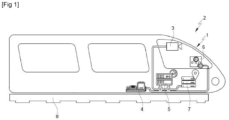
- FIG. 1 shows a diagram of the image detection and annotation system according to the invention.
- the invention relates to a system 1 and a method for automatically annotating a sequence of acquired images, using signaling data.
- this invention is applicable to the field of transport and more particularly to the field of rail transport.
- the invention aims to generate databases of annotated images with a view to their subsequent use for training neural networks (or any other system and/or artificial intelligence software operating by learning) intended to be installed in systems artificial vision allowing the autonomous driving of railway rolling stock 2.
- the railway rolling stock 2 is for example a railway vehicle for transporting goods or passengers, traveling on a railway line 8 on the edge of which signaling equipment is installed.
- train 2 will be used to qualify these railway vehicles.
- the image selection and annotation system 1 comprises means of acquisition and automatic timestamped recording 4 of so-called driving data.
- driving data correspond to at least part of the data acquired and recorded by the aforementioned means 4, and include in particular train speed data, signaling data (that is to say indicating the type of equipment of signaling or the type of signal emitted by specific signaling equipment), data relating to braking actions, light or sound warning signals, the location of train 2 on track 8.
- train speed data that is to say indicating the type of equipment of signaling or the type of signal emitted by specific signaling equipment
- signaling data that is to say indicating the type of equipment of signaling or the type of signal emitted by specific signaling equipment
- data relating to braking actions data relating to braking actions
- light or sound warning signals the location of train 2 on track 8.
- these means of automatic acquisition 4 and recording of driving data can be the black boxes installed in the trains - for example the ATESS system (for "Acquisition and Processing of Safety Events in Static") used by the French National Railway Company.
- ATESS system for "Acquisition and Processing of Safety Events in Static" used by the French National Railway Company.
- all these data are recorded in a storage space of a remote server within a centralized database.
- the image selection and annotation system 1 comprises image acquisition means 3, for example a high-definition camera installed at the front of the train.
- these image acquisition means 3 comprise second time stamping means 5 of the acquired images, which images are recorded in a second storage device provided for this purpose.
- the image acquisition means 3 are also connected to geolocation means 7 so that each timestamped image is associated with a position of the train 2.
- the system of the invention also comprises means 6 for manual acquisition of driving data.
- This manual acquisition is carried out by the driver via an Automatic Standby System with Pressure Hold Control (commonly called VACMA) installed for safety reasons in trains. Indeed, to ensure the vigilance of the driver, the latter must periodically carry out pressing or releasing operations on the electrical contactors forming part of this VACMA 6 system. If the driver does not carry out these operations, the train 2 issues an alert and/or stops automatically.
- VACMA Automatic Standby System with Pressure Hold Control
- the driver indicates by pressing one of the contactors of the VACMA system 6 that he has indeed located a signaling device or a determined signal emitted by said device.
- This manual signaling datum generated following the driver pressing the electrical contactor, is time-stamped by the second time-stamping means 5.
- the automatic acquisition means 4 of the driving data acquire and record a datum detection of pressing on the VACMA system 6, which detection datum is time-stamped by the first time-stamping means.
- the system 1 comprises computer means for processing driving data and images, connected to the first and second storage devices, as well as to the image acquisition means 3, to the acquisition means automatic 4 driving data and manual acquisition means 6 driving data.
- These processing means know in particular the characteristics of the high-definition camera, in particular its focal length.
- the processing means comprise data making it possible to identify the type of train, the number of the train and the type of railway track 8.
- the processing means identify, in the driving data timestamped by the first timestamping means, those which correspond to signaling data on a determined period of time, that is to say data which identifies a signaling equipment or a determined signal emitted by this equipment over said determined period of time.
- the time period is selected by the processing means as follows: an initial time corresponding to a threshold time for detection of the signal by the driver and a final time corresponding to the passage of the signal by the train 2. More precisely, this threshold time is correlated with a minimum distance separating train 2 from the signaling equipment, and even more precisely, this threshold time is equal to the ratio between the minimum distance and the speed of said train 2. The speed of train 2 being known at each instant, the processing means easily determine this threshold time.
- the initial time corresponds to a reference time characterized by an action by the driver indicating that he has correctly identified a signaling device or a signal emitted by this device, which reference time can, if necessary, be corrected by a reaction time characteristic of the driver or determined by the processing means.
- This reference time corresponds to a distance separating the train 2 from the signaling equipment greater than the minimum threshold distance.
- the processing means identify, among the images acquired, the sequence of images acquired between the threshold time (or the reference time if applicable) and the passage time, via the timestamp information of the images obtained by the second timestamping means 5.
- the processing means calculate a first time difference between the threshold time and the passage time obtained via the first timestamping means, and a second time difference between the threshold time and the passage time obtained via the second timestamp means 5. If the offset between the first and second time differences is less than a determined value, the processing means consider that the two timestamps are indeed simultaneous and the method proceeds to a step of selection and annotation of the sequence of images which will be described later.
- the processing means carry out a registration between the pipe data and the acquired images. This resetting can be done in several ways.
- the processing means identify a position of the train 2 measured by the geolocation means 7, and time-stamped by the second time-stamping means 5, between the threshold time (or, where applicable, the reference time) and the transit time. Then, the processing means search for these same position coordinates measured by the means of automatic acquisition and recording 4 of the driving data, which position is time-stamped by the first time-stamping means.
- the processing means determine the time offset between the first and second time stamps respectively measured by the first and second time stamp means 5, then use this offset to readjust the driving data with the driving images, for example by using a least squares optimization method.
- the processing means identify a datum, timestamped by the second timestamping means 5, of manual detection of the signaling equipment characterized by the pressing of an electrical contactor of the VACMA system 6. Then the means of processing identify a datum, timestamped by the first timestamping means, corresponding to the detection and to recording by the automatic acquisition means 4 of the driver pressing the contactor.
- the processing means determine the time offset between the first and second time stamps respectively measured by the first and second time stamp means 5, then use this offset to readjust the driving data with the driving images, for example by using a least squares optimization method.
- the two registration variants can be applied successively or in parallel by the processing means.
- the method implements the step of selecting the sequence of images between the threshold time (or, where applicable, the reference time) and the passage time, and each image of the sequence is annotated by the means of processing with the information relating to the signaling equipment or to the signal transmitted by said signaling equipment.
- the method may comprise a prior step of framing the areas of interest in each image, which areas are the subject of the annotation by the processing means.
- the processing means calculates the difference between the threshold time and this reference time.
- This difference could, if necessary, be used as a standard value to compare the performance of an artificial vision system capable of implementing the method of the invention with that of a human user.
- the system 1 and the method of the invention make it possible to annotate images or sequences of images reliably and inexpensively by using the driving information already acquired by the train.
- the method makes it possible to overcome the difficult climatic conditions which are detrimental to the quality of images, since a signaling equipment is automatically associated with a signaling data from driving data.
- the database will include annotated images of different quality, which further improves the recognition of the signaling in the context of autonomous driving.
Landscapes
- Engineering & Computer Science (AREA)
- Business, Economics & Management (AREA)
- Human Resources & Organizations (AREA)
- Strategic Management (AREA)
- Theoretical Computer Science (AREA)
- Physics & Mathematics (AREA)
- General Physics & Mathematics (AREA)
- Economics (AREA)
- Entrepreneurship & Innovation (AREA)
- General Business, Economics & Management (AREA)
- Tourism & Hospitality (AREA)
- Marketing (AREA)
- Quality & Reliability (AREA)
- Educational Administration (AREA)
- Development Economics (AREA)
- Operations Research (AREA)
- Mechanical Engineering (AREA)
- Game Theory and Decision Science (AREA)
- Multimedia (AREA)
- General Health & Medical Sciences (AREA)
- Databases & Information Systems (AREA)
- Health & Medical Sciences (AREA)
- Computational Linguistics (AREA)
- Software Systems (AREA)
- Computer Vision & Pattern Recognition (AREA)
- Computing Systems (AREA)
- Artificial Intelligence (AREA)
- Medical Informatics (AREA)
- Evolutionary Computation (AREA)
- Data Mining & Analysis (AREA)
- Primary Health Care (AREA)
- Electric Propulsion And Braking For Vehicles (AREA)
- Train Traffic Observation, Control, And Security (AREA)
Applications Claiming Priority (1)
| Application Number | Priority Date | Filing Date | Title |
|---|---|---|---|
| FR2200699A FR3132159B1 (fr) | 2022-01-27 | 2022-01-27 | Procédé et système d’annotation automatique de séquences d’images de conduite d’un matériel roulant ferroviaire |
Publications (1)
| Publication Number | Publication Date |
|---|---|
| EP4220582A1 true EP4220582A1 (de) | 2023-08-02 |
Family
ID=81325793
Family Applications (1)
| Application Number | Title | Priority Date | Filing Date |
|---|---|---|---|
| EP23153295.3A Pending EP4220582A1 (de) | 2022-01-27 | 2023-01-25 | Verfahren und system zur automatischen annotation der sequenz von fahrbildern eines eisenbahn-rollgeräts |
Country Status (2)
| Country | Link |
|---|---|
| EP (1) | EP4220582A1 (de) |
| FR (1) | FR3132159B1 (de) |
Citations (1)
| Publication number | Priority date | Publication date | Assignee | Title |
|---|---|---|---|---|
| EP3772017A1 (de) * | 2019-08-01 | 2021-02-03 | Siemens Mobility GmbH | Bahnsignalerkennung für autonome schienenfahrzeuge |
-
2022
- 2022-01-27 FR FR2200699A patent/FR3132159B1/fr active Active
-
2023
- 2023-01-25 EP EP23153295.3A patent/EP4220582A1/de active Pending
Patent Citations (1)
| Publication number | Priority date | Publication date | Assignee | Title |
|---|---|---|---|---|
| EP3772017A1 (de) * | 2019-08-01 | 2021-02-03 | Siemens Mobility GmbH | Bahnsignalerkennung für autonome schienenfahrzeuge |
Non-Patent Citations (2)
| Title |
|---|
| HARB J. ET AL: "FRSign: A Large-Scale Traffic Light Dataset for Autonomous Trains", ARXIV.ORG, 5 February 2020 (2020-02-05), XP081599050, DOI: 10.48550/arXiv.2002.05665 * |
| ZENDEL OLIVER ET AL: "RailSem19: A Dataset for Semantic Rail Scene Understanding", 2019 IEEE/CVF CONFERENCE ON COMPUTER VISION AND PATTERN RECOGNITION WORKSHOPS (CVPRW), IEEE, 16 June 2019 (2019-06-16), pages 1221 - 1229, XP033747223, DOI: 10.1109/CVPRW.2019.00161 * |
Also Published As
| Publication number | Publication date |
|---|---|
| FR3132159B1 (fr) | 2023-12-15 |
| FR3132159A1 (fr) | 2023-07-28 |
Similar Documents
| Publication | Publication Date | Title |
|---|---|---|
| FR3049560A1 (fr) | Procede et systeme d'assistance au changement de voie de roulage pour vehicule automobile | |
| FR3112215A1 (fr) | Système et procédé de détection d’un obstacle dans un environnement d’un véhicule | |
| EP3873786A1 (de) | Verfahren zur erzeugung von steuerungseinstellungen für ein kraftfahrzeug | |
| EP3464006A1 (de) | Vorrichtung zur überwachung der fahrgewohnheiten eines fahrers eines transportfahrzeugs sowie entsprechendes verfahren | |
| EP4220582A1 (de) | Verfahren und system zur automatischen annotation der sequenz von fahrbildern eines eisenbahn-rollgeräts | |
| WO2017118688A1 (fr) | Procédé mis en œuvre dans un véhicule automobile et véhicule automobile associé | |
| EP1672585A1 (de) | Verfahren, Vorrichtung und System zur Verarbeitung von Bildern durch Bewegungsschätzung | |
| EP3926529B1 (de) | Systeme und methoden zur bestimmung einer anzahl von personen in einem fahrzeug | |
| FR3047217B1 (fr) | Dispositif de determination de l'etat d'un feu de signalisation, systeme embatque comprenant un tel dispositif, vehicule comprenant un tel systeme et procede de determination associe | |
| EP3417398A1 (de) | Vorrichtung und verfahren zur kalkulation des aufmerksamkeitsgrades eines fahrers eines fahrzeugs | |
| FR3103301A1 (fr) | Procédé de détection de pics d’intensité de faisceau lumineux réfléchi de manière spéculaire | |
| FR3078668A1 (fr) | Procede de detection d'anomalie dans la perception par un vehicule automobile de son environnement | |
| FR3140699A1 (fr) | Procédé et dispositif de suivi de l’environnement d’un véhicule | |
| CN120220087B (zh) | 一种基于固定摄像头的车辆识别方法和系统 | |
| FR3142430A1 (fr) | Détermination de la fermeture de portes de véhicule ferroviaire par analyse audio et/ou visuelle | |
| WO2019201845A1 (fr) | Dispositif de synchronisation d'une position primaire d'un objet mobile avec une position secondaire | |
| FR3161785A1 (fr) | Procédé et dispositif d’apprentissage d’un modèle de prédiction de profondeur à partir d’images filtrées par bandes verticales. | |
| FR3167468A1 (fr) | Procédé et dispositif d’apprentissage d’un modèle de prédiction de profondeur assisté par un modèle de flux de scène. | |
| FR3080177A1 (fr) | Securisation d’une cartographie de conduite autonome | |
| FR3151115A1 (fr) | Procédé et dispositif de traitement d’une image de situation routière par réseau de neurones optimisé énergétiquement pour un véhicule | |
| FR3158943A1 (fr) | Dispositif électronique et procédé de reconnaissance d’obstacle(s) sur une voie ferrée, programme d’ordinateur et système associés | |
| FR3167467A1 (fr) | Procédé et dispositif d’apprentissage d’un modèle de prédiction de profondeur capable de traiter des objets dynamiques présents dans une scène. | |
| FR3158576A1 (fr) | Procédé et dispositif de détermination d’un défaut de calibration d’un système de vision embarqué dans un véhicule | |
| FR3166126A1 (fr) | Système de perception d’un environnement pour un véhicule | |
| FR3160262A1 (fr) | Dispositif d’étanchéisation visuelle, système de vision, véhicule et procédé d’étanchéisation visuelle associés |
Legal Events
| Date | Code | Title | Description |
|---|---|---|---|
| PUAI | Public reference made under article 153(3) epc to a published international application that has entered the european phase |
Free format text: ORIGINAL CODE: 0009012 |
|
| STAA | Information on the status of an ep patent application or granted ep patent |
Free format text: STATUS: THE APPLICATION HAS BEEN PUBLISHED |
|
| AK | Designated contracting states |
Kind code of ref document: A1 Designated state(s): AL AT BE BG CH CY CZ DE DK EE ES FI FR GB GR HR HU IE IS IT LI LT LU LV MC ME MK MT NL NO PL PT RO RS SE SI SK SM TR |
|
| STAA | Information on the status of an ep patent application or granted ep patent |
Free format text: STATUS: REQUEST FOR EXAMINATION WAS MADE |
|
| 17P | Request for examination filed |
Effective date: 20240202 |
|
| RBV | Designated contracting states (corrected) |
Designated state(s): AL AT BE BG CH CY CZ DE DK EE ES FI FR GB GR HR HU IE IS IT LI LT LU LV MC ME MK MT NL NO PL PT RO RS SE SI SK SM TR |
|
| P01 | Opt-out of the competence of the unified patent court (upc) registered |
Effective date: 20240418 |